Showing posts with label Douglas Gamley. Show all posts

Sunday, 1 February 2026

The Vault Of Horror


Taking It EC

The Vault Of Horror
UK 1973 
Directed by Roy Ward Baker
Amicus/20th Century Fox  Blu Ray Zone B


Warning: A vault of spoilers. 

The Vault Of Horror was another of the Amicus portmanteau horror films with which they had a lot of success and, as the title suggests, the five stories found within (not including the framing story, I would guess) are adaptations from various 1950s EC comics, repeating the formula from their Tales From The Crypt movie (reviewed here). Despite the title and what it claims on the opening credits, which play out mostly over shots of London, none of the stories in the film are actually taken from the original The Vault Of Horror comic... instead, the segment entitled The Neat Job is taken from an issue of Shock Suspense Stories while the others are versions of stories first published in the pages of Tales From The Crypt. 

The film starts off with an elevator picking up various of the five main characters, played by Michael Craig, Curd Jürgens, Terry Thomas, Daniel Massey and Tom Baker. They are all going down but, down way further than any of them expect, as the elevator deposits them all in an underground chamber. They can’t get the elevator to take them back and so, for the rest of the film, they exchange stories about various nightmares which have been bothering them, allowing the audience access into the five segments which make up the majority of the film’s running time. 

Now, I’ve actually read four of these stories but only remember three of them in terms of a little of the details, because I read the entire run of Tales From The Crypt a few years back. So in the first story, I can definitely tell you that the term adaptation is loosely used. Don’t get me wrong, we still have the same story and the final panel of the comic is rendered as the final shot of that story but, yeah, it’s been watered down somewhat.

To explain, the first story is based on the Tales From The Crypt story Midnight Mess. In this, Daniel Massey pays a private detective who goes to find his lost sister, who has been left everything after their father has died. The detective, played by Mike Pratt (Randall, from Randall And Hopkirk Deceased) finds her but is killed by Massey, who then goes to find his sister. He can’t get served in a restaurant because it closes early in the village she is staying in, so he goes to her house and kills her. He then goes back to the restaurant, which now appears to be open. However, when he’s served dishes made from blood and human flesh, he complains and gives himself away. The waiter pulls back the big curtains in the restaurant to reveal a big mirror... casting only his reflection. All of the other diners are vampires, including his sister who also has a drink when the patrons set him up in the bar as a human bar tap, syphoning his blood ‘fresh from the source’ as the still alive Massey has a tap plugged into an open wound on his neck. Incidentally, his sister is played by real life sister Anna Massey. 

The problem with this segment... and why it’s watered down, in my opinion... is that in the original comic book, the lead character was an innocent. He doesn’t kill anyone but he suffers the same fate anyway... with the last panel being much more graphic in its depiction, if memory serves. I get the feeling the writers here turned him into an evil character so that it feels morally right to have him killed in such a grim fashion. Which kinda weakens the story but, there you go, this film pulls its punches a bit, that’s all. 

The next segment, The Neat Job, is the one told by great British comic actor Terry Thomas, where he marries a character played by actress Glynis Johns. This one is actually quite fun and you can tell these two must have really enjoyed working on this. It turns out that, after they are married, the wife finds out her husband is one of those people with a mania for neatness and everything in its proper place... with even his tool room with jars for each different kind of screw thread or length, kitchen cupboards with tick boxes to indicate stock replenishment etc. After a while, her attempts to please her husband culminate in a sequence where she bumbles about and manages to wreck a couple of rooms as she tries to re-tidy them for him when he comes home. On his discovery of the shambles, she deals him a huge hammer blow and we see the comedian with a claw hammer sticking out of the top of his head before he topples. In the final scene of this story, his wife has pulled out all his various body part and internal organs and put them all in correctly labelled, categorised jars. 

The third story is This Trick’ll Kill You and it’s features a stage magician played by Curd Jürgens and his wife played by Dawn Addams. While on holiday in India, looking for magic tricks, he stumbles onto a really good version of the old Indian rope trick but he can’t persuade the young lady performing the trick to sell it to him at any price. So he arranges a private show for his wife in their hotel room and, while the girl is performing the trick, he stabs her dead. He then re-performs the trick and his wife climbs up the rope but, suddenly, she disappears at the top of the rope and a slowly spreading puddle of her blood forms on the ceiling where the rope was leading too. The rope then gets out of control and has its revenge on Jürgens. 

The fourth story, Bargain In Death, is the worst of the five and features Michael Craig in a dire and slight tale of a man who slows his heart to fake death so he and his friend can split the insurance money... and then expects his friend to dig him up but, obviously, that part doesn’t happen. He does get dug up though, by a gravedigger played by Arthur Mullard at the request of two young medical student friends who need the body. In a curious piece of what would now be called stunt casting, the two med students are played by Robin Nedwell and Geoffrey Davies, who were known as the ‘comedy doctor’ duo in the long running British TV sitcom Doctor In The House. The other nice part of this is when one of the characters is seen reading the novelisation of the Amicus Tales From The Crypt movie.

The fifth story, Drawn And Quartered, stars Tom Baker as a British artist living in Haiti. When an old friend stumbles on him, he finds out that his old agent who had deemed his paintings worthless and bought them for a song, has colluded with an art critic and buyer and his paintings are now fetching high prices in London. So he goes to a voodoo man who gives his painting hand magical powers and he returns to London to take his revenge. Anything he paints and then erases or destroys gets erased or destroyed in a similar fashion and so he paints the three and causes them pain and death by taking their hands or eyes or, in the case of his agent, played by Denholm Elliot, gets him to shoot himself due to drawing a red dot on the forehead of the painting. However, he shouldn’t have left his own self portrait out in the open after he found leaving it in his safe was depriving him of oxygen after a while! Any kind of accident could happen to it. 

And that’s the five stories and then, of course, the elevator doors open to a graveyard and it turns out the men are all dead and forced to tell the same stories to each other for eternity. However, unlike the comics, the Vault Keeper who used to present the tales didn’t make it into the movie.

But it is an entertaining movie and it’s easily one of my favourites in the Amicus portmanteau horror series, falling just behind Dr. Terror’s House Of Horrors (reviewed by me here). Roy Ward Baker’s direction is assured and, once again, he uses some interesting camera movements... like that trick he does where he will zoom into something at the end of a camera pan to change the focus of the frame. Douglas Gamley’s score is also pretty good and he seems to use the Dies Irae musical motif a lot throughout the movie (darn, I wish there was a soundtrack CD to this one... or to any of Gamley’s music, to be honest). 

And, yeah, not much else to add to this. The Vault Of Horror, despite being the only one of the Amicus horror portmanteaus that didn’t star Peter Cushing, is a really entertaining little film and one I would happily watch a number of times. Something about the print or transfer on this seemed a little dodgy, I thought but, it’s still pretty watchable and I’m sure the Blu Ray authors have done the best they can with the materials. Definitely worth a look sometime if you are into this period of British horror movies, for sure.

Saturday, 27 December 2025

Asylum


Taking Over

Asylum
UK 1972 
Directed by Roy Ward Baker
Amicus/Second Sight  Blu Ray Zone B


Warning: Spoilers in this one. 

Asylum is the next movie in my watch of the old Amicus portmanteau horror films. Dating from 1972 this has four main story segments which include, if you go by the end credits of the print itself, Frozen Fear, The Weird Taylor, Lucy Comes To Stay and Mannikins Of Horror. All of these are written by Robert Bloch (although it’s suspected the first segment may have been more than inspired by a Clark Ashton Smith story) and the spelling of the Mannikins of the last story seems wrong. Modern sources tell me the last story is actually Mannequins Of Horror but, looking at the different spelling uses and the slightly different meanings attributed to each spelling, I think it’s much more likely that the fourth story is actually called Manikins Of Horror. This is not to say that no mannequins appear in the movie, as you’ll see as you read further but, specifically in the fourth segment, they seem to be manikins rather than mannequins.

Indeed, the idea of some kind of reanimated figure seems to be predominant in three of the four shorts in this one. The linking material in this one is of a young psychiatrist, played by Robert Powell, who drives to an old manor house acting as an Asylum, seeking a position there. His car ride over the opening credits is scored with a booming version of Mussorgsky’s Night On Bare Mountain. The current assistant, Dr. Rutherford, as played by Patrick Magee, tasks him with finding the identity of the former head of the place, one Dr. Star, who has gone mad and is, we are told, one of the four patients Rutherford wants Powell’s Dr. Martin to interview. If he can pick out from the four personalities just which one is a blind for the former head of the facility, he can have the job. 

So off Martin goes with the orderly, played by Catweazel himself, yup, Geoffrey Bayldon, to listen to the little horror and thriller stories so he can work out which is the real doctor. It’s at this point that I suspect, even before we meet any of the unlikely candidates, that most people will see the obvious twist ending of the piece coming so, yeah, I won’t say anything further but I thought it was pretty self-evident.

So the first segment, Frozen Fear, is told through the recollections of Bonnie, played by Barbara Parkins. She is having an affair with a character played by Richard Todd, who decides to take his wife, played by Sylvia Sims, permanently out of the equation. So he orders a new freezer for the cellar, bashes her in the head and disposes of the body by slicing her up into six segments (head, arms, legs, torso) and, curiously, wrapping each body part up in brown paper and string before disposing of it all in the new freezer. However, when the brown paper head escapes the freezer and starts rolling around on its own... you know something’s up. When Bonnie arrives on the scene, she finds Todd’s body in the freezer, from where one brown paper covered, severed arm has strangled him... and then she is attacked in the cellar by various bits of his wifes scattered body. It’s silly but hugely entertaining and the brown peper covered limbs give an unusual feel to this kind of material, for sure. 

The next segment, The Weird Tailor, is about a tailor played by Barry Morse, who is threatened with being thrown out of his shop for late payment of the rent by his landlord. Then, however, he gets a customer in the form of Peter Cushing, who wants the tailor to make a special suit for him, to the tune of £200. The conditions are that it has to be made of a certain, special material brought by Cushing’s character and the suit must only be worked on between midnight and 5am each day. Now, we know there’s something up with the material when Morse pricks his finger and it magically absorbs his blood but, he continues working on it and, when he delivers it to Cushing, finds that it’s a special suit to bring life back to Cushing’s long dead son. A special spell suit the client has learned to make from an arcane book of black magic which, given writer Robert Bloch’s long standing friendships in his life, is an obvious homage to H. P. Lovecraft’s Necronomicon, I’m pretty sure. Cushing has no money, it turns out and, in a struggle, Morse accidentally kills him. He returns home and tells his wife to burn the suit but, instead, she dresses up their store mannequin with it. And, yes, as you’d expect, the store mannequin comes to life and tries to strangle Morse, who is now obviously driven insane. 

The third segment, Lucy Comes To Stay, stars young Charlotte Rampling as Lucy, who has returned home from a ‘special’ hospital and is being more or less imprisoned by her brother in her house as a form of recovery. It’s not long, however, before Lucy’s friend, played by Britt Ekland, comes to spring her from her house and lures away the nurse on an elabourate ruse. Murderous shenanigans ensue but I think most people would have figured out the real identity of Lucy’s friend when she first enters the narrative so, alas, no surprises here.

The fourth and final segment, the incorrectly spelled Mannikins Of Horror, is more a quick prelude and stars Herbert Lom as a former doctor who has made various miniature, robot like manekins of former colleagues and one of himself. This leads directly into the bookends with Dr. Martin who is about to return to London, no longer wanting the job, when the last manekin, made to resemble Lom himself and with his own brain willed inside the tiny brain inside the model*, gets into the office downstairs and stabs Magee’s character dead with a scalpel to the back of the brain. Dr. Martin crushes the manekin, it’s tiny internal organs leaking onto the floor and, this has the effect of also crushing Herbert Lom’s character in the upstairs room. Then the real Dr. Star is revealed, another murder is committed and the film ends as a cycle with another doctor arriving for an interview to join the asylum.

And it’s a nicely done, mostly fun but unsurprising set of small horror and thriller yarns. Director Baker livens things up with some nice shot set ups (such as when a taxi cab pulls up and is viewed from the other side of a big arch in the street) and some nice camera movement ideas. One is where, instead of just following the action down, for instance, when Charlotte Rampling goes to look for something in a drawer, he pans down and zooms simultaneously to take us right into the drawer from looking at her in the shot. 

He moves the camera quite a lot actually, and there are some nice moments where he uses it to highest effect. For example, when Morse and Cushing are locked in a struggle, the camera movements, while still smooth, are short twisty turning movements resembling something similar to a hand-held camera shot and throwing the chaos of movement into the scene to depict the feeling of the fight. And when Robert Powell slowly drifts upstairs to meet the patients, he stops to look at a fair few black and white engravings depicting scenes of mental illness through the ages... something which is enhanced by Baker’s continually roving camera panning up and around and sometimes spinning 360 degrees around in the frame as it takes in the content of the black and white engravings... or they might be etchings, come to think of it.

All in all, Asylum is nicely acted, written with a certain tongue in cheek feeling and has some nice music by Douglas Gamley, although there seems to be more ‘classical’ needle drop in this one than there is original composition, it has to be said. And, yeah, there are absolutely no surprises in this one and it can hardly be called all that scary, either but, the stories have a certain charm of their own... it’s well shot and I had fun with it. Not the best of the horror anthologies I’ve seen put out by Amicus but... it’s certainly not the worst of them either. A decent watch and Second Sight’s Blu Ray transfer is excellent, accompanied by some extras worth having although, I have to say, like a lot of this label’s releases, the price is a bit steep for what it is. I would have liked to have seen Indicator tackle the Amicus portmanteau horror movies in a more price friendly boxed collection, it has to be said. 

*Since watching and writing this, the great Severin Films have also relelased their own edition of the movie and, although I was tempted, I didn't double dip in this case. I did, however, buy their new pin badge based on the film which is a wonderfully crafted likeness of the Charles Gray manikin with a little front door which actually opens on the badge itself, revealing the grim, brainy matter inside the chest cavity. The height of fashion accessories for sure. 

Thursday, 30 December 2021

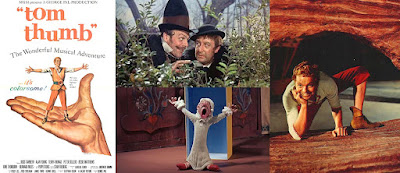
tom thumb


Yawn Of
The Bed


tom thumb
UK/USA 1958
Directed by George Pal
Warner Archive DVD Region 1


I must have been not much more than a nipper when I last saw tom thumb. It was one of those films that was perpetually showing on television every Bank Holiday and Christmas in the UK throughout most of the 1970s and probably the 1980s too. A well loved favourite that people didn’t fail to tune into. I wasn’t particularly wanting to see it again however but, my dad was keen to remake the acquaintance of the movie and I can remember him singing songs from this throughout the 70s (and sometimes still). So I took a gamble for his birthday because the only way this is still available to see, from what I can gather, is from a Region 1 Warner Archive DVD (it’s kind of a shame this isn’t available in Blu Ray) and reports were mixed as to whether the film was in the correct aspect ratio or not. Or maybe I’m just too old and ‘full frame’ doesn’t mean what it used to (which certainly used to mean a 4:3 aspect ratio whether the film was shot like that or not). Well, for anyone else wanting to pull the trigger on this one, let me assure you that the film is, at least, presented in its original 1.85:1 aspect ratio on the Warner release.

And it’s such a charming film. It kind of does seem made for kids in some ways because the acting is much broader than what you might normally see in an MGM Musical of the time... but that makes it no less entertaining and, although the special effects which won an award in its day are somewhat creaky now, the film hasn’t really lost any of its magic and, another plus if you’ve never seen it before, is that the story really doesn’t always go in the direction you think it will.

The film starts with a wonderful title sequence where a big old leather or Rexine-style bound book is shown bearing the title of the film in really small print. Then a hand with a magnifying glass passes over it so we can read said title before the pages start turning and we are introduced to the various cast members as page after page of illustrations etc. After this the film carries on with the magical Queen of the Forest (played by June Thorburn) asking the Woodcutter (Bernard Miles) not to cut down the big oak which has enough timber to keep the village warm all winter. For his kindness at eventually agreeing she grants him three wishes but, when he goes home to tell his wife (Jessie Matthews), the two of them accidentally waste their three wishes in sausage related mishaps. However, as a last streak of kindness, the Queen gives this childless couple a child of their own... except, instead of a baby, they get a full grown Tom Thumb, played by Russ Tamblyn, shrunken down to around 10 inches instead.

All goes well and we have singing and dancing and George Pal, who had what was more or less his first go at directing his first feature length film here instead of just producing (and it was a roaring success for him), also uses his ‘puppetoons’, which are basically stop motion characters such as Ray Harryhausen would later animate in movies, as various toys and objects that dance around and speak with Tom when the parents aren’t around (hmm... where have I heard that premise before?).

Then we’re introduced to the romantic interest, Woody, played by Alan Young, who wants to pair up with the Queen of the Forest but can’t until he’s kissed her and made her mortal. And also, the two villains of the piece, played by Terry Thomas and Peter Sellars. The film has some wonderful scoring by Douglas Gamley and Ken Jones (which I can’t believe has not made it onto CD as yet) and some of the work on the songs was by Peggy Lee (I’m not sure how much of a contribution she made, though). Actually, the songs are great and the sequence with the animated ‘yawning man’, voiced by the always brilliant Stan Freberg, is particularly infectious and is almost guaranteed to make any audience watching the scene feel sleepy.

There’s a nice symmetry to some of the shots as Pal uses uprights such as a bed post at centre of the screen while the woodcutter and his wife sleep, somewhat innocently, head to head, horizontally in bed, facing away from each other with the tops of their heads united (no wonder they never produced any kids... this position is not something you’ll find in the Karma Sutra). Something tells me this style of framing is so the audience gets used to it when sly techniques are used to try and cover up certain special effects trick shots throughout the movie. Some of these effects are successful... and there a few oversize novelty sets for when just Russ Tamblyn is on screen... but there are also quite a few bad matte lines in the picture, it has to be said.

There’s also a certain sense of traditional fairy tale cruelty laying at the hear of the film, such as when the woodcutter and his wife are charged with robbing the villages gold and instead of sentencing them to prison they are sentenced to a public whipping. Apparently, the ‘whipping guy’ had forgotten to be cast on the day of the shoot and so the masked character is Peter Sellars, doubling up on roles. Of course, this film is based on a fairy tale from The Brothers Grimm, who were not known for holding back on the gore and nastiness content of their tales in their original translations (they have become somewhat cleaned up throughout the years in different international versions) but the movie, at least, doesn’t make good on this particular set up, as Tom and Woody race against time to bring the real culprits to justice before the whipping begins. There’s even a nod to the source material as Russ Tamblyn is seen dancing on the cover of a copy of Grimm’s Fairy Tales early in the movie. Of course, he would reprise his role as Tom Thumb as well as playing another character just four years later in the big Cinemascope production of The Wonderful World Of The Brothers Grimm.

The acting in tom thumb is, as I said, not exactly subtle but I do like the fact that the film really doesn’t take itself too seriously and loved the fact that, when Tom is lowered by rope into the treasury, the bags of gold are labelled up as either ‘Gold’ or ‘More Gold’. And its little details like this within the frame that keep the film from getting dull at any point and make it a bit of a carnival ride entertainment. So there you have it... if you’ve not seen tom thumb then maybe you were missing out in your childhood. It’s full of wonderful, larger than life situations which, may seem humdrum now but which must have been a thrill to see at the cinema on its first release and, I for one, am certainly glad to be falling back under its spell again. Definitely worth a watch if you enjoy fantasy cinema and this film opened the doors to Pal directing an unproduced film he’d always wanted to have a go at, his amazing version of The Time Machine (which is another of the many classics which he either directed and/or produced). It would be nice if we could get a Blu Ray of this but, until then, the Warner Archive DVD is probably the best way you’re going to see this, almost but not quite, forgotten classic these days.

Saturday, 12 December 2020

Tales From The Crypt


Ghost Crypt

Tales From The Crypt
UK 1972 Directed by Freddie Francis
Amicus/20th Century Fox Blu Ray Zone B


Warning: Some spoilers here.

Okay then, I’ve seen three previous Amicus horror portmanteau films this year and the reason I’ve been holding back on watching these since I bought them is because the first segment of Tales From The Crypt is actually set on Christmas Eve so, yeah, I really didn’t want to be watching this film anytime other than in December. So this is the first of three Christmas movies I shall be reviewing for the blog this year. Tales From The Crypt is, of course, based on the 1950s EC comics of the same name, which featured five or six short horror strips with, usually, a twist ending. I’ve been reading those for this blog over the last few months but I still haven’t worked through all three EC horror title runs yet to be able to write a review (hopefully you should see that mid 2021). What this means is that I’ve only read two of the stories on which segments are based on in this film because other segments are based on stories from The Vault Of Horror and The Haunt Of Fear. Of course, it’s these EC comics which were the cause of all the shameful outrage ushered in by Wertham in the 1950s, leading to the reduction of free speech in comics for many decades and introducing the self regulating ‘Comics Code Authority’, with their famous seal of approval.

The film is nowhere near as good as the first film in this unofficial series, Dr. Terrors House Of Horrors (reviewed by me here) but it’s pretty consistently entertaining and makes for a more watchable, consistent experience than Torture Garden (reviewed here) and The House That Dripped Blood (reviewed here). The idea of adapting EC comics, which were horror compilations anyway, absolutely fit what Amicus were doing like a glove and so it’s kind of a marriage made in heaven (they would also go on to do one for The Vault Of Horror but, that will be another review, I haven’t watched it yet).

The location of ‘The Crypt’ in this movie version is Highgate Cemetery and the opening credits are views of this famous landmark grave yard but, it’s all rendered a little heavy handed, it seemed to me, with Bach’s famous Toccata and Fugue in D Minor roaring over the credits and, as far as I’m concerned, totally failing to set the tone of the original horror comics, which were never once poe faced or serious, tempering their grim tales with a large dollop of humour. In fact, despite their source, the first and fifth stories of this collection don’t even stray into the horror genre but, this is made up for by the supernatural shenanigans of the other three stories.

After the credits we join a guided tour of Highgate with guide Geoffrey Bayldon who, when they all enter the catacombs, wants his party to stay by him as the place can be dangerous. Almost immediately after he says this, five characters played by Joan Collins, Ian Hendry, James Elliot, Richard Greene and Nigel Patrick become accidentally separated from the tour group and, instead, enter a crypt... the crypt of terror! Or the crypt of actor Sir Ralph Richardson, actually, who keeps them there in the tomb (the entrance way slamming shut behind them) so he can tell his tale of each of the five to themselves... so, yeah, this is the kind of framing story which we are all familiar with now. Mr. Richardson is, I have to say, dreadfully miscast as The Crypt Keeper, who talked to the audience and presented each tale to the readers in the original comics. He’s fine for the script but, yeah, there’s nothing of the character, the look and the humour of The Crypt Keeper in this movie so, I reckon they really fumbled the ball here.

The first tale, which is probably the shortest but also the strongest, is called ... And All Through The House and its the one that is set in the home of Joan Collins, her husband and her daughter on Christmas Eve, the night a maniac from a lunatic asylum has escaped and is prowling the neighbourhood in a stolen Santa Clause costume. However, the maniac is not the person the husband should be worried about. After he creeps downstairs and puts his presents under the tree, with his daughter already tucked away in bed, he sits down to read the paper. Now the film has no real stylistic traits that stick out in the mind as a signature of the director to lift the film (it’s not a patch on the Dr. Terror film that Freddie Francis directed) but this first segment is easily the most dynamic of the five. As we look at the front of the newspaper that the husband is reading we hear the loud cracking of his skull and it’s a nicely done shot as the blood from his mortal wound seeps through the front of the newspaper before he drops to the floor with a 'caved in' head. We see Joan Collins revealed as his murderer behind him. It’s made clear she’s much more interested in his insurance policy than him and with her daughter relatively quiet in bed and after locking her doors against the escaped maniac, who seems to be lurking outside her house and trying to get in, she elaborately re-stages the killing to look like an accident in the basement of the house but, when she’s done, the little girl has let ‘Santa’ in and the maniac ‘gets her’. This is the only sequence in this film (which is untypical of the time but I’m guessing this is one of the earlier films to employ this technique) which includes one or two genuine ‘jump scares’, which are quite effective when they happen, thanks to Francis using a lot of moving camera to invest a sense of paranoia and panic in Joan Collins’ character. A brooch she is gifted by her husband in this scene is pretty much a foreshadowing of the timeline of the whole movie, if you spot it.

The second section, Reflection Of Death, is one which is based on a story I’ve read in the comic and, frankly, it’s not one I would have picked but it’s done fairly competently. This involves ex-Avenger Ian Hendry covertly leaving his wife to escape with his lover. However, they are caught in an accident and when he stumbles from the wreckage, something is different about him and, unknown to him, some time has passed. All is revealed with the second half of this short tale being done almost completely as a point of view shot from Hendry’s character’s eyes (pretty much the only way you could keep the, not so twisty, reveal kinda secret), just like in the comic.

The third section, Poetic Justice, finds Peter Cushing playing a widower (he had recently lost his wife in real life), a man whose face doesn’t fit in with the well to do neighbourhood and whose rich neighbours, especially the son played by James Elliot, try to get him to sell his house up and go. Although Cushing is in touch with his dead wife through a ouija board, he doesn’t count on the cruelty shown him by his neighbours and some insulting St. Valentine’s cards are the final nail in his coffin. He kills himself and his neighbours get what they want (if not in the way they wanted it). However, one year later, he rises from his coffin and gets a very poetic revenge on the son and, frankly, it’s the only tale in this collection which comes close to the humour of the original comic in the irony of the final denouement that finishes this section. Cushing is absolutely brilliant here as a kindly but broken old man and, seriously, the brilliance of his performance is very moving.

The fourth segment, Wish You Were Here, is a quick retelling of The Monkey’s Paw (with references made in the actual dialogue) and what happens when Richard Greene’s wife, played by Barbara Murray, uses the three wishes granted to them by a Chinese idol to try and get them out of bankruptcy. The demise followed by the unpleasant ‘fate worse than death’ conclusion to Richard Greene’s character oddly, in a way, doesn’t match up to the endgame of the framing story very well but, well, I guess it doesn’t really matter all that much.

The fifth sequence, Blind Alley, is what happens when an ex-military, penny pinching Nigel Patrick takes over a blind people’s home. This is the other story that I’ve read in the comic. He treats the people there poorly and lets one of them die unnecessarily. Then the ring leader of the group of blind people, played in his usual, wonderfully grim manner by Patrick Magee, hatches an elaborate plan of revenge involving Patrick’s ravenous Alsation dog and a wooden alley made by the blind people with walls decorated by many razor blades. The ending is suitably grim but, I honestly remember the comic book story seeming a lot harder hitting than this version of the tale.

And that’s that. When the five stories have played out, The Crypt Keeper reveals to the five characters what the audience has, by now, surely already figured out in an ending similar in intent to that of Dr. Terror’s House Of Horrors. And I’ve not got much else to say about this one, to be honest, other than to add that Douglas Gamley’s score for the movie is much better suited to the material than the heavy handed Bach piece at the opening and closing credits. Tales From The Crypt is a nice enough film but it’s certainly not the best, or worse for that matter, of the Amicus portmanteau horror films. I think I’ve got two more of these on my ‘to watch’ pile, which I hope I’ll get to sometime next year.