Showing posts with label Takashi Miike. Show all posts

Tuesday, 8 November 2022

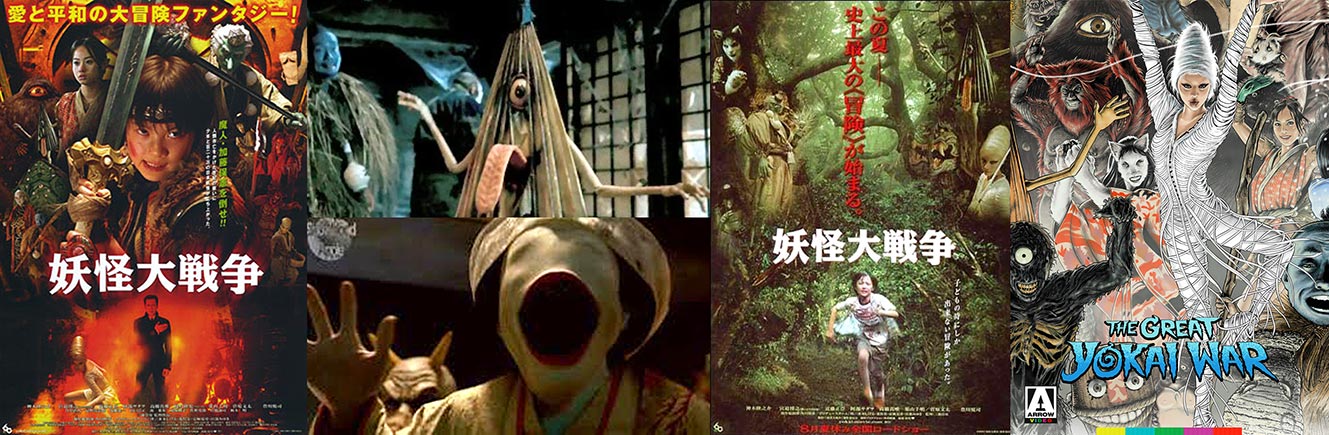
The Great Yôkai War


Monster Mash

The Great Yôkai War
aka Yôkai daisensô
Japan 2005
Directed by Takashi Miike
Shochiku Blu Ray Zone B
From Arrow’s Yōkai Monster Collection Blu Ray set


Once again, the Yôkai monsters are back... along with a whole host of new Yôkai (literally hundreds or possibly thousands in the scenes where they gather for ‘the final battle’ of the movie). This time around, however, they are set in contemporary times and the great and extremely prolific director Takashi Miike is setting the pace (I believe he’s just made a sequel to this movie last year) with The Great Yôkai War.

Now, Miike can be a bit hit and miss and the amount of visual information thrown at the audience in this one is huge and, to my western eyes, mostly bewildering. However, I believe the incredibly complicated story is revealed, in the end, to be a really simple tale after all, with a tsunami of energetic set dressing, so to speak. The plot involves a young boy who is chosen, in his village’s traditional annual festival, to be that year’s token Kirin Rider... who is supposed to retrieve a sword from Goblin Mountain to keep the ‘worked at’ peace every year. However, a very nasty demon who is enslaving many of the Yôkai and who is the living spirit of the ‘resentment humanity has earned’ by throwing out old things they think no longer useful, is leading a hate filled invasion of the world of humans and it’s up to the young, new Kirin Rider, along with some of his new Yôkai allies, to try and stop all of Tokyo (just for starters) from being destroyed.

Okay, so there are various twists on the plot dressing, such as a friendly rat creature and the return of various early Yôkai such as the snake necked lady Rokurokubi and the umbrella demon Karakasa Obake (with his long dangly tongue), not to mention the Kappa from Spook Warfare (reviewed here)... and also a gruesome process where the evil demons melt down the good Yôkai and merge them with resentful objects to transform them into evil, metal creatures... it all gets a bit Tetsuo, to be honest.

There’s also the bold colours that Miike can sometimes work with and the colour palette on this one tends to run to pinky mauves, reds and blues (other than a few shots of nature, I don’t remember seeing too much green in this one). Ditto for the sometimes striking frame compositions although, it all gets a bit lost here because there is just so much thrown at the screen, it seems to me. And a technique where he edits out many frames at a time to make these flash edits of someone, but they are still rooted in the same spot rather than walking away or to the camera, which kind of highlights the facial expressions as an overload of information on the part of the main protagonist. Don’t remember seeing that done before.

This is said by many to be a remake of Spook Warfare but I think that, although it shares some basic themes, such as the idea of two factions of Yôkai in conflict, it mostly does it’s own thing in this one. Even when one takes into account that the fragmentary, non-linear nature of some of the set up and first of the mini epilogues to the action could be seen as a distortion of the general plot (yeah, okay, I got there in the end but my brain had to wake up to decode this and try to make sense of it for a while).

The CGI effects of the evil demon’s metal monsters is interesting here because, although I can only assume this is all CGI, the monsters themselves look almost a throwback to the stop motion animation techniques pioneered by Willis O’Brien back in the 1920s/30s and, especially, to the ‘Superdynamation’ cinematic realms of Ray Harryhausen. Now, aping this technique with more modern methods isn’t anything unusual, I’ve seen this done before in films such as Blood - The Last Vampire (reviewed here) but it’s still nice to see this kind of homage/tribute to the special effects techniques of yesteryear and it’s far less dull than what might have been put up on the screen.

Other nice things on show here are an ‘on screen’ tribute to Shigeru Mizuki, who brought the Yôkai back to popular public consciousness in the 1960s with his manga based on the tales he heard from generations back and, indeed, he also has a small cameo in the film as a demon king. When the main lead goes to research a cute Yôkai that befriends him, he travels to the real life Mizuki Museum to get the information on the creature. There’s also a cool moment in the film when a giant demon-like thing flies through the sky on its way to destroy Tokyo and one of the people at ground level exclaims “Ah, it’s only Gamera.”, which did make me smile. I was also pleased to see the umbrella demon being used to float/fly another demon, as it was similarly utilised in Spook Warfare.

Some bits did fall flat for me though... 

 The use of an advertising jingle used to herald the fact that the evil demon is accidentally merging with an Azuki Bean which, given that “Azuki beans grow in love and peace!” as we are sung to, means his plans are scuppered. Similarly, an action sequence involving the main protagonists accidentally finding themselves riding on the wings of a jet plane, only for the screen to suddenly freeze with the caption “Don’t try this at home kids!” seemed a little pretentious and too much like a nod and a wink to an audience which might not, by this point, have found themselves too invested in the story line.

And that’s all I’ve really got to say on this one. I love Miike but The Great Yôkai War is not one of his films I could watch over and over again. There’s a lot of rich, visual, surrealistic creations on screen (and the reveal of the Rokurokubi is perfect) but the ‘throw everything in at once’ nature of the dense visuals means you are always just trying to take everything in to the point where, it has to be said, it becomes a bit of a dulled down experience. Still, it’s nice to see some of these monsters back and I certainly want to see what he’s done in the new one... although whether it will wash up on these shores is another matter.

Tuesday, 10 October 2017

Blade Of The Immortal


Chanbara Sauce

Blade Of The Immortal
2017 Japan/UK Directed by Takashi Miike
London Film Festival - Sunday 8th October 2017


Okay, so quickly onto the second of the films I’m seeing in this years festival. I always find Takashi Miike one of those directors who makes movies that you will either love or hate but, whichever polar opposite of that kind of Marmite spectrum you are sitting on with one of his movies, they are always, at the very least, extremely interesting. And, it has to be said, almost always interestingly extreme too.

At the grand old age of 57, Takashi seems to be somehow directing and financing between 2 - 6 films a year and this one, Blade Of The Immortal, based on the series of Manga strips by Hiroaki Samura, is his 100th movie. Does this guy ever sleep? Miike was actually at the festival for this premiere and, although I couldn’t stay to see his Q&A after the movie (alas, I was suffering from ‘last train home syndrome’), I was at least able to see his introduction where he told us that the series of manga this is based on spans a 15 year, serialised period and that this movie, although clocking in at an impressive 2 hours and 20 mins, was his attempt to encapsulate and compress the themes and ideas of the entire ‘decade and half story arc’ into one feature film. Well that’s a pretty tall order but I have to say that, for me at least, the film didn’t jump around or seem too episodic in light of this revelation and it never once seemed to me to be anything other than a coherent whole (albeit with a lot of new characters being introduced at various points in the story).

The film starts off in the way in which a typical chanbara (which, to be fair, this is) might finish.

 Opening in black and white, which reminded me a lot of those old Kurosawa samurai films of the 1950s and 1960s, we meet the main protagonist, Manji (played by Takuya Kimura) and his sister (played by Hana Sugisaki). They are on the run due to  a misdeed of Manji’s recent past but, rather than commit ritual suicide over his indiscretions, he has to stay alive to look after his kid sister. And then we get that typical 1970s chanbara ending where he alone has to fight a group of 50 - 70 men, the leader of whom gives him some motivation by cruelly slaying Manji's sister. So it's ‘Crazy 88 massacre time’ for this lot and Manji does the usual lone wolf samurai act of cutting down every opponent and leaving nobody else standing. However, unlike a lot of the classic chanbara I've seen, Manji actually gets quite badly damaged during the melee and is about to die of his wounds (which includes his right eye being stabbed out and his left hand parting company with his arm). However, a mysterious and unexplained sorceress woman drops blood worms into Manji’s wounds and he becomes immortal. His nearby hand is, kind of, organically knitted back on by the blood worms although, for some reason, his eye isn’t ever regenerated (yeah... it’s okay to have a scientific system for your film which regenerates your life etc but... oh no... don’t let it mess with the look of the character, right?). Finally, the title of the movie comes up and we jump into colour for the remaining running time.

Jump fifty years later and the rest of the plot is then set up as a young girl sees her father killed by a bunch of villains and her mother taken to suffer a fate worse than death. In the best traditions of movies like True Grit, she goes to find someone who can revenge her father as a salve for her grief and the wandering sorceress (for want of a better term) tells her about Manji... so off she goes. Of course, we have the usual, stand offish reluctance of the hero to take up the quest but the young girl, called Rin, reminds Manji of his long dead sister... which would make sense since she’s played by the same actress.

Once he’s got over his ‘it’s not my fight’ problems, the rest of the film involves, strangely, very little travelling (the two seemed to be based in the same place with the villains often just happening to be in the vicinity, for some strange reason... or at least within walking distance) but lots of swordplay and also, I’m glad to say, some time spent on giving little character sketches of other important characters (many of them villainous) and working them and their background into the plot. It’s refreshing that Miike takes time to do this when a lot of modern directors might not have approached the material in this way and the pay off is that certain characters have an emotional resonance on the story at key times during the course of the film (often when they die, as it happens).

The swordplay is ferocious and lively and is very much the kind of ‘one against many’ that you see in some of the later Zatoichi films, not to mention the fairly typical exploits of both Lone Wolf and Cub and Sleepy Eyes Of Death. Indeed, the first pre-credits fight I mentioned earlier is more or less a template for the various skirmishes throughout the movie but, of course, as the story builds to a climax, so does the number of opponents increase so you eventually have one man against whole armies, etc. There are two things which made these kinds of scenes a little different. Other than being shot by Miike with a nice attention to the way elements of the battles are framed and the incredible sense of the way the various shots are edited together, so you don’t lose your place in the combat scenes...

The first of these is that the fights seem a whole lot less bloody than I am used to seeing in a Japanese film and, of course, this goes doubly so considering that it’s Miike, the man behind such extremely, violently ostentatious movies such as Ichi The Killer (if you’re going to see that one, get a Dutch copy as they’re definitely uncut). Sure, there are lots of body parts flying and there is literally a small, almost river of blood formed in the middle of the battleground at one point... but you don’t get the huge gouts of blood and arterial spray that I tend to typically associate with any Japanese movies since Kurosawa first started that trend in the very last scene of his excellent Yojimbo follow up, Sanjuro. Instead, the brutality of the violence is somehow less comic book in its depiction here... although I’m really not sure whether I preferred this choice from the director or not.

The other thing about the various fights involving Manji is that he does tend to get cut up quite a lot in each and every fight he’s in and, too be honest. I was getting kinda tired of watching him being sliced n’ diced and then, slowly and painfully, regenerating each and every time he gets in trouble. I kind of felt like yelling... “He’s immortal, we get it!”... at various points because, it struck me that compared to many of the great swordsmen in Japanese cinema, he’s wasn’t that skillful that he couldn’t come away unscathed on occasion.

However, that’s a minor grumble and, in all honesty, I really enjoyed Blade Of The Immortal and it’s reminded me that, in terms of Takashi Miike, I’ve barely scratched the surface of his work and I need to see more of it. This is a nice slice of chanbara goodness which, perhaps, isn’t as unique or unusual as you might at first think but certainly pays homage to the genre and it should satisfy fans of this type of cinema. I’ll certainly be picking this one up on Blu Ray if this gets a UK release and look forward to seeing it again. A solid swordplay movie from one of Japan’s modern, master directors. Not to be missed.

Sunday, 15 May 2011

13 Assassins


Assassin-8 plus 5

13 Assassins Japan/UK 2010
Directed by Takashi Miike
Playing at cinemas now.

Takashi Miike’s 13 Assassins is a very surprising film, primarily for two reasons.

One, it is a relatively bloodless outing for a typical entry into the traditional Japanese chambara... at least in comparison to a lot of these kinds of movies released internationally since Kurosawa filmed that first extended gout of over the top arterial spray at the end of his Yojimbo sequel Sanjuro (if he’d have know the trend he was inadvertently setting, even in terms of international influence reaching up through the generations to be parodied by the likes of Tarantino in Kill Bill, would he have gone ahead and shot that final stand off between Toshiro Mifune and Tatsuya Nakadai in the same way, one wonders). Even though the movie starts off with a grim and determined display of the traditional form of seppuku, incorporating both the horizontal cut and the second vertical cut which opens up a persons belly, the scene is shot in tight close up with only the actors expressions and the sounds indicating the actual honouring of this ritualistic form of suicide portrayed on screen. A birds eye view pretty much shows a very subdued aftermath with only a small puddle of unobstrusive blood spilled on the ground. And then that’s it for the blood content up until about half way through the final battle scene.

Now it’s not realy like me for being one to concentrate on the goriness or bloodshed quota of a movie but on this particular movie it almost made the film lose credibility with me. This is because we see a fair few people killed and hundreds in the final battle, but the majority of this is without showing any blood whatsoever and, franky, when you kill a person with a sharpened object such as a samurai sword it tends to make a mess (this is something I have come to believe due to common sense backed up with many years of watching various gentlemen slicing each other up on screen in a celebration of this traditional style of story). There is always some fair to middling blood flow and not really any such thing as a tidy death, especially when one is in the heat of battle. So all the way through the movie I was wondering just what the censors were playing at. I would have expected the full quota of, admittedly mind numbing on occasions, squirting fountains of arterial spray splashing against the camera lens at frequent intervals. This film, in some places, felt like watching an episode of The A Team in respect to its treatment of the expected Japanes penchant for the after effects of slicing and dicing. Also, I knew from previous experience of this prolific and often wonderfully sublime director that Miike’s usual modus operandi is to push the gore content beyond where any of his contemporaries are willing to go to, creating a more surreal artform with the realisation of the absurdity of situations such demonstrations of enthusiatic bloodshed often herald.

The other reason that this is a quite surprising film for a Miike movie is that this is such a traditionally put together form of chambara, including many genre cliches, most of them harkening back to either Kurosawa’s Seven Samurai or the kinds of chambara Toho and Daie were putting out through the sixties and seventies such as the Zatoichi or Lone Wolf and Cub (Babycart) movies... some of the characters and situations could have almost walked straight out of these movies and into this one. This is a strange way of working for Miike, or at least it seems that way to me for a director who almost prides himself in assembling movies which are chaotic and genre-bending in their basic make-up at best. Mostly this movie follows a path from A to B, stays on course and within time period and genre with all the characters... and then finishes with a certain sense of resoution, none of which is by any means a given in a Takashi Miike movie. There is one little slight little tweak towards the end which I think might have been Miike’s little reminder to people watching out that he’s not “sold out and gone all Hollywood” so to speak... but I’ll leave that little bit to the end of this review.

The movie is surprisingly similar in structure to Kurosawa’s Seven Samurai, perhaps a little too close for comfort but then again, this kind of arrogance would be expected of someone like Miike so in some ways it’s almost a comfort that he’s daring to take on Kurosawa at his own game a little... at least in the basic direction this film takes. Starting off with a suicide and a background into the political turmoil Edo period Japan would find itself in if a very important official is not soon killed to prevent the crazy cruelty of his actions scandalising the Japanese people instead of the village raided by bandits which lies at the heart of Seven Samurai, the film then starts to follow that template very closesly in style as a widowed samurai puts together a team of samurai assassins to help him accomplish his deadly mission to rid Japan of this menace... giving number checks as people join, just like in Seven Samurai and its famous Western genre remake The Magnificent Seven. We then get the journey to, in this case, a village to which they reroute their enemy... a village which they buy out and then begin to fortify with defences (just like in Seven Samurai) and traps to help even the odds a little... after all, they believe the thirteen of them are going up against only about seventy people.

En route to the village they pick up a non-samurai, arrogant thief/farmer who is very much the Toshiro Mifune character in Seven Samurai in spirit and also rather blatantly even in posture. The "lovable rogue" is openly critical of samurai but he can cut heads and split bodies like a trooper with the rest of them... and so another genre cliché comes to pass.

The final battle when it comes is quite ferocious and, for the first part of it, almost entirely bloodless... although halfway through the sequence the blood begins to flow as it probably shoud. It doesn’t spray like a fountain from severed limbs or jump up and do violent sommersaults in the most surreal arterial-airbrush demonstrations ever... but it is at least present and therefore a sense of reality is somewhat restored to these scenes. It’s quite a long battle scene due to the fact that some miscalculations in strategy on the part of our unlucky heroes means there are actually over 200 soldiers accompanying their target but it never really drags down into tedium when it threatens that this could happen and is certainly reminiscent in some ways of the final denouements to be found in the aforementioned Lone Wolf and Cub movies, where our hero would single handedly take on (and win) against entire armies on his own (with the occasional little bit of help from his 4 or 5 year old son).

I’m not going to give anything away as to how many survivors are left at the end of this pseudo-blood bath, or even whether the 13 Assassins accomplish their mission or not... but what I will say is that it’s at this point where that “little gesture of Miike” comes to light...

Now, I don’t know if you’ve seen his Dead or Alive trilogy but the second and third films in this trilogy are absolutely amazing with some very entertaining touches and some perplexing moments such as the characters in the third film (who are played by two actors who play the male leads, but totally different characters in the previous two films) inhereiting from the actors who play them an almost shared race memory of the characters in the previous installments... admittedly before they merge and transform themselves into a giant mechanical penis which flys through the air to exact revenge on their enemy. The very first film in the series, however, is almost (and I stress the almost) just a dull and plodding cop versus yakuza movie which can’t maintain or live up to the absolutely frenetic pace of it’s first five minutes... but the punchline of the joke of the film lies within the last minute or so of that particular movie and, truth be told, if it didn’t have such a “what the f*ck just happened” kind of ending to it... then I would have never bothered with the second and third movies in the series and that would be a shame because the second one’s quite moving and the third one is... well let’s just say, if you like Blade Runner you’ll find Dead or Alive: Final an interesting movie at the very least.

At the end of the first Dead or Alive movie... something happens. I’m not saying what but it’s a real poke in the face and my best interpretation of it would be that it’s Takashi Miike saying, “You’re not really taking this yakuza stuff seriously like it’s anything to do with real life are you? Leave it out... cinema has moved on. Watch out or you’ll fall behind.”

Similarly, at the end of 13 Assassins, a character who you’ve already seen pretty much killed suddenly returns, none the worse for wear and muttering something along the lines of, “Pah! I’ve had worse wounds... that was just a scratch.” Now if you’ve not been paying close attention (which is easy to do when you’ve been watching leaping figures enthusiastically jumping around and slicing each other up in close quarters for over half an hour of screen time) then you may just believe him... but there’s that little part of me that’s a bit more familiar with Miike’s penchant for iconoclastically destroying genre preconceptions and it’s almost like this scene is a feint echo, in tone but not in content, to that earleir end sequence in Dead or Alive... it’s almost like Miike is saying, “You know this guy can’t get up and walk away again, let alone bound about and tell jokes like this... so come on, time to stop taking these old chambara movies seriously and move onto something new.” I can just imagine him wagging his finger at the camera now.

So there you have it. 13 Assassins is very much a genre throwback to the cliche ridden but absolutely crackling and watchable chambara of days gone by. A brilliant homage which very much keeps the genre alive, despite my interpretation of the ending... after all, intent is not result and at the end of the day, Miike has delivered a vastly entertaining take on a classic template deriving from Kurosawa and his ilk. If you like samurai movies then this one is definitely not one to miss!