Showing posts with label Matt Damon. Show all posts

Sunday, 24 November 2024

The Bourne Identity


Bourne Again

The Bourne Identity
USA/Germany/Czech Republic 2002
Directed by Doug Liman
Universal Films Blu Ray Zone B


What a great film. 

It’s been around 15 years since I last revisited this version of The Bourne Identity but I remember still the very first time I saw it at my local multiplex back in September 2002. I wasn’t expecting much from the film and I hadn’t at that time read Robert Ludlum’s original novel (which probably helps... it’s a loose adaptation at best) and I also hadn’t seen the original version starring Richard Chamberlain in the title role. This one, co-produced by Ludlum himself, who died before post-production was finished, was something Liman had wanted to make and I think Ludlum was not happy with the Chamberlain version. Whether he would have been happy with this version is anybody’s guess but... I’m pretty sure he would have hated the sequels, which have almost nothing in common with the novels on which they purport to be based.

All I can say is, I remember being overwhelmed when, quite against my expectations, this first movie in the series turned out to be incredibly good cinema. The hand held responsive camera work, the standout performances by Matt Damon, Franka Potente, Chris Cooper, Brian Cox, Clive Owen and Julia Stiles, plus the somewhat aggressive editing style which, no matter how choppy it gets in certain sequences, doesn’t confuse the viewer as much as the sequels would later (I’ll get into that when I review those films for this blog... coming soon)... they all add up to a pacey film which doesn’t let huge action sequences get in the way of both the story and some incredibly good character work from the performers.

One reservation I had is Matt Damon. He’s always been a great actor but he seems somewhat too young for the role. Or rather, he actually isn’t too young for the part... he just looks it. However, he does such a credible job and handles himself so well during the fight scenes (some of which were apparently done without a stuntman), that he totally manages to sell the movie. And, of course, the always marvellous Franka Potente, star of the phenomenal Run Lola Run, is so much more an interesting version of the character she plays and seems to bring more depth to the role than what a cookie cutter American actress might have done with it, it seems to me.

About that camerawork, some of it was handled by Liman himself (and I really wish this director had stayed around for the sequels) and some of it was by Oliver Wood, who was deliberately left out of some of the rehearsals so he could actually respond with the camera to where the action goes, rather than know where he was going. It’s an interesting idea and, since the camera is sometimes late to make a movement because of this, it does give the film a certain feeling which puts the audience right there in the events, as if they were responding to what was going on around them, in a different way to how some other films manage it.

The way the story is handled is great too... although it could have done with more of Marie (Franka Potente) in it, in terms of the importance of her character in the books. We start off totally in the dark as to who or what Bourne is, just like the character... although Liman does put in the odd scene or two early on of the CIA who are trying to track and kill their own operative, not knowing why Bourne has ‘gone rogue’. In the early appearances of the CIA manhunt scenes, they’re literally there to keep the audience warm as to the fact that something ‘fighty-punchy’ will eventually happen. Another scene early on where Bourne casually takes down two policeman, not knowing how he’s doing it, serves as a similar reminder to the audience that the slower pacing (for an American film) is going to get more action oriented as the movie progresses.

Lastly, I should probably mention John Powell’s absolutely brilliant score. The main title music and it’s use in the film plus other wonderful themes including the Treadstone theme (sadly and mysteriously absent from Powell’s own revisiting of the score in a composer’s cut, decades later) are absolutely top notch and the modern, almost techno style orchestrations really help carry the load, especially the strings section going into overdrive with repeat motifs to build suspense in certain scenes. Actually, that’s the one constant in four of the five films starring Matt Damon’s interpretation of Jason Bourne (both the character and actor are absent for the fourth off the five movies which, ironically, seems to me to be the best of the sequels)... no matter what you may think of those sequels, Powell’s scores for these are a powerhouse and also a great listen away from the images they were written to accompany. I’ve had the CDs for these movies on many spins over the years.

And that’s my take on this version of The Bourne Identity (and I will get around to the Chamberlain version, which I bought over twelve years ago but still haven’t reached that point where I need to watch it as yet). Despite the seeming age of the lead actor, this is truly one of the great modern spy films... normally I’d stick to the sixties classics in terms of that genre but, yeah, this one is a great movie and it certainly deserved the success it got. If you’ve never seen this one, seek it out and give it a go.

Sunday, 31 July 2022

Thor - Love And Thunder


From Her To Eternity

Thor - Love And Thunder
Australia/USA  2022
Directed by Taika Waititi
UK Cinema Release Print.


Warning: Electrifying spoilers within.

Right then. This is going to be a fairly short review, I think. Not because I didn’t like Thor - Love And Thunder... on the contrary, I loved it... but because it’s really hard, sometimes, to come up with things to say when the movie you’ve just watched is damn near perfect in every way. Now I know I’m in the minority here, judging by talk on the internet... and I know a lot of people didn’t like Eternals either (another truly great Marvel movie, which I reviewed here). I do find a lot of Marvel films a bit hit and miss, to be honest but, seriously, I think this new Thor may be the best movie from Phase Four of the Marvel Cinematic Universe (MCU) as it stands so far. When Marvel get things right... they really get things right.

Okay, so this one is something you can watch without having seen any of the recent Marvel movies after Avengers Endgame. After a brilliant prologue, where we see the origins of the film’s main villain, Gorr The God Butcherer, played by Christian Bale, this one starts off properly as Endgame left things. We have Thor tagging along with the Guardians Of The Galaxy and a wonderful and very strong set up scene which sees Thor inheriting two, giant, screaming space goats. I kept thinking to myself... this is such a strong opening, it’s got to go down hill from here... but no. The movie just keeps going from strength to strength as we have two initial separate story strands starting off... one being Thor (Chris Hemsworth) and Kevin (director Taika Waititi back as the comic relief rock creature) leaving the Guardians with the quest of finding the God killer, a trail that leads them back to new Asgard.

Meanwhile, Thor’s ex-girlfriend Jane Foster (played once again by Natalie Portman) is dying of stage four cancer. While trying to fight this, she is called by the shattered remains of Thor’s old hammer Mjonir, in New Asgard, which reassembles itself and turns her into a female version of Thor. But when she doesn’t have the hammer and she reverts back to her Jane Foster alter ego, she still finds herself dying of cancer. So, everybody suddenly finds themselves back at New Asgard on Earth, ruled over by Valkyrie (once again played by Tessa Thompson) when Gorr attacks but fails to kill them... he does, however, kidnap all the children as bait for Thor and his gang, so he can obtain Thor’s second hammer, Stormbreaker, which will allow him to gain access to the character of Eternity. Now, Eternity looks pretty much like he did in the comics but, Marvel are mixing thing up again since he was not originally a Thor character but a character from the original Doctor Strange strip... Eternity making his debut there in Strange Tales Issue 138.

And there you have it. There’s lots of good stuff happening in this and it’s mostly, pretty much, played as high comedy again, with even Matt Damon and Sam Neill returning as the Asgardian actors portraying Loki and Odin. That being said, there’s a warm beating heart at the film’s centre in the rekindled relationship building between Thor and Jane but, even a moment of high tragedy near the end of the movie, is still seen as pretty much upbeat the way it’s played here by the director. Although it’s simultaneously quite brutal and pulls the rug from under audience members like myself, who can see the solution to the big problem at the heart of the movie being put together piece by piece, only to have it taken away at the eleventh hour (but stay for the second of the post credits scenes to give a little more closure to the fate of one of the characters, for sure).

Another high comedy moment is when Thor and co go to Omnipotence City (where all the Gods hang out and plan for their big orgy)... in order to raise an army. I’m not exactly a fan of Russel Crowe but he does a pretty good, comical version of Zeus for this film, it has to be said.

And, yeah, that’s pretty much all I’ve got to say on this one, for the reasons explained in my opening paragraph (Katrin, if you’re reading this one backwards again, please jump to the beginning for closure on this sentence). Thor - Love And Thunder, like the previous Thor movie Ragnarok, wallows in its own levity and tears down the comic book gatekeepers of this world while still respecting the material on which it is based and managing to be completely entertaining in the process. It’s not hyperbole when I say that this is probably the best stand alone Thor movie yet... and I love the bit at the end which says, Thor will return... like he’s James Bond or Fu Manchu. Nice movie, not deserving of the critical drubbing it’s gotten in any way shape or form (indeed, I saw it at a screening with a fairly small audience but there was a round of applause when the credits started to role). Don't miss this one.

Sunday, 12 September 2021

Stillwater


Run Deep

Stillwater
USA 2021
Directed by Tom McCarthy
Dreamworks


Okay, just a short review of a long but solid film. I’ve been wanting to see Stillwater since I first caught a trailer for it in my local cinema a couple of months ago. I have a soft spot for Matt Damon since seeing him in films like The Bourne Identity and Dogma although, I don’t exactly go and see everything he’s in. I think he’s a remarkable actor though and I think sometimes he could do better with his choice of roles. And, heck, this movie is definitely one of his better choices.

Stillwater refers to a place in Ohio where Damon’s character, Bill, lives and works in construction... when he can’t get work digging holes for oil rigs. However, five years before this movie begins, his daughter Alison, played by Abigail Breslin (Little Rock in the Zombieland movies), is accused and found guilty of murdering her Arabian girlfriend, where she’s studying in Marseilles in France. Just after this movie starts, Bill goes to Marseiiles to visit his partially estranged daughter in jail and it’s then that he gets hooked into the possibility his daughter brings up of some new evidence that might prove her innocence and name the real murderer of the girl.

So, not being a rich person and unable to interest either his daughter's lawyers or being able to afford a private detective, he stays in Marseilles, picking up construction work there and tries to clear his daughter’s name himself. In the process he is befriended by an actress, Virginie, played by Camille Cottin (who can help him translate stuff as he doesn’t speak a word of French) and her young daughter Maya, played by Lilou Siauvaud, who he becomes a kind of father figure to.

And that’s really all I want to say because a) I don’t want to spoil it for you and b) because you will probably reach your own conclusions about how the story is going to go way before many of the characters cotton onto what’s going to happen. I will say, though, that  it’s a very dramatic film and the actors are all absolutely amazing in this. Damon fleshes out his ‘roughneck’ character as being a deeply religious man and someone who is busy redeeming himself for his past sins and trying to do the right thing by both his daughter and himself.

The photography on this one uses a lot of hand held camera stuff. It’s not especially jerky or unwatchable in any way but it’s one of those kinds of movies where the camera is responsive to capturing details and actors as they come up and following through the impetus of the shot accordingly, rather than using either big sweeping movement or, indeed, all that many static shots. What this means is that the film projects a kind of voyeuristic, fly on the wall atmosphere which is surprisingly not ruined by the great Mychael Danna’s low key score when it kicks in for the odd scene or two, here and there. This makes for some very immersive viewing and, despite it’s length, it never fails to be anything but an interesting and compelling drama.

Now, there is one thing which is a shame, in that there really are no surprises in the movie. You will probably twig both a certain ‘third act’ plot twist way before it comes along and you’ll probably figure out how and where the various characters are going to end up before the story’s finish. Sometimes this can ruin a movie but, I would say that in this case it really doesn’t do much damage and, well, sometimes the expected endings are clung on to because they happen to be the ones that work the best. It’s a shame, though, that one of the scenes near the end of the movie, where there is supposed to be a lot of suspense and tension, is kind of booby trapped by a shot a few minutes before which suggests that one of the key characters is not under as much threat as they themselves think they are. Which was a shame but, like I said, didn’t really harm the film any.

So, yeah, I said this was a short review and I meant it. Stillwater was an entertaining slice of life style drama which is mostly effective and which certainly entertains. It does kind of have that ‘Hollywood trying to take itself too seriously’ stamp on it but, again, it doesn’t harm the final product and it’s an enjoyable watch. It felt to me like it’s one of those films which Jack Nicholson that might have latched onto and won and Oscar for in the early 1970s like Five Easy Pieces and Matt Damon does a very good job of that kind of part. Definitely one to catch if you like those sort of dramas. I’m really glad I got to see this one. 

Sunday, 12 July 2020

Le Mans ‘66/Ford V Ferrari


My Sweet Ford

Le Mans ‘66/Ford V Ferrari
USA 2019 Directed by James Mangold
20th Century Fox Blu Ray Zone B


I’m not really into motor racing to be honest... heck, I didn’t even know, until watching this film, that the Le Mans race runs for 24 hours non-stop with relays of drivers. However, I don’t mind the odd movie about the subject such as Grand Prix or Rush (reviewed here) and my dad certainly loves the sport. So, you know, I missed this one at the cinema but caught up with it on Father’s Day.

I honestly wasn’t expecting great things from Le Mans '66 (Ford V Ferrari) but I was expecting it to be a competently made, heavily dramatised story about ex-driver and car designer Carroll Shelby (as played by Matt Damon) and English driver Ken Miles (played here by Christian Bale). Mangold is a pretty solid director too so I wasn’t expecting anything less than an okay time with it. Having seen the trailer it looked like one of those films which ‘does what it says on the tin’, as the saying goes and, certainly, if you have talent like Damon and Bale in a movie... then you’re certainly stacking the deck in your favour as a director.

So, yeah, it absolutely did the ‘tin thing’ and what we have here is a nice looking film with an aesthetic of making what could be fairly standard, boring shots of driving look both beautiful in certain places and downright gritty and ‘in your face’ for a lot of the time. It feels like you’re right in the seat next to the drivers in this and Mangold has an absolute knack for giving this kind of subject matter the excitement it needs.

Now, a film like this is normally going to be the standard collection of Hollywood clichés and blown up dramatic moments and with a plot like this... which retells the story of how, in the wake of an unsuccessful merger bid by Ford to buy out Ferrari, the head of Ford (the grandson of the original Henry Ford) hires Shelby to make a car that can run in Le Mans and beat Ferrari at their own game... you should probably be expecting a lot of them to turn up. So, yeah, a film ripe for all those things like the story of the people getting the car ready, arguing, bonding, the son and spouse (in this case) of the driver and his relationship with them, the trials and tribulations as one of them is sacked but then proved right etc. and... yep... I can confirm that all those kinds of clichés and dramatic summits are there.

This is a movie of terrible old clichés and souped up dramatic moments to be sure but, it’s also so well put together that it's the very epitome of all that makes the best of those kinds of films so successful. Yeah, there are no real surprises (even less, I’m sure, for those of you who know how one of these two people met their untimely demise in real life) but it’s a heck of a well put together piece and just as entertaining as you’d expect. The cast are all excellent, especially Bale and Damon but also people like Caitriona Balfe and Noah Jupe playing Miles’ wife and son. I was especially impressed with Tracy Letts playing the grandson of the original Henry Ford, who comes across as totally ruthless a lot of the time but also someone who is not necessarily going to be totally swayed by the grand standing idiots in his employ... he really won me over in a scene where he has a bit of a breakdown after Shelby takes him for ‘a little spin’ in his new racing car. This couldn’t have been that easy to perform and it comes across as a surprisingly powerful moment which, given the specific condition that hinges on the outcome of this scene, it really needed to be. Letts really nails it here.

Two other people who really nail it are Marco Beltrami & Buck Sanders. The soundtrack uses a lot of needle drop pop songs from the era (and also some in cover versions which weren’t yet around at the time, it has to be said) but the actual score itself is powerful stuff and, sadly, not available in CD form other than a couple of cuts on a song compilation (who wants a bloody song compilation?). The full score is only available in far inferior formats such as digital download or fragile vinyl but, alas, not on the medium of choice for people who care about stuff like this. So, yeah, as brilliant as it is, it looks like I’m destined to never hear it away from the film and that’s a shame because, if you’ll excuse the pun, it’s quite driven and has a relentless, pounding rhythm to it which really makes the scenes fly. Also, when the grueling scenes of the race through rain and thunder during the night are on, the way the music orchestrates and muddies up and attacks the rhythm with a kind of scuttling percussion (yeah, I’m not good on musical description but hopefully you know what that means), it completely complements the idea of rain hitting the windshield as wipers cut across the surface trying to swoosh everything out of the way. This is really great music and it’s yet another great crime against filmanity that the score is not available on CD. The record companies have got to stop doing this to us.

Okay, so great cast, well shot, great music and, also, nicely edited. You really aren’t going to get lost in the edit during the race scenes here and this is no mean feat when it turns out that the big race scene at the end was shot on multiple different courses all sewn together to ensure it matched the look of the real Le Mans course in 1966. That must have been somewhat challenging.

So, yeah, that’s me about done on this except to say that if you’re into the odd Hollywood style docudrama then Le Mans ‘66 (aka Ford V Ferrari, depending on which country you are watching this in) is a pretty good example of that kind of film-making and is certainly a fun ride, miles ahead of some of the other racing movies. If you’re expecting something unusual or quirky then this may be the wrong picture for you but, even for someone like me who doesn’t worship these big Hollywood box office follies like some, this is a solid film, well made and about as good as you’d have a right to expect from this kind of project. I’m really glad I saw it and I’m sure it’s going to be a staple of TV stations for many a Christmas or Easter to come. Definitely a big holiday movie for sure. Worth a look.

Sunday, 29 March 2020

Jay And Silent Bob Reboot


Snoogans Bluff

Jay And Silent Bob Reboot
USA 2019 Written & Directed by Kevin Smith
View Askew HMV Exclusive Blu Ray Zone B


Warning: Very mild spoilers.

I’ve been a big admirer of Kevin Smith’s Jay and Silent Bob movies for quite some time now (although apparently not as big an admirer that I only now find out there was a cartoon Jay And Silent Bob movie directed by somebody else about seven years ago). I tried to see this latest movie last year at the cinema in one of its very rare UK screenings in London. Heck, I even had my ticket booked but a real life situation arose so that I wasn’t able to get to the cinema and see it, sadly. So I’m really pleased that HMV have brought out a Blu Ray version of it this year, that’s for sure. I think this is now the third one, including the first two, that I didn’t get to see at the cinema.

Jay And Silent Bob Reboot is the seventh in the series of live action Jay & Bob movies, following on as a direct sequel to... let’s run the list in order... Clerks, Mallrats, Chasing Amy (my favourite), Dogma, Jay And Silent Bob Strike Back and Clerks 2.

This one is also a kind of reboot in a way because, even before the various characters in the movie have discussed how Hollywood reboots are just old movies where they take the good stuff and change it just enough to make a load more money off the reputation of the old ones (I think I got that right... it gets complicated but, as is Smith’s way, rings completely true), you will probably realise already that this is almost the exact same story as the fifth in the series, Jay And Silent Bob Strikes Back. In that film you had Jay and Bob going to try and stop the production of a Bluntman And Chronic Movie, based on the fictional comic strip that Holden McNeil (played by Ben Affleck who played the character in Chasing Amy, Jay And Silent Bob Strikes Back and this one) based on Jay and Silent Bob. They even beat up Harvey Weinstein at the end... that'll date it.

So, once again we have Kevin Smith reprising his role as Silent Bob, along with Jason Mewes as Jay. It’s really great seeing these two back as the titular characters again and lovers of the View Askewniverse will surely be delighted with this new movie. Now, for me, Jay And Silent Bob Strike Back was always the weakest link in the series of films but, honestly, Smith is a great writer/director and so even the weakest in the series was better than most comedy movies of the last 20 or so years.

Jay And Silent Bob Reboot is... well it’s kinda tying at the moment in my brain as least greatest of the films but... oh yeah... you can bet I got a lot out of it too and, since there’s so much going on in this one, I’m sure that once my head begins to unravel this properly, I’m going to love it even more the second time around.

Okay, so the film starts strong and reveals the exact same plot as the fifth in an unusual way. And I really don’t want to give away too many spoilers... at least not those unrevealed in the trailer but I will give you the heads up that, once again, Kevin Smith’s daughter Harley Quinn Smith, is in this movie playing the daughter of Jay, who he didn’t know he had. There are also, as to be expected, a heck of a lot of cameos for both actors and characters from the previous six films, including Smith’s wife Jennifer Schwalbach (as the manager of the branch of Mooby’s in this movie). Fans of the series will love seeing people like Affleck, Matt Damon, Jason Lee, Joey Lauren Adams and Shannon Elizabeth reprising some key roles. Although, bizarrely, none of them are playing dual roles here... they are all limited to only one character call back each. It’s also great to see Chris Hemsworth playing himself here and getting in on the “f*ck me ‘til I’m Thor” jokes. There’s also one very special ‘’pre-cameo’ during the many scenes shown during the end credits and I don’t want to ruin it for people but, this guy’s last ‘real’ cameo was in Jason Mewes directorial debut Madness In The Method (reviewed here) and Marvel fans might take note.

Like all the Jay & Bob movies, the film is absolutely crammed full of jokes and references to other films, including many of Smith’s own and yes, you will hear a lot of familiar lines from the series turning up when you see this. As with any film which shoehorns so much in, some jokes will hit right with you and some won’t... this is not my favourite of the series by a long shot but there’s enough in here that it hit the right spots for me and there are even some quite touching moments in the ongoing character arc between Jay and his daughter Milly, short for her full name Millennium Falcon. Yeah, you get the usual Smith Star Wars references in this too... that stuff never gets old. Silent Bob also has a ‘37’ football shirt on at one point so, yeah, you all know what that means, right (if not, watch Clerks immediately, you’re missing out)?

Actually, Smith originally had a full role written for Stan Lee, who would have been a big presence in the third act but who died before filming. Lee famously played himself in Mallrats, of course, and his cameo in Captain Marvel (reviewed here) last year was of him learning his Mallrats lines on the way to the set. However, after Stan ‘The Man’ Lee’s death, Smith wrote himself into the movie again, playing himself directing the new Bluntman And Chronic Reboot movie... so Smith has a dual role in this film and it actually works out quite well.

And yes, if all this sounds a bit too metatextual then you’d be right. Like the fifth movie, this thing goes so far beyond metatextual that it goes right back around to textual again. In addition to the Smith family roles mentioned earlier, you also have Jason Mewe’s infant daughter turning up as Holden McNeil’s daughter... but that’s okay because Kevin Smith plays Kevin Smith here, telling his audience that he hates nepotism so... again, it works out okay in the end. In fact, he’s as ready to send himself up as anyone else so you gotta love the writing on this. For instance, there’s a scene where Smith’s real life daughter playing Jay’s daughter says she hates Kevin Smith for always forcing his daughter to be in his movies. There are very few writer directors who would be in a position where they could get into that level of irony, I suspect so, yeah, good stuff. There’s even a great running gag where Jay tells people that God looks just like Alanis Morrisette (who, of course, played God in two of these films).

Additional references to Smith’s heart attack a couple of years ago materialise as an explanation for both him and his fictional alter ego, Silent Bob, having lost so much weight. Mallrats fans may particularly like the “Fly, Low Fat Ass, Fly” line here.

And that’s me done with the Jay And Silent Bob Reboot one I think... it’s a shame they couldn’t get Mark Hamill back as Cock Knocker but there is a Cock Knocker Army here and also a villain which, yes, did actually take me by surprise. So there’s that. All in all, Jay And Silent Bob Reboot is not the best of the Jay & Bob movies but that really doesn’t matter... it’s still pretty good and should certainly keep the fans happy. And, heck, yes I want Smith to keep knocking these movies out (I say that being one of the few people on the planet who actually liked Jersey Girl so, you know, judge me by that). If you’re not a follower of the Jay and Silent Bob movies or just plain haven’t seen them then, sure, you’re not going to get many of the jokes here so go see the others first. If however, you love these movies as much as me and are interested in seeing just what Holden McNeil and  Alyssa Jones have been up to... and just what the heck did happen to Bartleby and Loki after the events of Dogma, then you’ve come to the right place. Incidentally, for my money, Matt Damon gets the best punchline in the whole movie in his cameo scene so... it was worth me getting this just for that. Not the greatest of Smith’s oeuvre, for sure, but still an absolute hoot. Also, definitely check out Mewe’s movie Method In The Madness if you’re a fan of the Jay & Silent Bob films.

Monday, 20 February 2017

The Great Wall


Absent Without
Official Leave in China


The Great Wall
China/USA 2016 Directed by Yimou Zhang
UK cinema release print.


The Great Wall is a Chinese/American co-production directed by the epic director Yimou Zhang, who brought some great looking films such as Hero (which I loved) and House Of Flying Daggers (which I didn’t but which still looked like some pretty impressive eye candy to me anyway) to the cinematic table. As such, I knew I would probably get around to seeing this movie, even though there was some pretty strong backlash at Matt Damon being cast in the lead role. I don’t, in all honesty, understand the backlash on this one as it’s not once implied that the character was, in any way, a foreigner supervising the construction of The Great Wall of China... it’s already well intact before his character and his companion arrive on the scene. Nor is he playing a Chinese character in this so... yeah, it’s strange what some of the bizarre things you see flying around on the internet are these days.

None of that stuff matters to me, though, to be honest. When I go to the cinema I want to see a great work of art and, preferably an entertaining one. Although The Great Wall is less stylistically rendered than I’d hoped, all in all this is a fairly amusing piece although, it has to be said, it’s pretty much bobbins.

The film tells of a couple of mercenaries who are after the secrets of the black powder (aka gun powder) and their expedition leads them smack into contact with an army at a secret base at part of the film's titular construction who not only hold the secrets of the explosive substance but who, more importantly, are defending China from a terror of which the Western world remains ignorant.

Originally treated as criminals for execution by Commander Lin Mae (played wonderfully by Tian Jing), Matt Damon’s character William and his companion Tovar (played by Pedro Pascal) join forces with the Nameless Order who are defending China against a foe that William and Tovar prove their worth against even before stumbling across their new allies at The Great Wall. So they collaborate although Ballard, another seeker of the black powder played by Willem Dafoe, convinces Tovar to help him steal the goods in a move which slightly fractures the clear narrative at one point but without doing too much harm to the film.

And, of course, it turns out that the common foe is a group of alien lizard creatures who landed on Earth centuries before on a yellow meteorite and who try to cleanse the land every sixty years. Personally I would have preferred dragons or something because I wasn’t a great fan of the design of these aliens and their weak spot eyes located in their shoulders. Nor was I impressed that the much talked about ‘Queen’ creature was really not that much different than any of her subordinate creatures and... yeah, that may be one of the reasons why I was suitably unimpressed by any element of perceived danger in the movie, to be honest. Whether these creatures were actually based on anything from Chinese legend is not something I can actually find out but, if they weren’t, then I think the creative forces behind the film could have been allowed to have done a much better job on the design of these creatures, in all honesty.

Now, I like this director’s style because his compositions are usually very tight and he often employs bright, saturated colours to create an almost hypnotic effect on the viewer. Well, he certainly did have his signature in moments during this film to be sure. There’s some impressive colour coding of the various clans of warriors fighting against the alien creatures in the story, with bright blue, red and yellow armour clad warriors all neatly aligned in different sections of the screen. For instance, the bungee jumping warriors of Commander Mae’s forces are all armoured in bright blue and this, to be honest, gives a certain order to the proceedings. There’s also a lovely moment towards the end of the film where Matt Damon and Tian Jing are ascending the inside of a thin, tall tower, the walls of which are regularly punctuated with stained glass windows which allows the director to throw in big, interpenetrating shafts of rainbow colours colliding on the screen at once. This is a great look and one almost wonders why the characters in the movie don’t stop and take stock of the opulence of their surroundings at some point.

That being said, I felt the movie seemed a lot less than ‘a Yimou Zhang movie’ than I’d hoped for and, though their were a lot of scenes with bright colours and somewhat interesting shot compositions, there seems to be a lot less of this stuff at play here than in any of his other works I’ve seen and it almost felt like it was being deliberately dialled down in some places for the US producers. Most of the time the film just felt like a big, pulpy, standard American action movie instead of the graceful, kinetic art that I associate with both the director and his country so... I don’t know, it all seemed a bit less than what it could have been, truth be told. I don’t know if this was because there were so many hordes of dullish CGI lizard creatures for the cast and crew to wrangle but it somehow seemed tired and yawn inducing when, really, what I was expecting from the director and cinematographer was for them to bring the ‘bright and shiny’.

However, the film is entertaining enough in a pulpy fashion and, although Ramin Djawadi’s capable and appropriate score made me think of Pacific Rim (reviewed here) a little too much, it reminded me of recent films like Victor Frankenstein (reviewed here) and The Last Witch Hunter (reviewed here) in that I felt they were the kinds of films the old Hammer Studios might have chosen to be franchises back in the early 1970s cycle of their studio. Added to this you had the principal actors plus a load of, somehow, familiar faces (including one of the director’s regular actors, Andy Lau) and everyone, including Matt Damon (who I would expect this of anyway, given his indisputably good track record), does a fantastic job in this. Willem Dafoe seems a bit wasted and could have done with a larger and better written role but I suspect, like a few of the actors (I’m guessing here) he only took on the role because he wanted to work with this great, almost legendary, director.

Yes, it’s bobbins but it’s hugely entertaining bobbins and, while I was less enthusiastic about it than I imagined I would be, it’s not a wasted trip to the cinema and I would certainly recommend it to lovers of period set fantasy epics. It’s no Ray Harryhausen movie but it’s certainly in the same cinematic ball park and, while I wouldn’t say the screenplay is any better than any of those early monster fests from the 1950s, 60s and 70s, it certainly feels like it could have been written then and has that hokey, slightly toothless feel that a certain generation of cinema-goers might love. Although, like most of these kinds of fantasy films, this one could have been improved with the addition of Caroline Munro, to be sure. The movie even finishes up with an animated end credit sequence which is not a million miles away from some of those beloved, old Spaghetti Western opening title sequences like The Big Gundown (reviewed here). So, you know, there’s a lot of interesting things to watch out for. It’s not for everyone but you won’t know until you give it a try, I guess.

Friday, 29 July 2016

Jason Bourne

Billion Dollar Bourne

Jason Bourne
2016 USA Directed by Paul Greengrass
UK cinema release print. 


Warning: Very mild spoilers.

Hmmm.... okay, I’ll jump right in here with a quick history of my reaction to the Jason Bourne films. Still haven’t seen the Richard Chamberlain version of The Bourne Identity but it’s in the ‘to watch’ pile and I will get to that soon. Absolutely loved the Matt Damon remake of The Bourne Identity... one of the great spy films to join the classics such as The IPCRESS File (reviewed here), The Quiller Memorandum (reviewed here) and The Spy Who Came In From The Cold, as far as I’m concerned. Then Paul Greengrass took over as director for The Bourne Supremacy and The Bourne Ultimatum and, although the story content and acting etc was fine, the camera movement and editing made the action sequences barely watchable at best and, certainly, incomprehensible at their worst. There were some redeeming features in Supremacy such as Bourne’s visit to the daughter of two of his past victims but, ultimately, I didn’t think much of these movies other than continuing to love what John Powell was doing with the music in them.

Surprisingly, the Jeremy Renner starring The Bourne Legacy (reviewed here), while having an atrociously simplistic story which the writers seemed to be trying to disguise by giving it as many links to the Matt Damon films as possible, was actually quite entertaining. James Newton Howard’s score was cool too and I expect he might have gotten the gig with that after turning out an incredible pseudo-Bourne score for the Angelina Jolie vehicle Salt (reviewed here), a few years earlier.

And so now we come to Matt Damon’s semi-triumphant return to the Bourne films, along with Greengrass returning as director and.... it’s a mixed bag to be honest. I say semi-triumphant because, although I’m sure it will do the right numbers at the box office, Jason Bourne really doesn’t have too much going for it but, at least in terms of Matt Damon, his performance is worth watching, as always. So at least we have a credible main lead and the film feels like it’s got some kind of authentic link to the Bourne series.  However, even a great actor like Damon needs to have a half decent script to work from and... I really don’t think he got that here. In fact, this feels just as simplistic as The Bourne Legacy in terms of story content and no amount of heavy weight actors brought into this melange of  various, patched together conspiratorial shenanigans going on at the CIA is going to help make this anything which could reach the dizzying heights of the first movie.

We also have the return of Julia Stiles as Nicky Parsons in this, who really helps Damon keep this movie afloat, and as far as I could tell she’s the only other series regular in this one other than the title character. However, the way she's written in this story and her stupidity at attracting attention to herself, while brilliantly played by Stiles, really doesn’t do the character any favours. Well done to Stiles for making it work but, like most of this film, it’s the writing that’s the problem... not the acting.

The heavyweights I was referring to earlier are the three main supporting cast with Tommy Lee Jones as CIA Director Robert Dewey, Vincent Cassel as ‘The Asset’ (aka kick ass Bourne style assassin bad guy) and the relatively young Alicia Vikander as CIA tech guru Heather Lee. All of these people are good but they all serve a bad storyline. Jones is very much in the mould of CIA Directors from the previous films so, we pretty much know what’s coming from him and do we really need to see the CIA playing political games against each other involving fellow agents who are aggressively ‘taken out’ when they start to get in the way... yet again in the Bourne series? Can’t some of them just play as a team, once in a while. Vikander is pretty strong and just about manages to pull off the gravitas needed that not having so much ‘old timer character baggage’ from other films almost hinders. Her character works quite well and it’s someone the audience can root for as a possible ‘non evil’ character most of the time.

Vincent Cassel is always a nasty bad guy but, here, he really could have done with being given more lines, I think. Also, it has to be said, certain revelations about his character further serve to highlight just how amateurish the story is here. We have a back story to everything we already know about the Jason Bourne saga and his links to Treadstone, which is grafted on wholesale for this movie and which brings in Jason Bourne’s father... and what happened to him just before Bourne joined the CIA. When we get a true reveal on just who Cassel is playing in this, very near the end of the movie, it’s actually one of those things which you think of very early and then dismiss because, hey, that would be really lazy story telling, right? Everything seems to connect in this movie just a little too conveniently and way more than you would expect it to in real life... it seems to me. Cassel’s character is pretty much a victim to the cause and effect method of storytelling that a lot of US cinema tends to fall back on, crutch -like, these days and it’s a shame that the writers felt the need to do this, I think.

In terms of the way the camera moves and the editing... well it’s certainly fast paced but it suffers from the “Paul Greengrass special” school of filmmaking in that, a) the camera never stops moving around and b) it’s lots of short shots cut together continuously which, to be honest, can be more than a little disorientating and distracting  from the main action on-screen. I have to put my hand up and say, for once in a Paul Greengrass movie, I wasn’t totally lost in the action sequences and, for 90% of it, I was managing to figure out just what was going on. However, the editing and vertiginous camerawork never lets up and, after a while, you are just left wondering as to which part of the screen the director wants to show you, to be honest.

Composer John Powell returns to the fold with this one and he’s joined by composer David Buckley. Now I don’t know who scored which bits or what the nature of the collaboration was but I did notice how good the score throughout the movie was, when I could hear it above the ‘extra loud and in your face’ sound effects tracks. I’m looking forward to acquiring this asset on CD in a week or so and it will be interesting to hear it properly, away from the pop pop bang bang noises. The Jason Bourne theme is all over the movie but I wasn’t able to detect the Treadstone Assassin motif in this first sitting. I’m sure it must be on there though and this score certainly feels like it belongs in a traditional Jason Bourne film... so I would be interested in knowing who composed which bits.

Other than the score and the acting performances, however, it’s really not a good entry into The Jason Bourne series and, while it is pacey and quite entertaining, it has nothing of the power of the endings in previous Matt Damon entires in the franchise. The end here seems very contrived and, ultimately,  a bit anticlimactic... especially in terms of how Bourne is able to see and hear things for his not so mind blowing twist at the end. Even so, every plot point seems designed to propel the action forward without actually telling you what it really is everybody is playing this game for and I thought it really out of character when Bourne doesn’t run from it all at the start. All in all, if you like the previous Bourne films then I don’t think you’ll have a particularly bad time at the cinema with this one... it’s just not quite reaching that high bar which was set previously. It’s worth a watch if you like action spy movies with not much plot, though... so yeah, if that’s what you’re in to, maybe give Jason Bourne a go. There are a lot of worse things out there in the local cinemas at the moment.

Thursday, 8 October 2015

The Martian


Redded Bliss

The Martian
2015 USA
Directed by Ridley Scott
UK cinema release print.

Okay... the first thing you need to know about me if you’re going to read this review is that I’ve never read Andy Weir’s bestselling novel The Martian, on which this film is based. Therefore, I really can’t give you any idea of how good an adaptation this movie is of the source material, which, with someone like Ridley Scott at the helm, could go either way (I still refuse to watch Hannibal after what he apparently did to it). What I can do, though, is review this purely on its own terms as a personal cinematic experience... which is all a production team would possibly want from a review, I would think.

Ridley Scott used to be my favourite director for a little while, back in the mid-1980s. He directed two of my favourite films, in fact. Firstly, the original ALIEN, the first theatrical release cut of which I would still claim is the best of any of the movies to make use of the titular creature created for it by H. R. Giger. Secondly, he directed what has, since I first saw it as a teenager in 1982 at my local cinema, been my favourite movie of all time (maybe tying in first place with The Third Man). That film being the original cut of Blade Runner (reviewed here)... one of the most moving and spectacular modern noirs I can think of.

Unfortunately he's also let me down quite a bit over the years. The Hannibal debacle was just the start. He also delivered a ‘director’s cut’ of his original ALIEN which, while restoring sequences we all wanted to see, also trimmed footage from the whole experience and sped the film up somewhat needlessly, Scott citing the way audiences change and digest visual information to be the prime motivator in his decisions on that one (if I remember the interviews correctly about that at the time). Similarly, we now have something like five different versions of Blade Runner but, still by far the best, is the one which Criterion put out on laserdisc (now on the latest Blu Rays and DVD box set presentations of the movie) which was a less censored version of the original theatrical release.

So when it comes to Scott I have a lot to gripe about in terms of what he’s done to what were my favourite movies of his, not to mention the abomination of Prometheus... but that’s another story and I reviewed that one here.  The fact that he's about to 'prometheus up' a sequel to Blade Runner is the final nail in the coffin of good taste, it seems to me.

However, he’s visually brilliant, no matter what choices he makes, and since cinema is at least 50% reliant on the visual aspect (I would say) then you can’t deny that the man is a bit of a film making genius... whether you agree with his decisions or not. So I went into The Martian with open eyes and a desire to be impressed because I like science fiction and, also, I quite like Matt Damon as an actor/personality... so, yeah, I thought I’d give it a go.

What we have here is a film about an astronaut left for dead and stranded on Mars with roughly no chance of survival. He then sets about trying to beat all the odds to try and a) survive, b) communicate with his NASA colleagues on Earth and, c) organise some kind of plausible rescue in the kind of time window he has left before the inevitable stranglehold of approaching death comes to claim him.

And you know what? It’s a pretty good film.

Having a likeable celebrity like Matt Damon in the lead role certainly helps lift this and, luckily, he is supported by an absolutely astonishing cast of cool actors such as Jessica Chastain, Jeff Daniels, Sean Bean, Michael Peña and Chiwetel Ejiofor... not to mention a load of lesser known actors (to me, at least) who all knock it out of the park when it comes to performance. That is to say, like the best science fiction, the acting makes everything completely credible and, with a plot like this, where credibility isn’t so much of an issue due to the implied scientific know how... everything seems totally convincing in this movie. Even the bits which might not be quite as scientifically accurate as you might hope or expect.

Scott doesn’t direct this in the same way as the earlier movies that I best remember of his (The Duelists, Alien, Blade Runner, Legend or Someone to Watch Over Me, for example) and I was expecting the movie to be full of extremely long, slow pans and a very specific kind of lighting style which I didn’t see once. Instead, we have a way of shooting, or at least editing, which splits things up into smaller cells of time. Now don’t get me wrong here... this isn’t cut/cut/cut for the MTV generation kind of filmmaking... but it is a heck of a lot pacier and it struck me that Scott has done a clever thing here...

What he seems to be doing is splitting up the Matt Damon scenes of isolation and shooting them from different viewpoints and sources in order to somehow pacify the sense of isolation for the character. The director could very easily have gone down a Mr. Forbush and the Penguins kind of route (reviewed here) with the way in which he shot the lead actor but, instead, he goes from maybe a close up or slow pan to a different view as seen from a monitor... or on another kind of visual source. And quite a lot of the action deliberately takes us away from Damon and shows it all from the point of view of either the people on Earth or Damon’s colleagues, who are on their way back home. Though this is possibly dictated by the content of the novel (and like I said, I really don’t know)... the writer and director could easily have gone for a version of the movie which stays with the title character a lot more and gets information from other sources communicated in a different way than it is here. So it’s an artistic choice and I think either way could have worked very well and got us two completely different looking movies.

Scott’s gone this way and it seems to work really well.

The other thing we have here is a movie with no real central antagonist. Okay, yeah, it could be argued that Jeff Daniels character fulfils that role to a certain degree... almost by default because he’s the one who has to make a lot of tough decisions. However, this is more a disaster movie in the aspect that most people are all there pulling for each other (including Daniels) and this does tend to give the movie a strangely unexpected feel good factor. This is not a downbeat film by any means and, I think, Scott has chosen not to emphasise the chronic sense of danger in the way he’s shot this movie...

For instance, when Damon’s title character, Mark Watney, accidentally blows himself up while he is trying to find a way to manufacture water to grow potatoes for food, it’s played mostly for comedy and the moment the calamity happens is almost slapstick in the way it is timed and staged. It certainly got a huge laugh from the audience I was with at my local cinema. Sure, we are aware of the consequences but they’re downplayed to an extent where we can watch the drama unfold without taking things too dryly. Now that’s possibly not the most appropriate decision but it’s certainly a solid artistic decision and, whether you agree with it or not, you have to give the moviemakers some credit for taking a less expected route.

At the end of the day, The Martian is a surprisingly strong 'feel good' movie. I certainly wasn’t expecting that from someone like Ridley Scott, who is certainly no stranger at portraying ‘the black dog’ on film... but it’s certainly what I got. It’s maybe not as bleak or as effective in the sense of filling the audience with the appropriate amount of terror that such a situation presents us with but it’s extremely watchable and a real fun trip of a movie. Perhaps not a complete masterpiece but certainly a fine work of art from a great British director... so give this one a go if you like plausible science fiction wrapped up in an addictive little package of a movie. Not one you’d want to miss having an opinion on, methinks.

Sunday, 16 November 2014

Interstellar


Before The Paradox Passes By

Interstellar
2014  USA/UK
Directed by Christopher Nolan
UK cinema release print.

Hmmm... yeah, okay. I’ll say up front, for any readers who might not make it to the end of this one, that I actually quite liked this movie... but I also have issues with it too.

The thing about the director, Christopher Nolan, is that I don’t usually like his movies, even though I somehow seem to have seen most of them at the cinema. The two I really liked were his second and third Batman films, The Dark Knight and The Dark Knight Rises and, though I really hated Batman Begins when it first came out, I’ve learned to have a grudging respect for that one too... mostly only as a “set up” movie, though, because I find it tonally wrong for Batman.

The main problem I always have with Nolan is in his role as a story teller. To me it seems he either dresses up a really simplistic plot and tries to pretend it’s in some way “more” than it actually is (Inception anyone?) or, he’ll make the plot line and ending of his pieces really, very obvious and telegraph it all ahead, more or less, within the very early parts of a particular movie so you’re sitting there wondering why all the characters are left playing catch up for the rest of the, often considerably long, running times (The Prestige, for example). Quite often this annoys the pants off me and I really have a hard time dealing with the way in which everything is so decodable right from the outset and can’t seem to see why people like this, obviously very popular, director so much.

Now, it has to be said, that Interstellar is guilty, to a large degree, of both of these major problems I just identified in Nolan’s work. The difference here though, is that he somehow made me not mind about it so much because he’s also managed to make the obvious seem much more entertaining in this movie. Corny, perhaps, but definitely entertaining.

So let’s get the negative stuff out of the way first, preferably without any spoilerage.

The film does, indeed, telegraph itself way too much. Right from the start we have trouble with a poltergeist in Murph’s room. Murph is the daughter of lead protagonist Cooper, played by the always watchable Matthew McConaughey. The first thing I suspect most of the audience are going to do is draw a very specific conclusion as to Murph’s “ghost” and, by the time you get to the end of the film, the audience may find themselves a bit disappointed that they were right all along.

It doesn’t help when a specific “gravitational message” is kinda “skipped over” and discarded during the opening narrative set ups, once the thing has served its purpose and got Cooper in touch with the people he needs to be in touch with to ignite the plot. The writing and misdirection during these sequences is almost, it has to be said, like watching the film crew realising they’ve painted themselves into a corner and about to reveal the ending of the movie, so they quickly run through the wet paint and hope nobody in the audience notices. However, I’m willing to bet maybe at least half the audience notice this sloppy sleight of hand so... there’s that.

A third ingredient you’ll get which allows you to quickly solve the “riddle” element of the movie is probably something you’ll get just from the marketing for the movie, to be honest. As soon as anyone starts talking about wormholes or black holes, there's a specific phenomenon associated with those that most people will probably think about. Which is, also, kind of a shame. But there’s no escaping that... just like there’s no way of escaping a black hole, right?

One last negative, before I get onto the good stuff... the movie starts off with cross cutting talking heads that speak about a time in Earth’s past when the dust started. Anybody will be able to gauge, right away, the success, or lack of success, of the central mission of this movie from these little clips. You need to contextualise them and, as soon as you do that, you realise just what’s going on there.

Okay... sorry about all that. There’s one more big negative but I’ll get to it in time. Now for all the good stuff, okay?

Interstellar is a pretty good movie. It deals with big issues of a doomed planet Earth and a mission launched to go through a wormhole which has been suddenly “left” by us by “others” and the search for a planet which the population of Earth can either be moved to or colonised with. There’s actually a little twist to that which you’ll probably half guess but which turns out to be false anyway, so that’s quite nice and, without mentioning what it is, serves to increase the dramatic tension and turn a scene of grief into a scene of almost conflict... so there’s that. The film concentrates on Cooper’s mission with his companions and the disaster that’s hitting his home world while he goes about his business trying to save mankind. It has a whole host of really good actors on board for this film in addition to McConaughey, including John Lithgow, Anne Hathaway, Michael Caine, Jessica Chastain and Matt Damon and they’re all, as you would expect from such a top notch bunch, absolutely believable and convincing in their performances.

There’s also a nice structure to the first third of the movie in that, during the end of a message transmission from Earth to Cooper’s spaceship, we finish with the Earth part of it and we are left to pick up the story back on Earth. We only get back into Cooper’s mission when a similar message is sent and we end back up on the Cooper side of the message as it closes. So that’s a really nice structural thing and, when the director later discards this technique in favour of dramatic and metaphorical cross-cutting between the Earth and the mission, I couldn’t help but think that he was using the nature of the final solution of the movie to move away from that neat style of presentaiton to match this more, seemingly chaotic presentation of the footage. Possibly not but I’d love it if they actually thought about that while they were editing this movie... hopefully that will be addressed some day in future retrospective interviews about this movie.

The film has been compared to Kubrick’s masterpiece 2001: A Space Odyssey by a lot of people at the time I’m writing this but, I have to say, Nolan’s no Kubrick. I say this not to diminish all his good work on this movie but to point out that the use of camera (there’s a surprising amount of hand held work in this) and editing style (often quite jarring) seem to me to be less close to Kubrick than most people have been saying. So, yeah, not actually a good comparison to make, people. In terms of the epic feel and the subject matter, however, then I can see why people are all jumping on and making that comparison, in some way. Certainly, the absence of sound in space is something to be celebrated as making a return to the art of cinema, in my book, anyway.

Actually, the film reminded me more, in one of it’s early sequences, of the great director Andrei Tarkovsky’s masterpiece Solaris... in that it jettisons the bits which can be best used in indirect metaphor and discards them in such a way that it gets you to your narrative destinations quicker. For instance, in Solaris, you have a view of a road from a car windscreen as a car goes on a journey and it lasts for many, many minutes without doing much else than look at a moving road. The first time you see the movie, in fact, it seems like maybe a half an hour of nothing happening although, I can assure you, it’s a lot less time than that. After this, we see the main protagonist of Tarkovsky’s film already arriving at his destination at a space station and it’s as though the feel of the previous scene of a car journey was a metaphor for the journey across space. In Interstellar we have a much quicker scene of Matthew McConaughey leaving his daughter on bad terms and then, as we cut from that scene, he is already in space. This works because of the emotional weight of the previous scene and its effect on the lead protagonist as a sense of going on a journey. It’s enough and it also gets us quickly to where we want to be with no unnecessary build up of pencil pushing theories and spaceship construction, training etc. So this approach really works well for Nolan.

Another great thing about the movie is the robots used by NASA that accompany Cooper and co on their mission. When you first see them they are very much presented as a sinister, threatening creation and, I suspect, this is Nolan’s way of trying to deal with the inevitable 2001: A Space Odyssey comparisons he knows would be a pre-conception in the audience and use the plot of that movie as misdirection here. All the way through you’re wondering when one of the robots is going to get all “psychotic HAL 9000” on everybody’s collective ass and Nolan fans these flames by letting you know the robots in question are programmed for 90% honesty. All I will say about that preconception is that there’s certainly an element of  an antagonist in the movie but, it doesn’t necessarily come from where you think it will... well, until you actually come in to contact with a specific character and Nolan starts telegraphing it like crazy on first contact with that character but, hey, that’s maybe one of the least successful but strangely entertaining bits of the movie so... not sure if it’s a good thing or a bad thing to be honest.

In terms of these robots, though, all I will say is that I suspect they’ll be remembered for a long time in the future history of science fiction cinema... long after Nolan is dead, I’m sure. They are very simply designed and as easily iconic as Huey, Duey and Lewey in Silent Running, Brigitte Helm in Metropolis, Robby The Robot in Forbidden Planet (and many other appearances over the years) and the droids in George Lucas’ Star Wars saga. You are certainly not going to forget these robots in a hurry... that’s for sure.

Interstellar works best, for me at any rate, because it delivers a hugely optimistic message about the final fate of humanity. Admittedly, it’s one a lot of people will figure out from the first ten minutes or so of the movie but, hey, it’s still a breath of fresh air in its broad strokes and, although obvious, the twists and turns of this movie are, at least, honed to a very fine and over-the-top level which you maybe won’t be expecting in terms of the details of the film’s final destination. So there’s that too.

Frankly, despite a whole spaceship cargo full of faults, I really quite liked this movie and even though I found Hans Zimmer’s score to be a little too reminiscent of certain sections of the Philip Glass score for Koyaanisqaatsi in a lot of places, even that was quite listenable (I love Philip Glass anyway) and I look forward to hearing the score CD sometime on Christmas day (I suspect)... although I’m apparently not allowed to buy the 2 disc super duper version of the score unless I happen to live in America, which I find to be hugely discriminating and insulting of the publishers, Watertower Music, in terms of omitting people who would love to import and hear this version for themselves. That’s inexcusable in my book.

There is one more big problem with the movie, for me, and I’ve been putting off writing about it because I wanted to make this review spoiler free and... it’s hard to talk about without being specific. As a result the next paragraph is going to seem extremely and unnecessarily cryptic to people who haven’t seen the film (possibly even to those who have) and, frankly, if you’ve not seen it you might want to skip this next paragraph anyway, in case there are inadvertent spoilers in my words. I’ll do my best to sum it up though.

The identity of the “helping hand” and the placement of the wormhole and the so called twist ending of the movie creates an awful paradox. The entire narrative could never have happened without the main events of that narrative already having taken place. Since the advanced and evolved nature of a certain collective identity can justify that paradox by actually bypassing the physics that such a paradox is created by, then there was no need to actually go back and do that stuff anyway. So if you look at the problem from one end of the equation you have a massive paradox which can’t happen or, from the other end, you have a completely irrational event taking place because, frankly, this stuff doesn’t need to have happened to create the series of events that gets us to that paradox in the first place. So it’s a bit rubbish in terms of the whole film really meaning nothing and is a completely pointless exercise, if you choose to look at it in those terms.

There you go... that paragraph will hopefully make a lot more sense once you’ve seen the movie and, that being said, the level of the art and craft of this particular movie outweighs, as far as I'm concerned, this same old mistake as it is made time and again by movie folk. So, yeah, it’s guilty of the same crimes a lot of science fiction movies in the last 20 years or so have been guilty of... and I won’t name them because the titles could constitute spoilerage of this movie for a lot of people... but I would normally condemn a movie hard for making just this kind of mistake (and have done so this past year with a very popular franchise movie) but I’m gong to let Interstellar off the hook because the message is one of hope and there’s always a justification for this kind of mistake somewhere along the line when the broad strokes are this big, I suspect.

And that's that, I think, for my review of Interstallar. A more or less spoiler free look at a movie which relies relatively heavily on relativity and uses it for both dramatic tension and resolution. It’s almost three hours with no interval, so that’s a problem in itself... but ultimately it’s worth the butt numbing trial to take a look at this one on a big screen. It definitely needs to be seen large, that’s for sure. Although I suspect I’m still going to find Nolan a bit hit and miss on future films because his modus operandi seems to be the same as it always was. Here’s to hoping he proves me wrong... I like to see good movies as much as the next person.

Sunday, 23 February 2014

The Monuments Men


The Art Of War

The Monuments Men
2014 USA/Germany
Directed by George Clooney
Playing at UK cinemas now.

Warning: Very slight spoilers which, in no way, 
give away the course of the story.

There’s a scene about three quarters of the way or more through The Monuments Men which best demonstrates one of the things I found a little disappointing with this film overall. One of the lead protagonists has stepped on a landmine and cannot move for fear of blowing up himself and his colleagues. We’ve all seen this scene before in countless war movies, of course, and it’s a cheap but effective trick used by directors for decades to build up suspense, tension and force the audience to empathise with their characters even more... but this time it doesn’t quite work in it’s intent. At least that’s how it felt for me.

Instead of being played fully for tension, the director, as is his right, seems to want to play it for yet another in a series of “war romp” scenes. It’s not a funny situation but it’s played quite lightly and, for me, this really highlights the movie’s one, main flaw. There’s no edge to it and almost no consequence. It’s also dealt with in an unrealistic manner too... I thought the central characters were smarter than this.

Now my reaction to this might just be one of conditioning, to be honest. I’m really not one for watching too many war movies but we have been under fire in recent years from films like Schindler’s List, Saving Private Ryan and The Pianist, which show the horrors of war and pull, relatively few, punches in showing the raw misery that conflict will always bring into being. The Monuments Men, on the other hand, seems to be of direct lineage from films such as Kelly’s Heros and The Dirty Dozen in it’s genetic make-up (two films, I hasten to add, that I’ve not yet seen... so if I’m wrong in this judgement, please feel free to take me to task over it in the comments section below) and, naturally, films like The Inglorious Bastards and Tarantino’s own war movie in this vein, Inglourious Basterds (not actually a remake or homage to the former, in fact)... the latter being perhaps the best of this lineage to combine the War Is Hell but also, the bizarre War Is Fun element of a conflict which has been the subject of so many hundreds of movies since the 1940s.

It’s a decision and Clooney goes with his gut and delivers a war romp which is, in all honesty, quite entertaining... but finds itself at odds with itself, I believe, because some of the scenes he’s written in to deliver “the dark edge” are perhaps played a little too lightly for their own good. And I’m not putting that down to the acting because everybody in this movie... Matt Damon, Cate Blanchett, Jean Dujardin, John Goodman, Hugh Bonneville, Bill Murray, Bob Balaban and even Clooney himself, are all absolutely brilliant in their performances and it doesn’t seem to be their tone which is the problem.

For instance, I don’t think it’s a spoiler to say, when it comes to a movie set during the Second World War, that some of the main protagonists are going to wind up dead at various points in the movie. However, I found that, even though I liked all these characters, I didn’t really feel much when they died. Don’t get me wrong, the other characters on screen did... but I, as the audience, didn’t feel much. Similarly, when a couple of characters realise the gold they’ve been running their hands through is comprised of the gold fillings of dead victims of the German concentration camps, although we are given time to dwell on this horror, along with the characters, we don’t really feel it as such. At least I didn’t and, believe me, I’m not taking the actual events any less seriously for it.

I think the “lightening” effect I’m talking about here is something which came in the struggle to find the perfect edit and sound mix from the film. And also perhaps from the baggage that some of the actors have brought with them from other roles. Many of these are noted for giving some great comic performances and maybe that’s thrown into the mix too. Perhaps some shots needed to be a little longer or maybe have a less beautiful score than the “classic war anthem” style of composition, with direct lineage from the scores of Ron Goodwin, that master composer Alexandre Desplat has delivered... much to my puzzlement as this score doesn’t seem to me to fit his usual modus operandi, although it’s still a score and a half, to be sure.

So yeah. The film does seem a little, “war light” in places. Especially after such a brilliant opening montage of static shots of works of art juxtaposed with the sounds of hammer blows. This short sequence was almost stomach turning, when seen on a big screen, in the way the sound and image worked together in rhythm and sets you on edge for an intense and dynamic darkness which never quite delivers, at least on that front.

Okay, so that’s a pretty negative view of the film so far so let me just temper that a little and tell you about the good way of looking at this...

It’s actually quite fun and it’s well acted, holds your attention and doesn’t, not even once, get boring.

It was possibly scripted so that certain scenes would go to the various “stars” in the movie to play to their strengths but, honestly, it doesn’t look or feel like it’s been tailored for specific performers in that way and it flows beautifully, not feeling like a series of separate incidents highlighting characters... even though it kinda is in many ways, as the lead protagonists work in smaller, separate units for the majority of the film and only come together for key scenes every once in a while. It’s a solid little story and although it certainly doesn’t drum home the horrors of war I was talking about earlier, they’ve not been forgotten or pushed to the background either (maybe tonally but not in terms of sweeping them under a rug or something like that).

What we have in The Monuments Men, I think, is one of those films which is going to play on television during seasonal holidays like Christmas and Easter for decades to come and will, in future years, be rightly identified as a classic. I know, for instance, that when future generations sit down and watch this, they’ll see a snappy and solid little war movie with a great cast of actors who all died many years ago and wonder why this didn’t make a bigger splash when it landed at the box office on its release. The haze of nostalgic rediscovery is as valid a process of receiving the art form as any other, it’s my belief, so I think this film will be remembered well when it starts to be included in text books of the history of war films in years to come. But don’t take my word for it... go and see this possible classic in cinemas now while you still can. It’s nothing like a perfect movie for us now... but it may well be a perfect movie in the future.

Saturday, 24 August 2013

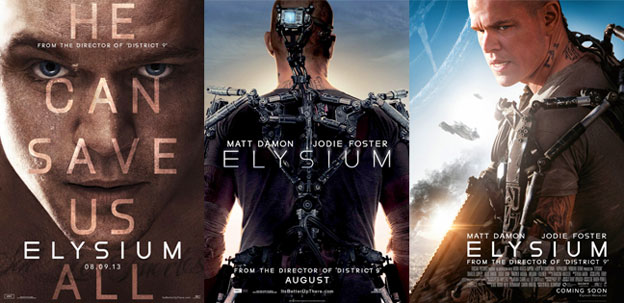
Elysium


The Magnificent Heaven

Elysium
2013 USA
Directed by Neill Blomkamp
Playing at UK cinemas now.

Warning: Possible slight spoilers.

I wasn’t the biggest fan of Neill Blomkamp’s last movie, his debut feature District 9, although I can acknowledge it was certainly quite an impressive film for all the right kinds of reasons and it’s no surprise to me that he’s got a couple of big names like Matt Damon and Jodie Foster in his follow up feature. Not to mention including the “seen him everywhere lately” character actor William Fichtner in the line up. So in terms of the acting he’s in safe hands here and, as you would expect, everyone in here more than pulls their weight, especially the actor who played the anti-hero main protagonist in District 9, Sharlto Copley, who here plays a very unpleasant villain.

And I have to say that I liked Elysium a lot more than that previous movie although, for sure, it can be almost seen as a companion piece. The worlds inhabited by both sets of characters on Earth is something of a dystopian vision and this also shows up in the style in which the movie is shot. However, since there’s not a great deal to criticise in Elysium and since this would be a real short review if I just said... “Elysium. Okay movie. Wouldn’t watch it again but good for a night out.”... then I’ll elaborate a little more, I think.

You’ve got some really good things going on here because we’re plonked down right into a future society with an established background for both Matt Damon’s Max character and his childhood sweetheart Frey, played charmingly by Alice Braga. Elysium, a space station world where the rich live in their perfect paradise (a metaphor for the world where those chosen favourites by the Gods go to in their afterlife, in certain ancient cultures) is already well established before these two characters are even born and being thrown together again in the mix of a storyline after having been apart from so long is quite poignant when you understand that their dream was always to go and live on Elysium.

However, they are not the chosen elite, they are part of the trodden masses who the rich and powerful look down on... not even that really. People are just things that live and die with no empathic response from the population “up there”. But things now come to a head because, once Max is accidentally exposed to a high dose of radiation, he embarks on a criminal data robbery from his old gang leader in order to get illegal passage to Elysium. Since he can barely stand, he is fitted with an exo-suit to make him stronger and has a data terminal spliced into him, in to which he has to steal and synch with the contents hidden in William Fitchner’s head. I don’t want to completely spoil the story for you but, when everything goes pear shaped, Max, Frey and the others find themselves heading to Elysium in... well... not the best company.

All the scenes on earth are shot with that same kind of gritty and jerky “reality viewpoint” which made District 9 a notable film to watch and the establishing footage initially shown of Elysium has a much more steady-cam, cleaner look to it... and this works really well. My one complaint being that the jerky camera work and editing style is also employed when our main characters are indulging in action sequences on Elysium too... which kinda annoyed me, it has to be said. It’s like the gritty realism is not really a harbinger of the duality of the environments portrayed in the movie... it’s more like a leitmotif for the inner chaos brought by the inhabitants of Earth and the way this bleeds out in to the world as they experience it. Which is a fair enough approach, I guess. I just maybe would have liked a more simplistic idea in terms of environmental rather than social expression.

Another gripe I have is the fact that the exo-skeleton suit that both Max, and later Sharlto Copley’s Kruger character, wear is really low tech. It looks like a pair of crutches and it’s not really believable that this would give our hero super strength. Yes, I understand it’s an Earth-tech, patched up version but that’s no excuse for the identical “frame” that Kruger wears, which he gets fitted on Elysium. So this kinda killed the mood for me a little.

That being said, the film has a certain gritty, brutality all its own and I suspect that this is why people will cotton on to this one so much. It’s easy to get sucked in and be inhabited by a movie when it’s hitting all your comfort zones with a big stick, I’m guessing. So, to be fair, it’s one of those movies where you really feel what’s going on (judging from the audience I saw it with the other night), rather than sit back comfortably and look at the way in which it is framed. It succeeds on this level really well.

One of the reasons it does succeed in this, of course, is because of the editing. Although the action sequences are chopped about quite aggressively, at a fast pace and with lots of changes of scale, it actually manages to capture what’s going on very well and although you may be numbed by the intensity of the various fight and chase sequences in the movie, you certainly shouldn’t have any problem with following what’s going on in them. It’s very carefully edited to produce a raw, in your face aesthetic while still preserving the sense of the overall scheme of things... Blomkamp really seems to know what he’s doing here.

There’s also a great and almost, at times, hypnotic score by first timer Ryan Amon, which is muscular and not unlike a solid Brian Tyler score... who is who I’d guessed had scored it until I saw Amon’s name in the end credits. The current retro trend of using short musical motif’s like Bernard Herrmann or Philip Glass is in full swing here but, who cares, it works and I happen to like those composers anyway. It’s a score I’ll probably get around to picking up sometime soon, I expect.

All in all, Elysium is over-the-top brutal fun for a certain kind of audience. The story is old and clichéd 1950s style science-fiction again, to be sure, but at least it’s treated with a certain degree of respect for its influences and Blomkamp certainly pulls no punches when it comes to manipulating the emotions of the audience. As a piece of hard hitting sci-fi, admittedly ramming its personal philosophies down your throat quite a lot, then it’s still a pretty impressive exercise in movie making and, while I probably wouldn’t watch it again, I’m certainly glad I’ve seen it the once at the cinema. Good work done here.

Monday, 27 May 2013

Contagion


Bugs N’ Kisses

Contagion
2011 USA/United Arab Emirates
Directed by Steven Soderbergh
Warner Brothers Blu Ray B 

Warning: Spoilers slowly mutating and spreading 
throughout this review as you read it.

Okay, so Contagion was a movie I really wanted to see when it came out in cinemas at the end of 2011 but I was already well into my 3-4 month Christmas preparations by then so I just couldn’t claw back any time to get out and see this one. I forgot about it after that, in all honesty, but when I saw a copy of the 2 disc Blu Ray/DVD edition in my local exchange shop going for a fiver, I finally remembered I’d wanted to see this one.

It’s interesting because, at the time it came out, I don’t remember this one being particularly marketed on the strength of the director and, considering it’s got a very big cast of ‘movie star’ actors like Matt Damon, Gwyneth Paltrow, Kate Winslett, Lawrence Fishburne, Marion Cotillard, Jude Law and Elliot Gould in it, it’s no wonder that the movie was kinda sold on its cast rather than any of the non-acting crew. In fact, because there are no credits at the start of the film, I managed to go all the way through the movie without knowing who directed it... although I did pick up right from the outset that the way this movie was shot was definitely something above average. I’d just assumed it was an old Hollywood director from the 60s and 70s come out of retirement to get that kind of ensemble piece going... but now that I know it’s Soderbergh and compare it to the last film I saw by him at the cinema, Side Effects (reviewed here), it all makes sense now.

Contagion is, for the most part, a quite impressive beast of a movie. It manages to look and feel epic in scope without really becoming too bloated by its own ambitions, although the second half of the movie did drag just a little in some places... but for the most part, especially in the first half, I was absolutely riveted.

Since I hadn’t known who the director was before I watched it, my main attraction for actually giving some time to this “virus movie” (yeah, it’s Outbreak without the monkey, but that’s okay) was actually Gwyneth Paltrow, who is an actress I seem to rate a lot higher than most people do. I rarely watch the kinds of films she’s in so I was looking forward to seeing what she was like in this one but, unfortunately, it turns out that she doesn’t make it through maybe even five minutes of the movie before dying from the virus she’s contracted on the day before the opening scene. There are some scenes with her later on in the movie where Soderbergh cleverly uses standard film footage and then freezes it at specific moments as a metaphor for the long distance security cam footage of this character that Kate Winslett’s character is reviewing simultaneous to this... but for the most part her quick death and the subsequent death of her son while Matt Damon is away having to deal with her dying in hospital, is merely used to make an opening point.

Matt Damon is not the main protagonist of this movie though... or, to put it another way... Matt Damon is one among many main protagonists throughout the film (as indicated by the actors playing them in the cast above) and as a result, no person stays as the focus of the film for very long. It’s also a film about the way characters can drop out of the narrative when you least want them too and it all meshes together to present an experience which is very much about a disease and the effects that disease has on every one (whether they have contracted the disease or not) and so, for instance, Kate Winslett’s World Health Organisation employee who is working for Lawrence Fishburne becomes this film’s Marion Crane character (Janet Leigh’s character in Psycho) as the story strands you are following with her character come to an end when she ends up being a customer in one of the big triage sites she has set up to deal with the onslaught of the virus. Her death works really well and, although you obviously have some warning of the end coming with her character, the slight shock value is not really deadened all that much by the inevitability of her situation.

However, in some scenes, this tactic about the film being about the effects of a disease rather than the people, backfires somewhat when the characters are maybe a little too fully explored than necessary (which is why I believe the second half of the movie loses it just a little) and while it’s very interesting and brilliant to explore just how Lawrence Fishburne’s character manages to get himself into trouble with the government just by showing a little empathy or the way in which Marion Cottilard’s character is kidnapped and used as a bargaining chip specifically because of her relationship with the World Health Organisation... or even how Jude Law’s unsympathetic (for the most part and dependent on your view of homeopathy and greed) blogger gets taken down by the CIA, I think we didn’t really need to have such closure on the ends of these mini stories because they detract from the “virus sweeping everyone along in its wake” kind of sensibility which a lot of the rest of the movie has in spades.

Actually, Lawrence Fishburne has to get an extra mention from me because he has been given some of the best lines (the dialogue is very 1970s “Hollywood crisp” in some sequences) and because his character is just so righteous and sympathetic that you would always want to be fighting in his corner. He is portrayed as a boss who actually does care about his workers and their personal physical and mental health as much as the jobs they need to carry out for him.

I said I knew right away that this movie had been directed by someone special. Well there’s at least two interesting things going on with this movie which I think I’ve got Soderbergh pegged on now. One is the way in which the colours go from very neutral to quite colourful (especially in the sequences with W.H.O workers in their more natural office environments, which are usually accompanied by some bright warm yellows and oranges) as opposed to the washed out greys and blues of the rest of the film and then switch back again from scene to scene. Even a bright green used to desaturate the feel of the shot at the start looks very drab because, as you probably know, green lighting usually kills off or neutralises flesh tones and this is used to give the usually glowing Gwyneth Paltrow a real visual sense of being someone who is feeling run down which, coupled with her excellent acting, works really well, of course.

The other great thing Soderbergh does is to have the camera lingering on little details in the shots... which is a tactic I’ve seen him use before to highlight certain details but which, in this movie, is used almost specifically to allow the audience to reflect on how something might be carrying the killer virus that is the main subject of the film. A folder left on a desk, for example, suddenly makes us think twice after the owner has walked off and we stay at the desk with a file. Or the way in which, instead of following Matt Damon and his daughter out of the hospital environment, our camera eye stays behind to linger and watch the door to the outside world slowly shutting, to make us think of the possible consequences of Matt Damon maybe being a carrier of the infection. That kind of thing is done at suitable intervals and it all raises this movie up and gives it a certain lift and entertainment value where another director might have made less of a point of it.

My only real complaint about the film, other than it trying to bring too much closure on certain scenes (the Stockholm Syndrome style reaction of Marion Cottilard towards the end after she has escaped and then goes back to warn her prior captors is something which stretched credibility just a little and which I could honestly have done without), is the score... which is quite wonderful in it’s own right as a score by Soderbergh regular Cliff Martinez but which seems to give us a little too much of a high in some scenes, where it deviates from it’s quiet, sinister tone into something more like techno dance in certain sequences. It’s a valid way of scoring the scenes in which it does this, I think,  but I kept asking myself if I should have been tapping my feet when everyone was fighting for their lives against a killer bug. It maybe works more appropriately in Italian giallo or horror movies than it did here but, still, it managed not to stretch things too far, maybe, and all in all it’s something I’d like to hear away from the movie if I get a chance. So that can’t be bad.

The ending scene was a slight disappointment, perhaps, only because you knew how this film was going to end from the first shot. The movie catalogues the number of days the virus has been active and we start the opening of the movie on Day Two and carry on from there... so it’s really not rocket science to figure out that with such an important moment remaining undisclosed, we will flash back to Day One for the finale and it certainly doesn’t play badly. Just might have been nice to be a little less predictable there, maybe.

So, anyway, my verdict for this movie is very much that it’s a film which is an impressive piece of screen art. It takes what is ostensibly a big name, Hollywood style cast and manages to pitch them against each other in the service of the story and main messages rather than use them as performances to just hang big movie moments on. This is a film which is put together as a creative and expressive piece, as much as a film like this could be, with the kinds of funding modern movies need and I was really pleased to have seen it. Definitely worth your time if you like big disaster movies or Soderbergh movies in general.