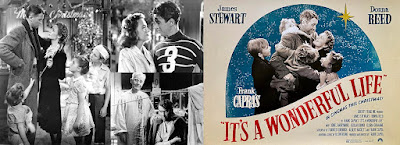
Mary Christmas
It's A Wonderful Life
USA 1946 Directed by Frank Capra
Liberty Films/Paramount
Blu Ray Zone BWarning: Small spoilers... like the ending.Well, I’m not even sure how to start a review of what is, frankly, one of the best known and most loved films in the history of cinema (and rightly so). I mean, is there much I can say that hasn’t been said about
It's A Wonderful Life a million times by others before me in a much more interesting and eloquent way than I? Well, possibly not but I do have the odd observation to add and some of the stories behind the production can never be repeated enough, I think.
The film, the first directed by the very successful Frank Capra to be shot at RKO studios under his own co-partnered company Liberty Films (after a string of hits directing for other producers), is most definitely the greatest Christmas movie ever made, even though the plot of the movie is not actually dependent on it being Christmas at all and, indeed, much of the film is not set during Christmas.
The basic plot, which I’ll explain very quickly, involves the great James Stewart as George Bailey. The film has a very dark prologue and a very brave one, after a load of despairing voices heard over establishing shots of the film’s sole setting, Bedford Falls, are heard praying to God to help out George in his hour of need. The audio of one of his young daughters crying out
“Please God, something’s the matter with daddy!” within the first minute or so is all it takes nowadays to start the tear ducts flowing and turn me into a blubbery mess for the remainder of the film’s quite lengthy (for it’s time) 130 minute running time.
We then get that incredibly brave shot of just a static image of stars lighting up whenever one of them ‘speaks’... representing God and his chief angel, talking... which lasts almost two minutes (turn the sound off and you’ll see why that’s incredibly brave... but the dialogue is riveting and saves it). Another angel, Clarence (AS2, Angel Second Class, who hasn’t won his wings yet), played by Henry Travers, is assigned with the task of helping out George Bailey and then he (and the audience) are shown stories from George’s life from when he was a kid and rescued his little brother (losing the hearing in his left ear for his trouble) and right up until the events to which Clarence is needed to act as his Guardian Angel (which doesn’t come until an astonishing hour and 40 minutes into the substantial running time).
After an absolutely brilliant movie up until this point, George considers taking his own life by jumping off a bridge into an icy river so his family and the Bailey Buildings And Loan Company, which he has been trying to hold together for all these years and which is in big trouble, can benefit from the life insurance policy that he has in his pocket. Okay, there’s all kinds of things wrong with that but, assuming the death is taken as accidental, then that policy would be no good anyway, surely, because it would go and get all soggy and unreadable in the river after the deed is done? Well, despite this, Clarence jumps in the river instead so George can rescue him and get an introduction. He then acts as a kind of
‘Ghost of Christmas That Could Have Been’ when he introduces a scenario where George Bailey was never born and how bad things in the world would be if this common man, trapped in the town of Bedford Falls all his life without being able to travel the world as he intended, hadn’t touched so many lives.
The final straw is when he sees his wife Mary, played by Donna Reed, shunning him, having grown up an old maid who runs the library (now the Pottersville Library after the films chief villain Mr. Potter, played by Lionel Barrymore). This is hardly a ‘Mary Christmas’. He prays to God to live again and then things get fixed, ending with a, perhaps uncomfortable, resolution where the sudden procurement of individual financial wealth is lionised within the ending of the movie.
Rounding out the cast of amazing actors in the film are Thomas Mitchell as Uncle Billy, Ward Bond as Bert the cop, Frank Faylen as Ernie the cab driver (husband of Carol Hughes, who played Dale Arden in the third
Flash Gordon serial, reviewed
here) and the amazing Gloria Grahame as Violet, the local, um... local bad gal (check out the brilliant, recent movie
Film Stars Don’t Die In Liverpool for an account of the last year or so of her life... reviewed by me
here). Alongside too many actors to name and they’re all good in this, every single one of them.
And the script is absolutely pitch perfect and manages to flesh out a lot of those supporting characters very quickly and with small sketches so that you believe in every one of them and can fill in their back story, to a degree, with the little shorthand, throwaway dialogue worked into the screenplay.
It had a lot of development in the script stages too, with the original short story on which it’s based distributed as Christmas cards to a small number of people, written by Philip Van Doren Stern, re-crafted as an absolute epic movie...
Some of the various versions of some of those alternate scripts have left little clues to their intent in the final product. For instance, Uncle Billy was originally a larger role and much use was apparently made of his affinity with animals and his curiously large assortment of pets. Indeed in at least one scene you’ll see his pet Raven on the loose and in the scene where tragedy has struck and he’s left crying at his desk by an infuriated and desperate George Bailey, you’ll see mice, various birds and, at the end of the shot, a squirrel which jumps onto the desk to try and comfort him... which must all have been a hangover from one of the previous versions of the screenplay.
Other variations are not obviously present in any shape or form in the final product... for example, there’s no evidence in this that there was once an ending where George Bailey had to fight the corrupt Government doppelgänger of himself and kill him to end the alternate reality. Yeah. that would have been a much different film.
Something I noticed this time around, in a truly gorgeous Blu Ray restoration job from Paramount (please people, don’t ever purchase or watch the silly colourised version... that is an object of evil put on the Earth as an ultimate crime against filmanity) was that the villain of the piece, Mr. Potter, has a little, ornate, precious metal skull on the desk in his office. Oh, and those set dressings are worth looking at... you’ll see a lot of things in the details. Such as a whole raft of pre-production publicity stills of the cast used as photographs in the little office space George has created for himself in his and Mary’s home.
Another thing of note... apart from a grown up Alfalfa from
The Little Rascals having a bit of a moment in the film’s early scenes with the dance hall/swimming pool... would be that Donna Reed actually managed to knock out the window of the old house that Mary and George would make their home by herself with her first shot (which is pretty amazing considering the distance). Also, the big crash just after drunk Uncle Billy exits screen right was a sound guy accidentally dropping some equipment leading to James Stewart’s laugh and Thomas Mitchell’s off-screen ad lib of
“I’m alright... I’m all-right!” earned the perpetrator a $10 bonus from the director for improving the film.
And a big thing which may well ruin the movie for you if you let it... the film was shot on big sets at RKO in June. A blazing summer and, indeed, in the middle of a heatwave which was so hot Capra sent the cast home to recuperate one day. However, it looks just like Winter and the effects team created, for the first time ever, a special snow compound, earning a
Class III Scientific or Technical Award from the
Academy of Motion Picture Arts and Sciences for their efforts. Indeed, it’s more or less the same way snow in films is done today and is much better than the dyed cornflakes or asbestos used prior to this.
Dimitri Tiomkin’s score is special too (what survives of it in the finished film, there were a lot of additional needle drops here) and, since I don’t know for sure which bits were his and which bits were borrowed, I won’t say too much about it. But it does more than just illustrate the scenes, providing immediate foreshadowing to the next scene, for instance, when George hears the news his father has had a stroke and you suddenly hear the
Funeral March woven into the score. Great cinematography too, considering the number of cinematographers who worked on it and how consistent it looks. Capra has some wonderful shot set ups. For example, the washing line which Clarence and George use to dry their clothes on after the bridge jump scene forms a diagonal which is used to compartmentalise the actors within the shot.
One last thing... I mentioned about the brave static shot at the start of the movie, pulled off with just winking lights and great audio... well another extremely unusual moment for a 1940s movie (possibly the first time this was done, I’m hearing) is when James Stewart first enters the picture as the adult version of George Bailey. When his face is clearly visible and turns to the camera, Capra freezes the frame for a good long while as the various angels talk about Bailey’s face. Again, it’s kinda bold for the time to just stop the picture like this (I bet Godard loved this film, I need to find out) and, once again, the brilliant dialogue and voice acting covers up the sudden lack of flow and doesn’t really pop you out of the picture. Another wonderful moment in a film full of them.
And that’s as much as I’ll say on
It’s A Wonderful Life for just a short review but I’d urge you to both read up on it in various books and, above all, watch this movie because it’s amazing. As is the new Blu Ray transfer which also includes a nice featurette about the restoration process, another one on various ‘secrets’ (I never realised how many matte painting plates were used to help flesh out the backdrops in the film) and a rare piece of ‘home movie’ footage of the final wrap up picnic with the cast and crew. So yeah, a wonderful film made better and preserved with modern restoration techniques. I’ve never seen it looking so good (even at the cinema, over the years). This is one for the ages and, despite it’s failure on its original release (helping seal the fate of Capra’s short lived Liberty Films), its reputation has grown over the years and it’s now recognised, as it should be, as one of the pinnacles of the art of American cinema. Not much comes close to this one, for sure.