Wednesday, 6 April 2022

Remake Remix Rip Off


Turkish Delights

Remake Remix Rip Off -
About Copy Culture &
Turkish Pop Cinema

Turkey/Germany 2014
Directed by Cem Kaya
DVD Region 0


Just a quick word here about Cem Kaya’s wonderful documentary movie Remake Remix Rip Off - About Copy Culture & Turkish Pop Cinema. This is not so much a look at the various ‘homage factors’ inherent in Turkish cinema (which is in no means restricted to Turkey anyway, although their variants are often somewhat less subtle than those made in many countries) as it is an overview of Turkish cinema over time and also culminating with a look at the current situation with television, where billions are spent on many hundreds of new TV shows every year. Two hour long episodes shot in 6 days and preceded each week by a one hour ‘previously on’ section on Turkish cinema... yeah, that would probably kill me, to be honest. But this film also gives you a rough idea of why that situation has come to be in the first place.

There are interviews with a lot of actors, directors and technicians from the history of Turkish cinema and these are all intercut with various themed sections that Kaya has used to structure the documentary, to give a very good introduction for those unfamiliar or only slightly ‘in the know’ about various films made over there. He also uses some nice repeat structures throughout, which push his points (although, while I appreciated this technique, perhaps in some areas the montages are perhaps a little too long). This is sometimes achieved, like in the pre-credits sequence, where the various directors are telling the camera how there are only 31 or 34 or 37 etc original stories (now I always thought it was only four) and using this as a justification, or at least explanation of the reasons why the films often seem carbon copies of themselves (let alone their Hollywood counterparts like Some Like It Hot or The Wizard Of Oz). Which, again, is perhaps something which should be recognised as symptomatic of any large scale production of an art form like a motion picture in any country but, yeah, it feels like a lot of the people interviewed in this are on the defensive, rather than pointing out that Hollywood and various other countries’ cultures do exactly the same thing (and don’t get me started on silly US remakes of J-Horror and assorted French comedies).

The montages of exactly the same themes, songs, lines of dialogue etc in close juxtaposition certainly show a very formulaic way of making the movies... which absolutely everyone being interviewed would agree on, it seems to me and, amusing as it is (and it really is, I had a good time silently mocking what was shown), it really wouldn’t take much to pick on, say, Hollywood’s current output and do exactly the same thing.

Important events are addressed, such as a big demonstration by actors and crew demanding health and safety on the sets and tales about a director planning and writing his film in jail for 11 years as it was being given to others, piecemeal, to film... and even the director of the highly censored and changed Turkish version of Bonnie And Clyde being beaten up by the police in jail for 15 days because of his creation. It all makes for an entertaining but, also very scary, informative text on the nature of censorship in Turkey, even when the pornographic sex films came into play and everything carnal was allowed... unless it got complained about for some reason. Indeed, even normal films were getting sex scenes from other films randomly spliced into the prints to spice the films up and draw audiences at one point. I guess that’s a case of splice n’ spice then. The ending of one of the notorious, master criminal (or should that be Kriminal?) Kilink films, where he praises the intelligent Turkish police for capturing him and bringing him to justice is, well, very telling about the sad state of affairs at the time, for sure.

The interviews conducted are very interesting and often reveal the incredibly inhumane and cheap working conditions under which these people were trying to create their art. From the small amount of film issued for every production to the bizarre story of how the black and white films were dyed or tinted under the guise of a new colour process and how the distributors were found out when, after a few days in cinemas, the colours all wore off and the films were back to standard monochrome again.

My favourite section, for obvious reasons if you know me in person or read this blog with any regularity, was the moment when the sound man took us to see his big soundtrack album collection, in a couple of shelves of a cupboard. There were no hard copyright laws in Turkey at the time (and it’s almost as lax now, apparently) as is evidenced by the amount of rip offs or amalgamated characters in Turkish cinema... in such versions as Turkish Superman, Turkish Jaws, Turkish Star Wars, Turkish Rambo, Turkish Death Wish, Turkish Exorcist, Turkish Rocky and so on and this also extended to the soundtracks, which were needle dropped by all of Turkish move makers, more or less, from the vinyls found in this one guy’s cupboard. So The Godfather, The Sicilian Clan, Enter The Dragon, Raiders Of The Lost Ark, Star Wars etc are all found here. An interesting moment was when he pulls out a copy of the old New American Orchestra cover album which passed for the closest thing to a Blade Runner soundtrack release back in the day... and he tells us that this one was a pretty useless album for trying to find good music to needle drop onto the film. If you’ve seen enough Turkish cinema you’ll probably find this section very interesting. I remember the first time I saw 3 Devadam, aka Captain America And Santo Versus Spider-Man and I realised almost all the music in the film was lifted from the vinyl releases of the fight music from Shaft’s Big Score and a track from Diamonds Are Forever. So, yeah, it’s nice to actually see the guy holding up the various records he used to use to ‘score’ these things.

Remake Remix Rip Off - About Copy Culture & Turkish Pop Cinema is a pretty good introduction to this culture’s film output and if you are interested in cinema from other countries (and why wouldn’t you be if you’re reading this blog?) then this movie is a pretty enlightening portrait of their national cinema. I don’t necessarily agree with all that is said in it... one Turkish film fan’s appraisal of some of the films, such as the film known over here as Turkish Star Wars is, frankly, ludicrous... but it doesn’t take the easy track of pulling the industry apart and I was quite upset when one of the very prolific directors on here (they all directed hundreds of movies) compares Turkish cinema production to what goes on in Hollywood and decides he’s never really made any proper films. That’s just a wrong conclusion on so many levels and I wish he’d realise that he has left a rich legacy, for those who seek it out and can find it. An entertaining and illuminating documentary... give this one a go.

Tuesday, 5 April 2022

The Falcon Strikes Back


She Done Him Bond

The Falcon Strikes Back
USA 1943
Directed by Edward Dmytryk
RKO/Warner Archive
DVD Region 1


Warning: Some big spoilers.

It was all change over at RKO for The Falcon series with The Falcon Strikes Back, which was managing to not only keep going but flourish after George Sanders had left the franchise. If you’ll remember, Sanders had relinquished the role in the previous film, The Falcon’s Brother (reviewed here) when his real life brother, Tom Conway, came to help out as The Falcon’s brother, Tom Lawrence. The Falcon was shot dead in an act of heroic self sacrifice in the final minutes of that last movie and his brother became the new Falcon.

Interestingly, two of the actors who were in the last film, including The Falcon’s regular sidekick from the previous movies, were not retained for the next adventure. However, in a bizarre choice, the studio decided that the characters themselves would keep going with different actors. Personally, since The Falcon is not the same character as his dead brother, they could have changed the characters too but... well, anyway, long standing sidekick character Goldie is now played by Cliff Edwards and the oriental houseboy, played by the famous Keye Luke in The Falcon’s Brother, is now played by Richard Loo.

To give the series some kind of continuity from the last one, in Conway’s first solo Falcon movie, we have Jane Randolph reprising her role as Marcia Brooks, the reporter from the previous film. We also have Inspector Donovan played once again played by Cliff Clark in his second Falcon movie (contrary to what the IMDB might tell you... they really need some fact checkers there) and Edward Gargan playing the Inspector’s sidekick, the fifth time so far in the series that he has played the ‘dumb detective’ role.

Although the Nazi lead in from the ending of the previous film is totally ignored... it seems to be a thing now where a new adventure is teased at the end and then completely ignored in the next movie (including the ending of this one)... it still has a plot lightly dealing with the subject of the Second World War, which was now playing out in the US as an ever present worry. This time around The Falcon is knocked unconscious and framed for the theft of a huge sum of War Bonds (just what he would do with them is not made clear). He escapes police custody and, with the aid of Goldie, his houseboy and the reporter, gets caught up in two completely different mysteries which converge at a hotel resort, a mystery involving both a ‘war bonds’ swindler named The Duchess and a murderer who is, actually, killing off the criminals with a gun rigged with a silencer (or suppressor if you like... I understand that these weren’t that good or useable at the time, or for many decades for that matter, if they ever were but, as usual, they work perfectly well in the movies).

It’s a pleasant romp of a mystery ticking all the right boxes and, like his brother, The Falcon only has to kiss an objecting woman for her to do an about face, swoon and then help him as much as she possibly can (ahh... those were the days). Now, I have to say that, back in the 1940s, it probably wasn’t a huge surprise as to who the murderer was in this film but I didn’t see it coming until about ten minutes before the reveal on this one. The reason is very simple... I’m not used to seeing the comedian Edgar Kennedy in diverse roles...

Edgar Kennedy was a comic whose theatrical comedy shorts I used to watch on TV in repeats during the 1970s as a kid. I was also used to him from numerous appearances in Laurel And Hardy shorts and, later on, when I saw him opposite The Marx Brothers in Duck Soup. However, I think in the 1940s, audiences would have been more used to him indulging in straighter, more sinister roles than I’ve ever seen him in and so, they would have had the advantage over me I think. So it came as a surprise, somewhat, when I figured out he was pretty much the only other person the killer could be by the end of the movie. He even falls to his death from a rooftop, being chased by The Falcon at the end.

There are a couple of other things in this movie which I think are worthy of note. One is that, at the start of the film, the sound of accompanying imagery such as speeding trains, ships, a pneumatic drill and a large hammer on a building site, are used as a visual metaphor to explain the state of The Falcon’s hangover as he is trying to sleep it off, in his introductory scene at the start of the picture. Which is a nice touch.

The other thing is when Edgar Kennedy, who is a puppeteer (using the credited ‘Velma Dawson Puppets’), brings in a puppet of Goofy and does an impersonation of him. The first thing I thought of when I saw this was... copyright and legal suit coming the way of RKO studios, surely? However, further research shows that Walt Disney was indeed still releasing films through RKO at the time, so I can only assume that this was above board (or RKO would have been in a lot of trouble, I guess).

And that’s that. The series was continuing to be popular and Conway would go on to portray The Falcon (or rather his brother) for another eight movies after The Falcon Strikes Back... all of which I hope to review for this blog soonest.

Monday, 4 April 2022

A Connecticut Yankee In King Arthur's Court


Yankee Pankee

A Connecticut Yankee
In King Arthur's Court

by Mark Twain and
adapted by Seymour Chwast
Bloomsbury Press ISBN: 9781608199617


I’ve never read Mark Twain’s A Connecticut Yankee in King Arthur’s Court. I remember seeing the Bing Crosby movie (one of many versions made) and also the kind of ‘inspired by’ 1970s movie The Spaceman And King Arthur (which I recently found out was called Unidentified Flying Oddball in the US, for no reason that I can think of). So my interest was piqued when a friend gifted me a graphic novel adaptation of said work by none other than famous graphic designer Seymour Chwast.

Now, since I don’t know the source, I can’t tell you or make any judgement as to how much of this incarnation of the work actually comes from Twain and how much comes from Chwast. I am going to assume that it’s mostly the design, layout and presentation of certain things in truncated text and visual support that is the realm of Chwast and the rest is completely down to the equally witty, it turns out, Twain.

Now, I also don’t know Chwast, or his work but, his style here seems to be a very flat, primitive representation of things which is, by its nature, quite direct in its communication with the reader. In fact, it rather reminded me of the old Tim Hunkin strip The Rudiments Of Wisdom, which I used to read in the back of the Observer Sunday Supplement magazine as a kid in the 1970s. The illustrations are done completely in monotone with the designer using just two, flat colours... in this case black and pale green... and also the white of the paper where ink doesn’t hit, to highlight certain areas of an illustration that he wants to stand out.

So various add ons to simplify and clarify Twain’s text such as a white highlighted head and shoulders profile of the main protagonist, with the wording “His name is Hank Morgan.” is the order of the day. I especially liked one of the designer’s more interesting choices for one of the splash pages, where a group of knights on horses are galloping flatly in a row, following a path into a castle which does a straight right angled turn. Instead of adding the knights past the turn in the same orientation, he also mirror flips the elements and adds it to the 90˚ turn on the image. Which was kinda neat.  

The story itself, of a man who gets hit on the head and then wakes up in medieval England at the time of King Arthur, is charming but really not as upbeat as the movie versions I’ve seen, which tend to drop a lot of the political commentary and the horrors of the time period that Hank learns to take in his stride. There’s a lot of unjust torture and killing throughout and even Hank is not against killing for the right cause. Yeah, I can kinda see why Hollywood did what they did with it.

Now, I don’t confess to understand the politics of the thing... which should certainly not surprise any of my regular readers... but there seems to be a lot of social commentary in the story and, yeah, that’s fine. Twain is quite witty with it too and I think my favourite comment in the book was, when Hank talks about a small country “as BIG as Columbia”... “You couldn’t sleep with your legs stretched out without a passport.”

All in all, this is a very short review for a very simple looking but, I can assure you, far from simple approach to the source material. Chwast’s page layouts and the way he pushes certain pieces of content are deceptive and, I think, are doing much more than you at first think. Sometimes the illustrations bring a certain sense of fun to undercut the horrors of what they are actually depicting, for example. Such as when some knights and horses gallop over a minefield and the illustration consists of the big onomatopoeia “Boom!” and various human and animal limbs are seen in free fall around it. But then you start to think about it.

So, yeah, in summary I really enjoyed this version of A Connecticut Yankee In King Arthur’s Court and I think I shall probably try to read the original novel sometime before I die (although that may be sooner than I think, the way things are going). Chwast’s adaptation is an excellent introduction to the characters, events and ideas of Twain’s novel, especially if you’ve not experienced any of the movie versions over the years, which tend to play things strictly as comedy, it seems to me. So yeah, glad I got gifted this one and a worthwhile addition to the NUTS4R2 library, I think.

Sunday, 3 April 2022

Ghostbusters Afterlife


A Spengler For Detail

Ghostbusters Afterlife
USA/Canada 2021
Directed by Jason Reitman
Columbia Pictures


Warning: Sorry, this one’s going to have some
big spoilers so I can talk about certain things.


Well, colour me surprised. My relationship with the Ghostbusters franchise over the years has been fairly hit and miss and I wasn’t expecting a great deal from Ghostbusters Afterlife, truth be told. I remember, when I was a teenager I was certainly no stranger to buying music (I was always a soundtrack listener) but I remember somehow, accidentally hearing the main Ray Parker Jr song from the first movie on TV and I rushed out and bought what was for me, the first piece of music I ever paid for which had vocals on it. Yeah, I bought the 12 inch single of the main thing and played it to death on my turntable.

So then, obviously, my parents and I (they liked the song as much as I did), went to the cinema to see the movie and, yeah, we had a relatively good time with it. I’m not saying I loved it but it was entertaining enough and it had a neat song and score. Alas, at the time, the soundtrack album was just a bunch of songs with just a couple of the Elmer Bernstein cues on there but, after a couple of decades, the proper Bernstein score was released on CD.

Anyway, getting back to the legacy of the franchise... we were all hyped up to see Ghostbusters II when it came out and, if I said I thought it was a bit of a letdown, that would be an understatement. The score on the thing didn’t help either. So, yeah, despite constant rumours of a third movie, it never materialised. And then, in 2016, a new all-female reboot was released and, well, I had a problem with it. I had nothing against the fact that the Ghostbusters were all women (that rocked and, to be honest), on a technical level the film looked great and it really worked well as an overall story. However, the dialogue just wasn’t, in any shape or form, funny... and it was obviously trying to be. So that kind of took the wind out of the sails of that one for me but, because it was so well put together, I kept hoping that the studios wold bankroll a sequel and maybe do a much funnier follow up. Alas, it didn’t happen and, instead, we have a new Part 3 to the franchise, Ghostbusters Afterlife, which is a direct sequel to the first two movies but, alas, forgets the reboot totally. So, yeah, like I said... I wasn’t expecting much from this one.

So I’m really pleased to say that I absolutely loved this new, fresh take on the series. Especially since it mainly deals with a bunch of kids... which is not something I usually get hooked into. This one, though, hits all the right notes and manages to do a fair bit, even when the producers are walking a tightrope of what could be considered a very ‘bad taste’ idea... and not only getting away with it but knocking it out of the park. And by that I mean, including Egon Spengler as a major character, despite Harold Ramis, who played Spengler in the original two and who helped write them, having been dead for a few years.

So, okay, the film starts off very strongly with Egon having a big showdown with an evil force in a little town where he’s been living the life of a recluse for the last 20 or so years. It’s set at night and lit in such a way that you never see the actor’s face who is stepping in for Ramis at this point... but it’s done brilliantly. And then, after trapping and hiding the spirit that the big bad supernatural force is after, Spengler is killed.

Cut to... Spengler’s estranged daughter Callie (played brilliantly by Carrie Coon), her son Trevor (nicely played by Stranger Things alumni Finn Wolfhard) and her daughter Phoebe (played by Mckenna Grace who is, frankly, phenomenal in this and pretty much carries the whole movie on her shoulders). Phoebe is the one who has inherited her grandfather’s love and talent for science and so she becomes the Egon of this movie. The three of them have just been evicted but, on the death of Egon, they’ve inherited the dirt farm in the small town and now have to try and live there and fit in. Rounding out the cast is Logan Kim as Phoebe’s new friend Podcast, Celeste O'Connor as Trevor’s new crush Lucky and, last but by no means least, Ant-Man himself, Paul Rudd as the local summer school teacher and seismologist Mr. Grooberson.

And it’s a blast as spirits are accidentally unleashed, including a Muncher (this films comic relief ghost, similar to the Slimer in the previous movies) and a welcome return for the Marhsmallow Man, or men this time as miniature versions, like a bunch of mischievous gremlins. Everyone does good in this and it’s a blast. I think there’s possible a little less of Rudd’s character than I would have hoped for and, okay, there’s obviously going to be a point where the original Ghostbusters re-enter the narrative and, yes, it’s great seeing them... Dan Akroyd, Bill Murray and Ernie Hudson are all back. As is Annie Potts playing their old secretary (no Rick Moranis, alas). I would definitely say they are somewhat underused though, coming in for a big deus ex machina moment towards the end of the movie, when everyone else has gotten in way over their heads as they take on the main villain from the original movie, Zuul. This time around it’s Carrie Coon and Paul Rudd who become her giant dog-like gatekeepers.

So, yeah, some of the acting talent is wasted a little but, all in all, it’s a good all rounder and I really had a good time with it.

But the main addition is the one you are not expecting. At some point in the narrative the audience comes to realise that the invisible ghost of Egon Spengler is helping Phoebe to put all the jigsaw pieces of the evil spirit’s dastardly plan together and get herself armed up with a working proton pack and trap etc... and I expected them to leave it there but, no, they took a bit of a risk at the end but, as it turns out, it pays off. I’m not usually a friend to the idea of CGI actors like, say, Peter Cushing and Carrie Fisher turning up in Rogue One. It just doesn’t look anything like the real person to me. It always looks fake. Well, the director has gone down this route here with a CGI version of Spengler to help out our heroes in the end showdown but, here’s the thing... because it’s an aged, silent, spectral ghost version of Harold Ramis, well, it looks just great. Not only that, his inclusion in those final scenes is actually quite a moving moment... there were tears in my eyes (which is only going to get worse on subsequent watches where my eyes erupt into fountains, I’m sure) and the whole thing manages to completely step out from the whole ‘bad taste’ issue and function well as both a story beat and emotional punctuation to the move. So, yeah, I loved it.

And not only that but Rob Simonsen’s score (which is thankfully on CD and which I will be ordering in a couple of weeks) totally plunders Elmer Bernstein’s original Ghostbusters score and uses his various themes and, yeah, that really works too. And even when he’s not using Bernstein’s themes, Simonsen uses similar orchestration to kind of glue it all together and it never once feels like a tongue in cheek parody... it just feels right for the spirit of the film. So that’s great.

Which leads me onto my other slight disappointment with the movie. There starts to be a point about three quarters of the way through when you want to hear that Ray Parker Jr song either teased within the score or just out and out played as the new Ghostbusters team go on to prove that they ‘ain’t ‘fraid of no ghosts’. Alas, they do play the song but it’s kept back for the end credits of the movie... I feel they should have integrated it into the film a little better, for sure (but then again, the original didn’t do all that much with it either, if memory serves).

And that’s me almost done with Ghostbusters Afterlife. A surprisingly good sequel and an all round entertaining movie. One last thing though... there’s a nice moment when you see a familiar name in the end credits list and think... wait a minute, she never turned up in it. And then the first, mid end credits sequence plays out and, yes, she does indeed turn up in it to reprise her role (if you know the original movie, I’m guessing you know who I’m talking about here). So, yeah, stay for the mid end credits scene and, also, for the final post credits scene, which isn’t quite as successful but seems to be setting up some kind of sequel possibility in it. And there you have it. A good time was had and I’ll be showing this one to my folks now as soon as possible.

Wednesday, 30 March 2022

Shiver Of The Vampires


Pointy Breasts Of Doom

Shiver Of The Vampires
aka Le Frisson Des Vampires

France 1971
Directed by Jean Rollin  
Redemption Blu Ray Zone A


It’s about time I revisited some of my old Jean Rollin favourites for this blog and Le Frisson Des Vampires is the third of his famous vampire movies, following The Rape Of The Vampire (reviewed here) and The Nude Vampire (reviewed here). And like those and many others in his oeuvre, it has a lot of the Rollin obsessions and trademarks running throughout the film. So lesbian/bisexual vampires who walk around either in a state of total undress or wearing completely see-through, diaphanous robes is absolutely the order of the day here. Also, there are two girls who are helping the vampires with their work in this one, as there are two brothers who have recently become ‘vamped up’, so to speak... so Rollin’s obsession with ‘two’, although not quite yet ‘twins’, is already very much a thing.

The film starts off with a monochromatic pre-credits sequence when the lover of the film’s two brothers, Isabelle (played by Nicole Nancel), organises two coffins being taken into their castle. This is followed by a black and white opening credits sequence depicting a graveyard with fog billowing out, with blood red letters over the top on the credits and with the crude but haunting, brittle, small scale guitar and percussion score by Acanthus, coming in to belt out the music which, throughout the film, is sometimes spot on and sometimes less so but which, despite its unusual nature, never quite fulfils the function of a good movie score it seems to me. It’s kinda catchy though, in places.

Then, the rest of the film is shot in colour, beginning with some nice frames of the castle and surrounding grounds. One of the strong points of the great, surrealist vampire movie maker Jean Rollin is that, like Mario Bava, pretty much all of his shot set ups and frame designs would make perfectly composed, still images. Despite often having less than adequate acting skills demonstrated by the majority of the performers in his films and, frankly, stories which are either too simplistic or way too convoluted to convey what they are about, Rollin’s beautiful visions of his Gothic and sexually curvy domains are always absolute perfection. They haunt the mind and provide more than enough eye candy to maintain the interest of even the most casual viewer, the visual images of his works becoming the raison d’etre for seeking out this great auteur.

The plot is fairly simple in this one but it’s not revealed to us all at once, rather (and this is kinda subtle for Rollin, I guess) it’s released in little pieces of information scattered throughout, with each reveal building on the last one to give us a picture of the whole story and its background. In short, the plot and course of the movie are as follows but, I make no apologies for spoilers because, for most of Rollin's work, the plot isn’t actually the point of the movie (as you will probably know if you’ve seen one) so the concept of spoilerage is rendered redundant. In a nutshell it’s this...

Two nameless brothers, played by Michel Delahaye and Jacques Robiolles, have been lifelong vampire hunters and spent many years of their life dedicated to this, with the assistance of their lover Isabelle and their two young, pretty nameless maids (the main ‘two’ of this movie), played by Marie-Pierre Castel and Kuelan Herce. However, the two brothers have been bitten and so commit suicide by driving stakes through their own hearts. The next day, a young man called Antoine (played by Jean-Marie Durand) and his new bride Isle (Isa in some prints, apparently, played by Sandra Julien), still in her wedding dress, drive to the castle to visit her uncles for the first part of her honeymoon... who are, of course, the two brothers in question. They learn they are dead but, sure enough, the two brothers are back on their feet in no time (vampicide by stake through the heart seems bizarrely unsuccessful here) and the household is now all enslaved to the vampire Isolde (played by Dominique), who has them doing the normal fiendishly vampire things and who turns up after sundown from random places such as, in one famous case, popping out from inside a grandfather clock. She kills Isabelle by hugging her when she’s wearing her big, spikes on the ends of her nipples. She also seduces Isle and has her under her spell over the few days it takes Antoine to figure out what’s really going on and attempting to get out of there with his wife. The whole thing ends up on Rollin’s favourite beach (which turns up in quite a lot of his movies and is almost a character itself) and the two brothers and the, by now, fully vamped up Isle are exposed to sunlight while she’s cavorting naked on the beach. Due to a lack of special effects budget, they wink out of existence in a jump cut rather than with anything more subtler.

But. like I said, the story in this one, as it does with pretty much every one of this director’s personal works (he directed a lot of porn films to finance his own projects), takes a back seat to the astonishing mise en scène of the piece. In this one, the colours are absolutely smashing and what he does in a lot of the exterior shots, when people are lingering in cemeteries or standing outside the big open doors of a castle or some other location, is to use large washes of colour lighting and then, quite often, pitch them against each other. So a graveyard may be completely bathed in red light as the characters walk through it or, sometimes, he’ll split the lightning between levels of the shot. So the foreground objects like the castle walls or grave markers may be in red but, the space behind the open door of the castle or the ground where the actors are performing behind the gravestones, might be bathed in a wash of blue light. It’s astonishing looking stuff and it’s not quite the same as what a colour god like Mario Bava or the older Kurosawa might have done (or even Dario Argento in a few of his movies) but, well, it more than holds its own and is uniquely Rollin... who should be recognised as one of the great cinema forces of colour these days, I think.

There’s also the usual stuff which you can just tell the director wasn’t interested in enough to fix... such as one of the crew members being completely visible in a mirror in one shot. Or the moment when Antoine rushes into Isle’s room and the camera whips around to find it empty and he rushes out, only... it’s not empty, you can see the arm and leg of an actress sitting in a chair who thought she was out of shot on the far right of the frame. Or the fact that one of the two maids, who is holding a candelabra full of lit candles, has had one of the candles go out but it’s magically alight again in the next shot. So, yeah, sloppy too but, honestly, the whole thing looks so stunning that I don’t think most people will care about these little errors here and there... Rollin obviously didn’t.

There are also some interesting shots attempted here... not all of them are successful but they are at least interesting. For example, a camera spins around a room full of five people from the centre of them who are arranged in a circle. The camera does a ‘more than 360 degree’ anti-clockwise turn as it pans around to the left and then stops as each person in turn says their next line of the conversation. 

Another unusual way of visually punctuating a conversation is seen when the two brothers are explaining the more acceptable parts of their back story to Isle and Antoine... when each one speaks he leans dramatically from his place on either left or right of the frame to appear in the centre of the frame... and then back out again as the other brother swoops in for his next line, etc. It’s forced looking and unnatural but, hey, it’s certainly interesting. A similar scene where the two brothers are emphasising their lines by using their hands to clock their conversation to tip the trays of a scale in their direction (a bit like fast chess players hitting their clocks to usher in their opponent) is quite a bit less successful but moments like these still lift the sequence and add another dimension to the shots. 

 Sometimes these elabourate set ups make no sense, such as when the brothers are circling a tied up Antoin who has been dumped on the floor... the camera takes the point of view of the camera which spins way more than 360 degrees around the set as the brothers walk around in a circle talking at him. Which looks fine until you remember that this means the bound man on the floor would have to be spinning around somehow to be making that POV shot work.

So there’s all this and, of course, the usual Rollin inserts of startling, arresting imagery, such as a burning coffin or, in the scene where the vampires dispose of Isabelle’s naked body by dumping her on her back in a nearby river, there’s a striking shot which in no way imitates but, is somehow still reminiscent of, the Millais painting Ophelia.

So, yeah, what more is there for me to say about Le Frisson Des Vampires. It’s a classic Jean Rollin piece with the usual naked vampire women, vibrant colours and attention grabbing, surrealistic, Gothic laced imagery... any cinephile worth their salt should be exposing themselves to his work but he still remains, to this day, somewhat out of the limelight for such an important and, probably, influential director. Miss these marvellous pieces of art at your peril, is what I say.

Tuesday, 29 March 2022

Broadcast Signal Intrusion


Truth Or Air

Broadcast Signal Intrusion
USA 2021
Directed by Jacob Gentry
Queensbury Pictures

Warning: Slight spoilers.

Broadcast Signal Intrusion is an expansion of a short film which was written and directed by Phil Drinkwater and Tim Woodall (who wrote this feature length version), which was inherited, for whatever reason, to be directed by Jacob Gentry. I’ve not seen the short myself but, seeing as this film raises more questions than it answers, it’ll be interesting to see this now in case it gives anymore closure than this longer version.

I’d like to be all neat and tidy and say that the film is a horror film but, honestly, I’m really not sure that it is, since the necessary information, to my mind, to be able to properly ascertain its possible inclusion in that genre description is very much among the many unanswered questions set up by it’s genuinely intriguing plot. I would go as far as to say that there may be an element of, perhaps, mad scientist science fiction, bordering on horror, for the last 20 seconds or so of the movie but, given the content of that admittedly interesting ending, I think it’s fairly ambiguous at best.

The film stars Harry Shum Jr. as James, a man working nights for a video archiving company, transferring gazillions of broadcast television tapes onto digital discs... and it’s set in 1999. He lives alone because his wife has gone missing, presumed dead, a few years before and so he attends regular weekly meetings of a counselling group for people who have also lost their significant others. He even has the date of her disappearance tattooed on his wrist.

He has started having some unusual dreams of late, especially regarding his late/missing wife where he is filming her and when she turns around she has a kind of flat, blobby, rubbery mask with dead eyes where her face should be. Then, one night when he is transferring tapes onto disc, he sees a broadcast signal intrusion (over here in the UK I think they’re more commonly referred to as pirate broadcasts, which somehow manage to hijack the airwaves and beam something else collectively into people’s homes before the station is able to shut them down) with disturbing imagery and sound design, populated by a person wearing the exact same kind of rubbery face that his wife was wearing in his dreams.

And then it becomes a rabbit hole movie, as we follow James down into a plot which leads him to finding that there have been three of these specific intrusions on the air and that they’re almost impossible to track down due to the FBI confiscating everything related to the case. But old message boards are alight with people trying to find out more and after a while he realises that, in each case, a woman went missing the day before each intrusion (well, okay, probably many people go missing every day but it feels more credible in the film) and that the third and final signal was put out on cable the day after his wife went missing.

And it does what rabbit hole films such as Michelangelo Antonioni’s Blow Up or Francis Ford Coppolla’s The Conversation (or even Brian De Palma’s Blow Out, at a push) do, which is to lead the viewer on a merry path down the same route with various, more puzzling questions raised at every turn, deepening the mystery at the films heart and gripping the audience tighter as it does so.

And it does so quite skillfully. Playing out sequences which, as interesting as they are, seem to go nowhere and do nothing other than hint that something mysterious is going on... but, you know, I kinda enjoyed it. There are some nice visual moments in the film too... the director is not afraid to section off shots with verticals but then leave vast areas of the screen in darkness to pull the eye into a certain part of the frame. There’s a nice split screen sequence which shows James looking into the direction of the camera (at the computer) on the left of the screen and, on the right split, the contents of that screen... with the director finishing that sequence by zooming out of both screens at the same speed. He also likes to do things like pick out details in close up (such as lighting the tip of a cigarette... not a new approach but still nice to look at) and he has a cool montage shot where the aisles of a video library are side on and we see James going through each aisle as a growing time composite, as he is added to each aisle simultaneous to the aisles he is already searching in.

The film also has an outstanding score by Ben Lovett which captures a kind of late 1940s/early 1950s film noir vibe and runs with it, injecting less harmonic music at certain intervals as James sinks deeper into the mystery and, on screen, slow moving dutch angles are used to reflect his inner turmoil.

The film gets darker as it wears on and then, in literally the last twenty seconds, when you think you may have a handle on things... something else happens. And I’m not going to tell you what but it did remind me of that famous, complete non-sequitur of a shot of the ‘mad puppet’ from Dario Argento’s Deep Red. It’s almost like he wanted to see what would happen if he added that kind of level of bizarre shenanigans at the end of a movie. This completely throws out the notion that any of the main characters in the film, not to mention the audience, have any idea of what is really going on... and I suspect that was the idea. I get the feeling that various ‘clues’ in the movie, such as when James and a woman who is helping him with his enquiries for a certain part of the film (played by Kelley Mack) go visit the man who helped make the broadcasts happen and they hear... ‘things’... happening off screen and upstairs, don’t have a specific solution to them. Things that they, nor again the audience, are liable to find out about anytime before the end of the movie. Or why the burned out guy, who has been on James’ path before, also trying to solve the mystery of the signals, slashes his own throat in front of James and his new friend.

It’s all very mysterious and, I suspect, rendered deliberately impenetrable and undecipherable, much like the intrusions themselves... but, again, the mystery element is also what keeps you watching so I can’t complain too bitterly by the lack of closure. I liked Broadcast Signal Intrusion a lot and I’d definitely watch this one again sometime... just not too soon after my first viewing.

Monday, 28 March 2022

Dead Of Winter


Hidden Fingers

Dead Of Winter
USA 1987 Directed by Arthur Penn
MGM/88 Films Blu Ray Zone B


Warning: Full spoilerage ensues.

I hadn’t seen Dead Of Winter for years and I never expected to find it as part of the slasher collection from 88 Films on UK Blu Ray. I really couldn’t remember the film at all but I certainly never thought of it as any kind of horror film or slasher... although the blurb on the back of the package says it’s “one of the highlights of the entire 88 Films Slasher Classics catalogue". Well, I can confirm now, having caught up with it again for the first time in a couple of decades, that this movie is in no way a slasher film... there is no serial killer (in fact there are technically two killers but one just drops out of the narrative after the opening sequence and the other one kind of inadvertently ends up being the main protagonist as she’s forced to defend herself). For another thing, although there are four murders here, there’s hardly any blood shown in the movie at all... this is not in any way a hyper stylised giallo or, as I said, a slasher. What it is, is a fairly bloodless but certainly very stylish noir thriller from Arthur Penn, the director who gave modern cinema what was, as far as I’m concerned, its most horrific moment in the final minute or two of his masterpiece Bonnie And Clyde. If I’m ever squeamish about any film it’s not the horror, giallo or slasher films I’ve seen over the years... it’s Bonnie And Clyde... and that certainly doesn’t seem to have changed over time.

What Dead Of Winter also is... and I wasn’t aware of this until I watched it recently... is a kind of remake/homage of a 1945 Nina Foch movie called My Name Is Julia Ross... although looking at a summary of that one it does have a slightly different plot in terms of various details but, yeah, the main concept at the heart of the movie is definitely lifted/inspired by that. Indeed, in memory of that movie, one of the things the writers have done is to name the character Mary Steenburgen plays in the first five minutes of the film Julia Rose. Which is close enough I guess. And, by the way, Mary Steenburgen was the only reason why I watched this movie back in the early 1990s and pretty much the only reason I’m returning to it here now. Ever since seeing her in Time After Time and Back To The Future Part 3, I’ve been struck by the screen presence of this lady so, though I’ve not seen that many of her films over the years, her name on a cast list is assured to get me interested.

The film opens strongly with Mary looking extremely stylish in a grey overcoat, white fedora and red scarf, as she goes to a train station on New Year’s Eve to raid a locker with a case full of cash. She then drives to a rendezvous, gets out of her car to use a phone box and, when she’s back in the car, a man pops up behind her from the back seat, strangles her and then cuts off her ring finger as proof of her murder for his client (off camera... the director really is not into showing blood in this picture, unlike in Bonnie & Clyde). At least, we assume she’s dead but then Mary Steenburgen turns up in the next scene as aspiring actress Katie McGovern. I know she is an actress because the director emphasises this with the clichĂ© of giving her a framed poster from The Maltese Falcon in her apartment. The question is... is she the girl from the opening sequence? Nope... but we don’t know for sure until later, In fact, Steenburgen plays three different characters in this movie... but I’ll get to that in a minute.

She goes to an audition for a part and the guy giving the audition, Mr. Murray played by Roddy McDowall, tells her she’s got it just on her looks. She’s told about a lead actress she resembles in a film production going missing a little way into the shoot and the producer, Dr. Joseph Lewis played, by Jan Rubes (and named after the director of My Name Is Julia Ross), will shoot a test scene at their shared house so the director can see it. So she leaves her boyfriend in the big city and is driven by Murray to stay with them in Lewis’ huge, snowbound and isolated house miles away from civilisation. She is made to look exactly like the ‘missing actress’ in question and shoots a test video which describes the events of the opening sequence of Dead Of Winter as having happened to her, to an off camera character. Unknown to her, this footage gets sent to a woman being blackmailed, called Evelyn. Evelyn was the person who employed the assassin to murder the woman at the start of the movie. She was being blackmailed by the doctor and her own twin sister, Julia Rose... so she had her sister killed and her finger cut off as proof to stop the leverage. However, the footage sent by the doctor makes it look like her sister is still very much alive. Meanwhile, it doesn’t take Katie long to realise that Murray and the doctor are up to no good but she can’t escape the house and when the local police stumble onto the scenario, they are told she is the doctor’s ‘mental case’ patient, so they go off again. Then Evelyn arrives to see her for herself (and to try to murder her when the doctor and co are not looking) and she certainly believes it’s her sister. Why?

Well, because in a chilling scene where Katie was drugged earlier in the movie, Mr. Murray surgically removed Katie’s finger and nobody can tell the two of them apart. And, yes, as I mentioned earlier, Steenburgen plays three characters here... Katie and the two twin sisters Julia and Evelyn. Shenanigans continue and the plot eventually resolves itself, with Katie going in to a kind of shock or trauma at the end of the movie when she is driven to safety by her boyfriend and the police... after she has managed to kill Evelyn, Mr. Murray and Dr. Lewis in self defence at various points in the movie.

There are a few leaps of faith for the audience in this movie to be fair. Like how does McDowell, posing as a production assistant, manage to find someone who is an absolute double for the murdered actress just from an open audition? Or how, when Katie only meets Evelyn for a minute when in a highly drugged state and then for a minute later, when Evelyn is trying to kill her, is she able to convincingly pose as Evelyn using the same style of speech delivery to fool the doctor. It’s a bit of a stretch, to be honest.

However, the film looks beautiful and Arthur Penn and his cinematographer Jan Weincke shoot the film with an emphasis on moody, noirish atmosphere which works really well. Having said that, the brown colours and something about the way it’s shot does seem to give the film a very grainy look on Blu Ray, which surprised me somewhat because I’m sure the transfer must be fine.

But the compositions are wonderful. The house which is the backdrop for 95% of the film, buried in the heavy snowfall of the winter of the film’s title, makes for a great space for the director to really put some depth on the shots and he really makes use of everything. For example, when Roddy McDowell, who does a wonderful job here as a very nice but obviously unhinged person (one of the best acting jobs I’ve seen him do), first enters the house behind Mary Steenburgen, his head can be seen framed in a curved opening of an elaborately detailed fire screen, then as the two characters move into the house, the camera moves back to allow them into a much deeper frame stretching back from the front of shot. The director does a lot of this kind of ‘frame within a frame’ highlighting, including a rather silly but appreciated shot where a character is framed in the rounded steel frame of a bear trap hanging on the wall in the foreground of a shot. It’s nice stuff and it lifts the film.. as does Richard Einhorn’s piano lead score which was also given a nice, limited to 1000 copies CD release by Kritzerland back in 2010 (which I reacquainted myself with again before putting the film on).

So, yeah, not a great deal more to say on Dead Of Winter to be honest. The film has had two Blu Ray releases now but I think they might both be out of print (judging by the prices they go for)* but if you like ‘comfort thrillers’ which don’t go down the blood and carnage route and with some wonderful performances by Steenburgen and McDowell, then this one gets a firm recommendation from me. I know a couple of people I will be showing this to sometime soon so I’m glad I managed to pick this one up.

*Nope, it’s back in print again since I wrote this review and going fairly cheaply... grab it while you can.

Sunday, 27 March 2022

The Batman


Knighthawks
And Pink Smoke


The Batman
USA  2022
Directed by Matt Reeves
UK cinema release print.


Okay, so despite some minor concerns, it seems the latest cinematic incarnation of the caped crusader, The Batman, is really not a bad film. It’s been compared to a horror movie in some respects but, it really isn’t... I suspect people are referring to the gruesome death traps in the movie which are similar in tone to the ones in the Saw franchise... which just goes to prove the point really. I’ve only ever seen the first Saw movie but, it’s totally not a horror film... it’s a thriller. And that’s what this new take on The Batman is... a thriller with the expected dark edges on show and the odd action sequence or three. Actually, the action sequences are kept to a minimum, it has to be said and, it’s a credit to the direction and editing of the piece, which is really a police procedural movie with Robert Pattinson’s take on Batman at its heart, that despite the overall lack of action the film never gets dull or draggy, at least on first watch. Perhaps because, if nothing else, the film is a big, eclectically post-modern melange of a movie which really isn’t subtle about hiding it’s various ‘influences’ throughout the picture.

Now, I don’t particularly connect with Robert Pattinson as an actor but, he really does very well here as a version of Batman torn from the comic book pages. Conversely, he doesn’t do a very good job at bringing the confident, playboy Bruce Wayne from the comics onto the screen but I’ll definitely cut him some slack here because a) I don’t think that’s his fault, its the way the character has been written here, as a damaged Bruce Wayne who has never gotten over the murder of his parents and b) it’s not a bad route to go in and Pattinson conjures the character as its supposed to work here pretty succinctly. And he’s not seen as Bruce Wayne too much anyway, mostly sticking with his Batman personae (and thankfully, his chin just about measures up).

He’s also surrounded by a tonne of great actors including such heavy weights as John Turturro as Carmine Falcone (yeah, their are some shout outs to the Batman comic book mini series The Long Halloween here), ZoĂ« Kravitz playing Selina Kyle aka Catwoman (for the second time in her career as this character on the big screen), Jeffrey Wright as James Gordon and Paul Dano playing a very interesting version of The Riddler. About Dano... he’s not hamming it up for the majority of the movie but there is a point in at least one scene near the end where he definitely seems to be channeling the speech patterns of Frank Gorshin, who used ot play The Riddler in the 1966 TV show and movie. So that was nice because, it’s just such a grounded version of the character that I really wasn’t expecting it to come up but, he does go quite broad and large by the end. Also, the fact that certain modus operandi of both Riddler and Batman are identical, brings another question to the way their personalities work within society.

And I’m not going to talk about the plot of the movie at all, it’s not exactly original and you’ve seen it all before. This doesn’t invalidate it in any way and it’s very entertaining. And also very dark, not just in tone but, also, in that the majority of the film is set in darkness. There are very few daylight shots here. There’s also, thankfully, a realisation which seems to have been seeping through the current trend of comic book hero movies which this continues in that... you don’t have to show the origins of the character yet again with every new iteration, people know this stuff pretty well already. This is a Batman Year Two kind of story for sure.

Okay, I said the film is eclectic so, let me just talk you through a few things i noticed on my screening (I booked time off from work so I could go to a show with no Covid zombies in the audience and thankfully there were only three of us in total in the screening).

Okay, so there’s a nice shout out to Hopper’s famous painting Nighthawks which really is in your face in its on-screen rendering. I literally groaned to myself when I saw it pop up on screen. Also, the Bruce Wayne voice over narration to the audience seems like it’s been ripped straight out of Travis Bickle’s lips from Taxi Driver. Or, if you want a DC equivalent analogy... like it’s been filtered through Rorschach from the Watchmen comic book (and subsequent movie, if memory serves).

Another big thing which hit me straight away was, well, Mat Reeves is obviously a Kurosawa fan (as are we all, I suspect). There’s a scene where Dano is in a prison cell and Pattinson is talking to him as The Riddler reveals his character’s motivation. The sequence is like a mini version of a scene in Kurosawa’s High And Low, where Toshiro Mifune is talking to the kidnapper in his cell, to find his motivation... only to find his motivation is him, perceived as an upper class and highly successful businessman who lives in the high ground in the city and seems to look down on/at the working classes. It’s a direct steal, I think but, since I love that movie with its pink smoke and rendition of the psyche of the villain, it’s a big nod which I appreciated.

Another thing is the vigilantes. You have two sets of a kind of gang or cult of vigilantes in this movie and at least one set, its revealed, are as much inspired by Batman (who is as yet un-named in this version of the franchise and is generally just known as Vengeance) as they are by the villain who inspires their dress sense. Much to Batman's horror. And comic book fans will probably realise straight away that both this idea of thuggish motivation and the idea of a band of vigilantes being manipulated are straight out of Frank Miller’s influential The Dark Knight Returns comic book Batman mini series from the mid-80s. It’s not the first time this issue has been tackled in a Batman movie either.

About those villains. Asides from Falcone, who is a mafia inspired villain from some of the later comics (like the aforementioned The Long Halloween, I think that was the first time I came across the character)... there are actually four characters in this movie which would qualify as ‘super-villains’ in the comic. I won’t name them all here but the way they are portrayed here is really grounded and much less over the top than their original inspirations. The costumes, if they have any at all, are not haute couture but just things a poor, working class criminal could put together on the sly with a low budget. These costumes do not look great but, that’s kind of the point and, especially where The Riddler is concerned, sometimes lends the character an air of authenticity or menace which might be undercut by something slicker. So that was a nice touch.

The film looks great in shades of browns and dark palettes and even though the action scenes are few and far between, it all comes together very well on a visual level. It sounds pretty great too. Michael Giacchino, who has a long standing work relationship with this director, delivers an incredible score which is really the only reason I was keen to catch this before it hit the home market. Like many of my friends, I’ve become jaded by the exposure the character of Batman has gotten over the last ten years or so. Warner Brothers seem to be taking a page out of Disney’s book and running their franchises into the ground, diluting them constantly to the point where a lot of people are losing interest... like their Marvel and Star Wars franchises. It’s become the same way with Batman and some of my friends who are usually first in line for this sort of thing can’t even be bothered to go out and see this one. But Giacchino’s score, which I bought on CD before seeing the film because I like the composer’s work in general, is really a great piece of art and it hooked me into seeing how the visuals would mesh with score and, yeah, he’s the only reason I gave this movie a shot so soon.

There’s a Nirvana song featured twice in the movie and it’s not a group I know much about. But it seems to me the main Batman theme (at it’s best when woven against the Catwoman leitmotif) is based on the baseline of that song. It’s all over the score... but it doesn’t bother me and, as I said, Giacchino does a great job here.

And that’s me done on The Batman. It’s very much an old school detective movie which looks at the method and reasoning behind the various murders and plots of the film’s primary villain rather than focusing too much on the comic book action scenes. It still definitely feels like a comic book but it’s not all just about the flashy gadgets and fist fights often associated with the character. So, yeah, a little different to the usual take and, that could have gone either way, truth be told but... I think it worked out rather well here and I suspect most fans of the source should appreciate this one. Maybe give this one a chance if you’re one of those suffering from bat fatigue, for sure.

Wednesday, 23 March 2022

The World Of Drunken Master


Slam Drunk

The World Of Drunken Master
aka Jiu xian shi ba die
Hong Kong 1979 Directed by Joseph Kuo
Eureka Masters Of Cinema Blu Ray Zone B


Warning: Minor spoilers...
considering the lack of story beats.


The third of the eight movies to be featured in Eureka Masters Of Cinema’s splendid Cinematic Vengeance - Joseph Kuo Blu Ray boxed set release, The World Of Drunken Master, was one of many films to attempt to ride the coat tails of Jackie Chan’s big money spinner Drunken Master from the year before. 1979 saw quite a number of ‘drunken master’ movies made, it seems... this one including one of the actors from the Chan film playing a pre-credits introductory role before his character suddenly has the actor switched to someone else.

And, I have to say that, like The 36 Deadly Styles (reviewed here), I found myself very confused by this one very quickly. It was only about a half an hour before the end of the picture that I realised, from something one of the characters said, that there weren’t two very different stories going on here at all but that I had failed to take into account, once again, that Eastern films seem to go into flashback mode at the drop of a hat with rarely any preamble or indication that they have done so. I’ve seen enough Japanese films over the years to maybe not let this get the better of me but it took me a long time to figure out that the two main goofball, comedy characters in this Hong Kong affair... who are learning ‘drunken kung fu’ while they pay off their debt for stealing grapes from the vineyard that makes the premium quality wine that disciples of The 18 Moves Of The Drunken Immortals prefer... are, in fact, the same two older characters from the bookend scenes of the movie.

So, yeah, the story isn’t as fragmented as I thought it was for the majority of the running time but that really didn’t matter because, as I've seen from this director’s movies so far, I was vastly entertained by the almost non-stop kung fu action sequences which are strung together on, it has to be said, a plot line which is barely wafer thin. The various actors and actresses in these movies are extremely impressive in their ability to perform what always comes across as quite complex and gruelling choreography and, looking at the vast amounts of energy and concentration squeezed out by the performers in these films, I have to wonder if there were also a lot of musicals made in Hong Kong at some point. These must be pretty intense shoots, especially regarding how quickly the director was knocking these out while also maintaining good camerawork and, in this one at least, a semblance of a story line (when it’s identifiable).

The ‘drunken’ aspect of the kung fu seems a little silly to me. I’m not sure the odd swaying around and falling over in drinking poses constitutes a formidable fighting style but, well, there were obviously enough of these made that the writers were invested in this. It’s perhaps not always perfectly performed... in one of the scenes where a kung fu legend is fighting and diving and somersaulting while drinking, his bottle clearly gets tipped upside down on occasion at a speed slow enough to have let the contents out if it had been full for those shots but... well, it’s still all quite impressive and some of the double and triple tumbles where various opponents perform in, around and on top of each other is quite spectacular from a physical perspective.

I also love the various added swishing sounds of hands and feet as they move through the air on these things... not quite as exaggerated as the very slow moving hands, powerfully making slow swishes as the air forms around their kung fu aura in The Seven Grandmasters (reviewed here) but yeah, everything seems to have its own signature sound which is both effective and ridiculously amusing in equal measure, I would say.

The story beats on this also include two masters of kung fu who have been drinking for thirty years because they think the shared love of their life plunged off a cliff to her death. This is shown to both them... and the audience... as being a false assumption by the end of the movie but, at this point, the bitter-sweet news is a little too late and more poignant in its treatment. The film ends on notes of melancholy reflection for what might have been if the two main protagonists could stop quarreling physically, rather than the joyous remembrance celebration the story might have turned to.

And, okay yeah, a short review but I don’t have a heck of a lot to say about The World Of Drunken Master, it has to be said... since these films are mostly just one big punch up leading onto another and so forth. However, because the actors and characters they portray are presented in such a charming manner, the films don’t suffer for any weaknesses in the story telling as they might in the hands of other directors and they more than make up for any shortcomings with the sheer energy of their tireless presentation. So, yeah, I kind liked this one, it has to be said.

Tuesday, 22 March 2022

They Came from the Swamp - The Films of William Grefé


Swamplimentary Tickets

They Came from the Swamp:
The Films of William Grefé

USA 2016 Directed by Daniel Griffith
Ballyhoo Motion Pictures/Arrow Blu Ray Zone B


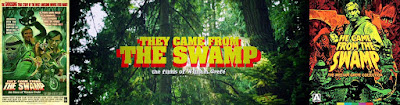
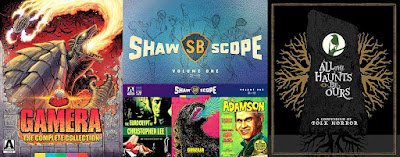
Just a quickie, short shout out review to Daniel Griffith’s interesting documentary They Came from the Swamp: The Films of William GrefĂ©. This plays, in it’s extended cut, on the last disc of Arrow’s nicely put together He Came From The Swamp - The William GrefĂ© Collection Blu Ray box, which houses seven of this director’s quickie exploitation films plus this film as one of the extras. Now, I hadn’t heard of GrefĂ© before this movie was put out by Arrow so I decided, much like I’d done with Severin Films’ Al Adamson - The Masterpiece Collection (although, obviously I knew who Adamson was), that I’d dip into the documentary first and at least find out a little more about the man before watching his works. And, frankly, if you want to know why I bought this in the first place, it’s the lure of one of GrefĂ©s early films, Sting Of Death, which has a really hilarious looking Jellyfish Man as the main antagonist... I mean, who doesn’t want to watch a movie about a Jellyfish Man?

The documentary, which I think was made independently of this release but has found a home in UK physical media distribution here, is basically a mix of the usual ‘talking heads’ interviews with people who knew/know GrefĂ© and who tell some interesting anecdotes about their time on the sets of a handful of the director’s movies... not just the ones in this set (I suspect the UK release of a couple of the movies not included might fall foul of a certain ‘red flag’ for the BBFC in this country, so my guess is they didn’t try to release them all).

Of course, one of those talking heads... probably the person most featured for this documentary... is GrefĂ© himself, who is now 92 years old (at time of publishing) and, from the looks of it on the IMDB, might still be working (he was filming episodes of a TV show in 2017 but I’m not sure if he’s still doing that or not). He certainly doesn’t look his age and he has some real stories to tell about his times leading up to him loving movies as a kid (especially those by John Ford), being bitten by the acting bug when he was young and going through the whole ‘Summer Stock’ experience before suddenly becoming a director, due to various reasons and opportunities. The talking heads also include some other directors, the most famous of whom is probably the Godfather Of Gore himself, Herschell Gordon Lewis, filmed for this documentary.

This is, as I said, a short review (and I’ll certainly be reviewing the films in this set at some point soon for the blog), but this full version of the film runs for just over two hours and includes little snippets of stories such as the man who was in the aforementioned Jellyfish Man costume, which basically had a big, semi transparent plastic bubble for a head, almost suffocating on set because of the lack of air supply. Or another as to how GrefĂ© managed to get Rita Hayworth at a discount rate for The Naked Zoo in 1970. Or how he’d have to shoot many of his films in really short time periods like, writing one overnight and then shooting it in a week to make the drive-in release deadlines. It also mentions the time he was sought out, since he knew how to film Florida and worked with alligators etc, to do the second unit direction in various countries on the James Bond movie Live And Let Die (which he did, my review of that one is here), with the comment that, with the budget he had to work with as a second unit director on that movie, he could have made three films for.

Perhaps my favourite story (which fortunately has a happy ending), is when William Shatner is telling us about the time he was working as the villain in the movie Impulse. There’s a private detective in the movie called Karate Pete, played by Harold ‘Odd Job’ Skata from Goldfinger. Anyway, Shatner tells his story and it’s accompanied by the unused outtake footage of the very thing he’s describing. As he tells it... and as we see it... Shatner was supposed to hang Sakata’s character from his house and then, when Sakata is dangling there and gurgling in the noose, Shatner starts improvising and hitting him in the stomach etc, as the villain would do and then trying to pry one of the gurgling Sakata’s arms away from the noose. As we watch and as Shatner describes it, Sakata’s other hand starts reaching for his pocket to try and get to it to write a note or something. Then, as Shatner realises that the safety rig had been incorrectly put on Sakata and that he was literally choking to death during the sequence, he lifts him up (not easy with a man as big as Sakata) to try and stop him from dying as he calls to the rest of the crew, who rush on to get Sakata down. Wow, a close call for Sakata but the actor would work again for GrefĂ©, opposite Richard Jaeckel in Mako - Jaws Of Death (a film that nobody wanted to finance but then, all of a sudden, the script became a hot property after Spielberg released Jaws).

And, yeah, that’s all I’ve got to say on this little gem of a documentary, They Came from the Swamp: The Films of William GrefĂ©. I’m kind of looking forward to exploring some of the films in this set, although I suspect it may be a very hit and miss affair. I’ll report back on my findings on this very blog, of course.

Monday, 21 March 2022

12 Years Of NUTS4R2


Physical Excavations

12 Years Of NUTS4R2

Okay, so it’s Friday night and I just discovered my 12 year blog anniversary is only three days away... not a month or so as I’d thought. So, faced with something of a rush deadline for this post (anniversary posts and additional 100 count posts being something I like to keep as a separate entity from a standard review), I thought I’d talk here about something which has been worrying me as of late... the switch from physical releases to streaming services. And not just for movies too... but for their soundtracks.

Okay, so streaming services got very popular over the pandemic... so did physical services actually, with record sales of Blu Ray and DVD players but, yeah, they're still far from the popularity, with the kiddies, of the streaming services. And I think this is a bad thing, not just from my end as a consumer who wants a movie (or indeed score) in a proper physical release but, also because I think the switch towards streaming is going to harm the art of film making to a certain extent.

I write this as various labels renowned for their physical releases... companies like Criterion, Arrow and even the BFI... have started up streaming services. They often have licences for other labels to stream alongside their own product too... I think the Arrow one has stuff produced by Severin and/or Vinegar Syndrome, for example... so I can half see the appeal. But it worries me that these companies are starting up these services, not only in direct competition with all the usual (some might say ‘evil’) suspects like Netflix, Disney and Amazon Prime... they’re also competing with the option of buying one of their own physical releases over their streaming alternative. Now, as far as quality goes... yeah, HD streaming looks fine but I still think a decent Blu Ray blows it away when it comes to quality. That’s only half of my worry though.

Firstly, labels like Criterion, Arrow, Vinegar Syndrome, Severin, Eureka Masters Of Cinema, 88 Film, Indicator, Second Sight, 101 Films and various other boutique labels are producing high quality product for various film-makers and in terms of physical releases, at present... we’ve really never had it so good. Although, with the current trends, I don’t expect that to last. Reading between the lines on comments I’ve heard from label producers from listening to a few podcasts, there seems to be a sense in the industry that film makers want their films to be released on decent quality Blu Rays with a slew of extras right now because many of them feel this is the last shot at a physical release they’ll have, to get their film looking the best it ever could. A kind of library copy for the future, if you like, showing the film in all it’s glory as opposed to what its possibly shoddy future on streaming is, if indeed it has one. So I believe physical media is the preferred choice for the majority of movie makers in the industry at the moment.

And lets look at those extras. There are various documentaries about a product, some invaluable commentary tracks (mostly the best commentaries are on older films but, yeah, everything becomes an older film at some point, right?) and various other extras which give the purchaser a very good look at not just the movie but the historical context of the film too... via digital press books, trailers, TV spots and even, in the case of many Indicator releases, the 16mm film projector cut down versions for selling commercially to collectors in the 1960s and 1970s. Now, I know some streaming services do carry the odd film with a commentary track or some kind of ‘marketing extra’ but, a lot of them don’t (I would suggest the majority of them don’t but that really is just a guess based on what I’ve read about them)... so we’re heading towards a time, once physical media production and the hardware which can access it has ceased production, where all this extra content could become a thing of the past... or only found as relatively low quality versions on the likes of YouTube but, rarely made specifically for a release anymore, I’d wager. And, hey, I get it! If you’re a casual movie watcher then you probably don’t watch most of this stuff anyway (and I don’t often find the time to explore that many of the extras as I’d like)... but for people who really love and appreciate film, this scenario is a bit of a nightmare, truth be told.

Not to mention the many horror stories I’ve read over the past few years on the likes of Twitter, where people are no longer able to access the film they want on any streaming service and so have gone shopping for the physical release, only to find it’s out of print and fetching silly money on the secondary market. These people have had the range of choice removed for them because they didn’t snag a longer lasting physical copy while they were still able to. They find their favourite film is no longer streaming at the present and, if it’s a relatively obscure film which means a lot to just a handful of people, based on the number of times it was streamed in the past, there’s a good chance it won’t be returning to a streaming platform anytime soon... or indeed, possibly ever. Bye bye favourite movies. 

 Look at what's constantly shown on the former terrestrial TV stations these days, if you don't believe me... where the same old films are repeated over and over within days of each other.

Also... and I think I’ve mentioned this before on this blog over the years... streaming is either going to kill the art of film or, at the very least, dumb it down somewhat... at least in terms of what will get green lit. At the moment, various film makers are loving companies like Netflix and Apple because they are funding films they want to make which they probably couldn’t get the money for at other studios not wanting to take a risk (for now)... Duncan Jones’ Mute springs to mind. But let’s just take that movie as an example of something which got funded which, as it happens, is a really good movie. Well for starters, it’s not available on physical media and, just like most of, say, Disney’s various TV shows, probably never will be. But most people haven’t got the money to subscribe to a load of different channels showing the content which that service has got the license to exclusively. Who has the money for Netflix, Amazon Prime, Apple, Disney Plus, Shudder, HBO etc?

So, sticking with the example, many people haven’t seen Mute (legally... I myself only managed to see it because I caught one of only a few screenings at a cinema one weekend in London, on very limited performances). Most people don’t know what they’re missing and don’t care... but what that leaves us with is a movie which is making ratings numbers just from people who have whatever channel it’s on. It doesn’t have the chance of a proper box office take in both a wide release pattern cinematic venue (where people can usually see content from all the studios and independents without having to turn up at a specific cinema only showing one brand of film) and it doesn’t have the blind ‘I fancy that’ buy of a person walking into a shop or trawling Amazon and getting interested in purchasing a physical copy behind it either. It’s not something which has had a shot at being displayed on people’s shelves in their home for some significant time and, subsequently, nobody is going to remember it 20 years from now.... they’ll remember the films that they have at home in plain view or the ones at their friend’s house.

And Netflix and their competitors, who are all doing very well right now, opening their own studios etc... won’t have a bottomless money pit forever. If they can’t make films which are giving them Avengers or Star Wars or Spider-Man levels of money at the box office, they’re going to eventually stop bankrolling those big budget spectacles (which, like ‘em or not, is arguably one of the things that cinema is all about... I’m sure Georges MĂ©liès would agree with me here) and settle for less risk projects. Given to producers, directors and artists who are willing to settle for less.

So, yeah, the shape of film will change because you can’t keep taking risks on projects which don’t, through their venue, have a shot at getting back a big return short term. And, okay, yay! We might get more independent, low budget movies for people who like to watch characters talking about ideas and love stories and various other lower budget things... which are also what cinema is about. But, unless we can somehow create a receptive culture where a significant chunk of young audiences, which account for the bulk of cinema and, I suspect, streaming revenue (in whatever form that takes) can get into this stuff ... then the audience won’t be there for those movies a lot of the time... they’ll have switched to computer games (which is where the future of cinematic storytelling may be anyway but, yeah, I’m not yanking on that thread here, today). So, films will run the risk of dying out or become the rare, deluxe item that are catering to a smaller percentage once more... just like current physical media enthusiasts. Except, in this scenario, the newer stuff with the smaller budgets and no attention to bonus features will lose out considerably to the cinematic legacy of what made a mark before, rather than what will be the current shiny thing, in whatever form that is. So we will still be talking about Star Wars and James Bond movies, for example, fifty years from now whereas, various other non-historical franchises will possibly crash and burn.

So, anyway, that’s my cheery warning of a thought to film lovers and a shout to buy all the lovely, rescued and restored, bonus features clad physical media releases while you still can. Some of those recent box sets of the last few years such as All The Haunts Be Ours, The Eurocrypt Of Christopher Lee, Shaw Scope, Marlene Dietrich At Paramount, Sam Fuller At Columbia, Cinematic Vengeance, Mae West In Hollywood, Hemisphere Horrors, The Al Adamson Masterpiece Collection... and a whole host of others I could name, are absolutely worth their weight in gold and, if you get the opportunity, you should take advantage of these releases while you still can. Pretty soon their ilk may not be seen again.

Anyway, that’s my 12 year anniversary post written and hopefully some of you will be reading this in a few days time (Monday 21st March 2022). And if you are, thanks so much, once again, for reading and, yeah, there should be some interesting reviews coming up very soon. 

Thanks for dropping by.

Sunday, 20 March 2022

The 355


Mission Inevitable

The 355
USA/China 2022
Directed by Simon Kinberg
Universal Pictures


Warning: Spoilers.

Well, they’ve been promising a female version of The Expendables, in terms of a powerhouse female action movie for some time now but never came through and so it was inevitable that something would pop up to fill that void and, this year’s attempt at that vacancy so far is The 355. Originally it was shot in a different form with some slightly changed characters as a TV pilot for a series that was never picked up (and I assume the pilot was never shown?). But now it’s a big budget movie and it’s got a stellar cast of credible looking, very smart actresses to take on the roles of the five main heroines of the movie...

There’s US secret agent lady Mace, played by the always brilliant Jessica Chastain. Her former opponent (from the early parts of the movie), German agent Marie, played by the wonderful Diane Kruger. There’s Mace’s friend in British intelligence, cyber expert Khadijah, played in a wonderfully British upper middle class way by Lupita Nyong'o. There’s ‘getting caught up in something she doesn’t belong in’ Spanish psychiatrist Graciela, played by the legendary PenĂ©lope Cruz and, finally, there’s ‘is she an enemy or is she an ally?’ agent Lin, played by Bingbing Fan.

So, five powerhouse actresses who, for the most part, seem a little wasted in likeable roles, to be honest, in a fairly entertaining... if unsurprising... film. Yeah, about that...

While I enjoyed the movie just fine, it’s very formulaic... like a lot of stuff coming out of Hollywood these days. It doesn’t matter, in a way, that the actresses are all so good in their roles because, frankly, there are two elements here which hamstring the movie quite badly.

One is the script.

One character played by Sebastian Stan, Mace’s partner, gets killed off very early in the movie. It happens off screen and a body is not shown. So, yeah, if you believe that character’s just left the movie, well... you’ve not seen many movies. Secondly, because Mace’s boss tells her that he’d died... if you go with your gut and assume the former character is not dead, you’ll know how credible an ally her boss is so, again, when he’s killed by ‘enemy presence’ Lin, it also kind of points to her really being one of the ‘good gals’ all along. So, unfortunately, it’s a film which has ‘reveals’ that unravel very quickly before they’re even declared, as each is set up like a little row of Matryoshka dolls unmasking the whole plot development before the movie has even properly started. So in terms of surprises... nothing to see here folks, move along.

The other thing that disappoints is that it feels like it’s an 18 rated movie that’s been gutted like a fish to bring it down to an age rating where kids can go and see it. Take just the fight scene elements, for example... they’re filmed in a vicious, brutal, hard hitting manner but you never really see any hard hitting gore or, for example, bullet shots to the head or body squibs etc... nor any stabbing highlighted. It’s like a 1970s Marvel comic in that respect and... I’ve got nothing against that for sure, I like that stuff... but this feels like the wrong venue to be playing those kind of ‘softening games’ considering the cold war backdrop of a group of rogue agents trying to obtain a hard drive which would mean the end of everything, if in the wrong hands, very quickly. The film is trying to be a cold war, secret agent movie but it feels like it keeps pulling its punches. My guess is, it was filmed as something with a higher rating and then cut down by the studio to reduce the likelihood of actually getting that rating. The same with the lack of nudity and intimacy in the one sex scene too... the tone felt off. Now, I may be wrong in what’s happened at final cut here but, heck, that’s what it feels like and that element of it didn’t do the film any favours, in my estimation.

But, regardless, the film does have the five lead actresses as it’s ace in the hole. All of them look like they could do what they are doing and it lends the movie an air of credibility it may have found tough achieving with some lesser artists in the roles. The cinematography and editing is also nicely done. Nothing too interesting in terms of shot design but I did like the subtle shifts in the colour palette between certain sections of the film, at it least subtle but most gorgeous when the girls turn up in Morocco and everything turns into whites with washed out yellows, browns and oranges. Nice stuff. And the editing didn’t get in the way of things really... just softened it a little due to, what I suspect, were deliberate omissions to that all important final cut. You certainly knew where you were in a fire fight though and it brings a certain clarity to the combat scenes where, again, a lot of modern Hollywood movies just bring confusion.

More confusing are such unanswered questions such as, how can Khadijah set the girls up with special spy equipment half way through the movie when they have no resources and are all on the run? Or, how can Khadijah’s boyfriend know it’s her calling him on the phone when we’ve already seen her smash up her phone so it can’t be traced earlier in the movie, so she surely wouldn’t have the same number?

So, all said and done, The 355 is an entertaining action movie and I’d recommend it to anyone who likes those things, with the caveat that the audience will see everything coming long before it actually is revealed in the story. There’s a nicely sinister and ruthless villain portrayed rather well by Jason Flemyng who is kinda wasted and thrown away at the end so, yeah, that doesn’t really help the movie either but he turns in a strong performance here, so there’s that. All in all, a nice looking film but, if you really want to see an absolutely amazing female action movie, then maybe you should steer yourself towards last year’s excellent Gunpowder Milkshake (reviewed here), which is far more innovative, surprising and much more interesting than this one. But, The 355 is an okay action movie and better than many cranked out these days, for sure.