Mech N’ Roll
Terror Of Mecha-Godzilla
aka Mekagojira no gyakushu
Japan 1975
Directed by Ishirô Honda
Criterion Blu Ray Zone B
It’s funny how one’s perceptions of a movie can change when you revisit it years later. I remember watching Terror Of Mecha-Godzilla once, almost thirty years ago and thinking that it wasn’t that great (that being said, it was an English VHS version, which was probably the dubbed American cut, I would expect). Looking at it now I realise it’s one of the high points in the series.
This is the ‘last film’ of things in a few ways. Firstly, it was the final Godzilla film in the Showa Era wave (and hence the last in Criterion’s wonderful Showa Era boxed edition). The character would not return to cinemas for another nine years later, rebooted back to being the antagonist rather than hero of the films, with the Heisei Era movies which revisited the monsters and encounters of the original series in ‘modern’, re-imagined ways.
Secondly, it’s the last Godzilla film of the director of the original (and many of the early sequels), Ishirô Honda. He decided to do this film on a freelance basis, years after he had been ‘let go’ by the struggling Toho, because he liked that the woman who wrote the original script was from his area and I think he realised there was an interesting plot at the heart of this one, which is still effectively a direct sequel to the previous movie in the series.
Thirdly, not only was it’s Honda’s last Godzilla movie, it was his last feature length film period. Although, as I’ve mentioned before, he afterwards went to work as assistant director on some of the films of his good friend Akira Kurosawa. I personally belive it’s Honda’s assured direction of this one which makes the film superior to many of the other, later entries in the Showa Era movies.
Look at the lengthy opening credits sequence, for example. Honda chooses to play selected highlights of Jun Fukuda’s footage from the final fight of Godzilla VS Mecha-Godzilla (reviewed here), by way of a recap, of sorts. Also, true to Honda’s ‘very slow burn’ approach, since Godzilla only turns up in the film about two thirds of the way through, it’s a way of giving the viewers a taste of what’s to come and keep them in their seats. However, the way this is edited together is far more exciting and attention grabbing than it was in the original film the footage was culled from. This is not a failing of Fukuda, perhaps, since it obviously is paced faster but, I did find it interesting how there was even a sense of gravitas to the clash of these two titans in this revisited opening as opposed to just the humour of watching it the first time around.
Of course, it doesn’t hurt that while the opening credits are playing out, we have the return of another old, absentee from the series for a while in the form of composer extraordinaire Akira Ifukube... and it’s great to hear his original Godzilla march playing over this titanic battle. In fact, in terms of the first two thirds of this movie, I’d say this is right up there as one of Ifukube’s finest Godzilla scores, although, towards the end, is does tend to sound like he’s constantly playing the same cue over and over, it has to be said.
The plot of this film involves the wreckage of the Mecha-Godzilla under the surface of the sea going missing. A submarine searching for it is destroyed by a dinosaur called Titanosaurus. For some reason, the good guy scientist at the Japanese equivalent of an Oceanic research lab are puzzled as to how a dinosaur could suddenly be alive. I’m more puzzled, bearing in mind they all clearly demonstrate they have a working knowledge of not only Godzilla’s various appearances... but also many of his kaiju antagonists and allies... that they are suddenly surprised there’s another one. But, hey... whatever!
Anyway, Dr. Mashumi, played by Akihiko Hirata, is helping the aliens from Black Hole Planet 3 (the antagonists of the previous movie) by controlling Titanosaurus and also helping them with their super duper, ‘rebuilt and improved from the previous wreckage’ version of Mecha-Godzilla. He does this because a) he is an embittered man who was sacked 15 years before for believing in dinosaurs and controlling them (which makes no sense, see previous paragraph) and b) because they saved his daughter when she got accidentally electrocuted helping him. His daughter, Katsura, played by the beautiful Tomoko Ai, was given robotic insides and helps control Titanosaurus. When she takes a knock later in the film, they also bury the controller of Mecha-Godzilla in her, to make things easier. Probably shouldn’t have fallen in love with one of the good guys then, I guess. Which is what is really at the heart of this story and probably what drew Honda to it... can a cybernetic girl still love and have human thoughts and feelings. Gee, I guess so, is what the writer and director conclude here. By the way, if you’re wondering why the name Akihiko Hirata, who plays Dr. Mashumi, looks familiar, he’s no stranger to having parts in various Godzilla films over the years and it was he, of course, who played the doomed hero Dr. Serizawa who created the Oxygen Destroyer in the original Gojira (aka Godzilla, reviewed by me here).
There are a couple of things of note in this one, such as a prisoner of the aliens being gunned down with multiple bullets and the director actually using blood squibs... which you wouldn’t really expect to see in a movie made specifically for the Children's Champion Film Festival in Japan. Similarly, there is some nudity, of a sort, when Katsura is undergoing surgery and her mechanical innards are being repaired... her breasts are clearly visible here. Admittedly, they’re bizarre, prosthetic breasts such as you might find on a department store mannequin but this didn’t stop the footage from being censored in the US release of the film.
Other than that it’s kaiju shenanigans as usual but Honda genuinely brings a certain levity to the proceedings and, like many of his previous movies, takes things quite slow. It’s the first time in a while Godzilla hasn’t had an ally other than the humans to help him defeat his foes and, arguably this is noticeable. He gets beaten up quite badly by Titanosaurus and Mecha-Godzilla in this one and, it has to be said, without the humans blocking Titanosaurus’ controls with sonic waves and Katsura killing herself to relinquish control of Mecha-Godzilla for the good of humanity, then Godzilla wouldn’t have had a chance here. As it is, he gets to swim off into the sunset and this is his goodbye for the original cycle of films.
Criterions presentation of the film is wonderful, as are all of their entries (barring the ‘hidden on a different disc’ and slightly less quality transfer of the Japanese version of King Kong VS Godzilla, reviewed here). This really is the only set of these you need to be going for if you don’t speak Japanese and want a quality presentation of the material. Terror Of Mecha-Godzilla is a fine film from the franchise although, you kinda need to see the previous film to get all the references. Definitely it would be high on my list of Showa Era films, for sure and, as such, is one of my recommendations in the series. As is the wonderful Criterion boxed edition, Spine Number 1000 for all you Criterionphiles out there. Definitely worth the investment... these films have never looked better in English speaking territories.
Thursday, 6 January 2022
Terror Of Mecha-Godzilla
Sunday, 25 July 2021
All Monsters Attack
Godzilla Home Alone
All Monsters Attack
aka Gojira-Minira-Gabara:
Oru kaijû daishingeki
aka Godzilla's Revenge
Japan 1969 Directed by Ishirô Honda
Toho/Criterion Collection Blu Ray Zone B
Okay...so time for me to re-watch and review what is a singularly unique film in pretty much all of the various Godzilla eras. After the success of the previous film in the series, Destroy All Monsters (which I reviewed here and which is, confusingly, known by the title All Monsters Attack in some territories... possibly the same ones where this film has a title change to one of many, such as Godzilla’s Revenge), Toho decided to carry on the series of Godzilla films after all (the previous was intended to be the last, initially). However, the mostly diminishing returns of many of the previous films in the cycle made them look at what their imitators making the Gamera films were doing right and so, this one was tailored to be a Godzilla film targeted at younger children... ready for release into cinemas at Christmas.
The film has a strong child protagonist who pretty much carries the film on his own and, in fact, the many scenes with various monsters on Monster Island all take place in the imagination of the lead protagonist, who often dreams, Walter Mitty-like, about his friends Minilla, Godzilla and various other monsters. Which is why, in this one, cute little Minilla even has a load of scenes with dialogue as he talks to the boy, Ichiro, played by Tomonori Yazaki. Being as the monsters don’t actually appear in the real world at all in this movie, outside of collaborating with Ichiro in his dreams, pretty much anything is permissable and I guess having Godzilla’s son loafing around and talking Japanese is a good example of this.
Okay, so the plot of this is... schoolboy Ichiro is ‘picked on’ often by the school bully and he’s a latchkey kid, not seeing much of his parents as they tend to work all hours while relying on a friend, a toymaker neighbour, to provide him with food when they’re gone. Thrown into the mix are two robbers who have just stolen 50 million yen and are hiding out in the area. Ichiro’s mind wanderings, where he watches Minilla and Godzilla battle various monsters in what are mostly re-tracked footage from previous Godzilla films, help him to become confident enough to tackle his bullies and, during the second part of the film, evade recapture after he has been taken as a hostage by the two robbers, when he inadvertently stumbles into their hiding place. In fact, pretty much the whole last quarter of an hour of the film is Ichiro laying in wait in an abandoned building, foiling these two criminal buffoons in what has to be an early precursor and possibly even an influence on the Home Alone movies.
The film starts off as it means to go on, with a fun song in what would be a completely out of place score in most Godzilla movies, playing through the credits. Composer Kunio Miyauchi only did little more than ten movie and TV show scores, such as work on Ultraman... this was his only score for the Godzilla series. The opening song, sung by a child chorus against, at first, footage of fighting monsters... is pretty 'out there' for the series so far (more groovy songs were coming). This is followed by an opening which, like the rest of the film, shows how well Honda could shoot movies with some truly interesting shot designs. The opening here follows Ichiro and his friend as they walk home from school through a city where the grime and pollution of the urban environment really hits home. As if to highlight one of the underlying social messages of the film, the song then starts up again and tells us that “smog and exhaust are the real monsters”. This message of the evils of pollution would, of course, be much more overtly explored in the next film in the series (which also happens to be my favourite, if memory serves).
The other two messages the film wants to impart seem almost a little contradictory. On the one hand it criticises the adult world and the parents who leave their young to fend for themselves while they go to work but, on the other hand, the scenes where Godzilla is strict with his son to stand up and fight for himself and his enthusiasm to train Minilla to make a stand, kind of emphasises, to some degree, the exact opposite.
This move is not very well liked, it seems, by fans of The Big G and, while it’s not great, I do have a soft spot for it, not just because is has some beautiful cinematography but because it tries to break the mould and do something different. Honda makes some interesting aesthetic choices which I’ve not seen him try before, such as lots of sequences which are filmed in slow motion or various static images used as a montage to make an almost comic book like sequence in places. Indeed, the abruptness of the effects and edits and the psychedelic segues into the dream sequences, where even the laws of gravity are not as harsh as in the real world, give the film a kind of 1970s anime kind of feel. It’s a long way from his usual style so... that’s pretty interesting, isn’t it?
This playful style may be at odds when, say, one of the robbers pulls a flick knife and wants to stab the kid but for the most part it gets away with it. There’s one sequence during a monster fight where the composer does a kind of ‘homage riff’ on Akira Ifukube’s main Godzilla character theme (not the march) but, mostly the music is light hearted and much like you would expect, in fact, for a children’s movie.
So that’s me done with All Monsters Attack. This is not the disaster that a lot of Godzilla watchers tend to make out and actually has a lot of interesting things in it, if you can handle the slightly more childish tone. Definitely one you’d need to take a look at if you want a well rounded look at the different styles of Gojira movies over the years... this one’s very unusual.
Tuesday, 8 June 2021
Destroy All Monsters
Crouching Eiga,
Hidden Dragging
Destroy All Monsters
aka Kaijû sôshingeki
Japan 1968 Directed by Ishirô Honda
Toho/Criterion Collection
Blu Ray Zone B
Well, the next up in my rewatch of The Showa Era Godzilla films, courtesy of Criterion’s lovely Blu Ray Book Edition, is Destroy All Monsters and... well it’s a bit of a curio. Especially since only one monster is actually destroyed in it.
Depending on which version of the film you are watching (Japanese or American), the film takes place in Earth’s far future... at the end of the century (Japanese) or 1999 (American). After being introduced to some of the characters on the moonbase we are straight into a title sequence that, for some reason, I have no recollection of in terms of visuals but... well... the opening title music is absolutely stunning and you can tell right away that Akira Ifukube was back on board. One of the biggest strengths of this film is its wonderful score and, even if the visuals and drama in this were terrible, it almost wouldn’t matter because I spent most of the film tapping my toes along to the music.
As it happens, it doesn’t have terrible visuals or drama. Like Honda’s previous films in the series, this one is strong on story and plot twists but, unlike his earlier works, this one gets straight to the monsters after the end credits. It seems that in our future, the monsters from various Toho films all live together on Monster Island... so Godzilla, Minilla, Baragon, Mothra, Rodan, Varan, Manda, Gorosaurus and Kumonga. Eagle eyed monster movie spotters will no doubt wonder why some of these creatures are still alive, having been killed off in earlier kaiju eiga but, I’m afraid I don’t have an answer for you on that one.
Anyway, tragedy strikes as the people in the control sections of Monster Island (referred to as Monsterland in this iteration) are gassed... along with all the monsters. What is going on? Then tragedy strikes as the ‘escaped’ monsters start attacking the rest of the world. Rodan attacks Moscow, Baragon (kinda) destroys Paris, Mothra sorts out Beijing, Manda is malevolent in London and Godzilla takes out New York. What’s going on?
Oh, wait. The monsters didn’t escape at all. Instead they, along with the human staff of the island, are under the control of the Kilaaks, a race of space aliens who want to take over our planet. It’s up to Captain Katsuo Yamabe (played by series regular Akira Kubo... who you might recognise from films like Mantango - Attack Of The Mushroom People and some of Kurosawa’s masterpieces) and his trusty moon rocket crew, with the aid of Dr. Yoshido (played by another Gojira and Kurosawa regular, Jun Tazaki) to help the military resist and get up to all kinds of shenanigans as each twist and turn of the plot is revealed.
Luckily, the humans finally defeat the aliens who have been calling the shots on the moon and then regain control of the various ‘Earth kaiju’ so they can lead a big, all out monster attack on the alien’s not so secret base under Mount Fuji. One complication is, as an eleventh hour surprise for everyone, the aliens summon space monster King Ghidora. There is much glee from the alien antagonists as they tell their human enemy, “Earth’s monsters are no match for him.” Which seems to be a bold claim and I can only assume the aliens haven’t watched the previous Godzilla films to feature King Ghidorah. The Big G has needed much less aid than he has in this one to try to take down his old, three headed foe and, predictably, the ‘big monster team’ fight ferociously and suffer no casualties as they defeat the behemoth. Little Minilla, Godzilla’s son, puts in a finishing touch by blowing one of his cute, trademark smoke rings over Ghidorah’s last, surviving head, which proves to be the surprising last straw that breaks Ghidorah’s defensive back. What’s more surprising though, for a film set in the Earth’s far future in the year 1999, is that little Minilla hasn’t grown to become a big Godzilla like his father already.
This film probably has both more monster and human VS alien action in it than the majority of Honda’s work in the Godzilla series but, in amongst all the set pieces, he still finds time to give us bright colours, nicely lit sets and some creative shot designs. There’s a scene where a doctor who has been taken over by the aliens is being interrogated by Katsuo and Dr. Yashida, in which a kind of decorative screen is placed between the three actors and the camera. The elabourate screen has three circles in a row going the whole width of the shot and from the top to the bottom of the screen. The back of the doctor’s head is large and more than fills the middle circle. However, with the perspective of the shot, the other two actor’s heads are perfectly framed in the centre of the two circles on either side of this character. Yeah... there’s some great stuff here.
This was supposed to be the last hurrah for the Godzilla films as the box office returns for the kaiju eiga were diminishing with every new entry... thus the idea to have a load of monsters in the one film (it would be many decades later before this many monsters in the series would be matched... or exceeded, in fact). However, this was a pretty entertaining movie and, I guess the audience thought so too at the time because, this one was a huge financial success for the company and kept them going with the Godzilla series for quite a few more films comprising the Showa era.
And I honestly don’t have much more to say on that. I think Destroy All Monsters is one of the most fun in the series of films and, despite the unintentional hilarity of many of the scenes (or possibly because of it), it’s certainly one I’d watch more enthusiastically than some of the others. Next up for the series, though, would be a very different kind of Godzilla movie indeed. I’ll let you know about it after I’ve watched it again soon.
Sunday, 28 February 2021
Beast-Human Snowman (Half Human)
Yeti’s Berg Addressed
Beast-Human Snowman
aka Jû jin yuki otoko
aka Half Human
Japan 1955
Directed by Ishirô Honda
Warning: Some very slight spoilers but probably not enough to warrant stopping interested readers from pursuing this review, I suspect.
Although not his next film after his original Godzilla, Beast-Human Snowman was the second of a steady stream of sci-fi, horror and /fantasy films made just one year after Ishirô Honda’s most famous behemoth, The Big G, was released onto Japanese screens.
It’s also a lost film.
Yeah... so this film was released to cinemas for a short while by Toho in Japan before being 'unofficially banned’ by them, due to various misconceptions (and possibly the nation’s collective guilt), about the depiction of the mountain tribe in parts of the film who, like the title character, live on and around Mount Fuji... many of whom appear deformed due to in-breeding. As such it’s never been released onto any home video format (it was almost released once on VHS tape but got pulled at the last minute) and has remained largely unseen apart from a print which, very occasionally, gets screened at Ishirô Honda film festivals in Japan. I can only assume that’s the source for this blurry transfer of, what looks like a pretty good print, which I purchased from one of the ‘usual kind of places online’, because I didn’t want to end up dying at some point before ever being given the opportunity to watch this film.
It’s true, the usual truncated recut for American audiences, called ‘Half Human’ in this case, was released into cinemas in 1958 but, from what I can understand, this is probably the most compromised version of a Japanese film recut for American release that I’ve ever heard of. Reportedly, between various scenes utilising footage of John Carradine in a new, grafted on and tonally changed story, only half an hour of footage from this original Japanese version found it’s way into that re-cut, by all accounts. So, frankly, I was willing to take a punt on the possibility that the print here might be totally unwatchable in the hopes of being able to see this at last. As it happens, the print is pretty much like one of those bad transfers of old movies at the dawn of DVD so... yeah, quite watchable depending on your expectations, I suspect.
It’s also, as it turns out, another early masterpiece from Honda and, frankly, it’s a crime against filmanity that a film this good has been left to wallow unseen for, so far, 66 years. This needs a decent Blu Ray print released on the double but I suspect the chances of that happening in my lifetime are slim to nothing.
The film starts off in a grim setting... a kind of station waiting room in the rain where a reporter finds a small group of Alpine Club members deep in gloom. They have been to find out what happened to another party lead by a professor who is a brother to one of them. A woman in part of this second expedition, played by Momoko Kôchi, also has... well, had... a brother on the first team but they find his remains a little while into the movie. Apart from one brief cut back to this scene a third of the way through... and then back to it at the end of the movie, the entire film appears as a flashback as told to the reporter. And what a film it is.
After finding the remains of one person, they wait and go back after the ‘spring thaw’ to resume their explorations. Meanwhile, another outfit trying to discover the ‘big foot’ creature that lives there for exploitation purposes, in the tradition of King Kong but more ruthless and unrelenting, are keeping an eye on them without them being aware of their presence. And also, the mountain tribe I mentioned earlier, with the beautiful village daughter played by Akemi Negishi (who was discovered by Von Sternberg and who you might remember from roles in such films as Lady Snowblood and the Female Prisoner Scorpion movies), is a third ‘interested party’ in that they help feed the bigfoot and his son, worshipped as deities in the village.
And there are a lot of shenanigans and twists to the story which I won’t relate or spoil here but, I will say that, at no time, is the title creature presented as anything other than a pacifistic, non-threatening and tranquil creature, completely worthy of our sympathies. Indeed, when one of the characters is being held prisoner and left dangling over a mountain for vultures to finish off, the creature pulls him up and then frees him from his bonds before going peacefully back to what he was doing. Indeed, the only time the creature becomes aggressive and wilfully violent is when, upon regaining consciousness after his son attempts to rescue him, he sees his young ‘un shot to death. So he first kills the people involved with the murder before going to the village of the local tribe and tearing through it in a frenzy of revenge (the tribe actually had nothing to do with the death of his offspring but, he has no way of knowing that as he now obviously sees humans as treacherous and dangerous).
It’s a beautiful looking film shot with a group of actors who are all highly convincing (even the larger than life, evil stereotype of the fortune seeking entrepreneur serves the film well) and also, it has to be said, very familiar. I think I recognised a few members of Akira Kurosawa’s stock company of actors here including the ‘morale booster’ character from Seven Samurai.
There are some great compositions in the 4:3 aspect ratio and Honda uses the frames well, especially in the group shots where everyone seems to be on the screen without the shots seeming over crowded. Also, there are some great skiing shots where big, diagonal swathes of snow take up a lot of the composition as the team of the Alpine Club glide across the frame. There’s even one shot which reminded me a little of a moment in a Kurosawa film called Stray Dog, where he goes to an extreme amount of non-action space on a frame. In this case, we see a big mountain valley and, at the very bottom of the shot, like ants and taking up less than a 20th of the vertical space, the small group of the expedition are walking from one side of the frame to another, almost hidden before the eye is attracted to the movement.
Added to all this, there’s some interesting stuff where the camera shoots through undergrowth and we can just make out the movement of a figure behind it all. Are we watching one of the party or a bigfoot, seems to be the challenge of shots like this and, I have to say, they fit in really well.
The film is genuinely intriguing and atmospheric too, primarily in the way the tension is ratcheted up before the audience is let in on the true, peaceable nature of the title creature.
One such scene is when the expedition first go to find out what’s going on and are staying at a log cabin (where they meet Akemi Negishi’s character the first time). In one sequence where the gloomy tension and mood of the expedition is dominant, the silence of the room is first shattered by the hourly warblings of a cuckoo clock before immediately being followed by the sound of a phone ringing. When one of the party answers it, we hear yelling, the wailing of a beast and a shot, heralding an ominous atmosphere of a potentially hostile creature (later we find that the creature was trying to rescue and care for an injured party but, by then, things have escalated).
Another great sequence full of creepiness is when we first meet the bigfoot. Momoko Kôchi’s character is sleeping in her tent when, in the window of the canvass just above her sleeping form, appears the face of the creature. It then reaches inside an opening in the tent with its hand and, out of curiosity, starts feeling around her face before she wakes up and screams in terror. It’s a nice moment and also our first inkling that the ‘Beast-Human Snowman’ is not the aggressive creature one might expect in this kind of genre movie.
And that’s me more or less done on this one. Masaru Satô’s score is perhaps less striking than I would have expected from him but perfectly suits the mood and tone of the picture. There’s a bit of an error when you may realise that many of the events being told by the returned party and conveyed to the reporter are not anything the Alpine Club members could have possibly had any knowledge about but, I think I’ll kindly put that down to framing the whole story for the audience as opposed to the first hand knowledge the reporter is getting. Artistic license and all that.
Whatever its very minor faults though, make no mistake, Beast-Human Snowman is one of Honda’s best films and, like I said earlier, it’s a real crime that this one has not had a release and that, at time of writing this article, most people haven’t seen the film and a lot of people are probably even unaware that this film exists. So, in the end, yeah, I was glad I paid the money on this one and am really happy to have been given the opportunity to see it. If you are a fan of Japanese fantasy films of this type, you may well want to try and track down a source for this one. Great movie. Deserves a proper release.
Thursday, 28 January 2021
Battle In Outer Space
Anti Gravitas
Battle In Outer Space
aka Uchû sai sensô
Japan 1959 Directed by Ishirô Honda
Toho/Eureka Masters Of Cinema Blu Ray Zone B
Battle In Outer Space was directed only a year after Ishirô Honda’s The H Man (reviewed by me here) but, even so, he managed to sandwich directing another six features in between that one and this. This is part of the new double bill of Honda restorations released very recently on the Eureka Masters of Cinema label and, between these and their simultaneous release of a UK edition of Mothra (which I reviewed in its previous Blu Ray edition here), Eureka have basically reissued the old US Toho Icons Of Sci-Fi DVD set of these three films and relaunched it, at a higher price, for the UK market. But it’s still a welcome release and, although I really don’t have much to say about Battle In Outer Space (it’s an okay watch but nothing really special), I’m really glad that The H Man was restored and, frankly, there are still some nice things about this one which are worth noting.
One of those is ‘the Japanese John WIlliams’ Akira Ifukube’s rocking score, which is basically cribbed off one of his sub themes from the first Godzilla and also makes its way back into the Godzilla franchise at various points. What this means is, no matter how bad or ridiculous things get on screen, the viewer can at least tap their toes along to the rocking score as it plays through, sometimes a little less than appropriately, as the story unfolds.
Alas, that story is absurd but at least it’s fun. The film was made in 1959 but it’s actually set in Earth’s far future of... 1965. I’d like to think the Japanese really were that optimistic that, by 1965 they’d have manned space stations and a space force but... yeah, the projection of where they’d be at seems a little absurd, especially considering this was made ten years before man even got to the moon.
Starting with a group of flying saucers who destroy said space station, the plot unfolds as they go to Earth and do dodgy things, causing destruction that makes no sense. For example, we see them levitate a huge (model) railway bridge and so a train plummets to destruction but, then they just put the bridge back and you’re left with the question of... why the heck did they want to do that anyway? Soon, though, the pesky Earthlings plan their counter move, with two rockets sent to the moon for reconnaissance. However, the aliens (who we never get to see out of their spacesuits), have taken over a human in the crew and turned him into a spy, who they force to explode one of the two rockets while the ground crew are skirting around, trying to find the alien moon base. There’s a battle on the moon where the alien base is destroyed, another battle escaping back to their lone standing rocket (which is somehow a much more interesting sequence than the rest of the film) and then, when they return to Earth, the planet is galvanised into action, building a defence force for one big super battle above our planet.
It’s pretty tame stuff and, like always on these films, some of the effects and model work is quite good and... other stuff isn’t (you can clearly see and count all the various strings holding up all those models). Some of the models are nice though, especially the cute little lunar mini-buses which the humans use to journey around to the light side of the moon. They’d make really good Japanese tin toys and, for all I know, they might well have been at the time.
One quite comical moment comes when a crowd of aliens finally encounter two of the Earth people and attempt to stop them. They totally sound like a group of dogs all got a new squeaky toy for Christmas and are squeaking them all together at the same time for a sustained period. This made me smile... as did the various ray guns and lasers in the wonderful sequence where the two moon buses are trying to beat a hasty retreat back to their rockets, not knowing one has already been destroyed.
And, yeah, not much else to say about Battle For Outer Space. This was always going to be a short review because there’s nothing really great or really terrible about it. It’s a solid, late 1950s Japanese sci-fi movie which is probably superior, at least in the ambition of what the writers and director were trying to do compared to the US films of the same ilk but, perhaps because of this, lacking the real gravitas of the situation which is constantly etched into the faces of the various characters (as it should be). Nowhere near my favourite of Honda’s films but I’m looking forward to listening to the new commentary track at some point and I love the colours and clarity of the restoration of the thing. So top marks to the Eureka Masters Of Cinema label, once again. I’m assuming we’ll be getting The Mysterians from them or a similar label again sometime soon.
Sunday, 10 January 2021
The H Man
Blob’s Your Uncle
The H Man
aka Bijo to ekitai ningen
Japan 1958 Directed by Ishirô Honda
Toho/Eureka Masters Of Cinema Blu Ray Zone B
It’s been a while since I saw The H Man but I’m really grateful for Eureka putting this out on a really nicely restored Blu Ray (as part of a double bill set with The Battle In Outer Space) because the film hasn’t grown old for me. I still think this is a much more interesting movie than the original version of The Blob, which was released the same year as this one and shares a somewhat common element. The inspiration for this was the real life incident of the Lucky Dragon Number 5 fishing boat which strayed into a nuclear testing zone, the very same thing which inspired the director’s earlier classic, Godzilla (aka Gojira, reviewed by me here).
I’m also delighted to find that the print is subtitled with the actual translation of the real movie title on the Japanese language version here, so it’s Beauty And The Liquid People which is, frankly, a much more accurate title for the film. Although The H Man is also pretty cool, let’s be honest.
The film starts off strongly with some eerie pinging from Masaru Satô’s wonderful score, marking time on the soundtrack as the suspenseful prelude to a rainy night’s narcotics pick up goes wrong for the gang members involved. One gang member starts shooting at the floor and runs into the centre of the road and into the path of an oncoming vehicle and, when his partner gets out of the getaway car to see what’s happened, all that’s left of him are his clothes.
We then get the usual bafflement from the police, headed up by kaiju eiga legend Akihiko Hirata. They go and hassle the disappearing gang member’s girlfriend, the ‘beauty’ of the Japanese title, played by the wonderful Yumi Shirakawa, who is a singer at the local night club. The police obviously mitigate their bafflement by assuming that the gang member, quick as a flash and before anyone could see him, removed his clothing and ran off. Because, yeah, that’s just what a normal person would do in the middle of a rainstorm, right? Well, apparently, according to the police and various members of the gang in question, who also hassle Shirakawa (one of them coming too close and being violently absorbed by The H Man of the UK title).
Meanwhile, a dashing young scientist and new love interest for Shirakawa, played by classic kaiju actor Kenji Sahara, believes a liquid monster, possibly more than one, is absorbing people it doesn’t like, who are getting in the way of its former girlfriend. And, of course, after the police refuse to listen to him multiple times, he’s later proved right.
The whole thing is actually pretty fun and, well, some of the special effects are wonderful and... others not so good but it never once stops being entertaining. Honda brings his usual, wonderful sense of screen composition and injects the thing with a sense of cool more reminiscent of something Seijun Suzuki might have cooked up if he’d have wanted to make a monster movie.
Beautiful frame designs abound with some nice greys and greens plus a really good eye for using natural and, not so natural, vertical slabs of the screen to frame different things in. Indeed, this is so pronounced in some shots that they are literally split into exact thirds by the vertical slats created by doors or boxes etc. There’s a flashback scene on a ship where some sailors discover the bizarre ‘liquid people’ of the Japanese title, when they are going into the belly of the ship with lanterns to light the way... and the director uses these shots to further push his fascination with vertical patterns, using the travelling light source in the actors hand to literally light upright rectangular slabs filled with people while the rest of the screen is left black. It’s a really wonderful use of the ‘Tohoscope’ ratio and exactly the reason why I end up watching these kinds of films in the first place.
Another thing he does, which is something I would more associate with much later films, is to use a cut to a shot meaning one thing before cutting away to reveal a transition to another scene. For instance, when the lead scientist drops the lifebuoy of the irradiated ship onto the floor at police headquarters, we cut to a close up of the shot of the buoy on the floor and then, when we cut away from it again, we are already in the scientist’s crowded lab with the various people also looking at it on their floor. So, yeah, nice stuff like this is what watching these films are mostly about for me. Along with listening to some cool music and seeing outrageously bad monsters, of course. Although, the two night club scenes, where the actress is dubbed with a completely inappropriate voice as she sings to songs in English, had me scratching my head a little... especially as to why Eureka felt they needed to subtitle the song when it was already being sung in English. It’s a little bizarre.
However, when it comes to great colours, great composition, slime monsters and a cool soundtrack, this movie really delivers the goods and, I think, is one of Honda’s better movies (and he made a lot of highly entertaining movies in his time, as watchers of his various kaiju eiga will know. So, yeah, Eureka Masters Of Cinema’s new Blu Ray restoration of The H Man is definitely one I’d recommend for any fans of this period of Japanese cinema’s output. I’m really pleased that I have this version on a beautiful looking Blu Ray.
Sunday, 29 November 2020
King Kong Escapes
Kong Voyage
King Kong Escapes
Japan/USA 1967
Directed by Ishirô Honda
Toho/Universal Blu Ray Zone B
Warning: This one has spoilers.
So I took some time out from the Criterion Godzilla set to pop this one in. King Kong Escapes is a muddled but entertaining movie... alas, entertaining for all the wrong reasons. Now, I’ve no idea what the proper Japanese cut of the film is like but I suspect it’s not all that different because, although the film has actors like Rhodes Reason and Linda Miller in it, it was an American co-production and they all appeared in scenes with many of the Japanese actors such as Godzilla veterans Akira Takarada and Mie Hama (Hama was also a big star for the Bond film You Only Live Twice, reviewed by me here, by this point). Hama plays the main female villain who, in a fit of conscience towards the end, double crosses the main male villain of the piece, Hideyo Amamoto as the nefarious Dr. Who. Yeah, okay... not that Doctor Who. Another one, although, it has to be said, the costume and look of the character seems very much based on the William Hartnell incarnation of everybody’s favourite timelord at the time.
That being said, Who is a carry over from the source material of this film... which isn’t really, as many may suspect, a sequel to King Kong Vs Godzilla (which it’s often marketed as and which you can find reviewed here). Instead, it’s a big screen adaptation of a Rankin/Bass King Kong cartoon of the time... it’s also the last time Toho had the rights to use the character, unfortunately.
The film is... well it’s kinda terrible, despite being directed by Godzilla veteran Ishirô Honda and having a, somewhat slow and ponderous score by Godzilla composer Akira Ifukube. It’s fun though but, alas, the humour on this one is completely at the expense of the cast and crew, it has to be said. The dialogue and plot are... well I guess like something you’d find in a cartoon of the time and the effects work is, surprisingly, mostly abysmal.
I mean, take the ‘not so bad’ actress Linda Miller (she only appeared in three movies and one TV episode but, one of those movies was The Green Slime... reviewed here). Here she is being picked up by a badly 'matted in' giant hand against a live action plate but, as soon as we see her in the hands of the, truly ridiculous looking King Kong man in suit (possibly even worse than the version from King Kong VS Godzilla) in long shot she is a lifeless, plastic doll which, throughout the movie, only has one costume. Now, Ms Miller gets picked up by her new pal Kong fairly frequently throughout the movie, it has to be said but, although one of her costumes does look a little like the one on the rigid doll in the hands of the ‘suit-mation’ Kong, most of the time she’s wearing something different. It doesn’t matter to the special effects guys though... if she’s wearing white or some other colour, when it cuts back to the doll in the hand... she’s back to wearing yellow. Not only that but, through the course of the movie (and depending how wet she gets in a scene... she takes a dive into the ocean before being picked up by Kong at one point), she has a kind of ‘dirty blonde’ hair. However, when she’s seen in long shot in Kong’s fist, that really is going to change to a vibrant redhead on the doll, for sure.
Other things about the ridiculous effects are the fact that, when our heroes go to check out Kong’s island near the start of the movie, the strange hover ship they use is nicely designed but, honestly, you can clearly see the wires as it’s lifted over the tank of water standing in for the sea. Added to some truly boring fight scenes and this iteration of Kong really is nothing to write home about. The fight Kong has with a dinosaur is fairly ludicrous but I think that one, at least, was played for laughs. However, there’s a big set up battle in the movie and you’re waiting for it to happen and, when it does... well, more on that in a moment.
So the other big hangover from the cartoon series was the invention of the giant robot Kong facsimile, Mechani-Kong. He’s introduced into the plot line to mine for ‘Substance X’ for the villains before the ‘real’ Kong even enters the movie and, all the way through you’re just waiting for the battle between these two titans to unfold. When it does... well it takes place in Tokyo, mostly with a kind of ‘climbing dual’ as the two Kongs climb something which looks remotely like the Eifel Tower (except we’re in Tokyo) and... well... it’s a bit anti-climactic, it has to be said. But, even so, there’s a lot of fun to be had about the idea of this head to head and, ridiculously bad as it is, it still holds a curious entertainment value (this is like the fourth or fifth time I’ve watched this movie in different formats over the decades).
The Mechani-Kong from the cartoon show and made flesh... err... steel here was presumably the inspiration for the similar looking, semi-regular villain Mecha-Godzilla who made his first appearances in the Showa Era films Godzilla VS Mecha-Godzilla in 1974 and the final film in that first cycle, Terror Of Mecha-Godzilla. So some good came out of this movie in regards to that element at least and, either way you look at it, Mechani-Kong certainly looks great and makes for some good photos and artwork. More than his hairy co-star at any rate... who seems to have a permanently manic look about him with his huge, staring eyes.
And... yeah, that’s really all I’ve got to say about King Kong Escapes. A fun but insubstantial piece which has so far been given, it has to be said, a truly insubstantial Blu Ray release. The transfer is okay but you can only watch this in the English dub and, talk about bare bones. I’d moan about the extras if there were any but... remember some of those early DVDs which, when you put the film in the player, didn’t have any kind of menu and just went straight into ‘the movie is now playing, deal with it’ mode? Well let’s just say that this is the first Blu Ray I’ve had which does just that. No menu, just a quick copyright notice and then the film starts playing. Universal really should take a leaf out of the book of Criterion, Severin, Arrow, Indicator, Blue Underground and various other labels who know how to market films like this. I’m hoping somebody will get the smart idea of releasing limited edition kaiju sets with the proper Japanese versions of films like this and Frankenstein Conquers The World in them, crammed with extras pertinent to the subject matter. Until that time comes, alas, we’re stuck with what I would call substandard releases like this and, yeah, I’m glad I only spent £6 on this edition is all I’m saying. If you can get it cheaper, it’s worth a quick look.
Tuesday, 18 August 2020
Invasion Of The Astro-Monster
Crouching Eiga,
Hidden Dragging
Invasion Of The Astro-Monster
(aka Godzilla VS Monster Zero
aka Kaijû daisensô)
Japan/USA 1965 Directed by Ishirô Honda
Toho/Criterion Collection Blu Ray Zone B
Warning: Some spoilers in this one.
So the next in my watch through of the newish Criterion Spine 1000, Godzilla - The Showa Era, is one of my all time favourites of this period... Invasion Of The Astro-Monster. It’s also a direct follow on, in some ways, to the previous film in the series, Ghidorah, The Three Headed Monster (reviewed here).
Once again directed by original Godzilla director Ishirô Honda, this film displays one of what I will more often than not describe as one of the strengths of this particular director working on the franchise (although sometimes also a weakness, as I have concluded in another of these reviews previously), that of having the monsters manifesting quite selectively, perhaps even at their most minimalistic in terms of screen time and only used as a way to fulfil the needs of the underlying story, rather than be an all out monster slug fest as many of the later ones could be considered.
So, for example, the film starts off with some absolutely brilliant music by classic Godzilla composer Akira Ifukube, taken from my favourite, secondary march from the very first film in the series, accompanying a sequence of still images from the movie which very much push the ‘astro’ part of the title... so the rocket that the astronauts fly, a flying saucer and shots of a giant radar dish (all of which are models) and absolutely no monsters here at all. Despite the trailer for the movie probably showing off that three of the main monsters from the franchise were back in action in this one, Honda is playing it real cool and not giving away his hand at this point that this is, indeed, a Godzilla movie.
In fact, it takes a while for the monster aspect to emerge as the story follows, like King Kong VS Godzilla, two plots... one involving the main action and one involving an invention which will eventually help save the day.
For the main part of the plot, we have two astronauts flying into space to check out a mysterious new moon of Jupiter named, perhaps demonstrating somewhat less imagination than one might hope for... Planet X. The two space aces are Fuji, played by Akira Takarada (who, like some of his co-stars in this movie, starred in many Godzilla films in different roles as well as films by Akira Kurosawa) and Glenn, the American played by Nick Adams. Presumably named Glenn to give a nod to real life space hero John Glenn, Nick Adams was good friends with both James Dean and Elvis Presley but his downwardly spiralling career in films like this and some of AIP's features (before all this stuff was re-evaluated by modern cineastes and nostalgia driven contemporaries) may well have contributed, among other things, to his probable suicide by drug overdose three years later.
One element about this film which is truly awesome is the special effects created by series regular Eiji Tsuburaya and his crew and, in particular, in the outer space settings. The rocket miniatures are awesome and there’s some really beautiful and very colourful stuff when the rocket lands on the brightly hued, textured surface of Planet X. There, in a plot far more convoluted than any of the previous films in the series, the ‘commandant’ (if the subtitles are to be trusted) of the Xiliens, the alien race native to the planet, offer up our species a cure for cancer in exchange for us allowing them to ‘borrow’ Godzilla and Rodan to fight the scourge of their own planet, Monster Zero... who it turns out, is King Ghidorah, fled there from the last movie (or recalled there, perhaps).
Meanwhile, Fuji’s sister Haruno, played by Keiko Sawai, also works for the Japanese equivalent of NASA... but Fuji doesn’t trust her new fiance. Her new fiance, Tetsu (played by Akira Kubo) is the other part of the ‘good guys’ plot, as he has invented a portable alarm system which nobody wants until a lady called Miss Namikawa (played by Kumi Mizuno), who also winds up as Glenn’s new girlfriend, buys it for her shady organisation.
And then, after a brief but entertaining interlude where Godzilla and Rodan defeat Ghidorah on Planet X (including a little victory dance by The Big G), the convoluted plot twists start to come as it turns out the Xiliens really just wanted to conquer the Earth, with the help of Godzilla, Rodan and King Ghidorah, so they can rule us and use our water. But luckily, before we are destroyed by the aliens, Fuji and his scientist friend construct weapons which will nullify the effects of the aliens... sorry, Xiliens... evil, electromagnetic control over Godzilla and Rodan.
Meanwhile, the other plot twist is gradually revealed as it turns out the organisation that bought Tetsu’s new personal alarm invention were just doing so to keep it off the market. The sound it emits completely sends the Xiliens into paroxysms of agony (and also short circuits a lot of their technology, somehow, it seems to me). So Tetsu and Glenn, after escaping from the Xiliens Earth, base, construct a super duper version to broadcast to radios and amplify around the world. You can’t blame them for being captured earlier on in the film though... after all, the aliens usually have a dark strip of a visor in front of their eyes and a radio antenna coming out of their head... which makes them all look a little like Alfalfa from Our Gang/The Little Rascals. When they’re undercover on Earth though, they dress just like us. Not easy to spot when you’re used to their regular look, I suppose.
The film brings in the usual monster showdown at the end, starting with all three kaiju stomping the country until the signals from the saucers are jammed and Godzilla and Rodan then re-team up to defeat King Ghidorah. Godzilla even tries some ‘float like a butterfly, sting like a bee’ boxing moves out on the three headed monster. And it’s an entertaining movie with some interesting moments and, given the amount of really good looking effects and beautiful sets, some obvious cost cutting exercises in other areas. Such as the various riots internationally following on from the Xilien’s ‘ultimatum’ announcement taking the form of documentary style black and white stills montaged together to try to hide the fact that... well... this was the cheaper way to do it.
For me, though, Invasion Of The Astro-Monster is one of the very best in the series... part of that is because the sequences on Planet X are quite bright and well composed... and partly because Ifikube’s score for this one is just so much fun that my toes tend to tap along most of the way through it. Not my absolute favourite but, certainly a runner up for me. Criterion’s new Blu Ray transfer is awesome when it can be but there are some fairly blurry moments too (possibly due to some of the stock footage from previous films in a couple of places). Either way, this was always one of the selling points of their new box set and it’s a great addition to any cineaste’s shelves... or even the casual viewer like me.
Thursday, 16 July 2020
Ghidorah - The Three Headed Monster
Ghidorah With Excitement
Ghidorah - The Three Headed Monster
Japan 1964 Directed by Ishirô Honda
Criterion Blu Ray Zone B
So this next kaiju movie, which I am reviewing as part of Criterion’s lovely Spine 1000 box set of The Showa Era of Godzilla films, is very much a direct sequel to the previous film in the series, Godzilla VS Mothra (reviewed here). That’s not to say things haven’t moved on a little in this entry, Ghidora - The Three Headed Monster, as we’ll soon discover but some of the characters (human and kaiju alike) recur and many references are made to the original film.
This one is directed, once again, by Ishirô Honda... who was responsible for kick-starting the series with his original movie Godzilla (reviewed here), as well as directing other films starring both The Big G and a variety of other monsters, such as Mothra (reviewed by me here). And like his previous kaiju eiga, this one has a very slow build up but, where that really seemed to hamper the previous film in the series, this one has a very entertaining plot which is developed over a half an hour before the first monster even turns up... in the form of Rodan (or Radon as he was know in Japan... wish a legitimate Blu Ray release was available for this monster’s debut feature). In fact, this is probably the best in the series so far since the original Godzilla movie and it never once gets dull.
The opening titles are a bit strange, showing a series of 'moving to freeze frame' monster moments from the forthcoming movie and I can only assume that this was done because of the slow build up on this one (much like the inclusion of ‘home video footage’ of Godzilla in Godzilla Raids Again, reviewed here). In this case, the decision is not the best because, as I said before, the plot development on this one is quite interesting and holds its own against the forthcoming attraction of battling behemoths.
Okay, so lets get to that plot then. Characters and their relationships with each other are established very economically with some nice, catch all lines which make any subsequent patter redundant, so it cuts to the chase very quickly compared to some of the other dialogue writing in the series... for instance, the line when a character is asked if there’s "anything up" is followed up with the answer... “If so, your paper would be on it before us cops.” Stuff like this really moves things along nicely and cuts a lot of extraneous material which might have been there in an alternate approach.
Primarily, the film centres around the princess of a fictional country called Sergina, played by Akiko Wakabayashi. She was in a few of these kinds of films but Bond fans may remember her for her performance as Aki in You Only Live Twice, three years later. Everybody in Sergina seems to dress with big Elizabethan ruffles around their necks, making them look totally out of place in the modern world in which this movie is set. Even their briefly glimpsed military look completely strange, as they all appear to be dressed in bright red Santa suits. Thankfully, not many of the princess’ scenes are set in her home country and she is the unfortunate victim of an assassination plot as her plane explodes from a bomb planted within. Or, at least she would have been if a strange alien voice in her head hadn’t urged her to leave and caused her to jump out into a bright light outside the aircraft before it explodes... could this have something to do with the mysterious UFOs that Naoka, the other female lead played by Yuriko Hoshi, has been researching for her job on the upcoming TV show, Mysteries Of The 20th Century? Pretty likely, I would say.
Confusingly, Yuriko Hoshi was in Godzilla VS Mothra playing a similar but totally different character. It’s puzzling since another of the main protagonists, Professor Miura played by Hiroshi Koizumi, reprises his role from that same film. He is studying one of the ‘mysterious meteors’ with strange properties that have crashed in the area. Meanwhile, the Princess resurfaces as an uncannily true prophet, who walks around in an almost trance-like state warning people to flee, as she believes she is a Venusian who can see into the future. Which she kind of is actually, because the Venusian light thing that rescued her from the plane is obviously controlling her actions.
She warns people to keep away from a mountain, for example, just a short while before Rodan busts his way out of it. Then, after Godzilla goes on the prowl again, out of the blue, she also warns about the creature that's the instigator of the destruction of the Earth, King Ghidora, the three headed monster of the title... who promptly hatches in a strange, phoenix like manner from the mysterious meteor.
Meanwhile (again), Mothra’s tiny guardians, played once again by the pop duo The Peanuts (their third and final appearance in a Godzilla film), are in town for a TV appearance and we are informed that, of the two surviving Mothras from the previous movie, one has passed away. Which is a shame. However, when Ghidorah starts his rampage, The Peanuts summon Mothra (who stays in larvae state for the entire movie) to talk sense into the warring Godzilla and Rodan, in a sequence in which we see Mothra talking to them while The Peanuts translate for the benefit of the audience... and so the stage is set for an epic battle at the end of the movie where Godzilla, Mothra and Rodan team up to battle King Ghidorah.
While all this is going on, we have the cop trying to protect the transformed princess from a group of hit-men who have been sent from Sergina... so we have a Godzilla movie with some proper gun battles in it too, which wouldn’t, it has to be said, look totally out of place in a Seijun Suzuki movie. The second half of the film also features legendary actor Takashi Shimura in his last appearance in a Godzilla film, as yet another new character, Doctor Tsukamoto.
And... it’s a really entertaining movie and a lot better than how I’d remembered it.
The special effects on this one are great and even the scenes where live action and miniature work are blended look pretty good (as opposed to the previous movie). There’s a lovely shot too, where Godzilla rising up out of the sea is preceded by the backs of fleeing whales rippling the surface of the water... this is really nice stuff.
The sound design is a mixed bag though. Nice work with the silenced guns of the villains, so the heroes louder gun shot sounds have their own signature and you can hear just who is doing the shooting at any one time in a gun battle. I’ll never understand, though, why Rodan always seems to sound like a jet engine. That just never works for me.
Akira Ifukube provides a magnificent score for this one and uses his big, ponderous Godzilla main theme a lot. There’s even something like a theremin used for some of the UFO/meteor moments. Curiously, though, his big Godzilla march still doesn’t make a reappearance here, at least that I could hear. There’s a wonderful musical build up when we first see King Ghidorah attack a city and we see the people shutting up shops and fleeing.
There’s a big musical misstep here though, as far as I’m concerned and, yes, I know selling records would have been a priority here... but there’s a brand new Mothra song which The Peanuts perform in two scenes and, well, it’s just not good... although matched visually by some nicely montaged shot compositions, such as the heads of the two blown up large on either side of the frame, superimposed with the chanting natives on Infant Island sandwiched between them.
All in all though, Ghidorah, The Three Headed Monster is a really entertaining and rewatchable entry into the series and brings in the concept of space aliens and space monsters to the films, acting as a great prelude/set up to the next movie in the series the following year, which was always one of my favourites, Invasion Of The Astro-Monster.
It also marks a great turning point in the series because Godzilla starts off as a menace but, when talking to Mothra and revealing his reasons for his former behaviour... and then agreeing to team up and help protect the earth from King Ghidorah... he finally takes on the mantle of heroic protector of Tokyo which would pretty much stick with him for most of the following films in The Showa Era. There’s also a hint at how whacky and comical the character would become as his laughter and amusement at Rodan getting equally covered with Mothra’s semen-like silk is plain old slapstick, pantomime acting... it’s quite hilarious, as are some of the reactions the monsters have to each other during the fights. This is one of the best movies in the series, for my money but... the best was yet to come.
Thursday, 18 June 2020
Mothra VS Godzilla
Raiders Of The Lost Bukkake
Mothra VS Godzilla
aka Godzilla VS The Thing
aka Mosura tai Gojira
Japan 1964 Directed by Ishirô Honda
Toho/Criterion Collection
Godzilla - The Showa Era Box Set Blu Ray Zone B
Mothra VS Godzilla is a sequel to both Mothra (which I reviewed here) and King Kong VS Godzilla (which I reviewed here). Directed by original Gojira and Mothra director Ishirô Honda, this is pretty much the last time in the Showa Wave of Godzilla films that he is portrayed totally as a menacing figure. Barring, of course, him being controlled by evil aliens but, yeah, I’ll get to that in a future review.
Another thing it shares with both the original Gojira and Mothra movies, courtesy of this particular director, is the slow and ponderous nature of the plot which once again concentrates on various human characters such as those portrayed by Akira Takarada, Yuriko Hoshi and Hiroshi Koizumi. This way of gradually building to the inclusion of the main monster characters can often work well but, as far as I’m concerned, this really doesn’t help the pacing at all on this one and the characters themselves, even the token human villains out to exploit Mothra’s egg, are all pretty dull and forgetful. The only bright spot is, of course, the pop duo The Peanuts, reprising their miniature roles from the first Mothra movie. Alas, their single costume in this is pretty hideous and it’s hard to take them seriously when they are wearing such silly, furry hats.
So the basic plot set up is this. After a mudslide caused by a typhoon carries Mothra’s egg onto the ocean and out to a beach in Japan, it is ‘bought’ by a philanthropist and his naive but still evil co-investor to design a theme park around it. The Peanuts try to retrieve the egg but are left empty handed. Then Godzilla rises from a beach in much the same way that a future George A. Romero zombie would and starts causing havoc. In fact, for a while there he just seems to be stumbling around and tripping over things, accidentally destroying them, until his aimless path of destruction becomes more focused and intentional.
The humans from Japan manage to enlist the aid of the original Mothra, who is near the end of her life cycle, to try to repel Godzilla. Alas, halfway through the first battle, Mothra finally expires but then the egg hatches and it seems she has given birth to twins. Two twin larvae finally take Godzilla down and then return with The Peanuts to Infant Island where they originated.
This one was very popular in Japan but, I have to say, the pacing really drags it down and the special effects don’t really hold up as well as even some of the earlier movies in the series. Shots of the giant Mothra egg on the beach while people stand around it and watch look terrible and it’s obvious from the inclusion of these shots that the close up scenes of the egg on the beach show the only small portion of the shell that the effects department built to full scale. The cracks on the egg as it hatches look a bit better than last time this happened though, it has to be said.
Some of the battles look okay and although her spawn only ever remain in their larvae state, the original Mothra looks pretty good. There’s also some interesting shot choices in the movie too. For instance, one of the shots of a cityscape has the camera panning along, stopping and then going back to a building it just passed before zooming in on one of the windows to give us the establishing shot of the next interior scene. This is quite bizarre and is almost a foreshadowing of the way modern TV shows use the camera in a kind of reactive mode to ‘find their shot’ as a play for authenticity.
Other things of interest in the movie include a scene where one villain punches the other and his face gets really bloody, before he shoots the other guy. And they don’t skimp on the blood there either... which is strange for a film which many might perceive to be a ‘family, kid-friendly movie’ but this ‘adult’ tone is not the last time this will occur in a Godzilla movie, if memory serves.
That being said, nobody even thinks to ask who or what it was that’s got Mothra in her pregnant state in the first place. Seriously, who has a penis big enough to fertilise Mothra? I didn’t notice Chuck Norris anywhere in the movie so this is a real plot hole.
And talking of penises... that’s exactly what the two Mothra larvae look like in the last ten minutes, when they take on Godzilla. Basically bobbing up and down and spraying Tokyo’s nemesis with white webby stuff which looks pretty much like they are... um.. cumming all over Godzilla’s head and shoulders repeatedly. Yep, I wouldn’t mind betting this is where the Japanese porn staple of bukkake really started, foreshadowing it by around 20 years. Never mind The Big G... this is pretty much The Big GGG (and if you understand that joke then you have no right to come complaining to me about the observation and, if you don’t understand it, don’t Google it around kids or at work and don’t say I didn’t warn you).
Ultimately, this film hasn’t aged well but it does have a nice score by Akira Ifukube, although the main march is absent. It also references certain orchestrations and melodies from Yûji Koseki’s score from Mothra, including The Peanuts doing a new rendition of the famous song. So there’s that. Certainly, Godzilla watchers will need to see this one in order to get all the links between previous and future films but it’s nowhere near the best in the series, for sure. That being said, the rushed production and release of the next one in the series, Ghidorah - The Three Headed Monster, brought out the same year as this one, is a fair bit better, if my memory of it is anything to go by. I guess I’ll be finding out for sure soon enough.
Sunday, 24 May 2020
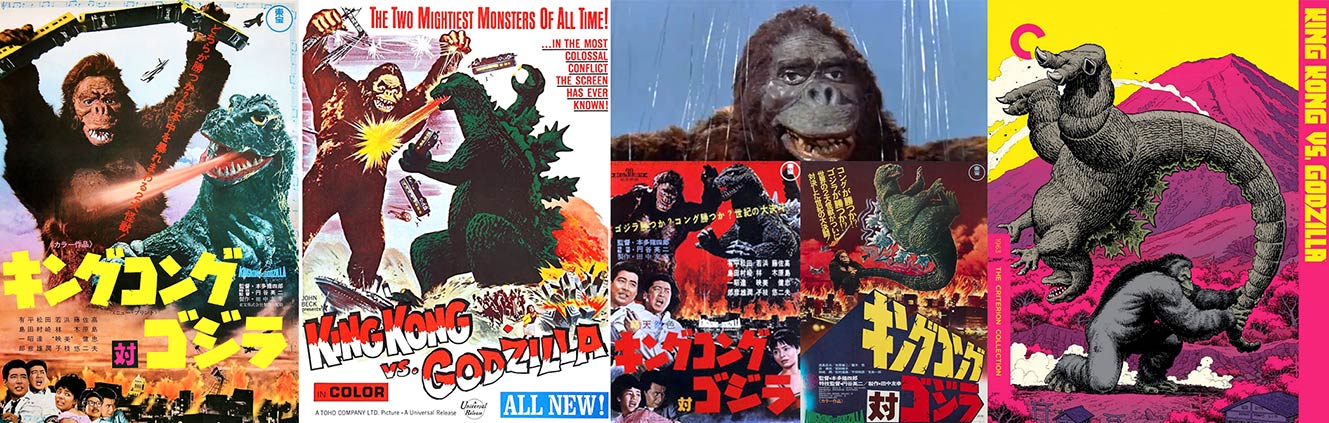
King Kong Vs Godzilla
Crouching Eiga,
Hidden Dragging
King Kong Vs Godzilla
(aka Kingu Kongu tai Gojira)
Japan/USA 1962 Directed by Ishirô Honda
Toho/Criterion Collection Blu Ray Zone B
So seven years after Godzilla Raids Again (reviewed here) had, presumably, ended Gojira’s onslaught on the Japanese and US box office, there was still a lot of interest in King Kong and Toho Studios wanted to celebrate their own 30th anniversary with a slate of big films including something with the much loved giant ape in it (Kurosawa was also coaxed, grudgingly, into making the second and final sequel movie in his career with Sanjuro, his follow up to Yojimbo). So the Japanese did a rights deal with US studio RKO, who still held the rights to King Kong and... wondered who he could fight in his film. The answer was, of course, Godzilla so... in a way, King Kong saved Godzilla because the Godzilla cycle really took off after this movie and hasn’t really stopped for any great length of time since.
When I took out the next disc of this epic Criterion set, I was dismayed to find that the version of King Kong VS Godzilla was the butchered, re-edited version with loads of stuff missing and some terrible fake TV broadcast news sections inserted all the way through to try and explain the story. It’s a truly awful version of the movie and, until now, the only one I’d ever been able to see, alas. Once the film finished... and the American version truly is a dreadful way to experience this movie... I was all ready to ‘tweet angry’ at Criterion to complain about their bad judgement in only including the stupid US version.
However, just before I did this, I came upon an article which explained that the original Japanese cut of the movie is, indeed on this set... it’s just ‘hidden in plain sight’ on the eighth disc as an extra. It seems weird to me that the one film which is, I suspect, the main draw for a set like this for a lot of people, is kinda tucked away at the back of the set like it’s somehow not the most important movie on here. However, it’s not been treated that well either in that, the scenes on this version of the film that are in the American version are proper Blu Ray quality while the scenes which are unique to the Japanese version are, in a lot of cases, only in DVD quality and, in some instances, the change over from one source to another can be quite jarring. So... yeah, a little disappointed but at least it’s on here (unlike the US version of Godzilla Raids Again... yeah, thanks Criterion).
The film in summary is very simple. Godzilla emerges from the ice in the form of an iceberg... presumably that’s what the island he was frozen on has become in the seven years since the last movie... pulling himself out of his deep freeze due to shear strength of will it seems to me. Meanwhile, two TV reporters go to Faro Island (not Skull Island as in the original Kong movies) to get some unique red berry juice and also look into the local legend of a legendary evil God-like presence living on the island. It is, of course, King Kong who, after fighting a giant octopus, falls asleep while drinking some of the berry juice and so is towed back to Japan in time to fight against Godzilla. There’s also a sub-plot about one of the reporter’s brother, who has invented an unbreakable steel wire which dovetails into the main plot towards the end of the film when the authorities lift Kong by helium balloons attached to this wire to get the slumbering beast closer to Godzilla. It’s all very silly in both cuts of the movie but the US version renders it completely ridiculous with bad dubbing changing the actual dialogue and, also, turning into a bizarre ‘selected highlights’ edition by cutting in and out of scenes for more explanatory exposition by the added American and Japanese news teams. The US version also includes terrible dialogue choices like “King Kong can’t make a monkey out of us.” They leave out a lot of the ‘TV ratings war’ satirical edge that Honda has in his version too, with all the re-dubbing.
Another thing the Americans really overdo on their cut of the movie is keep mentioning the atomic bomb. Every time the authoritarian Japanese scientist turns up and everyone is overdubbed with completely different dialogue, people just keep asking him if they’re going to drop an atomic bomb on The Big G. Really weird and almost a subconscious but punishing reminder of the horrific US triumph over the Japanese during the Second World War. On the Japanese version, the Hydrogen Bomb is only mentioned once and very briefly. This could be so that, as every Japanese person will remember, Gojira was woken and reborn from the atomic bomb tests so... well, it’s not going to do any damage to it at all if they use such devastating force. So it’s a bit of a weird and persistent inclusion on the US cut.
One thing the Japanese version also seems to forget though, especially since it’s the director of the original Gojira movie at the helm here, is that electricity didn’t stop Gojira either. Indeed, in this movie, this actually works on the monster, contrary to everything we already know about it. That being said, the electricity only makes King Kong stronger... he’s seen literally eating it from wires at one point... and, towards the end of the movie, lightning strikes fix it so that Kong can actually channel electricity through his fingers. So, yeah, not a lot of continuity with the original Kong in this one then. Although, to be fair, this idea might have been inspired by a famous, 1930s publicity still montage which pictures Kong with a load of lightning behind him in the sky.
The fights are entertaining in this movie. They are more comical and a bit like a wrestling match... much to the dismay of director Honda, who wanted to keep the monster elements more serious than the rest of the movie... but they are quite watchable and this is pretty much the direction that the majority of the Showa Era films would go when depicting their epic battle sequences. That being said, the fight scenes in the Japanese cut seem just a little bit longer and more consistent somehow than the US version, which seems to chop and change and then leave the action very quickly at the first chance. Not sure why this is, to be honest. They do both include a beautifully silly moment, though, where Kong uproots a tree and shoves it down Godzilla’s/Gojira’s throat... only for The Big G to fire it up and then spit it out at Kong as a flaming projectile. Nice stuff. Also, the effects work on the giant octopus which fights Kong at the start, apart from a comical moment where it sits on Kongs head and engulfs it, is actually pretty realistic and probably the most interesting effect in the whole movie.
Both cuts feature some very colourful scenes on Faro Island with the indigenous population there, although, all the of the islanders appear to be Japanese actors wearing black face so, yeah, they wouldn’t get away with this kind of approach today. They also show the influence of the US producers in some places, like the inclusion of the vinyl album cover of Hollywood Love Themes one of the Japanese characters has on the wall of her house.
A huge difference between the Japanese and American cuts is the score. The Japanese version has a proper score by famous Gojira composer Akira Ifikube, which brings back themes from his first one and is generally appropriate and well spotted. For example, when Godzilla is finally identified emerging from the ice, the famous, ponderous Gojira sub-theme swells up on the soundtrack and has a lot more impact than the throw away attitude of the American cut of the same scene. The US version’s treatment of the music is just preposterous. Hardly any of Ifikube’s score is retained and there’s generally a lot less music in this version of the movie anyway. Instead, when they feel it is called for, the Americans needle drop old 1950s sci-fi B-movie scores in instead and it can be very jarring, I can tell you, when King Kong takes on either a giant octopus or Godzilla himself when all you can hear on the soundtrack is the famous three note sting based music from Creature From The Black Lagoon (which I reviewed here). It just pulls you out of the movie completely. Of course, Ifikube kinda got his revenge on the US decades later in the first of McG’s Charlie's Angels movies when, all of a sudden on the soundtrack, the Godzilla sub-theme swells up... which caused me and, I assume, many others, into believing there would be some kind of visual Godzilla reference making its way into the shot. It’s kind of disappointing it didn’t and, since it completely pops you out of the movie because the soundtrack is telling you ‘Godzilla is here!’, I have no idea why it turns up in that first Charlie’s Angels movie at all, truth be told.
And there you have it. King Kong VS Godzilla had and, I believe, still has the highest Japanese box office gross of any of the other Gojira films. It’s an important movie and well done to Criterion for including it, no matter how well hidden and only partially restored in terms of quality, on their big Godzilla box set. I was hoping the obvious Blu Rays of Mothra, Rodan and King Kong Escapes would also make their way into this box due to their obvious connections to these films, many of which are sequels or prequels to these three films but, alas, Criterion didn’t quite push the boat out as far as they could when they put this impressive set together.
Thursday, 14 May 2020
Mothra
I Larvae Good Movie
Mothra
Japan 1961
Directed by Ishirô Honda
Toho/Mill Creek Steelbook Blu Ray Zone A
And so onto Mothra.
Made by the director of the original Gojira (aka Godzilla, reviewed here), Ishirô Honda, Mothra is similar in style to that movie in that it’s a fairly slow burn for the first part of the story. It’s strong on characterisation though, focusing on a scientist, a reporter and the reporter’s photographic assistant, played by Hiroshi Koizumi, Furankî Sakai and Kyôko Kagawa respectively. We also have screen legend Takashi Shimura turning up as the chief editor of the newspaper where the reporters in question work.
The film starts off with a somewhat overly long opening credits sequence where the typography is superimposed over shifting shots of very colourful rock textures, before we get into a ship crashing on the supposedly irradiated shores of Infant Island in yet another reference, presumably, to the real life radiation accident with a bunch of fishermen that inspired the original Godzilla movie. When the few survivors are rescued it is found that they are not irradiated at all and a group of investigators, including the main scientist and the reporter (who stows away), are sent to Infant Island to investigate. It is there that they find two teeny tiny doll sized ladies played by the Japanese pop duo The Peanuts, who are kind of guardians of the Mothra legend and held in high regard by the group of natives who, just as in King Kong VS Godzilla (review coming very soon), consist of a bunch of Japanese people in black face. Not very politically correct these days, I guess, but fine for anyone over the age of thirty, I would imagine.
It’s in this first section that Honda sets up the necessary human villain who is the spanner in the works regarding the peaceful coalition of islanders and civilisation. This is a ‘single monster’ movie (albeit a dual incarnation monster) and so there has to be an antagonistic element somewhere. This comes in the shape of a philanthropist bad guy and his henchmen who all come from the country Rosilica. In my naiveté, I suspected that Rosilica was a less than subtle stand in for Russia so the writers could have a dig at that country and show them up to be the land of origin for the less than intelligent and evil antagonists. As it turns out, I was only half right... it’s an amalgam supposed to represent both super powers... Russia and the USA, showing them up to be the bad guys as, well, subtly as it can manage I guess.
Anyway. Long story short... the villain kidnaps The Peanuts so he can put on shows with them in Japan and so they sing (regularly) and this, combined with their psychic link to the sacred Mothra egg and the natives doing their ritualistic dance, causes Mothra to hatch as we first see her, in larvae form... which is basically a white grub-like creature which swims across the seas to rescue The Peanuts, causing a wake of destruction in her path. This is because, in the words of the two ‘small beauties’ (as they are referred to in the film), Mothra has no sense of right or wrong... which is possibly at odds with her heroic nature later on in the Godzilla franchise but certainly it’s a step in the right direction to having a film with a ‘good monster’ in it as opposed to the normal perception of them.
From hereon in, the movie is about the cities trying to battle the Mothra larvae while the heroes are trying to track down the film’s prime villain, who has stuffed The Peanuts into a suitcase and is on the run with them. At one point, when the humans think they have destroyed Mothra, all that’s happened is it has cocooned itself, emerging from the cocoon a day later as the full on flying ‘moth’ version of the creature, with it’s voice as distinctive as Godzilla’s roar.
And that’s pretty much everything and the story continues mostly as you’d imagine but, once again, Honda shows a real knack for framing and building characters rather than just concentrating on monstrous action. Indeed, the first half of the movie is devoid of this kind of spectacle asides from a fairly cheaply done blood sucking plant on Infant Island. He also takes time to hone in on little details which other directors might not bother with, such as a view of a ship’s wake through calm water by way of an establishing shot and to add to the atmosphere of the thing.
We also have Yûji Koseki’s score, which seems organ dominated at times and which is, mostly, very different from what Akira Ifikube would do for a film like this. And, of course, there are the songs sung by The Peanuts including the famous Mothra Song. Plus some nice use of leitmotif as the Mothra theme comes back in different arrangements in moments when you’d least expect it to.
All this and some nice but variable special effects. The model work in some of the scenes is still quality stuff and some of those tanks must have been just fronts of lorries for some of the shots because there’s an impressive moment when a human, not a puppet, is riding a motorbike right next to one of those things. And it still makes me laugh when somebody says that they’ve called on the 'Rosilican Heat Ray Brigade', as though those mobile heat ray cannons actually existed... but the model shots of them and the tanks battling the Mothra larvae are still very impressive here.
What’s not so impressive are the matte lines where shots are composited together and, as you might guess, this nice new Blu Ray transfer of the film just makes that dodgy stuff all the more apparent. It’s also really easy to spot the strings holding Mothra up too so... that’s not necessarily a good thing either, to be honest. Although, having said that, I’m glad they didn’t make the heretical decision to digitally remove the strings for the Blu Ray edition.
In terms of the leading villain, I find it curious that a big, elaborate ‘death by Mothra’ scene was planned for him originally but, in the final movie, he never actually meets Mothra. Instead, he just has a ‘super villain mad moment’ towards the end and is gunned down by the authorities for his trouble. Which actually seems quite a lot bleaker, truth be told.
All in all, though, while it possibly drags a little for some people's tastes during the first three quarters, Mothra is a solid entry into the kaiju eiga of Japanese cinematic legacy and it’s easy to see why she was revived for the Godzilla franchise a little while later. Although, due to the way she’s pitched here, she doesn’t die at the end (instead is seen as a rescuer character), it should have made bringing her into the Godzilla franchise an easy task but my memory is kicking in and telling me that it’s not necessarily the ‘same’ Mothra in the later films because, I seem to remember she starts off in her larvae state in the first of her Godzilla appearances too?* I’ll know soon enough because it’s in the Criterion Blu Ray set I’m steadily working my way through so I’ll report back on that sometime soon. If you’re a fan of Japanese monster movies then the original 1961 version of Mothra certainly isn’t the worst of them and it’s well worth a look, especially to see how the human characters are portrayed in these things.
*My memory was faulty, it turns out. There are, in fact, three Mothras
in that next film and it does follow on from events in this one... kinda.
Thanks to Charlie Brigden for helping me source a Blu Ray copy of this.