Showing posts with label nunsploitation. Show all posts

Monday, 27 February 2023

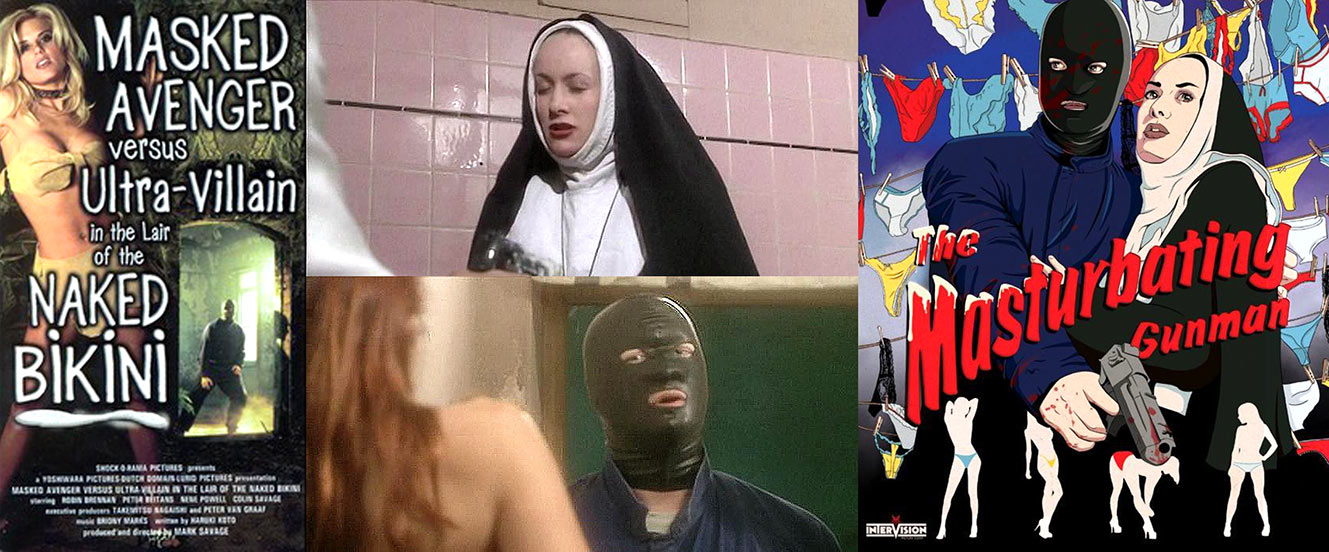
The Masturbating Gunman


Fantom Seed Slinger

The Masturbating Gunman
aka Masked Avenger Versus
Ultra-Villain in the Lair
of the Naked Bikini

Directed by Mark Savage
Australia 2000
Severin Blu Ray Zone 1


Warning: Spoilers... because, wow!

The Masturbating Gunman (known bizarrely in some territories by a much less appropriate title, as Masked Avenger Versus Ultra-Villain In the Lair Of The Naked Bikini) is a micro-budget film by Mark Savage. It’s actually a lot of fun and straddles the line between softcore comedy action with just a dash of added nunsploitation... pretty well. It’s also, it has to be said, truly ridiculous and a film which you really have to suspend your disbelief in order to enjoy it properly, for what it is.

It starts off with the truly unstrustworthy statement that the film is ‘based on a true story’ and follows this with a quote from a fictional person which certainly flags up one of the director’s influences... “If you don’t stop, you’ll go blind. - Hiroshima Nikkatsu” and so the Nikkatsu name firmly establishes that the director wants to make an action thriller and, this is certainly an off beat one, with a plot the likes of Seijun Suzuki might contemplate. However, instead of the rice sniffing hero of Suzuki’s Branded To Kill we have Robin Brenna as the panty sniffing private detective who, when on a case, dons the black leather gimp mask that transforms him into the title character... The Masturbating Gunman. He and his lame assistant take on missing person/abduction cases and he uses the panties of the missing person to completely profile the missing gals and then track them throughout the country via his keen sense of smell.

During a scene early on in the film, we see him track down a girl and rescue her from a bunch of kidnappers on a beach, in an action sequence which serves to set the tone of the movie while also introducing us to the gunman’s other personality quirk, which is a huge flaw in his chosen profession. Whenever he sees a beautiful woman and is turned on by her, he has to stop whatever he’s doing and masturbate to her until he’s finished. Something we also see at the start of the film when he hires a sex worker to look at him while he jerks off... and huge gouts of semen cover his masked face, in a scene with a preamble much reminiscent of the way Sergio Leone might stage a showdown in one of his spaghetti westerns.

So in the action sequence in question, we see him take out two gunmen and then, reaching into the gaping wound of one bad guy, he pulls out his intestine and uses it as a whip to disarm the main man. Alas, a bikini clad woman is also on hand and he has to stop what he’s doing, fall on the floor and masturbate. He manages to finish just before the bad guy hits him on the head with a rock and saves the day.

After this set up, we meet the main villain, Helmut Gunta, played by Peter Beitans, a ruthless but bizarre criminal who has just got out of jail and orders his hired goons to find him a virgin so he can father the ultimate God-like child as an heir to his villainous organisation. Where his goons make a mistake is in kidnapping a nun from the local church (played by Nene Powell) who happens to be the sister of... you guessed it... The Masturbating Gunman. Luckily, she realises what’s happening and leaves her panties behind outside the church, for her brother to find.

And the film is totally silly, over the top and, a little strained on occasion in terms of how it’s edited (I suspect not quite everything got shot) but, for a micro-budget feature, it’s actually pretty impressive with all the actors playing it straight faced and totally going for it... which is hard when the script is full of lines like “They say he must jerk before he does his work” or “Only a gay man would jerk off to a woman with a moustache”.

Spoilers now though so, if you don’t want to know how strange this film gets (and how much you have to cross your fingers and go with it due to the sheer ridiculousness of the content), then read no further. After a lengthy action scene near the end of the movie, the villain has laid on a series of stripping woman, each one slowing the hero down a little more while he has to masturbate to each on in turn until, by the time he’s ‘well spent’ after the last one, he is in the clutches of the enemy. However, his nun sister opens her legs to inspire him and he jerks a fresh load of come into his enemies faces, incapacitating many of them.

However, this is still not enough but then the deux ex machina comes from a place where, I didn’t see coming (if you’ll pardon the expression) even from the set up. That is to say, there’s a scene earlier in the picture where, behind the main villains back... the nun sleeps with every one of the thugs and steals their guns while she does so, leaving the villain’s army without any guns at a crucial time. It pays off later when her brother has accidentally pulled his cock off from too much wanking and has no more of his deadly weapon left because, when all hope seems lost, she starts masturbating and ejaculates around 15 automatic weapons from inside her vagina where she has hidden them, allowing her brother to grab one and save the day.

So yeah, like I said, did not see that one coming.

My main problem at the start of the movie was the cheap sounding synthesiser score by Bryony Marks... which I can tell you now is not the way to score a masturbation scene shot like a Leone western. However, the score does actually work quite well in context of other things with a couple of nice leitmotifs and it does reasonably well as a solid piece of musical glue to hang the story onto... so I would say give it a chance because that score’s got more legs than you may, at first, realise.

And that’s me about shot my load on this review, I think. The Masturbating Gunman is a fun slice of exploitation movie which, if you can handle the kind of production values that this kind of micro-budget tends to throw up, should keep most explorers of unusual movie making entertained for an hour and a half. I really enjoyed this one and am pleased Severin saw fit to issue this (although I can’t imagine it getting a release in the UK, is my guess). Definitely worth a look though, I would say and, where else would you see a movie with these two entries in the end credits roll... Cum Wrangler - Julie Stone, Masturbation Consultants - Cast and Crew.

Friday, 15 April 2022

Benedetta


B For Benedetta

Benedetta
France/Belgium/Netherlands 2021
Directed by Paul Verhoeven
Pathé


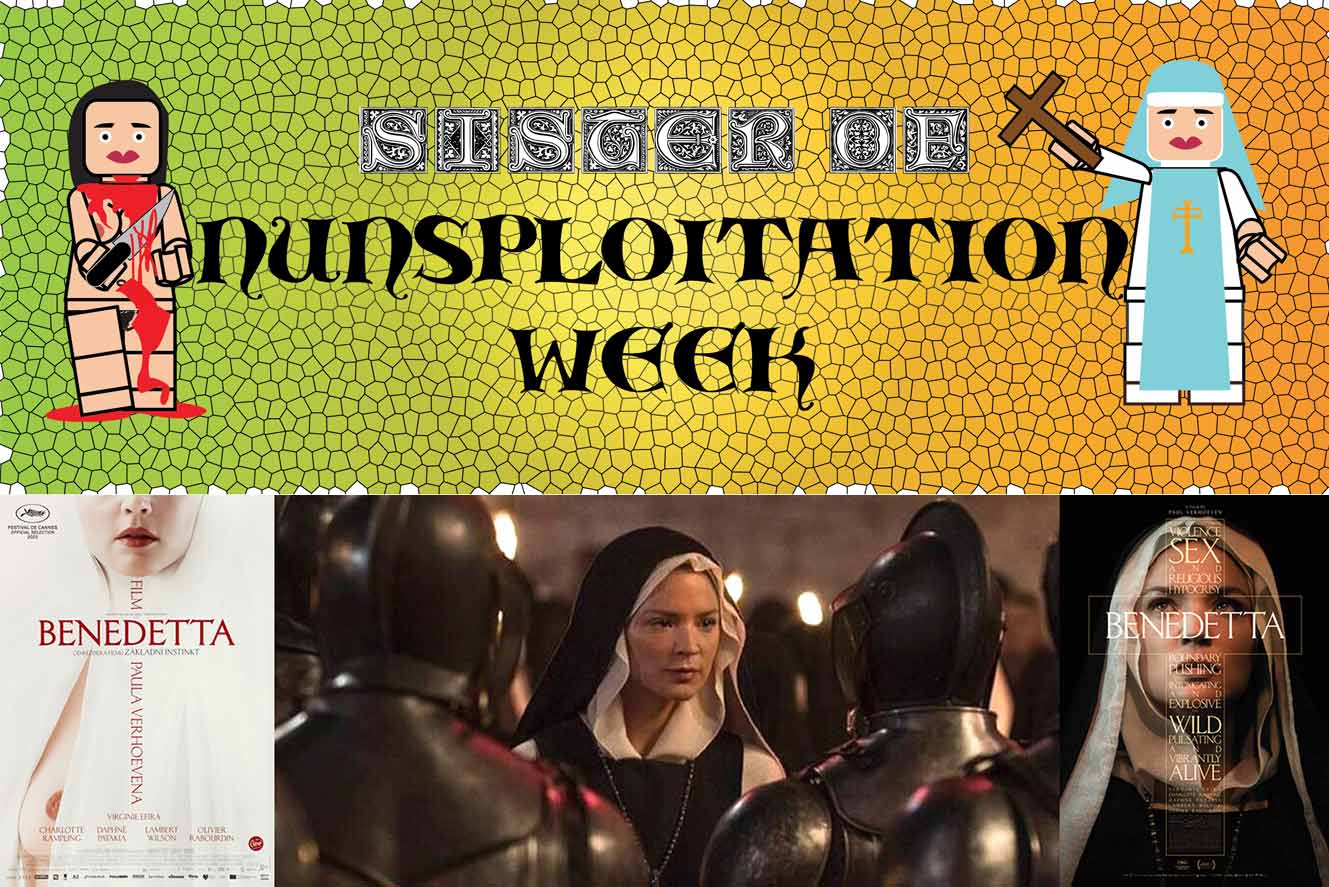
Okay, so Benedetta is the final movie in the second of my two Nunsploitation weeks for the blog this year... the one I’ve been building to in the hopes I could time my review with the same week of its release (or just after). Of course, when you see that a film has been made by a quality filmmaker and adapted from Judith C. Brown’s account of events... the book Immodest Acts: The Life of a Lesbian Nun in Renaissance Italy (or as Verhoeven puts it on the opening credits of this movie... “This film was inspired by real events”)... you have to wonder if it really is actually going to qualify as a nunsploitation film or more as a respectful, historical account of what we are told are the facts. Well now, Verhoeven is a consummate artist and, no matter what genre he chooses, he usually ends up delivering a very ‘classy’ looking picture, which is exactly what he does here...

But, of course, he really is also a fairly schlocky director in terms of the content of his work and, frankly that’s not a criticism. I reckon it could have gone either way but, of course, what he finally delivers, while certainly being respectful of the characters involved and also presenting quite an epic feeling, historical drama is... well I think anyone who’s seen this would have to agree that it’s a modern example of ‘proper nunsploitation’, no two ways about it. Certainly, in terms of the many exploitative moments in the movie, it really goes a lot further in terms of what it gets away with than the majority (if not all) of the films I’ve reviewed in my two nunsploitation weeks. This doesn’t, of course, make it the best of these but, I have to say it’s certainly one of the better ones I’ve seen.

Okay, so I’m not going to go into full synopsis mode on this one but I will say, in terms of judging the basic elements of the story, is that it deals with Benedetta (played by Virginie Efira) seeing many visions of Christ, manifesting stigmata and also taking on a lesbian lover in Bartolomea (played by Daphne Patakia). There is political intrigue between the various interested Catholic church parties, Benedetta and the Abesse (which I assume is the equivalent way of saying Mother Superior, played by Charlotte Rampling) and various trials and tribulations suffered by all the key players, set in the 17th Century midst the backdrop of the plague.

What Verhoeven does here... and kinda gets away with to an extent... is to try to show both sides of the coin in terms of the reality of Benedetta’s visions and he’s definitely treading on fairly similar ground to the brilliant, recent horror/thriller movie (depending on what the audience brings to it in their final analysis) Saint Maud... which I reviewed here. So you will see what Benedetta sees when she has her visions and it could be argued, when you think back to the intervention of a wild bird on her behalf at the opening of the movie when she is just a child, that he also shows one or two minor miracles. He does load it a little more in Benedetta’s favour than the way Saint Maud treats its central character, it has to be said but ultimately the film, although not having as visceral a finale as the former movie, gives us a similar ‘on the fence’ kind of stance. So although, for example, we’ll see many of Benedetta's visions of Christ, we are also given the possibilities of self inflicted stigmata, although it’s these very points that are played on as the drama unfolds and it all gets a bit ‘Salem witch trially’ for a bit.

And then there’s the heavy exploitation element... the fact that Bartolomea whittles down Benedetta’s miniature statuette of the blessed virgin into a dildo for their use, for instance. Or the torture scene where the pear of anguish is used to extract a confession. There’s also the element of blasphemy in this and, though I honestly wouldn’t usually bother to mention it, Verhoeven has already been questioned on this area regarding this film and gone on to deny that the film is blasphemous because, as he puts it, it depicts things that really happened. But, you know, because of the grey area more than heavily implied by the director when he shows us visions of Christ at their most exploitative, you have to maybe wonder at how he got away with that answer... he should maybe have just responded by an admission and then question the relevance of the accusation instead, I think. Because, yeah, you will see Jesus lopping off the heads of killer snakes, persuading Benedetta to get naked and up on the cross with him, save her from rape by slicing up soldiers and so on (and there’s a certain sense of duality in that scene in terms of ‘is it really Christ... no, the nightmare just changed’ aspect of that particular scene)... so, yeah, probably just a little bit blasphemous but, I’m not really the one to judge on that kind of stuff. It is, however, one of the most pulpy of dime store pulps takes on Christ that I can remember seeing in a film. A heroic Christ who wields a sword to get his woman out of danger, so to speak.

The shot set ups are not too intricate but they’re all pretty nice to look at and the movie feels like something very big and polished. Verhoeven does a nice thing with some of his transitions by pitching the occasional, very different, colour palette to segue into another scene. For example, you’ll go from those warm creams, oranges and beiges of the interior of the Abbey to, suddenly, the outside of the Abbey in a storm at night, where it’s all blues, greens and blacks. Not overly saturated or anything like that (although the ‘comet’ scene nearly gets there) but even these more subtle colour changes brush up against each other from scene to scene with a pleasing visual frisson that helps the movie trundle along at a fair pace (and it’s quite a long movie so that’s a good thing). Ann Dudley’s score helps the whole thing along too and, yeah, in one scene depicting self flagellating monks, you get to hear yet another rendition of the Dies Irae, which is kind of a curious comfort by this point.

And I’ve not got much else to say here about Benedetta other than, it really is a pretty exploitative piece of nunsploitation, the girls (who are often naked) look great and are so enthused in their roles that they pull off amazing, believable performances plus, my favourite bit (and see if you can spot it when you see it), there’s a dire part of the movie which brought an unwitting smile to my face when I realised the dialogue was the 17th Century Paul Verhoeven equivalent of, well, the ‘Pagliacci joke’. Yeah, that was a good moment. So that’s me done with both this and the second nunsploitation week and, I guess if you like the genre, you’ll definitely like Benedetta. So, yeah, done with the nun themed weeks now but not quite done with nunsploitation as a genre yet. There are a couple of good Blu Rays which have  just been released which I think could be considered part of this cycle, including what sounds like one in the big Severin box set of All The Haunts Be Ours folk horror movies sitting on my shelf so, yeah, there will be some more of these reviews coming at some point, I think.

Thursday, 14 April 2022

Sins Of Sister Lucia


The Scarlet
Wimple Now


Sins Of Sister Lucia
aka Shûdôjo Rushia: Kegasu
Japan 1978 Directed by Kôyû Ohara
Nikkatsu/Mondo Macabre DVD Region 0


Sins Of Sister Lucia is one of Nikkatsu’s lucrative (until the advent of home video) Roman-Porno films (aka romantic pornography), brought out to combat the rise in Pink films which had become a way for Japanese cinema to combat what you could get away with on television and thus continue to bring audiences into the cinema. There were loads of these things made and, from what I can tell, the Roman-Porno sub-genre differed from Pink films only in that the budgets were a lot more generous. As Jasper Sharp, renowned expert on Japanese cinema (and fungi, but that’s another story) explains in one of the two extras that feature him on this nice Mondo Macabre release of the movie, there was a bit of a sea change at Nikkatsu when many top directors who didn’t want to just make sex movies left and went to other companies, leaving a load of former assistant directors suddenly in the driving seats and giving them new opportunities... although he does mention that the director of this one, Ohara, while good at what he did, wasn’t really considered the upper tier of Roman-Porno directors. I’m glad he said that actually because, honestly, I didn’t get a heck of a lot out of this one.

I bought this one because a) I quite liked the 7 or 8 Pinky Violence movies I’d seen (what the Pink genre evolved into) and I saw this one at a film fair and b) I liked the cover of this one (Yuki Nohira in a sexy nun costume) plus I saw the film was on the Mondo Macabre label. Now I used to love Mondo Macabre and they introduced me to a lot of undeservedly unloved exploitation classics over the years. I hadn’t bought one of their films in a long time so, since the price was right, I thought I’d give this one a go. Plus, I’ve seen very little nunsploitation in my time (this has changed since writing this review...  as you may have noticed on the blog recently) and certainly, to my memory, none of the Japanese nunsploitation movies.

The film starts off with Yuki Nohira as lead character Rumiko, renamed Sister Lucia by the head of the Mother Superior, being bizarrely and slowly pursued down the corridors of an abbey by her fellow nuns, singing religious songs at her. They finally corner her and tell her to confess her sins in order to properly join the convent. So we get a flash back of her revealing, to her religious teacher, that she’s stolen the corrupt bribe money of her crooked politician father, before seducing him. When caught in the act of practically raping the poor guy, she stabs her dad’s bodyguard and this prompts him to send her to the convent. They punish her for her sins with spanking, while simultaneously getting turned on by her story. The rest of the film is just the nuns all sexing each other up and the Mother Superior bringing in a monk every few days to fuck her and her two assistants to ‘bless them’ and relieve them of the desires which torture their bodies and get in the way of them communing with God. Pretty soon, though, everybody is at it! Sister Lucia continues to flaunt the rules of the sisterhood, culminating in her aiding two escaped convicts who fornicate their way through all the nuns before the police come. In a bizarre epilogue, Lucia is sent to a mental hospital as punishment for her wicked ways.

And there’s not much to say other than that. It really didn’t do much for me, it has to be said. It’s filled with the quite inane and rough groping of naked female flesh, while everyone on screen - man and woman alike - bow to the bizarre laws of their country by ensuring that their genitalia are in no way caught by the camera. It’s an easy and quick watch of a movie and, while it looks nice, I can’t say there were any breathtaking compositions in this one or much in the way of unusual edits which caught my attention.

Probably the best thing about the disc are the various extras. There’s a nice documentary about Japanese erotic cinema and the resurging interest with a new generation of female fans of the genre in Japan, including references to Seijun Suzuki’s famous Gate Of Flesh (which I confess, never entered my mind as being related to the genre) and some interview footage of the great man himself. There’s also a pretty great talk by Jasper Sharp about the differences between Pink, Pinky Violence, Roman-Porno and their birth in Eroduction (Erotic production) which, I’m probably never going to get straight in my mind but it’s extremely interesting (I do have Sharp’s definitive book on the subject in my ‘to read’ pile so, I’m hoping to get on to that one sometime next year). Added to this is a bunch of trailers for others in this series that Mondo Macabre have put out on DVD and, of course, the general Mondo Macabre trailer reel of just some of the weird and wonderful titles they have on their books... which is something I always love watching (even though I’ve sat and watched it on various releases a gazillion times).

And there’s probably not much more I can say about Sins Of Sister Lucia, other than the nuns at the convent must get through an awful lot of fabric because their clothing is constantly being torn away from their bodies. It’s not a film I’d particularly recommend and I suspect there are some much better Roman-Porno films which serve a similar kind of function in a much more interesting way... so, yeah, that’s a 'film watching hole' I definitely need to research and fill. I’ll report back here when I have done so.

Tuesday, 12 April 2022

Satanico Pandemonium


Solving A Problem Like Maria

Satanico Pandemonium
aka Satanico Pandemonium:
La Sexorcista

Mexico 1975 Directed by Gilberto Martínez Solares
Mondo Macabre Blu Ray Zone A


Warning: Satanico spoilers.

Wow, what an amazing movie. I was not expecting too much from Satanico Pandemonium, especially with the amount of nunsploitation films I’ve watched recently but, yeah, I sure got a surprise with this one. It’s easily the best nunsploitation movie I’ve seen and so much more. A real masterclass of movie making which, I believe, should be taught in every serious film studies class across the planet. I almost don’t know where to start with it, other than to say... I skimmed the user reviews on the IMDB and was astonished to read some absolutely terrible, unappreciating reviews of this little masterpiece on there. Maybe it’s an age thing but, it’s like some of the people who reviewed this were almost deliberately missing the point (and if they weren’t doing it deliberately then I feel sorry for them... and they should get out more and go watch some movies).

Now, many people will know this title, not from the film itself but from another film... Quentin Tarantino’s From Dusk To Dawn. In that film, Salma Hayek plays a vampire stripper called Satanico Pandemonium and, while that film doesn’t really have much in common with this one, her character is obviously named after this one. A nice little homage although, yeah, it seems almost a bit too ‘name checky’ for QT. That was an okayish film, though, to be sure.

This film though... wow. Okay, so it’s filled with some beautiful colours. Many of them are natural landscapes (and sometimes studio additions to those landscapes it seemed to me) where the camera dwells slowly on the various environments the main character, Sister Maria, finds herself wandering in for various stretches of the movie. Sister Maria is played by Cecilia Pezet and... what an amazing performance! This is easily one of the most well thought out, nuanced and intelligence performances I've seen in any kind of exploitation movie. Pezet plays the role completely seriously and, one of the strengths of the film over a lot of the nunsploitation movies I’ve seen, is that everything does come across as genuinely real in terms of the intent of all the characters, as opposed to the more tongue in cheek tone of levity regarding the more exploitative elements of most nunsploitation movies. Don’t get me wrong, this film does involve some full on exploitation elements but, the tone of this movie is measured enough to dilute any silliness from them. How should I clarify this...?

First of all, the story is very simple. Maria is tempted by a teleporting devil (played by Enrique Rocha) and his big, crisp, red apple on a number of occasions and, after a while, gives in to temptation... not by eating the apple but by being seduced by a lesbian nun who turns out to be the devil having intercourse with her and thus setting into motion the seed of the evil acts of lust and violence she starts to indulge in. The film takes a little while to build up Maria’s character and she plays the nun as almost the purest of the pure... a kind hearted, good natured, charitable servant of God who all the other nuns seem to look up to. Somebody who knows medicine and can help heal sick lambs, cows and people etc... a valued member of the nun community. So every time we see her committing an evil act, we clearly see her own guilt and revulsion at the atrocities she inflicts upon others... 

 For example, when another nun comes to her seeking medical aid but resists Maria’s naked seduction, she responds by stabbing her ‘patient’ in the neck with a pair of scissors. When she seeks out a young, ‘just in his teens’ boy and jumps naked into his bed, trying to lust him up and he rejects her... she attacks him with her knife until the blood covers her naked body and leaves the boy and his mother behind to perish in a burning cabin. And again, when her hands suddenly start smoking in one scene from the weight of her sins or, say, she has a vision of a snake jumping out of her cup during supper, we see the battle of good and evil going on in her soul by her ‘almost but not quite deadpan’, very subtle facial expressions. Cecilia Pezet really invests a lot of energy and intelligence into this central performance.

But while all this stuff is going on... the movie feels old. And I don’t mean like it was shot in 1975... I mean it manages to present this story but feels like it was shot in the late 1940s to mid 1950s in the golden age of Hollywood. Or maybe the kind of films Powell and Pressburger were making in the UK at around that time. Seriously, it’s like watching a rural Western movie or something and it feels almost authentic to the period. This also goes for the score under the music director (a credit which makes me suspect there may have been a little needle drop used in here too) named Gustavo César Carrión. The scoring feels like it was either 40s/50s Hollywood or, in some instances, a mid 1960s Star Trek episode (which more or less amounts to the same thing anyway, in terms of the style of the cues I’m thinking of).

Now, it’s not uncommon in terms of the music for some countries to be somewhat behind the trend and looking backwards when it comes to trying to compete with Hollywood product. For example, when I first listened to the score of Riccardo Freda & Mario Bava’s movie Caltiki Il Mostro Immortale (reviewed here), way before I actually got the opportunity to see the film, the people writing the liner notes had to explain why the score for a 1959 movie sounded the way it did... as in why did it sound like it was being scored in the 1930s/1940s Hollywood B-movie style. So, yeah, I’m used to movies not made in America sometimes harkening back to an older sound and not being quite ahead of the curve... or even caught up to that curve as yet. And as I first started watching Satanico Pandemonium, I thought this was maybe the case. But as the film moved on, I realised that some of the musical choices, while working completely, were still deliberately playing against the implications of what we were seeing. So, for instance, when Sister Maria goes off to infiltrate the young boy’s home and molest him, the music is still playing the light, airy and charming style of music associated with the innocence of her character until we get up to the deed, in direct counterpoint, even though we know her intent and the track record for the character has already been soiled by evil acts. So, the more I think of it, the more I’m beginning to realise that this probably was a very clever and deliberate choice on the part of Carrión and his director.

And what this does is bolster up the ‘old Hollywood’ feel of the picture already in evidence, which in turn makes the various set pieces of violence and nakedness that would be just dimmed down to being a standard use of the genre tropes in most other nunsploitation movies, much more powerful because they are less frequent and paced out. The film is a very slow boil and, while there is certainly some slow camera movement in a few scenes here and there, there are also a lot of sequences where the camera is completely static and observes people walking in and out of the frames (and there are huge swathes of the movie without dialogue too, which helps push the atmosphere). Those compositions are not overly clever or complex either... everything is simply done with some very bright (well, okay, not ‘Bava bright’) colours which give the shots interest. Even the nuns are not as stridently costumed as they are in other movies. There is a lot of visible white on their clothes contrasted with a very light blue hue and, on each, a yellow Patriarchal Cross with its double cross bars stitched onto the front of the pale blue habits (the two figures of this week’s Sisters Of Nunsploitation Week header are both renditions of Maria in Satanico Pandemonium from various points in the movie) .

And then, at the end of the movie, two things happen which are of interest. Firstly, we get a whole extra dose of quick, exploitation imagery all in one hit, as Maria is further tempted by the devil and imagines herself naked and being tortured by the inquisition... by such things as being forced to drink molten lead, having her torso ripped open and having her eyeball pulled out. This almost yanks you out of the movie and I wonder if the director was just told he had to put something like this in to satisfy the audiences expectations of the genre tropes towards the end... but somehow the music and the sure and steady tone of the whole thing, keeping consistent with the rest of the movie, kind of allows for it to not seem too ‘tacked on’.

Secondly... there’s the ending... and this really is a big spoiler people so, be warned, don’t read on if you don’t want to know. After becoming the Mother Superior of her convent, Sister Maria eventually finds herself stabbed to death by the various naked, cavorting nuns under her care and, her habit covered in blood from many wounds, she dies on her bed. But then we cut to many nuns, including a few who Maria has either injured or outright killed (in an overly enthusiastic assisted suicide scene in one case), very much alive and praying for her. We cut back to the bed we just left her on and there’s no blood and she’s very much at peace. Some dialogue makes us aware that she’s been ‘infected with the plague’ and been fighting it for days, finally succumbing to the disease and death. So, yeah, I can totally get why some people can condemn this ending as being a total cop out, ‘it was all a dream’ kind of ending, as we are lead to believe the entire battle between good and evil was playing out entirely in her head in some kind of fever dream but... you know... while I wouldn’t have chosen that ending, I think the director, whether he was forced to include it or not, really makes it work. It doesn’t undo the slow burn of the movie and its final trajectory much, if at all and, furthermore, you do get to see the Lucifer character again at the end, after Sister Maria has died. So, did he actually infect her with the plague all along?

I don’t know the answer to that and I don’t think it matters. I think the movie is, if anything, hugely subversive and getting away with a lot (including issues of the damaging effects of racism too in one scene)... presenting it all in a way that both makes it more palatable due to the tonal style of the movie but, somehow more shocking when the exploitation content is juxtaposed with that presentation. And that’s me done with Satanico Pandemonium... a film that I intend to watch quite a few more times in the future and which, for me, is the absolute cream of the crop in terms of what the genre can do. This film is an absolute masterclass of how to make a movie which is tonally setting up an atmosphere and using it to sweeten the pill of the less palatable (by comparison), exploitation elements. Absolutely amazing. I honestly can’t recommend this one enough.

Monday, 11 April 2022

Flavia The Heretic


A Simple Flavia


Flavia The Heretic
aka Flavia, la monaca musulmana
Italy/France 1974
Directed by Gianfranco Mingozzi
Shameless Films DVD Region 2


Okay, I want to start off Sister Of Nunsploitation Week with a bit of an apology. My previous week celebrating the genre saw a series of four films with somewhat diminishing returns, with my verdict on the later films being mostly negative. Well, because I want to continue, with this one, the practice of reviewing this week’s films in the order they were released into cinemas, I’m afraid this first review is still a fairly negative one, it has to be said. But, please, stay with me because the film I’m reviewing tomorrow is an absolute humdinger of a movie which I was absolutely thrilled to discover (when I actually wasn’t expecting much from it, truth be told).

Okay, so the notorious Flavia The Heretic, often cut in the UK but presented uncut finally by Shameless, on both their DVD and later Blu Ray edition (why they can’t do the same for The New York Ripper, which contains similarly exploitative scenes, is anybody’s guess at this point), is a film I was mostly disappointed with, in all honesty. Not that I was expecting a lot from it but, the ideas behind the movie are interesting... I just found it was all done in a fairly dry and dull manner.

The film starts off with a pre-credits sequence giving a semblance of motivation to the main protagonist, as young Flavia... who has been looking on at a battlefield filled with the slaughtered bodies of Muslims... sympathises and shares a moment with the one surviving enemy soldier before her father, despite her pleading, then cuts his head off. Then, she is sent to a nunnery and, sometime during the fairly dull opening credits, we are told the year is around 1400 and she manages to grow up into famous actress Florinda Bolkan, right in the middle of a scene which jumps time via a clever cut.

The film is mostly a lot of boring conversations between her, her friend Sister Agatha (played by María Casares) and pretty much anyone who will listen, about how men are all bad (apart from the odd one or two she likes) and how women should be doing more stuff. Yup, she’s a real feminist but, I dunno, she’s definitely ahead of her time and seems like one of those new era, man hating feminists who seem to have taken the stage in recent years (which seems to me less like proper feminism and more like enhancing the inherent matriarchy of society but, yeah, I’m not getting into that here).

So she hates her father and all the men in her Christian town, especially what they did to one of her fellow nuns for showing sexual interest during a bizarre scene in which a bunch of lunatics are let into the convent for a little while, for purposes less clear to me. And what they do to the nun in question is one of the notorious scenes which always used to be snipped out on these shores until recently... so body having hot pitch dripped on it, cutting the nipples off etc. Things get no better after Flavia runs away from the convent with her favourite male tutor and the father recaptures her and has her flogged (for reasons again unclear to me but presumably as a metaphor for the prominence of the stupidity of male power over the female?).

Flavia also has a sympathy for Muslim invaders since her experience on the battlefield as a kid... looking up to them and having odd, surreal moments when a painting of one comes alive to interact with her now and again. So when the Muslims show up, Flavia and Agatha spout their feminist mantra gleefully at the fleeing Christians and stay to watch the carnage, walking around the battlefield unmolested as they witness various conflicts. Unmolested, that is, until Sister Agatha is speared to death by one of the Christians due to her words. So Flavia throws herself at the Muslim chief, sexes him up and then, after a slightly surreal scene where she takes them all back to the nunnery to get revenge by sexing the nuns up (naked nun climbing into the stomach of a slaughtered, hanging cow anyone?)... wakes to find the nuns all dead. Then she armours up and joins the battle as the Muslims take her father’s town but, after this, comes a cropper with her new man and is left behind when the invaders return to the sea. After which, Florinda Bolkan continues the cliché of coming to a rather sticky end in some of her films, by being held to account for her crimes by the remaining Christians and having the skin torn from her body.

And it’s a film which admirably pushes the idea of feminism and acceptance pretty well, more so than I’ve seen in many other movies but, at the same time, I have to say that with all these spectacular and truly exploitative things also happening, I found the film pretty much dull as ditchwater. I think Florinda Bolkan is a pretty good actress but here she just spends the whole film in a kind of moody anger all the time, scowling at almost anyone who tries to engage with her.

Also... and I don’t think this is anything to do with the print that Shameless Films sourced, the colours are all completely washed out. I mean, it’s a given perhaps that the monastery and its interiors are just full of creams and beige hues but, even when Flavia ventures into a green landscape, it’s extremely pale like it’s dried out with dead grass in terms of its colouring. There are no really strong colours in the movie and this, combined with the lack of any really interesting frame designs, is maybe why I responded to the film in a less than enthusiastic manner. Don’t get me wrong, the camerawork is fine, with the director using moving camera to capture both the subject of a shot and then shifting to others reacting to that within the same shot without a cut so... yeah, it’s economical in that manner and holds some interest rather than just cutting to reverse shots all the time but... I dunno... nothing really grabbed me about this one.

So that’s me done on Flavia The Heretic... a film which has some notorious exploitation moments but, ultimately, left me more than a little cold. I don’t think I’d recommend this to many people, to be honest. However, come back tomorrow and you certainly will find me reviewing a true masterpiece which I certainly would recommend to all lovers of cinema. Hopefully you’ll take a look.

Wednesday, 9 March 2022

The True Story Of The Nun Of Monza


Monza Veneris

The True Story Of
The Nun Of Monza

aka La vera storia
della monaca di Monza

Italy/France 80
Directed by Bruno Mattei (as Stefan Oblowsky)
Severin Blu Ray Zone A/B


Warning: Yeah, spoilers on this.

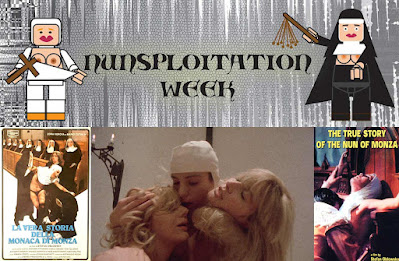
Okay, so the four movies which make up Severin’s ‘beyond the call of duty’ Nunsploitation Blu Ray set, Nasty Habits, have generally all been slightly less watchable than the previous one as I’ve been going through the films one by one and, to be honest, this last one, The True Story Of The Nun Of Monza, is no exception and continues, to my mind, that gradual decline in quality. A decline which seems to be more prominent the later the films were made, it has to be said. Also, I knew practically nothing about the real life nun of Monza (nor the historical literary portrayal of her, which seems slightly different again) but a quick reading of Wikipedia was all it took to tell me that the writers of this genre entry were being quite a bit liberal with their title when describing their ‘version’ of events as being true.

This one starts off with the title character, Virginia (played by Zora Kerova) as she is taking her vows in that whole ‘marriage to God’ ceremony that various nuns have to go through (if I’ve learned anything from this set over the last week, as I slowly made my way through it, it’s that). However, cross cut with this scene is a sequence of two copulating horses, as the camera dwells on the giant cock and flaring nostrils of the beast in close up as it has sex with... um... well, Mrs. Horse, I guess. Now, I couldn’t quite work out why this whole sequence was being used as a metaphor to a nun wedding her spirit to God but, at least some kind of metaphor was being tried... I suppose.

So, okay... Sister Virginia is rich and she’s the daughter of the feudal lord of the area in which the convent resides. After his death, she then ‘accepts’ the other nuns as swearing fealty to her and takes over as mother superior. She gets over her earlier scene where, after dreaming of copulating versions of herself with both her future ‘lover’ and also Christ coming down from the cross, she asks Sister Benedetta to give her a good flogging for her sinful thought crimes. Sister Benedetta definitely gets a little overenthusiastic in her participation of the event but, after Virginia takes over the convent, there seems to be sexing galore going on... not the least from the corrupt, sex mad local priest and his best friend, who has his eye on Virginia to the point that said priest helps him out by creating a situation in which he can rape her. She then gets pregnant but the baby is still-born. Things soon come to a head with the political war in the monastery between Virginia and the priest played by Franco Garofalo (who spends the whole film looking like a really miserable version of Dario Argento). The inquisition is called in and everyone gets their just (or perhaps unjust desserts), including the title character who is walled up in a cell... presumably to die of starvation at some point.

All in all, the film seems to be just an excuse for throwing naked female bodies up in front of the camera and... yeah, as much as I love that idea, for some reason it didn’t do much for me in that department either. I was pretty unimpressed with the pedestrian cinematography and general mise en scène on this one too, truth be told. Maybe I need my erotica well framed and creative for it to have an effect on me, who knows. I wasn’t that impressed by all of the musical score by Gianni Marchetti either, I have to confess. The choral cues, which were pretty good were, I thought, extremely reminiscent of Ennio Morricone’s score for the giallo Who Saw Her Die? and other sections of the score were really, horrible, cheap sounding synthesiser cues (which there seemed to be a lot of in the early to mid-1980s, from what I can remember).

And I don’t have too much more to add to this one and, once again I can only apologise for the shortness of this review but, yeah, there’s nothing really interesting about this film. I mean, Images In A Convent was equally devoid of stylishly designed frames but at least that one made up for it in sheer craziness of its shifting genre elements. The True Story Of The Nun Of Monza doesn’t really even have that to fall back on. And, aside from the director's seeming obsession with capturing horse genitalia at the start of the film, it doesn’t have much that one might remark as being anything worth writing home about. And horses caught in the act of making baby horses is not something I would choose to write home about anyway, to be honest.

So that’s me with the last review of Nunsploitation Week posted but before I go, let me remind you why I got into doing a Nunsploitation Week in the first place. At some point within the next month or two, Paul Verhoeven’s latest venture into this genre, Benedetta, is being released in the UK (long after the rest of the world, alas). So I wanted to acquaint myself with some more of the legacy of the genre before going into this one. But, of course, it wasn’t just the Italians who started pumping out sexy nun movies at this time. When Benedetta comes out, my plan is to include it in a second week of genre reviews, Sister Of Nunsploitation Week and, only one of the films included in this selection will be co-financed with Italian money so, yeah, look out for that at some point over the next month or two. Thanks, as always, for taking the time to read here.

Tuesday, 8 March 2022

Images In A Convent


Pagan Sandwich

Images In A Convent
aka Immagini di un convento
Italy 1979 Directed by Joe D'Amato
Severin Blu Ray Zone A/B


Warning: Some spoilers.

Well Images In A Convent is, so far, the dullest of the three of the four films I’ve watched in Severin’s splendid Nasty Habits nunsploitation boxed edition. It’s also, despite the tediousness of many of the sex scenes, quite an interesting film so... yeah, I think it’s definitely a bizarre contrast by what I see as, not that great execution in terms of cinematography etc but with some twists in the tone that certainly make for a wild viewing experience if... possibly not for the reasons the director was intending.

Don’t get me wrong... I love seeing young, nunned up females in a state of undress as much as the next person and this film is certainly the most sexualised of the ones I’ve seen in the set so far. But, I dunno, it didn’t make me feel much of anything while I was watching it and there’s not too much of a plot on this one either. Ultimately though, after the wonderful cinematography I saw on Cristiana Devil Nun (reviewed here) and Story Of A Cloistered Nun (reviewed here), this one seems much less interesting visually, at least in terms of the way the frames have been designed and the way the camera runs through them.. and it just didn’t feel that exciting. There was one moment when the camera is placed in the corner of two intersecting corridors and shifting the view to follow the action before shifting back to the other corridor to catch the next bit but... it’s then followed by another standard cut to more of the same and, to be honest, there’s way too much walking down corridors in this movie for my liking anyway.

The actresses playing the main nuns, especially Paola Senatore as new recruit Isabella, are all very attractive and get up to lots of pleasuring in the film... doing unto others as they do unto themselves, so to speak. Perhaps because there are so many extended sequences of nudity and sexual activity in this one, the very simple plot is not referred back to as much as it should be and so this element equally didn’t engage my interest.

However, what there is of the story (very loosely inspired by Prosper Mérimée's La Vénus d'Ille, as we are told on the credits) is quite wild and the narrative takes some lovely genre turns. The plot is simple... Isabella has been forced to come to the convent to escape the attentions of her uncle. As soon as she gets there, things get very sexualised, partially because of her presence and partially because of a demonic statue in the courtyard. Cuts back to the statue from the camera show things like windows blowing open and then nuns engaging in spontaneous sexual outpourings. The film also includes the, almost compulsory, whipping scene as one nun called Licinia, played by Marina Ambrosini, is flogged by a senior nun with a cat o’ nine tails (judging by the looks of the wounds) before the dominatrix is overcome by her own desires and starts ‘lesbianing up’ Sister Licinia herself.

However, the devil statue keeps appearing in places it shouldn’t be by ‘camera magic’... okay, they mostly just cut the film and plonk the statue there... like a Weeping Angel from Doctor Who (hmm... one wonders if Steven Moffat didn’t take some inspiration from this movie and, yes, I know the effect is achieved differently) and pretty soon a wounded traveller turns up who is brought into an outer building and who is also sexing up as many nuns as he can. Perhaps he is physically linked to the demon. Or perhaps, as I suspected, the devil character is linked to Isabella. One thing’s for sure, they never should have built that convent on top of an old Indian burial gro... err... I mean, on top of an old pagan temple, as we are told at one point in the movie. That’s a bit of a rookie mistake, I guess. At which point, after a fairly graphic rape scene... famous genre actor Donald O’Brien turns up and, well, things take another turn.

So the thing about the movie is, it starts of as nunsploitation with a strong sexual element but, somewhere along the way it turns into proper pornographic content (apparently, according to whether you’re watching the long or short cut... being as Severin are always thorough and don’t scrimp on their releases, this is the full length version)... showing erect cocks (which probably wouldn’t be allowed if it came out from a UK label) along with every other orifice and wooden dildoes etc, as the nuns sex up everything that moves and engage in all kinds of acts such as forced fellatio and sixty nining... well, okay, I guess in this case it’s sixty nunning. And then, bizarrely, O’Brien turns up and it turns out he’s there to eradicate the devil from the convent so, yeah, for the last twenty minutes or so it turns into an exorcist movie, albeit a highly sexualised one where various nuns are following him around to try and distract him from his rituals by flaunting their frenzied, masturbating bodies at him as he walks the convent to perform a ritual in every room. The ending is totally lacking any closure after Isabella stabs the ‘wounded traveller’ to death and the priest presumably finishes his exorcism. It’s all left in a bit of a cyclic state, to be honest. The traveller, by the way, has the hairiest legs I’ve ever seen... even hairier than Sean Connery’s chest... and that’s saying something.

There are a couple of bizarre things which have been unearthed by the Severin team which are of interest though. The main feature commentary track, which I’ve not listened to yet, is by the delightful Kat Ellinger but she also talks over 25 minutes of silent, rediscovered lost scenes deleted from the final cut. As she says, only in a D’Amato movie would all the cut scenes be those with character building moments... the sleaze was retained while plot and story points were deleted. Now, there’s a moment in the movie where Isabella slaps the traveller and then we cut to a reverse shot where her head is also thrown back and, coupled with the ensuing dialogue, it gives the strong impression that the traveller slapped her back full in the face too. However, on the cut, extended version of the scene, it shown that they both take a couple of good slaps at each other here.

The real eye opener is the alternate ending. I said I’d suspected Isabella all along as being a manifestation of the devil and so, when she stabs the traveller and things seem to die down for a bit, I was kind of disappointed. Well, there’s an alternate ending here where she finishes up having an intimate, topless chat with the devil statue, clearly showing the two are in league with each other. This then concludes with the statue’s grey arm actually manifesting as living stone and strangling her. I’m with Kat Ellinger on this one... this is a far better ending and I wish the producers had left it in.

But, overall, while the film passed the time... well, like I said, I found Images In A Convent to certainly be the least inspiring of the movies so far in my journey through Severin’s wonderful Nasty Habits box set (although my memory of it is kinda growing on me now... might have to revisit). One more to go in that set but, also, a few other nunsploitation movie reviews coming to the blog at some point soon (more about that in tomorrow’s review).

Monday, 7 March 2022

Story Of A Cloistered Nun


The Spartacus Solution

Story Of A Cloistered Nun
aka Storia di una
monaca di clausura

Italy/France/West Germany 1973
Directed by Domenico Paolella  
Severin Films Blu Ray Zone A/B


Warning: Many story spoilers here.

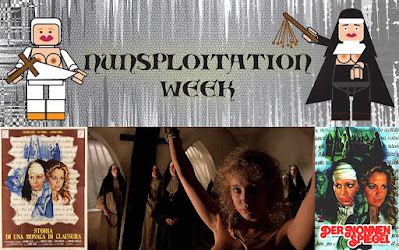
Story Of A Cloistered Nun is set in 1571 and tells the story of a young baby called Carmela (as we are first introduced to the character), who we see in a nuptial ceremony where her and the child of another family (I’m not sure if these kids are even a year old yet) are promised to each other in an arrangement designed to bind two families together. This sequence is following a fairly sedate set of opening titles where old etchings of monastic events are thrown up against Piero Piccione’s score, along with the text announcing that it’s “Adapted from authentic 17th Century Chonicles” (which makes no sense since it’s set in the 16th Century, I’m guessing) so, yeah, they were getting into marriage really early in those days, it seems. Then we find Carmela grown up and indulging what can only be classed as extraordinary tame lovemaking with her real boyfriend... honestly, not much is going on as they’ve still got their clothes on at this point but Carmela is already in raptures of ecstasy, her bosom heaving in that extra special bosomy way.

Now, Carmela obviously doesn’t want to marry the grown version of the toddler her family picked out for her so... dishonouring the family, she finds herself ‘gotten to a monastery’ to become a nun. There’s she’s subjected to lesbianism (which she completely refuses to partake in) from both her new friend Elisabeth (who has an underground group of libidinous nuns who secretly go to dress in colourful clothes, drink wine and indulge in things only hinted at in the dialogue) and also Elisabeth’s enemy, the Mother Superior. Both are in love with Carmela and both are scorned but Elisabeth gets back at her by having her boyfriend put to death, thus temporarily crushing Carmela’s will to live.

But then it turns out she’s pregnant and, when she comes to term and gives birth to a baby boy, the church hear about it and send priests and troops to investigate. In a bizarre moment, when the lead inquisitor (or whatever he’s called, this is not one of those torture porn films) questions whose child it is, Carmela owns up to proclaiming “I’m the mother!” However, in a  bizarrely Spartacus moment, Elisabeth also screams the same thing, followed quickly by the Mother Superior and then all the rest of the nuns in the convent. The powers that be have no choice but to shut down the order and expel everyone from the monastery but, before they all are split up and sent to other nunnerys, Carmela is given all the precious belongings the nuns come into the convent with so that she can flee and survive with the child, where she will wander the world helping those in need. The end of the film bitterly trumpets the fact that she’s never been beatified or canonised for her service to those in need.

The film stars a triumvirate of actresses in the key roles and whom many might remember especially in their roles in Dario Argento movies. So we have the main lady Carmela played by the beautiful Eleonora Giorgi, who would go on to play Sara in Argento’s horror film Inferno (reviewed here) and then from two of Argento’s gialli we also have Catherine Spaak as Elisabeth, who was the main female lead in Cat O’ Nine Tails (reviewed here) and Suzy Kendall as the Mother Superior, who was one of the female leads in Argento’s game changing directorial debut The Bird With The Crystal Plumage (reviewed here).

It’s another eye opener for nunnery life too. Like in Cristiana Devil Nun (reviewed here), Carmela has to wear a wedding veil to announce her wedding to God, although she renounces her vows before she actually takes them. Also, the nuns seem to all bind their breasts in a kind of half corset for some reason... hiding their femininity.

The camera work is pretty good. Carmela starts off arriving at the nunnery in very colourful clothing but... barring a window in one room, a wonderfully colourful shot of a distorted mirror and the scene where Elisabeth’s ‘secretly bad nun society’ are dressing up... most of the film is the dingy greys, whites and creams of the convent. However, the cinematography more than makes up for it and although the director is content for a while to split the screen vertically using architectural features to make areas for the actors, he does some really outrageous stuff with finding little triangular areas in front of the screen to use to segregate various characters in the spaces. For instance, in a scene where a tall monk and a shorter nun are walking side by side but in profile to the camera, he hangs a triangular frame down in front of the lens just splitting off a small area at the top of the screen. When the two characters pass behind it, the tall monk’s head is just in the triangle with both his lower body and the nun in the space below. It’s quite good stuff. And there’s a lovely introductory scene to a few of the nuns when Carmela arrives and they’re all observing her from behind what I could only call some kind of wrought iron, spiral web with a cross at the centre. The cinematography in this one is nothing if not creative, that’s for sure.

And there are a few stabs at other more exploitational tropes of the genre such as a topless whipping scene for Carmela and a scene where Elisabeth has to crawl along the ground of a big area in the convent with her tongue scraping along the ground, cleaning the floor as she goes but, I’d have to say this is all handled in a very non-sensational way and, in terms of nunsploitation, it all seems very tame compared to some other stuff I’ve seen.

All in all I would say, especially with the striking presence of Eleonora Giorgi as the main protagonist, that Story Of A Cloistered Nun is a perfectly fine and nice looking movie. I didn’t enjoy it as much as, say, Cristiana Devil Nun but then, that one seemed even less on board with the tropes of the genre than this one. I mainly had a good time with this film and, once again, am looking forward to seeing some more movies in this category very soon.


Sunday, 6 March 2022

Cristiana Devil Nun


Ending With A
Wimple And A Bang


Cristiana Devil Nun
aka Our Lady Of Lust
aka Cristiana
monacan interminate

Italy 1972
Directed by Sergio Bergonzi   
Severin Films Blue Ray Zone A/B


Warning: Full spoilers on the ending.

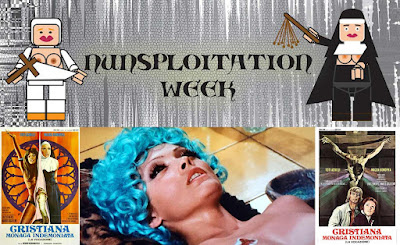
Nunsploitation is not a genre of film I know much about. I’ve seen a few over the years but I thought, with Verhoeven’s Benedetta set for imminent release in the UK and, in light of the release of Severin’s Nasty Habits Blu Ray nunsploitation box set (of which this film is the first)... not to mention a few others I’ve acquired over the years... I thought this might be a good opportunity to familiarise myself with the genre more. So it’s great that with this one, Cristiana Devil Nun, it pretty much surprised me in terms of the actual low level of nun content although, judging from the trailers of the other three films in this set, I suspect that this one is a bit of a wild card.

The film is set contemporary to when it was made and starts off setting up title character Cristiana as a bit of a hedonist who especially enjoys her sexual activities. Cristiana herself is played by Toti Achilli and, frankly, she has such beauty and appealing screen presence, I’m very surprised to find that this is the only role on her CV. She’s pretty amazing in this.

Early on in the picture, after a scene of Cristiana and her current boyfriend cavorting with a guitar player on a mountain, we find her and her main squeeze having full on sex in a packed airplane cabin as all the customers watch and place bets on the outcome (must admit, I didn’t understand quite what they were betting on but they kept counting down to something). Not everyone approves of course... a stewardess and a nun both find the act untenable. Then, tragedy quite literally strikes, as the cheaply made model aircraft they are purported to be flying in is struck by lightning and the engine catches fire (I’m sure I’ve seen this same model aircraft used as a stand in for the real thing in one of Sergio Martino’s gialli too... although I can’t remember which one). As the plane plummets to a certain death and with the disapproving nun as her witness, Cristiana preys to God that she’ll abstain from sin in the future and become a nun if only he’ll save them. And, miraculously, as soon as she does this the fire goes out and the plane somehow returns to its flight course.

So, yeah, Cristiana goes to a local convent, at the objection of her mother, to immerse herself in a monastic lifestyle and in preparation to become a nun. There, she is befriended by a lapsed nun called Sister Leonora (played by Magda Konopka, who used to turn up in a lot of things) who is obviously in love and lust with Cristiana. A budding lesbian relationship is strongly implied but never quite blatantly shown. However, Cristiana is clearly not suited to a life of celibacy and self sacrifice so, when her boyfriend on the run from the police shows up, she hides him in the bell tower and has sex with him every night. However, Sister Leonara finds out about them and so she wants in on the arrangement too. She, too, sexes the guy up in the bell tower while Cristiana is finally taking her vows with the other novice nuns in waiting... a practice which apparently includes a bunch of nuns wearing white wedding dresses in a ritual which marries them to God (Seriously? I never knew this... I’m going to have to check this out because there’s nothing to suggest that this is not a real thing in the movie). When Cristiana finds them together, about half way through the picture, she leaves the convent (so the full on nuns in a convent stuff is only about a half to two thirds of the film here and not properly returned to for any length of time) and returns to her mother. 

Her mother, it turns out, is a very rich and wealthy upper class prostitute so she lets Cristiana join her jet set lifestyle as a sex worker for a criminal kingpin who also employs an artist (who seduced Cristiana in an earlier scene in the convent after painting her... ringing the bells of the bell tower with ropes tied to his legs as he sexes her up, so the other nuns don’t realise she’s not properly engaged with her bell ringing duties)... to make expensive forgeries which can be sold on the black market. Cristiana enjoys the lifestyle but still has psychedelic guilt flashback sequences and is half and half on whether she wants to keep taking the money, booze and sex or if she wants to go back to the convent. Long story short, after donning her habit again to steal a valuable crown from the a statue in the local abbey (she even thumps a priest with a candlestick to escape) she goes on the run, is briefly reunited with Sister Leonara who has come looking for her in the outside world (and whom she rejects) and then drives off in a high speed car, deliberately driving it over a cliff to her death in an act of, as she sees it, redemption.

And yeah, it’s a surprisingly moralistic tale if you think about it. Cristiana does try to return to her idea of a God throughout and, what is perhaps easily forgotten, is that there is clearly some divine intervention shown in the early airplane scene. It’s not got the stuffy, whips and chastisement tropes of some of the other nunsploitation films I’ve seen and, if anything, the attitudes of the fun loving characters gives it a feel more of some of the early giallo films being made prior to this than anything which, as Lindsay Hallam covers in her accompanying visual essay Sisters Of Vice And Virtue: The Marquis de Sade And Nunsploitation, could be seen to be closely aligned to Ken Russell’s The Devils and the slew of Decameron themed movies at the time, which cleared the path to the brief thriving of the nunsploitation genre.

The photography is great and there are a lot of scenes where, although many of the interiors are white walls, Bergonzelli and his cinematographer push vertical lines joining the big white panels to split up the composition with the frame (with occasional big blocks of colour to break things up). Something obviously echoed in the way they shoot the courtyard in the centre of the convent, to push the many vertical columns to their best effect. There are also a lot of moving Dutch angles employed in some of the later party and revelry scenes but, this was pretty much the norm for the time and isn’t as speedily done as many (although those guilt montage flashbacks in Cristiana’s head have that speed fragmented, temporal whirl more than covered).

Now, the car going off the edge of the cliff is ludicrously done. We see an obviously empty car which has been waiting for a quick push by an off screen hand once the camera has started rolling and it’s not in any way, shape or form convincing. However, when the wreck of the car is subsequently raised up from the cliff and deposited back on top by a crane, with the victim back on board, the director chooses to have the side doors open and I don’t think this is an accident that they echo the shape of a cross coming from both sides of the car. Similarly, the blood on the wound from the top of Cristiana’s head in death could be a reference to the crown of thorns that Christ was thought to have been forced to wear. So it’s definitely not a Godless film and, I think, shares it’s not so excessive exploitation elements with a strong morally upright core, so to speak.

The music provided by composers Nevil Cameron and Elvio Monti is interesting too. Whenever Cristiana is doing something sinful, I noticed one or the other of them had found ways to subtly interpolate different treatments of the Dies Irae ‘devil’s music’ into the score. A score which has, alas, never been made available on a soundtrack release. That being said, the blatant comedy music used in a couple of sequences seems totally inappropriate to the tone of the visuals so, yeah, wonder who was responsible for what in the composing team.

Now, one problem I had was that, after selecting the full length Italian cut of the film, although the transfer is tip top, they really must have had some trouble with the print. There are some scenes, for example, which go from daylight to night and back to daylight tones again in the same shot. So, I suspect they’ve done wonders with what they’ve got but, don’t expect absolute perfection.

The other big problem I had was that I was surprised to see someone telling somebody else to ‘take a chill pill’ on the subtitles. I didn’t think this was a common expression in 1972. Now I’ve researched it and, although the term chill has been around since the 14th Century (although generally not used in that context) and while there was, indeed, a recipe for a Chill Pill published in the 18th Century, I’m pretty sure it wasn’t really a ‘used utterance’ as an alternative to, say, ‘calm down’ when the film was made (certainly not in the UK, at least). So I suspect some serious errors in the modern subtitling, forgetting about the time the movie was made, are to blame here. Still, you’ve got to love Severin for releasing these into the wild so, I’m grateful for them to pour all that time and effort into it.

And that’s me done with Cristiana Devil Nun. I really enjoyed this one and would recommend it to lovers of this kind of cinema (although not necessarily those expecting various nunsploitation tropes, some of which are absent). I’m looking forward to the rest of my journey in this genre now, for sure.

Friday, 31 October 2014

Alucarda


Happiness Is A Warm Nun

Alucarda
1977 Mexico/USA
Directed by Juan López Moctezuma 
Mondo Macabre DVD Region 1

Alucarda is one of those movies that has been on my radar for quite a number of decades but which I’ve never actually got around to checking out before now, mainly because it always put me off that the DVD on the market place is a 4:3 full frame presentation and in an English language version. However, I recently found out that, indeed, the film was actually shot in, more or less, that aspect ratio and, yes, it was actually shot in English... so the lip synch issues would be fine. So it seems that, once again, the guys and gals at Mondo Macabre have done a bang up job of giving us a  classic exploitation movie in pretty much the best way you can get to see it.

Watching it now, I can see why the film has held it’s appeal and grown a following over the years. 

For starters the vivid... but not transluscent... colours combined with some fairly rich shot compositions in 1.37:1 put me in mind, right off the bat, of a mid to late 1950s Hammer horror film and I can certainly see why followers of Hammer’s movies of that period would take Alucarda to their heart. It certainly wouldn’t have looked out of place as part of a double bill with something like, say, The Curse Of Frankenstein or Brides Of Dracula. 

Also, the plot set up of this film would probably hit the spot in some ways. Following the death of her parents, a woman named Justine is taken in by a convent. Yeah, I know, there’s a name and setting which would ring some bells with anyone familiar with the work of De Sade and there’s certainly some images which are “of a tone” with his work later on in the movie. Here she meets Alucarda, who has a certain sapphic influence on the girl and who leads her on to join her in letting Satan into her soul. So, although this is purported to be based on a novel by a variety of writers, if the opening credits are anything to go by, it’s very close to being yet another movie variant  of Sheridan Le Fanu’s Carmilla... a story which was plundered many a time for movies, not least the three movies Hammer made with tie-ins to that title, The Vampire Lovers, Lust For A Vampire and Twins Of Evil.

The film starts off as lesbian tinged satanism with a nod to Dennis Wheatley and then goes into full-on nunsploitation meets the exorcist for a bit, before the persecuted Alucarda and Justine attempt revenge on the former convent, the latter returning from beyond the grave to wreak havoc. I don’t know if it was a particular nod to Stephen King’s novel Carrie but the two girls do seem to have a knack for catching people on fire with just the power of their demon posessed minds. Which is kind of a useful talent to have. They also tend to get into the habit... or should that be out of the habit... of running around with no clothes on for a fair bit... especially Justine, for some reason... so this was all pretty good as far as I was concerned. Although, it has to be said, the two girls do seem to indulge in an awful lot of screaming throughout the movie.

The title is, of course, an allusion to Bram Stoker’s Dracula... but I was surprised to find direct reference to the events of that novel made in this movie, as the girls accidentally open up the tomb of Lucy Westenra in an early scene in the movie... said to have been dead for the last 15 years. Which is kinda interesting considering that there is no mention of where this film is really set but... one thing I know for sure... it’s not supposed to be London.

Asides from the basic plotting and scripting, the film is filled with effective and well executed little moments which make the whole thing quite likeable, it has to be said... if you can get your ears accustomed to all that screaming.

For instance, Alucarda’s first appearance as a grown woman comes from her kind of slowly appearing from the background of a shot (in quite a small room, which is unusal) and walking up behind Justine. However, the way this is achieved, and the way the shot is lit, it appears like she is conjured up by the very air itself, as she slowly gains a richer, denser colour as she approaches the foreground of the shot. It’s hard to describe but it’s a very well executed moment and I was pretty impressed. 

There’s a similarly impressive shot where the rain is “summoned” outside of Justine and Alucarda’s room at the convent, and as their earthly souls are invaded and conquered by the devil, a red light is used on the outside weather, which can be seen through a small window in the wall, and which, quite effectively, makes it appear as if the skies are raining blood. Actually, the theme of being showered with blood is taken on as a recurring element a few times during the course of this movie, the culmination of which would be the very first time we see the post-death character of Justine manifest herself by rising out from a coffin filled with blood and walking around with the sticky fluiid as her only item of clothing. This is great stuff and more the kind of imagery I would expect from a Jean Rollin movie, to be honest, but it really seems to work well here and I’m pleased the director included this particualr vision in his movie... a really nice touch.

Alucarda is, at the end of the day, a nice little horror movie with a few cases of nudity and goriness, an enthusiastic cast, some detailed set dressing, competent editing, nice long shots with fluid camera work and some truly standout moments in terms of special effects and the little bursts of astonishing illusion which make it all worth taking a look. Certainly, if you’re looking for a film which features the kinds of nudity and gore you would expect from a mid 1970s euro trash movie, but tempered with the charm and sensibility of mid-1950s British horror cinema, then look no further than Alucarda. I’m glad I’ve finally seen this one now and I wouldn’t be surprised if its influence within genre cinema is actually quite long and often present in the work of some of the modern masterworks which we take for granted these days. If you are into horror cinema then you should probably put Alucarda in your “to watch” pile. Not exactly a scary movie, by any means, but certainly one that has a certain unique power hiding within the frames, waiting to pounce on you as it weaves it’s hypnotic web of exploitative gore and nudity. Be warned, however... you might need to invest in some ear plugs too, at some point.

Sunday, 3 March 2013

Nude Nuns With Big Guns


Nun’s The Wiser

Nude Nuns With Big Guns
2010 USA
Directed by Joseph Guzman
Havana Films Blu Ray Region B

Nuns? Yes.
Nude nuns? Oh yes.
With guns? Affirmative.
Big guns? As the film carries on the guns get a bit bigger so... yes, very much so.

As you can see from my blindingly scientific and rigorous critical technique above, I have perhaps come to the conclusion that Jospeh Guzman’s grindhouse homage, Nude Nuns With Big Guns, does exactly what it says on the tin.

That’s not always a recommendation , of course, and if you’re a somewhat seasoned film watcher like me and you come across a title of this kind of... um... calibre, you’ll know that even if the writers/directors of these kinds of things managed to live up to the title... it can still be a dull and deadly affair with the name of the tale being just about the only thing that’s interesting about it.

I’m happy to report, however, that Nude Nuns With Big Guns exceeded my expectations for it.

This film seems to be based, from what little information I can glean, on Guzman’s original short of the same title, which is actually just one scene which would then make it’s way into the final feature, with the actresses and roles slightly changed around. But it’s made, I would think, with the wave of modern grindhouse movies very much in mind and it does nothing to hide its influences, perhaps wearing them on it’s celluloidal sleeve just a little too obviously but in a way that will, I suspect, be much appreciated by fans of this kind of work. You know the kind of stuff I’m talking about here...

Grindhouse: Planet Terror, Grindhouse: Death Proof, Machete (reviewed here), Hobo With A Shotgun (reviewed here)... this film is very much trying to hold its own with these kinds of movies and, I have to say, it succeeds at this very well. Right from the outset we have a modern day take on the early 70s exploitation thriller which really makes sure that no grimy, sleazy stone is left unturned to make up the proper ingredients for a jaw dropping and mostly quite dumb hour and a half of escapist mayhem.

The villains are unpleasant and vicious, of course. They do nasty things like rape and kill... but that’s always a good way to get the audience’s back up and ensure that when the time for final retribution comes, as it does in this tale of an abused nun coming back for revenge and doing “the lords work” in her best “old testament” style of anger, wrath and fury... the audience is on her side when it comes to the films tough and “if you’re a geezah cross your legs” grizzly denouement.

But of course, since it’s trying its darndest to be a tight, little exploitation movie, you can be sure the path to revenge will take the sleaziest of routes possible as the titular Sister Sarah (played unflinchingly by Asun Ortega) and her “lesbian lover nun sidekick” spend as much time out of their habits as they do getting back in them and going into battle fully locked and loaded. The film gets all the clichéd genre thrills squeezed into its short running time and, even when the characters in the movie are being their most unpleasant, you can be sure that the filmmakers will put something humorous or “knowing” into the editing style to give you a little smile, even at the most inappropriate of times.

The film asks you to suspend your disbelief because one of the things you have to accept about the landscape and network of villages this plays out in, is that all the nunes and priests are drug dealers and are the religious equivalent of a kind of low life mafia. Against this backdrop, Sister Sarah walks as God’s right hand gun, and if the movie does tend to make you think of the lone western gunman roaming the desert and doing the Lord’s work, then I really think it’s supposed to. In terms of the twisted morality and the prevalence, no matter how grim, of an angry, vengeful justice of sorts, the tone of this movie comes across no less as a modern, but not that modern, take on the classic Italian spaghetti western idiom.

And it has a lot of help with that on the musical front too, with Dan Gross’ score being a definite cross between emphasising a kind of rerun of the heavy Planet Terror music (and it’s really close on that front) and a typical Morricone meets Nicolai mode of spaghetti western scoring in the quieter passages. So if you find yourself thinking the locations and some of the stylistic tweaks are similar to something you’ve seen in those Italian oaters... I really don’t think you were supposed to think any other way.

It’s not going to be everyone’s cup of tea, fair warning. The villains are very well played, which also means they’re thoroughly unpleasant and commit atrocities you might have a hard time having fun with... but like I said earlier, that’s all part of the tension and release part of the game on these kinds of revenge movies and if you can handle this kind of stuff then you shouldn’t have a hard ride with this one.

The performances on this are all very good including a little bit of business with modern character actor Bill Oberst Jr that will come back to haunt you if you stay to the films, enigmatic, last minute or so of footage. If you’ve seen and loved films like Machete and are also into watching such lowly 70s fodder as They Call Me One Eye and The Blood Spattered Bride in the spirit in which they are intended, then you shouldn’t find yourself having too much of a problem and probably quite like, Nude Nuns With Big Guns. If you’re anyone else, however, I’d definitely say “stay away”.