Showing posts with label super hero. Show all posts

Monday, 17 January 2022

Wonder Woman


Bullets & Bracelets

Wonder Woman/
The New Adventures
Of Wonder Woman

USA 1975 - 1979
Three Seasons
Blu Ray Zone B


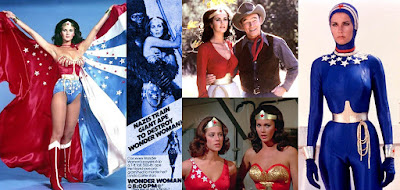
Following a somewhat muted attempt at a Wonder Woman TV show with a pilot starring Cathy Lee Crosby, in a much toned down version of the role (similar to a run on the DC comics around that time, when the character had lost her powers and become a kind of secret agent, I suspect) a new attempt was made to capture the lightning of the character (DCs top female superhero character, pretty much since her first appearances in Sensation Comics in 1942). A new pilot starring Miss World 1972, the great Lynda Carter, was commissioned... along with a couple of episodes. Then a gap as this first series proved good with the ratings and another load of episodes were commissioned, giving a total of 14 episodes in total made by Warner Brothers for ABC. Despite the popularity, ABC didn’t renew the contract but two more seasons were created for CBS, under the slightly revised title The New Adventures Of Wonder Woman.

Now, I didn’t really watch these as a kid. I saw a few episodes and liked what I saw at the time but couldn’t get over the fact that I’d managed to miss the Cathy Lee Crosby TV movie from the year before (it aired on the week I was away on holiday) and I found it hard to get invested in something if I couldn’t see all the episodes (even when I was six). By the time I was eight, though, I was very much interested in her as a pin up girl and I treasured any issues of Starburst, Starlog and the like which had photos of Lynda in her sexy costume.

However, visiting them properly now for the first time on Blu Ray (I’ll get to the 1974 TV movie when I finally get around to purchasing it), I can see just how great this must have been for young female viewers in the 1970s. Shows like Wonder Woman, The Bionic Woman and Charlie’s Angels, all of which had relatively strong female characters (while still operating with highly sexist values, it has to be said) must have had a considerable impact on women of the time and I’m so glad these were made. I came to Wonder Woman as an interesting character very late (asides from seeing her regularly on the old Super Friends cartoon show), when I grudgingly went to the first Gal Gadot movie... which completely blew me away and forced me to re-examine this character.

All I can say is, wow, this was a really great show. Especially the first series where you had Lynda as Diana Prince/Wonder Woman, Lyle Waggoner (who was just pipped at the post by Adam West for the role of Batman in 1966) as Steve Trevor and Beatrice Colen as Etta Candy (all characters from the comic books). These first season episodes were set in the 1940s during the war (as were the original comics penned by William Moulton Marston, although the TV show continues using his literary pen name, Charles Moulton, on the credits). This debut season was amazing in that it used a brilliant series of animated comic book panels for the opening credits (pitched against a rollicking song which was toned down more and more each season) and the comic book style would continue into the story so you’d have comic book drawings become photos and the constant use of captions superimposed on the live action footage such as ‘Meanwhile’ and so on. One minor problem in the writing, perhaps, was that the villains were always the ‘Nazi of the week’ during the first year but, heck, the entertainment value was high and she also had her ‘invisible jet’ in this season. I don’t recall if it was used more than maybe only once more from Season 2 onwards... which is strange because I can remember that invisible jet being a hugely popular thing when I was a kid and the recent Wonder Woman 84 movie (reviewed here) also features an homage to it.

Like later seasons, the show was peppered with guest stars, many of them big names and one of the fun things about watching the various incarnations of the show now is spotting the various people who were either nearing the end of their careers or just starting out. There were people like Frank Gorshin, Roddy McDowell, John Saxon, Ron Ely and Ann Francis turning up in various shows. Even Roy Rogers was in one, although he refused to work with Carter until they got her some Western style clothes... so Wonder Woman has a new cowboy themed look to her costume for that episode (which actually works quite well, it has to be said). Also, a young Debra Winger was in a few episodes as Diana’s sister, Wonder Girl for the first season, although she bought herself out of the contract and turned down offers for episodes in a future season and her own spin off series (I’m currently reading Elvira’s wonderful autobiography and I now know why that particular piece of casting came to be).

For the second season, the show was updated to contemporary times... which was fine with the Wonder Woman character, as she’s not supposed to age. However, Lyle Waggoner also returned, this time playing the son of the character he'd played in the first season, also called Steve Trevor. This version of Trevor works for the Inter-Agency Defence Command (IADC) and, following an opening episode which half plays as a repeat of the first season pilot, Diana becomes an agent working under him. However, the revamped show lost its ‘comic book’ visual connections and, although the villains in the stories were more varied in their motivations, it did kind of lose a little in the updating. Especially when a ‘funny computer’ and a ‘funny robot’ were thrown into the mix.

In the third from last episode of Season 3, the show’s producers went for another reboot and Diana moves to LA, to work for a different branch of the IADC... introducing a whole host of new regular characters including a streetwise, Gary Colemanesque kid, a chimpanzee and an invincible man. This must have been made after the last two episodes (which were aired a little later as specials) because, in those two (which make up a single story), Diana is back in Washington and working for Steve Trevor Jr again. So yeah... I would have liked to have seen it continue but, honestly, not in the new format they were steering towards for an LA version of the show so... perhaps it’s best it ended when it did, with 60 episodes under its belt.

Still it’s a really interesting series but I did notice it always kept reinventing itself a little more than I would have liked... which is my polite way of saying it kept changing the rules. For example, the famous spin created for the TV show, where Diana Prince transforms into Wonder Woman, is shown as it should be for the first three episodes. It’s slowed down and shows Diana moving at super speed and throwing off her outer clothes to change costume. But it was time consuming (and therefore expensive) to keep doing that and locking off the camera before a 45 minute make-up and costume change so... pretty soon they developed a magical woosh superimposed over the two parts of the spin to bridge the footage and, it looks fine and is a staple of TV nostalgia now (again, there are even a couple of very subtle references to them in the Gal Gadot movies) but it’s also problematic. And the reason it’s problematic and the reason I say it’s reinventing itself is because the rules of Diana’s powers change over time due to this. When she’s tied up or imprisoned as Diana, she no longer has her powers unless she’s completed her spin in later episodes. So she becomes more like a Billy Batson changing to Captain Marvel style character, when he used to have to shout SHAZAM! to change and gain his powers. She is vulnerable when she’s Diana Prince which, obviously, is total rubbish and not the way the character is supposed to work at all. Not how she did work in the earlier episodes, where she had various other powers such as the ability to mimic any voice, many of which were dropped for the post-season one incarnations of the show. There seems to be a definite lack of consistency as the show develops as to what she can and can’t do and, if you’re watching them back to back in a compressed time slot as I just did, you’ll notice these little changes more.

And there’s a heck of a lot more I could write about this show, actually. I wrote a lot of notes as I watched but, honestly, I don’t want to write a book on the subject (although, if anyone wants to commission me to write a book on the first of the Gal Gadot movies, I’d be happy to oblige). Unless you want to read about me getting annoyed about how every corporation depicted in Season Three having exactly the same bizarrely shaped coffee mugs and things like that. Suffice it to say that Lynda Carter totally nails it in the role and is an amazing hero who, I guess, happened to hit at the right time when she was needed by an audience that appreciated her. The only thing which occasionally grates is the big, cheesy, freeze frame grin she gives at the end of pretty much every story but, honestly, she’s absolutely brilliant in this and I’m surprised she didn’t go on to do more higher profile things in Hollywood once the show had ended. 

 If you are interested in the character then this show, despite its differences to the comic, does not let the character down too much and the title role is a strong, positive role model for people, as far as I’m concerned. Or if you don’t want to go the long haul, maybe give Season One a spin, where the visual style of the comic book source material is played up  in a really nice way... something which should never have been dropped in my opinion. Anyway, the recent Warner Brother Blu Ray set of the entire three seasons of Wonder Woman is definitely worth a twirl, whichever way you look at it.

Thursday, 8 August 2019

Doctor Solar - Man Of The Atom


Up And Atom

Doctor Solar - Man Of The Atom
(The Gold Key and Whitman Years)

Gold Key Issues 1 - 27 USA 1962 - 1969
Whitman Issues 28 - 31 1981 - 1982


Written and drawn, initially and without credit, by Paul S Newman and Bob Fujitani, Doctor Solar - Man Of The Atom was not a comic I read when I was a kid. I always loved the beautiful covers of those old, Gold Key comics, which were the biggest rival to Marvel and DC then back in the 1960s and 1970s but there were not that many of them around over here in comparison to the sheer volume of their competitor’s comics and they never had the issue number printed on the front other than a kind of code number that the publishers used. I had a couple of their Star Trek issues (and a load of the strips reprinted in the British annuals), a big black and white reprint album/colouring book of some of their Boris Karloff Presents... series and, I think a Scooby Doo comic I have might be from Gold Key too (or else that one was published by Dell, like the Alvin comic I had). But those covers were always much more stunning than the Marvel and DC covers of the time and featured some nice painted artwork.

Doctor Solar was published for eight years in the 1960s, which is a fair run until you realise that Gold Key comics were never published that often and the frequency at which they were published varied form year to year. Doctor Solar was published anything from between twice a year up to maybe four or five times a year. He’s a nice character though and, having now read this Gold Key run, I found it very interesting that the style of the character changed/progressed over the stories as, one can conclude, the Marvel superhero comics which became incredibly popular from 1962 onwards, had an influential impact on the contemporary comics scene.

Doctor Raymond Solar was the real name of a scientist who worked in ‘Atom Valley’ with his colleagues Doctor Gail Sanders and Doctor Clarkson. However, while trying to stop an atomic accident which kills one of his other colleagues, Solar doesn’t die as you might expect but, like many comic book characters of the time, finds himself transformed into an ‘super powered man’ who can change his body into various forms of atomic energy to stop the forces of evil from trying to obtain the secrets of Atom Valley. Dr. Clarkson is in on his ‘secret identity’ from day one (as the president of the USA soon is, too) since Solar has to live, confined in his lab/office so others won’t have much exposure to his level of radioactivity for long stints and, also, so he can be recharged. Gail, the ‘almost love interest’ of the comic, also is let in on the secret after a few issues. Already, though, you can see the influence of Marvel since the character sometimes turns green when using his atomic powers (actually, the green colouring is a bit random in the first few issues but gets a half baked explanation for this phenomena as the series progresses).

The stories are fine and all based on scientific principles which often generated a lot of letters for the letters page where various kids would write in about continuity glitches or factual errors which the publishers would then have to try and write off with elabourate scientific explanations. He also had his own Blowfeld-like super-villain, who you would only see from behind or with his features partially hidden behind a speech balloon with just his prominent bald head to indicate he was responsible for the latest evil plot (he also appears in almost all the issues and the letters pages are full of people complaining that it’s almost always the same villain).

The early issues would contain two Doctor Solar stories per issue with a short back up strip, Professor Harbinger, sandwiched between the two. As the series progressed, the two Solar stories would be two parts of the same story but, for the 27 Gold Key issues, the Professor Harbinger stories were always in there because he was popular with the readers and I can certainly see why. These are great little stories where Gold Key’s very own Harbinger of doom would highlight a scientific achievement or miracle of nature and then start imagining/speculating/explaining to the reader what could happen if things naturally progressed on this theme in the future and how humanity might perish from the result of the seed sown from this scientific nugget. The strip would then end with an indication that Harbinger’s prophecies were already under way, which would make the Professor jump or nearly pass out until it turns out that, say, a giant bug was really just a projected shadow or a creature flying outside the window was really just a shaped helium balloon. I must say, I really enjoyed these little flights of fancy as much as I enjoyed the main Solar strip so I can see why they didn’t stop running them.

Now Doctor Solar was pretty unique for the first four issues... he didn’t even have a costume and I must say I did like that fact. However, those pesky Marvel and, to an extent, DC heroes were leading the way in sales and so various concessions can be seen coming in as the stories progressed. In Issue 5, Solar finally gets a costume to help protect his secret identity. It uses the radiation symbol on a red costume and is very similar to the costume used by the creators of The Simpsons (who were obviously paying tribute here) for their Radioactive Man character. However, he also has a visor (and glasses when he’s just plain old Ray Solar) to protect others from his unhealthy, radioactive glare and I can’t help but think this might have been ‘acquired’ from Cyclops of Marvel’s The Uncanny X-Men, who made a debut earlier in the same year. Similarly, stories where Ray demonstrates that he can cool down his body to freezing temperatures, heat it up etc might well be borrowed from X-Men’s Iceman and the newer version of The Human Torch, who would have gained popularity in Fantastic Four comics at the time. It’s all a bit tell tale when, for the first time ever in Issue 7, Doctor Solar is referred to in the narrative as a radioactive ‘mutant’... a word which was fully popularised right from the outset in the X-Men comics, if I recall correctly. Although, to be fair, the term doesn’t have the same satirical message that it did in the Marvel comic.

Again, as Ray demonstrates in later stories that he can shrink his body to tiny size or, indeed (and accidentally at first) grow to a huge, giant-sized version of himself, you have to wonder if the Ant-Man (and later Giant-Man incarnation of that character) was a huge hit with the kids at the time. And it could have been any number of Marvel villains who served as a template when, in the later comics, Nuro transplanted his brain into his robot helper Orun and became a more active, mechanical threat to his super powered nemesis.

When the strip first started, as with the Doc Savage Gold Key comic I reviewed here, the page layouts were all five panels per page operating out of a six panel grid, two by three, with one or other of the panels being stretched vertically or horizontally to break up the page. However, as Marvel and DC presumably grew more adventurous and the artists influenced other people in the same field, the layouts grow more relaxed and dynamic as the comic progresses.

And then, in 1969 and without warning, the comic just stops. Doctor Solar does have at least one later crossover appearance in an issue of Gold Key’s The Occult Files Of Doctor Spektor but I haven’t read that one yet... and I’ll save it for when I read those for another review for this blog (hopefully fairly soon). After this, the character was put on ice until the same publishers, under the name of Whitman Publishing, brought the character back for four issues running sporadically from 1981 to 1982. The art is not much different but the story content seems a lot less interesting and, by this time, the character of Doctor Solar is a lot more haunted by his fate. Also, in an age after Star Wars, Battlestar Galactica, The Black Hole, Buck Rogers In The 25th Century and a whole host of other, popular science fiction films and shows, he also seems to have two ‘cute and funny’ robot helpers lending a hand in Atom Valley... which really sets it apart from the earlier stories where the writers did, at least, try to keep the majority of the tales less fantastical where they could (with only the odd alien or energy monster unleashed in the strip very rarely). These issues dropped Professor Harbinger and, instead, had another popular Gold Key character making a return in the pages, Magnus Robot Fighter (again, another run I have to read for this blog). Probably the worst thing about Whitman’s brief resurrection of the character, however, was the awful, drawn covers. These things look quite childish and are a far cry from the traditional Gold Key covers of the 1960s and 1970s.

Again, there’s no warning of cancellation on this brief reappearance of the character but this wasn’t Solar’s last hurrah, by a long shot. In the 1990s and still, I think, to this day, there are new versions of the character, although none of them are actually Phil Solar. I believe the first ‘rebirth’ of the character actually took his inspiration from being a fan of the old Gold Key comics and so, when he is transformed into a similar being, pays homage to them. I’ll probably get around to catching up with these at some point in the next ten years though, I suspect. Meanwhile, I would thoroughly recommend the original Gold Key run of Doctor Solar - Man Of The Atom as they are quite nice commentaries of a certain section of society who were reading them (I found a young Paul Gambaccini had written in on one of the 1960s letter pages) and, despite their growing similarities to the comics of ‘the opposition’ on the racks at the time, they were also their own unique thing, to an extent. Quite a change of pace from the amount of teenage angst which made the Marvel tales so popular during the same period (and which became more prominent in the Doctor Solar comics in their short Whitman incarnation).