Showing posts with label super heroine. Show all posts

Monday, 17 January 2022

Wonder Woman


Bullets & Bracelets

Wonder Woman/
The New Adventures
Of Wonder Woman

USA 1975 - 1979
Three Seasons
Blu Ray Zone B


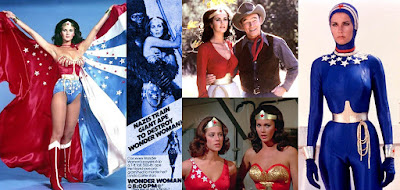
Following a somewhat muted attempt at a Wonder Woman TV show with a pilot starring Cathy Lee Crosby, in a much toned down version of the role (similar to a run on the DC comics around that time, when the character had lost her powers and become a kind of secret agent, I suspect) a new attempt was made to capture the lightning of the character (DCs top female superhero character, pretty much since her first appearances in Sensation Comics in 1942). A new pilot starring Miss World 1972, the great Lynda Carter, was commissioned... along with a couple of episodes. Then a gap as this first series proved good with the ratings and another load of episodes were commissioned, giving a total of 14 episodes in total made by Warner Brothers for ABC. Despite the popularity, ABC didn’t renew the contract but two more seasons were created for CBS, under the slightly revised title The New Adventures Of Wonder Woman.

Now, I didn’t really watch these as a kid. I saw a few episodes and liked what I saw at the time but couldn’t get over the fact that I’d managed to miss the Cathy Lee Crosby TV movie from the year before (it aired on the week I was away on holiday) and I found it hard to get invested in something if I couldn’t see all the episodes (even when I was six). By the time I was eight, though, I was very much interested in her as a pin up girl and I treasured any issues of Starburst, Starlog and the like which had photos of Lynda in her sexy costume.

However, visiting them properly now for the first time on Blu Ray (I’ll get to the 1974 TV movie when I finally get around to purchasing it), I can see just how great this must have been for young female viewers in the 1970s. Shows like Wonder Woman, The Bionic Woman and Charlie’s Angels, all of which had relatively strong female characters (while still operating with highly sexist values, it has to be said) must have had a considerable impact on women of the time and I’m so glad these were made. I came to Wonder Woman as an interesting character very late (asides from seeing her regularly on the old Super Friends cartoon show), when I grudgingly went to the first Gal Gadot movie... which completely blew me away and forced me to re-examine this character.

All I can say is, wow, this was a really great show. Especially the first series where you had Lynda as Diana Prince/Wonder Woman, Lyle Waggoner (who was just pipped at the post by Adam West for the role of Batman in 1966) as Steve Trevor and Beatrice Colen as Etta Candy (all characters from the comic books). These first season episodes were set in the 1940s during the war (as were the original comics penned by William Moulton Marston, although the TV show continues using his literary pen name, Charles Moulton, on the credits). This debut season was amazing in that it used a brilliant series of animated comic book panels for the opening credits (pitched against a rollicking song which was toned down more and more each season) and the comic book style would continue into the story so you’d have comic book drawings become photos and the constant use of captions superimposed on the live action footage such as ‘Meanwhile’ and so on. One minor problem in the writing, perhaps, was that the villains were always the ‘Nazi of the week’ during the first year but, heck, the entertainment value was high and she also had her ‘invisible jet’ in this season. I don’t recall if it was used more than maybe only once more from Season 2 onwards... which is strange because I can remember that invisible jet being a hugely popular thing when I was a kid and the recent Wonder Woman 84 movie (reviewed here) also features an homage to it.

Like later seasons, the show was peppered with guest stars, many of them big names and one of the fun things about watching the various incarnations of the show now is spotting the various people who were either nearing the end of their careers or just starting out. There were people like Frank Gorshin, Roddy McDowell, John Saxon, Ron Ely and Ann Francis turning up in various shows. Even Roy Rogers was in one, although he refused to work with Carter until they got her some Western style clothes... so Wonder Woman has a new cowboy themed look to her costume for that episode (which actually works quite well, it has to be said). Also, a young Debra Winger was in a few episodes as Diana’s sister, Wonder Girl for the first season, although she bought herself out of the contract and turned down offers for episodes in a future season and her own spin off series (I’m currently reading Elvira’s wonderful autobiography and I now know why that particular piece of casting came to be).

For the second season, the show was updated to contemporary times... which was fine with the Wonder Woman character, as she’s not supposed to age. However, Lyle Waggoner also returned, this time playing the son of the character he'd played in the first season, also called Steve Trevor. This version of Trevor works for the Inter-Agency Defence Command (IADC) and, following an opening episode which half plays as a repeat of the first season pilot, Diana becomes an agent working under him. However, the revamped show lost its ‘comic book’ visual connections and, although the villains in the stories were more varied in their motivations, it did kind of lose a little in the updating. Especially when a ‘funny computer’ and a ‘funny robot’ were thrown into the mix.

In the third from last episode of Season 3, the show’s producers went for another reboot and Diana moves to LA, to work for a different branch of the IADC... introducing a whole host of new regular characters including a streetwise, Gary Colemanesque kid, a chimpanzee and an invincible man. This must have been made after the last two episodes (which were aired a little later as specials) because, in those two (which make up a single story), Diana is back in Washington and working for Steve Trevor Jr again. So yeah... I would have liked to have seen it continue but, honestly, not in the new format they were steering towards for an LA version of the show so... perhaps it’s best it ended when it did, with 60 episodes under its belt.

Still it’s a really interesting series but I did notice it always kept reinventing itself a little more than I would have liked... which is my polite way of saying it kept changing the rules. For example, the famous spin created for the TV show, where Diana Prince transforms into Wonder Woman, is shown as it should be for the first three episodes. It’s slowed down and shows Diana moving at super speed and throwing off her outer clothes to change costume. But it was time consuming (and therefore expensive) to keep doing that and locking off the camera before a 45 minute make-up and costume change so... pretty soon they developed a magical woosh superimposed over the two parts of the spin to bridge the footage and, it looks fine and is a staple of TV nostalgia now (again, there are even a couple of very subtle references to them in the Gal Gadot movies) but it’s also problematic. And the reason it’s problematic and the reason I say it’s reinventing itself is because the rules of Diana’s powers change over time due to this. When she’s tied up or imprisoned as Diana, she no longer has her powers unless she’s completed her spin in later episodes. So she becomes more like a Billy Batson changing to Captain Marvel style character, when he used to have to shout SHAZAM! to change and gain his powers. She is vulnerable when she’s Diana Prince which, obviously, is total rubbish and not the way the character is supposed to work at all. Not how she did work in the earlier episodes, where she had various other powers such as the ability to mimic any voice, many of which were dropped for the post-season one incarnations of the show. There seems to be a definite lack of consistency as the show develops as to what she can and can’t do and, if you’re watching them back to back in a compressed time slot as I just did, you’ll notice these little changes more.

And there’s a heck of a lot more I could write about this show, actually. I wrote a lot of notes as I watched but, honestly, I don’t want to write a book on the subject (although, if anyone wants to commission me to write a book on the first of the Gal Gadot movies, I’d be happy to oblige). Unless you want to read about me getting annoyed about how every corporation depicted in Season Three having exactly the same bizarrely shaped coffee mugs and things like that. Suffice it to say that Lynda Carter totally nails it in the role and is an amazing hero who, I guess, happened to hit at the right time when she was needed by an audience that appreciated her. The only thing which occasionally grates is the big, cheesy, freeze frame grin she gives at the end of pretty much every story but, honestly, she’s absolutely brilliant in this and I’m surprised she didn’t go on to do more higher profile things in Hollywood once the show had ended. 

 If you are interested in the character then this show, despite its differences to the comic, does not let the character down too much and the title role is a strong, positive role model for people, as far as I’m concerned. Or if you don’t want to go the long haul, maybe give Season One a spin, where the visual style of the comic book source material is played up  in a really nice way... something which should never have been dropped in my opinion. Anyway, the recent Warner Brother Blu Ray set of the entire three seasons of Wonder Woman is definitely worth a twirl, whichever way you look at it.

Thursday, 3 May 2018

Wonder Woman Unbound


Lost And Bound

Wonder Woman Unbound
by Tim Hanley Chicago Review Press
ISBN: 978-1-61374-9098

Wonder Woman Unbound is the first of what will be, I’m sure, many books I’ll be reading for this site dealing with various aspects of, to quote this book’s subtitle, ‘The Curious History of the World’s Most Famous Heroine’, in the wake of last years truly great cinematic incarnation of the title character. I was given this at Christmas and, despite the bold cover, it looked a slight thing in terms of how much value it could bring to my understanding of the Amazon Diana and her heroic persona. However, looks can be deceiving and are not the best things to rush to judgement on and so it proved to be with this.

Tim Hanley’s book is a knockout and a gold mine of great information, much of which could only be researched in the wake of the availability of expensive duplicates of the early comics which were reprinted for the general public more recently than when some of the other tomes which have tried to look into Diana’s background were written. I truly learned a lot from this valuable book, which doesn’t just limit itself to looking at creator William Moulton Marston’s original take on the character but also brings us right up to date... or at least as up to date as 2014 when it was written.

After an introduction which touches upon some of the issues Hanley wants to cover in the book, he gets right into things with the first section, entitled The Golden Age. In this he recaps, for the less comic literate, the history of the medium and the various things that happened to the strips... such as a, surprisingly, balanced view of what Wertham was really saying when he sparked those comic book witch hunts with their grim fallout involving the creation of the Comics Code. Not to mention the slumps in sales and how the various strips and characters weathered these things through this and certain other periods of modern history.

Diana’s origins were slightly different from the current version of the character as portrayed in the movies.... with the amazons imprisoned by Hercules before escaping to Paradise Island where they fashioned bracelets from their chains to remind them of the world of men... although the idea that Diana was sculpted from clay by her mother and given life from the Gods was there too. However, the origin was revisited and changed a few times over the years... as it has been for a lot of comic book characters over the decades (especially DC characters) and this is perhaps due to the longevity of the Golden Age characters... when many other of the superpowered giants were refashioned (with some notable and legendary exceptions) as brand new characters with different origins... I might mention the Golden to Silver and Platinum Age transformations of such characters as Green Lantern, The Flash or The Human Torch (who originally wasn’t human at all), for example.

Another very good point that the author makes, and it’s not something I’d even thought of before, was that many of those Golden Age heroes were born from personal tragedy... Superman fleeing the destruction of his race, Bruce Wayne’s parents gunned down in front of him etc... whereas Wonder Woman was not. Her origins seem way more upbeat and optimistic in comparison and perhaps that’s why she tries to solve all the problems she faces from various villains with a sense of love and reformation rather than with overt antagonism (something which came over very well in the recent movie version of her character, reviewed by me here).

So, for example, it talks about how she would recognise the good traits of her enemies and use those to suggest alternate career paths and how she had set up ‘Reform Island’ to rehabilitate those foes who survived her attentions (something which I’m guessing may have been purloined from either Doc Savage’s Crime College or The Shadow’s similar reforming island.

It also talks about the gender role swap and compares Steve Trevor to Lois Lane in terms of being a 'damsel' to rescue. Batman’s Robin fulfilled a similar role but was, also, always quite useful to Batman whereas Steve Trevor seemed to be completely ineffectual against his enemies and would have to be bailed out by Wonder Woman time and time again. Hanley then looks at how alter ego Diana Prince fulfilled the same weak role in comparison to Steve Trevor, before transforming herself into Wonder Woman to save the day.

The author is also not afraid to take on all the issues of Marston’s personal psychology and how his much celebrated and still used to this day (if my understanding is correct) DISC theory was the underlying message of the propaganda living inside the strip and also points out the difference between this and the undeniable sexual kinks depicted metaphorically in the book... which are problematic not by their nature but by being somewhat contradictory in their gender representation to the underlying tenets of DISC.

He goes on to show various charts of his research to point out the high percentage of her time Wonder Woman spent in bondage or, most importantly, binding others compared to her nearest male rival in terms of ‘getting tied up’, Captain Marvel. Of course, the big red cheese’s* bondage content was often a necessity of the writers finding ways of incapacitating his alter ego, Billy Batson, so he could be gagged and unable to say the magic word SHAZAM!, which would bring Captain Marvel into the world... so it has the highest amount of bondage in any male oriented comic book. Wonder Woman had stacks more and the writer also looks at the different ways it was shown in relation to who was getting tied up (male or female) and if it was, perhaps, a disservice to Marston’s own theories of female dominance being depicted.

Hanley also talks about Marston's theory about the positivity of submission being at odds with the way it was portrayed in the strip but shows that other elements of the stories also supported the strong feminist ideal that the character was meant to represent. Also, that the strip was very much aimed at a male readership, as well as female readership and that, for the most part, the male readership was much higher. He does this very impressively by gleaning the amount of data to be found in the letters pages of the comic over the years and also by looking at the kinds of ads which were being pitched (mostly to boys) in the Wonder Woman comics.

The book goes on to cover the character in the wake of Marston’s death, looks at the various other important writers contributing to the strip (including other, very interesting features in the pages of the various comics starring Wonder Woman) and gives an overview of how ‘in touch’ they were with Marston’s principles... including the use of the phrase ‘Suffering Sappho’ and how the evidence from a lot of the comics is undeniable that Diana was, especially at the start, a lesbian... although I suspect what she became very quickly, in terms of her alter ego, was at least bisexual (something which I think is another element which the recent film makes as overt as possible for a family audience). Although the Amazons, as they stand in the movie, surely must have been created as bisexual because their original mission was to appease/calm down and ‘sexy up’ mankind, if I’m interpreting the movie version correctly.

Hanley explores the differences between the character and the silly plots of the Silver Age in the wake of the shake up after the EC comics years and the ‘Wertham effect’. How the women in the comics, including Diana, were injected with ideals of ‘female domesticity’ propaganda after the death of her creator (something which I don’t think would have necessarily have happened if he had lived longer).

It investigates and demonstrates these things by giving us a very welcome potted history and summary of various other characters in comics at the time... including the female characters. This shows that, in many ways, Diana at this time was even less independent than the title character of the ‘Superman’s Girlfriend Lois Lane’ comic book. Other DC female characters were far stronger in terms of their identities and roles in the DC line.

Thus, it shows how the women's liberation movement of the fifties and sixties totally passed Diana by. In fact, in a very interesting run of the comics, her superpowers were taken away from her, as was Steve Trevor, who dies as her motivation to become a kind of mentored, kung fu killing machine spy who was falling in love with every man she came across and who was as interested in wearing the right fashions as she was anything else. Actually, this run of the comics sounds fascinating and, although they completely destroyed Diana’s character, I would truly love to read these ones. Unfortunately, I don’t think they’ve been reprinted so it would take a lot of time scouring comic book shops for expensive back issues if I were to ever get that opportunity, methinks.

So after making the point that while women were rising up and claiming independence in real life, Wonder Woman was doing the exact opposite... it shows how Gloria Steinem reclaimed Wonder Woman in the 1970s by putting her front and centre on the cover of the first issue of her phenomenally successful Ms magazine - celebrating her inside the covers and engineering the restoration of her superpowers with a powerful friend at DC to tie in with this.

As Hanley covers the next four decades, bringing us to the somewhat sorry state of the character in 2014 (in terms of sales at least) it becomes increasingly clear that he knows a lot about the history of feminism in its many incarnations (many of them opposing)... including one based on theories of an all female genesis for our species through a process called parthenogenesis which, in all honesty, does nothing to make me take certain somewhat respected splinter groups of feminism in any way seriously. I mean... oops.

It’s a shame, in a way, Hanley didn’t wait another three or four years before he published this so he could see what a successful phenomenon Wonder Woman has become again, especially in terms of the film which has become probably one of the most successful DC superhero movies of all time (deservedly... it’s one of the great works of art in modern cinema). I suspect he might want to revisit the book at some point and revise it in light of what Diana has become to modern audiences and I would love to read what he makes of this recent chapter in her ongoing history.

That being said, though, Wonder Woman Unbound is a truly wonderful tome to have in one’s personal library and it certainly armoured me up with a lot more knowledge about the character than I was previously aware of. It’s concise but thorough and extremely well written... it also includes a number of interesting photos of key covers, adverts and other items of note from her history in a section about two thirds of the way through the book. Now, admittedly, I am a novice when it comes to this character so don’t know how this holds up to more knowledgable fans of Diana and her story but I can certainly recommend this as required reading for anyone who is a little in the dark about Wonder Woman’s place in comic book history. I had a really good time with this one... perhaps you will too.

* Arch enemy Dr. Sivana's name for Captain Marvel (played by Mark Strong in next year's movie version).