Monday, 9 May 2022

Death Curse Of Tartu


Tartu Detour

Death Curse
Of Tartu

USA 1966
Directed by William Grefé
Arrow Blu Ray Zone B


Warning: I guess this has spoilers.

Death Curse Of Tartu was shot in just seven days and came about because director William Grefé could only sell his recently shot film, Sting Of Death (reviewed by me here), to a distributor if it was double billed with another horror picture. And I’m finding this one kind of bizarre because, although in a lot of ways it’s just as awful, possibly more so, than the aforementioned jellyfish-man movie, I actually kinda liked this one.

Okay... so the film involves an isolated island in the sub-tropical wilderness of the Everglades in Florida. An explorer finds a cave on a burial mound and a mummy gets out of a tomb and kills him. Then, in probably the only really interestingly done part of the film, the mummy drops some papyrus scripts on the floor and the camera jump cuts to them and we find the opening credits on them with the title music, such as it is, playing in the background as the mummy’s hand slowly removes each piece of paper from the top of the pile to reveal the next credit. The film has a credit for two song writers but no scoring credit and the over the top nature of some of the score used against the images (especially at the start of the movie) and the repeating of only a couple of tracks over and over, later in the film, leads me to believe the music for this movie is either plundered from another production or, more than likely, just needle dropped in from a music library.

Now, apparently, a lot of Seminole Indians lived in this territory and the character of Billy, who’s in a couple of scenes in the first half an hour as a kind of Indian guide to the local region, is one of these. He takes another professor out to the place where the burial mound can be found a long walk away on the island but will go no further. He tells the professor, as he tells the professor’s friends the next day when he gives them a map to get to the island, that the place is haunted by the spirit of an old witch doctor named Tartu, who comes to life as a mummy and transforms into various creatures to kill those who trespass on his land. Native drums and indian cries are heard in the air whenever he is near, as they are perpetually throughout the movie, due to the repeated use of some audio library track or other.

The guy is left there exploring and finds a rock. Now, the key theme of this film is given away right from here... and it’s padding. This is a movie where we see both this professor... who is soon crushed to death by Tartu in snake form... and also the next bunch to pitch up here... taking forever to walk or airboat in and then every stage of the journey, literally of people just walking around, takes up the majority of the running time. That’s maybe why I found the movie so comforting and reassuring to watch, to be honest. There is a heck of a lot of unnecessary footage here. I’d detected a certain amount of that in Sting of Death but Death Curse Of Tartu really excels at showing you levels of superfluous detail which is of little or no interest (although, like I said, I kind of didn’t mind it in this one, myself).

However, to my shame, there is an early jump scare which actually made me jump. It’s the exact same scare as was used in the first 10 minutes of Raiders Of The Lost Ark and here, involves the professor pulling aside a tree branch to reveal a rubbishy, plastic looking skull on a stick while an over the top musical stinger plays. And it’s really useless and non-threatening but, like I said, it actually worked for me. All I can say in my defence here is that I really wasn’t expecting any kind of jump scare in a 1966 swamp movie and that the various, slow paced shots of the professor walking around maybe lulled me into a certain stupor.. which was the exact state of mind needed for this cheap trick to actually work on me. So a big thumbs up to Grefé here for actually getting me good. I was most appreciative of the jolt, for sure. Although I’d defy anyone else to be scared by this... especially since you can see the skull before it’s revealed.

Okay, so the professor is killed and then his friends, Professor Tison (played by Fred Pinero), his wife Julie (played by Babette Sherrill) and two young archaeology student couples...  Cindy (Mayra Gómez Kemp), Johnny (Sherman Hayes), Joanne (Maurice Stewart) and Tommy (Gary Holtz)... all get their airboats through to the island to find their friend and carry on exploring... but all they can find is the strange rock which the professor has dug up. When Tison translates it, we get to hear the back story of the Witch Doctor Tartu for yet a third time. Yay!

The kids go to make out by a lake while the professor stays behind in camp to finish the translation and... also makes out with his wife. Because of all this obvious work and discovery going on, the kids have a radio with them and the director manages to shoehorn a ‘wild and crazy’ teen dance scene into the picture where, once again, he shows a propensity for focusing his lens on the shaking derrieres of the teenage gals as they ‘swing their pants’. However, the punchline to this scene comes when Joanne and Tommy go for a swim in the water. Oh no, you may exclaim. Will a water snake or a crocodile get them? No because... and believe me, I was as surprised as the main cast at this... Joanne and Tommy get attacked and eaten by a shark! Which is preposterous! However, even Professor Tison reminds the audience that sharks don’t live in fresh water* and so it’s by now obvious, of course, that the mummy of Tartu has risen from his crypt and hit upon the good idea of temporarily transforming himself into an out of place shark to kill these two kids. At this point, Professor Tison, who has been downright aggressive in the film when anyone even mentions the possibility of anything supernatural occurring in real life, suddenly says, sweepingly, that “There are things on this planet that scientists have no answer to.” Blimey, he sure stopped being Mr. Cynical on the turn of a penny.

They decide to get off the island and go back to the nearest civilisation but, just like in Sting Of Death when the boat full of kids trying to get help all get killed before that can happen, when Johnny is sent back to wade through the swamp he soon gets ‘snaked up’ by Tartu. When Cindy tells the others the bad news because she saw it in a dream (don’t even ask!), the survivors decide to find Tartu’s mummified form and kill it before it eats or cuddles anyone else. However, the professor and his wife get trapped in the cave while Cindy gets her arm bitten up by Tartu in crocodile form. The bleeding arm doesn’t explain why, in the next shot when the freed Professor is holding her dying body in his arms, she also has blood coming out of her mouth but... I’m suspending my disbelief as much as possible at this point.

The professor and his wife go to confront Tartu in the form of a virile, aggressive native American Indian and manage to finally dunk him into the nearby quicksand. And before you can say Tartu Barado Nickto, the villainous witch doctor re-takes his mummified form... just before his head goes under and he’s then sucked into the murky waters. This is apparently because the guy playing the Indian didn’t want his head under the quicksand so they came up the idea that Tartu would revert back into another actor just before dying. As the professor and his wife walk off with the bitter sting of a sad victory, they seem to have forgotten that they don’t have any boats to get them home. Let’s hope they don’t get eaten by crocodiles on the long journey back then.

I’ve not much more to say about Death Curse Of Tartu and I have to say that, while it’s not a film I could in all conscience recommend to anyone, I did find this one extremely enjoyable and somewhat comforting when it came to observing all the dull, plodding around in the undergrowth scenes. I’d watch this one again for sure. Looking forward to what’s up next in Arrow’s lovely He Came From The Swamp - The William Grefé Collection Blu Ray set and you can bet I’ll report back here soon.

*It’s come to my attention since writing this review that,
certain conditions have allowed this to happen in real life
on occasion, a shark in fresh water... but still.
Whether this information was available when this
was made (considering what the character
in the movie says) is not something I am sure about.

Sunday, 8 May 2022

Doctor Who - Frontier In Space


Master Plan

Doctor Who -
Frontier In Space

UK Air date: February - March 1973
Six Episodes
BBC Blu Ray Zone B


Warning: Slight spoilers.

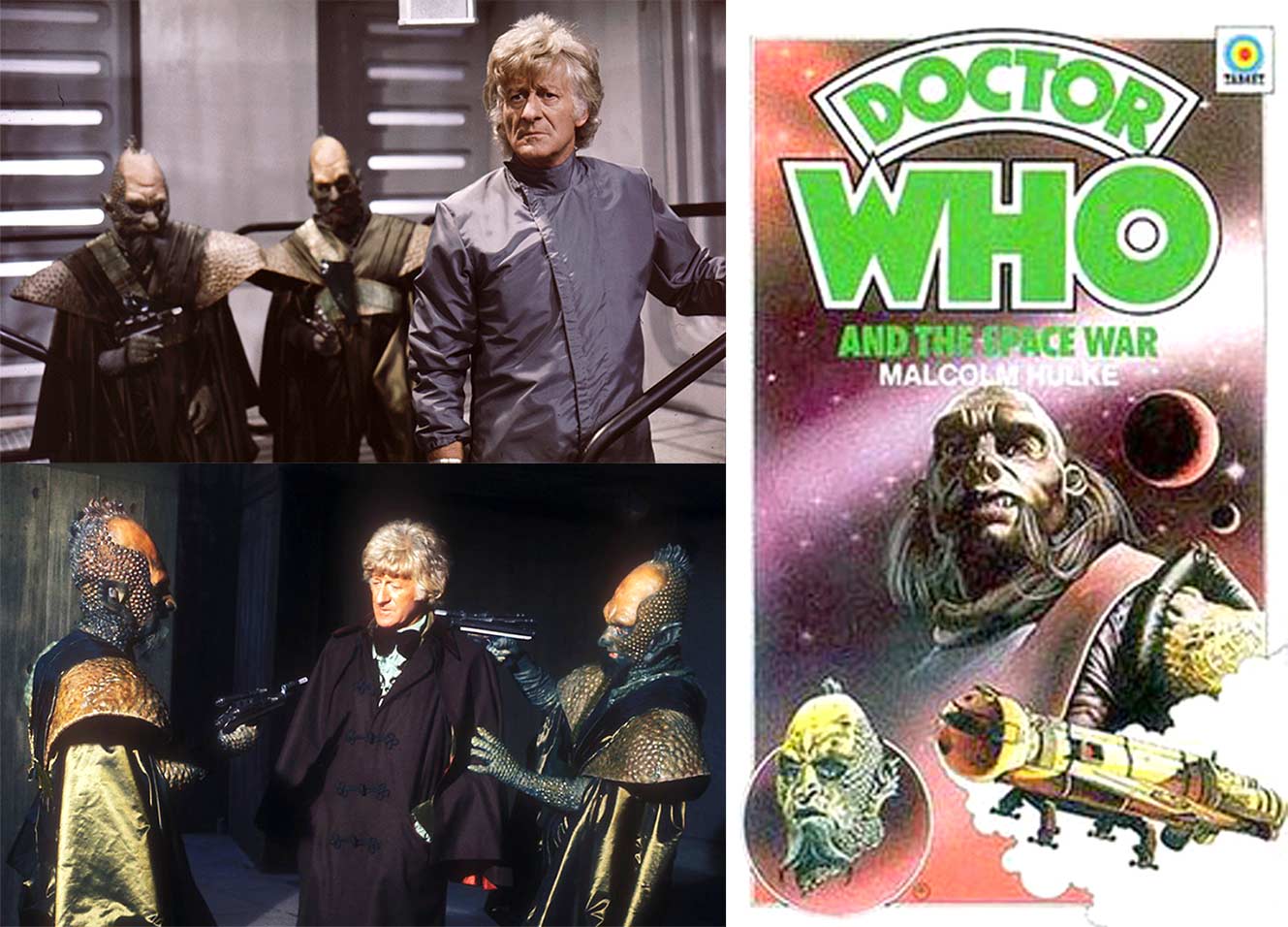
So Frontier In Space is the third story of the tenth series of Doctor Who, as reissued in the nice Blu Ray set of that season from the BBC. I was five years old when this story aired but I only seem to have hazy recollections of this one. Whereas, the next two stories in the box, I have a lot of childhood memories of terror. Looking back on it now, though, I have to say that it’s easily one of the best of the John Pertwee Doctor Who stories I’ve seen.

This one’s a six parter and involves The Doctor and Jo Grant (played by the always brilliant Katy Manning) getting involved with a cold war climate powder keg in the far future between the people of Earth and the people of Draconia (who are kind of a short hand version of ancient Japanese style lizard people, in terms of their manner and codes). The TARDIS is taken away from our two heroes more or less from the start of the tale and the majority of the first three episodes sees them being imprisoned by various people and spending a lot of time in jail cells, as the plot moves along without them in some areas. It sounds boring and padded but, well okay it possibly is padded but it’s nothing short of interesting and exciting since, you know there’s going to be some jail break or other set piece in each episode.

The plot is kickstarted by an outside party committing hostile acts of space piracy on the two species and using a sound based, hallucinogenic gadget to make the victims believe they are seeing the other race, humans or Draconians, committing these crimes, in order to start an intergalactic war. Fairly soon it turns out that the actual people committing these acts are the Ogrons, a race of quite dumb mercenaries for hire which were on a lot of merchandising such as jigsaw puzzles when I was a kid but were only actually in two stories in the Pertwee era (I’m not counting their cameo in Carnival Of Monsters, reviewed here and nor am I counting the 1990s Eastenders charity crossover, Dimensions In Time). The Ogrons, of course, are being directed by a higher power and it soon becomes evident that this is a master plan of... um... The Master, kind of. In the last episode it is revealed that he is working (although he plans to double cross them) with the Daleks, who only turn up in that final episode.

The story is absolutely superb and it has a great script. Katy Manning’s always watchable Jo Grant is given more to do here and there’s a wonderful scene where she is holding up a very long, one sided conversation with The Doctor to hide the fact from a security camera that he’s already escaped the cell... demonstrating that Jo Grant can talk the hind legs off a donkey with ease when she has to.

The Master is, once again, played absolutely brilliantly by Roger Delgado (aka Roger Caesar Marius Bernard de Delgado Torres Castillo Roberto) who, alas, died quite violently while shooting a television show in Turkey when the car he and two other crewmen were in plunged into a ravine, just a few months after Frontier In Space aired on television. It was a real loss and I think it’s probably why Jon Pertwee opted to leave the show a year later. Delgado’s last scene in this story is of him shooting The Doctor down, before Jo helps the wounded Doctor into the TARDIS at the end of the last episode. The Master would not return again until he was pictured as a kind of melted looking monster in the Tom Baker story The Deadly Assassin in 1976. He’s been played a few times by different actors since then and, in at least two of the incarnations of this time lord, the actors have somewhat resembled the look of Delgado in the role.

The special effects in this one aren’t great as the story calls for things like space walks and so on but, it never really bothered us as kids. Even then, I’m sure, we could see those big cables holding the actors up but, you know, how else do you tell a story like this on a TV budget in the early 1970s. I look on them now as a kind of comforting presence in these things and count myself lucky that, unlike some other films and shows put out in high definition, the copyright owners haven’t tried to tart up the special effects and turn them into something they never were (although they have in some of these Blu Ray sets, it’s true.... but there's always the option to watch the original version). I like that the cell holding the prisoners here wobbles when they bash it and stuff like this should always be left in. It’s not just entertainment... it’s art and, as importantly, a historical document of its time. So leave it alone is always my view on the decision to intervene too much with modern technology.

The Target novelisation of the story, always a big winner with kids... I guess they were the Harry Potter novels of their day to some extent, when it came to promoting children’s reading... was one of the few of their adaptations not to use the name of the story for the book title. Instead of going on the shelves as Frontier In Space, the book version was called Doctor Who And The Space War. I probably enjoyed this one along with all the others... I certainly had a copy of this shelved with around 60 others at one point, I’m sure.

The next story in the series and on this Blu Ray set is Planet Of The Daleks, which I assume follows on directly from this story. I only remember a few things from it which haunted my nightmares but I also remember being disappointed with it when I watched this one again on a VHS tape in the late 1980s so... yeah, we’ll see how that one goes. Frontier In Space, though, is an absolute corker of a story and probably, it turns out and much to my surprise, the real jewel in the crown of this boxed set.

Wednesday, 4 May 2022

Diabolik


Kant Buy
Me Love


Diabolik
Italy 2021
Directed by Antonio & Marco Manetti
RAI Italian Ltd Edition
Blu Ray Zone B/DVD Region 2 set


Warning: Very light spoilers.

So, after both the 1968 Mario Bava movie known in the UK as Danger Diabolik and an animated series, Diabolik returned to Italian cinema screens at the end of last year. Alas, it’s still not found an English distributor for either a UK cinema or home video release (or possibly even streaming, at time of writing) but I wanted to do this right so, rather than just watch a free HD copy online, I managed to acquire the new limited edition Italian Blu Ray/DVD set, which also comes with a replica copy of the third issue of the original fumetti, The Arrest Of Diabolik (on which this film is based, along with also taking material from a 2012 remake comic book of the same story) but, since I can’t read Italian to get the one detail about a certain jewel I wanted to know, I can’t work out whether a specific reference was put there by the Manetti Bros or if it was in the original version of the comic... or, indeed, if it’s just a coincidence (I’ll get to that possible reference in a minute).

The new film starts off with a very similar style opening to the Mario Bava version (reviewed by me here), to which the first time viewer will obviously compare it to, at least for a while. So the film is set in the late 1960s and we have Diabolik in his black Jaguar evading the police after a heist. It’s one of very few action sequences in the movie, actually and, I suspect, those who are not intrigued by the story and the absolutely wonderful performances of Luca Marinelli as Diabolik, Miriam Leone as Eva Kant and Valerio Mastandrea as Inspector Ginko... may find the lack of stunts and explosions etc a little disappointing. However, because the story is so strong... it’s an origin tale, of sorts, for the way that Diabolik and his future girlfriend Eve Kant first met... I found it absolutely absorbing from start to finish and didn’t notice the 2 hour 15 minute running time.

Okay, so I won’t say all that much about the plot but two things that caught my attention were the diamond and a section of the story involving an execution by guillotine. Okay, so the jewel that Diabolik is after from Eva Kant, which brings him to her door, is a very special pink diamond. So my first thought was obviously the specific diamond named The Pink Panther, which was the plot device of the 1963 film and which birthed the animated title sequence using a literal pink panther, thus giving kids all over the world a new hero when the title sequence character got his own cartoon show (which used to feature an Inspector Clouseau cartoon as its second half each week, if I remember correctly, both segments utilising Henry Mancini’s themes from The Pink Panther and A Shot In The Dark respectively). It’s a nice touch but I’ve no idea now if it was a deliberate reference or not, due to the dates being fairly close (if it did appear in that original fumetti).

The other thing I noticed which, judging from my look at the replica fumetti... since the first two thirds of this movie seem to follow it fairly closely (and so don’t blame the Manetti Brothers for eschewing action sequences, it looks like they are trying to do it fairly straight to the source material)... deals with the mistaken execution by guillotine of one of the characters who has been switched out at the eleventh hour, allowing Diabolik to escape justice. Now, I’ve read the first Fantomas novel from 1911, years ago and, honestly, it’s an absolute steal from that inaugural story but, of course, it’s not rocket science to figure out that the original character of Diabolik was blatantly inspired by the French master criminal.

So, okay, I had two slight problems with the movie. One is.... and I suspect this is endemic of the current state of Italian film production in general... that, although I’m sure a lot of money was spent on this new movie, there’s something about it that makes it look really cheap. Like it’s a TV movie or something. It all looks like it’s just been shot on a high res video camera and so doesn’t have that cinematic feel I was expecting from it (and no, I didn’t have the stupid motion smoothing setting on, thanks very much). However, once I got  used to it I managed to forget about it.

The other thing is... there are no real surprises in the film. Even though the narrative structure is deliberately built to hide information until certain things happen, I could pretty much second guess the entire movie. For example, during the first meeting between Ginko and Eva Kant, I realised that this was probably not Ginko at all... in which case, the same kind of fictionally heightened style masks used in the Mission: Impossible series and films was probably being used here and, yep, indeed it was.

However, when a film is put together this well, the lack of unpredictability is not that distracting... there are lot of other good things to grab your attention. Some of the frame designs, for example, are nicely done with the directors sometimes emphasising vertical patterns to echo the frames of a comic book... something which they do big time in the last third of the movie, which is basically a heist, much of which is made of dynamic, split screen compositions. I found it odd that they saved the use of split screen for only the last third of the movie but it works effectively for the sequence and was as good a solution as any other. There are also some sets of camera movements that are a little reminiscent of some modern horror movies, in that they’re designed to conceal rather than reveal elements of a scene before a particular story point is reached.

The comic strip style is further enhanced by details which you wouldn’t necessarily get away with in other forms of fiction in a credible manner. For example, the fact that Diabolik has managed to have a raising ramp built right into the middle of a street so he can take that route to evade the police, after making sure he gets boxed into the correct location. Hmm... yeah... don’t know how he would have managed to install that one without being seen. Also, the ears of the character protruding from either side of his mask (either that or his ears are also very tightly covered in latex) which would look really silly if not for the fact that they’re lit so well to hide any colour or texture change in the scenes where they are prominent. Also, Diabolik has a very strong widows peak, which echoes the open eyes section of his mask to remind you who he is when he’s not wearing his criminal costume (Ginko has a widow’s peak too).

The structure of the piece is good also. Like I said, no real surprises but there are a few sequences where conversations are cross cut with other conversations (often with one of the same characters) so the present of a character can be at counterpoint with a reveal needed to make more sense of a scene when it comes up later. Again, even though I’d figured out most of those reveals on this one way before they happen... mostly due to just thinking logically about the way what I was watching was unfolding... it’s a nice way of presenting the information and the two or three times where this is done in the movie adds to an overall ‘corporate style’ to the film.

I really liked the sexual chemistry between Marinelli  and Leone as Diabolik and Eva too. Don’t get me wrong, it’s nowhere near as evident or blatantly expressive as the version of the relationship between John Philip Law and Marissa Mell’s versions of the characters in Bava’s movie but, the camera does still linger on the strength of their attraction to each other here as the glue which holds their relationship together... so that’s nice. I was worried they were going to shy away from that element here.

So it’s a shame, then, that due to the film’s release schedule being delayed by the Coronavirus pandemic, Marinelli is unable to reprise his role as the title character for the two sequels which are just winding up back to back production in Italy as I write this review. I hope the new guy they’ve got is able to at least match his, mostly emotionless and chilled performance here.

And that’s me done with the new Diabolik. I hope this one manages to find someone to give it a UK and US release because, frankly, our cinemas need more ‘shades of grey’ characters like this. This is a pretty good adaptation of the comics is my best guess, not to be compared to the Bava movie (which will always have the number one spot in terms of this character) but still doing something of its own with the material. And also... I love it whenever Diabolik throws his knife and the camera follows it at the same speed by keeping it in centre frame before we see who it killed (and, yes, I know it probably wasn’t captured like that but, that’s the impression it’s trying to create and it works really well, I think). Diabolik doesn’t need ‘bullet time’ when he has ‘dynamic dagger duration’ moments like this.

Tuesday, 3 May 2022

Danger Diabolik


Kant Get Enough

Danger Diabolik
aka Diabolik
Italy 1968
Directed by Mario Bava  
Paramount Blu Ray Zone A

 
Warning: Light spoilers.

I thought, in light of the reboot movie released in Italy recently, I’d revisit one of my favourite comic book movies, Danger Diabolik, based on the famous, long running fumetti Diabolik by sisters Angela and Luciana Giussani which, as far as I know, has not been translated for an English audience. The comic book followed in a long  line of lionised fictional super-criminals which seemed more abundant in countries like France, Germany and Italy than they did over here in the UK or in the US. I suspect the character was more than a little inspired by the original Fantomas, for example and there were a few attempts to get Diabolik started as a film by producer Dino De Laurentiis, with actors like Jean Sorel and Catherine Deneuve in the roles of Diabolik and his super sexy girlfriend Eva Kant, before he finally got the great Mario Bava to direct the movie.

So this version stars John Philip Law as the master criminal (who was also working on Barbarella for the same producer at the time), the marvellous Marisa Mell as Eva Kant, the great Michel Piccoli as Diabolik’s nemesis police Inspector Ginko, Adolfo Celli (who played Bond villain Largo in Thunderball) as mob boss Valmont and, in a few scenes scattered throughout the film in what is more or less an extended cameo, comical British actor Terry Thomas (who was so much in demand at the time that he shot all his scenes in one day).

Although Diabolik does not come over as ruthless, perhaps, as he did in the early comic books, he’s still going around killing innocent people who get in the way of his headline grabbing crimes and, although you’re always on his side as much as Ginko’s, he does tend to do some typical Robin Hood style acts of terrorism along the way. For instance, when a new police commissioner puts out a one million dollar reward for his capture, he sends him a note saying that he does not believe using this sum of money as an enticement to his capture is in the interests of the regular taxpayer... and then proceeds to blow up all the tax offices in the district so that people no longer have to pay any income tax, since the government has no records left to figure out what anybody owes to anyone.

The film is beautifully directed and, because Dino chose Bava to direct it, looks stunning. Bava uses some of his standard modi operandi to split the shots with foreground objects such as book cases, windows and bars to compartmentalise his actors and uses ‘natural inserts’ such as reflections in a rear view mirror in a car to add interest to the shots (and possibly as a wink to the comic book origins of the character, almost as if he’s presenting the audience with a bunch of comic book panels on the page). Although his colouring in the film isn’t as bright as the neon primary hues he uses in a lot of his films, it’s still a pretty colourful affair with the odd Bava trademark colour collision thrown in, such as a psychedelic night club party sequence, enhanced by Ennio Morricone’s swinging score or, in the pre-credits sequence where Diabolik uses a smokescreen to steal a car carrying a large amount of money, using three jets of orange, purple and green smoke injected into the mix. And when Diabolik has to climb up a pale castle tower in the moonlight, he changes from a black catsuit to a white one to better blend in with the environment.

Bava also uses his lens to really build an iconic status around the characters of Diabolik and Eva, with everything they do in their ‘larger than life’ sets and locations (including a super-villain’s lair which would make Bruce Wayne green with envy) enhanced to the point where almost every shot they are in becomes an artificial, attention grabbing statement of the importance of their respective characters. For instance, Diabolik is not introduced as a person initially, but as his two seat Jaguar car, which invades the proceedings in the pre-credits with a Morricone musical stinger and which becomes almost an apex predator to the poor, bumbling policemen who are trying to protect the money... and when Diabolik’s masked, iconic visage is seen, he is giving a proper super-villain laugh before he dives into the sea, along with the money, as the brilliant title song ‘Deep Down’, sung by Christy, cuts in with swirling credits before we rejoin him racing off in his speedboat, hotly pursued by police helicopter.

Now, there are a lot of wonderful, jokey comic book style sequences in the movie, such as when Valmont promises to cross a character’s name off the human register and then later, indeed, making an X shape with the path of his machine gun as he guns the victim down. And there’s that sumptuous villain’s lair with it’s huge, pipe organ alarm system and, of course, everything is enhanced with Bava’s miniatures and matte paintings to make everything look much bigger than it really is. He even adds in a couple of animated sequences to bring the comic book comparison closer in a couple of scenes.

The film has often been called campy but, with the hard edge of various characters, not forgetting the dark criminal heart of Diabolik himself, it really isn’t. There are, however, a couple of similarities, it could be said, to the landmark Batman TV show and film from a couple of years earlier. Most notably when Diabolik and Eve, disguised as press photographers, use laughing gas dispersed by their flash bulbs to infect a police press conference with a very lively atmosphere. So... in very much the Batman style... the gas is actually labelled up as Exhilarating Gas and the pills which Diabolik and Eva take to protect themselves, are similarly labelled up as Anti Exhilarating Gas Capsules.

If I had to pick a favourite moment, in a film which is full of little ingenious and light hearted gags, it would be when the title character places himself under a security camera, takes a shot of the room with a polaroid camera and them places the photo in front of the camera so the room looks empty. Preposterous, of course, since it would probably be completely out of focus but, in the setting of a comic book milieu which is further heightened by the visual genius of Mario Bava, it works really well.

And I suppose that’s me done with Danger Diabolik, for now, although I am hoping to watch the new version over the next week or so and so, I will review that one for the blog soon (yeah... I did just that, review coming tomorrow, stay tuned). Meanwhile, if you haven’t figured it out by now, Danger Diabolik is a movie I’m always going to recommend to any lover of cinema and well worth your time.

Monday, 2 May 2022

When Dracula Met Frankenstein


Sherman Fountain

When Dracula Met Frankenstein:
My Years Making Drive-In
Movies With Al Adamson

by Sam Sherman
Murania Press ISBN: 9798530794858


What a great book!

Just a quick shout out to something which will be a nice addition, I’m sure, to many a film enthusiast’s book shelves. You may remember when, a couple of years ago, Severin films put out a very pricey but, as it turned out, worth every penny boxed edition of 32 Al Adamson films, as part of a package to accompany the documentary movie Blood And Flesh - The Reel Life And Ghastly Death Of Al Adamson (which I reviewed here). Well, I went through that boxed edition of Adamson films and, though I found some titles to be terrible, I found others to be pretty good and sometimes beyond that but, whatever I thought about them (and I reviewed every one of them for this blog), going through that wonderful set reminded me of just how great an art form cinema could be and it revitalised my slowly waning interest in the medium.

Now, as I said, you can find my reviews of those on this blog and you can check for a title in the second ‘movie’ section of my site index (link at top left) or, if you want to go a more direct way, I also wrote an article specifically about the box, Al Adamson - The Masterpiece Collection, as a bookmark section, from which all my reviews are linked... and you can access that here.

As I waded into the set, two things bacame apparent and impressed me. One was that Adamson’s films were more often than not produced by Sam Sherman, who seemed a really sweet guy and came across in all the interviews as someone very knowledgable about the world of film, demonstrating a genuine love and affection for movies in general. He seemed like someone you would want to hang out with in a bar and buy drinks for so he won’t stop telling fascinating, illuminating stories about his decades in the business.

The other thing which came across to me was that, heck, I really needed to read a decent biography, or at least an enthusiastic book, on the films of Al Adamson and so I looked for one on Amazon and various online book stores but couldn’t find anything in print at the time. There was apparently one published in 1998 called Schlock-o-Rama: Films of Al Adamson but, yeah, good luck even finding a copy now, even at the ludicrous price I’m sure it would go for if anyone had a copy to sell. Well, that was a year ago so, imagine my surprise when I’d found out that, not only had a book which was much of what I wanted been published since I’d last looked but, it took the form of a memoir by Sam Sherman, about the films he’d produced with Adamson (and others) at Independent International Pictures.

When Dracula Met Frankenstein, subtitled My Years Making Drive-In Movies With Al Adamson, is a valuable, well written tome from somebody who’s about as no nonsense and as fair a person running a business as you can get. Going out of his way to help people along in the process of his career and championing the art form while still managing to make tonnes of money from... well, if you ask me... from some unlikely pictures. Sherman managed to make something out of both his own productions and others peoples (as I’ve talked about in some of my reviews of... let’s call them ‘rescued films’) and is a genuine success story, capturing various niche markets as and when required.

The various forewords to the book tell it all in terms of Sam’s character, with the people writing those intros singling him out as a nice, honest human being (which really comes across in both this book and various interviews on the Severin set, not to mention his little audio section on the Dracula VS Frankenstein soundtrack CD). And cinephiles will have a ball with many of the anecdotes on offer here.

The book is split into two sections. The first half being a look at his personal history with ‘the age of celluloid’ with tales of Al’s dad, cowboy star/director/producer Denver Dixon, how Sam himself got started on the road to producer by re-releasing an old 1930s Hollywood production of The Scarlet Letter in the 1960s, how he hired out equipment from the late great Kenneth Strickfadden (there’s a book about him I reviewed right here), how he worked with the infamous Hemisphere Pictures and so on. And really great stories I’d never heard before such as how he managed to generate income for the old Hammer films adaptation of the TV serial The Abominable Snowman (reviewed by me here) and, of course, how some of those Adamson flicks like Brain Of Blood and Nurse Sherri turned out like they did (and just why they did too... which was an eye opener). He even had famous artists like Neal Adams (who passed away last week) and Basil Gogos designing and painting promotional posters, sleeves and whatever else was needed to give a movie a first run lift or, often, a new lease of life when required. In fact, there’s a very interesting section which explains the early days of the sudden, burgeoning Home Video market and just how he was able to ‘more than stay afloat’ with some of his old titles.

The second section of the book is a rundown of chapters devoted, alphabetically, to various films he’s been involved with (mostly but not limited to, working with Adamson) and, as you would expect, he has quite a few stories to tell of just what happened on those productions. Blazing Stewardesses which, I’m sorry Sam, I really didn’t like compared to their original The Naughty Stewardesses, certainly makes more sense now in terms of just why the heck it ended up being the film it is now, for sure. Also, the inside story on just what happened with the ending of Girls For Rent is kinda interesting.

There’s also more than a hint in the book that Sam is working on a second book of memoirs (which I’ll be first in line for if it’s publicised better than this one was... I need to know about it before I can buy it) of all the other things which he’s been involved with outside of IIP. Frankly, there’s an unexplained photograph of Sam in the book (it’s also loaded with plenty of photos relating to the various stories, if that’s your thing) where he’s standing with the one and only Larry ‘Buster’ Crabbe and, yeah, I really want to hear about that meeting, for sure.

As you can see, I had a real blast with When Dracula Met Frankenstein and I’m sure glad Sam’s still around to share his stories. This is another of those essential film books every cineaste shouldn’t be without, as far as I’m concerned. Perhaps Tom Weaver, a film historian whose name I tend to associate with his expert knowledge on the classic Universal horror movies of the 30s - 50s, says it best when he shares an anonymous quote that... “When an old man dies, a library burns down.” That’s a really nice way of putting things and I couldn’t agree more. When Dracula Meets Frankenstein is available now from Amazon and, as the saying goes, all reputable book stores and... I sure hope Sam gets his skates on writing that second book. I want to read it sooner, rather than later.

Sunday, 1 May 2022

The Old Master


Getting To
Know Yu


The Old Master
aka Shi fu chu ma
Hong Kong 1979
Directed by Joseph Kuo
Eureka Masters Of Cinema
Blu Ray Zone B


The Old Master is the fourth of the kung fu films presented in Eureka Masters Of cinema’s splendid Cinematic Vengeance - Joseph Kuo Blu Ray boxed set and it’s also a lesson learned to me for the saying, “Be careful what you wish for.” While I really enjoyed the first three of the eight films in this collection, one of my biggest complaints was that they lacked story and character development. Well, here we have story and character development in spades... and as a result the film seems a lot poorer and way less spectacular for it.

As evident from Kuo’s The World Of The Drunken Master (reviewed here), Kuo had no qualms about riding Jackie Chan’s new found success and The Old Master beat Chan’s upcoming movie, The Young Master, to the big screen by a good four months. Although the films bear no resemblance to each other (I’m told... I’ve seen hardly any of Chan’s movies, to be honest), the exploitation machine was very much grinding away in the background with the casting of Jim-Yuen Yu as the title character, Grandmaster Wan. Jim-Yuen Yu was apparently the man who trained Jackie Chan in martial arts when he was a kid so... yeah, there’s that. Yu didn’t agree to do the film at first because he now lived in Los Angeles and didn’t want to return to Hong Kong and so, the production moved to a Los Angeles setting to accommodate him and to secure him in the main cast. Joining him is the younger Bill Louie as... Bill... to provide both comic relief and some fairly watchable and dynamic kung fu sequences.

Okay, so the plot is that the old master has been called over to Los Angeles to help a former pupil, who now owns a martial arts training school. He is in over his head with gambling debts but he uses the old master by setting up fights with other schools and, without the older guy knowing, gambling on the results (knowing the old master will beat anyone sent his way). Wan thinks he’s defending his former student from trouble and, when he finds out he’s been used to win high stakes fights, he gets angry and goes to stay with a former student of the school... that’d be Bill. The two get into so many ‘comedy’ hijinks, developing their characters at the cost of turning the film into a somewhat dull and plodding affair, that you kind of wish they’d all get back to kung fu fighting. Well, after a truly unmemorable disco scene, the fighting starts to return to the film until it takes over everything again, saving the movie in the last twenty minutes or so.

It does get fast and furious again and the actors are all pretty good. Yu makes for a pretty nice, comical old Asian guy who also is an unstoppable but effortless fighting machine when he needs to be. That being said, he would have been 74 years old when he starred in this (after being in only one other film 11 years earlier) and certainly didn’t have the energy to keep up with all the younger bad guys he’s fighting here. Alas, it’s pretty obvious they’re using a stunt double for the fighting here, as you only see him looking down or against the light with his face hidden in all his fight scenes. That being said, Bill Louie is both charming and with enough personality to help carry the film and, for the most part, he does just that.

Bill’s character has everything you’d expect from a young lad living in Los Angeles at the time... a small sized accommodation filled with posters of Saturday Night Fever and Superman The Movie... but with a strong work ethic. You know he has embraced the American culture because, when he takes Yu out for a meal, the two of them end up in McDonalds (which I’m assuming must have been a piece of product placement... at least I hope the production got some money in for having their burgers and logo prominently featured).

Unlike the other films I’ve seen by Kuo, this one is paced fairly slowly with an early fight inserted, presumably just to break up the ‘travelogue’ element of the photography of the first quarter of an hour, as Yu tries to find his way to Chinatown while appreciating the sights and sounds of the city.

And... yeah, I’ve not got much else to say about this one. The Old Master is entertaining up to a point but it takes a long time to arrive at any halfway decent fighting scenes and it’s only after the plot has gone off at a tangent before drifting back to it for the last half an hour or so that things get a little more interesting. Certainly not the best in the set but far from unwatchable. Well, okay, ‘far’ may be the wrong word and I wouldn’t recommend this one to my friends but, yeah, I’m still really enjoying this set, I have to say.

Wednesday, 27 April 2022

His House


The House
That Roared


His House
UK 2020
Directed by Remi Weekes
BBC Films


His House is the feature length directorial debut of Remi Weekes and it’s quite a nice, morally uplifting film, in a way. After some brief footage of the two central protagonists... Rial (played by the wonderful Wunmi Mosaku) and Bol (played by the equally watchable Sope Dirisu)... escaping from Sudan, we get wind that something has happened to their child as they are crossing the ocean to England. We then join them waking up in a holding cell in the UK, being released ‘on bail’ and given a fairly big house (though it’s extremely dilapidated). Their conditions on staying in the UK are that they must not work or supplement their income, which is provided them by the government to the tune of £74 per week. They have a case worker assigned to them in the form of actor Matt Smith (yup, The Doctor himself) and they are told that they need to stay out of trouble, aren’t allowed any guests etc.

However, when the two start to try and fit in and begin a new life in their shoddy but spacious new home, it becomes clear fairly quickly that either the house, or at least some spiritual presence residing there with them, is not all that friendly. So that’s the set up... a haunted house story, of sorts, where the victims cannot leave because, if they do create a disturbance, they are faced with being deported back to Sudan.

And... it’s very well done, actually. There’s a certain atmosphere of foreboding in the earlier parts of the picture which is sustained for just a tiny bit before the director brings on the big scares. This is not the kind of ghost story that focuses on the shadows in darkened rooms... I mean, okay there certainly is a lot of that but it’s coupled with what I should maybe call a more practical, physical manifestation of the supernatural. So what we have is a bunch of ghosts/demons etc seeming to come from behind the walls (which by the end of the picture has loads of holes banged out of it for reasons I won’t get into here) and getting actually quite aggressive. These are not ghosts gently pursuing a suggestion of a soul in a state of unrest. These are aggressive, ‘coming to slash your throat with a sharp knife when you least expect it’ kind of demonic manifestations, for sure.

Now, quite honestly, this kind of practical, hands on approach to the way in which the evil present around Rial and Bol is handled can often kill a film stone dead and, truth be told, the last 20 minutes or so of the movie do seem a little less scary than anything that comes before it but there are some effective jump scares (and a nice double jump scare in one place early on in the running time) that help the movie come alive and are extremely effective.

Now one criticism I did have of it... and perhaps this is a big contributing reason as to why the scares faded away to nothing by the last act of the story... is that there’s a strong suggestion that there’s a twist coming and the opening shot of the movie is a big heads up to that, it has to be said. Indeed, there are a couple of sequences at the end which fill in the blanks and gives more fuller disclosure to the ‘highlights version’ of the trip from Sudan to the UK and, while it’s a nice reason for the hauntings which are manifesting themselves in the house, it does tend to pack less of a wallop than it might have without all that extra telegraphing.

That being said, it does have some good actors in the leads (and, honestly, does Matt Smith never age?) and it’s also aided by composer Roque Banos’ interesting score... sadly not released on CD at time of writing (which is a shame... I like this composer and I won’t now be able to listen to the score as a stand alone experience). There are also some nice touches lurking in the background which help re-enforce the sense of alienation the family are feeling... such as a security guard in a local store keeping an eye on Bol in the background when he’s shopping  or various local kids being pretty much as unhelpful as they could be to Rial when she’s trying to find her local doctor’s surgery.

And, that’s that. A short review perhaps but I quite liked His House and thought that, for the most part (especially the first half of the film), it’s a nicely made scary movie and while I don’t think it’s necessarily a ‘must watch’ for a lot of people, fans of the genre should certainly get something out of it so, if you are into some of the less subtle manifestations of supernatural dread in movies, you might want to check this one out, for sure.

Tuesday, 26 April 2022

Italian Horror Cinema


Genre Splicing

Italian Horror Cinema
Edited by Stefano Baschiera
and Russ Hunter
Edinburgh University Press
ISBN: 9781474419680


Oof... okay, I nearly didn’t publish this review. I almost let it die along with a few others which I’ve never published for fear my scathing indictment of the authors not knowing anything about their subject matter would hurt someone’s feelings (not to mention mine in the event people might enthusiastically disagree with me). To be fair to around half the authors in the book, though, I’ve decided as I type these words to press ahead with it and see what comes up. If, indeed, you are reading these words now, then that means I didn’t lie to myself in the opening of this paragraph.

Okay, so first off let me thank my friend who got me this for Christmas. It’s a book I definitely wanted to read and, truth be told, I did find it interesting. And, to be fair, it’s a collection of various essays by multiple authors and, while I might suggest that the essays maybe belong in a different tome, there are some good things here, despite some of my problems with them which I’ll highlight in a moment.

Okay, so, my number one bug bear with this book is I was, perhaps justifiably, expecting a book entitled Italian Horror Cinema to actually have a fair amount about Italian horror films within its pages and, certainly, the cover photo of the shark vs zombie fight from Lucio Fulci’s Zombi 2 (aka Zombie Flesh Eaters, which I reviewed here) would re-enforce that understandable expectation. Alas, some of the authors/editors here, don’t seem to know the difference between various film genres and have mixed up Italian giallo movies as somehow being horror movies (are you really going to tell me that gialli such as A Black Veil For Lisa, One On Top Of The Other, The Sweet Body Of Deborah, The Girl Who Knew Too Much and a gazillion others I could name off the top of my head are somehow magically transformed into horror movies?). They’ve also, bizarrely, lumped other genres like the cannibal movie or the slasher movie into convenient (and frankly non-existent) sub-genres of horror too. By that I mean, they are a genre unto themselves, not subservient to the horror field in any way, shape or form.

Frankly, I’ve been fighting against this notion where every film a horror afficionado likes is somehow suddenly lumped into the genre, for most of my adult life (arguably a status not as attributable to me as you might think, in terms of behaving like an actual adult). Horror is a bit of a misnomer as a genre term anyway because, not everyone will be able to agree on something that horrifies them and if you’re under the belief that, say, a ‘human monster’ such as a serial killer somehow designates a film’s status as a horror movie, then I’m sure the writers and directors of such pieces as, say, The Blue Dahlia or While The City Sleeps would take umbrage with that idea. Something that horrifies is not enough of a genre definition, it’s too broad and what I might find horrifying will, I assure you, often be very different to what the next person in line does... and so on. So, I tend to take the tack that it’s anything which includes either a supernatural, alien or, if I really want to stretch the genre to include such films as Frankenstein, a weird science element. After all, many of John Carpenter’s films such as Assault On Precinct 13 or Ghosts Of Mars are generally (and correctly) identified as westerns (or possibly neo westerns) without a cowboy hat or Winchester rifle in evidence.

So, yeah, not only do the editors (who I hold accountable here) lump all these other genres under the horror label, including some quite wonderful essays on gialli, which seems to be the most referenced genre in the book... there also seems to be very few references to actual Italian horror within the various texts at all. Sure, there will be mentions of the occasional horror film by, say, Dario Argento or Mario Bava but, also quite a big mention of their gialli too. One or two writers here actually referenced a great giallo director as being the king of Italian horror. Well I’m sorry but, of the 23 feature films (including a few TV episodes for fairness) Argento’s directed to date, just 6 of them, by my count, would qualify as horror. Prince of giallo (in deference to certain others) I could possibly be persuaded by but, King of Italian Horror... no. After all, he’s known as the Italian Hitchcok, right? Seriously, do you think Alfred Hitchcock would stand to be called a horror director?

My other big problem with this book, which is a common one in many modern studies of various genres of interest, is the bizarre and outdated academic way in which pretty much all of the essays here are couched. The structure of these things is ludicrous. When I was a schoolboy and had to write up a chemistry experiment as an essay, I had to write a Method section telling the reader what I was setting out to do, an Experiment section recording the experiment and its findings and then finally, a Conclusion section, basically reiterating those findings as a way of, I don’t know, patting myself on the back for discovering what I set out to find? And honestly, even in my early teens I recognised the redundancy of this approach. It’s like I was writing exactly the same thing in three different ways (and tenses) where, frankly, you only needed the middle section to make the point and tell the results. The other stuff is just padding. Well, yep, pretty much all the essays in the book, even the brilliant ones by the likes of Francesco Di Chiara, Johnny Walker and Austin Fisher, tend to adopt this style of ‘this is what I’m going to do, this is me doing it and this is me telling you I did what I set out to do’ style of writing. Frankly, I’d rather people got to the point and, in the unlikely event that the third section didn’t actually prove what it is the writer set out to do... well, then why tell me about it at all? If it’s a failed experiment, I really don’t need to hear about it (but obviously, these things wouldn’t get written unless the writer knew what they were talking about and felt that they could make their points).

Okay, rant over. Asides from all this, there are some really interesting sections, such as the aforementioned Austin Fisher’s essay Political Memory in the Italian Hinterland: Locating the Rural Giallo (again not horror but, about half the writers, including this one, do at least seem to know the difference between a giallo and a horror and some even make the quite implicit and obvious case that they are completely different genres as an aside... bravo). And much thanks to Craig Hatch’s chapter, The Horror of Progressive Rock - Goblin and Horror Soundtracks which, while not making the distinction between the many gialli scores mentioned, at least turned me on to the fact that a specific progressive rock album by an Italian group New Trolls is, in fact, a rearranged presentation of their score to the giallo The Designated Victim (and I am awaiting my order of the CD from Discogs to come through with joyful anticipation). Even Mark Bernard’s look at real animal killings made to give fake human deaths in cannibal films more credibility... regardless of the fact that I don’t agree with killing animals for movies, don’t like cannibal films and am conscious of the fact that they don’t fall into the category of horror...is a very interesting read.

There are, of course, some things here I’m less in agreement with. For instance, the idea that Tim Lucas’ excellent and hefty tome on Mario Bava - All The Colours Of The Dark (the perfect film book), is somehow so thorough that it negates the idea that Bava was an auteur filmmaker is, frankly, ridiculous. And Russ Hunter’s argument (perhaps included as a defence of the title of this collection) that genre definitions should be as flexible as the perceived shifting and changing use of language is also something I find untenable... and I similarly find the practice of mutating grammar and word usage equally suspect and usually only propositioned as ‘language changes’ by people who have allowed the ignorance of using words incorrectly to remain unchallenged. Not something I would find easy to defend, for sure.

One other thing I noticed was that one of the authors seems to be either missing a point or, perhaps, not finding it relevant to his own observations about the subject matter (in as much as the subject matter here could be agreed upon). It’s to do with the, quite correctly highlighted fact about Italian genre films making use of international stars to sell them to other countries. So, for example, David Hemmings in Deep Red, John Saxon in Tenebrae, Carrol Baker in Orgasmo etc. However, as Sir Christopher Frayling once pointed out in a seminar I attended at an Italian poster art exhibition, these actors (and also the practice of Italian directors substituting American sounding names instead of their own on the credits) were tapped not just to sell these films to the international marketplaces but, as importantly, to sell the film back to their own Italian market, who were much more likely to venture out of their homes to the cinema to see an American made movie than something they perceived as being home grown in Italy.

So, yeah, it would be fair to say I had a few problems with this book but, despite this, Italian Horror Cinema is a fascinating collection of essays, many of them with something to say and with a hit and miss ratio completely, as anything, based on the interests of the reader. So worth a read if you are interested in certain areas of exploitation cinema but don’t, I would say, expect it to be dealing specifically with Italian horror (if at all, it’s the least touched upon genre in the book).

Monday, 25 April 2022

The Falcon In Danger


Falcon Your
Seatbelts


The Falcon In Danger
USA 1943
Directed by William Clemens
RKO/Warner Archive
DVD Region 1


Well now, this rushed out sequel, because The Falcon films were getting very popular, demonstrates just why that was the case. The Falcon In Danger, despite its somewhat blasé title, is definitely one of the best I’ve seen in the series. Once again we have Tom Conway, now established as the current incarnation of The Falcon, Tom Lawrence, after his fictional brother Guy Lawrence, star of the first four films as played by Conway’s real life brother George Sanders, had died at the end of the fourth film in the series (The Falcon’s Brother, reviewed here). Conway had obviously proved he could carry The Falcon pictures on his own with the success of the previous entry in the series The Falcon Strikes Back (reviewed here) and he certainly has a charm about him and way of playing the character which is close enough to Sander’s characterisation so that you don’t really miss Sanders in the role.

He’s joined once again by Police Chief Donovan, played by Cliff Clark and his sidekick Detective Bates, played by Edward Gargan). These two, however, are behaving a little differently than they normally present themselves. For one thing, the running gag about Clark having to remind Gargan of his character’s authority every time he tells him to do something is not present in this movie. Secondly, The Falcon is never a suspect in their investigation and doesn’t get arrested once... which I think is the first time this happens in the franchise, if memory serves.

There’s also an interesting addition and subtraction with the dynamic of the way The Falcon’s main character is aided and abetted in this one. So we have an additional character called Bonnie, played by Amelita Ward, who is Tom Lawrence’s jealous Texan fiance in this. She fulfils exactly the same role as Wendy Barrie did in the first couple of the George Sanders Falcon films and, for the most part, just gets under his feet and tries to steer him clear of an unusually large amount of female characters in this one. However, what we don’t have here is any kind of male sidekick for The Falcon. No Goldy or Goldy substitute here... it’s just Tom Lawrence operating on his own and, frankly, the film is none the worse for it.

It’s also got a strong start to this mystery, with an airport scene as a plane everyone is expecting to land, instead crashes at the airport. When the plane (minus a wing from the crash) is boarded, there’s nobody on board it at all... not even a pilot. It doesnt take long for The Falcon to be embroiled in a plot involving two missing industrialists, a missing $100,000, the daughter and sister in law of one of the missing people and an assortment of interested parties. The mystery of the film is offset by the return of one of the industrialists about a third of the way through but, it also further complicates things although, I have to say, I was pretty sure I knew who the real villain of the piece was by about two thirds of the way through and, yeah, it was a fairly easy one to solve but that didn’t make getting to the conclusion any less enthralling or entertaining.

The dialogue is fairly quick fire and everything makes sense. They really don’t often make movies which sing themselves off the page in such a soluble pill these days (if you’ll pardon the mixed metaphors) and it’s a real pleasure to watch. Of course, because it’s shot in 1943, there are a few references to the war in this one, including a neat trick where The Falcon covertly operates the neon sign in the front of an antique shop during a blackout in order to bring the police there and get himself out of trouble. There’s also a scene near the start of the picture where a gambling joint is also raided but quick steps are put into operation to hide the evidence of what’s really going in there from the police and... I couldn’t quite work out what the police would be doing raiding a gambling joint, to be honest. It’s not like it was a ‘speakeasy’ from 20 years before so... maybe gambling wasn’t allowed during the war, I don’t know. If you’re old or knowledgable enough to know the answer to that question then please leave a comment at the bottom of the page and enlighten me.

If I had one criticism of this one, it’s that there were far too many female characters for me to keep track of, especially when a lot of them looked quite similar. I gave up on that angle about half way through the film. Interestingly enough though, at the end of the picture, Lawrence manages to revert to trickery and get his fiancé to ditch him so... I’m not sure what the set up will be for the next film in the series but, obviously, I’ll report accordingly in my next Falcon review. In the meantime though, I’d have to say that The Falcon In Danger is easily one of the more entertaining installments in the series and would definitely recommend this one to lovers of the detective fiction genre. I’m looking forward to revisiting the next one of these soon.

Sunday, 24 April 2022

Sting Of Death


Belly Of A
Swampitect


Sting Of Death
USA 1966
Directed by William Grefé
Arrow Blu Ray Zone B


Warning: Spoilers lurking like tendrils
of death wrapping around your heart.


Sting Of Death is the first film in Arrow’s lovely He Came From The Swamp - The William Grefé Collection Blu Ray boxed set and it was my primary reason for picking this collection up because, after all, who doesn’t want to see a movie where various people are threatened by a jellyfish monster? Well, after watching the movie, I suspect the answer is probably me but, hey, the concept sounded like it was a lot of fun.

The film is watchable and it has bright colours. It’s about a bunch of women going to stay with the father of one of their number, Karen (played by Valerie Hawkins) for their vacation. Her father, Dr. Richardson (played by Jack Nagle) happens to live on an isolated island in the Florida swamps and is a marine biologist, helped by his two assistants in the form of Karen’s love interest Dr. Hoyt (played by Joe Morrison) and the forever lurking, facially disfigured, hulking Egon (played by John Vella). And, yeah... I think the character’s name is supposed to invoke associations with Ygor and his ilk in the 1930s and 40s Frankenstein movies from Universal. Well, I say he’s disfigured but his bashed in right eye, which is supposed to be sealed shut, does kind of pop open and come a little unstuck in some scenes.

Okay, so the film starts off with the jellyfish monster destroying radio communication on the island and then grabbing a bathing beauty off the decking outside the front of Richardson’s place and pulling her to her death while the credits play out. There is a line around halfway through the movie where the Doctor asks where Ruth disappeared to and I think this is in reference to this character... who is otherwise not mentioned again throughout the running time of the film.

Then the girls arrive, as do some students who promptly chase the freakish Egon off with their hateful prejudices, before enjoying the second of two long dance scenes where Grefé seems to spend an incredibly long time focusing on the backsides of various bikini clad girls as they dance about to Neil Sedaka’s new song written for the movie, “Do The Jellyfish”. It’s not a good song but the various party shenanigans seem to distract the teenagers from noticing right away that the jellyfish man attacks a girl in the swimming pool right in front of them. Another teen is also badly injured and, due to no radio, the doctor sends him and all the students back to get medical attention but... yeah... they are attacked by a swarm of jellyfish controlled by the jellyfish-man and all die. And when I say jellyfish, what I mean is inanimate polythene bags tied up with dangling bits of string floating calmly on the surface of the water while various teenagers act like they’re being stung and in their death agonies. Yeah, the special effects are not high tech  on this one.

It all ends in tears after a few more deaths and people going ‘missing’ as, in a twist reveal (which really was a twist for me because, it was kinda lame and I must not have been paying proper attention), the Jellyfish man turns out to be Egon, who has perfected, among other things, the power to transform himself into a man wearing a muddied up diving suit with dangling tendrils and an almost completely see-through polythene bag on his head. I promise you, the jellyfish man looks a lot worse than I’m making him sound here.

There’s the usual resolution to this kind of picture and it’s not unwatchable... just not quite making it into the ‘so bad it’s good category’, as far as I’m concerned... although it certainly flirts with it at times. I do have a love for the atmosphere of these kinds of throwback pictures though... it’s colourful and it feels like it’s been shot in the 1950s, rather than being filmed the same year that The Beatles had their Revolver album in the charts. I’ve mentioned this in reviews of films before but it’s like certain filmmakers were kind of stuck in time and churning out exactly the same product in the 1960s which was more ‘of its time’ a decade earlier. I do like these kinds of films but, the movie doesn’t quite do enough to turn this into an absolutely essential piece of viewing, as far as I’m concerned... although I think it would be a good one for a monster themed allnighter with your friends, in between two more scarier pictures, to be sure.  

Of note is the big, black bruise on Jack Nagle’s head. He hit his head on the first day of shooting and the wound had to be explained away in the script. Also, when the bruise was wearing off in the shoot, this had to be augmented by having the make-up artist drawing in the bruise for various scenes. This is mentoned on the wonderful William Grefé documentary feature, which also comes in this set (reviewed by me here) and a few other anecdotes, two of which I’ll briefly mention here...

One involves the loss of the cable for the ariflex camera, overboard in the swamps before a day’s shooting was even started and this caused some headaches on the location during the day, a lot of hours were lost... remember, this was when Grefé could churn out one of these pictures in two weeks or less so time was a valuable commodity while shooting.

The other thing involves John Vella. I wasn’t kidding about that being a big polythene bag on his head so, on at least one occasion, when a shot was taking a long time to get done, he nearly suffocated through lack of air. Obviously he didn’t (or the film would be much more well known now, I guess) but you can pretty much see his head lurking within the bag, in many of the shots.

And that’s pretty much it for me on Sting Of Death. It didn’t quite hit the mark with me but, well, it was watchable and I did kinda enjoy looking at it to an extent... but it didn’t blow me away like I’d hoped. I’m really keeping my fingers crossed that it’s not, as some reviewers have said, the best of the movies on Arrow’s Grefé collection. Time will tell I guess.

Thursday, 21 April 2022

Lamb


Wham, Bam,
Thank You Lamb


Lamb
Iceland/Poland/Sweden 2021
Directed by Valdimar Jóhannsson
Mubi Blu Ray Zone B


Lamb is an absolutely stunning, modern folk horror film set in Iceland. I wish I’d seen it at the end of last year when it was released in UK cinemas (despite there being a deadly pandemic on) because this would easily taken my number two spot for films of the year, second only to Pig (reviewed here). This would have been extra pleasing to me, to have my top two films listed as being single nouns describing animals.

The film stars the always incredible Noomi Rapace (the original girl with the dragon tattoo) and Hilmir Snær Guðnason as a childless couple, Maria and Ingvar, who work their small, isolated sheep farm in Iceland. During the opening scene, something comes to visit the sheep one night and, later on, as the couple are helping birth a lamb, the offspring comes out as something slightly unusual, which I won’t reveal to you here. Because of the way the film is shot, it’s not revealed to the audience exactly what is so special about the latest addition to the farm until about 40 minutes or so into the film but, I suspect you can probably take a good guess. Then, after a while, Ingvar’s brother Pétur, played by Björn Hlynur Haraldsson, turns up and the family dynamic is changed a little. And that’s all I’m going to say about the story as, due to the simplicity of the tale, you really have to go in spoiler free (as there’s not much to spoil) but it’s a beautifully shot film with the final ten minutes going exactly where you think they might. This doesn’t, however, take away from the potency of the ending, nor the beautiful way in which those final minutes have been realised. All I will say on this stuff is... the special effects are great.

After a truly sinister opening with a POV shot of something trudging across snowy wastes and worrying the sheep, probably the first thing you will notice is the crisp, deep focus photography. But what really stands out is the director and cinematographer’s apparent obsession with using vertical panels and upright posts etc to constantly split the screen into three. This results in, at least for the first two chapters of the movie (of which, of course, there are three), the audience being constantly bombarded with frames split up like triptych and, quite often, with quite an equal split between the three panels, as the actors either stay in their third of the screen or cross over into another. And even when there’s not a full triptych of vertical splits, there’s often an echo of one when, say, it will cut to a wide open shot of the beautiful landscape and one of the actor’s heads or their body will be filling just a third of the space. It’s an incredibly controlled film in terms of the way the frames are delineated and I really appreciated this, admittedly quite blatant, attention to the look of the shots, I have to say.

It goes without saying, almost, that the three lead actors (maybe four but, I don’t want to get into that here) are all absolutely brilliant in this. They’re also quite naturalistic in their roles... given the subject matter, there’s no room for anyone being a little over the top on this. It all has to be deadpan and natural and the three main protagonists excel at this. Incidentally, I’m told that, although Noomi Rapace was born in Sweden, she grew up from the age of five living in Iceland and that, in fact, this is the first movie for which she’s performed her dialogue in the Icelandic language. So that’s kinda interesting... Noomi as you’ve not hear her before.

The other thing which is interesting about this film is that, while it’s certainly a folk horror movie, it’s not actually scary and that’s because the modus operandi of the storytelling is such that it tries to do something else, I think, instead... and succeeds very well at it. That is to say, it’s totally character based and a lot of the film is you getting to know these people and how they bond together as a unit. However, once the director has you in this frame of mind, there are two scenes which definitely cause a great deal of anxiety. One is where the brother takes another family member into the wilderness armed with a shotgun. I can’t say more about it than that without giving spoilers but, there’s a lot of tension in the sequence and it’s got a beautiful pay off in the next scene, which is quite a delightful resolution. The other time is the ‘big thing’ the film has been building up to ever since the opening of the movie and, yeah, because you care about these characters so much, you don’t want to see anything bad happen to any of them and... well, I’ll just leave it there but, because of the way the whole movie has been shot, a sequence which would just be ‘another thing’ in many movies is something of a stress inducing event in this one and, like I said, it all works beautifully.

As does the score by Þórarinn Guðnason, which is a very effective set of cues that, sadly, aren’t available as a commercially released CD at time of writing. Which is a shame because I would have ordered it straight away. And talking about sound... the director does that thing in one or two moments where the sound of the upcoming scene intrudes into the prior scene for a few seconds... which is kinda nice. It’s nothing new but I’ve not seen it done for a while (or, you know, heard it done for a while).

And that pretty much concludes my review of Lamb. A truly beautiful film and, I suspect, an excellent companion piece to Severin’s recent All The Haunts Be Ours box set, which I must get around to cracking open sometime soon. But, yeah, Lamb... easily one of the best films released last year and something I would recommend to pretty much anyone who loves the art of cinema. I was truly blown away by it. Also good for people who like watching Welsh Border Collies cavorting around with sheep, I should probably point out.    

Wednesday, 20 April 2022

Morbius


Suck, You Ducker

Morbius
USA  2022
Directed by Daniel Espinosa
UK cinema release print.


Okay, so I managed to get a relatively Covid safe screening of Morbius with only two other people in the audience, due to my suspicion that, a) nobody wants to go to the cinema on a Thursday morning and b) nobody liked this film enough to go for a repeat screening. And I really have nothing against this movie... I don’t know the character all that well (I think I had a Marvel comics sticker of him on a wardrobe somewhere in the early to mid 1970s and I possibly may have read his first appearance in a reprint of a Spider-Man story) but, really, all I went into this movie with was that he always used to be called Morbius, The Living Vampire (which would have been much more of an audience magnet of a title for this movie, I suspect) and that he was a Spider-Man villain, back in the day.

The film is not great, it has to be said but, neither is it terrible. I don’t like Jared Leto in pretty much anything I’ve seen him in, except for Requiem For A Dream where he really did a good job but, yeah, I’ve not enjoyed any of his performances since then, to be honest. In this, playing the title role, he says his lines with conviction and gives a more than adequate performance of the character as written on the page. He’s really not bad in this although the screenplay and dialogue is... well, it’s not great and somewhat out of its time, I thought...

By that I mean, it feels like it was made in the early to mid 1980s and it all seems very simple and, I dunno, somewhat flatly presented. I can imagine this fitting in well with certain things Marvel were doing in TV land and in their attempts to translate those properties into cinematic terms in the late 1970s to early 1980s... so it feels a little like a companion piece to something like the old, Nicholas Hammond Spider-Man TV show or that Dolph Lundgren attempt at a movie of The Punisher. It’s all a bit lifeless and like something you might feel a little cheated by in terms of ticket prices these days, at least that’s the way I felt about it.

Again, though, nothing wrong with it. One of the problems about the lack of any real stand up personality in the form of Leto’s, quite acceptable, turn as Morbius would be the possible mistake of putting an actor with a true powerhouse personality up against him as the villain. I remember when the previews of the Kevin Costner version of Robin Hood were screened and the studio had to slice out a lot of Alan Rickman’s scenes as the Sheriff of Nottingham out of the movie before it got released, because everyone in the preview audiences liked his character a heck of a lot better than the main hero. Well, it feels like something that maybe should have happened here because, well, they’ve put former Doctor Who incarnation Matt Smith in as the villain. And so, as you would expect with a giant personality like that, the only person you are watching when he’s on the screen is Matt Smith... the other characters all kind of go out the window. Personally, I think the studio should have had Leto and Smith switch roles if they wanted a better shot at a lucrative franchise out of this thing.

Which is something they obviously are going for because there are shout outs in here to the Marvel 'blip' plus both Venom and Spider-Man, including two mid-post credit scenes featuring a returning villain from one of the MCU Spider-Man films (in a couple of moments which completely contradict the way that character would logically be imported into this facet of the multiverse and, also in a way which, if the writers aren’t careful, may completely contradict the wonderful way in which that character was left in the post credit scene of an earlier movie).

There are some nice things about the movie... such as a line paraphrasing the Bill Bixby catch phrase of the old TV show of The Incredible Hulk, where Morbius says to a policeman, “You wouldn’t like me when I’m hungry.”... but there are also lots of not so great things, such as the editing and lucidity of the big confrontations scenes between Leto and Smith where, frankly, I was confused as to what was going on half the time. There could have perhaps been a bit more visual clarification in the action set pieces.

Another curious thing is, it sometimes feels more like a DC universe movie than something starring a Marvel comics character. The night time setting on most of it and the frequent shots of swarms of bats certainly are reminiscent of one of DC’s flagship characters, for sure. But more than that, in some of those scenes, the music almost feels just like what James Newton Howard and Hans Zimmer were doing for Christopher Nolan’s Dark Knight trilogy so, yeah, it just felt a little like I was watching one of ‘the other company’s’ movies at some points in the story.

And there’s not much more for me to say on Morbius, I think. At the end of the day, it wasn’t a bad movie and, if they feature Leto in the role in upcoming team-up movies (which I’m sure is the plan), then I’ll happily go along and watch them in the hopes the writing gets better. I wouldn’t necessarily recommend this one but, hey, if you’re big on the superhero and super villain movies right now then, you’ll probably have an okay time with this one and it’s just nice seeing someone like Matt Smith on the big screen. They really need to get him in some bigger title roles, for sure.

Tuesday, 19 April 2022

X


Boogie
Knives


X
USA 2022
Directed by Ti West
A24


I’ve not seen much of anything by Ti West before... just a couple of short segments of portmanteau horror films V/H/S (reviewed here) and The ABCs Of Death (reviewed by me here) and, I honestly don’t remember either of them making an impression on me. That being said, I’m certainly going to have to play catch up with this particular director because, what we have in the case of X is a very well put together movie in a genre that, I really don’t usually enjoy all that much.

And by that last comment, to explain, X is really not a horror movie... it’s a slasher film. I know many people, especially those who believe that slasher movies are somehow horror movies, would disagree with me here but, honestly, it doesn’t have the necessary genre tropes to make it into the area of horror for me (for further clarification on my thoughts about the genre here, check out a review of a book purporting to be about Italian Horror Cinema which I have scheduled to go up on the blog in a week or two). I’m pretty sure the director would disagree with me here too... especially since it’s stated by one of his characters in the movie that Hitchcock’s Psycho is a horror movie (it isn’t, it’s a straight thriller folks!). And if there’s one genre of cinema I’m not very interested in it’s the American slasher movie... which is possibly quite ironic considering I love Italian gialli but, well, there you have it.

I decided to see this one, however, because I found the hook of it being set in 1979 and being about a group of six people who rent out a cabin to shoot a porn movie, well... irresistible. And then, as it turns out, it’s so well shot and executed that, well, I certainly didn’t regret my decision.

I’m not going to sum up the modicum of a plot because the fact that I’ve told you it’s a slasher combined with the other information in my previous paragraph pretty much tells you all you need to know. And, also, I don’t want to be accused of spoilers on this one, although I’m sure veterans of the slasher genre will probably see every set piece coming, for sure... but that doesn’t matter.

The film opens very strongly and had me from the start, by almost parodying the opening camera placement of John Ford’s The Searchers to some extent, by having the camera looking out from behind the doorway of a cabin to the main house across the way as a police car slowly pulls into view and joins some others. However, what this opening shot also serves to do it set up in the mind the 4:3 aspect ratio of television and home video formats of the time period, because the sides of the screen around the opening of the cabin (or possibly it’s the barn, which also features in the story) are almost completely black, setting up that aspect ratio in your mind. The director than further pulls the audience into the world by zooming the camera in closer to the exterior view, causing the black vertical bands to disappear off the sides and bringing us into the widescreen format. Then, using a blend of static shots and slow camera movements which inform the whole film, we are taken on a tour of the bloody aftermath of an incident which has taken place at some point (without being shown any of the details). And then we flashback to 24 hours before, with stripper and budding porn actress Maxine, played by the always watchable Mia Goth, getting ready to go with her producer boyfriend Wayne (Martin Henderson), sound girl Lorraine (Jenna Ortega), director for hire RJ (Owen Campbell) and fellow porn actors Bobby-Lynne (Brittany Snow) and Jackson (Kid Cudi) to the site of the shoot.

The two octogenarian antagonists of the film are Howard (Stephen Ure) and his wife Pearl (played again, in a dual role, by Mia Goth, who stayed on with Ti West at the location to film the prequel movie, Pearl, when X had finished shooting). Actually, when I figured out it was Goth behind the old age make up (one of my big problems with movies which use old age make up is that they always look fake), I figured that the film would steer into horror territory by the end of the story, expecting some kind of Elisabeth Bathory style twist reveal to the character but, alas, there is no story content reliant on the casting. Even so, Goth does a really good turn as the old lady who causes so much trouble for the young film-makers of the piece, it has to be said.

The film has a nice 1970s vibe to it, while still maintaining a clean, crisp look to the proceedings. It’s straight, no filter, as the saying goes but it does emulate the 1970s feel in other ways, such as using a wipe at one point and also, quite often, using that fast crosscutting into and out of the next scene and then back again and repeat... which I kinda hate but, heck, he seemed to do it in a, slightly, more palatable way than when Dennis Hopper used the same technnique in Easy Rider so, yeah, nicely done.

There are some other things which he does too which are very interesting. For example, shooting some of the shots from very low down angles and then just throwing them into the edit alongside shots taken at eye level, somehow without managing to pop the viewer out of the movie in a jarring manner. It all flows pretty well. There are some nice split screen moments too, when West pushes the method and actually has characters and situations switching sides of the split frame and, in one wonderful case, the same things overlapping to make a single image but just slightly out of kilter on the angle (or the way it’s been spliced in) and I thought this looked pretty cool.

Another interesting thing he does is subvert the visual syntax of the film via the audiences familiarity of the medium. For instance, a 4:3 shot from the porn movie the actors are shooting might follow on or precede a shot of another character somewhere else but, it will still be exactly the next follow on shot the subconscious mind is expecting it to be, just with a different character and in a different aspect ratio. And, yeah, once I’d got the hang of that after he’d done it a couple of times, I'd say I was having a good time with the way the material had been edited too.

Now, in terms of jump scares... there are a couple of good ones but none of them relating to the set piece kills. Frankly, if you are reasonably cine-literate, you’re going to see all the kills coming before they happen (you don’t go looking through holes in barn doors and you don’t poke your hand through a hacked out door panel to reach around for the lock, for example). Now, in many of the cases, I’m pretty sure this is done intentionally by the director, who seems to delight in getting away with well worn clichés and, well.. he gets away with them perhaps but I don’t think the average viewer will have any surprises and, honestly, I’m not so sure all of the kills (perhaps the final one where one of Mia Goth’s characters takes out the other one) are supposed to be as obvious. There was one moment that annoyed me because, there’s a famous Lucio Fulci ocular gore moment in Zombi 2 (aka Zombie Flesh Eaters) where it totally looks fake and, frankly, a similar sequence here didn’t look any better. However, even with the fake looking effects, the movie was quite fun in the execution of them and I still had a good time with most of it, to be fair. And the artistic decision during the first stab scene to suddenly have the assailant and the victim bathed in red lightning for the remainder of the shot, to emphasise the idea of blood in an almost Dario Argento/Mario Bava non-sequitur lighting manner, was actually very impressive.

One last thing... the score for the film by Tyler Bates and Chelsea Wolfe also was quite 1970s/1980s in its approach and I quite enjoyed what they did with it here. I mean, it’s not so blatant as, say, the Disasterpeace score for It Follows (reviewed here) but, yeah, it did remind me of something like, say, The Amityville Horror to a certain extent and I thought it was subtly done. Alas, the score has not been released as a proper CD, merely a substitute electronic download, so it doesn’t look like I’m going to be able to hear it away from the movie anytime soon, it would seem.

But, yeah, that’s me done with X and, I have to say, it was so much better than I thought it was and, despite my aversion to the slasher genre, I have to admire the film for what the director and the rest of the cast and crew managed to achieve here. This was definitely the first feature I’ve seen directed by West so, yeah, now I’m going to have to go back and catch some of his other movies, for sure. Very much worth a look!