You Are
What You Eat
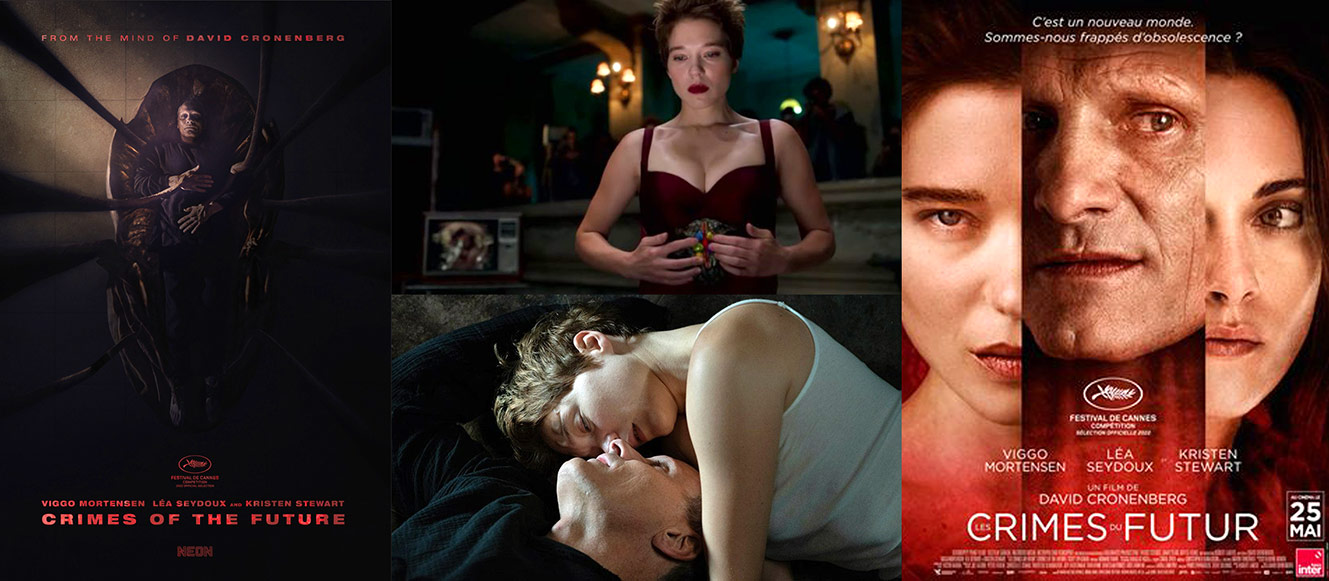
Crimes Of The Future
Canada/UK/Greece 2022
Directed by David Cronenberg
Canadian Broadcasting Corporation
Warning: Spoilers all over this one as I want
to talk about it properly. Please don’t read my
take on it until after you’ve seen the movie...
which you need to see if you are into the
art of cinema in any way, shape or form.
So Cronenberg returns triumphant with a great new film called, wait for it, Crimes Of The Future... which was also the original working title for his excellent eXistenZ and the title of his earlier short film (reviewed by me here). Now, first of all, let me address the elephant in the room which seems to be the little ‘out of place’ and unduly sensationalistic reportage of this film. I don’t know why people have been walking out of this one and putting it about that it’s somehow controversial but, no, it really isn’t. By modern horror film standards it’s actually quite tame (I just watched The Sadness, reviewed here, the other night so, please!) and, actually, this one isn’t even a horror film... it’s one of Cronenberg’s science fiction films, lacking the horror element completely. It maybe comes on as minor body horror but, I’ve always found that label a little problematic because, nine times out of ten, body horror movies don’t really shift into the horror genre, to be honest.
That aside, though, I always find Cronenberg a bit hit and miss... although more hit than miss I’d have to say and, if you like his work, then I’m happy to report that Crimes Of The Future is actually quite a charming and playful, fun movie. It’s properly old school Cronenberg delivered with the kind of visual sophistication which he started delivering as an aesthetically polished concept in the 1980s-1990s period of his work, I believe. I wasn’t expecting this to be as good as some of the movies I regard as his classics... such as Shivers, Rabid, Scanners, Videodrome, Dead Ringers, Crash and eXistenZ... in fact, I wasn’t expecting it to be much at all considering the, presumably manufactured ‘controversy’ hype used as a tool for marketers. But I have to say that it’s not only harkening back to a classic period of this director’s work, it’s also one of Mr. C’s best films, definitely in the top five of my favourite Cronenberg movies.
The film is set in a future which, it’s implied visually but not revealed, has survived some kind of apocalyptic event or possible evolutionary cull. The colour palette used throughout seems to be very dulled down, neutral and pastel versions of colours and everything seems consistent with that kind of aesthetic throughout... everything dialled back a notch and then infused with beiges, yellows, creams, blues and greens, I believe. Following an opening where a young boy starts eating his plastic wastepaper bin and then is smothered to death by his mother, our two main protagonists are introduced... Saul Tenser, played by Viggo Mortensen and Caprice, played by Léa Seydoux. The two are performance artists of some esteem. Humans don’t feel a lot of pain these days, the ability has left them but, Saul is one of those who still can and who is continually growing new, mysterious internal organs in his body, which Caprice then cuts out of him as the performance, using a Sark unit with robot arms wielding scalpels.... pulling apart new incisions, retrieving and slicing the organ in question and presenting it to the public (I’m assuming the Sark unit is derived from the term sarcophagous here).
However, after registering his next organ with a new, secret company called the National Organ Registry, things start to get complicated. Tenser meets Wippet, played by Don McKellar and Timlin, played by Kristen Stewart. We also meet the two maintenance technicians who come to service his organic bed (used to help him monitor and cultivate new internal organs) and feeding furniture (to help him eat), called Berst, played by Tanaya Beatty and Router, played by Nadia Litz. For reasons that become apparent later in the movie, the playful nature and agenda of these two struck me as being a female version of Wint and Kidd from Diamonds Are Forever (reviewed here). We also meet Scott Speedman in the best performance I’ve seen him give, as Lang Dotrice, father of the murdered child at the start, who wants Saul and Caprice to do a show based on the autopsy of his kid, for reasons which become apparent after Saul discovers he’s part of a cult of people surgically altered to consume plastic instead of food, in easy to consume chocolate looking bars referred to by one as ‘candy’. Of course, given Cronenberg’s passion for Philip K. Dick as evidenced quite explicitly in eXistenZ along with other movies, I couldn’t help but think this was also a reference to Can-D and Chew-Z from Dick’s novel The Three Stigmata Of Palmer Eldritch, which wouldn’t be the first time the director has referenced this specific novel.
However, a part of what qualifies as the government, as manifested by Welket Bungué playing a detective of the Body Crime Unit, are very much interested in this group of people, especially since the dead child has, it is rumoured, inherited the evolved genetic trait of consuming plastic from his father, rather than be surgically altered. All this is going on while Saul has registered for an Inner Beauty Pageant - Category: Best Original Organ With No Known Function... but he’s also an informant for the Body Crime Unit, unknown to Caprice but, as the film progresses, you realise a few of the people who he comes into contact with might know this already.
And its great. One of the buzz phrases associated with the marketing of the film is that ‘Surgery is the new sex’ which, I thought nothing of but it turns out that this is also a mantra of a few of the people in the movie and, certainly Saul and Caprice indulge their mutual sexuality in this way. With Saul controlling the Sark with a remote unit quite reminiscent of the pods in eXistenZ, she lays naked, enjoying each stroke as he slices up her flesh for her sexual pleasure, before putting the unit on remote and joining her. In another scene, she unzips the scar of a new hardware access point from something put in him to monitor the Inner Beauty Pageant and starts licking his open wound which is given and received in much the same manner as a blow job. The punchline to all this comes later when Kirsten Stewart, who coins the phrase ‘Surgery is the new sex’ in the movie, tries to instigate sex with him through a passionate kiss and he rejects her after a minute stating, “I’m not very good at the old sex.” So, yeah, as much as people are calling this one an edgy film, it’s more full of humour, almost to the level where at some points it’s almost functioning purely as a comedy.
And being as it’s Cronenberg, it all looks fantastic. There’s a brilliant moment where a shot is split vertically by the frame of a door. The door opening on the left with Stewart standing in it, with yellowy beige walls behind her and with Léa standing on the right against the wall of the room in which the camera is placed, the wall cream coloured behind her. It’s such a striking shot composition that one could be forgiven for thinking Cronenberg had used a split screen for the shot... it’s that much of a contrast, in spite of using colours which wouldn’t have a lot of perceived contrast against each other in a busier shot. The film is full of this kind of good stuff and you are constantly reminded you are in the hands of a master director all the time.
Once slight criticism might be that the blood effects in the film look like they’re handled by CGI. They may not be but, they do look like they don’t have much substance to them. At least to me. I have no idea how the effects were achieved but it might be a trade off to easily include the concept of the Sark unit (an earlier conceptual version of which was seen in Ridley Scott’s Prometheus, if memory serves).
And one observation, rather than criticism, is that time seems to drift without warning in the film. Everything seems to be taking place in close proximity to earlier events but, as you go through, you realise days, weeks or possibly even months may have taken place between one sequence and the next with no real warning. I was fine with that and the progression of people and organisations over this time can be easily tracked either visually or in details of the text but, I suspect some people may find this a barrier... not an insurmountable one though and I kind of grew to like that freestyle attitude to the story after a while. And it is a proper story, people... this one more than most of Cronenberg’s is actually leading up to a moment in the last shot which, once you think about the consequences of what you are seeing, actually has a meaning and resonance that hints at an actual evolutionary process in a certain direction without direct provocation. So that was pretty cool.
And all of this is supported by a typically Cronenbergian score, provided by the director's frequent collaborator Howard Shore and, frankly, the biggest crime of the future, in regard to this movie, is that this brilliant score at time of writing, has not been issued on a proper CD. Come on people, get your act together. People need a proper release of this stuff on the only format worth listening to it on.
And, apart from me singling out Kirsten Stewart’s performance as being brilliantly against type... I’m used to seeing her play very confident characters, not nervous and excitable people... I will leave you with a solid recommendation for Crimes Of The Future. It oozes old school Cronenberg charm and I found it hugely entertaining. He really knocked it out of the park here.
Wednesday, 14 September 2022
Crimes Of The Future 2022
Sunday, 16 January 2022
The French Dispatch
French Letters
The French Dispatch
USA/Germany 2021
Directed by Wes Anderson
Warning: Very mild spoilers.
A new Wes Anderson movie is always a cause for celebration. He’s a director who, in my humble opinion, has been consistently stunning since fairly early on in his career and when I sat down to watch this, I was fully expecting this to be my favourite film of the year... which it was for the first third of the movie but, although this is indeed another of Anderson’s amazing, cinematic spectacles which once again remind people that you can shoot an intensely personal artistic vision and still turn it into a glorious epic in this kind of medium, I’d have to say the film came up just a little short of being movie of the year for me. But, hey, this would surely be in anybody’s top ten last year once they’ve seen this amazing, visual feast.
The film starts off with the death of the founder of the news magazine The French Dispatch, played by Bill Murray and, in typical Anderson style, the film is presented to the audience as articles in that magazine. The magazine is an American publication but based in France, in the small fictional town of Ennui (Ha! I love that Anderson can boldly get away with ridiculous jokes like this without losing credibility for his elaborately concocted fictions) and, in addition to Bill Murray, includes a whole host of A list actors in all kinds of roles, large and small, such as Benicio Del Toro, Adrien Brody, Tilda Swinton, Léa Seydoux, Frances McDormand, Timothée Chalamet, Jeffrey Wright, Mathieu Amalric, Owen Wilson, Bob Balaban, Henry Winkler (yes, The Fonz is back in a movie and doing an unbelievably good job as a perfect, understated Anderson character), Christoph Waltz, Willem Dafoe, Edward Norton, Saoirse Ronan and Elisabeth Moss.
So a star studded cast and all caught in little pockets of the story but, as I said, the structure is that for the main sections sandwiched between the obituary and the End Note - Declines and Deaths section, the film is actually four ‘articles’ told from the point of view of one of the main writers of the magazine. So we have The Cycling Reporter from the Travel section (the briefest of the four main ‘articles’ told by Owen Wilson’s character) followed by Tilda Swinton of the Art And Artists section telling us about The Concrete Masterpiece (my favourite section of the movie), Frances McDormand’s Revisions To A Manifesto for the Politics/Poetry section and Jeffrey Wright, who seems to be channeling the performance style of Orson Welles (unless I’m missing a more literary allusion to the basis of his line delivery) to captivate the audience with the tale of The Private Dining Room Of The Police Commissioner for the Tastes And Smells section.
So, what we actually have, rather than one consistent linear narrative, is a medley or showcase of Wes Anderson short films... which is alright by me. The only weakness of the film is the inherent one of taking this format as the break from a single arc, meaning the audience will naturally compare and rate the various sections, as they would do in any kind of portmanteau movie. The ‘hit and miss’ nature of the strength of each episode being part of the territory. That being said, with Anderson being such a master of his craft now, it’s more of a ‘hit and not quite as much of a hit’ affair in terms of quality. In other words... there are no misses.
I’m not sure when each article is set but the death of the editor comes in 1975, with the publication of the last issue of The French Dispatch, which is shut down as part of the provision of the will. Whether these articles are all put together for this final issue or are a selection from various years is not something I could quite make out but, certainly, the Revisions To A Manifesto felt more 1960s to me than some of the other articles.
And once again, Anderson is mixing it up in terms of the different formats of the picture... a lot of it is black and white, some of it is in colour, most of it is in a 4:3 ratio with other moments in widescreen and even split screen where additions to the 4:3 ratio can be added as an appendix or reference to the content of the main shot mixing both colour and monotone simultaneously in one, nice sequence. This is not a division between different sections, more that every section contains all these kinds of treatments within the boundaries of its own ‘magazine article’. He also, uses a couple of animated cartoons to illustrate parts of some of these sections and, as quirky as that is... and also considering his past works where live action and animated styles have co-existed in the same picture (such as The Life Aquatic With Steve Zissou or The Grand Budapest Hotel)... I couldn’t help but think that in the second, cartoon animated car chase, the budgetary concerns of shooting such a section may also have come into play as to where best to unleash this technique.
The storytelling of each segment continues the style of the writer/director as sudden tangents to the storyline of each segment are often revealed to be Russian nesting dolls of ideas that ultimately grow from each other to add to the forward momentum of that particular arc.
There’s not much more for me to say on this one but I will reveal one delightful thing which, I suspect, would have had an audience composed of Jean Luc Godard and David Lynch howling with delight if such a situation were possible. When Tony Revolori (Zero from The Grand Budapest Hotel) is playing a young version of the imprisoned, psychotic, homicidal Moses Rosenthaler, he suddenly grows up into the later version of the artist, played by Benicio Del Toro. This is not done with a clever dissolve or other trickery but with the simple and ‘immersive defying’ moment of Revolori vacating his chair as Del Toro then sits in it, while taking his medallion off and putting it around Del Toros neck. One actor handing a character over to another, in fact. A truly nice touch and this one brought my personal house down, so to speak.
And that’s me done on this. If you like Anderson’s quirky, ‘catalogue and categorise’ style of narrative coupled by his squeaky clean shots, quirky physical space negotiations (such as when we track the progress of a character journeying up a tall building by his accelerated appearances at windows and balconies) and truly strong performances by actors investing in larger than life characters, then The French Dispatch should definitely top your list of ‘must see’ movies of 2021. And, of course, it’s all made more sweeter by the needledrop soundtrack selections punctuated by another of Alexandre Desplat’s masterpiece scores... this one very similar to his work on The Grand Budapest Hotel and yet another great triumph in this composer/director relationship. If not the best then, certainly, one of the best of last year.
Tuesday, 4 January 2022
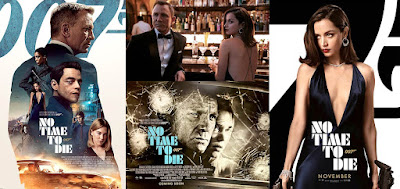
No Time To Die
A Die For A Die
No Time To Die
UK/USA 2021
Directed by Cary Joji Fukunaga
EON Productions
Blu Ray Zone B
Let me once more state for the record that I don’t have anything against Daniel Craig. In fact, I think he’s a great actor. He’s just got the wrong colour hair for James Bond and, also, I just don’t like any of the Craig Bond films. I’d frankly rather watch him in other roles. That being said, my expectations were hopeful for No Time To Die because I was receiving some very mixed, word of mouth reviews from the various friends I have. For instance, my die hard, Bond fanatical friend Chris, who usually has very few bad words to say about the Daniel Craig Bond films, was very disappointed with this one... thinking it one of the all time lows of the series, from what I can make out. Conversely, my cousin Steve said this was one of the very best Bond films and went back to his local cinema in Australia to see it a number of times. So, yeah, I thought this one would at least be interesting if it was dividing people’s opinion so much.
Alas, I have to report back that this latest outing for England’s popular secret agent has a lot in common with the previous Craig films, as far as I’m concerned... in that it’s very boring, drab, dull and any other descriptions which could be best summed up with the modern term... meh! My initial response once the film had concluded was... how can they make a movie which was both worse than Quantum Of Solace (reviewed here) and simultaneously, unbelievably more boring than Octopussy (reviewed here)?
Once again, the film picks up the plot threads from the previous Craig films, allowing them to all be seen as one single arc. We catch up with a now retired Bond living with his girlfriend Madeleine (Léa Seydoux reprising her role from S.P.E.C.T.R.E, reviewed here) but then, of course, Bond manages to find himself back in the thick of the action and attempting to save the world from yet another super villain, this time in the form of Safin (played by Rami Malek).
And... it’s a bit of a yawn, to be honest. The fact that the opening gun barrel sequence has Bond missing his target for the first time ever in the history of the EON Bond films (there’s no red blood washing it out in this version... just a really awkward transition), should have given me a heads up. The pre-credits sequence is certainly plot and character motivated but it forgets to be a big blast of action like the many James Bond films before it. I mean, there’s definitely a little action there but just as it starts to get going it’s already over and we are into a quite dreary opening title animation accompanied by a similarly dreary opening song. Sadly, this is a good guide to how the rest of the film is going to go... it’s a long, slow burn (running two and three quarter hours) with very few action sequences and, for the most part, not enough ooomph in them to really deliver the kind of pace and energy a loyal legion of Bond fans might expect from the franchise. This would perhaps explain why the response to the movie in my timeline on Twitter has been lukewarm at best.
Now, I was pretty careful to pick up absolutely no spoilers for this one before I fired up the Blu Ray but, alas, as I’d revealed to my friend @cultofthecinema on the phone a few days before, I was pretty sure how the movie was going to end (using the same kind of casting information with which I’d predicted, a couple of years before release, a certain event which takes place towards the end of the Star Wars movie The Force Awakens). And, yes, I was dead right on that one. I really don’t want to give away the ending of the film here but, even if I’d had no suspicion before the movie started as to the final trajectory of the story, the writers and director manage to telegraph it so much that it’s pretty much a foregone conclusion by the midway mark. Scenes which would have been better occurring at the end of the movie play out earlier than you might expect and, by some point, I suspect most people in the audience would realise there’s a reason why certain plot points are explored more fully before the final innings, so to speak.
Okay, enough on that. Let me say something positive here. There are two things I did like about the movie. One was the brief but effective scenes where a new character played Ana de Armas shares the one good action scene with her Knives Out co-star Daniel Craig. I could have done with a lot more of her character in the movie, to be honest.
And the other thing was Hans Zimmer’s score. He’s done a wonderful job on this one and managed to deliver a nice score which really gets to the heart of what the John Barry and early David Arnold scores were about. I love Zimmer but I was really surprised he was able to pull something like this off. He also interpolates various themes from the classic Bond film On Her Majesty’s Secret Service (reviewed here) for the score and, although the film doesn’t reference the plot of that movie at all (how could it when the Craig films were supposed to be a total reboot), there are a lot of musical echoes of it... enough to inject a kind of ‘surrogate nostalgia’ into the movie, it has to be said. Probably didn't need that ‘emotional association by proxy’ though. Not that there aren’t a lot of visual references to previous Bond films from the history of the franchise in the movie anyway... bit of a strange kind of homage. Nevertheless, I thought Zimmer did a remarkable job with the music... although now I know why there wasn’t too much action music on the CD soundtrack... you can only score what’s on the screen, I guess.
Okay, my biggest problem with the movie is it’s far too long. And that makes no sense since, not long after a scene where M and Bond are at each others throats and Bond is not welcome to return to active duty, it’s almost immediately followed up by them being all pally again and Bond being recruited for the mission. I can only assume that some kind of sequence of events which would have led to this change of heart was cut from the movie to get the time down. Even so, the film drags so much that, you have to wonder why the producers and director didn’t get the editor to trim another hour out of it.
All in all, then, I didn’t have a good time with No Time To Die. I wish Craig all the best in the world and hope to see him in some more movies soon but, as far as Bond films are concerned, I think I’m more than happy to see the back of him. If the series is to continue, as it implies right at the end with the familiar caption ‘James Bond Will Return’, it will have to be a hard reboot with, I suspect, a much younger actor. But let’s see what happens with the ageing producers before we count any more chickens, would be my final word on that.
Tuesday, 3 November 2015
S.P.E.C.T.R.E
In SPECTRE, gadget
S.P.E.C.T.R.E
2015 UK/USA
Directed by Sam Mendes
UK cinema release print.
Warning: Very slight identity spoilers.
Regular readers of my column and, in particular, my many Bond movie reviews, will know that I really don’t rate the Daniel Craig Bond films all that much. I’ve gone on record in saying that they’re at least better than some of the worst of the Roger Moore era films (my least favourite Bond) but they’re not that far apart from them and they inhabit the lower end of my Bond rankings alongside such terrible Bond movies as Octopussy, Licence To Kill and Die Another Day. That being said, I don’t want you to think I don’t rate Daniel Craig. I think he’s a pretty cool actor, actually... I just think the version of Bond he’s been asked to play - the unsophisticated, everyman’s 007 thug - is not necessarily the right way to go and anyone who's read the original Ian Fleming novels will see a big difference in the character as it's portrayed here. Perhaps, bearing in mind the dubious nature of the character in the first place, a more honest approach but... not necessarily a good role model to have. He is extremely popular however and, I’m sure, this movie will be much loved by fans of this era.
Now S.P.E.C.T.R.E didn’t appear in more than maybe two of Ian Fleming’s later Bond novels. The Bond villain organisation of choice in the majority of the Bond books were the real life organisation known as Smersh (an amalgam of two Russian words meaning “death to spies”). When Doctor No and the early Bond films were made, Smersh was changed to S.P.E.C.T.R.E, I seem to remember, although my memory may be failing me... because the producers didn’t want to offend the Russians. Consequently, when the movie From Russia With Love came out, although Smersh does get a mention (it even gets a mention in the first Flint movie), it’s all about S.P.E.C.T.R.E again and this carried on and was eventually taken up by Fleming in the novels himself, after he based his own novel Thunderball on the script he was developing for the movie with Kevin McClory (again, if memory serves).
So fans of the books always felt kinda cheated when the movies used S.P.E.C.T.R.E as the bad guys... we all knew who the real villains were and the films seemed to be somewhat compromised in their intent before they were even out of the starting block. I remember sitting in a cinema in Llandudno on my summer holiday in 1987 and breathing a sigh of relief when one of the villains in The Living Daylights sent down the “death to spies” message to one of Bond’s colleagues before killing him... Smersh were finally back.
But now, it seems, Smersh have had their day once more and we get the original film version of the organisation not only returning as the title of this latest Bond movie but, also, tying into the storyline from the previous three Daniel Craig films, which are all fully referenced in this movie (along with a few other little nods to Bond over the years). And, of course, with the return of the movie organisation we have the return of one of the main villains of the Bond novels and films... although I think the writers were kind of trying to keep that a surprise. Honestly though, I think pretty much everyone who was interested in this movie, however, figured that out from the word go so... yeah, we have the always excellent Christoph Waltz playing Blofeld.. an exceptional choice of an exceptional actor for an exceptionally Bond fan pleasing role.
We also have some excellent actors and actresses cast alongside him such as Monica Bellucci, Léa Seydoux, Ben Whishaw (continuing as Q), Andrew Scott (Moriarty in the modern TV incarnation of Sherlock), David Bautista, Naomie Harris (continuing as Moneypenny), Jesper Christensen (returning as Mr. White) and Ralph Fiennes (continuing as M). And everyone is excellent in it. They’re all good, every last one of them... but I couldn’t help but think that both the script and the action choreography let them down a bit on this one.
Bellucci, for instance, is totally wasted. She is, and always has been, a phenomenal screen presence but she really is in the movie for a very short time in, I believe, only two scenes (unless you count the time split in one scene as the opening of a third). Waltz is excellent but the dialogue really isn’t up to scratch, I felt. He always delivers it so well and does some really interesting things with his acting but... you need to really give him special lines to work with like Tarantino did on two occasions (to date). And why the writers insist on treating the revelation of Ernst Stavro Blofeld as some kind of reveal is beyond me. Like I said, we all knew this before they’d even started shooting the thing. Andrew Scott is cool but he’s also got an element to his character which is written like it's supposed to be some kind of twist... you will see everything coming, as far as his character goes, pretty much from his first scene in the movie... which is kind of a shame but the storyline even makes it almost impossible for his character’s personal revelation not to be the case as it basically resolves a dramatic problem the writers put in the way of the main protagonists right from the start of the picture. So it’s all a bit of a shame, truth be told.
Now there are some very good things about this particular installment in the Bond franchise. The opening sequence is pretty good... although the lack of ‘racoon eyes’ completely spoils a character reveal... not to mention continuity in all the shots leading up to this, in much the same way that we all thought it was a ridiculous choice to make when Michael Keaton has exactly the same thing happen to him when he pulls his mask off in Batman Returns. Seriously? Movie makers really should start realising that we’re not all completely stupid. You’ll know what I’m talking about it when you see it and if you’re anything like me it’ll pop you right out of the movie. But yeah, other than this and some improbable helicopter shots not matching, the pre-credits sequence is probably one of the strongest things about this movie. A big shout out to David Bautista too, playing one of the most tough and relentless Bond henchmen in the history of the series and, if you’re paying attention, doing it in such a way that the character, alongside another of the main villains, can easily be brought back for another movie if so desired.
Thomas Newman’s score is pretty good in places too... a lot better and more obviously Bondian, I thought, than some of the stuff in the previous movie Skyfall... although during some of the action sequences it does get totally lost in the sound mix, if truth be told. Either way, it’s a lot better than the horrible non-Bond song the producers saw fit to include during the title sequence. I thought the title song for Skyfall was bad enough but this one... well... I guess the writer couldn’t think of anything to rhyme with S.P.E.C.T.R.E and, you know, also forgot to put a strong melody line in it.
Okay... I so I didn’t have high expectations for this movie from the start but I was kind of buoyed up from the strength of the opening sequence. Alas, it didn’t take long before I was looking at my watch trying to work out when the movie would end again, I’m afraid. There were more bad things than good in this movie, I reckon. For instance... the title sequence was really not that great. It didn’t help that it had the aforementioned song playing over it but it did, at least, have a few classically surreal moments that looked like they belonged in a Bond movie credits piece, for sure... but not many, I’d hasten to add.
Another thing is that the action sequences seemed, for the most part, just astonishingly dull for a lot of the movie and, worse, seemed to be getting less interesting as the movie wore on. The editing on them was fine... this is no Quantum of Solace, I’m pleased to say, but I did find myself rather bored through most of these scenes and, the one scene which looked like it would have all the main good guy protagonists storming British intelligence and getting into a big battle, alas, didn’t quite get there. It all seemed just a bit anticlimactic in the end and I really couldn’t get into the spirit of the movie, by the final reel. Add to this a main protagonist who completely relies on his gadgets to get him out of trouble in this one, especially, rather than his own cunning, plus a highly predictable story line and... well... it just wasn’t happening for me, I’m afraid.
Ultimately, this is a big looking Bond film which I’m pretty sure the majority of modern audiences will really get into... however, I don’t think I’m that audience anymore and this really isn’t my Bond. At least they saw fit to resurrect the iconic gun barrel opening shot this time although, bizarrely, they seemed to have forgotten just how to use it to get you into the next scene like the majority of Bond films have easily have managed to do in the history of the franchise. Oh well, I’ll keep my hopes alive that the next movie in the series can breath some life back into the franchise. And as far as S.P.E.C.T.R.E goes... well at least it didn’t have an invisible car in this one.
Saturday, 7 December 2013
Blue Is The Warmest Colour (La Vie d'Adèle – Chapitres 1 & 2)
Torrents Of A Labia
Blue Is The Warmest Colour
aka La Vie d'Adèle – Chapitres 1 & 2
2013 France/Belgium/Spain
Directed by Abdellatif Kechiche
Playing at UK cinemas now.
La Vie d'Adèle – Chapitres 1 & 2 is known over here as Blue Is The Warmest Colour, the title of the original graphic novel, Le Bleu Est Une Couleur Chaude, on which it was based... although I understand the writer of that, Julie Maroh, is not too happy with the way the movie version turned out. This is possibly understandable since the summary I just read of the story deals with a long relationship which ends with drug addiction and death. So if anyone is expecting the movie to be like the comic, you may be a bit disappointed with it.
Now I didn’t know much about this movie going in, other than it was three hours long, had a long lesbian scene in it which was quite gruelling to shoot and that the film, as a whole, wasn’t very pleasant to the two lead actresses, Léa Seydoux who plays the blue haired Emma and Adèle Exarchopoulos, who plays Adèle. Although it’s essentially a two hander with two very watchable performances by these actresses, Adèle is the real main protagonist and it’s through her eyes that we see the story of the film’s central relationship and it’s her story we are following.
Now, I have to say, I was expecting much more on the visual level, seeing as the posters released have all been quite neatly designed, but the film is more naturalistic than I was hoping for in terms of no blatantly artificial or stylised framing that I could make out and a heck of a lot of handheld camera work too. It’s not in any way incompetent on a visual level, far from it... but for me I was expecting something within the realms of Kieslowski or Tarkovsky and, instead, got something which was perhaps a little more reminiscent of early 70s Hollywood film-making than what I’d expect from a European director.
Of course, the haphazard editing and absolutely minimal use of music (a couple of very brief non-diegetic cues and source music when needed) means that there’s no possibility of the visual design intruding or acting as a filter to engagement either and I did find that, although the movie is pretty much a full three hours (oh, yeah, alright then, 179 minutes... but it’s pretty close), I didn’t find myself once getting bored and it was over almost before I knew it. I’d still prefer a stronger visual design myself, though, and the muted colours weren’t working for me so much.
The director was interesting with what he was doing with transitions both visually and in terms of sound design, though. Quite often we’d cut from a shot with one or two characters in isolation to one or two characters in the context of a crowd. We then start re-approaching that character and singling them out of their surroundings and contextualising them from the hubub of what’s going on around them... be that a protest march, a nursery school classroom or a dance performance. It also allows the director to do with sound the same kind of thing that Kurosawa did in the battle scene in Ran and the snow lady scene in The Blizzard section of Dreams... and that is he uses a roar of sound, be it a crowd of people or dance music, to shock you into that transition, which usually goes from a moment of self reflection or post-coital reverie into “loud and chaotic” without notice. This caught me out a couple of times because I was very tired when I saw this movie.
The sound design in general is all kinds of fun on this one, I have to say... especially in the sex scenes. A lot of the time the volume and presence of the sounds created are, in the parlance of our time, turned up to 11 and it certainly gives the film a very stylistic feel to it in the accoustics department, at least, which goes some way to making up for the lack of strong visuals I reckon. But maybe that’s just me.
The real find of this movie, though, is the two actresses, who both have strong and likeable personalities. They carry the movie from the realm of being just so-so into something really worth taking a look at. Emma, the art student with the blue hair is almost channelling a young Oscar Levant in looks, in female form, and she comes across as a very strong presence in contrast to the wonderful character/actress Adèle... who is the wandering innocent of the film to some extent, although by the time the movie reaches its climax, you’ll soon come to realise that, despite crying her way through a third of the movie, she’s actually the stronger and more interesting character of the two. The girls work very well together (yes, even in those scenes) and, given all the post-Cannes shenanigans, which mark the first time the actresses in a film have been specifically named on the award along with the director... I would have to say that we very much have the director to thank for coaxing those performances out of them, I guess. Although where performance and direction blend is not something I’m that clued up about, I’m afraid.
Blue Is The Warmest Colour, then, is not the great visual confection that I was expecting when I sought this one out... but it is a really good movie, full of emotion and a certain quality of weight to the characters which makes for a really impressive and fulfilling viewing experience... which in my book makes for great entertainment. The film has only been out two weeks but already looks like it’s on its last performances over here. So if you want to catch it on the big screen... now would be the time to go.