Showing posts with label Umberto Lenzi. Show all posts

Thursday, 26 November 2015

Nightmare City


Halt! Hugo’s There!

Nightmare City (aka Incubo Sulla Città Contaminata)
Italy/Mexico/Spain 1980
Directed by Umberto Lenzi 
Arrow Films All Region Blu Ray/DVD dual release

I’ve been wanting to see Nightmare City for a year or so, since catching up to Stelvio Cipriani’s score on a CD reissue put out by Digitmovies. It’s technically a zombie movie and therefore, I would argue, does indeed belong in the horror category of movie, although I’m sure many people would mistake it for a gory thriller. This is understandable, since the plotline does deal with supercharged, atomic infected humans who have all gone loopy and start killing everyone in various ways... but I’d have to argue the case that the film’s reputation as being a movie in the zombie genre is pretty spot on since, after seeing the zombies riddles with bullets and otherwise killed, they are technically reanimating from the dead to carry on their addiction to blood-letting. This brings a supernatural element into the film which elevates it, depending on your point of view as to which direction the movement goes, and places it firmly into the realm of the horror movie.

This one has a very simple story, for what it is, but the main start off point of a plane full of passengers landing at an airport without permission and, when the doors are opened at the request of the police, delivering a huge outpouring of crazy, zombie people who attack an entire city, was an interesting enough premise to make sure I sought this one out. That being said, I’d caught wind of this Arrow restoration being underway a couple of years back, so I waited until this was released a month or so ago before I made my purchasing decision. In the wild world of film, especially with genre horror and its unwanted attraction from the scissor crazy hands of the censors, the modern film buyer has to be careful and do the research.

The film mainly follows the plight of a TV reporter called Dean, played by Hugo Stiglitz (fans of Tarantino’s Inglourious Basterds might recognise an homage to this actor in one of the character names of that movie), who witnesses and manages to escape the slaughter at the airport. When he returns to the TV station and finds himself silenced by the military, he then sees the studio who are putting on a live 'contemporary dance show', which obviously involves lots of women in tight fitting leotards, similarly pulled apart by the zombies. He escapes and tries to find his wife Anna, played by Laura Trotter, who is a nurse working at the local hospital... the most obvious place for the contaminated zombies to strike next, as they are rushed in as victims before becoming rampant antagonists themselves. Dean and Anna again manage to escape and they travel about trying to avoid zombies while we cut between them and a couple of equally “are my lovers and relations safe” subplots involving a couple of the military personnel, as we watch the government and the army being thwarted at every turn by the creatures.

Now the zombies in this are, it has to be said, quite intelligent although, it should also be pointed out, they seem to have no consistency in their attitudes or actions when it comes to their murderous attacks. They are quite intelligent and are good at cutting phone wires and disabling electrical power to buildings and areas with a quite deliberate snip of their varied cutting implements... but they seem to approach their killing of innocent victims in a manner which can either be simply ripping them apart and drinking their blood or, with more sophisticated methods like machine gunning them down or slitting their throats, for example. Which doesn’t give them a lot of credibility, especially when some of them stop to aggressively disrobe the female victims before “goring them up good” as you might expect from both a movie which was one of those listed in the notorious Video Nasties scare of the 1980s and, well... an Italian movie of that period where female nudity was pretty much an essential ingredient in films intended for an adult audience. And when I say adult, as is always the case with these brutal but enjoyable romps, I use the term strictly in terms of age restrictions rather than to unwittingly accredit these films with a level of moral responsibility or maturity.

That being said, there is usually an interesting element of hidden sophistication in some of the most excessive exploitation films and it would be hypocritical of me to say I didn’t enjoy these kinds of affairs. However, I much prefer the movies which have a measure of visual elegance about them and, while fan favourite director Umberto Lenzi does have an eye for putting together a fast paced, understandable movie, this one left me a little cold in terms of creative cinematography it has to be said. Although this one does try to rise above the simple nature of the format by bringing up the zombie threat in conversation as the fulfilling of the blight of human nature at some point... it’s mostly paying lip service and is very brief on this point.

As usual though, there are some nice moments in here which are worth watching, including a scene which made me smile when the zombies crash through some doors into an operating theatre and the chief surgeon responds by elegantly throwing his scalpel across the room and into one of the zombies. I don’t know why but the timing on this moment just made me chuckle midst all the crazy carnage. Another scene with an unmanned lawnmower moving across the grass, however, just demonstrates the stupidity of one of the central protagonists and it almost seems like an ironic form of justice in terms of the value of characters like this in the film when they come to a bitter end.

There’s also a strange moment where the realm of the non-diegetic soundtrack of Cipriani’s excellent score... well apart from those horrible 1980s source music sections... blends with the action on the film in a way that it almost imposes on the action. By this I refer to a scene where Dean and Anna suddenly turn, presumably as we discover, to the sound of a group of zombie footsteps. However, when Hugo Stiglitz expression changes, the sound of the footsteps isn’t audible yet on the foley, but Cipriani’s slow and ambient baseline has just kicked in, like it does in a lot of sequences to conjure up the atmosphere of a zombie attack. The result being that, at this moment, it looks like Dean is getting his cue from the score as opposed to anything visible or audible on the screen... kind of a bizarre juxtaposition, I thought.

Now, this really isn’t, as far as I’m concerned, a genre classic like George A. Romero’s Dawn Of The Dead or Lucio Fulci’s Zombi (aka Zombi 2 aka Zombie Flesh Eaters - reviewed here) but I am glad to have seen it because I love the premise and, although the film is pretty repetitive and not in any way scary, as a lot of zombie pictures are, I never really got bored with it and am happy to have this one on the shelf. Arrow have done as bang up a job as they can on the restoration which, in this case, has given them a few problems. They have put two different source print transfers on the discs and you can choose which option you would rather watch and, if you’re into the reasons why this is so, then you can watch one of the many extras, Nightmare City And The Limits Of Restoration, to find out just what the issues are. I found this pretty interesting and informative which, frankly, is the sign of both a good package and, in this case, a conscientious production team on this particular incarnation of the home video version.

The ending section of this film has come in for a lot of criticism over the years and, unfortunately, I was already primed for it because it’s famously not what people wanted from it. Indeed, it is a terrible cliche of an ending and, alas, I can’t really tell you the last intertitle which comes up on the film before the credits run without giving you a huge spoiler... but I have to say that I didn’t mind this ending too much myself. That being said, though, if I wasn’t already prepared for it I’m sure I would have let out a huge moan and had a bit of a rant about it. I can see why the ending has the reputation it has and.... well... I think it’s possib;y deserved. All in all, though, Nightmare City, while not exactly a classic in my book, is the kind of enjoyable rubbish it’s easy to pass a bit of the afternoon with. Being as it’s completely unscary, it would certainly fall into my personal “comfort horror” category and I’m sure fans of the genre in this period will be well up for it. Not the best I’ve seen but certainly not the worst and if you’re into this kind of stuff, the new Arrow version is an essential purchase. Give it a go sometime if late 1970s to mid 1980s zombie movies are your thing.

Wednesday, 7 March 2012

Eyeball (aka Gatti rossi in un labirinto di vetro)


Eyeball Basher

Eyeball (aka Gatti rossi in un labirinto di vetro) 1975
Directed by Umberto Lenzi
The Camden Collection Region 0

Warning: Ever so slight spoilers in
this one... but the killer isn’t named.

Eyeball is a movie I’ve been trying to track down for a while, both because I really like the Italian Giallo as a cinematic genre and also because it has a typical “Bruno Nicolai does giallo” score, which was issued on Digitmovies CD a while back. It’s a little different in setting from the normal environment that becomes the killing ground for this kind of movie (as you’ll see below) but it’s not untypical of the genre and doesn’t feel that different to any of the other movies made in this style at the time.

I’m not really the biggest fan of Umberto Lenzi’s entries in the giallo cycle, I’d be the first to admit that, but at the same time he tends to manage to hit all the right points when he styles these films... almost as if he’s assembling a recipe for “giallo soup” from the raw ingredients: gloved killer - check (red instead of black in this one), gory murders - check, unhinged raison d’etre for the killings - check, more suspects than you can shake a stick at - check, bottle of J&B whisky for product placement - check.

This one, as I said, is a little different from most in that it follows a holiday touring group around Spain, as the members of the tour get bumped off one by one and, amazingly, it takes for this to happen three times before the police inspector assigned to the case decides to confiscate everybody’s passports so they can’t do a runner. This is a typical plot device for early murder mystery books and movies such as Charlie Chan Carries On, for instance, but it’s not something I remember seeing done in the more stylistic palette of the Italian Giallo before... and I’ve seen quite a few of these things now.

And what about that policeman, eh? At the start of the movie you find out that... yeah you guessed it didn’t you... this guy has only one more week left until retirement. Woohoo! Much glee and jumping up and down at that particular cliché in my household... and I was the only one in the house at the time! Well... apart from the dog but he doesn’t find movie clichés as excitingly foolish as me.

Okay, so this one is not directed with as much relish as a lot of gialli, I would say, although there are still some vibrant colour schemes and the odd few shots where the cinematographer has really gone for it and done something a little more Bergmanesque with people placement or explored some interesting spatial relationships with people and objects in perspective. These are exactly the kind of touches which make the giallo genre something I like to watch on a regular basis and there’s just enough of these little moments in this film to keep me interested throughout although, having said that, this one’s not exactly one of my favourites.

There are some stand out moments, however, like a murder in a ghost train sequence which is edited in such a way that it takes you out of the run of the mill of some of the rest of the movie and has a more “in your face” kind of vibe to it. And the murders are all themed around the motif of the victims having their left eye stabbed out and collected by the killer... which honestly sounds a lot more fun than it actually is when presented within the context of the movie... all the way through this one I was wondering what someone like Sergio Martino or Aldo Lado might have done with the same material to lift it slightly.

Still, having said that, I was still as baffled as I usually am while watching gialli... I had no idea until the end of the movie who the killer was. My main suspect was a woman who I’d cleverly realised was a photographer who holds her camera up to her eye. Therefore, I figured, this was a connection to only taking a single eye from the victims when murdering them. I was feeling all very clever with myself and patting myself on the back with this reasoning when the film suddenly did what almost every other giallo film does to me at some point... my chief suspect suddenly gets murdered in front of me and becomes the next victim. Doh!

Having said that, the fact that it turns out that the deranged killer is taking the eyeballs away and making use of them in his/her own hollow left eye socket (you’d never suspect that one of the characters has a false eye, by the way) is a real corker in the motivation stakes and something which is to be applauded... although again, without giving away the identity of the killer here, the final reveal does seem to be paying a little too much homage to the early work of Dario Argento in it’s make up. Just like Lenzi wanted to check another box in his selection of raw materials from which to try to create “the perfect giallo”.

Eyeball, I would say to you, is far from that perfect giallo, but it does give it a hell of a good go in trying to harness the best of the resources that ring true to giallo fans and, as I mentioned earlier, it does have one of Bruno Nicolai’s typical scores for this kind of movie to keep you company while you watch it... although I do find this one to be a little more repetitive than most of his “swinging seventies scores” to be honest with you. Ultimately this is not a great movie and if you’re new to giallo in general then I’d urge you to stay away from this one until you become a little more acquainted with the general tropes and fingerprints that help define the genre. On the other hand, if you’re already a fan of this particular species of colourful (in more ways than one) movie making then you’ll certainly want to give this one a watch... it’s by no means a terrible movie and you might well appreciate this one a lot more than I.

Tuesday, 30 November 2010

Ornella Day's Work


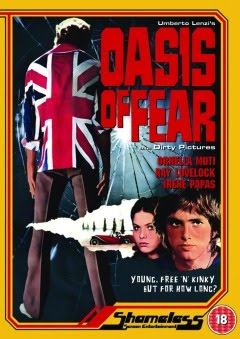
Oasis of Fear aka Dirty Pictures aka An Ideal Place To Kill
1971 Italy/France Directed by Umberto Lenzi
Shameless Screen Entertainment Region 0

Please note: An oasis of spoilers await you in this review.

Umberto Lenzi’s a bit of a legend as Italian directors go. Perhaps more notoriously remembered for a couple of his ventures into the puzzling (to this reviewer) genre of cannibal movies with such dubious classics as Eaten Alive and Cannibal Ferox, he’s actually a bit of an all rounder. Whether you take that to mean he’s a skilled director at whatever he’s turned his hand to or whether you take that to mean he’d try his hand at anything is up for you to decide. All I know is in that some of the movies I’ve personally seen of his (such as Violent Naples, Seven Blood Stained Orchids or Spasmo) have all got that certain high quality look to the shot composition which I’ve come to associate with Lenzi and shout them out as movies to take a look at... if just on a purely visual level.

Oasis of Fear is a quite entertaining entry into what I call the “almost-a-giallo” genre of film making. Here, you won’t see corpses piled high or violent and gory deaths (that makes a change then), but there is a murder at this film's manipulative core and, if you’ve never seen the film before, you might even find yourself surprised at the direction this one takes.

This one has Ray Lovelock (The Living Dead at the Manchester Morgue, Murder Rock) and Ornella Muti (Princess Aura herself from the 80s version of Flash Gordon, Chronicle of a Death Foretold) as young teen lovers, Dick and Ingrid, who seem to be stripping off and single-handedly shoving their newly found, sign of the times sexual freedom into the faces of their fellow men at every chance they get. After making loads of money for their holiday by reselling pornographic magazines and then spending it all again, they go into the home-made market and start selling nude photos of Ingrid herself to keep them going on their road trip across countries and out of the path of “the law”. They come across an “oasis” (actually just a big house with some grounds) when they run out of petrol and the woman who lives their is at first hostile to their absconding with some of her petrol but things take a curious turn when she invites them to stay on with her for the night.

The movie continues with scenes of debauched revelry, nakedness (Ornella Muti guys!) and quite harshly comical 70s dancing (mind you, I tend to find most dancing highly comical, I’ll confess). If you’re an astute viewer then alarm bells will probably be going off in your head around about now as the proud home-owner Barbara (played by Zorba The Greek’s Irene Papas) attempts to divide our young lovers by sleeping with Ray Lovelock but also doing some dodgy things like making sure his fingerprints are all over the revolver in her husbands car... a man who she says she has been expecting to return home all evening.

After all these shenanigans, our two heroes of the sexual revolution finally twig that the husband isn’t just late in the time keeping sense, this little lightbulb popping up after they find his dead body in the boot of his car. They realise that Barbara has been setting the two of them up to take the fall for the murder of her husband and after some elaborate cat and mouse with her, they eventually get away with their car repainted and as much of the evidence destroyed as they can. Ultimately, though, this doesn’t stop Barbara from using these “undesirables” to take the blame for her and, in the last ten minutes of the film, the police are once again hot on the trail of our two young love birds in flight.

Surprisingly for a movie of this era, the murderess actually does get away with her crime... no last minute mistake or clever flash of inspiration from the police to moralistically pin the blame on the real culprit (I wonder if this film ever got a cinema release in the UK back in the 70s... my guess is probably no).

What is, perhaps, a little more typical of the time is the final minute or so of the film where Dick and Ingrid, being chased by the cops, see a stray dog in the road and swerve to avoid it. Being as this is a 1970s film that road happens, obviously, to be at the top of a cliff and our two protagonists lose control of the car and end up dead in the wreck of their MG! Just to milk the poignancy of the conclusion, the final shots of their corpses and lead out is punctuated by the same cheesy pop song which has been following our heroes around all over the film... but, you know, it kinda gets its message across.

So is this movie worth a watch? Well, as long as you don’t expect any deep messages to be imparted from its quirky moral centre, this film is definitely a fun ride from the start right through to the end credits. It’s got funky, 70s Italian music, Ray Lovelock in a Union Jack shirt (or should that be Union Flag considering he’s not on a boat), Ornella Muti in a distinct lack of shirt and some wildly entertaining (for all the wrong reasons) dancing. Add to this some mostly likable characters and some pretty amazing cinematography (as I’d suspect from an Umberto Lenzi movie) and I’d have to say that there are a lot worse ways of spending your money than on this peculiar thriller.

Just don’t go into it expecting high art.

As usual, Shameless have rebuilt this print from various elements to give you the longest possible, uncut version of the film (I’d previously seen a bootleg of this in its “Dirty Pictures” print and even that version was not quite as complete as this). There’s also an irreverent trivia subtitle track to watch with it if you like that kinda thing (which is something I’ll definitely be turning on next time I take this movie out for a spin). Once again, Shameless prove themselves to be a label to watch out for in this particular niche of the market. So definitely worth an upgrade if you’ve already got a version of this and you’re a fan of this particular movie.

Check out their website at www.shameless-films.com

Images used with permission of Shameless Screen Entertainment.