Showing posts with label David Lowery. Show all posts

Monday, 20 December 2021

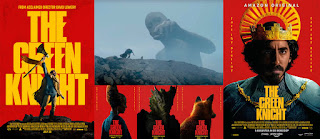
The Green Knight


Knight Fever

The Green Knight
Ireland/Canada/United States/
United Kingdom 2021
Directed by David Lowery
A24


Warning: Very mild spoilers.

The Green Knight is just the latest in a long line of movies based on the Arthurian myth verses, written in the 14th Century, depicting the tale of Sir Gawain And The Green Knight. At least, that’s what it purports to be... I’m hearing that a lot of the characters and situations are misplaced and changed and some incidents even come from other works so... yeah, it would be true to say that it was inspired by, rather than a genuine adaptation, I think. Thankfully for me, I’ve not read the original text and I’ve somehow, not on purpose, managed to miss seeing any of the other versions of this so... yeah... I say lucky because I can’t be enraged with the various liberties taken with the text.

So instead, what I saw when I sat down to watch this, was a truly magical and surreal experience of a movie, starring Dev Patel as Gawain (who is not actually a knight at all in this one), supported by a wonderful cast including Alicia Vikander as his prostitute girlfriend (in a dual role actually)... who he spends nights with in the local brothel, Sarita Choudhury as his witch of a mum (a kind of misplaced Morgan Le Fey character, even though that character is also represented here later on in the movie, blindfolded... she wasn’t Gawain’s mum in the original, I think), Sean Harris playing a truly excellent and interesting version of King Arthur and Kate Dickie as his Guinevere.

The plot is simple and the reason I’ve been waiting to watch this until now is that it’s actually a Christmas movie (again, displaced from New Year’s Eve in the original text, I am told). The events take place at Christmas and then, for the next part, the days leading up to the next Christmas. A big creature of a person who seems to be made of wood, The Green Knight, shows up at Arthur’s castle during the Christmas feast and challenges a knight to ‘A Christmas Game’. One should fight him and, if he wins and beats him, then he has to present himself to The Green Knight’s chapel, a fair few days ride from there, the next year to quietly accept whatever blows or wounds which are done to the knight to be visited upon him in turn. 

 Of course, Gawain, who really wants to be a knight, accepts. Arthur lends him his sword, Excalibur and, thusly armed, he faces the enemy in the hall. The Green Knight, however, just puts his sword down and waits for whatever blow is delivered but Gawain, wound up by the odd atmosphere and not knowing what to do, takes his head clean off. Then, after a minute, The Green Knight gets up, picks up his head, and reminds him that he has to present himself to him to receive the same blow in a year’s time. The rest of the film is Gawain’s journey to that fateful meeting and, it has to be said, it gets quite surreal and more than a little ambiguous before the completely uncertain conclusion of the film (and even the post credits moment doesn’t help too much at this point, since the audience has become aware of the inherent trickery of the narrative to impart unreliable information).

The film starts off as it means to go on, with a shot of Gawain on a throne while a narrator (a mixture of voices of the director and his wife) leads the audience in and then we see Gawain's head suddenly catch fire, while leaving him unharmed, like he’s the lead character in an old Marvel Ghost Rider comic... and the roar of the flames as the sound grows, giving way to sudden silence and a black screen before a more tranquil, pastel toned image of the start of the story, proper, is revealed.

And this is something which the director keeps doing in this, truly breathtaking looking film (this is definitely a ‘buy the Blu Ray’ job when the time comes for a re-watch, although it looks like that’s only available in the US at the moment at an overinflated price), playing in contrasts of both sound and visual rhythm. The sounds keep dialling up and then leaving us in a wake of almost silence (and old trick but no less powerful) and also the visual rhythms cut from very fast, fluid tracking shots to slower and more leisurely paced camera movements mixed with the odd static shot. It’s like a visual collision of pacing but most of the time it’s fairly slow and sure. I love that the director has learned, where many modern directors haven’t, that to truly make a small incident in a film special... you need to surround it with a long lead in and a quiet approach. And, believe me, this film is very effective. Confoundingly non-conclusive, for sure (the director is definitely wanting you to bring your own conclusions with you by the end of the film) but the various set pieces are truly powerful, even when they are mere camera moves to reveal a different view point of what you think you are watching.

For example and without giving anything away, there’s an extremely beautiful ‘double 360 degree pan around’ a forest clearing where Gawain has been tied up and left for dead. The first time it catches back up to Gawain it reveals something you really aren’t expecting to see at this point and then, when it gets back to him again... okay, the second pan around gets to something more predictable but the whole shot, which must take somewhere between 30 seconds and a minute, is absolutely brilliant and really a key into the way creative expression is brought to the foreground of the movie. The music also is wonderful but, alas, at time of writing it’s not been released on a proper CD so it looks like I won’t get to hear it free from the bounds of the movie, which is a real shame.

There are lots of wonders which I daren’t reveal here (but, honestly, “chaos reigns” at one point ;-)) but the ending, it has to be said, is extremely ambiguous. You can always take the easy route and read the original text to see how it’s supposed to go but, like I said, the ending is deliberately vague as to the final fate of Gawain and, perhaps, even errs on the absolute opposite of the version in the original text. I guess it depends on how you choose to interpret it as to whether the film ultimately delivers for you but, I’d have to say I’d certainly recommend The Green Knight to all those who love what the magic of cinema can give us when used to create unique and interesting story telling formats. Definitely one I’ll be watching again at some point.

Tuesday, 15 August 2017

A Ghost Story


We’ll Sheet Again

A Ghost Story
2017 USA Directed by David Lowery
UK cinema release print.


I’ve been trying really hard to figure out how to write this particular review without putting any spoilers in it because I really don’t want to be spilling too many beans on this truly amazing cinematic experience for anybody. I think what I may find myself doing, as my writing progresses down the page, is alluding to things without actually mentioning them. If you find this a little grating in places... my apologies to you.

So I saw the trailer for A Ghost Story maybe a month or more ago and I wasn’t overly struck on the idea of going to see it, to be honest... although I liked the idea that one of the main characters is a guy draped in a white sheet. However, I figured out enough to know that this wasn’t another run of the mill horror movie... not a horror movie at all as it turns out. So I figured, since it was showing locally, I had some time and I’d give it a go. Wow... so glad I did. The trailer really undersells the brilliance of this piece and makes it look like something, admittedly a little more accessible to what modern audiences are unfortunately expecting but, at the same time, redundant as a reflection of the final product. At least that's what I think.

The film stars Casey Affleck and Rooney Mara as unnamed lovers... possibly husband and wife or maybe not, you never really know. When we first meet up with them they are looking like they are moving out of their current house as Mara is packing up books and so on and not getting much response or help, it seems, from Affleck, who is busy composing and mixing a new song (presumably he works in the music industry). In these opening sequences we get the set up that they are a loving couple going through a slight rough patch. Then, the clang of the piano wakes them up in the middle of the night and, it was only in this one moment as the two of them check out the house to see if anyone has gotten in, that I found the movie in any way predictable. I was pretty sure I knew exactly who had caused that piano to sound of like that and, as it turns out much later, I was right... but by then the identity of this random and spooky noise loses importance as you are already at a place way beyond that moment in terms of how you view the story. In pretty much every other way, the writers/director stayed one step ahead of me and I was really grateful for that.

Okay, so one of the things this movie does, or rather doesn’t do, is herald anything before it happens. Things just happen, sometimes off camera and the passage of time goes on and any changes that have happened tend to sneak up on you because they’ve already come to pass in the movie, for the most part. So the film is full of surprises until you quickly start locking into the same rhythm and expecting the upheavals as they come. And I’m mentioning this right now because... and I don’t think this is a spoiler because you can work this out pretty easily from that initial trailer... the director uses this sneak attack approach to usher in the film’s first big change. That is, when we see Casey Affleck dead in a car wreck just outside his house in the early stages of the film. It’s an event that’s done and dusted and we are already plummeting into the aftermath as Rooney Mara then goes to identify the body at the local hospital.

Most of the identification scene plays out in long shot and with a static camera and that’s pretty much the modus operandi for the majority of the movie, actually. Long held static or exquisitely slow moving shots which give the film a languid pacing. Especially since there’s hardly any dialogue throughout, apart from a few sentences here and there plus a dialogue heavy monologue at a party around half the way through. So the gurney with Affleck’s covered body is in long shot with Rooney Mara and a nurse who pulls back the sheet. Mara asks for some time alone with the corpse, which she has and you can see her keeping everything inside her all muffled, as she does through most of her scenes in the movie. She then pulls the sheet back over Affleck’s face and walks out of the room, leaving us looking at a wonderful composition of a door on the left leading our eye into a dividing screen which, between the door and screen, takes up half the frame. And the dead body is on the slab on the right hand side of the frame.

And allow me to make a quick deviation here, while I’m talking about the way a shot was composed. The whole film is shot in a 4:3 (aka 1.33:1) aspect ratio, with curved corners on it. I kept thinking that when things changed for the lead character (as in when Affleck dies in the car accident) that the aspect ratio would open up to a standard widescreen but, no, it’s held throughout the movie. I don’t know why the director chose to do this but the beauty of the shot compositions certainly don’t render this frame ratio invalid at any rate. Maybe he wanted to enhance the loneliness of both characters through a more intimate or crowded frame space... I don’t know. Either way, once you get used to it, it stops becoming important. So let me jump back to that scene...

Mara has walked out of the room and we are just left with the composition I described above for maybe a minute or two with absolutely nothing happening in shot for a good long while, which is a technique which seems very European and something which I like... I remember Scorcese and Woody Allen have both emulated that kind of empty shot sequence in some of their movies. After a while, though, the sheet rises and Affleck is, just like that, a ghost. A typical children’s vision of a ghost, in fact. Just a sheet with two black eyes in the front where the head should be. We join him as he walks back home and, pretty much from this moment on we never leave his side. The whole movie becomes a look at loneliness, not just of Mara’s but, more so the loneliness of Affleck’s ghost. It’s a film about Affleck watching what goes on in the house or, considering all the things that then happen to that house, what goes on with that piece of land.

In the first sequence of his emerging as a ghost in hospital, we begin to start to put together the underlying purpose of his character as he is wordlessly presented with a visual choice before leaving the hospital, which he decides to ignore to ‘walk the earth’ instead. What’s keeping him here? Well, without going into too much detail, Rooney Mara does something just before she moves on with her life and away from the property which keeps the ghost remaining there as other tenants move in and more things happen. It’s a bit of a plot device but it allows us to watch the ghost watching the world go by and we start to slowly pick up on the boundaries and rules of the afterlife, to some extent. For example, ghosts can just silently talk to each other...

In a wonderfully depressing scene, Affleck’s ghost spots a neighbour’s ghost through the window and they have a poignant moment or two... speaking to each other wordlessly through the subtitles which come up on screen. It’s a wonderful element to a film with a central idea that never really gets played out and the simplicity of it is deceptive because tiny little things happen to enrich the concept further as the story progresses. For example, when something happens in a certain scene you wonder just what the heck is going to happen to Affleck and the neighbour’s ghost now and you see something quite simple but very powerful happen just after you maybe have that thought.

This is very much a film of powerful moments. Remember how in a film like Andrei Tarkovsky’s Mirror, the moment when the condensation of a coffee cup is left behind on a table to fade from view in a second or two becomes a main event of the film, in a way? Well A Ghost Story is very much like a few of these ‘little moments which have bigger consequences’ sequences put together to make a very compelling and quite wonderful film. And the director’s approach to not really clueing the audience to something that’s about to happen visually is a major ingredient of that and allows for certain moments later in the film, which you may not have shrugged off so quickly in the early stages, to be accepted easier. For instance... and because of spoilers I’m trying to make this contextless... at one point in the film near the end the ghost is sitting on the ground looking at something quite tragic and, when he looks up to notice something else, you realise at least a hundred years must have passed where he was just sitting there recovering from what he has seen. And it’s little moments like this that help make this deceptively simple movie a rich and powerfully rewarding experience. And the ending is just perfect...

There’s a moment near the end that I can only describe, without giving away too much information for those who haven’t seen it, as being similar in intent as those infamous whispered words from Bill Murray to Scarlett Johansson at the end of Sofia Coppola’s wonderful Lost In Translation. The thing you might want revealed becomes the unimportant part of what happens then... its the consequences to the central character which matter and it’s those consequences you see which, like the rest of the movie, happens so fast it takes you by surprise. I was pretty sure I knew exactly where the ending of this film was going to take us but the director surprised me in the last quarter of an hour or so, where the game has already changed and in which you come to realise there are more levels to the ‘afterlife’ than you had at first realised. And Daniel Hart’s intensely and achingly beautiful score completely carries the tone of the film and helps give emotional context to the characters in some scenes (I’m waiting for the soundtrack to arrive on CD because the score is quite haunting too).

So there you have it... I could actually go on more about A Ghost Story but that would involve me getting into spoilers and, if you haven’t seen it yet, I don’t want to do that to you. This movie gets a strong recommendation from me though and absolutely anyone who calls themselves a lover of cinema owes it to themselves to seek out and see this wonderful movie. Easily one of the very best of 2017 and probably for many years to come. I can see this building up a huge following with future generations over the years. Plus I think people will be talking about a certain ‘pie eating’ scene for a while too.... Rooney Mara is quite astonishing here. So, yeah, definitely go and see this one or your future self may regret it.