Showing posts with label Alicia Vikander. Show all posts

Monday, 20 December 2021

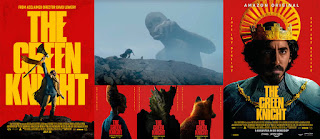
The Green Knight


Knight Fever

The Green Knight
Ireland/Canada/United States/
United Kingdom 2021
Directed by David Lowery
A24


Warning: Very mild spoilers.

The Green Knight is just the latest in a long line of movies based on the Arthurian myth verses, written in the 14th Century, depicting the tale of Sir Gawain And The Green Knight. At least, that’s what it purports to be... I’m hearing that a lot of the characters and situations are misplaced and changed and some incidents even come from other works so... yeah, it would be true to say that it was inspired by, rather than a genuine adaptation, I think. Thankfully for me, I’ve not read the original text and I’ve somehow, not on purpose, managed to miss seeing any of the other versions of this so... yeah... I say lucky because I can’t be enraged with the various liberties taken with the text.

So instead, what I saw when I sat down to watch this, was a truly magical and surreal experience of a movie, starring Dev Patel as Gawain (who is not actually a knight at all in this one), supported by a wonderful cast including Alicia Vikander as his prostitute girlfriend (in a dual role actually)... who he spends nights with in the local brothel, Sarita Choudhury as his witch of a mum (a kind of misplaced Morgan Le Fey character, even though that character is also represented here later on in the movie, blindfolded... she wasn’t Gawain’s mum in the original, I think), Sean Harris playing a truly excellent and interesting version of King Arthur and Kate Dickie as his Guinevere.

The plot is simple and the reason I’ve been waiting to watch this until now is that it’s actually a Christmas movie (again, displaced from New Year’s Eve in the original text, I am told). The events take place at Christmas and then, for the next part, the days leading up to the next Christmas. A big creature of a person who seems to be made of wood, The Green Knight, shows up at Arthur’s castle during the Christmas feast and challenges a knight to ‘A Christmas Game’. One should fight him and, if he wins and beats him, then he has to present himself to The Green Knight’s chapel, a fair few days ride from there, the next year to quietly accept whatever blows or wounds which are done to the knight to be visited upon him in turn. 

 Of course, Gawain, who really wants to be a knight, accepts. Arthur lends him his sword, Excalibur and, thusly armed, he faces the enemy in the hall. The Green Knight, however, just puts his sword down and waits for whatever blow is delivered but Gawain, wound up by the odd atmosphere and not knowing what to do, takes his head clean off. Then, after a minute, The Green Knight gets up, picks up his head, and reminds him that he has to present himself to him to receive the same blow in a year’s time. The rest of the film is Gawain’s journey to that fateful meeting and, it has to be said, it gets quite surreal and more than a little ambiguous before the completely uncertain conclusion of the film (and even the post credits moment doesn’t help too much at this point, since the audience has become aware of the inherent trickery of the narrative to impart unreliable information).

The film starts off as it means to go on, with a shot of Gawain on a throne while a narrator (a mixture of voices of the director and his wife) leads the audience in and then we see Gawain's head suddenly catch fire, while leaving him unharmed, like he’s the lead character in an old Marvel Ghost Rider comic... and the roar of the flames as the sound grows, giving way to sudden silence and a black screen before a more tranquil, pastel toned image of the start of the story, proper, is revealed.

And this is something which the director keeps doing in this, truly breathtaking looking film (this is definitely a ‘buy the Blu Ray’ job when the time comes for a re-watch, although it looks like that’s only available in the US at the moment at an overinflated price), playing in contrasts of both sound and visual rhythm. The sounds keep dialling up and then leaving us in a wake of almost silence (and old trick but no less powerful) and also the visual rhythms cut from very fast, fluid tracking shots to slower and more leisurely paced camera movements mixed with the odd static shot. It’s like a visual collision of pacing but most of the time it’s fairly slow and sure. I love that the director has learned, where many modern directors haven’t, that to truly make a small incident in a film special... you need to surround it with a long lead in and a quiet approach. And, believe me, this film is very effective. Confoundingly non-conclusive, for sure (the director is definitely wanting you to bring your own conclusions with you by the end of the film) but the various set pieces are truly powerful, even when they are mere camera moves to reveal a different view point of what you think you are watching.

For example and without giving anything away, there’s an extremely beautiful ‘double 360 degree pan around’ a forest clearing where Gawain has been tied up and left for dead. The first time it catches back up to Gawain it reveals something you really aren’t expecting to see at this point and then, when it gets back to him again... okay, the second pan around gets to something more predictable but the whole shot, which must take somewhere between 30 seconds and a minute, is absolutely brilliant and really a key into the way creative expression is brought to the foreground of the movie. The music also is wonderful but, alas, at time of writing it’s not been released on a proper CD so it looks like I won’t get to hear it free from the bounds of the movie, which is a real shame.

There are lots of wonders which I daren’t reveal here (but, honestly, “chaos reigns” at one point ;-)) but the ending, it has to be said, is extremely ambiguous. You can always take the easy route and read the original text to see how it’s supposed to go but, like I said, the ending is deliberately vague as to the final fate of Gawain and, perhaps, even errs on the absolute opposite of the version in the original text. I guess it depends on how you choose to interpret it as to whether the film ultimately delivers for you but, I’d have to say I’d certainly recommend The Green Knight to all those who love what the magic of cinema can give us when used to create unique and interesting story telling formats. Definitely one I’ll be watching again at some point.

Sunday, 18 March 2018

Tomb Raider


Bust In Show

Tomb Raider
2018 UK/USA Directed by Roar Uthaug
UK cinema release print.


Remember when Robert DeNiro ate himself into all that extra weight so he could play Jake La Motta? Or that time when Christian Bale slimmed his weight down to almost nothing to play the central protagonist in The Machinist? This is what an actor does to get himself closer to the look and feel of the character he or she is playing. This is why I just don’t like Daniel Craig as James Bond. In the books, Bond has short black hair. Not smudgy blondy browny stuff (admittedly he has a facial scar too which they should have had right from the start of the movies). Anyway, this is why I can’t take the character of James Bond as seriously as the new films seem to want me to. Like Roger Moore’s version of the character... it’s just not James Bond unless they get the physical details right too.

Now do you remember when Angelina Jolie played Lara Croft for the first two Tomb Raider movies? She wore false breast enhancers because, presumably, she knew how integral the character’s huge bust size was to getting her characterisation right. I have those statistics written down in a celebratory magazine about the original computer game character somewhere. I can’t remember the exact size but the point is that they were important enough at the time that the game publishers knew exactly what the measurements were... possibly because her bosoms helped her keep her balance on crossing dinosaur filled chasms on precariously balanced logs, I should think. So, as much as I love Alicia Vikander as an actress... and I really do, she’s great... I really can’t take her that seriously as an on screen version of Lara Croft if she’s not trying to bring the physical attributes of the character into cinemas with her.

That being said... it’s totally not Alicia Vikander’s fault because, apparently, the various games which have continued the series long after I stopped playing them (I’d finished with the third or fourth game in the series, I think) have been completely contradictory with the various back stories and origins of the character as the series progressed and, yes, even to the point where they reduced her bust size... which is just crazy. I think they should have just been confident enough with the character to do the right thing by her and leave her exactly the same as she always has been and it’s quite sad that they should make these changes.

So, although I am quite offended that they have chosen to change all these things and reduce the character to a point where she completely loses integrity... yeah, I can’t lay the blame for that at the door of the new writers, director or star. Not their fault, I think.

As it happens, the new Tomb Raider film plays hard and fast with the legend of Lara Croft again anyway and she’s actually trying to make her pennies last in this because she doesn’t, by choice, have control over her potential inheritance. People seem to have forgotten... and so does the internet search engines, by the looks of it... that Lara Croft was originally born on something like January 10th 1968 (one day after my own birthday) and not February the 14th, which is what it was changed to a few years later to make a nice tie in with Valentine’s Day. The new movie is set contemporary to its release, which means the central character should be 50 years old now. So... clean slate and a reboot of sorts, it seems. Forget everything you thought you knew about Lara for this one because... they’re just making things up as they go for the movie.

It’s not a bad movie, though, despite having some fairly negative reviews...

Vikander is, as you would expect, excellent in the lead role (as she is in just about any role she takes on, as far as I’m concerned) and she pretty much carries the film. She is ably assisted by Dominic Cooper as her father (another character who has had a name change over the years), Walton Goggins as the villain Mathias Vogel and Daniel Wu as her new sidekick Lu Ren. And, yeah, it’s a straight up action adventure in the style of the original proposition of the first games I used to play... a kind of updated Raiders Of The Lost Ark with a female Indiana Jones figure front and centre. Or back and centre really because the third person gaming style engine on the originals meant you saw a heck of a lot more of Lara’s wiggly backside than you did of anything else, if memory serves.

And... contrary to some reports I’ve heard... it’s no better or worse than the previous Tomb Raider films and, since I quite liked the previous movies, that’s fine by me. It’s a straight, archaeology in action kind of deal and, although there are no new modern twists in the tale, which I suspect is the reason it’s getting something of a lukewarm reception, it is pretty well made and it doesn’t get too dull. Even though... and this is a shame... the story has been stripped of any supernatural elements and, perhaps, resembles more an episode of Scooby Doo in that it leads the audience in with the strong promise of a terrifying, death dealing super being and instead gives us a different and less incredible reveal than we were, perhaps, hoping for.

Still, it’s a fun film and I thought it hit a lot of the right notes.

Visually it’s very interesting because there’s a richness to the images and textures throughout. By that I mean that the director has gone out of his way to give the film a certain amount of depth to it. Not in terms of the 3D version I saw... the 3D is rather unnecessary here... but in the way that he uses various layers on screen to show the audience more going on in the background than they might get usually. It’s essentially the same trick that director Roger Corman used to use on stuff like his famous Edgar Allan Poe inspired films for AIP back in the 1960s... he always used to leave a door open into another room/part of the set to add depth and interest to the frame composition. Director Uthaug seems to be using the same kind of method here and it works fairly well. There’s never, visually at least, a dull moment.

That being said, my favourite part of the movie was the first twenty or so minutes, set in London, where the basic character of Lara is set up in somewhat contradictory form to what we have known from the character in the past. This includes a dodgy appearance by Nick Frost and a truly cool bicycle chase sequence that, alas, seems to top anything else that comes later in the movie. That being said, the director has at least tried to put in a lot of trade mark, physical ‘character situations’ from the game and you will see Lara stumble and fall and generally be placed in the way of various death traps during the course of her adventure. So that’s kind of nice.

Tom Holkenborg (aka Junkie XL) continues to show great proficiency as a film score composer and I’m pleased to see that this one, at least, has a CD release. It’s appropriate to the piece and has many nice moments which really help hold the movie together. My understanding is that he gave up the Justice League gig (reviewed here) to work on this one so I’m guessing he was a player of the old Tomb Raider games back in the day.

Ad there’s not much else to say about this one, I think. Other than stick around for a few seconds into the final credits to see another iconic piece of Miss Croft’s imagery added into the mix. A well put together action movie which has nothing really special going for it but which certainly succeeds in pretty much everything it’s trying to do. Maybe give Tomb Raider a go if you are a fan of the games or the Angelina Jolie movies.

Friday, 29 July 2016

Jason Bourne

Billion Dollar Bourne

Jason Bourne
2016 USA Directed by Paul Greengrass
UK cinema release print. 


Warning: Very mild spoilers.

Hmmm.... okay, I’ll jump right in here with a quick history of my reaction to the Jason Bourne films. Still haven’t seen the Richard Chamberlain version of The Bourne Identity but it’s in the ‘to watch’ pile and I will get to that soon. Absolutely loved the Matt Damon remake of The Bourne Identity... one of the great spy films to join the classics such as The IPCRESS File (reviewed here), The Quiller Memorandum (reviewed here) and The Spy Who Came In From The Cold, as far as I’m concerned. Then Paul Greengrass took over as director for The Bourne Supremacy and The Bourne Ultimatum and, although the story content and acting etc was fine, the camera movement and editing made the action sequences barely watchable at best and, certainly, incomprehensible at their worst. There were some redeeming features in Supremacy such as Bourne’s visit to the daughter of two of his past victims but, ultimately, I didn’t think much of these movies other than continuing to love what John Powell was doing with the music in them.

Surprisingly, the Jeremy Renner starring The Bourne Legacy (reviewed here), while having an atrociously simplistic story which the writers seemed to be trying to disguise by giving it as many links to the Matt Damon films as possible, was actually quite entertaining. James Newton Howard’s score was cool too and I expect he might have gotten the gig with that after turning out an incredible pseudo-Bourne score for the Angelina Jolie vehicle Salt (reviewed here), a few years earlier.

And so now we come to Matt Damon’s semi-triumphant return to the Bourne films, along with Greengrass returning as director and.... it’s a mixed bag to be honest. I say semi-triumphant because, although I’m sure it will do the right numbers at the box office, Jason Bourne really doesn’t have too much going for it but, at least in terms of Matt Damon, his performance is worth watching, as always. So at least we have a credible main lead and the film feels like it’s got some kind of authentic link to the Bourne series.  However, even a great actor like Damon needs to have a half decent script to work from and... I really don’t think he got that here. In fact, this feels just as simplistic as The Bourne Legacy in terms of story content and no amount of heavy weight actors brought into this melange of  various, patched together conspiratorial shenanigans going on at the CIA is going to help make this anything which could reach the dizzying heights of the first movie.

We also have the return of Julia Stiles as Nicky Parsons in this, who really helps Damon keep this movie afloat, and as far as I could tell she’s the only other series regular in this one other than the title character. However, the way she's written in this story and her stupidity at attracting attention to herself, while brilliantly played by Stiles, really doesn’t do the character any favours. Well done to Stiles for making it work but, like most of this film, it’s the writing that’s the problem... not the acting.

The heavyweights I was referring to earlier are the three main supporting cast with Tommy Lee Jones as CIA Director Robert Dewey, Vincent Cassel as ‘The Asset’ (aka kick ass Bourne style assassin bad guy) and the relatively young Alicia Vikander as CIA tech guru Heather Lee. All of these people are good but they all serve a bad storyline. Jones is very much in the mould of CIA Directors from the previous films so, we pretty much know what’s coming from him and do we really need to see the CIA playing political games against each other involving fellow agents who are aggressively ‘taken out’ when they start to get in the way... yet again in the Bourne series? Can’t some of them just play as a team, once in a while. Vikander is pretty strong and just about manages to pull off the gravitas needed that not having so much ‘old timer character baggage’ from other films almost hinders. Her character works quite well and it’s someone the audience can root for as a possible ‘non evil’ character most of the time.

Vincent Cassel is always a nasty bad guy but, here, he really could have done with being given more lines, I think. Also, it has to be said, certain revelations about his character further serve to highlight just how amateurish the story is here. We have a back story to everything we already know about the Jason Bourne saga and his links to Treadstone, which is grafted on wholesale for this movie and which brings in Jason Bourne’s father... and what happened to him just before Bourne joined the CIA. When we get a true reveal on just who Cassel is playing in this, very near the end of the movie, it’s actually one of those things which you think of very early and then dismiss because, hey, that would be really lazy story telling, right? Everything seems to connect in this movie just a little too conveniently and way more than you would expect it to in real life... it seems to me. Cassel’s character is pretty much a victim to the cause and effect method of storytelling that a lot of US cinema tends to fall back on, crutch -like, these days and it’s a shame that the writers felt the need to do this, I think.

In terms of the way the camera moves and the editing... well it’s certainly fast paced but it suffers from the “Paul Greengrass special” school of filmmaking in that, a) the camera never stops moving around and b) it’s lots of short shots cut together continuously which, to be honest, can be more than a little disorientating and distracting  from the main action on-screen. I have to put my hand up and say, for once in a Paul Greengrass movie, I wasn’t totally lost in the action sequences and, for 90% of it, I was managing to figure out just what was going on. However, the editing and vertiginous camerawork never lets up and, after a while, you are just left wondering as to which part of the screen the director wants to show you, to be honest.

Composer John Powell returns to the fold with this one and he’s joined by composer David Buckley. Now I don’t know who scored which bits or what the nature of the collaboration was but I did notice how good the score throughout the movie was, when I could hear it above the ‘extra loud and in your face’ sound effects tracks. I’m looking forward to acquiring this asset on CD in a week or so and it will be interesting to hear it properly, away from the pop pop bang bang noises. The Jason Bourne theme is all over the movie but I wasn’t able to detect the Treadstone Assassin motif in this first sitting. I’m sure it must be on there though and this score certainly feels like it belongs in a traditional Jason Bourne film... so I would be interested in knowing who composed which bits.

Other than the score and the acting performances, however, it’s really not a good entry into The Jason Bourne series and, while it is pacey and quite entertaining, it has nothing of the power of the endings in previous Matt Damon entires in the franchise. The end here seems very contrived and, ultimately,  a bit anticlimactic... especially in terms of how Bourne is able to see and hear things for his not so mind blowing twist at the end. Even so, every plot point seems designed to propel the action forward without actually telling you what it really is everybody is playing this game for and I thought it really out of character when Bourne doesn’t run from it all at the start. All in all, if you like the previous Bourne films then I don’t think you’ll have a particularly bad time at the cinema with this one... it’s just not quite reaching that high bar which was set previously. It’s worth a watch if you like action spy movies with not much plot, though... so yeah, if that’s what you’re in to, maybe give Jason Bourne a go. There are a lot of worse things out there in the local cinemas at the moment.

Monday, 17 August 2015

The Man From UNCLE


A Few Of My Waverly Things

The Man From UNCLE
2015 USA
Directed by Guy Ritchie
UK cinema release print.

Hmmm... okay, so this is one of those films that make reviewing these things both interesting and, frankly, extremely frustrating. I saw the trailers for this and the tone looked somehow wrong and, well... it certainly is but there’s a lot of good stuff here too.

I used to watch The Man From U.N.C.L.E as a kid on TV, mostly in the many movie incarnations... some of which were just edited versions of compiled episodes and others which were original stories (if memory serves me correctly). It’s been a long time since I saw any of those projected onto a big screen... I think I saw one or two around about the early to late seventies, on screenings at holiday camps etc when I was a kid. I remember the biggest factors in me getting into these things, as it always seemed to be, were the musical scores on these. Although the original The Man From UNCLE theme by Jerry Goldsmith is what most purists will probably cite as the best, I personally prefer the reworkings and scores by other composers such as Gerald Fried and Richard Shores... once the unusual time signature of maestro Jerry’s had been changed to something more usual (which I really don’t mind in this particular instance... not nearly as much as the original composer did) and made more typically jazzier. I used to hum this stuff all the time as a kid.

Now I don’t know much about Guy Ritchie but I saw his excellent Sherlock Holmes film and his not that bad but, not great, sequel to it some years ago. I can see that he’s a great talent and has some nice, possibly even innovative stuff, going on in his films. As such, I was expecting at least a half watchable movie from this and The Man From UNCLE is certainly more than that. However, the film at no time seems like either and extension or a reboot which is faithful in any way, shape or form to the original series or movies... and it really seems to make no attempt to be that, it has to be said.

For me, the movie needed to have at least two things in it besides characters who were like the originals... that was a variation of the original Jerry Goldsmith melody line plus baseline to give it a musical identity and, of course, those signature scene changes which sent the camera fast panning off to the left or right with a jumble of “incomprehensible to the eye” image movement which snapped you into the next location. I thought that the studio would at least retain these things but, alas, it really didn’t and I think this hurts the film tremendously in terms of being an addition to The Man From UNCLE universe.

As far as the characters are concerned, the movie puts too much history into the characters and this means they have been severely changed from their earlier counterparts. Bond author Ian Fleming originally created the Napoleon Solo character for TV before being pulled off of the project due to contractual conflicts with the Bond series of films (again, if my memory serves me correctly). However, the character name, at least, made it into the book of Goldfinger (and the movie version, reviewed here, although in the film he’s just referred to as Solo), so that’s kind of interesting in terms of development times. The character name was used in the book five years before the show aired so I’m not sure if that was a long development time or just a case of Fleming using an old name he liked... he also contributed the character April Dancer, who would later be played by Stefanie Powers in the TV show The Girl From UNCLE. 

In this updated version, Solo has somehow become an ex-thief and Ilya Kuryakin is a big gorilla of a Russian who suffers from psychotic episodes. This is a far cry from the original characters and it really puts the final nail in the coffin as far as continuity with the originals goes.

That being said, Henry Cavill and Armie Hammer are both absolutely great playing this movie’s versions of Solo and Kuryakin... the audience just has to accept they are playing different characters. They are ably supported by Alicia Vikander and Elizabeth Debicki playing both ally and villain in this although, it has to be said that Debicki seems a little underused as the main antagonist. One wonders if there was a much larger film, much of which was left on the cutting room floor for this one. Certainly the visual absence of a pay off scene involving Kuryakin and Count Lippi, in a nice reference to Ian Fleming’s Count Lippe character in Thunderball (reviewed here) and the use of montages which promise larger action sequences than were revealed, perhaps, may indicate that this movie has been heavily trimmed... probably by the director I should imagine. All that being said, the film is a joy to watch once you can get over the fact that the only character who is remotely like his original source is Hugh Grant channeling a younger version of Leo G. Carrol’s Mr. Waverly character.

The film is set in the 1960s and that’s certainly good. The director seems to enjoy playing with a kind of hyper real version of the sixties which is not a million miles away from the style employed through various espionage films over the years... just not really The Man From UNCLE franchise. One of the things he does is employ split screen techniques such as those popularised in movies like the original version of The Thomas Crown Affair and he has a great slant on this at the end of the first sequence he does in this manner, where the vertical split from two separate, parallel displayed shots is pulled away revealing that you are actually seeing a single shot which is split by a vertical in the composition already. He does this less successfully later in the movie but the first time he does that here it’s a nice little reveal.

Another interesting thing he does is to take the old horror cliché of having something important happening in the background of a shot which the main characters are unaware of, the audience witnessing what’s going on before the characters realise it. He uses it for comic effect and, certainly, the first time he does this it works quite well. However, I have to say that it becomes something of a signature flourish throughout the film and, by the third time he relies on this technique, I was getting a little tired of it, to be completely truthful.

However, asides from all these little moans, it’s actually a great little 1960s style homage movie with bright colours, nice dialogue, great performances and a very freestyle shooting methodology - Ritchie seems to use every kind of different camera move and trick in the book and it’s really to his credit, and the editor’s, that he manages to make it all work so well without ever once jarring the viewer. There is a certain positive chemistry between all the lead actors and actresses too, which really helps the film, even though these are not the characters you are familiar with from the original show.

Daniel Pemberton’s percussion heavy score is the icing on the cake. Ritchie uses a number of songs, many of them put to surprisingly good use on the soundtrack, but Pemberton’s sixties style spy score is absolutely brilliant and this soundtrack was an instant purchase for me on CD. My one regret, as I stated earlier, was that the powers that be had decided not to use the original theme tune, which would have greatly lifted the movie more into UNCLE territory and I would have really liked to have heard what Pemberton would have come up with  for this. I was already a fan of his score for The Awakening (movie reviewed here) and it was a blast to hear him having the opportunity to do something this flamboyant in a modern film score... hopefully he will become a bit more well known in the industry after this because, Goldsmith cues or not, it’s a pretty cool score.

And that’s about all I have to say about The Man From UNCLE: The Guy Ritchie Affair. It’s not the best version of the source material it could have been. In fact, it couldn’t be much further from it even if the director had tried to update it chronologically to modern times. However, it is a great little gem of a movie and if you are not someone going in with any expectations that it needs to live up to the original, then you should have a lot of fun with it. Like the 1960s Modesty Blaise movie, this film is an absolutely appalling adaptation... but it’s a really fun film. Go see it.

Sunday, 25 January 2015

Ex Machina


Blues Ex Machina

Ex Machina
2014 USA/UK
Directed by Alex Garland 
UK cinema release print.

Warning: Some light spoilers on this one, I guess. 

Right. Been worrying about how to approach this review because, frankly, I know that one of my twitter followers really liked this movie and I suspect she’d be very disappointed with my response to it if she ever read this. However, I’ve always kept the reviews on the blog honest as to my reactions to the films and it would be irresponsible to my readers to be anything less than that now... so should Becky Grace Lea of the nethersphere known as Twitter ever stumble on this review... and I sincerely hope she doesn’t... turn back now and don’t read this one would be my best advice to her.

Also, anyone who reads on from here and hates this review should probably go and check out Becky’s review of this which, I’m sure, will probably be up at some time within the next day or two of this review going live and which can almost certainly be found somewhere on the Assorted Buffery website here. She’ll have a much more positive spin on it for you, I’m sure. As for me... well you were all warned.

Okay, so Ex Machina is the first film to be directed by the famous novelist Alex Garland and, I have to say, it kinda feels like it’s a first film and somebody trying to get something out of their system, in some respects. I can’t say I was particularly looking forward to this one since, after seeing the trailer, I was pretty sure I knew exactly where it was going to be going with the ending of the movie. Well, the good news is... the film doesn’t quite go exactly where you assume it will be going from the set up in the trailer. Another piece of good news is that the implications of Deus Ex Machina being used as a literary device to give the film a cop out, miracle ending is not the usage the title of the film is embracing. It’s merely a metaphorical identifier of the origins of the phrase and not the modern, more common usage of the term.

And those are the two bits of really good news I have about the film. Now for the mostly bad stuff...

The ending of the movie and attempted sleight of hand used as a general progression towards that idea doesn’t really work because we are already expecting something almost clever to happen and, when it just starts telegraphing the ending of the movie to us within, literally, the first ten minutes of the opening sequence, we are pretty much there at the end already, and you have the rest of the running time to start wondering when one of the other characters will stop being an idiot and see what’s really going on. Once the power cuts start, and we really know they’re not power cuts right from the very first one, then the audience will sense straight away the degree of manipulation at work within the main narrative strand and it doesn’t take much of a push to realise where this will all be leading to. Indeed, by the time one of the lead characters cuts his arm open to reveal certain information to the audience, it’s already too late... we’ve started ditching those preconceptions based on the trailer already within the first ten minutes... so that surprise at the evidence of actual humanity within the film is somewhat stingless and antiseptic by that point.

But, you know what? There’s good stuff in this movie too. It’s just always tempered with the bad stuff.

Some of the acting, for instance, is very good... although the dialogue does seem to be a bit streamlined and non naturalistic at times. Are the sometimes less convincing moments, then, the fault of the actors or the writing of the lines? I’m not sure. Hard to call. It maybe explains why the one character in this film without any lines coming out of her mouth was, for me at least, the most interesting and watchable presence in the film. That is to say, while I found the main robot creation played by Alicia Vikander to be interesting and, due to her android nature, kind of spot on... it was the character played by another actress I’d not heard of before, Kyoko played by Sonoya Mizuno, who grabbed all my attention in this. As an actress and presence on the screen, she was absolutely stunning in this and the one reason why I didn’t feel like I’d wasted my Saturday evening at the cinema. I’d definitely like to see more films with her in and, possibly because she didn’t have some very basic and clunky dialogue coming out of her lips, I found her to be the best thing about Ex Machina.

The story itself seems to be guilty of the thing I’ve been accusing most US made science fiction films of doing in the last ten years or so... playing catch up with the 1950s. These are exactly the same kinds of stories that people like Philip K. Dick were writing as shorts in the 50s and 60s and for someone to be claiming this is an original idea, or even that it’s executed as well or with at least an element of surprise being retained, is something I find to be really poor behaviour. But, like I said, there’s good with the bad.

Alex Garland can direct quite well.

That’s an established fact, now. The opening montage is, perhaps, a little aggresively edited and some of the shots are maybe not as creative as they could be given the artificial nature of sets which can be controlled to the nth degree. Nothing hugely, visually creative springs to mind when I think back on the film now. However, when edited together, the footage cuts together in a way that was neither confusing or in any way inhibiting you seeing what the director wants you to see... well, apart from accidentally telegraphing the ending, that is. What that means is that, while this does indeed feel like a first film... it’s one where the director has proven his confidence and, frankly, means that people should maybe give him a load more money so he can grow and become the directorial artist that’s obviously lurking within the best selling novelist. I think this guy has proven, with the clean look and feel of this one, that he definitely has the potential.

As a film which is entertaining... it had its moments but most of those, as I’ve indicated already, featured Sonoya Mizuno’s turn as Kyoko. A role not bound by any lines the actress might have been required to speak. In fact, I would say that both Kyoko and Vikander’s Ava were the most watchable aspects of this movie. The two main male protagonists, played by Domhnall Gleeson and Oscar Isaac, both bring a lot of enthusiasm but it seemed, to me, that they were much more hampered by the script. Real people don’t talk like this and, if you’re someone with the genius of a director like, say, Hal Hartley, then the warmth and emotional intent will always come through the stylistic stripping down of the sometimes clinical dialogue but, with this film, the performances seem to add up to being less than the sum of their combined parts, it seemed to me.

The ending, also, or should I say the epilogue to the film, seemed like something we don’t need. The final fate of Domhnall Gleeson’s character was already fairly eloquently sealed at one point and the last series of shots of both him and Ava, after their last scene together, were completely unnecessary. The points about whether Ava has managed to pass a specific kind of test had all been made, perhaps a lot sooner than the director intended, and the final scenes shown are not giving us any new information... I think that stuff could have been pared back right down and, perhaps, if the director had even lead us to the point where he’d cut to the credits before the last scene between Alicia Vikander and Domhnall Gleeson took place, maybe with the final moments having Ava looking over Gleeson's unconscious body, Garland would at least have given us a film with a little more enticing ambiguity at the conclusion as opposed to what we have here. That being said, the totally superfluous last 6 or so minutes might well have been a studio addition as opposed to Garland’s own natural conclusion to the narrative and so it might not be his fault. As it is, the ending is overcooked and it’s a shame because giving us a lot less of a conclusion would have at least encouraged the audience to think around some of the key issues more than they will now, I expect.

The only other possible saving grace to this film might well have been the score by Geoff Barrow and Ben Salisbury but, while I found it effective in some parts of the movie, I found it to be more wallpapery in other parts and I wonder if that’s the fault of the way the score has been mixed into the foley or if it’s within the composition. I’m not sure how it will play as a stand alone listen on a CD but I think it was a bit of a hit and miss affair in the body of the movie itself. Not sure if I’m going to give it a try away from the movie or not, truth be told. I’ll have to see how much the album is if it ever gets a proper, non-downloadable, physical release.

The film itself, though, seemed a bit less special than a lot of the buzz going around on twitter had lead me to believe. It seems popular, which is good news for Garland and hopefully he’ll get another go to grow as a director. As for me and judging it still in terms of someone who had seen the trailer for the movie first, I’d have to say that Ex Machina certainly wasn’t a terrible movie but, neither was it a particularly good one. That is to say, it’s not nearly as bad as the movie I was expecting it to be... but not nearly as good as the movie I was hoping it would be. It’s not a film which many will find all that challenging, I expect, but some will possibly like the “popcorn” fodder aspect to it and the CGI is done quite well for special effects enthusiasts. I think future generations will probably respond to it better because of the lack of historical journey to the concept when they’re youngsters, perhaps. I just hope there won’t be a Deus Ex Machina Part Deux.