George Lassos Book
The It's A
Wonderful Life Book
by Jeanine Basinger
Knopf Books
ISBN: 0394747194
It’s been over twenty years since I first borrowed this book from a library and read it... but I was never able to afford a copy and, well I think it’s come back into print now but, this October, I managed to stumble on the exact same, first edition I read all those years ago for the less than princely sum of £2.12... an opportunity I immediately took advantage of. It’s A Wonderful Life (reviewed here), of course, is not just a much loved Christmas movie but, also, one of the all time greats. So I was pretty surprised when I revisited this tome to find that some of the stories about its production and reception were things I’d managed to forget over the years.
If you’ve not read this one and, like me, you have a passion for the film, then I would definitely recommend it. It covers the film from its infancy to its initially disappointing reception and then goes into the life it gained for itself afterwards (the nearest modern equivalent I can think of, of this phenomenon, would be Ridley Scott’s Blade Runner... reviewed here). It’s a very interesting look at the classic movie and it’s done with the aid of key witnesses and participants of the production... as well as by referencing some interesting visual artefacts surrounding the movie.
It starts with both the director, Frank Capra and star James Stewart both returning from active duty in the Second World War... both wanting to get back into their previously successful careers and both very nervous about it. Capra set up an independent film company, Liberty Films, with a few people like director William Wyler but only this and Wyler’s The Best Years Of Our Lives were, I believe, released by them. My understanding, or at least it’s strongly hinted at, is that the perceived box office failure of It’s A Wonderful Life (bearing in mind it was still one of the top ten grossing box office films of the year of its release), lead to the premature downfall and liquidation of Liberty Films.
The tale begins properly when a property bought by RKO for their star Cary Grant proved to be something that they just couldn’t figure out how to make work. They had already made three script attempts by three writers, all of them quite different and based on The Greatest Gift, a short story by Philip Van Doren Stern. This was a story which Stern couldn’t get published so, in frustration, he had it printed up as 200 Christmas cards to give to his friends. Someone at RKO saw it, liked it enough to develop a film about it and bought the rights. But, yeah, they couldn’t make a go of it so it was sold to Capra, who also took custody of the three prior scripts (none of which he ended up using other than a few similar scenes, for his rewrites).
The book then goes through the production process with various artefacts presented such as alternate casting ideas jotted down by Capra and also ideas about the various characters. For instance, for the wonderful Violet, played brilliantly by Gloria Grahame in her first big break, he wrote “She doesn’t count sheep to go to sleep, she counts men.” And there are a lot of stories told, many of them by first hand witnesses as the author of this book researched her tome, where she sorts out the truth from the publicity to the best of her knowledge. There were stories which I did remember from the last time I read it... such as the snow developed especially for the film (shot on an exterior set through a very long hot summer) and the fact that the special effects team who developed this new, more realistic snow for the film received a Motion Picture Academy Class III Certificate of Honourable Mention for this invention. Also, when Donna Reed has to throw a stone a good long distance and break one of the windows in the old, abandoned house which would eventually become Mary and George Bailey’s home, her experiences growing up as a farm girl with plenty of brothers meant that she was able to pitch the pebble and break the far off window first go, without resorting to the sniper Capra had standing by to shoot the window out.
Then there’s the story about the loud clatter of objects as drunk Uncle Billy walks off screen at one point in the movie... the tale going that this was recorded by accident as an electrician accidentally knocked over a stack of props during the take and, with the voice of Uncle Billy improvising against it, a new ending to the scene was born (for which Capra rewarded the electrician with 10 dollars for improving his film).
And there’s also the occasional behind the scenes info I’d forgotten recounted in here, such as Lionel Barrymore being too well associated with nice guy roles so, as the villainous Potter, he was fitted with a prosthetic to change the shape of his forehead to make him look less sympathetic (something I still never notice to this day... I’ll have to remember to look out for it again next time I watch it).
In addition, there are lots of dates and facts about the production, such as when Capra was forced to give the cast and crew the day off due to extreme heat and, also, lots of talk about the picnic party he and Stewart threw for everybody, not long after the picture had wrapped production.
The first hundred or so pages of this book detail all this stuff and the press reaction to it, followed by a look at the modern day renaissance of the film through television showings throughout the 50s, 60s and 70s, interviews with James Stewart and Jospeh Biroc (one of the three cinematographers on the film) and even a reprint of the original story, The Greatest Gift, which started the ball rolling. This last is a very interesting read because the essence is there to a degree but Capra and his people sure did more than just add a heap of window dressing. This is all followed by a reprint of the final shooting script, again heavily illustrated by production stills... which was again changed, of course, as it was being filmed with improvised and improved replacement lines and actions directly on set (so yeah, that’s a pretty interesting read too). The last item before a few appendices of more documentation and artefacts is a transcript of a Q&A session with Frank Capra at a College screening of the film he attended in the 1960s. Which certainly gives an insight into how this much celebrated director worked with his casts and crews.
And that’s me done, for another couple of decades (at least) with Jeanine Basinger’s pretty great The It’s A Wonderful Life Book. Certainly a recommendation to lovers of the cinema as an insight into the production of a well loved motion picture and, of course, an absolute must read for those who have discovered and loved the film over the years. One of the more interesting film books you can buy.
Showing posts with label James Stewart. Show all posts
Tuesday, 20 December 2022
The It's A Wonderful Life Book
Thursday, 16 December 2021
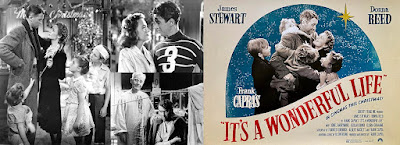
It's A Wonderful Life
Mary Christmas
It's A Wonderful Life
USA 1946 Directed by Frank Capra
Liberty Films/Paramount
Blu Ray Zone B
Warning: Small spoilers... like the ending.
Well, I’m not even sure how to start a review of what is, frankly, one of the best known and most loved films in the history of cinema (and rightly so). I mean, is there much I can say that hasn’t been said about It's A Wonderful Life a million times by others before me in a much more interesting and eloquent way than I? Well, possibly not but I do have the odd observation to add and some of the stories behind the production can never be repeated enough, I think.
The film, the first directed by the very successful Frank Capra to be shot at RKO studios under his own co-partnered company Liberty Films (after a string of hits directing for other producers), is most definitely the greatest Christmas movie ever made, even though the plot of the movie is not actually dependent on it being Christmas at all and, indeed, much of the film is not set during Christmas.
The basic plot, which I’ll explain very quickly, involves the great James Stewart as George Bailey. The film has a very dark prologue and a very brave one, after a load of despairing voices heard over establishing shots of the film’s sole setting, Bedford Falls, are heard praying to God to help out George in his hour of need. The audio of one of his young daughters crying out “Please God, something’s the matter with daddy!” within the first minute or so is all it takes nowadays to start the tear ducts flowing and turn me into a blubbery mess for the remainder of the film’s quite lengthy (for it’s time) 130 minute running time.
We then get that incredibly brave shot of just a static image of stars lighting up whenever one of them ‘speaks’... representing God and his chief angel, talking... which lasts almost two minutes (turn the sound off and you’ll see why that’s incredibly brave... but the dialogue is riveting and saves it). Another angel, Clarence (AS2, Angel Second Class, who hasn’t won his wings yet), played by Henry Travers, is assigned with the task of helping out George Bailey and then he (and the audience) are shown stories from George’s life from when he was a kid and rescued his little brother (losing the hearing in his left ear for his trouble) and right up until the events to which Clarence is needed to act as his Guardian Angel (which doesn’t come until an astonishing hour and 40 minutes into the substantial running time).
After an absolutely brilliant movie up until this point, George considers taking his own life by jumping off a bridge into an icy river so his family and the Bailey Buildings And Loan Company, which he has been trying to hold together for all these years and which is in big trouble, can benefit from the life insurance policy that he has in his pocket. Okay, there’s all kinds of things wrong with that but, assuming the death is taken as accidental, then that policy would be no good anyway, surely, because it would go and get all soggy and unreadable in the river after the deed is done? Well, despite this, Clarence jumps in the river instead so George can rescue him and get an introduction. He then acts as a kind of ‘Ghost of Christmas That Could Have Been’ when he introduces a scenario where George Bailey was never born and how bad things in the world would be if this common man, trapped in the town of Bedford Falls all his life without being able to travel the world as he intended, hadn’t touched so many lives.
The final straw is when he sees his wife Mary, played by Donna Reed, shunning him, having grown up an old maid who runs the library (now the Pottersville Library after the films chief villain Mr. Potter, played by Lionel Barrymore). This is hardly a ‘Mary Christmas’. He prays to God to live again and then things get fixed, ending with a, perhaps uncomfortable, resolution where the sudden procurement of individual financial wealth is lionised within the ending of the movie.
Rounding out the cast of amazing actors in the film are Thomas Mitchell as Uncle Billy, Ward Bond as Bert the cop, Frank Faylen as Ernie the cab driver (husband of Carol Hughes, who played Dale Arden in the third Flash Gordon serial, reviewed here) and the amazing Gloria Grahame as Violet, the local, um... local bad gal (check out the brilliant, recent movie Film Stars Don’t Die In Liverpool for an account of the last year or so of her life... reviewed by me here). Alongside too many actors to name and they’re all good in this, every single one of them.
And the script is absolutely pitch perfect and manages to flesh out a lot of those supporting characters very quickly and with small sketches so that you believe in every one of them and can fill in their back story, to a degree, with the little shorthand, throwaway dialogue worked into the screenplay.
It had a lot of development in the script stages too, with the original short story on which it’s based distributed as Christmas cards to a small number of people, written by Philip Van Doren Stern, re-crafted as an absolute epic movie...
Some of the various versions of some of those alternate scripts have left little clues to their intent in the final product. For instance, Uncle Billy was originally a larger role and much use was apparently made of his affinity with animals and his curiously large assortment of pets. Indeed in at least one scene you’ll see his pet Raven on the loose and in the scene where tragedy has struck and he’s left crying at his desk by an infuriated and desperate George Bailey, you’ll see mice, various birds and, at the end of the shot, a squirrel which jumps onto the desk to try and comfort him... which must all have been a hangover from one of the previous versions of the screenplay.
Other variations are not obviously present in any shape or form in the final product... for example, there’s no evidence in this that there was once an ending where George Bailey had to fight the corrupt Government doppelgänger of himself and kill him to end the alternate reality. Yeah. that would have been a much different film.
Something I noticed this time around, in a truly gorgeous Blu Ray restoration job from Paramount (please people, don’t ever purchase or watch the silly colourised version... that is an object of evil put on the Earth as an ultimate crime against filmanity) was that the villain of the piece, Mr. Potter, has a little, ornate, precious metal skull on the desk in his office. Oh, and those set dressings are worth looking at... you’ll see a lot of things in the details. Such as a whole raft of pre-production publicity stills of the cast used as photographs in the little office space George has created for himself in his and Mary’s home.
Another thing of note... apart from a grown up Alfalfa from The Little Rascals having a bit of a moment in the film’s early scenes with the dance hall/swimming pool... would be that Donna Reed actually managed to knock out the window of the old house that Mary and George would make their home by herself with her first shot (which is pretty amazing considering the distance). Also, the big crash just after drunk Uncle Billy exits screen right was a sound guy accidentally dropping some equipment leading to James Stewart’s laugh and Thomas Mitchell’s off-screen ad lib of “I’m alright... I’m all-right!” earned the perpetrator a $10 bonus from the director for improving the film.
And a big thing which may well ruin the movie for you if you let it... the film was shot on big sets at RKO in June. A blazing summer and, indeed, in the middle of a heatwave which was so hot Capra sent the cast home to recuperate one day. However, it looks just like Winter and the effects team created, for the first time ever, a special snow compound, earning a Class III Scientific or Technical Award from the Academy of Motion Picture Arts and Sciences for their efforts. Indeed, it’s more or less the same way snow in films is done today and is much better than the dyed cornflakes or asbestos used prior to this.
Dimitri Tiomkin’s score is special too (what survives of it in the finished film, there were a lot of additional needle drops here) and, since I don’t know for sure which bits were his and which bits were borrowed, I won’t say too much about it. But it does more than just illustrate the scenes, providing immediate foreshadowing to the next scene, for instance, when George hears the news his father has had a stroke and you suddenly hear the Funeral March woven into the score. Great cinematography too, considering the number of cinematographers who worked on it and how consistent it looks. Capra has some wonderful shot set ups. For example, the washing line which Clarence and George use to dry their clothes on after the bridge jump scene forms a diagonal which is used to compartmentalise the actors within the shot.
One last thing... I mentioned about the brave static shot at the start of the movie, pulled off with just winking lights and great audio... well another extremely unusual moment for a 1940s movie (possibly the first time this was done, I’m hearing) is when James Stewart first enters the picture as the adult version of George Bailey. When his face is clearly visible and turns to the camera, Capra freezes the frame for a good long while as the various angels talk about Bailey’s face. Again, it’s kinda bold for the time to just stop the picture like this (I bet Godard loved this film, I need to find out) and, once again, the brilliant dialogue and voice acting covers up the sudden lack of flow and doesn’t really pop you out of the picture. Another wonderful moment in a film full of them.
And that’s as much as I’ll say on It’s A Wonderful Life for just a short review but I’d urge you to both read up on it in various books and, above all, watch this movie because it’s amazing. As is the new Blu Ray transfer which also includes a nice featurette about the restoration process, another one on various ‘secrets’ (I never realised how many matte painting plates were used to help flesh out the backdrops in the film) and a rare piece of ‘home movie’ footage of the final wrap up picnic with the cast and crew. So yeah, a wonderful film made better and preserved with modern restoration techniques. I’ve never seen it looking so good (even at the cinema, over the years). This is one for the ages and, despite it’s failure on its original release (helping seal the fate of Capra’s short lived Liberty Films), its reputation has grown over the years and it’s now recognised, as it should be, as one of the pinnacles of the art of American cinema. Not much comes close to this one, for sure.
Tuesday, 15 December 2020
John McClane Vs George Bailey Grudge Match
Every time a bell rings,
another terrorist gets his wings...
John McClane Vs George Bailey Grudge Match
So... I got into a disagreement on Twitter last month. Not an argument as such but a slight difference of opinion with a lady I much admire, who I follow on Twitter. One of the many strings to this talented lady’s bow is that she does a podcast about movies with her equally talented husband (I’ve written a review of one of their amazing books here in the past... they’re really great) and on that podcast they were having a debate about whether Die Hard is a Christmas movie. She takes the stance that it’s not and I take the stance that, it most certainly is but... well, I hate disagreements so I stated my case and left the conversation hastily because, frankly, she gave me an idea about something I could write on the subject and which I could use for Christmas blogging... which is this lonely little article here. ;-)
I got to thinking because, it seems a lot of people take the tack that just because a movie is set during the Christmas season, that doesn’t make it a Christmas movie. Many people will not accept the first two Die Hard movies as traditional Christmas fodder at all. Well, I can sort of see the point if you’re talking about ‘Winter’ movies but... not if the Christmas setting and sentiment of the season suffuses the film with its spirit. For instance, On Her Majesty’s Secret Service (which I review here) is not a Christmas movie because it’s set in a snowy locale for much of its running time during the winter... it’s a Christmas movie because parts of it are set around Christmas and include Blofeld giving out deadly Christmas gifts, hope of a future beyond what James Bond has been doing with his life up to now (basically killing people) and, frankly, the most kick ass Bond song ever written by John Barry. No, not that one, I’m talking about the other song which is Christmas themed and shows up in a number of places on the soundtrack in varying forms, Do You Know How Christmas Trees Are Grown? This song, which talks about the magic of Christmas, is sung by Nina with lyrics by Hal David and, yeah, easily the greatest James Bond song ever written. I get it out every Christmas for many spins.
Anyway, I thought to myself, how can I prove to people that Die Hard is a genuine Christmas movie and then I thought... by taking a traditionally loved and accepted Christmas film and showing how, if you compare the two, Die Hard has way more Christmassy elements to it than said example. So George Bailey and his guardian angel Clarence came to my rescue because, frankly, my number one all time favourite Christmas movie is... and I suspect always shall be... It’s A Wonderful Life. There’s no two ways about it... it’s a Christmas movie which blows away all other seasonal films and leaves them standing in the snow. It’s a film I love and could watch over and over again, every December (and I do need to find a decent Blu Ray of it to upgrade to so I can review it for this blog next year).
However, if you’re talking Christmas movies then, in terms of the ornaments and decorations which make a Christmas movie, not to mention the underlying spirit of the film, then Die Hard appears to blow it away like Bruce Willis throwing James Stewart off the roof of the Bailey Building And Loan and yelling out “Yippee Ki-Yay Frosty Lover”. I’m going to labour now, in a very quick to make point, why Die Hard is more a bona fide Christmas movie than my beloved It’s A Wonderful Life in the possibly misguided hope that this will end the immortal argument of McClane’s Christmas credentials once and for all.
Okay, so it’s an easy thing to do. Just list the Christmassy elements of the two films and let you decide...
So... in the Red Corner, we have Die Hard (reviewed by me here). It’s a film which takes place at Christmas and, get this, the action takes place in a building where a huge office Christmas party is taking place. That party gets brutally gatecrashed by thieves posing as terrorists but, woohoo, the husband of one of the party goers, a cop called John McClane, wants to preserve those Christmassy family values by putting his own life on the line and saving his wife and fellow party goers from Alan Rickman and his gang of thugs. So there are your family values right there but, woah, this film is absolutely littered with Christmas propoganda. I should mention, perhaps, Mr. McClane’s message on the corpse he dresses with a Christmas hat and with the message written on his jumper which says... “Now I have a machine gun. Ho - Ho - Ho!” Heck, he even uses Christmas tape to fasten a gun to his back in one scene. Then there’s the chauffer in the car park playing Christmas rap tunes in his car. And let us not forget the late, great Michael Kamen’s wonderful score which actually takes some traditional song melodies such as Winter Wonderland and writes them into the action and stealth cues as John McClane brings his message of Christmas spirit and death to his enemies. All this, for me, gives the whole film a flavour of Christmas and, while I’m not nuts about this film and don’t hold it in as high regard as a couple of the sequels... if I’m ever going to watch this film on any given year then it has to be between the 1st and 30th December for me, otherwise... it’s just ‘out of season’.
Okay, so... in the gloriously monochromatic corner we have... It’s A Wonderful Life, the greatest Christmas movie of all time. So let’s take a look at the Christmas elements. Okay, so strong family values for sure as George Bailey sacrifices his entire life and stays in Bedford Falls in the pursuit of everybody else’s happiness. Technically not a Christmas thing in and of itself but I’ll let that slide. Okay, so the film starts off, for the first couple of minutes, at Christmas Eve in Bedford Falls and returns to that setting for the last, what... 30 to 40 minutes of the movie? This film is 2 hours and 10 minutes long and the part which just happens to be taking place at Christmas is not even a third of the total running time of the thing. And even then there’s no real interaction with the Christmas festivities in this part... it’s pretty much just one of the Bailey kids practicing a Christmas song in the background of a scene for maybe a minute. And as for music... I think there’s a snatch of Oh Come All Ye Faithful mixed into the opening of the film to point out that it’s December but, well that’s it as far as the score goes into festive territory I think (I have the wonderful CD put out by Kritzerland a few years ago on in the background as I write this). The song they all sing in front of the Christmas tree after the suicidal father decides not to kill himself after all is... the traditional version of Robbie Burns’ Auld Lang Syne, which is pretty much a New Year's song, not a Christmas thing. And then there’s... oh wait, that’s it. There’s hardly any specific symbols of Christmas in this thing other than the warm feeling you get in your heart when all is well (despite a loose end or two)... just like you get a warm feeling in your heart when John McClane’s family unit is safe and he pushes Hans Gruber off the Nakatomi Plaza building. And, for your information, angels are not specifically a Christmas thing, especially not Guardian Angels. This just makes It’s A Wonderful Life a Christian movie, not necessarily a Christmas one.
And there you have it. I personally think they’re both Christmas movies but if you’re going to stand up and attack the festive feel good yuletide slammer that is the yearly Die Hard tradition for, I’m sure, a lot of people then... yeah, well there’s a heck of a lot more of the Christmas trimmings in the Bruce Willis flick than the Jimmy Stewart one (and, like I said, I’m not the biggest fan of the first Die Hard but I recognise it as a well made movie, as you’ll know if you’ve read my review of it). If it comes down to it personally, It’s A Wonderful Life is always going to be getting a good seasonal showing throughout my life, truth be told but, yeah, Die Hard once in a while for the odd December or two, for sure.
So there you go, two Christmas crackers that movie fans will mostly love, I should think but, both equally valid of being termed a Christmas movie, at the absolute least. I’m sure this debate will run and run between people for many years to come but, if you just want the facts, point the naysayers towards this little article... it’ll hopefully save you some time. ;-)
Thursday, 13 October 2011
Hobo With A Shotgun

The Bloodiest Hobo
Hobo With A Shotgun Canada 2011
Directed by Jason Eisener
Momentum Region 2
Like the brilliant Machete, Hobo With A Shotgun started life as a fake trailer in the Rodriguez and Tarantino joint Grindhouse venture... although I understand it only played as that trailer in the Canadian release of the movie (apparently it was a competition winner). I’d read a lot of feedback to it on places like Twitter and it had some pretty positive reviews... all except one person who really seemed to hate it (my only guess is it’s a generation thing).
Like Planet Terror, Death Proof and Machete before it, there’s a definite knack to getting these kinds of movies right for a modern audience and a lot of that has to do with the “nostalgia haze” that comes with movies of a certain age and the ability to look back at things through a certain, almost hyper-real attitude which gives the movie a degree self-awareness which would have been, by its very nature, totally absent on the original, definitive articles which these movies are paying homage to.
And that’s the difference, in my mind, between enjoying these films and embracing them on a fun level or standing back from the action a little bit and admiring the artistry of the brush strokes in comparison with the original archetypes of this sub-genre. This is why, to me, Tarantino’s Death Proof section of Grindhouse is not anywhere near as successful as either Planet Terror or the later produced Machete. Death Proof was far more like the product it was actually trying to emulate. Everything felt just right for that style of cheap, exploitative American moviemaking that, asides from obvious indicators such as the “out of their time” cast list, the movie is almost indiscernible from the original product. Trouble is... I’ve seen the original product and those experiences are usually frustrating and not something I’d care to repeat. Those movies, the US variety anyway, were ugly and uninspiring and, fairly often, quite bland. So I guess what I’m saying here about Death Proof is, for once, Tarantino made an uninspiring and bland movie.
Planet Terror and Machete, on the other hand, are both major triumphs of the genre because, well they’re giving it a bit more than what you would have seen in the original versions of these kinds of movies. Certainly they’re made in the style of those grungy, violent, seventies B-movies... but they are much more fun and certainly a lot wilder with their set pieces than a lot of the directors and producers of those 70s movies would have been brave enough to release.
So how did I find Hobo With A Shotgun? Well, for starters this movie doesn’t really seem to be parodying 70s “grindhouse” at all... except for in the choice of typography, which is brilliantly tied to that period. No, this is a movie that looks and feels much more like it belongs within the realm of the cheesy, straight-to-video market of the early to mid 80s. That’s probably a better viewpoint to approach this movie with. As the “straight to VHS or BETA” secondary market... that should give you some idea of the tone and feel of the movie.
But how does it do in comparison to its modern predecessors? Just fine. Actually, more than just fine.
For starters, getting Rutger Hauer to play the lead hobo is casting genius... and giving him a character who moves along to another town to beg for money so he can save up to... buy a lawnmower is just an odd enough premise to keep you rooting for him. However, the town he’s ended up with is run by a boss and his sons who hold the towns population in a grip of terror and who have the police in their pockets. They really are quite appallingly bad in the way that only direct-to-video villains were back in the 80s and after not too much time you really want these guys and their minions to die a long drawn out and overtly gratuitous death... each and every one of them. And of course, because this is an over the top and rose tinted glasses echo of these kinds of movies... that’s exactly what you get.
And when I say rose-tinted, I’m not that far off from describing the movie in a literal sense also. The colours in this movie absolutely jump out at you from the screen, kiss you, slap you around the face a little and then jump back into shot and wave at you for a while. Everything about the colouring and lighting on this movie is almost hallucinogenic... it’s like what would happen of Mario Bava and Dario Argento had got together to paint a fence and found a couple of gallons of fluorescent paint to do the job with... and this movie is that fence. In other words... this movie is a visual powerhouse of beauty and, just to give you an absolute contradiction to the beauty of the images... it’s also one of the most violent and bloodiest movies I’ve seen in quite some time. Really gory here folks. Over the top, perhaps, but certainly enough to really put off people with a nervous disposition.
But the most important thing about this movie, with its mean spirited villains who have created a town of absolute despair, is that the central hero character played by Rutger Hauer, even with his “love interest” subplot which works really well, is not your typical 80s antihero. He is not an antihero in any sense of the word in fact. What we have here in Hobo With A Shotgun is a bona fide all American, righteous, Roy Rogers meets James Stewart doing Destry, full blooded hero. A man of high morals and standards who is ready to stand up for what is right and just... even if it means he has to give up on his dream of buying a lawnmower to be able to afford a shotgun and some shells. A hobo’s gotta do what a hobo’s gotta do... it won’t be pleasant and the ending won’t be particularly happy either... but it has to be done and at least the ending is a good one... and you can’t ask much more than that.
Hobo With A Shotgun, ladies and gentlemen... not a film for the squeamish to be sure but certainly a big recommendation from me. Well, with that kind of combination of technical brilliance and a high moral centre.. it was hardly likely to get any other verdict, if truth be told. Take a look and see for yourself.
Tuesday, 28 June 2011
Bell, Book and Candle

Bewitched,
Bothered and Becandled
Bell, Book and Candle US 1958
Directed by Richard Quine
Columbia Pictures
Ok then... I think this must be my first ever review talking about a movie I’ve watched off of a TV broadcast. Why? Because I’d never seen Bell, Book and Candle before and I wanted to check it out before parting with any of my hard earned cash on a DVD transfer. That simple.
Yeah, I know. Considering one of my all-time favourite movies is Hitchcock’s Vertigo, I probably should have caught up with this one long ago... seeing as it also top-lines Kim Novak and James Stewart and was shot in the same year.
Well... I’ve seen it now and I have to say I was mostly pleased with what I saw. The first half an hour of this tale of a coven of mostly benign witches was actually pretty mind blowing and I was having a good time with it. The film also stars Jack Lemmon as Novaks hip-witch brother (bongo drums and jazz clubs baby) and Elsa Lanchester (possibly my all-time favourite Universal Horror icon - yeah okay, so I’m a walking clichĂ©) as Novak’s aunt... so it’s quite a watch.
To be honest though, after the initial “wow” of the first half hour or so which culminated for me in an absolutely gobsmacking and iconic (there’s that troublesome word again) piece of footage of Novak and her cat/familiar Pyewacket as they “bewitch” James Stewarts “Shep” character to fall for Ms. Novak’s character Gillian, then the film starts to slowly fall a little flat and become a little more hum-drum in its make-up. Seriously though, that scene I just described was like watching raw sex hotwired into the brain as Novak hums a spell of a tune which actually ties into the George Duning score on the soundtrack (not one of my favourites within the context of the movie, but I’ll get on to that later). Her head behind and above her cats head, Novak is already playing the role with an eerie and provocative, lazy, calm sexuality which just about reaches melting point by this time. I thought she was amazing in Vertigo (and she is) but here, although Bell, Book and Candle is a far inferior film to Vertigo... well she’s absolutely scorching.
I think there’s lots of good things I could say about this movie and probably an equal number of negatives.
The colours on this one are superb and though they follow a similar scheme as the colours in some of the scenes in Vertigo, washes of greens and orangey reds contrasted together (and green is not a good colour to light a human face with, they kinda turn neutral), these are not the same intense colours that were on display in Hitchcock’s masterpiece. Neither are hey the full-on almost fluorescent reds and greens of contemporary directors like Mario Bava or his direct “lighting descendent” Dario Argento. These are quite muted greens and reds but I found these kinds of colour schemes in this more pastel palette as interesting as the gaudier directors and cinematographers because the vibrancy created within the juxtaposition of those hues is equally striking... or at least it seemed so to me.
There’s some bad stuff here too though... and I’m aware my views here might be a little sacrilegious for dyed-in-the-wool fans of this movie but, please don’t judge me too harshly... I am going to go back for another look (I just saw how cheap the DVD is on Amazon... woohoo!) on a hopefully perfect transfer from a clean print at some point in the next six months or so.
So, bad to not so great stuff...
First of all there’s the fact that this movie was based on a stage play and, like a fair few movies of this type (I might mention The Seven Year Itch), it never really seems to break away from it’s stage requirements. The whole thing is set in just a few different interiors while the few location shots in the movie seem to be... um... locations built inside a studio. I can understand why, when you have such a successful play as this one obviously was, you wouldn’t want to fiddle with things too much... but this one does seem to suffer from a sense of being anchored to the original stage version a little... clumsily I guess.
Secondly, and this might just be in the casting as opposed to the scripting, but I’m used to seeing Stewart and Novak play off against each other in a very sultry manner and picking their way through the dialogue almost like a cat plays with a mouse... a mouse that thinks it’s also a cat. There’s a very serious edginess to the performances or... well I guess I’d probably be better off calling it screen chemistry here... and these two work very well together, except...
This movie is obviously supposed to be an absolutely hilarious comedy... and I believe it was successfully received as such... and therefore this kind of sexual smoldering seems to makes no sense. I was expecting this movie to go in a much more serious direction than the way it went because of the incredible tension between the two leads... but no! The wild and playful music is telling me this is like the 1958 equivalent of laughing gas and... then you have Jack Lemmon playing the bongos. Doh!
And what about that George Duning music? It’s fine but completely inappropriate to the tone of the piece... if you’re watching the two main leads. For the other characters this raucous and jaunty music makes sense... or at least doesn’t seem to be wildly overscored as it does when you’re watching either Novak or Stewart. This really was a problem for me because I couldn’t quite get a handle on the tone and the whole thing began to feel a little uneven after a while.
But, these minor grumps aside, Bell, Book and Candle is a brilliantly acted, exquisitely shot movie and certainly something I have a feeling will get a fair few repeat viewings from me in the years to come. If you’re a fan of classic, fifties Hollywood movies and you haven’t seen this one as yet, then I would strongly put it on your list as a contender to be watched soon. Just for that one scene where the sultry Novak hums her spell... this alone is worth the price of purchase.
Subscribe to:
Posts (Atom)