Showing posts with label Kow Otani. Show all posts

Monday, 21 February 2022

Gamera 3 - Revenge Of Iris


When Iris Eyes
Are Smiling


Gamera 3 - Revenge Of Iris
aka Jashin kakusei
Japan 1999
Directed by Shûsuke Kaneko  
Daiei/Toho Arrow Films
Blu Ray Zone B


Gamera 3 - Revenge Of Iris is the third and final part of the rebooted Gamera trilogy from the 1990s. Three of the regular characters return, with Shinobu Nakayama reprising the role she had in the first chapter, Yukijirô Hotaru as the comedy relief (former police inspector turned brewery worker from the previous two films) and, reprising her own role for a third time for... roughly the final third of the picture... is Steven Seagal’s daughter, Ayako Fujitani.

Fujitani’s character had her psychic bond with Gamera shattered in the previous movie but she’s kind of advising on this one because a new protagonist/antagonist played by Ai Maeda has a psychic link with the giant monster threat in this movie, who she names Iris after her cat. The cat and both her parents were killed when Gamera accidentally stepped on her house in the first movie, something we are told in a black and white footage continuation of the opening credits. Following on from a wonderful pre-credits sequence where a submarine style vessel finds loads of different Gamera skeletons on the ocean floor, those opening credits use scenes from Gamera - Guardian Of The Universe in monochrome and serves two purposes. One, it reminds audiences of Shinobu Nakayama’s character and two, it also reminds us of the multiple Gyaos monsters who are also in this film, used by the writers to a different end.

The first purpose of the Gyaos returning is so they can have a fight with Gamera early on in the picture. This is kind of needed because, well, Gamera is barely in the film until the last half an hour. The other reason is it gives a continued threat to mankind, that Gamera can go on fighting after the final credits have rolled. The story mostly deals with the creature called Iris, who is an imprisoned entity and old guardian of the south of Japan. A family have to keep it free from re-hatching and growing from generation to generation but, alas, the new Gamera hating character makes sure it hatches and then bonds with it to fight Gamera, who she hates.

And that’s about all I’m saying about the plot other than, yeah, this really does seem like a film of two halves. On the one hand we have a build up story for the first hour which is among the best in the series of Gamera films, including the majority of the Showa era. I was really enjoying it and was looking forward to seeing Gamera and Iris square of in the inevitable final fight. And it’s at this point that my problems with the movie began.

Yes, the special effects look great and somewhat spectacular but, honestly, what’s the point of all that spectacle if you can’t follow the action. The monster fight scenes in this were confusing me no end. I had a lot of trouble, due to the editing and the way it was filmed, trying to figure out just what was going on. To the point that, I was waiting for Iris to make another pass at Gamera before I realised that Gamera had already killed the beast and I hadn’t even noticed it. Which is kinda bad, right?

And it’s such a shame because the story is great and the performers are all so brilliant in this. Even the score by Kow Otani, which occasionally feels like something John Barry might have done for a mid to late 1970s Bond movie, sounds pretty great. The kaiju battles, though, are really disappointing and I had a hard time working up any enthusiasm as the ending of the movie approached (way before I expected it).

One nice moment occurs near the start of the film when half a small village community has been wiped out. A lady with a rake comes out of her hut  and bashes up a Gyaos body hard. Her clothes, attitude and rake all reminded me of a similar scene in Kurosawa’s Seven Samurai, when the ancient lady villager takes it upon herself to kill the captured bandit. I don’t know if this scene here was a direct homage to the 1950s film but, it would be nice if it were.  

It’s a shame that a fourth film to this particular era of movies was not put into production because, while Gamera destroys his foe, he suddenly has a gazillion Gyaos coming after him and, well, we are left on a kind of cliffhanger. Which is a shame but, what can you do? All in all, despite my muddled feelings from the monster fights, Gamera 3 - Revenge Of Iris is a pretty good take on the giant turtle, who keeps his trademark roar in this one, although, once again, he looks a lot less cute and more meaner than his Showa era incarnations. Definitely a good one to see if you’re a fan of the series but no good as a jumping on point, as it references the previous two films quite a lot. 

Monday, 7 February 2022

Gamera 2 - Attack Of Legion


Shell Shocked

Gamera 2 - Attack Of Legion
aka Gamera 2 - Region shurai
Japan 1996
Directed by Shûsuke Kaneko  
Daiei/Toho Arrow Films Blu Ray Zone B


Okay, Gamera 2 - Attack Of Legion is the second of the 1990s reboot series, again as featured in Arrow’s mammoth Gamera - The Complete Collection boxed edition (and in one of the two, smaller reissues of that collection now, I believe). And, yes, if you’re wondering why the monster aliens in this film are called Legion, it is that exact biblical reference that seems to get used as a crutch for evil in many movies.

And this is a real legion of foes as they are basically flying crab/grasshopper looking aliens who are a hive mind, controlled by a bigger soldier version who is the guardian of a giant seed pod which these specific beasties are trying to launch from the Earth into space, to make more of their kind. Which will also wipe out humanity, obviously. The military prove useless against these things and so, once again, everyone’s favourite, giant sized flying turtle, Gamera, steps up to the plate, so to speak, to three times do battle with these creatures.

Now I don’t pretend to understand all the monster science that gets bandied about in the film, the aliens mania for collecting glass and silicon is all explained along with their obsession with building hive pods in major cities but it all just seems like window dressing to me and I especially didn’t understand Gamera’s rebirth after the aliens pretty much kill him and, nor did I understand the golden space rays which allowed him to open up his shell and deliver his death stroke at the end.

That being said, the film is nicely paced and structured for the main human leads to build up the weight of the plot and the director more than builds up the resourcefulness and lethal capabilities of the aliens. It’s almost a third of the way through the running time before Gamera even turns up. Included in the humans, Steven Seagal’s daughter, Ayako Fujitani, returns as the unsolicited ‘Gamera whisperer’ from the last movie, in what amounts to an extended cameo of a support role where she is established and used for a few important scenes although, as I said, I totally didn’t understand the power of the vigil she kind of heads up, which leads to the re-animation of the once defeated Gamera.

Gamera himself is much redesigned from his last appearance. He no longer looks like the cute defender of Earth and looks much more like a bestial monster. I felt less empathy with him this time around for sure. Also, the first few times we hear his roar it seems to have been altered quite a lot, sounding much more like a cross between his original voice and something more Godzilla-like, although he does seem to re-find his classic voice before the end of the film. Ditto with Kow Otani’s score, which is not as fun as the Showa era movies but certainly fits the film well with a more modern sensibility... however, there’s one sub-theme which occurs more than once in the last third of the movie which does, I feel, bear more than just a passing similarity to one of Akira Ifukube’s Godzilla themes. I guess modern audience’s expectations dictated that kind of approach to the music as much as anything else.

The action footage is fine though, with some spectacular lightning style effects as the big Legion soldier generates power from between its mandibles and fires at Gamera. The editing never threatens to lose the audience or leave them behind as to what is going on during the action and, also, Kaneko does a couple of those striking, sideways wipes in the non-action scenes which work really well. There are also some fairly grim or, at least, substantially darker moments in the film... such as when Gamera’s blood splashes all over a skyscraper from which of the human protagonists are watching the kaiju battle and then slowly drips down the windows.

All in all, although I don’t have as much to say about this entry into the franchise (yes, it’s a very short review, I apologise), Gamera 2 - Attack Of Legion is a fine installment in the series although, I have to say, still not as engaging as many of the early Showa era films but, nevertheless, a huge box office success in Japan on the year of its release. A solid monster effort but, as I said, lacking the fun and cuteness of the earlier films, perhaps.

Monday, 24 January 2022

Gamera - Guardian Of The Universe


Gyaos & Dolls

Gamera - Guardian Of The Universe
aka Gamera Giant Mid-Air Showdown
aka Gamera daikaijû kuchu kessen
Japan 1995
Directed by Shûsuke Kaneko  
Daiei/Toho Arrow Films
Blu Ray Zone B


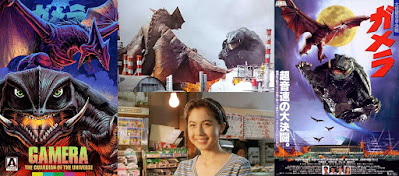
It had been 15 years since the last Gamera movie and a full three decades since his cinematic birth. Toho was releasing the final of the new Heisei era Godzilla films at the end of this year but now it was time for everyone’s favourite, jet propelled giant turtle to make a return, in a trilogy of Heisei era pictures beginning with Gamera - Guardian Of The Universe. It’s been hailed as a masterpiece by critics (it won a lot of awards) and, more importantly, it was a champ at the box office and its reputation is huge with most audience members... apart from the director and creator of the original Gamera films, who felt it lost a lot when it stopped focusing on young children as the target audience.

The film is a total reboot this time around. The Showa films never happened in this universe and nobody has even heard of Gamera, nor of Gyaos (also returning here) in this movie until an inscription embedded in a mysterious floating atoll, which houses Gamera within, is translated.

The plot of the film is that a whole bunch of 15 foot wing spanned Gyaos (so, initially much smaller than the original Gyaos from Gamera VS Gyaos, reviewed here) have awakened (or hatched) on a small island and eaten the 17 people who were there. Mayumi, played by Shinobu Nakayama, is an ornithologist and, since the Gyaos’ are initially believed to be giant birds, she is brought in by the government to research and then help capture or kill them. 

 Meanwhile, Yoshinaro (played by Tsuyoshi Ihara who you may remember from the remake of 13 Assassins, reviewed here, some years ago) is trying to find out why the drifting atoll was threatening his plutonium transport ship. He gives a comma shaped bead, one of many found on the atoll, to the teenage daughter of his employee, Asagi (played by Ayako Fujitani, the daughter of Steven Seagal, who plays this character in all the films in this trilogy). Gamera awakens and fulfills the prophecy from the monolith on the atoll as he goes to rid the world of Gyaos, mistaken at first as a destructive enemy force (because, you know, he accidentally knocks about a few buildings here and there) and therefore finding himself pursued by the army. However, the comma shaped bead has chosen Asagi, who is now spiritually bonded to Gamera and, when he receives a battle injury, she starts bleeding and getting beaten up too... although she can connect with him in her head and can use the spiritual closeness of her father Naoya (played by Akira Onodera) to help Gamera too.

Because Gamera is somewhat distracted by the army firing gazillions of missiles at him after he’s destroyed most of the Gyaos creatures, one Gyaos manages to eat enough to transform into a proper, much larger giant monster, more like the size of the original Gyaos in the Showa era films. So, after destroying as many of the Gyaos eggs as he can, Gamera has to face off against Gyaos one last time.

And, yeah, it’s pretty good. The acting all seems much more naturalistic compared to the wonderful Showa era movies and monsters have been updated for the times but, it’s all pretty much business as usual... it’s just had a lot more money thrown at it this time around. Well, I say the monsters are updated but they are still unmistakably Gamera and Gyaos. Gyaos is not licking everybody’s blood this time around though, as there is no reference to his legacy origin as being a ‘giant Dracula creature’ in the spirit of the ‘giant Frankenstein’ kaiju movies, alas. He does still retain his sonic beam and the initial ‘ramping up’ of the beam which creates a visual distortion field looks fantastic. Gamera looks as cute as ever and I’m happy to say the film makers have kept his distinctive, high pitched roar. Yes, he still sounds like Johnny Weismuller exhaling loudly on Helium gas, I’m glad to report.

And, yeah, it’s a fun romp with a lot of gravitas to the acting and some good model work. Although, I noticed a lot of the things which would have been done with easily perceptible models in the original movies, such as tanks and battleships, have been replaced by the real thing in this production (darn, I miss the silly models). It’s also quite spectacular and there are explosions galore with the only real weak effects appearing as matte lines in certain scenes at the end, where Gamera and Gyaos are locked together in combat and heading in and out of the Earth’s atmosphere.

The music is very different too, with composer Kow Otani giving this a much more darker and westernised sounding score (on a par perhaps with the kind of scoring found in the 1984 film The Return Of Godzilla). It works quite well but, I have to admit, I really missed the corny old Gamera song which was in a few of the 1960s and 70s productions. Still, we can’t have everything I suppose. At least Gamera got to keep his look and his roar and, you know, there isn’t a single ricochet sound on the entire foley, from what I could hear.

Yeah,  Gamera - Guardian Of The Universe is very enjoyable but I wouldn’t say it’s necessarily any better than the best of the Showa era films... it’s just a slightly modernised approach which happens to work really well and is hugely entertaining. I look forward to looking at the next two.