Biollante Night
Godzilla VS Biollante
aka Gojira vs. Biorante
Directed by Kazuki Ômori,
Kôji Hashimoto & Kenjirô Ohmori
Japan 1989
Toho/Criterion Collection
Blu Ray Zone B
I’d not seen Godzilla VS Biollante before this new Criterion Collection Blu Ray version of the film but, while I am certainly most grateful to finally get to see it, I do have a couple of criticisms of Criterion’s handling of it... which I’ll get back to later.
While this is mostly known as being the second entry in the Heisei wave of Godzilla films, after 1984’s The Return of Godzilla (aka Godzilla 1985), it’s technically actually the first, since the 1984 reboot was released during the Showa era. But it really doesn’t matter and lumping it all in gives a clearer delineation of how this second wave of films all fit together.
After some eerie music while the typography on screen tells us about the four official government warning signs of The Big G (which read in a similar vein to the three rules which make up UFO close encounters) accompanied by some more eerie music playing in the background, we are then treated to some credits which have what is presumably the denouement of the previous film playing out, as Godzilla is trapped in a volcano. After this, a scientist’s daughter is killed while he is experimenting with genetic cells taken from the monster.
Cut to five years later and his invention of an anti-nuclear weapon bacteria using said cells is at the violent centre of a conflict for control of the material, between the Japanese government, the clueless Americans and the evil people from the fictional land of Saradia (which I think is meant to be a pointed reference to Saudi Arabia). There’s a lot of convoluted plot and action here, leading to the reawakening of Godzilla from his volcano slumber but, while this is all going on, the scientist accidentally creates a new, giant plant monster called Biollante, by mixing the cells of Godzilla with those of a rose and his late daughter. All the expected shenanigans ensue as gigantic monster battles are fought.
And, it’s not the best of the Godzilla films (contrary to what a 2014 poll of the Japanese people said) but, after a very slow lead in, it’s not a bad one either. Although I would have to say that the giant monster battles between Godzilla, Biollante and a Thunderbirds-like submersible air craft called Super X2, which looks like just what International Rescue might have sent, are actually pretty dull. Lots of water splashing, reflected heat breaths, tentacle grabbing and tail wagging theatrics. But it’s just not on a par with some of the sillier (and therefore cooler) Godzilla films of the Showa era. Although, there is the welcome return of the maser cannons from those earlier films.
There are also some nice shot compositions including a cool moment where some big, building windows going back to one point perspective in the foreground of a shot are used to house the establishing moment of people arriving at the building. There are, however, also some not so great things about the movie.
For example, the score by Kôichi Sugiyama seems somewhat out of place in a Godzilla film. Sounding more like the kind of score Ron Goodwin might have written for a British war movie, for the most part. Great as a stand alone listen but, yeah, it really doesn’t help the movie any, for a lot of the time. Toe tapping but a bad support for the visual image. Which would explain why there’s also a lot of tracked in music from Akira Ifukube’s brilliant Godzilla scores included too, a fair bit of the time. And in comparison to the new stuff, this reappropriated stuff sounds magnificent. There’s a great moment in the tale where, after a fairly dull opening, I really started investing in the film and a good deal of that was due to the re-use of Ifukube. There’s a scene where two of the principal leads go and see a classroom of children who all have extra sensory perception (that’s ESP to you and me folks) at the Japanese Psyonics Centre (don’t ask) and they are busy drawing what they have all individually dreamed of the night before. In a wonderful moment foreshadowing the reawakening of Godzillla, when they are asked what they have drawn, the kids all hold up very differently styled illustrations of The Big G and, as they do so, Ifukube’s wonderful Godzilla march swells up in, to overpower the mix and, as it did, the film finally had its hooks in me.
I’ve got two more complaints to level at Criterion. Various people speak English a lot in the early parts of the film but, they are clearly not speaking their first language because, honestly, the accents and mutilation of the language is so bad I could only understand about every eighth word. Which is unfortunate because, in these sequences, the subtitles are in Japanese rather than English like the rest of the movie. So, yeah, I had no idea what was going on for a lot of the time during those scenes. I would have thought Criterion would have been all over that.
And the other thing, which is problematic to me as a fan, is the existence of an individual release of the film from Criterion in the first place. Sometime during the pandemic (or was it just before?), Criterion put out a beautiful book/box set of the entire run of Showa era Godzillla films and very welcome it was too. We have all been patiently waiting for them to release the other two big waves of Godzilla films in similar presentations. Why, then, are we getting this little individual release? The fan base is obviously there and chomping at the bit for a proper release of this stuff so... this really is annoying you guys! It almost feels like a drug dealer giving his customers a taste of the product before waiting to get them hooked properly later on. These other two Godzilla waves need to happening soon... is that not obvious to the marketing people at the label?
Anyway, that’s me done on the new Criterion release of Godzilla VS Biollante. If you are a fan of these kinds of movies then you will probably enjoy this one. If not then, well, probably stay away is my best guess.
Monday, 12 May 2025
Godzilla VS Biollante
Monday, 15 July 2024
Monarch - Legacy Of Monsters
Portal Poppers
Monarch - Legacy Of Monsters
10 Episodes
Airdate: November 2023 - January 2024
Toho/Apple
Warning: A legacy of spoilers.
Well, I have to admit I wasn’t really expecting much from Monarch - Legacy Of Monsters but I certainly got into this and am now looking forward to a second series. You’ll perhaps remember that Monarch is the mysterious organisation, mostly friendly, who monitors and tries to predict and limit damage done by the so called ‘Titans’ in the US branded Godzilla/King Kong movies... aka The Monsterverse.
Now, to just lower your expectations a little, yes, you do see them make cameos in the series, along with a few other monsters but, the actual monster scenes in these episodes are pretty fleeting. You get maybe one sighting (sometimes two) an episode for a minute or two but, that’s okay, because the story is so interestingly written and pretty brilliantly performed that you don’t need the monsters to make for an engaging show. Maybe they could have shortened the title of the show by three words though, so as not to get too many people’s expectations up.
Okay, so this is one of those shows that flip flops back in time so you have the three founding characters who started Monarch in the 1940s/50s played by the absolutely brilliant Mari Yamamoto as Keiko, Anders Holm as Bill Randa (playing the character that John Goodman played in Kong - Skull Island but as he was in the 1950s... and, yes, Goodman also turns up at the opening of the first episode) and last but by no means least, Wyatt Russell, son of actor Kurt Russell, playing a character called Lee Shaw... also played by his father in the modern sections of the show.
But you also have the modern day story with a sister played by Ana Sawai and a brother played by Ren Watabe, who find out about each other in different corners of the globe after their dad (who is the son of Keiko and Bill) is missing, presumed dead. And then they find out that he’s been living two lives of two secret and simultaneous marriages but, also, was once working for Monarch. And there are a whole bunch of other characters who are equally important but if I start listing them all this would be one long blog entry.
What I will say is that it’s absolutely brilliant and intriguing and is set mostly in the 1950s and 2015 (after the first Monsterverse Godzilla movie) but also in the 1960s and 1980s for little snippets. And, if you’re like me and doing the maths, yes, that should mean that older Russell, Kurt, should be in his nineties by the time of the show’s setting if younger Russell, Wyatt, is playing the same character in the early 1950s. And you’d be right but, here’s the thing... that ageing difference is also built into the plot and teased very early on in the series until, in the final two episodes, everything begins to make a bit more sense. All I’m saying is it has something to do with those portals into other worlds as they were in the time of these films... the 2021 movie Godzilla VS Kong (reviewed by me here) brings more clarification to the package, if you think about it... but that’s another story.
And while there’s not an awful lot of expensive monster mayhem in the show... it’s definitely a fast paced and very globe hopping experience, with more than enough questions, intrigue and drama to keep you on your toes. The odd appearance by a monster is just icing on the cake a lot of the time... plus, of course, the main reason for having an organisation like Monarch in the first place.
The music is kinda okay too although, I have to say, I would have liked to have heard the old Akira Ifukube Godzilla themes at least once in this... it’s a shame they didn’t put in an appearance, for sure. Still, I guess you can’t have everything and, by the time the last episode of season one ends, the present day has shifted to 2017. So I’m assuming, if this runs for another few seasons, it might even catch right up to the year of broadcast.
I hope we get these and, without getting any spoilers into the mix, if one of the above actors is to return (and I hope he does) then it makes sense that some years go by for some of the other characters if they embark on a rescue mission, of sorts. Anyway, I’m not going to say too much more about this one other than I enjoyed Monarch - Legacy Of Monsters way more than I thought I would and I’m glad it’s been renewed for another series at some point.
Saturday, 30 March 2024
Godzilla X Kong - The New Empire
Peanuts Gal For
Monkey Magic
Godzilla X Kong -
The New Empire
Directed by Adam Wingard
USA 2024
Warner Brothers
UK Theatrical Cut
Warning: Mild spoilers.
Last week I went to the cinema to see Ghostbusters - Frozen Empire (reviewed here) in which a centuries long imprisoned creature is released and aims to turn the Earth into a new ice age. This week I saw Godzilla X Kong - The New Empire which, apart from having a superfluous X that makes it the most ridiculous and childish title for a Godzilla movie ever, deals with a centuries long imprisoned creature who is released back into the mix with his followers and big ice creature, with the intent of conquering the Earth by turning it into a new ice age. I bet the makers of this one were pretty miffed that the new Ghostbusters had a better title that they could have used themselves.
This one is, by my counts, the fifth in the sequence of the US Monsterverse franchise, comprising Godzilla (reviewed here), Kong - Skull Island (reviewed here), Godzilla King Of The Monsters (reviewed here), Godzilla VS Kong (reviewed here) and now this one. Not to mention the relatively recent Monarch TV series, which I haven’t got around to watching as yet. It carries over three characters from the previous movie, as played by the great Rebecca Hall reprising the role of the main scientist, the extremely cool Kaylee Hottle as her deaf/mute adopted Skull Island daughter and Brian Tyree Henry, providing comic relief as the vlogger who was helping out Millie Bobby Brown in the last movie.
And, not only is this installment in the franchise way better in most respects than Godzilla VS Kong, it’s also a very fun watch and I really rather enjoyed it. Now, given the critical and commercial success of the Academy Award winning Japanese movie Godzilla Minus One (reviewed here ) a few months ago, I was fully expecting to be able to say that the aforementioned movie was way better than this one. And... yeah okay, I am saying that... no comparison. I’d take a film like that one over this any day of the week. However, you have to remember that you really can’t cant compare the two. Godzilla Minus One is very much a serious film similar in tone to the original 1954 Gojira movie (reviewed here) and uses Godzilla as a surrogate for the post survivor trauma of the ‘failed’ kamikaze pilot who is the film’s main protagonist. It’s carrying a lot of weight and it does it beautifully.
In contrast to that, Godzilla X Kong - The New Empire is very much in the style of the fun, mid 1960s to mid 1970s Toho Godzilla ‘monster romp’ movies... and as a lover of both kinds, I am quite happy with what the US filmmakers are able to achieve here, to be honest. It’s a different flavour of Godzilla but they are doing a much better job of that kind of brief here.
Now, the movie almost totally takes place in the Hollow Earth world discovered in the last film, asides from a few sequences where Godzilla and Kong manage to wreck part of Egypt and Brazil between them. And also one memorable moment where the movie’s other main protagonist, a monster veterinarian played by Dan Stevens, extracts Kong’s infected tooth with his helicopter and gives him a new, super duper tooth. Also, after a sequence where Kong suffers from frostbite in his right arm, due to reasons I won’t disclose, he cures it and gives him a new armoured glove so he can punch things better. So yay!
Also, Kaylee Hottle’s character ends up fulfilling the same role as The Peanuts did in the original Mothra films from the 1960s. She is the new human envoy to Mothra and she wakes her up to help out when Kong is trying to lure Godzilla into lending a hand in tackling their bigger problem. It’s nice stuff but, alas, she doesn’t sing the famous Mothra song... which would have been a nice touch.
And was that a shop sign depicting Gamera I saw for a second before Godzilla smashed through it? I’m pretty sure that’s what I saw... can anyone else confirm in the comments?
And it’s a film filled with good action, much better acting than you would expect and a fun storyline. My only real criticism is that the score by Antonio Di Lorio and Tom Holkenborg is bereft of any of the iconic Godzilla themes from the Toho series and, just fails miserably on that level. Every time you are expecting there to be a big Ifukube moment, the score does something which seems, I dunno, like a melody falling just short of the original to evade copyright payments. Which is a shame because, even the great Godzilla Minus One, which had a far superior score to this one, recognised the value in popping in Ifukube’s melodies into certain scenes. And to add insult to injury, the score to this one seems to be unavailable on a proper CD (which is a first for the films, it would be the only live action Godzilla theatrical release without CD representation to date). Shame on Watertower Records for not releasing it in the only physical format that real music lovers want. I hate this backwards decade, ignoring the essential physical media releases which should accompany these films.
Apart from the ‘knock off’ sounding scoring though, Godzilla X Kong - The New Empire was way more entertaining than I was expecting it to be and, if you liked Kong VS Godzilla (I kinda didn’t think it was all that), then you should definitely love this one. Don’t expect to be seeing the same kind of story substance present in Godzilla Minus One though... two very different kinds of films.
Tuesday, 12 December 2023
Godzilla Minus One
Gojira Warfare
Godzilla Minus One
Directed by Takashi Yamazaki
Japan 2023
Toho
UK Cinema Print
You know, I’m at that age where I don’t go out to the cinema on week nights anymore. I get up at 5am for work the next day so I tend to restrict my cinema time to the weekends if possible. But then Cineworld had an Unlimited cardholders preview of the new Japanese Godzilla film, just in time for next year’s 70th Anniversary of the character and, well, regular readers will know this would not be something I could resist. So I braved it out last night to the preview and... wow.
I’m not a fan of the usual hyperbole that enthusiastic audience members use to describe new films in a franchise just because it’s new and shiny. So please don’t take it lightly when I say that Godzilla Minus One is, probably the greatest Godzilla movie ever made (to date). Taking its cues from the original 1954 Ishiro Honda classic movie, this one... in my humble estimation... actually manages to pay homage to that version while somehow surpassing it.
Now, it is a reboot, so to speak and in some ways I’m sure some people will see this as just a remake from the original material but, no, it’s not. It shares some similar traits (quite deliberately and rightly so) but it is its own beast of a movie and it’s actually set just after the Second World War, as seen from the Japanese perspective. Starting towards the end of the war, the main protagonist Koichi (played by Ryunosuke Kamiki) is a kamikazi pilot who can’t see the sense in carrying out his mission now the outcome of the war is obvious. So he lands it on the fictional Odo Island (which is an island featured in the original Godzilla movie) and the mechanic team there try to figure out what’s wrong with his plane when, actually in many ways, it’s the pilot who needs fixing.
Then the creature talked about by the locals, Godzilla, shows up and leaves all but Koichi and one mechanic dead, in a truly frightening sequence. The remaining mechanic blames Koichi for not using his aircraft guns against the beast in the hopes of saving the lives of those colleagues who were either stomped, thrown or eaten and this continues the strand of emotion running through the whole film... guilt. Especially survivor’s guilt... of the chaos of war and the new terror of Godzilla.
When Koichi returns to a war flattened Tokyo, finding both his parents dead, he befriends a woman (played by Minami Hamabe) who has ‘stolen’ a baby and is being pursued as a thief when she tries to steal it food to keep it alive. The baby is not stolen... it’s left in her care by a dying parent and Koichi’s life becomes inextricably entwined with her and the child... not to mention the presence of Godzilla who, after the Bikini Atoll test bombs, is irradiated and changed, growing larger and gaining the ability to emit a nuclear death ray from it’s mouth. And that’s mostly what I’ll say about the plot but it’s a film which is all about personal redemption and ultimately doing the right thing in the face of lethal and overwhelming odds.
Like the original film, so many decades ago, the director wisely sticks to keeping Godzilla’s screen presence to a minimum. The creature only gets about 11 minutes of screen time in a 125 minute film. Instead, the focus is on the human drama at the heart of the story and also creating many characters that the audience can really get close to. So we have a director who understands that by keeping The Big G’s appearances to a minimum, the scenes of spectacular devastation when he does put in an appearance every so often, become intensely magnified in contrast to the heartwarming, grittiness of the drama of an American occupied, post-war Japan.
And there are some wonderful nods to the franchise too, especially the original film. For instance, there’s a device which appears to me to be a version of the famous Oxygen Destroyer from the first movie and in one sequence of gripping rampage, the iconic shot where Godzilla starts chewing on the train carriages is replicated but given a new spin too, as one of the main protagonists is aboard the train and finds a way to narrowly survive that experience.
And it’s just brilliant. The film has a lot of heart and the human drama and the story of the various characters is, as I said, the main focus here, punctuated with appearances of the title monster when appropriate. Godzilla is not a character you’ll be rooting for here either. Like in the very first couple of movies, he’s very much the villain of the piece and you will want to see him stopped by whatever means possible.
And the musical score by Naoli Satô is brilliant too. I am hoping this gets a CD release because it’s phenomenal, not just in the nods back to the original franchise... although speaking of that...
By about three quarters of an hour into the movie, I was assuming we wouldn’t be hearing any of original Godzilla composer Akira Ifukube’s music interwoven into the film which, I was almost disappointed by but, honestly, the film was working so well without it, I really didn’t mind. Except, no it’s here, they just make you wait for it with some cunningly spotted sequences, bringing in the first of Ifukube’s themes for a big Godzilla moment and then, later, bringing in the full Godzilla march during a climactic action sequence. Talking of which... the leitmotif for the march seems almost twisted around this time. It’s not so much scoring the majesty of the creature... more it’s scoring the rag tag band of humans who have come out to fight Godzilla and it becomes their heroic fanfare, of a sorts. But it works very well in this capacity, I must say.
One last thing... given the trials and struggles of the lead characters leading up to the end of the film, I was surprised that the finish of the story was quite so optimistic. Two things happened which, well I won’t say I didn’t see them coming, they were always a possibility and certainly didn’t surprise me... but they did almost disappoint me in their fall back on Hollywood style optimism and hope for the future. That being said, I don’t begrudge the audience the almost impossibly happy ending the film has and, yeah, it’s not really a complaint either.
Bottom line is, I absolutely loved Godzilla Minus One and, as I said, I think it’s the best one yet. I hope this gets a sequel set in the same period following some of the same characters, for sure. Go and see this one at a cinema, is my advice. Kaiju Eiga fans will not want to miss this one on a big screen.
Thursday, 17 March 2022
Gamera The Brave
Sod ‘Em And Gamera
Gamera The Brave
aka
Chiisaki yûsha-tachi: Gamera
Japan 2005
Directed by Ryuta Tasaki
Arrow Blu Ray Zone B
Well, the final film in the Arrow Blu Ray boxed set, Gamera The Complete Collection, certainly didn’t disappoint. Gamera The Brave is really something. A bang up to date continuation (rather than reboot) of the original Gamera movies (kinda) which returns to have a focus on children and reaffirming their connection to everyone’s favourite giant flying turtle, affectionately named Toto by the young male lead of the movie, while managing to make a monster movie which straddles a line between pleasing fans of the original, Showa era movies and keeping modern cinema audiences happy. It also tugs heavily on the heart strings along the way. I only had one major problem with this movie... and I’ll get to that a bit later.
The film starts off with an opening credits sequence that right away signals to the audience that it is ignoring the three Gamera films of the 1990s as well as passing on the 1980 Gamera Super Monster movie. Instead, this takes us back in time to 1973 where a city is burning as, two years after the last of the Showa era films, Gamera is in a pitched battle with Gyaos (who he first fought in 1967 and who was brought back in large numbers for the 1990s trilogy). And then, as a young boy watches in the turmoil and confusion, his hero Gamera self destructs himself in order to save humanity and rid the world of Gyaos. Cut to 2006, when the boy is now older (played by Kanji Tsuda) and, with his young son Toru (played by Ryô Tomioka).... who is the main human protagonist of the film... they go to put flowers on Toru’s mother’s grave and say a prayer, having lost her the year before to a car accident.
On the way home, Toru sees something ‘glinting’ on a nearby island. We then get a load of character building as we find out how Toru and his dad live together and how their relationship is, his camaraderie with the girl next door (who is about to have life threatening heart surgery)... and his various other friends. Then, at some point, he goes to investigate the glinting thing on the island and finds a special jewel with an egg on it. The egg hatches and a little baby turtle comes out and he takes him back home, hiding him in his room from his father. And so, of course, the little turtle called Toto turns out to be a baby Gamera. And we get all the usual comedy shenanigans and cute moments various aliens or ‘monsters living’ with young kids movies, like ET - The Extra Terrestrial, go through and, I have to say, this one is my favourite of those kinds of movies, as the teeny, tiny, baby turtle suddenly levitates at the most inappropriate times or reacts to a fallen knife with a burst of fire from its mouth.
Meanwhile, after the Giant Monster Council (active since 1973) is disbanded by the government, a fishing boat incident (very much reminding us of the real life fishing boat mishap which inspired Gamera’s main box office rival, Godzilla), sees a new monster surface, called Zedus. Meanwhile, little ‘Toto’ is growing at an alarming rate and initially sees Zedus off. However, when the government capture Toto and take him to a place where they are trying to make him bigger to see off future attacks, Zedus returns and attacks the city and complex where Gamera is being held captive. Meanwhile, the neighbour girl in hospital has possession of the red jewel (as a good luck charm) which Gamera needs to use, to grow again and defeat Zedus.
And it’s a real humdinger of a movie and certainly, as they say in many reviews about too many things but I’ll use the cliché anyway... an emotional rollercoaster ride. Everything about this one just works and I’m amazed this was the last Gamera movie to date. And with the protective father figure remembering his upset at the demise of the original Gamera in 1973 (as proposed by this movie), it feels almost like a passing the torch movie from one generation of kaiju watchers to the next, with the older character deciding to trust his son and not misplace his loyalties.
There’s an absolutely wonderful sequence near the end of the film where the city is in chaos, Gamera is losing against Zedus and everything looks like it’s going to pot. Toru has figured out that the jewel he found Gamera’s egg on, which is currently with his recovering neighbour somewhere in the city, in what looks like a shopping plaza where the hospital has been evacuated to, is what Gamera needs to survive and turn the tide of the battle. But his hope is gone... how does he find it. Well, the recovering gal is aware of this too and she trusts the jewel in the care of a very young girl to get it to ‘Toto’. The girl starts running before a policeman turns her back but the jewel is passed from one young kid to another, as various pre-teen strangers take it in turns, running it like an Olympic torch relay against the tide of fleeing humans, to try to get it to its destination, in a beautifully moving scene (I must be getting really old because I’m tearing up just writing about it).
Eventually the jewel gets back into Toru’s hands, who manages to make his way up a partially demolished skyscraper where Gamera is half lodged in the building, many storey’s up. He throws the jewel into Gamera’s mouth as Zedus is pulling at our favourite and, in this movie, very cute looking turtle and Gamera regains his strength and his earlier flying powers, finally demonstrating the jets and spinning shell which was a big part of his DNA in all the original films.
My one disappointment is that, as cute looking as he is, Gamera’s distinctive sounding, high pitched roar has been replaced in this by something much more bearish and monster-like, which is a shame. Although, I have to say, there’s a quick cut to a ‘running crowds’ scene near the end of the movie and if you listen to the sound design closely, the sound of the people screaming has definitely been reshaped to closely resemble the original Gamera vocal signature, in that one sequence. Too bad they never kept it for the title character himself.
And that’s me done on the Gamera films... until some bright spark decides it’s time to make another one (part of me is secretly hoping, if the US Monsterverse movies continue in the wake of Godzilla VS Kong (reviewed here), that Gamera will be allowed to cross over into that series somehow... if the rights holders could pull it off. This has got to be one of my favourite, most loved boxed editions from Arrow. It’s sad that it’s already out of print but it has been reissued as two separate sets, which you can get for a very good deal on their website when they have a sale. For some bizarre reason, August Ragone, who provides a newly filmed introduction for all the other Gamera movies in this set, doesn’t have an intro for this last movie... I’m not sure why because I would have loved to hear his thoughts on it. Either way though, this is a great set and Gamera The Brave is easily one of the crown jewels of the selection. A fitting swan song for a great kaiju character.
Monday, 21 February 2022
Gamera 3 - Revenge Of Iris
When Iris Eyes
Are Smiling
Gamera 3 - Revenge Of Iris
aka Jashin kakusei
Japan 1999
Directed by Shûsuke Kaneko
Daiei/Toho Arrow Films
Blu Ray Zone B
Gamera 3 - Revenge Of Iris is the third and final part of the rebooted Gamera trilogy from the 1990s. Three of the regular characters return, with Shinobu Nakayama reprising the role she had in the first chapter, Yukijirô Hotaru as the comedy relief (former police inspector turned brewery worker from the previous two films) and, reprising her own role for a third time for... roughly the final third of the picture... is Steven Seagal’s daughter, Ayako Fujitani.
Fujitani’s character had her psychic bond with Gamera shattered in the previous movie but she’s kind of advising on this one because a new protagonist/antagonist played by Ai Maeda has a psychic link with the giant monster threat in this movie, who she names Iris after her cat. The cat and both her parents were killed when Gamera accidentally stepped on her house in the first movie, something we are told in a black and white footage continuation of the opening credits. Following on from a wonderful pre-credits sequence where a submarine style vessel finds loads of different Gamera skeletons on the ocean floor, those opening credits use scenes from Gamera - Guardian Of The Universe in monochrome and serves two purposes. One, it reminds audiences of Shinobu Nakayama’s character and two, it also reminds us of the multiple Gyaos monsters who are also in this film, used by the writers to a different end.
The first purpose of the Gyaos returning is so they can have a fight with Gamera early on in the picture. This is kind of needed because, well, Gamera is barely in the film until the last half an hour. The other reason is it gives a continued threat to mankind, that Gamera can go on fighting after the final credits have rolled. The story mostly deals with the creature called Iris, who is an imprisoned entity and old guardian of the south of Japan. A family have to keep it free from re-hatching and growing from generation to generation but, alas, the new Gamera hating character makes sure it hatches and then bonds with it to fight Gamera, who she hates.
And that’s about all I’m saying about the plot other than, yeah, this really does seem like a film of two halves. On the one hand we have a build up story for the first hour which is among the best in the series of Gamera films, including the majority of the Showa era. I was really enjoying it and was looking forward to seeing Gamera and Iris square of in the inevitable final fight. And it’s at this point that my problems with the movie began.
Yes, the special effects look great and somewhat spectacular but, honestly, what’s the point of all that spectacle if you can’t follow the action. The monster fight scenes in this were confusing me no end. I had a lot of trouble, due to the editing and the way it was filmed, trying to figure out just what was going on. To the point that, I was waiting for Iris to make another pass at Gamera before I realised that Gamera had already killed the beast and I hadn’t even noticed it. Which is kinda bad, right?
And it’s such a shame because the story is great and the performers are all so brilliant in this. Even the score by Kow Otani, which occasionally feels like something John Barry might have done for a mid to late 1970s Bond movie, sounds pretty great. The kaiju battles, though, are really disappointing and I had a hard time working up any enthusiasm as the ending of the movie approached (way before I expected it).
One nice moment occurs near the start of the film when half a small village community has been wiped out. A lady with a rake comes out of her hut and bashes up a Gyaos body hard. Her clothes, attitude and rake all reminded me of a similar scene in Kurosawa’s Seven Samurai, when the ancient lady villager takes it upon herself to kill the captured bandit. I don’t know if this scene here was a direct homage to the 1950s film but, it would be nice if it were.
It’s a shame that a fourth film to this particular era of movies was not put into production because, while Gamera destroys his foe, he suddenly has a gazillion Gyaos coming after him and, well, we are left on a kind of cliffhanger. Which is a shame but, what can you do? All in all, despite my muddled feelings from the monster fights, Gamera 3 - Revenge Of Iris is a pretty good take on the giant turtle, who keeps his trademark roar in this one, although, once again, he looks a lot less cute and more meaner than his Showa era incarnations. Definitely a good one to see if you’re a fan of the series but no good as a jumping on point, as it references the previous two films quite a lot.
Monday, 7 February 2022
Gamera 2 - Attack Of Legion
Shell Shocked
Gamera 2 - Attack Of Legion
aka Gamera 2 - Region shurai
Japan 1996
Directed by Shûsuke Kaneko
Daiei/Toho Arrow Films Blu Ray Zone B
Okay, Gamera 2 - Attack Of Legion is the second of the 1990s reboot series, again as featured in Arrow’s mammoth Gamera - The Complete Collection boxed edition (and in one of the two, smaller reissues of that collection now, I believe). And, yes, if you’re wondering why the monster aliens in this film are called Legion, it is that exact biblical reference that seems to get used as a crutch for evil in many movies.
And this is a real legion of foes as they are basically flying crab/grasshopper looking aliens who are a hive mind, controlled by a bigger soldier version who is the guardian of a giant seed pod which these specific beasties are trying to launch from the Earth into space, to make more of their kind. Which will also wipe out humanity, obviously. The military prove useless against these things and so, once again, everyone’s favourite, giant sized flying turtle, Gamera, steps up to the plate, so to speak, to three times do battle with these creatures.
Now I don’t pretend to understand all the monster science that gets bandied about in the film, the aliens mania for collecting glass and silicon is all explained along with their obsession with building hive pods in major cities but it all just seems like window dressing to me and I especially didn’t understand Gamera’s rebirth after the aliens pretty much kill him and, nor did I understand the golden space rays which allowed him to open up his shell and deliver his death stroke at the end.
That being said, the film is nicely paced and structured for the main human leads to build up the weight of the plot and the director more than builds up the resourcefulness and lethal capabilities of the aliens. It’s almost a third of the way through the running time before Gamera even turns up. Included in the humans, Steven Seagal’s daughter, Ayako Fujitani, returns as the unsolicited ‘Gamera whisperer’ from the last movie, in what amounts to an extended cameo of a support role where she is established and used for a few important scenes although, as I said, I totally didn’t understand the power of the vigil she kind of heads up, which leads to the re-animation of the once defeated Gamera.
Gamera himself is much redesigned from his last appearance. He no longer looks like the cute defender of Earth and looks much more like a bestial monster. I felt less empathy with him this time around for sure. Also, the first few times we hear his roar it seems to have been altered quite a lot, sounding much more like a cross between his original voice and something more Godzilla-like, although he does seem to re-find his classic voice before the end of the film. Ditto with Kow Otani’s score, which is not as fun as the Showa era movies but certainly fits the film well with a more modern sensibility... however, there’s one sub-theme which occurs more than once in the last third of the movie which does, I feel, bear more than just a passing similarity to one of Akira Ifukube’s Godzilla themes. I guess modern audience’s expectations dictated that kind of approach to the music as much as anything else.
The action footage is fine though, with some spectacular lightning style effects as the big Legion soldier generates power from between its mandibles and fires at Gamera. The editing never threatens to lose the audience or leave them behind as to what is going on during the action and, also, Kaneko does a couple of those striking, sideways wipes in the non-action scenes which work really well. There are also some fairly grim or, at least, substantially darker moments in the film... such as when Gamera’s blood splashes all over a skyscraper from which of the human protagonists are watching the kaiju battle and then slowly drips down the windows.
All in all, although I don’t have as much to say about this entry into the franchise (yes, it’s a very short review, I apologise), Gamera 2 - Attack Of Legion is a fine installment in the series although, I have to say, still not as engaging as many of the early Showa era films but, nevertheless, a huge box office success in Japan on the year of its release. A solid monster effort but, as I said, lacking the fun and cuteness of the earlier films, perhaps.
Monday, 24 January 2022
Gamera - Guardian Of The Universe
Gyaos & Dolls
Gamera - Guardian Of The Universe
aka Gamera Giant Mid-Air Showdown
aka Gamera daikaijû kuchu kessen
Japan 1995
Directed by Shûsuke Kaneko
Daiei/Toho Arrow Films
Blu Ray Zone B
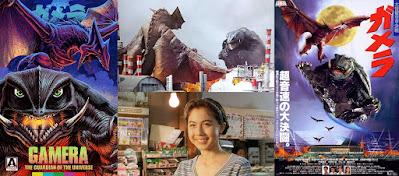
It had been 15 years since the last Gamera movie and a full three decades since his cinematic birth. Toho was releasing the final of the new Heisei era Godzilla films at the end of this year but now it was time for everyone’s favourite, jet propelled giant turtle to make a return, in a trilogy of Heisei era pictures beginning with Gamera - Guardian Of The Universe. It’s been hailed as a masterpiece by critics (it won a lot of awards) and, more importantly, it was a champ at the box office and its reputation is huge with most audience members... apart from the director and creator of the original Gamera films, who felt it lost a lot when it stopped focusing on young children as the target audience.
The film is a total reboot this time around. The Showa films never happened in this universe and nobody has even heard of Gamera, nor of Gyaos (also returning here) in this movie until an inscription embedded in a mysterious floating atoll, which houses Gamera within, is translated.
The plot of the film is that a whole bunch of 15 foot wing spanned Gyaos (so, initially much smaller than the original Gyaos from Gamera VS Gyaos, reviewed here) have awakened (or hatched) on a small island and eaten the 17 people who were there. Mayumi, played by Shinobu Nakayama, is an ornithologist and, since the Gyaos’ are initially believed to be giant birds, she is brought in by the government to research and then help capture or kill them.
Meanwhile, Yoshinaro (played by Tsuyoshi Ihara who you may remember from the remake of 13 Assassins, reviewed here, some years ago) is trying to find out why the drifting atoll was threatening his plutonium transport ship. He gives a comma shaped bead, one of many found on the atoll, to the teenage daughter of his employee, Asagi (played by Ayako Fujitani, the daughter of Steven Seagal, who plays this character in all the films in this trilogy). Gamera awakens and fulfills the prophecy from the monolith on the atoll as he goes to rid the world of Gyaos, mistaken at first as a destructive enemy force (because, you know, he accidentally knocks about a few buildings here and there) and therefore finding himself pursued by the army. However, the comma shaped bead has chosen Asagi, who is now spiritually bonded to Gamera and, when he receives a battle injury, she starts bleeding and getting beaten up too... although she can connect with him in her head and can use the spiritual closeness of her father Naoya (played by Akira Onodera) to help Gamera too.
Because Gamera is somewhat distracted by the army firing gazillions of missiles at him after he’s destroyed most of the Gyaos creatures, one Gyaos manages to eat enough to transform into a proper, much larger giant monster, more like the size of the original Gyaos in the Showa era films. So, after destroying as many of the Gyaos eggs as he can, Gamera has to face off against Gyaos one last time.
And, yeah, it’s pretty good. The acting all seems much more naturalistic compared to the wonderful Showa era movies and monsters have been updated for the times but, it’s all pretty much business as usual... it’s just had a lot more money thrown at it this time around. Well, I say the monsters are updated but they are still unmistakably Gamera and Gyaos. Gyaos is not licking everybody’s blood this time around though, as there is no reference to his legacy origin as being a ‘giant Dracula creature’ in the spirit of the ‘giant Frankenstein’ kaiju movies, alas. He does still retain his sonic beam and the initial ‘ramping up’ of the beam which creates a visual distortion field looks fantastic. Gamera looks as cute as ever and I’m happy to say the film makers have kept his distinctive, high pitched roar. Yes, he still sounds like Johnny Weismuller exhaling loudly on Helium gas, I’m glad to report.
And, yeah, it’s a fun romp with a lot of gravitas to the acting and some good model work. Although, I noticed a lot of the things which would have been done with easily perceptible models in the original movies, such as tanks and battleships, have been replaced by the real thing in this production (darn, I miss the silly models). It’s also quite spectacular and there are explosions galore with the only real weak effects appearing as matte lines in certain scenes at the end, where Gamera and Gyaos are locked together in combat and heading in and out of the Earth’s atmosphere.
The music is very different too, with composer Kow Otani giving this a much more darker and westernised sounding score (on a par perhaps with the kind of scoring found in the 1984 film The Return Of Godzilla). It works quite well but, I have to admit, I really missed the corny old Gamera song which was in a few of the 1960s and 70s productions. Still, we can’t have everything I suppose. At least Gamera got to keep his look and his roar and, you know, there isn’t a single ricochet sound on the entire foley, from what I could hear.
Yeah, Gamera - Guardian Of The Universe is very enjoyable but I wouldn’t say it’s necessarily any better than the best of the Showa era films... it’s just a slightly modernised approach which happens to work really well and is hugely entertaining. I look forward to looking at the next two.
Wednesday, 12 January 2022
Gamera Super Monster
Turtle Recall
Gamera Super Monster
aka Uchu kaijû Gamera
Japan 1980
Directed by Noriaki Yuasa
and Shigeo Tanaka
Daiei/Arrow Films Blu Ray Zone B
Warning: Spoilers but... you’re probably
not going to care either way with this movie.
Gamera Super Monster is considered both the last of the Showa era Gamera films and, also, the last kaiju movie of the Showa era. Out of the films I’ve watched so far in Arrow’s truly superb Gamera - The Complete Collection Blu Ray box (which is now in its second edition but split down into two, smaller boxes), both this one and the last one have been quite disappointing, following on from a load of truly bizarre and wonderfully surreal monster movies.
Now, 1980 is a bit late for people to be talking of it in terms of the Showa era, as far as I’m concerned but, I can certainly understand why, now that I’ve finally seen this. The most disappointing thing about this truly low budget, attempted revival of everyone’s favourite giant-sized flying turtle, which was not a success and failed to save the new, resurrected and bought out version of Daiei Studios (which filed for bankruptcy shortly after), is the fact that every single monster fight scene in the film is culled from previous Gamera movies! There are very few original kaiju themed special effects shots in this film apart from a couple of new Gamera fly-bys. So you will see him battle almost all of the monsters from the previous films, as spliced in footage highlights making up the total of the kaiju confrontations in this movie and, it’s only the supporting alien and human content which is original to this version.
Oh, wait. Did I say original. Sorry, I don’t know what I was thinking because the remaining, newly shot content is far from original.
So the film starts off with a definition of what a galaxy is and tells us that the ‘Zanon’ spaceship has conquered various planets... showing us a few static illustrations of space battles since the producers really didn’t have the budget to shoot those kinds of scenes at this point. From here on it basically parodies a bunch of American movies which were big in Japan from the last five or so years. Remember, this film is nine years after the previous entry and was released in 1980. So what do we have here?
Well, following on from the two illustrations of space combat, we have a starship which, apart from a couple of oversized fins, looks exactly like the Imperial Star Destroyers from the original Star Wars. So much so that the first moving shot of the film is an almost exact copy of the first shot of the 1977 original, as we watch the impossibly huge (but now quite quick) belly of the ship pass above the camera in space. Seriously, it’s almost the same shot dropped in.
The we meet the three adult stars, Kilara (played by Mach Fumiake), Marsha (played by Yaeko Kojima) and Mitan (played by Yoko Komatsu). All these gals have to do is go through a silly choreography of arm and leg movements and they shed their Earth bound alter egos, transforming into their superhero, space alien selves... with cloaks and costumes to match as they fly around in the sky like Superman. However, because of the big invading starship, they have to be careful about revealing their super powered selves to other people. Then we meet their friend, the child hero of the movie Keichi (played by Koichi Maeda) and also the evil alien woman Giruge (played by Keiko Kudo). Giruge is here to oversee the releasing of the monsters in the evil alien’s plan to invade and destroy the Earth by unleashing stock footage Gamera fights from previous movies at us! Shenanigans ensue including a hazy, bizarre reappearance of Gamera as Earth’s protector in somewhat muddy and questionable circumstances.
After that, the film becomes a rush of scattered ideas as the various players do the bidding of their script writers and rush around to various locations in an attempt to explain why the various kaiju battles are taking place all around the globe, with mismatching Gamera suits and a complete disregard for cars and fashions from the 1960s and early 1970s juxtaposed with new footage of 1980s environments.
Lots of ideas are shoe horned in here including a bizarre scene where the fins of one of the monsters are swimming around the ocean as the cast suddenly seem to be in a Jaws movie for a minute or two... very strange. It’s like the writers were trying to throw everything from a mid to late 1970s American blockbuster into the melting pot to see if some regurgitated idea might capture the attention of the audience. I mean, the alien gals are seen controlling their futuristic technology with musical notes whenever Keichi is around and having a close encounter with them, so to speak.
There are also some real bizarre moments when various famous Japanese anime shots are inserted, sometimes with Gamera superimposed over them. I recognised Space Battleship Yamato when Gamera was bizarrely in front of the cartoon image but another one is from something I don’t know of but which was apparently well known in Japan. About the only interesting reference is when a poster board of a monster, which is obviously supposed to be advertising a Godzilla movie (referred to here as Dojira, although not to be confused with the real Dojira from Ultraman, I guess), is toppled in Gamera’s wake as a kind of poke in the eye to Toho (who would make a big comeback with the first in their second wave of Godzilla films only four years later).
Also, while the music is reminiscent of both John Barry and Barry Grey in a few places, it’s really not very good (and the new Gamera Song is really awful) and I would say inappropriate to the film, not only not functioning to support the scenes it’s underscoring but actually dampening the potency of most of the scenes. It’s amazing how the exciting and humourously grotesque, surrealistic monster fights from previous, much better Gamera films can seem real drudgery when they’re rescored with this new stuff. It’s a bit of a hard watch, if I’m honest. Although, oh joys, that blasted ricochet sound effect is back in one scene... and I didn’t miss it one bit.
At the end, Gamera sacrifices himself to save the Earth but it’s not the moving moment it should be and, it’s then diluted by the three surviving space gals taking the youngster on a fly by of the city at night... just like the Superman and Lois flight scene from Superman The Movie... while the credits roll.
Arrow’s transfer is pretty good I suspect but, as is very apparent from the opening credits, this is a terrible print... if it is taken from a print. It looks, especially at the start, like a really good transfer of an old VHS tape print, which is to say... very fuzzy and almost unwatchable. Things perk up as the movie progresses but, you’ve also got the problems of different footage from different movies derived from different quality prints also fighting each other in the mind and so, the look of this particular one in the box seems inconsistent throughout.
Okay, I’ve nothing much more to say about Gamera Super Monster other than... I wouldn’t recommend it unless you are a die hard fan of the kaiju in question. I’ve only got four more Gamera films to watch left in this boxed edition now but I’m hearing they get very good again, very fast... the first of these being shot some 15 years later and I shall, as always, let you know.
Thursday, 6 January 2022
Terror Of Mecha-Godzilla
Mech N’ Roll
Terror Of Mecha-Godzilla
aka Mekagojira no gyakushu
Japan 1975
Directed by Ishirô Honda
Criterion Blu Ray Zone B
It’s funny how one’s perceptions of a movie can change when you revisit it years later. I remember watching Terror Of Mecha-Godzilla once, almost thirty years ago and thinking that it wasn’t that great (that being said, it was an English VHS version, which was probably the dubbed American cut, I would expect). Looking at it now I realise it’s one of the high points in the series.
This is the ‘last film’ of things in a few ways. Firstly, it was the final Godzilla film in the Showa Era wave (and hence the last in Criterion’s wonderful Showa Era boxed edition). The character would not return to cinemas for another nine years later, rebooted back to being the antagonist rather than hero of the films, with the Heisei Era movies which revisited the monsters and encounters of the original series in ‘modern’, re-imagined ways.
Secondly, it’s the last Godzilla film of the director of the original (and many of the early sequels), Ishirô Honda. He decided to do this film on a freelance basis, years after he had been ‘let go’ by the struggling Toho, because he liked that the woman who wrote the original script was from his area and I think he realised there was an interesting plot at the heart of this one, which is still effectively a direct sequel to the previous movie in the series.
Thirdly, not only was it’s Honda’s last Godzilla movie, it was his last feature length film period. Although, as I’ve mentioned before, he afterwards went to work as assistant director on some of the films of his good friend Akira Kurosawa. I personally belive it’s Honda’s assured direction of this one which makes the film superior to many of the other, later entries in the Showa Era movies.
Look at the lengthy opening credits sequence, for example. Honda chooses to play selected highlights of Jun Fukuda’s footage from the final fight of Godzilla VS Mecha-Godzilla (reviewed here), by way of a recap, of sorts. Also, true to Honda’s ‘very slow burn’ approach, since Godzilla only turns up in the film about two thirds of the way through, it’s a way of giving the viewers a taste of what’s to come and keep them in their seats. However, the way this is edited together is far more exciting and attention grabbing than it was in the original film the footage was culled from. This is not a failing of Fukuda, perhaps, since it obviously is paced faster but, I did find it interesting how there was even a sense of gravitas to the clash of these two titans in this revisited opening as opposed to just the humour of watching it the first time around.
Of course, it doesn’t hurt that while the opening credits are playing out, we have the return of another old, absentee from the series for a while in the form of composer extraordinaire Akira Ifukube... and it’s great to hear his original Godzilla march playing over this titanic battle. In fact, in terms of the first two thirds of this movie, I’d say this is right up there as one of Ifukube’s finest Godzilla scores, although, towards the end, is does tend to sound like he’s constantly playing the same cue over and over, it has to be said.
The plot of this film involves the wreckage of the Mecha-Godzilla under the surface of the sea going missing. A submarine searching for it is destroyed by a dinosaur called Titanosaurus. For some reason, the good guy scientist at the Japanese equivalent of an Oceanic research lab are puzzled as to how a dinosaur could suddenly be alive. I’m more puzzled, bearing in mind they all clearly demonstrate they have a working knowledge of not only Godzilla’s various appearances... but also many of his kaiju antagonists and allies... that they are suddenly surprised there’s another one. But, hey... whatever!
Anyway, Dr. Mashumi, played by Akihiko Hirata, is helping the aliens from Black Hole Planet 3 (the antagonists of the previous movie) by controlling Titanosaurus and also helping them with their super duper, ‘rebuilt and improved from the previous wreckage’ version of Mecha-Godzilla. He does this because a) he is an embittered man who was sacked 15 years before for believing in dinosaurs and controlling them (which makes no sense, see previous paragraph) and b) because they saved his daughter when she got accidentally electrocuted helping him. His daughter, Katsura, played by the beautiful Tomoko Ai, was given robotic insides and helps control Titanosaurus. When she takes a knock later in the film, they also bury the controller of Mecha-Godzilla in her, to make things easier. Probably shouldn’t have fallen in love with one of the good guys then, I guess. Which is what is really at the heart of this story and probably what drew Honda to it... can a cybernetic girl still love and have human thoughts and feelings. Gee, I guess so, is what the writer and director conclude here. By the way, if you’re wondering why the name Akihiko Hirata, who plays Dr. Mashumi, looks familiar, he’s no stranger to having parts in various Godzilla films over the years and it was he, of course, who played the doomed hero Dr. Serizawa who created the Oxygen Destroyer in the original Gojira (aka Godzilla, reviewed by me here).
There are a couple of things of note in this one, such as a prisoner of the aliens being gunned down with multiple bullets and the director actually using blood squibs... which you wouldn’t really expect to see in a movie made specifically for the Children's Champion Film Festival in Japan. Similarly, there is some nudity, of a sort, when Katsura is undergoing surgery and her mechanical innards are being repaired... her breasts are clearly visible here. Admittedly, they’re bizarre, prosthetic breasts such as you might find on a department store mannequin but this didn’t stop the footage from being censored in the US release of the film.
Other than that it’s kaiju shenanigans as usual but Honda genuinely brings a certain levity to the proceedings and, like many of his previous movies, takes things quite slow. It’s the first time in a while Godzilla hasn’t had an ally other than the humans to help him defeat his foes and, arguably this is noticeable. He gets beaten up quite badly by Titanosaurus and Mecha-Godzilla in this one and, it has to be said, without the humans blocking Titanosaurus’ controls with sonic waves and Katsura killing herself to relinquish control of Mecha-Godzilla for the good of humanity, then Godzilla wouldn’t have had a chance here. As it is, he gets to swim off into the sunset and this is his goodbye for the original cycle of films.
Criterions presentation of the film is wonderful, as are all of their entries (barring the ‘hidden on a different disc’ and slightly less quality transfer of the Japanese version of King Kong VS Godzilla, reviewed here). This really is the only set of these you need to be going for if you don’t speak Japanese and want a quality presentation of the material. Terror Of Mecha-Godzilla is a fine film from the franchise although, you kinda need to see the previous film to get all the references. Definitely it would be high on my list of Showa Era films, for sure and, as such, is one of my recommendations in the series. As is the wonderful Criterion boxed edition, Spine Number 1000 for all you Criterionphiles out there. Definitely worth the investment... these films have never looked better in English speaking territories.
Tuesday, 7 December 2021
Godzilla VS Mechagodzilla
Missile-Toe Monster
Godzilla VS Mechagodzilla
aka Gojira tai Mekagojira
aka Godzilla VS The Bionic Monster
Japan 1974
Directed by Jun Fukuda
Criterion Blu Ray Zone B
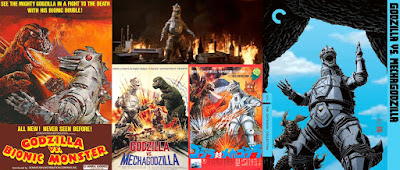
Well this one’s a bit if a fun romp. It’s nonsense with a capital G* but Godzilla VS Mechagodzilla, the penultimate film of the Showa Era Godzilla movies highlighted in Criterion’s recent Blu Ray set, is actually one of the better entries from this period. It also looks like it had a better budget than what the Godzilla films had deteriorated to in the last few outings and there’s very little recycled footage (apart from one major piece which I’ll get to in a minute... but it doesn’t last very long).
Okay, so the plot consists of two groups of main protagonists linked by one of each group being the brother of the other. One lot, including a good guy professor, is working on a piece of flat metal found in a cave. His conclusion is that the metal is ‘space titanium’ and so there must be some evil aliens up to no good somewhere (he’s not wrong... astonishingly). Meanwhile, a mini statue of local Okinawan monster deity King Caesar is found in another cavern... except the evil aliens are also after that. Why? Because it’s a key piece in enabling a gazillions of years old prophecy about a big monster arriving to destroy the world and then, when the sun sets in the West, two monsters teaming up to defeat it.
This prophecy is reenforced early in the film when a young girl doing her ritualistic ceremony at the House Of Azumi temple, where King Caesar is supposed to be the symbolic guardian, collapses momentarily when she has a vision of a big monster attacking the city. Now, this vision is the bit of recycled footage I mentioned a couple of paragraphs ago, since the monster in the dream seems to be King Ghidorah footage from another film. This is the only time, though, that Ghidorah is seen in this picture because the giant monster which comes in later is something else... so, yeah... this vision makes absolutely no sense and we could really have done without the visual heads up. Thanks a bunch, kaiju writers.
And from hereon in it's all shenanigans afoot. Godzilla surfaces and starts acting like a villain trying to destroy the city. So suddenly he’s a bad guy except... no he’s not. Isn’t it strange that Godzilla’s pal Anguirus is trying to fight Godzilla, getting defeated in a gory combat which sees Anguirus defeated and in retreat? However, it’s not before he knocks a bit of scale off of Godzilla to show a gleaming surface underneath. Then, when another Godzilla joins the fray, at the request of Anguirus, he also gets bashed up pretty badly but... not before he reveals to the world that he was being framed by tearing the outer skin off of the other Godzilla, to the point where it changes into its true self... Mechagodzilla! The Big G does manage to break Mecha-G’s head and the aliens bring it back to their secret base for repairs. Godzilla then finds a big thunderstorm on an island and, in a first since his affinity with electricity was first established 20 years earlier in Gojira (reviewed here), Godzilla charges himself up with the lightning bolts from the storm.
Meanwhile, a gunman has been trying to get the King Caeser statue from an archaeology gal and her friend, the professor’s nephew. When the gunman gets shot in the face for his trouble, half of said face goes through a shimmery transformation to reveal that he’s some kind of space ape. He is defeated by one of the secret Interpol agents who had been acting... just sinisterly enough... to make the audience think that they were the bad guys in this.
While all this stuff is happening, the aliens kidnap the professor and force him to fix Mechagodzilla’s head. It’s at this point I have to ask again, why? Since they invented and built the thing themselves... why would it be that the ‘aliens from Black Hole Planet No 3’ would need an Earth scientist to help them fix their creation. I have no idea what’s going on here anymore. However, as you can imagine, the whole thing leads to a big fight between Mechagodzilla... who has finger rockets, destructive laser vision and who can shoot missiles from his metallic toes... and Godzilla, helped by the long dormant King Caeser, who is revived in a ritual by the lady who had the vision earlier in the film.
Things get bloody in the later combat too, with Godzilla leaking some big jets of red, arterial spray from his neck courtesy of his mechanical counterpart (a monster inspired by Mechani-Kong from King Kong Escapes, reviewed here). Plus there's a nasty moment where Mecha-G shoots multiple hypodermic syringes into Godzilla for... well, for no apparent reason. However, things get resolved when, in a first for the series, The Big G somehow uses his electrical charge to turn himself into a giant electromagnet, to bring Mechagodzilla towards him just before, with King Caesar’s aid, he rips off the robotic antagonist’s head.
There’s a big escape and destroy sequence cross cut with this fight, which also makes use of arterial spray. When the professor and the Interpol man helping him use the professor’s ‘special pipe’ with magical properties of being able to shut down electrical currents to help themselves escape (now days we’d call it something which shuts down things with an EMF pulse) and when the leader of the aliens gets shot, we get black blood spraying out of his neck before he, too, turns into an actor in a bad ape face mask... with extra little sticky out bits jutting out to presumably denote his alien leader status.
And that’s about it. There’s not a great deal of inventive shot design going on in this one and in some of the effects shots, the wires are clearly visible (especially so when watching this in a high definition format). This film also features the very last score that the great Japanese composer Masaru Satô did for a Godzilla film although, I have to say, it’s not one of his best. He does, however, manage to invoke the piece of leitmotif established for Godzilla by composer Akira Ifukube in this in a couple of places by, literally, playing just the first, long held note and then ignoring the other notes because the musical phrase is so well known by this point that you kind of fill in the rest of it in your head. Ifukube himself would actually return for the next and final film in the Showa Era Godzilla film series, a direct sequel to this one.
Godzilla VS Mechagodzilla is a fun if full-on nonsensical film which, in all honesty, utilises a much better looking design for the film’s titular antagonist than the one revealed in this year’s Godzilla VS Kong movie (reviewed here). It’s pacey, action packed and the only real downside is that the director seems to have really discovered the way hand held photography can be used to lend a certain chaotic dynamic to a shot... to the point where it was actually making me feel a little nauseous in one sequence. However, like I said, one of the better of the later Showa Era films and, of course, the Mechagodzilla would also turn up in many films to come. And rightly so... flying, mechanical kaiju are always a welcome addition to any film, in my book.
*So that would be Gnonsense then.
Wednesday, 17 November 2021
Godzilla VS Megalon
Maim, Jet & Scratch
Godzilla VS Megalon
aka Gojira tai Megaro
Japan 1973
Directed by Jun Fukuda & Yoshimitsu Banno
Criterion Blu Ray Zone B
This is another one of those films which I loved in my twenties but, looking at it now, just seems like one of the lesser and most disappointing entries in the Godzilla series, although there’s also lots to enjoy and it’s still a heck of a lot more interesting than the previous movie, Godzilla VS Gigan (reviewed here).
Okay, so we hear that those pesky humans have been testing bombs again on a remote island.. the consequences of which can also be felt on Monster Island. You might ask why this would be the case and the answer seems to me to be two fold. Firstly, Godzilla doesn’t properly turn up in this movie until almost 50 mins into the 80 minute running time... so it’s kind of a way, I believe, of pacifying the audience, showing that it really is a Godzilla movie they have come here to see. There have been a lot of rumours that, in response to a young boy who won a design a creature competition for Toho, that his drastically changed creation (to the point that the crying young prize winner was inconsolable at the changes Toho made to the design), renamed Jet Jaguar, would be the sole headliner of the movie. Although that makes sense in many ways, there is apparently no real evidence to suggest that was the case, from what I understand. So yeah, they show Godzilla to remind the audience and, the other thing the studio gets to do is to use old footage from Monster Island at this point to pad out the running time.
Then, after this footage we have the opening credits and a kid in a wonderful little robot boat in a lake, which looks like three colourful dolphins, with the two side dolphins acting like paddles. However, his inventor dad and his friend almost can’t get the kid back after a fissure is opened in a series of earthquakes, one of which drains this lake. Luckily, the inventor friend has his handy “rope launcher” with him on the picnic because, yeah, this is just what you would take on a picnic, right? Anyway, the three escape the disruption and go back to the scientist’s pad where they fail to stop two thugs who are interested in the father’s latest project, the robot Jet Jaguar. But they do leave behind a red button and some red sand which, on scientific investigation... and I’ve no idea how this is science but I’ll suspend my disbelief here... they figure out comes from 2000 miles beneath the sea and is similar to sand found on Easter Island (which, as I said in my review of Gamera VS Jiger - right here), was all the rage at the time.
It turns out that survivors of the ancient cities of Lemuria and Mu (Atlantis), which were swallowed up by the Earth’s oceans, have built an underwater kingdom called Seatopia, complete with silly costumes and dancing girls. They are fed up with the horrible land dwellers testing bombs which have disastrous consequences for them, so they unleash Megalon... a giant bug with a star on his head that makes him look like a badly dressed Christmas tree that can spit bombs out of its mouth... to destroy humanity (later on, he accidentally swallows one of his own bombs when it fires straight up at Godzilla but lands back in his own mouth, which slows him down for a bit).
For some reason, the Seatopians need Jet Jaguar to tell Megalon what to do for about a quarter of an hour and there’s also a sub-plot where the scientist and his little nipper are kidnapped and driven in a container to be dropped in the cracks where the sunken lake... um... sank... only to be rescued by their friend in a highly non-sensical car and bike chase. Actually I have to ask how ocean dwellers suddenly got so proficient at riding motor bikes and cars. I mean, not quite so good that they can stop the guy they’re chasing but, still, pretty good for people who lived for thousands of years under the sea.
Finally the scientists regain control of Jet Jaguar but then, because he’d had his mechanical brain ‘stimulated by battle’, he gains free will and battles Megalon himself while waiting for Godzilla to arrive, whom he summons for aid. However, the Seatopians have also summoned help, this time from space, as the previous movie’s main villain, Gigan, arrives to help Megalon destroy humanity and its defenders. This is also, of course, in order that lots of footage of Gigan fighting Godzilla could be recycled from the previous films, along with various building carnage which, perhaps not surprisingly, is hardly ever in the same shot as the monsters inflicting the damage. Well, at least day and night footage doesn’t fluctuate so dramatically like it did in the previous movie but budgets at Toho were really stretched by this point in the cycle.
At one point, to make the ‘big fight’ more interesting, Jet Jaguar suddenly grows to giant kaiju size. Now I thought we were going to get some kind of bizarre pseudo-scientific explanation of how he manages to change size at will, such as organic metal or redistribution of molecules but, no, according to his creator... and I quote... “His determination made him grow this big.” Oh, well that’s a neat trick then. Must make a mental note to be more determined.
The fight scenes themselves are ludicrously bad, with Godzilla and Jet Jaguar teaming up to fight Megalon and Gigan and with all the beasts making signs and waving at each other etc like they’re human. A lot of the footage is recycled and spliced in with new stuff but it’s all just a bit dull to watch for any real amount of time, truth be told. It doesn’t help that Megalon’s signature move is to jump instead of walk. A really terrible, bizarre looking, series of progressive two legged hops which look about as credible as... insert least credible thing you’ve seen here...and which will probably make your eyes roll out of their sockets while you laugh at the unintentional hilarity. Things took on more poignancy about the sad state of affairs at Toho when I was researching this after watching it and found that the Megalon suit was extremely heavy and so it took the suit actor and the technicians huge efforts to manage those stupid looking jumps.
Later on, when Godzilla is throwing Megalon around, it’s pretty obvious that there’s no actual actor in the Megalon suit because every time The Big G throws him onto the ground, his floppy legs bend the wrong way. Other than this, when the military get involved, it’s just the usual live fireworks fired at the suit actors as a stand in for the shells of the cannons and, yeah, it just doesn’t look great.
One last thing I’ll menton is the music. Riichirô Manabe’s score doesn’t recycle any of Ifukube’s old themes and it’s not anywhere near the masterpiece of a score that the same composer supplied for Godzilla Vs Hedorah (reviewed here), although it does recycle a Godzilla theme from that one. It’s also interesting in that it’s a lot lighter in tone and, for a lot of the time, really doesn’t match the drama of the action, instead playing through the scenes with a kind of elevator pop muzak style. It does, however, have an interesting theme for Jet Jaguar which gets expanded into a full blown song for the film’s final minute or so. Which for me was probably the best part of the movie... a song very much in the style of the Gamera song found in rival Daiei movies around this time.
And that’s me just about done with Godzilla Vs Megalon. It’s not a film I could recommend to most people but, obviously, you can’t miss this one if you are into Godzilla movies. It’s definitely not Toho’s finest hour and their would be only two more films in the series before the first cycle of Godzilla films had run their course.
Wednesday, 20 October 2021
Godzilla VS Gigan
Gigan Counter
Godzilla VS Gigan
aka Chikyû kogeki meirei:
Gojira tai Gaigan
Japan 1972
Directed by Jun Fukuda & Yoshimitsu Banno
Toho/Criterion Collection Blu Ray Zone B
Okay, next up in my revisit of the original Godzilla films, courtesy of Criterion’s Godzilla - The Showa Era Blu Ray set, is Godzilla VS Gigan. Now, when I last watched this, maybe 25 -30 years ago on a PAL VHS tape, I seem to remember I quite liked it. Looking at it now though, I have to say it’s one of the worst in the series of films of this era although, as in a lot of them, it still has some interesting moments.
The film starts off, after a quick appearance by The Big G himself, on an opening credits sequence with a nice Akira Ifikube ostinato style credits march. As it happens, Ifikube was not actually involved with this film and all the music in this one composed by him is just needle dropped in from his previous Godzilla scores. We then get a nice, moving camera montage over several black and white comic book panels to introduce the main protagonist as an aspiring comic book artist. From this point on, though, which is only a few seconds after the opening titles, it would be fair to say the film rapidly goes downhill.
Okay, so comic book guy is not having much luck at finding employment so his... well he calls her his mother but she’s as young as he is and seems to act more like some kind of agent or sister so... I don’t know what relationship she has with him but she sends him to get a job at a relatively new company who are building a giant theme park called World Children’s Land. They even have a big tower with a lift on it built in the shape of Godzilla, at the heart of the theme park.
However, after some shenanigans with a man and woman who are, shall we say, concerned individuals... it becomes clear that the main players at World Children’s Land are all ‘space cockroaches’ who are masquerading as humans (but their shadows still show as cockroaches if you catch them in the right light). Their much publicised plan for bringing ‘Absolute Peace’ to the entire word really involves destroying Godzilla (which they fail to do) and bringing King Ghidorah and the new monster Gigan, from space, to decimate the cities of the world so they can live in peace on our planet in their cockroachy ways.
And it’s mostly painful to watch. The lead actor is almost comic in his ‘over selling’ of his facial expressions (perhaps he came from theatre, where that acting style works better than for screen acting?) and the various 'to'ing and 'fro'ing in and out of danger involving him and his new group of friends... and rescuing the brother of one of them before disrupting the plans of the cockroachy aliens... is kinda tiresome. All I will say about all that stuff is that it’s lucky his ‘sister/agent/whatever the hell she is supposed to be’ is a kung fu gal who can karate chop the aliens when they need to get out of a tight jam.
Now, there are a couple of things which are of interest. Number one is that Godzilla and his buddy Anguirus, from Monster Island, can speak to each other by crying out and then having their words translated as comic book speech bubbles filled with kanji (subsequently translated in the subtitles). So, yeah, nice but extremely silly. I think they dropped this element after this movie, if memory serves.
Another interesting thing is that Godzilla bleeds quite a lot in this one... finally. This was a response to children constantly asking why Godzilla never bleeds in battle and, I suspect, this is probably due to the more violent kaiju punch ups in rival studio Daiei’s various Gamera movies. So, yeah, when Gigan activates his front chest plates... which basically serve the same purpose as a giant buzz saw, you do finally get to see some arterial spray coming out of poor Gojira. Incidentally, Gigan doesn’t do much else in terms of fighting style to be honest. His only other move seems to be sweeping down with his sharpened arms to either swat jet fighters out of the air or bash a monster on the top of their head. I guess, because of his fighting style, I’d have to say that Gigan is pretty much the Bud Spencer of the kaiju world, for sure.
Overall, though, the film is very bad. The monster battles are made up with a huge chunk of footage from previous movies thrown into the mix... which is why the costumes and models don’t match each other from scene to scene (and why you have fights taking place at both night and day in the same scene). The model shot of Ghidorah flying whenever Gigan is in the same shot has absolutely no movement in it at all and looks just like a kids plastic model on a string... as opposed to footage from other movies where he has the full movement. You can see the budget was completely shredded for this film and also, special effects legend Eji Tsubura had died two years prior to this movie, which obviously doesn’t help. But even so, the effects still look cheap and the mismatching of the footage looks pretty bad all the way through.
Another head scratcher is... well... why the heck is King Ghidorah alive in this one anyway? We’d previously seen him killed in Destroy All Monsters (reviewed here). Well, the usual defensive explanation people seem to give is that Destroy All Monsters was set in the future and this film isn’t. Okay, fair enough but, if that’s the case, wasn’t Monster Island also started up in that same film set in the future then? Honestly, the continuity here is a bit loose at best. This would be King Ghidorah’s last appearance is a Showa era film, although he would obviously return in the various other era's movies since then. After this, he was also in a few episodes of the TV show Zone Fighter... but I don’t know anything about those.
And that’s me done on this one. I don’t think much of it, to be honest. It was supposed to be an antidote to the mis-step Toho thought they had made with Godzilla Vs Hedorah (which I reviewed here and which is, in fact, my favourite Showa Era Godzilla film) but, as far as I can see, they got something which is truly cheap and horrible as a follow up. There would be only three more Showa Era Godzilla films after this one and, yeah, I’ll be reviewing those on here very soon.