Showing posts with label Pamela Hensley. Show all posts

Sunday, 12 December 2021

Buck Rogers In The 25th Century


Cool As Buck

Buck Rogers In
The 25th Century

USA 1979 Directed by Daniel Haller

Buck Rogers In
The 25th Century

Airdates:
Sept 1979 - March 1980 Season 1
January - April 1981 Season 2
Blu Ray Zone B


I can't remember if it was Shanklin, Scarborough or somewhere like Eastbourne when I first became aware of a book sitting on a store bookshelf... but it would have been something like May or June and I was on holiday with my parents. I spied the paperback copies of Buck Rogers In The 25th Century and Buck Rogers 2 - That Man On Beta (apparently based on an unfilmed screenplay) on the shelf and I pestered my dad to buy me the first one. I was already on board with Buck Rogers because of the fantastic 1930s serial starring Buster Crabbe (reviewed by me here). But, it was expensive... I think it might have been 75p or even maybe 95p. An expensive, luxury item. So he said no. Even so, I knew I would be on holiday in the general area over the next few days and so I took note that the book shop stayed open late on a Thursday night, when it usually shut at 5pm.

Anyway, sometime the next day, my dad and I were trying to remember the name of a specific Gene Kelly musical where three army buddies are reunited a year or two after the war to find they had nothing in common. We just couldn’t think of it but then I had a brainwave. “It’s Always Fair Weather!” I shouted gleefully. “No.” said my dad. “I’m pretty sure it’s not that. “I’m sure it is.” I said... “What do you want to bet?” He said our usual bet of something like either 5 pence or a million pounds. I said, “Tell you what... If I’m right... you buy me that Buck Rogers book from that bookshop! It will give me something to read on the train.” It was Thursday... the day before we took off for home. He said fine because he had two things he was almost certain of... a) The name of that film surely wasn’t that and b) the bookshop shut at 5pm and we wouldn’t be able to get near it until 6pm. So he agreed and, somewhere, we found a store where we could look the information up in a book (no internet in those days, remember).  And yes, I was completely right, the film we’d been trying to remember was It’s Always Fair Weather and so he conceded he’d take me around to the bookshop later, knowing in his mind that it would have already closed. Imagine his surprise (he never lived it down) when he found the bookshop was still open and he had to buy me the novel, which I read from cover to cover very quickly... so much so that I was able to convince him to buy me the sequel a few weeks later.

Now, I think there must have been a lag on the UK cinema release date because it’s listed as July 1979 but I would have been on holiday early June in those days and so it maybe came a little later to cinemas just outside of London (Enfield Town is nowadays considered part of London, in fact). So I remember waiting a few months and seeing the film and loving it. Then, later, a TV show which, somehow never seemed to live up to the film and which got pretty bad in its second season. So it was an absolute pleasure catching up to these again on Blu Ray.

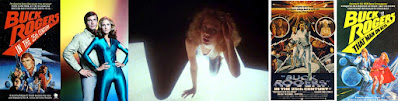
The film was originally made as the first of a series of TV movies but Universal decided it was looking so good that they decided to do it properly, as a theatrical version. And that version is also available on the current Blu Ray and it's like chalk and cheese to the later, pilot version recut of mostly the same material. It’s also not quite as dark as the version of the story in the novel, which was written from an earlier draft of the script. That being said, it was still fairly adult in tone, starting off with an almost James Bond title sequence with an actual title song (the TV show opening theme was an instrumental of this) and Buck (played by Gil Gerard) laying on the titles with scantily clad, super sexed-up versions of co-stars Erin Gray (playing Wilma Deering) and Pamela Hensley (playing Princess Ardala, who I first saw in the Doc Savage movie, reviewed here) crawling over his unconscious body in a suggestive manner. Indeed, the film is definitely more adult in tone, even though the first season of the show was extremely sexualised in its plot concerns (with some great costumes to match).

I remember someone once told me that if I looked at Gil Gerard in a fight in any episode of the TV show, he hardly ever (I think it happens just once) throws a punch... instead, every time the character gets into a fight, he just kicks people a lot. It looks quite ridiculous and feels way too theatrical but, in the original movie version, he does indeed throw the odd punch or two... which is nice. There are also some very adult lines in the theatrical cut of the movie, such as Buck turning down Wilma’s sexual advances with the line “I’m 500 years old and have to go easy on re-entry.”

The film also starred Henry Silva as Kane (aka Killer Kane), Tim O’Connor as Dr. Huer, Felix Silla as android Twiki (voiced by none other than Bugs Bunny man Mel Blanc), Eric Server as Dr. Theopolis and Dr. No himself, Joseph Wiseman as Ardala’s father. Wiseman was dropped completely from the TV show and, asides from the pilot film which was, as I said, a retooled version of the theatrical release... with the title sequence replaced by something far tamer, lots of adult lines removed or redubbed, the death of a character called Tigerman (amongst others) deleted and a few scenes of Buck’s new 25th century apartment added in... Michael Ansara took over as Kane, replacing Henry Silva.

And it’s a fun film. I absolutely loved it as a kid and I quite enjoyed it now, it has to be said. The TV show is more adventures on future Earth - Buck was frozen in the near future of 1987 for 500 years in a space shuttle, as opposed to the dirigible he was cryogenically frozen in for the serial - with Buck helping out his ‘high up’ friends and completing missions for them... for the first season, at least.

And there are some great guest stars in the first series too... such as Tamara Dobson (that’s Cleopatra Jones to you), a young (on the brink of success) Jamie Lee Curtis, Frank Gorshin, Jack Palance, Gary Coleman (Watchoo talking ‘bout Willis?), Leigh McCloskey (from Dario Argento’s Inferno) and even the tragic playmate Dorothy Stratton. Probably my favourite guest star was an early episode with an appearance by an ageing Buster Crabbe, the original Buck Rogers, starring as a character named somewhat after the other famous science fiction hero he played, ‘Brigadier’ Gordon.

The show has a lot of good, ‘of its time’ writing and action and Pamela Hensley returns every now and again to start invasions, strange conspiracies and cosmic wars... all because Buck refuses to be her boyfriend. In this way, she’s almost a carbon copy of the role Marta DuBois played in the TV show Tales Of The Gold Monkey (reviewed here)... or vice versa, come to think of it.

It was a fun show but Gerard didn’t get on well with the producers and was trouble on the set, apparently, for taking it all too seriously (well that’s kinda what you want, isn’t it?). When the second season began, there was a complete change. Most of the characters and actors who played them were replaced with new ones. Dr. Huer, Dr. Theopolis, Ardala and Kane are all gone. Instead we have new regulars Hawk (an alien bird man played by Thom Christopher), Dr. Goodfellow (played by Wilfrid Hyde-White), a second robot called Crichton (voiced by Jeff David) and Jay Garner as Admiral Asimov, who is indeed name checked as being an ancestor of popular science fiction writer Isaac Asimov (his famous three laws of robotics are quoted often in the second season). And with Mel Blanc being ill for the first handful of episodes, Twiki’s voice was changed to some kind of high pitched thing, before dropping back to Mel Blanc with no explanation whatsoever. Future Hollywood star Dennis Haysbert also turns up as a semi-regular bridge crew member in the second season.

Not only that, the show was no longer taking place on Earth but on a starship called Searcher, as Buck and the crew would basically ‘seek out new life and new civilisations’ around the galaxy, which made it another Star Trek/Battlestar Galactica clone and something far from the concept of the original Buck Rogers created by Philip Nowlan in the original novel and subsequent comic strip adventures in the earlier half of the 20th century.

There was an actors strike that year which held up production and, after that and considering their troubled relationship with the lead actor (apparently), Universal pulled the plug after only 11 episodes of Season 2. By then, though, there were less good episodes than bad, it has to be said.

That being said, the bad episodes are still quite fun looking back at them now, even though the designs and costumes took a big quality drop in the second season. The original starfighters in the movie and first season (and rarely seen in the second), which were reject concepts from the aforementioned Battlestar Galactica, were absolutely beautiful. And the costumes were... well... they definitely didn’t hide a lot of the various actors and actresses from episode to episode. Even the wise ass robot Twiki, who was picking up the old 20th Century lingo from Buck, was a well designed thing which you can see was probably influenced by Star Wars to some extent but, only in that you can trace the lineage of both him and the more famous C3PO right back to Brigitte Helm’s robotrix in Fritz Lang’s Metropolis (reviewed here). In comparison, the second season looks like nobody had any money to shoot proper special effects let alone put money into the sets... with the exception being the wonderful looking bird craft belonging to Hawk.

And that’s me done for a good long while, I think, with Buck Rogers In The 25th Century... not forgetting a quick shout out to Stu Phillips who composed the score to the movie (and several other interesting composers on the show)... not to mention Kip Lennon on vocals on the original, amazing vocal version of the Buck Rogers theme tune. I’m not sure I’d recommend this to everyone, for sure... however, if you liked the show in the 1970s, you might have some fun still with it now. It’s not for everyone these days but I’m glad I saw these again and, you never know, I might revisit again in another decade, if I’m still around myself.

Sunday, 4 April 2021

Rollerball


The Brave And The Rolled

Rollerballl
UK/Canada/USA 1975
Directed by Norman Jewison

Rollerballl
USA/Germany/Japan 2002
Directed by John McTiernan
German Ultimate Edition Blu Ray/UHD Zone B


Warning: Some spoilers.

So I wanted to see both versions of Rollerball again in some nice Blu Ray editions and I managed to get a used/very good and complete version of the wonderful German Ultimate 5 Disc Edition of the films, with oodles of extras, not to mention multiple booklets, posters, lobby cards and a limited edition certificate, for roughly the price of what it would have cost to buy the two films separately at full price elsewhere. Which I thought was a good deal and, also, I’d have to say I agree with a lot of people who reviewed this edition or did unboxing videos that, yeah, it’s pretty much one of the nicest Blu Ray box sets I’ve ever seen. A big, orange cloth bound thing with embossed black vinyl (or some such material) on it. Truly a beautiful objet d'art of the golden age of Blu Ray. I’m really pleased to have this one.

I also, actually, quickly read the original seven page short story, Roller Ball Murder, before I set out to write this review, so I could see where these films are coming from. This was written by William Harrison who also wrote the screenplay of the first movie, expanding out his ideas of the original account but also giving the movie a lot more of an interesting through line in terms of just what the story is about, I feel. Also, I wanted to highlight that, although the ‘almost a prequel’ reboot of the 2002 version changed things quite a lot, it still retained one of the basic premises of the plot, the whole ‘bread and circuses’ mentality of the people in control. The difference being that, in the first film, it’s used solely to pacify the global society of the future whereas, in the second, it’s being used to gain a market share in the ratings so a much smaller group of thuggish ‘businessmen’ can profit from the financial rewards. I should probably mention here that, although the first version is a classic and my personal favourite of the two, I also loved the second go around and I think it’s been unfairly treated from when it first came out and has not been re-evaluated in the way I hoped it would (I think I saw it about three times on its initial cinema run).

The original movie is set in what was then the not too distant future of... 2018. It’s got a very strong start with an empty Rollerball rink, circular in this version, which is in half darkness while Bach’s Toccata And Fugue In D Minor plays out over the credits while the crew of technicians start to ready the arena for the upcoming game and the audience and players begin to turn up. Then, after the playing of the ‘corporate anthem’ where the players stand to attention, we are pitched straight into the first of the three ‘action-game’ scenes of the movie. We have a brilliant James Caan as main protagonist and Rollerball champion Jonathan E, the wonderful John Beck as his friend and fellow player Moonpie and John Houseman as the owner of the team, corporation man Bartholomew. We also have a wonderful supporting cast such as Maud Adams as Jonathan E’s ex-wife (who he is hankering after), Pamela Hensley as one of the many ‘girls’ provided for short periods to the top players as their ‘live in’ sexual companion (think of the ‘furniture’ women of the rich and powerful in Soylent Green) and also a couple of very familiar character actors in the forms of Shane Rimmer and Burt Kwouk.

The opening game sets up the violent sport where steel balls fired onto the pitch at speeds of 200mph (so you don’t catch them until they’ve lost a little speed or they’ll rip your arm off) and two teams, consisting of a number of roller skaters and three motorbike riders each, try to take possession of the ball to score points in the special goal stations, bashing up opposing players as best they can. It’s a violent sport and a violent film. And, when I say that, I don’t mean to say that it’s really in any way gory because, well, it’s not really. But it isn’t comic book violence either... it’s violence with consequence and despite the minimal amount of gore it feels brutal and a much more adult take on the act of violence. Rollerball belongs to a special subset of early 1970s science fiction films which started to get made with prevalent adult attitudes before Star Wars came along and changed both the style and the audiences these things were pitched at. Films like Planet Of The Apes, The Omega Man, The Ultimate Warrior, Westworld, Soylent Green and Logan’s Run.

The music is important in its absence because there’s not much in it and apart from one ‘party scene’, it’s all classical music when it is used. Unlike the reboot, the games themselves are left unscored and I think it works really well because the director uses the sound design, such as the roar of the crowd and the chaos of the game... to highlight certain moments. For instance, he’ll dial the noisy, ambient sound of the track right down in volume to make a point of a specific moment sometimes and, it almost acts in a similar way to one of the functions of film music... although there are few movies which can really get away with this. He also uses the music to ‘bookend in’ certain sections of the movie. So, for instance, once the first game is played we have a debriefing of the men by Bartholomew in the changing room and then Jonathan E and Moonpie going through hordes of cheering fans as they go home. It’s only then that we get a withheld, finishing burst of the Bach music from before the game to round the scene off, as if to say to the audience that the first, introductory section is now over and now you can find out what the film is really about.

What it is about is the concept that many decades ago there were the ‘corporate wars’ and the world is now run by one big corporation. This corporation has managed to eradicate the history of the planet by destroying all books and having their historical secrets held by computers only the privileged (aka rich corporate men) can access and even that information is mostly classified. When Jonathan E tries to find some information about the history of these dark times so he can figure out what is going on with all the interest in him (I’ll get to it in a minute), the computer refuses and makes the human curator of the big computer of mankind’s knowledge, Ralph Richardson, very angry in the process. Almost as angry as he is from finding out that the computer has also ‘accidentally’ wiped out all knowledge of the 13th Century.

We have a massive population where the rich few can have wild parties and, in a very telling scene, go out and burn trees with futuristic laser guns as a drunken leisure pursuit, showing they have absolutely no empathy with the planet they live on, while the people running the planet give them their bread and circuses game of the violent outlet they need... Rollerball. This is a game designed to keep people watching and to see the hopelessness of free, individual expression and thinking and... here’s where Jonathan E’s problems begin. And also where Caan does an amazing job because he slowly transforms from brutal, violent sports player to a thinking, human soul with a conscience... unlike the version of the character in the original short story, it has to be said.

And this is because the corporation heads, including Bartholomew, want Jonathan E to retire. He doesn’t come to the realisation of why until much later but it’s because Jonathan has become bigger than the sport he is playing. A folk hero who people cheer and so, the corporation puts a special multiscreen TV show on Jonathan on air in which he’s supposed to announce his retirement (all the people of the future have  a multiscreen TV set up of simultaneous broadcast of screens augmenting each other, one big screen and three smaller ones above it). However, Jonathan is reluctant to and so the company change the rules on the next game to give it limited substitutions and no penalties, in the hopes that somebody will put Jonathan E out of action in the arena (and they get close). Instead, on the second of the three big matches shown in the film, Moonpie gets seriously wounded and ends up brain dead on a respirator. When Jonathan refuses to sign a waiver to take him off life support, which is sometime after the ‘accident’ has happened, we get a shot of the fading sequence of lights used in the game to denote the loss of a player from the field as a visual metaphor to make clear to the audience that, although technically still alive, another player has been sacrificed to the corporation.

There’s a nice moment or two where we see unruly hooliganism from the spectators as they get worked up by violence and the unswerving loyalty to their favourite players in the sport and, although it’s barely touched upon, it is there and it does kind of show exactly the kind of thing the corporation are working hard to avoid but, in some ways, exacerbating in their constant rule changes to make sure nobody stays in the sport long enough to get good at it and become a figure of inspiration.

And the film meanders along (in the best way) with beautiful shot compositions and smooth, flowing camera movement, where Jewison uses big blocks of screen and verticals to distribute the actors in space, until we get to the last game where, just like the last game in the 2002 version, the rules are changed so that there are absolutely no penalties, no substitutions (so when a team loses a player then that’s it, they’re a player down each time) and more or less no time limits.. which means that eventually, everybody in that game will be injured or killed until you’re down to one or two people. Of course, Jonathan ends up as the only man standing and, after his battered body walks up to the goal station and plonks the ball in, demonstrating that he’s survived and is effectively bigger than the system, the crowd start to chant his name and we are left with a chilling freeze frame of him rollerskating around the arena as the end credits roll to a reprise of the Bach music. It’s a very seventies ending but also, like a lot of those, a very effective and powerful one. A clever slice of science fiction which is deservedly a classic.

And then we have the attempted reboot.

Now, I have to say, it’s not the masterpiece that the original movie was but, that’s okay, it’s still an interesting movie and I can tell you it works really well when seen on a big cinema screen. The main difference is director John McTiernan is now aiming for a different aged audience. The first Rollerball still had quite an adult audience and the expected response was therefore a more sophisticated one. This second version needs everything to be over explained and underlined more but, it’s still quite a cool movie in many ways.

This one is set in the ‘near future’ and stars Chris Klein as main protagonist Jonathan Cross and, after we see him take part in an illegal downhill racer style competition, his friend Marcus, played by L. L. Cool J, offers to have him join him in Russia to get in on the ground level of a new game developing called Rollerball, on which people are betting huge amounts of money and which is a ‘people’s sport’, starting in the local mining town. So instead of a historical corporation, it’s basically the Russian mafia, headed by Jean Reno as Alexis Petrovich, who are trying to get their television ratings higher from the game to get more money. Caught in the middle are Jonathan, Marcus and Jonathan’s biker player girlfriend Aurora, played by Rebecca Romijn.

Another important character is the US commentator played by... I’m sorry, I can’t find him on the IMDB listing for this movie. He looks a little like John Candy but I know it isn’t him and he’s actually an interesting character because he’s our way in to the emotional tone of the constant rule changes which the owners are coming up with to take out the players... not for the suppression of individuality as in the first version but, because they soon realise the more violent and fatal the game is, the higher the ratings. So various manufactured accidents start to happen. There’s a great moment where Cross realises his head is on the chopping block, so to speak, when he sees five cameras are trained on him in the arena, tipping him off to duck before he get taken out.

Klein is excellent as Jonathan Cross although, it has to be said, I’ve always thought that he was just imitating Keanu Reeves in this movie. As it happens, I just read as I was writing this that Keanu Reeves was originally wanted to head up this movie. So it’s like the director tried to clone him and came up with Klein. He does do a good job here, though.   

And, yeah, it’s a choppy film. This is one of those movies where the shots are very short but, because it’s emulating what you see on TV a lot of the time, this kinda works to its advantage. In fact, there are various multimedia shot choices edited in and out rapidly as the show progresses, where the quality of the image will just change as it uses things like broadcast TV transmissions of the game and even security camera footage from scene to scene. We’re living in the time of ‘the media is the message’ and the film does tend to embrace that to some extent. And, another shout out to the ‘MTV generation’ is the fact that these incredibly violent games, played on a much more elaborate figure 8/infinity loop track and with added ramps, have bands playing live music in the stadium for the crowds as the action unfolds.

The soundtrack itself has one or two nice songs on it and also a brilliant score from Eric Serra, who composed music for quite a lot of Luc Besson’s movies back in the day (and back again with him recently). It’s not as hard hitting as the original and it also has a lot more elaborate team costumes which, is kinda what you’d expect from the hoopla surrounding these kinds of events with teens these days. It also has these long catcher’s poles which are actually mentioned in the original short story but which never made it into the first movie.

Jean Reno’s a bit over the top but, you know, that’s okay... he’s Jean Reno and he’s meant to be. He makes a really good villain. The whole ensemble cast is pretty good on this actually but, like I said earlier, it’s very much a ‘cinema experience’ kind of movie rather than a home video set up sort of film. I don’t have much more to say about it other than what I’ve already covered... it’s not as subtle and far from challenging material but it’s big and loud and the many hand held camera shots utilised throughout don’t really harm the experience. A nice attempt and doing something slightly different with the material and it’s a shame it’s not better recognised, I think. It’s not essential viewing like the first Rollerball but, if you’ve seen that then maybe don’t be afraid to give this one a visit sometime, you might actually like it. I still do.

Monday, 8 August 2016

Doc Savage - The Man Of Bronze


Righting Ron

Doc Savage - The Man Of Bronze
USA 1975 Directed by Michael Anderson
Produced by George Pal
Warner Brothers iTunes on iPhone6


The Arctic Circle, 1936. An American flag glides along the horizon and, eventually, a snow vehicle ridden by Ron Ely as Doc Savage - The Man Of Bronze, comes into view. We know he’s Doc Savage because the name is emblazoned on this and, indeed, on every vehicle that Clark Savage Jr owns in this movie.

Lower Edmonton, UK, 1975. A young boy of only seven years old is watching Chris Kelly’s movie programme Clapperboard on TV and the film, which he’s never heard of until now, is reviewed. He and his mother are watching as a clip is shown where Savage attempts to ward off certain death in the form of flying snakes, composed of green light, who reform themselves back into shape after being blasted with a shotgun shell. It’s pretty exciting stuff and both the boy and his mother urge the father that night to take them into Enfield at the weekend, to see the film at the Savoy cinema. By a strange twist of fate featuring two colliding cars which mount the pavement to wreak havoc on soft bodies just a year later, the family will soon move house to a location less than five minutes walk from that very same cinema.

Of course, the little boy was me and all the family were absolutely enthralled the night of that cinema trip. Doc Savage was, and to this day still remains, one of the greatest movies we’d ever seen. Now, a lot of Doc Savage fans didn’t like the camp humour of the film, which was lost on me at that time in much the same way that the Adam West Batman TV show is also serious business when you are a youngster... but we all thought it was brilliant. We loved the cheering on the soundtrack whenever a blow for justice was dealt. We loved the applause when Doc reminded his aides, The Amazing Five, of their honourable and heroic code. And most of all, we loved the 1930s knockabout theatrical serial atmosphere to the movie, which was perfect for Doc and which fit right in with another amazing thing I’d discovered on BBC TV about a year before this, the original Flash Gordon serials starring Buster Crabbe.

I recently found myself with a ‘good friend’ in London and she hadn’t seen the movie before. Due to a lack of options and the fact that I had no DVD player on me, nor my US Region locked disc of the movie, I downloaded it from UK iTunes and we watched it on my phone. It’s a movie I’ve seen dozens of times over the years and all I will say is... it still holds up.

The film was directed by Michael Anderson, who’d directed one of my favourite spy films, The Quiller Memorandum (reviewed here), and who would go on to direct another pre-Star Wars sci-fi classic the year after the release of this film, Logan’s Run. This movie plays up the ridiculousness of the situations found in many of the Doc Savage books without, I feel, poking too much fun at the characters. This was ‘wonder producer’ George Pal’s last movie and, despite reports of a sequel being half filmed while this movie was in production, the box office was so poor on this the second movie never came to be. Which is a shame because, in the days before the internet, news like aborted movie projects never came to light much and me and my father were waiting for the sequel to this to be released for years after.

The film follows, pretty faithfully (despite reports to the contrary), the first of Kenneth Robeson’s Doc Savage tales, at least for the first half of the book. The stuff about the green, floating snakes is added for the movie and perhaps, for the medium of film at least, gives a more exciting ingredient than seeing Doc running around trying to cure an Ancient Mayan tribe of a man made plague. The characterisations of Doc and his crew, played by Ron Ely (Doc), Michael Miller (Monk), Darrell Zwerling (Ham), William Lucking (Renny), Eldon Quick (Johnny) and Paul Gleason (Long Tom) are pretty much spot on. Even Monk’s porcine companion Habeus Corpus is along for the adventure, just as he was in a lot of the books.

The pacing is terrific and I remember we were all fooled for a few seconds, the first time we saw it, when Doc’s plane is shot down and destroyed with, seemingly, him and his crew in it... before a clever and less than subtle reveal gives the audience the truth behind that incident. We also marvelled at the refractive glass moving everything in Doc’s Empire State Building headquarters exactly 6 inches to the left, thus defeating a sniper’s bullet before it is even fired. And the wonderful fight scene between Doc and the prime antagonist of the movie, Captain Seas (played by Paul Wexler), where different fighting styles such as Sumo and Gung Fu come up on subtitles as the styles are played up, before plain old fisticuffs settles things, is a nice humourous touch used to lift the sometimes dull nature of such action sequences (in other movies) onto another level.

Frank DeVol’s original score for the film is pretty serviceable but everyone will remember it for his adaptations of John Philip SoUSA marches, which give Doc and his crew a strong musical identity during the action sequences. And anyone who says lyricist Don Black’s greatest song is Diamonds Are Forever (reviewed here) doesn’t know what they’re talking about, as far as I’m concerned. His lyrics for the Doc Savage song, which comes into the movie a few times, is easily his greatest work.

The epilogue to the film sets up the cliff hanger, sadly unrealised, for the next Doc Savage adventure, The Arch Enemy Of The World... and I so wish that the box office could have been better for this movie. I had a new idol and the film started me on the path of reading as many of the Bantam reprints of the 180 plus Kenneth Robeson (aka Lester Dent) novels as I could find... not to mention the eight issues of the Marvel comics which adapted four of those novels (such as Brand Of The Werewolf, featuring Doc’s cousin, Pat Savage) and the eight issues of the black and white Marvel magazine of original stories, which had excellent artwork in the style of their similarly produced Savage Sword Of Conan magazine. Some truly phenomenal stuff.

As the years pass, kickstarted by this film, I continue to read Doc Savage publications and buy what merchandise I can... which is not much, alas. I still have my bronze figurine of Ron Ely in the role on my bookshelf and I’m very much looking forward to seeing what Shane Black can do with a Doc Savage project, which is currently being developed with Dwayne ‘The Rock’ Johnson in the role... who looks very much like those old James Bama painted covers (which were modelled, incidentallly, by TVs Flash Gordon, Steve Holland) for the Bantam reprints. I regularly review Will Murray’s new Doc Savage publications, still written under the old Street and Smith house name of Kenneth Robeson, and if you go to the book section of the index here, you will find a fair few of those covered.

Doc Savage - The Man Of Bronze is, today, what it’s always been. A really fun slice of Boy’s Own adventure with never a dull moment. Heck, it even has Pamela Hensley, who went on to play Princess Ardala in the TV version of Buck Rogers In The 25th Century, only four years later. Not to mention that it’s the debut movie of iconic character actor Michael Berryman, who is still working at the time of writing this review. If you haven’t already guessed it, the original Doc Savage movie gets a big recommendation from me to anyone who has a pulse and is breathing. One of the great adventure movies and with lines like... “Have no fear, Doc Savage is here!”... it’s always guaranteed to bring a smile to the face.