Showing posts with label Rokurokubi. Show all posts

Tuesday, 8 November 2022

The Great Yôkai War


Monster Mash

The Great Yôkai War
aka Yôkai daisensô
Japan 2005
Directed by Takashi Miike
Shochiku Blu Ray Zone B
From Arrow’s Yōkai Monster Collection Blu Ray set


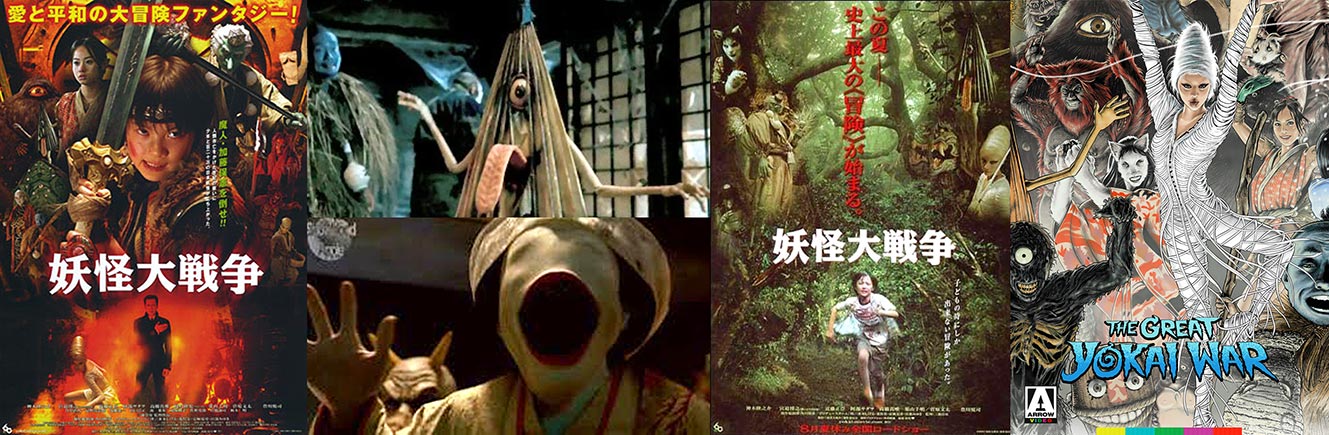
Once again, the Yôkai monsters are back... along with a whole host of new Yôkai (literally hundreds or possibly thousands in the scenes where they gather for ‘the final battle’ of the movie). This time around, however, they are set in contemporary times and the great and extremely prolific director Takashi Miike is setting the pace (I believe he’s just made a sequel to this movie last year) with The Great Yôkai War.

Now, Miike can be a bit hit and miss and the amount of visual information thrown at the audience in this one is huge and, to my western eyes, mostly bewildering. However, I believe the incredibly complicated story is revealed, in the end, to be a really simple tale after all, with a tsunami of energetic set dressing, so to speak. The plot involves a young boy who is chosen, in his village’s traditional annual festival, to be that year’s token Kirin Rider... who is supposed to retrieve a sword from Goblin Mountain to keep the ‘worked at’ peace every year. However, a very nasty demon who is enslaving many of the Yôkai and who is the living spirit of the ‘resentment humanity has earned’ by throwing out old things they think no longer useful, is leading a hate filled invasion of the world of humans and it’s up to the young, new Kirin Rider, along with some of his new Yôkai allies, to try and stop all of Tokyo (just for starters) from being destroyed.

Okay, so there are various twists on the plot dressing, such as a friendly rat creature and the return of various early Yôkai such as the snake necked lady Rokurokubi and the umbrella demon Karakasa Obake (with his long dangly tongue), not to mention the Kappa from Spook Warfare (reviewed here)... and also a gruesome process where the evil demons melt down the good Yôkai and merge them with resentful objects to transform them into evil, metal creatures... it all gets a bit Tetsuo, to be honest.

There’s also the bold colours that Miike can sometimes work with and the colour palette on this one tends to run to pinky mauves, reds and blues (other than a few shots of nature, I don’t remember seeing too much green in this one). Ditto for the sometimes striking frame compositions although, it all gets a bit lost here because there is just so much thrown at the screen, it seems to me. And a technique where he edits out many frames at a time to make these flash edits of someone, but they are still rooted in the same spot rather than walking away or to the camera, which kind of highlights the facial expressions as an overload of information on the part of the main protagonist. Don’t remember seeing that done before.

This is said by many to be a remake of Spook Warfare but I think that, although it shares some basic themes, such as the idea of two factions of Yôkai in conflict, it mostly does it’s own thing in this one. Even when one takes into account that the fragmentary, non-linear nature of some of the set up and first of the mini epilogues to the action could be seen as a distortion of the general plot (yeah, okay, I got there in the end but my brain had to wake up to decode this and try to make sense of it for a while).

The CGI effects of the evil demon’s metal monsters is interesting here because, although I can only assume this is all CGI, the monsters themselves look almost a throwback to the stop motion animation techniques pioneered by Willis O’Brien back in the 1920s/30s and, especially, to the ‘Superdynamation’ cinematic realms of Ray Harryhausen. Now, aping this technique with more modern methods isn’t anything unusual, I’ve seen this done before in films such as Blood - The Last Vampire (reviewed here) but it’s still nice to see this kind of homage/tribute to the special effects techniques of yesteryear and it’s far less dull than what might have been put up on the screen.

Other nice things on show here are an ‘on screen’ tribute to Shigeru Mizuki, who brought the Yôkai back to popular public consciousness in the 1960s with his manga based on the tales he heard from generations back and, indeed, he also has a small cameo in the film as a demon king. When the main lead goes to research a cute Yôkai that befriends him, he travels to the real life Mizuki Museum to get the information on the creature. There’s also a cool moment in the film when a giant demon-like thing flies through the sky on its way to destroy Tokyo and one of the people at ground level exclaims “Ah, it’s only Gamera.”, which did make me smile. I was also pleased to see the umbrella demon being used to float/fly another demon, as it was similarly utilised in Spook Warfare.

Some bits did fall flat for me though... 

 The use of an advertising jingle used to herald the fact that the evil demon is accidentally merging with an Azuki Bean which, given that “Azuki beans grow in love and peace!” as we are sung to, means his plans are scuppered. Similarly, an action sequence involving the main protagonists accidentally finding themselves riding on the wings of a jet plane, only for the screen to suddenly freeze with the caption “Don’t try this at home kids!” seemed a little pretentious and too much like a nod and a wink to an audience which might not, by this point, have found themselves too invested in the story line.

And that’s all I’ve really got to say on this one. I love Miike but The Great Yôkai War is not one of his films I could watch over and over again. There’s a lot of rich, visual, surrealistic creations on screen (and the reveal of the Rokurokubi is perfect) but the ‘throw everything in at once’ nature of the dense visuals means you are always just trying to take everything in to the point where, it has to be said, it becomes a bit of a dulled down experience. Still, it’s nice to see some of these monsters back and I certainly want to see what he’s done in the new one... although whether it will wash up on these shores is another matter.

Wednesday, 26 October 2022

Spook Warfare


Kappa-nese Action

Spook Warfare
aka Yōkai daisensô
aka The Great Yōkai War
Japan 1968 Directed by Yoshiyuki Kuroda
Daiei Blu Ray Zone B
From Arrow’s Yōkai Monster Collection Blu Ray set


Spook Warfare, also known as The Great Yōkai War... which is also the name of the partial reboot of this movie made decades later... is the second film of the original Yōkai monsters trilogy, again from 1968 but with a different director. And it’s a very different feel to the first movie in that a) it’s much more focused as one story, rather than two different character factions trying to solve the same problem, as in the first film and b) it feels much more comical in its execution. This second thing is interesting because, like a few of the Godzilla films where child heroes are pitched in with magazines showing ‘page 3 girls’, the Yōkai monsters films seemed to be perceived by a modern Western audience, from what I can make out, as children’s films. Well, I don’t know about that...

Yes, the monsters in this are much more friendly and helpful to the innocent, human victims in the movie but, there’s quite a bit of eye gouging and splashes of blood thrown about in this one which logically tells me that the ‘child-friendly’ angle is a bit of a misconception. Indeed, the UK release of this one by Arrow, as part of their four film Blu Ray Yōkai Monster Collection, carries a 15 rating. So I feel somewhat confused that a modern reviewer on the IMDB (no, I couldn’t bring myself to read the whole review... and I generally don’t read other people’s reviews of a movie before writing my own for fear of being somehow ‘infected’ with their words and viewpoint, anyway) starts off the review saying that he is not the target audience, these are kids films.

Hey ho... anyway, this does have a somewhat lighter tone than the previous film and starts off when two archaeologists accidentally unleash an Ancient Babylonian demon, Daimon, who quickly makes his way to Edo Period Japan and bites a previously benevolent magistrate on the neck like a vampire. What this basically does is inject the magistrate with the demon, who carries on disguised as the magistrate.. but as the totally bad guy version of him (we know he’s bad straight away when he slices the family dog up with his samurai sword). He basically drinks the blood of his bewildered servants to keep himself going and also injects clone demons of himself, with equal powers, into some of them.

However a kappa, water spirit (not looking completely unlike the Teenage Mutant Ninja Turtles of a couple of decades later) who haunts the magistrates grounds, is ejected by the demon so he goes into the forest and rounds up as many of his Yōkai friends as he can to attack the demon. Well they take a couple of goes at it but, after most of them are accidentally trapped inside a bottle by a magical inscription, they call on even more Japanese apparitions to help them, when they are eventually freed. And they help the poor humans to defeat the Babylonian demon and his clones because, as they point out, they don’t want a foreign demon running around and causing evil chaos as it would give Japanese apparitions a bad name.

Many of the Yōkai monsters are back from the first film, including two of my favourites the Rokurokubi (telescopic neck woman) and Karakasa Obake (the playful, hopping on one leg, tongue dangling umbrella demon). Alas, the big, bear cyclops Tsuchikorobi is not in this one but, also absent is Kuchisake-onna, the giant headed incarnation of the slit-faced woman. I can see why she’s absent in this one though since, as I said, the film is much lighter and comedic tonally, so she might have been a little too sinister to include this time around.

There are no real striking shot compositions that I can particularly recall standing out but there is some nice, hand held and moving camera stuff when the buddhist monk who is trying to expel Daimon is shot in a much more dynamic fashion and lit with reds and oranges, presumably to add visual interest to what would be, otherwise, a pretty boring instance of a guy sitting down and chanting.

The film flows along in a much more coherent fashion that the previous entry in the series and you never once feel like the elements of this story could ever have been transposed with a standard chambara of the time, which was a problem with the previous one, which might just as well have been labelled Zatoichi VS The Demon or Sleepy Eyes Of Death Meets The Yōkai.

One of the highlights of this one would be a moment when, after Rokurokubi uses her growing neck to surround Daimon like a boa constrictor, I thought to myself, careful lady, he’ll tie a knot in your neck if you’re not careful. Sure enough, he does just this! Secondly, I finally got to see a real use for the Karakasa Obake, as a Yōkai new to this film (and who looks startlingly similar to some early sketches of the design for Yoda when The Empire Strikes Back was being made, if I’m not much mistaken) uses him as a proper, expanded umbrella to float up to the head of the giant version of Daimon so it can get close enough to stab him in the eye.

I have to say that, although this is not as quirky, in some ways, as the first film 100 Monsters (reviewed by me here) I think that overall I prefer this movie, although the constant engagement of the various Yōkai and, indeed, having them as the main, driving force of the movie tends to make them less special than when they were used more sparingly.

If you’re like me then this kind of cinematic genre is unmissable and I’d certainly recommend Spook Warfare to any scholar of 1960s Japanese cinema. It’s pretty entertaining and you even, thanks to Kappa, begin to feel almost emotionally attached to the various Yōkai and their plight. Once again, thanks to Arrow for putting out such a wonderful boxed edition of these movies.

Tuesday, 18 October 2022

100 Monsters


Yōkai In The Pack

100 Monsters
aka Yōkai hyaku monogatari
Japan 1968 Directed by Kimiyoshi Yasuda
Daiei Blu Ray Zone B
From Arrow’s Yōkai Monster
Collection Blu Ray set


100 Monsters is the first of a trilogy of films which are included as the first three films in Arrow’s recent, four movie Blu Ray set, the Yōkai Monster Collection. The set also includes the first of Takashi Miike’s two Yōkai Monster movies (I believe the second one premiered in Japan sometime in 2021). I’ve been wanting to see these for a while and, well, I won’t go into the story of how a relatively ‘easy to purchase’ new Ltd edition was a bit of a chore to get a hold of but, thanks to Arrow for finally putting these things out (I hope they’ll consider putting the Crimson Bat series of films out there at some point too... I really want to see them).

According to that modern font of all knowledge... Wikipedia (whether it’s accurate information or not)... the term Yōkai comes from various kanji which mean, between them, such terms as ‘attractive; calamity’ and ‘apparition; mystery; suspicious’. Which sums the spirit of this first film up as nicely as writer Kim Newman does on the accompanying featurette on the Yōkai, where he prefers the broader, catch all term of Monsters as a collective companion name as the various spirits, ancient advertising creatures and personifications of places or inanimate objects can be easily dealt with in such a manner.

The film itself is... well it’s certainly charming but it’s also quite strange. Not because of the off kilter, surrealistic inventiveness of the creatures themselves (reintroduced into Japanese culture from stories passed on down the years to a successful and popular manga writer) but because of the way the film seems to take a standard, corrupt official exploiting the downtrodden ‘little people’ for his own profit and gain cliché of a story... and then kind of grafting on the aforementioned Yōkai as the downfall of all the corrupt plans, bringing their own brand of retribution.

So, very briefly, the village shrine and tenement building is about to be torn down by the local corrupt official with the support of his equally treacherous and rich friends. To get what he wants, he entraps the local landlord and even, eventually, ends up murdering him when he finds he has the means to buy himself back out of an arrangement whereby the tenement would be demolished... also nefariously plotting to take the landlord’s daughter as his own slave in the process. However, a government spy is causing hell for him to stop this. Parallel to this, some of the villagers are from the society of 100 Monsters, who tell stories of their own first and second hand experiences with Yōkai and who burn out a candle in ritual to ensure the spirit does not visit them after the telling of the story. Their leader tells the stories to the bad guys at a ‘pay off’ party for the villanous central deed but none of the bad guys can be bothered to participate in the ‘cleansing ritual’ afterwards. Thus, the various Yōkai manifestations in the film come after the villains to thwart their plans and reward them with their just and sometimes terminal deserts.

So, yeah, it’s the kind of plot you would see in, say, a regularly Zatoichi movie (and director Kimiyoshi Yasuda was no stranger to the Zatoichi movies, having directed several of them and even some of the Zatoichi TV series episodes)... but with added monsters/vengeful spirits grafted onto the story where the lone avenger of a movie of this type would traditionally take on all the bad guys and, more often than not, beat them on their own turf. There is, indeed, such a character in this, the government spy... but his resistance plot as he tries to help the surviving tenants is kept completely separate from the Yōkai and the two factions fighting off the evil oppressors are kept completely oblivious to the existence of the other.... with the ‘good humans’ benefitting from the Yōkai justice when everything just seems to fall apart for the villains of the piece.

The strength and, indeed, charm, of the film is definitely the various shapes and forms that the Yōkai monsters take. I had four favourites from this one. Firstly, the giant head manifestation of the Kuchisake-onna or Slit Mouthed Woman (think, giant Black Dahlia head lady, maybe?) who is very much a malevolent spirit and who seems to be making herself known again in various manifestations in the ‘J-Horror’ scene in recent years (I need to get into those movies... if I can find any).

Another great one is the Rokurokubi, who is a lady with a kind of telescopic, Mr. Fantastic style neck, who looks truly fiendish as her snake like neck with her head on the end terrorises those humans who have an encounter with her. Thirdly, the Tsuchikorobi, who is basically like a big hairy bigfoot cyclops creature who can ‘tractor beam’ a person into it’s paws by the use of some kind of mental telepathy.

An fourthly, my absolute favourite and almost a comic relief monster... the Karakasa Obake, who is basically an umbrella demon with a single eye and a big, lolly licker of a tongue that dances about on one leg and befriends the ‘mentally challenged’ young son of the prime bad guy. I’m looking forward to seeing more of him in the next one and his first appearance in this is quite startling... especially for a 1968 movie. The young man is painting line drawings of him all over some screens and one of them comes to animated life, jumping down and dancing around as a line drawing before switching to a more realistic puppet version of the character, while Chumei Watanabe’s comical scoring for this creature plays addictively in the background as it dances around (Watanabe is still composing scores for films, it seems, despite being born in 1925).

Asides from this, the film is fairly well made with the director and cinematographer making great use of blocked areas thrown up by the verticals... which can be a common but effective choice in Japanese films set in the Edo period, where the paper screen walls often throw up big, rectangular blocks which can be used to delineate the space on screen. Indeed, there is some use of dead areas of close ups of wall screens in certain places where the screen is pulled open to show a slit of a vertical rectangle with one or other character’s head in close up peering through. This is an aesthetic which actually has a great narrative pay off later in the film, when the bad guy slides open a screen door to be confronted with a giant head manifestation of the slit-mouther woman taking up the whole area beyond the screens.

And that’s me done with this one but, thanks to Arrow’s new limited edition set, I’m just getting started on the Yōkai Monsters, I’m glad to say. 100 Monsters is a nice introduction to some of the monstrous characters but, looking at the accompanying documentary, there’s a lot more good stuff to come so, yeah, I’ll get back to you very soon with the review of the next one in the series, for sure.