Showing posts with label Monsters. Show all posts

Wednesday, 26 October 2022

Spook Warfare


Kappa-nese Action

Spook Warfare
aka Yōkai daisensô
aka The Great Yōkai War
Japan 1968 Directed by Yoshiyuki Kuroda
Daiei Blu Ray Zone B
From Arrow’s Yōkai Monster Collection Blu Ray set


Spook Warfare, also known as The Great Yōkai War... which is also the name of the partial reboot of this movie made decades later... is the second film of the original Yōkai monsters trilogy, again from 1968 but with a different director. And it’s a very different feel to the first movie in that a) it’s much more focused as one story, rather than two different character factions trying to solve the same problem, as in the first film and b) it feels much more comical in its execution. This second thing is interesting because, like a few of the Godzilla films where child heroes are pitched in with magazines showing ‘page 3 girls’, the Yōkai monsters films seemed to be perceived by a modern Western audience, from what I can make out, as children’s films. Well, I don’t know about that...

Yes, the monsters in this are much more friendly and helpful to the innocent, human victims in the movie but, there’s quite a bit of eye gouging and splashes of blood thrown about in this one which logically tells me that the ‘child-friendly’ angle is a bit of a misconception. Indeed, the UK release of this one by Arrow, as part of their four film Blu Ray Yōkai Monster Collection, carries a 15 rating. So I feel somewhat confused that a modern reviewer on the IMDB (no, I couldn’t bring myself to read the whole review... and I generally don’t read other people’s reviews of a movie before writing my own for fear of being somehow ‘infected’ with their words and viewpoint, anyway) starts off the review saying that he is not the target audience, these are kids films.

Hey ho... anyway, this does have a somewhat lighter tone than the previous film and starts off when two archaeologists accidentally unleash an Ancient Babylonian demon, Daimon, who quickly makes his way to Edo Period Japan and bites a previously benevolent magistrate on the neck like a vampire. What this basically does is inject the magistrate with the demon, who carries on disguised as the magistrate.. but as the totally bad guy version of him (we know he’s bad straight away when he slices the family dog up with his samurai sword). He basically drinks the blood of his bewildered servants to keep himself going and also injects clone demons of himself, with equal powers, into some of them.

However a kappa, water spirit (not looking completely unlike the Teenage Mutant Ninja Turtles of a couple of decades later) who haunts the magistrates grounds, is ejected by the demon so he goes into the forest and rounds up as many of his Yōkai friends as he can to attack the demon. Well they take a couple of goes at it but, after most of them are accidentally trapped inside a bottle by a magical inscription, they call on even more Japanese apparitions to help them, when they are eventually freed. And they help the poor humans to defeat the Babylonian demon and his clones because, as they point out, they don’t want a foreign demon running around and causing evil chaos as it would give Japanese apparitions a bad name.

Many of the Yōkai monsters are back from the first film, including two of my favourites the Rokurokubi (telescopic neck woman) and Karakasa Obake (the playful, hopping on one leg, tongue dangling umbrella demon). Alas, the big, bear cyclops Tsuchikorobi is not in this one but, also absent is Kuchisake-onna, the giant headed incarnation of the slit-faced woman. I can see why she’s absent in this one though since, as I said, the film is much lighter and comedic tonally, so she might have been a little too sinister to include this time around.

There are no real striking shot compositions that I can particularly recall standing out but there is some nice, hand held and moving camera stuff when the buddhist monk who is trying to expel Daimon is shot in a much more dynamic fashion and lit with reds and oranges, presumably to add visual interest to what would be, otherwise, a pretty boring instance of a guy sitting down and chanting.

The film flows along in a much more coherent fashion that the previous entry in the series and you never once feel like the elements of this story could ever have been transposed with a standard chambara of the time, which was a problem with the previous one, which might just as well have been labelled Zatoichi VS The Demon or Sleepy Eyes Of Death Meets The Yōkai.

One of the highlights of this one would be a moment when, after Rokurokubi uses her growing neck to surround Daimon like a boa constrictor, I thought to myself, careful lady, he’ll tie a knot in your neck if you’re not careful. Sure enough, he does just this! Secondly, I finally got to see a real use for the Karakasa Obake, as a Yōkai new to this film (and who looks startlingly similar to some early sketches of the design for Yoda when The Empire Strikes Back was being made, if I’m not much mistaken) uses him as a proper, expanded umbrella to float up to the head of the giant version of Daimon so it can get close enough to stab him in the eye.

I have to say that, although this is not as quirky, in some ways, as the first film 100 Monsters (reviewed by me here) I think that overall I prefer this movie, although the constant engagement of the various Yōkai and, indeed, having them as the main, driving force of the movie tends to make them less special than when they were used more sparingly.

If you’re like me then this kind of cinematic genre is unmissable and I’d certainly recommend Spook Warfare to any scholar of 1960s Japanese cinema. It’s pretty entertaining and you even, thanks to Kappa, begin to feel almost emotionally attached to the various Yōkai and their plight. Once again, thanks to Arrow for putting out such a wonderful boxed edition of these movies.

Sunday, 30 May 2021

A Quiet Place Part 2


Silence Running

A Quiet Place Part 2
2020 USA Directed by John Krasinski
UK cinema release print.


Warning: Spoilers for the first movie, if you’ve not seen that one.

A Quiet Place Part 2 is, obviously, the sequel to John Krasinski’s A Quiet Place from a few years ago (reviewed here) and, like Krasinski, I was somewhat sceptical of the idea of a sequel. The first film is such a brilliant, modern version of an old 1950s style sci-fi horror movie, with well timed scares galore, that a sequel involving the giant, grasshopper like aliens (and they do seem to be aliens, it’s visually confirmed at the start of this movie) who have the weakness of sounds in a certain tonal range seems a bit of a one trick pony in terms of what you could do for a follow up and, in truth, it kind of is. However, when the trick is repeated in variations equally as convincingly and as potently as this one... well I’m glad Krasinski was finally convinced to write and direct the sequel because, frankly, he’s made another one of the best of these sci-fi horror movies and the two work together so well as an organic whole that, well, I don’t have enough words to say how brilliant this sequel is.

Once again he directs his real life wife, the always amazing Emily Blunt as Evelyn, Noah Jupe as her son Marcus and last, but by no means least, the remarkable Millicent Simmonds playing the deaf daughter Regan. Blunt and Jupe are absolutely brilliant in this but, like the first one, Simmonds is just so impressive here that her screen presence just sets the film ablaze whenever she’s on.

Now, the cynic in me would ask why we’d also need the acting presence of John Krasinski in the movie. After all, the father had died, sacrificing himself for his children’s survival at the end of the last film. However, he’s found a way to really make it work in an extended pre-credits flashback sequence which is anything but redundant. It’s a look at Day 1 of the giant bug invasion and we see it all starting, leading into some elements from the last film and with some nice call backs... such as his other young toddler son who we saw killed brutally in the first sequence of the last movie. This pre-credits section does two important things...

One, it reminds the audience just how lethal these creatures are, who have no sight but hunt by sound, re-enforcing the idea that people should all be very quiet when they’re around. So the tension is set up straight away and you remember to fear the presence of these monsters all over again. Secondly, though, it introduces a new character called Emmett, played by the wonderful Cillian Murphy. It’s a chance to see how his character was before the invasion and what his relationship with the central family is, so we can later witness how his character has become slowly devastated and desensitised by the act of his own survival. It’s a nice touch and really sets up things emotionally for the audience.

After this it’s a simple story but shot in a slightly convoluted way, taking on a  few dark turns as it weaves its way from the closing day of the last film into a progression towards two objectives, one of which is just to find other people, the other of which is... something which should be obvious but which is given as a big dose of hope to ensure that one of the characters ‘swallows the pill’, so to speak... and accepts the mission. Like any good horror movie director, Krasinski manages to divide the new group of five... the original family minus the dad but plus the youngster born towards the end of the last film and Cillian Murphy’s new character... so that we have three terrifying story elements going on at once in extended set pieces cross cutting with each other. These include some beautiful transitional shots and edits such as the swing of a rifle and torch to the right of screen becoming a door in another location being opened at the same speed and direction. It’s deft and wonderful stuff, to be sure.

 At some point Krasinski merges two of the groups back together for more horror while Millicent Simmonds and Cillian Murphy are off facing both the big bugs and new dangers I won’t go into... while also meeting up with Djimon Hounsou and accidentally bringing horror to a colony of survivors before their mission is accomplished, such as it is. And while both remaining pieces of action are still crosscutting, we have the lovely moment where the actions of one character in one strand of this adventure, due to an acceptable contrivance, saves three other characters in a totally different location two days journey from themselves. It also is a nice moment which shows the children in both segments as the hope of the future as much as anything else and the shot of a hearing aid next to a broadcast microphone probably says something much more clever than the likes of myself could understand as some kind of a metaphor for the hearing impaired saving the world... in some ways.

And all this with Marco Beltrami’s wonderful follow up score too, which is suitably terrifying and moving when called for and which, I’m happy to say, has been released as a limited edition CD from La La Land records... I’ve got mine on order from the US and I’m looking forward to appreciating the score away from the images it helps support.

And I don’t have much more to say on this one, I guess. John Krasinski has once again managed to fashion a truly stellar horror movie which works on pretty much all levels and which is, surprisingly, the equal of the first. I’d recommend A Quiet Place Part 2 to pretty much anyone who likes these kinds of movies (as I would the first) and I can’t wait to grab a Blu Ray when it’s released. But, honestly, go see it at the cinema because, once again, the sound design is superb and Krasinski plays with it to enhance the fear and also throw in a few audio red herrings here and there. A prefect cinema film and that’s where it initially needs to be seen. Go tell your friends!

Sunday, 24 May 2020

King Kong Vs Godzilla


Crouching Eiga,
Hidden Dragging


King Kong Vs Godzilla

(aka Kingu Kongu tai Gojira)
Japan/USA 1962 Directed by Ishirô Honda
Toho/Criterion Collection Blu Ray Zone B


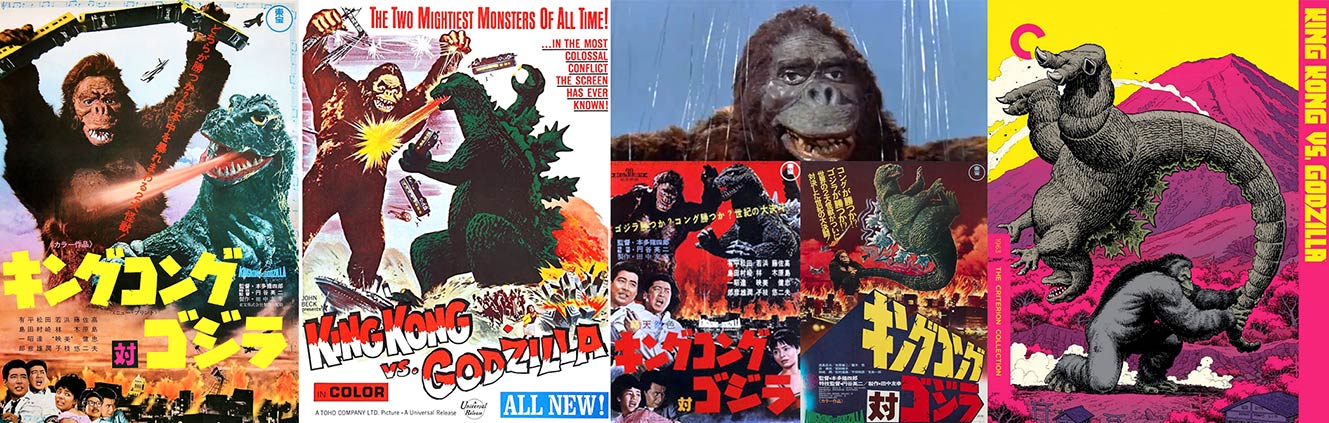
So seven years after Godzilla Raids Again (reviewed here) had, presumably, ended Gojira’s onslaught on the Japanese and US box office, there was still a lot of interest in King Kong and Toho Studios wanted to celebrate their own 30th anniversary with a slate of big films including something with the much loved giant ape in it (Kurosawa was also coaxed, grudgingly, into making the second and final sequel movie in his career with Sanjuro, his follow up to Yojimbo). So the Japanese did a rights deal with US studio RKO, who still held the rights to King Kong and... wondered who he could fight in his film. The answer was, of course, Godzilla so... in a way, King Kong saved Godzilla because the Godzilla cycle really took off after this movie and hasn’t really stopped for any great length of time since.

When I took out the next disc of this epic Criterion set, I was dismayed to find that the version of King Kong VS Godzilla was the butchered, re-edited version with loads of stuff missing and some terrible fake TV broadcast news sections inserted all the way through to try and explain the story. It’s a truly awful version of the movie and, until now, the only one I’d ever been able to see, alas. Once the film finished... and the American version truly is a dreadful way to experience this movie... I was all ready to ‘tweet angry’ at Criterion to complain about their bad judgement in only including the stupid US version.

However, just before I did this, I came upon an article which explained that the original Japanese cut of the movie is, indeed on this set... it’s just ‘hidden in plain sight’ on the eighth disc as an extra. It seems weird to me that the one film which is, I suspect, the main draw for a set like this for a lot of people, is kinda tucked away at the back of the set like it’s somehow not the most important movie on here. However, it’s not been treated that well either in that, the scenes on this version of the film that are in the American version are proper Blu Ray quality while the scenes which are unique to the Japanese version are, in a lot of cases, only in DVD quality and, in some instances, the change over from one source to another can be quite jarring. So... yeah, a little disappointed but at least it’s on here (unlike the US version of Godzilla Raids Again... yeah, thanks Criterion).

The film in summary is very simple. Godzilla emerges from the ice in the form of an iceberg... presumably that’s what the island he was frozen on has become in the seven years since the last movie... pulling himself out of his deep freeze due to shear strength of will it seems to me. Meanwhile, two TV reporters go to Faro Island (not Skull Island as in the original Kong movies) to get some unique red berry juice and also look into the local legend of a legendary evil God-like presence living on the island. It is, of course, King Kong who, after fighting a giant octopus, falls asleep while drinking some of the berry juice and so is towed back to Japan in time to fight against Godzilla. There’s also a sub-plot about one of the reporter’s brother, who has invented an unbreakable steel wire which dovetails into the main plot towards the end of the film when the authorities lift Kong by helium balloons attached to this wire to get the slumbering beast closer to Godzilla. It’s all very silly in both cuts of the movie but the US version renders it completely ridiculous with bad dubbing changing the actual dialogue and, also, turning into a bizarre ‘selected highlights’ edition by cutting in and out of scenes for more explanatory exposition by the added American and Japanese news teams. The US version also includes terrible dialogue choices like “King Kong can’t make a monkey out of us.” They leave out a lot of the ‘TV ratings war’ satirical edge that Honda has in his version too, with all the re-dubbing.

Another thing the Americans really overdo on their cut of the movie is keep mentioning the atomic bomb. Every time the authoritarian Japanese scientist turns up and everyone is overdubbed with completely different dialogue, people just keep asking him if they’re going to drop an atomic bomb on The Big G. Really weird and almost a subconscious but punishing reminder of the horrific US triumph over the Japanese during the Second World War. On the Japanese version, the Hydrogen Bomb is only mentioned once and very briefly. This could be so that, as every Japanese person will remember, Gojira was woken and reborn from the atomic bomb tests so... well, it’s not going to do any damage to it at all if they use such devastating force. So it’s a bit of a weird and persistent inclusion on the US cut.

One thing the Japanese version also seems to forget though, especially since it’s the director of the original Gojira movie at the helm here, is that electricity didn’t stop Gojira either. Indeed, in this movie, this actually works on the monster, contrary to everything we already know about it. That being said, the electricity only makes King Kong stronger... he’s seen literally eating it from wires at one point... and, towards the end of the movie, lightning strikes fix it so that Kong can actually channel electricity through his fingers. So, yeah, not a lot of continuity with the original Kong in this one then. Although, to be fair, this idea might have been inspired by a famous, 1930s publicity still montage which pictures Kong with a load of lightning behind him in the sky.

The fights are entertaining in this movie. They are more comical and a bit like a wrestling match... much to the dismay of director Honda, who wanted to keep the monster elements more serious than the rest of the movie... but they are quite watchable and this is pretty much the direction that the majority of the Showa Era films would go when depicting their epic battle sequences. That being said, the fight scenes in the Japanese cut seem just a little bit longer and more consistent somehow than the US version, which seems to chop and change and then leave the action very quickly at the first chance. Not sure why this is, to be honest. They do both include a beautifully silly moment, though, where Kong uproots a tree and shoves it down Godzilla’s/Gojira’s throat... only for The Big G to fire it up and then spit it out at Kong as a flaming projectile. Nice stuff. Also, the effects work on the giant octopus which fights Kong at the start, apart from a comical moment where it sits on Kongs head and engulfs it, is actually pretty realistic and probably the most interesting effect in the whole movie.

Both cuts feature some very colourful scenes on Faro Island with the indigenous population there, although, all the of the islanders appear to be Japanese actors wearing black face so, yeah, they wouldn’t get away with this kind of approach today. They also show the influence of the US producers in some places, like the inclusion of the vinyl album cover of Hollywood Love Themes one of the Japanese characters has on the wall of her house.

A huge difference between the Japanese and American cuts is the score. The Japanese version has a proper score by famous Gojira composer Akira Ifikube, which brings back themes from his first one and is generally appropriate and well spotted. For example, when Godzilla is finally identified emerging from the ice, the famous, ponderous Gojira sub-theme swells up on the soundtrack and has a lot  more impact than the throw away attitude of the American cut of the same scene. The US version’s treatment of the music is just preposterous. Hardly any of Ifikube’s score is retained and there’s generally a lot less music in this version of the movie anyway. Instead, when they feel it is called for, the Americans needle drop old 1950s sci-fi B-movie scores in instead and it can be very jarring, I can tell you, when King Kong takes on either a giant octopus or Godzilla himself when all you can hear on the soundtrack is the famous three note sting based music from Creature From The Black Lagoon (which I reviewed here). It just pulls you out of the movie completely. Of course, Ifikube kinda got his revenge on the US decades later in the first of McG’s Charlie's Angels movies when, all of a sudden on the soundtrack, the Godzilla sub-theme swells up... which caused me and, I assume, many others, into believing there would be some kind of visual Godzilla reference making its way into the shot. It’s kind of disappointing it didn’t and, since it completely pops you out of the movie because the soundtrack is telling you ‘Godzilla is here!’, I have no idea why it turns up in that first Charlie’s Angels movie at all, truth be told.

And there you have it. King Kong VS Godzilla had and, I believe, still has the highest Japanese box office gross of any of the other Gojira films. It’s an important movie and well done to Criterion for including it, no matter how well hidden and only partially restored in terms of quality, on their big Godzilla box set. I was hoping the obvious Blu Rays of Mothra, Rodan and King Kong Escapes would also make their way into this box due to their obvious connections to these films, many of which are sequels or prequels to these three films but, alas, Criterion didn’t quite push the boat out as far as they could when they put this impressive set together.

Tuesday, 19 March 2019

The Monster Movies of Universal Studios


Universal Challenge

The Monster Movies
of Universal Studios

by James L. Neibaur
R & L ISBN: 978-1442278165


It’s a surprising but no belittling a factor that, in his introduction to The Monster Movies of Universal Studios, James L. Neibaur quickly explains that he has eschewed various of what I would personally say are still very much candidates for the title in favour of, purely, going through the various classic monster movies from that studio which have seen numerous releases over the past twenty years on DVD and Blu Ray and which are nowadays known to fans of that particular sub-genre as The Legacy Collection. Nothing wrong with this, of course and it certainly provides a service for those who are discovering these films in this fashion for the first time... what it does mean, however, is that films that I would personally also consider part of that loose canon... films such as The Mole People, It Came From Outer Space, Tarantula and The Monolith Monsters... especially in light of the fact of the inclusion within these pages of the Creature From The Black Lagoon cycle (not to mention three of the Abbot And Costello crossover movies), are not covered by this book. That’s okay though... perhaps we’ll get a companion volume at some point.

The book starts off by briefly reminding the reader of the climate that brought about the enthusiastic pursuit and production, originally by Carl Laemmle Jr, of these horror vehicles that assaulted the public in the early to mid 1930s and then once again throughout the 1940s in various spin offs and sequels. The success of each movie (sometimes saving Universal Studios from bankruptcy) and the downward plummeting budgets of these movies during the 1940s is subsequently recorded as each film is looked at in chronological order of release. What we have here is a chapter for each film in the recently released (and rereleased on Blu Ray) Legacy collections... so the Frankenstein, Dracula, Wolfman, Mummy, Invisible Man and Creature From The Black Lagoon characters all have separate entries for each and every movie in their respective cycles lasting maybe 7 or 8 pages per piece. Also included is my personal favourite werewolf movie, Werewolf Of London, along with the somehow non-horror movie She-Wolf Of London (I’ve always puzzled why this psychological thriller is included in these sets since there’s no actual monster in the movie at all) and the three Abbot and Costello films... Meet Frankenstein, Meet The Invisible Man and Meet The Mummy.

Each chapter contains a look at how the cast and crew were selected for the upcoming project, followed by a synopsis of the film and a look at how the film fared both critically and at the box office (often two polar opposites when these things were lurking at the cinema). So, for example, in the section on the first Dracula film, he talks about how it was refined down by various writers from the Balderston reboot of Stokers stage version of the novel (as opposed to the novel, on which hardly any of Dracula’s cinematic excursions have been based on) and also talks about Lugosi’s involvement in acquiring the rights from Stoker’s widow, with his subsequent lobbying and accepting of far less money than his fellow actors to secure the role which he had already made his own on stage. Neibaur goes on to make the point about the way the narrative is focused more on the story of the title character as opposed to adding in more significant back story for some of the supporting characters like Lucy, Mina and Dr. Seward, as a more modern take on the material might pursue.

For each film the author makes comments about the stylistic sensibilities of the movie in regard to placement of camera and general cinematography and, sometimes, brings up some interesting facts or observations that I was unaware of (even though I’ve read and watched a lot of documentary material on these films over the years). For instance, in the case of the original script of Cagliostro, The King Of The Dead, which was revised and evolved until it became The Mummy, I was unaware that in that original script, Cagliostro was a 3000 year old magician who remains alive by injecting himself with nitrates. And it’s also interesting to know just a little more detail in the story behind the original make-up for Werewolf Of London, where make-up artist extraordinaire Jack Pearce and actor Henry Hull clashed on how much the make-up would hide the face of the actor... with Hull going above Pearce in the food chain to get his way via the consequences of the original make up to certain things indicated in the script. It’s also interesting to note that when the studio successfully rebooted a werewolf character via The Wolf Man and its subsequent sequels, Pearce went back to his original make-up designs for Lon Chaney Jrs make-up. By the way, in case you are in any doubt, I most certainly disagree with the author’s insistence that Werewolf Of London is somehow inferior to The Wolf Man... not a bit of it.

Another little gem I don’t think I remembered or, perhaps, didn’t know but which this book brought to light is the fact that Son Of Frankenstein was being written/finished on a day by day basis as it was being shot... so I need to go back to that movie sometime soon and see if I can find any plot points or continuity moments which betray that fact. He also talks about the scene in The Mummy’s Tomb where the couple is ‘making out’ in the car but are disturbed by the sound of the film’s main antagonist going past as being the first time this had happened in the horror genre... I’m not 100% sure on that myself because there are so many films from the silent era which are lost to us but I’m happy to take him at his word until other evidence comes to light. That being said, I suspect that one of the later Mummy movies in this cycle may be the first cinematic instance of a living dead person rising up out of the earth but... I’ll get on to that when I eventually get around to rewatching that movie for this blog.

Another interesting point the author makes is that blending comedy with horror was not a new concept by the time of the 1949 movie Abbot And Costello Meet Frankenstein and his musings on various of the films traces the decline of the monster series', noting which films had lower budgets than each previous, why that was the case (in some instances... like the special effects budget being slashed because more money for effects were needed for a film being shot simultaneously) and also takes note, I believe, of the declining running times as the various films emerged.

He also highlights a lot of the errors in these films such as the horrible continuity problems with the time placements and, sometimes, location settings for The Mummy movies... and its kind of refreshing to hear someone else acknowledging those. He goes on to point out that the footprints in the snow of the presumably naked Claude Rains in The Invisible Man are of shoes and not feet so... yeah, I can’t believe the studio went with that solution, to be honest.

That being said... I believe the author is not above making a few errors himself. For instance, when he talks about the Frankenstein monster as being... “... a legend that most audiences knew due to the popularity of Mary Shelley’s nineteenth-century novel.”... then surely that implies she merely popularised an already existing character, rather than fashion the whole story from clay as I believe is the case. Also, he notes that the stage version of Frankenstein gave The Monster the same name as his creator. Really? I’ve not heard that before and would have thought that, if that were the case and it such a bone of contention for people who love this character... that he is often confused with the scientist who created him... then this would be better known.

However, a few 'possible' errors do not kill a book and, although I knew a lot of the stuff covered here before, much of it gleaned from documentaries and commentary tracks, this book wins out because it is a handy guide to the ‘Universal Legacy’ monsters where all the information is gathered into one place and, also, because there is some stuff I didn’t know about in here and, yeah, that always makes a book invaluable. If you are a stranger to the movies covered in this book then I would definitely cite this tome as being a great starting place to jump on for a flavour of what these movies are all about... although it is, of course, no substitute for watching the actual films themselves. For die hard fans, though, this book is also a nice thing to have on hand to look up the quick, odd fact for when this kind of subject matter comes up in conversation, for sure. The Monster Movies of Universal Studios is a book which belongs on the shelf of any admirer of the genre and a big thank you to the coolest friend who bought me a copy of this one for my birthday. It was much appreciated.

Monday, 22 May 2017

Colossal


Beware The Ids That March

Colossal
Spain/Canada 2016
Directed by Nacho Vigalondo 
UK cinema release print.


Okay... so what the heck happened to the publicity machine for Colossal? I literally was only aware that this movie even existed when one of my favourite composers, Bear McCreary, talked about doing the score for this on Twitter. After a while it’s finally arrived on UK shores and, mainly due to the poster design, I actually thought this movie was some kind of animated film. However, I looked at the trailer online, a few nights before I went to see it and was absolutely enthralled by what looked like a comedy starring Ann Hathaway who has somehow become inextricably linked to a giant monster which is stomping Seoul.

Which is pretty much what it is...

Or should I say... what it starts out as, at least. One of the things the trailer is doing, however, is masking that the film suddenly ‘does a Gremlins’ and takes an unexpected left turn about two thirds of the way through the movie... once the rules of the monster/human link have been established in some fairly funny and, surprisingly, sometimes moving moments in the film. This is such a good movie on pretty much every level, to be honest (although I know it has its detractors too).

Anne Hathaway is absolutely excellent in this and also has one of the Executive Producer credits here. I’ve not actually seen her in many movies but I think she’s actually got a certain screen presence which goes far above and beyond her abilities as an actress. She can screw her face up into various expressions which are almost larger than life, stage acting style short-hand to convey emotion but... it really doesn’t look out of place on film, somehow, the way she does it and she manages to do so much with it, so naturally, that she brings a lot to the table. My eyes were pretty much on her, more so than any kaiju eiga inspired scenes in the film. She is joined by people like the always watchable Dan Stevens, as her ex-boyfriend who kicks her out at the start of the movie and Jason Sudeikis, who actually does a really interesting and subtle performance, especially in terms of bringing a certain amount of stealth character establishment in the first two thirds of the film. I honestly did not see the character arc for him coming in terms of his specific personality so... yeah, longtime readers of this site will know that I love the few rare films that can surprise me and this one surprised me no end as it sauntered to it’s... very satisfying ending.

So, yeah, all the acting is great.

What’s also great in this, asides from Mr. McCreary’s incredible and appropriate score for the film (yeah, you can bet that CD is already on order... can’t wait to hear it as a stand alone listen) is some of the incredibly interesting shot designs. This director actually does some interesting stuff with the character which was a pure joy to watch.

For instance, lets talk about the way a director might focus on a character.

Back in the days before a director could ‘zoom in’ effectively on someone, you had directors like Sergei Eisenstein. He would show a shot of, say, a crowd and then focus on individuals in that crowd for an emotional interaction with the audience. However, what he would do, possibly due to technical limitations of the equipment at the time he was making movies like Battleship Potemkin, Oktober or Strike, would be to cut to a close up of the actor or actress in question. However... and this works at almost a subconscious level the first time you see one of his movies, he shoots the actor against a different background without any distractions to the foreground... like a somehow more staged or hyper-real version of the original shot. You have a look sometime and you might see that not everything in those shots match. In Eisenstein’s case, he didn’t use actors but people who naturally looked like the kinds of stereotypes he wanted to convey to use in this manner and this kind of practice in Soviet Cinema of the time was known as typeage.

Well, director Nacho Vigalondo doesn’t do anything quite like that here but he does use the camera in some nice and unexpected ways to pull the focus onto the actors involved in the movie when a character, usually Ann Hathaway, needs to come into some kind of snap focus so the audience can catch everything and sympathise, or empathise, with her plight.

For instance, after a pre-credits sequence establishing the first appearance of the colossal monster 25 years prior to the main body of the film, we return to present day with Hathaway’s character Gloria being kicked out of her flat by her boyfriend because of her constant and repetitive bad behaviour... specifically because of her drinking problem. After he leaves her in his flat to go to work, a load of people start filling the room, who Gloria has waiting in the wings to resume the partying once her boyfriend has left for his office for the day. As people file in behind her we see sitting about two thirds of the way to the right of the screen, sitting at a table with shock on her face as she looks towards the camera. Behind her we have two large windows filling most of the screen with the single, upright vertical between the windows splitting the screen in half. The director slyly and casually moves the camera around to the right so Gloria moves to the left in relation to the window until it’s she, herself, who becomes the vertical split in the centre of the screen... thus highlighting her character in perfect symmetry as we concentrate on her features more. And it’s brilliant. I loved it and felt like clapping in the cinema.

Another thing he does, later, to bring the symbiotic link between her and the main monster of the film home on a visual level, is to have her standing in front of a giant television with her back to us as she watches news footage of the monster’s ‘rampage’ from the night before. Previously we had seen her put one hand up to test her hypothesis that there is an actual link between her and the creature, followed by swinging both arms up to the side as part of a series of gestures to reveal the truth of her plight. As she watches the playback of the monster, we see the back of the top half of Gloria’s body, with her hands by her side, in the centre of the shot, masking the creature on the TV screen. As the creature throws its arms up and to the side, we are given a visual metaphor of the link as the creature’s televised arms become the visual surrogate for Gloria herself, completing her body in a way that is one of the truly unique ways that film can make comparisons as part of a narrative flow. It’s a less subtle but really great moment in the film and, again, I wanted to throw my own arms up to congratulate the director here. This stuff was incredible.

As the film reaches the last third of the running time, the comedy is dropped and, in addition to the drinking issues already highlighted, it takes another serious social issue and tackles it head on in a way that, if this wasn’t a science fiction story, it wouldn’t be able to do in the unique way it does it here. I’m not going to spoil this thing for you but I will say that if you saw the trailer and are expecting an out and out comedy... think again. This film gets kind of ugly later in a way that you probably wont see coming and some of the character performances in this part get almost too hard to watch.

Another great strength of this film is, just like the majority of modern, post 1969 zombie movies, the writer doesn’t really bother to explain just why there’s a giant monster that is inexplicably linked to Gloria. Sure it gives a kind of half hearted ‘origin’ scene which it works it’s way up to in flashback but this in no way explains just what the heck is going on and it’s seen in fierce juxtaposition with a revelatory confirmation of the nature of one of the other characters in the film so much so that, by this point, it really doesn’t matter anymore. The movie is no longer about the ‘how’ but about the ‘why’ and how Gloria is going to be able to fix things in her life (and also save gazillions of people).

And that’s all I’m going to say here about this movie because it’s frankly awesome. Yes, I’m sure the social issues it targets are crudely handled in terms of the 'final solution' of a certain problem in the film and I’m sure it’s all done in an over-the-top manner but, you know, sometimes these issues are something you need to show in a simplistic, ‘beat you over the head with it’ form to provoke thought in an audience once the movie is finished. I don’t know enough about the specific issues it takes on to be able to say whether it hits the right points or not but at least it got me contemplating them for a minute or two. Which is no bad thing, I guess.

If you haven’t already guessed it, Colossal is a solid recommend from me. If you are thinking of seeing it, don’t go expecting a horror movie or even a comedy movie, although there are some good laughs to be had in the earlier parts of the movie. Catch this one at the cinema before it’s too late because it is quite original, in some ways, even if it’s deliberately using genre tropes to reach its end game. A lot of fun and it also makes you pause and think. Cinema at its very best.

Monday, 4 May 2015

Monsters - Dark Continent


Continental Drift

Monsters - Dark Continent
2014  UK
Directed by Tom Green
UK cinema release print.

Warning: Slight spoilers in here.

Monsters: Dark Continent is a sequel to the Gareth Edwards movie, Monsters, from a couple of years ago and which I reviewed here and which, like this one, had big, Cthulhu-like monsters as part of its main narrative thrust. It’s not to be confused with the upcoming movie Dark Continents which, I understand, is based on five stories by Cthulhu creator H. P Lovecraft and which, I suspect, may also have Cthulhu-like Monsters in it. Hmmm... so I guess the point I’m making here is... why release this movie with that title if there’s a much more famous, because of the directors involved, movie coming out with more or less the same title a year or so down the road? That makes no sense.

Now, this film can’t have had too much pre-publicity, I’m guessing, because the first I’d heard that they’d actually gone ahead and made a sequel was when I saw this included in the listings for my local cinema this week... and even then I had to look it up to find out that it was a sequel to Monsters (the original director is listed as a producer but I’ve really got no idea how much involvement he had on this one). To make things worse, I went to see this on the first Saturday, early evening, screening of its opening in my local multiplex cinema, a night and time when it should have been packed out, and found that there were only two or three other audience members in there watching it along with me. So, sad to say, I predict that the box office on this film isn’t exactly going to be great... especially since it was released a few weeks earlier in the USA and, as a dedicated Twitter user and follower of people interested in film, I still hadn’t heard of it until it was in the listings for my local cinema a couple of days before I went and saw it. That doesn’t bode well for it.

Which is unfortunate in some ways because, although I wasn’t personally happy with it for reasons I will elaborate, it turned out to be a highly competently made movie with a certain edge to it and, whether I personally liked it or not, it certainly holds the attention of the viewer and you will probably be as gripped by some of the sequences as I was.

The film follows on from the first film only by the inclusion of the titular characters. It’s ten years on and the world is fighting a losing war against the Monsters who have left “the zone”. This film follows a bunch of new recruits in the army who join up and go to the Middle-East to fight the Monsters, which are not evil and are just following their alien nature. However, because the US army have ben bombing hell out of the titular creatures in various areas of that region, they also have to deal with a population of hostile insurgents who would much rather the army were driven from their land than the monsters. When the new recruits are sent on a rescue mission to find some of their unit who didn’t come back from an operation, they are forced to fight their way through hostiles in order to try and locate them and tensions and frustrations soar.

Now, I had three main problems with it and I’ll get those out of the way before I get to the positive stuff.

My first issue is that the film is much more a “horrors of war” kind of story with the monsters acting only as a catalyst and background decoration to the conflict of the stupidity/violence men do to each other... which is kind of an interesting tack but, ultimately, it felt like the film was way too busy pushing the writer’s own political agenda with not enough of the monster focussed mayhem I would have liked to have seen. Sure, there’s a heck of a lot more of the monsters in this movie than their brief appearances in the first but, still, they really were only there as a plot device more than anything else... at least that’s how I felt.

Secondly, none of the main protagonists had my sympathies as people at all... they were all portrayed as, pretty much, young thugs who’d joined the army to have a better life than dealing drugs in their ghetto and the first quarter of an hour where, I believe, the director was trying to get me to identify with these characters, was absolutely doing the opposite of what was required. I didn’t like these people who used harsh language and demonstrated really crude, almost violent, male bonding rituals. They alienated me right from the start. But the flip side of that is, of course, whether the language and attitude of these people are accurate to those of modern, young soldiers or not... the actors were all really great at convincing me these were real people. I might have hated them all but, at least, I could suspend my disbelief to the point where I couldn’t sympathise with them. So... great acting job here by a lot of the people who are in this movie.

The third problem in this is the fact that it’s a conflict movie which does tend to fall back on the crutch of constant, war movie clichés throughout. For example, in the opening montage of the buddies who have “joined up”, the writers and director (not to mention the cast) are working hard to get across the importance of one of these friends returning home from duty by showing him helping his girlfriend give birth and all his friends promising they’ve got his back while they’re on his tour of duty. For anyone who watches these kinds of films, of course, that’s an instant telegraph that something bad is going to happen to this character and, I have to say, I was quite disappointed when exactly that happens and this character is the first of the group to meet his maker in an extended scene while his friends are under fire and trying to save his life. It doesn’t get much more predictable than this.

Other clichés include the group leader and authority figure whose responsibility it is to keep his soldiers safe, losing nearly all of them and then suddenly going a bit ‘Captain Ahab’ about things and getting obsessed by his mission at the cost of his humanity and sanity. Well acted but... nah, seen it all before. And the one about the lone soldier who grows to a state of enlightenment and understanding about things, to a certain extent, because of what he’s been subjected to in his own personal battle and his ability to see the good in his fellow man? There’s that one in there too. But, of course, clichés like these work and I suspect people who haven’t seen a lot of war movies, or that kind of thing, might be sucked into the narrative a whole lot better than I was... so I cant really condemn it for this. It might be old school but it does its job and, it has to be said, it does its job quite effectively.

Everything else about this movie is great. The special effects are cool, the tension and suspense in the combat scenes is almost unbearably intense in certain places and, while not as harrowing as some of the great war films, it can still be a gruelling watch in some moments and the combination of constantly moving, hand held camera combined with some extremely competent editing really pays off for it. Once you can get over the ridiculously low values of the characters, it’s a joy to see a well oiled machine of a movie like this one at the local cinema. It also has an interesting correlation in a “dog fighting sequence”, something I really don’t approve of or condone (we all love dogs, right?) but switched out to be a dog fighting an infant alien, and using that to show us both the changes and commonality in the attitudes of the cultural backdrop of the world depicted in the movie. Nasty to watch but, nevertheless, good stuff to get certain points across in short hand.

And the surprising thing for a movie which is using a lot of “camera reaction” style photography is the fact that it has a very striking and entertaining score by composer Neil Davidge which, alas, is only available as a stupid download. When will record companies get it in their heads that we want these things on CDs please? A download is next to useless to me, frankly. They might as well just put it on vinyl... which is equally useless to me. Such a shame because I actually wanted to buy this score since it is so strong in the context of the movie and sounds like it would be a really great thing to listen to away from the venue it was created for. Such a shame.

All in all, the film is quite gritty and if you are able to sympathise with the main characters, then you should have a really good time at the cinema with it. Even though I can’t relate to characters who seem happy to behave like football hooligans rather than somebody I would personally like to hang out with, it can’t be denied that this is well put together, well acted and is quite compelling... even though it’s also quite predictable and there are not too many surprises in store, to be sure. Its a shame that a movie like this has been released into cinemas at this time of year when it’s going toe to toe with stuff like the new Avengers movie (my review of that one here) which will inevitably suck all the audience away from films like this... it perhaps deserves a better fate than I suspect it might have in store for it. Saying that, though, it’s a good bet it will do reasonably well on DVD and Blu Ray rentals through word of mouth with a young audience, I reckon... so good luck to it and if gritty, gruelling action movies are your thing... you might want to give Monsters: Dark Continent a look.

Friday, 16 May 2014

Godzilla 3D ( aka Gojira 2014 aka Godzilla 2014)


Aphid And Goliath

Godzilla 3D 
(aka Gojira 2014 aka Godzilla 2014)
2014 USA/Japan
Directed by Gareth Edwards
Playing at UK cinemas now.

Warning: Big, giant sized spoilers breathing fiery destruction in your face... although, to be fair, it’s a movie about big monsters. How spoilerish could it be.

When I saw Gareth Edwards first feature, Monsters, four years ago (reviewed here), I noted that I quite liked it but the last act left me unfulfilled. I wanted to see a giant monster carnage fight sequence at the end and, since it was shot on a very lean budget, I’m guessing money would have been one of the deciding factors as to why that didn’t happen? Either way, that’s not a problem when it comes to this movie because the director has graduated from his original Monsters to a feature involving the original King Of The Monsters... so this film does seem like a bit of a natural evolution for him, thematically, and it’s been released just in time for The Big G’s 60th anniversary... which is nice (although I would have preferred to see a Toho film, in some ways).

I don’t remember what age I first saw the original 1954 version of Godzilla but it must have been sometime around when I first saw King Kong on television. I would have been about 4 years old so around about 1972 I would guess. Actually, the story of my original encounter with King Kong, very late at night, is a nice one for me but I’ll save that for another review, I think. All I remember about the original Godzilla is that, when I later saw the third film from the original first wave (The Shōwa Series) of the three waves (Shōwa, Heisei and Millennium series) of Japanese films about the character, King Kong Vs Godzilla, when I was about 5 or so, I was stoked to see the two giant monsters fight.

Of course, in the first four films or so of the Shōwa cycle, Godzilla was still pretty much a villain or, to be more precise, an uncontrollable beast that people needed to clearly defend themselves from and stop at any cost. By the time we got to the next few films in this first cycle, Godzilla had pretty much been subtly transformed and recast as Japan’s avenger and guardian, coming out to fight against whatever giant monsters were out to stomp Tokyo and its neighbours.

Now this is kind of relevant here because Gareth Edward’s new take on the legend is actually not really a reboot of the 1954 version. In fact it acknowledges the 1954 version without paying too many respects to the creation and legacy of the character in any great way. The film’s occasional stabs of postmodern homage lie in the date he was first spotted (1954), the name Serizawa, given to Ken Watanabe’s character but seemingly nothing to do with the original character from the 1954 film, plus occasional visual or typographic references to Mothra and other kaiju eiga elements thrown up in parts of the frames. There’s one more big piece of homage in the design of the title character... but I’ll get back to that later. What the director does do, however, is reestablish the role of Godzilla as an avenging guardian to the world, coming out of retirement to fight a world under attack by giant monsters who, in this movie, take the form of oversized aphid-like creatures who are swallowing radioactive devices like losenges, to feed and reproduce from.

If the plot sounds silly, well... it really is.

The story in itself is fine, tonally,  in terms of the history of the character... but I did have a lot of trouble with the dialogue in certain places when it comes to dealing with the fantastical elements of the story. They have some great actors in this movie, you see. The main leads, played by Aaron Taylor-Johnson and Elizabeth Olsen (as a husband and wife in this one, after playing brother and sister as Quicksilver and The Scarlet Witch in Captain America: The Winter Soldier, reviewed here, and coming soon in the same roles in the 2015 movie, The Avengers: Age Of Ultron), are both more than fine in their performances and give the movie some likable characters to get behind. However, there are some real heavy weight, long respected actors here like the aforementioned Ken Watanabe, alongside Juliet Binoche, David Strathairn and Sally Hawkins and, though the director uses little character sketches for each of these, and other action “sequence characters” (I’ll get to that in a minute)... it has to be said they’re mostly just standing around wasted in this film and the lines they have to deliver, for a lot of the time, are absolutely preposterous. It’s strange because, although the story itself is quite silly, it does work as a credible whole within both the world they create for this movie and also as something which isn’t out of place in keeping with the sensibilities of some of the Toho movies... but the dialogue itself is terrible. So that was kinda bizarre... I felt.

That’s about the only real weakness of the film, other than a couple of personal preferences, that I could find. In other words... I was thoroughly entertained by this movie and a lot of that, I suspect, is to do with the director’s approach to the material. Judging from this film, Edwards has two really potent signature elements which seem to work really well here...

One is a philosophy of always leading you into something else with a little revelation. While the director doesn’t eschew establishing shots, he does tend to leave them in the dust at several points and, instead, starts from things being revealed in close up and then going wide. For instance, while looking for something in a storage facility in the Nevada desert, a storeroom door is opened and just a bright light is revealed. We then cut and pull back so we can see that the storeroom has a big hole in the other side of the room where “something big” has broken out into the surrounding desert. A very similar kind of reveal happens when some firemen go into a room in a suite in a hotel, only to find that the other side of the room is missing and opens out into the city landscape, where an aphid style monster has ripped through half the suite.

It’s a really interesting way of shooting things and the director persists with this kind of “reveal detail” in either large or small scale occurrences throughout the picture. But not only that... he also uses exactly the same technique in reverse a couple of times. For instance, we are just about to glimpse one of the first proper shots of Godzilla with one of the insect-like monsters getting “into it” with some killer combat moves in long shot... when a safety door is shut in front of it and the screen goes to darkness for a half a second before cutting to another point in the story. There are a few moments like this and it’s a good way of whetting your appetite for the main bout a little later.

So yeah, reveals are this director’s thing... at least on this movie. But there’s something else he does too.

I noticed that for the scenes of carnage, a lot of the time the director will focus on a few characters that are entirely incidental to the story and are only around for, pretty much, the action sequence they are in. He makes you care about specific humans, caught in the turmoil of having giant monster action in their close proximity, and he follows these minor throwaway characters throughout their specific scene. It sounds like it shouldn’t work because you don’t have time to get involved with, basically, “star extras”... but he does it really well and, somehow, manages to pull it off beautifully. I really felt for the bus driver in the bridge sequence, for instance, even though I knew I wouldn’t see him again after that scene was over. The director uses this kind of “acquire a character for a short time and then jettison” approach all the way through and makes it really work... I applaud him for that.

My only grumble with that, of course, is that some of the other actors, like Sally Hawkins, Ken Watanabe and David Strathairn, could really have done with having their characters expanded a little more, I felt. Giving them a little more purpose would have helped a bit... as would ageing some of the actors and actresses for the fifteen year time jump near the start of the movie. Strange that some of them look more or less the same in 2014 as hey did in the sequences set in 1999... at least, that’s how it struck me.

What else? Well you have Godzilla him/herself (don’t even go there... I am not getting into that whole Gojira gender argument, thanks very much).

One of the problems... on of the many problems... with the previous US outing in 1998 was the fact that Godzilla was all CGI and didn’t look anything like any of the classic Toho incarnations of the character (no wonder the Japanese incarnation whipped the US version’s backside in just a few seconds in the last of the Japanese movies, to date, Godzilla: Final Wars). The fact that pretty much every Toho Godzilla movie shot in any decade of the characters monstrous career has featured men dressed in suits stomping on miniature sets as the sole way of portraying the character has given them a look and feel that G-Fans love. If it looks too much more functional than something that could be done with the “man in suit” approach, then it was going to turn a lot of people off. Luckily, the version of Godzilla in this movie is very respectful to the look and design of the original (and the many different, evolving suits over the years, during the course of 30 movies). It looks like the man in suit has come to life and we get a much more expressive version of the classic look we know and love... and yes, you will feel sympathy for this version of Godzilla and you will be rooting for him to get the upper hand on his opponents as they gang up on him...

Which leads me nicely into the choreography of those battle scenes.

As I said before, the director holds back and teases you, showing you through the eyes of the various human characters who will take up our attention in the foreground of a shot while things are happening in the distance (a similar tactic was taken in the movie Cloverfield, although that was a more natural thing to do because it was shot as first person footage). Towards the end, though, he stops teasing and you get some full-on giant monster wrestling. This doesn’t really deteriorate into one of those fights where Godzilla and other various kaiju start throwing rocks or bits of buildings at each other... which is okay for the intensity of this one actually. It’s up close and personal with The Big G and the aphids getting in each others faces.

Also, the writers use the classic fight dramatics which tend to go down well in these kinds of movies. Godzilla comes in and beats up the bad guys. Then the bad guys, or in this case “bad loving guy gal monster couple who want to hatch their eggs and destroy the world”, team up on Godzilla and do him some damage, thus invoking audience sympathy and concern for our big, scaly reptilian... um... thing. Then Godzilla gathers up his/her last remaining strength and gives one big final push and beats the living daylight out of the enemies... finally bringing in one of the old, key favourite weapons in, frankly, the most brutal and satisfying way I’ve ever seen Godzilla use it, to be honest. If you’re a fan of the character then you’ll know just what I’m talking about but, if not, then all I can say is the way I worded the spoiler warning at the top of this article was definitely a tip off to the killing blow, so to speak, in this film.

Another interesting thing, and I’m not sure if many of the audience would have noticed it at the time, is the echo of the main human protagonist, who happens to be a bomb defuser in the army, in the title character. It’s brought home visually by linking two scenes. There are a couple of completely preposterous moments in this movie when human characters you thought must have died... didn’t. It’s a big leap of the imagination in two particular places but one of these, when you think you are looking at a burn victim, is actually our human hero who is laying on the ground recovering, covered in thick dust. There’s a similar scene near the end of this one when you think Godzilla has sacrificed himself for humanity once too often and has died for our sins (the character actually dies a few times in the Japanese films... including the 1954 original). However, it turns out Godzilla's just unconscious and also covered in dust and scarring, which is kind of a nice touch, I thought.

One more thing I should address here is the music, of course. One of the first teaser trailers for this film featured one of my favourite composers, György Ligeti, on the soundtrack. Surprisingly, the music from that teaser is used in the corresponding scene in the movie proper... which is not something I was expecting. Now I love Godzilla scores and have all the soundtracks to these movies, mostly in the form of the six hugely, wallet munching Japanese boxed sets of the entires scores (and bonus tracks) which were released at irregular intervals over a 5 or 6 year period in commemoration of the character’s 50th anniversary. So I know the various classic Godzilla films provided by a number of composers, especially those by the Masaru Sato (who worked with Kurosawa a lot) and, the man who injected the series with three classic themes for the character (just on his very first outing) and who also invented the distinctive roar... Akira Ifikube.

Now I wasn’t in any way worried about this score because I knew it was being composed by Alexandre Desplat, one of my favourite contemporary film composers. I knew this guy could do a good parody of Ifikube if he wanted to but, in all honesty, I don’t hear a heck of a lot of Ifikube’s influence, and certainly none of his famous themes in this score. In fact, the end title musical suite that Michael Giacchino composed for the aforementioned Cloverfield is about as good a classic Godzilla parody score as you’re going to get. Desplat, it seems to me, hasn’t payed enough homage in his score and, I know some people say that he has but, honestly, I just can’t hear much more than the faintest influence in this.

That being said, though, Desplat’s score is nothing, if not appropriate to the visuals on screen and the rhythm of the editing and, once you resign yourself to the fact that nobody thought it was a good idea to pay the rights to use some of Ifikube’s original themes, you’ll probably realise that it’s still a fantastic, kick ass score and it works very well away from the movie too, as a straight listen. The score CD arrived in the post a couple of days before the UK release date of the movie so I had a chance to lower my expectations in terms of postmodernistic musical jokes on this one and realise that, once again, Alexandre Desplat has turned in a damn fine score in a year which includes, so far, his outstanding work for both The Grand Budapest Hotel (reviewed here) and The Monuments Men (reviewed here).

And there you have it. This movie has great acting coupled with clunky dialogue. You will find your powers of being able to suspend disbelief in some of the expository speeches a little hard to maintain but the action is pretty solid and the direction is interesting and noteworthy. If you’re a lover of Godzilla movies in general... it’s way better than the previous US effort and, possibly, better than some of the later Toho originals. If The Big G is not someone you’re familiar with but you like ridiculous action sequences anyway... then you might also want to check this movie out. It’s a mostly good Godzilla flick with a lot of heart... and that’s quite an achievement in the modern, US blockbuster movie stakes these days. Stomp along to your local cinema and take a look.

Tuesday, 18 June 2013

The Monster That Challenged The World


Slime Doesn’t Pay

The Monster That Challenged The World
1957 USA
Directed by Arnold Laven
MGM Midnite Movies DVD Region 1

So here I go on another review into uncharted B-movie territory, this time with the 1957... err... classic, The Monster That Challenged The World. My main hooks for watching this one were, firstly, because it’s on the same disc as another movie I wanted to watch soon - IT! The Terror From Beyond Space - and secondly because I already have the score to this movie on CD, and it’s always nice to go back and see how the music fits the film.

This one’s another hilarious horror but the monster looks quite classic. Ropey but, yeah, definitely classic. There’s an old pulp magazine from way back when which has pretty much this same monster featured on the cover. I know what it looks like but I just can’t remember what the title was and the cover to that one also used pretty much the same illustration on it... so I’d be interested in seeing which one came out first. Anyway, there are a number of monsters in this movie, all of the same species, but since we never see any two together in the same shot, I’m guessing the prop and costumes budgets on this one weren’t outrageously expensive.

The movie is set in an American town called Salton Sea and all the main protagonists come from the military base there or are police or scientists collaborating with the military. After a small earthquake, the movie starts out with two sailors going to pick a guy up out of the sea who has just landed in the drink as part of a parachute test. When they get to the spot they saw him go in, however, they realise he’s not around... only his parachute, bobbing in the water. When one of the two sailors goes down to find him, he also doesn’t return. Then, a creepily devilish shadow in the shape of a giant centipede thing sets the remaining sailor to screaming, so we know that it won’t be long before lots more people start to go missing.

We also know that the actor playing said sailor can’t scream for toffee... instead, emitting a manly vocal rendition of repeating “Arghhhhs” which sound more like the product of an act of sexual coupling than a harbinger of slime covered death. It’s quite a bad performance. Yeah, that's him pictured above. Just the still says it all, doesn't it?

Then, after meeting the main protagonist of the military base, his future love interest and the said future love interest’s young daughter (her mum’s a war widower)... it’s straight down to business as our brave crew of scientific explorers try to work out why some of the local sea water is slightly radioactive and why one of the recovered bodies from the earlier incident is all swollen up and bug eyed in death. And what’s that gooey slime that’s been covering everything at the various “scenes of the crime”? The local coroner can’t work it out... then again, the local coroner keeps his sandwiches in a frozen body drawer and can’t work out why nobody else wants a nibble, so it’s fairly safe to say that this strange phenomenon is a little beyond his knowledge.

Pretty soon our crew of intrepid heroes are back on the job and two scientists go back to the spot and dive down to investigate. They recover an egg before one of them is aggressively eaten by a centipede creature with bug eyes. The other one is chased back to his boat where the rest of the crew, including our main protagonist, manage to fend off this beast with various sticks and pointy things. When they get back to land, the egg is put in the scientists lab for study and, like in another giant sea creature movie a few decades later, all the neighbourhood beaches are closed (I’m looking at you Spielberg).

The egg in the lab actually furnishes us with two things. One is the chance to watch home movies of molluscs or, if you like, snails, while the stern but fair scientist tells us how these are the creatures which have been mutated to giant form as radioactive water seeped into an underwater fissure when it was shaken loose by the earthquake I mentioned at the start of the film... letting loads of creatures free to prey on tasty human snacks around the area. Unfortunately for the stock footage of snails and the supporting narration of the scientist, it should be fairly clear to any viewers of this movie with eyes located in their actual heads, that the giant monsters in this movie look absolutely nothing like snails and are in fact, in no way related. But we’re told they’re exactly the same so I won’t labour the point.

The other thing the egg in the lab gives us as a gift is the opportunity for more up close and personal shenanigans later on, just when our heroes thought all the monsters were killed off. You see, you know something is going to happen as soon as somebody questions the studies the scientists are doing on the egg, shortly after it is taken there. “Won’t it hatch?” is the question put to our main scientist. To which he replies something along the lines of... “No, It’s okay as long as the temperature doesn’t go up and this knob stays set below here, the egg won’t be able to hatch.” There you go... talk about tempting fate.

Meanwhile, the underwater sea caverns are sealed up but, it turns out the monsters have shown up via a secret passage and are hiding there, coming onto land to pick off people to eat when they’re feeling peckish. The question is, where is their entrance and where will they appear next.

And the film continues in this vein.

Actually, the film’s quite a nice, relaxing watch it has to be said. There’s some good unintentional comedy to be found throughout including a weird, almost “written as a gag”, moment when the police captain is telling the main protagonist (who is played by Tim Holt and who looks the dead spit of Doctor Who showrunner Steven Moffat) how a big stakeout turned out to be an event where nothing happened and likens it to the patrolling cars he has looking out for the monsters who are roaming the state. Cut to two officers patrolling in a car remembering how their situation right now is just like that stakeout where nothing happened. This is so stupid that I wonder if the writers actually meant to try and get a laugh out of the audience at that point? They needn’t have bothered, this film has a lot of laughs hidden in it, to be fair.

However, before I mock too hard, I do have to remember that one scene, where you know an elderly lock keeper is going to be slimed to death by a stray monster at some point in the picture, actually did make me jump as the mollusc struck the man down quick and definitely pre-empted future horror movies where something suddenly attacks from the side of the screen and makes your heart miss a beat. I had a genuine jump scare from a 1950s B-movie... so that’s kind of interesting. Similar to “the bus” in the Val Lewton’s Cat People to be sure, but with less noise and more visual startlement!

And, of course, Heinz Roemheld, the original Flash Gordon title music composer, completes the full on mutating mollusc mania with heavy stabs and stingers. Brooding, underwater menace doesn't get much better (the score can be picked up from Monstrous Movie Music here).

So what can I say. If you’re not a fan of sci-fi and horror B-movies from a time when radiation mutated, rubber beasts walked the studio lot, then this is not going to be your favourite movie anytime soon. If however, you’re happy to watch such intellectually challenging fodder as The Giant Claw, The Mole People or Earth Vs The Spider, then this movie is better than some of the similar features that were being made at the time and it’s therefore definitely worth you taking a look if you get the chance. They really don’t make ‘em like this anymore.

Sunday, 12 August 2012

The Ship Of Monsters (La Nave De Los Monstruos)


Monster Mash

The Ship Of Monsters 
(La Nave De Los Monstruos)
Mexico 1960
Directed by Rogelio A. González
The Camden Collection Region 0

Warning: There are spoilers in here but, seriously, 
are you actually going to watch this one anyway?

I finally got around to watching this rarely seen (at least in this country) Mexican sci-fi horror B-movie from 1960 the other day in a subtitled version and all I can say is that two words will always come to mind when I think of this movie in the future. Fantastic and terrible. 

Depending how you use these two words, will determine whether you are interested in ever seeing this movie yourself, if you haven’t already done so. I would have to say that my personal arrangement of these words is not, as some might favour, to report that the film is “terribly fantastic”. Instead I have to confess, and I’m sure some of you would prefer this anyway, that the film is indeed... fantastically terrible.

So Mexican, black and white, released and probably made in 1960... to me this means it’s pretty much a 1950s movie in concept and, indeed, you couldn’t find that many better 50s B-movies which inscribe all the right check marks, if you tried, than this one does. Starting off with a prologue about “the atom” and man’s prowess (or lack of) at harnessing it (yes, 50s B-movie paranoia already in the first minute of the movie), the film then takes us straight to the matriarchy of the planet Venus. Matriarchy, in fact, because all the Venusian males on the planet have died from their own “atomic meddling”... how or why this has left a planet full of only women is not made clear. Two young ladies, Gamma and Beta are given the mission of roaming the galaxy and kidnapping the finest male specimens they can get from different planets to kickstart the Venusians back into shape with their specially devised breeding programme. You can see from the pictures of the aliens at the top of this post that the two Venusian beauties may not really be thinking quite straight... as these are the best they can come up with after the credits sequence which suddenly jumps us, after a few minutes, to the end stages of their mission. 

However... something is wrong with their 1950s cool, rockety shaped spacecraft (I’m sure I’ve seen the interior set of this in at least one of the Santo movies) and they have to land on this strange planet called Earth, so their newly acquired, noisy but extremely intelligent robot can make repairs. The two ladies step out onto the earth’s surface and then conclude that the air and atmosphere are enough like their own that it can sustain life...

What the @$%&*!

Let me just repeat that. The two ladies step out onto the earth’s surface and then conclude that the air and atmosphere are... are these gals stupid or what? A ship full of technologically advanced alien technology and instead of checking the atmosphere’s chemical composition etc... they step outside and see if they choke themselves to death to ascertain whether they can breathe in the Earth’s atmosphere or not. There’s no way these girls are going to be smart enough to succeed in their diabolical yet sexy mission! Anyway... enough of that. Cut to...

A singing cowboy, riding his horse and singing to the camera at what a misunderstood but lovable rogue he is. OMG! Within ten minutes of the movie starting, this has turned into a sci-fi western. This is brilliant. And this guy is satisfying the dual elements of hero and comic relief in this movie! This is great.

It gets greater still, when our melodious young hero bumps into the two women who get interested in him as a potential “male specimen”, ripe for their breeding programme. Obviously the cultural void left on Venus by the dearth of “singing cowboys” is something that has been weighing heavily on their minds. Maybe it’s the fact that this guy doesn’t have a giant brain sticking out of his oversize head, is not covered in stretchable fur, doesn’t have a cyclopean eye that wiggles about overactively on a stalk and isn’t, in fact, an animated animal skeleton, that makes him a more attractive proposition to the ladies in question... if their other "male specimens" are anything to go by. So later on, they go to visit our hero, Lauriano, and his kid brother and Lauriano explains to the ladies... and their big lumbering robot... the meaning of love by singing the lyrics of a bizarrely karaoke instrumental record from his juke box and, also, by giving them a kiss. Once they understand the concept of love, of course, both the Venusian girls want him for herself. Even the robot gets a bit frisky when he admires “the valves” on Lauriano’s “sexy” jukebox.

The gals go back to their ship of monsters to hasten repairs and argue about who gets to “do it” with Lauriano but somehow... and you have to believe I’m not making this up... one of the two wanders off somewhere and when the other (and don’t ask me which is which out of these sexy Italian women.. I kept getting them confused) monitors her on her unfeasibly all-seeing video screen in the ship... she discovers the other’s closely guarded secret. 

Yes, that’s right. You guessed it didn’t you? 

One of the girls is really an undercover, bloodsucking vampire from the planet Uranus. What’s that? You didn’t see that startling juxtaposition coming? Neither did I? What the heck? This movie just turned into a science fiction/western/horror movie for, as far as I can make out, absolutely no apparent reason whatsoever! 

But of course (of course... eh?) bloodsucking vampirism is illegal on Venus and so Gamma, or possibly Beta, makes the other her prisoner so she can execute her later before getting back to the business in hand. However, our fanged and flying vampire escapes and captures the other. She then frees the alien monsters and strikes a deal with them to destroy the earth... promising to marry the big headed geezah with the brains that spill out decoratively from the top of his head. Some of the dialogue in this movie, if not all, is absolutely hilarious.

After all this happens, it’s a matter of intrigue and adventure as the loving Venusian who wants to marry Lauriano is rescued by him. After this, Lauriano manages to distract the Vampire lady, who wants him too, by singing at her and dancing until she is distracted enough to allow him to steal the robot control unit and the tables are turned. This is followed by a massive chase and punch up with all the principle cast until the aliens and vampire are vanquished and the true message of love is broadcast to the doomed female population of Venus. The robot, alone, returns to Venus... accompanied by Lauriano’s juke box, who dances and sings a song with him. True mechanical love is found!

This movie is, frankly, nuts and I enjoyed every minute of it. There is even some not too subtle dig at a famous Italian star of the time. Lauriano has a cow who he says bad things about and who he has named Lollabrigida. ‘nuff said.

There’s also some great special effects amidst the truly terrible ones. The aliens are laughable but the prosthetics on them, such as the cyclops’ overactive eye-on-a-stalk, are really quite good. The furry creature's stretching (like Mr. Fantastic) arms work surprisingly well (better than in Corman’s version of The Fantastic Four, reviewed here, that’s for sure) and the animation in the fight scenes of the animal skeleton creature is truly amazing. You won’t see any operators or strings here!

All in all, then, it’s an absolutely terrible sci-fi/western/horror mash up which has so much tackiness and fun in it that I couldn’t help but be absolutely charmed by it. I’m pretty sure the robot and aliens in this one probably turned up in other movies... either before or after... but I don’t know which ones. If you’re a fan of the absolute tackiest of 1950s and 1960s “atomic age” B-movies though, then you’re in for a treat. Try and get a hold of this one... it’s worth it’s weight in valves.

Monday, 13 December 2010

Cthulhu Dawn?

Monsters 2010 UK
Directed by Gareth Edwards
Screening at UK cinemas

Warning! Monstrous spoilers will ensue.

Monsters is an unbelievably low budget movie of something like $10,000 and as such, should be applauded by all fans of cinema in general for making something that has elements which feel like they belong in a bigger budget effects movie. It has a certain beauty and proclivity towards heightened suspense, however, that in some places makes it feel a little like the writing and cinematography is trying hard to hold the knowledge of that budget from its audience.

These are the facts.

A meteor or something landed on Earth and set up an “infected” zone which is placed in military quarantine from the rest of the world. There is an extraterrestrial presence (and these things are very Lovecraftian Cthulhu mythos in appearance) being contained as much as possible in that zone... and so right away you can see the set up is very similar to Arkady and Boris Strugatsky’s brilliant sci-fi novel Roadside Picnic (and the subsequent movie adaptation, Andrei Tarkovsky’s Stalker).

The similarity pretty much ends their though as a reporter has to get his bosses daughter, who has received an injured arm in an unspecified manner by a monster attack during the opening of the film, across the borders out of Mexico (where the "infected zone" is) and back to the US before the exits are closed in the next day or so. Unfortunately, after bonding to a certain extent and with all their money gone on unusable tickets due to the daughters passport being stolen, they are forced to pawn her engagement ring to get passage on boat and then foot across the “alien monster infested zone” to get back to the US.

And that’s the basic set up... and it’s a really nicely shot and competently acted movie but... for me it also has its problems... or rather one major problem... which is the ending. But I’ll get to that soon.

The movie is pretty much a road movie through a jungle and as such, it reminded me of no less than one of Werner Herzog’s old classic “travelogue” movies like Agguire, Wrath of God. Especially on the first leg of the trip by boat. At one point on that trip we even see a boat that’s been tossed up into a tree (presumably by a creature) which seemed to me to be an almost deliberate echo of Herzog’s Fitzcarraldo. Is Edwards referencing Herzog here? My guess is yes.

There are a couple of little set pieces involving an aircraft being tossed about from below a river by a monster and another where our two main protagonists are being escorted by a military like unit of armed men across the forbidden zone and they all get “monstered up” and only our two heroes survive. And everything leads to the point when they get to the wall that marks the end of the “infected” zone and re-enter America. You’ll get there way ahead of them in realising that, by the time they get to the suburban town on the other side of the wall it’s totally deserted (apart from a crazy shopping trolley lady who delivers perhaps the only genuine “jump” of the movie).

There are a few ways this film could have ended. All the way through the movie, the bosses daughter who you know survived an alien attack at the start has been checking out her arm. This coupled with the talk of the alien fungus spreading and growing and the talk of the infected zone made me assume that the girl would at some point pop free from her skin and become a raving alien monster... infected by an alien bite received during the credits sequence... sadly this doesn’t happen.

What is really needed though, in a film which has been truly competent at making you fairly edgy and cautious of these beasts... is some kind of extended fight/chase sequence lasting 10-15 minutes where the movie makes good on it’s threat, so to speak. You can maybe blame my Western outlook on the need for a horror/action punchline at the end of the film but, frankly, you’d be barking up the wrong tree with me on that one ‘cause I love movies which lead you to an understated place you’re not expecting. However, with the way monsters has been set up with all the graffiti on the walls and the news reports to remind the audience of the threat of their existence to humanity... I think they really needed to deliver some big set piece at the end. What we get instead is a vaguely suspenseful sequence with a tentacle groping blindly around our heroine in a shop (a scene which has been done to death in dozens of movies and which was taken to the extended, height of boredom in Spielberg’s tepid take on The War of the Worlds) followed by a sequence where we get to see two alien Cthulhu look-alikes having sex. Yeah, I get that we’re supposed to go away thinking...oh that’s really great... I really liked the ending of Encounter at Farpoint the first time around so I’m happy to see a rerun of it at the cinema... but not me I’m afraid. They really needed a run, jump and scare sequence to live up to audience expectations on this one I think... and it really doesn’t go there.

That aside though... it really is a beautifully shot film... so if you have a hankering for seeing something like one of those old Herzog pseudo-travelogue movies or maybe something a little similar to Apocalypse Now... but with no action set pieces and something perhaps a little less alien than Marlon Brando... check out the Monsters. You may just find yourself having a really good time!