Showing posts with label Terry Thomas. Show all posts

Friday, 16 October 2026

Munster, Go Home!


Ill Manors

Munster, Go Home!
Directed by Earl Bellamy
USA 1966
Universal Zone B Blu Ray


A week or two before filming began on Munster, Go Home!,  the first (and last) film to feature the majority of the original cast of The Munsters in colour, said cast found out that the show they had been so successful with for the last three years had been cancelled, trounced soundly in the ratings by Batman. But the producers went ahead with the movie hoping this would either gain interest from another studio picking up the show or, who knows, even carry it on as a series of feature films. Alas, the film flopped and so that was the end, for a while, of The Munsters. 

And, although this movie has been on British TV a number of times over the years, I don’t think I’ve ever seen it before now (although I have got the soundtrack CD somewhere). 

And it’s… honestly not that great a film and, I think I can almost put my finger on why but, I’ll get to that in a minute. But first, that cast…

So returning form the original show we have Fred Gwynne as the Frankenstein’s monster-like Herman Munster, Yvonne De Carlo as his vampiric wife Lily Munster, Al Lewis as the Dracula based Grandpa Munster and Butch Patrick as son Eddie Munster. And… um… Debbie Watson as the glamorous Marilyn Munster. Yeah, that’s right, regular Marilyn Pat Priest was effectively fired from the role because Universal wanted to try and build up Watson as a new star. I don’t think it worked out for either of them.

Rounding out the cast, which is set in England after Herman inherits the Munster estate in England and becomes Lord Munster, are the great Terry Thomas, Hermione Gingold and John Carradine. 

And there are all kinds of high comedy shenanigans, first on the ship over to England and then in the English village... where Marilyn gets a love interest in a rival family, a counterfeiting operation is discovered in the cellars of the house and Herman has to dodge the assassination attempts of a family member and come first in a drag race (driving his coffin turned into a car Drag-u-la! Hmm.).

And it’s not great. To show Terry Thomas is a relative of Herman, they have him throwing Herman-like Tantrums and acting quite childishly and… yeah… I got the feeling that the Americans almost but, not quite, knew what Thomas was about. It certainly doesn’t sit well when he breaks into this stuff and kinda lowers the tone of the movie, I felt. 

But the worst thing about this one, I think, is that the story and even some of the gags are not badly performed… but they seem to be executed in a way that is just a little over the top and written for a TV audience, it seemed to me. It’s almost like extra pauses have been given between the jokes to wait for the canned laughter to kick in (which is why I’d probably hate the show if I were ever to revisit it in so called adulthood… I hate laughter tracks). So things seem a little mistimed and just a little too broad for a big screen environment, as far as I'm concerned. 

All that being said, Jack Marshall’s score is serviceable (although, good luck if you are waiting for him to make really good use of the main theme tune arrangement which used to open the show), the colours are often beautiful - Grandpa’s lab in greens and reds gets ‘full on Bava’, for example - and there’s enough going on to hold the interest. Plus my mum really liked it and so I can’t judge it too badly, as I bought it to watch with her in mind. It just wasn’t really for me, in the end… although I’m sure I would have loved it if I’d seen it as a kid. 

There’s even a nice metatextual nod in a scene where Herman and Grandpa need to raise help and Herman yells out, “Car 54 Where Are You?”. Of course, Fred Gwynne and Al Lewis were the stars of the show Car 54 Where Are You? prior to starring in The Munsters, so, yeah, that would have meant more to audiences at the time I suspect (though I pointed at the screen when Herman shouted this).

All in all, Munster, Go Home! is something of a novelty movie and, though I could see myself sitting through it again in another decade or so, it’s not really one I’d recommend to many people whose age is in double digits. Which might possibly have been the point although, I suspect this one was aimed directly at a teenage audience. This one didn’t quite do it for me.

Sunday, 1 February 2026

The Vault Of Horror


Taking It EC

The Vault Of Horror
UK 1973 
Directed by Roy Ward Baker
Amicus/20th Century Fox  Blu Ray Zone B


Warning: A vault of spoilers. 

The Vault Of Horror was another of the Amicus portmanteau horror films with which they had a lot of success and, as the title suggests, the five stories found within (not including the framing story, I would guess) are adaptations from various 1950s EC comics, repeating the formula from their Tales From The Crypt movie (reviewed here). Despite the title and what it claims on the opening credits, which play out mostly over shots of London, none of the stories in the film are actually taken from the original The Vault Of Horror comic... instead, the segment entitled The Neat Job is taken from an issue of Shock Suspense Stories while the others are versions of stories first published in the pages of Tales From The Crypt. 

The film starts off with an elevator picking up various of the five main characters, played by Michael Craig, Curd Jürgens, Terry Thomas, Daniel Massey and Tom Baker. They are all going down but, down way further than any of them expect, as the elevator deposits them all in an underground chamber. They can’t get the elevator to take them back and so, for the rest of the film, they exchange stories about various nightmares which have been bothering them, allowing the audience access into the five segments which make up the majority of the film’s running time. 

Now, I’ve actually read four of these stories but only remember three of them in terms of a little of the details, because I read the entire run of Tales From The Crypt a few years back. So in the first story, I can definitely tell you that the term adaptation is loosely used. Don’t get me wrong, we still have the same story and the final panel of the comic is rendered as the final shot of that story but, yeah, it’s been watered down somewhat.

To explain, the first story is based on the Tales From The Crypt story Midnight Mess. In this, Daniel Massey pays a private detective who goes to find his lost sister, who has been left everything after their father has died. The detective, played by Mike Pratt (Randall, from Randall And Hopkirk Deceased) finds her but is killed by Massey, who then goes to find his sister. He can’t get served in a restaurant because it closes early in the village she is staying in, so he goes to her house and kills her. He then goes back to the restaurant, which now appears to be open. However, when he’s served dishes made from blood and human flesh, he complains and gives himself away. The waiter pulls back the big curtains in the restaurant to reveal a big mirror... casting only his reflection. All of the other diners are vampires, including his sister who also has a drink when the patrons set him up in the bar as a human bar tap, syphoning his blood ‘fresh from the source’ as the still alive Massey has a tap plugged into an open wound on his neck. Incidentally, his sister is played by real life sister Anna Massey. 

The problem with this segment... and why it’s watered down, in my opinion... is that in the original comic book, the lead character was an innocent. He doesn’t kill anyone but he suffers the same fate anyway... with the last panel being much more graphic in its depiction, if memory serves. I get the feeling the writers here turned him into an evil character so that it feels morally right to have him killed in such a grim fashion. Which kinda weakens the story but, there you go, this film pulls its punches a bit, that’s all. 

The next segment, The Neat Job, is the one told by great British comic actor Terry Thomas, where he marries a character played by actress Glynis Johns. This one is actually quite fun and you can tell these two must have really enjoyed working on this. It turns out that, after they are married, the wife finds out her husband is one of those people with a mania for neatness and everything in its proper place... with even his tool room with jars for each different kind of screw thread or length, kitchen cupboards with tick boxes to indicate stock replenishment etc. After a while, her attempts to please her husband culminate in a sequence where she bumbles about and manages to wreck a couple of rooms as she tries to re-tidy them for him when he comes home. On his discovery of the shambles, she deals him a huge hammer blow and we see the comedian with a claw hammer sticking out of the top of his head before he topples. In the final scene of this story, his wife has pulled out all his various body part and internal organs and put them all in correctly labelled, categorised jars. 

The third story is This Trick’ll Kill You and it’s features a stage magician played by Curd Jürgens and his wife played by Dawn Addams. While on holiday in India, looking for magic tricks, he stumbles onto a really good version of the old Indian rope trick but he can’t persuade the young lady performing the trick to sell it to him at any price. So he arranges a private show for his wife in their hotel room and, while the girl is performing the trick, he stabs her dead. He then re-performs the trick and his wife climbs up the rope but, suddenly, she disappears at the top of the rope and a slowly spreading puddle of her blood forms on the ceiling where the rope was leading too. The rope then gets out of control and has its revenge on Jürgens. 

The fourth story, Bargain In Death, is the worst of the five and features Michael Craig in a dire and slight tale of a man who slows his heart to fake death so he and his friend can split the insurance money... and then expects his friend to dig him up but, obviously, that part doesn’t happen. He does get dug up though, by a gravedigger played by Arthur Mullard at the request of two young medical student friends who need the body. In a curious piece of what would now be called stunt casting, the two med students are played by Robin Nedwell and Geoffrey Davies, who were known as the ‘comedy doctor’ duo in the long running British TV sitcom Doctor In The House. The other nice part of this is when one of the characters is seen reading the novelisation of the Amicus Tales From The Crypt movie.

The fifth story, Drawn And Quartered, stars Tom Baker as a British artist living in Haiti. When an old friend stumbles on him, he finds out that his old agent who had deemed his paintings worthless and bought them for a song, has colluded with an art critic and buyer and his paintings are now fetching high prices in London. So he goes to a voodoo man who gives his painting hand magical powers and he returns to London to take his revenge. Anything he paints and then erases or destroys gets erased or destroyed in a similar fashion and so he paints the three and causes them pain and death by taking their hands or eyes or, in the case of his agent, played by Denholm Elliot, gets him to shoot himself due to drawing a red dot on the forehead of the painting. However, he shouldn’t have left his own self portrait out in the open after he found leaving it in his safe was depriving him of oxygen after a while! Any kind of accident could happen to it. 

And that’s the five stories and then, of course, the elevator doors open to a graveyard and it turns out the men are all dead and forced to tell the same stories to each other for eternity. However, unlike the comics, the Vault Keeper who used to present the tales didn’t make it into the movie.

But it is an entertaining movie and it’s easily one of my favourites in the Amicus portmanteau horror series, falling just behind Dr. Terror’s House Of Horrors (reviewed by me here). Roy Ward Baker’s direction is assured and, once again, he uses some interesting camera movements... like that trick he does where he will zoom into something at the end of a camera pan to change the focus of the frame. Douglas Gamley’s score is also pretty good and he seems to use the Dies Irae musical motif a lot throughout the movie (darn, I wish there was a soundtrack CD to this one... or to any of Gamley’s music, to be honest). 

And, yeah, not much else to add to this. The Vault Of Horror, despite being the only one of the Amicus horror portmanteaus that didn’t star Peter Cushing, is a really entertaining little film and one I would happily watch a number of times. Something about the print or transfer on this seemed a little dodgy, I thought but, it’s still pretty watchable and I’m sure the Blu Ray authors have done the best they can with the materials. Definitely worth a look sometime if you are into this period of British horror movies, for sure.

Thursday, 30 December 2021

tom thumb


Yawn Of
The Bed


tom thumb
UK/USA 1958
Directed by George Pal
Warner Archive DVD Region 1


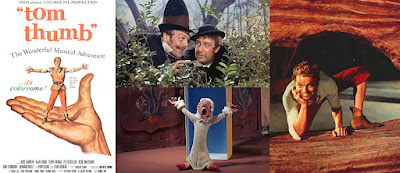
I must have been not much more than a nipper when I last saw tom thumb. It was one of those films that was perpetually showing on television every Bank Holiday and Christmas in the UK throughout most of the 1970s and probably the 1980s too. A well loved favourite that people didn’t fail to tune into. I wasn’t particularly wanting to see it again however but, my dad was keen to remake the acquaintance of the movie and I can remember him singing songs from this throughout the 70s (and sometimes still). So I took a gamble for his birthday because the only way this is still available to see, from what I can gather, is from a Region 1 Warner Archive DVD (it’s kind of a shame this isn’t available in Blu Ray) and reports were mixed as to whether the film was in the correct aspect ratio or not. Or maybe I’m just too old and ‘full frame’ doesn’t mean what it used to (which certainly used to mean a 4:3 aspect ratio whether the film was shot like that or not). Well, for anyone else wanting to pull the trigger on this one, let me assure you that the film is, at least, presented in its original 1.85:1 aspect ratio on the Warner release.

And it’s such a charming film. It kind of does seem made for kids in some ways because the acting is much broader than what you might normally see in an MGM Musical of the time... but that makes it no less entertaining and, although the special effects which won an award in its day are somewhat creaky now, the film hasn’t really lost any of its magic and, another plus if you’ve never seen it before, is that the story really doesn’t always go in the direction you think it will.

The film starts with a wonderful title sequence where a big old leather or Rexine-style bound book is shown bearing the title of the film in really small print. Then a hand with a magnifying glass passes over it so we can read said title before the pages start turning and we are introduced to the various cast members as page after page of illustrations etc. After this the film carries on with the magical Queen of the Forest (played by June Thorburn) asking the Woodcutter (Bernard Miles) not to cut down the big oak which has enough timber to keep the village warm all winter. For his kindness at eventually agreeing she grants him three wishes but, when he goes home to tell his wife (Jessie Matthews), the two of them accidentally waste their three wishes in sausage related mishaps. However, as a last streak of kindness, the Queen gives this childless couple a child of their own... except, instead of a baby, they get a full grown Tom Thumb, played by Russ Tamblyn, shrunken down to around 10 inches instead.

All goes well and we have singing and dancing and George Pal, who had what was more or less his first go at directing his first feature length film here instead of just producing (and it was a roaring success for him), also uses his ‘puppetoons’, which are basically stop motion characters such as Ray Harryhausen would later animate in movies, as various toys and objects that dance around and speak with Tom when the parents aren’t around (hmm... where have I heard that premise before?).

Then we’re introduced to the romantic interest, Woody, played by Alan Young, who wants to pair up with the Queen of the Forest but can’t until he’s kissed her and made her mortal. And also, the two villains of the piece, played by Terry Thomas and Peter Sellars. The film has some wonderful scoring by Douglas Gamley and Ken Jones (which I can’t believe has not made it onto CD as yet) and some of the work on the songs was by Peggy Lee (I’m not sure how much of a contribution she made, though). Actually, the songs are great and the sequence with the animated ‘yawning man’, voiced by the always brilliant Stan Freberg, is particularly infectious and is almost guaranteed to make any audience watching the scene feel sleepy.

There’s a nice symmetry to some of the shots as Pal uses uprights such as a bed post at centre of the screen while the woodcutter and his wife sleep, somewhat innocently, head to head, horizontally in bed, facing away from each other with the tops of their heads united (no wonder they never produced any kids... this position is not something you’ll find in the Karma Sutra). Something tells me this style of framing is so the audience gets used to it when sly techniques are used to try and cover up certain special effects trick shots throughout the movie. Some of these effects are successful... and there a few oversize novelty sets for when just Russ Tamblyn is on screen... but there are also quite a few bad matte lines in the picture, it has to be said.

There’s also a certain sense of traditional fairy tale cruelty laying at the hear of the film, such as when the woodcutter and his wife are charged with robbing the villages gold and instead of sentencing them to prison they are sentenced to a public whipping. Apparently, the ‘whipping guy’ had forgotten to be cast on the day of the shoot and so the masked character is Peter Sellars, doubling up on roles. Of course, this film is based on a fairy tale from The Brothers Grimm, who were not known for holding back on the gore and nastiness content of their tales in their original translations (they have become somewhat cleaned up throughout the years in different international versions) but the movie, at least, doesn’t make good on this particular set up, as Tom and Woody race against time to bring the real culprits to justice before the whipping begins. There’s even a nod to the source material as Russ Tamblyn is seen dancing on the cover of a copy of Grimm’s Fairy Tales early in the movie. Of course, he would reprise his role as Tom Thumb as well as playing another character just four years later in the big Cinemascope production of The Wonderful World Of The Brothers Grimm.

The acting in tom thumb is, as I said, not exactly subtle but I do like the fact that the film really doesn’t take itself too seriously and loved the fact that, when Tom is lowered by rope into the treasury, the bags of gold are labelled up as either ‘Gold’ or ‘More Gold’. And its little details like this within the frame that keep the film from getting dull at any point and make it a bit of a carnival ride entertainment. So there you have it... if you’ve not seen tom thumb then maybe you were missing out in your childhood. It’s full of wonderful, larger than life situations which, may seem humdrum now but which must have been a thrill to see at the cinema on its first release and, I for one, am certainly glad to be falling back under its spell again. Definitely worth a watch if you enjoy fantasy cinema and this film opened the doors to Pal directing an unproduced film he’d always wanted to have a go at, his amazing version of The Time Machine (which is another of the many classics which he either directed and/or produced). It would be nice if we could get a Blu Ray of this but, until then, the Warner Archive DVD is probably the best way you’re going to see this, almost but not quite, forgotten classic these days.