Showing posts with label Russ Tamblyn. Show all posts

Thursday, 30 December 2021

tom thumb


Yawn Of
The Bed


tom thumb
UK/USA 1958
Directed by George Pal
Warner Archive DVD Region 1


I must have been not much more than a nipper when I last saw tom thumb. It was one of those films that was perpetually showing on television every Bank Holiday and Christmas in the UK throughout most of the 1970s and probably the 1980s too. A well loved favourite that people didn’t fail to tune into. I wasn’t particularly wanting to see it again however but, my dad was keen to remake the acquaintance of the movie and I can remember him singing songs from this throughout the 70s (and sometimes still). So I took a gamble for his birthday because the only way this is still available to see, from what I can gather, is from a Region 1 Warner Archive DVD (it’s kind of a shame this isn’t available in Blu Ray) and reports were mixed as to whether the film was in the correct aspect ratio or not. Or maybe I’m just too old and ‘full frame’ doesn’t mean what it used to (which certainly used to mean a 4:3 aspect ratio whether the film was shot like that or not). Well, for anyone else wanting to pull the trigger on this one, let me assure you that the film is, at least, presented in its original 1.85:1 aspect ratio on the Warner release.

And it’s such a charming film. It kind of does seem made for kids in some ways because the acting is much broader than what you might normally see in an MGM Musical of the time... but that makes it no less entertaining and, although the special effects which won an award in its day are somewhat creaky now, the film hasn’t really lost any of its magic and, another plus if you’ve never seen it before, is that the story really doesn’t always go in the direction you think it will.

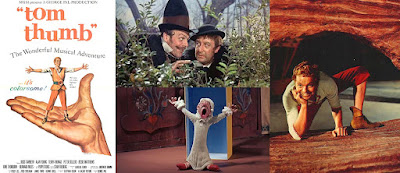
The film starts with a wonderful title sequence where a big old leather or Rexine-style bound book is shown bearing the title of the film in really small print. Then a hand with a magnifying glass passes over it so we can read said title before the pages start turning and we are introduced to the various cast members as page after page of illustrations etc. After this the film carries on with the magical Queen of the Forest (played by June Thorburn) asking the Woodcutter (Bernard Miles) not to cut down the big oak which has enough timber to keep the village warm all winter. For his kindness at eventually agreeing she grants him three wishes but, when he goes home to tell his wife (Jessie Matthews), the two of them accidentally waste their three wishes in sausage related mishaps. However, as a last streak of kindness, the Queen gives this childless couple a child of their own... except, instead of a baby, they get a full grown Tom Thumb, played by Russ Tamblyn, shrunken down to around 10 inches instead.

All goes well and we have singing and dancing and George Pal, who had what was more or less his first go at directing his first feature length film here instead of just producing (and it was a roaring success for him), also uses his ‘puppetoons’, which are basically stop motion characters such as Ray Harryhausen would later animate in movies, as various toys and objects that dance around and speak with Tom when the parents aren’t around (hmm... where have I heard that premise before?).

Then we’re introduced to the romantic interest, Woody, played by Alan Young, who wants to pair up with the Queen of the Forest but can’t until he’s kissed her and made her mortal. And also, the two villains of the piece, played by Terry Thomas and Peter Sellars. The film has some wonderful scoring by Douglas Gamley and Ken Jones (which I can’t believe has not made it onto CD as yet) and some of the work on the songs was by Peggy Lee (I’m not sure how much of a contribution she made, though). Actually, the songs are great and the sequence with the animated ‘yawning man’, voiced by the always brilliant Stan Freberg, is particularly infectious and is almost guaranteed to make any audience watching the scene feel sleepy.

There’s a nice symmetry to some of the shots as Pal uses uprights such as a bed post at centre of the screen while the woodcutter and his wife sleep, somewhat innocently, head to head, horizontally in bed, facing away from each other with the tops of their heads united (no wonder they never produced any kids... this position is not something you’ll find in the Karma Sutra). Something tells me this style of framing is so the audience gets used to it when sly techniques are used to try and cover up certain special effects trick shots throughout the movie. Some of these effects are successful... and there a few oversize novelty sets for when just Russ Tamblyn is on screen... but there are also quite a few bad matte lines in the picture, it has to be said.

There’s also a certain sense of traditional fairy tale cruelty laying at the hear of the film, such as when the woodcutter and his wife are charged with robbing the villages gold and instead of sentencing them to prison they are sentenced to a public whipping. Apparently, the ‘whipping guy’ had forgotten to be cast on the day of the shoot and so the masked character is Peter Sellars, doubling up on roles. Of course, this film is based on a fairy tale from The Brothers Grimm, who were not known for holding back on the gore and nastiness content of their tales in their original translations (they have become somewhat cleaned up throughout the years in different international versions) but the movie, at least, doesn’t make good on this particular set up, as Tom and Woody race against time to bring the real culprits to justice before the whipping begins. There’s even a nod to the source material as Russ Tamblyn is seen dancing on the cover of a copy of Grimm’s Fairy Tales early in the movie. Of course, he would reprise his role as Tom Thumb as well as playing another character just four years later in the big Cinemascope production of The Wonderful World Of The Brothers Grimm.

The acting in tom thumb is, as I said, not exactly subtle but I do like the fact that the film really doesn’t take itself too seriously and loved the fact that, when Tom is lowered by rope into the treasury, the bags of gold are labelled up as either ‘Gold’ or ‘More Gold’. And its little details like this within the frame that keep the film from getting dull at any point and make it a bit of a carnival ride entertainment. So there you have it... if you’ve not seen tom thumb then maybe you were missing out in your childhood. It’s full of wonderful, larger than life situations which, may seem humdrum now but which must have been a thrill to see at the cinema on its first release and, I for one, am certainly glad to be falling back under its spell again. Definitely worth a watch if you enjoy fantasy cinema and this film opened the doors to Pal directing an unproduced film he’d always wanted to have a go at, his amazing version of The Time Machine (which is another of the many classics which he either directed and/or produced). It would be nice if we could get a Blu Ray of this but, until then, the Warner Archive DVD is probably the best way you’re going to see this, almost but not quite, forgotten classic these days.

Thursday, 23 September 2021

Black Heat


Route Kicksty Kicks

Black Heat
aka The Murder Gang

USA 1976 Directed by Al Adamson
IIP/Severin Blu Ray Zone A/B/C


Warning: Spoilers I guess... c’mon, it’s Adamson.

Okay, so the next title up for me to watch in Severin’s pretty thorough Al Adamson - The Masterpiece Collection is one of his attempts to ‘cut it’ in the popular Blaxploitation market, albeit it’s kinda late in the cycle. Black Heat gives us lead actor Timothy Brown as... drumroll please... Kicks Carter! There’s a character name for you. Along with his partner Tony, he makes up a two man army of streetwise cops as they keep their ear to the ground (okay, not literally) and get the ‘dope on the streets’ and, you know, all that stuff.

Now, this really isn’t one of Adamson’s best pictures by a long chalk (but hey it’s more watchable than movies like the truly diabolical Brain Of Blood, reviewed here and Nurses For Sale, reviewed here) and the plot on this one almost, but not quite, made sense.

So... bad guys make a deal to trade weapons in the desert (because, Al Adamson, of course he’s shooting in the desert as much as possible) for high grade drugs for the main bad guys that ‘bad guy number one’ is working for... namely psycho Ziggy played by Russ Tamblyn and his boss lady, who owns a nightclub. A nightclub where various ladies employed there have been connected to a series of crimes. With me so far? Okay, so the deal is set but Ziggy needs to blackmail Tony’s girlfriend Terry, played by Jana Bellan, to get them the movements of a security guy from the firm she’s working in, so they know when he’s carrying some money in a suitcase strapped to his wrist. This is after they get rid of suspicious cop Tony and our main man Kicks has to go it, more or less, alone... apart from some other guy who’s next to useless and his sexy news journalist lady Stephanie, played by Tanya Boyd, along for the ride.

Okay, after some shenanigans where it’s revealed that Kicks’ good guy informant, who has a lot more of a vibrant personality than him anyway, is supplying arms (keeping Kicks informed so he can nab them all in the desert) while the bad guys get the money by killing the security guy and cutting his hand off for the case. More shenanigans ensue and there’s a big showdown at the nightclub where Tamblyn gets killed... and then another showdown in the desert where Kicks’ informant gets blown away and the last of the villains takes off with the weapons in a private plane, only to be blown up when a rogue shot from Kicks starts a fire near all that ammunition... in a shot of ‘something’ exploding hastily cut in next to footage of the plane, which looks suspiciously like the same footage from The Fakers (reviewed here)... which I suspect was also tracked in footage back then.

What else? Well... Adamson turns up as a gambling customer in one scene. There’s nudity and rape and it’s mostly unpleasantly handled because... well... I think it’s supposed to be edgy. Actually, the scene where Adamson’s wife, Regina Carrol as Valerie... a friend of Kicks, Tony, Terry and Stephanie... gets interrogated by Tamblyn and co with a brutal beating, has some good make-up so it actually does look like she’s having a rough time there. Carrol wasn’t such a bad actress and she comes through in scenes like this. That being said, Adamson’s also given her a long scene where she’s at a piano singing a song for the nightclub customers which... well, it’s not a great tune and it goes on for too long so, it does kind of stop any impetus the movie was trying to build on stone dead at that point. Also, I can’t work out what her character is doing in the movie in the first place. She seems to be way surplus to requirements and, the one time at the end when I thought the bad guys were going to use her as a hostage and thus give a dramatic purpose to her inclusion... they didn’t. In fact, all the way through the picture, the bad guys just seemed to be really stupid... not even realising the cops were onto them before they were already, more or less, knocking down their door.

And there’s not much that’s remarkable in this movie, to be fair. The action scenes are okayish but almost all of them take place in either the desert or on rooftops and, I’m only just realising that when his characters are in an urban environment in these kinds of movies, Adamson generally tends to shoot a chase or two on the rooftops because, well I suppose it’s easier to deal with no crowds and I suspect you can film these low key without paying any licenses. That’s just my best guess though.

Actually, there is one scene which stands out, not because it’s particularly well executed but because it has an unusual outcome. It’s when Kicks is trying to hostage negotiate a guy down from a building and into a getaway car without getting the woman that the guy's taken taken, who is wired up as a human bomb, blown up. Well, that’s a complete failure because, once the psycho packs his hostage into the car he gets in beside her ready to drive off, his wires have got caught in the car door and when he shuts it the car goes up with them in it anyway (I think this may be the sequence that Adamson recut into the end of Doctor Dracula, reviewed here). Which is kind of unusual but I think it matches the slightly bleak attitude Adamson gave to some of his projects.

And there’s not much more for me to say on this one. I didn’t mind it but Black Heat is probably the worst example of the genre I’ve seen (so far, I think he made some more of these kinds of movies) and it’s not something I’d recommend to anyone, to be honest. A bit lukewarm rather than the temperature expectations implied in its title, I would say.

Wednesday, 23 June 2021

Satan's Sadists


Uneasy Riders

Satan's Sadists
USA 1969
Directed by Al Adamson
Severin Blu Ray Zone A/B/C


Not, surprisingly, riding the dust of Easy Rider, which came out around five months after this movie was released, Satan’s Sadists was nevertheless still trying (and apparently succeeding) to capture the biker gang youth market of the time. Now, frankly, I hate these kinds of movies about leather and jeans clad biker hoodlums riding, raping, murdering and generally terrorising their way across the streets and, in this case, deserts of America but, well, all I can say is that at least this film was a little more engaging than the previous Al Adamson film I’d seen in Severin’s beautiful Al Adamson - The Masterpiece Collection Blu Ray set... namely Brain Of Blood (reviewed here).

The film starts with some road shots of bicycles, some of which, I’m pretty sure, turned up again later that year in the Hell’s Bloody Devils recut of The Fakers (which I reviewed in various versions here). We meet the Swastika decalled Satan’s Sadists, led by their chief named Anchor, played by everyone’s favourite Jet from West Side Story, Russ Tamblyn. Tamblyn’s 'look' in this film, in which he nearly always appears with red sunglasses and a big hat pulled down almost completely over those glasses, was apparently his own choice because he wanted to disassociate himself from this kind of movie with audiences. However, his name’s plastered all over the marketing, along with the fact that the film was shot, like The Female Bunch (reviewed here), on the infamous Spahn Ranch just before Charlie Manson’s ‘hippie killers’ went nuts and killed Sharon Tate. The marketing campaign for the film made much of this, apparently.

Okay, so we start off in a pre-credit sequence where Tamblyn and his gang... including Adamson regulars John 'Bud' Cardos, Robert Dix and, in an ‘introducing’ credit, Adamson’s future wife Regina Carrol playing the underappreciated, ‘besotted with Anchor’, sleazy biker chick... rape a lady and then kill her and her lover by pushing alcohol into their system and pushing their car off a nearby cliff. Again, I’m pretty sure it’s the same car roll and explosion used in other Adamson films such as Blood Of Dracula’s Castle (reviewed here).

We then have Bob Le Bar’s opening title sequence which is, pretty much the only saving grace of the movie, I would say (and still it’s more interesting than Brain Of Blood). Adamson then takes a divergence to set up various characters. So we have Jacqulin Cole playing Tracy, who goes to work in a desert cafe while her three lady friends head off into the mountains to camp and pick up stuff for their college Geology lessons. We also have hitchhiker and ex-marine Johnny Martin, played by Gary Kent. He hitches a ride with a big city cop on vacation with his wife and they all find their way to stop at the same cafe where Tracy works with her boss, played by another Adamson regular, Kent Taylor. And by this point you kinda know they’re all just there to be fodder for the biker gang who, naturally, turn up and terrorise them all. The cop’s wife is raped and they, along with the boss of the cafe, are shot by Anchor. However, Johnny and Tracy escape after Johnny has killed two of Anchor’s clique who were guarding them. This is apparently the first film to have somebody drown by having their head flushed in a toilet.

And this is where the film almost got very interesting but, well... at least it doesn’t quite continue as these films often do, with more of the same. Well, actually some of the same but, after Johnny and Tracy have to abandon Tracy’s beach buggy, they head into the mountains to try and evade... Satan’s Sadists. So here the film becomes a cat and mouse game between the bikers and the two fleeing protagonists... which has a lot of potential as a kind of pre-Rambo 'outdoors trap' movie... and I wish maybe somebody would actually make that film one of these days. However, the bikers come across the three camping Geology babes and terrorise them instead, while two of the bikers continue looking for our main protagonists. This includes a character called Acid spiking everybody’s coffee with LSD and they all have what I can only describe as a soft focus, very tame, desert pseudo-orgy with an overly used camera zoom. So, yeah, it’s a terrible way of bringing a grimy, shabby sexuality into the movie which is in no way thrilling and, frankly, quite dull. Of course, Anchor decides to shoot the girls too but, at least he does it off screen at some point.

While said orgy is occurring, rejected Regina Carrol rides her bike through the desert until her inevitable crash and burn moment, which you totally knew must be coming, as she rides her bike off a cliff. I’m beginning to notice a bit of a trend here as Adamson’s muse Regina seems to be having the same kind of brutal death luck that Dario Argento’s former muse, Daria Nicolodi, used to have in his films.

And by this point, most of the gang have either accidentally killed each other or themselves (LSD fuelled death by a solo version of Russian roulette anyone?) before they even get near the escaping witnesses. Johnny does take care of a few of them, though, leaving Tamblyn to die the last as Johnny and Tracy ride off into the sunset.

While I’m extremely grateful to Severin for making Satan’s Sadists and many other Adamson movies available in their box set, this is a movie I’m guessing I’ll never watch again. It held my interest for what it was but I have no desire to watch slacker hoodlums terrorising innocent folk as a regular part of my cinematic diet. I think there may be a couple more biker movies in this set and I shall definitely check them out for this blog but, yeah, films like this one are not why I made the purchase, in all honesty. Nothing really against these kinds of pictures it’s just that they’re... not really my cup of tea. Steer well clear unless you love these kinds of films, would be my advice.

Thursday, 25 March 2021

The Female Bunch


Sucker Bunch

The Female Bunch
USA 1971 Directed by Al Adamson
Severin Blu Ray Zone A


Warning: Some spoilers I guess but,
you know, it’s an Al Adamson movie!


Last year I talked about ‘Blu Ray boutique label extraordinaire’ Severin’s labour of love boxed set, Al Adamson - The Masterpiece Collection, when I reviewed the accompanying new documentary film, Blood And Flesh - The Reel Life and Ghastly Death of Al Adamson (review is right here). Well, it’s finally time for me to crack open this, sadly out of print, box set of thirty two Adamson feature films with the first movie in the set (doubled up on a disc with the aforementioned documentary)... The Female Bunch. For the record, I’m going to review all of these movies in the order that they’ve been put together in the set (as opposed to both the release date order and, indeed, the production order... which is also an entirely different and more fluid thing).

The film starts off with the following warning from Severin: The Female Bunch was scanned and restored from several faded 35mm release prints of varying physical condition. The negative is believed lost. Every effort was made to use the least damaged sections of each print to ensure the best possible image quality throughout.

And they’re probably right to do that because, although it’s a nice, clean transfer, it looks like it’s in terrible shape but, frankly, with a film like this, that quality kind of adds to the whole grindhouse charm of the thing. When Tarantino and Rodriguez did their Grindhouse double bill movie, they decided to add a distressed look to their movies... here Severin get the effect for free, from the various prints actually having suffered from a heck of a lot of wear and tear. What they don’t do is give you a word of warning about how bad the movie is but, that’s okay, I was kind of expecting it anyway and, you know, it’s kind of a ‘so bad it’s good’ movie anyway.

The film starts of with a man and a woman in an open top car driving along a desert road, pursued by a bunch of women on horses (yeah, that’ll be The Female Bunch then) and a gal shooting at them from a light aircraft. Their tyres get shot out and they make a run for it, finding a cave to hide in but not before the guy is shot, receiving an energy sapping wound just below one of his shoulders. The girl removes his shirt to get a look at the wound and screws it up into a disposable bundle. She then takes off her shirt to wrap around him which, to be fair, is what all the young ladies in these kinds of movies seem get around to doing anyway. Might as well get it out there early, I guess.

Anyway, as she stands in the cave in her underwear, the guy asks her “How did you get involved in this mess?” Which is a phrase that suddenly loops around on the soundtrack about six times as the camera zooms in on her face. After almost a minute of this, maybe, I kinda got the idea that this is a framing device and indicates a flash back as the girl, Sandy (played by Nesa Renet) lapses into voice over and tells how a string of hard luck and a failed romance with a night club singer played by Don Epperson ended up with her being discovered by her friend Libby (played by Adamson’s long standing muse Regina Carrol), half passed out on her bed after taking a bunch of pills in an effort to kill herself.

So Libby does what any good pal would do... she takes her blindfolded to a ranch in the hills so she can take an initiation test of being buried in a coffin, so her half psychotic friends, The Female Bunch, can take her on as one of their own... a bunch of women who live in freedom on their ‘no men allowed’ ranch , living off the drug money that their boss, Grace (played by Jennifer Bishop) uses for their expenses. Frankly, these are an antagonistic and unsympathetic bunch and just why the heck Libby hangs out with them is anybody’s guess. And there they live at their ranch, terrorising a local Mexican while, at the same time, tripping over to the border most nights to party it up at the local Mexican bar and having ‘sexual relations’ with various guys (asides from their man-hating boss, who prefers the lady flesh).

It’s here that one of the girls gets it on with one of the film’s two, very well known actors. Russ Tamblyn plays Bill, who is given a map to how to get to the ranch and this particular girl’s room so they can get it on again later in the week. However, with Grace’s ‘no men allowed’ policy, when the two are caught, The Female Bunch rough up Tamblyn and brand his forehead with a cross.

I’d just like to say that, for a lady who has a ‘no men allowed’ on the ranch policy, it seems somewhat strange that she has a stable hand/drug stash security guy who lives on the ranch with them, in the guise of Lon Chaney Jr in the last film he ever shot. Not the last film he was in that was released (that would be Adamson’s Dracula VS Frankenstein, which I reviewed quite a while ago here) but the last film he actually shot, six months after that one (he died in 1973). This makes no sense of the ‘no men’ policy whatsoever, of course, because the last time I checked, Lon Chaney Jr was definitely a man but, oh well, artistic licence I guess. It’s a sad performance because he has a raspy voice and that’s because of the radiation treatment he was having for his throat cancer. Of course, after hearing an anecdote from one of the crew on an accompanying extra about how the film was shot in a ‘Dry State’ and how he would have to go out every day to another county to bring back Chaney Jr’s quart of vodka that he drank every day, I can’t but help think that the excessive amounts of alcohol may also have something to do with how his voice sounds in this one but... yeah, throat cancer and it’s very sad.

Grace maybe starts to question Chaney Jr’s ‘definitely a man’ status too at some point because, after he hassles her for sex once too often, she hits him on the head with a hammer and has a horse drag him into the desert to die. Then she goes on a bit of a killing spree because, Mr. Tamblyn is understandably upset with having a big cross branded onto his forehead. He gets a friend to drop him at the ranch (the same guy who is shot at the start of the movie and inspires this whole extended flashback of a story) and tries to ‘revenge rape’ Grace. For his trouble he gets a pitchfork in the back and his friend, when he comes to pick him up, gets tied up and left in a barn while the girls decide what to do with him.

Then, with almost no foreshadowing whatsoever, Sandy decides to leave the group of psychotic ladies, releases him and they do a runner, finally catching up to the story and ending the flashback, leading into the last five minutes of the movie which I won’t spoil here for you but which features the return of another character from earlier in the film in a kind of ‘deus ex machina’ rescue moment.
 

And the film is pretty interesting. There’s lots of naked boobage revealing a variety of different nipple types (if that’s what you’re into) and a bizarre propensity by the director, I felt, to shoot everyone just a bit too close up. There’s lots of rolling around in the hay and, even though it’s certainly not as explicit as most modern movies, it does feel genuinely grubby and sleazy as the movie plays out. The tone of it is a little like watching Russ Meyer’s revered classic Faster, Pussycat! Kill! Kill! (reviewed by me here) but with a lot more women and, somehow it's a lot less better shot. Also, I’ve complained that the art of using a zoom lens properly is something which has really gone out of style in modern motion pictures. Let me assure you though, if more directors used a zoom lens as often and as badly as Al Adamson does in this picture, then its no wonder people would want to bury the technique.

There are some bizarre things in here that are fair;y questionable. One of the girls shoots another up with heroine (or something stronger), for example and then, instead of it dulling her senses, they have trippy lesbian sex. I know it must be trippy because the director uses one of those lenses (I’ll call it a fly’s eye lens because I don’t know what I’m talking about) where the girls are in the same image in little shots combined all around the screen. So, yeah, it’s trippy and wild, man.

Another thing of note and, alas, ridicule is the ‘day for night’ sequences when the girls visit the Mexican saloon. Much as I hate those filters, I have to say that the second time they go to the place it seems like the film crew just forgot to put the filters on the camera. Oh no, wait... they did for that shot, but not for that shot... no it’s gone again. Night and day change pretty quickly in Mexico it seems (every few seconds in some cases).

The soundtrack on the film, by a guy called Jaime Mendoza-Nava, is not very good. It plays like a bad, mid-sixties American Western score and, for all I know, it might well have been one. But it does add to the bizarre atmosphere of the flick in some way... just not in a way to effectively raise the level of the imagery, is my take home from that.

Something of note is that the majority of the film was shot two years before it was released, in the Summer/Fall of 1969, at the infamous Spahn Ranch. So, yeah, it was while the Manson Family were occupying it and there’s a chilling story on an accompanying extra by one of the film crew about, well, a very lucky escape they think they possibly had with the young ladies who killed Sharon Tate.  Pretty heavy stuff. One interesting piece of trivia from one of the actresses, Leslie McRay, on a bonus feature, is that she was actually the poster girl for the iconic shot of a girl with a lizard superimposed onto her for one of the many posters for Lizard In A Woman’s Skin (movie reviewed here). I always assumed it was Florinda Bolkan who was on that poster but, no, it was this young lady... so that’s an interesting bit of trivia I’ve never been able to pick up from anywhere else.

All in all I’d have to say that, while I found a lot to ridicule in The Female Bunch, I did have a pretty good time with it and it certainly won’t be the last time I watch this one. I can only recommend this wonderful set and I’m so glad I talked myself into investing the cash. That’s one down, 31 left to go.

Sunday, 5 July 2020

Blood and Flesh - The Reel Life and Ghastly Death of Al Adamson


What Lay Beneath

Blood and Flesh - The Reel Life
and Ghastly Death of Al Adamson

USA 2019 Directed by David Gregory
Severin Films  Blu Ray Zone A/B
As part of the Al Adamson -
The Masterpiece Collection 32 film Blu Ray set


I’ve only, at time of writing this, seen one of Al Adamson’s movies before. That was the incredibly bad but hugely entertaining Dracula Vs Frankenstein (reviewed, succinctly, by me in my early days of this blog here). However, there were a few I had on my list to try and get hold of but then Severin, who are a label worth reckoning with, released this limited edition, very long term project they’ve been working on for... well something like a decade, I think. And it’s really expensive too... probably the most expensive set I've ever bought. I finally pulled the trigger on this thing right before it sold out because... well I’d saved money from not travelling during the coronavirus lock down and it was likely that I would never again have the opportunity to see these films unleashed all in one place at the same time... 32 movies. So I wept into the remains of my tattered wallet, bit the bullet and ‘done the deed”.

This set also features this brand new feature length documentary film... Blood And Flesh - The Reel Life And Ghastly Death of Al Adamson, which was directed by David Gregory, who had made Lost Soul - The Doomed Journey Of Richard Stanley’s Island Of Dr. Moreau, which I watched and reviewed earlier this year (right here). Now, normally I would leave the documentary in a new set until after I’d watched all the other films but I figured, in this case, since I knew so little about Adamson (but had heard some disquieting rumblings), that it might be worth watching this thing so I could get an overview of his career and the strange way he finished his life.

Turns out Adamson was the son of an old, early Hollywood cowboy star/director called Denver Dickson (Victor Adamson) who turned down an offer with Universal studios in favour of making his films for his own production company. He had numerous movies coming out just at the tail end of the 20s and into the 30s, 40s etc as well as appearing uncredited in many movies and TV shows over the years up until his final appearance in the aforementioned Dracula Vs Frankenstein (he appeared in 285 productions according to the IMDB). So I guess the world of B-movie show business was somehow in Al Adamson’s blood when he started trying to direct/produce and also appear in his own films.

He was very much one of those kings or princes of the American made exploitation films and I guess you would think of him in the same breath as people like Herschell Gordon Lewis or, in some ways, a poor man’s Roger Corman, with even smaller budgets than Corman but making pictures which did very well on the drive in circuits in the 1960s and 1970s. This documentary details his story with interview footage from producers, friends, co-stars and even some of his stars, such as the legendary Russ Tamblyn, who was in a few of his movies like biker gang film Satan’s Sadists, Black Heat and the Dracula Vs Frankenstein movie. It also has appearances by Adamson himself in archival interview footage which must have been taken not too many years before the ghastly death mentioned in the title.

It shows many of the people who he worked with in some capacity or another such as... well lets just do a little list to whet your appetite...  Colonel Sanders (the real one, promoting his Kentucky Fried Chicken in one of Adamson’s shoots), Charles Manson (he shot one of his movies on the ranch shortly before, or possibly during, the famous murders), John Carradine, Jim Kelly, Lon Chaney Jr, J. Carrol Naish, George Lazenby and even Forrest J. Ackerman. Some of these are seen only in clips from the director’s movies and some of them in archival footage. And it’s a rare treat listening to some of the stories his friends and crew tell... many of them who were working for ‘experience’ and no fee on Adamson’s shoots. It’s also amazing to discover that he was working with the likes of such famous cinematographers as Vilmos Zsigmond and László Kovács very early on in their careers too.

Additionally, there’s the tale of the unseen footage, enough for three movies, where Adamson was called in to make a dramatised documentary film about UFOs. He was a total non-believer in the stuff until, it’s alleged (and then the various interview subjects clam up when they realise the camera is still running), he was taken to meet a fully documented alien/human hybrid person and that, after a while, everyone backed away from the film they had been making because they all thought it was too dangerous because... yeah, government and ‘other worldy’ intervention.

It’s also tells of the tragedy of his losing his wife Regina Carrol, who starred in most of his films, to cancer a few years before Al’s untimely death. Followed by that tragedy itself as Al was hammered to death by a friend who he was hiring to work on a ranch he was living at, only to be buried in a bag under where the old jacuzzi was, which had been ripped out and replaced with his corpse before being cemented in and having tiles laid out over the top of him. The last part of the documentary plays like a police procedural set of interviews as friends, relatives and various law enforcement officials talk you through the details of how the missing director was finally ‘discovered’ and how they found the culprit living in Florida with his latest girlfriend and her young child, safely bringing the killer (who denies it to this day but the evidence seems pretty damning) to justice (of a kind).

And, yeah, it’s certainly an interesting narrative... usually when a documentary of this kind surfaces, it doesn’t end with the director getting murdered in a way which wouldn’t look out of place in one of his own, sometimes gory movies. It’s a hell of a way to finish up a movie which suddenly takes a turn in a different direction from the way it started out and, of the two documentary films I’ve seen by David Gregory, as interesting as that other one was, I think this one is even better. It really is a nicely put together, informative and straight-on look at one of those ‘maverick’ directors, if I may use the term, who probably wouldn’t be remembered in a lot of people’s top ten movie lists but who certainly gave the backdrop of American cinematic culture an added layer of questionable texture and who is... unforgettable in his own way.

Of course, it goes without saying that Severin’s amazing new box set is crammed full of extras for each and every film (including this documentary) and is beautifully packaged as a book in a slip case with the fourteen Blu Rays housing the 32 films in a series of double page spreads including poster artwork from the films, not to mention a sizeable bound book talking about these, also housed within the slipcase. And if you don’t want to shell out for this full retrospective career of the man’s work, painstakingly restored by Severin in ways that you wouldn’t expect films like this to be enthusiastically resurrected, then this documentary can also be bought as a stand alone release from the same company. If you are into the history of exploitation films of all kinds... secret agents, blaxploitation, horror, sexy stewardesses and various examples of ‘niche’ moviemaking, Blood and Flesh - The Reel Life and Ghastly Death of Al Adamson is probably something you’re going to love. Definitely worth checking out, that’s for sure.

Tuesday, 23 June 2020

The Haunting Of Hill House


Eleanour Handbasket

The Haunting Of Hill House -
Extended Director’s Cut

10 episodes. 2018
Directed by Mike Flanagan
Paramount Blu Ray Zone B


Warning: This one has spoilers for pretty much all iterations of Shirley Jackson’s The Haunting Of Hill House.

Well this is going to be a hard one to write about because, in some ways, it feels almost like a personal attack on one of my favourite movie adaptations, the great 1963 version of The Haunting (which I reviewed here), based on Shirley Jackson’s novel The Haunting Of Hill House. Easily the best horror movie ever made and I suspect that’s why horror director Mike Flanagan, who I actually find fairly hit and miss, was so drawn to it. Everybody loves this novel/movie and, if you can get it right, it’s one of the scariest things you could do.

Alas, I’ll be up front here and say the reason why I’m torn on this new TV series ‘adaptation’, for want of a better word, is that it happens to be a quite well made TV show while, at the same time, having almost nothing in common with the original text.

That’s not to say the original text doesn’t make it into this iteration. It’s peppered all over the place throughout the series, just in completely different context. Richard Johnson’s opening delivery of Shirley Jacksons words, for example, open the series but this time spoken by the character Steven Crain and it is he who speaks dead Eleanour’s (Nell’s) lines at the end of this version.

Other examples would be the repeat dialogue from caretaker Mrs. Dudley’s line reading... “In the night... in the dark.” At least it’s, most of the time, Mrs. Dudley’s character who is saying it throughout the series here but there are a lot of lines of dialogue which are taken out of the mouths of others and given to different characters with a completely different context to the words... kinda like a fanboy homage to the original. Which in some way, I can’t really blame the writers for.

And as for the “Oh God, who’s hand was I holding!” moment, which was so terrifying in the 1963 adaptation (even though it was used as a highlight of the trailer), it’s referenced here at least twice by different characters. It’s like they wanted to have two different ways of giving us the same kind of scare (which is truly terrifying in the novel and original film version) but failing in the scare department and indulging themselves twice.

Not to mention a load of name drop references to people and things associated with the legacy... such as the funeral home being called Harris, in reference to Julie Harris who played Eleanour/Nell in the original movie. Heck, they even bring back Russ Tamblyn, who played Luke in the original, as Nell’s psychiatrist. Not to mention Nell’s ‘paranormal’ hail stone attack back story incident actually being present in the narrative, albeit given to the mother figure here, Olivia.

So, okay... I’ll start off with listing all the really bad points before finding my way to the positives because, it is a gripping TV show, even if it has nothing to do with the original...

Rather than three strangers brought together by the parapsychologist in the original... Nell, Theo and Luke are all siblings, along with their other brother and sister Steven and Shirley (obviously named after writer Shirley Jackson). They, along with their mother and father, played here by Carla Gugino of Sin City and Henry Thomas, who played the little boy in E.T. - The Extra Terrestrial, all live for a few months in Hill House. So when they eventually return (in the final episode), the events which are manifest are things which have been with them all their lives.

And the film takes a time jump kind of approach... which wouldn’t really be even doable if the director was making a straight adaptation. That is to say, the narrative keeps cross cutting from when the central characters were kids in Hill House to their various lives in the present (like in the original Stephen King novel IT)... where we have Timothy Hutton playing the older version of Henry Thomas’ Hugh Crain... another name which will mean something to fans of the original work but, again, taken totally out of context here. It’s actually not that confusing but the very nature of the structure is enough to tip you off to certain things as, of course, ghost stories have always been trafficking in states of temporal manipulation... ghosts by their very nature are ‘of a time’ different to that when they manifest.

For example, the death of Eleanour at the end of the novel/film is done and dusted in the very first of these ten episodes (half of the content of which doesn’t even take place in the titular residence). It’s not even the same death, instead it harkens back to the character who hung herself from the top of the spiral staircase at the start of the 1963 version. However, once Eleanour dies it’s more than enough to tip off the audience that the ‘bent-neck lady’ as seen by young Eleanour throughout the series, is obviously her older self revisiting backwards in time. I actually got there way before the character died right back near the start of the first episode actually but, yeah, by the end of the episode I think most people would have twigged it and it becomes something of a spoiler. Unless, maybe, Flanagan intended it to be just that, in order to give more meaning to the structure of the show itself... I dunno, could be, I suppose.

Another big element for me which kinda failed is that, unlike the 1963 movie, the show is not actually scary. And when it does go for some fright scenes it uses that technique of making the ambient sound in a room sound more ‘fizzy’ (a technical term, obviously) and it telegraphs (subconsciously for some, perhaps) that something unusual is about to happen. The 1963 one had outstanding sound design and that added much to the scary atmosphere... here it’s just like every other horror movie you see these days and... sometimes that works and sometimes that doesn’t but if you’re going to do a film following in the steps of the classic movie, then maybe you want to do something more jarring or special with the sound?

Also, the big, clever trick of the 1963 version is that you really see very little and your head puts the frights together for you... for this one, the big ‘scare’ moments are anything but subtle and often come across as cheap tricks.

Okay, I’m coming off as a little negative here but only because I love the original versions in their respective media so much. This TV show is actually quite well put together, in spite of some of my earlier criticisms...

For instance, the way the director inserts ghostly figures appearing and disappearing from certain scenes, such as a 360 degree pan which both includes and excludes ghosts depending on which revolution it is on. Or some nice transitions such as... one of those when they definitely got the sound right... a man nailing a frame to a wall in one shot cutting to a guy in Hill House knocking in a chimney as the bangs, slightly exaggerated, spill over between both shots and time zones.

There are also some nice moments scattered throughout where the director uses a very slow, almost imperceptible zoom on a static shot and, clichéd as this has perhaps become in modern horror, he makes this work fairly well and, while the show isn’t actually nearly as scary as it seems to want to be, it’s certainly handled competently as a technique and adds to a voyeuristic, creepy atmosphere which is held throughout the show’s ten episodes.

So yeah... some nice stuff and, because of the decade in which Flanagan is directing this from, Theo’s lesbianism is much more overt than what the Robert Wise directed version got away with when the character was played by Claire Bloom, where it was definitely there in a kind of capitalised highlight of the subtext but, by nature of its time (I suspect), much more suppressed.

Another interesting thing... and I didn’t even realise this until I was about four episodes in... is that the majority of episodes, bar a few of them, are all told through the eyes of one of the main characters. So Luke, Steve, Shirley, Eleanour, Theo, the mother and father are all given their own episode and, of course, this helps with certain ‘reveals’ when an event already witnessed by one character catches up with another character and we can see the whole picture. Such as when Carla Gugino smashes the mirror of a dresser in one scene. I mean, yeah, it’s pretty obvious what caused her character to do this but it’s nice seeing it revisited from her eyes when the time comes. So, while the structure of the way the story is presented may seem ponderous or padded out some of the time, it actually really isn’t... it’s just a complex puzzle the director is presenting to us in an interesting way and, I have to say, it must have been really hard to keep it all in your head in the right order at the writing stage when certain things need to be injected into a specific person’s episode and still be a ‘reveal’ when scenes are revisited. I wonder how much of that stuff was created serendipitously in the editing room.

So yeah, that’s me about done with this particular project. The Haunting Of Hill House TV show is an entertaining enough horror series with much more to be admired than scared of but, absolutely not anything like the original source material and fans of previous versions of this might find this a huge barrier to getting any enjoyment of the show. So if you’ve not read the original novel or seen the 1963 classic, then you will probably get a heck of a lot more out of this than others might. I’ll just leave you with this one thought though... in the 1963 movie, Eleanour, once she has ‘passed on’ and become a ghost, gives us the closing narration... “Hill House has stood for ninety years and will probably stand for ninety more. And we who walk at Hill House, walk alone.” In this version, it’s a very much alive Steven Crain who narrates the famous line reading but, this time around, it’s changed to... “And those who walk there, walk together.” Which is a very different look at the equation and says something, perhaps everything, about this new manifestation of what is, to many, a classic piece of literary and cinematic horror. Still, after all these years, it’s nice to see that walls continue upright, bricks meet neatly and the floors are still, to this day, firm.

Sunday, 24 June 2018

The Haunting


Hissed Air, Bloom N’ Fall

The Haunting
UK/USA 1963
Directed by Robert Wise
HMV/Fopp Exclusive Blu Ray Zone B

A few decades ago, when people used to ask me what my favourite horror movie was and I said The Haunting (even in the days before I had to clarify it with “the original 1963 version of” before hand), I was more often than not met with a response something along the lines of “not heard of that one.” Nowadays, however, I’m pleased to say that the majority of people I answer this too are as aware as I am that this is pretty much the greatest horror movie ever made. It’s reputation has grown in stature to the point that it usually makes most of the important “Top Whatever” film lists, such as the BFI’s corker of collective list-dom, often ranking quite high.

The film is directed by the great Robert Wise who not only edited Citizen Kane for Orson Welles but who directed quite a large number of films in surprisingly diverse genres over the years... you might know him from such films as The Day The Earth Stood Still (the original), West Side Story, The Sound Of Music, The Sand Pebbles, The Andromeda Strain (again, the original) and even Star Trek - The Motion Picture. He’s made many great films but none of these, to my mind, matches the absolute perfection and entertainment value of The Haunting (although The Day The Earth Stood Still comes quite close).

Out of the two filmed versions of Shirley Jackson’s source novel, The Haunting Of Hill House, this is supposed to be the closer, in tone and spirit, to the original and I know Wise did liaise with Jackson when he started working on it. In fact, he ditched a version of the script where it turns out everything takes place in an insane asylum in the mind of one of the characters because it wasn’t in the book and Jackson disagreed with the idea. While the book is quite chilling and not an awful lot physically happens in terms of things you could put your finger on (from what I remember... it’s been over thirty years since I’ve read it), the film is possibly stripped down even more and, if you want to see a ghost story film where hardly anything is seen but absolutely everything is felt then... this is the film for you.

The Haunting starts off with a voice over narrative intro by Richard Johnson against a shot of the house at night and, even though you might not consciously realise it yet, even that first shot is already working on you as part of the directors constant agenda to distort the audience's perception and keep them off guard as much as the house does the same to the main characters (if you look at the edges of the screen you’ll see the peripherals kind of lean toward the centre in a circular manner... I’ll get back to why that is in a minute). After a brief title sequence over the same shot, Johnson continues his intro as Dr. Markway as he explains to the audience (and a couple of people he is leasing the house from, which you’ll see at the end of this sequence) about the history of Hill House and the deaths that have occurred within its walls. And much in keeping with one of this character’s main traits, it also contains a certain amount of warmth and humour... “Built ninety odd... very odd... years ago...”. This history of the house sequence includes a horse going into a frenzy at a certain place by a tree in the grounds (an event which will, in some ways, come back to haunt one of the cast members right near the end of the movie) and a woman who ascends the spiral staircase of hill house with a rope on a plate.

One of the things Wise does throughout the film when he wants to disorient the audience (or disorient them even more, that is) is to use fast moving camera panning around everywhere and using things like whip pans and other tricks to really hit the feeling of a lack of control. Even in this opening history lesson we are treated to such things and a lovely piece of shot design ending with a fast camera movement is truly great. We are looking down from just above the young lady ascending the stairs with the rope and climbing with her (the camera was fixed to the rail built for it when the staircase was constructed) but we then pan to the left of the stairs looking down as she walks up past the camera. The next thing we know, her legs swing in to shot as it is made abundantly clear she has hung herself... the camera then rapidly descends back down the path of the spiral staircase at great speed (probably enhanced in the edit, I should think). Gorgeous stuff.

After, we see Markway granted access to the house, as long as he is lumbered with future owner Luke (played by Russ Tamblyn as the film’s big sceptical character) and he picks his ‘guests’. We then see a teeny bit of the back story of just one of those guests, Eleanour... played, really brilliantly (as they all are in this) by Julie Harris. We get a glimpse of her personal ‘sensitive nature’ as a sister who has had to look after her dying mother for a number of years and who now seems somehow at a loss after she has nobody to look after. She steals her sister's car and makes the journey, at Markham’s invitation, to Hill House. Of the ‘guests’ in the house, she is the only one who is given any real back story and it’ll become clear why later, especially since Markway chose her because she had a strange ‘poltergeist incident’ with hail stones as a young girl.

When she gets to the house, after a run in with Valentine Dyall as Mr. Dudley the groundskeeper, she meets Mrs. Dudley (Rosalie Crutchley) who shows her to her room in a most eerie performance. Starting off totally silent and evading all questions, when she gets Eleanour to her room she suddenly goes into her introductory spiel and the contrast between stark silence and a high speed volley of rules and regulations from a character who looks quite ‘haunted house gothic’, is a nice addition to proceedings. There’s a brilliant shot here when Elanour first arrives and puts her briefcase down and it’s one of many in a film which is filled with beautiful compositions. As she goes to pick her briefcase up off the floor, we have a shot from her point of view looking down at the floor with the briefcase at an angle filling the left of the screen and her face reflected, along with the lights from the ceiling, in the highly polished floor next to it. Again... beautiful stuff.

After this, Eleanour meets Claire Bloom’s character, Theodora, who we later find out is psychic. Right from when we meet her she says things which allow the audience to unravel the kind of person she is... by giving foreshadowing to her highly sensitive flashes of people and things... “you wear your thoughts on your sleeve”... as well as playing up the lesbian overtones of her character and her attraction to Nell (her pet name for Elanour). Actually, the sexuality of Theo’s character was originally going to be much more specific and overt with a back story scene for her too, with her splitting up and leaving her girlfriend at the start of the movie but, apparently, the censors didn’t like the idea so Robert Wise decided to cut it. I don’t know if it had actually been shot or not before that decision was made.

After this, the girls meet Richard Johnson’s Dr. Markway and Russ Tamblyn’s Luke where it’s explained that, because of Eleanour and Theo’s past brushes with the world of the supernatural, they and a few others who dropped out, were selected to research the supernatural occurrences of Hill House. Pretty soon after, when everyone goes to bed, we get the first of the film’s ghostly and, if it’s the first time you’ve seen the film... very unsettling, supernatural ‘attacks’. Actually, if you’ve seen the movie before, the use of sound design coupled with the camera work is still pretty chilling even when you know what’s coming.

Lets look at this a little then. Why is this such an effective film?

Well, we are told that Hill House is a house that doesn’t make sense. Doors all shut themselves, no room is a natural rectangle and all the angles 'don’t quite add up'. There are cold patches in various places and this is visibly demonstrated in certain scenes with little things like the shivering of a plant in a wind where there is no draught or the visible breath of Luke when he sits in a certain spot.

Now then, I said at the start that even the first shot of the house is a little out of kilter and the reason this is so is because Wise went to the photography department and asked to use a specific lens and camera... the 30mm, anamorphic, wide angle Panavision camera... which wasn’t in use yet as it was still being developed. He had a look through and looked at the way it curved all the peripherals ‘in’ slightly and asked to use this to help him create a personification of the distortion of Hill House... and he even had to sign a waiver when he got it, to say he understood that the lens was imperfect. And the imperfection of the lens is absolutely perfect for a film about a house as a character in its own right. There are some nice things which happen when, as he does in this, he pans the camera around an interior. If you follow a piece of scenery or prop around with your eyes as it travels from one side of the screen to another, you can see it straighten up and then bend itself back the other way as the lens does its thing. Added to the imposing interiors and unusual and slightly uncomfortable set dressing, such as a statue of a woman’s face with a veil over it, her features barely visible through the marble... this lens was just the ticket for the tight, claustrophobic and vaguely unsettling feel the director was going for here.

Combined with the sound in the supernatural scenes, it really comes into its own.

For instance, Wise is able to completely spook his audience by doing things like having the ghostly, almost aggressively conversational noises of the ghosts of Hill House coming into the foreground as the camera pans slowly across the wallpaper in Elanour and Theo’s bedroom, tweaking the pattern slightly and lighting it in such a way that the audience can fill in a hidden face which isn’t really there but... oh, yes it is because that’s one of the things the human brain does best... constructs hidden faces where there aren’t any. And another great trick is to switch the camera around suddenly from third person to first person view, disorienting the audience and making an audio connection which gives a certain personification to the unseen presence. For instance, Elanour shouts “It’s against the top of the door!”... and then we immediately cut to a shot of the two ladies huddled in bed, looking down at them from the top of the door.

And the whole film is like this... an unassailable, almost passive aggressive assault on the senses by Wise’s view of the story as much as the house is deliberately weakening the minds of the people inside. And that is what it’s doing because it doesn’t take long for the audience to realise that Hill House has an agenda for these characters... or one character in particular, at any rate... and it even uses distraction techniques to force the sets of inhabitants apart from each other at one point.

Even in its more relaxed moments, the film is a tour de force of beautifully composed, manipulative film making. There’s a lovely shot where Elanour and Dr. Markway are talking and the perspective is crashed together to give a marvellous effect with Markway’s head in close up on the right of the screen while the top half of Elanour and her torso is filing the left of the screen... these two protagonists facing each other compositionally from different distances from the camera while not necessarily looking at each other at all.

The Haunting is quite remarkable and a film which I try to come back to as often as possible and I’m glad I do because, even though I’ve seen the picture a number of times (well into double figures), I noticed something I hadn’t noticed before, this time around. I quite like Humphrey Searle’s, sadly lost, score to the movie but the early back story scene with Elanour fighting out her right to leave the rest of her family is something I’ve always considered almost comically overscored. Honestly, the music here is unwieldy and plays against the scene it is supposed to be illustrating quite badly. However, this time around I saw (and I can’t believe this was the first time I’d noticed this) that when the music stops, you can just make out Elanour switching off something which is not actually on the screen... so all these years I’ve thought I’d been listening to tragically awful underscoring in that scene, it turns out to have a diegetic source of a radio out of shot. This explains a lot.

If you’ve not figured it out by now, the original 1963 production of Robert Wise’s The Haunting gets a huge recommendation from me and this latest viewing does nothing to discourage me from  adhering to my notion that it’s the greatest horror movie ever made. Definitely watch this one if you’ve not seen it before... it’s a truly amazing ghost story.

Tuesday, 1 June 2010

Clash of the Gothic Icons!

Dracula VS Frankenstein 1970 US
Directed by Al Adamson
Cheezy Flicks DVD Region 1

Finally got to see this, um, masterpiece of mayhem yesterday. All I can say is “Wow!” If you like movies so bad that they actually make you laugh out loud and talk back to the screen... then you should definitely put this one on your play list.

The film concerns a Count Dracula who looks like he’s just stepped out of the ranks of the "Village People." He digs up the body of the original Frankenstein monster and brings it to the last surviving family member of the Frankensteins (played here by Universal veteran J. Carrol Naish) who runs a boardwalk ghost house come sideshow freak exhibition and does bizarre experiments on naked young girls in an attempt to find a serum for... something or other... sometimes you have to let art wash over you people.

He is aided by his not-actually-a hunchback-transforms-into-a-maniac-sometimes-and-decapitates-people friend played by Lon Chaney Jr and his puppy. Neither Lon Chaney Jr nor the puppy have any actual lines but that doesn’t matter... Lon Chaney Jr mimes his responses in a performance that, although I have a lot of respect for the man, induced spasms of gleeful laughter from this viewer (ok then, I smiled a lot).

This film has everything you need in a really bad film.

Really, really dire acting from most of the actors? Check.

Really horrendously wordy but totally nonsensical script which the actors seem to get wrong as they try to say those tongue twisting lines anyway. Check.

A REALLY badly written and badly performed song and dance number by the female protagonist and her two male dancers which had me grinning like a Cheshire cat at the sheer stupidity of the lyrics. Oh yes.

A groovy band singing in the hippy hangout. Have to have them.

Russ Tamblyn as the leader of a, very small, biker gang! Check.

A surly midget ticket seller who does magic tricks (“I eat your tickets!”) and dies by falling onto his own axe and splitting his head open. Tick that box.

An unbelievably over the top score (my limited CD is already on order as I type) which is mysteriously and mostly replaced during the last 20 minutes or so by tracked in cues from Creature From The Black Lagoon (which is cool, I like that score). That’s another check.

A really well designed Dracula ring that shoots bad special effects lightning to disintegrate people. Ok, so not all bad movies have to have that one but it helps.

And a completely pointless wrestle between Dracula and the Frankenstein monster at the end of the flick which results in both of them dying! Bingo.

The Cheezy Flicks DVD boasts an okay transfer, non anamorphic of the original 1.66:1 aspect ratio. It’s been a while since I had that much fun with a DVD!

Miss this one at your peril!