Kill Hillbilly
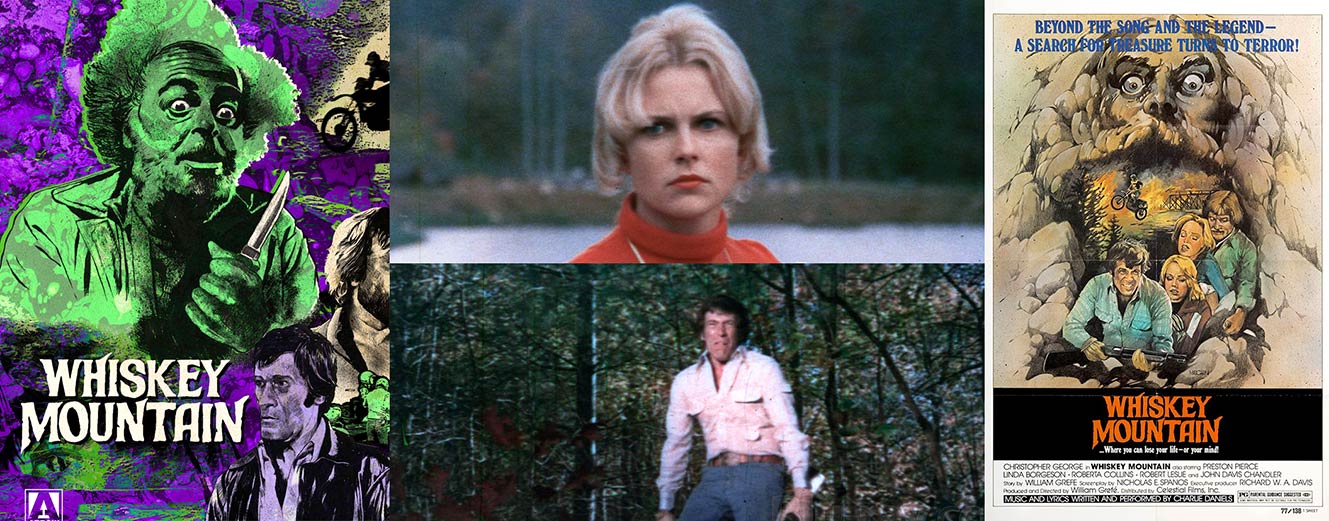
Whiskey Mountain
USA 1977
Directed by William Grefé
Arrow Films Blu Ray Zone B
Whiskey Mountain is the last of the movies featured in Arrow’s fine He Came From The Swamp - The William Grefé Collection Blu Ray box set. Now, I’ve had some fun with many of the movies in this set, most or probably all of which I would never have seen if it hadn’t been for this new collection. You can see from the poor state of some of these ‘restored’ movies that they must have been not very far away from ‘full on’ vinegar syndrome setting in on the film so, I’m grateful to some of the Blu Ray companies out there for rescuing these things before they disintegrate altogether (now if someone could do this for all the Flash Gordon serials etc, it would be a big help... the DVD versions aren’t good enough).
That being said, I think Whiskey Mountain, which I suspect is a kind of Deliverance rip off (I’m guessing since I’ve never seen the Boorman movie) is, I have to say, the least interesting film in this collection and the one I didn’t get much out of. Part of the reason may be the subject matter... families terrorised by hillbillies is right at the top of the list of movie types I really wouldn’t bother watching, right up there with home invasion movies (which I also, mostly hate).
The opening credits is of the two male leads taking part in a scramble bike race and Grefé leaves music off the soundtrack, preferring instead to catch the sounds of the engines during this sequence which sets up the two best buddies before following them into the main plot. This one tells of two protagonist couples, Bill & Jamie (played by Christopher George and Linda Borgeson) and Dan & Diana (played by Preston Pierce and Roberta Collins). They go off in their car, with bikes in tow, into the mountains of North Carolina to find the local myth of Whiskey Mountain because Jamie’s grandfather has drawn a map for her of where he and his friends hid gazillions of Civil War rifles and many cases of whiskey during the war. The antique fire arms are now worth around a thousand dollars apiece to the two if they can find the stash.
However, it turns out that the mountain is also being used by a bunch of drug dealers and hillbillies, who try to scare the family off when they are camping in the mountains by setting light to their cars and putting them at risk at various points. Our intrepid heroes eventually figure out they are being terrorised by human antagonists rather than nature biting back but not before they are all taken prisoner. The boss of the group, played by John Davis Chandler, who was so good in Grefé’s The Hooked Generation (reviewed here) and who also had a small part in Mako - Jaws Of Death (reviewed here), is going to kill them later but is cursed by bungling hillbilly gang members who play around and do stupid things when he’s not around. They rape the girls in a lengthy sequence where Grefé distances the audience from the action by having polaroids self develop on screen of what is happening to them as the soundtrack plays out the screams of the girls. It’s actually a fairly tame sequence by moderns standards but something about Grefé’s way of showing it but leaving it mostly to the imagination of the audience makes it a little unsettling, to be honest. But, as I said, I don’t really enjoy these kinds of movies that much.
Eventually the two guys escape and get away on their motorcycles, riding to the nearest town to call the sherif in to help them rescue the gals. Alas, the sheriff either doesn’t believe a word or is in league with the drug gang (it’s not quite made clear) and so the guys are forced to stock up (illegally, due to sheriff intervention) on guns and head back to the mountain where Dan is killed but Bill rescues the gals and kills everyone else. The film ends with a less than ambiguous freeze frame where the sheriff returns in a helicopter and you realise that Bill might not have many more seconds to live himself but it’s a recall to the time, in my mind at least, where Grefé finished off The Naked Zoo (reviewed here) with a freeze frame which suddenly throws the whole outcome of the film in question in the space of about a second or two before the credits roll.
And I wish I had more to say about this one but this one just didn’t light my fire like certain others in the box did. Grefé directed just one more feature film after this but not for another 18 years. I don’t know how successful Whiskey Mountain was but I’m guessing not all that. Looking at the timing of the movie, it was released into cinemas two months after George Lucas’ original Star Wars movie and, yeah, I think what Lucas unleashed onto audience expectations after this kinda changed cinema, for bad or good is something I’m still undecided on but, I really think films like Whiskey Mountain wouldn’t have stood much chance in the clamour from a movie going audience infused with the spirit of space opera.
And that’s me done with Whiskey Mountain... the least of the films in this set and not one I’d probably recommend to most people unless they were studying this subgenre of movies. That being said, though, this whole Arrow Blu Ray package is definitely worth picking up because there are films here which, while not absolutely gobsmacking in their impact, are both very interesting and probably not very well known to the average cinema goer... at least not over here in the UK. So would definitely point cinephiles who think they’ve seen everything in the direction of this boxed edition because, yeah, some interesting takes on various kinds of movie making, for sure.
Sunday, 2 October 2022
Whiskey Mountain
Wednesday, 24 August 2022
Mako - Jaws Of Death
Fin N’ Tonic
Mako -
Jaws Of Death
USA 1976
Directed by William Grefé
Arrow Films Blu Ray Zone B
Warning: Silly spoilers swimming under the surface of this review.
Well now, I can see how some people are going to be pretty underwhelmed by Mako - Jaws Of Death (as it’s titled on the actual print... as opposed to absolutely any other title listing for the film) but, you know, I kinda quite liked it and think it’s quite entertaining in a low key kinda way. This is the sixth film in Arrow’s incredible He Came From The Swamp - The William Grefé Collection Blu Ray boxed edition and, although the print isn’t in great condition (like a lot of these films included... barely saved from vinegar syndrome before it was too late), it does still retain its widescreen aspect ratio. This is the movie that Grefé worked on trying to get funding for years before and nobody was interested. Then a little movie called Jaws caused a bit of a bloody splash in 1975 and suddenly, everyone wanted their own shark picture. So although this is not actually a Jaws bandwagon movie... and the story certainly reflects that... it probably wouldn’t have been made without the success of Spielberg’s magnum opus.
Richard Jaeckel plays Sonny Stein, the main protagonist/antagonist, depending on your point of view. The film starts off strongly with a wonderful pre-credits sequence where three men on a boat are shark fishing. One of them has one on his line... then a frogman, Jaeckel, swims up to the shark and cuts it loose. He then boards the boat and cuts a swathe of bloody vengeance through the three fishermen, feeding them all to his sharky friends.
Okay, so the film tells Sonny’s story and pictures him as a kind of recluse... but he’s well known in Florida, where the movie is set, as being an expert on sharks. Everyone comes to this lonely man to fulfil their shark needs. He’s not that willing to help but he is pressured into it. He is conned into signing over one of his sharks to a sideshow act in a local bar and a scientific researcher wants him to ‘loan’ them his pregnant shark friend for ‘observation’. Yeah, you can kinda see what’s coming. One of the ‘bad guys’ is Harold ‘Odd Job’ Sakata (of Goldfinger fame) as another ‘shark worrier’... he seems to be turning up in a few things I’ve watched recently.
At some point in the film we get to hear Sonny’s back story... which is this. In the war, in the Philippines, he was trying to escape from some bad guys. At some point he has to make a choice between staying on dry land and getting shot or jumping into the local shark infested waters and possibly being eaten alive. So of course, he chooses the latter (just, why?) but the sharks don’t eat him... instead they eat the two guys chasing him. A local shaman... who is a ‘shark shaman’ sitting on his shark throne and who hangs with an unseen tribe of shark worshippers... witnesses what has happened and is impressed. He gives Sonny a big shark medallion and tells him that, whenever he is wearing the medallion, he is a friend of the sharks and they will talk to him. So, yeah, that’s why all of Sonny’s best mates have fins and impressive pearly whites, I guess.
Anyway, things come to a head and, when Sonny finds out that the guy who owns the bar is torturing the shark with sound waves to make it seem more threatening in the tank... and also that the ‘scientists’ have killed the pregnant shark and all the babies, well... he goes on a roaring rampage of revenge, killing all the nasty humans who are being unkind to sharks.
And it was okay... I found it entertaining. It really makes no references to Jaws and even the music is, almost always, completely unlike the iconic John Williams score for Spielberg’s picture. According to the IMDB, the score is by two composers, William Loose and Paul Ruhland but, it never really seems like it was scored to work together or even with the images, to be honest. It sounds more like needle drop to me and I wonder if these composers actually did work with Grefé on this movie or whether he just took existing music by both of them and dropped it into his film.
Jaeckel cut his head open on one day of shooting (the same day the camera was accidentally destroyed and the boat needed for the shoot hit a sand bank)... but he was apparently stitched up at the local hospital and back on the set in no time. I don’t know if this explains why, in some of the ‘swimming with Mako sharks’ shots, he has a big stuntman standing in for him... a stuntman who’s desperately trying to obscure his unfamiliar face from the camera by hiding it behind the shark’s fin. It looks pretty funny, it has to be said.
Not too much more to be said about Mako - Jaws Of Death really. It’s not particularly well put together in terms of the way the frames are designed or anything but it’s a more than competently sewn up movie experience (there are many movies out there by directors where you couldn’t say the same thing), it’s fairly fast paced, it’s entertaining and shark whisperer Jaeckel gives a real good, mean and pyschotic stare when required. Not a bad movie but, like I said, a lot of people are probably not going to give it much time. I liked it though and, yes, I’d watch it again.
Tuesday, 9 August 2022
The Naked Zoo
Drugs N’ Kisses
The Naked Zoo
USA 1970
Directed by William Grefé
Arrow Films Blu Ray Zone B
Warning: Okay, this one will have some spoilers.
The Naked Zoo is the fifth of the seven films presented in Arrow’s wonderful He Came From The Swamp - The William Grefé Collection. It’s also presented in its original, shorter cut... which had reshoots and re-edits by somebody else and included extra nudity and a performance by Canned Heat... plus the longer version (which I watched), which is the best assembly Grefé could get from multiple sources of his original director’s cut. Like The Psychedelic Priest (reviewed here), it’s a very loose film in that, although it has a set up and a great punchline to that introduction in the last few seconds of the film before the credits run, it’s got very little narrative structure at all and feels, for the most part, like a load of scenes put together almost randomly, to convey an attitude of the kind of drug and free love culture of the time rather than anything else.
The film stars Steve Oliver as main protagonist Terry Shaw (and also antagonist, as far as I’m concerned), a writer of poetry who doesn’t have a publisher with enough cash to get his second book out and who sleeps with various young ladies throughout the course of the movie in his swinging, bachelor lifestyle but also sleeps with older women, using and abusing them to get their monetary gifts as a kind of gigolo. One of these older ladies is Mrs. Golden, played by Rita Hayworth in one of her last movie roles. There’s a nice story about how Grefé managed to get her agent to agree to her involvement in the They Came From The Swamp - The Films Of William Grefé documentary (reviewed here), by dumping the initially declined and not nearly adequate amount of cash on her agent’s desk up front.
Miss Hayworth’s scenes are, it has to be said, the only real sequences which you could possibly credit with having any kind of traditional narrative or story follow through in them. Grefé managed to get a big name star to hang his movie on but I suspect he only had her for a few days so her scenes are few and far between but, scattered through the movie at intervals, between parties. And I do mean between parties, as the majority of the rest of the ‘action’ involves us following Terry as he goes from mood swing to mood swing at various ‘cool cat’ drugs and ladies parties, even going so far as to go nuts and start a camp fire in one apartment which, when viewed by today’s young ‘uns, probably looks more than a little strange. And, yeah, okay it is but it’s also not uncommon for stuff like this to be happening in films at the time, as a kind of ‘character short hand’ for just how free and liberal everyone is. Grefé tilts the camera, swings it around and does multiple visions within the frame to match the antics and drug trips of various characters and it all goes pretty well, even though a lot of the characters, including Terry, come off as pretty mean spirited and not fun people to be with.
The scenes with Rita Hayworth are the anchors for the whole story (such as it is) and things kick off when her wheelchair bound husband catches her and Terry 'in the act' and runs amok... okay, wheels around amok, firing a pistol and trying to kill them. He doesn’t succeed in this but does manage to accidentally kill himself by running his wheelchair into the fireplace and knocking his head. Terry abandons Mrs. Golden to sort it all out herself and assumes he is in her will, so he stands to inherit her cash. In a later scene near the end, he finds out about her heart condition, deliberately gives her the wrong psychedelic pills to exacerbate that condition and then gives her the scare of her life posing as her dead husband. She dies of a heart attack and... well, I guess she does leave him her money in the will because he gets his next book published and it’s a roaring success.
And it’s not a great film but it chugs along at its own pace just fine and I think I’m really beginning to like this director now. I’m grateful to Arrow for releasing this set because, there’s no way any of his titles would have grabbed my attention and now he’s definitely on my radar as someone to watch.
The great thing is it’s got a nice, twist reveal ending. And I almost didn’t see it coming because the format of the film as a rag tag bunch of scenes drifting together to make a whole really doesn’t tip you off to the fact that the film would have this kind of reveal... and it involves a character who the audience hasn’t met yet and is only briefly mentioned in a scene early in the movie. I saw it coming literally only one minute before it happens and, without giving anything away, if finishes the movie with a freeze frame moment where you know exactly what’s going to happen without the director actually showing it... which is a nice thing here. Sometimes a bit of restraint and holding back can certainly pay off.
All in all, I really quite liked The Naked Zoo, once I’d warmed up to it a bit. I’m not sure I’d know anyone in my circle of friends I would recommend it to and I’m not sure where the audience for this one is at these days but, I had a good time with it and, if you want to take that as a recommendation, then that’s fine by me.
Wednesday, 22 June 2022
The Psychedelic Priest
Road Trip
The Psychedelic Priest
aka Electric Shades Of Grey
USA 1971/2001
Directed by Terry Merrill and William Grefé
Arrow Films Blu Ray Zone B
Warning: Some spoilers here.
Okay, so although The Psychedelic Priest (aka Electric Shades Of Grey) is solely credited to Terry Merrill, who was actually the producer, I’m piecing together from William Grefé’s introduction to the movie that it was solely Grefé who directed this. I’ll get into that in a minute but let me give you a brief synopsis of this one first.
A teaching Catholic priest moans at four of his students for having a good time and taking drugs instead of attending their lessons. One of the kids give the priest a coca cola but it’s laced with LSD. The priest, John (played by John Darrell) goes on a weird trip and God talks to him in a drug fuelled vision. So he takes off and goes on the road to experience America and giving the old ‘Turn on, tune in and drop out’ ethos a go. He picks up a lady hitch-hiker, Sunny (played by Carolyn Hall), who’s wary of men and life in general and they get friendly on a long trip to Los Angeles. They do drugs together with a load of hippies who tell stories. On the way to LA they find a pregnant lady about to have a baby on the side of the road. They get her to a local ‘hippie hospital’ (a van) where a dropped out, turned on doctor delivers the baby and everybody is happy. The doctor decides to come with them but the cops don’t like that he’s got black skin so they beat him to death. John and Sunny are sad.
Sunny declares her love for John but John, being a crazy, mixed up priest, is harsh with his confused rejection of her. She leaves in the night and goes back to hitch-hiking. John is distraught... he goes to a private detective to find her, selling his car so he can afford his services. He finds that Sunny was so upset that she went back on acid and drove her car off a cliff. When he goes to hospital to be reunited with her, she dies of her injuries before he can see her. He then turns to drink, gets beaten up a few times and then finally does some heroin. Then some people find him and take him to church and then he finishes up hanging out at a live gig in a park. The end.
Well now that I write it, I find that there’s actually a lot happening in this movie, although you wouldn’t know it from just watching it. There’s actually no real story and I was surprised at Grefé because, well, the style is so loose and free. I actually quite liked it although, this is definitely a rescued print, being in a 4:3 aspect ratio (quite probably it was shot like this) and being in quite poor condition (despite being a great transfer). It’s kind of a footnote in his work but I enjoyed it anyway. The trip scenes where shapes are cut out of black and the camera zooms in and out or pans around are... acceptable. The songs are okayish too (although I couldn’t find any of them available to buy commercially, I’m sorry to say).
Surprisingly, compared to some of his earlier films, the two lead actors are pretty good and so are pretty much everybody else, although there weren’t many actual actors in the film, just people found in the street is the vibe I’m getting from this. Grefé explains in his intro that there was no script for the film so he told the producer, who wanted him, he would only do it if he sent his round trip fayre and half his fee. Well, that all turned up and he went down to see him and there was still no script, although the producer had to deliver a finished film very soon. So Grefé went on the road with a crew of just three people (shooting it himself) and they all just made it up as they went along... which actually, despite his obvious lack of comfort about doing that, is possibly not a bad way to shoot a movie about the counter culture of the time, with its relaxed and laid back attitude to life which, I have to say, really comes across in the movie.
It’s not a significant film in any way and I suspect the rag tag lack of a solid narrative structure might well put most people off but I certainly enjoyed The Psychedelic Priest. It’s not necessarily a good document of the hippie and drug movement of the time but it does live within the general malaise of that kind of diminished lifestyle and it may just give a taste of the truth of the people on the street (quite literally, on the street). It does have this kind of downward spiral of bleakness to it too, which is interesting given the subject matter and the fact that the central character is a priest so... yeah, there are things of interest here. I wouldn’t recommend it to everybody but it you’re interested in this particular period and expression of a specific way of thinking, it might be of value to you and you might get something out of it. My take is that it’s worth a watch.
Tuesday, 7 June 2022
The Hooked Generation
Fury With The
Syringe On Top
The Hooked Generation
USA 1968
Directed by William Grefé
Arrow Films Blu Ray Zone B
Warning: Some spoilerage ensues.
The Hooked Generation is the third of the movies presented in Arrow’s Blu Ray box set He Came From The Swamp - The William Grefé Collection. Now you might be forgiven for assuming, from the title (which really doesn’t seem to mean much in relation to the content of the movie), that this was some kind of psychedelic documentary about the drug tinged counter culture of the time. However, although there is a scene in the later parts of the film with a ‘lair’ of stoned hippies in it, the movie is more a kinda crime drama, of sorts, with a heavy drugs leaning.
Okay, so the main characters are three guys (originally four but one gets killed fairly quickly) who obviously enjoy drugs but also trade in them for cash. The whole opening titles, in fact, are shown against a backdrop of the arm on a table of one of the characters, as he goes through that whole heroin style ritual of the teaspoon, powder, heating it in a candle flame, tying the arm off with rubber tubing etc (excuse me, I don’t know anything about drugs but, presumably the rubber tubing you always see them use in films is to reduce marks and bruising on the skin?) and popping the vein up for receiving a needle. All accompanied by a not bad, trippy jazz score courtesy of Chris Martell & The Odyssey... I’d buy it if it was available but there’s obviously been no commercial release.
After the credits we meet the heroin addict in question, Acid (played quite hypnotically by John Davis Chandler), Dum Dum (played by World Light Heavyweight Boxing Champion Willie Pastrano) who is hollowing off the tops of bullets, which is presumably where he gets his name and the leader of this little rag tag group, Daisey (played by Jeremy Slate). They’re in a boat near Cuba and roughly the first two thirds of the film take place, more or less, on this boat (in keeping with Grefé’s budget conscious modus operandi). The three have been saving up to buy some drugs from some Cubans but, when the Cubans arrive on the boat, the price has changed. So Daisey harpoons the leader and they grab the big stash of drugs, kill the other two and blow the Cubans’ boat up. If you hadn’t figured it out by now, even though these guys are the three characters who the film focuses on, none of them are very likeable.
But they’re all doing a lot better than most of the actors I’ve seen in Grefé productions of the 1960s and they’re all very interesting to watch. So, yeah, you can’t sympathise with any of them and you really just want them to die horribly as soon as possible but, they do make for fascinating characters, it has to be said.
Anyway, the rest of the story goes like this... the coast guard arrive the next day and, long story short, the drug dealer protagonists end up killing them, grabbing a young couple as hostages and making a run for it. The first dealer they try to sell their stash to wants nothing to do with them because their actions have made them ‘hot’ and he tips off the FBI, who are already on their trail. They hole up in the swamps of Florida (of course, it’s a Grefé film!), initially with some Seminole Indians and Acid is sent to the local hippy commune to grab some food, where he meets his ultimate fate. Then the FBI go into the swamps and, after some pedestrian but never boring shenanigans, Dum Dum and Daisey are also killed. Because... I dunno... they’re the hooked generation? Or something.
Either way, it’s an interesting film and that, like I said, this comes from the portrayal of the characters. Slate plays Daisey as a solid leader who tries his best to keep his head above water while his two friends manage to trip him up and get everyone in worse trouble every step of the way. Dum Dum is, also pretty good considering that acting was not Pastrano’s main profession. It’s Acid who’s the one to really watch, though. He spends the entirety of the film completely hopped up on heroin and is even shooting up during a pitched gun battle in the earlier scenes. He manages to have an almost permanent, half smile on his face (apart from when he gets really angry) and he’s a nasty character (stabbing and even raping a woman he just accidentally drowned) but it’s such a fascinating performance. He gets one of the more poetic deaths in the film when, in his permanently confused state, he tries to stop the raid on the hippy commune and takes on multiple gun shots before taking a dive through a glass window... then Grefé goes to town in his dying moments as he has some kind of ‘death trip’ with the camera and editor going nuts to give a surreal, jittery flashback of some of the events for a minute before he dies and we are treated to the visual metaphor of a candle being snuffed out. These might have been low budget cheapies that Grefé was churning out at this time but he was really trying to put something worth watching up on the screen, you can be sure of that.
As I said, the music is quite good, which helps... although, the director does manage to get another of his bikini gal dancing scenes in when the three protagonist/antagonist figures get one of the hostages dancing and, yeah, you can bet it features Grefé getting enthusiastic about showing her bottom shaking again... I’m really beginning to sense a theme in this director’s work.
And that’s that. The Hooked Generation is not going to light everyone’s fire but it’s not without interest and has an atmosphere all its own. The ‘three evil hoodlums’ terrorising innocent people genre of film is not the kind of thing I really like to watch (even the famous Italian ones) but Grefé and his performers really hold the interest here and, it’s one I would recommend if you’re a cinephile who’s seen it all and who wants to see something just slightly different from the norm at that time. Terrible title though, to be sure.
Monday, 9 May 2022
Death Curse Of Tartu
Tartu Detour
Death Curse
Of Tartu
USA 1966
Directed by William Grefé
Arrow Blu Ray Zone B
Warning: I guess this has spoilers.
Death Curse Of Tartu was shot in just seven days and came about because director William Grefé could only sell his recently shot film, Sting Of Death (reviewed by me here), to a distributor if it was double billed with another horror picture. And I’m finding this one kind of bizarre because, although in a lot of ways it’s just as awful, possibly more so, than the aforementioned jellyfish-man movie, I actually kinda liked this one.
Okay... so the film involves an isolated island in the sub-tropical wilderness of the Everglades in Florida. An explorer finds a cave on a burial mound and a mummy gets out of a tomb and kills him. Then, in probably the only really interestingly done part of the film, the mummy drops some papyrus scripts on the floor and the camera jump cuts to them and we find the opening credits on them with the title music, such as it is, playing in the background as the mummy’s hand slowly removes each piece of paper from the top of the pile to reveal the next credit. The film has a credit for two song writers but no scoring credit and the over the top nature of some of the score used against the images (especially at the start of the movie) and the repeating of only a couple of tracks over and over, later in the film, leads me to believe the music for this movie is either plundered from another production or, more than likely, just needle dropped in from a music library.
Now, apparently, a lot of Seminole Indians lived in this territory and the character of Billy, who’s in a couple of scenes in the first half an hour as a kind of Indian guide to the local region, is one of these. He takes another professor out to the place where the burial mound can be found a long walk away on the island but will go no further. He tells the professor, as he tells the professor’s friends the next day when he gives them a map to get to the island, that the place is haunted by the spirit of an old witch doctor named Tartu, who comes to life as a mummy and transforms into various creatures to kill those who trespass on his land. Native drums and indian cries are heard in the air whenever he is near, as they are perpetually throughout the movie, due to the repeated use of some audio library track or other.
The guy is left there exploring and finds a rock. Now, the key theme of this film is given away right from here... and it’s padding. This is a movie where we see both this professor... who is soon crushed to death by Tartu in snake form... and also the next bunch to pitch up here... taking forever to walk or airboat in and then every stage of the journey, literally of people just walking around, takes up the majority of the running time. That’s maybe why I found the movie so comforting and reassuring to watch, to be honest. There is a heck of a lot of unnecessary footage here. I’d detected a certain amount of that in Sting of Death but Death Curse Of Tartu really excels at showing you levels of superfluous detail which is of little or no interest (although, like I said, I kind of didn’t mind it in this one, myself).
However, to my shame, there is an early jump scare which actually made me jump. It’s the exact same scare as was used in the first 10 minutes of Raiders Of The Lost Ark and here, involves the professor pulling aside a tree branch to reveal a rubbishy, plastic looking skull on a stick while an over the top musical stinger plays. And it’s really useless and non-threatening but, like I said, it actually worked for me. All I can say in my defence here is that I really wasn’t expecting any kind of jump scare in a 1966 swamp movie and that the various, slow paced shots of the professor walking around maybe lulled me into a certain stupor.. which was the exact state of mind needed for this cheap trick to actually work on me. So a big thumbs up to Grefé here for actually getting me good. I was most appreciative of the jolt, for sure. Although I’d defy anyone else to be scared by this... especially since you can see the skull before it’s revealed.
Okay, so the professor is killed and then his friends, Professor Tison (played by Fred Pinero), his wife Julie (played by Babette Sherrill) and two young archaeology student couples... Cindy (Mayra Gómez Kemp), Johnny (Sherman Hayes), Joanne (Maurice Stewart) and Tommy (Gary Holtz)... all get their airboats through to the island to find their friend and carry on exploring... but all they can find is the strange rock which the professor has dug up. When Tison translates it, we get to hear the back story of the Witch Doctor Tartu for yet a third time. Yay!
The kids go to make out by a lake while the professor stays behind in camp to finish the translation and... also makes out with his wife. Because of all this obvious work and discovery going on, the kids have a radio with them and the director manages to shoehorn a ‘wild and crazy’ teen dance scene into the picture where, once again, he shows a propensity for focusing his lens on the shaking derrieres of the teenage gals as they ‘swing their pants’. However, the punchline to this scene comes when Joanne and Tommy go for a swim in the water. Oh no, you may exclaim. Will a water snake or a crocodile get them? No because... and believe me, I was as surprised as the main cast at this... Joanne and Tommy get attacked and eaten by a shark! Which is preposterous! However, even Professor Tison reminds the audience that sharks don’t live in fresh water* and so it’s by now obvious, of course, that the mummy of Tartu has risen from his crypt and hit upon the good idea of temporarily transforming himself into an out of place shark to kill these two kids. At this point, Professor Tison, who has been downright aggressive in the film when anyone even mentions the possibility of anything supernatural occurring in real life, suddenly says, sweepingly, that “There are things on this planet that scientists have no answer to.” Blimey, he sure stopped being Mr. Cynical on the turn of a penny.
They decide to get off the island and go back to the nearest civilisation but, just like in Sting Of Death when the boat full of kids trying to get help all get killed before that can happen, when Johnny is sent back to wade through the swamp he soon gets ‘snaked up’ by Tartu. When Cindy tells the others the bad news because she saw it in a dream (don’t even ask!), the survivors decide to find Tartu’s mummified form and kill it before it eats or cuddles anyone else. However, the professor and his wife get trapped in the cave while Cindy gets her arm bitten up by Tartu in crocodile form. The bleeding arm doesn’t explain why, in the next shot when the freed Professor is holding her dying body in his arms, she also has blood coming out of her mouth but... I’m suspending my disbelief as much as possible at this point.
The professor and his wife go to confront Tartu in the form of a virile, aggressive native American Indian and manage to finally dunk him into the nearby quicksand. And before you can say Tartu Barado Nickto, the villainous witch doctor re-takes his mummified form... just before his head goes under and he’s then sucked into the murky waters. This is apparently because the guy playing the Indian didn’t want his head under the quicksand so they came up the idea that Tartu would revert back into another actor just before dying. As the professor and his wife walk off with the bitter sting of a sad victory, they seem to have forgotten that they don’t have any boats to get them home. Let’s hope they don’t get eaten by crocodiles on the long journey back then.
I’ve not much more to say about Death Curse Of Tartu and I have to say that, while it’s not a film I could in all conscience recommend to anyone, I did find this one extremely enjoyable and somewhat comforting when it came to observing all the dull, plodding around in the undergrowth scenes. I’d watch this one again for sure. Looking forward to what’s up next in Arrow’s lovely He Came From The Swamp - The William Grefé Collection Blu Ray set and you can bet I’ll report back here soon.
*It’s come to my attention since writing this review that,
certain conditions have allowed this to happen in real life
on occasion, a shark in fresh water... but still.
Whether this information was available when this
was made (considering what the character
in the movie says) is not something I am sure about.
Sunday, 24 April 2022
Sting Of Death
Belly Of A
Swampitect
Sting Of Death
USA 1966
Directed by William Grefé
Arrow Blu Ray Zone B
Warning: Spoilers lurking like tendrils
of death wrapping around your heart.
Sting Of Death is the first film in Arrow’s lovely He Came From The Swamp - The William Grefé Collection Blu Ray boxed set and it was my primary reason for picking this collection up because, after all, who doesn’t want to see a movie where various people are threatened by a jellyfish monster? Well, after watching the movie, I suspect the answer is probably me but, hey, the concept sounded like it was a lot of fun.
The film is watchable and it has bright colours. It’s about a bunch of women going to stay with the father of one of their number, Karen (played by Valerie Hawkins) for their vacation. Her father, Dr. Richardson (played by Jack Nagle) happens to live on an isolated island in the Florida swamps and is a marine biologist, helped by his two assistants in the form of Karen’s love interest Dr. Hoyt (played by Joe Morrison) and the forever lurking, facially disfigured, hulking Egon (played by John Vella). And, yeah... I think the character’s name is supposed to invoke associations with Ygor and his ilk in the 1930s and 40s Frankenstein movies from Universal. Well, I say he’s disfigured but his bashed in right eye, which is supposed to be sealed shut, does kind of pop open and come a little unstuck in some scenes.
Okay, so the film starts off with the jellyfish monster destroying radio communication on the island and then grabbing a bathing beauty off the decking outside the front of Richardson’s place and pulling her to her death while the credits play out. There is a line around halfway through the movie where the Doctor asks where Ruth disappeared to and I think this is in reference to this character... who is otherwise not mentioned again throughout the running time of the film.
Then the girls arrive, as do some students who promptly chase the freakish Egon off with their hateful prejudices, before enjoying the second of two long dance scenes where Grefé seems to spend an incredibly long time focusing on the backsides of various bikini clad girls as they dance about to Neil Sedaka’s new song written for the movie, “Do The Jellyfish”. It’s not a good song but the various party shenanigans seem to distract the teenagers from noticing right away that the jellyfish man attacks a girl in the swimming pool right in front of them. Another teen is also badly injured and, due to no radio, the doctor sends him and all the students back to get medical attention but... yeah... they are attacked by a swarm of jellyfish controlled by the jellyfish-man and all die. And when I say jellyfish, what I mean is inanimate polythene bags tied up with dangling bits of string floating calmly on the surface of the water while various teenagers act like they’re being stung and in their death agonies. Yeah, the special effects are not high tech on this one.
It all ends in tears after a few more deaths and people going ‘missing’ as, in a twist reveal (which really was a twist for me because, it was kinda lame and I must not have been paying proper attention), the Jellyfish man turns out to be Egon, who has perfected, among other things, the power to transform himself into a man wearing a muddied up diving suit with dangling tendrils and an almost completely see-through polythene bag on his head. I promise you, the jellyfish man looks a lot worse than I’m making him sound here.
There’s the usual resolution to this kind of picture and it’s not unwatchable... just not quite making it into the ‘so bad it’s good category’, as far as I’m concerned... although it certainly flirts with it at times. I do have a love for the atmosphere of these kinds of throwback pictures though... it’s colourful and it feels like it’s been shot in the 1950s, rather than being filmed the same year that The Beatles had their Revolver album in the charts. I’ve mentioned this in reviews of films before but it’s like certain filmmakers were kind of stuck in time and churning out exactly the same product in the 1960s which was more ‘of its time’ a decade earlier. I do like these kinds of films but, the movie doesn’t quite do enough to turn this into an absolutely essential piece of viewing, as far as I’m concerned... although I think it would be a good one for a monster themed allnighter with your friends, in between two more scarier pictures, to be sure.
Of note is the big, black bruise on Jack Nagle’s head. He hit his head on the first day of shooting and the wound had to be explained away in the script. Also, when the bruise was wearing off in the shoot, this had to be augmented by having the make-up artist drawing in the bruise for various scenes. This is mentoned on the wonderful William Grefé documentary feature, which also comes in this set (reviewed by me here) and a few other anecdotes, two of which I’ll briefly mention here...
One involves the loss of the cable for the ariflex camera, overboard in the swamps before a day’s shooting was even started and this caused some headaches on the location during the day, a lot of hours were lost... remember, this was when Grefé could churn out one of these pictures in two weeks or less so time was a valuable commodity while shooting.
The other thing involves John Vella. I wasn’t kidding about that being a big polythene bag on his head so, on at least one occasion, when a shot was taking a long time to get done, he nearly suffocated through lack of air. Obviously he didn’t (or the film would be much more well known now, I guess) but you can pretty much see his head lurking within the bag, in many of the shots.
And that’s pretty much it for me on Sting Of Death. It didn’t quite hit the mark with me but, well, it was watchable and I did kinda enjoy looking at it to an extent... but it didn’t blow me away like I’d hoped. I’m really keeping my fingers crossed that it’s not, as some reviewers have said, the best of the movies on Arrow’s Grefé collection. Time will tell I guess.


