Showing posts with label Andreas Marschall. Show all posts

Friday, 17 December 2021

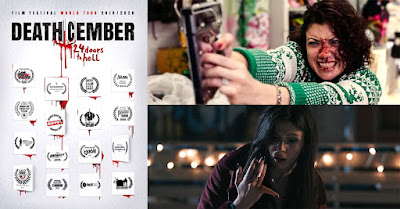
Deathcember


Christmas
Advent-ures


Deathcember
Germany 2019
Directed by Various Artists
Shout! Factory


Warning: Yeah, some spoilerage.

A fairly quick shout out for a 2019 Christmas movie called Deathcember. It’s basically a bit like The ABCs Of Death movies in that it’s a collection of short films based around Christmas death (and sometimes horror) by a variety of international directors, some of them quite famous such as Ruggero Deodato, Andreas Marschall, Lucky McKee and Pollyanna McIntosh. The film is advertised as being 24 films but there are actually 26 short movies in this one, as there are also two additional movies mid and post end credits.

The film starts off with the camera swooping over a computer generated snowscape which finds a cemetery with borders that are shaped like the Star of David. The camera wanders around from various gravestones on which credits for the movie are found before moving up and out of the cemetery to take in the film’s title and then going into a cabin. Inside the cabin, which includes an upside down Christmas Tree (the anti-Christmas?) the camera starts moving around a room and then it will stop on an object. The outline of an advent calendar door will then appear around that section of the screen before opening and allowing the camera to swoop inside the door to access each segment.

As you would expect from this kind of portmanteau movie, it’s a hit and miss affair but, I’d have to say on this one that most of the segments are at least interesting and it’s never a dull affair. I’d say more hit than miss but, at the same time, don’t expect too many of them to really knock your socks off. There are some nice ideas though, such as a greedy, advent calendar chocolate binging child finding himself suddenly turned to chocolate and inside an advent calendar himself, as his sister then eats him. There were some definite highlights for me too...

All Sales Fatal by Michael Varrati was a nice one of an unsatisfied customer trying to return her Christmas purchase because she’s changed her mind but the store won’t refund her without a receipt. Anger wells up and she and the sales guy get suddenly involved in a brutal fight to the death before the, admittedly obvious, punchline moment of that particular story. X-Mas On Fire by Florian Frerichs is not such a great idea but it is quite entertaining, depicting a heist gone wrong. It also has a nice few moments of Reservoir Dogs parody in it. Bob Pipe’s door, The Hunchback of Burg Hayn is a black and white silent movie and nicely captures the style, albeit with a big dollop of humour, of a 1920s Hollywood production. Andreas Marschall’s door Pig is probably going to be big with the strange modern brand of feminists. When a man is marked up with a big P on his jacket, mimicking Fritz Lang’s movie M, a brutal retribution is visited on a guy by a group of vengeful women. However, when he is unmasked and one of them exclaims to the others that it’s the wrong guy... the brutality continues under the guise of “There are no wrong ones.”

There were some wrong ones for me though and, one of the segments, a spectacular looking science fiction piece called 3rd December 2389AD, mainly failed for me because I just didn’t understand what the heck was going on in it at all. But that’s probably more to do with me than the quality of the actual film. Probably my three favourites in this collection were Crappy Christmas (terrible title) by Juergen Kling, December The 19th by Milan Todorovic and Five Deaths In Blood Red by Ama Lea.

Crappy Christmas is an animated short in the style of a claymation movie. It includes what is certainly the most inventive death of the film (and of most movies, I suspect) which I will only describe as the ‘viagra catapult cock through the head’ death, involving a Bishop... and I’ll leave that there but, yeah, you need to see it. December The Nineteenth is a short tale about two girls about to embark on a lesbian relationship, who have their first date, as it were, by going ice skating together at night. However, the first time skater is so bad at it that she ends up causing the other to first break one finger before she accidentally slices off the fingers of her other hand with her skates, eventually ending up with her ice skate accidentally embedded in the other girl’s face before meeting her own accidental death. It’s stylish and funny. Five Deaths In Blood Red is exactly as it sounds, a mini giallo parody and it really captures the style of the early to mid-1970s gialli by the likes of Sergio Martino in its too short running time. There is some nice music in this segment too by Eduardo Daniel Victoria, which hovers between slightly out of kilter, 1970s US slasher mode but also some lovely giallo homages in its make-up which really help push the comparison.

And that’s me pretty much done on Deathcember. I think  the notes I took while watching this one were longer than the review this time but looking at them, there’s not much else I’d want to elabourate on, I think. The movie is exactly what you’d expect from these kind of ‘film collective’ movies and it doesn’t scrimp on the violence/goriness and even adds some very occasional nudity. It’s not fantastic but it’s certainly entertaining enough to ensure that the nearly two and a half hour running time breezes by and it continues to hold the interest. Definitely not a bad film to watch if you want something both violent and funny to check out over the Christmas period.

Thursday, 3 September 2020

German Angst

Angst In Your Pants

German Angst
Germany 2015
Directed by Jörg Buttgereit, Michal Kosakowski & Andreas Marschall
Artsploitation Blu Ray Zone A


Warning: Spoilers on this one because
there’s not much else to talk about.


Okay so... shortly after I saw the absolutely brilliant Luciferina (reviewed here) and I was having to come to terms with the fact that nobody in the UK seemed to be interested in making that masterpiece available (or even giving it a proper cinema release), I finally found somebody with a Blu Ray up for pre-order in the US. So I ordered from overseas from Amazon as represented, in this case, by a label that I will really have to look into properly at some point, called Artsploitation. They look like they have some really interesting movies on their books, most of which seem completely unknown over here in England (at least to me) and so I ordered another one, German Angst, while pre-ordering Luciferina, because it had such a great cover and promised an anthology film giving us three tales of gory and sexual grotesquery.

I had already seen a movie made by one of the directors, Andreas Marschall... but wasn’t as impressed by his stuff as I thought I would be (although I still have a copy of Tears Of Kali to watch - my review of his pseudo-Suspiria movie Masks is right here). That being said he seems to have a great deal more running time on his segment than either of the other two directors so I’m guessing he might well have been the driving force that got this movie made.

Now, I will tell you right off the bat that, while I was impressed aesthetically with the level of blood and splatter on show in this movie, I was pretty disappointed in the stories themselves and I don’t think I would have made the purchase had I already seen this one at the cinema (which is why cinema is important people... it’s a shop window for your library of physical media... don’t bother with downloads, they’re evil).

Okay, so of the three tales in this one, the most effective one is the much shorter, opening segment directed by Jörg Buttgereit called Final Girl. Ironically, it’s the only one of these segments which never strays into the category of ‘horror film’ as far as I could tell. No monsters (human monsters don’t count) and no supernatural shenanigans either.

What it does have going for it is a real air of clinical detachment. The film starts with shots of a hamster crosscut with close ups of someone’s skin and then gets going when a very young woman wakes up in her apartment and starts telling us about why the hamster has an amputated leg. As she goes about her early morning routine, I was interested in the way the director shot the piece. He seems fond of picking out tiny little details from what is going on and then focusing on them while often eschewing a jump to a master shot. So, for example, he will latch onto some cereal and then milk being poured into a bowl in close up or will start looking at reflections in a tap. This was all pretty good stuff and it reminded me a little of the early films of Darren Aranofsky like Pi and Requiem For A Dream and why I used to like that director’s work a lot more than I do nowadays.

After a little while we find the young wife has her husband tied and blindfolded naked to a bed and she goes in and cuts off his genitals with a kitchen implement that looks a bit like a pair of garden secateurs, with much made on the approach to this act from her voice over narrative on the soundtrack. It was a little reminiscent, actually, of that mock castration scene in David Slade’s Hard Candy... but with actually having a pay off to the sequence. When she revisits him a little later, she stabs him in the neck with a scalpel and cuts hits throat and, between these scenes and which glue these two moments together, we get little clues as to the nature of their previous relationship... although I confess I couldn’t work out just what had been going on to prompt such violent vengeance myself. The abstract and wordless visual narrative of the back story seems a little too cryptic to me. Still, this is easily the best segment here and the one that promotes the most engaging and slightly uncomfortable response, as far as I’m concerned.

The second segment, Make A Wish by Michal Kosakowski, focusses on two deaf and dumb lovers wandering into an abandoned building. I suspect the fact that they are both afflicted with these disabilities is a metaphor for something and possibly ties into something else a little later in the segment. The guy tells the girl a story set as a flashback to a group of villagers being terrorised by Nazis in Poland in 1943 and the significance of a talisman he has. This sequence is very gory but again, very throwaway and naturalistic with it, so when we see, for instance, an old woman who has her head chopped in half with a spade, it’s brief but haunting. We then cut back to modern times and the two are terrorised by a group of violent thugs who proceed to torture and murder them... but not before the guy has used the talisman in question to bring about a certain change.

Honestly, I hate these kinds of scenarios in movies anyway but this one also seems quite politically charged and, again, the politics are way too enigmatic for me to completely figure out. In a sequence where a main character seems to be talking directly out of the screen to the audience and speaking about generational differences and what I imagine is some kind of collective German guilt for the atrocities of the 1940s, it felt a little bit too preachy for me and I was almost glad, in a way, that I didn’t understand really what the issue was. Frankly, I hate hooliganism so this segment really turned me off.

The third and final lengthy segment by Andreas Marschall and called Alraune is, I think, based on a German myth but I didn’t know that when I watched this... so the title made absolutely no sense to me. This should have been right up my street but I have to confess I found it relatively unengaging and lethargic.

A man who has just gotten back together with his girlfriend after a break up tells her what he did after they split up. It’s the tale of developing an on-line relationship and then meeting the wrong person at a night club called the Mabuse Club (probably a reference to the Dr. Mabuse movies, I would guess). He ends up joining a private and exclusive club of a 'sexual nature' at a private residence but things aren’t quite what they seem and... well it’s less than two weeks since I watched this but already I can’t remember how this one ended. It’s not that well done or memorable is my take away... although there is some nice cinematography including the use of some gialloesque reds and greens in juxtaposition which, at the very least, makes the segment easy on the eye. The lead actor of this segment, Milton Welsh, is also quite engaging with a good personality so, at least you have a main protagonist you can kind of root for. However, it all just seems such a tame affair from what I would expect of this kind of story set up, to be honest.

And that’s me well and truly done with this one. I’m probably not going to watch German Angst ever again but, I am interested in pursuing some of the other titles over at Artsploitation at some point, especially since they were good enough to release the absolutely brilliant Luciferina. Some horror enthusiasts may get a little more out of this one than I did and it’s shot very nicely and competently put together so, I guess it could have been a lot worse. Mainly worth it for Jörg Buttgereit’s opening segment, though.


Thursday, 14 December 2017

Masks


Death Odd Acting

Masks
Germany 2011
Directed by Andreas Marschall
Lighthouse Blu Ray Zone B


I’m not sure what one could classify Andreas Marschall’s Masks as (should one want to do such a thing). I’d like to say it’s a horror film but, at the end of the day, there’s no content in this to suggest that it’s any such thing... although I’m sure the odd viewer might find some of the murder scenes somewhat horrific. However, one person’s horrible is another person's jacket potato so, you know, slightly horrific does not a horror film make. I’d be more tempted to say it’s a giallo although, while certain genre tropes like the fetishisation of the weapon of choice for the killer are certainly in evidence here, I felt it didn’t quite really make the count on being a part of the wide variety of gialli which have come before it in cinematic history, either.

I guess then I’d have to call this one a drama/thriller but, to be fair, Andreas Marschall certainly uses the tropes and visual/audio syntax of these aforementioned genres and homages both the Italian giallo and the Italian horror film throughout the running time here... in particular the popular works of Mario Bava and Dario Argento. In the end credits, there is even a written dedication to both these directors and one other, the wonderful Sergio Martino but, to be honest, while it’s very easy to see either Bava or Argento’s influence in pretty much each and every frame of this movie, I couldn’t personally see anything specifically of Martino in the DNA of this film. So maybe this was just too subtle for me on the first watch.

Let’s be a little clearer, though, because it definitely uses the visual style of a certain famous Italian horror movie as its guiding principle and I’ll break it down a little more for you to call this what it really is. That is to say... I’ve never seen a movie which so much wants to be Dario Argento’s Suspiria than this one. And I don’t mean that in a derogatory way... far from it. I might, if the film lacked any of the kinds of visual panache or intricate sophistication of that particular tour-de-force but this one, Masks, really does it all so well. Fans of the Argento classic should really take a look at this one.

It has its own story, of course, but the resemblances in even the structure and basic plot points, while being quite different, have huge similarities and it would be impossible to imagine this film being birthed in any other way than for the director to be writing in all the elements that he loved of both Suspiria and it’s first sequel, Inferno, at the script stage. For example, there’s no ‘ballet school’ in Germany where the main protagonist goes to study... instead we have an infamous ‘acting school’ somewhere in an 'off the beaten track' location in Berlin... where the heroine goes to study.

The film opens with a look at the ‘method’ of the school's founding teacher, Matteusz Gdula, where a girl is tortured as incentive to improve her performance and make her craft more convincing. We then go into a title sequence where some footage is posterised to a great degree and turned red. It’s the absolute dead spit of one of the famous trailers for the 1971 Mario Bava movie A Bay Of Blood (aka Twitch Of The Death Nerve) in tone and I’ve seen a fair few title sequences from around that time done in this manner over the years too (mostly Spaghetti Westerns, to be fair). The similarity between the A Bay Of Blood trailer and this (albeit A Bay Of Blood kept changing the colour wash while this one stays in red) is quite astonishing and, given the director’s dedication at the end, I can’t see that there was any way in which this was a coincidence.

We then cut to contemporary Berlin (of 2011) where a not so great actress, Stella played by Susen Ermich, is failing her audition to get into a drama school. Then one of the judges breaks this to her he tells her of a certain ‘other’ school where he thinks she might do better. From that point on, if not sooner, the films plays out like a compressed and stylistic cross breed of Suspiria and Inferno with a little nudity thrown in, on occasion, for good measure.

For example, when her boyfriend drops Stella off at the 'kooky old school' they nearly run over a woman who is hurrying away from the school in a distraught manner. A little later in the film (and certainly not as early as Argento’s own pay off to his version of a similar scene in Suspiria), the girl goes back to the apartment of her friend. Since I remembered the opening ten minutes of Argento’s classic horror movie, I knew right away that the two girls wouldn’t be surviving the film for more than another few minutes... which, of course, was quickly proven correct. This is quite unfortunate in a way because it makes the film very predictable if you’re familiar with Argento’s body of work.

Another specific example would be the guy working the lighting when Stella has her audition for this specific school. He shines it in her eyes and, although not quite as subtle as the reflected light sequence which stuns Jessica Harper’s character in Suspiria, the effect and atmosphere are exactly the same. And the film goes on like this, using both familiar visual and audio tropes (the film has a somewhat Goblinesque score by composers Sebastian Levermann and Nils Weise which comes on a bonus CD with this deluxe, limited German edition of the movie) to create a patchwork quilt giallo/horror movie which, ultimately, doesn’t get to really be of either genre but, no matter... because the way it’s put together here is amazingly competent and riffs on all those great moments cineastes will remember.

So, yeah, you get the voyeuristic, smooth camera movement stacked together with shots of a black rimmed eyeball, the half drugged girl who is trying to investigate what is going on through the hazy miasma created by the pills she has been given, long corridors with fluid camerawork, large blocks of primary colour lighting and shots which are almost POV of the murder weapon chucked in and mixed around in the most stylish manner.

For instance, there’s an incredibly beautifully designed shot near the start of the picture where Stella climbs the stair well and we can see her, plus another character in the background on a different level and the screen is split by the various vertically diagonal sections created by the bannisters. It’s a remarkable shot, thrown away fairly early in the picture but a promise of things to come and very much a calling card to make you aware that you are watching a film put together by a director of some considerable talent.

There are also some not so great things about the movie too, though.

Asides from the ‘familiarity breeds predictability’ issue, for instance, there’s a scene when Stella sees a photograph of the girl who was fleeing the school and we get a flashback of that moment to really drum the point home as to who it is... except that it’s maybe less than three minutes since that scene actually happened so, seriously, who needs a flashback at this stage? Also, I hate to say it but by the end I was getting a little tired of the whole thing. I think the last half an hour of this movie, which is the point where it should be reaching a crescendo, could have been severely shortened in the edit. I was beginning to find the denouement just a little dull and sleep inducing, truth be told.

However, at the end of the day, this doesn’t detract from the fact that if you are either an Italian giallo or Italian horror enthusiast (or possibly a thrilling and hedonistic combination of the two) then Masks is a lovely little homage to some of the, admittedly, mostly popular films and directors in both those genres. Definitely a movie to track down if those areas are your thing and certainly an interesting film to run as the second feature on a double bill with Argento’s Suspiria, if you are in the mood. Not quite a giallo, not quite a horror but still pretty entertaining and with enough traits of those streams of cinema to hold the interest for most of the running time.