Sunday, 24 May 2026
My 2900th Blog Post
The Great London
Film And Comic... con
My 2900th Post
For my 2900th post I thought I would like to bring to light the current escalation of the actions (some might even say crimes) committed by the London Film And Comic Con, which I used to love going to every year until the dreaded day that they did this (back in 2014). Since then, I’ve gone pretty much every year (as it’s the excuse I need to take the day off work when the blooming ‘Staff Barbecue’ is held) and, the list of egotistical celebrities just keeps getting bigger and bigger (I wish they wouldn’t invite ‘guests’ to these things at all if this is what happens) while the amount of choice on the stalls keeps getting smaller and smaller. I’ve seen a number of my regular dealers from other film fairs stop attending this one for pretty much the same reason... the wrong kind of audience being attracted by the dubious celebrities and treating the once main attraction, the stalls of merchandise, as a secondary add on.
But I still like to go because the few different kinds of stalls they have there are usually quite unique when compared to the other, far superior, film fairs I attend every year (where else would you find pink, knitted Daleks and homemade Alpacas?).
So once again, this year, I bought my advanced ticket to the 2026 show. Now I found it strange that, instead of the usual early July date (with, once again, what was always the best day of the show, the Friday, when the stalls have not been ransacked by other attendees waiting until the Saturday) being suspiciously absent once more... they’d replaced it with an early, Saturday or Sunday only June date. Okay, I could live with that and, once I’d seethed and raged quite a bit, I could also live with the bizarrely expensive increase on the ticket price, gone up another £6 this year to a staggering £31 entrance fee (for just the stalls, which is the ticket I always buy and which, before they got so pseudo-popular, always used to cost around a fiver). And, so it was booked and I didn’t have to worry about it again.
Except I did.
A few weeks ago I received an email from the organisers of the London Film And Comic Con which started out with the very diplomatically worded phrase... “Sadly, we have had to take the difficult decision to postpone London Film and Comic Con 2026 to August 2027.” No people, if you postpone something until a date taking place even after the next annual event was supposed to happen... it’s not a postponement, it’s a cancellation! And, of course, rather than straight refund people without a lot of tomfoolery in trying to contact them, they decided to keep the money and just reassign the ticket to the new August date. Because of course they would, that’s how certain organisations like this operate I guess (and don’t get me started on theatre ticket, non-refund expectations during the pandemic).
Reasons for this postponement/cancellation listed in the email used phrases like “airline costs rising sharply and ongoing uncertainty around flight availability”, “unfolding global issues”, “increasing energy shortages” and “rising cost of living”... that last specifically talking about the fact that they have the audacity to charge for autographs and snaps with the celebs!
And I’m really not happy about this. All the decisions made here are to do with the string of guests they wanted to attend... many of which usually seem to be of the ‘third stormtrooper from the right’ in this film, ‘fifth Ewok from the left’ in this film, someone who ‘dressed up as a Dalek once’ variety... amongst the smattering of bigger guests who charge even more money for the privilege (if you care to call it that).
But what about people like me?
I don’t give a hoot about the celebrities! I just want to visit the stalls. C’mon... what about remembering the real value and atmosphere of the ‘event’ of the humble Film Fair? Not what it seems to have unfortunately mutated into, in the hands of some certain showrunners.
Once again the organisers seem to be getting away with it but, food for thought, my main concern after reading their email (asides from being cheated out of a day in London, shopping for unique merchandise) is... who is to say it won’t also be cancelled next year? Will there even be a London Film And Comic Con still standing or will it just sink into bankruptcy because of rubbish decisions like this?
Anyway, thought I’d spread the news here so people who were thinking of going again this year... and who are scratching their heads when they find next year’s dates on the website, know about it... well at least you’ve been informed somewhere, even if it’s just on this blog, that the show isn’t going ahead in 2026. It might have been nice to put that up on the landing page of their own website though. This is nuts!
So that’s my latest rant and my 2900th Post. Thanks so much for reading, always grateful. Normal reviewing service will return on my next post.
Monday, 1 July 2024
Doctor Who - The Evil Of The Daleks
Victoria Spun
Doctor Who
The Evil Of The Daleks
UK Air date: 20 May - 1 July 1967
Seven Episodes.
BBC Blu Ray Zone B
Warning: Exterminating spoilers.
The Evil Of The Daleks was ‘the last in the present series’ of its particular season of Doctor Who back in 1967. After famous actress Pauline Collins turned down the BBCs offer to continue her character from the previous story as a new, regular Doctor Who companion, the script was rewritten to introduce a new addition to the TARDIS crew, Deborah Watling as Victoria Waterfield. She would join The Doctor (as played by Patrick Troughton) and Jamie (as played by Frazer Hines) after the death of her fictional father towards the end of the seventh and final episode. The next series would start off with the much loved Cyberman story, The Tomb Of The Cybermen.
And, well this is a first time watch for me but, unfortunately, due to the much hated policy of the BBC wiping all their master tapes to reuse sometime after broadcast, this serial suffers largely from the ‘missing presumed wiped’ status in that only the second episode, rediscovered on a copy tape at a car boot sale, has survived... which is a lot better off than most of the Doctor Who serials from before 1971, although I am still optimistic that versions of these will turn up in places like Australia or South Africa, pried from the clutches of the black market private collectors who I believe still have many of them, at some point in the future.
However, unlike the visuals, the BBC retained most (perhaps even all?) of the audio tracks to the stories so, this three disc set gives three viewing options. A third disc is extras (which I haven’t watched yet at time of writing and the second disc is the seven episodes with an animated cartoon in colour to accompany the original audio (goodness knows why anybody would want to see a black & white Doctor Who story in colour but I guess there are some strange people out there). The first disc in the set is the same 7 episodes in glorious monochrome with, if you desire, the option of watching the original surviving episode as part of that mix (for some reason relegated to the extras section). So, obviously, I watched the first black & white animated episode for this review, followed by the surviving episode, followed by the monochrome versions of 3-7. And I’m glad it shows up this way because, in comparison to the actual footage, it really shows up just how bad and limited the animations are, it has to be said.
I’ll declare that, as regular readers may remember, the Patrick Troughton version of The Doctor was my favourite incarnation of the character and this story, had I seen all the original live action versions of the episodes, may well have been one of my favourites. Alas, it has to be said, the combination of the original recordings with less well researched animation really takes all the enjoyment out of things.
The story is simple... the TARDIS is kidnapped from Gatwick Airport and The Doctor and Jamie track it down to an antique shop selling ‘brand new’ Victorian antiques. It turns out that the proprietor is using his own time machine to bring them to the present day (1967) for reasons not totally made clear but with the aim of bringing The Doctor and Jamie back in time to the Victorian era, for the Daleks to use for certain aspects of their plan to instil their race with the human factor (although that’s not the complete version of their plan). He does this because the Daleks have his daughter, Victoria and, of course, once The Doctor and Jamie arrive, the former pretends to work with the Daleks in order to defeat them while Jamie tries to rescue Victoria, unwittingly giving the Dalek’s the ‘human factor’ which is ultimately part of their plan.
And it’s probably nice stuff but it’s hard to tell by only having episode 2 to go on, as far as the visuals go. What I can say... and I know a lot of people like it, including my cousin in Australia... is that the animation is really not very good for a number of reasons. It’s a little flat and lifeless, to be honest. It’s like watching an old 1970s Filmation cartoon where you are on tenterhooks to find out if the animators are going to remember to make one of the characters blink every now and again (if you want to have a good shot at surviving the Weeping Angels then manifest yourself as a 1970s TV cartoon is my best advice). Yes, I know these are brand new state-of-the-art animations and there is obviously a fair amount of artistic expression going on but... well, even that is playing fast and loose with the brief in my opinion. Because, in addition to the lack of emotion on the actors faces which you can’t get just from sound itself (The Doctor comes across as particularly ruthless at some points during the middle section of the serial... you can’t see the worry which was presumably etched into his face in the live action version), the animated sections don’t even seem to be trying to match what originally might have been there.
Now that last statement could easily have been relegated to the ‘sheer conjecture’ department if it were not for the fact that we have the surviving middle episode as a comparison piece... with the top and tail of the cliffhanger in that episode seen as something which should surely be matched in the new animated footage. Alas, it’s clear when you see those moments in comparison that there have been huge liberties with what has been animated as opposed to whatever was originally seen. The angles are completely different and, in the animated version, show details like a person’s face which was clearly not visible on the real version. Also, little details like a Dalek’s arm pointing up instead of, in the original version of the scene, pointing down are also in evidence.
Not to mention the fact that famous actors in roles, like Windsor Davis, look absolutely nothing like the actors in question... not to mention the bizarre way that the animated version of Victoria looks somehow permanently surprised. And was their really a coat of arms on the wall in the original labelled Whitaker, presumably in homage to the writer of this one being David Whitaker... or was it an in-joke added in only for this new version? And don’t get me started on why the scenes originally broadcast with The Beatles song Paperback Writer playing at the bar have been tracked in with a different song... good grief BBC, this is history, pay the money for the license!
So, as a facsimile stand-in for the original... which is what I would hope the brief here would be, I’m not interested in visual reinterpretation, just accuracy... then the cartoons here are absolute codswallop, it has to be said. And so I’ve not got too much more to add about this Blu Ray release, to be honest. For me, the newly animated cover version of The Evil Of The Daleks gets filed under the heading of ‘interesting’ rather than ‘good’ or ‘entertaining’ it’s sad to say. If you are a fan of Troughton’s Doctor then, obviously its a no-brainer to take a look at this but, yeah, don’t expect a faithful reconstruction of the original story because, as you’ll notice, it’s fairly clear the animators had absolutely no idea as to what was going on in some of the scenes and, yeah, they aren’t the best at improvising, it would seem.
Monday, 19 February 2024
Doctor Who - The Chase
Mechanoid Mayhem
Doctor Who - The Chase
Airdate: 22nd May - 26th June 1965
BBC Region B Blu Ray
Six Episodes
I’d never seen the Doctor Who story The Chase before. It’s actually down in records as the least popular of the Dalek stories but, I certainly preferred it to a few fair others I’ve seen with those creatures in it, including some which other people consider absolute classics. There’s lots going on in these six episodes but with little actual plot... the Daleks have somehow invented a time machine and are pursuing The Doctor (William Hartnell), Ian (William Russell), Barbara (Jacqueline Hill) and Vicki (Maureen O’Brien) through time and space in order to destroy their timelord enemy and his companions once and for all, after their defeat in the Dalek Invasion of Earth (which I reviewed in TV form here).
The TARDIS crew go to a fair few locations such as a desert planet, the Empire State Building, a ship (more on that soon), a horror themed fun house and, finally, the planet Mechanus. So this review is going to be a hotch potch of facts more than anything else... but lots of interesting things, to say the least.
Like the fact that one of the humanoid/formerly aquatic/sand dwellers in the opening two episodes is played by Hywel Bennett in his first role. Or the fact that some of the Dalek props were mismatched, borrowed versions from the first movie version of Dr. Who And The Daleks (reviewed here).
This is also the first Doctor Who story to feature a doppelganger of The Doctor, a robot version constructed by the Daleks to ‘infiltrate and kill’. Unfortunately, the actor standing in for Hartnell as the doppelganger (who was his acting/stunt double on set anyway), looks nothing like him... so it sounds rather disturbing when they dub Hartnell’s voice over his. Having said that, the quality of the signal reception in those days may well have hidden the inadequacies of the character from the original audience.
Episode three marks the first role in this serial for Peter Purves, who plays a bizarre and highly comical American tourist in the third episode. Now William Russell and Jacqueline Hill, much to the consternation and regret of Hartnell, had decided this was to be their last Doctor Who story. The BBC had no contingency plan to replace them with other companions but, because Purves got on so well with Hartnell for the third episode, Maureen O’Brien suggested to the people at the top that he would be someone who could get on with the sometimes cantankerous Hartnell on set and so, for the final episode, Purves returns in a different role, who would be the new companion opposite Vicki for the next year or so.
There are some terrible things which make no sense too. Continuity wise, for example, The Doctor refers to having built the TARDIS himself. This then, is before the established back story that he did, indeed, steal it (unless, maybe he built it then stole it?). But the worst glitch comes in Episode Four, which The Doctor explains, incorrectly, all takes place in the human mind. The crew meet both Dracula and the Frankenstein monster (the latter being somehow totally based on Jack Pierce’s make up job for the Universal horror films... how did this lot not get sued?). However, when the Daleks show up and try to exterminate both these creatures, their death rays do not affect them at all. Indeed, the guy playing the Frankenstein monster must have been pretty strong because you see him pick up a Dalek and throw it. However, a pull back at the end of the episode shows it to have been a futuristic fun house... why then did the Dalek rays not kill or destroy the creatures therein? Make no sense.
But at least, according to Doctor Who lore, we now know why the Mary Celeste was empty. There are shenanigans afoot when the TARDIS arrives but, of course, when the Daleks arrive on the ship, the entire crew are scared and flea to their deaths in the sea. Mystery of the Mary Celeste solved, I guess. It was the Daleks all along!
I’m glad to say that this version of The Chase is uncut (but only the UK Blu Ray version... everywhere else the sequence I talk about next has been sliced out). So you will see about a minutes worth of footage of The Beatles (the only surviving footage of them left in existence of their appearances on Top Of The Pops) although, how Ian can sing along with a song (Ticket To Ride) that hadn’t been released before he got on the TARDIS is anyone’s guess.
And then there are The Mechanoids from the last episode (and a brief appearance at the end of the fifth). These robot creatures were supposed to be the next big thing after the Daleks but, this was their (to date) only proper appearance. My best guess as to why they never took off is... yeah... they’re really pants. Not good monsters at all although, it has ot be said, their English/Basic (computer language) speech is kinda interesting. There is a big battle between them and the Daleks which is all superimposed action montaged together... trying to make it look spectacular and, to be honest, failing at that.
There’s also a ‘still’ montage of Ian and Barbara returning to Earth two years after they’ve left. It’s very Richard Lester inspired, it seems to me but, at least they got a nice send off. As the episode closes, Peter Purves new character is lost, presumed dead but, yeah, I think I know where he is... pretty sure he stowed away on the TARDIS so, we shall see in the final story in this Blu Ray Series Two boxed edition, which is one I’ve always wanted to take a look at. My verdict on The Chase though is that it’s mostly tosh but, so what? It’s very entertaining and interesting tosh so, I’m happy with that. This particular serial was supposed to have been the basis for a third Peter Cushing Dr. Who movie which, alas, never came to fruition.
Sunday, 8 May 2022
Doctor Who - Frontier In Space
Master Plan
Doctor Who -
Frontier In Space
UK Air date: February - March 1973
Six Episodes
BBC Blu Ray Zone B
Warning: Slight spoilers.
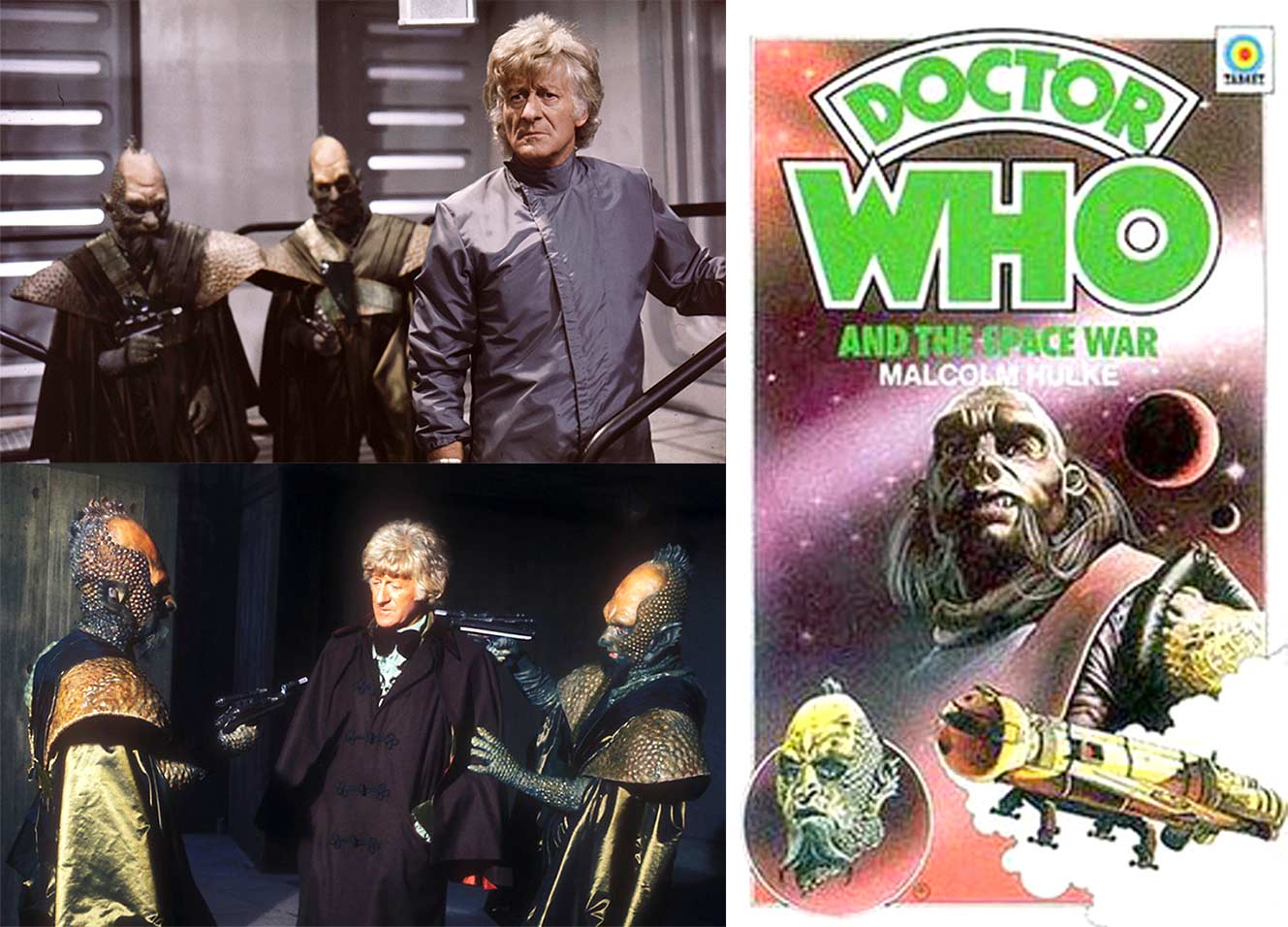
So Frontier In Space is the third story of the tenth series of Doctor Who, as reissued in the nice Blu Ray set of that season from the BBC. I was five years old when this story aired but I only seem to have hazy recollections of this one. Whereas, the next two stories in the box, I have a lot of childhood memories of terror. Looking back on it now, though, I have to say that it’s easily one of the best of the John Pertwee Doctor Who stories I’ve seen.
This one’s a six parter and involves The Doctor and Jo Grant (played by the always brilliant Katy Manning) getting involved with a cold war climate powder keg in the far future between the people of Earth and the people of Draconia (who are kind of a short hand version of ancient Japanese style lizard people, in terms of their manner and codes). The TARDIS is taken away from our two heroes more or less from the start of the tale and the majority of the first three episodes sees them being imprisoned by various people and spending a lot of time in jail cells, as the plot moves along without them in some areas. It sounds boring and padded but, well okay it possibly is padded but it’s nothing short of interesting and exciting since, you know there’s going to be some jail break or other set piece in each episode.
The plot is kickstarted by an outside party committing hostile acts of space piracy on the two species and using a sound based, hallucinogenic gadget to make the victims believe they are seeing the other race, humans or Draconians, committing these crimes, in order to start an intergalactic war. Fairly soon it turns out that the actual people committing these acts are the Ogrons, a race of quite dumb mercenaries for hire which were on a lot of merchandising such as jigsaw puzzles when I was a kid but were only actually in two stories in the Pertwee era (I’m not counting their cameo in Carnival Of Monsters, reviewed here and nor am I counting the 1990s Eastenders charity crossover, Dimensions In Time). The Ogrons, of course, are being directed by a higher power and it soon becomes evident that this is a master plan of... um... The Master, kind of. In the last episode it is revealed that he is working (although he plans to double cross them) with the Daleks, who only turn up in that final episode.
The story is absolutely superb and it has a great script. Katy Manning’s always watchable Jo Grant is given more to do here and there’s a wonderful scene where she is holding up a very long, one sided conversation with The Doctor to hide the fact from a security camera that he’s already escaped the cell... demonstrating that Jo Grant can talk the hind legs off a donkey with ease when she has to.
The Master is, once again, played absolutely brilliantly by Roger Delgado (aka Roger Caesar Marius Bernard de Delgado Torres Castillo Roberto) who, alas, died quite violently while shooting a television show in Turkey when the car he and two other crewmen were in plunged into a ravine, just a few months after Frontier In Space aired on television. It was a real loss and I think it’s probably why Jon Pertwee opted to leave the show a year later. Delgado’s last scene in this story is of him shooting The Doctor down, before Jo helps the wounded Doctor into the TARDIS at the end of the last episode. The Master would not return again until he was pictured as a kind of melted looking monster in the Tom Baker story The Deadly Assassin in 1976. He’s been played a few times by different actors since then and, in at least two of the incarnations of this time lord, the actors have somewhat resembled the look of Delgado in the role.
The special effects in this one aren’t great as the story calls for things like space walks and so on but, it never really bothered us as kids. Even then, I’m sure, we could see those big cables holding the actors up but, you know, how else do you tell a story like this on a TV budget in the early 1970s. I look on them now as a kind of comforting presence in these things and count myself lucky that, unlike some other films and shows put out in high definition, the copyright owners haven’t tried to tart up the special effects and turn them into something they never were (although they have in some of these Blu Ray sets, it’s true.... but there's always the option to watch the original version). I like that the cell holding the prisoners here wobbles when they bash it and stuff like this should always be left in. It’s not just entertainment... it’s art and, as importantly, a historical document of its time. So leave it alone is always my view on the decision to intervene too much with modern technology.
The Target novelisation of the story, always a big winner with kids... I guess they were the Harry Potter novels of their day to some extent, when it came to promoting children’s reading... was one of the few of their adaptations not to use the name of the story for the book title. Instead of going on the shelves as Frontier In Space, the book version was called Doctor Who And The Space War. I probably enjoyed this one along with all the others... I certainly had a copy of this shelved with around 60 others at one point, I’m sure.
The next story in the series and on this Blu Ray set is Planet Of The Daleks, which I assume follows on directly from this story. I only remember a few things from it which haunted my nightmares but I also remember being disappointed with it when I watched this one again on a VHS tape in the late 1980s so... yeah, we’ll see how that one goes. Frontier In Space, though, is an absolute corker of a story and probably, it turns out and much to my surprise, the real jewel in the crown of this boxed set.
Thursday, 15 October 2020
Doctor Who - Genesis Of The Daleks
The Time Meddler
Doctor Who -
Genesis Of The Daleks
Airdate: 8th March 1974 - 12 April 1975
BBC 1 - Region A/B Blu Ray Six Episodes
Warning: Some spoilers.
Okay, so the next story in my re-watch of Series 12 of Doctor Who is the much acclaimed fan favourite Genesis Of The Daleks. Even Tom Baker cited this as one of his favourite stories but, I have to say, this one always left me a bit cold. Alas, any hopes I had that I might, with age, revise my reaction to this serial as anything other than having to sit through a dull story, faded very quickly as I watched.
This follows on from The Doctor and his companions Sarah (Elisabeth Sladen) and Harry (Ian Marter) using the teleport at the end of The Sontaran Experiment (reviewed here) to return to Space Station Nerva after making the repairs to the system they promised in The Ark In Space (reviewed here). However, this is not to be, as their transmat beam is intercepted by none other than the Time Lords themselves, who have a mission for The Doctor. This is not unprecedented throughout the run of the show but it was with Tom Baker that the Time Lord culture and The Doctor’s place in it were explored a little more thoroughly than their brief mentions and appearances in the previous 11 years.
The mission is simple... The Doctor, Sarah and Harry have been transported to the planet Skaro, back to when the Daleks were first coming into being. Their mission, destroy the Daleks before they become the lethal menace that they become for hundreds of thousands of years (or more). As far as the Daleks are concerned it all starts here with their creator, Davros (played here by Michael Wisher), who we meet for the first time. Despite his ironic death at the end of the sixth episode, he would of course, return to face off against The Doctor many times over the years including Tom Baker’s second and final story against the Daleks four years later, in Destiny Of The Daleks. Out of the two, I’ve always loved Destiny Of The Daleks and not had much time for Genesis Of The Daleks so I hope, if the BBC get around to releasing the latter on Blu Ray at some point in the next few years, the experience of the second Davros story lives up to my memory of it.
Another thing I absolutely hate about this is it kinda changes the history of the Dalek race somewhat. Oh yes... I forgot... some people call it revisionism... I call it meddling with things the original Dalek creator (Terry Nation) should know better than to tinker with. The fact is, before this story the warring race against the Thals were called the Dals. However, from this moment on in Genesis Of The Daleks until the present day stories, their name has been changed into a stupid anagram of their future selves, the Kaleds. This is pretty weak and, frankly, unforgivable... you don’t mess with continuity.
Now, Genesis has some interesting elements and, for a family show airing before the watershed, it’s quite bleak and dark. We see the Thals and Kaleds at war with each other but, this earlier incarnation of the Thals are far from the race of blonde haired, blue eyed pacificistic hippies we meet in both the William Hartnell stories and the first Peter Cushing, big screen adaptation. Instead, they are virtually interchangeable with the Kaleds and, yeah, I did get confused a lot re-watching this as to which set of species I was looking at from one scene to the next.
The bleakness continues as the war combat scenes are very reminiscent of the trenches in World War Two and the Kaleds (and possibly the Thals as well, if I got this right) are all pretty much parodies, in uniform and attitude, of the Nazis. This whole World War Two atmosphere was touched upon again in the 2015 series of the show starring Peter Capaldi as The Doctor, with the early days of the planet Skaro maintaining that pessimistic vision. Here in Genesis, though, it’s a full on blatant set of references right down to a form of Nazi salute and even, in the first episode, Davros’ main henchman Nyder wearing something similar to an Iron Cross (it was ditched after the first episode for maybe spelling things out a little too clearly).
Something which really bothers me about the writing on this one is that, for an extremely intelligent Time Lord, The Doctor really doesn’t seem very clever in this at all. For example, in a typical case of the writers painting themselves into a corner for a dramatic situation, we have The Doctor using a detached Dalek gun to destroy some tapes made by Davros, containing information about future Dalek defeats which he was forced to give him in an interrogation. However, straight after this moment, The Doctor and Harry find themselves locked in the room and can’t do anything to shift the lock until they are freed later on in the story. Gee... it’s not like they even thought to use the same Dalek gun which was just laying on the table by the door to blast themselves free?
And... I honestly find the whole reason for Davros creating the Daleks for the good of the Kaled race, because they know what they will mutate into and so need sturdy exo-skeletons to look after them, somewhat ridiculous. Honestly, how can you predict what you are going to evolve into... especially since it’s made clear that The Doctor is the first Time Lord that the Daleks have come across. It just doesn’t make much sense and, good as all the actors are, I just find the action dull, the humour almost completely absent and, iconic monologues and exchanges aside, somewhat hard to sit through. Maybe at six episodes it’s just too long and could have, perhaps, been better served as a four parter. The music doesn’t seem to help matters either and doesn’t, I believe, give the story the lift it needs to make its points. Maybe a full on military march may have been a better route to go down on this one.
Either way, Genesis Of The Daleks is a story that is much loved and so nothing I say will matter, thankfully. It so impressed people at the time that I remember an abridged LP record album of the show was released by the BBC with linking narrative sections by Tom Baker between scenes, not long after it aired on television. I remember borrowing it from the library at the time and, guess what? That didn’t do much for me either. However, despite the ‘revisionism’, it did give the series a new, villainous character in the form of Davros and people still thrill when he turns up in the show occasionally to this day. So it’s not all bad... just not my cup of tea in terms of classic Doctor Who. Still, I am, very much looking forward to perusing the last of the stories which make up this season soon, featuring what are probably, to this day, the show’s second best remembered regular villains.
Wednesday, 2 January 2019
Doctor Who - Resolution
Super Kaled, Fragile-istic
Doctor Who - Resolution
Airdate: 1st January 2019
BBC 1
You know, let me just say that I think Jodie Whittaker is a good Doctor and her supporting cast of Bradley Walsh, Tosin Cole and Mandip Gill are all pretty spot on for being travelling companions. There’s only been a few stand out episodes in Whittaker’s first season as, frankly, the writing hasn’t been good on a lot of these. I seem to have a large number of people following me on my Twitter timeline who used to regularly watch the show and comment on it after every episode. I’ve heard from hardly any of them this year in relation to this show and I know that some people have either given up on it or... and this seems to be quite common... have it backed up or waiting to watch on iPlayer but just can’t seem to get around to it. Which I think is an indication of what’s been going on with the show this year.
You need to have some truly outstanding, clever episodes to make the show work or at least to keep people coming back for more and... that doesn’t seem to be happening at the moment. And last night’s New Year’s Day Special, which unfortunately took the place of having a 2018 Christmas Special, was another less than outstanding episode, it has to be said. Again, nothing wrong with The Doctor and her companions... and even the supporting cast were pretty amazing on this one... just bad judgement and some not so strong writing on this one, as far as I can see.
Now, most of us had probably all figured out from the trailer at the end of the last episode that the Daleks were going to be involved in this somehow. Good, bring them on is what I say to that. Daleks are the best way to Christen a new Doctor. Alas, they tipped their hat too soon in the episode by showing one crawling up a wall. Seriously, any fan of Doctor Who probably figured out straight away that was just a Kaled out of its Dalek case. So maybe the reveal was a tad early on for that one.
However, not content with having the promise of a Dalek, which stayed in its Kaled form for way too long before building itself a fairly primitive version of its casing (I really wanted to see the Doctor surrounded by proper Daleks at some point), they also gave this Kaled the ability to attach itself to a human host like a bloody Metebelis spider... something we’ve never seen one do before or had any idea that they even could, as far as I can remember, in the entire 50 plus years of the show. It’s like the producers decided to give them new, super powers just for the hell of it. Bad continuity and, while they were rewriting Who lore... I quite liked the government cuts excuse for the demise of UNIT (United Nations Intelligence Task Force as it was back in the day... I’m not using their idiotic new acronym from the last ten years of the show) but it’s a really stupid idea. After the planet has been invaded so many times in the past, they get rid of the only Earth run defence against aliens. This is, frankly, implausible.
This episode seemed to me to be a really thinly veiled remake of Christopher Eccleston’s first encounter with the Daleks, except, it also had a Kaled roaming around for a while and a slightly bigger playing field (Sheffield instead of a highly secured building). This wasn’t exciting and didn’t have me on the edge of my seat like that original template did... I just got kinda bored, to be honest. While simultaneously trying to defend the programme from all the negative reactions in the room from the rest of the family, who really do seem to have given up on their ritualistic watching of the programme. If it wasn’t for me, this wouldn’t have been allowed on our telly box anymore.
Also, nobody seems to be addressing the real elephant in the room here. The Earth has been invaded by the Daleks on numerous occasions in the last ten or so years and the people who inhabit the world of the show certainly should remember them. It’s kind of hard to just wipe them out of memory when they even stole the Earth and moved it to another location at one point and enslaved billions of people another time. So tell me... how the heck does none of The Doctor’s new companions, or anybody in the episode, not remember previous invasions all of a sudden? This makes no sense whatsoever. Especially in a seemingly post-UNIT world. I’m sorry but, no, if you want me to invest in your stories emotionally then... you need to make them credible and treat what’s gone before with a little respect it seems to me.
The irony is, there were some great dramatic scenes here between Graham, Ryan and Ryan’s dad... beautifully written and performed. However, like someone in the house shouted, there’s a Dalek on the loose on Earth, why has it just turned into a slow moving soap opera instead. Personally I didn’t mind the juxtaposition of the pacing between the two tones myself but, yeah, other people were less than happy (and one person started falling asleep).
So... nice performances from pretty much everyone in the show, some okay sets and props and a workable premise for a story but, no, this one really didn’t work for me I’m afraid. And I’m getting tired of defending the show to the people who did once like it. This was the only episode we are getting of the show this year (the next series, if it happens, it scheduled to start around about April 2020 I think) and I was pretty angry about that but, honestly, now I’m kinda glad of the break. Hopefully, there will be some changes to the direction of the show (nobody expects people to get everything exactly right on the first series from a new creative group) and it will maybe have the rest it needs so people can really think about getting the show back on track. And I need a break from reviewing new Doctor Who for a while, I think because, frankly, I hate saying negative things about the show. Resolution was not special enough for a special edition of the show and... I’ll just leave it at that, I think.
Sunday, 16 April 2017
Doctor Who - The Pilot
Fore Play
Doctor Who - The Pilot
Airdate: 15th April 2017 BBC 1
Well this was a very strong start to the latest series of Britain’s most popular science fiction export (arguably more popular than Professor Quatermass, although I really don’t think it could exist without the good Professor clearing the path in the first place, so to speak). This episode introduces a new companion or, quite possibly, an old companion (yeah, alright, I’ll get to my silly speculation bits later) in the shape of lesbian character Bill Pott’s, played by the really very good Pearl Mackie, and also brings back the current ‘sort of’ companion Nardole, as played by Matt Lucas (who is also good... which shouldn’t surprise me but it does). This is the episode which had a preview scene released quite a while ago (over a year?) but I noticed there’s a heck of a lot less dialogue coming from Bill in the version of the scene as it was presented here so I can only assume that the character has undergone some ‘tweaks’ since she was first written in... well they’ve had a very long time between series’ to tinker with her, I guess.
So the episode starts off strongly for me, personally, because we have The Doctor, now seen to be a lecturer at Bristol University, explaining to students as to the nature of time. Time, he says, is an illusion created by seeing lots of static bits placed in such a way that the perception of them experienced one slice after another gives us a sense of a journey over ‘time’. This is nicely demonstrated with a moment which seems like it would better fit right in with Moffat’s other hit TV show, Sherlock, in that the film itself (although we’re really watching digital, right?) is sliced up before us as a metaphor for the explanation of the true nature of time. I’ve been telling people they’ve been looking at time all wrong for years... as a fluid rather than a static state accessed in a specific way we are mostly cursed with looking at it... it doesn’t exist. So it’s good that the universe’s premiere timelord has finally gone on record as saying this.
Okay, so we have a really good opener because it does what Doctor Who does best... gives us a mystery to work on. In this case there’s more than one because we have the introduction of Bill and the mysteries surrounding her and The Doctor’s mysterious ‘secret vault’... and we also have the writer running through the wet paint very fast to distract us with the mystery which gives the story its name. That of The Pilot... who appears as a manifestation of a permanent puddle which can chase you through time from one end of the galaxy to another and reflect your image back as a feedback the right way around, rather than a true reflection. This in itself is good stuff and this underlying plot, which I won’t detail here, helps explore the sexual diversity of the new companion and does it in a romantic way, full of wonder. So that’s all good then.
We also have another encounter with the Daleks which, fortunately, is only a minor appearance and doesn’t hook in with the main plot. There’s one of a few nice little nods to the history of the show which are found in this episode here in that the Movellans are seen with them. I couldn’t believe it because the last and, I suspect, only other time we saw them was in the Tom Baker serial Destiny Of The Daleks back in 1979. My joy was slightly tempered by the fact that the Daleks we see with them are a more updated design than they were when the Movellans were around but... oh, well... that BBC budget thing is getting in the way of authenticity, I suspect.
Another nice and, I suspect, ‘more important than they’re letting on’ reference came up in the scene where The Doctor was persuaded not to use a memory wipe on Bill. The implication of him falling victim of the very same thing in the last episode to feature Jenna Coleman as the deal breaker here was beautifully re-enforced by composer Murray Gold using his old companion Clara’s theme to support those moments... lovely stuff.
But there’s more than one mystery her to solve and, as is usual for the rebooted Doctor Who stories since the time of Christopher Eccleston’s reincarnation of the character, there’s an underlying puzzle thread to be solved which will obviously be an arc for the entire series. We know that Peter Capaldi will be leaving soon, allegedly during the Christmas special but, I suspect, the transformation may be a little sooner than that... after all the Mondas cybermen who are returning for the last two episodes of the series and who haven’t been seen in the show since 1966 saw the death of the William Hartnell incarnation of the character (who I suspect Bill is named after by the writer, in an affectionate tribute) and it would be a nice, fearful symmetry if they were to cause the death/regeneration of the latest incarnation too. But this is not the real mystery and nor, I suspect, is the vault which The Doctor is apparently guarding. He would know better than to have something precious locked up, surely? He’d hide it in plain sight I would have thought. It could be a TARDIS or a nursery even but, I suspect, something timelordy (especially if The Master is making a return) and so I think it’s about time I went into the ‘wild speculation’ section of this review. So I apologise if all this turns out to be silly...
We are used, over the last ten years or so, to seeing references to the previous episodes of the show and they are usually very brief, blink and you’ll miss them, shout outs. However, we have here a Doctor who has a picture of his 'late' wife River Song on his desk at the University along with a photo of his Grandaghter Susan Foreman, as seen in the first year or so of the original series. She was played by Carol Ann Ford and she left the show in the 1964 story The Dalek Invasion Of Earth, which I reviewed towards the end of last year here. And The Doctor keeps coming back to these photos throughout the episode rather than just have this as a throwaway shout out so... the writer wants us to notice something here.
Now I have several theories on the subject but this is my pet one at the moment. I’m betting on something similar to this but, please remember, I’m only one episode in so the pieces of the puzzle might not all have been revealed as yet...
What’s missing from this set of photos? We have The Doctor’s wife and The Doctor’s granddaughter... no Doctor’s son or daughter... whichever that was. That element is decidedly missing. We also have a new companion called Bill who The Doctor has suddenly taken an interest in and whose mother died when she was born. When she is now given some photos of her mother before she died, she spots the reflection of Peter Capaldi’s Doctor in a mirror taking the photo in one of them. And then she, and we, are all promptly asked to forget about it as the ‘puddle story’ takes up the heat for most of the rest of the episode...
However, if we don’t let ourselves get distracted we have the idea that we have The Doctor who knew Bill’s mum before she died and the idea of memory wipes represented. So my number one theory at the moment is that Bill’s mum was The Doctor’s daughter and, since Pearl Mackie doesn’t seem to be expecting to be staying around past this current series, I’m guessing her mind will be wiped a little and that she is The Doctor’s granddaughter and, when she regenerates into the familiar Susan Foreman incarnation of the character through televisual trickery at the end of the show, she will be left with an earlier incarnation of The Doctor (aka William Hartnell) and he will take her to Coal Hill School, sometime shortly before the very first Doctor Who story, An Unearthly Child, takes place.
Well, that’s my most favourite conclusion at the moment, anyway. Although, if that really does prove to be the case, then the LGBT community will want Moffat’s head on a stick for having a lesbian character who regenerates into a character who runs off with a man at some point. So maybe not. But I like the idea that the new companion ‘may’ be Susan or, at the very least, in some way related to her so... lets see if she’s revealed to be in possession of two hearts anytime soon, eh?
And that’s that for me. Great opener and I can only hope the show continues at this quality. I guess I’ll find out next week.
Monday, 13 February 2017
The Lego Batman Movie
Brick Grayson
The Lego Batman Movie
Denmark/USA 2017
Directed by Chris McKay
Warner Brothers
UK cinema release print.
Warning: Some spoilers, of sorts.
I was pretty surprised when, a couple of years back, Warner Brothers allowed their Batman character (plus a load of other licensed characters from various franchises) to be diluted, just a little, by having a version of him in The Lego Movie (reviewed here) while the franchise and their film rights were still very much active in the current cinematic landscape. It was a great idea and I welcomed it heartily but I think it was quite brave of them to lampoon their own characters like that and they’ve done it again now with this spin off film, The Lego Batman Movie.
What this means is that they’re allowing a movie with a major character in ‘comedy mode’ out in the very same year that at least one movie also featuring Batman (as played by Ben Affleck) is coming out at our cinemas in the Justice League movie. It remains to be seen whether his character will also make an appearance in a cameo at the end of the new Wonder Woman movie too, to remind the audience what they are building up to but... I wouldn’t be surprised.
However, I’m pretty glad that this movie here is in existence because frankly, and I’m sure most people would probably agree on this, it’s way more of an interesting and engaging film than the current crop of dark DC movies that are being inflicted on audiences and this one really captures certain, albeit exaggerated, truths about the characters in a direct and effective way which the other cinematic representations we’ve had lately just aren’t able to compete with on a similar level.
So, this weekend, I armed myself with a kid, being as I went to the cinema with my friend, his lovely wife and their cute child... and took in the new Lego movie myself and, although there was exactly the ‘first showing overload’ problem I expected to have with it on this one (yeah, I’ll get to it soon enough), I overall had a good time with this movie and it even got me to smile at some moments, a facial expression which is fairly out of character for me, it has to be said.
The first thing prospective audience members may want to know about this one is that you absolutely do not need to see The Lego Movie to watch this. In fact, I couldn’t find any reference to the events and characters of that film anywhere in this one. They might be in there but I certainly didn’t spot them on first viewing so, yeah, this can very much be seen as a stand alone film. Well, other than the fact that Batman is in it, of course... totally not referring to his previous brick-based adventures in any way shape or form. There are, however, quite a lot of references to the previous incarnations of The Batman, both on screen and off, as there are about the DC universe in general... and they do come thick and fast. It was nice, for example, seeing a clip from the 1960s Adam West Batman on the big screen again (there are at least six homages to the Batman TV show and also the film spin off that I could count) and it was also nice to see a brief reference to the 1940s theatrical serials at one point.
And it doesn’t stop there either... the DC universe isn’t the only thing that gets furious referencing here as this follows the same modus operandi as The Lego Movie in that characters from a whole host of other Lego licensed franchises are also seen on screen. I was disappointed that a lot of the DC Universe characters were sidelined in this movie but it was nice to see The Superfriends mixing it up with their Justice League buddies in a party scene. It’s in this sequence that Batman and his newly acquired sidekick Dick Grayson, aka Robin (or Reggae Man... nah, you watch the film to find out) steal The Phantom Zone projector from Superman’s Fortress of Solitude so they can banish The Joker there. Of course, that’s exactly what The Joker wants and it’s here that he teams up and unleashes various Lego versions of their licensed characters (and some unlicensed, as far as I know) and teams up with them to destroy Gotham City. So yeah, we have Voldemort from Harry Potter, the Eye of Sauron from Lord Of The Rings, the Gremlins from... um... Gremlins, King Kong, the DALEKS from Doctor Who and the Wicked Witch of the West with her flying monkeys from The Wizard Of Oz, all involved in an all out attack on the brick city where Batman lives and... it’s pretty much as fun as you would expect.
There are a couple of problems. The main one being that there is so much going on in the movie, both in terms of cramming in a heck of a lot of laughs and action and also in terms of the dialogue/visual referencing that it does get a little difficult to process it at points. Some of the action sequences... especially when Batman, Robin, Batgirl and Alfred (as voiced by Ralph Fiennes) team up with all the supervillains The Joker left behind in Arkham Asylum and go head to head against the aforementioned army of evil... are a little hard to follow at certain points, to be sure. Of course, it could be argued that the choppiness, albeit often inventive action sequences, coupled with the sheer randomness of the assorted roll call of non-DC universe character mash ups are an homage to the free imagination of a child and, well, who am I to argue with that.
Another thing that irritated me a little was Batman’s description of the un-named DALEKS as ‘British Robots’. Okay, British is fine (even though they were created on the planet Skaro) but robots they are not. If anything, they are living creatures driving personal tanks, to some extent. So wasn’t that impressed with the almost derogatory way in which they are referred, especially when they are in the movie a fair bit.
And I also found it strange and somewhat disappointing that in a movie which has Ralph Fiennes doing one of the voices, he wasn’t also asked to voice his recurring Harry Potter villain Lord Voldemort, since he plays a big part here, instead choosing to have Voldemort voiced by Eddie Izzard instead. Don’t know what they were thinking there, to be honest.
However, these are all pretty minor things and it’s a quite fun movie most of the time. Like a lot of these kinds of films these days it also pitches its humour on two parallel levels. You’ve got all the slapstick and stuff for the kids but there’s also an adult level hidden but quite easily decryptable in the movie too... so if you’re an intelligent member of the 'grown ups' race (and not just a man-child like me) then you have something which you can hook into too.
And that’s about it for The Lego Batman Movie. Oh, apart from a quick shout out to Lorne Balfe who provides an excellent, Batman-esque score for the proceedings (the CD is in the mail) and a quick note to say that Billy Dee Williams finally gets to reprise his role of Harvey Dent (aka Two Face) from the 1989 Batman movie, albeit briefly. Other than that though, The Batman Lego Movie is not full of interesting shot set ups or mind-blowing visuals but it does have a huge sense of fun and, like the previous movie, a whole brickload of heart. This is almost certainly going to be more interesting than any other Batman related movie released this year (I’m just guessing here but we’ll see if I’m right) and it’s definitely worth a look... especially if you know your comic book history and like spotting all the references. There’s a lot here to hold your interest.
Thursday, 5 January 2017
Now On The Big Screen
Whoniversal Pictures
Now On The Big Screen: The Unofficial And Unauthorised Guide To Doctor Who At The Movies
by Charles Norton Telos Publishing
ISBN: 978-1845839307
“Now you can see them in colour on the big screen...
closer than ever before. So close, you can feel their fire...”
Thus stated the original theatrical trailer to the 1965 movie Dr. Who And The Daleks, which is one of the many items under discussion in this, relatively, new book (2013/15) by Charles Norton. Which is what I found myself reading on Christmas Day this year since, for technical reasons, the new Patricia Cornwell and Kathy Reichs novels had not yet found their way to me under their traditional, seasonal wraps. Don’t worry, said tomes were gifted to me a few days later once family members had been met and greeted so, if you’re waiting for my usual, annual review of the latest works by these two ladies... they will be coming soon (as soon as I get to finish them).
Instead, this somewhat marvellous tome given to me on Christmas morning gets to be my first book review of 2017 and, I have to say, it’s certainly an interesting project (as is often the way with unauthorised and, therefore, often more ‘honest’ editions). Writer Charles Norton not only attempts to document the origins, production and aftermath of the original and, to date, ‘only’ Doctor Who movies to be released in cinemas at the height of Dalekmania in the UK - the 1965 movie Dr. Who And The Daleks and the 1966 film Dalek Invasion Of Earth 2150AD (both starring Peter Cushing as scientist Dr. Who and Roberta Tovey as his grand daughter) - but he also, for the majority of the book, goes on to lift the curtain on all the various planned and aborted Doctor Who movies which have never made it to the screen in the intervening years. Some of these proposed projects came from names associated somewhat with the television history of the show itself and others, from less familiar quarters. And it’s a very interesting read for anyone who loves the colourfully depicted, distorted movie versions of the characters as played by Cushing and co as much as they do the television show.
The first two sections deal with the original motion pictures in quite some detail and even include, like I’ve seen done before in other important works that deal with British films of that era, some of the considerations of the BBFC (British Board of Film Censors, as the acronym more honestly stood for in those days) from the script submissions, before even a shot of frame was filmed. This is interesting in itself since we have an insight into some scenes which were scrapped and also some sequences which were shot and then later cut or modified, like the close-up shots of the Kaled inside one of the Daleks which the BBFC thought too disturbing to include in a family/children’s film (such as it was perceived back then). It also includes, as do all of the chapters dealing with other, more ill-fated productions, comments about the experience from various cast and crew culled from a number of credited sources over the years.
It’s good stuff and, as far as I can tell, the most definitive story 'behind the scenes' of the two Peter Cushing movies in print and, if it had just been these two movies that the book was solely about, then it would have still been a great read. As interesting though, are the next chapters which probably make up around three quarters of the book, which detail the likes of various projects by people who were trying to get another movie incarnation of the good Doctor to the screen... including a third continuation of these original two movies.
So we have a section, for example, devoted to Doctor Who Meets Scratchman, which was the long gestating brain child of the two writers who were also starring in the television series at the time the project was first mooted... Tom Baker (the Fourth Doctor) and the late Ian Marter (who played the Doctor’s fourth assistant Harry Sullivan, for a while, as a preliminary to going on to write various novelisations of the series for Target books, before dying tragically young). There are some nice reminiscences to be found here including the time when Tom Baker and Ian Marter went to the Dominion in London in 1977/8 to take a look at that new Star Wars movie which had just come out... only to leave the cinema dejected when they realised the budgetary goal posts for any big screen science fiction projects had just been dramatically changed and that they really had no hope in hell of getting something like that financed.
Along with a whole host of projects in the book, two of which would have featured one of my favourite ladies, Caroline Munro, in their genetic make-up, the tome also covers Douglas Adams’ proposed film project, Doctor Who And The Krikkitmen. Now Douglas Adams had a history of writing some episodes of the show (including the infamous ‘lost’, half filmed due to TV strikes, Tom Baker story Shada) but he is perhaps more famous, world wide, as the man who created and wrote the legendary Radio Show, series of novels, TV show, theatre production, movie and audio recordings that constitute The Hitchhiker’s Guide To The Galaxy. Now, as soon as I’d read the title of his proposed Doctor Who movie I think I’d figured out what eventually became of it and, sure enough, this book confirms that it did end up being the basis of the third of the five Hitchhiker novels... Life, The Universe and Everything.
Now On The Big Screen does, in places, get a little dry and perhaps just a little tedious in some chapters but it’s all done in the name of enlightenment and you can’t knock author Norton’s quite thorough approach to digging up all he can about the material in this volume. Indeed, a synopsis of the script usually running between five and eight pages long is provided for pretty much all of the detailed movie projects in this book, which is absolutely invaluable. What it did, however, make me realise is that, as much as I’d love to see another new Doctor Who movie at some point in the future (and, call it a hunch, but I suspect we’re all a lot closer to that prospect than we are possibly aware of until the marketing machine gets into high gear) is that I’m really thankful, in some ways, that none of the stories summarised here never made it anywhere near the big screen because, honestly, they do mostly sound quite awful (although there’s surely still time for Caroline Munro to be offered a big part in the regular TV show, perhaps?).
After the main book has concluded, with a little on the background politics of the BBC that ushered in the new Russell T. Davies era of The Doctor’s adventures in televisionland, we also get another invaluable, much smaller section telling a little bit about the various, unauthorised, straight to home video spin offs featuring some of the actors, actresses and characters from the series... some of which are written by people who work on the show these days, such as Mark Gatiss. So this is a good little guide for further, non-Doctor adventures with characters like Sergeant Benton, Brigadier Alistair Lethbridge Stewart, Sarah Jane Smith, Liz Shaw and even the likes of Professor Travers and Victoria Waterfield, it would seem.
All in all, the information contained in this tome is of great interest to fans of Doctor Who and I’m really glad to have Now On The Big Screen on my book shelves (such as they are... might be the floor at this point). Charles Norton has done a great service to fandom when pulling this research all together here and its an absolutely invaluable addition to any Whovian’s library. So glad to have this one.
Friday, 26 August 2016
Doctor Who - The Dalek Invasion Of Earth
Hello, Dalek!
Doctor Who -
The Dalek Invasion Of Earth
21 November - 26th December 1964 BBC1
BBC DVD Region 2
“One day, I shall come back. Yes, I shall come back. Until then, there must be no regrets, no tears, no anxieties. Just go forward in all your beliefs, and prove to me that I am not mistaken in mine.”
The Doctor, The Dalek Invasion Of Earth
Well, it’s been a while since I personally watched the original version of the Doctor Who story The Dalek Invasion of Earth. My previous experience of this classic William Hartnell tale dates back to the days of VHS, when I probably borrowed it off my cousin. Of course, this 1964 adventure was remade two years later by Amicus studios as Daleks - Invasion Earth 2150AD, following the success of their 1965 remake of the 1963 Doctor Who serial The Daleks, entitled Dr. Who and the Daleks, for the big screen.
Now, while I quite like this original version of the story, I have to say I much prefer the big screen version a whole lot better with its crazy music, vibrant colours and more condensed, pacey version of the plot points. However, this version runs for six, 25 minute episodes instead of the 84 minutes of the movie version, and both have good things and bad things to offer the casual watcher of a story like this.
The first episode starts off strong with a slightly disturbing moment as a robo-man’s brains are finally scrambled enough by the device he’s wearing so that he throws himself in the river to drown, his floating body used in this and subsequent shots. Then the TARDIS materialises, not with the sound we know these days but with much less fuss. Interestingly, it’s not a model but a life size prop and... it’s looking a hell of a lot more authentic in this incarnation than it has done on many occasions in the intervening years. It even has two of its windows tilted open... not something I remember seeing before (or should that be since?). The TARDIS is still carrying its original crew who first set off in their adventures the year before, namely William Hartnell as The Doctor, Carol Ann Ford as his grandaughter Susan, Jacqueline Hill and William Russell... as Coal Hill School teachers Barbara Wright and Ian Chesterton. Of course, we shall be hearing more about Coal Hill School later in the year when the BBC launch their new Doctor Whoniverse spin off Class.
The four seperate into two groups after Susan sprains her ankle (no, really) and the TARDIS is accidentally buried under a falling bridge. Ian and The Doctor go to a warehouse, where they encounter the robomen while Susan and Barbara are picked up by the resistance. They soon discover that they are in the year 2164... which is 200 years after the episode was broadcast, of course. For some reason unknown to me, the big budget movie remake was set in the year 2150 so... I don’t know, maybe the producers of the movie version just liked rounded numbers.
At the end of the first episode, where Ian and The Doctor are cornered by robomen alongside the Thames, we get treated to the famous, classic reveal, cliffhanger shot. As they turn to hurl themselves into the river Thames and escape, not the best choice anyway if you don't want to get killed by the polution (in any century), we see a ripple on the surface and then a Dalek reveals itself as the main enemy of this story, slowly trundling out of the water and onto the bank of the river. Good stuff. This was only the Daleks second appearance, the first being just under a year before this in the second Doctor Who adventure but... I don’t think it’s too much of a leap to conclude that if series producer Verity Lambert hadn’t broken from her 'educational, history programme’ brief for the show in the second story... the series may not have continued running for too much longer. The Daleks were a huge hit on their first appearance and even more so with the release of more Dalek stories... as Dalekmania shook Britain in much the same way that Beatlemania had a year or two before.
It’s an interesting story and, as the groups of protagonists get further divided and find each other over the course of the six episodes they, independently of each other, all make their way with other characters to a mining operation using human slave labour in Bedford, to uncover the Dalek’s master plan of destroying the Earth’s core so our planet can be piloted around the galaxy like a huge spaceship. Fair enough, I guess.
There are quite a few differences from the film other than the obvious cinematic shorthand used in the later production. For a start, there’s certainly not an abundance of posters in post invasion London which are advertising the popular breakfast cereal Sugar Puffs like there are in the movie... where you can hardly look at any exterior shot without finding a Sugar Puffs poster at some point. The film version is, of course, very much an example of exclusive product placement gone mad and shattering the illusion of reality... unless mankind in the future really are subsisting on a diet of Sugar Puffs like they’re chowing down on Soylent Green.
The robomen are a very different beast here too. In the serial here they’re wearing very cumbersome, top heavy helmets and whatever clothes the human who was converted was wearing at the time. In the movie version it’s a much more military, deliberately Nazi-like affair with black, shiny uniforms and a sleek helmet not entirely unlike a German stormtrooper from the Second World War. It’s safe to say that the movie is pushing a slightly different commentary on the robomen than the no less sensitive but, certainly less demonised, versions in the serial. Also, I know these were being primarily watched on small, fuzzy screens which showed none of the detail you get these days but... it’s kind of hilarious when you realise the actor playing the roboman who throws himself into the river at the start of the first episode plays a roboman in various locations throughout the six episodes... and dies a fair few deaths too. Great stuff.
Other takeaways I got from this show was that, while the Daleks do say their trademark “Exterminate” a few times, it hadn't quite got the status it later achieved and, more often than not, they’ll just talk about people being killed instead. I also noticed one of the resistance fighters talking about striking a blow to give Europe a hope... so I guess by 2164 we must somehow be on very good terms again with our fellow Europeans after all this Brexit fuss... at least according to Doctor Who.
The ending of the final episode is quite dramatic and, surprisingly moving. The Doctor’s grandaughter has fallen in love with one of the resistance fighters but she has to leave him to carry on with her travels. However, The Doctor gets wind of this and locks her out of the TARDIS, abandoning her to a more stable future away from all his time travelling shenanigans. This is where the famous, farewell, ‘no regrets’ speech which I quote at the top of this review comes from. Even if you’ve never seen this episode, you’ve probably seen the speech because it is always used in documentaries about the show and in flashback sequences within the show itself. This was the very first time a companion had left the show but Carol Ann Ford would, of course, briefly return to the role opposite Richard Hurndall (standing in for the long dead Hartnell) in the 20th anniversary show, The Five Doctors.
And that’s that, I think. Doctor Who - The Dalek Invasion of Earth is something of a classic of the Hartnell era and definitely one to contemplate watching if you ever feel a hankering to watch a First Doctor adventure. Dated but kinda fun... but don’t count the movie version out just yet.
Sunday, 27 September 2015
Doctor Who - The Witch's Familiar
Skaro Margin
Doctor Who - The Witch's Familiar
UK Airdate: 26th September 2015
BBC 1
Warning: Yeah, yeah. Still spoilers in this one.
Okay so... I haven’t got a heck of a lot to say about this second episode of the latest series. There’s good and there’s bad but... really nothing to refute the astonishingly good work set up last week and I’m sure most people will be fairly happy with this one.
The episode doesn’t quite pick up from the cliff hanger ending of last week’s installment... instead pushing it firmly into the background until it can be similarly revisited to bring back exactly the same kind of dramatic flourish towards the end of this show, slightly weakened in that we now understand more what is really at stake and with the people behind the camera, presumably, hoping the audience has really short memories. This tactic seems to work out okay and I can’t make up my mind whether it was edited into the end of last weeks show, when they already had a viable cliffhanger of the seeming death of Clara, in order to balance up the running time or whether the story really was structured this way. Not too sure and it really doesn’t matter in the grand scheme of things, I guess. In modern day film precedents it’s the equivalent of the end of the second of Matt Damon’s Jason Bourne movies actually being placed chronologically towards the end of the third movie. Which can sometimes make things interesting.
In terms of the bad stuff I mentioned in this episode... bad being a euphemism for stuff I don’t personally like... there were two things which really bothered me here. One is Missy... who was really consistently well acted and well written throughout the episode except... the madness part of her character which I lamented at the end of the last series and which didn’t really bubble up to the surface last week, is back in a few scenes. I really don’t need to see her dancing around for no apparent reason with the Daleks... it just makes her seem overly dramatic for the sake of it. Still, I’m sure people will be into it. The other thing which bothers me is the apparent loss of The Doctor’s sonic screwdriver and its replacement with a set of sunglasses. Now, hold on. There’s a few things wrong with this decision... if, indeed, it’s not just a decision being used to tease the audience and stir up viewer reaction with the pay off being a new look screwdriver at the end of the year or next year... which can then be reproduced as a toy to generate more cash.
They’ve tried this idea before. The sonic screwdriver has been a staple of the show since it was first introduced in the mid-1960s in various Patrick Troughton episodes, beginning with Fury From The Deep. Jon Pertwee’s redesigned one was a very popular contraption and I could never work out, as a child, why they didn’t make a toy of it in the 1970s. Had to make my own. The device was scrapped in the 1980s, destroyed by a Terilieptil in the Peter Davison story The Visitation, if my memory isn’t failing me. I think the idea was that the screwdriver had become an almost omnipotent device to get the writers of the show out of any situation and... yeah, maybe they had a point. Or, you know, maybe the writers could just have been a little more clever with their writing... there’s always that option open to them, I guess.
The thing is, though... the screwdriver is as iconic an ingredient of Doctor Who as the TARDIS looking like a Police Box and the theme tune. Get rid of that and you lose one of the key recognition factors of a show which sometimes really needs that if the key cast member turn over is as high as it’s been, by design, over the years. The Americans presumably realised this too because the sonic screwdriver reappeared in the Doctor Who TV movie with Paul McGann and has been reunited with The Doctor, in one design or another, ever since. Until now... where they’ve replaced it with a pair of sunglasses.
What?
There’s absolutely no need to do this and there’s especially no need if you’re going to take away what is, effectively, The Doctor’s magic wand and replace it with something completely different which does the same thing. This smacks of either tinkering needlessly with the things that work or, as I said earlier, aggressive fan baiting... so I shall watch the online reaction to this elimination of a key element with great interest as the weeks go by.
So that’s the bad stuff. The good stuff? Mostly everything else.
Not much here in terms of postmodernistic referencing to the past this week but there are some really great scenes between Davros and The Doctor which, if I’m not mistaken (but, hey, I probably am), are trying to hit exactly the same kind of emotional beats as the famous Batman/Joker ‘character analysis and shared joke scene’ which closes Alan Moore’s much loved Batman one-shot, The Killing Joke. Still, whatever its inspiration, it works pretty effectively and the added 'twist' that Davros is up to no good all along may seem pretty obvious, as does The Doctor’s knowledge of this... but it doesn’t make it any less effective and both Peter Capaldi and Julian Bleach do a fantastic job here.
As do Jenna Louise Coleman as Clara and Michelle Gomez as Missy... barring my caveat above. The comical chemistry between the two is pretty good and it’s quite well written. Not brilliant in some ways because you do always know what’s coming - Missy pushing Clara down a hole to test the length of the drop is beyond telegraphed in the dialogue, for instance - but this doesnt stop it being funny and the two seem to have an interesting dynamic between them.
As far as everything else in the story... it was sturdy. Nothing very “wow” but, again, nothing which let the side down in terms of the set up episode, as I was expecting it too... so pleasantly surprised there. This looks like an odd season we’ve got in store for us and I wonder just where show runner Steven Moffat wants to take us this time around. We’ve got to lose Clara at some point and, hopefully, restore Danny Pink to her to lend credibility to the Orson Pink timeline but... whether Clara will actually leave or whether she transforms into someone/something else, maybe a Dalek in Asylum Of The Daleks (reviewed here), is anybody’s guess. I also wonder about Missy (The Master) and the “tune out and you’ll miss it” comment that The Doctor gave a specific ring to her daughter... presumably a relation of The Doctor’s if he and Missy are... um... brothers. Time will tell, I guess.
And that’s as much as I can say about this one. Nice solid episode which didn’t have the wow factor of the opening episode but which concluded things in a way that it didn’t leave a bad taste in the mouth. Not a contender for a great episode as the first part was but... not a bad one either.
Sunday, 20 September 2015
Doctor Who: The Magician's Apprentice
A Man Kaled Davros
Doctor Who: The Magician's Apprentice
UK Airdate: 19th September 2015
BBC 1
Warning: Oh yeah. You bet there are going to be all kinds of spoilers in this one... otherwise there’s not a heck of a lot left to talk about.
Yay! The Daleks are back...
... which, if you’re a regular reader of my Doctor Who reviews over the last five years, is probably not something you would expect to hear me say, given that I always keep banging on about how overused they are in the modern era of Doctor Who. However, for this episode at least, writer Steven Moffat does something fairly special with them....
So, following on from a fairly unremarkable Christmas special, the 2015 season of Doctor Who begins its broadcast with the first of a two part story, this episode being called The Magician’s Apprentice... and it has to be said it’s one of the best episodes I’ve seen in a while in the series. Probably since somewhere in the middle of David Tennant’s last year on the show. Opening with a brilliant and surreal opening hook set on a war torn Skaro, a young boy gets caught in a field of ‘hand mines’ which are hands which come up from under the ground and which can see you with an eye embedded firmly in each palm, grabbing you and pulling you under the surface, presumably to your death. In flies the Peter Capaldi incarnation of The Doctor to give the young boy a hand but, on learning that his name is Davros... he leaves him again to his fate. Which may seem a bit harsh if you’re not a fan of the show and know that the young boy will grow up to become the ruthless creature who mutated the Kaled race and invented the Daleks; a character created approximately 12 years after the Daleks first appeared on the show in 1963, opposite Tom Baker’s Doctor in his first season in the 1975 story Genesis Of The Daleks, before making regular appearances throughout the show’s long history. The eyeballs in hands, of course, now make perfect sense as an inspirational motif for the young evil genius when you realise their similarity to the eye stalks of the Daleks, only translated into humanoid terms.
After the credits, the story continues with Clara Oswald rejoining The Brigadier’s daughter in UNIT as a ‘returned from the dead’ Missy (aka the female incarnation of The Master) gets her attention and then teleports her away to grab The Doctor... who is in the year 1138AD, in a nice little reference to George Lucas’ magic numbers. They are then all transported to Skaro where both Missy and Clara are “Exterminated”... yeah, right... and The Doctor is left on a cliff hanger as he goes back to destroy Davros as a young boy.
Okay, so the story is fairly dark and, more importantly, darkly handled by director Hettie MacDonald, who last directed for the show on my all time favourite episode Blink... so no wonder she does a great job here. It seems the combination of Steven Moffat’s writing and her direction has given us what could, if we’re very lucky and the second part lives up to the set up, be another classic episode of the show. It’s downright creepy and atmospheric and, somehow, the emotional investment conjured up the actors delivering Moffat’s lines for this director seems to really help the audience believe that great things are afoot and... well they kind of are.
I’ve never really liked Davros as a character that much... my only interest in him being a symbol of what he stands for rather than anything any of the actors or dialogue have done for the character in the past four decades. Here though, as a dying creature who has summoned The Doctor for one final meeting, he is absolutely brilliant... seemingly relaxed and at ease on his home planet and, I dunno, just something about the way that Julian Bleach, who last played the character in the two part Tennant story The Stolen Earth/Journey’s End, plays him in a much more relaxed manner here that really makes the character work and Moffat ,once again, proves himself as a writer of, at the very least, great starting point stories.
There’s a lot for regular fans of the show to love about this one too, with various Doctor’s who have come across Davros over the years either heard in dialogue clips or seen in video clips... including a major moment for Tom Baker’s Doctor... the famous “Do I have the right” scene opposite Sarah Jane (Elisabeth Sladen is not seen here) as he debates whether he has the moral high ground when considering ending the Daleks before they are even properly unleashed on the universe. Something which this story has big echoes of, of course, with Capaldi’s Doctor being given the choice of saving him, leaving him to die or, perhaps, destroying him (although we know he won’t do that).
There are also some great dialogue references to the Tom Baker and Matt Smith incarnations of The Doctor by Capaldi, who also does some great guitar solos here, including a version of the Doctor Who theme. Music seems to be a key plot device here, in fact, with Missy using a variation of the 1982 chart hit Mickey, by Toni Basil, to grab UNIT's attention. Interestingly, The Doctor also plays a quick version of this on his guitar as a reference to Missy when they meet in this episode although, since he wasn’t around for that scene at the start of the story, one might wonder how he would know that Missy used that to identify herself to UNIT personnel? I’d like to believe it’s a Moffat clue to indicate that The Doctor already knows what’s going on and is one step ahead of the game at this point but... yeah, although he’s done stuff like that before I think it may just be a bit of sloppy writing here in that respect. Time will tell, I guess. Hope he proves me wrong.
Among other nice things for fans of the show is the reappearance of The Sisterhood Of Karn, who were first seen in Doctor Who in the 1976 story The Brain Of Morbius, before returning in a short web based episode prequel to The Day Of The Doctor 50th Anniversary special, giving Paul McGann the power to change into John Hurt’s War Doctor for the purposes of that story. They also reappear in a short web prequel to this episode, released last week. In addition to The Sisterhood and a whole load of other places and creatures from recent Who stories like the Judoon and the Ood, there are some great Daleks from the show’s early history featured in the story, which is great and, better than that, the famous monsters are in no way overused here and seem to be much more of a threat because of their lack of domination of the episode.
My favourite bit, though, was the ambient sound of the chamber in which Davros resides... which is a dead spit of the ambient sound used on the first of the mid 1960s Peter Cushing Doctor Who movies whenever the characters are in the Dalek city and, I’m pretty sure, dates back to the Daleks’ first on screen appearance at the end of 1963. That sound effect made me chuckle to myself when I noticed it.
So, yeah, all in all a well written, well directed and, it almost goes without saying, well acted episode, especially by the three leads Peter Capaldi, Jenna-Louise Coleman and Michelle Gomez, with the latter being little calmer in her delivery of the role (mostly due to the nature of the dialogue, I suspect) and, therefore, a little more lethal like The Master really ought to be. Some nice hits from Murray Gold’s score too with the Capaldi Doctor’s theme getting a little more prominence in the mix, this time around.... although saying that, why they were using it for scenes accompanying Clara rather than using a variant on Clara’s theme is anybody’s guess.
In general, though, The Magician's Apprentice is a truly triumphant season opener and I am keeping my fingers firmly crossed that the follow on and, presumably, lingering season long fallout from this episode set up, doesn’t let it down. Unlike The Doctor, I can’t travel in time anyway except very slowly forward, so I’ll have to wait for the answers to those questions but... a really strong opening here and I am looking forward to where the show goes from this, for sure.