Showing posts with label Katy Manning. Show all posts

Monday, 5 August 2024

Behind The Sofa - Celebrity Memories of Doctor Who


Sofa, So Good

Behind The Sofa -
Celebrity Memories
of Doctor Who

Edited by Steve Beery
Foreword by Terry Pratchett
Gollancz
Isbn 9780575129450


Just a very short review but a big shout out to my cousin Steve in Australia, who saw two copies of this book we’d never heard of on sale in a shop over there and was nice enough to send one to me.

Behind The Sofa - Celebrity Memories of Doctor Who is a small but many paged tome that does exactly what you think it does. The proceedings of the sales of the book all go into Alzheimers research and so, quite appropriately, it has a foreword by the late, great Terry Pratchett (it must have been one of the last things he wrote, I reckon). Each entry of a Doctor Who remembrance from various celebrity fans of the show is accompanied by a small black and white illustration but, I confess, I could make no rhyme or reason as to why some were of the celebrity in question, some were monsters and characters related to the anecdote and, also in large part, pictures of completely unrelated Doctor Who iconography (or so it seemed to me)... so in terms of the illustrations, it’s a bit ‘all over the place’. But they’re very good though and some are featured on the front cover design, making up the roundels of the TARDIS.

Something else which has the same quality of general higgledy piggledyness is the order of the anecdotes themselves. One might think the entries would be alphabetical but, no, that’s not a convention which has been employed by the editor here either.

Now, the range of remembrances go from recollections of the apparently not urban mythical ‘hiding behind the sofa’ from various Doctors over the years, starting with William Hartnell (who pop star Toyah lists as her favourite here). Other kinds of anecdotes are mostly from people who have worked, in some capacity, with either the production of the show or with an offshoot from the show (such as writing books about it etc). For instance, Michael Moorcock says some things about the scheduling of the show where he lives and it certainly explains a few things about the weaknesses of the Doctor Who novel he wrote, I suspect (which I reviewed here).

Some of these are even from the actors playing companions in the show (although, I don’t remember seeing any from any of the Doctors themselves here). So we have anecdotes like Richard Briers telling how he played his part in the Sylvester McCoy story he did as an over-the-top Hitler and Janet Fielding, who played Tegan Jovanka opposite Tom Baker and Peter Davidson (returning to the role decades later for Jodie Whittaker’s last story), tells of a ‘wardrobe malfunction’ she had which was instigated by Peter Davidson, no less.

Actually, some of the stories actors tell are exactly what you are expecting them to be but that makes them no less special. So we get Katy Manning’s remembrances of working with Jon Pertwee and the late Bernard Cribbins talks about his two times fighting Daleks, decades apart. Once as a companion to Peter Cushing (where they both got the giggles) in the second cinema adventure Dalek Invasion Earth 2150AD (reviewed here) and then during his regular stint on the show, as the grandfather of one of the companions, during David Tennant’s era.

Chris Tarrant says maybe too much about his friend Sylvester McCoy and his penchant for practical jokes and, in one of the more moving sections in the book, composer Sam Watts talks about accompanying actress Elisabeth Sladen on an episode of the spin off show The Sarah Jane Adventures... and how she found it great fun but it was getting quite tiring. Of course, with hindsight, we all know now just why she was finding it tough going towards the end of her short life so, yeah, it’s a very sad moment in the book. As it was in her autobiography (reviewed here), finished by her husband and daughter.

And I think that’s where I want to finish this review of Behind The Sofa - Celebrity Memories of Doctor Who. Not a book I knew about and it’s always nice to receive a gift. A fond set of remembrances for avid fans of the show and even casual viewers such as myself.

Monday, 24 October 2022

Doctor Who - The Power Of The Doctor


The
Regeneration
Game


Doctor Who
The Power Of The Doctor

Airdate: 23rd October 2022
BBC 1


Warning: All the spoilers.

Well this one was a bit hit and miss.

I’ll start off by saying I quite enjoyed the new Doctor Who special The Power Of The Doctor (more so than anyone else in the house, that’s for sure) and thought it was fast paced and fairly entertaining for a feature length episode of the series. I don’t think it was too hard to understand in terms of story... some people seem a bit stumped by it. I think a lot of the stuff which people are asking questions about at the moment are dead ends rather than loose ends in the plot... they weren’t supposed to be that clever and you should just take things like the ‘significance’ of the missing paintings (there isn’t much, it would seem) at face value.

Now, a friend of mine told me today, an hour or so before I watched it, that none of the dangling plot ends everything has been building up to get resolved or answered in any way. And I found that hard to believe but, it’s true. Following on from the overreaching story arc from a couple of seasons ago... we still don’t know much about the Timeless Child and why The Master went a bit mad and burned down Gallifrey, it seems to me. Hints and clues were pointing to the fact that maybe The Master was just a different life-cycle identity of The Doctor, memory blocked versions of each other but... I guess we’ll never know now. That part of the story seems to have been forgotten and, I suspect, be dropped completely from future stories (as many unanswered plot threads have been over the last ten or more years of the show).

Similarly... the pregnant mother reunited with the father of her child from Flux was somehow highlighted in a way that made me assume we’d find out the child inside her womb was The Doctor (and by extension, The Master, if my theory was correct) but, yeah, even though her other half is present in this adventure, it’s not even mentioned. So... no, none of it really tied up anything, it has to be said and, the emotional sub plot of the ‘burgeoning romance’ of The Doctor (played brilliantly again by Jodie Whittaker) and Yas (played wonderfully by Mandip Gill) wasn’t even tackled at all.

But the story, such as it was, kept moving a pace and never really got boring... so there’s that.

There were some nice, if corny shout back jokes such as the Master/Doctor forced regeneration incarnation wearing Sylvester McCoy’s jumper (still got mine), Peter Davison’s stick of celery, Tom Baker’s scarf and playing Patrick Troughton’s recorder. And... well... The Master Dalek Plan anyone? Long term watchers of the show like myself may have chuckled lightly at that one, I guess (yeah, okay, so maybe I did, briefly).

And there were some nice surprises in it too. I mean, we knew from the trailers that Janet Fielding was back as fourth/fifth Doctor companion Tegan Jovanka and seventh Doctor companion Sophie Aldred was back as Ace and... they did very nicely back in their respective roles, for sure. It was great seeing them again. But there were more surprises too. John Bishop’s companion Dan’s quick exit from the show early on was unexpected, for sure. And... not so much surprises... were the return of David Bradley as the first Doctor (reprising his recreated role of William Hartnell’s original take on the Timelord), Peter Davison as the fifth Doctor, Colin Baker as the sixth Doctor, Sylvester McCoy as the seventh Doctor and Paul McGann as the eighth Doctor. Now, I know why they were all showing their age... but that wouldn’t happen to the Doctor since he doesn’t age, he regenerates. I was surprised they didn’t CGI them as younger versions of themselves, since they were a kind of post-regeneration guardian/illusion (take your pick).

More interesting surprises were Bradley Walsh as Jaz co-companion Graham, Katy Manning as third Doctor companion Jo Grant, Bonnie Langford as sixth/seventh Doctor companion Melanie Bush and William Russell as first Doctor companion Ian Chesterton... although I was disappointed as to how brief those last three companion cameos were.

The one thing which didn’t surprise me, however, was who Jodie Whittaker regenerated into at the end of the episode. We’ve been hearing David Tennant would be returning to the role in some capacity and a few weeks ago I said to at least one friend that I didn’t think Jodie would be regenerating into the new Doctor just yet. Either she would perish off screen or possibly regenerate back into Tennant and, well, at least one of those two theories was proven right I guess. So, yeah, we have a very bemused Doctor at the end of the story, wondering just why she has changed back into the tenth Doctor (or eleventh if you rightly count The War Doctor as number ten). Even so, just because I was expecting it, I wasn’t disappointed by it... it was kind of what I was hoping for, to be honest.

Another big surprise is that the episode didn’t look dirt cheap. The effects work was quite good with some interesting shots and visual compositions. The acting from everyone was superb. Yeah, the script was weak and perhaps Sacha Dhawan’s version of The Master was a little over the top and irritating but, that’s fine, he’s the villain. He’s supposed to be irritating. But Jodie really shone in the role again and I was grateful that she went out in a blaze of glory, so to speak.

That being said, I did find one shot in the thing very strange. When Yas picks up The Doctor’s damaged body, we get a quick shot of the ground where she had fallen. Well... there seems to be nothing extraordinary about the ground and my guess is it was originally supposed to have shown some CGI blood there, to show audiences the seriousness of The Doctor’s wounds. Instead, perhaps it was deemed there would be no pool of blood in a family show and so the blood was either removed or not added. I’m just guessing here but, either way, it seems strange to have a shot covering a small area of ground for a second or two, for sure.

Another thing that niggled was...  if The Master inhabiting the body of The Doctor transplanted his personality and attitude into The Doctor, instead of triggering a new personality, then does that mean that the forced regeneration from the second to the third Doctor at the end of The War Games also meant The Doctor’s personality was erased or sublimated? I wish the writers, especially when they are the show runners, would be more careful when it comes to putting new angles on Timelord history, to be honest.

And that’s me pretty much done with The Power Of The Doctor. It’s not the best swan song for an incarnation of The Doctor but it’s not the worst either. Overall, I really hated the Chibnall era of Doctor Who (but loved Jodie Whittaker in the role) and, although the scripts were better, I didn’t have much love for the Moffat era either. I really enjoyed the Russel T. Davies era on the show but, now that he’s come back and hinted at what the future has in store for the character, I can’t say I’m looking forward to his return either, if I’m being honest. In fact, I suspect that he’s only been brought back to stabilise the show and I reckon if he hadn’t taken the job to come back and rescue it, the show might have been cancelled at the end of Chibnall’s run. Still, as ever, we shall see what we shall see when The Doctor returns for his sixtieth anniversary show in November of 2023. Until then, I shall be slowly working my way through those Blu Ray legacy sets so... plenty more classic Doctor Who reviews will be going up before then.

Monday, 11 July 2022

Doctor Who - Planet Of The Daleks


Me And My Thal

Doctor Who
Planet Of The Daleks

Airdate: 7th April - 12th May 1973
BBC 1 - Region 0 Blu Ray Six Episodes


So this isn’t a bad story in the Series Ten Doctor Who Blu Ray boxed edition. Following on from the last episode of Frontier In Space (reviewed here), Jo Grant (played by Katy Manning) has dragged The Doctor (played by Jon Pertwee) back into the TARDIS as he had been shot by The Master (in Roger Delgado’s swan song in that role). After instructing the Timelords to pilot the TARDIS to ‘follow the Daleks’, who were at the periphery of the last dastardly plot, he slips into a coma and the TARDIS lands on the planet Spiridon. Jo goes out to find help and gets embroiled with a group of Thals who have come on a suicide mission from Skaro (planet of the Thals and Dals... as they once were, although the Dals were later revised to being Kaleds) to try and find the new Dalek base on Spiridon and... well, do something to stop them. Meanwhile the TARDIS is covered in fungus but The Doctor recovers (due presumably to his Timelord biology) and, when he goes looking for Jo, he also gets embroiled with another part of the same group of Thals.

Jo, who is near death due to being sprayed with fungus, is rescued by one of the natives of Spiridon called... um... a Spiridon... and nursed back to health. The Spiridons are completely invisible, by the way, except when they are wearing their trademark, huge purple fur coat thingies. The Spiridon who rescues Jo is, naturally, the only Spiridon on the planet who is not helping the Daleks, who are keeping a huge army in cold storage, ready to unleash on that part of the galaxy. It’s soon up to Jo and The Doctor (who has been a legendary and mythical figure in Thal history, since the impression he made on them in the very first 1963 Dalek story) to infiltrate and stop the Dalek’s master plan... which also involves releasing a bacteria onto the planet to kill all life there before unleashing their army.

And, although it feels like it’s been padded just like an old 1930s - 1950s theatrical serial, the story is entertaining enough and, while not as good as the previous one, certainly doesn’t get boring at all.

One of the nice things which seems to be endemic in the DNA of the writing of the show at this time is that the story never feels hampered by the special effects. Occasionally those effects are very good but, for quite a lot of the time, they do also look characteristically cheap and awful, it has to be said. But, the writers never really let that get in the way. There seems to be a real ‘make do and mend’ attitude to the way in which the stories are crafted to the final visual production and, it never fails to amaze me how many things the special effects team try and tackle, knowing that it won’t look too great a lot of the time. For instance, there’s one scene where The Doctor and some Thals are trapped by the Daleks in a room with a big ventilation shaft leading to the surface. The Doctor organises a big bit of cloth and they heat up the air under it and the whole lot of them hold onto the corners and float up to the surface of the planet through the vent. To say this looks convincing would be less than the truth but, you know, it’s a fun solution and they did their best with the materials and budgets they had, for sure.

There are a couple of silly plot points that bother me though. For instance, the ‘weird science’ of the planet is such that water doesn’t freeze and turn into ice but, when it gets well below zero, instead turns into molten ice water. So, of course the way The Doctor and the Thals kill a couple of Daleks is to drag them into one of these natural, extreme cold molten ice pools. The Daleks die instantly because, we are told, they are extremely susceptible to cold.  However, The Doctor’s big plan is to flood the sleeping Dalek army with the icy water flow to kill them all. Ahem... this is the same Dalek army which have been frozen and placed into suspended animation to wake up later. So... they didn’t automatically die like the others when they were chilled out then? Kinda makes no sense, does it? Also, I’m pretty sure the miniatures used for the sequences where the army starts to thaw out before being flooded with thick, icy water are repainted versions of those old, little Dalek rollykins you used to be able to buy in the shops, mounted on magnets... or possibly even the old Marx branded miniature Daleks. Either way, they look noticeably different from their full size counterparts.

The other thing that bothers me is the part of the Dalek plan to kill everything on the surface. Honestly, the Spiridons are already a slave labour force for them and the only other people on the planet are a few Thals. Why in heck would you need to destroy all life there? This really doesn’t make much sense for a race who are supposed to be amongst the most intelligent, albeit evil and diabolically deadly, species in the galaxy. Mind you, constantly repeating phrases like “You will be exterminated!” and “We are defeated.” at the top of their Stephen Hawking-like voices doesn’t sound much like a highly evolved race of creatures to me either, truth be told.

Once again, the insides of a Dalek are scooped out so a human can fit in and masquerade as one. This is something which was not new to the show, in fact William Hartnell and Peter Cushing’s versions of The Doctor were encouraging that right from the very first Dalek story and its big screen adaptation but... bearing in mind the amount of blue prints and diagrams which have been published over the decades showing you just what is inside a Dalek (in the fictional Whoniverse), I still am amazed that there is any room left to fit a person inside it. With all that inner machinery there really is only room for the very small Kaled creature inside it, it seems to me.

Anyway, Planet Of The Daleks is not a great story but, even as perhaps the least interesting story of 1973, it’s still pretty entertaining and never really gets dull, as some of the modern variations of the show sometimes do. The next story in the box is the classic story The Green Death, which was the final story in the main show of Jo Grant and which I reviewed in its DVD incarnation here. The whole series has six discs loaded with extras and, on the last disc, the full two part story The Death Of The Doctor from the spin off show The Sarah Jane Adventures is included, which would, decades later, return Katy Manning back to the role of Jo Grant, for which she was best known. That story also includes Matt Smith as The Doctor and, of course, Elisabeth Sladen as Sarah Jane Smith. If you are a lover of Pertwee’s much loved stab at The Doctor, then I would, in conclusion, highly recommend this Series 10 box set.

Sunday, 8 May 2022

Doctor Who - Frontier In Space


Master Plan

Doctor Who -
Frontier In Space

UK Air date: February - March 1973
Six Episodes
BBC Blu Ray Zone B


Warning: Slight spoilers.

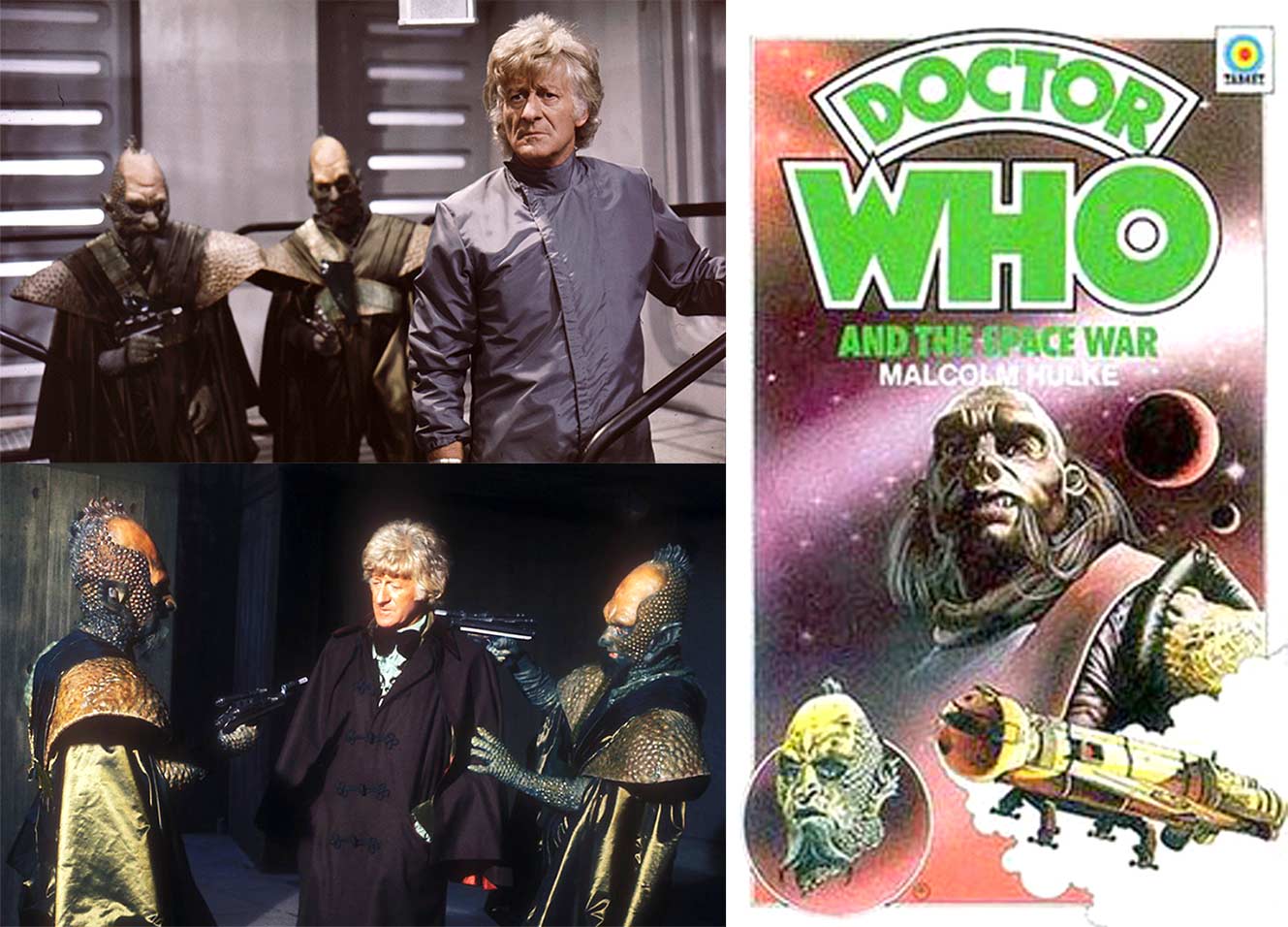
So Frontier In Space is the third story of the tenth series of Doctor Who, as reissued in the nice Blu Ray set of that season from the BBC. I was five years old when this story aired but I only seem to have hazy recollections of this one. Whereas, the next two stories in the box, I have a lot of childhood memories of terror. Looking back on it now, though, I have to say that it’s easily one of the best of the John Pertwee Doctor Who stories I’ve seen.

This one’s a six parter and involves The Doctor and Jo Grant (played by the always brilliant Katy Manning) getting involved with a cold war climate powder keg in the far future between the people of Earth and the people of Draconia (who are kind of a short hand version of ancient Japanese style lizard people, in terms of their manner and codes). The TARDIS is taken away from our two heroes more or less from the start of the tale and the majority of the first three episodes sees them being imprisoned by various people and spending a lot of time in jail cells, as the plot moves along without them in some areas. It sounds boring and padded but, well okay it possibly is padded but it’s nothing short of interesting and exciting since, you know there’s going to be some jail break or other set piece in each episode.

The plot is kickstarted by an outside party committing hostile acts of space piracy on the two species and using a sound based, hallucinogenic gadget to make the victims believe they are seeing the other race, humans or Draconians, committing these crimes, in order to start an intergalactic war. Fairly soon it turns out that the actual people committing these acts are the Ogrons, a race of quite dumb mercenaries for hire which were on a lot of merchandising such as jigsaw puzzles when I was a kid but were only actually in two stories in the Pertwee era (I’m not counting their cameo in Carnival Of Monsters, reviewed here and nor am I counting the 1990s Eastenders charity crossover, Dimensions In Time). The Ogrons, of course, are being directed by a higher power and it soon becomes evident that this is a master plan of... um... The Master, kind of. In the last episode it is revealed that he is working (although he plans to double cross them) with the Daleks, who only turn up in that final episode.

The story is absolutely superb and it has a great script. Katy Manning’s always watchable Jo Grant is given more to do here and there’s a wonderful scene where she is holding up a very long, one sided conversation with The Doctor to hide the fact from a security camera that he’s already escaped the cell... demonstrating that Jo Grant can talk the hind legs off a donkey with ease when she has to.

The Master is, once again, played absolutely brilliantly by Roger Delgado (aka Roger Caesar Marius Bernard de Delgado Torres Castillo Roberto) who, alas, died quite violently while shooting a television show in Turkey when the car he and two other crewmen were in plunged into a ravine, just a few months after Frontier In Space aired on television. It was a real loss and I think it’s probably why Jon Pertwee opted to leave the show a year later. Delgado’s last scene in this story is of him shooting The Doctor down, before Jo helps the wounded Doctor into the TARDIS at the end of the last episode. The Master would not return again until he was pictured as a kind of melted looking monster in the Tom Baker story The Deadly Assassin in 1976. He’s been played a few times by different actors since then and, in at least two of the incarnations of this time lord, the actors have somewhat resembled the look of Delgado in the role.

The special effects in this one aren’t great as the story calls for things like space walks and so on but, it never really bothered us as kids. Even then, I’m sure, we could see those big cables holding the actors up but, you know, how else do you tell a story like this on a TV budget in the early 1970s. I look on them now as a kind of comforting presence in these things and count myself lucky that, unlike some other films and shows put out in high definition, the copyright owners haven’t tried to tart up the special effects and turn them into something they never were (although they have in some of these Blu Ray sets, it’s true.... but there's always the option to watch the original version). I like that the cell holding the prisoners here wobbles when they bash it and stuff like this should always be left in. It’s not just entertainment... it’s art and, as importantly, a historical document of its time. So leave it alone is always my view on the decision to intervene too much with modern technology.

The Target novelisation of the story, always a big winner with kids... I guess they were the Harry Potter novels of their day to some extent, when it came to promoting children’s reading... was one of the few of their adaptations not to use the name of the story for the book title. Instead of going on the shelves as Frontier In Space, the book version was called Doctor Who And The Space War. I probably enjoyed this one along with all the others... I certainly had a copy of this shelved with around 60 others at one point, I’m sure.

The next story in the series and on this Blu Ray set is Planet Of The Daleks, which I assume follows on directly from this story. I only remember a few things from it which haunted my nightmares but I also remember being disappointed with it when I watched this one again on a VHS tape in the late 1980s so... yeah, we’ll see how that one goes. Frontier In Space, though, is an absolute corker of a story and probably, it turns out and much to my surprise, the real jewel in the crown of this boxed set.

Monday, 28 February 2022

Doctor Who - The Carnival Of Monsters


Drashigs In Amber

Doctor Who
The Carnival Of Monsters

UK Air date: January - February 1973
Four Episodes
BBC Blu Ray Zone B


The Carnival Of Monsters was the second story of the tenth series of Doctor Who and, although I would have seen it when I was five years old, this is not one of the third Doctor’s adventures which stuck in my mind at that young age... as much as, say, the story introducing the Sea Devils or the Series Ten closing story The Green Death, with its giant maggots (reviewed by me on DVD here). Of course, I’d read the 60 or so Target novelisations I had at the time (on numerous occasions for many of them) and this was one I must have read at least a feew times. However, this one was very much fresher in my memory in 1981 because it was one of two stories chosen (the other being the previous serial, The Three Doctors, reviewed here) to highlight Jon Pertwee’s Doctor in the special series of repeats that year called The Five Faces Of Doctor Who... which was a bit of a cheat at the time because this limited the Tom Baker repeat to being his final story, Logopolis (the only one made to briefly feature the face of the fifth Doctor at the end of the last episode before his official, proper start on the show a month or two after the broadcast of this special set of broadcasts). I remember recording all the shows on blank audio cassettes so I could listen to them again for years afterwards... microphone crammed up against the television set (these were the days before video cassettes remember). Even so, it was still not that fresh in my mind as I re-watched the story on the new Blu Ray presentation from the BBC.

The story involves a carnival showman Zorg (played wonderfully by Leslie Dwyer) and his assistant Shirna (played by Cheryl Hall), who arrive on an up-tight planet of political unrest with their sideshow attraction, The Scope. This contains miniaturised living forms taken from their own environments without their knowledge and set to replay little dramas in replica settings of their native worlds, to be gawked at by those outside on a view screen. A bit like a mini zoo crossed with an old What The Butler Saw kind of attraction.

Meanwhile, if you’ll remember the events of the last story prior to this, for his help in the defeat of Omega, the Timelords had ended the Doctor’s exile on Earth and so this is the first time since the Troughton era that he was allowed to properly fly his TARDIS to other worlds (and, more to the point as far as the BBC is concerned... more expensive locations which had to be built to look like other worlds again). However, true to what would become form in the show, The Doctor is completely unable to navigate the TARDIS consistently or correctly and so, instead of taking popular companion Jo Grant (played by the lovely Katy Manning) to Metebelis 3 as he’d intended (he’d get there eventually), the two wind up on a ship in the 1920s in the Indian Ocean, just as it’s about to be attacked by a sea monster. Of course, after a while they realise, due to the repeat action resets of the brainwashed people on the ship, that they are in a peep show and break through the seal to the artificial environments in the scope, crawling from world to world as they try to find their way out of the machine. Also in the scope are some giant, hand puppet style monsters called Drashigs, which you are never really that worried about eating them because of the limitations of the special effects at the time and, seen briefly on screen only, the Ogrons (who were used as military enforcers by the Daleks in this era of the show, if I remember rightly) plus, in their only appearance in a Pertwee episode prior to his own reappearance in The Five Doctors, some Cybermen.

Also on the crew of the ship in the 1920s is one Lt John Andrews, who is played here by Ian Marter, who would just a couple of years later become a regular on the show for the first season or two of Tom Baker's reign, as co-companion Harry Sullivan (he would also write a few of the Target novelisations before his untimely death). He does very well here as a stubborn, blundering authority figure as he tries to imprison his stowaways every time his story resets itself.

Meanwhile, on the planet on which the Scope has arrived, the political situation with allowing aliens there for the first time could lead to an incident and blow up into a war. It’s just enough to bolster up a simplistic tale which, honestly, is one of the better stories of the show from those years. It’s fairly fast paced, even if it looks a little padded at times and, while the cliffhanger chapter endings are not exactly terrifying, it’s certainly very entertaining and I have to admit, I thoroughly enjoyed looking at this one again. It’s also very well acted and the costumes of Zorg and Zirna are definitely something to write home about and make Pertwee’s Doctor, wearing his green velvet jacket and proper frilly shirt (which we all should be wearing these days, I love these shirts) look positively under dressed. It also features Pertwee making prominent use of his sonic screwdriver to blow up clods of Earth in front of him in order to try and scare the Drashigs off, in one nice sequence. The sets look kind of cheap, for the most part but, you kinda expect that with Doctor Who and you may, by this point, be disappointed if they didn’t look like they were assembled by the Blue Peter team the night before.

Not a heck of a lot to say about this one, to be sure but, still, an entertaining slice of early 1970s UK science fiction tele-fantasy which certainly shows off the heroic and unquestionable authority of Pertwee’s version of The Doctor and perhaps this is one of the reasons why The Carnival Of Monsters  was chosen to be part of the ‘Five Faces’ celebration. There’s a certain quaint and comfortable vibe to the story and this is always a winner for this kind of show.

Tuesday, 1 February 2022

Doctor Who - The Three Doctors


Real 3D

Doctor Who
The Three Doctors

UK Air date:
December 1972 - January 1973
Four Episodes.
BBC Blu Ray Zone B


And so it came to pass it was time to crack open the Doctor Who Season 10 Blu Ray box set and, the first story in the box is the much loved fan pleaser The Three Doctors. This show must have been a nice Christmas present when the first episode was first broadcast in the holiday period between Christmas and New Year in 1972 and it was the programme’s ten year anniversary story. Of course, only the last three episodes were in it's 10th year and in January... the show itself wouldn’t reach that 10 year marker until November but, nobody seemed to care much and it’s an entertaining story.

This one tells of the Timelords on Gallifrey trying to save themselves and the rest of the universe by teleporting in previous incarnations of The Doctor to help himself fight the threat of the famous, 'missing presumed dead' Timelord Omega, who sacrificed himself many centuries before to give their race the power to master time travel... and who now lives in a black hole of his own making, out for revenge.

This was the first time in the history of the show that two or more incarnations of The Doctor had met each other and, to date, this has only happened four other times (not counting CGI trickery of half glimpsed running feet etc). This marks the first time that Patrick Troughton’s wonderful second Doctor would appear in one of these crossover stories (also his first time in colour) and he would go on to do the same in 1983 and 1985 (although his 1985 appearance, reviewed by me here, is perhaps best left forgotten). Also, because of the failing health of first Doctor William Hartnell, a small ‘limbo’ set was constructed at his home and his few brief scenes, roughly one per episode, were relayed as communications to Patrick Troughton and Jon Pertwee’s Doctors by video screen... the excuse being that the timelords didn’t have enough energy to fully transport him to rendezvous with the others.

And for an obvious, celebratory gimmick episode it’s actually quite well written, at least in terms of dialogue and the story isn’t too bad either. The show also features the then current Doctor’s companion Jo Grant, played by the inimitable Katy Manning (this would be her last season until she returned for two episodes of The Sarah Jane Adventures opposite Matt Smith’s Doctor in the next century), Brigadier Alistair Lethbridge Stewart (played impeccably, as always, by Nicholas Courtney, who again made his swan song in a story from The Sarah Jane Adventures) and also a bigger part than normal for John Levene as Sgt. Benton (this is due to the part originally being earmarked for Frazer Hines to reprise his role as Second Doctor companion Jamie but, alas, he was busy doing Emmerdale Farm at the time... or Emmerdale as it seems to be known as today).

The chemistry between all the players is very strong and the humour coming from the dialogue is great. This one has probably one of my favourite scenes where, at UNIT HQ in the first episode, where the situation is already dire, the Brigadier asks The Doctor if there’s anything he can do to which Pertwee’s Doctor asks him to hand him a carbon rod. When the Brigadier does this, Pertwee uses it to stir his cup of tea... good stuff.

The really good decision the writers made in this was to not have the two primary Doctors, Troughton and Pertwee, who are present for all the episodes... get on with each other all that well. Just because you’re both the same person doesn’t mean you will agree on things and a great source of the humour and entertainment of this story is the constant bickering between the two of them, both put in their place by Hartnell at one point who calls his ‘replacements’ a dandy and a clown. Yep, there’s some good writing here. Such as the explanation of why so much stuff is pulled into the black hole when Omega is just after The Doctor... “Rather like taking a pill with a swig of water.” There’s even a joke reference in this, made by Katy Manning, to The Beatles song, I Am The Walrus.

I also liked the breakaway sets that were whisked away into the ‘quarry’ landscape of the planet in the black hole and the way bits of man made items are scattered about seemingly randomly in surrounding landscape... UNIT HQ even gets completely transported as the cliff hanger ending of one episode.

The special effects, though, are... not great. The electronic jelly that beams everything back to the black hole is a pretty rubbish looking video effect and the iconic gel guard monsters are actually quite awful and unconvincing suit creatures when you see them moving around. Quite disappointing for monsters who were never used again but whom everyone seems to remember (they even made it onto Weetabix cards, if memory serves).

Omega himself, a completely masked up figure, looks fairly impressive, a little like a golden pre-Darth Vader type presence. Alas, camera angles being what they are, especially when restored to Blu Ray, when the creature is revealed to have been eaten away with, as much of a surprise to him as to everybody else, nothing actually inside the suit, the illusion is ruined a little later on when you can clearly see the actors eyes behind the slits in the mask at one point.

About the Blu Ray... the transfer is pretty good but, for some reason the externally shot scenes, especially those at the beginning of the first episode, look fairly blurry and foggy still. I am guessing this is because the cameras weren’t quite in focus, maybe and, bearing in mind the way these episodes would have been received on first broadcast, probably nobody minded much. It wouldn’t look very different on those old TV sets compared to the rest of the footage, which on this new Blu Ray looks very sharp in comparison.

And that’s me about done on The Three Doctors. Omega would return in a different form for a Fifth Doctor story in the 1980s and the other thing that’s very important about this episode is that, as a reward for helping out the Timelords and saving the known universe, The Doctor is gifted with the components and memory needed to be able to control his TARDIS and travel in time again. His exile to Earth, brought in at the very end of the last Troughton episode and designed to make the show cheaper by not having to constantly make unrealistic looking alien sets, was over. Of course, this meant a very reduced role for the Brigadier and the rest of the United Nations Intelligence Taskforce (as it was in those days.. I’m not having any of this new Unified stuff, thank you very much) officers in the show but they wouldn’t disappear completely... not yet anyway. Overall, one of the more enjoyable stories and a cracking set of scenes with the Second and Third Doctors working together and bickering their way through the story. An entertaining celebration of a series which, I’m sure, had already run far longer than the show’s original producers had expected it to.

Tuesday, 28 March 2017

Eskimo Nell


From Nell

Eskimo Nell
UK 1975
Directed by Martin Campbell
88 Films Blu Ray Zone B

From the director of Goldeneye, The Mask of Zorro and Casino Royale comes... oh dearie me. Another, quite atrocious, British sex comedy.

And, yes... it’s that Martin Campbell.

I was given Eskimo Nell for Christmas by the wife of a friend (who is also a friend, obviously). I don’t know why people take a look at a Blu Ray, see that it’s got Mary Millington’s name prominently displayed and then think of me but... well, I guess I just evoke ‘quality film’ when they bring me to mind. ;-)

To be fair, I’d been curious about this movie for a long time, mostly for the Millington connection but, in regard to Mary’s appearance in this, all I can is that for someone who gets prominent billing in the casting on the box when she’s in the film for, maybe, less than 10 seconds with her footage played at high speed as she does a strip as part of an ‘audition’ montage... is that it’s nice she’s still so well remembered. She appeared in this a couple of years before she made the first of her two breakout hits, Come Play With Me (reviewed here) and The Playbirds (reviewed here) and there really isn’t much to see here if you’re a fan of the actress. Although there is a more Mary-centric short movie included on the extras. The product description mentions her turn here as an “eye popping cameo” but its more of a “don’t blink or you’ll miss it” kind of affair, I have to say.

What’s more interesting is that, although it’s a bit of an ensemble piece, the lead actor who plays the main character, as I see it, isn’t even listed on the front of the box at all. So one has to wonder what that actor must have thought of appearing in this that he’s somehow managed to have his name ommitted from the main cast list on the packaging. Oh yes... I’m looking at you Christopher Timothy, aka James Herriot in the hit TV show All Creatures Great and Small.

The film starts off with a voice-over song giving singing narration about a young graduate fresh out of film school, who we see tripping around all the usual places in London, trying to get a job as a director. There are some nice visual and audio references to places like the Hammer film company on Wardour Street and the like and, as this song continues, said young man is kicked out of various studios until he starts looking at the rock bottom places working straight from Soho, landing a job from producer Benny U. Murdoch as played by Roy Kinnear. You can tell exactly the kinds of films Murdoch and his backers make from the posters adorning the walls of various offices... The Sexorcist, King Dong, Vampire Vomit and Motor Bike Orgy. There’s even a poster for the Doris Wishman directed movie, Deadly Weapons, starring Chesty Morgan in Murdoch’s office (which I reviewed here). It becomes clear that he specialises in making ‘sexy’ sequels to ‘real’ movies such as his sequel to Son Of Cochise... Keep It Up Hiawatha.

This is not the kind of role I would equate with Kinnear, the national treasure who was often on TV in the 1970s and 80s, not to mention his work in some prestige film roles such as The Three Musketeers (and its two sequels). Here he plays a ‘tits obsessed’ producer who measures anything of quality in terms of how it can be boiled down to sex (when he’s not getting undressed and trying to demonstrate his prowess in this particular area) and he clearly wants a porn film made by the new graduate. So the new guy says yes and enlists his friend, the penguin obsessed writer Harris Tweedle, as played by the aforementioned Christopher Timothy, to write a script.

The rest of the film comprises the exploits of the director, his agent and the writer as they accompany the producer securing backing money from various people and then find their script requests (not to mention leading lady requests) getting more contradictory and impossible as the quest for production goes on and they interact with a cast list for this movie that... yeah... you really wouldn’t associate with this kind of endeavour. There’s Christopher Biggins... as the son of a ‘Mary Whitehouse’ character... and his sister who is dating the director and who happens to be played by the great Katy Manning, who played my favourite Doctor Who companion Jo Grant in the early seventies. Her inclusion here alone makes the acquisition of this film a necessity in my book although, it has to be said, she’s totally wasted in this.

So, anyway, when Kinnear’s character absconds with all the money and our three heroes are left responsible for it, it’s up to them to write and direct four different versions of the movie for each of the backers, including Katy Manning’s character’s mum, who is all about purity and censorship in cinema. So, yeah, they have to do a Christian parable, an out and out porn version, a gay S&M version and, my favourite, the world's first Kung Fu musical... which in this case also involves a lot of nuns and is somewhat based on The Sound of Music... but with added kung fu action.

Now, even though this is a truly terrible film and might test the film stamina of a certain type of audience, there are some nice ideas in the mix, to be sure. Although I found most of it to be pretty unfunny, there were a few things that made me chuckle. Such as a line from one of the backers explaining what he wants in the movie. “Hardcore, plenty of flagellation, rubber appliances, throw in some bestiality as well... then in the second scene...” and so on.

There’s also a long montage sequence showing the lads on set as each of the four versions of the movie are directed which is where, for me, the most laughs come from. The sequence where one of the Eskimo Nells and her leading, Asian actor are singing a line of verse before kung fu-ing one of a series of nuns in repeat mode did make me smile somewhat. However, all that being said, it’s generally a bit dull and less than witty, for the most part. Like a downmarket version of a Carry On film but with added anatomical detail.

It’s funny... back in Germany in 1962 some young directors got together at a film festival and drafted a document called the Oberhausen Manifesto because they were worried about the direction of German cinema, much of which had devolved into soft core sex comedies as their chief product. Ten years later many of these directors were pushing at these boundaries and producing interesting movies and are now more well known as starting the New German Cinema... or what was the New German Cinema. Meanwhile, in the UK, despite all our kitchen sink and cinéma-vérité stuff which was getting critical acclaim at the time, there were still a lot of sex comedies being produced and one wonders whether a similar protest to the backdrop of this kind of product was going on behind the scenes, so to speak, in Great Britain at the time. It seems to me we were somewhat lagging in these kinds of areas (and no, I don’t hate sex films, just making a comparison to the creative climate in different countries, is all).

And that’s about it in terms of my take away from Eskimo Nell except for... just one more thing. I’ve mentioned on this blog before that I was a professional child model in the very late sixties to mid 1970s and it’s always good to see various London locations like Wardour Street, Piccadilly Circus, Leicester Square and the surrounding areas used in a movie like this. It’s a London which can only exist on film now and it is always nice to see and remember various landscapes which are still there, mostly, but populated with different shops etc. Seeing things like the old Athena shop on Leicester Square (a regular haunt) with a Wimpy Bar right next to it brings back a fond rush of nostalgia for days gone by. So, you know, even if Eskimo Nell isn’t your kind of thing... if you’re as old as me, you might want to take a look just for the unexpected trip down memory lane, as our intrepid film school heroes run through the streets of London trying to put right the consequences of their actions. It was kinda fun, I guess.

Thursday, 27 August 2015

Doctor Who - The Green Death: The Special Edition


For The Larvae The Professor

Doctor Who - The Green Death: The Special Edition
UK Airdate 19th May - 23rd June 1973
BBC DVD Region 2

Warning: Slight spoilers in this one.

I last saw The Green Death when it was first broadcast in 1973. I would have been five years old and I remember the giant maggots, which are a big feature of the episode, being a talking point around the house and a thing which would invoke both fear and playful memories of big, wiggly things coming to get ya! I wasn’t expecting it to be half as good as I remembered when watching it now on this special edition version of the DVD but... well... it surprised me in more than one way.

I’ve noticed over the past few years that the Doctor Who stories featuring Jon Pertwee don’t seem to age as badly as the ones starring Tom Baker, Peter Davison, Colin Baker and Sylvester McCoy... I don’t know why it is and the special effects are still quite shoddy, though not as shoddy as the ones utilised in the programme during the 1980s and 1990s... I can say with some confidence. The stories and, certainly, the dialogue and scripts, are all pretty top notch and tackle issues in exactly the same way that all of the best science fiction does... head on and by exaggerating certain elements to be able to explore the issue to a degree it would be less able to do without a science fiction context.

In this one, the big issue is ecology and the environment. It centres on a computer who has taken over the employees of a global oil company which is dumping toxic waste... it’s seeping into a local coalmine in Wales. Brigadier Lethbridge-Stewart (Nicholas Courtney) and the always brilliant Jo Grant (Katy Manning) go to investigate the deaths of people who come into physical contact the sludge, infecting them with a virus which turns them into a cheap 1970s TV effect... glowing green before claiming their lives. Jo declines going with The Doctor on a quick jaunt to the planet Metebelis 3, where he acquires a blue crystal which will cause him trouble later in the history of the show, because she believes the environmental work being done by Professor Jones and his group of ‘Eco Hippies’, combatting the global company who is responsible for the toxic sludge and the giant sized maggots who are breeding and infesting the coal mine, is more important... good for her. It also heralds the fact that this will be Katy Manning’s last TV adventure as Jo Grant until her brief return to the role in a two part story, The Death Of The Doctor, opposite Elisabeth Sladen and Matt Smith in The Sarah Jane Adventures almost 40 years later (and reviewed by me here).

Now, although Jo Grant was always a well admired character by me, when I was a toddler, my recent rewatches of a few of the old Jon Pertwee stories have made me realise that her character wasn’t all that well fleshed out or given that much interesting dialogue. Here, however, it’s clear that by this point she is really being written in a more useful manner and the focus on her and the dialogue/scenes she is given are all absolutely marvellous. And, of course, Katy Manning really makes the most of it, displaying great chemistry with all her co-workers, including Stewart Bevan as Professor Clifford Jones (she was engaged to him in real life, at the time, although I understand that didn’t last too long) who she goes off with to get married and travel down the amazon at the end of the last episode here.

Now the show is not without its weak moments...

There’s a loose end of a character when one of the principal actors had to drop out of the show due to ill health. The special effects are quite good in some places (the miniature work of explosions is good although the white action figure driving the model of The Doctor’s car Bessie in one shot is hilarious) but utterly abominable in others when it comes to the blue-screen work. Whenever any of the characters goes down the lift shaft in the coal mine, for example, they are quite clearly standing against a superimposed piece of back projection footage. Similarly, although there’s a lot of location work in a fair bit of it, there are a fair few terrible shots when the people at UNIT are walking or standing around a studio, superimposed against a backdrop of the open country. Now I’ve got no idea why this was needed and all I can think of was there wasn’t enough time to get all the shots required and, instead of going back out on location to reshoot, the decision was made to go with a studio solution. In all honesty, it really is quite noticeable and surely hurts the scenes when this is done.

However, everything else in this story seems right on the money and it even involves some scenes of Jon Pertwee returning to his comedy roots as he dons two ridiculous disguises to penetrate the security at Global Chemicals... one is a “funny milkman” personae and the other is the old “dressing up in women’s clothing” routine where he impersonates a cleaning lady. This is all quite amusing, if a bit clunky, but I can’t imagine what young fans of the show might make of all this dressing up shenanigans these days, to be honest. That being said, the costumes Pertwee wears as The Doctor are, as usual, absolutely brilliant and I just wish I could get the crushed leather jackets and the frilly shirts that he got access to on these things... I’d be wearing them all the time.

Not too much else to say on this one. The score by Dudley Simpson is lively and typical of the show in that era, the giant maggots are actually fairly well done but when one of the larvae hatches, the resulting, dragonfly like creature is quite badly handled. However, when The Doctor steps off the TARDIS on Metebelis 3 and a tentacle suddenly whips out from the front of the screen and goes straight around his neck... I have to say that it was so effectively done that it actually made me jump. Something these kinds of shows don’t really do to me that often... at least not since I was a kid, at any rate. The end is quite poignant too and I’d be lying if I didn’t say the last scenes with Pertwee and Manning didn’t bring a tear to the eye. Overall, I’m really impressed that The Green Death has held up as well as it has and I think it’s certainly one of the best Pertwee stories and also, I would say, one of the best of the stories in the history of the show. Now I just have to figure out which Pertwee story to acquire next.

Wednesday, 19 August 2015

Doctor Who - The Vault


Memor-Who-bilia

Doctor Who - The Vault:
Treasures From The First 50 Years
by Marcus Hearn 
BBC Books
ISBN: 978-1-84-990581-7

Doctor Who - The Vault: Treasures From The First 50 Years is one of those clever books about a subject which manages to smartly side-step the problems inherent in work about a passionately followed phenomenon that can cause so much friction between fans and leave everyone smiling. Marcus Hearn offers up a coffee table book which is not in any way a thorough reference volume of the first fifty years of this much loved programme but, more, a fond recollection and celebration of our favourite timelord.

It’s all about the pictures, in this volume, which are less about capturing the actual show and more about remembering the wealth of memorabilia which has been generated over the decades. Although it has a good amount of text and with a chapter split for every year of the timelord’s presence on screen during those 50 years, it’s by no means a detailed account of either the making of the show or an in depth look at the fictional universe portrayed in the series... it’s more of a quick description of what was going down in any particular year and about the striking illustrations provided in this generous tome... which up until a couple of weeks ago was still only a fiver on Amazon... although I still saw a stallholder charging £25 for it at the recent London Film and Comic Con (reviewed here).

As I went through this book, I found a wealth of things which I used to have as a kid and which brought back a lot of memories for me by association. There are things which I still have to this day... such as the stand up cards free with Weetabix, the Jo Grant badge I got from a packet of Sugar Smacks, the Radio Times Ten Year Anniversary Special celebration of the show (still one of my favourite bits of merchandise which I remember reading cover to cover on a long train journey as a kid) and that old standard, The Doctor Who Monster Book. There are also things which I regret letting go of at some point, like the series of Jon Pertwee jigsaw puzzles and various well read Target books over the years... but it just made me appreciate how much this show gave me in the past and is still, to some extent, giving to me now.

As I wandered through pictures of old Iron-On Transfers and Dalek Bubble Bath which I remembered from my youth, I was also pleased to actually learn the odd thing or two in the text... such as John Nathan-Turner’s increasing lack of interest in the show as the years took their toll and his attitude towards the fans... something I never realised when I used to watch his version of the series in the 1970s and 1980s. It was a nice surprise, too, to see the odd photo or play bill from a stage show I saw in the 1970s called Doctor Who and The Seven Keys To Doomsday which starred former Troughton companion Wendy Padbury and Trevor Martin as the good Doctor himself. To this day I’d remembered almost nothing about the show other than the Daleks were in it and that it was very loud. I’d completely forgotten about the other robot monsters in it until I saw a photo and I was quite moved as the writer described the opening regeneration sequence and the two companions in the show running out from the audience to help The Doctor as he regenerated into Trevor Martin. Now I’ve read about it I can actually remember that bit and also being completely alarmed and seeking the advice of my parents as these two audience members started kicking up a fuss and running up on stage to become part of the play itself... wonderful stuff.

There are also some glaring omissions in this book which, for a show primarily for a family audience rather than specifically a children's programme, fails to mention Pertwee companion Katy Manning’s nude appearance in a photoshoot with the Daleks for an 'adult magazine'... something I believe she did while still appearing in the show. I can understand why the publishers felt best to leave the photos themselves out of a book which they know will also have a large child audience... but they could at least have given this important piece of Doctor Who memorabilia a mention. Oh well, the pictures and details are usually easy to get hold of on the internet, I guess. And it was small price to pay considering the amount of annuals, games and other things from my childhood I was constantly reminded of as I worked my way through, some of which I might otherwise have forgotten now I’m left with a brain that keeps dumping huge amounts of information haphazardly as the years drift on by.

My one big regret about this volume is that there weren’t enough illustrations of the amount of stuff available at the time. I kept thinking to myself... well yeah, that’s one of the 'x amount' but where are the pictures of all the others in that range. It’s an immensely enjoyable, fun book to read through, no doubt about it, and Marcus Hearn has done a wonderful job on this one. That being said, it really does highlight the need for a modern, up to date book on the full range of collectibles available over the years which have been generated, officially or (more interestingly) unofficially, by the show... that’s a book I would buy in an instant. But, as it stands, while this book will certainly appeal to a lot of young ‘uns who weren’t around when this stuff was originally being produced, I think it’s probably safe to say that it’s definitely the adult readers who will get the most out of this precious tome. Certainly a book I’m proud to have on my shelf and something which will definitely be 'dipped into' time and time again. A great addition to any Doctor Who fan’s library.

Sunday, 16 March 2014

Doctor Who - The Daemons


On The Devil

Doctor Who - The Daemons
UK Airdate: 22nd May to 19th June 1971
BBC Region 2

The Daemons is the last story in the second series of Jon Pertwee’s stint on the show. It’s a much loved classic among fans and, I believe, it was Pertwee’s personal favourite of the stories he worked on for his run as The Doctor.

I didn’t remember much of this one from when I was a kid, I was two years old at the time,  but I have a fair few Doctor Who memories from before this so I must have seen it and I think I vaguely remember Bok, the stone gargoyle that comes to life as a servant of Roger Delgado’s character The Master in this particular five parter.

Seeing it now with fresh eyes, I can see why people like it so much and it’s very obvious that the influence on this particular story probably stems from Nigel Kneale’s groundbreaking teleplay for the third of the four Quatermass serials, Quatermass And The Pit (my review of the movie remake of that serial is here). Like the Quatermass story, The Daemons uses supernatural belief and terrors as a way into a tale which eventually turns out to be rooted in science, cannily exploiting the “best of both worlds” scenario to elicit the fantastic curiosity of the supernatural, specifically in this case The Devil, with the “grounded in science” personality of this show’s lead protagonist. Both the Quatermass story and this one both use the idea of another race of creatures chaperoning the human race in some sort of experiment although, it has to be said, Quatermass And The Pit was far more intriguing than this exploration of that concept.

One of the things going for it is that you have a full range of regular characters in the line up for this story, which was in one of the “Doctor is exiled to earth by the timelords” series, due to budgetary restraints at the time. Here we have my favourite of the female companions, the hippyish Jo Grant (as played by Katy Manning) and you have a full compliment of UNIT characters, featuring Captain Mike Yates, Sergeant Benton and, of course, Brigadier Lethbridge-Stewart, who in this story utters his famous line, which actor Nicholas Courtney plundered for the title of his memoirs, Five Rounds Rapid. When faced with Bok, the stone gargoyle who is running around and disintegrating people, he casually turns to one of his men and barks the wonderful order... “Jenkins. Chap with the wings there. Five rounds rapid.”

This particularly story is a bit of a romp and includes a force field around the sleepy village of Devil’s End which is keeping The Doctor, Jo, Yates and Benton inside the village while the Brigadier and his team are trying to find a way in. It’s pretty much action fuelled with lots of running about, Jon Pertwee driving both a motor bike and his faithful car Bessie, and lots of explosions (including a helicopter explosion which was tracked in from the James Bond film From Russia With Love, which I reviewed here).

Roger Delgado is in great form as The Master in this one... he’s always a delight to watch. I was, however, surprised to find that the two trained soldiers, Sergeant Benton and Captain Yates, get beaten up and have to be rescued so much by people who wouldn’t be as trained in the art of hand-to-hand combat as they are. I was also disappointed that The Doctor tends to talk down to Jo Grant quite a lot in this one, constantly pointing out her shortcomings to make relevant plot points apparent. However, it is at least Jo who saves the day in the end when she demonstrates the human trait of self sacrifice to The Deamons... or Daemon in the singular, actually, since you only ever see one of them. The make up on the Daemon is excellent but, alas, the special effects which superimpose his gigantic form over the rest of the setting is particularly bad, which is a shame.

There are some sequences when the titular monster is rampaging about the countryside where he is never actually seen on shot and is just glimpsed by others as we see their reaction shots to let our imaginations fill in the blanks. I expect that’s probably a shrewd move on knowing the limitations of the special effects rather than an all out attempt to be subtle but, whatever the reasoning, it works quite well.

Despite the conclusion of a classic but, frankly, silly scene where The Doctor is captured by Morris Dancers and almost burnt on a maypole, the story has some very nice moments and, although I prefer stories like The Sea Devils in the Pertwee years, this is certainly a pretty good jumping on point if you’ve never seen one before... although three scenes rely on Jon Pertwee making use of driving Bessie by a remote control device... when seen as a whole that’s a little over done but it would certainly have made sense when the story was originally spaced out over the course of five weeks. Reminders would have been necessary so we can see why The Master finds himself returned to UNIT captivity at the end of the story.

The other big weakness on this one for me was that, although I can fully understand that the idea of a stone gargoyle coming to life as The Master’s assistant is a pretty scary concept, Bok has his stone tongue permanently stuck out of his mouth... which makes him look rather silly and unthreatening in my book... but I’m sure as a kid I would have been as petrified as this stone monster is himself, so I can understand why he’s become one of the iconic images of the Pertwee years.

Still, a bona fide classic Doctor Who story and one which is well worth a watch if you are interested in the third incarnation of the United Kingdom’s favourite science fiction export. Sometimes it’s better the devil you know...

Saturday, 15 December 2012

Doctor Who: The Sea Devils


Devils In The Deep Blue Sea

Doctor Who: The Sea Devils
UK Airdate: 26 February to 1 April 1972
BBC Region 2

When I was three years old I watched this serial on my mum and dad’s old black and white television set with them. We all loved it. The iconic monsters that were The Sea Devils, rising up from the surface of the sea in their string vests and waving about their strange weapons was bound to create a certain sense of fear and left a memorable impression on me... and it didn’t help that my dad kept doing impressions of them at the time. I remember being disappointed by them when they returned, with their marine cousins The Silurians (see review here), in the era of The Fifth Doctor (and I’ll know sometime soon whether I still feel the same about that) but this original serial was a big hit with me and it’s taken too long, almost 41 years in fact, for me to catch up with it again.

I’m really pleased to say that this Pertwee era story is even more entertaining than I remembered it although, to be fair, I barely remembered any of it past the obvious iconic monsters and a scene I’ll describe in a little while. It’s well written, Pertwee is in complete control of his character, Katy Manning’s Jo Grant is absolutely adorable (and adorably written) here, complete with her trademark white suits which never get dirty even when she’s been crawling through a ventilation shaft, and Roger Delgado’s triumphant performance as The Master is up to his high standard.

The only thing that surprised me was that UNIT and The Brigadier were not in this story. UNIT is mentioned enough but outside of The Doctor and Jo, their presence is never felt on screen.

The other thing that surprised me was a sequence that I’d forgotten but which made a great impression on me as a kid, when The Doctor and Jo are trying to find their way through a minefield with The Doctor’s sonic screwdriver, and then use said familiar implement to blow up a load of mines to frighten off a Sea Devil. I remember incorporating this scene into games I used to play in the garden as a kid... but I’d completely forgotten both the scene and my childhood games of it until I saw it again. Little tear brought to the eye their for sure!

There’s also some amazing stuff in the storyline, like The Doctor and Jo being stranded in a fort on an island with only a sick, surviving crew member and a Sea Devil for company. That’s a really good sequence where you wonder just how our two heroes are going to get themselves out of harm’s way.

And there’s another great sequence where Delgado and Pertwee have a sword fight at the end of an episode which is so good, the entire fight is repeated at the start of the next one. And when I say good, I mean corny and riddled with typical, Hollywood swashbuckler incidents and choreography which is bound to bring a smile to the face on anyone who realises that the two actors in question must have been having a really good time shooting this.

There are some other nice action sequences along the way in subsequent episodes and there’s also a heck of a lot of location work than you might expect from a Doctor Who story arc, especially in comparison to the show today. I have to say that this one knocks a lot of the latest season’s stories for six when it comes to sheer, all ‘round entertainment value. I was really pleased that the one memory I had of this show was not marked by disappointment on the re-watch... this one was a real treat for me and I whizzed through all six episodes in two sittings. Great stuff.

Oh, and the unusual synthesiser music by Malcolm Clarke is absolutely suited to Doctor Who and probably made a big impression on me as a child too. I wish they’d have let this composer loose on some of the other stories in the series because it’s quite forward thinking for it’s time. At the very least, I wish the BBC would have a think about releasing the score properly on CD, as a four or five minute suite really isn’t good enough for this music.

A short review, then, but a very positive one. If you’re a fan of the Pertwee era of the show then this one is definitely one of the best ones to watch, I reckon. Sun, sand and sea monsters are just what The Doctor ordered, it turns out.

Friday, 20 April 2012

Doctor Who - Terror Of The Autons


Mastering The Doctor


Doctor Who - Terror Of The Autons
UK 1971
BBC Region 2

Okay... so here we have a Doctor Who serial that I’ve not seen in 41 years... I was three years old the last time I watched this one. It’s the second and final of the Jon Pertwee era stories to feature the Nestene intelligence and its deadly tools of the trade, the Autons. This is the last time this enemy would be properly seen again until they returned to the series (on more than one occasion) with the inaugural Christopher Eccelston story Rose.

As I began to watch this one, however, it became very clear to me that this story was a pretty interesting tale of Doctor Who “firsts” than I’d realised when I’d slipped the disc into the player. Lets take a little look at those...

My first clue was when one of my favourite all-time companions Jo Grant (played by the incredible Katy Manning) walked into shot and The Doctor was actually quite rude to her. What’s going on, I thought. Turns out these two characters had never met before. Yep! This is the very first story to feature the inimitable, long-standing companion Jo Grant, after Caroline John’s companion Liz Shaw (who featured in the first Pertwee story, Spearhead From Space, which was the first Auton story) had left the show. After accidentally causing trouble and mayhem in her first appearance, Jo Grant is kept on as The Doctor’s new assistant because, it seems, she’s just too nice for The Doctor to tell her he doesn’t want her around. Smart move Doctor!

The second “first” is that this is also the initial story of UNIT (United Nation Intelligence Taskforce) regular Captain Mike Yates on the show (Richard Franklin). He’s got pretty good chemistry with Jo Grant and one might almost feel that romance could possibly be on the cards at this stage. So this is, in fact, the first story to feature the full triumvirate of regular UNIT characters on screen together in the same story - Brigadier Lethbridge Stewart, Sergeant Benton and Captain Yates.

Lastly, and my no means leastly, this is the first appearance of The Doctor’s arch nemesis The Master, as played by the late, great Roger Delgado. Delgado made such a lasting impression with this role, mixing charm and ruthless villainy in equal measure... and right from the start he’s using his famous trademark weapon of a Tissue Compressor Gun which kills people by shrinking them down to the size of dolls. In just a couple of years, Delgado would find himself decapitated in a freak road accident in real life, but it’s a testament to the absolute brilliance of his performance that he is the one face you are always guaranteed to think of first (if you’re over 40) when the character of The Master is ever mentioned.

Okay... so this four part serial is one of those ones which got a lot of complaints from the parents of “scared silly” children at the time... and it’s easy to see why. The Auton’s trademark has always been death by everyday plastic objects which are usually harmless and this one has its fair share of ingenious deaths, aside from the trademark shop mannequins. These include a plastic blow up sofa which crushes a man to death by... well kinda swallowing him (it sounds better than it’s actually presented, believe me), a telephone chord that tries its best to strangle the life out of The Doctor, deadly plastic daffodils and a miniature doll that hurls itself on its victims to strangle them. All good stuff although modern viewers looking back at this one through the passing years may wonder what all the fuss was about, and I can’t say I’d blame them. The execution of these effects is so awful and crude (more so than in the previous Doctor’s black and white incarnations) that it’s hard to remember just how naive we all were to be taken in by this kind of thing at the time.  Even some of the effects that shouldn’t be effects shots, just actors in interior sets, are actually the actors standing on a projected backdrop of that interior... and they so look like it. The miniature doll death is particularly disappointing in retrospect, since it relies on an actor in a suit on blown up, projected backdrops lunging... followed by the victim attempting to sell the shot by gagging and trying to pull off a static doll from his throat. Comical death then but... the nation was in an uproar at the time it seems.

But, as typical of the Doctor Who stories in this period of the show, the bad effects work is just not really a problem because the dialogue, story and acting in these things is all top notch and the on-screen chemistry of the performers really helps to sell the story and distract from the sheer clumsiness  of the effects work (mostly due to budgetary constraints I would  guess... the effects teams on these things had to be pretty resourceful) and instead get the viewer caught up and involved in the events as they play out on screen. There’s some nice stuff here, especially when one of the guest characters fights the Nestene consciousness that has taken control of his mind and sacrifices himself for the good of the The Doctor and Jo. Perhaps a little rushed but it still manages to inject a certain amount of poignancy into proceedings.

At the close of the story, The Master helps The Doctor defeat the Nestene intelligence himself but when he escapes, The Doctor reveals that he has swapped out a crucial piece of The Master’s TARDIS with an older version from his own... leaving The Master as stranded on earth as he is. This new Moriarty for The Doctor was obviously expected to be a successful element of the show right from the outset and the chemistry between Pertwee, Manning and Delgado is a joy to watch at these early stages, as they always would be. These characters really hit the ground running.

So... all in all I would say that Terror Of The Autons is even more entertaining than Spearhead From Space and definitely worth a watch as an important serial establishing some long running elements in the show. Put this one on your Doctor Who play list, if you have one.

Tuesday, 20 December 2011

Doctor Who: The Claws Of Axos


It’s Beginning To
Look A Lot Like Axos

Doctor Who: The Claws Of Axos
UK 1971
BBC Region 2

It’s been a while since I last saw the Doctor Who story The Claws Of Axos... I’ve not seen it since I was three years old in fact and did not, therefore, have much memory of it... other than the much reprinted photographs of the iconic creatures created for this story, of course. Seeing it again for the first time in 40 years taught me two things...

Thing One is that you certainly don’t have to have modern, tricksy writing, kick ass orchestral scores and increasingly long story arcs to be left with a fun, entertaining and attention grabbing science fiction story... these old episodes had some pretty good stuff going for them such as the relationship which had developed between the characters like The Doctor, his playful companion Jo Grant and their banter with other series regulars such as the U.N.I.T personnel headed up by The Brigadier and their long standing villain, who had been introduced in the Pertwee era, The Master.

Thing Two is that you really do have to beware of Greeks bearing gifts... or to be more precise... you really do have to beware of impossibly beautiful golden beings who are really hideous, red, energy sucking spaghetti monsters in disguise... bearing gifts.

That said, this is a pretty standard and simplistic piece of scriptwriting retelling the story of the Trojan Horse... but this time that Trojan Horse is a substance known as Axonite which is given to humanity as a gift in the hopes that it will be spread around the earth quickly through various representatives of different countries to enable the Axons to steal the energy from our planet. The success of this plan is challenged slightly when you throw in the political angle of a British Government who want to control the distribution of the Axonite themselves.

As I intimated earlier, pretty simplistic writing... but when you factor in the performances of the actors involved in selling this little story and the way in which their characters react to any given situation... then you have something which can be quite gripping at times.

Yes, it’s true the special effects on these ones, for the most part, were worse in places than many of the black and white stories that preceded the Pertwee era (and this tradition continued into later Doctor’s eras in an ever increasing trend for terrible effects work) but every now and again they got it right. Case in point, when a spaghetti Axon wipes out a fleeing soldier with its tendril and the soldier disappears in a wisp of smoke, I found it surprisingly hard (if not impossible) to perceive just how the “trick” in that particular trick shot was done.

It’s a shame the rest of the action and effects were a bit less solid though. When a jeep is blown up, for example, not only does it not blow up where the grenade was (hey, two charges from one grenade... impressive) but it also happens to be speeding down a hill when it’s doing it... that is to say, the jeep’s valuable engine must have been taken out and so the effects crew presumably had to push it down a hill to make it look like it was going fairly fast.

But, as I’m sure most of you readers will know, special effects do not a good story make! Roger Delgado’s performance as the original version of The Master still puts all future incarnations of the character to shame and his vibrant, evil and above all self-assured personality is easily as good, if not more believable, than even Derek Jacobi and John Simm’s incarnations of the role.

And, as I said earlier, the relationship between the characters is not all that simplistic. I don’t recall Jon Pertwee being this grumpy in the role before but certainly, for the vast majority of this story, he definitely plays the role as an “angry Doctor” who might well put William Hartnell’s original “grumpy old man” personae to shame. When The Doctor pretends to team up with The Master to escape the threat of the Axons and leave the earth to it’s fate so he can trick them into getting caught in a time-loop, you almost believe that The Doctor has turned into the villain of the piece... certainly his constant companions fall for it hook, line and sinker.

There are some nice one liners in the script and they’re not all reserved for The Doctor and his companions. Periphery characters who are only in it for the duration of this story (often to provide a body count of victims for the alien menace on hand) also get some interesting bits of dialogue and the whole thing comes across as a real ensemble piece. It keeps you watching when elements of the storyline become a bit tiresome and over padded.

So there you have it. The Claws of Axos... an iconic monster but not exactly a great story. That being said, however, it was certainly a pleasant change from some of the other stuff I’ve been watching lately and hugely enjoyable in contrast to some of the more earnest fare of modern television writing. Check this one out if you like a flamboyant Doctor and some iconic monsters puttering around.