Showing posts with label Asia Argento. Show all posts

Monday, 19 May 2025

Demons 2


Shock Block

Demons 2
aka Dèmoni 2... l'incubo ritorna
Italy 1986
Directed by Lamberto Bava
Arrow Blu Ray Zone B


Okay... this really is going to be a short review. When I revisited the first Demons on Blu Ray recently (reviewed here), as part of Arrow’s excellent double bill collection of the films, I was somewhat disappointed with it not living up to my memories of a better film. However, since I was very much let down by the sequel when I first saw it (20 or more years ago), I figured that my tastes may have changed and I’d maybe get more out of Demons 2 on a second look. Alas, I can confirm that Demons 2 is... well... it does still make the first film look pretty good. It’s a lousy sequel with not a whole lot going for it, it has to be said.

One of the nicer things about it is the concept. In the first movie we had the people in the first film in a cinema watching a horror story which suddenly became a parallel for the customers suddenly getting infected by a demon virus themselves. In this movie, it’s almost completely set within an apartment block, late one evening when most of the people living there are tuned into a similar horror movie on their TV. This one has a demon from the movie pushing itself out of the TV screen of one of the characters and infecting her, unleashing the demon virus into the tower block. And that’s that... another simple story of survival horror (or non-survival, as the case may be) and there’s not a heck of a lot of fun to be found in the various twists and turns.

There are a few nice things and points of interest I can briefly mention here though.

For example, the resurrection of the demon from a corpse in the movie within the movie is a simple effect but executed brilliantly so it looks great. There’s another nice special effect moments later where a dog is transformed into a demon and that’s not handled badly at all (perhaps inspired by the John Carpenter remake of The Thing, reviewed here, although obviously not in the same league). And talking about... ‘inspired by’... there’s a sequence where a demonic kid is running around chasing a pregnant woman but then he starts writhing around himself in a kind of parody of John Hurt’s character from A L I E N. Yep, there’s a chest burster parody here as the demon boy gives birth to... something not entirely unlike the title creatures of the movie Gremlins, to be honest. So two references for the price of one there. Plus, a nice moment when the bloody knife seen at the start of the movie turns out to be dripping with jam in a patisserie shop. A nice but minor piece of visual rug pulling.

There’s a lot of bad things in the movie too. There are a few actors back from the first one in different roles but, it has to be said that, in general the acting in this movie is not a high point. It’s also the film debut of a very young Asia Argento (she was around 11 years old when this film was released in cinemas) but she’s kind of wasted in this and doesn’t seem to do much at all... bizarrely dropping out of the fillm towards the end with no real clue for the audience as to her fate... as she hides in a car in the underground car park where a lot of the short lived survivors fight their last stand.

Added to this, there are a few moments at various intervals in the movie where it takes the parts that were practically unwatchable in the last film, a bunch of teens driving around the city very fast playing rock music... and repeats it with another bunch of unlikable teens who, this time around, don’t go anywhere close to catching up with the rest of the plot. In fact, there are quite a few scenes in this movie where it feels like other sequences were planned but then never shot. And goodness knows why two of the main exterior shots are completely out of focus. Why were they even left in the film? The budget obviously didn’t cover reshoots I guess.

Other than that, the only really good thing about the movie is the music. And I don’t mean the bunch of ‘hard to listen to’ pop songs which clutter up the soundtrack, especially when the teens are driving around the city. I’m talking about young, up and coming composer Simon Boswell’s score, which supports this mess of a movie when it can but, I can tell you that the CD soundtrack of his Demons 2 score is much more interesting as a stand alone listen. It’s a mostly different kind of vibe to Claudio Simonetti’s driven score to the first film. It does share some similar ‘orchestration’ of the electronics at certain points but it definitely sounds like Boswell’s distinctive musical signature on the score, for sure.

And that’s really all I’ve got to say on this one. Demons 2 is not a movie I would recommend to anyone. If you want to see a decent, virally violent group of people slicing and dicing their way through an apartment block then David Croneneberg’s Shivers (reviewed here) would be the film to watch. That one was made 11 years before Demons 2 but is a far superior movie and much more potent than this mess of a sequel, for sure. I know some people love this film but... yeah... this one is just not for me.

Tuesday, 9 May 2023

The Stendhal Syndrome


The Prisoner
Of Stendhal


The Stendhal Syndrome
aka La sindrome di Stendhal
Directed by Dario Argento
Italy 1996 Medusa
BFI Screening NFT 3
Sunday 8th May 2023


Warning: Yeah, it’s an oldish film and to talk about certain interesting aspects of it requires a big spoiler... so don’t read this if you’ve not seen it before.

So, after three years of lapsed subscription brought on by the Coronavirus pandemic, I finally renewed my BFI membership (the first and only time I’ve let it lapse since the mid-1980s). If I’d known that the BFI were doing a season of films by my favourite director, Akira Kurosawa, earlier in the year then I maybe would have done it sooner (although the tickets are still expensive, even with a member’s discount). However, one of my other favourite directors, Dario Argento, is the subject of a season in May and so I picked two films which, although I’ve seen them before, I don’t think I’ve seen on a big screen before (but my memory is a bit hazy on which I’ve seen in a cinema and which ones I haven’t, truth be told).

For some reason the season seems to be marketed as some kind of ‘horror’ season, so maybe the BFI dropped the ball a little there because, from memory, Argento only ever made a few horror films with almost all the rest of his output belonging exclusively to the giallo genre. And if you are confusing horror for the cinematic variant of giallo then, yeah, I think you definitely haven’t seen enough gialli to realise there’s a huge difference. The other bad thing I noted was that the season is subtitled Doors Into Darkness. Why, then, would the BFI choose to not show any of the TV episodes (at least the one he directed) of the Dario Argento presented 1970s TV series of that very same name? Seems a bit odd, to say the least.

Okay, onto the film. I’ve not watched The Stendhal Syndrome in at least two decades, possibly more. I remember at the time there was a lot of buzz around the violence of the movie and how Dario could have put his lead actress, his daughter Asia Argento, into the situations in the story. Because of all this hype, I remember thinking at the time that the film really wasn’t all that violent and indeed not in any way shocking. That overly sensitive people were overreacting... which is interesting, especially given the audience reaction on this screening (I’ll get to it).

Firstly, yeah, the film doesn’t seem overtly violent or misogynistic or any of the other accusations levelled at it (I’d have gone with a 12A rating maybe... or possibly a 15 for those more sensitive souls watching). However, I do have to say that I was getting increasingly surprised by the audience reaction on this as the film played through at the NFT (where it was relegated to screen three, a mini cinema with pretty much no leg room... I still feel the pain in my knees as I write this the next morning... and just atrocious seating). People were gasping at certain scenes and it kind of popped me out of the experience a little... because a) I was thinking, “What are you gasping at? Please grow up, you can’t be that overly sensitive.” and b) seriously, were there people in this audience who hadn’t seen this ‘old master’ before?

And it is an ‘old master’. I appreciated the film a lot more now and see how it fits in as one of a few stepping stones between the director’s early films and what came, for better or worse, later in his career (and I pretty much like 99% of this guys movie output anyway... excepting Phantom Of The Opera). Of course, I use the analogy of an ‘old master’ because the film uses the very real condition known as Stendhal Syndrome (named after the famous writer, who first wrote about it but wasn’t the first to suffer from it). In the unlikely event you’ve not heard of the condition, a very quick summation is that it manifests as an overwhelming response to the aesthetics of art in close proximity. 

 The opening scene takes place in the Uffizi Gallery (to date, Argento’s the only director been allowed to shoot there because of his status in Italy, I think) and we see Asia’s young detective Anna Manni get similarly overwhelmed by the condition and actually falling into a painting, swimming around and encountering a big fish (a scene actually shot in an ocean, surprisingly, rather than a water tank although, it still looks like it’s a tank to me). She accidentally enters paintings a few times, even using a doorway opened via a painting in her hotel room to act as a flashback narrative (think Woody Allen’s Annie Hall, revisiting earlier moments of the characters’ lives) to fill the audience in on who she is (since, by this point, she’s got temporary amnesia).

And it’s a great movie which, like Argento’s earlier Tenebrae (reviewed here) utilises the trick where the identity of the main antagonist changes halfway through the movie and becomes someone else. One of those killers, who we know from very early on in the movie, is a young Thomas Kretschmann who turns in a really nice... or should that be nasty... performance. Alas, for all the red herrings in terms of suspects Argento places throughout the movie to throw the audience off the trail, I figured out the other killer from very early on when I first saw this decades ago and, yeah, I certainly hadn’t forgotten who it was. It’s a gutsy move but, totally obvious, it has to be said... although it doesn’t stop this from being a really good movie experience, that’s for sure. I think, of all Argento’s films, it was only this one and his debut, The Bird With The Crystal Plumage (reviewed here) where I figured out who the antagonist was right from the outset. More often than not the director will fool me, though.

And that’s all I’m saying about this other than, despite not seeming quite as beautifully contrived in the camera movements and edits as his early classics (although the inserts of pills being swallowed from inside the throat and the bullet hole piercing a womans cheeks and being used as a spyhole are certainly in keeping with the aesthetic of the unusual shot versus versimilitude), the film is still visually arresting and I think it’s criminal that this and certain others of his later movies have had no proper Blu Ray release in this country to date (I mean, why keep reissuing the same films over and over and leave the rest neglected... the same thing applies to Jean Rollin’s output too, why aren’t his later films available?).

One piece of trivia that has stayed with me over the decades is the fact that this was, from what I can tell, the first Italian film to use CGI effects. Although they obviously look a little dated now and, I think, were only used during the scenes where The Stendhal Syndrome kicks in for Asia’s character, ushered in each time by Ennio Morricone’s hypnotic and repetitive score. Another piece of trivia is that the director’s later, much maligned movie The Card Player, was originally developed as a sequel to this film and was to have Asia Argento  reprising her role here, before real life circumstances took that movie in another direction.

After all these years I think I’d place this in the upper half of Argento’s movies if I ranked them and I certainly enjoyed the film (if not quite the experience of siting in those seats at the NFT) as much, if not more, than the first time I watched it. Definitely recommended to Argento fans and, especially, to people unfamiliar with his work, I think.

Tuesday, 30 August 2022

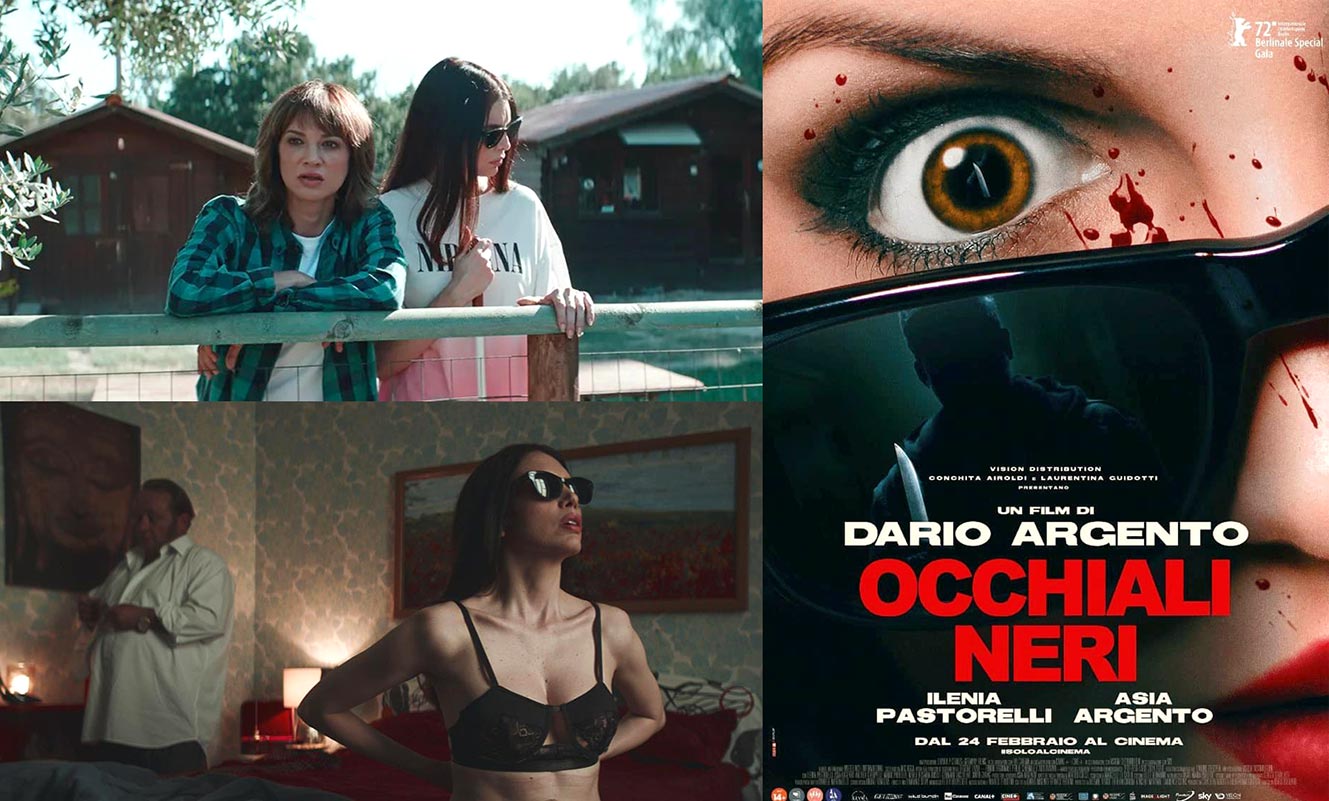
Dark Glasses


Blind Games

Dark Glasses
aka Occhiali Neri
Italy/France 2022
Directed by Dario Argento
RAI Cinema
FrightFest Screening 27/8/22


I’m not quite sure why the new giallo from the legendary Dario Argento has met with a somewhat muffled response from audiences over the last few months. Dark Glasses is, in many ways, a return to form for Argento... although I’ve frankly found something good in pretty much everything he’s done, including those last few films which received a critical mauling from fans.

This one stars Ilenia Pastorelli as sex worker Diane. In an opening scene she apparently damages her eyes slightly by watching an eclipse although, frankly, not badly enough that it makes any difference to her vision and, asides from one line in the script, I suspect this sequence may well have been a hangover from another draft of the script 20 years prior but, typically for the director, he’s kept it in anyway because he wanted a nice scene showing an eclipse (I may be wrong about this but my gut tells me this may be true, since the director has admitted on numerous occasions in the past that clinging onto a fantastic visual composition is much preferable to it actually making sense within the context of the movie).

Anyway, after a string of escorts are killed... we see one grottled to death early on in the picture in a scene where she takes a bizarrely long time to bleed out and die, while a crowd of concerned onlookers fail to help her... Diane somehow finds herself next in the line of sight of the killer. An early scene which highlights the killer to the audience is so obvious that, most (including myself) would think that this was a deliberate red herring to deflect attraction from the real killer but, no, it’s not the case. Anyway, the killer... who is somehow intelligent enough to spray his black van white after the first victim but not smart enough to repaint it again after any of the other murders or attempted homicides in the picture... causes Diane to lose control of her car. She is blinded in the subsequent crash, which also kills a mother and father in another car, leaving an orphaned boy called Chin, played by Andrea Zhang.

Diane is given a dog and a white stick, striking up a friendship with her ‘adapting to being blind’ coach Rita, played by Asia Argento. She also, unofficially and illegally, adopts the boy but, of course, the killer is after them and the rest of the movie is a cat and mouse game between the killer, his intended victims and also the police, who want to find the boy to put him in an orphanage. And that’s enough I’ll say on the plot.

So, yeah, it’s actually in many ways a typical Argento and, right from the outset, you are probably going to be in not much doubt just who is directing this one. The score by Arnaud Rebotini (which is about to come out on CD, yay!), for example, is absolutely spot on for what I think Claudio Simonetti or his group Goblin would have been doing with this material. It sounds right away like it belongs in an Argento film.

Added to this we have the fluid, moving camera work and slavish devotion to beautiful visual compositions which you would expect from this director. He loves using elements of architecture and other natural elements to split the shots into interesting shapes and this is especially noticeable in the first two thirds of the movie, before we go into a rural setting leading to the film’s finale. For instance, there’s a wonderful shot where the screen is split by a big vertical doorframe which is taking up more or less the full height of the frame on the right hand third of the composition. Behind it, through the doorway in a corridor, on the wall right behind it, is a large, vertical rectangular painting... which is angled so the top and right hand sides of it make a perfect margin within the frame, thus accentuating the vertical split. Then, to the right and slightly overlapping the door is the big foreground head of Chin as he writes at a desk. Then, the other two thirds of the shot shows the wall with various bits of furnishing and Diane as an upright vertical herself at a distance farther back from the lens. This looks really great and, of course, this kind of stuff is exactly the reason why I admire Argento’s work so much.

One thing, it almost surprises me to say, is that the acting is pretty good. I mean, that’s kind of a given in terms of his daughter Asia but, both Pastorelli and Zhang do really well here and have good chemistry. It’s not quite the same kind of relationship as between Karl Malden’s blind character and his granddaughter in Argento’s classic Cat O Nine Tails (reviewed by me here) but, yeah, I can see how lovers of his earlier works might feel a little nostalgic at this element of the story.

If there’s anything I have to say as a criticism, it’s that the last third of the film could have been a little more ingenious in terms of character reveals and kills but, honestly, it all works fine and I was happy to be watching something which is, probably, his best movie since The Card Player. That being said... yeah... I could have done without the snakes scene which makes me giggle every time I watch this one (don’t ask... it could have used Samuel L. Jackson in here yelling it up a bit, maybe).

And, yeah, this is probably one of my shorter Argento reviews but, what can I say, I enjoyed Dark Glasses a lot and I hope a UK/USA friendly, subtitled Blu Ray gets a release date sometime soon... this one deserves it (although you can certainly pick up an Italian Blu Ray with English subs at the moment... copies of which were at sale on one of the stalls at this year’s FrightFest). A nice return to form and I hope we get more from Argento soon. He’s still a visual wizard. Actually, on that last point, Dario was on hand at the screening to talk a bit about the film and he is planing to start shooting a new movie in Paris, spring of next year, which he hinted would be a remake of a dark Mexican, 1940s movie so, yeah, we shall see.

Tuesday, 17 November 2020

Fear - The Autobiography by Dario Argento


Silver Tongued Devil

Fear - The Autobiography
(Limited Collectors Edition 0184/1000)
by Dario Argento
FAB Press
ISBN: 9781913051051


There are, of course, a number of books on Dario Argento that have tried... and sometimes succeeded... in doing justice to a director who, for me, is one of the most interesting Italian directors around (more so than, say, the wonderful Fellini, the impressive Antonioni or the sublime Bava). A couple of my favourites would be Broken Mirrors/Broken Minds: The Dark Dreams of Dario Argento by Maitland McDonagh (I have the old edition with the ‘Opera’ cover) and any one of numerous ‘just that little bit better than the previous one’ editions of Dario Argento - The Man, The Myth & The Magic (as it’s currently subtitled) by the great Alan Jones. This look at him, however, is a little different to previous books exploring this iconic, cinematic figure.

This time it’s the turn of Argento himself to tell his own story and I snapped up a copy of the first edition English translation of this tome put out by FAB Press last year... which is a beautiful, limited edition hardback with silver edged pages (Argento translates as Silver in English), its own cloth strip bookmark and a nice, silver embossed image of The Bird With The Crystal Plumage on the cover, beneath a dust flap depicting the writer/director himself. This edition also has, I’m pleased to say, the great man’s signature on a book plate inside... this is the second time I think I’ve got a book with his signature in it... the other was one of the Alan Jones' editions, which Jones also signed for me.

Now, if you’ve been reading my more ‘bookish’ reviews on here for a while, you’ll know I find autobiographies a bit of a hit and miss affair. The worst ones leave you with none of the questions about the work of the author explored at all whereas, the best ones will be so well written and breezy that they will just leave you wanting more. Which is, of course, somewhat of the same thing... but I’ll take the speedy, witty read any day and, thankfully, that’s just what we get with Mr. Argento’s biography.

One of the things I noticed right away is that, while it covers all the usual things about growing up and the major relationships of the central figure... it never stays anywhere for very long and, although it certainly isn’t jumping around like some of these kinds of books (far from it), it certainly goes through things at a fair pace. Starting with Argento’s childhood and telling of how he used to hob nob with the film stars as a young ‘un in his parent’s photographic studios... it runs right through to where he is now in life (or where he was a few years ago at any rate, when the Italian edition was first published).

One of the things which surprised me is that he does so in quite a candid fashion. For instance, after a lovely forward by Alan Jones, the book starts off with a written snapshot from 1977 with Argento in his hotel room, waiting to see how the new film he is working on, Suspiria, is going to turn out. He is not shy in admitting his suicidal tendencies and, as he goes to throw himself from the hotel window, he can’t get past the dresser which he’s had placed in front of said windows to stop exactly this thing from happening. After this teaser, he then starts from the beginning of his life and goes through until, roughly two thirds of the way through the book, he catches up to this point and passes it.

He’s also not shy in mentioning various things about his love life with a variety of women over the years. Some of them are left unnamed (including his latest lover) and some of the more high profile ones, like Daria Nicolodi, who starred in many of his movies and gave birth to his second daughter, Asia Argento, are also included in his quite honest assessment of the state of things. Saying that, it seems to me that he’s never disrespectful of them and he certainly gives Daria full credit for helping him write and research Suspiria. He also, finally, tells of the misunderstanding around the central casting of the lead actress in that film, which pushed them apart for some time.

I found out, or perhaps was reminded, that while a voracious reader as a child his real first loves were the tales of Edgar Allan Poe and these certainly infused his imagination in his later career, I suspect. I also discovered that we have the same favourite episode of The Twilight Zone in common, so that’s nice (Time Enough At Last).

One of the problems with autobiographies of famous people, at least as I’ve found, is the tendency to shy away from talking about their work. Thankfully, Argento doesn’t do that and, although I was very much wanting more from his priceless anecdotes, he does manage to touch upon one or two little gems from most of the films and TV series in which he’s had a hand. So you’ll hear in his own words how he and Bernardo Bertollucci (both yet to start their real careers) worked with another of my favourite Italian directors, Sergio Leone, to write Once Upon A Time In The West. You’ll learn stuff like how the aquarium of the producer of The Five Man Army (which Argento wrote) inspired one of the ideas that manifested in The Bird With The Crystal Plumage, how much he and Tony Musante didn’t ‘get on’ working on that movie... as well as how much he did ‘get on’ with Michael Brandon on Four Flies On Grey Velvet and with David Hemmings on Deep Red (Profondo Rosso).

You’ll learn just how he got those intense colours on the actors faces in Suspiria, by shining light through velvet and just what things happened to him in real life to birth his ideas on movies like Tenebrae and Phenomena. I was spellbound as I read how he’d used lots of life size mannequins manipulated by neighbouring extras in the audience in Opera to keep the cost down, a story which reminded me of similar movie magic trickery used in both the chariot race in Ben Hur and the pod race in Star Wars - The Phantom Menace (cotton reels, if I remember the model I saw exhibited years ago correctly).

Above all, the book feels like it’s fresh and relatively unfiltered. He is, perhaps, a little less critical of his least successful films than I had suspected, given the candor which he shows in all the other aspects of his life but it doesn’t really harm the book at all. You just get a sense that it’s not that important to him... or, at least, to his public facing image. Ultimately, its a fun read, informative in the way he releases little nuggets of information about his work and also, I found out that he actually spent a day or two locked up in a jail cell (for something he didn’t do, I hasten to add). He even gives a little hope that there may be material enough left for a second book at some point (which would be nice). So, yeah, if you’re a fan of the work of Dario Argento and want to know a little more about the man behind the magic, a man who hugely popularised the Italian giallo movie in the wake of Mario Bava, then his autobiography, Fear, is something you should read as there are lots of little details about his life and work which you won’t easily find anywhere else. Definitely get this one onto your book shelves if you are of a mind to.

Monday, 6 October 2014

Incompresa (aka Misunderstood)


Aria Pigeon

Incompresa (aka Misunderstood)
2014  Italy/France
Directed by Asia Argento.
Seen as part of the Raindance Film Festival on Saturday 4th October

I’ve been aware of Asia Argento as an artist to be reckoned with for a decade or two now. Ever since getting interested in her famous father’s various gialli and horror films and seeing her pop up in a few roles in both his and his contemporaries’ movies such as her feature film debut as an actress in Demons 2 and through to such classic Dario Argento films as Trauma and The Stendahl Syndrome (amongst others).

She’s also, of course, a very beautiful model, on top of being a talented actress, but the thing that pleased me most about this woman was about ten years ago when I finally got around to seeing her debut as a feature film director, Scarlet Diva. There were some really great things going on in this film and the camerawork was both inventive and unintrusive, when it needed to be, in equal measure. I remember saying to a friend of mine at the time that I thought she was maybe an even better director than her father.

She hasn’t directed that many features over the last 14 years since Scarlet Diva and I’ve never understood why. In fact, despite working behind the camera on a lot of shorts, Incompresa is only her third feature, following on from The Heart Is Deceitful Above All Things (a film I’ve not gotten around to seeing, I have to admit). So when I saw her tweeting over the last year or so about the film she was making (Yeah, I follow her on twitter, what can I say?) I was getting kinda interested in seeing this thing and when she announced that there would be a couple of screenings in the UK, as part of the 22nd Raindance Film Festival in London, I was straight on the phone to my friends to see who wanted to go with me.

Incompresa is the story of a young girl growing up in a troublesome family environment, split between an artistic father, who is an actor, and a pianist mother who are at each others throats whenever they are occupying the same homes... which is rarely. The whole scenario is seen through the eyes of the daughter, Aria, who also has a sister (who is her mother’s favourite) and a loathsome step sister (who is her father’s favourite). Aria is just trying to lead a normal life in a world where the sting of disappointment and unfair peer pressure is taking its toll just a little more than usual.

It would perhaps be a little too easy to say that Incompresa is an autobiographical film. There are some striking resemblances that could easily appear to an outside observer, aka the audience, to be indications that the director is what this film is all about. The young protagonist’s name Aria is only one letter out from Asia, for instance. The always fantastic and watchable Charlotte Gainsbourg here plays Aria’s troublesome mother, a self confessed “love witch” and the way she is made up in the movie strongly calls to mind the presence of Asia’s real life mother, the equally wonderful Daria Nicolodi. Anyone who knows anything about some of the stories about how Suspiria and the Three Mothers trilogy came into being will know that there’s a strong connection to witchery there too. Similarly, I’ve no idea if Dario Argento is superstitious or not but the “actor” father of Aria could easily be a surrogate Dario for all I know.

So yes, a little tempting and, as I said, too easy a target for accusations of biographical intent, especially since Asia Argento has maintained that the movie is not intended to be. That being said, however, she is very much an artist and artists do tend to take what they know and plough it back into their works... so I don’t think it would be too unfair to say that there’s also an element of the finished product which takes bits of her life and reshapes them to fit the overall drama. Or so it seems to me, anyway. That's pretty much how everyone working in a creative medium uses personal experience to shape and inform their art.

The structure of the film is not what I was expecting. Rather than take a specific arc from one starting point to a place where a sense of closure is maintained, the story is episodic in nature and presents dramatic sequences which build up a gradual picture of the main protagonist, through the observations of both the problems and the good times piled onto little Aria, played so assuredly by Giulia Salerno. In fact, the constant traipsing between the houses of both her father and her mother as she commits some new wrong and is expelled from each of her father’s or mother’s house in turn, time after time, make this seem to be something of a road movie at heart. Aria certainly wears out a lot of shoe leather in her to-ing and fro-ing and, it has to be said, the sequences where she is seen journeying from one house to another is used as a form of punctuation or grammar for the piece... sometimes invoking a comical reaction and, at other times, underlining the drama of a situation in the most moving way.

In a way, it’s the journey that’s always the important bit in this movie, rather than the destination, and as Aria stirs up trouble with black cats and pigeons (her father is depicted as a victim to superstition), stolen letters and various other attempts to explore her life and gain the attention of the kid she likes in school, the more we become aware of something that maybe some of us have forgotten over the years... how hard it is to be a kid.

Of course, Argento frames the various adventures of her young characters with some of the best compositions she can find in the various locations... the vision of Aria walking away from the camera at a three quarter angle against a vertical slatted fence which perfectly frames the perspective is a shot that springs to mind... and I wouldn’t expect anything less from her. What is more telling is how close I think she must be to the heart of the story she is trying to shape. She manages to coax some amazing performances out of all the kids in this film, with the aforementioned Giulia Salerno absolutely knocking it out of the park in terms of conjuring up a little girl who I totally believed in throughout the running time.

My favourite part of the film, for instance, is when Aria stumbles across a group of homeless people and stays with them for the night, making a connection based on the spirit of movement and exploration that captures the hearts of her new, adult companions. The relationship she creates with the young rock star boyfriend (one of many boyfriends her mother courts throughout the film) is also a great series of moments in the film and also shows that Asia Argento hasn’t forgotten to show the good things about being a kid too. Which is refreshing in a film which seems to court tragedy as a friend.

Now I’m not sure if Incompresa is going to get a general release over here in the UK but, even if it doesn’t, I’m pretty sure something this well made should hit DVD or Blu Ray over here at some point. It’s one of the more entertaining and moving motion pictures I’ve seen dealing with this kind of subject matter (yeah, alright, I admit to tearing up in two places, okay... but only for a minute, honest) so I’m hoping it gets some kind of release soon. If you like films which try to find the truth through the journey of a child’s heart then this one is definitely worth some of your time. And like I said, both Giulia Salerno and Charlotte Gainsbourg give some terrific performances here so you don't really want to miss that. Once again, Asia Argento flexes her movie making muscles and shows the general public a side to her they never knew before. And, of course, she also reiterates that she is a film-maker to be taken very seriously.

Monday, 15 July 2013

Dario Argento's DRACULA


Tooth High To A Grasshopper

Dario Argento's Dracula
2012 USA
Directed by Dario Argento
Sony Italian BluRay Region A,B & C 

Dario Argento is a bit of a legend of a movie director these days... and rightly so, having stolen Mario Bava’s thunder somewhat when, in 1969, he repopularised (and how) the Italian giallo thriller single handedly with the first of many spectacular gialli which he made over the decades, The Bird With The Crystal Plumage. The director is mostly a practitioner of this form of cinema although, since people often find themselves confused between movies depicting serial killers and movies depicting monsters, he is often misconceived as being primarily a director of horror films.

It’s true, of course, that Argento has directed both films and TV episodes which fall into the horror genre, including one of his most famous films, Suspiria. However, his horror direction is only a small body of work compared to his giallo output and should never, I believe, be considered his primary voice... although he is obviously inspired by both a sense of the gothic (instilled in him by some of the writers he used to read when he was ill in bed as a child, if memory serves) and the famous cinematic forays of the past which encapsulated that very atmosphere as their primary focus (with offerings from Universal, RKO, Hammer and the like).

I first got into Argento at the dawn of DVDs when, after about a year or two of the machines being on the market, I finally bit the bullet and bought a player primarily because I found out you could get American DVDs of the Flash Gordon serials. This was important stuff. Of course, owning a multi-region DVD player, like pretty much anybody who is serious about film in my country would, opened up a wealth of possibilities and suddenly more controversial directors who were either not allowed to have films released in my country or were heavily censored over here (which amounts to the same thing... who wants to see a censored version of a movie?) were now instantly accessible to people in the UK properly for the first time. Which is why, I think, genres such as the giallo, the spaghetti western, sexploitaiton, blaxploitation, nunsploitation and pretty much every other kind of interesting genre around have found a big resurgence in popularity... people now have relatively easy access to these kinds of movies.

Argento, it has to be said, has been producing films which have been less than popular with his fans of recent years, although I have no problem with most of them... my one caveat being his awful version of The Phantom Of The Opera (which isn’t a recent one, as it happens). I remember being in a packed Fright Fest screening of his previous film Giallo and the audience, in which there were undoubtedly a lot of Argento fans, was howling with collective laughter at some of the execution of the movie. Now I saw no real problem with, most, of it... but I’ve always thought of Argento as primarily a visual and aural stylist, which makes sense seeing as he comes from a background of churning out very successful gialli. These films are not about acting or their ludicrous scripts... they’re about visual style and great music. So I really don’t have the same kinds of issues as some people do with his later stuff (like The Card Player, for example, which I loved).

His version of Dracula, of course, is obviously a horror story but, although it has a certain sense of a thread of adaptation running through it, it changes things around sufficiently from both Stoker’s original novel and stage play versions (and, of course, the later stage adaptations which Universal studios culled their original version from) to be different enough for even the most jaded fans to find something fresh in the story. I suspect the location budget also had something to do with that (it’s all set in one village) but even so, there are some interesting things going on here. Carfax Abbey is mentioned as Carfax Sanitorium, for example, which was formerly run by Dr. Abraham Van Helsing (Dr. Seward is completely written out).

Does this make for a good movie then?

Well... yes and no. I think it’s all down to how much certain outrageous ingredients spoil the main course for you. There was one point about a quarter of an hour before the end, for example, when I started laughing out loud.

Now then, the acting by a lot of the cast is not up to scratch. You expect that from an Argento movie and it shouldn’t, in itself, be a problem if you are already used to this director’s work. However, surprisingly, there is also some pretty good acting in this one too. The director’s daughter, Asia Argento, can always be relied on to give a great performance (and on the strength of the one movie I saw that she directed, I suspect she might even be a better director than her old man... the talent runs in the family) but we also have Thomas Kretschmann giving a really great performance as Dracula and Rutger Hauer making a more than competent Van Helsing... although Dracula’s nemesis doesn’t actually turn up until the last part of the film.

Added to this you have Dario Argento’s trademark visual splendour and the shot design and camera motion through those shots is absolutely superb in this one. The striking use of Bavaesque colour is again pushed to the fore and the outrageously saturated pools of red and yellow light sharing the same frame and the greener than green forest in the moonlight are all things of beauty. If nothing else... this film is quite spectacular. There are also a few good doses of female nudity too, which is unusual for this director and, I think, is probably more on show here (albeit briefly) than all of his other movies combined. That, of course, adds its own kind of spectacle into the proceedings... especially lit and shot as well as it is.

That being said... there’s quite a lot of bad stuff here too. One of which is Argento’s fascination with style over substance. I remember, decades ago, Argento was asked in a documentary if, when faced with the insertion of a cool and beautiful shot in his movie as opposed to a shot which would be more appropriate and make total sense within a story, which he would choose. Argento said he would always take the cool shot over logic any day. Dracula is full of “the cool shot” which is a trademark of Argento, to be sure, including one where you see the course of a bullet as it travels from the base of a man’s jaw and up and out through the top of his head... not as audacious as the notorious “bullet scene” from Argento’s movie Opera but certainly an echo throughout the years. However, you also have one scene near the end, the one I started laughing at, where the movie totally “jumps-the-shark” as it were, in modern pop culture parlance...

Dracula, it seems, can transform himself into any kind of beast he wants. One would think he would be fairly subtle in his choice perhaps but, no, he decides to go and kidnap Mina Harker transformed as a giant sized, bright green CGI grasshopper which, while certainly giving the movie a sudden and fierce injection of 1950s B-movie atmosphere... seemed perhaps a fair bit inappropriate given the sombre tone of the rest of the movie and its leanings towards the gothic. This was a fairly unfortunate choice, it has to be said, but taken out of context it looks pretty cool, at least.

But there’s more.

The various “myths” of the vampire are neither adhered to faithfully nor ignored. One or the other or the popular tactic of establishing which of the various trappings are being used would have been a way to go. Set up your ground rules for the audience first. Here, it’s contradictory and, well... all over the shop to be honest. One minute, Jonathan Harker (very much tapping into the pretty boy Keanu Reeves vibe of Coppola’s version of the story) is bitten and is instantly allergic to deadly sunlight... the next we are introduced to the “Renfield” character stand-in, who is also obviously a vampire, but who has no problem with strolling around in sunlight at all. Similarly, Lucy (beautifully played by Asia) is committing her undead crimes at night and sleeping in her tomb by day (just as her master Dracula is sleeping in his protective coffin) but why then is it, when the count himself turns into another creature, he’s perfectly fine running around in the sunlight? None of this makes much sense and neither does the fact that a bitten Jonathan Harker needs to feel the sharp end of Van Helsing’s stake but the equally vamped up Mina Harker doesn’t. None of it makes much sense... which is a big shame, to be honest.

Also, there is a dreadful reliance on CGI blood effects for the trademark Argento gore in this movie and, to me, this just looks awful when compared to a plain, in camera, practical effect. Maybe Argento’s resorted to this finally because of something to do with the 3D process... I don’t know. However, it looks very fake and unsatisfying and I hope he doesn’t continue to go down this route.

However, I let none of this detract from my enjoyment of the film, to be sure. And there are some nice nods both to the original Stoker novel (Kretschmann crawling up the outside of the castle wall) and to Todd Browning’s 1931 version, with both a large spider’s web and the full Lugosi treatment as Kretschmann digs in to the well worn “children of the night" dialogue. And, of course, Rutger Hauer’s impromtu holy cross assembly will bring back fond memories of Peter Cushing’s more succesful attempt in the old Hammer version. So some nice stuff too, including the music...

After the problems Argento had convincing the studio to retain his regularly composer, and once figurehead of Goblin, Claudio Simonetti on the previous project (the final score to Giallo was by Marco Werba), Simonetti has returned to Argento’s side with a brilliant, theremin tinged score which is quite remarkable in tone, although one of the sub-themes did remind me a little of the theme which the group Toto allegedly pilfered for their score for Dune, namely Ronald Stein’s score for Roger Corman’s Haunted Palace. That minor gripe aside though, I’ve been enjoying the score for a year or so now on CD and am pleased to finally be able to hear it in the context of the movie for which it was written. This includes the end title song which is performed by Simonetti’s current progressive rock group Daemonia.

Dario Argento’s Dracula, when all is said and done, is a film which I am more than happy to have in my possession and will definitely get a few spins as the years go by. Perhaps it may be a bit anticlimactic for some to realise that such a legendary director tackling such a legendary story is not without its problems but I, for one, am happy with the result (grasshopper aside) and, to be honest, it’s a lot better than I’d hoped it would be after the feedback I got from some. It looks, like usual for this country, I won’t get a chance to see it in any kind of cinema release over here in its 3D version but I’m still keeping my fingers crossed.

Oh yeah. About the 3D. If you are buying the Italian Blu Ray of the film (which is shot and presented in the English language anyway, by the way) then you will be shelling out a lot more for the 3D version of the movie than the 2D version, if you have a 3D player. Not to worry though... as the stall holder who I bought this from pointed out to me, the 3D print of the movie is also on the 2D disc, they’ve just repackaged the same disc for the more expensive version to get some extra cash. So if you buy the Blu Ray standard edition, at least on the version I have, you’ll get both versions. Watch out for those large, heaving bosoms in the 3D version though! You might get a wallop.