Showing posts with label Daria Nicolodi. Show all posts

Sunday, 29 October 2023

Paganini Horror


Violin Violence

Paganini Horror
Italy 1988 Directed by Luigi Cozzi
88 Films Blu Ray Zone B


I’ll be honest, I was expecting a lot more out of Paganini Horror than what the movie delivers. The reason why is because it has a good pedigree. For starters it’s directed and co-written by Luigi Cozzi who directed both the wonderful Star Crash (reviewed here) and the very entertaining Contamination. Also, Cozzi wrote and co-wrote a number of interesting gialli including one of my favourites, The Killer Must Kill Again (can we have a Blu Ray of that one already please?) and two of Dario Argento’s early films, The Cat O’ Nine Tails (reviewed here) and Four Flies On Grey Velvet (reviewed here).

Secondly, the film was co-written by Dario Argento’s former muse (and mother of Asia Argento), Daria Nicolodi, who co-wrote Suspiria (reviewed here) and also has a major role in Paganini Horror, as the owner of the house in which most of the movie is set.

So, yeah, with that kind of collaboration, what could go wrong? Well lots actually but it’s perhaps not that the film is actually bad, it’s just that it could be almost interchangeable with a lot of Italian horror movies of the time, including the directors own mis-step of a movie (in my opinion), The Black Cat (reviewed here).

The story starts off with a young girl killing her mother by deliberately dropping a hairdryer in her bath tub. It’s actually a very ‘over the top’ electrocution, with big electrical arcs and a woman whose flesh burns amongst all the pyrotechnics (I doubt if a simple accidental, water-based electrocution from such a household item would be quite as spectacular in real life). Jump to the present day and we have a mostly female rock group consisting of lead singer Kate (played by Jasmine Maimone), two guitarists and a drummer named Daniel, working on recording a new song. Their producer says the song is no good and an argument erupts between Kate and her producer. The day’s recording is cancelled and Kate goes home to try and find inspiration.

However, Daniel buys a bizarre scroll from a shady character played by Donald Pleasance (in well ‘over the top’ form) for a stash of cash so Kate can have a song (yeah, great and obvious solution there folks). After undoing the suitcase holding the scroll (with double combination locks of 666), Paganini’s ‘lost song’ is unearthed and he gives it to Kate for her next hit. Within a few minutes of bizarre and over the top exposition, filled with monumental coincidences of good fortune for the sake of brevity... the whole troupe, including the producer, set off for an out of the way haunted house belonging to Daria Nicolodi’s character, to shoot a rock video for the song with a famous horror director. I can’t tell you how ridiculous this two or three minutes of expository dialogue is but they even manage to name check Michael Jackson and compliment him on his video to Thriller.

Meanwhile... Donald Pleasance is wandering around Venice, climbs to the top of a tower and starts throwing the money off it, repeatedly calling the folding money ‘Little Demons’ as he tosses more and more of it into the streets. Yeah, there’s obviously something not quite right about his character, is there?

Okay, so once the video shoot starts off, a masked figure who, it seems, is the dead spirit of Paganini himself, starts picking off the group and their entourage one by one, handily using a knife blade which pops out of the bottom of his violin on occasion. At this point Nicolodi tells a story that Paganini originally killed his wife and used her intestines to make his violin strings after making a deal with the devil... I’ve not fact checked this myself but, yeah, seems unlikely.*

There are lots more electricity deaths and various stabbings and crushings and, also, a woman who is covered in a fungal mould said to be specific to the kind of wood Paganini’s violins were made from. There’s one nice moment when the blood flying from a stabbed woman hits a light around a vanity mirror and shorts it out, which seems almost a nod to the iconic light bulb moment in Argento’s Tenebrae (reviewed here). There’s also a huge attempt at integrating the idea of ‘the harmony of the spheres’ and a room with a picture of Einstein and a big, bizarrely lit hour glass which seems to be a portal to alternative dimensions. Apparently Cozzi wanted to make more of this concept with a longer cut of the movie, to tie the various, strange proceedings together but, the producer wanted it to play more like a straight horror piece than science fiction... although I think it all comes across in it’s own, muddled way.

The film is definitely trying to be a ‘Suspiria light’, I would say. Various colour washes of bright reds, blues and lime greens etc are used throughout in certain sequences and Vince Tempera provides a kind of progressive rock based score which is typical of Italian horror movies of the time. It’s not as catchy or as listenable as Goblin, for sure but, it’s certainly trying to serve the same function.

There’s a lot wrong with the film too, I reckon. It’s possibly just the audio looping but it’s got some of the worst acting I’ve seen in an Italian horror film for quite some time. And the constant hysteria of the ladies as they spookily explore the house for long periods of time, without even bothering to pick up a weapon such as a heavy guitar for the most part, is quite grating and hard to take.

Some of the deaths have some bad moments too. When one girl is crushed as if by invisible glass in a room while the others look on, her head explodes and the blood splashes on the sheet of Paganini’s music. Except, we’d already seen this sheet of music go up in flames a minute or so before. And then, later, when one woman is stabbed by a character, we see the knife enter her fake flesh in close up with the blood oozing but, when we cut to the long shot, the knife is just sticking out of her black top and nowhere near any visible flesh so... yeah, maybe a quick insert from footage originally intended for elsewhere in the movie, perhaps?

All in all, I’d say Paganini Horror is an entertaining distraction of a movie but it’s not so good as to be that interesting and not nearly bad enough to get sucked into the ‘so bad it’s good’ category. I had a certain amount of fun with it for a first time watch but really didn’t find anything to write home about and it’s not something I’d recommend to most people, even fans of mid to late 1980s Italian horror movies, to be honest... which is probably the only target audience this film has. But I was happy enough to see it and 88 Films have put a nicely restored transfer of it out on Blu Ray so, good for them. A fairly good label but not so great a movie, I would say.

*Having now had to time to fact check this... I have learned that it is indeed a rumour which was circulating about him and he also was said to have trapped his wife's soul in said, intestinal violin.

Tuesday, 19 July 2022

The Black Cat (1989)


Cat Me
If You Can


The Black Cat
aka Edgar Allan Poe’s
The Black Cat

aka Demons 6
Italy 1989
Directed by Luigi Cozzi (as Lewis Coates)
21st Century Film Corporation
Severin Films Blu Ray Zone A


Well this is a complicated mix. I’ve been wanting to see this particular version of The Black Cat for some time because, well, the great Caroline Munro is in it (her second film for Cozzi after Star Crash, which I reviewed here). However, even though she looks great in this film especially, gives a good performance and has gone on record that she has a good deal of affection for this writer/director, it’s certainly not one of her best films. I love these kinds of movies and even love Cozzi movies like Contamination but, this one is a bit of a mess, I reckon (although it’s a miracle it looks as good as it does, considering the budget Cozzi had to work with).

Okay, so I’ll start off by stating that this film has nothing to do with Edgar Allan Poe’s The Black Cat (as it proudly proclaims to the contrary on the titles on this print)... absolutely nothing and, to be honest, I don’t know why producers would want their film called that when there are so many movies out there with that title already. Apparently, the notorious Menahem Golan (formerly of Canon Films) asked Cozzi to drop some shots of black cats into the film after he’d delivered the finished product because he’d apparently already sold this film as an adaptation of the Poe story. So, I don’t know who he thinks he’s fooling but there are a few added shots of a black cat here and there and the film within a film, which is being finished by the characters at the start of the movie, is said to be a version of The Black Cat... which it also clearly isn’t, it has to be said.

What it actually is, or at least started life as, is the first crack at a third part of Dario Argento’s Three Mothers trilogy, written once again by his ex-wife and long standing writing and acting partner Daria Nicolodi (she had made large contributions to the first two and can even be seen in an early sequence of Suspiria, reviewed here). But Luigi Cozzi is good friends with Argento (I believe he even runs Argento’s shop in Italy) and, after Argento rejected the screenplay to go and do something else, Cozzi didn’t want to do something which might seem like a betrayal... so he rewrote the script so it’s an ‘homage’ to Argento’s Three Mothers movies instead although, it has to be said, homage or not, it still kinda plays out like a direct sequel, it seems to me. At this point, Nicolodi left the production and also dropped out as the lead actress/protagonist, movie star Anne Revanna... to be replaced by Florence Guérin who, actually, does a pretty good job here anyway. Although it’s hard for the actors in this to shine completely because the script is not good... at least that’s what I think.

So, anyway, Anne’s husband Marc (Urbano Barberini) and his writing partner plus his wife (Nora, played by Caroline Munro) have written a script based on the Third Mother in homage to Argento’s Suspiria (all happily referenced in the film). Once a sinister producer, Leonard Levin (played by Brett Halsey) agrees to back the film, things start going wrong and the lead actress cast in the movie, Anne, starts getting dream visitations from the real third mother... and there is loads of jumbled up murder and mayhem ensuing for the rest of the movie. There’s also a kind of cosmic element to the film and Cozzi goes on record on an extra feature on the beautiful new Severin Films Blu Ray restoration of the film, saying that it’s a sci-fi movie dressed up in horror clothing because horror was a lot easier to get green lit back in those days. To me, actually, it almost feels like a close cousin to Lucio Fulci’s Manhattan Baby and, between the two of the movies, there’s not much in it.

Nice things for me were, Caroline Munro’s sexy performance (she’s playing a bad girl here and is not what she at first seems) and the over the top goriness of some of the effects which might make you raise an amused eyebrow. For instance, a professor who is really a good witch, is gotten by the Third Mother by a psychic signal which makes her start bleeding everywhere on her head until her heart explodes and ejects itself from her shattered rib cage. It’s an obviously similar death to some of the ones in Cozzi’s Contamination and also, it's fairly evident that it’s an attempt to both recall and out-do the famous chest burster scene in Ridley Scott’s A  L  I  E  N, except, they never really look all that convincing, it has to be said. Although I do appreciate the effort and feel they have a somewhat satisfying, almost comical feel to them.

The photography and whole atmosphere of the film is nicest, though, when it’s spoofing or paying homage to Suspiria. For instance, when Ann is reading the script for the film, the lighting style is primary greens pitched against reds and, instead of Vince Tempera’s hit and miss score on the soundtrack (but not as miss as those awful needle dropped rock songs which were fashionable at the time), they actually track in Goblin’s main Suspiria theme into these shots too. Which I’m surprised they got permission for but, that’s fine.

The only other thing I’ve really got to say about this... somewhat dull and messy affair... is that there are some beautiful and arresting visual moments in the film but, they never really add up to anything more consistently substantial and so, yeah, nice to look at but it’s not a film I think I would be revisiting often. It’s a shame actually that the producers didn’t think to get Ania Pieroni back to reprise her short cameo as the Third Mother from Dario Argento’s Inferno (reviewed by me here) but, yeah, another missed opportunity, I feel. One last thing though... when Argento did finally make Mother Of Tears (aka The Third Mother) in 2007, it was much more of a successful movie (at least I think so) but it felt less like he was making a film close to the sensibilities of Suspiria and Inferno and more like he was doing a riff, in terms of style, to The Black Cat. Just a thought and I’m sure people would disagree but, that’s what it felt like to me. Mother Of Tears is still a great film though and I wish somebody would put the thing on a definitive Blu Ray edition soon. I definitely need an upgrade.

Wednesday, 2 March 2022

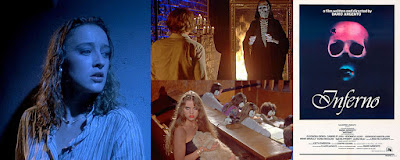
Inferno


Mother Nature

Inferno
Italy 1980 Directed by Dario Argento
20th Century Fox - Arrow Blu Ray Zone B


Warning: Some spoilers here.

Following on from the success of his phenomenal film Suspiria (reviewed by me here), the great Dario Argento made a movie with mostly American finance which, honestly, shouldn’t be overlooked as, like many of his films, it’s a truly beautiful looking picture. Also, it’s one of the few horror films in his CV (he mostly directed gialli) and it’s a direct sequel to Suspiria, being a second helping of the story of another of the Three Mothers (or Three Witches) who Daria Nicolodi and Dario Argento cribbed/were inspired to create from a few pages in Thomas De Quincey’s sequel essay to Confessions Of An English Opium Eater (and which is often bundled in with that book by publishers).

Now, the directing genius Mario Bava helped out Argento on this one on special effects although, I’m now hearing that while Argento was ill, Bava directed whole sequences and Irene Miracle says, according to a source, that Argento wasn’t on the set during her shoot for the film. Either way, I can’t start pulling this film apart and assigning scenes to who I thought might have directed different portions of it so, for me, this is an Argento film and it surely has some of the key features of Suspiria mixed in with it, such as the strong, vibrant colours pitched against each other in the lighting (which is admittedly a Mario Bava signature but it also very much came to be an Argento fingerprint on a lot of his movies too).

The plot is very thin, as you would expect form an Argento film and it’s just the principle protagonist, Mark played by Leigh McCloskey, wandering around Italy and then, for most of the picture, an apartment building in New York (home to Mater Tenebrarum, the Mother Of Darkness), trying to find his sister Rose, played by Miracle. That beings said, Argento films are never about the story or even the acting and this one is no exception. It’s all about atmosphere and the unbelievable visual feast of eye and ear candy that the director lavished on the senses of the audience.

The film lulls you in with Rose reading from a fictional book by the architect Varelli, talking about DeQuincey’s Three Mothers. Then, all of a sudden, the brilliant Keith Emerson score comes crashing in with the title of the film and then, as the credits continue on an angled shot of Rose from above, in a very slow zoom, the music stays strong and really pulls you in.

This one is very focused on Argento’s obsession with architecture and three quarters of the film are about moving the characters in small adventures around the New York building. The shot design is mesmerising stuff and, as he often does, Argento uses a lot of moving camera where he completely moves around the space without tearing apart the compositions as he goes, framing actors in portions of the screen in areas made by various horizontals and verticals of objects or architectural features of the sets. Indeed, there’s an elaborate sequence where Daria Nicolodi is watching Mark’s unconscious body being dragged across the floor from a window opposite and... it’s a gridded window so, of course, when the killer relaxes his grip on the body, Mark's head is perfectly framed in one of those small squares. This film shows Argento at the top of his game and I think it’s this period of his career, or his slightly earlier phase, that people think of when they recall the ‘golden age’ of this particular director’s output as an artist.

The use of various connections of acoustical egress and access via grills and ventilation shafts in the structure of the New York building does, of course, play to the director’s favourite modus operandi, as he moves the camera around cramped, interior crawlspaces to show the journey of a conversation. But, the real triumph of artifice over nature, which often highlights his work, is seen in a brilliant shot where a man simply gets out of an elevator and walks into a corridor. I remember the very first time I saw this movie, maybe 20 or more years ago, I had to backtrack on the DVD I was watching it on because I couldn’t work out why the man was holding his right leg at a funny angle in a quite unnatural pose as the doors open. However, when you look to the left of screen and see one of various windows which you see more of as the camera backs away from the angled shot to follow the progresss of the man down the corridor, you realise that those windows all have a very thin, black slanted separating line and the man’s leg, held at the same angle for a second or two, was a deliberate visual echo to the environment he finds himself in. Totally artificial, of course but, an interesting detail, none the less.

There are also references to earlier Argento ‘moments’, if that’s the right word, such as one of the killers (the film seems to have a few ‘agents’ of the Three Mothers) being reflected in the broken piece of a glass door handle, something which plays on Argento’s use of reflective surfaces up to that point. There are also things in this which I’m sure are references to other artists, such as the ants crawling on Mark’s hand in a scene which, although they actually do become a slight story point later on, I’m sure are there as a little visual homage to Dali and Bunuel’s Un Chien Andaleau.

Despite the vibrant colours in some of the film recalling Suspiria, this movie seems to have its own atmosphere to it, although the director does go out of his way, it seemed to me, to recall certain moments of the previous ‘installment’ in this as, almost a way of engaging the audience and giving them more of the same. There’s a scene with Sacha Pitoëff as a particularly unpleasant character, for example, where he is being picked off by rats in New York’s Central Park (which I believe was rebuilt in a studio in Italy, if memory serves) and a hot dog vendor who you assume is running to his aid but actually hacks away at his neck with a knife once he gets to him... which almost recalls the unexpected moment when the blind man gets killed by his own dog in Suspiria. Also, a lot of the dialogue in the movie sounds particularly childish, such as the deliberately child-like dialogue in the former film... which does no favours for the actors here, I’d have to say.

The very first time I watched this movie I was particularly unimpressed with Leigh McCloskey’s performance and thought he was a bad actor. Now that I watch it and, taking into consideration the dialogue and atmosphere of the thing, I realise that this must have been a quite deliberately minimal performance and it’s actually perfect for the film. McCloskey does a brilliant job here and, in a scene where he’s overwhelmed by the presence of the Third Mother (Mother Of Tears) in a music lesson in Rome, I realise now that his performance combined with the misé en scene and Ania Pieroni’s performance as Mater Lachrymarum... is a masterpiece of visual film making, no two ways about it. A sequence which absolutely transfers a sense of slow burn, oozing intensity onto the viewer. Really wonderful stuff. And, of course, Mark taking ill and also the exploding, burning building around him as he makes good his escape at the end, also recall similar moments from Suspiria.

Missed opportunities abound, of course, in terms of Ania Pieroni since she did not reprise her absolutely brilliant performance as Mater Lachrymarum in the third part of the trilogy made 27 years later... nor, indeed, in Luigi Cozzi’s closely related movie The Black Cat, nine years later. But she does a good job here in her two small scenes and she really adds to the film, I think.

Emerson’s music is one of those Argento scores which, at first, seems out of place and sometimes inappropriately placed... until you get used to it and realise just how outstanding it is. When his song Mater Tenebrarum kicks in (which is also nicely covered by Claudio Simonetti’s group Daemonia on a couple of their albums), it’s totally unexpected but absolutely fantastic and it feels like, rather than try and fit itself to the on screen action, the visuals are trying to keep up and fit themselves to the music... it’s quite an ear opener of a sequence, for sure.

And that’s me done, for the time being, with Argento’s Inferno, although this really is one of those films which a lover of cinema can never be completely done with... it’s something which I’m sure I’ll revisit many more times over the course of my life. Another Argento masterpiece and as great a contribution to horror cinema as you can get... it just looks so beautiful.

Tuesday, 17 November 2020

Fear - The Autobiography by Dario Argento


Silver Tongued Devil

Fear - The Autobiography
(Limited Collectors Edition 0184/1000)
by Dario Argento
FAB Press
ISBN: 9781913051051


There are, of course, a number of books on Dario Argento that have tried... and sometimes succeeded... in doing justice to a director who, for me, is one of the most interesting Italian directors around (more so than, say, the wonderful Fellini, the impressive Antonioni or the sublime Bava). A couple of my favourites would be Broken Mirrors/Broken Minds: The Dark Dreams of Dario Argento by Maitland McDonagh (I have the old edition with the ‘Opera’ cover) and any one of numerous ‘just that little bit better than the previous one’ editions of Dario Argento - The Man, The Myth & The Magic (as it’s currently subtitled) by the great Alan Jones. This look at him, however, is a little different to previous books exploring this iconic, cinematic figure.

This time it’s the turn of Argento himself to tell his own story and I snapped up a copy of the first edition English translation of this tome put out by FAB Press last year... which is a beautiful, limited edition hardback with silver edged pages (Argento translates as Silver in English), its own cloth strip bookmark and a nice, silver embossed image of The Bird With The Crystal Plumage on the cover, beneath a dust flap depicting the writer/director himself. This edition also has, I’m pleased to say, the great man’s signature on a book plate inside... this is the second time I think I’ve got a book with his signature in it... the other was one of the Alan Jones' editions, which Jones also signed for me.

Now, if you’ve been reading my more ‘bookish’ reviews on here for a while, you’ll know I find autobiographies a bit of a hit and miss affair. The worst ones leave you with none of the questions about the work of the author explored at all whereas, the best ones will be so well written and breezy that they will just leave you wanting more. Which is, of course, somewhat of the same thing... but I’ll take the speedy, witty read any day and, thankfully, that’s just what we get with Mr. Argento’s biography.

One of the things I noticed right away is that, while it covers all the usual things about growing up and the major relationships of the central figure... it never stays anywhere for very long and, although it certainly isn’t jumping around like some of these kinds of books (far from it), it certainly goes through things at a fair pace. Starting with Argento’s childhood and telling of how he used to hob nob with the film stars as a young ‘un in his parent’s photographic studios... it runs right through to where he is now in life (or where he was a few years ago at any rate, when the Italian edition was first published).

One of the things which surprised me is that he does so in quite a candid fashion. For instance, after a lovely forward by Alan Jones, the book starts off with a written snapshot from 1977 with Argento in his hotel room, waiting to see how the new film he is working on, Suspiria, is going to turn out. He is not shy in admitting his suicidal tendencies and, as he goes to throw himself from the hotel window, he can’t get past the dresser which he’s had placed in front of said windows to stop exactly this thing from happening. After this teaser, he then starts from the beginning of his life and goes through until, roughly two thirds of the way through the book, he catches up to this point and passes it.

He’s also not shy in mentioning various things about his love life with a variety of women over the years. Some of them are left unnamed (including his latest lover) and some of the more high profile ones, like Daria Nicolodi, who starred in many of his movies and gave birth to his second daughter, Asia Argento, are also included in his quite honest assessment of the state of things. Saying that, it seems to me that he’s never disrespectful of them and he certainly gives Daria full credit for helping him write and research Suspiria. He also, finally, tells of the misunderstanding around the central casting of the lead actress in that film, which pushed them apart for some time.

I found out, or perhaps was reminded, that while a voracious reader as a child his real first loves were the tales of Edgar Allan Poe and these certainly infused his imagination in his later career, I suspect. I also discovered that we have the same favourite episode of The Twilight Zone in common, so that’s nice (Time Enough At Last).

One of the problems with autobiographies of famous people, at least as I’ve found, is the tendency to shy away from talking about their work. Thankfully, Argento doesn’t do that and, although I was very much wanting more from his priceless anecdotes, he does manage to touch upon one or two little gems from most of the films and TV series in which he’s had a hand. So you’ll hear in his own words how he and Bernardo Bertollucci (both yet to start their real careers) worked with another of my favourite Italian directors, Sergio Leone, to write Once Upon A Time In The West. You’ll learn stuff like how the aquarium of the producer of The Five Man Army (which Argento wrote) inspired one of the ideas that manifested in The Bird With The Crystal Plumage, how much he and Tony Musante didn’t ‘get on’ working on that movie... as well as how much he did ‘get on’ with Michael Brandon on Four Flies On Grey Velvet and with David Hemmings on Deep Red (Profondo Rosso).

You’ll learn just how he got those intense colours on the actors faces in Suspiria, by shining light through velvet and just what things happened to him in real life to birth his ideas on movies like Tenebrae and Phenomena. I was spellbound as I read how he’d used lots of life size mannequins manipulated by neighbouring extras in the audience in Opera to keep the cost down, a story which reminded me of similar movie magic trickery used in both the chariot race in Ben Hur and the pod race in Star Wars - The Phantom Menace (cotton reels, if I remember the model I saw exhibited years ago correctly).

Above all, the book feels like it’s fresh and relatively unfiltered. He is, perhaps, a little less critical of his least successful films than I had suspected, given the candor which he shows in all the other aspects of his life but it doesn’t really harm the book at all. You just get a sense that it’s not that important to him... or, at least, to his public facing image. Ultimately, its a fun read, informative in the way he releases little nuggets of information about his work and also, I found out that he actually spent a day or two locked up in a jail cell (for something he didn’t do, I hasten to add). He even gives a little hope that there may be material enough left for a second book at some point (which would be nice). So, yeah, if you’re a fan of the work of Dario Argento and want to know a little more about the man behind the magic, a man who hugely popularised the Italian giallo movie in the wake of Mario Bava, then his autobiography, Fear, is something you should read as there are lots of little details about his life and work which you won’t easily find anywhere else. Definitely get this one onto your book shelves if you are of a mind to.

Sunday, 18 November 2018

Suspiria 2018


Entrail Acte

Suspiria 2018
2018 Italy/USA Directed by Luca Guadagnino
UK cinema release print.


Well this is a worryingly problematic film which I’d be tempted to sum up in just a line or two but, since some of it seems to be fairly well made, I’ll give the project its due. Fair warning though... I’ve not seen any other films by this director so I can’t comment on how his particular sensibilities find any commonality with any of his other projects.

Let’s get all the preliminary nonsense out of the way first by clearly stating that there’s no reason and, really no way, that you should... or could... attempt a remake of Dario Argento’s masterpiece Suspiria (which I reviewed here). The original/real Suspiria is a unique film and is also unshakeably bound by the artistic sensibilities of its director. I would no more think of remaking this classic than I would any other classic of cinema such as Citizen Kane, Star Wars or Taxi Driver (and you can bet at least two of those are coming in the next 10-30 years). It’s almost impossible to subvert Suspiria to a modern sensibility with another creative team behind the film and... in some ways it’s a relief to find that this is, in fact, not what Luca Guadagnino has done here with his new, ‘updated’ version.

In fact, the approach to this version seems almost childlike in that he’s almost gone in exactly the opposite direction from all the things that made the original so unique in order to not be compared to it. If that was the case, "well done" because it’s certainly true that this could never be compared to the original. It’s just too different. The original had two things which are common to the majority (not all) of Dario Argento’s work... bad acting and a not so great story. It also had absolutely stunning mise en scene, shot in bright, primary colours via a technicolour printer and an absolutely awesome score by Goblin. It is incomparable to most any other film (even to Argento’s equally superb sequel Inferno) and stands alone as the piece of art it is.

In this new version, it’s hard to find much of any common ground. You have the basics of Daria Nicolodi and Dario Argento’s story of a dance academy housing a coven of witches, also remotely inspired by a certain couple of essay pages written by Thomas De Quincey about the three mothers, often published in compendiums of his writing bundled with Confessions Of An English Opium Eater. And... that’s about it as far as connections go. You have characters who aren’t necessarily fulfilling the same kind of story roles as they did in the original. Dakota Johnson’s Susie Bannion is a completely different kind of protagonist and she has a much different arc here... as does, surprisingly, the character of Helena Marcos (played as one of three roles by Tilda Swinton)... who has a kind of demotion from her status in the previous version (I won’t go into spoiler territory here though).

You also have a great cast... with Johnson and Swinton having to hold their own among equally gifted actors such as Mia Goth, Chloë Grace Moretz and Angela Winkler. One thing this film is big on is acting talent. There’s even a cameo from Jessica Harper in this but the character she’s playing (again without giving too much away as to the true nature of her role), is connected to an element of the film which is in no way present in the original story. Indeed, Swinton’s turn as the male Dr. Josef Klemperer is one of many different avenues the film goes down into a story, set the same year as the original release of 1977, which seems to be more about fallout from World War Two and, also, the whole Bader-Meinhof thing than it does to the witchy goings on in a dance school.

Furthermore, the famous primary colours have been dropped in favour of an almost exclusively washed out colour palette and, although there are a few sequences with smooth, longish camera movements there is also, it seemed to me, an abundance of short, static shots in an edit which is something which pretty much removes this film’s right to be compared to Argento’s opus even more. So you really have to look at this movie on its own terms as, frankly, anything you could use to compare it to the former is taken away from you.

As a film in it’s own right then... well, it starts off really strong and builds up a nicely unsettling and powerful atmosphere which it manages to sustain for the first two thirds of the movie... which it then somehow manages to waste completely by getting truly dull and uninspiring by the time it reaches the last third. This last third includes scenes of orgiastic goriness which, frankly, should have left me shocked and gasping but which... and maybe it’s just the way it was cut and paced... distanced and comforted me in a kind of dull, passive way almost, rather than confront me with the visceral jolt of horror I was expecting. I mean, people having their entrails pulled out, limbs twisted and heads half severed to spray fountains of arterial blood over the rest of the cast sounds like a great and visually ostentatious, fun time should be had by all but, the way it was shot and presented here it just felt a little too much like David Cronenberg-lite, to be honest.

The most interesting things about the film were the bits where it built up the political and redemption sub plots but, honestly, they seem to amount to nothing by the end of the movie and when it comes to Tilda Swinton, one of the great actresses of our time, playing Dr. Klemperer in this one... a character who isn’t even in the original... one has to ask the obvious question here. Why? She does it well but... could they not afford another male actor?

And then there’s Thom Yorke’s celebrated score. It’s just fine. It’s mostly appropriate... although I could do without the songs... but the film is really not as special or as visually striking as the 1977 movie so it doesn’t have to serve the same function as Goblin’s absolute masterpiece of the original. It must be a hard thing to score, knowing you’re going to be compared to Goblin in this way but, there you have it. It’s not nearly as strong but it doesn’t have to be and so, being appropriate and probably a nice enough listen away from the images is absolutely fine. It’s pleasant rather than essential but, frankly, that’s no mean feat anyway so I’m not complaining. I’ll be picking up the CD of this one soonest, I suspect.

And that’s all I’ve got for you as a first impression. This is really not a remake of Dario Argento’s Suspiria. Instead, it’s a nice but somehow muddied (plot wise) horror film which starts off phenomenally well but which then gets burdened with an overlong and excessively dull final third which kind of felt like it wasn’t living up to the strength of its set up. Still, it’s an interesting curio but... why call it Suspiria? I’d hate for youngsters today to think this is in anyway a substitute for the real thing. A nice enough attempt to do something interesting but a failed one (not necessarily a bad thing... spectacular failures can be as interesting as successes) and something which seems unnecessary to be birthed in, quite, this ‘named branded’ manner. I couldn’t watch it over and over again like the original but, then again, I really wasn’t expecting that to be the case anyway.

Thursday, 22 June 2017

Phenomena


Doo Doooo, Be Doo Doo

Phenomena
Italy 1985 Directed by Dario Argento
Arrow Blu Ray Zone B


“I chose Switzerland as it's somewhere nothing much happens.”
Dario Argento


Back in the misty days known as the ‘Dawn of DVD’, a new chapter of European cinema of all shapes and sizes was opened up to me. I’d always been a big watcher of movies at home but VHS tapes were not releasing enough stuff in the correct aspect ratio and I refused, and still do to this day, to watch things in anything other than the ratio it was meant for... except in very rare cases where the original prints are no longer in existence and have never been made commercially available. Not only that... loads of the films available over here in the UK were shamefully censored by the BBFC, who even to this day are somehow allowed to be perpetrators of one of the most inexcusable crimes against filmanity ever... censorship.

So my ‘video junkie’ habit kinda slowed down to a ‘not quite stand still’ after a while. Then, however, DVDs were upon us and with them came the relative ease of ‘multiregion players’. You could literally walk into your local TESCO, buy a player and then look up the appropriate remote control button combination hack for the player you bought to make it ‘region free’. It’s not quite so easy with Blu Ray these days but it’s still not that hard to get a proper multizone player... thank goodness. Otherwise cineastes in Britain would be suffering even more due to the greed of the companies who want to jack up the prices to foreign countries. Not to mention the censorship and ‘time of release’ issues. Back in the day, you could buy the US edition of the DVD months ahead of the UK theatrical release for cheaper than the price of a cinema ticket and then, if you liked it, wait for it to come out on general release in the cinema in the UK and watch it like that too.

Long story short... not only were most of the DVDs finally being put out in the correct aspect ratio but you could get away from the drag of Victorian era censorship practices by just buying the uncut version from whatever country that was putting them out. There were even a load of shops selling the foreign discs in London, if you were worried about making transactions on the internet, at that time (pretty much all gone now).

And so, with the easy bypassing of censorship laws coupled with the quality transfer of the print (in most cases... don’t get me started on companies like ArtsMagic) and the correct frame size, a whole new vein of cinematic treasure was opened up to me which I’d previously ignored because I knew certain director’s films would be snipped by the censors in the UK editions (and still are, in many cases). So, of course, one of the first director’s films I went to take a proper look at... along with the likes of Jess Franco, Jean Rollin and Mario Bava... was the great Dario Argento. After years of admiring the soundtrack ads on the back of American magazines like Starlog.

This film, Phenomena, which has just come out in a ‘most but not quite all of the bells and whistles’ limited edition from Arrow, was the first Argento that, on my first watch, left me a little disappointed. I’d recently seen The Bird With The Crystal Plumage, Deep Red (reviewed here), Suspiria, Tenebre (reviewed here) and Inferno (films like Four Flies On Grey Velvet were still not readily available on DVD in any other way than poor bootlegs still, at that time... now I have something like six different prints of that one) so I was being really spoiled with quality Argento. Phenomena, while still pretty good, has quite a different feel, in some ways, to those classic Argento films I just mentioned.

A fair amount of people seem to somehow, class this as a horror picture but, although there’s a strong supernatural presence in the film, this isn’t something the villain(s) of the piece, such as they are, can access and it really is another one of Argento’s trademark pictures... the Italian giallo. The supernatural element is similarly discounted in favour of true giallo leanings in such films as his aforementioned Deep Red (Profondo Rosso) and the modern giallo Tulpa (aka Perdizioni Mortali - reviewed here). When I first watched this one years ago (on the old Anchor Bay Region 1 double bill DVD with Argento’s Inferno) I remember thinking that, of all the Argento films I’d managed to see by that point, it was a bit of a dud. However, I’ve began to warm up to the unconventional feeling generated by the movie (it’s not really a whodunnit style giallo  in that there aren’t a gazillion suspects and one of the main killers is not introduced properly into the text of this film until he is more or less revealed) and since then, I’ve seen a fewArgento movies which, believe me, are far worse than this one (Phantom Of The Opera, anybody?). Although, it has to be said, I’m much more tolerant of his later stuff than a lot of his fan base seem to be these days. So yeah, watching this in the new Blu Ray transfer from Arrow was a pretty good experience (and also had its downsides... which I’ll get to in a while).

Set in Switzerland, the film follows a teenage girl played by Jennifer Connolly (called Jennifer) who has a psychic link with insects and an affliction where she sleepwalks (sometimes with an insect’s eyes’ view of a killing being committed). She befriends a wheelchair bound, Scottish forensic entomologist played by the late, great Donald Pleasance who, naturally, has a trained chimpanzee to help him get stuff done. Actually, the chimpanzee is used at one point as almost Argento’s only concession to the whodunnit style of the traditional giallo in this, when he uses the creature holding a razor blade early on in the film to put the idea in the viewers mind that, just maybe, the monkey is going to turn out to be the killer!

Monkey magic aside, though, he film is actually full of those beautiful compositions and swooping camera shots which are a bit of an Argento trademark but some viewers (myself included, first time around... about 17 years ago) may miss them because of the muted tones employed... cold whites, grays and blues... but not used as starkly contrasting against strong blacks or textures as those kinds of tones are in the director’s amazing movie Tenebrae (aka Tenebre), where they absolutely pop. Actually, there is one moment which stands in stark contrast to the rest of the movie towards the end of the film, where we cut to a shot of an airport, which is all the acidic, primary colours reminiscent of Argento’s more usual palette (which is a colour palette Bavaesque in style, to say the least). This scene is completely at odds with the visual tone of the rest of the movie, as far as I'm concerned. If you want to find out more about the whites, greys and blues and the way they are manifested then read Rachael Nisbet’s excellent essay on the fashions of the film which is the absolute highlight of the printed booklet in this limited edition set (and check out her blog too if you like excellent writing on Italian exploitation cinema... just click here).

Regardless of the visual style, the film is, however, a visual feast of strong composition and the movement through those compositions.

For example, there’s a beautiful shot through an elliptical glass window taking up approximately the left hand two thirds of a shot with Jennifer making a phone call in one half of the window which is artifically split in half by the back of the booth behind her, framing two other characters in the near distance in the right hand half of the split outside the booth. Then the camera pans slightly right as these two go to what was, until now, the last third of the frame and stops with the dead, right hand half of the window split in the now remaining first third of the screen. We cut to a quick insert of Jennifer in the booth reacting to their comments before we cut back to that same, original master shot. Then Jennifer leaves via that half split of the window and the other two girls leave as the camera follows Jennifer into the next part of the shot... as the window goes out of frame. Beautiful stuff.

Another interesting moment comes after a bus drops Jeniffer off while she's busy being the film’s Nancy Drew character. The camera movements directly after the bus unloads Jennifer kind of swoop into framing her at the same kind of speed and movement it used with the filming of the departing bus and everything kind of follows through in the same kind of motion. It’s moments like this which make Argento one of the great directors, as far as I’m concerned.

I also noticed, this time around, a kind of visual obsession (probably in this one film only but I’ll be on the lookout for it more now) of downward movement as objects are dropped, falling to the bottom of the screen. Argento does this at least three times here... once in the opening of the first murder of a girl played by his own daughter, Fiore Argento, when we get a beautiful detail shot of a pair of scissors dropping and sticking into the floor, accompanied by a nice audible clamor. These scissors will soon find themselves embedded in the girls hand. The second use of this strange dropping motif is of the girl’s head itself. As she is pushed back through a window, a little reminiscent of violence found in both Argento’s Suspiria and Tenebrae, we cut to the other side of the window above a waterfall as Fiore is decapitated by the glass and the camera follows the course of her head as it drops into the swirling, white waters below.

A third ‘drop’ shot takes place during a suspense scene in the last fifth of the movie, where Jennifer is trying to disentangle herself from an intravenous drip and leave a room before her guarding nurse wakes up and catches her. The nurse has fallen asleep while she is knitting and at one point, while Jennifer is making her escape, the kitting needle drops to the floor and we fear the sound of it may wake the nurse. However, instead of clanging to the ground, the needle drops perfectly into a waiting ball of wool in a shot very reminiscent, at least to these eyes, of the shot much earlier in the film of the dropping scissors. So I need to be revisiting all his work again now to see if he used this kind of visual echo in any of his other films (like I needed an excuse to revisit Argento with all these nice Blu Ray editions coming out).

One of the things about the movie which is kinda all over the place is the music. There were a lot of different composers working on this one, including Goblin’s former head honcho Claudio Simonetti and British composer Simon Boswell. The music is mostly pretty fantastic and a lot of it is included in a new, remastered CD presentation which has a few more tracks than previous editions, as a fourth disc in this Arrow limited edition set (alas, it still doesn’t contain Bill Wyman’s lovely, atmospheric track The Valley on the CD but, well, you can’t have everything I guess). Simonetti’s stuff is absolutely brilliant but, like a lot of the music in the film, quite often seems inappropriate to the imagery. There are some nice tranquil shots going on in a movie comprising, mostly, a laid back sense of pacing but, for the most part, the music is speeding along and doing its own thing for a lot of the time. It seems to me it works much more successfully as a stand alone listen but I know a lot of both Italian horror movies and gialli were being scored in this manner then so, you know, sign of the times and all that. It doesn’t deter from the beautiful visuals too much and it’s still a great score (I’ll admit, the remastered CD was the primary reason I pre-ordered this set).

The film marks the last shoot that Argento and Daria Nicolodi (mother of Asia Argento) worked on while they were still together as a couple (although not the last film they both worked on). Here we have Nicolodi killed in a hideous manner and also Argento’s other daughter Fiore meets an equally terrible fate. Daria is killed in an even more spectacular manner in the director’s excellent movie Opera, two years later and, one wonders whether that says anything about Argento’s character and attitude to his partner at the time. Probably not but I did find the interviews with him on the Arrow documentary a lot scarier and less benign than the usual ones.

It’s a pretty good documentary too... where I learned things such as the front view of a scene set in a car was shot in Italy while Daria Nicolodi and Jennifer Connelly’s part of the same scene involving a bee in the back of the car was shot in Switzerland. And I honesty would probably never had noticed it if it hadn’t been for this documentary but, now that I know it, I can see that the background whizzing by past the windows of the car doesn’t really match when the camera is pointing at either the front or back. So... don’t think I knew that before so much appreciation there to Arrow as they have commissioned quite a good documentary from the guys at www.freakorama.org. It’s interesting that nobody mentions the fact that Jennifer Connelly got the top of her finger bitten off by the chimpanzee and it had to be reattached in hospital, though. A bite is mentioned but it's somewhat downplayed here. However, there are a few things about this top notch Blu Ray that left me a little disappointed, to be honest.

First up, there’s the case of the elusive footage from the Japanese laserdisc version of the movie. The film is presented three times in this set... one in the International cut, one in the horrible US release Creepers cut and the obvious winner here, a hybrid version which is the longest to date and includes the extra footage from the Italian cut. However, the footage from the Japanese laserdisc, where Jennifer apparently levitates above the other children, doesn’t seem to be present. What’s more, nobody seems to be saying anything about it either. I asked Arrow directly a few times on Twitter if they were going to include the scene in their new cut but they seemed reluctant to even reply to me on this issue. What’s more, although the documentary doesn’t mention this footage, there’s plainly a sequence of archival footage in this very same extra which shows Argento and his crew shooting that missing scene. Talk about winding up the fans! It’s a shame that, if this footage couldn’t be found in something the producers of this disc thought salvageable for a high quality Blu Ray presentation, even as an extra, they didn’t at least acknowledge its existence. Oh well.

Also, for a package with an abundance of extras on every disc, why couldn’t they get the clearance for some of the old Anchor Bay bonuses to be included too? The Bill Wyman video of his musical contribution to the film, The Valley, is not on this one (and neither, as I mentioned above, is it on the CD soundtrack) and it’s a shame because, although it’s a bit of a slow burn the very first time you hear it, it’s actually quite a nice bit of scoring.

Another thing which annoyed me intensely was the fact that this disc is region locked and, not only region locked but it doesn’t have a screen to tell you about it. Now my Blu Ray player often defaults back to Zone A after it’s been on stand by for a while and so, when I put the first disc in, the machine tried to read it and then it just went black. It took me a few tries because Arrow didn’t see fit to include an apology screen for this horrible practice, before I realised I had to reset my machine to Zone B to be able to play it rather than send the thing back to Arrow as a faulty disc. I got there in the end but, honestly, for a company who are such a boon the UK home video market like Arrow are at the moment, you would expect at least the courtesy of a screen clarifying that you are trying to play it on the wrong region setting. This is something that companies like, for example, Shameless, do really well with.

Other than those few of points though... it’s well done again to Arrow for giving us a great package and especially for including the remastered score on CD. This is probably the absolute best version you could possibly get of Phenomena anywhere in the world, as far as I know (to date). If you are a fan of Argento’s work you will seriously want to make sure you have this new Blu Ray version of the film and, if you aren’t, make sure that if this is the first time you see this film that this is the version you watch. It's a movie which has grown on me over the years and it’s certainly a film like no other Argento’s done... quite unique in its atmosphere and flawless in its visual execution, at the very least. Watching this movie reminds me that I’d really like to retire to Switzerland some day. Who knows? One day that might even come to pass.

Sunday, 12 June 2016

Tenebre (aka Tenebrae)


Giallo Dolly

Tenebre (aka Tenebrae)
Italy 1982 Directed by Dario Argento
Synapse Dual Blu Ray DVD Zone A/Region 1 Steelbook


1982 was a really great year for movies. We got Star Trek II - The Wrath Of Khan (reviewed here), John Milius’ original Conan The Barbarian, John Carpenter’s The Thing adaptation and, my personal all-time favourite, Blade Runner (reviewed here). We also got what I think is one of director Dario Argento’s absolutely best movies... Tenebre (aka Tenebrae).

It’s been a while since I’ve watched the movie but it’s one of the two Argento films I saw back to back on TV a couple of decades ago and, notably, Tenebrae was still stupidly censored in our country. I’ll get to the ridiculousness of that particular cut a little later on but what it did, of course, was made me pursue all of Argento’s films on DVD, with the release of various uncut, good quality releases in their correct aspect ratios available in different countries and easily playable once I was armed with a low priced multi-region player from my local Tesco (the fact that you could also buy the original Buster Crabbe Flash Gordon serials on US DVD at the time was another big incentive to get myself multi-regioned up).

Now, with the appearance of Blu Ray, I can’t really re-buy all the 3000 plus movies I have on DVD again... especially when there are so many other previously unreleased movies still being unearthed around the globe. Argento, however, is one of the directors whose films I would at least be happy to upgrade ten or more of. So I leapt at the chance when I heard of this new US Synapse three disc dual format version of one of my favourites... primarily because the third disc is a remastered edition of Goblin’s classic score for the movie. That being said, they’re not allowed to be credited as Goblin on this film because the line up had slightly changed and there were some legal issues, I believe... so, to this day, the music is still credited to Simonetti-Morante-Pignatelli. It’s one of their greatest, however, and if you want to know what a “disco slasher” sounds like... this score is it. I’ll always remember those old vinyl soundtrack adverts on the back of Starlog magazine as a kid in the 1980s, with the lurid Tenebre cover of the girl’s head hanging down and the broken glass panel going through the back of her neck. It pretty much became an iconic image... once seen, never forgotten.

The film starts off with the fictional thriller novel of the title being read from (by Argento himself, if you choose to watch it with the Italian language track on) and the book is then thrown on a fire to be devoured by flames as Goblin’s (sorry... pseudo Goblin’s) score kicks in. We then follow a shoplifter played by Ania Pieroni, who had made an unforgettable appearance in a cameo as the third mother (The Mother Of Tears) in Argento’s previous film, the Suspiria sequel Inferno. Here she is pursued by her killer, represented voyeuristically with a following camera eye which is, possibly, overused as a visual prop in this movie but, frankly, is so stylishly done that I really don’t mind it here. There’s some absolutely beautiful moments in this early sequence with the camera stalking her with Argento’s keen eye watching her from behind a rack of goods in a shop, stopping and starting the movement in time as she is framed perfectly at every stop by a gap in the display shelf packaging. It’s just these kinds of sequences which keep me interested in Argento and the giallo format in general.

After getting herself into various bits of trouble with antagonistic forces of one kind or another, Pieroni is attacked by the black gloved killer, force fed pages of the fictional book Tenebrae (written by the lead character, Peter Neal) and then slashed to death with a straight razor. When we finally meet Peter Neal, played by Anthony Franciosa, who is visiting Italy to do a tour for his book, he is already being included in the investigation of this and other similar murders. Heading up the investigation is Detective Germani, played by the extraordinary Spaghetti Western star Giuliano Gemma and, in typical giallo fashion, he checks back in with the main protagonist, in this case Neal, who starts to get involved with his own investigation. As you would expect from this genre, the bodies start piling up and it’s not long before everyone you expected to be the killer is gradually murdered, leaving us with few people left in the cast who the antagonist could be.

Tenebre is somewhat overshadowed, I think, by the Bava drenched colours of the two Argento films that came before this one (Suspiria and Inferno) but I think it’s a much maligned movie in that respect, in that it’s easily one of the greatest of the gialli ever committed to celluloid. Contrary to the title of the piece, the film is all bright light with shiny, reflective surfaces and architectural details. Although the big city landscapes are quite blatantly modernistic, I think it’s often forgotten, or mostly completely overlooked, that the film was intended to be set in the near future. But whether people take that away from this or not... one thing for sure is that it’s one of the most hyper-real and typically outstanding giallo movies that Argento ever made.

For example, on a visual level, similar to the sequence I described with the tracking camera in the shop, Argento uses a lot of vertical lines to split up and separate different people into specific, multi-layered spaces... challenging or creating perspective as he captures his performers doing their thing. There’s a brilliant shot, for example, towards the end of the movie with Anthony Franciosa and Argento’s early muse Daria Nicolodi (the mother of their daughter, the actress and director Asia Argento) standing back to back, with Nicolodi in the foreground and Franciosa a little further away, where the two planes are artificially split by the vertical of the middle of the frame of a set of windows they are standing in front of. Absolutely incredible stuff.

Another celebrated shot is the one which starts off outside the window of a lady's apartment looking in, travels in close up around the building a bit, enters her lover’s room upstairs through another window, comes back out again and goes “around the houses”, so to speak, before ending up back down in the original woman’s room. This is a prelude to a brilliant double murder, committed against the two lesbian lovers, with some breathtaking shots including a razor blade slicing a big hole in a t-shirt to reveal the face of the girl who is in the process of putting it on... and the celebrated ‘head through the glass panel’ shot I mentioned from the old vinyl album cover earlier on. And there’s an exceptional shot of a straight razor striking the side of a lightbulb to shatter and extinguish it which really does stick in your mind long after the film is over.

There's a truly great visual flourish at the end of the movie which certainly shows Argento's influence on his contemporaries and the rich visual legacy the next generation of film-makers have in their arsenal. A character in the centre of the shot bends down to inspect a possible clue and the killer is revealed behind him taking up the exact same visual space. When the character stands up again, his head replaces the head of the kiler in the shot exactly, once more. I think you'll find that this exact same shot set up is recreated by Brian De Palma in, I think, Raising Cain, if my memory is working properly.  So clearly an influential director... of that there can be no doubt.

In typical genre fashion, any number of characters are built up as possibly being the murderer but, like all good gialli, your suspicions are shifted constantly the more you watch (and, as I said before, the more your suspects end up as just another gory death for the killer’s roving, camera eye). However, Argento also does something quite clever in terms of the final solution of the puzzle of just who the killer is in this one but... I really don’t want to spoil the chance that you might figure it out for yourself, if you’ve never seen this movie before. But, yeah, it’s a typical example of the genre in that Argento manages to subtly, and often not so subtly, set up pretty much almost everyone in the film to possibly be the killer.

It’s also a film where Argento gets to poke fun at his critics too, which is kinda nice. He took a lot of flack in the 70s and 80s for being a misogynistic director but the arguments for that have always seemed quite false to me. For instance, there are almost as many men being killed off in imaginatively gory ways in his films as their are women. Also, giallo movies are abundant with both female killers and strong women who survive to the end of the movie as the ‘final girl’ trope of many horror movies. I don’t think you can call that particularly disempowering or hateful, to be honest.

This also has, as far as I’m concerned, the best script of any of Argento’s movies in terms of credible dialogue and Argento uses it quite well in one particular line, where he argues exactly in opposition to the myth that somebody who makes violent art is a violent person. The line comes from the Peter Neal character in the movie, whose books are being used by the killer as a justification for his own actions... at least in the first half of the film. Frankly, we are all living in a real life world where a notorious serial killer was inspired in his killing by the George Lucas movie Star Wars Episode VI - Return Of The Jedi... so any argument that giallo or horror films are a catalyst due to their content dies with that reality, as far as I’m concerned. The line itself, spoken to the police inspector is “If you find someone killed with a Smith and Wesson revolver, do you go and interview the president of Smith and Wesson?” This is a fair point, I think, and definitely raises the question of whether the manufacturer, or the artist in this analogy, should be held responsible for the way people choose to respond or react to their product or art.

There’s also a particularly comical moment in this one where John Saxon, who has hilariously demonstrated in an earlier scene that his new hat doesn’t fall off, finally gets caught up in a particular incident where his headwear heads to the floor and this involves the death of one of the male characters (I’m being cagey here about the identity of that character because I really don’t want to give anything away to people who haven’t seen this movie yet). But these kinds of little details and clues in the script are what help make Tenebre one of the absolutely greatest and credible of the films made in the giallo genre and for me. It stands the test of time with other classic Argento gialli such as Deep Red (aka Profondo Rosso, reviewed here), The Bird With The Crystal Plumage and Four Flies On Grey Velvet.

The film is presented uncut and the UK version is also uncut, nowadays. This main censored scene in previous UK versions featured the actress Veronica Lario, who went on to notoriously marry Silvio Berlusconi at one point in her life. Here, she is waiting with a gun in her hand when an axe comes through the window and severs her arm halfway up, above the wrist. She then gets up and paints the clinically white walls red with the arterial spray of her blood. The comical thing about some of the previous, censored versions, is that the BBFC in our country (for example) decided that the actual axe going down into the arm, which is relatively tame compared to the aftermath, was excised from prints but... the truly ostentatious goriness of the moments following, were always left completely in tact. How insane is that? Just another odd thing to show that censors were really bizarre when it came to doing what they saw as their job.

The disc itself sports a lovely transfer of the film and includes several extras including a feature length documentary on the history of the screen giallo, with maybe just a little over emphasis on Argento’s huge contribution towards popularising the format himself. The documentary includes comments from a number of genre experts (one of whom I wish wasn’t included in this film as an expert of this particular subject, for reasons I won’t go into here) and it’s great to see such brilliant testimony from such cool people as Alan Jones, Maitland McDonagh, Kim Newman and a variety of writers and directors of these kinds of films too. I do wish, though, that people would stop holding up Michelangelo Antonioni’s Blow Up as an example of a giallo film in order to somehow legitimise the genre to people unfamiliar with it, to be honest. I really can’t see how Blow Up, wonderful as it is, could ever be considered a giallo, bearing in mind how many of the genres tropes and intents it fails to demonstrate. Also, the music that plays throughout the majority of the documentary is also from the main feature presented here. Not particularly surprising, given the expense of music rights, but still something which might have been better served with a decent mixture of Morricone and Cipriani mixed in with the Goblin, methinks. But this is a minor criticism of a great little US Blu Ray set of this film.

If you’ve never seen Tenebre and you are a fan of the genre then this is a near perfect giallo and, also, an absolutely brilliant jumping on point if you’ve never seen one of these movies before. An incredibly beautiful film to look at with traditionally clunky but ‘still much more credible dialogue than most gialli and with some just jaw droppingly stunning set pieces in places. Definitely something everyone into Italian film should see at some point. No wonder Dario Argento is still thought, rightly so, as the master of his craft.

Thursday, 26 February 2015

Profondo Rosso (Deep Red)


Flats N’ Sharps

Profondo Rosso (Deep Red)
Italy 1973
Directed by Dario Argento
Special 40th Anniversary screening at the 
Barbican with live score accompaniment by Goblin

So this was yet another revisit to what was, for me, the third of Dario Argento’s movies that I saw all those years ago, after first seeing Suspiria and Tenebrae. Not one I was due to look at again anytime soon... not because it’s not a great movie (it’s fantastic) but because there are so many films I haven’t seen yet by so many people which get first priority. However, with the promise of a reformed Goblin providing their score live (they left the George Gaslini material on the soundtrack of the print they were using) headed up by the one and only Claudio Simonetti on keyboards, this was a screening I really didn’t want to miss out on.

Profondo Rosso is Argento’s fifth film as a director, although he did provide a few screenplays for films before his early classics and is perhaps notable for working with Sergio Leone, Bernardo Bertolucci and Sergio Donatti on the story for Leone’s epic Once Upon A Time In The West, seven years before he directed this film. It’s also the fourth giallo he made after taking a break from his animal trilogy of gialli (The Bird With The Crystal Plumage, Cat O’ Nine Tails and Four Flies On Grey Velvet) to work on Le Cinque Giornate. After the relative failure of that film at the box office, when compared to his phenomenally successful trilogy, Profondo Rosso was seen as very much a welcome return to the genre for the man who, right from the start of his directorial career, had become known as “the Italian Hitchcock”. And, of course, it was also another smash hit.

The film stars British actor David Hemmings and Dario’s then lover (and mother to his daughter, the famous Asia Argento) Daria Nicolodi as, respectively, the witness of a horrific murder and a reporter who wants to nail the story. The film starts off, after an off camera but bloody murder set to a lullaby style theme written by George Gaslini, with the presence of a supernatural element in the guise of a lady who becomes the film’s second victim (if you count that opening murder sequence). She is a psychic in a stage demonstration of her mysterious powers who picks up the presence of a killer and draws attention to the fact that there is a murderer in the theatre. This supernatural/psychic element of the story, along with talk of a house where ghosts dwell later in the movie, is really just a tool for Argento to get things moving. When the psychic lady drops out of the movie in a violent sequence near the start of the film, that unearthly element also drops out and so this is not, in fact, a horror movie like Argento’s next film, Suspiria, would be. Profondo Rosso stays well inside giallo territory throughout the running time and it’s important, I feel, not to get the two genres confused (as many do, for some reason).

The film continues as an investigation of the murder by David Hemmings and Daria Nicolodi, as more bodies pile up and Hemmings wrestles with a mysterious puzzle piece in his mind of something he’s missing from when he rushed into the flat of the murdered woman at the start, who the killer left bloodily hanging out her smashed window. This, of course, ties it in thematically to Argento’s directorial debut The Bird With The Crystal Plumage, in that both films have a central protagonist who was both an eye witness to the opening key ‘event’ and who has to try and unlock the one thing that his brain is hiding from him to solve the mystery. Now Argento is quite bold in both The Bird With The Crystal Plumage and Profondo Rosso because he actually does show the audience exactly what those protagonists see in those specific scenes. Now in The Bird With The Crystal Plumage, I had no troubles at all in seeing the answer to the end of the movie within the first five minutes of the film while the character, played in that film by Tony Musante, saw it happening. In that film the clue comes in the way in which the eye witness and the audience perceive what they are seeing. This didn’t spoil the movie for me, it’s too well put together, but I did see the ending coming a mile off in that one.

Similarly, in Profondo Rosso we are shown the identity of the murderer in exactly the same way that David Hemmings is shown the information but, like him and almost guaranteed on the first time you watch the movie, you miss it because you perceive it as something else completely. Which is great because when the killer is finally revealed, and we suddenly wonder if we’ve been misled, we are fortunate enough now to be living in the age of the home video system and you can rewind to the original scene, once the trick of it has been revealed at the film’s denouement, and prove to yourself that Argento didn’t cheat his audience. Of course, back when this was released, this wasn’t possible as it pre-dated home video systems and I wonder just how much of the film’s large box office take was due to repeat performance attendances as people went back to the cinema to make sure the footage revealed at the end was indeed in the opening reel. It’s a great trick for bumping up box office, I suspect.

Another similarity between the two films is that the killer is, just before the final scenes, revealed to be a different character than who it actually is... and that someone is a) covering up for the real killer and b) violently killed while the main characters still believe that person is the culprit. When the real killer is revealed, there is also another link between the two films but... I really don’t want to tell you what that is because, if you’ve never seen either movie, then I really don’t want to spoil the pleasure you’ll get from the unravelling of the thread leading to the conclusion of each film.

Another commonality between the movies, which seems to be almost a stylistic trait for Argento at this point in time, is the fascination with the pondering and highlighting of flat surfaces. In The Bird With The Crystal Plumage we have the two glass doors which trap Tony Musante between them and hold him a captive audience for the first ‘incident’ and we have the constant pondering of the painting by an artist which gives a clue to the killer’s identity, and which Musante keeps coming back to. In Profondo Rosso we have the paintings on the walls again, we have the surface of the wall with the child’s drawing underneath the dried paint... not to mention the wall that Hemmings spends a lot of time bashing through to find the skeleton of the very first murder victim from the opening of the movie. We also have the scene where a lady who has pretty much had her face boiled off (possibly in tribute to the fate of the character played by Gloria Grahame in Fritz Lang’s The Big Heat but in a more graphically revealing sequence) writes her name in the condensation on the side of a bath as she lays dying and another character’s realisation of the possible location of a message on the flat, reflective surface as he turns on the hot taps to reveal what has been written. So, yeah, there seems to be a prominent fixation on flat surfaces in certain early works in Argento’s oeuvre, it seems to me.

The film is one of the all time great giallo movies of Italian cinema of the period and it shares all the trademarks that you would expect from one of these. The gialli tended to have bad acting, bad scripts, beautiful photography and shot design that takes your breath away, fantastic editing, wonderful camera movement through the sets and absolutely killer music. Profondo Rosso is no different although the screenplay is a little better than one might expect. The acting by various cast members is pretty good too although, even with people of the calibre of David Hemmings and Daria Nicolodi, there are moments when the acting seems a little over the top. However, I have a new theory about why that is, actually... and it’s all due to Luigi Cozzi’s later science fiction movie Star Crash...

In Star Crash (reviewed here) we have a groovy movie with one of my favourite actresses, Caroline Munro, playing the central character Stella Star. Now there’s a bit fairly early on in the movie where she is having a conversation with her companion in her star ship and she suddenly, in the final cut, yells the words “Go for hyperspace” in, frankly, a way that seems seriously too enthusiastic to fit in the scene at that point. It draws attention to itself in an unnecessary way and I always thought... well that’s a pretty bad slip up from Caroline on this one. However, as I found out years later... it wasn’t her fault at all, it’s the fault of the edit. To explain, when one of the last DVDs came out of Star Crash... I think it’s the beautiful one put out by Shout Factory in the US... there are a load of deleted scenes and also extended versions of scenes which were pared down in the final cut and the scene I just described is one of those included in a much longer version than it’s presented in the final movie. In the full version of the scene, there is a lot more dialogue between the two characters and Munro naturally reaches that point in her performance where her line “Go for hyperspace” makes much more sense in the way in which she delivers it. However, when Luigi Cozzi cut a load of that dialogue out in the finished version, he kills her performance in that scene and the line seems almost nonsensical in the context of the pared down cut. So, in a similar spirit, I think it’s quite possible that Argento might have done something similar with some of the scenes between Hemmings and Nicolodi (who have great chemistry together) in this one, and might be the root cause of the excess one might detect in certain sections of this movie (and seeing the longer cut with the Italian sections in helps with that too... but that’s another story and one of many I can’t take up space on in this review). But, obviously, that’s just a theory.

All the good stuff you expect from this genre niche is present and correct, though. The mise en scene is bloody fantastic... as well as being fantastically bloody in one or two places, and the music, by both George Gaslini and Goblin, is phenomenal, of course. Now I don’t want to go into too much detail about why both Gaslini and Goblin ended up supplying music for this film... but I do seem to remember that it was Nicolodi who introduced Argento to Goblin and the rest, as they say, is Italian genre cinema history. I think Goblin had about three progressive rock albums out before working on Profondo Rosso, at least one of them under a different band name (Cherry Five) but this was their first go at writing and performing the score to a movie. It was, of course, phenomenally successful for them and they would do many more films for Argento and for other directors in their career.

I’ll spare you the explanations of possibly why there are so many incarnations of the band over the years and why it was important for me that the version of the band playing at the Barbican was headed up by the composer Claudio Simonetti on keyboards, but I will say that the sound that Goblin produced for this movie was hugely influential to giallo and, even more so, to horror films... both in their native Italy and in the US actually. For example, American horror maestro John Carpenter had made two amazing films, both with scores by him, before his breakout film Halloween (which were Dark Star and Assault On Precinct 13... both much more well known movies these days, of course). However, if you listen to his score for Halloween, and even certain sections of the music for his fantastic movie The Fog, and then go back and listen to what Goblin did for Profondo Rosso, it’s almost impossible to imagine the scores for those specific Carpenter movies existing without Simonetti’s group making popular the concept of playing through a sequence with a hard, progressive rock guitar or synthesiser line. For his previous three gialli, Argento had worked with the master of Italian film scoring Ennio Morricone, which gave him three jazzy and sometimes atonal, absolutely beautiful scores (Argento would return to Morricone for his awful version of Phantom Of The Opera and his brilliant movie The Stendhal Syndrome years later). After Goblin scored Profondo Rosso, the heavy beat fuelled, driven school of scoring became the norm for a while and I’m sure many composers were asked to produce Goblin-like scores after the impact of both this and Suspiria.

That being said, the live accompaniment at this special screening of Profondo Rosso felt a bit flat for the first hour. Not because of anything wrong with what Goblin were doing, they were brilliant. However, what I and probably a lot of audience members didn’t necessarily realise is that the movie is quite loosely ‘spotted’ during the first half. There are some small snatches of score at regular intervals but nothing really to get your teeth into for too long during the first half and then, presumably because the Barbican venue wanted to sell loads of beers in the intermission, they foolishly put a 20 minute interval halfway through the film. Which, to be honest, kind of killed things a bit, for a while. The lady I was with for the screening, who was almost as familiar, if not more so, with the film as I was, actually considered going home in the interval because she was so disappointed. However, I persuaded her to stay (silver tongued devil that I am) and I’m glad I did because the next hour of the movie has a lot more music in it and has some key and truly toe tapping cues which Goblin performed amazingly well. I found the way the drummer managed to keep hitting the symbols, Mickey Mousing David Hemming’s attacks on the wall as his hammer bashed through each time, absolutely mesmerising. This was good stuff.

And then, after the movie had finished, came the piece de resistance. Goblin then played through long versions of some of their classic Argento tunes in a kind of mini concert encore to the movie, starting off with two that Argento produced but didn’t direct himself which were Demoni (Demons) and Zombi (Dawn Of The Dead... and not the track that is usually covered from that film but one of the longer, main action cues). They then followed these up with full renditions of the themes from Suspiria, Phenomena and Tenebrae and, frankly, it was a real treat. I didnt get home until midnight that night but I had a really good time at the concert.

So, final verdict in terms of this mini review... yeah, if you’re not familiar with either Dario Argento or the giallo genre at all then Profondo Rosso (aka Deep Red) is definitely one of the great ones to start with. Like most of these kinds of movies, especially Argento’s, it’s a tour de force of moving camera taking you to extraordinary shots and places and, for all the flaws that you often find in the genre, it’s an absolutely brilliant experience... more so on a big screen, of course. So definitely take a look at this one if you’ve never seen it and certainly, if you get the opportunity, catch Goblin’s 40th Anniversary tour of the movie with live musical accompaniment. It’s good to still see some of these guys going after all these years and, seriously, they rock!