Showing posts with label Barbara Shelley. Show all posts

Tuesday, 9 April 2024

Dracula Prince Of Darkness


Fresh Prince
Of Hell, Keir


Dracula Prince Of Darkness
UK 1966
Directed by Terence Fisher
Hammer/Studio Canal Blu Ray Zone B


I’ve never known why there’s no comma in the title of this movie but I’ve left it as it is for this review. Perhaps, if you are some kind of royalty in the world of vampires, there’s no need to bother with trifling grammar... but it’s a bit of a bizarre ommission, it has to be said.

Anyway... Dracula Prince Of Darkness is the third of Hammer’s classic Dracula film series... although only the second to have Dracula in it as an actual character. As such, the film starts with a nicely framed flashback to the climactic showdown between Christopher Lee’s Dracula and Peter Cushing’s Van Helsing in the first movie... framed as a kind of diamond shape and with streaming mist behind the diamond... an interesting choice which looks like something that would have been done on the old flashback in a theatrical serial of the 1930s. So it’s a bit of a mistake to say that Peter Cushing is not in this movie... he certainly is as one of his key scenes from Dracula (aka Horror Of Dracula, reviewed here) is played at the start.

In a scene made to set up the Van Helsing substitute of the movie... a wonderful, jolly priest called Father Shandor, played by future Professor Quatermass Andrew Keir... Shandor stops a superstitious bunch from committing the blasphemy of staking a local, recently deceased young lady, reminding them (and us) that there’s been no vampirism since the death of Dracula, ten years prior (more dates to totally sink the idea of timeline continuity within this series of films).

We then cut to two English couples, related by brothers, travelling around the area, consisting of the younger brother and his wife, played by Francis Matthews and Suzan Farmer... and the slightly older couple played by Charles 'Bud' Tingwell (from the Margaret Rutherford Miss Marple movies) and Barbara Shelley (who would also star opposite Keir in Quatermass And The Pit... reviewed by me here). Pretty soon though, the English travellers find themselves in trouble and staying as guests of Dracula’s former butler Klove (played by Philip Latham... who looks a little in this like a sinister version of Riff Raff from The Rocky Horror Show and its subsequent movie adaptation... I wonder if Richard O’ Brien had this character in mind in terms of the look?).

There’s a much less throwaway version of a Dracula resurrection scene in this, as Klove hangs Tingwell’s character upside down over a big coffin where he scatters Dracula’s ashes (he was melted by sunlight in the first film... although why Van Helsing never did something with the ashes is beyond me). He then slits the guys throat and, in this uncut restoration, there really is quite a lot of blood (bordering on Japanese arterial spray proportions) which mixes with the ashes and, in a long drawn out sequence of resulting mist and overlapping dissolves, revives Christopher Lee’s iconic take on the Count. Vampiric shenanigans ensue with the surviving younger couple fleeing to Father Shandor’s monastery where they are pursued by Dracula and his new vampire lady, Barbara Shelley.

And it’s a pretty good movie with some beautiful photography and direction from Terence Fisher, who uses some roaming camera for some sequences, such as an extended night time tour around the corridors of Castle Dracula which is almost like the ‘killer POV’ shots you would find happening later on, in a lot of US slasher films of the 1980s. Although the camerawork is in no way jerky, it’s very fluid and very controlled as it roves around the sets and actors. He does some nice things with colour too. A lot of the sets of the castle at night are lit up with blues but every now and again he will highlight something with a patch of bright red... such as a strip of curtains or a picture which is somehow bathed in red for no logical reason but looks great. Also, there’s a wonderful scene in Dracula’s coffin room where the light from a stained glass window is replicated and lit large as the lighting on a wall behind the actors in the reverse shot... with big blocks of different coloured shapes splashed against the background. It’s a bit like a slightly more pastel palette version of what Mario Bava might have done and it works really well.

The actors are all pretty good and we even have Thorley Walters turning up as this film’s equivalent of Stoker’s Renfield character, called Ludwig. Renfield was curiously absent from Hammer’s earlier Dracula movies but Ludwig pretty much does all the same things, including eating a pot of freshly caught flies at one point. Christopher Lee, famously, has no lines of dialogue in this movie... just goes about hissing at things and pointing. He allegedly announced he’d refused to speak the lines because the script was so bad but there have been several conflicting stories over the years as to why Lee has no lines in this... I suspect Lee’s version certainly has some elements of truth in it but how it played out exactly seems lost to time. I will say that, although Dracula is spread out into various sections of the movie, I would be surprised if Christopher Lee’s actual footage in the movie plays out for much more than five minutes. Probably his death scene under the ice of a moat in the castle, which somehow has running water under it and which looks truly awful in terms of the fake ice, has the most sustained footage of him (and this scene almost drowned Lee’s stuntman for real, from what I’ve read). He’s a definite presence in it though and the way he portrays him in this allows his facial expressions and physical skills to come more to the fore.

Dracula Prince Of Darkness ends, like many of the Hammer movies of this period of the 1960s, with a distinct lack of epilogue in terms of the wellbeing of the characters. Dracula is dead... again... and the credits run over his frozen features without fanfare or a real sense of resolution. It’s a mood which Hammer similarly employed for their third Quatermass adaptation, although the TV serial of Quatermass And The Pit (which I reviewed here) had a very long epilogue, from what I recall. Either way, this one is definitely an improvement over The Brides Of Dracula (reviewed here) and one of the better Hammer films of this, quite rich period in the company’s history, as far as I’m concerned. Definitely worth a look.

Wednesday, 16 July 2014

Cat Girl


Lost That Loving Feline

Cat Girl
1957 UK
Directed by Alfred Shaughnessy
Insignia Films
Network DVD Region 2 

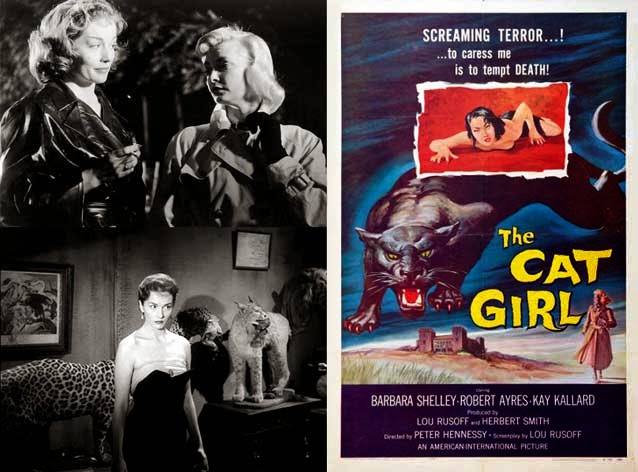
Okay. So Cat Girl is a movie I’d not heard of before it came up in one of Network’s regular DVD sales. I wanted this one because, for all intents and purposes, it looked like a 1950s British remake of Val Lewton and Jacques Tournier’s Cat People (a very tiny “pocket review” of which can be found here). Also, it starred Barbara Shelley, who is an actress I loved, mainly due to her role as the extremely strong female character she played as an assistant to the two male protagonists in Hammer Films' movie adaptation of Quatermass And The Pit (which is a film you can find reviewed here and, if you so desire, you can see my small visual tribute to Barbara Shelley in that role included in my 800th Blog illustration here).

As it turns out, even though it emphasises that the film is an update of Cat People on the back cover notes of the DVD, Cat Girl is really not, in any way, a translation of the aforementioned feline themed adventure. It may well have started off to be so, for all I know, but if it was... well, so much was changed in the writing, which is not credited as being based on anything in the opening titles, that the result really is unrecognisable as anything but the very vaguest of conceptual descendants of the 1940s RKO classic.

The films both have large cats in them... that’s it. They’re not even the same cat as far as I can recall. I’m pretty sure the species in question in Cat People is a black panther where, in Cat Girl, the large cat is a standard leopard.

In Cat People, the character Irene is the victim of a Serbian family curse which threatens to transform her into a hostile panther when she loses her virginity. A large chunk of the opening is taken up with the courtship of Irene, followed by her marriage and the breakdown of that marriage for fear that her character cannot consummate said marriage without turning into a wild, jungle beast. The rest of the film then deals with her psychotherapy and her husband's affair with another woman which, after a film which is totally psychological in tone (as opposed to the actual “make-up monsters” of rival studio Universal, who RKO were competing with in their most budget conscious, creative fashion), sees Irene finally transforming into one of the titular Cat People and, when her life is taken, reverting to the corpse of the woman she once was.

Cat Girl, on the other hand, features none of the sexual hang ups of the main character in Cat People. Barbara Shelley’s character Leonora Johnson is already married at the start of the movie and her virginity a long lost feature of her past. Instead, this film deals with her inheritance, where a family curse is passed onto her and she becomes, for want of a better word, psychologically linked with the family’s pet, killer leopard. The cat comes out at night and, when it does so, some shot cuts and reveals are used to show a distinct change in Shelley’s make up... but in no time does she ever actually transform into a cat herself... although she shares the same final fate as the leopard in this film due to her psychic bond. Naturally everyone thinks she’s totally crazy because... well, you know... she thinks she’s channeling a leopard... and so she is placed in a sanitarium and, in some of the worst and hilarious movie psychiatry I’ve ever seen, released to spend time with the object of her sexual jealousy and hate, the wife of her psychologist, who was himself once her childhood crush.

So... nothing like Cat People. 

Quite the opposite, in fact, when you consider that the sexual subtext of the first film is not present in this one other than as a complete reversal. Indeed, the sexuality in Cat Girl is pretty blatant and strong, especially in a scene where we see Leonora’s shadow undressing against the wall and, certainly, given the “costume” she wears in the final act of the film... a shiny, black leather coat which seems to be her solitary piece of clothing in this section and which seems to be almost deliberately encoded as a sexual fetish. I’m guessing it was a deliberate choice in terms of the designers of the look of the film too... although there’s always a chance the actors and actresses didn’t realise it at the time.

The lighting is beautiful throughout, often creating a halo around the hair of the central characters and showing off the black and white cinematography nicely... which is lucky since there’s very little camera movement in the majority of the shots in the film and most of the movie is assembled as edits from static set ups. So the lighting does help to offset the often lack of dynamic visual motion. Thankfully, the editing is not too uninteresting in places and everything keeps ticking along at a fairly solid rate. Having said that, the film came out just a few months after Hammer’s colourful The Curse Of Frankenstein, so I’m guessing that the success of the former and the expectations it created for horror films in its wake possibly meant this particular gem had a more lukewarm reception in the year of its release, both here in the UK and stateside.

But I say “gem” because it really is.

Cat Girl is a film which is definitely “of its time” but it’s quite charming in its own way and, frankly, Barbara Shelley’s performance in this is brilliant in both its intensity and, perhaps, its bravery at the time. This is definitely another strong female role for this actress and I suspect she probably relished this part when she won it. Whether she did or didn’t, though, she certainly sank her teeth into the part, so to speak, and although a lot of the on screen shenanigans by her and the rest of the cast isn’t exactly subtle, it is passionate and, more importantly, interesting to watch. Shelley certainly has a lot of presence in this role.

The one area where I think this movie does slip up big time, however, is in the musical scoring. I was wondering who was murdering the film with all the heavy handed compositions while I was watching but, as it turns out, it’s not the work of one composer but a range of different composers’ stock music tracked in and used here. All I can say is that, though these pieces may have been useful in their own right and in certain situations, as a score for this movie they are a fair degree less than subtle and it’s such a shame because, with some more appropriate cues, or even some of the same ones knocked down a little bit in the mix, they might well have given the film a little more lift and support in certain scenes. So that’s a pity.

Other than that, though, I would well recommend this movie for audiences who have a taste for old school British horror curios and I’m well pleased that Network have put this little beauty out in a digital format. Not one for all modern horror audiences, for sure, especially as there are no real scares to be had, but certainly something which does its own thing and, perhaps, even pushes the sexual envelope a little for its time, at least in terms of the overt references you could get away with in a commercial release of the period, I suspect. Definitely a movie I plan to be returning to at some point.

Wednesday, 28 May 2014

800th Post - The Ladies Of Hammer


For this, my 800th Blog Post I thought I'd return to territory from what is still my most popular post on here, my 300th Blog - Faces Of Caroline Munro (see here). So, in that spirit, above is my tribute to just a few of those ladies who helped make those wonderful Hammer Horror films of the past so memorable. Click on the image above to "embiggen". ;-)

Tuesday, 15 May 2012

Blood Of The Vampire


A Kind Of Blooding


Blood Of The Vampire UK 1958
Directed by Henry Cass
Showing as part of the 6th May 2012 
Classic Horror Campaign double bill

I have to confess that I’d never heard of Blood Of The Vampire so, when the Classic Horror Campaign decided to show it in one of their double bill screenings, along with the sex and blood fuelled Vampyres, my ears pricked up. Of course, when it comes to the second half of their double feature it wasn’t just my ears that were... um... pricking up... but I’ll review that separately on another blog post in the very near future.

I have to say that, while Blood Of The Vampire is, no doubt, a very interesting curio given it’s timing in British Horror History, it’s also, I’m almost afraid to say, not a film I enjoyed very much.

The title is very misleading in that a person who has been revived after death by a heart transplant and who drains his “experimental subjects” of blood by transfusing it into his own to continue living is the only character that passes for a vampire in this one... so I was a little disappointed that none of the traits or usual trappings of the screen vampire are brought into play here. This is probably due to the heavy influence of Hammer Studios’ breakout horror hit of the previous year, The Curse Of Frankenstein, in that this is not really a story of vampires, neck biting and crosses as you might expect, but more a tale of surgical experiments as live human beings are used as raw material for a mad doctor, the so-called vampire of the title, and his deformed laboratory assistant (a “quasimodo” if ever there was one, with a large unblinking eye prosthetically placed halfway down his right cheek). It’s also written by Jimmy Sangster who did the writing duties on The Curse Of Frankenstein and a plethora of other Hammer movies throughout the years.

The story is well crafted, to be fair, telling the tale of a young doctor falsely accused and sent to an “inescapable” prison which turns out to be a set-up so the mad “Doctor Callistratus” can use his special “blood-related” skills to further his own ends. When the set up is discovered, our hero is reported dead but the young man’s VIP girlfriend goes undercover in the prison to find out the truth. The usual shenanigans occur and the film very much plays like a cross between the Hammer Frankenstein movies, which I confess to not liking all that much anyway, and Roger Corman’s Edgar Allan Poe “adaptations”... which I like a good deal more than this warmed up pot boiler. For me this film just drags a little too much for its own good and I did catch myself trying to nod off on more than one occasion (maybe it was the combination of alcohol and good fun atmosphere that the Classic Horror Campaign events always engender). If the photography or shot design had been a little more remarkable I would possibly have perked up a little but, as it was, I can see why this movie got kinda buried in the wake of the Hammer Dracula of the same year... a film which does deal with vampires in a more head-on manner. Not to say that the direction and cinematography on this one aren’t competent... they’re fine. Nothing particularly breathtaking in this one though and, it has to be said, the miniature shots of locations coupled with painted backdrops for some scenes are a lot less effectively handled than they would have been in the hands of someone like, well, the great Mario Bava, to name but one.

And while I’m busy invoking a comparison to The Great Bava, I’d have to say that the one vampiric scene in the movie, which is a pre-credits sequence, shows a staking through the heart of an unseen vampire (Doctor Callistratus) with a big mallet which is done with all the timing and ritualistic trapping of the pre-credits sequence of Bava’s Black Sunday (aka Mask Of The Demon and reviewed here) and features more blood in this first little snippet than most Hammer films of this period put together. I wonder how this film fared with the censors? I know the US and International cuts are different from each other, each containing different scenes and cuts the other don’t have... but I don’t think this opening was under discussion or “on the table” with the censors for some strange reason. Would be interesting to find out a little more perhaps.

And that’s about all I’ve got to say about Blood Of The Vampire. I would suggest If you’re doing a study of British Horror or want to watch all the relevant stuff churned out in this period then this movie is essential viewing because of it’s obvious influences from other horror films of that period but, if you’re not that fussed, then I suspect this movie has nothing much to offer you.

Luckily, my afternoon was saved as I started to watch the second half of the Classic Horror Campaign double bill, Vampyres... which I will review in a blog post coming soon...