Showing posts with label British Horror. Show all posts

Sunday, 15 February 2026

Night Of The Big Heat


All You Can Heat Buffet

Night Of The Big Heat
aka Night Of The Burning Damned (US)
aka Night Of The Burning Doomed (US TV)
Directed by Terence Fisher
UK 1967 
Planet Films Distribution/88 Films
Blu Ray Zone B


 Warning: Minor spoilers.

Okay then. I’d not seen Night Of The Big Heat before 88 Films issued this new Blu Ray transfer, although I’ve got it in the back of my mind that it probably played on British TV a fair amount during the 1970s and 80s. This one is set on a small island called Fara where, in the middle of winter... and at odds with the rest of the country... the inhabitants are suffering a huge heat wave. Patrick Allen plays novelist Jeff Callum, who is on the island writing his new book and who runs the local pub alongside his wife, Frankie (played by Allen’s real life wife Sarah Lawson). Then Jane Merrow turns up as his new secretary, Angela, who had a fling with him in her past and wants to reconnect... plus take no prisoners as far as his wife is concerned. 

This all goes on against a backdrop of strange goings on at the island, with the big tropical heat just a symptom of something else that’s happening. There are instances of strange, high pitched whirrings in the air sometimes and this is usually a prelude to somebody being confronted by something off screen and then being burned to death, as is the case when a character played by Kenneth Cope runs away after attempting to rape Angela... only to be confronted with ‘something unusual’. 

Trying to get to the bottom of it all is Godfrey Hanson and his amazing scientific instruments, played deliberately unemotionally by the great Christopher Lee. And, billed as a guest star  (he is only in a few scenes dotted about the movie at various points) is the equally great Peter Cushing, as the local Dr. Vernon Stone. Shenanigans ensue when Jeff and Godfrey form an uneasy alliance after the latter shares his theory that the heat is a by-product of beings from another planet coming to the island as the vanguard of an invading species, who need the heat in order to survive. 

And, it’s a film on which I’m now very torn. On the one hand, it has all the makings of a good ‘comfort horror film’ and I suspect it’s one I shall come back to every now and again. On the other hand, there are a lot of problems with it, tempered by the heat being a good excuse for Jane Merrow to run an ice cube over her half exposed torso and neck. I mean, some of the dialogue and story ideas are awful, which is strange considering it’s supposed to be an adaptation of a novel by John Lymington. Apparently it was rewritten from scratch a day or two before filming. It kinda shows.

And the film also suffers from some very low budget and not terribly effective monsters. Most of the time the monsters are unseen and thus create a certain amount of suspense and jeopardy until the big reveal. Unfortunately, the big reveal is just light pulsing rocks looking like they’ve been constructed from canvass. So, yeah, not good. 

The other problem is... the body count in the film wouldn’t be nearly as bad if some of the characters just acted on common sense rather than whatever the heck they do here. For example, people are practically going off to their deaths in ways that can be easily foreseen and, I suspect, easily escaped from...

In one scene,  for instance, Godfrey uses his walkie talkie to contact everyone in the inn to tell them to turn off the lights as it’s what is drawing the creatures to people. And so a token is made of showing some of the characters doing just that but... do they heck!?! When we return to the scene of the people in the inn, they have clearly left a few lights on... obviously to light the shot, I get it but, yeah, it makes no sense by this point in the film and it’s almost like the various main protagonists are trying to get themselves killed by doing the lamest things ever. So, yeah, I have no sympathy for their actions throughout the film, for sure. 

But, the pace is nicely fitting for the film and it has a kind of interesting score by Malcolm Lockyer. Now, I don’t know Lockyer at all apart from his music for the first Doctor Who movie (reviewed here) but, I have to say, I recognised the style immediately as sharing the same DNA of that score and was waiting for his name to come up in the opening credits. Which is another thing that pushes it into comfort movie territory for me, for sure. 

The denouement of Night Of The Big Heat is abrupt and totally unsatisfying, it has to be said. If you thought the ending of the movie version of The Day Of The Triffids was bad then, yeah, you ain’t seen nothing yet. So, all in all I would have to say that, in many ways the film is really terrible but, I found myself thoroughly entertained by it so, I was very happy to have 88 Films’ wonderful transfer hitting shops. It’s not one I’d recommend to everybody but fans of studios like Hammer and Amicus should maybe try and catch this one, for sure. 

Tuesday, 10 September 2024

Starve Acre


Bunroaming

Starve Acre
UK 2023 (2024 releaase)
Directed by Daniel Kokotajlo
BFI/BBC Film


Warning: Tried to talk around the spoilers but they may have crept in regardless.

Starve Acre is a new folk horror movie from director Daniel Kokotajlo. Now, I’m not as enamoured of the folk horror sub-genre as I perhaps should be, mainly because it’s often quite clumsily rendered. I think what a good folk horror film should do is bring in a slow, haunting strangeness for the first half of the movie, steeped in locale specific folklore, before stepping up the pacing and leaning into the fantasy element, which would then start building for the last half of the movie. And so I’m very pleased to say this is exactly what Kokotajlo does with this tale and it works really well, conjuring up a nicely unsettling film with a couple of worrisome beats near the start which set up the strangeness of the rest of the story as it unfolds.

Now, I have to be honest here... I didn’t realise this was set in the 1970s (I had to look it up, too) until I finally twigged nobody was using a mobile phone in the picture so it might be set in the past. I think I’m kinda period blind to anything taking place after about 1930 because fashion styles all look pretty much what I’d be wearing after that date, to be honest. It’s also set in Yorkshire which, I also had to look up to find out what accent the main lead and many other characters are speaking in. I’m also assuming Starve Acre is the place where they all live because, no real mention is made of the title in the dialogue anywhere, that I heard.

Anyway, the film concerns Richard (played by the great Matt Smith with said Yorkshire accent) and his wife Juliette (played by the brilliant Morfydd Clark from Saint Maud, reviewed by me here) who have, two years prior to events portrayed here, moved back into the area where Richard’s father raised him (in somewhat unusual and traumatising ways, it transpires). They have a young son and, you can tell right from the opening that he’s not quite right because, at a local gathering/activity, he pokes out a donkey’s eye. This obviously worries the parents who want to put him into psychological evaluation but, it’s not long after this that something else significant happens and a few seconds of just a black frame denotes a timescale shift of... some months after this specific incident.

Juliette’s sister Harrie, played by Erin Richards, comes to stay with them for a bit as Juliette is suffering from depression... as is Richard, who buries himself in his archeological work revolving around the people who used to live in the area years ago and their use/worship of a once powerful oak tree which had some significance to them, the roots of which Richard thinks he may have found in he earth near to where they live (he has been given a year’s leave from the local university at which he teaches, due to an earlier incident). When a non-human skeleton of... some description (spoilers, I suspect) which he has dug up begins to regenerate organs, things start to take a turn for the strange and uncanny, leaning into the folk horror more as Richard and Juliette come under the spell of whatever is going on and Harrie is discovering that not all the locals who live in the neighbourhood are necessarily what they seem (another important ingredient of folk horror, I reckon).

And it’s an absolutely fine film. It’s suitably creepy and there are some nice shots of the landscape, which is often filmed in ways you wouldn’t expect, with close ups of details (on the interior shots as well, such as concentrating on the hand of an actress first, before giving any kind of establishing shot). The camerawork does feel like it’s very voyeuristic a lot of the time. Like a lurking, perhaps menacing presence is watching all that transpires in a fly on the wall kind of way.  

The actors are all terrific, of course. Matt Smith seems to be playing it very differently from many of his signature roles and somehow manages to nullify any baggage from other movies or TV performances he might have been carrying... you totally believe in this man drowning in his own despair. Ditto for the brilliant Morfydd Clark, who goes from giving up on the world to the confident, feminine Earth power she needs to be for the sinister enchantment of the film to be able to work effectively. And as for Erin Richards, well, she doesn’t have quite as much chance to shine in the spotlight as the other two but she certainly does a great job... in particular and without giving anything away, the last ten seconds or so you see of her character is absolutely unsettling and a brilliant physical performance. I can’t say anymore for fear of spoiling the ending of the movie.

And all this, coupled with Matthew Herbert’s folksy terror scoring means that Starve Acre is a wonderful viewing experience and absolutely something that the great Severin Films in the US should be considering including when they get around to putting together the inevitable All The Haunts Be Ours Volume 3 box set in a couple of years time (I suspect). This one is up there with the best of these kinds of movies and it’s always great to see something made by film-makers who absolutely understand the power of the sub genre and know how to deliver. Also... and excuse me for being cryptic but spoilers need to be jumped on here... it doesn’t quite go the full Monty Python And The Holy Grail, but it comes pretty close. I absolutely loved this one.

Thursday, 19 November 2020

Torture Garden


Fair Warning

Torture Garden
UK 1967 Directed by Freddie Francis
Amicus/Columbia Indicator  Blu Ray Zone B


Warning: Some story set up spoilers.

Torture Garden is not, as I’d once assumed as a teen, an adaptation of Octave Mirbeau’s late nineteenth century novel (from which I can only assume the famous fetish night club takes its name) but is, in fact, the first kind of ‘follow up’ portmanteau horror film from Amicus, riding on the success of their tremendous Dr. Terror’s House Of Horrors (which I reviewed here). Now, I have to say, I was very taken with that first one when I watched it fairly recently. Alas, the same can’t be said of Torture Garden which, asides from having the same director and one of the original stars, I’d have to say is a very mixed bag indeed.

The film’s opening credits are all superimposed over footage of various fast moving fairground rides and, once these finish, we are introduced to one of the fixtures of the fair, the horror museum of Dr. Diabolo. Yeah, if you’re right in thinking they replaced the train in Dr. Terror with the fairground attraction of Dr. Diabolo, you’d be right. It’s another device to open up the narrative into four separate, short(ish) horror (again ish) stories. We are presented with Dr. Diabolo showing off his exhibits and then, after the ‘official’ show, he invites members of the audience into his private rooms to see, if they so dare, the real horror they carry inside of them... for the price of a fiver each, which was a lot of money in those days (to some of us it still is). Five ‘victims’ agree and he leads them to a wax figure of Atropos, Goddess of Destiny (played by Clytie Jessop), whose countenance turns up in the odd place throughout the movie. Of course, she’s not really a waxworks figure in real life and, in the long shots, she is having a hard time keeping still. I suspect, in some of the close ups of her, a static image is inserted. Anyway, the five victims (well four of them anyway, I’ll get to that soon), have to gaze between her shears and see their ultimate fates, in the form of a short story.

Now, like Dr. Terror, there are some famous people turning up in this one but they’re not all in the bookend scenes. Dr. Diabolo himself is played by Burgess Meredith and this would have been around the time he was playing The Penguin in the Batman TV series. Which is interesting because he has a couple of costumes in this and the first one includes a top hat and cigarette holder just like the ones he used as Penguin. Also, you know he’s not quite what he seems because, when the five ‘customers’ aren’t looking, he burns the five pound notes they gave him. Of course, Meredith is one of those very interesting actors who are easy to watch, so it’s a shame he doesn’t actually appear in any of the four segments... just the binding story between them and bookending them. I’ll go through a few more of the actors as I get up to them but let me give you just a brief flavour of them as I go through the film.

Unlike Dr. Terror’s House Of Horrors, the four segments here are all adapted by the same writer who actually wrote all of the short stories on which they are based... Robert Bloch, who’s name may be familiar to some of my readers as being the man who wrote Psycho. Although not titled on the screen, the four shorts are called, in order as they appear in the binding narrative... Enoch, Terror Over Hollywood, Mr. Steinway and The Man Who Collected Poe.

The first sequence, Enoch, shows a young man (played by Michael Bryant) who goes to visit his sick uncle (played by Maurice Denham) in the hopes of getting money out of him. He causes a heart attack which kills the uncle and then searches the house for the old gold coins which the uncle seems to be paying for everything with. It turns up, alright when he unearths a coffin in a dungeon beneath a trap door. There’s a cat trapped inside the coffin with the skeleton and the furry fiend houses the spirit of an old witch, which takes over the young man’s mind and makes him kill so she can feed off the victim's energy. Now, this may sound quite interesting but, honestly, this overly long segment (and the next one) is incredibly dull and not worth watching for anything other than for seeing director Freddie Francis’ various shot set ups. Indeed, there’s a remarkable shot taken from just next to the underside of the bed with the action going on in the far end of the shot, which alerts us to the presence of a trap door long before the central protagonist sees it. Also, when the cat is filmed in close up, it’s done so with the kind of bright red and green lighting scheme which instantly reminded me of the way Mario Bava used to light his movies.

Segment number two, Terror Over Hollywood, tells of a ruthless young lady played by Beverly Adams, who blags her way into being an actress in a substantial role in an American movie but, to her cost, finds out the terrible secret as to why the top ten movie stars of Hollywood look so young for so long. Out of the four segments here, I’d have to say that this one is more of a science fiction story with a possibly slight horror tinge but, even though it deals with an interesting subject matter, it didn’t exactly grab me and we were maybe an hour into the movie by this point (not leaving too much time for what I thought would be another three segments but... there’s a great little trick when you get up to the fifth person... I’ll get to that in a minute). And it was an extremely dull and hard to watch movie up until now, I thought. Not a patch on the previous Amicus portmanteau movie.

Things turn around for the last two, briefer segments, though. The first of which, Mr. Steinway, tells of a female reporter who falls in love with a successful pianist, only to find the Goddess who lives inside the piano, gifted to him by his long deceased mother, harbours a grudge and is jealous of her. So, yeah, it’s a short but sweet segment and, wonderfully, includes a killer grand piano. It’s nicely done and the combination of Francis’ shot compositions when coupled to a less dull story seems to work wonders.

The fourth segment, The Man Who Collected Poe, concerns the man who has remained wordless in the linking scenes until now, letting his presence add mystery to the proceedings until he explodes into speech for this final segment. This man is played by the wonderful Jack Palance and it’s essentially a two hander between him and the even more wonderful Peter Cushing. Oh yeah, by this point you know you’re in really good hands with a story about two collectors of paraphernalia associated with the writer Edgar Allan Poe. Palance is the jealous guy in awe of Peter Cushing’s collection and, when he gets him drunk, he gets Cushing to show him his 'even more private' collection in the basement. Here he finds brand new stories written by Poe and a surprise in store as it’s revealed that Cushing, once he has been ‘done away with’ so to speak, is from a family which has used powers of black magic, ensuring he is the owner of what I will only say here is... the ultimate Edgar Allan Poe collectible. This is a terrific piece and Palance’s nervy, 'threatening to explode in his fanaticism' performance is a joy to watch... as is Cushing’s. Anyone who thinks of Cushing as someone who is just a solid character actor should watch his performance as a slightly drunk collector in the last part of this sequence. It’s an amazing turn and really calls to attention to just what a great performer he could be, when the script gave him the chance.

And then we have the bookend scene, where the fifth victim, the great Michael Ripper (who you will probably know from damn near every other Hammer film which was made), completely flips out and... no I won’t spoil that for you other than to say... when you think you know how it’s ended, stick around for a few more minutes... not everything is as it appears and I was immensely pleased with this because, for once, I didn’t see the coming twist reveal until it was almost upon me.

The score for the film is a double hander between two composers who I only really know from Hammer film productions, Don Banks and James Bernard. I suppose they both got one or more segments to score and, I have to say, that whoever scored the first sequence, wrote a great score which I would gladly listen to as a stand alone experience (if it were possible and actually got a release) but in terms of being a back up to the ‘on screen’ images... well it just comes across as a little heavy handed, is all.

And, that’s more or less that. I couldn’t get into Torture Garden nearly as much as I could with Dr. Terror’s House Of Horrors but, having said that, there were things which made it worth sticking around for. Asides from the quirky and sometimes brilliant third and fourth sections, there’s also the odd interesting idea here and there. Such as a night club scene which had a giant sized snow globe with a Christmas scene inside, with real people in it. So I’m glad I saw it but I’m very glad this wasn’t the first of these films I watched. Definitely worth persevering with if you are into 1960s British horror movies though and, once again, Indicator have done a truly marvellous job with this Blu Ray restoration. As is usual for them, it has a fistful of accompanying extras included. Not one to miss if you’re a fan of these kinds of productions.

Thursday, 26 September 2019

The Numbers


When Your Number’s Up

The Numbers
Written and directed by Andrew Elias
Ciao Handy Films. Available on Amazon Prime


The Numbers is a fairly recent ‘novella’ of a horror movie (moviella?), written and directed by Andrew Elias and it’s one of those movies which showcase exactly what the British do best... make relatively fun and entertaining films on what was probably a more than modest budget.

It’s rare I watch films like this (or am given the opportunity, to be honest) but I’m glad I managed to see this one because I’ve been following Andrew and his company on Twitter for a while now and it’s always good to see what some of the people you follow have been up to. This film seems to be trying and, for the most part succeeding, in catching the lightning in a bottle that was last done in this country successfully in the late 1960s and early 1970s. That is to say, we have almost a pseudo-portmanteau horror film but with a thread that runs through each chapter and fashions it together as one arc. You know, the kind of movie that Amicus and Tigon studios were so good at pulling off back in the day.

The Numbers
starts with some nicely striking opening titles which have a beautiful piece of demonic music courtesy of composer Reg Length playing through as the camera hones in on some white cliffs at a, possibly, ‘day for night’ version of  twilight and then, through the miracle of distracting the viewer with superimposed clouds, to a mansion house and then on through a window to a man played by Andrew Elias himself. This first and very short sequence is labelled up as 1912, which is when the action takes place and it bookends the movie. This segment is also dialogue free (up until the last shot when we revisit it at the end of the movie) and it shows a man waiting for something uncertain and reading a book called, An Evil Motherhood. Which might possibly explain what he’s waiting for.

Every now and again we are made aware of the presence of his servant within the house but the way the sound is designed and the faceless path of the servant sometimes being used almost as a jump scare in terms of rushing by very fast in the foreground of the camera or staying close to an edge of the frame, is already using the language of the horror movie within its DNA. The first part of the segment ends when the main character finds a calling card on his noticeboard for a fortune teller called Madame Mimi.

The shot style of the movie is fairly clean and, quite often, favouring centre oriented set ups. There’s no clutter to the set dressing (something which sometimes works in favour of a scene and, sometimes not) and the whole thing gives off a very measured and self assured kind of pacing. There are also a lot of browns and blacks used in this opening sequence and a nice colour palette is established here but, of course, that palette is changed and pitched differently depending on which section of the movie you are watching.

The next chapter starts, as do they all, with a time check in terms of the year and a seemingly random number which will have some significance later on in the chapter... the second sequence is called 1955 - Twelve. This section concerns a young woman who is, as she tells her friend who works in a restaurant, going to see a fortune teller and we can see that her card is exactly the same one we just saw in the film’s 1912 opening, implying that the fortune teller in question is either ageless and therefore extending her life through supernatural means or, possibly, she’s travelling in time... but I place less stock in that second theory since the film is tonally slanted with a good old fashioned horror vibe.

The meeting with the fortune teller does not go as planned and the customer ends up being told she is going to die when the hands of the clock point north. So the majority of this section, which is again mostly dialogue free, gloriously so, is the woman waiting in a room and killing time until the perceived hour of her death. One of the things she does while she’s waiting is read a book called The Devil In Woodford Wells by Howard Hobson, which is important to the next mini story in the film (and which is, in fact, a real book). She leaves the fortune teller’s card in this before the end of the episode, which takes place in a wonderfully red corridor and lift area, almost, it seemed to me, trying to capture tonally the spirit of Stanley Kubrick from his film The Shining.

The woman, is played by Lilly Driscoll, doing a wonderful job throughout her short, especially when it comes to the solo scenes. The fortune teller, Madame Mimi, is played by someone called Peyvand Sadeghian and she’s one of those actresses who seems to be able to bring a certain, playful yet forceful presence to a role. She’s well cast as the fortune teller, who appears in all the segments of the story without, as you would expect from the set up, ageing at all.

So the second chapter is called 1983 - Six and it concerns a composer played by Nicky Stephens. He can’t get the last part of a composition he’s working on and swears a lot throughout the segment, although he’s probably the most likeable character in the film. When he goes to a second hand/Antiquarian bookshop to help clear his block, he stumbles across the same copy of The Devil In Woodford Wells from the previous segment and, of course, finds the card and goes to the fortune teller, Madame Mimi. This is probably my favourite segment of the movie, to be honest and I love the little Faustian deal references symbolised by the purchase of the book in question (with a crisp, one pound note... aaah, I remember those). There’s also a terrific denouement in this section which, I really should have seen coming but... just didn’t. So that was cool.

That being said, there is, I think, at least one anachronism in the book shop scene, where a poster for the reissue/film re-release tie in album for The Beatles Yellow Submarine is the poster from a decade or two after the time setting on this segment. However, I do like this sequence in the bookshop and absolutely loved the use of colour in this scene. Where the orange covers of the old paperback Penguin Classics are echoed in the shirt of the bookseller and in the tie of one of the other customers.

I also loved a scene where the composer is playing the piano and all of a sudden the diegetic source music of said piano transforms, after the introductory bars, into a version with all the synthesised instruments in place, as if we can hear what the composer is hearing in his head as he finds his tune. Lovely stuff and, hold that thought because the director does the same thing only in reverse at the start of the next segment, again presumably using composer Reg Length’s remarkably fun score.

Okay, so the third sequence is called 2018 - Zero and it involves a jogger, played by Howie Cobby, who we are introduced to as he runs along some sandy cliffs. Here, the music on Length’s score matches the pace and time setting of the segment with some up tempo, almost techno music. However, in a reversal of the technique used in the earlier scene, we have the non-diegetic soundtrack turning into diegetic source music as we come to realise the music is also what’s being pumped through Cobby’s earphones as he’s running.

And, of course, when he trips and falls on the sand, as his character seems prone to do for some reason, he stumbles upon an almost empty wallet half buried there with, you guessed it, Madame Mimi’s card inside. And this is where the film gets even more interesting... when he takes the card to the pub and has a chat with the landlady there to seek her advice, played really nicely by a lady named Jo Burke. The pub landlady starts telling Cobby about her former experience with an on-stage fortune teller and, as she does so, she is transported into an empty scenario of the theatre where this event happened, along with the ambient sounds of the memory she is recalling. It reminded me a little of Fellini, actually, in terms of where films like the glorious Nights Of Cabiria (reviewed here) would have a brief diversion from the tone of the rest of the movie. Specifically the scene where Cabiria goes up on stage during the hypnotist act and the film kind of stops dead and takes a little tour into another kind of magic before continuing on its course. I loved the whole feel of the scene as Andrew Elias presents it in The Numbers and it’s just one of many quirky little moments that give the film a real lift.  And stuff like this, coupled with a truly beautiful, overhead shot of Cobby running along the top of the cliff, is another thing which marks this director out as a having a visually unique way of putting a sequence together. Not to mention being one of the reasons why films like The Numbers deserve to get a proper cinematic release, instead of wallowing in the world of the electronic download... but I’m not going to get into that here.

After this sequence plays out, we end with a brief epilogue taking us back to that opening sequence, this time with its full title revealed as being... 1912 - Two. Once again, I’m not going to tell you where this sequence ends up but I will say that the last shot of the film, which I mentioned briefly earlier, does leave, perhaps, more questions than answers and it’s nice to know that Elias is one of those story tellers who prefers not to spoonfeed his audience and allows them to either work things out themselves or bring their own baggage and interpretations into the mix. At least, that’s the way it seems to me.

But don’t take my word for it, check it out for yourself. The Numbers can be purchased or rented at Amazon on this link here and the Ciao Handy Films trailer for The Numbers can be found on YouTube here.

Thursday, 24 January 2019

Quatermass And The Pit (TV Serial Version)


Hob’s Your Uncle

Quatermass And The Pit
UK 1958/59
Directed by Rudolph Cartier
BBC Blu Ray Zone B


Warning: Spoilers here if you really don’t know the story by now.

Note: If you’re looking for my review of the Hammer Films remake of Quatermass And The Pit, it’s right here... http://nuts4r2.blogspot.com/2012/02/quatermass-and-pit.html

Well, what can you say about Quatermass And The Pit that hasn’t been said already? Not much I suspect but I can at least give you my impression of my recent rewatch of the original TV serial, as it’s just been ‘restored’ on Blu Ray by the BBC. Although, to be honest, since it was recorded off a screen televising the live performance, there’s not an awful lot that could have been done to clean up the visual quality, I suspect. It’s nice to revisit it here though.

Quatermass And The Pit is the third of four Quatermass TV serials written by Nigel Kneale and the last of the three performed as a live broadcast by the BBC (the fourth TV serial didn’t surface until 20 years later on rival TV station ITV). Now I never saw the serials as a kid but always loved the Hammer remake movies, especially the first and third ones. I didn’t catch up to the original serials until the VHS and DVD days. Only the first two live broadcast episodes of the original version of The Quatermass Experiment still exist but both Quatermass II and Quatermass And The Pit have survived and this Blu Ray is a welcome addition to any science fiction film and TV watcher’s home... although I would have preferred the BBC would have ‘cut to the chase’ and Blu Rayed up their former Quatermaas Collection DVD box set, rather than release this as a stand alone and then, presumably, expecting us to double dip on it a few years down the line.

This is going to be a fairly short review because I’ve probably covered most of the story beats in my previous review of the movie remake (right here) but I will say that I can never really make up my mind if I prefer the original serialised version of Quatermass And The Pit or the Hammer adaptation of it. I think it’s a case of... I like whichever one I’m watching at the time but of all the Quatermass serials which made the transition into the movies, this one has the least changes to the story, I think. The first two Quatermass serials had great chunks of story shorn from them in their movie transitions but for this one, the condensation from the three hours of the serial to the one hour and thirty seven minute movie is quite an achievement and you don’t really miss any important story beats in the latter.

So I think the most useful thing do here is highlight the differences between the two and then, if you want more extended input as to the flavour of the story, visit my review of the Hammer adaptation of this.

Professor Quatermass is played by Andre Morel in this ‘incarnation’ of the main character. He plays him in the most authorative way I’ve seen and, for my money, is probably the best of the many actors to play the role over the years. He was no stranger to Hammer films, of course, and was later asked to come back and reprise the role for their movie version but I believe he didn’t really feel like repeating himself. The movie Quatermass for this one was played by Andrew Keir, who was writer Nigel Kneale’s personal favourite of the Quatermass actors if my memory circuits are firing on all cylinders (Keir was the only actor to ever play Quatermass twice, in the film version of this plus in Kneale’s radio show The Quatermass Memoirs). Brilliant as Kier is in the role, he still seems a little too passive for my liking whereas Morel immediately commands a sort of gravitas in the role and makes it his own.

He is ably supported by some truly great thespians with Dr. Rowney played in this version by Cec Linder (who James Bond fans may remember from his turn as Felix Leiter in Goldfinger), Anthony Bushell playing a somehow even more terrifyingly stupid version of Colonel Breen than the great Julian Glover managed in the movie version and Christine Finn, the voice of Tin Tin in Thunderbirds, as Barbara Judd. Although he was a Hammer regular, we also have Michael Ripper playing the Sergeant in this (he had appeared as a different character in the movie version of Quatermass II). You’ve also got John Stratton as Captain Potter and Richard Shaw as the all important drill operator Sladden. Now, I love the movie version of this and think the actors in it are exemplary but, I have to say, the cast in this original version are even more brilliant and you couldn’t want for a better bunch. I think the only actor who was actually in both the serial and the film was Noel Howlett, who plays the vicar in this and the Abbey librarian in the movie.

Like I said, the action and story are all pretty much the same between the two versions, with the serial obviously taking more time to grip onto the audience (the events in the movie version do seem unnaturally accelerated if you watch this one in close proximity before it, to be sure). However, they both have things which they do better than each other. The special effects on the serial for the great martian purge, plucked from the mind of Barbara Judd as she wears a headpiece which turns her hallucination race memories into something which can be recorded on a primitive video tape (or film, by the looks of it), are much more interesting and credible than the movie version. That’s because a) you can see various martian insects being singled out and killed and b) because the Hammer version of this scene contains truly atrocious special effects work, to be sure.

That being said the Hammer version of the story is much more visual in other ways. For instance, instead of Rowney sacrificing himself by earthing the, mostly unseen on camera, martian manifestation which has emerged from the disintegrated hull of the five million year old space capsule... by running into it and throwing the iron conductor to earth it before being obliterated... the movie version has him riding the top of a crane into it, which is much more interesting to look at. Similarly, the manifestation of the martian with all the colour bleached out of it and almost over-illuminated in the movie suggests exactly why primitive man saw it as Hob, or the Devil in that it’s much more of a horned demon looking thing (and one of the few horror films to give this 6 or 7 year old a complete lack of a good night’s sleep the first time I saw it). So in that way the movie version definitely wins out over this one.

Another big difference is that the movie version has diggers adding an extension to a tube tunnel at Hobb’s Lane first coming across the archeological finds and, eventually the space capsule, as part of the tube works. In this original version it’s already an archeological dig from a find on a building site at Hobb’s Lane... so it really is a big pit that this thing is mostly set around here... I guess Quatermass And The Tube Extension didn’t have the desired ring to it for the movie version.

Another major difference is the ending. The Hammer one stops on a characteristically bleak shot (typical for that period of Hammer film) of Quatermass and Barbara trying to get their heads together after Rowney’s sacrifice. Here, the sequence is followed by a, somewhat clunky, little press conference held by Quatermass to warn humanity that there are probably many more of these capsules spread around the Earth and we should be on the look out for them. It’s kind of the Quatermass version of the “Watch The Skies” monologue at the end of The Thing From Another World and, it gives things a less than exciting or haunting conclusion than the Hammer movie, it has to be said.

However, although it probably looks fairly dated to the youth of today, the TV serial has a lot to offer and the leisurely pacing in which it unfolds all the various incidents and drip feeds it to the audience is very well done. Yes, there are the occasional small mistakes which were part and parcel of live broadcast television, such as a camera operator moving to the other side of the room before his cue, panning back to the original speaker as he’s finishing his line and then having to quickly pan back to where he was going on the first place. This is all part of the fun though and I wouldn’t want it any other way. Some of this third serial, especially the outside locations, was pre-filmed to be slotted in between scenes, such was the ambition of Kneale’s script. Also, the music is quite effective and some of those electronic effects and scoring sections in the original serial mark this out as being the first sci-fi TV show to use electronic music (apparently, I need to check that out and see if that claim is correct). Whatever the case, it’s certainly damned atmospheric and is well used by the serial.

And that’s that for this one. This, like most of the Quatermass serials, was a ground breaking and important event show of its day (you wouldn’t get shows like Doctor Who without the presence of Quatermass changing what was acceptable on television) and the central premise that our world was invaded by martians millions of years ago and the majority of our species is actually descended from genetic experiments created by the martians was pretty much a first at the time. The martians are already here and they’re us... was quite a bit of a scary proposition. Like both the central character and writer Nigel Kneale, Quatermass And The Pit was hugely influential and the legacy has never stopped being plundered... I can’t quite work out why it’s not been remade again for modern audiences. If you’re a fan of science fiction and you’ve never seen the Quatermass serials then... you really should add these to your list. Quatermass And The Pit, no matter which version you watch it in, is sheer genius and an important part of British science fiction. I’m glad the BBC have finally put this out on Blu Ray and, hopefully, the surviving episodes of the first serial and the full second serial won’t be too far behind this one, fingers crossed. Truly stunning.

Sunday, 8 April 2018

Ghost Stories


The Fear Hunter

Ghost Stories
2017 UK Directed by Jeremy Dyson & Andy Nyman 
UK cinema release print.


Warning: Some slight spoilerage.

Well... I really wanted to like this one but, unfortunately, it was not to be.

I’d wanted to see this in one of its earlier incarnations as a stage play in the West End of London a few years back but, alas, the truly scary ticket prices had put me off seeing it. Something which I’m now thinking may have been a blessing in disguise, to be honest.

I can’t quite put my finger on why I was so disappointed by this one because, frankly, the movie is very well put together. I doubt it’s because I saw another brand new and quite intensely scary movie earlier in the week (the frighteningly brilliant A Quiet Place, which I reviewed here) because one scare fest does not necessarily cancel out the other. I suppose it could be, as mentioned by me in another review recently, that I have become somewhat jaded by the format of ghost stories of late.... although, having said that, I can think of several horror movies with ghostly themes which have been fairly successful in their intent over the past five or ten years (although none of them can hold a candle to Robert Wise’s original version of The Haunting, of course).

Let’s see if I can figure out what this one didn’t deliver as I start writing about it. 

Ghost Stories stars Andy Nyman as a mildly famous, professional debunker called Professor Philip Goodman. The film is also co-directed and co-written by Nyman and Jeremy Dyson and it takes the form of one of those old portmanteau style horror movies of years gone by... the kinds of things pushed out by Amicus and AIP back in the day (and even Ealing, in one notable case). I can only assume it’s an homage to these kinds of films and, thinking about it, I suspect this is where my main gripe with the movie lays. I’ll come back to that.

Nyman’s Professor Goodman is contacted by his childhood hero, another professional debunker, who disappeared in mysterious circumstances decades before. He challenges Goodman with investigating three cases which he, himself, couldn’t disprove and the film takes the format of Goodman going to each of the troubled individuals who have had ‘supernatural experiences’ in turn... played by Paul Whitehouse, Alex Lawther and Martin Freeman.

Contrary to the blurb on the trailer, that the various cases are each more terrifying than the last, I personally found it to be the exact opposite of this, with the scariest one being the first segment. In this, the director’s skillfully shoot a more or less static interview between Nyman and Whitehouse for the first half of the segment, cutting between various angles and distances and it is in this sequence especially that I found them to be absolute masters of their craft. I was especially enamoured of the way they designed the composition of their frames to keep the audience fixated on specific things and not jump them out of it... something which is almost a necessity since the widescreen format started being commonly used in the 1950s and it’s a skill which, it seems to me, a lot of directors and cinematographers seem to forget these days.

For instance, they’ll have Whitehouse’s head large on the right hand side of the screen and, when they cut back to Nyman, his head is also filling the same area of the screen so there’s no jolt or excessive eye movement on the part of the audience. This was pretty good and especially effective in this first sequence (which is pretty much the only one which employs static shots in abundance in the interview part of the mini chapter) because when we go into Whitehouse’s flashback of the events that took place... the camera movement is a contrast and drags you into a scarier journey where, like in all the other segments, the camera can be wandering around and allowing the audience to anticipate and keep vigil on various corners and reflective surfaces on the screen... to build tension as to where the next threat is coming from.

After the denouement of this first scene, however, with an all important finger hooking into the protagonist’s mouth which was made notable enough to kind of give away an echo of a specific piece of ‘master imagery’ at the end, we immediately go into Nyman interviewing someone else without going back to Whitehouse’s character. This immediately got my back up and my ‘Spidey sense’ tingling because there’s no way of telling whether, as implied, Whitehouse survived his encounter and it immediately made me think that the main threat and punchline of this film would revolve around the character of Goodman himself, far more than the set up of the sequences as is first implied.

Sure enough, the second segment, which is a bit of a romp and involves a truly excellent performance by Alex Lawther, takes us a little closer to the uncertainties of Goodman in the set up for the interview. Actually, Lather looks very much like a demented ventriloquist’s dummy in some ways and I was totally expecting him to actually turn out to be one by the end of the segment but that was not the case. One wonders, though, if the look of the character was a nod to the 1945 movie Dead Of Night, in terms of referencing the lineage of this type of horror format.

This whole sequence involves a car in the forest coming a cropper with a creature that is probably the devil (or a vertically walking goat person, you decide) and, my one take away from this was I quite liked Haim Frank Ilfman’s score in this section, although I suspect the particular Cineworld screen I was looking at this in had one of the speaker channels down and so none of the music seemed particularly well mixed, even in the horrible and much hated product adverts before movie played.

Again, this second story sequence left things hanging in terms of the interview by the end of the story and you were never really sure whether the main protagonist really got out alive or not... at least that’s how it felt to me.

By the end of the third segment, which starts off promisingly enough, things start to get significantly mixed into the personal history of Goodman himself and it’s only a short hop away from being the kind of ending you would expect from this type of multistory linking device but, alas, not really any different from such tales we’ve seen or read in the past. Which I think is my main problem with it. It’s not that the specific ending is obvious... it’s not really. It’s just the style of ending which seems quite weak, to me and, coupled with my feeling that the individual segments all came to a stop just when they were starting to actually get scary... well, it really left me spectacularly unimpressed and shoulder shrugging by the end of the movie.

Which is a shame because, apart from the actual structure of the writing, everything else is good. Even the written dialogue is well put together. The performances are all sound and the direction and cinematography all pretty amazing. So I really am surprised that I was so underwhelmed by this production and I’m now wondering if it’s just because I’m ‘an oldie who’s seen it all before’. I don’t think I could really recommend this one to my friends and I don’t think I’d ever want to watch it again (although I do want to pick up a CD of the score, if it’s released) but I suspect teenage viewers who may be less familiar with the dark and delightful legacy of horror cinema this is so obviously trying to tap into may get a lot more out of Ghost Stories than people like me. I’m not saying more movies like this shouldn’t be made... I just wish they were a little less obvious than this as to the nature of their end game and, maybe, just a little scarier on the journey to their final destination. This one’s not quite my brand of tea, I’m sad to say.

Sunday, 11 February 2018

Requiem


The Cello-ship Of The Thing

Requiem
Airdate: 2nd February -  9th March 2018
BBC 1 Six Episodes


I don’t often watch TV shows if I can help it...

There are a few special ones, sure... but, on the whole, they tend to divert too much time away from my blog for too little return in terms of reviews to be published. However, I do occasionally make an exception and, in this case, it was as a result of a review on the internet which highlighted that this was actually a horror show (a rare thing for modern day BBC)  and the reviewer seemed quite enthusiastic about it. He even singled out the musical score by Dominik Scherrer (with Natasha Khan) as being... well... more than something to write home about so, obviously, I needed to have a look at this one. In truth, it had sold me on the idea because I well remember some of the outstanding horror themed TV shows of the past such as the Quatermass serials, Sapphire & Steel and The Omega Factor and I just, somehow, assumed this one would be an echo to the kind of quality of writing and production that the various stations used to put into these things back in the day.

Alas... that’s not quite the case here.

Now, if you only watched the very first episode of Requiem, I can understand why you’d probably be put off from watching another. Episode One is particularly dreadful on a number of counts. For instance, the main character, internationally famous cello sensation Matilda Gray, played by Lydia Wilson, seems a bit inconsistent as a cellist when you compare what her hands are doing when they cut from a long shot to close up and back again. Not much continuity in tempo there, I can tell you. Also, when one of the characters slashes their throat right in front of Matilda, I found it a bit hard to swallow when I realised that the dead character’s eyes kept looking around in at least two of the shots. Seriously, if the actress couldn’t hold the pose then just don’t let the footage run that long.

Both of these things in themselves could be overlooked but the main problem here is that the ‘timing’ of the horror elements in this particular episode is appallingly ineffective. I would have thought they’d have saved the definitive presence of an unseen terror at least until the end of the first one, to be honest but, the abundant appearances of ‘ghostly spirits’ and badly timed set pieces does nothing to hold the atmosphere, it has to be said. Worse than that, the identity of the person who Matilda and her musical sidekick Hal Fine (as portrayed kind of interestingly by Joel Fry here) try to find when they take a ‘time out’ to investigate shenanigans which might make sense of the bizarre death I mentioned earlier, is pretty obvious to work out once you are about twenty minutes into the first episode. Blindingly obvious.

So why did I bother watching all six, you might ask?

Well, I very nearly didn’t but I was impressed that the identity of the person I mentioned above was not held until the last episode but was, in fact, revealed at the end of the first. That meant they had to be going somewhere else with the storyline and so I thought I might as well watch the next one to see what happens next.

Thankfully, the second episode is a heck of a lot better than the first and the ghostly shenanigans are pretty much put on hold until the end of the episode. This pretty much enables the writers and performers time to build up a certain amount of intrigue and atmosphere so, by the end of the second one, I was much more into the whole thing. Although, the series doesn’t quite sustain that standard right the way through to the end, it has to be said.

Now, there is some nice stuff in here such as some excellent sound design and the odd shot where the framing looks well designed to take advantage of the placement of the characters within their environment. However, there’s still a lot of bad stuff too.

For instance, the main protagonist is someone I found I could find no sympathy for at all. Most of the time she comes across as a selfish, entitled youngster who is used to always having her own way and seems intent to ignore the people around her who actually care about her and want her to succeed. Now that may, on reflection, have been the whole point of the way that character was written and played (going by something one of the characters reveals in the last episode) but, if that was the case, it certainly didn’t do me any favours. I was far more interested in the exploits of the local bar maid, played by Sian Reese-Williams and her developing relationship with Hal or the adventures of the local police sergeant played by Clare Calbraith, than I was the main protagonist. I really didn’t care what happened to Matilda by the end of the show and I guess that’s possibly a problem for this kind of story.

The other thing was that, for a TV show trying to be, presumably, a cutting edge horror tale which is broadcast after the watershed, I found the levels of nudity compared to their necessity in certain scenes preposterously low during the moments which were obviously written to exploit such things. The BBC iPlayer made a point of warning me that 'the following show' had ‘upsetting scenes’ and ‘sexual situations’ and... well I think that’s false advertising, to a certain degree. I can never figure out how you can take a series shots of a naked lady in a shower and still manage to not show much of her body. If you don’t want to show her body then... hey, that’s fair enough... but then why set the scene in a shower in the first place? It wasn’t necessary.

Similarly, I’m all for having sex scenes in a show but why the heck, when the bedsheets are flung back after an evening of frantic lovemaking, would you reveal that the heroine of the piece still has her bra on? How unreal and harmful to the pseudo-reality of the story is that? I mean who actually behaves this way in real life? Unbelievable.

So, yeah, there are some problems with the show but I did find that for four of the episodes... numbered two to five... I was sufficiently hooked and intrigued to say that I really enjoyed it a lot. And, yes, that original review I read was right... the music is pretty good and I would certainly grab a copy if a CD soundtrack was released of this one.

Unfortunately, I’d have to say that the series was unable to sustain the levels of intrigue for the sixth and final episode which is, if I’m honest, as much of a mess as the first one was. I quite liked that some things which seemed a little like loose ends were the writers trying to be subtle and allowing the audience to fill in the blanks by themselves but, one of the scenes towards the end actually undercuts the lack of bloodletting you know is coming by having a quick, abstract shot in flashback followed by, a short while after, a shot of four shallow graves including an arm sticking out with a watch that really does try and spell things out for the audience in the least engaging way possible. I mean, if you were going to allude to what the fate of some of the characters was going to be, withhold a certain event and then show us anyway, you might have been a lot better off just showing us what occurred in the first place.

Also, it has to be said that the final fate of the main protagonist, Matilda, is pretty obvious once you get to a certain point here and so the various epilogue scenes seemed quite redundant and you are just waiting for the writer and director to spell it all out again... just in case you hadn’t already worked it out (while I would have said that it was almost impossible not to figure it all out in advance). The show starts going ‘The Full Wheatley’ (Dennis, that is) from the second episode in so you can pretty much work out where all this is going. So what we have is an unsatisfying ending which wasn’t exactly unexpected and which will probably leave most fans of the horror genre a little unsatisfied, truth be told.

At the end of the day, I’m kind of half glad I watched this one because four of the six episodes were at least interesting but, in all honesty, I don’t think I could recommend this one to most people... especially if they are horror fans. There are a lot better genre exercises than this out there and, maybe this one is a little bit of a time suck that a lot of people wouldn’t need. Which is not, I promise you, what I was hoping to write about Requiem.

Thursday, 6 April 2017

Amicus - The Friendly Face of Fear


Am I Cursed?

Amicus - The Friendly Face of Fear -
The Definitive History of Amicus Productions

by Allan Bryce
The Dark Side
No ISBN?


Amicus, The Friendly Face of Fear: The Definitive History of Amicus Productions
is pretty much one of those ‘does what is says on the tin’ books, to a certain extent. This tome was bought for me by my cousin for Christmas, who last year gifted me Bruce G. Hallenbeck’s The Amicus Anthology (reviewed here) and it’s more like the book I thought that first one would be... although, ironically, it’s not as detailed as the former.

It’s not a bad little book though, especially for someone like me who knows very little about the Amicus studios and who hasn’t seen... that many... of their films. Starting off with the usual kind of mini biography of the two former partners MIlton Subotsky and Max J. Rosenberg, the book then goes on to look at each film, mostly assigning a chapter per movie. I really didn’t realise that Amicus had made this few films in their mere 15 year history so that was an eye opener for me.

Each mini chapter discusses the production of one film or other and uses occasional interviews by people who worked on the film themselves... usually the directors and producers, for the majority of those sources, although the words of some actors and actresses are also included.  There’s not too much about the musical scores for the films here, which is a shame, but it does take you through some of the censorship issues, although they really didn’t have that many of them, by the looks of it. Not even a fraction of the trouble their more successful rival Hammer did, it would seem.

Actually, looking at that censorship issue, it’s almost like they had the exact opposite problem to Hammer. This may seem quite strange when you compare things to modern audiences and their effect at the box office but an X rating wasn’t the kiss of economic death like the nearest equivalent mostly is today. In those days, if you were making a horror film... and the majority of the Amicus films were, barring the odd thriller or their science fiction stuff like the Doctor Who movies, The Land That Time Forgot (and its sequel, which didn’t actually have the Amicus name on it), At The Earth’s Core and so forth... then it was more desirable for your film to be granted an ‘X’ certificate to show your audience you meant business and to get the punters in.

Ironically, however, it was almost like a mission statement of one of the producers that their films would not be anywhere near as gory or as violent as their Hammer counterparts... indeed, he wanted to be making horror films for children. So when it came to the censorship issues, I was surprised to find that, on occasion, the films were awarded a much lower certificate and Amicus would have to request a higher rating from the BBFC to maintain credibility with their target audience... sometimes even going so far as to shoot the odd, slightly bloodier scene to help raise the rating.

The book is quite well designed for the most part and, one thing it does have in abundance, is plenty of picture content... some in black and white but a lot of colour stuff too and, of course, this includes the poster designs for a lot of the productions plus some behind the scenes stuff. It’s nothing, if not densely illustrated and, although I was disappointed in the lack of full on detail in the content (I could have done with thirty or so pages per film as opposed to 5 - 7 pages per production), the writing style is not too bad and it makes for a warm and cosy read.

Throughout and especially towards the end, the book also tells us the state of Subotsky and Rosenberg’s partnership as time went on and how it deteriorated over the 15 year period due to a variety of different reasons, especially when a producer called John Dark appeared on the scene. It’s sad to read of this stuff but there’s also a sense of... “well at least we got as much as we did from them” and the book does also go into how the two thrived or survived after the company went under.

So there you go... a short review for a short book. Amicus, The Friendly Face of Fear possibly won’t tell people who know a lot about the company much that is new and so, in all honesty, I wouldn’t recommend it to them. I would, however, recommend it to folks like me who haven’t actually got a lot of knowledge on the studio in the first place and who want a quick, introductory primer to the films. This is something which is a valuable addition to my book shelves until, at some point, a suitably more substantial version looking at the entire history in detail is researched and written (one can hope, I guess). Top marks, though, for Allan Bryce who makes this look at the studio and the reputation they built as entertaining as possible.

Friday, 22 May 2015

Island Of Terror


Confounded? Try Silicate!

Island Of Terror (aka Night Of The Silicates)
UK 1966
Directed by Terence Fisher
Odeon Entertainment (for Planet Films) 
Blu Ray Region B

Warning: Slight spoilers but nothing which 
should really diminish your enjoyment of this movie.

One of the things I love about the current Blu Ray and DVD release landscape in the UK is the discovery of movies I really should have been tuned into as a kid but which, somehow, managed to escape me. Such a release is the new UK Blu Ray of the 1966 Terence Fisher movie Island Of Terror. Now Fisher is a director who is probably on the radar of pretty much anyone who’s interested in British movies made in the Science Fiction and Horror genres... most famously for the movies he shot for Hammer films such as Dracula (aka Horror Of Dracula and reviewed by me here) and the excellent Four Sided Triangle (reviewed by me here). He also directed one of my all time favourite British sci-fi/horror tales, The Earth Dies Screaming, which I would recommend to all of my readers and which definitely falls into the realm of what I have often called on here, my much loved ‘comfort horror’ films.

Island Of Terror is, from now on, also one of these much loved comfort horror films I will occasionally reach for but, I should probably warn the faint of heart when it comes to certain people who like to take their horror straight up and as it comes, that it’s also badly written and falls quite comfortably into that realm of cinematic entertainment known as... the unintentionally hilarious movie.

The film starts off with some amazing script outbursts which show the inhabitants of an island village at their harbour, each passing second including samples of dialogue which absolutely highlights how cut off from the world they are, even to the point where ‘the company’ hasn’t even bothered to put phones on the island for the last two years. It’s a smallish community and even the local police force seems to be a force of one - Constable John Harris played by Sam Kydd. We then cut to a scene of some of the most incomprehensible sci-fi techno babble I've heard committed to celluloid, which I’m sure even the scriptwriters probably didn’t understand and made up without any kind of research, as a team of scientists in a secluded manor house on the island start their next experiment involving Strontium 90 and a load of lab equipment. All in a quest to discover the cure for cancer. The pseudo-science dialogue is quite outrageously bad, even for a movie like this, and would have took some rehearsing to get it to roll off the tongue like that, I’ll bet.

We then get a credit sequence where my ears stood up and took note. I’d not consciously heard any other movies scored by this composer except one and, as they music played out, I just had time enough to say to somebody in the room that... this sounds a little like the music to the first Dr. Who And The Daleks movie... before the music credits came up. Music by Malcolm Lockyear with sound effects by Barry Gray, who people will know as the musical team behind that first Dalek movie and, in Barry Gray’s case, the composer of many of the Gerry Anderson TV shows such as Joe 90, Captain Scarlet, Thunderbirds, Space 1999 (Season 1) and the like. So I was quite pleased to be able to identify Lockyear’s trademark style when I’d only ever heard his stuff on that first Dalek film, to my knowledge. That being said, when the music was playing on the menu screen, the other person in the room with me suggested the film must be a comedy, from the sound of the score. Nope, it’s not a comedy... well, not intentionally, anyway, but I’ll come back to this point with the music a little later, I think.

Pretty soon, a man goes into a cave and we hear his screams. When he’s discovered by Sam Kydd and taken to one of the three male main protagonists of the film, Dr. Landers (played by Eddie Byrne), it becomes apparent that the rubbery husk of the remains has somehow had the bones stripped from the body. Oh no! Is it a virus? Landers takes advantage of the only boat a week that leaves (or some such, they really do keep emphasising how cut off the population of the island is at any opportunity) to go to London to enlist the aide of his friend Dr. Stanley, played by the legendary Peter Cushing. Stanly takes Landers to meet the lothario Dr. West (played by Edward Judd) who agrees, along with Dr. Stanley to accompany Dr. Landers back to the island to investigate the body.

But how to get there?

Well, West’s girlfriend Toni (played by the lovely Carole Gray) has a rich father and she secures a helicopter ride back to the island... on condition that she can accompany them. Unfortunately, she only accompanies them to be a paper thin character frequently put in peril, assist exposition and help out with the villagers while the men do all the interesting stuff but... hey ho... that’s what you expect from this kind of movie, I guess. Of course, it then transpires that her father will need the helicopter again the very next morning... so the four of them are dropped off on the island and the helicopter agrees to return in a few days... because it’s really important to the plot that everyone in the audience knows they are cut of from the rest of the world on this island for a number of days, right?

And then, amost immediately, the whole film gets really great and when our intrepid heroes go to investigate the Manor House containing the island’s experimental scientific community... they find them all in an equally dead and rubbery state, their bones sucked from their bodies. It doesn’t take long for our heroes to discover that the scientific experiments to cure cancer inadvertently brought forth a rock based, amoeba like creature with a long tentacle that can sting you and suck the very skeleton from you in a very small amount of time. Oh... so it wasn’t a virus after all then? Okay that’s good.

From here on the film turns into a standard monster combat situation, as our heroes learn in no uncertain terms that the silicates (as they call them) split after they’ve eaten some bones (belonging to the odd horse or human, for instance) and multiply with great rapidity. Our three scientists, aided only by West’s girlfriend, the short lived constable and a bunch of “Oh, arrr” local villagers, have only a day at most to stop the total annihilation of the population of the island by the increasing numbers of silicates. As one of the villagers said to another, in a piece of dialogue that says everything about this movie in terms of its scripting... “There’s some peculiar goings on, going on, on this island.” Not sure if that’s the right punctuation  for that sentence or not but... no, I’m not making this stuff up.

Oh wait. Did I say ‘standard’ monster combat situation. Well, this movie is anything but standard and although the script is quite bad and giggle inducing at regular intervals, it’s... well, it’s pretty well made for starters. There’s some really nice things happening with the composition of the shots and the director uses the varied heights of people to make diagonal patterns and pyramid shapes within the set ups... which works really well and might well be a signature trait of the director since I’m sure I’ve picked up on that element of his films before.

The other thing this movie has got going for it, apart from some brilliant actors and actresses in it who you wouldn’t believe would ever want to attempt to bring these almost unsayable lines to life, is a certain unpredictable quality to it. It’s not a film which sticks completely to a formula and, though the elements of peril and much laboured sense of jeopardy are hitting pretty standard riffs, things suddenly happen in this film that you just don’t expect to see... like the unexpected death of one of the three doctor heroes about half way through the movie (and no, I’m not going to tell you which one that is).

There’s another quite amazing moment which completely contradicts what we know about the physiology of the silicate monsters but is a nice scene, nevertheless... where Peter Cushing’s character gets a tentacle around his wrist and is being pulled towards a silicate. Edward Judd’s character reacts as quickly as he feels the audience can keep up with and grabs an axe, moving towards the silicate... and, just when you expect him to cut the tentacle off the creature, he chops off Cushing’s hand instead. Apparently this particular scene was trimmed in a few countries, including here in the UK, to delete the spurting of blood from Cushing’s stump. However, I’m happy to confirm that this Blu Ray reinstates the second or two shot... which was previously only available in a German DVD release of the movie, from what I can make out.

Even the possible cure to the silicate problem, which I won’t go into here, involves the heroes sacrificing all the cattle on the island to the creatures in order for their mad scheme to work... which is kinda brutal and ruthless even for a modern horror film, when you stop and think about it, let alone something which hit the cinemas in 1966. So all in all, the less than predictable way in which a lot of the plot unfolds is quite stand out and it certainly had me scratching my head, in a good way, at times.

Less good is the amount of padding in this movie. It’s not  long affair but a lot of the film seems like it’s lingering unnecessarily in scenes to fill out the running time. For instance, when the helicopter leaves our heroes on the island we are treated to a long, held shot as it flies off into the distance for a while. The music tries hard to make this long, drawn out static shot sound a bit more exciting but, sad to say, and going back to the comment made about the film looking like it was a comedy, the soundtrack does seem like inappropriate scoring for the majority of the movie. it would be great as a stand alone listen, I’m sure (although I’m also sure we’ll never get the chance) but as support to the movie, it’s heavy rather than robust a lot of the time.

Similar scene padding comes when Cushing and Judd go to collect a load of Strontium 90 from the Manor House. We are treated to a long scene of them putting on their protective radiation suits which takes far longer than it should and, sad to say, looks like each actor is wearing a giant condom over their head. I know the characters want to stay safe but that’s not the kind of safe I was expecting from them, to be honest.

While I’m at it though, I noticed a probable cut scene too, that doesn’t seem to have made the final version of the film. In one scene, where Judd is addressing the village community, he talks about running one of the creatures over... well I can probably hazard a guess as to where this scene would have been but it’s certainly not referring to anything that happens in the movie as it was released... so that’s a bit of a worry. Also, a quick note to anybody fighting monsters... if you’re going to throw Molotov cocktails at rock creatures, don’t stand directly under a tree which happens to have one in it. Just a little word of advice there.

And that’s all I got on this one. The ending is... well it’s a bit more predictable than some films I’ve seen Fisher work on but there's a little punchline of an ending, where one of the characters says the truly groan inducing line... “We’re lucky this was an island. If it had happened anywhere else I don't think we could have destroyed them.”... takes us to a scientific research team in Japan,  obviously working on a similar problem and getting killed offscreen by a similar ‘accidental creature.’ It’s all happening in this movie but it makes for an incredibly corny ending, I must say.

All that being said, though, I absolutely loved Island Of Terror and have no hesitation in recommending it to pretty much anyone who loves these old British B movies and it’s one I’ll no doubt watch a fair few times in my life, now I know it exists. Not a hard release to love and I certainly hope there are a lot more of those kinds of movie coming from wherever they dug this one up from. I’ll be happy to stand in line for them.

Wednesday, 16 July 2014

Cat Girl


Lost That Loving Feline

Cat Girl
1957 UK
Directed by Alfred Shaughnessy
Insignia Films
Network DVD Region 2 

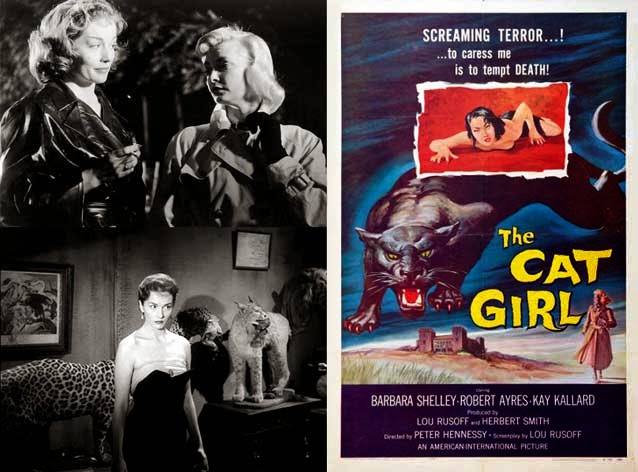
Okay. So Cat Girl is a movie I’d not heard of before it came up in one of Network’s regular DVD sales. I wanted this one because, for all intents and purposes, it looked like a 1950s British remake of Val Lewton and Jacques Tournier’s Cat People (a very tiny “pocket review” of which can be found here). Also, it starred Barbara Shelley, who is an actress I loved, mainly due to her role as the extremely strong female character she played as an assistant to the two male protagonists in Hammer Films' movie adaptation of Quatermass And The Pit (which is a film you can find reviewed here and, if you so desire, you can see my small visual tribute to Barbara Shelley in that role included in my 800th Blog illustration here).

As it turns out, even though it emphasises that the film is an update of Cat People on the back cover notes of the DVD, Cat Girl is really not, in any way, a translation of the aforementioned feline themed adventure. It may well have started off to be so, for all I know, but if it was... well, so much was changed in the writing, which is not credited as being based on anything in the opening titles, that the result really is unrecognisable as anything but the very vaguest of conceptual descendants of the 1940s RKO classic.

The films both have large cats in them... that’s it. They’re not even the same cat as far as I can recall. I’m pretty sure the species in question in Cat People is a black panther where, in Cat Girl, the large cat is a standard leopard.

In Cat People, the character Irene is the victim of a Serbian family curse which threatens to transform her into a hostile panther when she loses her virginity. A large chunk of the opening is taken up with the courtship of Irene, followed by her marriage and the breakdown of that marriage for fear that her character cannot consummate said marriage without turning into a wild, jungle beast. The rest of the film then deals with her psychotherapy and her husband's affair with another woman which, after a film which is totally psychological in tone (as opposed to the actual “make-up monsters” of rival studio Universal, who RKO were competing with in their most budget conscious, creative fashion), sees Irene finally transforming into one of the titular Cat People and, when her life is taken, reverting to the corpse of the woman she once was.

Cat Girl, on the other hand, features none of the sexual hang ups of the main character in Cat People. Barbara Shelley’s character Leonora Johnson is already married at the start of the movie and her virginity a long lost feature of her past. Instead, this film deals with her inheritance, where a family curse is passed onto her and she becomes, for want of a better word, psychologically linked with the family’s pet, killer leopard. The cat comes out at night and, when it does so, some shot cuts and reveals are used to show a distinct change in Shelley’s make up... but in no time does she ever actually transform into a cat herself... although she shares the same final fate as the leopard in this film due to her psychic bond. Naturally everyone thinks she’s totally crazy because... well, you know... she thinks she’s channeling a leopard... and so she is placed in a sanitarium and, in some of the worst and hilarious movie psychiatry I’ve ever seen, released to spend time with the object of her sexual jealousy and hate, the wife of her psychologist, who was himself once her childhood crush.

So... nothing like Cat People. 

Quite the opposite, in fact, when you consider that the sexual subtext of the first film is not present in this one other than as a complete reversal. Indeed, the sexuality in Cat Girl is pretty blatant and strong, especially in a scene where we see Leonora’s shadow undressing against the wall and, certainly, given the “costume” she wears in the final act of the film... a shiny, black leather coat which seems to be her solitary piece of clothing in this section and which seems to be almost deliberately encoded as a sexual fetish. I’m guessing it was a deliberate choice in terms of the designers of the look of the film too... although there’s always a chance the actors and actresses didn’t realise it at the time.

The lighting is beautiful throughout, often creating a halo around the hair of the central characters and showing off the black and white cinematography nicely... which is lucky since there’s very little camera movement in the majority of the shots in the film and most of the movie is assembled as edits from static set ups. So the lighting does help to offset the often lack of dynamic visual motion. Thankfully, the editing is not too uninteresting in places and everything keeps ticking along at a fairly solid rate. Having said that, the film came out just a few months after Hammer’s colourful The Curse Of Frankenstein, so I’m guessing that the success of the former and the expectations it created for horror films in its wake possibly meant this particular gem had a more lukewarm reception in the year of its release, both here in the UK and stateside.

But I say “gem” because it really is.

Cat Girl is a film which is definitely “of its time” but it’s quite charming in its own way and, frankly, Barbara Shelley’s performance in this is brilliant in both its intensity and, perhaps, its bravery at the time. This is definitely another strong female role for this actress and I suspect she probably relished this part when she won it. Whether she did or didn’t, though, she certainly sank her teeth into the part, so to speak, and although a lot of the on screen shenanigans by her and the rest of the cast isn’t exactly subtle, it is passionate and, more importantly, interesting to watch. Shelley certainly has a lot of presence in this role.

The one area where I think this movie does slip up big time, however, is in the musical scoring. I was wondering who was murdering the film with all the heavy handed compositions while I was watching but, as it turns out, it’s not the work of one composer but a range of different composers’ stock music tracked in and used here. All I can say is that, though these pieces may have been useful in their own right and in certain situations, as a score for this movie they are a fair degree less than subtle and it’s such a shame because, with some more appropriate cues, or even some of the same ones knocked down a little bit in the mix, they might well have given the film a little more lift and support in certain scenes. So that’s a pity.

Other than that, though, I would well recommend this movie for audiences who have a taste for old school British horror curios and I’m well pleased that Network have put this little beauty out in a digital format. Not one for all modern horror audiences, for sure, especially as there are no real scares to be had, but certainly something which does its own thing and, perhaps, even pushes the sexual envelope a little for its time, at least in terms of the overt references you could get away with in a commercial release of the period, I suspect. Definitely a movie I plan to be returning to at some point.