Showing posts with label Charlotte Rampling. Show all posts

Saturday, 27 December 2025

Asylum


Taking Over

Asylum
UK 1972 
Directed by Roy Ward Baker
Amicus/Second Sight  Blu Ray Zone B


Warning: Spoilers in this one. 

Asylum is the next movie in my watch of the old Amicus portmanteau horror films. Dating from 1972 this has four main story segments which include, if you go by the end credits of the print itself, Frozen Fear, The Weird Taylor, Lucy Comes To Stay and Mannikins Of Horror. All of these are written by Robert Bloch (although it’s suspected the first segment may have been more than inspired by a Clark Ashton Smith story) and the spelling of the Mannikins of the last story seems wrong. Modern sources tell me the last story is actually Mannequins Of Horror but, looking at the different spelling uses and the slightly different meanings attributed to each spelling, I think it’s much more likely that the fourth story is actually called Manikins Of Horror. This is not to say that no mannequins appear in the movie, as you’ll see as you read further but, specifically in the fourth segment, they seem to be manikins rather than mannequins.

Indeed, the idea of some kind of reanimated figure seems to be predominant in three of the four shorts in this one. The linking material in this one is of a young psychiatrist, played by Robert Powell, who drives to an old manor house acting as an Asylum, seeking a position there. His car ride over the opening credits is scored with a booming version of Mussorgsky’s Night On Bare Mountain. The current assistant, Dr. Rutherford, as played by Patrick Magee, tasks him with finding the identity of the former head of the place, one Dr. Star, who has gone mad and is, we are told, one of the four patients Rutherford wants Powell’s Dr. Martin to interview. If he can pick out from the four personalities just which one is a blind for the former head of the facility, he can have the job. 

So off Martin goes with the orderly, played by Catweazel himself, yup, Geoffrey Bayldon, to listen to the little horror and thriller stories so he can work out which is the real doctor. It’s at this point that I suspect, even before we meet any of the unlikely candidates, that most people will see the obvious twist ending of the piece coming so, yeah, I won’t say anything further but I thought it was pretty self-evident.

So the first segment, Frozen Fear, is told through the recollections of Bonnie, played by Barbara Parkins. She is having an affair with a character played by Richard Todd, who decides to take his wife, played by Sylvia Sims, permanently out of the equation. So he orders a new freezer for the cellar, bashes her in the head and disposes of the body by slicing her up into six segments (head, arms, legs, torso) and, curiously, wrapping each body part up in brown paper and string before disposing of it all in the new freezer. However, when the brown paper head escapes the freezer and starts rolling around on its own... you know something’s up. When Bonnie arrives on the scene, she finds Todd’s body in the freezer, from where one brown paper covered, severed arm has strangled him... and then she is attacked in the cellar by various bits of his wifes scattered body. It’s silly but hugely entertaining and the brown peper covered limbs give an unusual feel to this kind of material, for sure. 

The next segment, The Weird Tailor, is about a tailor played by Barry Morse, who is threatened with being thrown out of his shop for late payment of the rent by his landlord. Then, however, he gets a customer in the form of Peter Cushing, who wants the tailor to make a special suit for him, to the tune of £200. The conditions are that it has to be made of a certain, special material brought by Cushing’s character and the suit must only be worked on between midnight and 5am each day. Now, we know there’s something up with the material when Morse pricks his finger and it magically absorbs his blood but, he continues working on it and, when he delivers it to Cushing, finds that it’s a special suit to bring life back to Cushing’s long dead son. A special spell suit the client has learned to make from an arcane book of black magic which, given writer Robert Bloch’s long standing friendships in his life, is an obvious homage to H. P. Lovecraft’s Necronomicon, I’m pretty sure. Cushing has no money, it turns out and, in a struggle, Morse accidentally kills him. He returns home and tells his wife to burn the suit but, instead, she dresses up their store mannequin with it. And, yes, as you’d expect, the store mannequin comes to life and tries to strangle Morse, who is now obviously driven insane. 

The third segment, Lucy Comes To Stay, stars young Charlotte Rampling as Lucy, who has returned home from a ‘special’ hospital and is being more or less imprisoned by her brother in her house as a form of recovery. It’s not long, however, before Lucy’s friend, played by Britt Ekland, comes to spring her from her house and lures away the nurse on an elabourate ruse. Murderous shenanigans ensue but I think most people would have figured out the real identity of Lucy’s friend when she first enters the narrative so, alas, no surprises here.

The fourth and final segment, the incorrectly spelled Mannikins Of Horror, is more a quick prelude and stars Herbert Lom as a former doctor who has made various miniature, robot like manekins of former colleagues and one of himself. This leads directly into the bookends with Dr. Martin who is about to return to London, no longer wanting the job, when the last manekin, made to resemble Lom himself and with his own brain willed inside the tiny brain inside the model*, gets into the office downstairs and stabs Magee’s character dead with a scalpel to the back of the brain. Dr. Martin crushes the manekin, it’s tiny internal organs leaking onto the floor and, this has the effect of also crushing Herbert Lom’s character in the upstairs room. Then the real Dr. Star is revealed, another murder is committed and the film ends as a cycle with another doctor arriving for an interview to join the asylum.

And it’s a nicely done, mostly fun but unsurprising set of small horror and thriller yarns. Director Baker livens things up with some nice shot set ups (such as when a taxi cab pulls up and is viewed from the other side of a big arch in the street) and some nice camera movement ideas. One is where, instead of just following the action down, for instance, when Charlotte Rampling goes to look for something in a drawer, he pans down and zooms simultaneously to take us right into the drawer from looking at her in the shot. 

He moves the camera quite a lot actually, and there are some nice moments where he uses it to highest effect. For example, when Morse and Cushing are locked in a struggle, the camera movements, while still smooth, are short twisty turning movements resembling something similar to a hand-held camera shot and throwing the chaos of movement into the scene to depict the feeling of the fight. And when Robert Powell slowly drifts upstairs to meet the patients, he stops to look at a fair few black and white engravings depicting scenes of mental illness through the ages... something which is enhanced by Baker’s continually roving camera panning up and around and sometimes spinning 360 degrees around in the frame as it takes in the content of the black and white engravings... or they might be etchings, come to think of it.

All in all, Asylum is nicely acted, written with a certain tongue in cheek feeling and has some nice music by Douglas Gamley, although there seems to be more ‘classical’ needle drop in this one than there is original composition, it has to be said. And, yeah, there are absolutely no surprises in this one and it can hardly be called all that scary, either but, the stories have a certain charm of their own... it’s well shot and I had fun with it. Not the best of the horror anthologies I’ve seen put out by Amicus but... it’s certainly not the worst of them either. A decent watch and Second Sight’s Blu Ray transfer is excellent, accompanied by some extras worth having although, I have to say, like a lot of this label’s releases, the price is a bit steep for what it is. I would have liked to have seen Indicator tackle the Amicus portmanteau horror movies in a more price friendly boxed collection, it has to be said. 

*Since watching and writing this, the great Severin Films have also relelased their own edition of the movie and, although I was tempted, I didn't double dip in this case. I did, however, buy their new pin badge based on the film which is a wonderfully crafted likeness of the Charles Gray manikin with a little front door which actually opens on the badge itself, revealing the grim, brainy matter inside the chest cavity. The height of fashion accessories for sure. 

Friday, 15 April 2022

Benedetta


B For Benedetta

Benedetta
France/Belgium/Netherlands 2021
Directed by Paul Verhoeven
Pathé


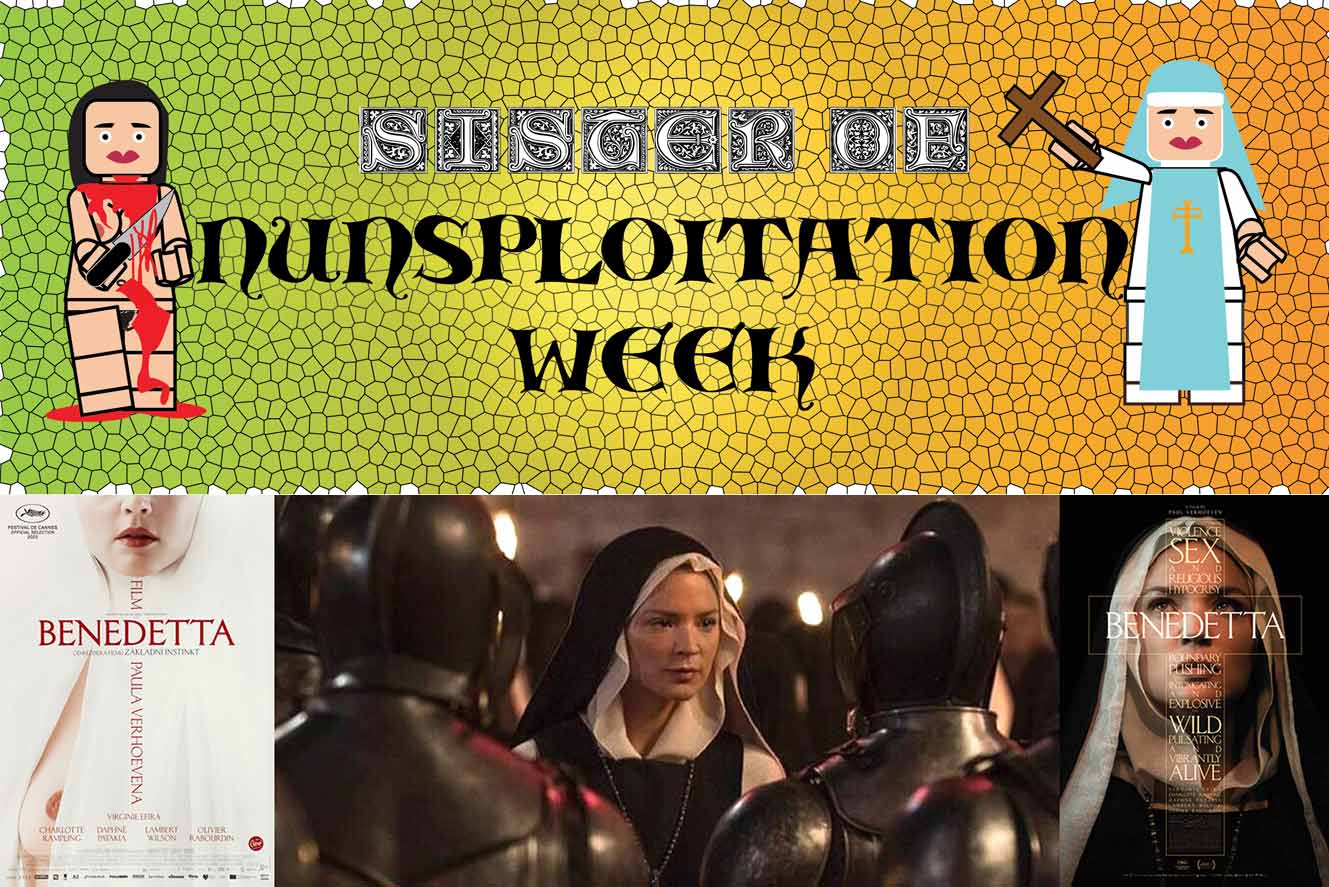
Okay, so Benedetta is the final movie in the second of my two Nunsploitation weeks for the blog this year... the one I’ve been building to in the hopes I could time my review with the same week of its release (or just after). Of course, when you see that a film has been made by a quality filmmaker and adapted from Judith C. Brown’s account of events... the book Immodest Acts: The Life of a Lesbian Nun in Renaissance Italy (or as Verhoeven puts it on the opening credits of this movie... “This film was inspired by real events”)... you have to wonder if it really is actually going to qualify as a nunsploitation film or more as a respectful, historical account of what we are told are the facts. Well now, Verhoeven is a consummate artist and, no matter what genre he chooses, he usually ends up delivering a very ‘classy’ looking picture, which is exactly what he does here...

But, of course, he really is also a fairly schlocky director in terms of the content of his work and, frankly that’s not a criticism. I reckon it could have gone either way but, of course, what he finally delivers, while certainly being respectful of the characters involved and also presenting quite an epic feeling, historical drama is... well I think anyone who’s seen this would have to agree that it’s a modern example of ‘proper nunsploitation’, no two ways about it. Certainly, in terms of the many exploitative moments in the movie, it really goes a lot further in terms of what it gets away with than the majority (if not all) of the films I’ve reviewed in my two nunsploitation weeks. This doesn’t, of course, make it the best of these but, I have to say it’s certainly one of the better ones I’ve seen.

Okay, so I’m not going to go into full synopsis mode on this one but I will say, in terms of judging the basic elements of the story, is that it deals with Benedetta (played by Virginie Efira) seeing many visions of Christ, manifesting stigmata and also taking on a lesbian lover in Bartolomea (played by Daphne Patakia). There is political intrigue between the various interested Catholic church parties, Benedetta and the Abesse (which I assume is the equivalent way of saying Mother Superior, played by Charlotte Rampling) and various trials and tribulations suffered by all the key players, set in the 17th Century midst the backdrop of the plague.

What Verhoeven does here... and kinda gets away with to an extent... is to try to show both sides of the coin in terms of the reality of Benedetta’s visions and he’s definitely treading on fairly similar ground to the brilliant, recent horror/thriller movie (depending on what the audience brings to it in their final analysis) Saint Maud... which I reviewed here. So you will see what Benedetta sees when she has her visions and it could be argued, when you think back to the intervention of a wild bird on her behalf at the opening of the movie when she is just a child, that he also shows one or two minor miracles. He does load it a little more in Benedetta’s favour than the way Saint Maud treats its central character, it has to be said but ultimately the film, although not having as visceral a finale as the former movie, gives us a similar ‘on the fence’ kind of stance. So although, for example, we’ll see many of Benedetta's visions of Christ, we are also given the possibilities of self inflicted stigmata, although it’s these very points that are played on as the drama unfolds and it all gets a bit ‘Salem witch trially’ for a bit.

And then there’s the heavy exploitation element... the fact that Bartolomea whittles down Benedetta’s miniature statuette of the blessed virgin into a dildo for their use, for instance. Or the torture scene where the pear of anguish is used to extract a confession. There’s also the element of blasphemy in this and, though I honestly wouldn’t usually bother to mention it, Verhoeven has already been questioned on this area regarding this film and gone on to deny that the film is blasphemous because, as he puts it, it depicts things that really happened. But, you know, because of the grey area more than heavily implied by the director when he shows us visions of Christ at their most exploitative, you have to maybe wonder at how he got away with that answer... he should maybe have just responded by an admission and then question the relevance of the accusation instead, I think. Because, yeah, you will see Jesus lopping off the heads of killer snakes, persuading Benedetta to get naked and up on the cross with him, save her from rape by slicing up soldiers and so on (and there’s a certain sense of duality in that scene in terms of ‘is it really Christ... no, the nightmare just changed’ aspect of that particular scene)... so, yeah, probably just a little bit blasphemous but, I’m not really the one to judge on that kind of stuff. It is, however, one of the most pulpy of dime store pulps takes on Christ that I can remember seeing in a film. A heroic Christ who wields a sword to get his woman out of danger, so to speak.

The shot set ups are not too intricate but they’re all pretty nice to look at and the movie feels like something very big and polished. Verhoeven does a nice thing with some of his transitions by pitching the occasional, very different, colour palette to segue into another scene. For example, you’ll go from those warm creams, oranges and beiges of the interior of the Abbey to, suddenly, the outside of the Abbey in a storm at night, where it’s all blues, greens and blacks. Not overly saturated or anything like that (although the ‘comet’ scene nearly gets there) but even these more subtle colour changes brush up against each other from scene to scene with a pleasing visual frisson that helps the movie trundle along at a fair pace (and it’s quite a long movie so that’s a good thing). Ann Dudley’s score helps the whole thing along too and, yeah, in one scene depicting self flagellating monks, you get to hear yet another rendition of the Dies Irae, which is kind of a curious comfort by this point.

And I’ve not got much else to say here about Benedetta other than, it really is a pretty exploitative piece of nunsploitation, the girls (who are often naked) look great and are so enthused in their roles that they pull off amazing, believable performances plus, my favourite bit (and see if you can spot it when you see it), there’s a dire part of the movie which brought an unwitting smile to my face when I realised the dialogue was the 17th Century Paul Verhoeven equivalent of, well, the ‘Pagliacci joke’. Yeah, that was a good moment. So that’s me done with both this and the second nunsploitation week and, I guess if you like the genre, you’ll definitely like Benedetta. So, yeah, done with the nun themed weeks now but not quite done with nunsploitation as a genre yet. There are a couple of good Blu Rays which have  just been released which I think could be considered part of this cycle, including what sounds like one in the big Severin box set of All The Haunts Be Ours folk horror movies sitting on my shelf so, yeah, there will be some more of these reviews coming at some point, I think.

Wednesday, 3 November 2021

Dune Part One


Fremen Popsicle

Dune Part One
aka Dune

USA/Canada 2021
Directed by Denis Villeneuve
Warner Brothers


I remember when Denis Villeneuve was first announced as the director of yet another adaptation of Frank Herbert’s novel Dune. I said at the time that if anyone was going to be able to capture the inherent beauty of a sand planet then, given his track record it was Denis Villeneuve. Even though, at the time, I was still angry at him for attempting to make a sequel to the greatest movie ever made (aka Blade Runner reviewed here) and then making a great looking film which was absolutely unlike the spirit of the original in any way, shape or form (which you can find reviewed by me here).

That being said, I was surprisingly uninterested when this film finally got released and it took some hefty recommendations from my friends to actually bother sitting down and watching this one... despite wanting to hear what Hans Zimmer did with the score. I remember seeing the David Lynch version in the cinemas back in 1984 and being similarly disappointed in it, especially since I knew Lynch was capable of making something as brilliant as Eraserhead. I think I also read the book around a similar time frame and... yeah, I liked the novel well enough but wasn’t a huge fan like my father was. I never got around to reading any of Herbert’s sequels and I still don’t feel the pull of it, to be honest.

However, I did sit down to watch the new version, eventually and... yeah, it’s okay. Not too terrible. Better than Lynch was allowed to get away with at any rate. It’s influences on film properties such as Star Wars are certainly apparent and the special effects departments are good enough now to render the necessary nuts and bolts workings of the universe which the characters inhabit as something fairly credible, it has to be said. It also should be mentioned that the personal shields used by the various fighters in the field are in no way an improvement over the big, blocky, Tron-like effects in the 1984 version (I haven’t bothered watching any of the TV shows of the various novels) and I think they still look a bit lame, to be honest.

We’ve got a star studded cast on this one, of course, including Timothée Chalamet as main protagonist Paul Atriedes, Rebecca Ferguson as his mum, Oscar Isaac as his dad, Zendaya as his Freman love interest (seen mostly in visions with a small amount of running time in this version, since this film only covers roughly the first half of the first novel), Jason Momoa as Duncan (although why there are bagpipes on the score because he’s called Duncan is beyond me), Dave Bautista, Stellan Skarsgård, Javier Bardem, Josh Brolin and Charlotte Rampling. They’re all as solid as you’d expect from them and help carry the story along at a leisurely pace. There have been comments made that Chalamet is a bit wooden in this... well I don’t know the actor at all but I think he actually plays the role with the suitable amount of gravitas and royal burden a role like that should be played so, yeah, I’ve got no complaints and I think much more emotion might have killed his credibility a little, to be honest. I seem to remember that Kyle MacLachlan was accused of something similar back in the day so, yeah, I think this is the right approach to take with the character.

The film is exquisite to look at, as you would expect from a director like Villeneuve and this gives it a kind of epic feel, like a lot of his movies have, even though it’s obviously been truncated to fit the pacing of his take on the story. There are some nice moments and some suspenseful scenes (such as when the remote, silent assassin comes for Paul) and although it is appropriately slow for the source material, it never gets boring... although I’m not sure I could sit through it again anytime soon.

I should shout out that the ornithopters, machines I’ve been reading about for years in various science fiction and fantasy tales (especially some of those by Moorcock), are beautifully rendered on screen and the absolute impossibility of their movement within the confines of a man made object is neatly transcended by the special effects people at least rendering their mechanics in a visually appealing way. I’m not sure the same can be said of the sand worms though and I think I could have done with seeing them a little bit more... Villeneuve tends to hide them in the sand like they’re on an episode of Michael Bentine’s Potty Time and save the full look at one for the last part of the movie.

Zimmer’s score is absolutely fine and, sounding like a lot of his other scores of late... and that’s not meant to be a slight, I actually like this composer a lot and I think that’s just the power of his personal, musical voice coming out. That being said, the Arabian flavour of some of the score did, at times, sound almost like it was tracked in from the 1982 Vangelis score to Blade Runner, to my ears. Again, though, I think I’m just picking up on the distinctive style of the music in certain parts of the Blade Runner score which obviously shares the same inspirational source.

And that’s really all I’ve got to say about this new version of Dune, in all honesty. It was not as boring or as terrible as I was expecting and, all in all (and without having seen the TV version), I’d say it’s certainly the best cinema release version we’ve had of the story thus far. If you’re a fan of the novel... or even of David Lynch’s neutered version of it... then you’ll probably get a kick out of this version so, yeah, don’t sit on the fence on this one like I did. It’s really, as I said, not too terrible.

Friday, 2 March 2018

Red Sparrow


Nate N’ Sparrow

Red Sparrow
2018 USA Directed by Francis Lawrence
UK cinema release print.


Red Sparrow is a Cold War spy thriller based on a novel, the first part of a trilogy, by ex-CIA agent Jason Matthews. So I guess you can certainly say the writer of the source material knows where he’s coming from in terms of the nuts and bolts operating procedures used in the story and this certainly, I think, comes through in the filmed version.

Now before I go any further, I have to say that I went into this movie knowing it was pre-cut for release in the UK... which is something I almost never humour or entertain. However, the trailer really intrigued me so I made one of my rare ‘window shopping only’ cinema trips. If I liked this ‘selected highlights’ version of the movie then I would buy the full, uncut version from the US market when it comes out on Blu Ray. Which I will be doing, as it happens. However, I really wouldn’t consider the UK presentation the same as being able to actually watch the movie itself. Why? Because I consider even a single frame (one 24th of a second) excised from a movie to be an incomplete edition and not the full work of art. I remember well the old late 1980s TV showings of Blade Runner (reviewed here) where, just the removal of one single swear word totally changed the underlying atmosphere of a specific scene and gave a different emotional hit from it. So... no... watching a movie with cuts is not the same as watching the actual film and I’m both ashamed and offended that censors in this day and age still exist. And I am certainly not giving any respect to the studio who released this and allowed it to be cut just to get a lower rating. Forget the money, guys, it’s about the art... let it lose money, it’s not that important. Art is more important. Entertainment is art and art is not a business. I know that’s a totally naive and less than credible thing to say about the Hollywood money machine but I don’t care... unless we strive to reach that ideal then we’ll never, ever get there.

So anyway... Red Sparrow is not the film I was expecting it to be.

It looked, from the trailer, like an edgier version of the film the Marvel Black Widow movie... if that ever sees the light of day... should be but, although it certainly is edgier than I would imagine Marvel would let their Natasha film be, this one isn’t an ‘action’ thriller by any sense of the expression and if you’re looking for a ‘high octane’ guns and explosions kind of movie, you’re definitely in the wrong place.

This film is actually a proper spy thriller.

It has an edge to it for sure but it’s more like a brutal version of something that John Le Carre or Len Deighton might have written so, oh yeah, I’m definitely a big fan of this film (or what little I saw of it... one of the cuts made is clumsy and obvious so I'm looking forward to seeing the ‘Jean Rollinesque’ pay-off to a certain, early sequence in the film).

Jennifer Lawrence is an actress who impresses me more and more with every film I see her in. I didn’t see her Hunger Games films by the same director (who is no relation to her, despite the surname) because the Young Adult nature of the source material put me off but everything I have seen her in, I have sat up and taken note. I hated Aronofsky’s Mother! (reviewed here) for example but, even in that, you can see what a great and dedicated performer she is and my respect for her deepens with Red Sparrow because, well, it’s a really brave part to take on and she really runs with it. Considering you have some real acting heavyweights in the cinematic ring with her on this one, such as Jeremy Irons and Charlotte Rampling, she does a really good job and more than holds her own. Watching her career now with a lot of interest.

The film is about her character, Dominika Egorova, once a world famous ballet star but now recruited, due to circumstances I won’t spoil here (even though they’re on the trailer), to the secret government division of agents code named the Red Sparrows. It’s specifically about a plot concerning US intelligence operative Nate Nash (played by Joel Edgerton) and the identity of a Russian mole he is trying to keep secret. The film tells the story of the grey areas where the lives of these two agents overlap and penetrate each other. It raises the obvious questions about whether Dominika is committed to the Russians or whether she is really helping the Americans and, any weaknesses in the story come, I think, from the writing more than anything else. For instance, there’s a scene where you will definitely find out one way or another, whose side she is on  but I was pretty sure the way it has been set up to make you think the opposite of the truth of the situation was, in itself, giving the game away. Another slightly problematic thing is the identity of the mole, who I was pretty sure I had guessed correctly from the outset and when the reveal came later... again, it was the obvious choice. That being said, there is a nice bit of shenanigans with that character right near the end of the film where Dominika pulls her own trump card which is a moment I didn’t quite see coming... although it makes perfect sense with the way the recruitment of her character is pitched at the start of the piece.

However, these little obvious things really don’t stop this movie from being a tight spy thriller and I really enjoyed this one a lot more than some of the other, recent attempts to juggle the expectations of ‘action thriller’ as opposed to ‘spy thriller’ in modern cinema. There’s also some really great stuff going on with the way the film is put together too... asides from the nude scenes with Jennifer Lawrence which, of course, are already leading this movie into ‘great’ territory. ;-)

For instance, there are some nice things done with the sound in certain sequences, such as the boiling sound of a whistling kettle transmuting into the squeak of an opening door in the next scene. Also, the crosscutting of the plot set up with Nate and the introduction of Dominika’s character in the pre-credits sequence, long before either of these characters meet in the chronology of the story, is handled really well and could have gone completely wrong but it’s edited very competently and doesn’t lose the atmosphere of two things coming to a simultaneous, mini climax.

Another thing the director seems to like to do is to set up expectations of a sequence by showing you what happens with a different character earlier in the film and then upending that expectation the second time around. Such as showing the presence of another character’s nasty demise in a similar situation before leading up to it again with a slightly different denouement. This is something which another great spy thriller, The Quiller Memorandum (reviewed by me here), does in its opening phone booth sequence, setting the audience up for a similar moment much later in the film. In Red Sparrow, this technique almost takes on metatextual proportions when one of the characters uses a video of a sequence to deliberately foreshadow the possibilities of ‘what comes next’ to one of the other characters in an interrogations scene. So the film really wears its foreshadowing on its sleeve here and demonstrates an awareness of how those same, subconscious tricks used on the audience can also be brought into play in the context of the movie itself.

Another thing which got me into the cinema to see this was the promise of a new James Newton Howard score. This composer has grown on me over the years and my appreciation increased after I saw a London concert last year. This isn’t, as I’d initially expected, in the same kind of mode as his excellent score for Salt (movie reviewed here) but is a much slower score with a lot of Russian flourishes (or possibly the Westernised perception of Russian musical phrases) peppered into the mix. I suspect it will take me a few stand alone listens to fully get into but it will be getting a proper CD release at the end of the month so I will, at least, get a chance. There’s some stuff in it, especially in a later scene where Dominika meets Nate in his apartment, which plays out like something Bernard Herrmann might have written for it so, yeah, definitely looking forward to the physical release and it certainly works in the context of the movie itself.

The film has a wonderfully ambiguous ending too. I am in no way spoiling it but, now that I know the source material is a trilogy of novels it certainly makes more sense that things aren’t so ‘spelled out’ for the audience and I can only hope (although somehow doubt) that the director and actors reunite for two sequels. Time will tell, I guess.

Red Sparrow is definitely a solid recommendation from me, especially to fans of spy movies which don’t just limit themselves to the action packed confections of the James Bond or Jason Bourne movies. A proper espionage thriller with a very cold sting to it and something which deserves to do a lot better at the box office than I expect it to. Absolutely go and see this one because it’s rare these days that movies like this are let out the gate, so to speak. Stupid plot holes for sure (like how can a world famous ballerina go under cover by dying her hair blonde?) but a top notch thriller, nonetheless.

Friday, 27 December 2013

Jeune & Jolie


Jolie Good!

Jeune & Jolie 
2013 France
Directed by François Ozon
Just about still playing at cinemas in the UK if you’re quick.

I always find director Françoise Ozon a little hit and miss, truth be told. But even when it’s a bit of a miss, I still tend to appreciate his stuff, on the rare occasions it’s actually advertised enough that I’ll get to hear about it before it passes me by at the cinema. I nearly missed this one and I’m angry that my local Cineworld didn’t bother showing it when it was released back in November. They’re getting worse and worse at showing anything much other than US blockbuster type movies these days.

I didn’t really want to brave a trip out on 27th December to go to London and pay loads more money than I normally would to see a film, to be honest, but I figured if this one was good enough it might make my best movies of 2013 list and I see so few contemporary foreign films nowadays that I really wanted to take in something different to my usual escapist fodder... I was much better at the whole World Cinema scene when I was a student, to be sure.

Now that I’ve done so, I’d have to say that Jeune & Jolie is a pretty good movie. It’s not exactly what I’d classify as a hit or a miss, by my standards anyway. It sits there somewhere in between but it carries itself well with its paired down sense of what a story is and isn’t and, like a small poem where you have to concentrate and look harder because the minimal trickle of words entices you into thinking there’s something more in there that requires your attention, the film holds you in its grip over its short running time and it doesn’t get boring at any point.

This one centres on a 17 year old girl’s decision to become a prostitute and Ozon’s lens takes a chance to almost glamourise the lead actress with his voyeuristic way of framing her and concentrating on her physical beauty and the expression of her contemplation of her life, without sensationalising it or exploiting it in the overtly sexual way that many directors might do, either as a strategy or subconsciously.

The really big thing for me about this film is the ambivalence inherent within the camera eye’s stance in making a value call on the main protagonist Isabelle’s career path as a sex worker and the unwillingness of both her character and the film to depict this as either a positive or a negative. What the film does do, however, is point out both the innefectiveness and the hypocrisy of those standing in judgement around the central lead’s “part-time activities”... and this is something I really value. It’s refreshing to find a central character who’s a sex worker but not one trying to justify her own decisions and if some may see Isabelle as something of an emotional cypher, I think that’s a pretty good call.

Personally, I think, since their seems to be no real financial motivation to the character, who keeps the huge amounts of money she makes hidden away from her parents... unspent, that she enjoys something of the life she has made for herself away from her family, to the point where the sexuality becomes something of an addiction (like sex usually does become to most people) and I think it’s pertinent that the character, when she is found out due to one of the negative aspects of her job colliding with the outside world in the form of the police, keeps her old mobile sim card with all her client numbers and contacts for use at a point when she has run the gauntlet of counselling and family misunderstanding. She obviously had every intention of returning to her life of prostitution when all the fuss has died down.

There are two key points in the film which I think are good Rosetta Stone moments when it comes to decoding the character of Isabelle. One is when Charlotte Rampling, playing the widow of one of Isabelle’s regular clients, hires her to understand and almost relive her husband’s final liaison. It’s telling that Isabelle at first mistakes this gesture as a sexual encounter and is willing to jump in there and service the former wife to her former best client. The character is 17 and so is perhaps inexperienced enough at life to be anything other than willing to decode the liaison as a prospect rather than a mental autopsy... or is it that she’s actually a lot more confident than that?

The second of my key moments may shift towards the latter when Isabelle discovers the possibility that her mother might be having an affair. She doesn’t use this as much of a threat but more as a leveller to point out to her mother, and the audience, that she is being judged by standards which are unfairly being applied to her from an outside that clearly has no grasp of her personal confidence as a person to make the kinds of decisions about her life that she wants to. At least that’s the way I read it and I think it’s this confidence to a character who tends to give nothing away throughout the film’s running time (even a scene where she breaks down crying is perhaps best seen as a release of tension combined with survival strategy as opposed to a more pitched reaction) that really cements this film as something a little more stand out than the way it could easily have been moulded by another director.

The camera work is quite beautiful and mixes sweeping movement with curiously static and repetitive establishing shots which lend the piece a certain sense of visual anchoring... which is a nice touch. The performances are all pretty convincing and interesting too. The 1970s fly-on-the-wall approach to the material, despite an abundance in some places of camera motion, allows these performances to shine through in the way they need to in order to pull the audience in and encourage suspension of disbelief.

My one real problem with the movie was the music strategy. The film has hardly anything in it that I noticed at all for the first half, apart from some songs used in a non-diegetic manner. This is an okay choice but then there is musical scoring later on in the film and, while this is a perfectly valid tactic of ratcheting things up to a certain level or changing the tone at some point during a film (Jerry Goldsmith’s score for Coma, for example, exists pretty much in only the last 45 or so minutes of the movie) I felt the scoring here was too thin and not quite up to the task whereas, the soundscape of the earlier sequences without music were already creating a certain audio intensity without needing to throw music in as well... and since I love movie scores it really hurts me to say that.

That minor criticism aside, though, Jeune & Jolie is a pretty good movie if you fancy seeing something French which deals with adult themes (although some of the characters themselves don’t respond in much of an adult manner in some sequences within the film). It’s not one I’d go out of my way to watch again but, certainly, it’s not one I’d run to avoid seeing again if the opportunity arose and it may, you never know, make my years best new release list. I’’m not sure yet but you can find out about that one in a few days, methinks. The film is certainly worth a peek, though, if you feel like a trip to the cinema.