Gunning To Glory
Top Gun
Directed by Tony Scott
USA 1986
Paramount Pictures Blu Ray Zone B
and
Top Gun: Maverick
Directed by Joseph Kosinski
USA 2022
Paramount Pictures Blu Ray Zone B
The first of an occasional series of double, triple and quadruple bills, mostly because I don’t have much to say about any of them as a single movie, truth be told.
Warning: Some spoilers.
I’ve never watched any of the Top Gun films before now. I wasn’t a fan of the young Tom Cruise (and think he’s absolutely great in his later career) and I really didn’t want to watch what amounts to a dressed up Navy recruitment movie. Added to this, I used to work in a record store on Saturdays at the time of the first film, while I was going through college and, honestly, that rubbishy best selling songtrack album was horrible to have to endure week after week.
However, my mother accidentally caught the recent sequel on telly last year and liked it a lot and so, as one of her Christmas presents this year, I got her the double Blu Ray pack of both movies. So, yeah, guess what I had to watch over Christmas this year?
Okay, so both movies are pretty much the same but they are different in the way they do it. Of the two, I think the first one by uber director Tony Scott is the less interesting. It’s not a great movie but it’s not downright terrible either. Just a film about Tom Cruise playing Maverick, a best of the best trainee pilot at the Top Gun flight school in the Navy. His co-pilot is Goose, played by Anthony Edwards (and Goose’s wife is played by Meg Ryan) and Maverick’s high profile rival is Iceman (played by Val Kilmer). Maverick’s love interest is played by Kelly McGillis.
The story is just toned down Porkys humour coupled with fast flying, naval cadets not doing what they’re told, a tragic loss to add a dash of drama and the obvious combat scene at the end. I’m guessing it must have somehow caught a mood at that point in the 1980s which I just wasn’t a part of.
However, it is directed by Tony Scott so there is some great photography and a few moments when he goes ‘full Bava’ on the colour palette, such as when Maverick is cradling Goose’s head (who promptly dies) as they float in the sea waiting for rescue. Harold Faltermeyer’s score is okayish (not as brilliant as Beverly Hills Cop and Fletch) but it didn’t really make much of an impact on me until it was extensively re-used by Hans Zimmer in the sequel, to be honest. Or maybe the mix in the second one was just kinder to it.
Top Gun Maverick hits all the same beats more or less. A still arrogant Maverick is called in to teach a bunch of Top Gun graduates how to pull off an almost impossible mission in a limited timeline. Miles Teller is playing Rooster, son of Goose, so that Maverick has a dramatic arc of survivor’s guilt via the offspring of his old co-pilot. The always watchable Jennifer Connolly plays his new love interest but, yeah, it’s not too hard to pick up on the fact that this is an old and troublesome flame who is mentioned by name a few times in the first film (just never seen until now). Val Kilmer is back as Iceman, suffering from the same illness as the actor did in real life.
The sequel is pretty much the same thing but it seems more interesting and I suspect that’s more to do with the contemporary language and the attitudes in this one, even though they’re employed to tell a similar story. And not just a similar story to Top Gun either... you’ll recognise many aspects of the final mission they are working towards as being exactly the same as the Death Star run in the original Star Wars (later retitled Star Wars Episode IV - A New Hope and reviewed by me here). They even have a Top Gun equivalent of Yoda’s “Do or do not, there is no try.” added into the mix.
Zimmer’s score, which highlights Faltermeyer’s old themes, seems much more epic and useful to the film as a whole (I liked it when I saw him do it in concert at one of his live shows too) and, all in all, Top Gun Maverick is a less bitter pill to swallow. I also trust the older version of Tom Cruise more and find him eminently more watchable than he was as a youngster.
All in all, then, I didn’t have a terrible time with either Top Gun or Top Gun Maverick... I can appreciate the second one more. Neither of them are great films but I can understand, I think, why people gravitate to them. You might well be one of those people so, yeah, please don’t take my word for it.
Thursday, 2 January 2025
Top Guns
Sunday, 3 March 2024
Dune Part Two
Harkonnen
The Barbarian
Dune Part Two
Directed by Denis Villeneuve
USA/Canada
2024 Warner Brothers
UK Cinema Print
Okay, so I quite liked Denis Villeneuve’s first attempt to film Frank Herbert’s landmark science fiction novel Dune (reviewed here) and, I have to say, I really liked the second one too. People are maybe over hyping this a little and calling Dune Part Two a great masterpiece. I can appreciate it may feel like that due to the epic scale of the production (although, I think that’s something of an illusion) but, out of Villeneuve’s various films I’d say that some of his others, such as Arrival (reviewed here) are much better.
Nevertheless, this is a pretty entertaining film with an incredibly long running time which, honestly, doesn’t feel like anything half as long. The reason I say the epic scale is a bit of an illusion is because, honestly, the majority of this one takes place just on Dune (aka Arrakis) itself... with the only other scenes being set on the worlds of the Emperor and Baron Harkonnen. But they are brief scenes in the scheme of things and, the majority of the action here follows the plight of Paul Atriedes, played pretty well by Timothée Chalamet (I’ll get to that in a minute) and Chani, played wonderfully by Zendaya. So it’s a lot of running around in the sand with some really great guerilla warfare action scenes and lots of stuff like sandworm riding. And it really doesn’t get dull.
Oh... and about that. The special effects in this are great but, UK readers of a certain age will, I’m sure, know exactly what I’m talking about when I say the sandworm riding scenes are like something straight out of Michael Bentine’s Potty Time. It was all I could think of while watching these sequences throughout the movie. So, I also got a lot of smiles mixed in with the drama.
There are a lot of great actors in this including the almost wasted Rebecca Ferguson (that’s just me... I always want her in more scenes no matter what film she’s in), Javier Bardem, Josh Brolin, Dave Bautista, Léa Seydoux, Stellan Skarsgård and Charlotte Rampling (who is very underused also, compared to the build up of her role in the first movie). Everyone’s great in this but... I do want to just say something about Chalamet and two other actors in the movie, namely Christopher Walken as the Emperor and Florence Pugh as his daughter. Who are all good in this but, I don’t know, seem a little inappropriately placed, it seems to me.
Okay, so Chalamet is always good in whatever he’s in but, towards the end I don’t think the casting suited him. Lets look at another film series which borrowed heavily from Dune (not to mention a load of other science fiction literature such as Edgar Rice Burroughs Barsoomian novels), namely Star Wars. Luke Skywalker in the original trilogy goes through a similar arc in that he goes from being an inexperienced young man who leans into his ‘mystic powers’ and comes out, by the opening of Return Of The Jedi, as a powerful badass who can take down an empire if he so decides. By the end of Dune Part Two, Paul Atreides is in a similar state but, as good as the frenetic fight scene at the end between Chalamet and a psychotic bad guy is... and for all his posturing and ‘using his voice’... well, I just didn’t buy it. It felt undersold to me.
And Christopher Walken, who is absolutely great as always, also felt inappropriately cast... unless the Emperor is supposed to feel like a flimsy old man who doesn’t seem to be able to ever have acquired and held on to the power he has, that is. Why would anyone throw down their allegiance to this guy in the first place, was my main thought in his casting. He was great saying the lines but, like Chalamet, seemed to lack the gravitas his part required... and I’m really surprised to hear myself saying that about the legendary Walken, for sure.
Thirdly... what the heck Florence Pugh? I felt she was being totally misused here as an actress. Literally, from her opening of the film as a kind of a ‘recap girl’ and onwards, she seemed to be just there to provide a narrative clarification for the audience in most (if not all) of her scenes... which is a shame because she’s actually an important bargaining chip in Paul Atreides’ end game.
I also spotted a nice cameo from one of my favourite actresses, Anya Taylor-Joy but, it was literally just a very small scene as a character who won’t enter the narrative properly for another 25 years or so later in the saga. So, yeah, I don’t suppose we’ll be seeing much more of her in the inevitable sequel, to be honest. I looked for her name in the cast list at the end and she wasn’t there so, I thought I’d just imagined it but, no, her own IMDB page confirms her inclusion in this film, for sure.
And, of course, the other big star of the film is Hans Zimmer’s wonderful score, which does provide both atmosphere and gravitas and, honestly, probably makes the film sound more epic than it actually is. I can’t wait to get my hands on a CD release of this one soon (I’m assuming they’ll be releasing one on proper CD... the first movie got two albums, one of which was also a double album, if memory serves). The leitmotif follow through on this one is pretty strong so, at times it does almost feel like they’ve tracked in parts of the previous score... but it works really well and, yeah, hoping to have the opportunity to hear a proper physical release of this one at some point in the near future, for sure.
And I think that’s me done on the quite wonderful Dune Part Two other than to say, the film has something of a cliffhanger ending again so... I hope Villeneuve is called in to direct Dune Messiah pretty soon. I shall be looking forward to it. Also, the film jumps around a bit and, I suspect there was a lot of it cut out from various sequences which, giving Villeneuve’s hatred of showing deleted scenes, I suspect I won’t get to see in my lifetime (although future lovers of cinema might get to see them once the director is dead, is my guess).
Sunday, 1 October 2023
The Creator
AI Sir
The Creator
Directed by Gareth Edwards
USA 20th Century Fox 2023
UK cinema release print.
Gareth Edwards is one of those directors who, well... I usually tend to quite like his films but find there’s often something which disappoints and prevents them from being a great movie. I saw two very different trailers for his new film, The Creator, over the last couple of months... one was very much based on story and the plight of the central characters and the other one was more of an action movie kind of trailer. The first one disappointed me with its clichéd plot somewhat and the second one made me think... well, some of the robots look pretty cool. So I figured I’d give it a go and just not expect too much from it.
Which was probably the best attitude that I could have gone in with because, despite what some may justifiably call weaknesses in the basic DNA of the movie, for me this was the film by Edwards which is truly great. By which, perhaps I mean, it’s definitely his most accomplished and entertaining movie to date, as far as I’m concerned.
The plot follows a military character in Earth’s... relatively close... future. It’s been many years since the AI beings, such as robots, allegedly nuked Los Angeles and the US government (and various other powers... but not all) banned AI. But not in Thailand where humans and AI live in peace. So America goes to war with the AI, using their super weapon and obliterating AI and AI sympathisers. The main protagonist Joshua, played by John David Washington, who has a robot arm and leg, is undercover trying to find the enemy’s genius professor/creator and he’s been trying to do this for a number of years, by latching onto the alleged daughter of the target (played by Gemma Chan). And in that time the two have fallen in love, got married and she’s pregnant with their child. However, she and the baby inside her get killed when Joshua’s American team attack the place where they are living and wipe almost everyone out.
Five years later, after Joshua is still recovering from the psychological issues of losing her, he gets recruited in to find a new super weapon that this professor has created, which can allegedly wipe out the US superweapon and turn the tide of the war on the AI resistance. And I don’t think it’s a spoiler to say, if you’ve seen any of the trailers, that the superweapon turns out to be an AI in the form of a little girl, played by Madeleine Yuna Voyles. However, once he finds her (after most of his unit have been wiped out), Joshua goes on the run with her, trying to keep her alive (or is it the other way around?) because he belives she can lead him to his wife... who is alleged now to still be around in the land of the living and in cahoots with the enemy. At which point the film becomes a road movie as the two bond with each other and he comes to realise that maybe AI are not just machines which you can terminate and turn off but, instead, have something approximating a soul and sense of self awareness not dissimilar to human beings.
So, yeah, to be fair, it’s a movie which is, really full of story clichés and, there are a couple of ‘twist’ reveals which most audience members will see coming fairly early on in the movie (like maybe five or ten minutes in). But, that being said, this in no way spoiled my enjoyment of it because, honestly, it looks absolutely stunning, has some gritty and suspenseful moments and whizzes by at a cracking pace.
Now, the look of this world really is a potpourri of many different science fiction elements which, if you’ve read, watched or ingested it in whatever media the genre has been living in from, say, the late 1920s to the early 1970s, you’ll be very familiar with. In other words, there’s nothing really new here in terms of the film’s acquirement and refashioning of old genre concepts... but, again, it’s done so well and, the film is nothing if not eclectically post-modern in its regurgitation of this material and it does it in such a convincing and entertaining way that, I couldn’t help but fall in love with it. And, in terms of that kind of stuff, it would be true to say that the director tips his hat and says to his audience ‘look, I know you know all this stuff but go with it, it’s fun’ by using the company motto of the Tyrell Corporation from Ridley Scott’s Blade Runner (reviewed by me here) quite blatantly within the first couple of minutes of the film. And, as one of my favourite critics pointed out in a podcast, the resulting world building is first class here.
One of my favourite moments was the return of the idea of walking bombs... or running bombs in this case. I’m not talking about just sentient bombs here, as in John Carpenter’s early 1970s movie Dark Star... but proper walking bombs which I don’t remember seeing, albeit in a much more expressionistic and beautiful way, since the annihilants seen in the 1940 theatrical serial Flash Gordon Conquers The Universe (reviewed here). The versions in this movie are both ‘cute’ and brutal, running through enemy lines at full pelt until they come to a stop and just explode. There’s a wonderful suspenseful scene during a battle sequence in the movie which deploys these creations and an equally wonderful visual reveal when Alfie (what Joshua has named this ultimate AI weapon in the form of a girl), steps in to lend a hand against these things. And, frankly, it’s nice to see this concept back again after so long (I guess there was probably a sidewayds variant of these in Screamers too, if I remember correctly... based on Philip K. Dick’s short story Second Variety).
Lastly, after a great last shot where the changing expression of Alfie’s face pretty much invites the viewer to bring their own baggage with them about their thoughts on AI consciousness and its nature, I waited around for some of the credits because I wanted to find out who wrote the music. I was surprised to find it was Hans Zimmer. Now, I love Hans Zimmer and always go to his concerts when I’m able to but, this is such a different score from him. It’s not as flashy or sweeping as his usual stuff for movies which are, to be fair, often inherently of that nature anyway. Instead it feels much more focussed on stepping back and allowing a more intimate musical landscape for the film, which seems like a much more appropriate choice for this kind of story. Alas, the score is not, at time of writing, available in a proper CD format so, it’s unlikely I will get to hear any of it away from the movie unless he decides to add it in on one of his future concert tour play lists, it would seem.
And that’s me pretty much done on The Creator. For me, this is Gareth Edwards best movie to date and I will certainly be looking to pick this one up on Blu Ray at some point in the, hopefully near, future. I absolutely loved it but, please, don’t anyone make a sequel.
Tuesday, 4 January 2022
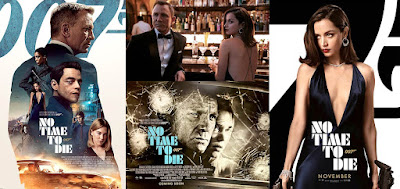
No Time To Die
A Die For A Die
No Time To Die
UK/USA 2021
Directed by Cary Joji Fukunaga
EON Productions
Blu Ray Zone B
Let me once more state for the record that I don’t have anything against Daniel Craig. In fact, I think he’s a great actor. He’s just got the wrong colour hair for James Bond and, also, I just don’t like any of the Craig Bond films. I’d frankly rather watch him in other roles. That being said, my expectations were hopeful for No Time To Die because I was receiving some very mixed, word of mouth reviews from the various friends I have. For instance, my die hard, Bond fanatical friend Chris, who usually has very few bad words to say about the Daniel Craig Bond films, was very disappointed with this one... thinking it one of the all time lows of the series, from what I can make out. Conversely, my cousin Steve said this was one of the very best Bond films and went back to his local cinema in Australia to see it a number of times. So, yeah, I thought this one would at least be interesting if it was dividing people’s opinion so much.
Alas, I have to report back that this latest outing for England’s popular secret agent has a lot in common with the previous Craig films, as far as I’m concerned... in that it’s very boring, drab, dull and any other descriptions which could be best summed up with the modern term... meh! My initial response once the film had concluded was... how can they make a movie which was both worse than Quantum Of Solace (reviewed here) and simultaneously, unbelievably more boring than Octopussy (reviewed here)?
Once again, the film picks up the plot threads from the previous Craig films, allowing them to all be seen as one single arc. We catch up with a now retired Bond living with his girlfriend Madeleine (Léa Seydoux reprising her role from S.P.E.C.T.R.E, reviewed here) but then, of course, Bond manages to find himself back in the thick of the action and attempting to save the world from yet another super villain, this time in the form of Safin (played by Rami Malek).
And... it’s a bit of a yawn, to be honest. The fact that the opening gun barrel sequence has Bond missing his target for the first time ever in the history of the EON Bond films (there’s no red blood washing it out in this version... just a really awkward transition), should have given me a heads up. The pre-credits sequence is certainly plot and character motivated but it forgets to be a big blast of action like the many James Bond films before it. I mean, there’s definitely a little action there but just as it starts to get going it’s already over and we are into a quite dreary opening title animation accompanied by a similarly dreary opening song. Sadly, this is a good guide to how the rest of the film is going to go... it’s a long, slow burn (running two and three quarter hours) with very few action sequences and, for the most part, not enough ooomph in them to really deliver the kind of pace and energy a loyal legion of Bond fans might expect from the franchise. This would perhaps explain why the response to the movie in my timeline on Twitter has been lukewarm at best.
Now, I was pretty careful to pick up absolutely no spoilers for this one before I fired up the Blu Ray but, alas, as I’d revealed to my friend @cultofthecinema on the phone a few days before, I was pretty sure how the movie was going to end (using the same kind of casting information with which I’d predicted, a couple of years before release, a certain event which takes place towards the end of the Star Wars movie The Force Awakens). And, yes, I was dead right on that one. I really don’t want to give away the ending of the film here but, even if I’d had no suspicion before the movie started as to the final trajectory of the story, the writers and director manage to telegraph it so much that it’s pretty much a foregone conclusion by the midway mark. Scenes which would have been better occurring at the end of the movie play out earlier than you might expect and, by some point, I suspect most people in the audience would realise there’s a reason why certain plot points are explored more fully before the final innings, so to speak.
Okay, enough on that. Let me say something positive here. There are two things I did like about the movie. One was the brief but effective scenes where a new character played Ana de Armas shares the one good action scene with her Knives Out co-star Daniel Craig. I could have done with a lot more of her character in the movie, to be honest.
And the other thing was Hans Zimmer’s score. He’s done a wonderful job on this one and managed to deliver a nice score which really gets to the heart of what the John Barry and early David Arnold scores were about. I love Zimmer but I was really surprised he was able to pull something like this off. He also interpolates various themes from the classic Bond film On Her Majesty’s Secret Service (reviewed here) for the score and, although the film doesn’t reference the plot of that movie at all (how could it when the Craig films were supposed to be a total reboot), there are a lot of musical echoes of it... enough to inject a kind of ‘surrogate nostalgia’ into the movie, it has to be said. Probably didn't need that ‘emotional association by proxy’ though. Not that there aren’t a lot of visual references to previous Bond films from the history of the franchise in the movie anyway... bit of a strange kind of homage. Nevertheless, I thought Zimmer did a remarkable job with the music... although now I know why there wasn’t too much action music on the CD soundtrack... you can only score what’s on the screen, I guess.
Okay, my biggest problem with the movie is it’s far too long. And that makes no sense since, not long after a scene where M and Bond are at each others throats and Bond is not welcome to return to active duty, it’s almost immediately followed up by them being all pally again and Bond being recruited for the mission. I can only assume that some kind of sequence of events which would have led to this change of heart was cut from the movie to get the time down. Even so, the film drags so much that, you have to wonder why the producers and director didn’t get the editor to trim another hour out of it.
All in all, then, I didn’t have a good time with No Time To Die. I wish Craig all the best in the world and hope to see him in some more movies soon but, as far as Bond films are concerned, I think I’m more than happy to see the back of him. If the series is to continue, as it implies right at the end with the familiar caption ‘James Bond Will Return’, it will have to be a hard reboot with, I suspect, a much younger actor. But let’s see what happens with the ageing producers before we count any more chickens, would be my final word on that.
Wednesday, 3 November 2021
Dune Part One
Fremen Popsicle
Dune Part One
aka Dune
USA/Canada 2021
Directed by Denis Villeneuve
Warner Brothers
I remember when Denis Villeneuve was first announced as the director of yet another adaptation of Frank Herbert’s novel Dune. I said at the time that if anyone was going to be able to capture the inherent beauty of a sand planet then, given his track record it was Denis Villeneuve. Even though, at the time, I was still angry at him for attempting to make a sequel to the greatest movie ever made (aka Blade Runner reviewed here) and then making a great looking film which was absolutely unlike the spirit of the original in any way, shape or form (which you can find reviewed by me here).
That being said, I was surprisingly uninterested when this film finally got released and it took some hefty recommendations from my friends to actually bother sitting down and watching this one... despite wanting to hear what Hans Zimmer did with the score. I remember seeing the David Lynch version in the cinemas back in 1984 and being similarly disappointed in it, especially since I knew Lynch was capable of making something as brilliant as Eraserhead. I think I also read the book around a similar time frame and... yeah, I liked the novel well enough but wasn’t a huge fan like my father was. I never got around to reading any of Herbert’s sequels and I still don’t feel the pull of it, to be honest.
However, I did sit down to watch the new version, eventually and... yeah, it’s okay. Not too terrible. Better than Lynch was allowed to get away with at any rate. It’s influences on film properties such as Star Wars are certainly apparent and the special effects departments are good enough now to render the necessary nuts and bolts workings of the universe which the characters inhabit as something fairly credible, it has to be said. It also should be mentioned that the personal shields used by the various fighters in the field are in no way an improvement over the big, blocky, Tron-like effects in the 1984 version (I haven’t bothered watching any of the TV shows of the various novels) and I think they still look a bit lame, to be honest.
We’ve got a star studded cast on this one, of course, including Timothée Chalamet as main protagonist Paul Atriedes, Rebecca Ferguson as his mum, Oscar Isaac as his dad, Zendaya as his Freman love interest (seen mostly in visions with a small amount of running time in this version, since this film only covers roughly the first half of the first novel), Jason Momoa as Duncan (although why there are bagpipes on the score because he’s called Duncan is beyond me), Dave Bautista, Stellan Skarsgård, Javier Bardem, Josh Brolin and Charlotte Rampling. They’re all as solid as you’d expect from them and help carry the story along at a leisurely pace. There have been comments made that Chalamet is a bit wooden in this... well I don’t know the actor at all but I think he actually plays the role with the suitable amount of gravitas and royal burden a role like that should be played so, yeah, I’ve got no complaints and I think much more emotion might have killed his credibility a little, to be honest. I seem to remember that Kyle MacLachlan was accused of something similar back in the day so, yeah, I think this is the right approach to take with the character.
The film is exquisite to look at, as you would expect from a director like Villeneuve and this gives it a kind of epic feel, like a lot of his movies have, even though it’s obviously been truncated to fit the pacing of his take on the story. There are some nice moments and some suspenseful scenes (such as when the remote, silent assassin comes for Paul) and although it is appropriately slow for the source material, it never gets boring... although I’m not sure I could sit through it again anytime soon.
I should shout out that the ornithopters, machines I’ve been reading about for years in various science fiction and fantasy tales (especially some of those by Moorcock), are beautifully rendered on screen and the absolute impossibility of their movement within the confines of a man made object is neatly transcended by the special effects people at least rendering their mechanics in a visually appealing way. I’m not sure the same can be said of the sand worms though and I think I could have done with seeing them a little bit more... Villeneuve tends to hide them in the sand like they’re on an episode of Michael Bentine’s Potty Time and save the full look at one for the last part of the movie.
Zimmer’s score is absolutely fine and, sounding like a lot of his other scores of late... and that’s not meant to be a slight, I actually like this composer a lot and I think that’s just the power of his personal, musical voice coming out. That being said, the Arabian flavour of some of the score did, at times, sound almost like it was tracked in from the 1982 Vangelis score to Blade Runner, to my ears. Again, though, I think I’m just picking up on the distinctive style of the music in certain parts of the Blade Runner score which obviously shares the same inspirational source.
And that’s really all I’ve got to say about this new version of Dune, in all honesty. It was not as boring or as terrible as I was expecting and, all in all (and without having seen the TV version), I’d say it’s certainly the best cinema release version we’ve had of the story thus far. If you’re a fan of the novel... or even of David Lynch’s neutered version of it... then you’ll probably get a kick out of this version so, yeah, don’t sit on the fence on this one like I did. It’s really, as I said, not too terrible.
Saturday, 26 December 2020
Wonder Woman 1984 (aka WW84)
Paw Deal
Wonder Woman 1984 (aka WW84)
UK/USA/Spain 2020
Directed by Patty Jenkins
Warner Brothers
Warning: Yeah, this will have loads of spoilers so,
you know, see the movie first.
Okay, so if you know me at all in real life you’ll know that, for me, Patty Jenkin’s 2017 movie Wonder Woman (reviewed by me here) is not only the best superhero movie ever made but also one of the greatest movies, to date, of the 21st century. There was no way in hell WW84 (aka Wonder Woman 1984, if you go by the posters as opposed to the title on the actual print of the movie) was probably going to come even close to the greatness of the first movie and, yeah, that’s probably the case here but, although it maybe has a few very slight problems, I’d have to say it wins through with what are, for me, the two most important things to get right... one is it’s vastly entertaining and two, it doesn’t let the side down when it comes down to living up to and respecting the original.
What I’m trying to say is, although it doesn’t deliver quite the same experience (I wasn’t weeping throughout the whole movie as I tend to when I re-watch the original one time and time again), it’s a pretty good movie and it certainly has a lot of spectacle to it.
As different as it is to the first film, however, it does try to match some of the elements of the first, attempting to give the fans of the first film more of what they want to see in regards to the specific ingredients which may (or, arguably, may not) have made the first film such a huge draw for the box office.
Perhaps the most blatant of these, at least visually, is a very strong opening action sequence which takes us back to the 12 year old Diana on Themyscira, taking part in a huge sporting contest reminiscent of the games the Amazons used to play on Paradise Island back in the 1940s iteration of the comics (which are, at the moment, the only ones I’ve read... well, just the first couple of year’s worth and a stretch by John Byrne a fair few decades later). This is really a spectacular sequence and Hans Zimmer’s score matches that spectacle note for note. I’ll come back to the scoring of this in a little while.
Another very blatant thing to capture the essence of what made the first film so successful is the return, in 1984, of Steve Trevor, portrayed once again by Chris Pine opposite the sensational Gal Gadot as Wonder Woman. People who have seen the first movie will know that Trevor dies at the end of the first film, sacrificing himself at the end of World War I... however, the surprise return of the character fits into the ‘magical’ theme, which sees an ancient artefact of the Gods granting wishes (mostly unconsciously) and thus Diana Prince accidentally wishes Trevor back to life. As does Kristen Wiig’s character Barbara Minerva, who wishes for Wonder Woman’s powers and becomes (although not named in the movie), her alter ego of The Cheetah (or one of them... I’m only familiar with one of the earlier incarnations of Cheetah so I’ve no idea how this character lives up to the comics). So, yeah, you have all that and with it you therefore have the fish-out-of-water scenario from the first film, where Diana was trying to grapple with the world outside her invisible island, reversed here with Steve Trevor trying to catch up with a culture which has moved on almost 70 years. We also get a similar reversal of the costuming scene in the first film, with Trevor this time trying to find something to ‘blend in’ with 1984.
One other nice touch is the way photographs in Diana’s apartment show that the writers have not forgotten the power the photo from the first movie had as an emotional punch on the audience and, although 'that photograph' is not easily in evidence here, there are some moments where the poignancy and emotion of photographs are dwelt upon just a little longer than you may expect in any other film where this fetishism to the static image was not rendered so lovingly in the previous installment.
And everybody is good in this. Pine and Gadot are excellent in their roles, both retaining certain character traits to keep them credible, although I would have liked to see Diana take a punch in a thoughtful manner the way she did in both Wonder Woman and Justice League (reviewed here). Kristen Wiig is also very good in her role, although she totally goes through exactly the same kind of transformation (just a little more gradual) that Seline Kyle went through in Batman Returns (reviewed here). And when it comes to that character, this was one of my slight criticisms of the film... there needed to be a five minute follow up to explore the post-story relationship between Minerva and Prince, I felt. Unless they’re maybe saving her for a sequel.
Pedro Pascal, The Mandalorian himself, does an equally fine job as villain Maxwell Lord and I was very impressed with the arc of the character, who starts off so smarmy that you really dislike him from the get go but then (just like Wiig’s villainess), as more of his back story is revealed, you begin to feel a lot more sympathy for and I was very happy that the arc for both of these villainous characters were handled in a way which was much more appropriate to the title character’s realm and not as they might have been disposed of in other films.
The movie perhaps feels a little light in action in places and another minor criticism is that it starts with a bang and maintains the rush right through to about maybe halfway through the film, with a big desert vehicle chase which, after it has finished, kind of leaves the film a little flat in some ways. I think, however, when I watch this one again, I will probably be more on board with the second half of the piece and I’m pretty sure I’ll regret writing that previous sentence before long.
Just as I regret criticising Rupert Gregson-Williams score in the first movie. By the second screening of that one, I was totally on board with his score and, frankly, tend to get more than just a little teary eyed when I have it on the headphones, walking down a street. I’ll say here that, although I love Hans Zimmer’s music as a composer for a lot of movies, I wish that Rupert Gregson-Williams had been asked to return for this one because, although Zimmer did build the basic Wonder Woman motif for Batman Versus Superman - Dawn Of Justice (reviewed by me here), I thought the stuff that Gregson-Williams brought to the table in the first one far exceeded Zimmer’s wonderful contribution. That being said, Zimmer does have vague hints of Gregson-Williams thematic material from time to time and, of course, he does retain his own Wonder Woman theme with an appropriate build up to it in this film. Other times, though, I thought the score seemed wildly inappropriate, with a comic theme which recalled, to me, his Electro theme from The Amazing Spider-Man 2... a score I was not all that fond of, to be honest. Still, there are also some wonderful pieces of music in WW84 and I certainly can’t wait until the CD arrives in the post.
The structure of the film is clever too and The Monkey’s Paw element of ‘magic’ at the heart of the story (something it comes clean about a few times in the film) extends in like spirit to a credible, if you’re on board with this central concept (I expect some people won’t be), rendition of a new twist on the old Invisible Jet that Wonder Woman used to have in the comics and TV series, imbuing it with a new accessibility which could prove interesting in the future, if the film series keeps going. Alas, the way the story is put together also reveals the end game quite early on and the obvious ‘sacrifice’ on the table here... I mean, I knew it would have to come anyway but there’s a point in the film where audiences are going to figure out, probably before Diana does, that a certain character is going to have to disappear into the ether again for her to be powerful enough to resume her stance as a guardian of the planet. It doesn’t take the sting out of it too much but, yeah, things are pretty obviously pointing to both this and the mechanics of how the ending is going to have to work to give each of the ‘super-villains’ a way out of the mess they’ve, almost inadvertently, created. The ending is nice, though and, certainly retains both the spirit of the first film and, also, the way the character arcs would tend to go in those 1940s comics I’ve read.
And that’s about me done with Wonder Woman 1984 (WW84) other than to say, if you’re a long term fan of the character in the medium of the moving image, you’re going to want to stay around in the cinema for the mid-end credits sequence. Again, I could see the reveal there coming before it happened and, to be honest, it was done in perhaps one of the least subtle, cheesiest ways imaginable but, you know, without revealing too much, I really loved it and hope a certain character can return if there is a sequel made to this movie. Other than that, it fits in surprisingly well with the continuity of the other three DC Universe movies in which Gal Gadot has played this role and I would recommend this as a high calibre superhero movie for most people but, with the small caution that there was no way it could ever be better than the first one. Definitely worth most people’s time though. Loved it!
Tuesday, 28 April 2020
Pirates Of The Caribbean - At World’s End
Depp-reciating Returns
Pirates Of The Caribbean
At World’s End
USA 2007 Directed by Gore Verbinski
Disney Blu Ray Zone B
Wow... this is not a good movie. I’m kinda surprised this one got the box office it did after the second movie was not so great. You’d think it would be a case of once bitten, twice shy but, then again, in order to get good box office, Hollywood relies on repeat viewings of a film from the same audience... I just can’t imagine anyone wanting to watch this thing again after they’ve just had to sit through the interminably long (almost three hours) running time of Pirates Of The Caribbean - At Worlds End.
To be fair, there are one or two good moments in this but they all seem to be front loaded within the first half an hour. The film opens strongly with what can only be described as a musical number set to a hanging. The song a little boy sings before he is executed with various other pirates is a nice opening set piece from Hans Zimmer and it’s quite striking but, the reason for the song and the comments made by onlookers makes absolutely no sense and it’s only briefly touched upon later in the most vague and confusing way. In other words, it’s a completely pointless scene which, honestly, works very well as such but, for some reason, the filmmakers try to justify its inclusion into the narrative space of the film (you wouldn’t catch someone like Fellini trying to rationalise what he wanted to do like this) and this kind of dilutes the effectiveness of the scene to some extent. Throwing in a sense of logic where none is required (film is art and art doesn’t have to mirror reality, people!).
This is followed by another strong sequence of stealth followed by action as the various pirate crew members from the last movie team up with the newly resurrected Captain Barbosa (Geoffrey Rush) and go to Singapore, to the stronghold of infamous pirate villain Sao Feng (played by Asian superstar Chow Yun-Fat) to retrieve a map to a place in the afterlife. This is a pretty promising sequence which, maybe, loses something on home video but I remember it being quite a spectacle at the cinema. And then we get some assorted plot snippets thrown into the mix as Keira Knightley’s Elisabeth Swann and Orlando Bloom’s Will Turner, plus assorted regulars, go off to find Johnny Depp’s Jack Sparrow in order to bring him back from his own, personal space in Hell.
And, surprisingly, this is where this film suddenly falls flat. I find it ironic that the original, classic Pirates Of The Caribbean movie (reviewed here) only came alive once Johnny Depp made his memorable entrance but this time around, the whole first half an hour of the movie, which is Depp-less, is the strongest part of the film. Things really begin to flag by the time Jack Sparrow is introduced... in a curiously surreal but bewilderingly boring sequence with multiple versions of the character occupying the same space. I don’t know why the film never really recovers from here on out but I understand the script was still incomplete when filming commenced on this one so, yeah, maybe not the most ideal conditions to make a piece of movie art under, for sure.
Once again there are strange creatures at large (most of them seen in the last film, as the Flying Dutchman and its crew return to add drama to the proceedings) and big set pieces with cannons and crossed swords but, without really having any good filler for the calm moments to allow contrast and highlight the ferocity of the action sequences (not to mention the confusing editing in these scenes) the whole swashbuckling yarn seems a bit bland and... well... less swashing and more ‘let’s all go and have a sleep on the sofa until this monstrosity of a movie passes by’ it seemed to me.
The one ray of light in this film comes in the form of Hans Zimmer’s excellent score. Using the same musical language of the previous installments we have some cracking tunes that, while ultimately failing to break through the lethargy of the finished product, does at least support this bloated behemoth appropriately and, to boot, is an enjoyable stand alone listen away from the movie. Of special note, asides from the opening song (which is curiously truncated on the CD soundtrack) we have a stand out piece of score which Zimmer excerpts in his live concerts for the scene where Jack gets everyone to topple his ship upside down, called Up Is Down on the accompanying soundtrack album. It’s moments like this which, at least, had me tapping my feet along to the music while I tried to find something visually interesting on the director’s canvass.
And there you have it. An extremely short review for a movie that, as far as I’m concerned, joins its sequels in proving that the original film was a bit of a fluke in terms of being a truly great movie (although I also liked Verbinski’s The Lone Ranger, against all the odds, which I reviewed here). Honestly, though, I can’t really recommend any of these films to a movie lover barring the first one and, by this third go round, it really did seem like all involved were flogging a dead sea turtle, truth be told.
Thursday, 14 March 2019
Pirates Of The Carribbean - Dead Man’s Chest
Kraken Mad
Pirates Of The Carribbean -
Dead Man’s Chest
USA 2006 Directed by Gore Verbinski
Disney Blu Ray Zone 2
And so I bravely tread into my rewatch of the second of the movies inspired by the long standing Disneyland ride, Pirates Of The Caribbean - Dead Man’s Chest and... you know what... this is not nearly as dreadful as I remember. I recall finding it fairly dull the first (and last) time I saw it, at the cinema back in 2006 and, although that’s probably still an accurate description of it, in all honesty, it’s by no means the complete disaster that I originally perceived this huge, box office burster to be. I think my extra disappointment with the film probably came for the fact that this was, in no way, a worthy sequel to the fantastic debut in the series (reviewed by me here). Yes, that’s true enough, as it is for all the Pirates Of The Caribbean movies but, back then, I actually thought, until I started watching it, that it may give the first film a run for its money. Alas, it’s not nearly an adequate sequel of a movie but, now that enough water has flowed under the hull, I can at least look at it with less expectations than I did on my initial viewing and find that it’s really not that offensive. Bits of it are even watchable.
Okay, so the film opens with a bit of a shock (good... nothing wrong with that to help get the audience interested) as two of the main protagonists of the first film - Elisabeth Swan, played by Keira Knightley and Will Turner, played by Orlando Bloom - are arrested and awaiting execution for their part in the escape of Johnny Depp’s scallywag rogue Captain Jack Sparrow at the end of the last movie. However, a deal is struck for Turner to find Sparrow and bring to the new Governor of... wherever the heck the characters in these films are all living... Jack’s magical compass. He goes off and, when Elisabeth escapes, she also goes after him.
Meanwhile, Johnny Depp’s opening scene is... well it’s not bad actually. A coffin is thrown into the sea and a bird lands on it and starts knocking on it with it’s beak. After a short while of this a shell flies through the wood of the coffin, fired from inside, eradicating said bird in a quick flurry of black feathers. A hand holding a flintlock pistol pokes through the hole left in the wake of its deadly harbinger and looks around as if it were a periscope. The lid is then lifted from inside, revealing Johnny Depp in his Jack Sparrow form as he then uses the leg of the skeletal corpse he is resting on to start rowing his coffin to his destination. And it really isn’t a bad character intro but... don’t try and compare it to the first film, where Depp’s entrance into the picture was a wake up call to great character entrances the world over. It’s a bit of a shame that this moment here isn’t remotely able to compete with that first intro but, like I said, divorce it from your treasured memories of The Curse Of The Black Pearl and... it’s really not a bad entrance, methinks.
And then everything gets really silly with Depp being struck with ‘the black spot’ (fans of Treasure Island should know that reference) and the main villain of the piece, Davy Jones (Hey, hey!), played by Bill Nighy as a Cthulhu-like squid creature, is after Depp with the similarly mutated crew of the famous Flying Dutchman. He will stop at nothing, including unleashing the fabled Kraken of myth, to track down Jack Sparrow to pay his debt of servitude to him unless, in a new deal, Jack can bring him 100 other souls. Meanwhile, Jack wants to find the key to unlock Davy Jones' chest (I'm guessing that would be Davy Jones locker then?) and free himself from his debt by piercing the living, beating heart of the skipper enclosed within.
And that’s as much of the silly plot that I can remember, to be honest... the rest of the film being one set piece after another while Depp tries to show off his tremendous acting talents with, it has to be said, a script not that worthy of him and with lots of chases played for comedic effect. The fight choreography doesn’t seem quite as good as the first one and, although there is an okayish extended swordfight between three main characters towards the end, it’s really not that swashbuckly and, in what is presumably an attempt by the director to try and top his first installment, the simple pleasures of the cutlasses clashing is mostly abandoned as he tries to find bigger set pieces to make everything seem like it’s delivering a lot more when, as it happens, it’s just delivering more a lot less effectively than the previous time around.
Now there are some nice moments, to be sure, with some great little throwaway jokes which look back to the previous adventure, such as when Jack first realises he is back in the company of Elizabeth Swann and, recalling a certain scene, he whispers to a crewman to “hide the rum”. And the actors are all good in this as they try to work hard and perform wonders with a script that is really not delivering on either the comedy or action in the same way as it did before. There also seem to be some huge story jumps between the two films as we find, for example, what became of Jack Davenport’s character Norrington... which doesn’t really help when it comes to echoing the feel of the original. And then there’s those set pieces...
Gore Verbinski must really like action sequences when everything is out of control and without the heroes able to do too much with the situations they find themselves in. In fact the action feels very repetitive... especially when we have a scene where Jack’s crew are trying to break out of spherical bone cages which they then proceed to roll around without much control when, later on in the film, we have a watermill which comes off its central axle and the three swordfighting characters... Jack, Will and Norrington... are fighting both inside and on top of it as it rolls around the environment, out of control. I was, at one point, wondering when the next inanimate object would somehow break free and start rolling around and causing our heroes more problems.
I also missed the pirate skeletons of the first film. Sure, the writers tried to deliberately hit that same supernatural undercurrent which made the first film a little fresher but, to be honest, fish/squid/what the heck people, while nicely surreal, kind of detracts from the atmosphere in this one, I reckon and I would have much rather they’d taken the supernatural element out of it altogether on this one rather than what they pushed it to here. It just seems very dull, at times.
That being said, the film isn’t all tedious and it still does entertain enough to keep you watching for what is, it has to be said, a monstrously unnecessarily, ginormous two and a half hour running time. One of the things which makes it so watchable, of course, is Hans Zimmer’s wonderful score for the film. Now, I don’t like this score as much as I liked Klaus Badelt’s original but this is still pretty good and it certainly keeps your toes tapping while the action sequences are playing out (and honestly, without the music, the film really would have been pretty much unwatchable). So a big shout out to Hans for this one and, of course, also to the cast of first rate actors who are able to make some of this dialogue sound half credible. This film wouldn’t be a recommendation from me but, of course, since Pirates of the Caribbean - Dead Man’s Chest was made back to back with the next installment, you need to see this one before you can make sense of the next... especially since this one leaves it on a bit of a cliffhanger. Although, if memory serves, the next one suffers from having a really strong set of opening scenes followed by more of the 'less-than-exciting' shenanigans which marred this one, to an extent. Of course, I’ll only know that for sure by rewatching it so... you know... watch this space.
Tuesday, 12 June 2018
Pirates Of The Caribbean - The Curse Of The Black Pearl
Her Cool Pirate
Pirates Of The Caribbean -
The Curse Of The Black Pearl
USA 2003 Directed by Gore Verbinski
Disney Blu Ray Zone 2
Here we go then. It so happens that it’s finally time to watch the Pirates Of The Caribbean films again from the start, since I’ve not really watched these since their cinematic release. My impression of these at the time was similar to what I later thought of Michael Bay’s Transformers movies... that being that the first one in the franchise is a pretty good film and that it’s been followed up with some truly dreadful sequels, none of which has managed to disprove the old adage that, in terms of the quality of both series’ of movies, lightning doesn’t strike twice.
This first one is, in retrospect and as I look at it now, just a little too long in terms of its total running time of almost two and a half hours. That being said there’s very much a case to be made, in my mind, that the movie is made watchable by one particular actor and, coupled with a pretty cool score, he’s the thing which makes this one worth watching at all... although that’s not to dim the light of the other very good performances in this.
The film is based on the 1967 Disneyland attraction of the same name (minus the subtitle). It was the last such attraction to have been steered by Walt Disney himself, although he died a few months before it opened and it’s kind of ironic that, since this film was so financially successful and popularly received, the ride was closed down for a while to make it even more like the movie version... although there are apparently plenty of references to the original ride in this film.
The opening of the movie is a prologue chapter on a ship under the command of a character called Norrington, played by Jack Davenport. Here we see the younger versions of Elisabeth Swan and Will Turner before they grow up, by the next sequence, to be played by Keira Knightley and Orlando Bloom. Elisabeth’s father, played by Jonathan Pryce, is quite keen that Elisabeth marry Norrington, even though there are obviously years between them (although Jack Davenport doesn’t seem to age at all in the time between the sequences). Of course, she is in love with the village blacksmith, the aforementioned Will Turner, who she knows to have something to do with piracy from the opening sequence, although she’s doesn’t reveal this information to Will. I remember sitting in the cinema and watching this first ten or so minutes of the film and looking at my watch and thinking... please don’t let the entire film be this dull and boring all the way through. Luckily, it’s just at this moment that we get the opening salvo of shots of Johnny Depp’s entry in the story. The music swells as the camera holds back from an establishing shot and we see Depp’s Captain Jack Sparrow in command of his vast ship and the score gives wind to his sails. It’s only then that it’s revealed that Sparrow’s ship is, in fact, a tiny boat with one smallish sail and a reliance on how the camera can change the perspective of a shot and flatten it out. A nice little punchline as the boat is obviously sinking and Jack starts trying to bail it out as he nears port. A follow up shot not so long later sees Jack gliding confidently into port with a pullback to reveal he’s standing on top of the still sinking mast which just manages to get him to port so he can gracefully step off as the boat goes under. Nice stuff and this has got to be one of the best and most elaborately shot entrances for a character in modern Hollywood.
And then the writers throw a plot and some action at everything of varying quality but the film is, frankly, completely reliant on Johnny Depp’s exaggerated performance of Captain Jack Sparrow as the very heart and soul of the entertainment. Without Depp, in this case, the film would be nothing but here he really adds the ingredients so sorely missing from the sequences which find themselves "Deppless" and some nice concoctions of skeletal pirates, blood sacrifices to Aztec gold, coupled with some great swordplay and chase choreography make the film a pleasure to behold. Admittedly, it’s a slow trundling pleasure but there are some nice little movie references too, to keep the weary audience afloat and there are a lot more doubloons than duds in this one... something which sadly can’t be said for the other films in the series, if memory serves.
There’s a nice moment, for instance, where Jack Sparrow and Will Turner decide to team up and use an overturned rowing boat to walk beneath the surface of the sea, like a miniature submarine, using the naturally formed pocket of air left in the top of the boat to breathe. This is, of course, a nice little shout out to the exact same submersible solution created by James Hayter in The Crimson Pirate, as he uses the idea to transport himself, Burt Lancaster and Nick Cravat out of trouble (if you’ve never seen this marvellous movie, make a point of doing so... not only does Hayter’s character invent this submersible when called for... he also invents gun powder and the hot air ballon throughout the course of the story). Similarly, a well choreographed bit of ‘rescue nonsense’ at the end of the movie where Turner tries to get Jack Sparrow away from his impending execution is similarly choreographed almost like a dance routine and recalls the acrobatic antics of Lancaster and Cravat in certain scenes in The Crimson Pirate.
And then there’s the score. Although it’s composed and credited to Klaus Badelt (who also did a marvellous score for the reboot of The Time Machine), he also had a lot of help, primarily from Hans Zimmer who wrote the themes and, according to the original soundtrack album credits, ‘over produced’ the CD release. When you start digging deeper, however, you start to realise that there were a few composers working on the movie but, be that as it may, it’s a great score. There have been some marvellous scores over the years for pirate movies... the as yet unreleased score for The Crimson Pirate by William Alwyn and the much re-issued John Debney score to Cutthroat Island, to name but two... and The Curse Of The Black Pearl certainly joins them in having a rousing and much loved score. It does the job admirably and the strong Jack Sparrow action theme, albeit somewhat similar to something which originally appeared in Zimmer’s score for Gladiator, is one of those cues which people will be humming through the ages. It’s mixed quite heavily into the foreground in this movie and, frankly, it’s all the better for it. More movies these days, where the sound designers are in love with their own miasma of audio bombast and submersion, should give the music greater room to breathe, in my opinion. The films would certainly reap the benefits.
So there you have it. Well before Pirates Of The Caribbean came out, I was an admirer of Johnny Depp as a great actor and on screen personality and, although I’ve learnt in recent years that a good Johnny Depp performance isn’t always enough to save the day (Secret Window, The Tourist, Mortdecai etc.) this is definitely a film where he shines enough to carry the action and weight of the movie on himself and turn it into something quite watchable. There’s much buckling of swashes to be had in this first installment of Pirates Of The Caribbean - The Curse Of The Black Pearl and, though I couldn’t watch it every decade, I feel like there’s still a few viewings of this one left for me. If you like big adventure movies and you’ve never seen this one before... you’re in for a good time.
Tuesday, 8 May 2018
Score - A Film Music Documentary + Score - A Film Music Documentary... The Interviews
The Winds Of Score
Score - A Film Music Documentary
USA 2016 Directed by Matt Schrader
Epicleff Media Blu Ray Zone A
plus
Score - A Film Music Documentary
The Interviews - Educational Edition
by Matt Schrader
Createspace
ISBN: 978-1974367412
A NUTS4R2 TWO-IN-ONE REVIEW
“… the really simple brass ‘brahms’ of Inception. Now, when Chris (Nolan) and I did those, they were a story point, an absolute story point. They were in the script. And then they sort of became ubiquitous, in a funny way, in trailer music. People were just sort of using them as transitional pieces. So the idea that they actually tell a story got lost. They’re just a sound effect. So their meaning got distorted and so there’s a sort of misuse of that.”
Hans Zimmer.
Score - A Film Music Documentary is something I didn’t think I’d get to see over here. I’d just assumed it would be one of those films that didn’t get a UK release and would sink without a trace with no other venue to watch it on other than the slight possibility of a dodgy download somewhere. However, I was very pleased to find that there is this Blu Ray release in the US (it’s also been released in the UK but only as a DVD release for some strange reason). I was also surprised to learn that there is an accompanying educational edition, book companion to the film with full length transcripts of the many interviews conducted for this... about 90% of which doesn’t seem to have actually made it into the film so, actually, it’s a very valuable resource independent of the actual documentary itself. I was delighted to be presented with this on my 50th birthday by a friend earlier in the year, before I even knew this tome existed.
There is also, as it happens, a release of Ryan Taubert’s score for this film but, alas, it’s only available as an electronic download and not as a proper CD edition so I probably won’t get to hear it away from the movie. I really do fail to see how a movie about film scores would ignore a segment of the fan base for such things and not release it in a high quality presentation on the best available media. I guess it says something about the studios who control these properties that they’re a little out of touch, I guess.
So, anyway, this really is not a bad documentary and, although it deals primarily with the state of scoring or the film industry now, it’s actually quite unique in its own way because it interviews a lot of the ‘now’ composers who are the ‘new guard’ including some of my absolute favourites like Bear McCreary, Brian Tyler Hans Zimmer and Marco Beltrami. I mean, there’s a whole host of names in here and chances are that, even if movie music isn’t your thing, you’ve heard at least a few scores by each of the many interviewees here. And it was certainly nice to finally be able to put faces to the names I have adorning the, literally thousands, of film score discs I have lining every wall and alcove of my immediate environment.
Although it’s been said by some people that the film only deals with modern scoring from the 1960s and onwards, I think that’s a little unfair as the documentary is only an hour and a half long (personally, I would have liked it to be at least four hours) and there are some deliberate nods to many of the composers who have made landmark scores in the past. Admittedly, there are less golden age composers than I thought would have made the grade (where are Korngold and Tiomkin?) but the film does acknowledge certain aspects of the past with dedicated segments to composers such as Alfred Newman, Max Steiner, Bernard Herrmann, John Barry, Jerry Goldsmith and John Williams although, of those, the only one still living, Johnny Williams, is not actually interviewed for this movie. That being said, I’m kind of glad that the overall focus of this one is a little slanted to modern composers and their methods/practices because, frankly, we’ve already seen a lot of the other stuff countless times... I think interviews with people like Christopher Young, Junkie XL and the great Hans Zimmer are far more valuable at the moment.
The movie opens with... I think it was Marco Beltrami... demonstrating a dying piano way up on a deserted hill which is connected to a studio by loads of wires which react to the wind. So the wind and environment are helping create the musical texture and, as he says, the notes travel through the wire faster than the wind carries them so you kind of hear the echo of the notes first. This is a great opening hook to start the film off with. It then shows the importance of score by using snippets of the Rocky films under Bill Conti’s famous ‘getting stronger’ theme and really gets the message home for an audience who are perhaps unused to contemplating such things (although whether any of them would sit still for a movie about film scores is anybody’s guess).
The documentary has a number of interview snippets with various composers, mostly new guys although there are some people like Quincy Jones also added into the mix and it’s an extremely valuable bunch of excerpts for the modern film score afficionado, it has to be said. There are also numerous, valuable clips of the various composers either conducting or overseeing the recordings of the films from various scoring sessions, which makes for some interesting watching. Especially when they show the cues being performed in one half of the screen and the accompanying visuals for such movies as Mission Impossible: Rogue Nation (scored by Joe Kraemer) and Casino Royale (scored by David Arnold) in the other half.
It’s also nice that you have legends like Hans Zimmer and his contemporaries paying their respects and expressing their admiration of some of the past ‘greats’ of film score composers such as John Williams and Jerry Goldsmith. It’s just nice to see that the importance of these people is so well appreciated still. Plus, a good visual representation of how leitmotif works, as seen when notes of recurring motifs are highlighted during sections of Howard Shore’s score to The Fellowship Of The Ring.
There are also some very interesting choices of interviewee such as a music psychologist, Siu-Lan Tan, who talks about the way music effects us. How music can be delivered directly into the specific reward centre of the brain, the same place where sensations such as chocolate and sex are processed (ha, I knew it). Actually, I found her the most fascinating of the subjects in a way and I am now on a mission to seek out and read her books about this specific subject.
It’s also nice that there’s a lot of fun stuff in here too and if you want to see Bear McCreary rocking the Hurdy Gurdy and talking about the history of the instrument and why he used it on the TV show Black Sails, this is the place to do that. Indeed, a longer take of him playing the instrument and talking about it is one of the very nice extras accompanying the film on the Blu Ray and DVD release of Score - A Film Music Documentary.
The book, Score - A Film Music Documentary: The Interviews, is available separately and, rather than just reiterating all the great stuff found in the movie, it actually gives you way more information when it comes to each composer and their attitude and approach to the art and craft of scoring. There are a couple of slight niggles with this volume though.
One is found in the very first words of the first chapter. Each chapter comprises an interview with a specific composer and starts off by listing a few of the scores they are known for plus a list of awards, nominations and other musical affiliations but I was quite annoyed to see that the first score listed for David Arnold was for Independence Day - Resurgence, the sequel to a film Arnold actually did write the score for. Alas, as I’m sure most fans of film music will be able to tell you, the score for this sequel was actually by Thomas Wander and Howard Kloser. Now, I don’t know if maybe Arnold did actually do some work on this and his score was rejected but I’m guessing that this would surely have been known before this book went to print. So, yeah, that’s a problem. When the same kind of error occurs later in the book for Tom Holkenborg, it’s at least understandable as I think the book may have already been published before he was taken off of Justice League and Danny Elfman took over scoring duties on that one.
The other slight problem I have with this book is the amount of typos. There are absolutely loads of sentences which start off with a lower case letter dotted around the book. At least, I hope these are typos and not some bizarre attempt to change the way English grammar works, at any rate.
In spite of all that though, the volume is something which I think most film score junkies will appreciate. It’s true there are some things you expect certain composers to talk about... so included in David Arnold’s section is his enthusiasm for using Monty Norman’s James Bond theme at various points in a Bond movie and director James Cameron talks about the importance of the temp score and working with James Horner. However, there’s also a lot of stuff which people may find less familiar and it’s in these words by the people in the front line that you gain the real knowledge from.
For instance, Quincy Jones starts off talking about how hard it was to be a black composer in 1960s Hollywood. But it’s interesting to learn how he'd make a conscious effort to get away from representational music (what we would call ‘Mickey Mousing’) and to score something more in touch with mood and feeling/setting (something which Bernard Herrmann used to do, I believe). Similarly, the composing team of Trent Reznor (Nine Inch Nails) and Atticus Ross talk about completely coming at the score from a soundscape kind of sensibility to ensure that each section is appropriate for the mood and tone of a picture and scene. Being an admirer of their score for the US version of The Girl With The Dragon Tattoo, I found their interview section very refreshing and informative.
It’s also interesting to read about the contradictions between composers talking about their work too. Some think the sole job of the score is to just illustrate what’s already on the screen but others, such as Hans Zimmer, more correctly talk about the music enhancing rather than supporting the film. Filling in bits to give the audience emotional direction, for example.
Another interesting point is when the great Bear McCreary makes a really good case for why composers have to use orchestrators and why it’s actually, in the long run, more preferable to the lifestyle than doing it on your own. It’s something I’ve never been quite comfortable with in terms of the artistry of the profession but Bear more than justifies this practice here. He also talks about how you should put the directors in a very comfortable state of mind and connect with them to have the most productive dialogue in the first place.
On the other hand another of my favourite modern film score composers, Brian Tyler, is not a fan of letting what he writes go to orchestrators and mixers and, although he kinda admits it’s a necessity, he will sometimes go and remix it all again afterwords anyway. He also cherishes the imperfections of timing and performance because that's how the music feels "alive and original" which is nice. When you see a concert I’ve always been conscious that this is the only way you will ever see it performed exactly a certain way... no repeats, it’s always going to sound different every time. It’s interesting to see Tyler celebrating this natural phenomenon as being extremely beneficial to the final performance recording of the art form.
And then there’s Garry Marshall. Now, it could be that I was reading his section with the wrong tone but he seemed to come across, at least to me, as either a complete nutter or a total idiot. For example, if he wants a sequence in a film to seem like something is important... he’ll just put in a song by U2. I don’t know, maybe he’s just got a really great sense of humour and I was reading it incorrectly but... yeah... if I were a composer I might have second thoughts about collaborating with him on the strength of his words here, that’s for sure.
However, the book is, as I said, a really useful and insightful tome, in spite of the occasional piece of misinformation and rampant typos . An excellent companion piece to Score - A Film Music Documentary. If you’re a fan of the art of motion picture music then chances are you would have already seen/read this one or added it to your list. If not, then you really should and both the book and the film are certainly good for people who have no idea about the art and want to get up to speed. I’m really happy to have both the Blu Ray and the paperback and these get a big, raised conductor’s baton thumbs up from me. They’re certainly noteworthy.
You can read my review of a Hans Zimmer concert here and a review of a Brian Tyler concert here.
Wednesday, 10 January 2018
Best Scores Of 2017
NUTS4R2s Top
Fifteen Scores of 2017
Okay... so I’ve been fairly ruthless again this year with my selections. If the film was released first run either at the cinema or ‘straight to home’ releases then it’s eligible on my list, as long as the score got a CD release. If it only got a vinyl release or, worse still, some kind of rubbishy electronic download (okay, those two formats are almost as bad as each other these days), then it’s not going to be on here.
Also, no archival releases are on here. As with most recent years, there have been some absolutely fantastic CDs of great, past scores in 2018, most of which would easily win out against the newer ones... so it’s not really fair to let them be on this list.
Anyway, here’s are my picks in reverse (aka ascending) order...
15. The Limehouse Golem by Johan Söderqvist
Söderqvist wrote a pretty cool thriller score which included some nice string orchestrations for this Victorian mystery tale. I could also hear some very specific influences from Jerry Goldsmith making their way into the film (although I don’t remember if those sections I’m thinking of made it onto this album). This CD was a very limited release from Varese Sarabande but... well... at least we eventually got a CD version. You can read my original review for this movie here.
https://nuts4r2.blogspot.co.uk/2017/09/the-limehouse-golem.html
14. Wind River by Nick Cave and Warren Ellis
Wind River had a very quiet and contained score, to match the icy visuals of this stark chiller. Everything seems like it’s a lesson in restraint as the score keeps sounding like it’s going to burst forth in anger at any moment. It also contains some vocal passages which I really didn’t like at first but which have grown on me and work as a part of the stand alone listening experience. My review of the accompanying film can be found here.
https://nuts4r2.blogspot.co.uk/2017/09/wind-river.html
13. Pirates of the Caribbean - Salazar’s Revenge/Dead Men Tell No Tales by Geoff Zanelli
Probably the best of the poor crop of sequels to the original, much better movie, Zanelli’s score uses the themes developed by Klaus Badelt and Hans Zimmer throughout and, it has to be said, he does so in a much less subtle but certainly way more entertaining manner than most of the sequel scores manage. I was pleased that this didn’t jettison the soundscape developed over the years and was delighted with the results. My review for the ‘not as good as the score’ movie can be found here.
http://nuts4r2.blogspot.co.uk/2017/05/pirates-of-caribbean-5.html
12. Professor Marston and the Wonder Women by Tom Howe
This is a lovely selection of cues from an amazing movie. When you have a dialogue based film with a script that sparkles the way this one does, without relying on any action sequences, some composers are better off just letting their music get out of the way as a support to the visuals. However, Tom Howe provides a rich accompaniment which raises the emotional highs and lows of the characters perfectly. It was an absolute nightmare to get hold of this CD, for some reason. After my third supplier told me it had somehow been lost in the post (How, when every other thing I ordered this year arrived safe and sound, did three copies of this from three different suppliers get lost in transit?) I despaired of ever getting to hear this before it went out of print but, thankfully, it’s here now and worth the wait. My movie review is here.
https://nuts4r2.blogspot.co.uk/2017/10/professor-marston-and-wonder-women.html
11. Happy Death Day by Bear McCreary
This is one of a few movies with scores by the wonderful McCreary in it this year, for what turned out to be a kind of teen slasher remake of Groundhog Day, no less. Bear’s score matches the slow burn shock of waking up every day and I love how the first four cues on the album, titled Day One through to Day Four, have similar, chilling, slow building openings to the tracks to enhance the familiarity of where the main protagonist wakes up every morning. The film wasn’t without some minor flaws but the same couldn’t be said for the score, which is absolutely marvelous.
https://nuts4r2.blogspot.co.uk/2017/10/happy-death-day.html
10. Dunkirk by Hans Zimmer, Lorne Balfe and Benjamin Wallfisch
I’m not the greatest fan of Christopher Nolan’s, admittedly epic feeling, movies but I do like the scores on some of them and this one is no exception (thankfully, it’s no Inception, either). The film is quite intense in the way it piles on the suspense but I think, if you took away this score which, it seems to me, is doing all the work, then the whole film would collapse. So a score which, I suspect, saved the move in some ways. As reviewed here.
https://nuts4r2.blogspot.co.uk/2017/07/dunkirk.html
9. Spider-Man Homecoming by Michael Giacchino
The first of two Giacchino scores in my top fifteen this year is one which I wasn’t overstruck on when I first heard it (asides from the immediate impact of the Marvel Logo music being a new version of the old cartoon series theme). However, it’s really grown on me and it’s had a fair few spins this year. I reviewed the film here.
https://nuts4r2.blogspot.co.uk/2017/07/spider-man-homecoming.html
8. Blade Runner 2049 by Hans Zimmer and Benjamin Wallfisch
This unwanted sequel to the greatest movie ever made really missed the mark in a big way but I was really interested in seeing what the director’s more recent collaborator, Jóhann Jóhannson, was going to do with the score. Alas, he was replaced fairly late in the game with Zimmer and Wallfisch, both excellent composers in their own right but almost every decision about this film seemed ‘off’ to me. However, this final score, with an overpriced limited edition soundtrack which then turned out to be not so limited after all, is an okay listen, although it never quite seems to get to the heights of sonic empathy it really sounds like it wants to in terms of relating to the original Vangelis score for the original classic. The CD album suffers from the placement of songs dropped into the score which doesn’t help maintain a steady atmosphere in places. My review of Blade Runner 2049 is here.
https://nuts4r2.blogspot.co.uk/2017/10/blade-runner-2049.html
7. War of the Planet of the Apes by Michael Giacchino
My second Giacchino score is his second score for the Planet Of The Apes series but, it’s also the first one of the modern films, as far as I am concerned, that doesn’t sound out of place with the stylistic leanings of the majority of the scores from the original, five films from the late 1960s and early 1970s. This one has some really great stuff in it including a kind of march for the apes to counter some of the rich, emotional stuff at other points in the movie. I reviewed this one here.
https://nuts4r2.blogspot.co.uk/2017/07/war-for-planet-of-apes.html
6. A Ghost Story by Daniel Hart
About the worst thing you can say about this truly interesting score by Daniel Hart for this amazing film is it’s too short. I could quite happily have listened to a double CD of this stuff. It even has a not unlistenable song on it which carries a lot of the emotional weight at times. My look at A Ghost Story is here.
https://nuts4r2.blogspot.co.uk/2017/08/a-ghost-story.html
5. Shin Godzilla by Shiro Sagisu and Akira Ifikube
The score from Shin Godzilla is a far greater achievement than the actual movie itself, as far as I’m concerned. Shiro Sagisu’s new material blends in perfectly with the new recordings of Akira Ifikube’s melodies from some of the original films and it’s a pure joy to listen to this. The CD is a bit pricey, as it comes from Japan but, worth every penny as it’s been in my player quite a bit since it arrived. I recently reviewed this one here.
https://nuts4r2.blogspot.co.uk/2018/01/shin-godzilla-aka-shin-gojira.html
4. La La Land by Justin Hurwitz
Despite what I said in my initial review, this film has both a strong score and a pretty good, if small, range of songs in it too. When I’d listened to the songs a second time, after writing my review, I realised just how great they were and what I’d been missing. The album had a strange release in that it was split, unnaturally, into two albums... one for mainly score and one for mainly songs... which is an expensive way to do it, especially when I suspect most people, myself included, were going to recompile it into a proper album reflecting the combined order in film sequence. Then, towards the end of the year, a third double CD in a box was released with even more stuff and alternate material which is finally, more or less, what should have been released in the first place. My slightly wrong headed review of this movie is here.
http://nuts4r2.blogspot.co.uk/2017/01/la-la-land.html
3. Jackie by Mica Levi
I was absolutely gutted this music by relative newcomer Mica Levi didn’t win the Oscar for best score last year. Well, at least it got nominated, I guess. Like her earlier Under The Skin score, this one is just pure genius and may take you to emotional places you didn’t realise you had. Any other year, this may well have been my number one choice but, as you can see below, the competition for the top spot was tough in 2017.
http://nuts4r2.blogspot.co.uk/2017/02/jackie.html
2. King Arthur - Legend of the Sword by Daniel Pemberton
Well, this is one of those ‘not so rare as you may think’ instances when a quite terrible movie has a truly stupendous score which takes on a life of its own as a stand alone listen. This is right up there with Pemberton’s equally cool score for the same director’s recent reboot of The Man From U.N.C.L.E and it basically feels like... well... medieval rock n’ roll. The percussion and various other effects like the use of breathing as a musical instrument really serves to give a fresh and ‘beyond toe tapping’ suite of musical delights. I gave this one a lot of play and you can read my response to the less than stellar movie it’s trying its best to support here.
http://nuts4r2.blogspot.co.uk/2017/05/king-arthur-legend-of-sword.html
1. Wonder Woman by Rupert Gregson-Williams
I couldn’t believe I missed just how brilliant Rupert Gregson-Williams’ score for Wonder Woman is on my first listen through at the cinema. I sure as hell twigged it when I heard it away from the images which inspired it, though. This is a case of my number one film from 2017 and the score from the same both taking the top spot. While Gregson-Williams occasionally uses Hans Zimmer’s Wonder Woman theme from Batman VS Superman (to very good effect... less is more) he also introduced numerous rich, extremely emotional and, for sure, powerful themes which tend to sweep me off my feet every time I listen to it. In fact, when I was walking around London with earphones on and listening to this thing, I began to start tearing up exactly the same way that I do when I see the movie (actually, tearing up may be a bit of an understatement). A truly soulful set of cues which, considering just how much good music has been left off the CD, really needs an expanded 2-3 disc release from one of the boutique soundtrack labels like La La Land or Intrada. This disc has been played to death by me this year and I suspect it will be getting a lot of spins by me over the next decade or more. My review is here.
http://nuts4r2.blogspot.co.uk/2017/06/wonder-woman.html