Savage Kung Fu
18 Bronzemen
aka Shao Lin Si shi ba tong ren
Taiwan/Hong Kong 1976 Directed by Joseph Kuo
Eureka Masters Of Cinema Blu Ray Zone B
Okay, so the seventh film in Eureka’s rather invaluable Cinematic Vengeance - Joseph Kuo boxed edition is 18 Bronzemen and, I have to say, I’d been looking forward to this one (although it’s certainly not the best in the box so far). I’d heard about this from a colleague at work many years ago and was interested in hearing the loud clangs as various opponents hit actors painted Bronze... although, to be fair, apart from a few bronze armoured champions, they are supposed to be humans just painted bronze and so, yeah, for the most part the loud clangs when they come into contact with fists and feet makes absolutely no sense whatsoever.
This one has an elabourate plot set up which kind of finds its way into the third act of the film, although as a movie it’s a very simple through line with all the story development being shown as reveals, which takes the basic story of three ‘brothers’ training to be Shaolin Warriors somewhat tenuous in terms of understanding the glue which holds these three together. True to IMDB form, putting names to the faces is somewhat hampered in terms of the three main, male protagonists (one of whom also turns out to be a minor antagonist towards the end of the picture)... however, the accompanying booklet helps me out by telling me that two of the three are played by Tien Peng and Carter Wong. The three are training from a young age at a Shaolin temple and the main geezah, who is only the second best at king fu, it would seem, is the one we join from when he’s saved as a baby from being slaughtered along with the rest of his closest family, before his aunt hides him and, after four years, places him under the care of the Shaolin monks in the temple for kung fu training... so he can eventually (20 years later, as it turns out), avenge his parents.
So yeah, the first hour of the thing is pretty much the main protagonists enduring hardships on their training journey so they can eventually pass the tests which involve beating the 36 Chambers (amazingly foreshadowing the title of the Shaw Brothers classic The 36th Chamber Of Shaolin, made two years later) and facing the challenges of the 18 Bronzemen before, in the final of some fairly gruelling challenges (which are failed the first attempt and need another two years of training to finally beat), they each move a burning cauldron out of the way of the exit, incidentally branding themselves by doing this, with the twin dragon brands on their inner arms to mark themselves as true Shaolin Warriors.
Then, in a very quick, final half hour, more jigsaw pieces fall into place as the main man accidentally finds his future wife... due to her having the other half of a jade medallion which his father left with him shortly after his birth to lead the way to said wife... and together the two of them, along with ‘3rd Brother’, foil a few assassination attempts before meting out justice and destroying the guy who killed the main man’s father. And it’s a strange tale of three fathers, as it turns out, as each of the main male characters are fulfilling secret tasks unknown only to each of them, handed down by their dads in the past. Oh, and the future wife is once again played by Polly Ling-Feng Shang-Kuan from Dragon Inn (reviewed here) and The Shaolin Kids (reviewed here).
And it’s... certainly not as fun as some of the other films in this set but it is fairly entertaining, it has to be said. Little set pieces like bleeding from the nose and ears as part of the tests to ascertain whether you can successfully stand having your head inside a big bell while it is being chimed are somewhat interesting (and just a little bit horrifying, to be honest) but there’s just enough meat on the bone to keep the film going and enough kung fu action to keep you interested. There are the usual, shouty, ridiculous kung fu moves as various players either use them on their enemies or practice them and there’s a lot of play given to the hidden manual of the Secret Fist moves, which is apparently what eventually allows the main villain and his three look alikes (which is not as well handled in terms of continuity as you might expect, if you’re going to go down that route in the first place) to almost defeat the three surviving protagonists (the two actors and actress mentioned above) and certainly extract a cost from them (one of them dies), once again allowing Kuo to have his surviving characters pondering a somewhat hollow victory and giving the film something of a downer of an ending... which seems to be his preferred method of conclusion, certainly on most of the films included in this boxed edition.
So yeah, 18 Bronzemen is certainly not his worst film and I quite enjoyed it. If I’ve heard of this one then I guess it must have been one of his more famous films and so I’m sure many people rate it a lot higher than I do. It was certainly popular enough that he soon made Return Of The 18 Bronzemen, a sequel (of sorts... I’m hearing there’s a complication to that assumption) and that is the final of his films included in this edition. So I’ll try to catch up to that one sometime very soon.
Wednesday, 13 July 2022
18 Bronzemen
Monday, 23 May 2022
Shaolin Kung Fu
Shaolin Alley
Shaolin Kung Fu
aka Shao Lin gong fu
Taiwan 1974
Directed by Joseph Kuo
Eureka Masters Of Cinema
Blu Ray Zone B
Warning: Some small spoilers.
Well this is an interesting one from Kuo. I think this is possibly the earliest of the eight movies directed by him which are presented in Eureka’s Cinematic Vengeance box set and, it’s also one of the bleaker entries. On the surface, Shaolin Kung Fu is a tale about young Lin Fung, played by Chiang-Lung Wen, who earns his living as one of many rickshaw drivers in a small village to support him and his blind wife. However, a new, rival rickshaw company is taking away their trade by not playing fair and using bullying tactics to drive the underdogs out of business. Lin Fung, who also has two other female characters looking on him with admiration, in addition to his wife, has vowed to not fight after his wife was blinded and her father destroyed in a flashback sequence, by the vengeance of a violent kung fu grudge. Alas, when he sees first his uncle and then a young boy being beaten by the bad guy rickshaw drivers, he goes nuts, breaks his vow and violence begets violence until he reaches a final showdown with the rival boss.
Now, you could say this is a morality tale showing that violence and vengeance never pays but, no, it’s actually far bleaker than that. If Lin Fung does nothing then many lives are ruined, so he’s pretty much got to stand up and do something... as he’s clearly the most skilled kung fu fighter amongst the firm of ‘good guy rickshaw drivers’. So, it just spirals out of control with various people getting killed and, in turn, being sacrificed as each successive layer of bad guys, hierarchical leading up to the main villain of the piece (the owner of the ‘bad guy’ rickshaw drivers) is in his sights. On that journey, we are certainly shown how violence welcomes one dose of bad fortune after another, as all three lead females who were Lin Fung’s friends are killed due to his efforts to equalise the situation... to no avail. Impressively, his blind wife head butts herself to death rather than see Lin Fung get hurt... which obviously just leads to more conflict.
And this film really is an example of the best of both worlds, in terms of what I’ve seen by this director. I’ve seen a number of films where story takes a back seat to excellent kung fu sequences... to the point where the story is almost non-existent and confusing at best (I’m looking at you The 36 Deadly Styles... reviewed here) and I’ve seen films where he’s tried to inject a strong story element and spend time developing the characters and their relationships with each other, at the expense of totally losing any real interest in the spectacular fighting scenes which are the main draw for the target audience. Here, however, we have a very strong story and build up with characters peppered with just enough fight scenes, as the tension escalates, before finally kicking into high gear in the second half of the movie where, after the death of his wife, Lin Fung escapes a dungeon but then loses two more female friends before going on, as Beatrix Kiddo might put it, a roaring rampage of revenge.
The fight scenes are maybe not quite as sophisticated as in the director’s later pictures but they make up for it with lots of energy, astounding and unbelievable leaping and, in two instances, a demonstration of Lin Fung’s ability to stop the heart of his enemy by just jabbing it with his finger on the correct pressure point. So yeah, good stuff.
There’s some nice cinematography in various scenes, such as when the director will use internal window frames between rooms to frame an actor or use the verticals in a room to further compartmentalise and split the characters. Also, there’s a pretty good looking fight on various parts of a cliff which make for some interesting shots, where the opponents leap to and from various parts of the rocky cliff side. It’s almost enough to make me forget that certain sections of the movie are needle dropped with bits of Lalo Schifrin’s score to Enter The Dragon from the year before. Well, almost but, you know... not quite.
And that’s all I’ve got to say about Shaolin Kung Fu. It’s a nice movie which shows a final, hollow victory for the hero as he saves the reputation and business of his rickshaw company at the expense of losing his wife and two other admiring young women. Is it worth it for the hero of the film? Well probably not but it’s certainly fun to watch and a solid kung fu mini opus from director Kuo. Plus, you know, we get to see the fabulous finger of death move, too!
Sunday, 1 May 2022
The Old Master
Getting To
Know Yu
The Old Master
aka Shi fu chu ma
Hong Kong 1979
Directed by Joseph Kuo
Eureka Masters Of Cinema
Blu Ray Zone B
The Old Master is the fourth of the kung fu films presented in Eureka Masters Of cinema’s splendid Cinematic Vengeance - Joseph Kuo Blu Ray boxed set and it’s also a lesson learned to me for the saying, “Be careful what you wish for.” While I really enjoyed the first three of the eight films in this collection, one of my biggest complaints was that they lacked story and character development. Well, here we have story and character development in spades... and as a result the film seems a lot poorer and way less spectacular for it.
As evident from Kuo’s The World Of The Drunken Master (reviewed here), Kuo had no qualms about riding Jackie Chan’s new found success and The Old Master beat Chan’s upcoming movie, The Young Master, to the big screen by a good four months. Although the films bear no resemblance to each other (I’m told... I’ve seen hardly any of Chan’s movies, to be honest), the exploitation machine was very much grinding away in the background with the casting of Jim-Yuen Yu as the title character, Grandmaster Wan. Jim-Yuen Yu was apparently the man who trained Jackie Chan in martial arts when he was a kid so... yeah, there’s that. Yu didn’t agree to do the film at first because he now lived in Los Angeles and didn’t want to return to Hong Kong and so, the production moved to a Los Angeles setting to accommodate him and to secure him in the main cast. Joining him is the younger Bill Louie as... Bill... to provide both comic relief and some fairly watchable and dynamic kung fu sequences.
Okay, so the plot is that the old master has been called over to Los Angeles to help a former pupil, who now owns a martial arts training school. He is in over his head with gambling debts but he uses the old master by setting up fights with other schools and, without the older guy knowing, gambling on the results (knowing the old master will beat anyone sent his way). Wan thinks he’s defending his former student from trouble and, when he finds out he’s been used to win high stakes fights, he gets angry and goes to stay with a former student of the school... that’d be Bill. The two get into so many ‘comedy’ hijinks, developing their characters at the cost of turning the film into a somewhat dull and plodding affair, that you kind of wish they’d all get back to kung fu fighting. Well, after a truly unmemorable disco scene, the fighting starts to return to the film until it takes over everything again, saving the movie in the last twenty minutes or so.
It does get fast and furious again and the actors are all pretty good. Yu makes for a pretty nice, comical old Asian guy who also is an unstoppable but effortless fighting machine when he needs to be. That being said, he would have been 74 years old when he starred in this (after being in only one other film 11 years earlier) and certainly didn’t have the energy to keep up with all the younger bad guys he’s fighting here. Alas, it’s pretty obvious they’re using a stunt double for the fighting here, as you only see him looking down or against the light with his face hidden in all his fight scenes. That being said, Bill Louie is both charming and with enough personality to help carry the film and, for the most part, he does just that.
Bill’s character has everything you’d expect from a young lad living in Los Angeles at the time... a small sized accommodation filled with posters of Saturday Night Fever and Superman The Movie... but with a strong work ethic. You know he has embraced the American culture because, when he takes Yu out for a meal, the two of them end up in McDonalds (which I’m assuming must have been a piece of product placement... at least I hope the production got some money in for having their burgers and logo prominently featured).
Unlike the other films I’ve seen by Kuo, this one is paced fairly slowly with an early fight inserted, presumably just to break up the ‘travelogue’ element of the photography of the first quarter of an hour, as Yu tries to find his way to Chinatown while appreciating the sights and sounds of the city.
And... yeah, I’ve not got much else to say about this one. The Old Master is entertaining up to a point but it takes a long time to arrive at any halfway decent fighting scenes and it’s only after the plot has gone off at a tangent before drifting back to it for the last half an hour or so that things get a little more interesting. Certainly not the best in the set but far from unwatchable. Well, okay, ‘far’ may be the wrong word and I wouldn’t recommend this one to my friends but, yeah, I’m still really enjoying this set, I have to say.
Monday, 14 February 2022
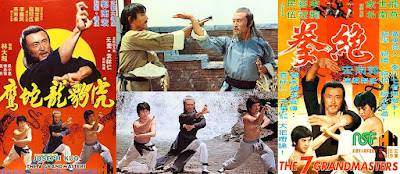
The Seven Grandmasters
Grandmaster Bash And
The Fu-rious Strive
The Seven Grandmasters
aka Jue quan
Taiwan 1977 Directed by Joseph Kuo
Eureka Masters Of Cinema Blu Ray Zone B
Well this is an interesting movie, for sure. I was gifted, this Christmas, with the new Cinematic Vengeance - Joseph Kuo Blu Ray boxed set from Eureka Masters Of cinema, something I wanted because... apart from some brief dalliances with some nice Shaw Brothers movies (and their artistic descendents) over the years... martial arts is not a genre of cinema I’ve followed that closely or bothered to educate myself much in. I guess I need to change that and this is my first stab at taking a look at this rich legacy, now being tackled by some of the UK boutique labels and slowly resurfacing from out of the back of pirate VHS and DVD-Rs which you could pick up in certain areas of London over the last few decades.
The Seven Grandmasters is a curious film as there is no pre-amble into it and a decidedly hasty exit from the story at the end. I mean, I’m used to many films starting with important sequences while the credits are playing but this one really is hasty, offering up what amounts to a dialogue sequence with the odd opening credit almost infiltrating it by stealth in what, to my Western eyes, seems a decidedly rushed manner.
This is not, however, a sign of questionable quality of the movie. Yes, it’s a low budget exploitation actioner but this in no way hides the fact that it’s a well crafted film which, I have to say, rarely gets boring. This one tells the story of a Grandmaster of Kung Fu who runs a fighting school. He is anonymously questioned/challenged as to his fighting credentials one day before he is due to retire. So he takes a few of his best students and starts touring China to challenge and fight various other Grandmasters to a friendly duel, one after the other, to reinforce his position so he can retire undefeated. So, yeah, within 20 minutes we have four spectacular fight scenes already. I don’t think there are actually seven Grandmasters in this but... maybe I was having trouble with my adding (to paraphrase a character from a completely different genre).
Thrown into the mix, Seven Samurai style, is a young man in almost a comic relief role, who desperately wants the master to train him... shunned but following around the small group until his charm and usefulness during trying circumstances leads to him being accepted as another student by the Grandmaster. After the one interminable training montage where the young man eventually exceeds the abilities of the other students, we come to a point where he finds out the master is the very man who killed his father... and has to try and kill him in a duel. But, soon after the duel starts, the real villain (a dead spit for Pai Mei in various other films... culminating in his Western film appearances in the Kill Bill movies) tries to kill them both and, between them, the two good guys conquer the villain before the film, without giving any pause or epilogue, just suddenly finishes.
And it’s quite brilliant in places (apart from the drawn out training montage, it has to be said). The influence of the fighting styles used in the film is easily evident in the number of big budget Hollywood movies which now seem to emulate this same stuff (I believe the fight choreographer from this one was tapped, many years later, to perform the same duties on The Matrix movies and it certainly shows in a lot of those kind of movies contemporary to it, too). So lots of dodging arms, legs and heads and the constant ‘resetting’ of fighting stances as adversaries struggle spectacularly to find an opening weak spot in their opponent’s defences. It’s good stuff.
The only real problem I had with it is in one in particular of the fights, which you seem to see in a lot of Hollywood movies showcasing Eastern culture these days. Yep, it’s the old ‘if you can take this bowl of tea (or insert whatever beverage or concoction is the focus of the scene) from me without spilling a drop’ style combat and it follows the same patterns and looks spectacular enough... except there was at least one point in the fighting that the tea bowl was clearly tilted through a 90 degree angle and held there for a few seconds... the bowl magically still full of tea in one of the next shots when, really, it shouldn’t still be there at all.
But yeah... it was a pretty good film. At first I thought the music was an original score and, indeed, it’s credited to Fu-Liang Chou. But there seems to be an awful lot of needle-drop cues in this thing as well. I couldn’t identify one piece which was clearly tracked in from a 50s or 60s, sleepy time American Western but it was certainly a dead giveaway when one of the main characters is introduced to the Grandmaster using the melody of one of the more comical tracks from Ennio Morricone’s score to The Big Gundown. So, yeah, that was definitely a ‘pop you out of the action’, finger point moment, for sure.
And that’s all I have to say about this one. For the most part I really enjoyed the movie although, it has to be said, there are no extras accompanying Eureka’s wonderful transfer of the pretty good looking print. Also, I got bogged down at the start by having a choice between watching it in Mandarin or Cantonese and, honestly, I had no idea which was the best one to watch. I just wish people would stop giving me choices on these things but, at least I knew enough to not watch the English dub, I guess. Although saying that, the English subtitles translated a character saying he’d just received a message via carrier pigeon, with no trace of irony despite the fact that I saw the message delivered myself and it was definitely sent by ‘flying dagger’, which I personally wouldn’t translate as carrier pigeon by a long shot.
So, yeah, loved The Seven Grandmasters and would definitely recommend this one to people who like the genre. I’m really glad to have received this set and I’m looking forward to exploring the other seven films in it. So I guess there will be more kung fu film reviews on the blog sometime soon.