Assisted Development
Without Knowing
Anything About Her
aka Senza Sapere
Niente Di Lei
aka Unknown Woman
Italy 1969 Directed by Luigi Comencini
Conway Films DVD Region 0
Warning: Full on spoilers of the slight plot and ending.
Back around 2002, a new Italian soundtrack CD label started up called Digitmovies. They’re still going but they don’t seem to have as much presence on the market as when they first started, it seems to me. One of the scores I bought from them in either the first or second year of their existence was a beautiful Ennio Morricone score for a film I’d never seen called Senza Sapere Niente Di Lei, which translates into Without Knowing Anything About Her and, from that moment on, it was in my CD player all the time for a good long while. It soon became one of my all time favourite Morricone scores, in fact... even though it’s quite minimal in content and had to be bolstered up by four tracks from an unrealised project on the same disc (which are also great, as it happens). I looked around to find the film but never could until, a recent* purchase of a disc of admittedly dubious origins. I don’t think this has had a proper subtitled commercial release alas. But it certainly needs the Blu Ray treatment because, honestly, it turns out that this is a truly beautiful and enthralling movie, even though not a heck of a lot happens.
It’s been touted by many as a giallo and, well, it’s not what we think of as a cinematic variant of the giallo film today for sure. This is another one which came out in that little five or so year period, just after Mario Bava had made a couple of giallo and just before Dario Argento cemented the stylistic tropes and the genre exploded on the big screen... and like films of that ilk such as The Sweet Body Of Deborah (reviewed here) and A Black Veil For Lisa (reviewed here), it’s more an echo of the original literary forms of giallo which were touted by publishers like Mondadori back in those days. So, I’m not taking a side on this one but if you’re expecting black gloved killers and lurid deaths then, you won’t find anything like that here.
Instead, what we have is a film where almost nothing happens at all but it’s just wonderful. It deals with an insurance investigator Nanni (played by Philippe Leroy) who is trying to prove that a woman who has died committed suicide, so his company won’t have to make a big pay out to the family (which is a plot you find a lot in these kinds of film and especially noir thrillers, although this movie is based on a novel, La morale privata by Antonio Leonviola). Before anything can be properly contested, though, he has to track down the youngest of the woman’s three daughters so all the family can be present. However, when he finally catches up with Cinzia (played by Paola Pitagora), the two fall in love and end up sleeping together. Alas, when Cinzia finds out he’s an investigator into her mother’s insurance claim, she slits her wrists in her bath. After Nanni nurses her back to health, the two continue thier love affair but things get a bit dark when, finally, she confesses to him that she actually performed an assisted suicide on her mum... but, by then, Nanni is already implicated legally in the case and so he needs to somehow prove both their innocence. Before he can do that, however, Cinzia drives their car into oncoming traffic and Nanni dies (while Cinzia is injured badly and may or may not pull through).
And it’s a slight story but it’s not about that. It’s about two absolutely blistering and well written performances of the male and female leads, some beautiful music and some absolutely fantastic shot compositions. Okay, so as to the performances... Philippe Leroy is absolutely amazing. He comes across at first as quite a timid character but he has a real strong and confident undercurrent... a real flesh and blood person brought to life with some amazing and subtle facial expressions which tell you everything about the mental state of the character in any specific shot. And he’s coupled with Paola Pitagora, who’s sensational in this and looks like Guido Crepax just drew her and she stepped out of one of his Valentina comics (in fact, why was this actress not tapped to play Valentina on film?). She’s breathtakingly gorgeous as the screwed up daughter who is completely confused by everything going on in the world around her and, honestly, I could just sit and watch these two actors chatting in character in a room or in a park for hours at a time. So I was kinda in luck when, it turns out, that a lot of the movie is... well, exactly that.
And as for the cinematography. Wow. The director and camera guy do that thing where they use vertical lines found in the environments to split the shots into segments to place the actors in but, they have a beautiful twist on this approach because the verticals are usually sitting on an angle thrown out by the perspective over a distance, which gives it an even fresher and out of kilter feel. They tend to push the angles and the verticals quite a lot in the movie. For instance, a shot of the two protagonists in bed opens a scene and they are at an angle with various verticals either side of them... it’s only when they pan left to a more straight view of the scene that you realise you were looking at the scene in a huge refection in an angled mirror taking up the majority of the opening of the shot.
Another great moment is when the two of them are talking in medium shot from opposite ends of a park bench angled slighty to the left and away in perspective from the camera. They are also sitting facing out from different sides of the bench... so you have Leroy sitting with his back mostly turned to us in the distance on the left of the screen and Pitagora in a more close up version with her face more or less angled towards the camera on the extreme right of the screen, which looks fantastic. And to top the shot off, there’s a vertical tree trunk in the background in the centre of the screen, splitting the two parts of the shot and giving each actor their own zone to perform in. It’s marvellous stuff.
Even when he’s dealing with loads of people in a room, the director finds a way to make the compositions dynamic. For instance, when four people including Leroy are standing in a living room in a line as they are talking, three of them taking up the right three quarters of the screen are all in one depth while a fourth guy, taking up the left quarter, is more in close up and shaking a cocktail... it all just gives a visual richness to the shots which are among some of the best compositions I’ve seen (which seems to be a key thing with Italian film and their gialli in particular).
The most clever thing he does, though, is to foreshadow the suicidal car crash of Cinzia at the tail end of the film. The audience is certainly aware from her body language and implied dialogue (not so, Nanni) that she is about to drive them both into oblivion when she asks if she can drive. We never see the car drive off and the accident is left entirely off screen other than a bit of the aftermath but as she goes to pull out, the next shot is a police car siren as it rushes to the presumed accident, the blaring, wailing sound acting as a surrogate for the shock of the unseen crash itself, and it’s brilliant... as the camera then cuts to a shot of Nanni’s lonesome hat and Cinzia’s abandoned handbag on the ground, thrown clear, somewhere away from the site of the wreck.
And that’s it. Although it’s light on action I would recommend Without Knowing Anything About Her to pretty much anyone I know. It’s a gentle and romantic film with two amazing performances and with absolutely astounding cinematography and music. It’s a crime that this movie has never had a proper UK or USA release in this day and age and this absolutely needs a subtitled Blu Ray print to come on the market. What a brilliant film. You need to see this one.
*Not that recent but, at time of writing, pre-pandemic.
Monday, 16 June 2025
Without Knowing Anything About Her
Tuesday, 3 May 2022
Danger Diabolik
Kant Get Enough
Danger Diabolik
aka Diabolik
Italy 1968
Directed by Mario Bava
Paramount Blu Ray Zone A
Warning: Light spoilers.
I thought, in light of the reboot movie released in Italy recently, I’d revisit one of my favourite comic book movies, Danger Diabolik, based on the famous, long running fumetti Diabolik by sisters Angela and Luciana Giussani which, as far as I know, has not been translated for an English audience. The comic book followed in a long line of lionised fictional super-criminals which seemed more abundant in countries like France, Germany and Italy than they did over here in the UK or in the US. I suspect the character was more than a little inspired by the original Fantomas, for example and there were a few attempts to get Diabolik started as a film by producer Dino De Laurentiis, with actors like Jean Sorel and Catherine Deneuve in the roles of Diabolik and his super sexy girlfriend Eva Kant, before he finally got the great Mario Bava to direct the movie.
So this version stars John Philip Law as the master criminal (who was also working on Barbarella for the same producer at the time), the marvellous Marisa Mell as Eva Kant, the great Michel Piccoli as Diabolik’s nemesis police Inspector Ginko, Adolfo Celli (who played Bond villain Largo in Thunderball) as mob boss Valmont and, in a few scenes scattered throughout the film in what is more or less an extended cameo, comical British actor Terry Thomas (who was so much in demand at the time that he shot all his scenes in one day).
Although Diabolik does not come over as ruthless, perhaps, as he did in the early comic books, he’s still going around killing innocent people who get in the way of his headline grabbing crimes and, although you’re always on his side as much as Ginko’s, he does tend to do some typical Robin Hood style acts of terrorism along the way. For instance, when a new police commissioner puts out a one million dollar reward for his capture, he sends him a note saying that he does not believe using this sum of money as an enticement to his capture is in the interests of the regular taxpayer... and then proceeds to blow up all the tax offices in the district so that people no longer have to pay any income tax, since the government has no records left to figure out what anybody owes to anyone.
The film is beautifully directed and, because Dino chose Bava to direct it, looks stunning. Bava uses some of his standard modi operandi to split the shots with foreground objects such as book cases, windows and bars to compartmentalise his actors and uses ‘natural inserts’ such as reflections in a rear view mirror in a car to add interest to the shots (and possibly as a wink to the comic book origins of the character, almost as if he’s presenting the audience with a bunch of comic book panels on the page). Although his colouring in the film isn’t as bright as the neon primary hues he uses in a lot of his films, it’s still a pretty colourful affair with the odd Bava trademark colour collision thrown in, such as a psychedelic night club party sequence, enhanced by Ennio Morricone’s swinging score or, in the pre-credits sequence where Diabolik uses a smokescreen to steal a car carrying a large amount of money, using three jets of orange, purple and green smoke injected into the mix. And when Diabolik has to climb up a pale castle tower in the moonlight, he changes from a black catsuit to a white one to better blend in with the environment.
Bava also uses his lens to really build an iconic status around the characters of Diabolik and Eva, with everything they do in their ‘larger than life’ sets and locations (including a super-villain’s lair which would make Bruce Wayne green with envy) enhanced to the point where almost every shot they are in becomes an artificial, attention grabbing statement of the importance of their respective characters. For instance, Diabolik is not introduced as a person initially, but as his two seat Jaguar car, which invades the proceedings in the pre-credits with a Morricone musical stinger and which becomes almost an apex predator to the poor, bumbling policemen who are trying to protect the money... and when Diabolik’s masked, iconic visage is seen, he is giving a proper super-villain laugh before he dives into the sea, along with the money, as the brilliant title song ‘Deep Down’, sung by Christy, cuts in with swirling credits before we rejoin him racing off in his speedboat, hotly pursued by police helicopter.
Now, there are a lot of wonderful, jokey comic book style sequences in the movie, such as when Valmont promises to cross a character’s name off the human register and then later, indeed, making an X shape with the path of his machine gun as he guns the victim down. And there’s that sumptuous villain’s lair with it’s huge, pipe organ alarm system and, of course, everything is enhanced with Bava’s miniatures and matte paintings to make everything look much bigger than it really is. He even adds in a couple of animated sequences to bring the comic book comparison closer in a couple of scenes.
The film has often been called campy but, with the hard edge of various characters, not forgetting the dark criminal heart of Diabolik himself, it really isn’t. There are, however, a couple of similarities, it could be said, to the landmark Batman TV show and film from a couple of years earlier. Most notably when Diabolik and Eve, disguised as press photographers, use laughing gas dispersed by their flash bulbs to infect a police press conference with a very lively atmosphere. So... in very much the Batman style... the gas is actually labelled up as Exhilarating Gas and the pills which Diabolik and Eva take to protect themselves, are similarly labelled up as Anti Exhilarating Gas Capsules.
If I had to pick a favourite moment, in a film which is full of little ingenious and light hearted gags, it would be when the title character places himself under a security camera, takes a shot of the room with a polaroid camera and them places the photo in front of the camera so the room looks empty. Preposterous, of course, since it would probably be completely out of focus but, in the setting of a comic book milieu which is further heightened by the visual genius of Mario Bava, it works really well.
And I suppose that’s me done with Danger Diabolik, for now, although I am hoping to watch the new version over the next week or so and so, I will review that one for the blog soon (yeah... I did just that, review coming tomorrow, stay tuned). Meanwhile, if you haven’t figured it out by now, Danger Diabolik is a movie I’m always going to recommend to any lover of cinema and well worth your time.
Monday, 14 February 2022
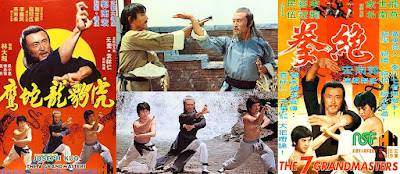
The Seven Grandmasters
Grandmaster Bash And
The Fu-rious Strive
The Seven Grandmasters
aka Jue quan
Taiwan 1977 Directed by Joseph Kuo
Eureka Masters Of Cinema Blu Ray Zone B
Well this is an interesting movie, for sure. I was gifted, this Christmas, with the new Cinematic Vengeance - Joseph Kuo Blu Ray boxed set from Eureka Masters Of cinema, something I wanted because... apart from some brief dalliances with some nice Shaw Brothers movies (and their artistic descendents) over the years... martial arts is not a genre of cinema I’ve followed that closely or bothered to educate myself much in. I guess I need to change that and this is my first stab at taking a look at this rich legacy, now being tackled by some of the UK boutique labels and slowly resurfacing from out of the back of pirate VHS and DVD-Rs which you could pick up in certain areas of London over the last few decades.
The Seven Grandmasters is a curious film as there is no pre-amble into it and a decidedly hasty exit from the story at the end. I mean, I’m used to many films starting with important sequences while the credits are playing but this one really is hasty, offering up what amounts to a dialogue sequence with the odd opening credit almost infiltrating it by stealth in what, to my Western eyes, seems a decidedly rushed manner.
This is not, however, a sign of questionable quality of the movie. Yes, it’s a low budget exploitation actioner but this in no way hides the fact that it’s a well crafted film which, I have to say, rarely gets boring. This one tells the story of a Grandmaster of Kung Fu who runs a fighting school. He is anonymously questioned/challenged as to his fighting credentials one day before he is due to retire. So he takes a few of his best students and starts touring China to challenge and fight various other Grandmasters to a friendly duel, one after the other, to reinforce his position so he can retire undefeated. So, yeah, within 20 minutes we have four spectacular fight scenes already. I don’t think there are actually seven Grandmasters in this but... maybe I was having trouble with my adding (to paraphrase a character from a completely different genre).
Thrown into the mix, Seven Samurai style, is a young man in almost a comic relief role, who desperately wants the master to train him... shunned but following around the small group until his charm and usefulness during trying circumstances leads to him being accepted as another student by the Grandmaster. After the one interminable training montage where the young man eventually exceeds the abilities of the other students, we come to a point where he finds out the master is the very man who killed his father... and has to try and kill him in a duel. But, soon after the duel starts, the real villain (a dead spit for Pai Mei in various other films... culminating in his Western film appearances in the Kill Bill movies) tries to kill them both and, between them, the two good guys conquer the villain before the film, without giving any pause or epilogue, just suddenly finishes.
And it’s quite brilliant in places (apart from the drawn out training montage, it has to be said). The influence of the fighting styles used in the film is easily evident in the number of big budget Hollywood movies which now seem to emulate this same stuff (I believe the fight choreographer from this one was tapped, many years later, to perform the same duties on The Matrix movies and it certainly shows in a lot of those kind of movies contemporary to it, too). So lots of dodging arms, legs and heads and the constant ‘resetting’ of fighting stances as adversaries struggle spectacularly to find an opening weak spot in their opponent’s defences. It’s good stuff.
The only real problem I had with it is in one in particular of the fights, which you seem to see in a lot of Hollywood movies showcasing Eastern culture these days. Yep, it’s the old ‘if you can take this bowl of tea (or insert whatever beverage or concoction is the focus of the scene) from me without spilling a drop’ style combat and it follows the same patterns and looks spectacular enough... except there was at least one point in the fighting that the tea bowl was clearly tilted through a 90 degree angle and held there for a few seconds... the bowl magically still full of tea in one of the next shots when, really, it shouldn’t still be there at all.
But yeah... it was a pretty good film. At first I thought the music was an original score and, indeed, it’s credited to Fu-Liang Chou. But there seems to be an awful lot of needle-drop cues in this thing as well. I couldn’t identify one piece which was clearly tracked in from a 50s or 60s, sleepy time American Western but it was certainly a dead giveaway when one of the main characters is introduced to the Grandmaster using the melody of one of the more comical tracks from Ennio Morricone’s score to The Big Gundown. So, yeah, that was definitely a ‘pop you out of the action’, finger point moment, for sure.
And that’s all I have to say about this one. For the most part I really enjoyed the movie although, it has to be said, there are no extras accompanying Eureka’s wonderful transfer of the pretty good looking print. Also, I got bogged down at the start by having a choice between watching it in Mandarin or Cantonese and, honestly, I had no idea which was the best one to watch. I just wish people would stop giving me choices on these things but, at least I knew enough to not watch the English dub, I guess. Although saying that, the English subtitles translated a character saying he’d just received a message via carrier pigeon, with no trace of irony despite the fact that I saw the message delivered myself and it was definitely sent by ‘flying dagger’, which I personally wouldn’t translate as carrier pigeon by a long shot.
So, yeah, loved The Seven Grandmasters and would definitely recommend this one to people who like the genre. I’m really glad to have received this set and I’m looking forward to exploring the other seven films in it. So I guess there will be more kung fu film reviews on the blog sometime soon.
Sunday, 5 December 2021
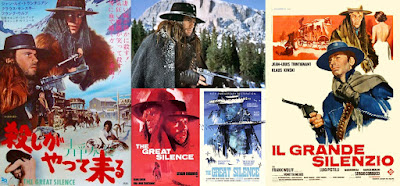
The Great Silence
Silence Still Golden
The Great Silence
aka The Big Silence
aka Ill Grande Silenzio
Italy/France 1968 Directed by Sergio Corbucci
Eureka Masters Of Cinema Blu Ray Zone B
Warning: Spoilers because, of course, you can’t
discuss a great work of cinema like The Great Silence
without talking about the amazing ending of the movie.
“They call him silence because wherever
he goes the silence of death follows.”
Vonetta McGee, Ill Grande Silenzio
The Great Silence is one of those films which will always be in my top two or three all time favourite Italian Westerns. I already talked about it a little in my 2013 look at some of the most powerful endings in cinema history, End Game (which you can read here if you so desire)... but I thought it was time to do a ‘clean review’ with the advent of the Eureka Masters Of Cinema label’s brand new restoration Blu Ray release because, well, the film has never looked better. Perhaps it’s even a little too good looking but... I’ll discuss that comment in a minute.
Now, mainly I suspect because of the films powerful and cynical ending, the film was not shown in some countries, such as the US and here in the UK, for a couple of decades. Banned maybe too strong a word for it in retrospect but, it was certainly stifled at birth as far as English speaking countries go... even though the majority of the actors in this one are lip synching (kind of) in English and the original English dub was made and thankfully still exists (which is probably the best choice to watch this on, given it's the language being spoken on set, which was also an unusual thing for an Italian western... where everybody usually just spoke their native language from whichever country they were born). So my first experience of this remarkable movie was when director Alex Cox showed it on his weekly film series Moviedrome in 1990, under the title The Big Silence... which I believe was the first ever screening in this country.
The plot is simple. A bunch of outlaws who are not really bad, just in unfortunate circumstances created by the officials in the town of Snow Hill and its environs, are being hunted by ruthless Bounty Killers and being shot dead for the reward, whether they give themselves up or not. One of these, Loco (as he is known on the English dub), played by the great Klaus Kinski, is doing a lot of damage to their poor, outlaw community who are hiding in the mountains. A new Sheriff, played by Frank Wolff, is sent to Snow Hill to pave a way for an amnesty for the outlaws. Something not wanted by Loco and the town’s banker Pollicut (who pretty much runs the place), played by Luigi Pistillo. But the so called outlaws have hired the great, law abiding assassin/hero Silence, played by Jean-Louis Trintignant, to help rid them of some of the bounty killers. And then, when Loco lawfully but unjustly kills the ‘outlaw’ husband of a local lady, played by Vonetta McGee, she herself hires Silence to put an end to Loco but, as anyone who’s seen this knows, things don’t play out as they would in a more formulaic spaghetti western, for sure.
Silence has his own reason to hate Pistilli’s character, as he slit his throat as a young lad to stop him from telling of the ‘murder for bounty money’ killing he took part of when murdering Silence’s parents in front of him. I don’t know how slitting the boys throat kept him from talking, since it’s clear Silence can still read and write but, yeah, this is perhaps the real reason he’s called Silence at any rate, in contradiction to that wonderful quote from Vonetta McGee’s character, which I put at the top of this review. Well, that and the fact that Trintignant couldn’t speak English.
Another thing about the character is that he carries an automatic weapon, a German Mauser (a 7.63mm Mauser C96 ‘Broomhandle’ version) in this, which is not a common thing for characters in Spaghetti Western cinema and which most people assume is an anachronism, although these pistols were actually first manufactured two years before the setting of the film... so this overlap with ‘the old West’ is actually distinctive but quite valid. I seem to remember Corbucci’s next Western, Il Mercenario, also has a main protagonist carrying an automatic pistol.
The film is beautifully shot with Corbucci and his cinematographer doing some nice things with the camera. In one shot, for instance, he uses the vertical slats of a prison cell to shoot through to delineate the space on screen and highlight characters in two rectangles... before moving in to highlight just one character, changing the focus as he does so, so that the bars blur out and disappear. It’s almost shot entirely in the snow too (and a lot of shaving foam, by all accounts)... which is unusual for a Western, to have it in a snowbound setting (although it’s not the only one). The director, who was responsible for a fair few good westerns originally wanted to shoot his classic Western Django in the snow but was turned down by the producers (hence, they ended up with a film shot in the mud, a bit like the last 20 minutes or so of Kurosawa’s Seven Samurai). However, Django was successful enough so that, by the time he got to making this movie, he was allowed his snow. And the print and transfer has never looked better but, as I intimated earlier, I’m not sure if the transfer it totally correct. The reason I say this is that in all versions of the film I’ve seen before, including screenings at cinemas, there were a few shots here and there at the start of the movie where a kind of MoirĂ© pattern covered the entire shot. Some people have said this was caused by light reflecting on the lens but I don’t see how a simple light reflection could produce that kind of look. I don’t know what caused it and it seemed totally a non-sequitur to the visual continuity of the movie but it was strong enough that I always believed it was a patterned filter put over the camera for certain shots (don’t ask me why). In this new transfer, that patterning is almost entirely absent other than in part of a shot where it’s quickly glimpsed so... yeah... is this from a better source or has this been removed in the transfer process after the fact? The answer is... I don’t know but if anyone does, then please message me via the comments section at the bottom of this blog.
Asides from the wonderful cinematography, there are three other great strengths inherent in The Great Silence. The first one I should mention is that the performances by the wonderful cast are all excellent. Trintignant’s Silence is a powerful, silent figure and McGee is wonderful as the wronged spouse who falls in love with him, after hiring him to kill Loco. Kinski is absolutely wonderful when he’s playing a villain anyway (as he often did). The weasel face contradicted by the big, blue puppy dog eyes are the perfect look for a villainous presence on screen but the film is full of little acting details which go the extra mile, such as when Kinski licks his lead pencil before totting his kills up in his notebook. The supporting cast of Luigi Pistilli and Frank Wolff are wonderful too, with Wolff playing somewhat against type to play the likeable, truly honourable sheriff character (something you couldn’t say about a lot of sheriffs in Italian Westerns for sure). It struck me for the first time while I was revisiting this film again, when they shared a scene or two together, that Pistilli and Wolff both went on to kill themselves in real life (Wolff just three years after making this movie and Pistilli in 1996).
Asides from the acting, another big strength of the movie is the late, great Ennio Morricone’s amazing and sparsely spotted score. There’s not a huge amount of it (indeed, the 35 minutes that have been released on CD in the past is pretty much the entire score, from what I can make out) but it’s got a wonderfully elegiacal tone and is full of addictive melodies. This means it’s one of those movies to which I am constantly tapping my toes in time as I watch it, which is no bad thing.
Lastly, of course, there’s that ending. Big spoiler for this and don’t read this if you’ve not seen it and want to... you need to go in blind...
At the end of the film, Loco and his gang of evil bounty killers shoot Silence’s hands up, parodying Silence’s trademark move of shooting off the bad guy’s thumbs so they can’t use a gun against him. They then shoot him dead, then shoot dead his new girlfriend who hired him... and then massacre the roomful of innocent ‘outlaws’, men and women, who they have tied up to the bar in the saloon... “all in accordance with the law” as Loco remarks... and he and his group of truly evil bad guys ride off into the snow to commit evil deeds elsewhere. It’s a powerful ending and one which will surprise most first time watchers. Especially since the dialogue is peppered with foreshadowing throughout the film, highlighting the more expected ending of Loco getting his just and bloody desserts at the hands of the film’s main heroic protagonist, Silence.
The new Eureka Masters Of Cinema is definitely one to get for any fans of the movie. Transfer aside it’s loaded with amazing extras... some of which are legacy from other companies’ releases over the last 20 or so years and others which are brand new (to me at least). Everyone who has one of the previous releases will remember, for sure, the silent alternate ending scene, with the preposterous return of Wolff’s character (somehow alive after being dropped and sucked under a frozen lake) and the armour gauntlet reveal of the lead character... where Loco is indeed killed and the good guys have a happy ending. This release does this one... or two... better in that, in addition to Alex Cox’s commentary on the alternate ending, the non-commentary version of this actually now has the sound restored. So you can hear the original Italian dialogue (subtitled in English) for this silly scene. Not only that, but they’ve unearthed another alternate ending, which they call the ‘ambiguous’ ending and, honestly, it’s like a cut down version of the original ending where, by the ommission of most of it, Silence is wounded and everyone remains alive but so do the bad guys, who decide to just leave everyone alone and get out of there... or that’s what it seems like. I’ve no idea what we’re supposed to make of that version, to be honest.
But there’s more, including various behind the scenes featurettes, archival documentaries and also some new talks, including a wonderful fifteen minutes by Alex Cox himself. And, although I haven’t had a chance to explore these yet, there are three commentary tracks on here, including a recording of a live commentary that Alex Cox gave at a screening earlier this year (which I most certainly do need to listen to, for sure).
And that’s me done on The Great Silence. One of the all time greatest Westerns ever made (if you watch it with the proper, original ending) and an absolute joy from start to finish. Everyone who is interested in Western cinema should give this one a watch and I would recommend this one to pretty much everyone. And don’t snooze on the new Ltd Edition Blu Ray from Eureka Masters Of Cinema, which also has reversible artwork, a nice slipcase, a set of miniature, reproduction lobby cards and a double sided poster. A wonderful purchase and the most definitive release this film has ever had, I would say.
Tuesday, 26 January 2021
Ennio Morricone In His Own Words
Absolute Applications
Ennio Morricone In His Own Words
by Ennio Morricone and Alessandro De Rosa
Oxford University Press ISBN: 9780190681012
Just a brief review of a very valuable book in the annals of musical history, which I’m sure I won’t do anything like full justice to but, I hope it will give interested parties enough of a flavour to pursue this magnificent tome themselves.
I’ve been lucky enough to see Ennio Morricone conduct concerts of his works in London around five or six times in my life. They are always a treasured experience and each time I attended it just compelled me to re-explore his back catalogue of music. Alas, the great man died back in July so I won’t again have the pleasure of seeing him live ever again but, I guess I knew that anyway as his last concert tour, from a few years ago, was pretty much promoted as his farewell set of concerts.
This manuscript, Ennio Morricone In His Own words, a 2019 English translation of a 2016 book, is a wonderful exploration of the composer which is a transcription of conversations taking place between Morricone and a young composer/freelance musician named Alessandro De Rosa.
Now, I usually find “In their own words” style books to be either just a tonne of bite sized quotes organised under theme or as much about the author compiling things as it is about the subject. I’m delighted to say that neither case is true in relation to this tome. These are genuinely long transcriptions of conversations between the two men with De Rosa deliberately taking the back seat and asking the right kind of provocative questions to allow Morricone to do the lion’s share of the book... often while the two are playing chess. That’s something I learned from this book for a start... Morricone was a keen and evidently excellent chess player, even subscribing to several magazines and playing in the odd tournament. He mentions very early on in the book (possibly even on the first page) that he sees strong links between music and chess notation.
Now I’ve always found this amazing composer to be somewhat arrogant when I’ve read quotations by him in various programmes or articles over the years but, this book firmly dispels that idea (along with a lot of others). Rather than being arrogant, I gather that Morricone is merely shy (as am I and that’s often perceived as a certain aloofness in other people, although a certain ‘special’ lady friend of mine would not recognise that trait in me, for sure) and genuinely honest about himself and this can sometimes come across as an unfortunate attitude when taken out of context. Which is another reason why this book is so good. I realise that Morricone was a thoughtful man and although, as I said, honest... I sense a reluctance to tackle certain issues due to his respect for the wishes and beliefs of others.
And I learned some really interesting stuff such as, despite often being perceived as not finding value in his work with the great Sergio Leone, he regarded that relationship as very special and cherished their continual friendship both on and off the job. There’s a heartbreaking anecdote in here about when and how he heard that Leone was dead, when they were due to meet up again very soon.
One thing which I’ve been trying to find out for years was just what was the great rift, often alluded to on most writing about his work, that occurred between him and Bruno Nicolai (who made up quite a good team of composers, conducting each others works and also collaborating on compositions in Morricone’s early years). It turns out, if Morricone is to be believed and I’ve no reason not to, that Nicolai was a great friend and they didn’t have any kind of falling out at all, just decided to part ways to retain their own individual styles... or at least retain the public perception of it (if I am understanding correctly). Morricone goes on record that he misses him (Nicolai died in 1991 but he did some remarkable scores in his time).
And, of course, he talks a lot about music. The inspiration, the experimentation and the difference between what he calls applied music (music created to serve another medium such as film, theatre, ballet etc) and what he calls ‘absolute music’, which is technically free of the bounds of certain rules (and equally the special creativity which comes as part and parcel of those restrictions, I would say). I am very glad to see that he doesn’t (like many critics seem to adhere to, as a belief about music they don’t understand or get on with in the arena of film) see his applied music really as any way of lesser value than his other stuff. Indeed, his thorough experimentation with music as heard in both styles of composition and the fact that he imposes his own limits in his writing for both forms anyway, certainly shows the similarity of the DNA in terms of the fact that he was always writing for an audience... even if that audience was himself.
And, yeah, not too much more to say about Ennio Morricone In His Own Words. I said up front that this would be a brief review but the quality and thoroughness of the events, details and periods explored in these conversations is so rich and varied that, frankly, this is the closest thing you can get to a genuine autobiography by the man, I believe. As such, it’s a valuable addition to anybody interested in film music and, towards the end where the conversations get quite technical in terms of the art (it kinda lost me a little in the last fifth of the book because I have no musical training), I think it’s also has a lot of value for modern composers in relation to where Morricone’s own experiments with music took him. This one gets a big, solid recommendation from me and I was certainly as enlightened by the contents as I was entertained. A true window into the mind of one of the greatest composers of the 20th/21st century.
Sunday, 26 July 2020
The Thing (1982)
The Thing Man
The Thing
USA 1982 Directed by John Carpenter
Arrow Ltd Edition Blu Ray Box Blu Ray Zone B
Warning: Man is the warmest place to hide huge spoilers if you’ve not seen this movie.
I’ve already said that, out of all three movie versions of John W. Campbell Jr’s novella Who Goes There?, my favourite version is always going to be the 1951 adaptation, The Thing From Another World, (reviewed here) regardless of the inaccuracies to the source material... which is something they are all guilty of, one way or another although, I think the prequel to this movie might actually be closer in some ways, ironically. That being said, I absolutely love John Carpenter’s The Thing and it’s nothing short of a modern horror classic. I can’t believe it was such a huge flop when it released in the summer of 1982 and I find it hard to understand the critical attacks on it. This film, like many of those released that summer, gave us things we hadn’t seen before on screen and, certainly, this is something which I think has had a huge influence on modern horror directors.
Starting with a saucer flying down to the earth, Carpenter then goes out of his way to replicate the title card of the original movie (minus ‘from another world’ obviously, which in itself was only added to the original to distance it from a comedy, novelty song of the time). We then start the film proper with a low, pulse rhythm which is absolutely reminiscent of most of Carpenter’s other scores but was also composed by Ennio Morricone. Actually, the music in this is one of those huge mystery puzzle pieces to the layman like me as not all of the score was retained (some of it turns up in Tarantino's The Hateful Eight), some of it not used in its final form and some was composed by Carpenter himself.
We see a Norwegian helicopter chasing a dog in Antarctica, trying to shoot it to slow it down so the occupants can blow said dog up with a stick of TNT. The dog makes it to safety as we are introduced to the personnel of the American base camp and this includes the only female presence in the movie... the voice of MacCready’s Chess Wizard computer voiced by Carpenter’s then wife, Adrienne Barbeau. Her inclusion is short lived because, when the computer wins at chess, MacReady pours the rest of his J&B into the machine and it dies a death as he comments, “Cheating bitch!” I don’t know if Carpenter was already, at this time, having problems with his marriage but, if he was, this seems like a perfect line for him to express himself with. I really like Barbeau myself and am looking forward to reading her autobiography soon.
As the dog makes it to the base, we get the whole team out there and the Norweigans come to a sticky end, one by a bizarre, clumsy accident which destroys him and his helicopter and the other, by the base commander shooting him through the eye, after the intruder accidentally wounds one of his men. We have the one and only Kurt Russell playing the main protagonist/anti-hero MacReady and he is ably supported by a full ensemble cast of Wilford Brimley (Blair), T.K. Carter (Nauls), David Clennon (Palmer), Keith David (Childs), Richard Dysart (Copper), Charles Hallahan (Norris), Peter Maloney (Bennings), Richard Masur (Clark), Donald Moffat (Garry, yes that’s right folks... REM from the Logan’s Run TV show is in this), Joel Polis (Fuchs) and Thomas G. Waites as Windows. This really is an ensemble piece here although, when MacReady is forced to take charge of the situation later, it becomes clear that this is his film.
And it’s got the whole, lurking paranoia and trust issues that was a hangover from the original source material, mostly absent from the 1951 classic (of which, from what I understand, Carpenter is a huge fan). It’s also got some really unusual and surreal gory, alien transformation effects as various people are assimilated or attacked by The Thing throughout the movie. Including what I should probably call ‘the split head dog’ scene and the eye popping moment when the doctor is trying to revive one of the men with a defibrillator and the whole stomach caves in, revealing teeth which bite both his arms off. Also that wonderful moment when the head pulls itself off of a body, sprouts big spider legs and eye stalks... and tries to sneak out of the room past the others.
The make up effects were primarily spearheaded by the very young and enthusiastic Rob Bottin, who had worked with Carpenter previously on The Fog (which I reviewed here). I understand he put so much into the opportunity that he was hospitalised with stress sometime into the shoot but, when you look at what he and his effects crew achieved here, it’s nothing short of remarkable and, surprisingly, there’s not a heck of a lot like it out there in movies since (although, obviously, the prequel rightly took a page out of the same book, if memory serves). It’s pretty much exactly the kind of twisted, organic look you might imagine when reading an H. P. Lovecraft story... it’s surely the closest we’ve had to an actual manifestation of Cthulhu like namelessness on screen. It’s been said that Campbell’s original story was influenced by the classic Lovecraft tale At The Mountains Of Madness but, I think that’s probably not all that accurate if you’re comparing the story content dispassionately and I’m not 100% sure if Campbell ever went on record as saying that, to be honest.
Carpenter pays homage to the Christian Nyby version of the tale when he has MacReady go over to the Norweigan base camp to find the aftermath of the people who have already been ‘Thinged up’. He finds the big, thawed out block of ice (no idea how the Norweigans got it through the door but maybe I missed something on the interiors) and when they check out the videotape footage of their ‘discovery’ later, lots of the shots are silent, restaged versions of the crew in the 1951 version discovering the saucer. However, what Carpenter also cleverly does... because the grotesque aftermath of the camp and what they find there occurs before the dog-splitting scene... is to ramp up the tension by showing the audience the kind of ride they are soon going to be in for themselves. Make no mistake, this is a master of horror at the top of his game here.
And I won’t spoil anything else for you but, suffice it to say, the 1982 remake/adaptation is just as essential viewing as the original is. Fans of cinema truly need to see both versions. The limited edition Arrow Blu Ray box has a nice slipcase, posters, booklet and cards but I’m assuming the non-limited edition which is still around also has the same Blu Ray extras. There are a lot of those on here too and I haven’t watched them all as yet but, one of note would be a new documentary which details, not just the making of this version but also the original story and the making of the 1951 version. Another featurette lasting just under a half an hour tries to shed some small light on just why The Thing might have been ‘lost in the woods for the trees’, so to speak, by highlighting many of the incredible, modern classics of cinema that were released around the same time... so stuff like Conan The Barbarian, Star Trek II - The Wrath Of Khan (reviewed here), Blade Runner (reviewed here) and the horrible horrribleness that was E.T. - The Extra Terrestrial. There’s even a FrightFest short from one of the previous years which is a mini, twisted version of the famous ‘wire in the blood’ scene from John Carpenter’s The Thing. It’s a nice transfer of the movie too, obviously and... all in all... tremendous value for money for one of the all time classic pieces of early 1980s cinema. Always worth a watch and the Arrow Blu Ray is definitely the way to go. There’s no thing like it.
The Thing at NUTS4R2
The Thing From Another World (1951)
The Thing (1982)
The Thing (2011)
Sunday, 21 June 2020
It Couldn't Happen Here
Happiness Is
A Warm Nun
It Couldn't Happen Here
UK 1987 Directed by Jack Bond
BFI LTD Edition Book Version
Dual Blu Ray Zone B/DVD Region 2
Earlier this week the British Film Institute released this limited edition of the Pet Shop Boys’ feature film, It Couldn't Happen Here... and I bet they wish they’d manufactured more because the thing sold out in less than a week, by the looks of it. I’m glad I pre-ordered mine though and if you want to see the film but were too slow to hit the order button, they have announced they will be releasing a standard edition later in the year. I grabbed this one because I remember I really liked it at the time and it stirs up a few memories.
I was into the music of the Pet Shop Boys back then and, in particular, their second album Actually, which was released in 1987 (the same year that this film previewed at the London Film Festival). A lot of the songs in this movie come from that album and I was interested in seeing just how you put visuals to these works. My memory is a little hazy on these things (being as it was so long ago) but I think I first saw it at my local ABC/Canon/whatever cinema it was, just around the corner from me in Enfield, when it was released theatrically in 1988. I can’t remember if my best friend Kerry was with me at that screening or if I showed him the VHS tape a year or two later but, I remember he must have liked it a little because he kept reciting one of the lines used by Gareth Hunt in the movie to repeatedly irritate those around him... “Ha, ha, ha! Only a laugh, no harm done.” Kerry also used it like this and I enjoyed him slipping it into conversation with people who had no idea what he was quoting.
Anyway, the film was... and still is for that matter... at least in some ways, a typical ‘pop star movie’. Only a tenuous story at best (or not really at all in this case) as the stars are put in situations where they get caught up in little episodes with people and get to sing their songs. You know the score... films like A Hard Day’s Night (The Beatles), Head (The Monkees) and Spice World (the Spice Girls)... all of which I admire for different reasons but, yeah, you can certainly tell a pop promo style musical.
Here we also have the usual load of star actors supporting our heroes... Tennant and Lowe... as they wander aimlessly through a series of pop video styled visuals and keep us, hopefully, entertained for the length of the feature. In this one we have people like the aforementioned Gareth Hunt (who was famous in the UK for playing Gambit in The New Avengers), Neil Dickson (playing a World War I fighter pilot, similar to his turn a few years earlier in Biggles), Joss Ackland (well he gets in everything) and the one and only Barbara Windsor. What a Carry On.
There’s also a big side helping of quite deliberate surrealism underlying the film, in a way which only Head (out of those examples above) shares with it in intent. It’s distinctly British and it belongs to what I would call a certain kind of ‘almost golden’ era of British cinema which I sometimes refer to as... the Palace Pictures era. If anything, the film kind of has the atmosphere and visual density in some parts, of the kind of films directed by Peter Greenaway around the same time. In fact, if somebody asked Greenaway to make a movie to a bunch of pop songs, I can’t help thinking that he might have come up with something similar to this - the two zebra men leading the zebra around, the free moving ventriloquist’s dummy waxing lyrical about the nature of time and the not entirely inevitable creation of tea cups, the nuns with their suspenders and garters who strip off and do a lovely dance to the hit song It’s A Sin (one of a few in the film choreographed by Strictly Come Dancing star and Hot Gossip choreographer Arlene Philips), a man going about his day but on fire and, of course, Joss Ackland as a blind priest/serial killer getting away with, as only he could by this point, telling the old nymphomaniac who only gets turned on by Jewish cowboys joke.
And it’s of its time. There’s lots to look at if you don’t mind the sometimes pretentious use of Tennant’s lyrics recited by him straight on the voice over narrative but delivering it in his distinctive style. For instance, in the performance of the hit song by the Pet Shop Boys with Dusty Springfield, What Have I Done To Deserve This?, we have Neil Tennant on the phone with Barbara Windsor miming to Dusty’s singing and, at one point, she’s spinning around in front of the camera on a swivel chair. This is cross cut with the telephone box that Neil Tennant is making the call from also spinning around in front of the camera and it’s the kind of shot where you might not at first click what’s going on until you realise it’s not the camera moving... it’s the people and their props. Effective and interesting stuff like this certainly helps you forget the lack of substance to the content of the film and both the Pet Shop Boys hold up pretty well in this movie... especially when you consider the wealth of acting talent they’ve surrounded themselves with in this film. It’s also very colourful and I can’t help think but the film must have played really well when it was screened at the old Scala Cinema at Kings Cross at the time. I think Tennant, at least, was a semi-regular attendee at some of those outrageously off kilter Scala double bills (which I talk about a little in my review of Jane Giles book on the Scala here) and one wonders if some of that atmosphere and sensibility was injected both into his music and, certainly, into this movie.
And that’s pretty much all I have to say about this one except the limited edition packaging of the film by the BFI is pretty nicely done, with both the Blu Ray and DVD discs housed in a hardback book which comes out from the bounding slipcase and which features a fair amount of essays on the film and the people behind it. There’s also a round of extras (as yet unwatched by me) which include the pop video, partially culled from this movie, for the hit Pet Shop Boys song cover version of Always On My Mind and an interview with dance choreographer Arlene Phillips. My one regret is that there’s no extra feature on the music of Ennio Morricone, who collaborated with Tennant and Lowe on the song which gives this movie it’s title. Nobody ever seems to mention this and I remember accidentally discovering his name included in very small print on the Actually CD when it came out but... with absolutely no fanfare. Strange that. Anyhow, It Couldn’t Happen Here maybe looks a little dated in places but it’s a great film for capturing a certain time and feel of British cinema. If you’re old enough to remember that time... or if you’re a Pet Shop Boys fan obviously... then you should have a good time with this movie, actually.
Wednesday, 5 February 2020
A Fistful Of Dynamite
How Would He Duck?
A Fistful Of Dynamite
aka Duck You Sucker
aka GiĂ¹ La Testa
aka Once Upon A Time... The Revolution
Italy/Spain 1971 Directed by Sergio Leone
Eureka - The Masters Of Cinema Blu Ray Zone B
Warning: Slight spoilers if you’ve never seen this one.
Okay, so let’s talk about Duck You Sucker or, these days perhaps it’s better known by one of its other many names, A Fistful Of Dynamite. This is a beautiful new Blu Ray release from Eureka which my friend and I both got for each other at Christmas. A two disc special edition of what is, essentially, my favourite ever Western movie (occasionally alternating with this director’s previous film) and the last Western ‘officially’ directed by Sergio Leone... the next film directed under his own name, after a long interval, would be his swan song, the absolutely brilliant Once Upon A Time In America.
The plot is very simple but told in an entertainingly convoluted way. A Mexican bandit name Juan, played by Rod Steiger as an almost parody of the director (who I seem to remember he didn’t get along with during production) inadvertently teams up with an IRA terrorist named John, played by James Coburn, during the 1913 revolution in Mexico. The two start off kinda hating each other but do the whole male bonding over violence and adventures thing and, inexplicably and regretfully in the case of Juan, end up becoming heroes of the revolution.
The film looks beautiful and, although there are only a few incidents told in its lengthy running time, everything is stretched out in the way that only Leone can do it (and leave you wanting more) so that it feels like an absolute epic. Which, of course, it is.
The film has a lot of comedy in it, with one of my favourite scenes being the bank raid at Mesa Verde when Juan has been talking John, ‘the firecracker’ who is so good with explosives, into doing the bank job only to find, when he goes through with it, that it is he who has been manipulated by John all along as there is no longer any money in the bank. Instead, he finds himself freeing a hundred or so political prisoners. The look on Steigers face each time he opens a bank vault and instead finds prisoners is priceless in a montage scene beautifully backed for comic effect by Ennio Morricone’s truly awesome score.
The film is also very moving, with a wonderful, protracted sequence after Juan and John have stopped the bad guys in government from crossing the bridge and following the rebels where they go rejoin all the people they have saved, only to find they’ve all been slaughtered in a cave by another military troop. The scene is just Rod Steiger’s face for pretty much most of it as he looks around and talks to Coburn and you begin to realise what has happened and that Juan has lost his father plus all six of his children in the massacre. When he goes outside in a suicidal bid for revenge (only to be caught in time to be rescued later), it’s only then we are left with John and we see the many bodies piled up, with the machine gun bullets of Juan’s bid for vengeance outside the cave on the soundtrack co-opted by the visuals of the dead bodies of the rebels as a metaphor of the way they died. It’s a wonderful moment of sound juxtaposed with on-screen visuals to make a comment on what you are seeing and add a layer of dynamic context.
There’s also a moving scene earlier in the movie and, for my money, Steiger’s monologue from this scene is probably one of the best, if not the best, in cinema history. Now I don’t acknowledge politics or the necessity of them myself and I usually don’t understand them anyway but, twice in Spaghetti Westerns they’ve simplified thing so that even I can comprehend them and one of them is this speech, which I’ll quote here (the other is probably the end moments of A Bullet For The General, if I’m not confusing politics with morality that is)...
“I know what I am talking about when I am talking about revolutions! The people who read the books go to the people who can't read the books, the poor people, and say, "We have to have a change." So, the poor people make the change, ah? And then, the people who read the books, they all sit around the big polished tables, and they talk and talk and talk and eat and eat and eat, eh? But what has happened to the poor people? They are dead! That's your revolution! Sh... so, please... don't tell me about revolutions... And what happens afterwards? The same fucking thing starts all over again!”
The photography in this is absolutely beautiful, of course and, it’s very easy to recognise that the meticulously designed shot compositions are by Sergio Leone. You have action scenes through horizontal slats in the foreground or mid-ground and the screen split up into sections with holes to view other things going on... not to mention an abundance on close ups of eyes and, in a brilliant part at the start where Juan is riding in the carriage with the rich people, their mouths full of food to show the way the ‘other half’ lives and how evil they are in this situation (one of them a priest, of course).
And as far as the composition goes... there’s that wonderful moment where a poster with a face on it is suddenly torn out from behind in a slat on the train carriage it has been plastered over to reveal Rod Steiger’s eyes looking out from inside and into the camera in close up... a shot which must surely have inspired the scene where Gromit does more or less the same thing hiding inside a box of dog food in The Wrong Trousers.
One particularly favourite moment of composition is near the start of the movie, when the camera is placed behind the guy riding shotgun on a stage coach and is looking down past him at the action. The brim of the guys hat fills the right third of the widescreen frame while we see Juan and the driver interacting on the ground in the left two thirds of the screen below... really nice stuff.
And then there’s Ennio Morricone’s score adding to every scene of course. This is one of my all time favourite scores too and one of my ex-girlfriends used to get so tired of me bringing it to play in the car every time we went out. At times jaunty but ultimately containing some of the most moving melodies he ever wrote... especially for the scenes where John is remembering his IRA past, which we see more of as his back story is revealed over the course of the movie.
Actually, if you go with the title Once Upon A Time... The Revolution and realise it is sandwiched between the director’s other epic movies Once Upon A Time In The West and Once Upon A Time In America, we see the director’s obsession, as I see it, with memory and how important it is to the characters who inhabit these three films (and also his earlier film, For A Few Dollars More). Like it is in some of Andrei Tarkovsky’s movies, memory seems to be almost an added character to the story and the events of the present time in the film are always affected by what has gone on in the past of the character’s lives. I won’t spoil James Coburn’s full character arc for you here if you’ve never seen it but, it’s a sad and tragic one and explains, to a certain extent, why he sees the actions of one specific character in the film as a betrayal of sorts... although he doesn’t, as we at first think, do anything about this betrayal. He does inadvertently pave the way for redemption for that character towards the end of the film though.
Eureka’s wonderful two disc set of A Fistful Of Dynamite, including both the American version of the film and the much longer Italian cut (which is the one to watch but maybe choose the English dialogue track option on the audio because that’s what the two main American actors are speaking throughout) is loaded with extras (none of which I’ve yet had a chance to watch) including separate commentary tracks from both Sir Christopher Frayling and Alex Cox plus a beautiful slipcase housing a book of essays about the film. If you call yourself a film buff (I wouldn’t), a cineaste, a movie goer or any variant of a lover of cinema then this is a film which you should always have a version of on your shelves. One of the great movies of cinema and another that I’ll always try and revisit every five years or so. Get this version before it sells out.
Sunday, 23 September 2018
Four Flies on Grey Velvet
Fly In Me Eye
Four Flies on Grey Velvet
Italy/France 1971
Directed by Dario Argento
Shameless Blu Ray Zone B
Honestly. I must own about 6 or more different versions of this movie on DVD. Why? Because there was a massive delay when it came to getting this thing out in that format, for some bizarre reason... possibly something to do with rights issues tied up with the American company Paramount Pictures, if I was asked to speculate. So, in the early years of the format, we were all making do with a bootleg of the thing. Then, there was a more, ‘half official’ German bootleg in nice packaging and so we all double dipped on that thing. Then, after a good many years (over a decade since the dawn of DVD I think), Paramount finally released an official DVD of this in the US. Except, guess what, it wasn’t quite the full version of the movie (not even as complete as the various bootlegs on the market by this point) so then, as the years went by, more official releases from other countries emerged which, as they went on, got just a little better with moments not on the previous releases and in a better transfer or with different sound formats etc. So it went from becoming this ridiculous hole in anyone’s selection of Argento films to... well... the one with the most different variations on the street, probably.
The excellent Shameless Blu Ray of the full, uncut version (or should that be... even fuller, more uncut version) even makes reference on the film’s difficult home video release history in the kind of charming hyperbole I come to associate with boutique labels of this nature. The film is released on their label as “Dario Argento’s Lost Masterpiece” Four Flies On Grey Velvet. Well... it works for me... kind of. All I will say is that this Blu Ray looks, asides from some additional footage edits which I’ll get to later, absolutely stunning compared to some of the versions I’ve had to watch over the last decade or so.
The film starts off with a stop and start credits sequence, depicting a young Michael Brandon (who UK viewers might best remember from the TV show Dempsey And Makepeace in the 1980s) in the role of Roberto Tobias. He is playing the drums with his pop group in a couple of different locations and then cutting in and out with the almost threatening opening titles of a bloody heart beating out time as the furious Morricone score is silenced and then thrown back in on the next bit of footage of Brandon drumming... and so on. These opening credits include a wonderful shot where the screen is blacked out apart from a round hole in the centre of the screen, from which you can see the band... it’s only a little later when you see fingers strumming in close up on the other side of the opening that you realise the shot is supposed to be a camera view looking out from inside a guitar (although I’m guessing Argento and his crew might have achieved the shot with a more camera friendly prop of the same thing.
So by the time the credits are over and we hear Roberto talk to one of the other players, we realise he must be a fairly successful recording artist and, though I love Argento’s work and really like this movie, it has to be said this is such a light sketch of a scene representing the character’s day job that even the slight way in which the same kind of character is depicted in Deep Red by David Hemmings (reviewed here) is more convincing than this... and in Deep Red it’s really not that convincing.
Anyway, Roberto’s eye is caught by a strange figure watching him and it’s someone who has apparently been shadowing him for a while now. He follows him into an empty theatre and confronts him but the guy pulls a knife and in the struggle, appears to fall onto the knife, leaving Roberto with the smoking gun in his hand (or in this case, the bleeding knife) and with a whole load of worry because he also notices a strange masked individual deliberately taking photos of the whole thing. Later on, the photos start turning up in places in Roberto’s house, along with strange warnings that he will be killed soon. What can Roberto do, though? He tells his wife, Nina, played by Mimsy Farmer, who would go on to star in a number of these Italian genre films (including the giallo Autopsy aka Sun Spots and the ‘not quite a giallo’ The Perfume Of The Lady In Black... which I reviewed here). She doesn’t know what to suggest but agrees Roberto shouldn’t go to the police while there’s hard evidence that he appears to have killed someone so he turns to a friend, God (aka Godfrey), played by Bud Spencer, for advice. He hires a private detective (Jean-Pierre Marielle in a really funny performance) as he tries to find out who is giving him so much trouble while, at the same time, having an affair with his wife’s cousin and also having to deal with another couple of murders as someone who knows what’s going on is killed when a ransom is mentioned. I really don’t want to say anymore about the plot or the unfolding story at this point because it’s one of Argento’s great movies and I don’t want to put in any spoilers.
Needless to say, the film is full of wonderful ‘only from Argento’ visual moments throughout and these alone ensure it is a joy to watch.
For instance, the camera eye view shifts to different people or sometimes inanimate objects. So a shot of Roberto walking through a series of curtains near the start is quite immediate and in your face in a way this kind of activity had probably not been shot before. There’s also a brilliant moment where a goblet at the side of screen is picked up and moves with the camera eye of the killer to bludgeon a guy. Later in the same sequence, the POV switches again to being the actual object itself and as the camera smashes down on the victim's head, the screen gets covered in his blood. The immediacy of shots like this really grab the viewer and call attention to the style in which the images have been constructed and edited in a really great way. I’d say the film’s visual richness is even more ground breaking than the previous parts of Argento’s so called Animal Trilogy, The Bird With The Crystal Plumage (reviewed here) and Cat O’ Nine Tails (reviewed here).
More visual flourishes I wouldn’t want you to miss out on can be found in the ‘waiting in the park’ scene. As the time passes in a typically long and relatively dialogue free scene as a character is waiting for ‘the killer’ to turn up with some ransom money, the park empties out and gets dark. Argento doesn’t show this passing of time in a traditional manner here. Instead, when the character looks at a couple kissing or some kids on the roundabout, she sees them for a second or two before we jump cut to the same shot, devoid of any people. It’s a bit similar to David Hemmings winking out of existence at the end of Antonioni’s Blow Up, to tell the truth and one wonders if this was an influence on Argento here. Similarly, as the character is walking around and trying to find an exit, the sky jumps from daylight to moonlight on her in the blink of an eye. Not a choice a lot of directors would have made here, for sure.
Like pretty much all Argento’s work, especially from this period, the film also has some exquisitely designed visual compositions where the director makes full use of the environment to find new ways to frame his characters. Such as the case where the private detective comes to a stop across the street from a building. The camera is inside the building and looking out and down a couple of floors as the verticals along the window then frame the detective while he pauses and then, eventually, looks up into the camera. He also uses a lot of transition moments where a cut to a character’s head in relative close up at the front of a shot is perceived to be the extension of a scene but when the camera pulls back it reveals that we are in an entirely new setting with the same person, carrying on an entirely different conversation. Moments like these hold the interest and prevent the telling of the tale from getting too dull (let’s face it... and this is a rule of thumb for the giallo genre in general... with some of these scripts you really need a visually exciting approach to the material to keep things watchable).
There’s also a typical Argento trademark kind of shot when somebody phones the killer and he follows the course of the phone lines across the city in a series of cuts until we see the phone at the other end of the destination. Argento would, of course, polish this almost irrational idea of following a flow of seemingly irrelevant visual detail and do a similar thing all in one shot in the celebrated moment in his film Tenebre (which I reviewed here), when he takes the camera literally ‘around the houses’, so to speak, before we are witness to a double murder sequence.
Also, like most gialli I’ve seen (and I’ve seen a fair amount of them now), Argento makes it almost impossible to work out who the killer is, burying the main suspect under a mound of red herrings so, unless you can see the trick of the thing right from the outset (and I think the only time I did this with Argento was when I first saw The Bird With The Crystal Plumage), then you will possibly be a little surprised at the end. All through the movie Argento puts deliberately misleading moments in to try to point the finger of suspicion at somebody other than the true person behind the main protagonist’s tormentor. For instance, the deliberate smoke and mirrors of Michael Brandon going through his record collection at a party and finding one of the incriminating photos slipped in among them is something Argento quickly follows up with a shot of the housemaid seeing him do this and pulling a sinister looking expression on her face in reaction, leading the audience to think she might have a hand in things. The real cheat he utilises in this movie though... and I don’t know why nobody ever questions it after they’ve seen it... is to use the sound bytes from the killer’s unhappy childhood flashbacks superimposed over a series of shots of another character... thus throwing suspicion on them just by playing on the fact that the audience will immediately tie up the audio to the visual in their collective mind.
Also, in typical giallo fashion, each time you think you’ve cottoned onto who the ‘giallo killer’ is, they more often than not wind up dead themselves in the next scene and remove themselves from your mental suspect list. That happens a few times here and Argento even reverses that trick at some point by... oh right...spoilers. I won't go there on here.
Like Argento’s prior giallo films having at least a tenuous link to the actual events of the movie, the title Four Flies On Grey Velvet is a reference to a scene which adds further mystery to the identity of the killer in the final act. The old, corny chestnut about a person’s eyeball retaining the last image seen before death which can then be photographed directly from the retina is behind this title... an idea Argento wasn’t keen on using until he was told about the kind of shot he would be able to put in the film... the four flies being the final image photographed from one of the murder victim’s eyeballs. I have to say, the actual shot and pull back of a characters extracted eyeball being photographed through a lot of optical equipment does make for a striking visual moment and you can see why Argento was persuaded to go down this route here. Certainly he’s a director who, I believe, is quite happy to sacrifice credibility in the service of finding the perfect shot and this attitude is put to good use here. Also, until the crazy reveal as to what the four flies actually mean, it’s not going to give anything away to first time audiences, that’s for sure.
The film also has a beautiful Ennio Morricone score for Argento which is also a little more ‘poppy’ in places compared to his scores for The Bird With The Crystal Plumage and Cat O’ Nine Tails. However, the two fell out over Argento’s use of this score in the final film, from what I can tell and it was the maestro’s last score for Argento until the 1980s, when he scored The Stendhal Syndrome and Phantom Of The Opera. That being said, if Morricone had not left after this film, would we now have the style of typical giallo scoring which was pioneered when Argento discovered, through Daria Nicolada I believe, Claudio Simonetti and his group Goblin? Sometimes bad things happen for a good reason and it’s almost impossible to think of 1970s and 80s Italian giallo and horror scene without the influence of the Goblin sound, for sure. Or the music of the 1970s/80s American slasher scene which referenced it either, for that matter.
Four Flies On Grey Velvet is easily one of Argento’s best giallo films and it looks absolutely beautiful here. The Shameless edition Blu Ray really shows the movie off to its best with the one possible caveat being the jumps in the print... but that’s not their fault. You see, like a lot of these restorations where the longer Italian cut has been recreated utilising a much better print from the American release, you can tell just what footage was deleted from the original US/UK cut. One of the obvious giveaways, although I’ve never seen it done by a company quite so seamlessly as this excellent release, is that the colours and look of the film stock changes completely midway during a shot. Another giveaway is that, since the English language dub (which the English and US actors are actually lip synching to visually) was not created for certain trimmed scenes (or didn’t survive), a character will be speaking in English one minute and then, suddenly be speaking in a different voice in Italian with subtitles coming up the next... before hopping back in to English. Now this doesn’t, thankfully, happen that often here but the upside to both the stock change and language inserts is that you can work out exactly which scenes were cut for the US/UK releases and speculate as to why. Mostly it’s just the openings and endings of scenes where a few seconds of a shot have been trimmed to speed things up. However, I noticed that the start of a scene where one of the characters is introduced as Nina’s cousin is trimmed... presumably because the idea of the lead character sleeping with his wife’s cousin was considered a little risky by some censors (not by the general public, mind... just the censors). Another scene which has a lot of Italian inserts popping up is when the killer has been revealed and they make a long speech explaining some things. It does go on for quite a while, actually and I can see why it would have been thought better to trim by some. So, yeah, the downside of these restorations is not always such a problem when the nature of the original cuts can be unearthed, I reckon.
This latest Blu Ray is the best version of Four Flies On Grey Velvet to date and if you are an Argento fan then you will want this film in your library. It’s criminal that it was left unproduced on home video for so many years though. Almost as criminal as charging me money for each subsequent, slightly better version which came along afterwards. That being said, the extras on this one are fairly minimal, it seems to me and I’m wondering, now that Shameless have apparently gone into a closer partnership with Arrow Films, whether a full bells and whistles version might be somewhere around the corner with a load of extras and lobby card reprints etc. I hope so because, yeah, in the case of this particular film... I’d probably buy it all over again.
Sunday, 16 September 2018
The Cat O' Nine Tails
X + YY = 9
The Cat O' Nine Tails
( aka Il Gatto A Nove Code)
Italy/France/West Germany 1971
Directed by Dario Argento
Arrow Blu Ray Zone 2
Warning: Slight spoilers.
Well it’s been quite a long time since I last watched Dario Argento’s second feature film The Cat O’ Nine Tales. It’s one I think I’ve only seen once before because, out of his first 8 or so films (I’ve never gotten around to watching Five Days In Milan - aka The Five Days - so I can’t include that one), it’s the film I like the least. Strangely enough, I think Argento was of a similar conclusion for many years (perhaps still) that this was his least favourite of his own movies. Now, I remember reading decades ago that in terms of success, the film played to packed audiences and it was, at the time, the most rented or bought of Argento’s films on the home video format. I’ve never understood this one’s popularity but if you can get away from the fact that the story is just a little dull and simplistic, it’s really not a bad film and, in retrospect, it really is an amazingly put together example of an auteur piece in terms of Dario’s output.
As I said, the script is somewhat dull but the acting is actually a notch up from what you get in many of Argento’s movies, as the two Americans who headline the picture are both turning in top gear performances here. It’s really unusual to see this calibre of work in an Italian giallo, even if it is made by one of the two kings of the genre, Dario Argento. Both James Franciscus, who you might remember from such films as The Valley Of Gwangi and Beneath The Planet Of The Apes (reviewed here) and his co-star Karl Malden, who you may remember from films like Murderer’s Row and Billion Dollar Brain... are as good as I’ve ever seen them here.
The film starts its set up with break-in at a high end Genetic Research Laboratory in which nothing appears to be stolen. Newspaper reporter Carlo (Franciscus) and retired, ex-journalist Franco (Malden), who is blind and does a wonderful job convincing the audience of that, join forces in trying to solve the mystery, which seems to be connected to a string of deaths and an attempt on both their own lives.
We also have the lovely Catherine Spaak in the movie, who plays the daughter of the boss of the company and it has to be said, her fashion choices are partially worth watching the film for. Her role is strangely silent for a lot of the time and her striking figure isn’t in a whole lot of the movie but that might be deliberate as it seems that Argento really goes out of his way to make her the person of suspicion in terms of the serial killer here. Actually, in terms of the sex of the killer, this second film is one of the few that breaks the Argento mould but I won’t say too much here because he does really seem to go to great lengths to make sure that his red herrings are well set up. That being said, when the killer was revealed I was surprised but, to a certain extent, not that inspired by the choice of killer as I really didn’t have anything emotionally invested in that person. In fact, I didn't even recognise them.
The film takes the X-YY chromosome revelations of the time and runs with the idea that people with this ending of chromosomes in their genetic make up are more likely to be troubled or violent individuals... something which holds no water today although the idea that anybody can pick out the father of their child and promote certain tendencies in their future offspring genetically is something still very much relevant, from what I remember in the news a few months back. So despite the false premise, the film almost seems bang up to date in terms of the explorations of this particular obsession.
That being said, while the violent set pieces are mainly dull - asides from an interesting shot of a man’s face hitting the front of a train - there are a lot of Argento-isms to enjoy in this film and I think it’s one of his best in terms of the way it’s put together visually.
For example, early on in the film there’s a wonderful, three quarters view of a poorly lit corridor with two men walking up it towards camera which pans along with them. The moonlight from the unseen windows past the camera’s field of vision is creating a series of verticals in the shape of a diminishing pyramid along the full length of the corridor at a certain height on the screen, punctuated by stabs of colour as it also lights up the brown doors of the many offices in the corridor. A truly gut punchingly beautiful composition. Then, not ten minutes later, the shape of the train tracks in relation to the height of the platform on the scene where the train murder is committed is a huge visual echo of this earlier shot. The director also splits the screen up into shapes and does stuff like an actors head and shoulders, off centre in the composition masking the vertical corner of a wall where the two colour textures meet... good stuff.
And talking of visual echoes... he does a thing here where future parts of shots or even shots from a previous scene are strobe cut into the current scene to show you what a character is thinking about or to give it forward momentum before actually going into the next sequence (a little like what Dennis Hopper does with his quick cuts in certain sections of Easy Rider or a less overt form of what Nicholas Roeg would do in his movies). I don’t remember Argento ever employing this technique again but it certainly gives the film an interesting dynamic, with these little visual stutters suddenly popping up out of the blue and giving you either an insight into a thought process or propelling you forwards into the next set piece.
Other more familiar Argento-isms might be the photographer’s dark room being a bright, neon green instead of the usual red colour (any good for developing photos?) and a wonderfully bizarre, close up, camera mounted POV shot from behind two glasses of milk as they are carried over to Catherine Spaak... similar to other quirky highlights Argento introduces in his art. Not to mention the ‘brown eyed’ close up shots to signal to the audience that... the killer is watching.
It’s been said almost exclusively of Mario Bava, that you could take any frame of the footage from any one of his films and have a perfectly composed, still photograph. Well, of all of Argento’s movies which have exquisite cinematography, this is certainly one where you could do just that too. Some of the shot compositions are truly breathtaking and, to give you some extra icing on the cake, we have another wonderful ‘atonalism meets jazz’ score from the wonderful Ennio Morricone. It’s well worth a listen away from the film too. Very interesting stuff with, of course, the wonderfully hypnotic shenanigans of Edda Dell’ Orso’s truly amazing vocal performance. This is music made in both heaven and hell and the dynamic between the two is always an interesting listen.
And that’s about all I have to say about The Cat O’ Nine Tails. Despite the gorgeous visuals and audio, it’s still one of my least favourites of the early Argento’s but certainly still one, I suspect, which I could watch over and over, if I had the time. Possibly not one of the best ones to take on if you’re an Argento novice but well worth checking out at some point.... especially if you managed to snag one of Arrow’s limited edition boxed versions of this dual Blu Ray/DVD edition, which also includes a booklet, poster and miniature lobby cards along with the usual high quality extras you would expect from their discs. The print and transfer sure look good on this one.