Showing posts with label Jean-Louis Trintignant. Show all posts

Tuesday, 24 October 2023

Death Laid An Egg


Murder Most Fowl

Death Laid An Egg
aka La morte ha fatto l'uovo
Italy/France 1968 Directed by Giulio Questi
Nucleus Blu Ray Zone B


Warning: More or less full story spoilers... not that this film is really about story.

Okay, it’s been a couple of decades since I first saw Death Laid An Egg, so I’m revisiting it now on a nice Limited Slip Case Numbered Edition Blu Ray from Nucleus, in it’s full length cut and with a beautiful new transfer. Yay!

 The film starts off, in the version I watched this time around, with Bruno Maderna’s unusual, strident score over a credits sequence which shows various cells growing in a chicken embryo. We then get in to the main movie, which I’ll lay out very briefly here because, frankly, it’s a very simple story and it’s not the movie’s strength.

We have a married couple... Marco played by Jean-Louis Trintignant and Anna played by Gina Lollobrigida. The two run a chicken factory where a scientist is doing experiments on some of the eggs to try and produce boneless chickens... at one point in the movie and much to Marco’s disgust, he succeeds in breeding headless, wingless chickens. Staying with Marco and Anna is Marco’s cousin Gabrielle, played by Ewa Aulin, who is having a secret affair with him. Marco, unknown to pretty much everyone, likes to hire prostitutes in a nearby hotel and stage fake, brutal murders with them... his personal kink. Meanwhile, Gabrielle is plotting with a new PR man at the company to bring down Marco and Anna so Gabrielle can inherit the family wealth. They murder Anna towards the end of the movie but Marco, finding the corpse and thinking he will be blamed (which is the plan all along), takes it to the factory to dispose of it in a pulveriser (something which his poor doggy fell into earlier in the picture). However, he forgets he sabotaged the machinery so Ann would fall in when he planned his own murder of her so, instead of disposing of the body, he accidentally falls into the machine and dies. But with the body of Anna found on the premises where Gabrielle and the PR man are... they are rightly blamed for the murder after all. The end... so yeah...

One murder. Hardly any dwelling on the plot and a strange sub-plot element of an old friend of Marco’s, suffering from mental trauma is also thrown into the mix... the first thing which strikes me about this film is that, for a ‘rediscovered giallo’, well, this really isn’t a giallo. This has only one actual murder and few, if any, of the tropes which the giallo was defined by. Bava had made a few proper gialli before this but the genre hadn’t exploded in popularity yet and wouldn’t for another year, until Argento’s The Bird With The Crystal Plumage was released into cinemas (reviewed here).

However, stylistically, it’s really quite special and does it’s own thing. I’m not exactly the biggest fan of Questi’s Django Kill! but this film is a different story. It’s almost an expressionist film in some ways and the plot and story has very little interest. It’s all about the collision between stylish visuals and sound... perhaps one of the things which actually could be said to be something in common with a giallo but, this is also really its own thing here.

The composition on a lot of the shots, especially the interior scenes, are all based on blocks. In some scenes they are big upright verticals split with horizontal rectangles and then diagonals coming in from the top or bottom of a shot to bring in a kind of exaggerated single point perspective... which looks as fantastic as it sounds. Then, all of a sudden, the director will cut to a scene where we are in, say, the big area where the chickens are being fed, which is a big silo utilising an abundance of diagonal struts delineating actors in their specific space on screen and moving around and through them as various diagonals overlap visually in the frame. It’s pretty much good eye candy (which, yeah, is basically what gialli are all about for me... although just this element alone doesn’t make a giallo, it’s just good direction and cinematography).

The camera movement is also quite special and, in a lot of sequences through the movie, he will have shots moving at similar speeds where the camera is dollying or panning left and then cut it to a shot panning in the other direction and repeat this a few times... so the montages of moving camera elements can be quite unsettling at times. This is taken to a nice ‘coda’ moment where that aesthetic is followed in just a single shot, where a man paces back and forth in front of the camera but the camera is panning back and forth at the same speed in the opposite directions to the ones the man is walking in. It certainly put a lot of speed in a shot and I don’t think I’ve ever seen anybody pacing, filmed in quite this way but, that initial shot almost informs the way the shots are cut together at odds throughout the picture.

Another amazing thing he does, in one sequence where Marco and a friend go for a walk... is just to have their voices on the soundtrack as we are presented with a montage of shots of various people walking in the streets... however, the shots are quite out of focus and it’s more an impression of people rather than anybody you could pick out. And then, suddenly, we are presented with a more traditional shot of the two men walking in close up, carrying on their conversation in sharp focus but, again, with all the people moving around them in the street seen in exactly the same level of blurriness as the prior shots... a wonderful effect which both brings you back to the characters while allowing you to suddenly accept the prevalence of the out of focus street. Wonderful.

And then we have what I can only think to call the ‘crash montages’. There are a few moments in the movie where the already aggressive editing style skyrockets into overload and the audience is bombarded with short, sharp edits all splashed together in a hard to follow and disorienting manner. The first time I really noticed this was when Marco is driving and we are suddenly smashed into loads of quick close ups of advertising signs... while Maderna’s crazy scoring strives to punctuate every little quick edit to heighten the sense of visual agitation. Another similar scene suddenly assails us when Marco and Gabrielle are having a conversation in their vehicle about a car accident in Marco’s past and we are suddenly hit with an unhinged motion montage of various shots of the car accident played out to punctuate the memory in a kind of extended, hyper-real visual echo of the incident. It’s astonishing stuff and is the kind of sequence which leads me to the idea that this film is pure expressionism, along with the film’s focus on Marco’s growing paranoia that... “something’ is going on” and the almost bláse attitude to the machinations of the plot, such as it is.

And that’s what I got out of my revisit to the hugely entertaining Death Laid An Egg. It’s very poppy, trippy and a joy to watch as the director has fun playing with the visual language of cinema at the expense, perhaps, of the weight of the story but, honestly, who cares about the story aspect of a movie (I’ve never really understood this propensity of modern Hollywood directors to pander and honour the story... often to the expense, in my mind, of the real art of the moving image). Questi doesn’t seem to have a problem with it here and, fortunately, with great actors like Trintignant and Lollobrigida, he really doesn’t need to either. This film is always going to be a definite recommendation from me and I hope the various boutique labels keep releasing and rescuing beautiful Italian movies like this. Grab it while you can.

Sunday, 5 December 2021

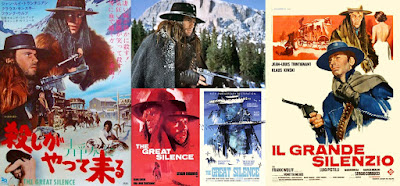
The Great Silence


Silence Still Golden

The Great Silence
aka The Big Silence
aka Ill Grande Silenzio
Italy/France 1968 Directed by Sergio Corbucci
Eureka Masters Of Cinema Blu Ray Zone B


Warning: Spoilers because, of course, you can’t
discuss a great work of cinema like The Great Silence
without talking about the amazing ending of the movie.


“They call him silence because wherever
he goes the silence of death follows.”
Vonetta McGee, Ill Grande Silenzio


The Great Silence is one of those films which will always be in my top two or three all time favourite Italian Westerns. I already talked about it a little in my 2013 look at some of the most powerful endings in cinema history, End Game (which you can read here if you so desire)... but I thought it was time to do a ‘clean review’ with the advent of the Eureka Masters Of Cinema label’s brand new restoration Blu Ray release because, well, the film has never looked better. Perhaps it’s even a little too good looking but... I’ll discuss that comment in a minute.

Now, mainly I suspect because of the films powerful and cynical ending, the film was not shown in some countries, such as the US and here in the UK, for a couple of decades. Banned maybe too strong a word for it in retrospect but, it was certainly stifled at birth as far as English speaking countries go... even though the majority of the actors in this one are lip synching (kind of) in English and the original English dub was made and thankfully still exists (which is probably the best choice to watch this on, given it's the language being spoken on set, which was also an unusual thing for an Italian western... where everybody usually just spoke their native language from whichever country they were born). So my first experience of this remarkable movie was when director Alex Cox showed it on his weekly film series Moviedrome in 1990, under the title The Big Silence... which I believe was the first ever screening in this country.

The plot is simple. A bunch of outlaws who are not really bad, just in unfortunate circumstances created by the officials in the town of Snow Hill and its environs, are being hunted by ruthless Bounty Killers and being shot dead for the reward, whether they give themselves up or not. One of these, Loco (as he is known on the English dub), played by the great Klaus Kinski, is doing a lot of damage to their poor, outlaw community who are hiding in the mountains. A new Sheriff, played by Frank Wolff, is sent to Snow Hill to pave a way for an amnesty for the outlaws. Something not wanted by Loco and the town’s banker Pollicut (who pretty much runs the place), played by Luigi Pistillo. But the so called outlaws have hired the great, law abiding assassin/hero Silence, played by Jean-Louis Trintignant, to help rid them of some of the bounty killers. And then, when Loco lawfully but unjustly kills the ‘outlaw’ husband of a local lady, played by Vonetta McGee, she herself hires Silence to put an end to Loco but, as anyone who’s seen this knows, things don’t play out as they would in a more formulaic spaghetti western, for sure.

Silence has his own reason to hate Pistilli’s character, as he slit his throat as a young lad to stop him from telling of the ‘murder for bounty money’ killing he took part of when murdering Silence’s parents in front of him. I don’t know how slitting the boys throat kept him from talking, since it’s clear Silence can still read and write but, yeah, this is perhaps the real reason he’s called Silence at any rate, in contradiction to that wonderful quote from Vonetta McGee’s character, which I put at the top of this review. Well, that and the fact that Trintignant couldn’t speak English. 

Another thing about the character is that he carries an automatic weapon, a German Mauser (a 7.63mm Mauser C96 ‘Broomhandle’ version) in this, which is not a common thing for characters in Spaghetti Western cinema and which most people assume is an anachronism, although these pistols were actually first manufactured two years before the setting of the film... so this overlap with ‘the old West’ is actually distinctive but quite valid. I seem to remember Corbucci’s next Western, Il Mercenario, also has a main protagonist carrying an automatic pistol.

The film is beautifully shot with Corbucci and his cinematographer doing some nice things with the camera. In one shot, for instance, he uses the vertical slats of a prison cell to shoot through to delineate the space on screen and highlight characters in two rectangles... before moving in to highlight just one character, changing the focus as he does so, so that the bars blur out and disappear. It’s almost shot entirely in the snow too (and a lot of shaving foam, by all accounts)... which is unusual for a Western, to have it in a snowbound setting (although it’s not the only one). The director, who was responsible for a fair few good westerns originally wanted to shoot his classic Western Django in the snow but was turned down by the producers (hence, they ended up with a film shot in the mud, a bit like the last 20 minutes or so of Kurosawa’s Seven Samurai). However, Django was successful enough so that, by the time he got to making this movie, he was allowed his snow. And the print and transfer has never looked better but, as I intimated earlier, I’m not sure if the transfer it totally correct. The reason I say this is that in all versions of the film I’ve seen before, including screenings at cinemas, there were a few shots here and there at the start of the movie where a kind of Moiré pattern covered the entire shot. Some people have said this was caused by light reflecting on the lens but I don’t see how a simple light reflection could produce that kind of look. I don’t know what caused it and it seemed totally a non-sequitur to the visual continuity of the movie but it was strong enough that I always believed it was a patterned filter put over the camera for certain shots (don’t ask me why). In this new transfer, that patterning is almost entirely absent other than in part of a shot where it’s quickly glimpsed so... yeah... is this from a better source or has this been removed in the transfer process after the fact? The answer is... I don’t know but if anyone does, then please message me via the comments section at the bottom of this blog.

Asides from the wonderful cinematography, there are three other great strengths inherent in The Great Silence. The first one I should mention is that the performances by the wonderful cast are all excellent. Trintignant’s Silence is a powerful, silent figure and McGee is wonderful as the wronged spouse who falls in love with him, after hiring him to kill Loco. Kinski is absolutely wonderful when he’s playing a villain anyway (as he often did). The weasel face contradicted by the big, blue puppy dog eyes are the perfect look for a villainous presence on screen but the film is full of little acting details which go the extra mile, such as when Kinski licks his lead pencil before totting his kills up in his notebook. The supporting cast of Luigi Pistilli and Frank Wolff are wonderful too, with Wolff playing somewhat against type to play the likeable, truly honourable sheriff character (something you couldn’t say about a lot of sheriffs in Italian Westerns for sure). It struck me for the first time while I was revisiting this film again, when they shared a scene or two together, that Pistilli and Wolff both went on to kill themselves in real life (Wolff just three years after making this movie and Pistilli in 1996).

Asides from the acting, another big strength of the movie is the late, great Ennio Morricone’s amazing and sparsely spotted score. There’s not a huge amount of it (indeed, the 35 minutes that have been released on CD in the past is pretty much the entire score, from what I can make out) but it’s got a wonderfully elegiacal tone and is full of addictive melodies. This means it’s one of those movies to which I am constantly tapping my toes in time as I watch it, which is no bad thing.

Lastly, of course, there’s that ending. Big spoiler for this and don’t read this if you’ve not seen it and want to... you need to go in blind...

At the end of the film, Loco and his gang of evil bounty killers shoot Silence’s hands up, parodying Silence’s trademark move of shooting off the bad guy’s thumbs so they can’t use a gun against him. They then shoot him dead, then shoot dead his new girlfriend who hired him... and then massacre the roomful of innocent ‘outlaws’, men and women, who they have tied up to the bar in the saloon... “all in accordance with the law” as Loco remarks... and he and his group of truly evil bad guys ride off into the snow to commit evil deeds elsewhere. It’s a powerful ending and one which will surprise most first time watchers. Especially since the dialogue is peppered with foreshadowing throughout the film, highlighting the more expected ending of Loco getting his just and bloody desserts at the hands of the film’s main heroic protagonist, Silence.

The new Eureka Masters Of Cinema is definitely one to get for any fans of the movie. Transfer aside it’s loaded with amazing extras... some of which are legacy from other companies’ releases over the last 20 or so years and others which are brand new (to me at least). Everyone who has one of the previous releases will remember, for sure, the silent alternate ending scene, with the preposterous return of Wolff’s character (somehow alive after being dropped and sucked under a frozen lake) and the armour gauntlet reveal of the lead character... where Loco is indeed killed and the good guys have a happy ending. This release does this one... or two... better in that, in addition to Alex Cox’s commentary on the alternate ending, the non-commentary version of this actually now has the sound restored. So you can hear the original Italian dialogue (subtitled in English) for this silly scene. Not only that, but they’ve unearthed another alternate ending, which they call the ‘ambiguous’ ending and, honestly, it’s like a cut down version of the original ending where, by the ommission of most of it, Silence is wounded and everyone remains alive but so do the bad guys, who decide to just leave everyone alone and get out of there... or that’s what it seems like. I’ve no idea what we’re supposed to make of that version, to be honest.

But there’s more, including various behind the scenes featurettes, archival documentaries and also some new talks, including a wonderful fifteen minutes by Alex Cox himself. And, although I haven’t had a chance to explore these yet, there are three commentary tracks on here, including a recording of a live commentary that Alex Cox gave at a screening earlier this year (which I most certainly do need to listen to, for sure).

And that’s me done on The Great Silence. One of the all time greatest Westerns ever made (if you watch it with the proper, original ending) and an absolute joy from start to finish. Everyone who is interested in Western cinema should give this one a watch and I would recommend this one to pretty much everyone. And don’t snooze on the new Ltd Edition Blu Ray from Eureka Masters Of Cinema, which also has reversible artwork, a nice slipcase, a set of miniature, reproduction lobby cards and a double sided poster. A wonderful purchase and the most definitive release this film has ever had, I would say.

Sunday, 10 May 2020

Successive Slidings Of Pleasure


Tether Report

Successive Slidings Of Pleasure
France 1974 Directed by  Alain Robbe-Grillet
BFI DVD Region 2


I’ve already reviewed two films by Alain Robbe-Grillet on this site... Eden And After (here) and Gradiva (here). He also wrote the wonderful movie Last Year In Marienbad but that one didn’t highlight his themes of sexual fetish as much as those two above, at least not as overtly as he does in films like this one.

I do find the films he directs himself a bit wearing on the brain and hard going at times, in spite of his content and this one is similarly hard to penetrate. It’s interesting to note, actually that he’s considered one of the French New Wave these days (as opposed to when I used to read about him) because the tactics he uses in this film to make the viewer aware all the time that he is watching a man made piece of art as opposed to something which one should immerse oneself in absolutely fits in with the aesthetic of the man who I think of as being the absolute father figure of the Nouvelle Vague, Jean-Luc Godard. Indeed, the very few pieces of Michel Fano’s score in the movie are mostly used to heighten the viewers awareness in contrast to the images and reminded me of the use of music in Godard’s Contempt (Le Mépris).

So the opening credits sequence of Successive Slidings Of Pleasure, where dislocated shots which are, it transpires, excerpted from the main feature are assembled almost hap-hazardly with mismatching sounds such as shattered glass, gun shots and images of actors looking directly into the screen from different situations, cross cut with images of things like spilled egg yolks, really pushes home the fact that, as an audience member, you are not going to be in for a passive time here. Nor indeed a totally coherent one, it has to be said, because there is no real story development or logic to the film, although it hangs around the plot frame of a woman called Nora (played by Olga Georges-Picot) tied to a bed naked by her girlfriend and main protagonist/antagonist Alice (played by Anicée Alvina), who then paints patterns on her. Nora is then found with Alice, with scissors impaling her heart after her death 'in situ' and Alice is then locked in a convent (which includes a handy dungeon) and interrogated by various ‘visitors’ who, as she unfolds events in an almost but, not quite, entirely illogical manner, seduces each of her visitors in one way or another and enacts various sexy things such as painting her own naked body.

What you have to understand though is that the minimalistic, inappropriate sets and the complete non-sequitur responses sometimes of the people who are, on the surface, trying to get to the bottom of the events of this young, alleged murderess are huge indicators that this is just the directors game. No realism is intended. Indeed, the heightened, stylised form of acting (reminiscent sometimes of Hal Hartley’s movies) and the carefree attitude of the two lovers in flashback, as they cut up and bloody a mannequin on the beach when they are not being prostitutes and murdering clients, gives the film a slightly surreal attitude which undermines any attempt to decode the main text in any way other than as a redundant part of the narrative thread, such as it is.

It’s simply not believable as something to be taken that seriously and scenes where, for instance, Alice breaks eggs over Nora’s nude body for a bit before covering her in wine and investigating her crotch with her foot certainly push the film into an almost erotic mood... which is often killed by the absurdity of the responses from various characters... many of whom are taking their ‘story arc’ very seriously. If you want to see Michael Lonsdale, who played Bond villain Hugo Drax in Moonraker, doing something totally different to what you’d expect from him... as his character slowly seems to go insane with obsession to ‘crack the case’ after he’s sucked Alice’s foot 'to remove blood from it'... then you might want to check this one out. Other famous actors in this are Jean-Louis Trintignant and a very young Isabelle Huppert (who, even though I knew she was in it, I still couldn’t recognise).

One thing that is present in the movie is the director’s eye for a good shot. I’ve already said that the majority of the sets are quite simplistic, with barely any set dressing and I believe this is a deliberate play to emphasise the fake nature of the so called plot but he does make things look visually attractive throughout... in addition to the obvious enhancement of several naked women draped over the sets in various scenes of course. So quite often he will be sectioning areas of space for characters to balance against but, in this one, he often has two styles of sectioning combined into the same shot...

So he might have vertical sections on the right part of the screen offset with the chequered frame of a window dominating the left of the screen. or he’ll have different levels of rooms manifesting as open doorways (an old Roger Corman trick) or as an angular look down and across to a spiral stairway adding a different depth to that part of the frame. Indeed, he even has one shot with a curly, iron bed head with Alice peering through different parts of it in front of the camera and constantly shifting so her eyes are perfectly framed in the twirly bits (a technical term). It all looks splendid and, indeed, if it does get just a little pretentious and dull in places, the visual splendour of the shot design often more than makes up for it.

And that’s me done on Successive Slidings Of Pleasure I think. I bought this as one of those ‘add on at the counter’ DVDs when I was in Fopp and got this for just £3. I don’t regret it and I may, I guess, even watch it again some day. It’s not something I would lightly recommend to most casual film viewers but if you have a passion for decoding visual and textual layers which appear to support each other but are really saying contrasting things then you might want to give this one a go. I might try another one of his in another year or two, I think.