Showing posts with label Spaghetti Western. Show all posts

Sunday, 5 December 2021

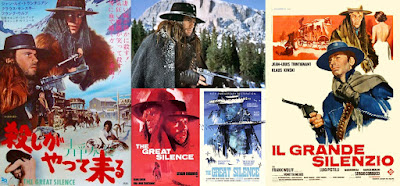
The Great Silence


Silence Still Golden

The Great Silence
aka The Big Silence
aka Ill Grande Silenzio
Italy/France 1968 Directed by Sergio Corbucci
Eureka Masters Of Cinema Blu Ray Zone B


Warning: Spoilers because, of course, you can’t
discuss a great work of cinema like The Great Silence
without talking about the amazing ending of the movie.


“They call him silence because wherever
he goes the silence of death follows.”
Vonetta McGee, Ill Grande Silenzio


The Great Silence is one of those films which will always be in my top two or three all time favourite Italian Westerns. I already talked about it a little in my 2013 look at some of the most powerful endings in cinema history, End Game (which you can read here if you so desire)... but I thought it was time to do a ‘clean review’ with the advent of the Eureka Masters Of Cinema label’s brand new restoration Blu Ray release because, well, the film has never looked better. Perhaps it’s even a little too good looking but... I’ll discuss that comment in a minute.

Now, mainly I suspect because of the films powerful and cynical ending, the film was not shown in some countries, such as the US and here in the UK, for a couple of decades. Banned maybe too strong a word for it in retrospect but, it was certainly stifled at birth as far as English speaking countries go... even though the majority of the actors in this one are lip synching (kind of) in English and the original English dub was made and thankfully still exists (which is probably the best choice to watch this on, given it's the language being spoken on set, which was also an unusual thing for an Italian western... where everybody usually just spoke their native language from whichever country they were born). So my first experience of this remarkable movie was when director Alex Cox showed it on his weekly film series Moviedrome in 1990, under the title The Big Silence... which I believe was the first ever screening in this country.

The plot is simple. A bunch of outlaws who are not really bad, just in unfortunate circumstances created by the officials in the town of Snow Hill and its environs, are being hunted by ruthless Bounty Killers and being shot dead for the reward, whether they give themselves up or not. One of these, Loco (as he is known on the English dub), played by the great Klaus Kinski, is doing a lot of damage to their poor, outlaw community who are hiding in the mountains. A new Sheriff, played by Frank Wolff, is sent to Snow Hill to pave a way for an amnesty for the outlaws. Something not wanted by Loco and the town’s banker Pollicut (who pretty much runs the place), played by Luigi Pistillo. But the so called outlaws have hired the great, law abiding assassin/hero Silence, played by Jean-Louis Trintignant, to help rid them of some of the bounty killers. And then, when Loco lawfully but unjustly kills the ‘outlaw’ husband of a local lady, played by Vonetta McGee, she herself hires Silence to put an end to Loco but, as anyone who’s seen this knows, things don’t play out as they would in a more formulaic spaghetti western, for sure.

Silence has his own reason to hate Pistilli’s character, as he slit his throat as a young lad to stop him from telling of the ‘murder for bounty money’ killing he took part of when murdering Silence’s parents in front of him. I don’t know how slitting the boys throat kept him from talking, since it’s clear Silence can still read and write but, yeah, this is perhaps the real reason he’s called Silence at any rate, in contradiction to that wonderful quote from Vonetta McGee’s character, which I put at the top of this review. Well, that and the fact that Trintignant couldn’t speak English. 

Another thing about the character is that he carries an automatic weapon, a German Mauser (a 7.63mm Mauser C96 ‘Broomhandle’ version) in this, which is not a common thing for characters in Spaghetti Western cinema and which most people assume is an anachronism, although these pistols were actually first manufactured two years before the setting of the film... so this overlap with ‘the old West’ is actually distinctive but quite valid. I seem to remember Corbucci’s next Western, Il Mercenario, also has a main protagonist carrying an automatic pistol.

The film is beautifully shot with Corbucci and his cinematographer doing some nice things with the camera. In one shot, for instance, he uses the vertical slats of a prison cell to shoot through to delineate the space on screen and highlight characters in two rectangles... before moving in to highlight just one character, changing the focus as he does so, so that the bars blur out and disappear. It’s almost shot entirely in the snow too (and a lot of shaving foam, by all accounts)... which is unusual for a Western, to have it in a snowbound setting (although it’s not the only one). The director, who was responsible for a fair few good westerns originally wanted to shoot his classic Western Django in the snow but was turned down by the producers (hence, they ended up with a film shot in the mud, a bit like the last 20 minutes or so of Kurosawa’s Seven Samurai). However, Django was successful enough so that, by the time he got to making this movie, he was allowed his snow. And the print and transfer has never looked better but, as I intimated earlier, I’m not sure if the transfer it totally correct. The reason I say this is that in all versions of the film I’ve seen before, including screenings at cinemas, there were a few shots here and there at the start of the movie where a kind of Moiré pattern covered the entire shot. Some people have said this was caused by light reflecting on the lens but I don’t see how a simple light reflection could produce that kind of look. I don’t know what caused it and it seemed totally a non-sequitur to the visual continuity of the movie but it was strong enough that I always believed it was a patterned filter put over the camera for certain shots (don’t ask me why). In this new transfer, that patterning is almost entirely absent other than in part of a shot where it’s quickly glimpsed so... yeah... is this from a better source or has this been removed in the transfer process after the fact? The answer is... I don’t know but if anyone does, then please message me via the comments section at the bottom of this blog.

Asides from the wonderful cinematography, there are three other great strengths inherent in The Great Silence. The first one I should mention is that the performances by the wonderful cast are all excellent. Trintignant’s Silence is a powerful, silent figure and McGee is wonderful as the wronged spouse who falls in love with him, after hiring him to kill Loco. Kinski is absolutely wonderful when he’s playing a villain anyway (as he often did). The weasel face contradicted by the big, blue puppy dog eyes are the perfect look for a villainous presence on screen but the film is full of little acting details which go the extra mile, such as when Kinski licks his lead pencil before totting his kills up in his notebook. The supporting cast of Luigi Pistilli and Frank Wolff are wonderful too, with Wolff playing somewhat against type to play the likeable, truly honourable sheriff character (something you couldn’t say about a lot of sheriffs in Italian Westerns for sure). It struck me for the first time while I was revisiting this film again, when they shared a scene or two together, that Pistilli and Wolff both went on to kill themselves in real life (Wolff just three years after making this movie and Pistilli in 1996).

Asides from the acting, another big strength of the movie is the late, great Ennio Morricone’s amazing and sparsely spotted score. There’s not a huge amount of it (indeed, the 35 minutes that have been released on CD in the past is pretty much the entire score, from what I can make out) but it’s got a wonderfully elegiacal tone and is full of addictive melodies. This means it’s one of those movies to which I am constantly tapping my toes in time as I watch it, which is no bad thing.

Lastly, of course, there’s that ending. Big spoiler for this and don’t read this if you’ve not seen it and want to... you need to go in blind...

At the end of the film, Loco and his gang of evil bounty killers shoot Silence’s hands up, parodying Silence’s trademark move of shooting off the bad guy’s thumbs so they can’t use a gun against him. They then shoot him dead, then shoot dead his new girlfriend who hired him... and then massacre the roomful of innocent ‘outlaws’, men and women, who they have tied up to the bar in the saloon... “all in accordance with the law” as Loco remarks... and he and his group of truly evil bad guys ride off into the snow to commit evil deeds elsewhere. It’s a powerful ending and one which will surprise most first time watchers. Especially since the dialogue is peppered with foreshadowing throughout the film, highlighting the more expected ending of Loco getting his just and bloody desserts at the hands of the film’s main heroic protagonist, Silence.

The new Eureka Masters Of Cinema is definitely one to get for any fans of the movie. Transfer aside it’s loaded with amazing extras... some of which are legacy from other companies’ releases over the last 20 or so years and others which are brand new (to me at least). Everyone who has one of the previous releases will remember, for sure, the silent alternate ending scene, with the preposterous return of Wolff’s character (somehow alive after being dropped and sucked under a frozen lake) and the armour gauntlet reveal of the lead character... where Loco is indeed killed and the good guys have a happy ending. This release does this one... or two... better in that, in addition to Alex Cox’s commentary on the alternate ending, the non-commentary version of this actually now has the sound restored. So you can hear the original Italian dialogue (subtitled in English) for this silly scene. Not only that, but they’ve unearthed another alternate ending, which they call the ‘ambiguous’ ending and, honestly, it’s like a cut down version of the original ending where, by the ommission of most of it, Silence is wounded and everyone remains alive but so do the bad guys, who decide to just leave everyone alone and get out of there... or that’s what it seems like. I’ve no idea what we’re supposed to make of that version, to be honest.

But there’s more, including various behind the scenes featurettes, archival documentaries and also some new talks, including a wonderful fifteen minutes by Alex Cox himself. And, although I haven’t had a chance to explore these yet, there are three commentary tracks on here, including a recording of a live commentary that Alex Cox gave at a screening earlier this year (which I most certainly do need to listen to, for sure).

And that’s me done on The Great Silence. One of the all time greatest Westerns ever made (if you watch it with the proper, original ending) and an absolute joy from start to finish. Everyone who is interested in Western cinema should give this one a watch and I would recommend this one to pretty much everyone. And don’t snooze on the new Ltd Edition Blu Ray from Eureka Masters Of Cinema, which also has reversible artwork, a nice slipcase, a set of miniature, reproduction lobby cards and a double sided poster. A wonderful purchase and the most definitive release this film has ever had, I would say.

Wednesday, 5 February 2020

A Fistful Of Dynamite


How Would He Duck?

A Fistful Of Dynamite
 
aka Duck You Sucker  
aka Giù La Testa  
aka Once Upon A Time... The Revolution
Italy/Spain 1971 Directed by Sergio Leone
Eureka - The Masters Of Cinema  Blu Ray Zone B


Warning: Slight spoilers if you’ve never seen this one.

Okay, so let’s talk about Duck You Sucker or, these days perhaps it’s better known by one of its other many names, A Fistful Of Dynamite. This is a beautiful new Blu Ray release from Eureka which my friend and I both got for each other at Christmas. A two disc special edition of what is, essentially, my favourite ever Western movie (occasionally alternating with this director’s previous film) and the last Western ‘officially’ directed by Sergio Leone... the next film directed under his own name, after a long interval, would be his swan song, the absolutely brilliant Once Upon A Time In America.

The plot is very simple but told in an entertainingly convoluted way. A Mexican bandit name Juan, played by Rod Steiger as an almost parody of the director (who I seem to remember he didn’t get along with during production) inadvertently teams up with an IRA terrorist named John, played by James Coburn, during the 1913 revolution in Mexico. The two start off kinda hating each other but do the whole male bonding over violence and adventures thing and, inexplicably and regretfully in the case of Juan, end up becoming heroes of the revolution.

The film looks beautiful and, although there are only a few incidents told in its lengthy running time, everything is stretched out in the way that only Leone can do it (and leave you wanting more) so that it feels like an absolute epic. Which, of course, it is.

The film has a lot of comedy in it, with one of my favourite scenes being the bank raid at Mesa Verde when Juan has been talking John, ‘the firecracker’ who is so good with explosives, into doing the bank job only to find, when he goes through with it, that it is he who has been manipulated by John all along as there is no longer any money in the bank. Instead, he finds himself freeing a hundred or so political prisoners. The look on Steigers face each time he opens a bank vault and instead finds prisoners is priceless in a montage scene beautifully backed for comic effect by Ennio Morricone’s truly awesome score.

The film is also very moving, with a wonderful, protracted sequence after Juan and John have stopped the bad guys in government from crossing the bridge and following the rebels where they go rejoin all the people they have saved, only to find they’ve all been slaughtered in a cave by another military troop. The scene is just Rod Steiger’s face for pretty much most of it as he looks around and talks to Coburn and you begin to realise what has happened and that Juan has lost his father plus all six of his children in the massacre. When he goes outside in a suicidal bid for revenge (only to be caught in time to be rescued later), it’s only then we are left with John and we see the many bodies piled up, with the machine gun bullets of Juan’s bid for vengeance outside the cave on the soundtrack co-opted by the visuals of the dead bodies of the rebels as a metaphor of the way they died. It’s a wonderful moment of sound juxtaposed with on-screen visuals to make a comment on what you are seeing and add a layer of dynamic context.

There’s also a moving scene earlier in the movie and, for my money, Steiger’s monologue from this scene is probably one of the best, if not the best, in cinema history. Now I don’t acknowledge politics or the necessity of them myself and I usually don’t understand them anyway but, twice in Spaghetti Westerns they’ve simplified thing so that even I can comprehend them and one of them is this speech, which I’ll quote here (the other is probably the end moments of A Bullet For The General, if I’m not confusing politics with morality that is)...

“I know what I am talking about when I am talking about revolutions! The people who read the books go to the people who can't read the books, the poor people, and say, "We have to have a change." So, the poor people make the change, ah? And then, the people who read the books, they all sit around the big polished tables, and they talk and talk and talk and eat and eat and eat, eh? But what has happened to the poor people? They are dead! That's your revolution! Sh... so, please... don't tell me about revolutions... And what happens afterwards? The same fucking thing starts all over again!”

The photography in this is absolutely beautiful, of course and, it’s very easy to recognise that the meticulously designed shot compositions are by Sergio Leone. You have action scenes through horizontal slats in the foreground or mid-ground and the screen split up into sections with holes to view other things going on... not to mention an abundance on close ups of eyes and, in a brilliant part at the start where Juan is riding in the carriage with the rich people, their mouths full of food to show the way the ‘other half’ lives and how evil they are in this situation (one of them a priest, of course).

And as far as the composition goes... there’s that wonderful moment where a poster with a face on it is suddenly torn out from behind in a slat on the train carriage it has been plastered over to reveal Rod Steiger’s eyes looking out from inside and into the camera in close up... a shot which must surely have inspired the scene where Gromit does more or less the same thing hiding inside a box of dog food in The Wrong Trousers.

One particularly favourite moment of composition is near the start of the movie, when the camera is placed behind the guy riding shotgun on a stage coach and is looking down past him at the action. The brim of the guys hat fills the right third of the widescreen frame while we see Juan and the driver interacting on the ground in the left two thirds of the screen below... really nice stuff.

And then there’s Ennio Morricone’s score adding to every scene of course. This is one of my all time favourite scores too and one of my ex-girlfriends used to get so tired of me bringing it to play in the car every time we went out. At times jaunty but ultimately containing some of the most moving melodies he ever wrote... especially for the scenes where John is remembering his IRA past, which we see more of as his back story is revealed over the course of the movie.

Actually, if you go with the title Once Upon A Time... The Revolution and realise it is sandwiched between the director’s other epic movies Once Upon A Time In The West and Once Upon A Time In America, we see the director’s obsession, as I see it, with memory and how important it is to the characters who inhabit these three films (and also his earlier film, For A Few Dollars More). Like it is in some of Andrei Tarkovsky’s movies, memory seems to be almost an added character to the story and the events of the present time in the film are always affected by what has gone on in the past of the character’s lives. I won’t spoil James Coburn’s full character arc for you here if you’ve never seen it  but, it’s a sad and tragic one and explains, to a certain extent, why he sees the actions of one specific character in the film as a betrayal of sorts... although he doesn’t, as we at first think, do anything about this betrayal. He does inadvertently pave the way for redemption for that character towards the end of the film though.

Eureka’s wonderful two disc set of A Fistful Of Dynamite, including both the American version of the film and the much longer Italian cut (which is the one to watch but maybe choose the English dialogue track option on the audio because that’s what the two main American actors are speaking throughout) is loaded with extras (none of which I’ve yet had a chance to watch) including separate commentary tracks from both Sir Christopher Frayling and Alex Cox plus a beautiful slipcase housing a book of essays about the film. If you call yourself a film buff (I wouldn’t), a cineaste, a movie goer or any variant of a lover of cinema then this is a film which you should always have a version of on your shelves. One of the great movies of cinema and another that I’ll always try and revisit every five years or so. Get this version before it sells out.

Tuesday, 12 November 2013

Alive or Preferably Dead (Vivi O, Preferibilmente, Morti)


Limp Spaghetti

Alive or Preferably Dead 
aka Vivi O, Preferibilmente, Morti
1969 Italy/Spain
Directed by Duccio Tessari
Wild East Region 1

Wow. This is a terrible movie.

If it wasn’t for the fact that the actors, including the legendary Giuliano Gemma (who died earlier this year), are obviously doing their best here with the material, I’d probably just post a one sentence review warning you all to keep away and that would be that. But I think I maybe owe it a little more than that and even the director, whose work I have been okay with when he’s working on various giallo films, has made an effort to do something with this.

Alas, this movie seems to have been cranked out to capitalise on the success of the then recent sub-genre of the Italian western, the “comedy spaghetti western”, which reached its zenith a year later with My Name Is Trinity (Lo chiamavano Trinità...). The comedic element tended to be fairly broad and regularly crossed the line into slapstick on these kinds of films, especially in the Terence Hill and Bud Spencer movies, but here the combination of “lots of fighting” and “hilarity” really strains and, although all involved are appearing to make an effort, it really can’t save the film when the editing and pacing seem to be working so much against it.

The plot set-up is fairly simple. The main protagonist, Monty (played by Gemma), owes lots of debts  to the point that his life is under threat. However, when a relative leaves him three hundred thousand dollars to be collected once he and his estranged brother Ted have been living under the same roof for six months, he heads to the “Wild West” to join his brother, who is none too happy about seeing him, or even that interested in the money, for the most part. This is fine to kick things off with but one of the problems the movie has, while the brothers try to pull off various criminal capers in order to pay just the next month’s rent, is that the story is kinda jumpy and although this perhaps could be blamed on the episodic nature of the scripted shenanigans, it did seem to be forgetting what the main plot line was at several points, only to bring it back later when it was at a convenient point to remind the viewer what it was. Honestly? There is a point to all this codswallop?

Even some of the crazier little details seem to be directionless and fly out the window at the first sign of the next distraction, including things which are set up once and then never referred to again. For instance, in the opening sequence in “the big city”, Monty is attacked by a bunch of thugs and he makes a great show of opening his trick cane and pulling out a big test tube. He drinks the mixture in the test tube and then, like Popeye on a spinach rush, he turns into a super-agile, near invincible fighter who can take on all and sundry (although he soon finds himself in trouble again). Lot’s more fist fights ensue over the length of the movie, some involving him and his brother Ted (played quite charmingly by Olympic boxing champion Nino Benvenuti, in one of only three acting roles he had in his career), but the secret potion in the test tube is not once referred to again. It’s like the film’s script and storyline was constantly changing as the actors shot it and, to be honest, with things I’ve heard over the years about the Italian film industry, I wouldn’t be surprised if that was the case and the actors were following a different storyline every few days, such is the narrative flow, or lack thereof, of this movie. No editing could fix this.

Tessari and his cinematographer introduce some nice shot designs in places, but the way they are spliced together without any real thought in certain places of the way one short sequence may transition into the next, left me feeling a bit underwhelmed. Also, I noticed that a rather inventive shot of two people on rocking chairs, where each rocks into shot from left or right to iterate a portion of their conversation, was also included (with one of the same actors even) on the trailer for one of Tessari’s earlier films Kiss Kiss Bang Bang. Because of the staginess of the shot, it seems like the director is stealing from himself on this and perusing his back catalogue for ideas. I don’t know what the time limits were for the shooting schedule but I’m guessing it must have been pretty pacey.

Gianni Ferrio provides the score for this movie and usually I like what he does on his scores (I have a few recordings in my selection of CDs by this composer, who died back in October of this year). However, the music in this film is also a complete mess, with a terrible running ballad which kinda recaps the story, such as it is, in ways which stretch the credibility of what one might call “rhyme and rhythm” in both the music and the lyrics. Quite appalling. The one bright moment in the score lasts for just a few notes, where a musical joke is inserted as a direct reference to Sergio Leone’s A Fistful Of Dollars but, for the most part, the music is pretty flat, lifeless and unfunny when it’s so obviously trying hard to be exactly the opposite, presumably because the music is trying to help you not notice the fact that, for a comedy western, this movie just isn’t funny.

I wish I had more to say on this one but I just don’t. Alive or Preferably Dead... watch it at your peril.

Monday, 21 October 2013

A Colt Is My Passport


Cold Colt Ground

A Colt Is My Passport 
1967 Japan
Directed by Takashi Nomura
Nikkatsu/Criterion Eclipse DVD Region 1 
(as part of the Nikkatsu Noir boxed edition). 

Warning: Reading this review is a passport to very slight spoilers.

The last in Criterion Eclipse’s astonishing collection of Nikkatsu thrillers, A Colt Is My Passport maybe lacks the shot compositional flair of most of the other movies in this boxed set (apart from one amazingly framed sequence where the main protagonist is waiting, sniper’s rifle in hand, to make ‘the kill’) but it more than makes up for it with the style of the camerawork in certain sections and, very much so, in the way the footage is edited.

The opening, for example, is a tour de force of style over substance. Following a credit sequence which utlilises a brilliant pseudo-Morricone spaghetti western scoring style of sound to great effect, we go through a scene where the main protagonist, hitman Shuji played by Nikkatsu superstar Jô Shishido, is being briefed and shown the details of his new target. The man hiring him provides a steady stream of narrative for the first few minutes over shots of him and Shuji following the target and being shown and told where the target will be over the course of the next few days (it is up to Shuji how and when he completes his mission for hire).

During this sequence the camera is not the steady glide or mesmeric static shot of many a NIkkatsu crime flick. Instead we have something which seems far ahead of its time, as I watch it now. The camera does all kinds of acrobatics to catch things and people as they are pinpointed by the voice over instructions to Shuji. It’s like the camera is looking around and then stops and concentrates on parts of the shot when it stumbles upon the correct piece of visual information. Normally, this is not the kind of shot sequence a studio of that period would have indulged their directors in, I would have thought. It’s very much a sequence of fast paced POV ‘camera reactions’ edited together in one big, narrative scoop.

This is something which I’ve noticed modern TV shows, especially in the science fiction genre, using to great effect nowadays (to the point where it’s become a cliché almost) but I can’t imagine the creative freedom to throw out the prescribed way of shooting these things could have come easy back in the late sixties in an environment like Nikkatsu. Shows like Firefly and the rebooted Battlestar Galactica tend to use this “taking you unawares” style of catching things out of the corner of the camera eye before swivelling around and focussing, quite frequently to help push the credibility of shots set within a fantastic universe, which would be less easy to buy into without this style of camera work. Artificial lens flares on the model and CGI shots seem to be another favourite nowadays. I find the fact that Takashi Nomura was able to get away with a similar sensibility in the first 5 or 10 minutes of A Colt Is My Passport very interesting. He must have been either a very confident director or pulled a lot of weight at the studio, is my guess.

This is one of the films where Jô Shishido’s star presence really comes through and helps to carry the movie... in as much as he is the main focus of the narrative and he manages to hold your interest by, for the most part, not doing very much. Shishido is extremely low key in this, showing neither emotion or interest for a great deal of the running time... although it does transpire that he is a big softie where friends and family are concerned (as these kinds of characters usually are).

Even though he doesn’t seem like he’s emotionally available for most of the film, it’s probably this kind of cooler than ice attitude which makes him stand out more against the other actors, even though there’s not a bad performance in this film. It’s an interesting contrast between his indifference and the emotional investment of some of the other characters in this.

The one thing which will make you sit straight up in your chair is the opening musical notes on the credits, followed by a string of gunshots, followed by a main theme tune which, as I noted earlier, sounds like it was torn straight from the score a spaghetti western. I mention this again because all the way through the movie,  there’s not a heck of a lot of music (at least not by modern, wall-to-wall standards) but when the music does come in it’s usually this bold Morricone-esque, ride-your-horse-to-death-and-beyond, wild spaghetti western style scoring. And it makes sense because Japan has always been a country where spaghetti westerns have been extremely popular (more so than America and the UK I suspect) and treated with a certain amount of respect where they wouldn’t be as well recieved in other countries. This movie seems particularly influenced by the genre... what with Shishido’s distanced and iconic anti-hero characterisation and the climax of the movie which basically ends in a many against one duel in a wasteland of dust, doubling for a western desert. Even the title, A Colt Is My Passport, is quite similar to the English translations of some of those movies.

This is a great piece and it’s a film full of details. Shishido lighting a cigarette, for example, purely so he can judge the speed and direction of the wind before he settles down to make his killing is particularly spell-binding. Another thing the director goes out of his way to do is have the various weapons’ audio signatures different to the others in the film... so the sound of bullet shots pitched against each other gives a more interesting sound dialogue than it would in a movie where the same kinds of gun shot sounds are used for all the weapons. This is a tactic Spielberg used for absolute realism on Saving Private Ryan and, more artificially and artistically, in the Indiana Jones films... where Indy’s revolver actually utilises the sound of a shotgun on the soundtrack. Shishido even digs a trench and makes his own version of a sticky bomb at one point in the proceedings.

It’s stuff like this, the cool music, the cool anti-hero and the little quirks and details that make A Colt Is My Passport another unmissable Nikkatsu treat and Criterion’s boxed set of five of these gems is definitely worth picking up if you’ve not seen them before. My only regret is that there aren’t more of these kinds of movies on the market right now. if you’re into the “cinema of cool” then this movie is not something you’re going to want to let get past you.

Sunday, 3 March 2013

Nude Nuns With Big Guns


Nun’s The Wiser

Nude Nuns With Big Guns
2010 USA
Directed by Joseph Guzman
Havana Films Blu Ray Region B

Nuns? Yes.
Nude nuns? Oh yes.
With guns? Affirmative.
Big guns? As the film carries on the guns get a bit bigger so... yes, very much so.

As you can see from my blindingly scientific and rigorous critical technique above, I have perhaps come to the conclusion that Jospeh Guzman’s grindhouse homage, Nude Nuns With Big Guns, does exactly what it says on the tin.

That’s not always a recommendation , of course, and if you’re a somewhat seasoned film watcher like me and you come across a title of this kind of... um... calibre, you’ll know that even if the writers/directors of these kinds of things managed to live up to the title... it can still be a dull and deadly affair with the name of the tale being just about the only thing that’s interesting about it.

I’m happy to report, however, that Nude Nuns With Big Guns exceeded my expectations for it.

This film seems to be based, from what little information I can glean, on Guzman’s original short of the same title, which is actually just one scene which would then make it’s way into the final feature, with the actresses and roles slightly changed around. But it’s made, I would think, with the wave of modern grindhouse movies very much in mind and it does nothing to hide its influences, perhaps wearing them on it’s celluloidal sleeve just a little too obviously but in a way that will, I suspect, be much appreciated by fans of this kind of work. You know the kind of stuff I’m talking about here...

Grindhouse: Planet Terror, Grindhouse: Death Proof, Machete (reviewed here), Hobo With A Shotgun (reviewed here)... this film is very much trying to hold its own with these kinds of movies and, I have to say, it succeeds at this very well. Right from the outset we have a modern day take on the early 70s exploitation thriller which really makes sure that no grimy, sleazy stone is left unturned to make up the proper ingredients for a jaw dropping and mostly quite dumb hour and a half of escapist mayhem.

The villains are unpleasant and vicious, of course. They do nasty things like rape and kill... but that’s always a good way to get the audience’s back up and ensure that when the time for final retribution comes, as it does in this tale of an abused nun coming back for revenge and doing “the lords work” in her best “old testament” style of anger, wrath and fury... the audience is on her side when it comes to the films tough and “if you’re a geezah cross your legs” grizzly denouement.

But of course, since it’s trying its darndest to be a tight, little exploitation movie, you can be sure the path to revenge will take the sleaziest of routes possible as the titular Sister Sarah (played unflinchingly by Asun Ortega) and her “lesbian lover nun sidekick” spend as much time out of their habits as they do getting back in them and going into battle fully locked and loaded. The film gets all the clichéd genre thrills squeezed into its short running time and, even when the characters in the movie are being their most unpleasant, you can be sure that the filmmakers will put something humorous or “knowing” into the editing style to give you a little smile, even at the most inappropriate of times.

The film asks you to suspend your disbelief because one of the things you have to accept about the landscape and network of villages this plays out in, is that all the nunes and priests are drug dealers and are the religious equivalent of a kind of low life mafia. Against this backdrop, Sister Sarah walks as God’s right hand gun, and if the movie does tend to make you think of the lone western gunman roaming the desert and doing the Lord’s work, then I really think it’s supposed to. In terms of the twisted morality and the prevalence, no matter how grim, of an angry, vengeful justice of sorts, the tone of this movie comes across no less as a modern, but not that modern, take on the classic Italian spaghetti western idiom.

And it has a lot of help with that on the musical front too, with Dan Gross’ score being a definite cross between emphasising a kind of rerun of the heavy Planet Terror music (and it’s really close on that front) and a typical Morricone meets Nicolai mode of spaghetti western scoring in the quieter passages. So if you find yourself thinking the locations and some of the stylistic tweaks are similar to something you’ve seen in those Italian oaters... I really don’t think you were supposed to think any other way.

It’s not going to be everyone’s cup of tea, fair warning. The villains are very well played, which also means they’re thoroughly unpleasant and commit atrocities you might have a hard time having fun with... but like I said earlier, that’s all part of the tension and release part of the game on these kinds of revenge movies and if you can handle this kind of stuff then you shouldn’t have a hard ride with this one.

The performances on this are all very good including a little bit of business with modern character actor Bill Oberst Jr that will come back to haunt you if you stay to the films, enigmatic, last minute or so of footage. If you’ve seen and loved films like Machete and are also into watching such lowly 70s fodder as They Call Me One Eye and The Blood Spattered Bride in the spirit in which they are intended, then you shouldn’t find yourself having too much of a problem and probably quite like, Nude Nuns With Big Guns. If you’re anyone else, however, I’d definitely say “stay away”.

Tuesday, 23 October 2012

La Resa Dei Conti (The Big Gundown)


Cleefhanger

La Resa Dei Conti (The Big Gundown) 
1966 Spain/Italy 
Directed by Sergio Sollima
Screening at the London Film Festival 2012

Warning: Spoilers standing off against each other, 
waiting to be the first one to fire. 

Well... I was more than a little surprised when I found that the organisers of the London Film Festival had chosen to acquire a restored print of one of my all time favourite spaghetti westerns, The Big Gundown, and screen it as part of their Treasures Of The National Archive section in this year’s programme of events. Particularly as I couldn’t remember if I’d actually ever seen it projected on a big screen or not. Hey, it’s actually two years older than I am (so it’s positively ancient) and when you get to my age all those revival and restored re-release screenings over the years blur into one. I just can’t remember all the ones I’ve seen projected at a cinema.

I’ve certainly seen the film a number of times on TV screenings and bootleg DVDs over the years though, so I was positively wetting my lips at the prospect when I found out, a few days before I went, that the definitive print they had restored was longer than anything we’d seen before (it was pretty much butchered on its initial American release and I think the US version is the one which gets shown on TV from time to time). Well I have to say that, if this sounded to good to be true... in some ways it certainly was. And in other ways, I guess it wasn’t.

That is to say... aww, heck... lets get the main disappointments out of the way first... before I remind you how amazing this movie is.

I’d been tipped off that this was going to be showing via the BFI earlier in the year chatting to the UK’s foremost authority on the Italian western, Sir Christopher Frayling, at a film fair (we always go to the same Italian soundtrack stall first, it seems). Well, he was there to say a few words about the movie before the screening started, as I knew he would be, and in it he impressed upon us how this was going to be a more complete version of the film than we’d seen before. I had a few alarm bells ringing in my head when he read an extract of a review out from the time of its original full length screening in the sixties, which described a particular scene. As he read it, I was nodding my head and thinking, “yeah, that’s a good scene and the score in that part is brilliant” etc... but then he said something along the lines of... “of course, we’ve never had the opportunity to see this scene ourself... so I hope to God it’s in there today.”

It was then that I started thinking... “Wait? What?”

So anyway... the screening starts and plays out and I am held spellbound but... it was, I have to say, no longer (and possibly not that much better quality too) than the bootleg edition which had been doing the rounds for over a decade and which could easily be picked up for a fiver. So this was a bit wrong. I sometimes wonder how these people who commission these things have never managed to get access to stuff which the fans have had for a while. It’s a bit bizarre.

A similar, surprising thing happened when I read a book about giallo movies about three years ago... the author had said that he just couldn’t get hold of the films he wanted to research so, in many cases, went with reviews and articles about them from the time. Since I seemed to have pretty much all the movies he was talking about not being able to get ahold of... well, all I can say is it’s about time all these various companies and academic types realised that we’re living in a global community nowadays. The internet and DVD as a universal format used as a bridge between various countries is a reality people are going to have to start getting used to... there are many fan edits and message boards for these kinds of things out there. Especially when it comes to stuff like spaghetti westerns.

The other eye opener for me is that they went with an Italian dub with English subtitles, even though the principal actors were both speaking English. it was understandable but... let me tell you how I think this works and how things like this happen...

The Italians don’t usually record sound when they’re making their movies, certainly at the time when these were made and I suspect things haven’t changed too much in recent years either, but I would be interested to hear if they have. Anyway, it’s all dubbed on after and the principal actors all speak whatever language they are comfortable with. This means that, as an actor, you have to know when a person’s going to stop speaking so you can come in on your cue because, more often than not, you won’t be able to understand a word they’re saying to you. The movie is shot like this and then dubbed, usually very badly, in various languages for release in different countries. Rarely, in any print, is the lip synch any good.

Now then, if the footage is cut out of a US release on its first run, there’s a chance that the sound for those scenes hasn’t been dubbed in English... so what usually happens with these things, when they are restored for the US and UK marketplace, is the language used is often English... but the reinstated scenes are Italian with English subs. For this screening the whole thing was dubbed in Italian with subtitles. I didn’t mind it myself, actually... but the best way to see this particular movie is probably in English for the scenes where they have the audio. If they want to spend money on it (aka, if they don’t want to be cheap about it), then they can always do what they did a few years back on the restored version of The Good, The Bad And The Ugly... which is get Clint Eastwood and Eli Wallach back in the studio to dub the missing scenes and get another actor to impersonate the late, great Lee Van Cleef for his scenes. This seemed to work pretty well.

What’s the most interesting thing about this particular screening of The Big Gundown, though, is that in this version they chose to put the English language version of the song over the credits and end titles instead of the Italian vocal version. Not that I mind, I love the English performance of the song (by the same singer, Christy) but I just found it a strange choice, especially considering the proximity of the last word said in the film on screen in the English version and the deliberate juxtaposition of the crashing Christy vocal which follows it.

Which brings me to my other little grumble... Christopher Frayling apologised for the “screechy song”! I was gobsmacked... I love that song. What’s the world coming to when people can’t appreciate the opening title song to The Big Gundown.

Anyway... enough of that.

If you’ve not seen The Big Gundown before and you like spaghetti westerns... then you really need to check this one out. It’s one of the greats. Lee Van Cleef plays Corbett, a respectable bounty killer, who is more in it for justice than any money he may make from it. When a local big wig offers to fund Corbett’s future political ambitions, one of his “favours” is that Corbett track down a Mexican who has raped and killed a child... a Mexican by the name of Cuchillo (the knife). However, this is a film about political corruption and, as he tracks down, captures, loses and retracks down Cuchillo, who is played absolutely brilliantly by a scene stealing Tomas Milian, it becomes clear that Cuchillo might not actually be guilty of any crime other than being poor and that Corbett is being used to blame and kill a man to cover up the crime of the son-in-law of the man who sent him on his mission.

The film includes various action sequences which highlight both Van Cleef’s stoic and sturdy ‘avenger of justice’ and Milian’s ‘young hippy’ of a character who relies on his animal cunning to always stay ahead of Van Cleef and the performances really are a joy to watch. We even have some sequences with Nieves Navarro (who giallo watchers will best know under the name Susan Scott) in them as a lady landowner of a ranch full of men she keeps fighting amongst themselves for the promise of her sexual favours (sexual favours which both Corbett and Cuchillo indulge themselves of, I might add).

Sergio Sollima is one of the more conscientious of the genre directors and this western is beautifully shot, much like you’d expect from something by either of the other two great ‘Sergios’ of the form, the genre’s kickstarter Sergio Leone and, equally, Sergio Corbucci. Vast landscape canvases with various shots showing figures large and small in contrast to each other, against the flat surface of the cinema screen... it’s all bold stuff and I can tell you, you really get a lot more out of Milian’s subtle facial reactions when you see this on a large screen. It’s just fantastic.

There’s a fair but of action and a lot of humour all put into the mix with a more serious political (possibly) subtext which ultimately leads to a heartwarming alliance for both of the characters you’ve been cheering all along. Lee Van Cleef’s opening sequence where he takes down three criminals after giving them each a bullet of ammunition (in a beautifully framed shot which would have echoes later down the road for the spaghetti western) and Cuchillo’s opening sequences, where he outsmarts Corbett before you even get to see his face... are equal delights.

And, of course, there’s the music.

Ennio Morricone’s masterful score (arranged and conducted by another great Italian composer, Bruno Nicolai) is almost overpowering but the film is strong enough to stand up to the pounding and lyrical humour that Morricone throws at it (a piece for this which specifically references one of the villain’s penchant for classical piano is even used, completely out of context, in the opening shots of Tarantino’s Inglourious Basterds). The action writing is superb and it’s all mixed into the foreground like it needs to be... in those days the sound guys and the directors had a little more respect for the power of the score... not like these days where it’s often buried within the mix. Seeing it with this score coming out loud at the cinema was fantastic and I have to confess I was toe tapping to a lot of the movie as I was watching... hope the guy sitting next to me didn’t mind.

One thing about this screening which was very gratifying was that the venue was so full... it may even have been a sell out (and it wasn’t in a small screen either). To counter that, though, I thought it was kinda sad that the average age of the audience attending seemed to be people in their 50s and 60s... younger people need to see this great stuff and get inspired by it too. It blows away a lot of modern action movies!

Since this movie has been recently ‘restored’ (although I think it might be the same as the old Japanese Region 2 DVD in terms of content... if you quite rightly don’t want to go down the bootleg route) then I’m pretty sure that this is currently being prepped for either a US Region 1 or UK Region 2 release, although I’m told that the new German release DVD uses the same restored master as this one, from the same company.

Either way, it’s a film every fan of these kinds of westerns will want to see and, if you like this one, I can tell you now that the sequel, once again starring Tomas Milian as Cuchillo and from the same director, is at least as good as (if not better, although sadly without Van Cleef) than the first one. It’s called Run, Man, Run after the chorus from the song in The Big Gundown (Seeeeeee! It was popular enough a song to name a sequel after the lyrics!), has a blinding score by Bruno Nicolai (there are rumours as to who actually composed it, put about by the director in many interviews, but I’m told by a specialist in this field that those rumours are untrue) and it would, obviously, make a great double bill with this one. Curious thing about Sergio Sollima though, is that he’s a director who doesn’t like endings. So, while The Big Gundown has a lot of closure in it... you are left with the feeling that there is more to be told just around the corner. Run, Man, Run is even more blatant in ending the film at a point where you think you are in the middle of the story... so if you’re a fan of the traditional beginning, middle and end format of storytelling, you’ll just need to adjust your hat a little. You won’t want to miss out on either of these two movies.

Saturday, 15 September 2012

Doctor Who - A Town Called Mercy


Once A Pond A Time In The West

Doctor Who - A Town Called Mercy
Airdate: 15th September 2012. UK. BBC1

Warning: A fistful of spoilers.

When I first read that tonight's episode of Doctor Who was going to be a western, the first since Hartnell’s Doctor in the sixties, I was thoroughly expecting something as rudimentary as the Spectre Of A Gun episode from the original Star Trek series or the Living In Harmony episode of the prisoner. Instead, I think what we got was something much less interesting. So my apologies to any readers perusing this now but... it’s, once again, going to be an uncharacteristically short review.

This episode had no real story arc woven into it (as far as we know) and there’s nothing wrong with that... but I just felt it needed something. Can’t really fault the writing which probably looked quite edgy on paper since it’s basically dealing with the alien equivalent of a nazi war criminal and a cyborg victim of said criminal seeking revenge. Oh... and about that ‘borg in this episode. Are they all going to start looking like that now since Star Trek The Next Generation? That’s got to be a copyright prosecution waiting to happen, is my feeling. Mind you, I felt the same back in ‘95 when I turned up at the cinema to watch Jeunet’s latest at the time, The City Of Lost Children... so what do I know, eh?

I think maybe a big contribution to my disappointment on this one was the fact that this was almost set up to be something bigger than it was. When an alien doctor is mentioned during the pre-credits sequence, we get the idea that The Doctor is going up against someone he’s met before and that there’s going to be some big reveal right at the end. Unfortunately, that conclusion gets shot down very quickly into the episode and you realise quite sharpish that the opening narrative hook really was just that, a hook with no real substance to back it up.

In the end, all we got was a conflict between two opposing people which just happened to be transplanted onto a cowboy backdrop. Granted, you could argue that pretty much all genre fiction is constructed in much the same way but this one just seemed a bit of a waste of the BBC going all the way to the legendary Almeria in Spain, where gazillions of legendary Italian (Spaghetti) Westerns were shot back in the day. I was expecting some more spectacular Western tropes and references on display than I actually got in this one. Maybe I was just expecting too much though because it is a genre I hold dear to my heart... although I’m by no means an expert on them.

The acting in this was okay too, not that I’d expect anything less from Doctor Who, but I must say that the flow of the narrative seemed to be a bit unnecessarily jumpy at times. Jumpy to the point that things weren’t quite making sense. For instance, The Doctor leaving the sheriff’s office off on a plan he’s concocted and leaving the others behind... followed by his friends involved in a sequence of events that could only have been briefed by The Doctor after he’d hatched his plan. What’s that all about then? Did we miss an embarrassing scene where his companions call him back and say... “Okay, Doc, we’ll help you... but first tell us what your plan is and tell us what you want us to do.” Because, frankly, the stage direction, so to speak, of these two sequences didn’t make any sense.

And then you have The Doctor talking outside the sheriff’s office again in the middle of the night. However, when he goes back in, unless i was somehow interpreting things wrong, the barely glimpsed background out one of the windows was broad daylight... or at least lit so it looked like broad daylight.

Similarly the music seemed a bit uneven in tone. At times it was aping the Italian Westerns in style, with the kind of orchestrations popularised by composers like Ennio Morricone for the films, before suddenly lapsing into the kind of Aaron Copland/Elmer Bernstein Americana feel of the classic American Westerns of the first half of the 20th Century. I’m not saying it was undeliberate, it obviously was what the composer was doing, but I did find the juxtaposition of the two musical styles somewhat jarring and it popped me out of things when I really didn’t want to be.

There was, however, a really nice sequence with The Doctor riding a gender-challenged horse called Sue in which he reveals that “horse” is also a language he can speak, as a nod to his speaking baby from last series I suspect. If you have a popular episode... echo it back to the audience when you can. That’s a common track taken with most Hollywood movie sequels, as it happens.

Amy and Rory didn’t have much to do in this one and, well... I really don’t want to knock the efforts of all the people who have sweated blood making that episode, it’s not nice, but I have to at least acknowledge that I thought tonights episode was possibly the most boring episode I’ve seen since the show started back up again in 2005. I thought last week's was going to be the worst episode in this series but, frankly I was wrong. I’m guessing, and hoping for that matter, that this was the dullest one we’re going to be getting this year. So I’m keeping my fingers crossed for that.

Next weeks looks more interesting though and when I first read the brief teaser for it a few weeks back in the Radio Times, it’s the one I pegged to be the most coolest episode of this year’s offerings. Let’s hope I’m right as I am still, in spite of tonights pseudo-western, looking forward eagerly to next weeks installment.

Now I just wish I had a time machine to get me there quicker.