Showing posts with label Luigi Pistilli. Show all posts

Monday, 23 October 2023

The Sweet Body Of Deborah


Resurrection Shuffle

The Sweet Body Of Deborah
aka Il dolce corpo di Deborah
Italy/France 1968
Directed by Romolo Guerrieri
DemCan Films


Warning: Strong spoilers right from the outset.

I suspect a lot of people would dismiss The Sweet Body Of Deborah as something which isn’t really a giallo these days. After all, many of the visual tropes that are associated with the genre... the black gloved, black hatted killer lurking in the shadows, the string of violent killings etc, are not on display in this movie. Heck, of the four deaths in the movie... well, there’s actually only one, when justice is served (although it seems like there are four... I’ll come back to that in a little while). There isn’t even a good old J&B sighting either. However, I can certainly see why this is considered a giallo because the ‘gaslighting’ style conspiracy between various ‘people you least expect’ in the film is almost a cookie cutter template for some of the more famous gialli from a few years later. The ones I’m thinking about could almost all be re-workings of the same ideas inherent in the plot of this film and directors like Sergio Martino certainly seemed to dip their toes into this kind of convoluted but domestic plot line in his films. Which is no surprise when you look at the credits of The Sweet Body Of Deborah and see that young Sergio was one of the producers and his brother, Luciano Martino (who also wrote a few gialli in his time) was one of the co-writers of this film. So, yeah, I’d certainly go with the consensus on this one that it’s a giallo... even if the German DVD cover of this one proclaims it a Krimi (which it also could be, in a way, I suppose).

Okay, the story such as it is, is all set in the honeymoon of newlyweds Deborah (played by Caroll Baker, probably the most prominent of the imported ‘American giallo queens’) and Marcel (played by Jean Sorel, who has been in a fair few of these himself). They spend their time between Switzerland and France as they holiday but, their first night in Geneva is marred by the discovery that Marcel’s ex-lover committed suicide the year before and many of his friends... including one played by, um, ‘giallo king’ Luigi Pistilli... blame him for her death. And then some gaslighting starts going on as traces of his ex-lover involving piano music, lipstick smeared cigarettes and other ‘out of place’ elements alongside threatening phone calls, follow Deborah and Marcel on their honeymoon... leading to the uncovering of a conspiracy and also the presence of yet another ‘suspect’, something the standard giallo always has in abundance. In this one it’s the swarthy ‘neighbour’ next to a rented villa, played by another giallo king, George Hilton.

The film is nicely shot with the director using various parts of the screen to highlight different characters in different split sections of the frame and the editing is pretty good in this one too... although the initial scenes of the two lovers driving into Geneva is a little bit scrappy in both framing and cutting, it has to be said. There’s some nice editing and coverage in a nightclub in this too, where large black and white comic book panels of characters like Barbarella, Batman and Galactus adorn the walls and bursts of comic strip onomatopoeia are flash cut in between shots, it's kinda interesting... and I think shows a culture willing to embrace that form of entertainment way before the English speaking countries started to recently lionise its own rich, comic book inheritance. 

 It’s all glued together nicely by Nora Orlandi’s somewhat syrupy score and it’s that element that got me watching the picture in the first place. She also scored my favourite giallo, The Strange Vice Of Mrs. Wardh (reviewed by me here)... which, of course, could also be a close relation to this film in terms of certain plot elements... that one IS directed by Sergio Martino.

The convoluted twisting of this thing is not something I can totally experience with the same kind of rawness that the first audiences to this film experienced. After all, I’ve seen the legacy of this movie offering similar or even more convoluted alliances of double crossing villains so, yeah, I was always going to be suspicious of various main characters here. So when the ‘assumed deceased’ character of Suzanne (played by another genre favourite, Evelyn Stewart) turns up alive and well... and plotting bad things for her successor, Deborah... well, yeah, I can’t say it was an unexpected plot twist. Indeed, I suspected each and every death in this film... except for the very last one, where one of the three main antagonists (not counting two possible counter-antagonists) is shot dead in the presence of the police... to be a possible fake and, yeah, that’s pretty much how it played out... 

Suzanne’s suicide, never seen and only lied about by others, is a facade to facilitate the preliminary gaslighting. Luigi Pistilli’s death is deliberately staged for the deception of another character and, when one murder is actually set in motion, as the title character is tranquilised and has her wrists slashed to bleed out under the guise of a suicide... well, George Hilton’s ‘knight in shining armour’ character comes through and rescues/hospitalises her before any damage is done. So yeah, like I said, not a typical giallo in some ways but, people who know many of the gialli which started dribbling out two years after this film, when Dario Argento popularised the genre beyond expectations, should see a marked similarity for sure.

And that’s really all I’ve got to say about The Sweet Body Of Deborah other than, I can see that it’s much more in keeping with the literary conventions of the Italian giallo than perhaps predecessors such as Bava’s The Girl Who Knew Too Much (reviewed here) and Blood And Black Lace (reviewed here). I think films such as this, A Black Veil For Lisa from the same year (review coming this week to this very blog) and a fair few others are kind of a partial ingredient... a missing link if you like... between what Bava and Argento were peddling to an unsuspecting public and what that product evolved into after that, during the 1970s. So, at the very least in terms of lineage, if you’re a giallo watcher then you should probably check this one out.
 

Sunday, 5 December 2021

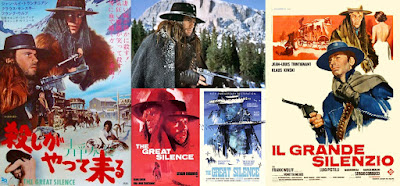
The Great Silence


Silence Still Golden

The Great Silence
aka The Big Silence
aka Ill Grande Silenzio
Italy/France 1968 Directed by Sergio Corbucci
Eureka Masters Of Cinema Blu Ray Zone B


Warning: Spoilers because, of course, you can’t
discuss a great work of cinema like The Great Silence
without talking about the amazing ending of the movie.


“They call him silence because wherever
he goes the silence of death follows.”
Vonetta McGee, Ill Grande Silenzio


The Great Silence is one of those films which will always be in my top two or three all time favourite Italian Westerns. I already talked about it a little in my 2013 look at some of the most powerful endings in cinema history, End Game (which you can read here if you so desire)... but I thought it was time to do a ‘clean review’ with the advent of the Eureka Masters Of Cinema label’s brand new restoration Blu Ray release because, well, the film has never looked better. Perhaps it’s even a little too good looking but... I’ll discuss that comment in a minute.

Now, mainly I suspect because of the films powerful and cynical ending, the film was not shown in some countries, such as the US and here in the UK, for a couple of decades. Banned maybe too strong a word for it in retrospect but, it was certainly stifled at birth as far as English speaking countries go... even though the majority of the actors in this one are lip synching (kind of) in English and the original English dub was made and thankfully still exists (which is probably the best choice to watch this on, given it's the language being spoken on set, which was also an unusual thing for an Italian western... where everybody usually just spoke their native language from whichever country they were born). So my first experience of this remarkable movie was when director Alex Cox showed it on his weekly film series Moviedrome in 1990, under the title The Big Silence... which I believe was the first ever screening in this country.

The plot is simple. A bunch of outlaws who are not really bad, just in unfortunate circumstances created by the officials in the town of Snow Hill and its environs, are being hunted by ruthless Bounty Killers and being shot dead for the reward, whether they give themselves up or not. One of these, Loco (as he is known on the English dub), played by the great Klaus Kinski, is doing a lot of damage to their poor, outlaw community who are hiding in the mountains. A new Sheriff, played by Frank Wolff, is sent to Snow Hill to pave a way for an amnesty for the outlaws. Something not wanted by Loco and the town’s banker Pollicut (who pretty much runs the place), played by Luigi Pistillo. But the so called outlaws have hired the great, law abiding assassin/hero Silence, played by Jean-Louis Trintignant, to help rid them of some of the bounty killers. And then, when Loco lawfully but unjustly kills the ‘outlaw’ husband of a local lady, played by Vonetta McGee, she herself hires Silence to put an end to Loco but, as anyone who’s seen this knows, things don’t play out as they would in a more formulaic spaghetti western, for sure.

Silence has his own reason to hate Pistilli’s character, as he slit his throat as a young lad to stop him from telling of the ‘murder for bounty money’ killing he took part of when murdering Silence’s parents in front of him. I don’t know how slitting the boys throat kept him from talking, since it’s clear Silence can still read and write but, yeah, this is perhaps the real reason he’s called Silence at any rate, in contradiction to that wonderful quote from Vonetta McGee’s character, which I put at the top of this review. Well, that and the fact that Trintignant couldn’t speak English. 

Another thing about the character is that he carries an automatic weapon, a German Mauser (a 7.63mm Mauser C96 ‘Broomhandle’ version) in this, which is not a common thing for characters in Spaghetti Western cinema and which most people assume is an anachronism, although these pistols were actually first manufactured two years before the setting of the film... so this overlap with ‘the old West’ is actually distinctive but quite valid. I seem to remember Corbucci’s next Western, Il Mercenario, also has a main protagonist carrying an automatic pistol.

The film is beautifully shot with Corbucci and his cinematographer doing some nice things with the camera. In one shot, for instance, he uses the vertical slats of a prison cell to shoot through to delineate the space on screen and highlight characters in two rectangles... before moving in to highlight just one character, changing the focus as he does so, so that the bars blur out and disappear. It’s almost shot entirely in the snow too (and a lot of shaving foam, by all accounts)... which is unusual for a Western, to have it in a snowbound setting (although it’s not the only one). The director, who was responsible for a fair few good westerns originally wanted to shoot his classic Western Django in the snow but was turned down by the producers (hence, they ended up with a film shot in the mud, a bit like the last 20 minutes or so of Kurosawa’s Seven Samurai). However, Django was successful enough so that, by the time he got to making this movie, he was allowed his snow. And the print and transfer has never looked better but, as I intimated earlier, I’m not sure if the transfer it totally correct. The reason I say this is that in all versions of the film I’ve seen before, including screenings at cinemas, there were a few shots here and there at the start of the movie where a kind of Moiré pattern covered the entire shot. Some people have said this was caused by light reflecting on the lens but I don’t see how a simple light reflection could produce that kind of look. I don’t know what caused it and it seemed totally a non-sequitur to the visual continuity of the movie but it was strong enough that I always believed it was a patterned filter put over the camera for certain shots (don’t ask me why). In this new transfer, that patterning is almost entirely absent other than in part of a shot where it’s quickly glimpsed so... yeah... is this from a better source or has this been removed in the transfer process after the fact? The answer is... I don’t know but if anyone does, then please message me via the comments section at the bottom of this blog.

Asides from the wonderful cinematography, there are three other great strengths inherent in The Great Silence. The first one I should mention is that the performances by the wonderful cast are all excellent. Trintignant’s Silence is a powerful, silent figure and McGee is wonderful as the wronged spouse who falls in love with him, after hiring him to kill Loco. Kinski is absolutely wonderful when he’s playing a villain anyway (as he often did). The weasel face contradicted by the big, blue puppy dog eyes are the perfect look for a villainous presence on screen but the film is full of little acting details which go the extra mile, such as when Kinski licks his lead pencil before totting his kills up in his notebook. The supporting cast of Luigi Pistilli and Frank Wolff are wonderful too, with Wolff playing somewhat against type to play the likeable, truly honourable sheriff character (something you couldn’t say about a lot of sheriffs in Italian Westerns for sure). It struck me for the first time while I was revisiting this film again, when they shared a scene or two together, that Pistilli and Wolff both went on to kill themselves in real life (Wolff just three years after making this movie and Pistilli in 1996).

Asides from the acting, another big strength of the movie is the late, great Ennio Morricone’s amazing and sparsely spotted score. There’s not a huge amount of it (indeed, the 35 minutes that have been released on CD in the past is pretty much the entire score, from what I can make out) but it’s got a wonderfully elegiacal tone and is full of addictive melodies. This means it’s one of those movies to which I am constantly tapping my toes in time as I watch it, which is no bad thing.

Lastly, of course, there’s that ending. Big spoiler for this and don’t read this if you’ve not seen it and want to... you need to go in blind...

At the end of the film, Loco and his gang of evil bounty killers shoot Silence’s hands up, parodying Silence’s trademark move of shooting off the bad guy’s thumbs so they can’t use a gun against him. They then shoot him dead, then shoot dead his new girlfriend who hired him... and then massacre the roomful of innocent ‘outlaws’, men and women, who they have tied up to the bar in the saloon... “all in accordance with the law” as Loco remarks... and he and his group of truly evil bad guys ride off into the snow to commit evil deeds elsewhere. It’s a powerful ending and one which will surprise most first time watchers. Especially since the dialogue is peppered with foreshadowing throughout the film, highlighting the more expected ending of Loco getting his just and bloody desserts at the hands of the film’s main heroic protagonist, Silence.

The new Eureka Masters Of Cinema is definitely one to get for any fans of the movie. Transfer aside it’s loaded with amazing extras... some of which are legacy from other companies’ releases over the last 20 or so years and others which are brand new (to me at least). Everyone who has one of the previous releases will remember, for sure, the silent alternate ending scene, with the preposterous return of Wolff’s character (somehow alive after being dropped and sucked under a frozen lake) and the armour gauntlet reveal of the lead character... where Loco is indeed killed and the good guys have a happy ending. This release does this one... or two... better in that, in addition to Alex Cox’s commentary on the alternate ending, the non-commentary version of this actually now has the sound restored. So you can hear the original Italian dialogue (subtitled in English) for this silly scene. Not only that, but they’ve unearthed another alternate ending, which they call the ‘ambiguous’ ending and, honestly, it’s like a cut down version of the original ending where, by the ommission of most of it, Silence is wounded and everyone remains alive but so do the bad guys, who decide to just leave everyone alone and get out of there... or that’s what it seems like. I’ve no idea what we’re supposed to make of that version, to be honest.

But there’s more, including various behind the scenes featurettes, archival documentaries and also some new talks, including a wonderful fifteen minutes by Alex Cox himself. And, although I haven’t had a chance to explore these yet, there are three commentary tracks on here, including a recording of a live commentary that Alex Cox gave at a screening earlier this year (which I most certainly do need to listen to, for sure).

And that’s me done on The Great Silence. One of the all time greatest Westerns ever made (if you watch it with the proper, original ending) and an absolute joy from start to finish. Everyone who is interested in Western cinema should give this one a watch and I would recommend this one to pretty much everyone. And don’t snooze on the new Ltd Edition Blu Ray from Eureka Masters Of Cinema, which also has reversible artwork, a nice slipcase, a set of miniature, reproduction lobby cards and a double sided poster. A wonderful purchase and the most definitive release this film has ever had, I would say.

Sunday, 11 November 2012

The Iguana With The Tongue of Fire


Fiery Tongue In Cheek

The Iguana With The Tongue of Fire 
aka Lizard With A Tongue Of Fire 
aka L'iguana Dalla Lingua Di Fuoco 
Italy/France/West Germany 1971
Directed by Riccardo Freda
New Entertainment World Region 0

Wow. The Iguana With The Tongue Of Fire, eh?

People who know me or know my reviews should know by now that I adore the form of, predominantly Italian, cinema known as the ‘giallo’. I’ve mentioned my passion for the beautiful camerawork, overwrought shot design and fantastic music at the expense of bad acting and scripting on numerous occasions but, if you want to familiarise yourself with my summation of the giallo as a worthwhile, collective cinematic achievement, then please see my article on just that subject here. So what I want you to realise is that it’s quite a rare thing for me to say, or type, the statement that follows...

The Iguana With The Tongue Of Fire has got to be the most unintentionally, hilariously bad giallo movies I have ever seen.

Like most gialli, I wanted to see this one because of the gorgeous score to the movie, courtesy here of the wonderful, popular Italian composer Stelvio Cipriani. However, it has to be said that this is pretty much the only really decent thing going for it.

The film stars Anton Diffring (everybody and their pet iguana's first choice of multi-national, intimidating German), giallo favourite Dagmar Lassander and, as the main protagonist (although he doesn’t turn up for about 20 minutes or so into the flick), the one and only Luigi Pistilli. Pistilli is seen here in a rare portrayal of a hero figure, rather than a villain of some description. I’d have to say that, although he turns up in tonnes of stuff before his tragic real life suicide, this film really shows that he had what it takes to be a major star of a movie, rather than just the lead villain or a supporting role.

Now then, it has to be said that the version of this movie I was watching wasn’t, from the outset, being screened in the best conditions. Although not a bootleg copy, the official German release of this movie I was watching had one of the worst and faded prints I’d seen of an official release. Honestly, some of the establishing location shots at the start of the movie, and near the end, looked almost as yellow as the word this genre takes it’s terminology from... literally a yellow giallo! I can’t really comment on the transfer of the print because I just can’t tell how much of the picture is the transfer and how much is the print.  After having seen the film though... I would have to say I can understand why nobody has bothered to pay out for a new print from the negative as yet.

Dealing with a set of murders in, of all places, Dublin... the story involves a German diplomat (yeah, that’d be Diffring then) who gets involved in some acid in the face/throat slash murders while staying in Dublin with his family in the German embassy.

Did I just say acid in the face and throat slash murders?

Yes I did. Starting off with a sequence where a woman has her throat cut after acid has been splashed on her, making her face all red... just to make doubly sure. One has to assume that the motives of the murderer on this one are “better dead than red.” Now this all sounds quite ghastly, I’m sure, but I have to tell you that the special effects on this, and other sequences like it, are absolutely awful. Remember that taylors dummy which scrapes down the side of the cliff edge taking off its face at the start of Lucio Fulci’s Seven Notes In Black? Well this same kind of terrible dummy is used for close ups of the acid in the face in this one. Fortunate for me because, lets face it, I really don’t want to be subjected to a woman getting acid thrown in her face but, simultaneously, unfortunate for the film because the lameness of the technical effects makes you laugh out loud at the silliness of the problem solving going on here.

So there’s that.

Then there’s some other crazy and mostly laughable stuff going on. Like the killer wearing sunglasses at the start of the movie means that every time during the movie that any of the characters decide to pull out a pair of sunglasses, and they do, frequently, whether you are expecting them to or not, there is this highly charged and ever so over dramatic musical sting to accompany a close-up shot of said sunglasses. Honestly, this is so funny you’ll be wishing every character in the movie has a pair of sunglasses to pull out so the sound guys can whack you over the ears with another musical sting.

And there’s the accents. Most gialli are shot in several languages with the predominate language usually being English to help lip synch any of the UK or US actors in the film. The sound, is then, very badly dubbed with no regard to lip synch in any language you happen to watch it in. You will never, I would guess, see an Italian giallo where the spoken word matches up to what you are seeing. This particular film is dubbed into English for the print I was watching, which would be the correct way to view it but... it’s a terrible and highly comical Irish accent that everyone in the movie, apart from Anton Diffring, has been dubbed with. Seriously. Even Luigi Pistilli is talking in this highly fruity Irish accent all the way through and I’m sorry but I was not always able to contain my mirth at this viewing.

And little details that the production design slipped in didn’t help matters either. When questioned if the chauffer of the German family was going to get some laundry done, he is asked to confirm the receipts when shown them by the investigating police. Noticing, in the top right hand corner that the washing was done by a company called “Swastika Laundry Ltd” did nothing to relinquish the sense of accidental comedy on display in this one.

To be fair to it, the story was actually quite a good one for a giallo and it even had Luigi Pistilli living with his mother and his daughter, with the mother referencing both Agatha Christie and Miss Marple as she gives her son pointers as to who the killer is. It also takes a quite nasty turn near the end when the killer is revealed, with Pistilli’s mother being severely battered (possibly to death) and his young daughter having acid thrown in her face. This is quite sobering in the face of the unintentional comedy on display throughout the movie, but utterly wasted as, days or a week after this scene in terms of movie time passing, Pistilli doesn’t see fit to reference or comment on this turn of events, not rushing back to hospital by his daughters bed but instead going off with his boss for a cheery pint down the pub... presumably a nice, clichéd pint of Guinness.

If the film had been in the hands of a better director, is my guess, then this would have seriously been a giallo to contend with. But it’s just limply and half heartedly put together... although the acting in this one is mostly pretty good. Pistilli really was a great actor and this should be better recognised, I feel.

I looked at the director’s biography on the IMDB and it was very revealing. I noticed two of his films were I Vampiri and Caltiki - Il Mostro Immortale... two films I know Mario Bava had to unofficially finish off directing due to problems with the director on the set. Similarly, his last entry on the IMDB is for La Fille De D'Artagnan, a film I really love, from which it says he was “fired” and “uncredited”. I’m guessing this particular director may have been a little highly strung to say the least. I notice that one of the gialli I have in my “to watch” pile, Murder Obsession, is also directed by this guy... so I’m not really looking forward to watching that one so much now.

The Iguana With The Tongue Of Fire is a well plotted and well acted (for once) giallo that is in every way terrible to watch... in all but the musical score, which is excellent, as you’d expect from composer Cipriani. The score is free on a separate feature on the German DVD release although I’d personally recommend getting the limited edition Digitmovies CD release if you like the music as it has more of the score on there (plus, you know, it’s a CD).

Cipriani and Pistilli fans will definitely get something out of this movie and some people will also, like myself, get a good laugh. But to most people I would say... “stay away from this one”. There are much better gialli out there and very few that are as badly put together as this one.