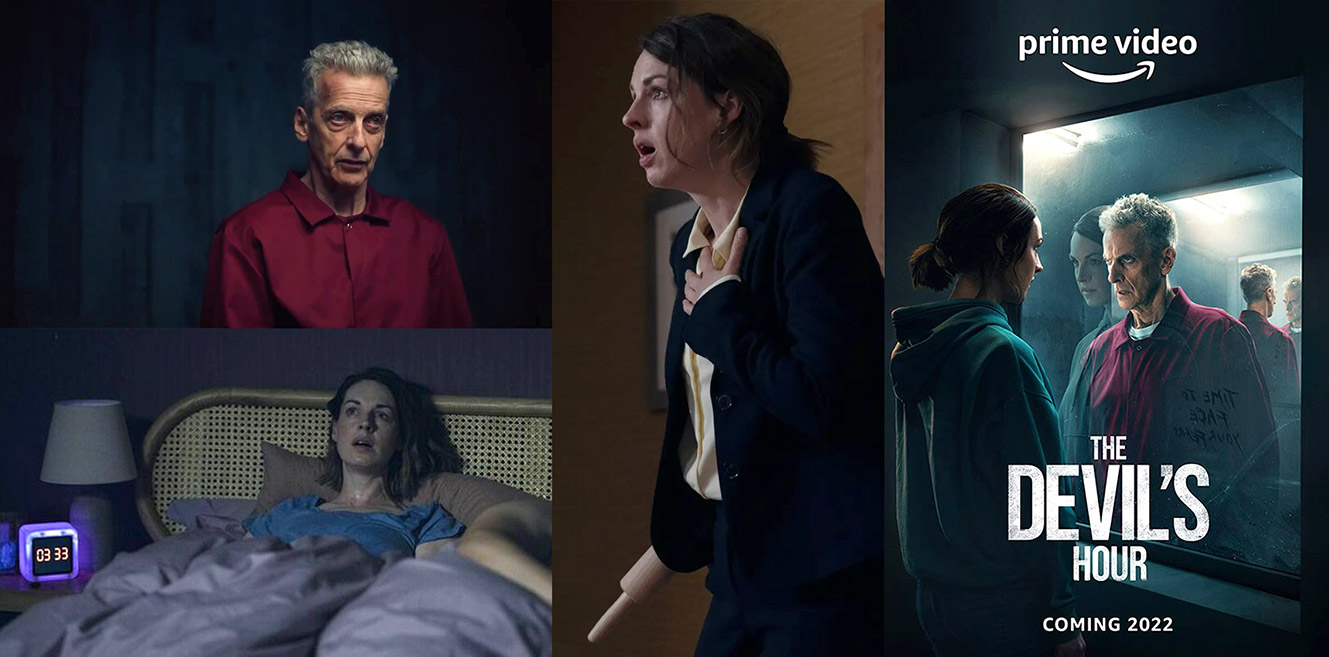
Loop Dreams
The Devil’s Hour Series 2
Directed by various
UK October 2024
Five Episodes
Warning: Very light spoilers for series one.
Okay, so when I reviewed the excellent first series of The Devil’s Hour (right here) I rightly praised it but was forced to conclude that it’s a bit of a one trick pony in terms of any future iterations. But, just to prove me wrong (and they really did), here comes Series Two. I wasn’t expecting much from it after the conclusion of the first series but, I certainly got more than enough here to keep me happy. This second season is easily the equal of the first... although it’s one episode shorter than the 2022 season.
One thing which I’m very happy about is that, after hearing a short interview with the main co-star Peter Capaldi (who plays the serial killer but on the side of righteousness, as far as we know) is that the story arc obviously has a very clear beginning, middle and end because the second and third seasons have been shot back to back and the third series will definitely be the final one (although I suspect it won’t actually get a release until October 2025 or 2026).
All the cast return here, including Capaldi as Gideon, the always brilliant Jessica Raine as Lucy (in at least two different iterations of her character and their respective occupations), Nikesh Patel as Ravi (who is a detective in both of his ‘versions’, so to speak), Benjamin Chivers as Isaac and Meera Syal as Isaac’s psychiatrist. They’re all absolutely fantastic in this, as are all their co-stars.
This one starts off with the Detective version of Lucy we were introduced to right at the end of the last series... we see her life post-Gideon and, I think (it gets confusing at first), we find that the future version of her character is the one who is talking to the ‘far future’ version of Gideon in this particular multiversal loop, which we saw towards the end of the last season. It all points to this second version of Lucy we know as living a life taking place before the main Lucy of last season... because when she dies, Gideon has her blessing to ‘wake her up’ in the next life (if I’ve got this correctly), which is what the first series was all about, it turns out.
The show continues after this following both Detective Lucy and the later (or previous, depending on your point of view) iteration of Lucy after the events of the first six episodes, crosscutting between the two and also the various versions of the other actors’ characters in their respective versions of their reality. Where this one gets interesting is that Gideon seems to be building, possibly by accident, a network of people who seem to be ‘awoken’ (sometimes tragically so) to their plight in the universe. This could possibly be a small group utilised in future loops of themselves, I suspect.
So the focus on this one is the explosion in the toy shop which kills so many children... primarily to find the identity of the bomber in the yellow hoodie. Now, we’ve not been shown his/her face as yet but it kind of seems obvious to me just who this person must be and, maybe it’s a bit obvious from the start (although I’m still hoping series three will be able to surprise me on that score... fingers crossed).
A couple of things of note though... they’re still hiding people in the background of shots on occasion. There’s a brilliant moment in the early stages of the second episode here where Lucy and Isaac are with their psychiatrist and, in one long shot only, another version of Isaac peeking out at them from behind the curtains is clearly visible in a ‘blink and you’ll miss him’ appearance. And it’s not just things like this which keep me watching because the show is just so gripping on its own but, heck, this is pretty good icing on the cake as far as I’m concerned.
Two minor gripes though... and they really are minor.
We still don’t know why the show is called The Devil’s Hour. The waking up at 3.33am is still a feature for at least one of the characters but there’s no significance attached to this at any point, it seems to me.
Secondly, when one of the Lucy characters is going through a lot of pregnancy test kits over a ‘time passing’ montage, we see her throwing each dud into her bathroom bin as each negative result comes to light. Alas, the dud kits are piling up on top of each other in the bin to suggest the passage of time but... yeah, honestly that’s ridiculous. I mean, I know, visual shorthand and all that but are they really expecting us to believe that this woman doesn’t ever empty her bin over a number of months? Or even let other rubbish pile up on top of it?
Other than that though... I was gripped and thrilled and, asides from feeling smug at least about the identity of the yellow jacketed bomber (to an extent), The Devil’s Hour continues to surprise me, certainly with the twists the story takes but, not least of all in that it actually manages to hold its own with the previous series. I’m absolutely, once again, flagging this show up as one to watch and... I just hope there’s a Blu Ray version coming up at some point down the line.*
*Got sick of waiting to show this one to my folks so I just ordered a ‘Korean Blu Ray’ of the first two.
Monday, 18 November 2024
The Devil’s Hour Series 2
Tuesday, 22 November 2022
The Devil’s Hour
Perception
Committee
The Devil’s Hour
Directed by various
UK October 2022
Six Episodes
Okay, so The Devil’s Hour is a new thriller series out from the UK and I am going to try very hard to write this one without spoilers. Mainly because, once you know the answer to what’s going on... you know... and a lot of people will probably get there themselves without my help. Also, though, because it’s a brilliantly executed rendition of a currently popular movie trope but it’s done with a certain amount of skill, enough to properly pull it all off quite effectively.
Okay, so I can give you the main premise because it will tell you absolutely nothing about what this show is about. You may remember the magic time 3.33am, popularised in modern cinema by films like The Haunting Of Emily Rose, as the time when a person is woken by the devil or some demonic force due to the time’s representational mockery of the three who are... in religious mythology... the father, the son and the Holy ghost. The idea here is that the show’s central protagonist Lucy Chambers, played by the always brilliant Jessica Raine, is awoken from nightmarish dreams and... lets call them flashbacks... at exactly 3.33am every night (okay, morning) for pretty much the majority of her life. She is separated from her husband (played by the Cineworld Adverts Phil Dunster) and lives with her strange son, Isaac (played astonishingly by Benjamin Chivers). Isaac has no emotional response to anything in his life, is susceptible to the commands of others, feels no pain and sees things which aren’t there. He is going to a child psychologist played by Meera Syal (one of many he’s seen) but no breakthroughs are being made. Meanwhile, a detective played by Nikesh Patel is trying to find a man who is abducting and killing people. These two worlds collide when Isaac dissappears for a while (found by Lucy’s seemingly schizophrenic/dementia ridden mother) and the man behind it all, Gideon Shepherd (played by the great Peter Capaldi), is making like Hannibal Lector as we crosscut between a future interview between him, Lucy and the detective... and events as they happen.
And that’s all I can say other than, the title and the premise of the show are obviously there to make the audience believe that this is some kind of horror concoction but, as I suspect most people will realise by the second episode in, this main hook of the 3.33am (which may be better written as 33rpm in terms of the ultimate explanation for everything, it seems to me, as a visual metaphor) and the choice to shoot the story in the visual and audio language of a horror film, is really just a red herring. It’s a bit of misdirection to, perhaps, try to stop the audience from guessing what’s really going on too quickly.
Certainly, it’s in one sense a police procedural show but, also has strong, dominant elements of another genre but I don’’t want to say too much. What I will say about the story however, is that it’s amazingly complex and the execution echoes that. The editing is so good on this with various bits of crosscutting between dreams, reality and so on and... yeah, that’s good because it really has to be. Hats off to the writer here but I suspect a lot of the final cut was partially shaped, more so than most shows, in the editing room to enhance the twists in the story.
So, yeah, can’t say too much. It’s well shot although, pulling out a directorial signature style is hard given that the show has multiple directors. But I can talk about the actors because, well, they are amazing. Jessica Raine is someone who my regular readers may remember from both her appearance in the Doctor Who episode Hide (reviewed here) and, perhaps more importantly, from her turn as producer Verity Lambert in An Adventure In Space And Time (reviewed here). She is absolutely the backbone of this show and really carries things... especially since Capaldi’s appearances, which you might at first think take place in her dreams (and probably they do, also... it would make sense), are fairly limited for the first four episodes. Nikesh Patel is equally great, given a gift of a character who hates blood and the aftermath of the violent crime scenes he has to go investigate (which becomes particularly poignant in one instance... but shh... spoilers). Patel takes this gift and really runs with it, making another credible character to help carry parts of the story. And as for Benjamin Chivers... well, he’s so good that even I was misdirected by his incredible performance (I assumed a grown up version of his character was also appearing in the series at the same time as he... but that wasn’t quite the case... although see the end of this article for further speculation). Now, it has to be said, that once the explanation you kind of see coming is explained by Gideon, with the help of a knotted shoestring (although it’s a nice spin on a popular concept, it has to be said), I felt a little left in the dark about Isaac’s character. It made sense up until a certain point but nobody, it seems to me, explained the ‘why?’ of that character... but that’s one of the strengths of the show. It doesn’t try and spoon feed you all the explanations so much and there are things left unsaid which will bring your own deductions to, I’m sure.
And then there’s Capaldi, of course. He plays Gideon pitch perfect and, by the end of the show, you will have to decide as to whether he is an evil person or, as he believes (and so do I, to an extent) a good, righteous person. Certainly he kills people and does horrible things to them and, yeah, with a role written like that you need someone as good as Capaldi to be able to walk that tightrope and make the character real and somewhat sympathetic. He once again proves why he’s such a great performer and, I was pleased to see, the quality of the acting by Raine and Patel means he managed to be a powerhouse without actually stealing the scenes from under them. Everyone holds their own beautifully in this and it was a pleasure to watch something so well made, to be honest.
Added to this, we have a pretty good score by The Newton Brothers which, alas, is only available so far as a horrible electronic download rather than on a proper CD where it belongs so, yeah, doesn’t look like I’ll be able to revisit this as a stand alone listen anytime soon. A shame really.
Now it seems some web sites think there will be a follow up season.* While I thought the ending of this was brilliant and really quite final, the nature of the basic premise, once revealed, means that all the cast of characters can return for future shows for sure. I’m just not sure why they’d want to do that because, it seems to me, to be a one trick pony in that respect. Brilliant trick as it is. But I’m not complaining either way... lets see what happens. All I know for sure is that The Devil’s Hour is one of the best things to hit TV screens over the last few years and it’s got a lot of power to it, plus a lot to recommend in it (I absolutely loved one ‘throwaway’ shot of a mobile phone... you’ll know it when you see it... to create a sense of time setting). And so I do... absolutely recommend this one unashamedly. Definitely worth some time.
*As of the day this review goes up, series 2 and 3 have beeen announced, including the obvious returning cast members. Really not sure what more that they can add to the story (apart from the possibly obvious true identity of Isaac) but, have at it.
Tuesday, 27 October 2020
Carmilla
Best Bloodies
Carmilla
UK 2019 Directed by Emily Harris
Bird Flight Films
Warning: Slight spoilers if you don’t know the original
story or any of its subsequent screen adaptations.
Carmilla is yet another screen version of Sheridan Le Fanu’s 1871 serialised novella of the same name and, by this point, one wonders how many times this tale of sapphic vampirism by way of passive and undetected home invasion can be committed to celluloid. That being said, Jean Rollin forged a career out of making surreal and truly astonishing, beautiful lesbian vampire movies (none of which were particularly inspired by Carmilla, I believe) so, maybe the answer is... plenty.
Well, when you have a film as good as Emily Harris’ new iteration of the source, you know there’s at least room for one more... although it would be fair to say I had a few small problems with it. Instead of going straight for the jugular, so to speak, here she instead opts to step right back from the vampiric qualities of the original, toning it down to such an extent that at one point I wondered if this really was a version of Le Fanu’s classic after all. As it happens, the vampirism is indeed included in this story but mostly through the deeds and implication of the characters at the periphery of the main focus of the main protaginist Lara (changed from Laura in the book) and the girl she, in this version of the story, names Carmilla (in the original text, as I’m sure many a Hammer Horror fan can tell you, it was itself an anagram of the first name of Mircalla Karnstein but, in this version, the famous ‘K’ word never comes up).
So yeah, I was a bit taken aback that both the vampirism and, honestly, the lesbianism of the subject was handled almost from a distance, at least in terms of overtly showing the harder edges (or should that be softer curves) of the latter element. In spite of all this though, the film has an amazing amount of positives and I’ll focus on those for a moment.
One is the acting. The main female trio of Lara, Carmilla and Lara’s governess Miss Fontaine are played by three very capable actresses who really make the film work on the performance level. Miss Fontaine is played by Jessica Raine (who readers may best remember for her turn as Doctor Who producer Verity Lambert in An Adventure In Space And Time, which I reviewed here... as well as in one of the better episodes of the modern version of the show, reviewed here) and she does her usual, wonderful job. Lara, played by Hannah Rae, does an absolutely brilliant turn here and, since the film is almost solely viewed through her character’s eyes, she almost carries the movie on her own. Carmilla herself is played by Devrim Lingnau, who does a remarkable job of breaking through the veneer of suppression which characterises Lara’s home and is exactly the brash and earthy creature (curious, perhaps, for an unearthly character) that you’d expect in a good version of Carmilla Karnstein. Although, she almost seems a little too young for the role at times.
So, yeah, fair enough, we have some great performances here. However, the real star of the show is the beautiful cinematography and shot designs that the director infuses the story with. Contrasting many shots of the beauty of nature with various insects and bugs in close up, to remind the viewer of the nature of the vampiric creature now residing in Lara’s home. Indeed, from early on in the film we hear Lara being reminded of why flowers look and smell so pretty, in order to attract the bees to pollinate them... so already the director is pushing a vampiric metaphor of an organism which uses something else for propagation, so to speak. So, great and beautifully shot wide open spaces might well be tempered with the close up sights and sound of ants crawling on a tree or worms turning in the earth. And it looks quite wonderful and certainly acts as a salve, in my case, to distract from the extraction of the details of the original story.
The director loves making nice, clean shots and there are some strong symmetrical designs throughout. A shot of Miss Fontaine and Lara’s father addressing Lara from either side of the foreground of the frame as she is standing in front of a fireplace in the centre background of a shot comes to mind. Also, there’s a beautiful moment when a triangle on one third of the screen is joined by a diagonal separator with all the plains being out of focus.
This director is not afraid to use the extreme edges of the wide screen shot either... where two characters are talking for instance... and just leave space in the centre of the screen. There’s a real feel of meticulous and well thought out design to the film and, while some viewers might find the artifice of the photography distracting, I personally love this kind of cinema and admire it above all others (it’s why I love the cinema of the Italian giallo so much).
One thing which did bother me, though, was the use of lens flares. Despite using it myself just recently in my role as a graphic designer, I find the use of lens flares to call attention to the camera a real irritant and am not a fan. They’re all over this film... even in darkened interior shots and, frankly, after a while I just wanted to duck every time a flare of light sprang up on the screen. So, yeah, could have done with less of that.
My other little problem was that the writer/director has distanced the specifics of the action so much that, I suspect the film may be a little hard to follow for people who are unfamiliar with either the source or one of the more faithful, previous adaptations of it (actually, Hammer’s first Karnstein movie, The Vampire Lovers, which I reviewed here, is a surprisingly faithful primer if you’ve never read the original). Luckily, I knew the original but because the vampirism of the story is masked and fairly thinly alluded to, I think some viewers might not have any idea as to that element of the story, especially when various tropes of the genre are more or less done away with here.
When Carmilla is, finally, staked there is no pre-warning and you don’t actually see it, just hear some thumping and moaning and, at this point, I was wondering what a certain section of the audience who had no idea this was in some way a vampire movie were supposed to think. I suppose the idea here is not to show that Carmilla is a vampire but, it’s more about the perceptions other people have of a person and the extremes they go to in order to make good on their assumptions. Thankfully, there is one brief shot of the aftermath to clue the more unsuspecting audiences in on what’s just been done to Carmilla... and it’s a shame it’s so brief because it’s a nicely brutal shot which really drives the message home, if you don’t blink and miss it. Again, though, I get the feeling that this is not the director saying... yes, she was a vampire. More saying, yes, this girl was suspected of being a vampire and this was the consequence of that suspicion (though, to be fair, Carmilla is all up for sucking Lara’s blood at one point).
One other thing I’ll briefly mention is the unusual score by Phil Selway. It uses a very small number of players (it seemed to me) and does some interesting things like, in some scenes, using high pitched and persistently reoccurring strings in a way which alerts the audience that something is going on, even when visually it’s maybe not too obvious that anything is amiss. That being said, it’s not overtly ‘stinger’ led or anything like that and it really hovers in the background, giving the film a coating of musical texture in the best way. It’s a shame that there’s no soundtrack CD available at time of writing this review because I’d really like to experience this as a stand alone listen. It’s certainly not a ‘horror’ score by any stretch and perfectly fits the restraint practiced and demonstrated by Emily Harris’ writing and direction.
And that’s me done with this latest version of Carmilla. It’s certainly not the least faithful ‘inspired by’ film but it’s also not something viewers might even realise was an ‘adaptation’ unless clued in by the name of the central vampire. Indeed, the coach crash which brings Carmilla to Lara’s door, so to speak, doesn’t even occur until almost half an hour into the movie. I don’t remember seeing Le Fanu mentioned in the credits at all (and I was watching out for it... maybe I missed it at the start, somehow), so I’m wondering how many of the potential audience for this quite strikingly shot and beautiful movie have missed this one. Certainly something I’d be happy to recommend with the caveat that it’s not anywhere near to being either a horror or straight vampire movie as you might expect from a film with this title. One to watch out for.
Friday, 22 November 2013
An Adventure In Space And Time
Cinema Verity
An Adventure In Space And Time
UK Airdate: 21st November 2013
BBC 2
Last night I saw one of the best put together pieces of contemporary television I’d seen in a long time. Written by Mark Gatiss and directed by Terry McDonough, An Adventure In Space And Time is a dramatic retelling of the story behind the first three years of Doctor Who and has been made as part of the fifty year anniversary of the show. It’s not, to be fair, all that detailed a look at the process and events that went down, for sure, but it doesn’t have to be and, anyway, it isn’t the intent. It’s a docu-drama with the emphasis on drama and, therefore, a certain amount of dramatic license has been allowed and utilised throughout the running time. This, however, is one of it’s strengths and allows the writer to weave a spell and create an atmosphere something closer to the heart of the matter... a place where mere facts can’t always explore so... well... so truthfully.
There’s one iffy moment near the end that, right since I’d heard they were making this show, I was wondering whether they’d be bold enough to try and was almost hoping that they would. Well they did but I don’t think the moment I have in mind really quite worked as well as it could but... oh, I’ll get to that later. You might want to shy away from the last few paragraphs here if you haven’t yet seen this and want to have a surprise moment still be a surprise.
Now, as I said, it’s not trying to cover everything but what this show does, and does very well, is take some of the triumphant moments from the first three years of Doctor Who and use them as story highlights to reveal the physical events and the beating hearts that birthed the series. It doesn’t harm things, either, when the casting is so good. David Bradley, Hogwarts caretaker from the Harry Potter films, amongst other roles, plays the actor William Hartnell absolutely pitch perfect and the cast he is with all deliver and, miraculously, many of the actors utilised here look very much like the people they’re playing. This helps but, honestly, they are all so fine in their roles that you almost wouldn’t mind if they looked nothing like the people in question (although it obviously assists very well in maintaining the illusion) as they all tackled the roles, or at least the popular perception of who those people were, with absolute charm and vitality. Jessica Raine channelling the strength of character of the show’s “first female producer at the BBC” Verity Lambert, for example, is absolutely compelling and creates a very strong positive role model for aspiring young people everywhere.
The way the story is introduced with a few scenes from the end of the time period under scrutiny is absolutely brilliant too. Starting off with a scene with Hartnell (sorry... Bradley) in a car, gazing at a police box after he’s just been, pretty much, fired from the role of The Doctor, due to various reasons, the narrative jumps forward a little in time to the shooting of his last story, The Tenth Planet, which introduced the Cybermen to the world, is all pretty good... and then the show jumps back via the TARDIS control panel readout to 1963, which is revisited and used as a device to click off each year as it occurs in the drama. I always kinda half like, half disagree with Mark Gatiss’’ writing (which isn’t a bad emotional response to be left with by someone actually... just means he’s a legitimate artist) but I have to say he’s been slowly growing on me over the last few years and, out of the few bits I’ve seen by him, this stands out as his best work to date... at least in my book.
The show also magically captures the spirit of the sixties, or more accurately, captures that distanced, nostalgic feel that passes as a kind of postmodern shorthand these days for the sixties, and this is injected lovingly into every frame and used to bring out the story in the most wonderous ways. Throughout the running time there are various geeky references and in-jokes and I’m certainly not buying into everything here as gospel, but it’s enjoyable stuff. There also seems to be an undercurrent of things which are put there, not for the likes of me, and which are kinda half hidden beneath the surface of the thing... which I could just about detect but which I can’t quite put a finger on because I don’t know the people in question. I was kinda half picking up on a repression of certain hints of alternate sexual chemistry with some of the characters, for example... never once spelt out in any fashion but certainly simmering somewhere down there in the subtext. I suspect this is done for the sake of subtlety and to touch upon certain issues for the sake of accuracy without bringing it up as any kind of judgement in itself... which is great. Kind of like extras for the people in question who happen to be watching this show.
Some of the recreations of the clips from the episodes are right on the money too and it looks like the people both in front of, and behind, the camera made every effort to make them so... much more than, say, the crew of the film Hollywoodland did when they were inaccurately reproducing episodes of the George Reeves, 1950 TV show The Adventures Of Superman, for example. And I loved the little nods to the shows past with such villains as the Cybermen, The Daleks, The Menoptra (from The Web Planet story) and Marco Polo from... um... yeah I think you get the idea. I'm just thankful they didn't show the Zarbi.
I also found myself very taken with an anachronistic piece of dialogue which was just perfect but which looks forward to the show’s future while referring back to the past of the audience... when Hartnell finds himself “let go” from the show, he uses exactly the same “I don’t want to go” bits of dialogue that David Tennant spoke just before regenerating in his last story. Which is a bit of an amazing temporal anomaly if you think about it but, you know, that’s what Doctor Who does best after all and... who cares? There wasn’t a dry eye in the house.
Another main “moment” that happened in this whimsical vein, and read no further if you don’t want to spoil the surprise, is something which I thought would be a cool idea for the people behind this to do when they first announced it... I just didn’t think they would be brave enough to do so. Well I was wrong, they did it. Matt Smith is in here, playing himself, playing The Doctor. Or at least the ghost of him from the future, who appears in Hartnell’s mind as he contemplates his last moments on the show. It’s a nice, but cheesy moment, which didn’t quite work for me but Gatiss and the producers were brave to give it a shot and, well, since I also thought it would be a good idea back before they started making this thing, I can’t be too critical of somebody having this idea and running with it. I’m not sure it quite fits and it certainly dates it and anchors future viewings of the show to a 2013 time frame, but it’s quite fun and certainly within the spirit of the show. So I’ll shut up whining about that now and whine about a couple of other things instead.
These things being a few missed opportunities in terms of things covered which I feel might have been good to include and which I suspect were excluded due to factors like running time. The creation of Ron Grainer’s title theme tune, for example. He is credited visually with this but Delia Derbyshire, who was instrumental to the sound of that theme, was kind of short changed here, I felt. Also, a little epilogue with Hartnell’s participation in the ten year anniversary show The Three Doctors might have been nice but it would have maybe have changed the tone the writer wanted from the ending. What I would have liked to have seen, though, since the show was extremely informative to me and showed me a few things I didn’t know (yeah, I know, been watching the show for nearly the whole 45 years of my life and still managed to be informed by this... marvellous) is what Hartnell’s reaction and thoughts at the time were to Peter Cushing playing the big screen version of The Doctor (or actually a character called Doctor Who in the movies, if memory serves me right). It would have been interesting to see how this impacted on him, considering the timing of those movies.
At the end of the day, though, this programme was damn near perfect and, as I emphasised at the start of this review, one of the finest pieces of drama put out on television in years (and easily better than the majority of the episodes from the actual show itself, over the last few years). If you are a lifelong fan of the show, or even if you’re just curious about the early days and Hartnell’s involvement in the show and the gumption of Verity Lambert to get it made, then this one off special is indeed an essential piece of viewing. If the 50th anniversary episode shown on Saturday 23rd November 2013 is even half as good as this one, then we’re in for a good time on that one too.