Shock Theatre
Universal Horrors -
The Studio’s Classic
Films 1931-1946
Second Edition
By Tom Weaver, Michael Brunas and John Brunas
McFarland Books
ISBN: 9781476672953
Universal Horrors - The Studio’s Classic Films 1931-1946 is the first of, to date, three books co-written by Tom Weaver covering the horror fantasy output of Universal Pictures... the other two being The Creature Chronicles - Exploring the Black Lagoon Trilogy (reviewed by me here) and Universal Terrors 1951-55 (reviewed by me here).
And once again, a book written by Tom Weaver took me ages to get through (what with my very limited weekly reading time)... not because it’s in any way dull (it’s exactly the stuff I love to read about) but because it’s a doorstep of a tome with a deceptively dense amount of enlightening text packed between its nearly 600 pages. This one does, mostly, what it says on the tin but, with some dubious justification from the authors to enable them to also include some of the studio’s mystery output too. For instance, of the fourteen Basil Rathbone/Nigel Bruce movies based on Sherlock Holmes (the first two put out by 20th Century Fox, of course), the twelve Universal movies are also covered extensively in this book. I’m not complaining too much though... I love those films and you will find reviews of all of them in the index of this blog.
The book tells you a load of information about the main films covered here (of which there are many) so there’s lots here that even the most jaded Universal monster kid may not know. For instance, I know now that Gloria Stuart did not get on well with Claude Rains on the set of The Invisible Man reviewed here). I know now of Henry Hull’s intervention on his make-up in my favourite werewolf movie (Werewolf Of London, reviewed here) to make him look more human so that, as in the script, his on-screen wife would recognise it’s him.
And then there’s the time that Boris Karloff put his foot down with a director on Black Friday so that Anne Gwynne could get some decent close up shots. And I was also surprised to hear that Abbott and Costello were working the burlesque circuit for years and that their respective wives were strippers. And upset when I learned that Lon Chaney Jr’s dog was run over on the shoot of Cobra Woman. And smiled at the tales of Chaney Jr’s hidden vodka hip flask with a straw beneath his bandages on the Mummy movies... as well as his obsession over buying and preserving huge amounts of canned food, in case something ever happened.
Now there are some personal caveats here for me as I was reading. I like both the English and Spanish versions of the 1931 Dracula (both reviewed here) so I was a little disappointed to find that the writer does not seem to like this film much at all. And, with an extensive ‘also ran’ index including capsule reviews for such notable entries as the Flash Gordon and Buck Rogers serials (those four reviews found in my index also), I was not happy that that, though it was a 1949 film and therefor outside the field of this book somewhat, one of my favourite Universal monster rallys, Abbott And Costello Meet Frankenstein (reviewed here) was not mentioned more than it was. Especially since it was Lugosi’s second and final time playing Dracula and Glenn Strange’s third time as the Frankenstein monster.
That being said though, Universal Horrors - The Studio’s Classic Films 1931-1946 is another very thorough and well researched tome that illuminates the classic movies and also gives new leads to some of the less available ones... which some people, especially in the UK, may not have had the opportunity to see. Although the Eureka Masters Of Cinema label have been doing a great service to Universal Horror fans in recent years with the likes of their Blu Ray Boris Karloff collections and their complete Inner Sanctum boxed set. So, yeah, if you are into these classic monster movies then this is certainly a ‘must purchase’ I would say... so I wait with baited breath for a fourth book in this loosely held together series of fascinating and indispensable tomes. Great stuff.
Monday, 14 July 2025
Universal Horrors
Sunday, 26 January 2025
Sinister Serials
Killer Serials
Sinister Serials
of Boris Karloff,
Bela Lugosi and
Lon Chaney Jr
By Leonard J Kohl
Midnight Marquee Press Inc
ISBN: 9781887664318
You’ve got to hand it to Leonard J Kohl. Researching this book in the ‘VHS age’ must have been quite a challenge, certainly a little less easy than it would be these days but, this man has done as thorough a job as anyone could do and you have to admire the detective work involved in a tome of this nature.
Sinister Serials of Boris Karloff, Bela Lugosi and Lon Chaney Jr pretty much does what it says on the tin, by examining the often neglected side of cinema, the serials (probably less books written about this part of the American cinematic legacy than any other aspect of the art, I suspect) and then applying it to three great actors who owe their fame to the Universal monster productions and, at least in the extent of two of these actors, who had their talent fostered by Universal, achieving mostly rewarding careers. So the book covers the serial productions of William Henry Pratt, Bela Blasko and Creighton Tull Chaney, better known as Boris Karloff, Bela Lugosi and Lon Chaney Jr.
What it doesn’t do is give much more than just a little of the personal history of each of these, instead choosing to focus just on their serial work, which is something a lot of people won’t know much about, I suspect. I didn’t realise until I read this that these three had made so few serials between them, truth be told. Karloff made twelve, Lugosi made five and Chaney Jr made seven. The book does, however, fill you in on where each actor was in his career at the time they came to make these serials. For Karloff the acting was sometimes his second job, for example... and it also looks at how Karloff and Lugosi both approached Hollywood by treading the boards on stage first. Which is interesting because it wasn’t until Lon Chaney Jr, coming out from his father’s shadow and working in films soon after his dad’s death, starred as Lennie in his well received stage production (and the subsequent movie version) of Steinbeck’s Of Mice And Men, that the studios realised he could handle more interesting acting roles.
Of the three actors in question, it was Karloff who was the only one of the three to star in a few fair silent film serials before he made the transition into the talkies but many of the serials he was in didn’t survive and there is no documentation left either... but the author has tried to work out which ones he was in from evidence like a few surviving film stills. I suspect Karloff may have made more but Kohl has given his best educated guesses, so to speak... and there does seem to be some evidence to back up all of the included claims.
One particular serial in which Karloff had a minor role is certainly one which I would have loved to have seen but, alas, it is among the missing presumed destroyed list (the silver nitrate stock possibly melted down to extract the silver). I found it most interesting that he was included in an American chapter play remake of Louis Feuillade’s 1913 film serial adaptation of Fantômas. I had no idea the Americans were making stuff like this at the time and I have to wonder if the title character has the edge to him he did in both the original novels and the French film serial.
The book only runs for six big chapters (roughly half the length of a talkie serial) but Kohl manages to say a lot within them, even going so far as to give notes on the music used (and reused) in some of them... as well as getting first hand accounts from the sons and daughters of the actors in question, not to mention the heirs of various actors and directors who used to work with them... including the likes of Ford Beebe Jr, which is a name I’m sure a lot of serial enthusiasts would have time for. I also now know why there’s no first serial before Lugosi’s star turn in The Return Of Chandu... it was a sequel to a movie in which Lugosi played a different role entirely, it turns out.
And I think I’ve said most of what needs to be said here. Sinister Serials of Boris Karloff, Bela Lugosi and Lon Chaney Jr is a fun tome and loving homage to the serial phenomenom itself, not to mention the three ‘horror’ personalities of the title. A well researched and enlightening book which every fan of the format will likely embrace. So if you’re a lover of such serials as The Hope Diamond Mystery, King Of The Kongo (technically the first talking serial), Shadow Over Chinatown, SOS Coastguard, The Phantom Creeps, The Three Musketeers (reviewed by me here) and Undersea Kingdom, then I reckon you will want to dip in between the covers of this particular tome sometime soon.
Tuesday, 5 November 2024
Man Made Monster
The Elec-Strickfaden Man
Man Made Monster
aka The Electric Man
aka The Atomic Monster
USA 1941
Directed by George Waggner
Universal/Eureka Masters Of Cinema
Blu Ray Zone B
Warning: Slight spoilers.
Man Made Monster, directed by George Waggner, was adapted from a short story, The Electric Man, by Harry Essex, Sid Schwartz and Len Golos and was originally intended to be a vehicle for Boris Karloff and Bela Lugosi before being put on hold for a little while. It stars Lon Chaney Jr as Dan, the titular horror and, well, it was a very important movie, despite it not being one of the best remembered horrors from Univeral at the time. Not only was it important to the careers of Chaney and director Waggner... it also was important, ultimately, to a famous comedy team of the 1940s and 1950s... I’ll get to all that in a minute.
So the film starts out with a bus crashing into an electrical pylon, killing the driver and five of the six passengers. That surviving passenger is Dan, played as I said by Lon Chaney Jr in what was pretty much his first starring role in a Universal picture, although he gets second billing behind the mad scientist character Dr. Rigas, played by Lionel Atwill. Anyway, Dan survives the crash and is invited by kindly Dr. Lawrence, played by Samuel S. Hinds (who played George Bailey’s dad in It’s A Wonderful Life, reviewed here), to stay with him at his laboratory/home for pay and food so he can study the condition that Dan seems to have. Dan had a sideshow carny act involving electricity... or rather electrickery, much like the shows I suspect Ken Strickfaden was involved with in real life, many years before. And, certainly, Stirckfaden’s marvellous machines feature prominently in this movie (you can read my review of a biography of Strickfaden and find out his importance to mad science movies everywhere here).
However, while Dr. Lawrence is away for a science conference, Rigas starts experimenting with Dan and gives him daily charges of superhuman amounts of energy. Eventually Dan becomes a shadow of his former self because he comes to depend on the electric treatment for his strength. Of course, a side effect is he can shoot electricity from his fingers and so on... so another movie which I’m sure comic book gurus Stan Lee and Steve Ditko would have seen and been influenced by back in the day. Of course, when Lawrence twigs what’s been going on, with a little insight from his daughter played by Anne Nagel and her newspaper man boyfriend Mark, played by Frank Albertson (who would go on to play... Hee Haaaw... Sam Wainwright in It’s A Wonderful Life), things turn sour and Rigas gets Dan to kill Frank and uses hypnotic powers over him, to make him confess to the killing (and forget everything else about it). But, when he is given the electric chair for his perceived crimes, of course, thing take the expected turn, leading to one of those ‘Just’ but, tragic endings that Universal did so well with some of their horror pictures.
And it’s great. A really nicely put together slice of ridiculous pseudo-scientific gobbledy gook played for drama and a cautionary tale (the Second World War had just started and Rigas wants to build an army of such electric supermen). It’s well acted by all the principal cast but the outstanding actor in the crowd is Corky... as Corky The Dog. He’s Lawrence’s canine who takes a shine to Dan and does funny, doggy things throughout the movie, including some clever tricks. He’s the one character I was most afraid might come to harm but, spoiler, he survives the movie to give a touching performance as he rests his arms and head on the lifeless body of Dan at the finale. The only problem with his performance was that you can occasionally catch him looking off screen to see what his owner wants him to do next but, this is something many porn actresses have also been caught doing on camera over the years in many productions so, I think I can cut the four legged thespian some slack here.
It’s an entertaining film and clocks in at just under an hour. It also has some nice shot compositions in it too, which is something I always find astonishing considering the 4:3 aspect ratio of these pictures. For instance, there’s a scene where Lionel Atwill is standing over Lon Chaney Jr’s body on a medical table, using his stethoscope to figure out if he’s accidentally killed him or just made him faint. A loop of wire from one of Strickfaden’s marvellous machines loops down from above into the foreground of the shot just above Chaney’s horizontal slab and, of course, Atwill is perfectly framed within the loop. Some nice noirish moments too, where the shadow of the police guard is seen only as a bold silhouette against the wall, as it approaches the lever for the electric chair. Yeah, there’s some nice stuff in the movie, for sure.
And, like I said, it’s also important. In that it was well liked enough that it gave director George Waggner and star Lon Chaney Jr their next picture together, released later that same year. That picture was, of course, The Wolf Man (reviewed by me here) and without it, the Universal werewolf movies that followed (if there had been any at all), would certainly have turned out a little differently. Would they have contributed to the later ‘monster rally’ movies and therefore, at the end of the 40s, have contributed significantly to saving the career of two comedy stars on the wane, Bud Abbot and Lou Costello, when their combined project Abbot And Costello Meet Frankenstein (which included Dracula, the Frankenstein Monster and The Wolf Man, reviewed by me here) took in big bucks at the box office? Who knows what would have happened if this director and actor hadn’t done this picture together.
Man Made Monster is part of Eureka Masters Of Cinema’s recent(ish) Blu Ray set Three Monster Tales Of Sci Fi Terror, alongside The Monolith Monsters and Monster On The Campus. It’s treated as well as all the other sets they’ve recently been releasing in a similar vein, which means it has some nice commentaries and, frankly, is about as good a transfer and print as you’re ever going to see it in. So, yeah, lovers of Universal Horror might want to check this set out and I’m very pleased to now have these wonderful films on the shelf, so to speak.
Wednesday, 29 December 2021
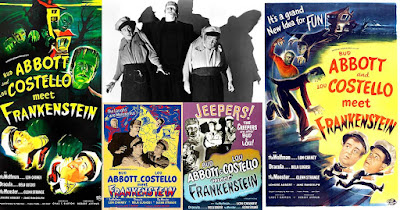
Abbott and Costello Meet Frankenstein
Wilbur Seeing You
For The Last Time
Abbott and Costello
Meet Frankenstein
USA 1948 Directed by Charles Barton
Universal Blu Ray Zone B
Lon Chaney Jr: I know you'll think I'm crazy, but...
in a half an hour the moon will rise and I'll turn into a wolf.
Lou Costello: You and 20 million other guys!
Abbot and Costello’s movie career was flagging somewhat, from what I can remember. I can’t find my reference for that now but I’m pretty sure the highly successful comedy duo were nearing what would have been a natural break in their careers, possibly for good. And then somebody came up with the idea for Abbot and Costello Meet Frankenstein which, despite Lou not initially liking the script, they at least agreed to try.
So three years after the cessation of Lon Chaney Jr’s contract with Universal, following what everybody thought would be the final film to star three of the classic franchise monsters, House Of Dracula (reviewed here), he was re-employed to make this film, which has Abbott and Costello playing two postal workers, Chic and Wilbur. Chaney would obviously replay his role as Lawrence Talbot, aka The Wolf Man and the film would also see the return of both Count Dracula and the Frankenstein monster. It’s kinda ironic given the title, I suppose, that Abbot and Costello don’t actually get to meet Frankenstein himself, of course, just the monster which became synonymous with this fictional name but, yeah, I guess we can forgive the marketing people on the movie for this grave error, to some extent at least.
Bela Lugosi returned to the role he made famous on stage and also on screen in the 1931 version of Dracula (reviewed here) and, it was a somewhat belated but welcome return for sure. Although he’d played other vampire roles for other studios over the years, such as the truly great movie The Return of The Vampire (reviewed here), this was only his second and final time playing the famous Count, brought to the world from the writings of Bram Stoker.
Also returning for another shot at his role was Glenn Strange, who was playing the Frankenstein monster for the third time, after his turns as the famous character (after Boris Karloff, Lon Chaney Jr. and Bela Lugosi had all had a go at the role) in House Of Frankenstein and House Of Dracula. That being said, when he damaged his ankle on set, Chaney Jr once more doubles up for him in a few shots in the movie, most noticeably the scene where he throws one of the two leading ladies out of a window to her death. It’s interesting to note that, for the first time, Glenn Strange actually gets a few lines in the role, reminding the audience that the monster can, in fact, talk when he puts his mind to it. He could also laugh, I guess because he ruined a lot of takes of certain scenes reacting to the improvisational shenanigans Lou Costello brought to his role when playing scenes opposite him.
The two leading ladies are Lenore Aubert and Jane Randolph, who both feign romantic interest in Wilbur here for different reasons... as a way of getting them to their own personal goals. Randolph is an insurance agent, Joan, trying to track down (as is Chaney’s Lawrence Talbot) the big packages containing Dracula in his coffin and the Frankenstein monster. She thinks Wilbur knows where they are because they are accused of stealing them somehow due to some earlier, well performed tomfoolery in the first third of the picture.
Dracula’s interest, along with that of Lenore Aubert’s character Sandra, is to revive and make a slave of the Frankenstein monster. His actual motivation as to why is left unclear but,as he says, he needs a different brain inside the fleshy casing. The brain of someone who has... “No will of his own. No fiendish intellect to oppose his master.” Which is why Sandra is trying to entice Wilbur to her castle laboratory... it would be fair to say she doesn’t want him for his body, just his brain.
And, it’s a hoot. There are some nice set pieces and, although this wasn’t quite the first film to fuse comedy with horror, it’s certainly the one that shows you how it can be done right and, the simple answer is... to play the comedy straight. That is to say, the three classic monsters are taking the proceedings of the film absolutely seriously. The characters are respected and their playing out a typical Universal horror movie plot. And then you add the comedy around and with them via the two lead actors, Bud and Lou. And it works really well and certainly the audiences thought so. This film completely revived the two comics’ ailing career and saw them continuing on in movies for quite a while. The box office receipts were very healthy on this, especially seeing that the film was the second cheapest picture Universal produced that year but then was their second biggest money maker of the year. That’s a good return and it’s a shame this didn’t also help the ailing careers of the classic monsters, who would not return on screen for Universal for many decades.
It’s been said that the film should not be treated as canon with the other Universal monster movies that came before it and not be seen as, for instance, a direct sequel to House Of Dracula, because of the ridiculous jumps in continuity. After all, the Frankenstein monster and Dracula (played by John Carradine in the previous two installments) had met their end and, also, Lawrence Talbot had been cured of his lycanthropy in the previous film... only to be living with the wolf man’s curse again in this one. My personal take is, especially considering the actors in the roles, that there certainly is continuity for precisely the same reason. I mean, have you looked at the continuity between films for those last few? It’s atrocious and so the lack of logic in the continuation of those characters here is actually very typical of the franchise... so it obviously is part of the whole bunch of them, as far as I’m concerned.
There are lot of good things about the movie. Abbot and Costello work nicely here and are fairly amusing. Costello breaks the fourth wall a few times by mugging at the camera and it kind of makes the audience complicit and engaged with the storyline, to some extent. When he glances directly into the camera to push a point or impress himself by accidentally pulling a table cloth off a chest without disturbing any of the objects on it, it almost feels like you are interacting with the film and it’s a real plus in terms of the.... well, I was going to say credibility of the characters but, maybe I should just say, it’s a real plus in arousing your sympathies and making sure you are rooting for the right characters to come out on top.
There are also several bad things in the film, mostly in terms continuity, it has to be said. One big problem for me is that, in a scene where Lugosi is biting Lenore Aubert’s neck to bring her completely under his spell, we can clearly see him reflected in a mirror. Even in the last movie (and certainly in the first when Lugosi initially played the role) it was always established that a vampire casts no reflection so, yeah, the internal logic of the creatures goes out the window with this final film in the series. Which is a shame but, as I said, the Universal monster movies were not exactly known for their tight consistencies.
So, yes, a big box office hit which, I might go so far as to say, saved the careers of Abbott and Costello but which saw the demise of the monsters although, it would not quite be the last of Universal’s monster movies. There are still a few more reviews for me left to write in terms of the classic Universal monsters. For instance, an uncredited voice appearance of Vincent Price turns up in the punch line to this movie as The Invisible Man and, although Price would not go on to play him for a third time, The Invisible Man would meet Abbot and Costello in an upcoming film. As would, of course, another iteration of The Mummy and, yeah, I will be covering those films too plus, of course, the fifth and last of the classic, big Universal franchise monsters, who would only ever appear opposite Bud and Lou on their TV show. I’m talking of course about the trilogy of movies top lining the Creature From The Black Lagoon, the first of which you will find reviewed here. So, yes, join me soon for some more Universal monster shenanigans.
Thursday, 11 November 2021
House Of Dracula
Creeping House
House Of Dracula
USA 1945 Directed by Erle C. Kenton
Universal Blu Ray Zone B
Many people regard House Of Dracula as being the final proper entry from this era to feature Universal’s top three horror franchise characters. Don’t worry though... those people are wrong and not being properly respectful of where the franchise went in the next movie in the series.
House Of Dracula took an awful long time to come out on the DVD home video format and, as a result, it took a long time for me to catch up to it again since seeing it as a nipper. It came very late in the game and wasn’t released on Universal's original run of classic monster DVDs until the reissues, some years later. Thankfully, by that time it was here to stay and is now out in a proper Blu Ray transfer. The missing piece of the Universal horror puzzle is now as easy to see as all the others.
I remember when I did finally catch up with it (having remembered nothing of the film from when I was around 5 or 6 years old), I was heavily disappointed with the movie. The big two problems for me with this one are... well, for one thing, it’s supposed to be a direct sequel to the same director’s House Of Frankenstein (reviewed here) from the year before and, indeed, includes the same three main monsters played by the same actors... John Carradine as Dracula, Lon Chaney Jr as The Wolfman and Glenn Strange as the Frankenstein Monster. However, although all three characters met their demise in the last film, the only one who has an explanation of how he survived his death is the Frankenstein monster - who is still clasping the skeletal remains of Boris Karloff’s character from the previous film... although they, quite bizarrely, have been washed up in the mud of an undersea cavern. A cavern which, by a strange coincidence, leads into a secret passage revealing Frankenstein’s old laboratory, below the estate of this film’s scientist character, Dr. Edlemann, played by Onslow Stevens.
Not only that but... the film is once again set in Vissaria, where surely the villagers would remember Lawrence Talbot from that time many years ago (in the last movie) when he was there before. It makes no sense.
The other big problem with the film is that, although the ‘big three’ are in each other’s presence in a scene or two in their normal guises, they never actually get to properly meet up in their full-on monstrous incarnations at any time in the film. Dracula is dead by a certain point in the film (well okay, deader... although has transferred his blood into Edlemann, thus turning him into a vampiric killer with the sole purpose of reviving the Frankenstein monster) and, astonishingly for the franchise, Lawrence Talbot is actually cured of his werewolvery, before the Frankenstein monster is revived for the last five minutes of the film. It turns out that all that was causing his ailment was pressures on the brain from calcium deposits, which fooled his glands into thinking his thoughts of turning into a werewolf were true and caused the body to change in the same way. Um... yeah, that really holds no water at all when you think of the origins of the character in the first film and the ‘man out of time’ nature of Talbot, who by now must be nearly 100 years old in terms of when each film was set (Even though the settings of each film are, somehow, always the 1940s... yeah, let’s just screw the continuity again right Universal? After all, nobody was ever going to see these films again once they’d left the cinema on their original release and they would then be forgotten forever.). So yeah, he’s cured but the treatment makes no sense to the symptoms and, anyway, as we’ll see in the next film in the series... the cure obviously didn’t last that long.
Unfortunately then... a monster mash up with no actual mashing up of the monsters and a sequel which makes no attempt to tie itself into the other movies, not even the same director’s House Of Frankenstein from the year before. Not to mention that, in a similar fashion in this film... well, Dracula’s actual house is nowhere to be seen. Unless you count the coffin in the cellars of Edlemann’s estate.
However, for all that and even excusing the cheapness of the budget on this one, if you can get over the disappointment of the main monsters not having a big fight at the end, you will find that this is actually a pretty good movie. It’s really nicely shot and the other elements that make for a classic Universal horror, even down to the casting of Lionel Atwill playing a similar law enforcement role to others he’s played in the Frankenstein movies, are all present and nicely done. There are some great shot set ups such as one, where Dr. Edlemann goes to open the door of his laboratory, pictured opposite camera and centre screen, which uses the perspective and some beautifully distorted, gothic shadows bending up into the middle to really draw the eye into the focus of the shot.
And talking of focus, when one of Edlemann's assistants looks at the sleeping Dracula, he hypnotises her and the whole right hand side of the screen is like someone has applied vaseline to the lens to fog it up, so only the assistant struggling with consciousness can be focused on. I don’t think it is actually vaseline in this case because the fog seems to move a little later on in the shot but it’s very well done however they did it.
There’s another great moment where the same assistant, played by Jane Adams, witnesses the other assistant (played by Martha O'Driscoll) under Dracula’s thrall and they both walk past a mirror. But no, it must be a window into a replica of the set with another actress behind the frame because, as the two walk in front of it, Dracula casts no reflection. It’s a wonderful shot and this kind of trick always reminds me of the ‘mirror scene’ between Groucho and Harpo dressed as Groucho in Duck Soup. Similarly, the moment where Edlemann finally comes under the transformation of Dracula's blood and he is seen standing in front of a mirror as his reflection slowly disappears is, for 1945, exceptionally well done.
Other things of note would be the fact that his lab assistant, played by Jane Adams, is the latest in the long line of hunchback assistants in the Frankenstein franchise. The fact that the hunchback is a female might well have been a first in movies and, similarly, the fact that she’s quite an intelligent and peaceful character is also a first for the hunchbacks of the franchise. So good for them. This film even has a scene which, finally, gives us what we’ve wanted to see since the first of The Wolfman films. The arrogant ‘doctor of the mind’ telling Lawrence Talbot, who is locked in a jail cell, in front of one of his assistants and Lionel Atwill, that his belief that he turns into a werewolf is really all just in his head. Then, just after he’s said this, the full moon rises and Talbot proves him quite wrong as he changes into his ferocious alter ego and tries to escape his cage.
And that’s about it for this one. Lovers of the Universal horror franchise will recognise a lot of the musical moments in this (correctly or incorrectly credited to Willam Lava) from previous films by the likes of Salter and Skinner and that certainly gives it a more authentic feel than, say, The Mummy’s Curse from the year before (and reviewed here). As I said... it’s a shame the monsters never really got the chance to fight but, even though Universal didn’t renew Lon Chaney Jr's contract after this film (he can also be seen as the Frankenstein Monster in a few shots tracked in from The Ghost Of Frankenstein, reviewed here... in fact, there’s even a dream sequence using shots from the majority of Frankenstein films, including some with Karloff), he would return along with both Dracula and the Frankenstein monster in a movie which, finally, gave us the big monster fight scene audiences were waiting for... and, in the process, the monsters saved and rejuvenated another famous franchise... but I’ll get to that story when I review that movie here.
Sunday, 10 October 2021
The Mummy's Curse
I’ll Have
Ananka One
The Mummy's Curse
USA 1944 Directed by Leslie Goodwins
Universal Blu Ray Zone B
The Mummy’s Curse used to be one of my favourite films of the Mummy franchise but, I dunno, it seems like less the movie I remember nowadays. I’m going to go right ahead and get the whole ‘series continuity’ elephants in the room out of the way first because, frankly, there are some big ones here... in keeping with the continuity crimes of the previous films in the series. This one was directed by Leslie Goodwins, the guy who directed the Mexican Spitfire pictures with Lupe Velez, in the very same year as the previous entry, The Mummy’s Ghost (reviewed here) and, frankly, I’m surprised that the writers here managed to build on those continuity problems even more. So let’s get to it...
If you remember the last film, Kharis and the woman hosting the soul of Princess Ananka sunk down into the swamp in New England. Now the swamp is being drained to make way for building work and Kharis is already up and about, with the help of yet another egyptian High Priest (plus his murderous assistant), who is trying to help Kharis find Ananka. However, absolutely nobody can answer the big, obvious question here? Why the heck the swamp has suddenly moved geographically to... New Orleans. Yes, that’s right, sink in a swamp in Massachusetts and rise in The Big NO. Nobody refers to the location of the last film in any way, shape or form and are acting as though the last picture took place in this latest locale.
Not only that. I’ve already said the films tend to jump anywhere between 3 to 30 odd years between sequels, right? Well this one is set a whapping 25 years after the last one but, guess what folks? Yeah, that’s right, 25 years have passed but characters are still getting drafted into the war because it’s still 1944. What the heck? I just read that somebody had worked out the time shifts between the films based on when the first one is set and, by rights, the action here should be taking place in the year 1997 but... no, ‘tis still 1944. Gosh knows what would have happened if Kharis had turned up in The Devils Brew (released as House Of Frankenstein, reviewed here) as originally planned.
Furthermore, when the decidedly confused and amnesia ridden Princess Ananka does come out from under the earth, well... she went down as actress Ramsay Ames but now she’s being played by Virginia Christine. Both lovely ladies but, really? It was shot the same year, couldn’t they get the same lady back for the next one? I’m speculating here but Virginia Christine has gone on record that she feared for her life in the scenes where the bandaged Lon Chaney Jr, playing the role for his third and last time, carried her around because he spent most of the production drunk. So maybe there was... I dunno... some tension between him and Ames in the previous shoot. I’m just speculating here but... well, it would be interesting to know if somebody has the information.
Okay, continuity aside, it’s not a bad picture but, considering it’s short, one hour and some seconds running time, it’s exceptionally slow. It takes maybe a half hour before Kharis even lumbers into the picture properly and it doesn’t help that we get a lengthy recap of the back story of the character (again using footage from both the Boris Karloff and Tom Tyler movies) to keep things from getting pacey.
Still, asides from the incredibly dull first half an hour, there are still some entertaining and also notable things about the film. Entertaining such as in lines of dialogue which brought a smile to my face like... “Come, the hours do not linger.” instead of just telling someone to hurry up. Or the discovery of... “freshly murdered men.” Oh, well... glad they were still fresh then, I guess.
The real big thing for me is the fact that we have an undead, reanimated corpse of a character, Princess Ananka, pushing up through the earth she is buried in with her hand, followed by the rest of the body. Many people think this was first done by George A Romero in his 1968 zombie classic Night Of The Living Dead. However, I can think of at least two other times prior to this that I’ve seen it done before that film. One would be the 1966 Hammer Horror The Plague Of The Zombies (which I can’t help think influenced Romero just a little) and the other time would be in this one. After all, Mummies are pretty much just Egyptian zombies and so, shot in 1944, I think this may well be the first film in which this was done. If anybody knows of an earlier example of this phenomenon then please let me know in the comments section below.
When Ananka walks around trancelike for a bit, she is caked in dust and earth and so she walks through a stream to wash herself out, so to speak. When she surfaces she looks a normal colour again and, wow, those streams in New Orleans must really be something. Not only does it get her clean, it gets her make up done and her hair styled too. Hair salon owners all over the world need to jump in a plane and wrest the secrets of the magical beautician super powers from the New Orleans swampland.
Other than that, there are a few more nice things. The shadows used to show the first murder as silhouettes against a wall is effective but an overwrought scene where Kharis keeps trying to grab Ananka but people, unaware of his presence keep leading her or driving her away from his clutches by accident just as his hand comes up to get her, actually does kind of play as a comedy almost and I wonder if this was deliberately supposed to register like this due to Goodwins’ other directorial assignments.
The music in this one is by genre composer Paul Sawtell (no, thanks all the same IMDB but he’s not, as you say, uncredited... thanks for playing though) and I think this is the first one of these he’s done (although he’d scored a lot of other pictures prior to this in the five years he’d already been working). It gives the film a somewhat different atmosphere than the others although, I did notice that an earlier piece of music from the Universal monster movies by either Hans J. Salter or Frank Skinner has either been tracked or rewritten for at least one of the scenes towards the end of the picture. And, frankly, it really needed that piece slotting in because, much as I like Sawtell and his future collaborations with Bert Shefter, this one really doesn’t help speed up the picture any and it could have done with some bolder scoring with a few more ‘musical stings’ in my opinion.
And that’s it... more or less... for The Mummy franchise. There would be one more in the series after The Mummy's Curse but it wouldn’t be Kharis reappearing, it would be a parody of the character for... well, you’ll see in a future review. Keep your eyes open on this blog because we were almost into the era of... the comedy/horror movies.
Thursday, 16 September 2021
House Of Frankenstein
The Man
With Niemann
House Of Frankenstein
USA 1944 Directed by Erle C. Kenton
Universal Blu Ray Zone B
Okay, so after hitting on the idea of having two monsters for the price of one in Frankenstein Meets The Wolfman (reviewed here), what could be a more natural progression than to fashion a movie which would star all four of Universal’s main, flagship monsters? Alas, the budget proved too much for their original line up so, despite originally planning another continuity busting component of this film when it was originally to be titled, The Devil’s Brew, the studio ditched the idea of having Kharis The Mummy getting in on the fun here too.
But we do have, in House Of Frankenstein, the first film to feature Dracula (as played by John Carradine), the Wolfman (as played once again by Lon Chaney Jr) and the Frankenstein monster (played once again by Glenn Strange). Bela Lugosi was originally scheduled to return as Dracula but some scheduling difficulties arose when Boris Karloff, who is also in this film, had to be released from a stage contract... so the studio went with Carradine in Bela's role due to the delay.
Yes, that’s right, Boris Karloff returns to this film as Dr. Niemann, a murderous mad scientist who along with a fellow cell mate, a hunchback lab assistant played by J. Carrol Naish, escape from their prison in order to find the secrets of the Frankenstein monster and seek revenge on the village people who put Niemann in jail (not the ones who sing YMCA). So, yeah, it’s kind of strange to have Karloff in a Frankenstein movie in which he’s not actually playing the monster but, honestly, he’s very good in this. His wonderful line delivery and the way he interacts with the other characters really lifts the film.
There are also a few other names from previous Universal horror movies who people will recognise, all pretty much playing different characters to their previous one... such as Anne Gwynne, Lionel Atwill and George Zucco.
Now, the thing about this movie is that it’s not really a proper monster mash at all. In terms of the story connecting up the three monsters... well, it really doesn’t. Niemann and his assistant are the only connecting tissue in a story that is definitely a game of two halves. The film plays for 1 hour and 10 mins but Dracula is only in the first half an hour and the other two monsters don’t come into the story until after he has made his last bow. Again.
So Karloff and Nash take over a travelling side show trailer, Professor Lampini’s Chamber Of Horrors on the way to the village of Frankenstein. The trailer comes complete with a specialist exhibit in the form of the actual skeleton of Dracula, with a stake pinning it in its coffin. When Karloff pulls out the stake in anger in one scene, not even he would have believed it but we are treated to the skeleton transforming into John Carradine, who kills one of Lampini’s foes (played by Sig Ruman from A Night At The Opera) in return for Niemman’s help... a favour which doesn’t get returned because, while he is being pursued for his crime, Dracula gets caught in the daylight and returns back to skeletal form (until the next film... yeah, we’ll get that one in another review). Of course, this whole back story about the skeleton being unearthed in Castle Dracula in Transylvania makes absolutely no sense in terms of continuity with any of the previous Dracula films but, hey, that seems to become the rule rather than the exception by this stage in the series of Universal horror films.
The other half of the film deals with Niemann not fulfilling his promises to either his assistant or to Larry Talbot, the Wolfman, who he thaws out along with the Frankenstein monster as, it turns out, the flood which engulfed the castle at the end of Frankenstein Meets The Wolfman merely washed them into a cave system under the castle where they were frozen solid for many years. Niemann has promised Larry a brand new brain for his help which, frankly, makes a lot less sense to me than just putting his current brain into a new body but, yeah, I’m not a scientist so what do I know about such things?
Anyway, as usual, things go wrong but, astonishingly, even though the Frankenstein monster and Lon Chaney in his human form share a couple of shots, the Wolfman incarnation doesn’t share screen time with the monster... so there’s not even a big showdown between these two like there was in a the previous installment. So, at the end of this one we have Dracula back as a skeleton, the Wolfman dead by a silver bullet (again, it’s only a temporary fix) and the Frankenstein monster engulfed by quicksand in much the same way that Kharis the mummy had sunk into a swamp the same year in The Mummy’s Ghost (reviewed here).
But, despite all this, the movie is rather well made and quite entertaining. Kenton seems to have an eye for the design and lighting of these things and there are some nice compositions which lead the eye into the centre of the frame quite a lot. Also some great scenes shot through vertical bars of windows and fences (and sometimes both) which make an impression... not to mention the placement of people at different heights to balance out the shots. And, of course, Hans J. Salter’s score does the usual thing and gives it the kind of music one always associates with these Universal monster pictures.
Admittedly, it’s a disappointment that at least two of the monsters don’t actually meet up properly in this one but these characters would all share the screen two more times for this era of Universal horrors and so, their time would come. House Of Frankenstein is one of the better B-movies of this era and a pleasure to watch every now and again... even if it features neither Frankenstein (it just features his more famous monster) nor, you know, his house. Essential viewing for admirers of these franchises, though, for sure.
Monday, 2 August 2021
The Mummy's Ghost
Wrappy Campus
The Mummy's Ghost
USA 1944
Directed by Reginald Le Borg
Universal Blu Ray Zone B
Another Mummy movie, another Bey. This time it’s Youssef Bey, played by young John Carradine. In an opening scene for The Mummy’s Ghost, George Zucco also appears as the High Priest, handing down the secret of the Tana leaves to Bey and giving him the mission of having Kharis The Mummy (once again played by Lon Chaney Jr), go with him to Mapleton, New England to rescue the remains of Princess Anankha and return her to Egypt. Remember the location where the rest of the film is set... Mapleton, New England.
Okay, so we then have the tentative male lead of the film, student Tom, played by Robert Lowery, attending his regular college lessons on the local campus in Mapleton, where the geology teacher is telling all the students about the last time Kharis was in town (in The Mummy’s Tomb, reviewed here), many years ago... even though, once again, the setting of the film is contemporary to the year it was released... which makes absolutely no sense, of course. He tells of the last rampage of the monster and how Tana leaves can be used to revive it because, well, of course that’s the kind of lessons you have in an American university, isn’t it?
Anyway, after class, Tom goes to see his strange Egyptian girlfriend Amina, played by Ramsay Ames. The audience can tell she’s strange because she doesn’t like talking about Egypt, has an undisclosed past and later on, when the resurrected Kharis (who it turns out, isn’t all that worse for wear after once more perishing in the flames at the end of the last movie) passes by her house on the way to murder the Professor of the college (who stupidly figures out that you need nine Tana leaves to call the mummy... so therefore does just that)... she sleep walks to the scene of the crime and collapses outside after Kharis drinks his fill of the potion and the professor is dead. Although, quite why Kharis chooses to strangle the professor for giving him a nourishing hot drink and not do the same to Youssef Bey is anybody’s guess.
The shenanigans continue for the running time of 1 hour and 25 seconds (a very short feature indeed) and it’s nicely paced and shot, although not as well done as the previous film. There’s a nice moment when the watchman at the Scripps Museum is reading a strange detective tale magazine and listening to a horror themed radio show (I’d like to think it’s an episode of Inner Sanctum but I don’t know for sure what it is) and the narrative on the radio foreshadows the watchman’s death 5 minutes later. I’m sure this brought grins of delight to the audiences who first saw this in a theatrical venue, as it still does to me.
It’s pretty run of the mill stuff throughout but, like I said, it’s certainly watchable. There’s a nice moment when Kharis is caressing the bandages of the princess in its museum case at Scripps when the bandages suddenly go limp to indicate the figure inside has vanished into the ether and it’s implied, quite strongly, that Anankha’s soul has jumped into the body of Tom’s special lady friend Amina. This would seem to be about right as there was obviously a family ancestry connection between the two anyway. When she faints the first night, she awakens with a pseudo-Lanchester white streak in her hair. When she faints again and is taken by Kharis, she then has two white streaks in her hair. Then, as Bey is struggling with himself and deciding to take the woman for his own and to make her his ‘forever partner’... in an attack of sexual attraction which seems to afflict most of these Egyptian sect members sent to be caretakers of Kharis... he looks down at her still unconscious form and her hair is suddenly replaced by a white wig.
She isn’t actually awake and when, at the end, Kharis has killed Bey and cut short his sexual enthusiasm, we see shots of her skin ageing considerably as Kharis approaches his final resting place for this movie, as he and his captive are chased into the swamp and sink into its depths to their forever sleep (where forever sleep equals... until the next sequel). Yes, sinking to their death in a swamp in... where? Oh yeah, New England. Remember that folks, for when my next Mummy movie review is up. Mapleton, New England.
Oh, and by the way, the place Bey and Kharis are seen to be hanging out at seems to be those long steps which, I believe, have somehow found their way from the coal mine in The Invisible Man Returns (reviewed here) and into this picture. I don’t mind though, it’s a nice set and it looks pretty good.
So there you have it... The Mummy’s Ghost is an okay entry into the franchise and it would be followed with another ‘continuity screwing’ sequel which tried to follow things from where they were left off in this movie, while still making no logical sense at all. If you thought the continuity was bad up until now, just you wait until the next part. All in all, though, a watchable movie and I will always watch these ones again.
Monday, 28 June 2021
Son Of Dracula
Swamp Vamp
Son Of Dracula
USA 1940 Directed by Robert Siodmak
Universal Blu Ray Zone B
So the next up in my rewatch of the classic Universal Monsters movies is Son Of Dracula. Now this is an interesting one for many reasons including the arguments about just who Lon Chaney Jr is playing here. Despite the title, the family line is really not mentioned here in the film, nor any real mention of the Dracula he plays being in any way a chip off the old block. Rather, it’s intimated over half way through the movie, that he’s actually the original, believed to have died in the 19th Century. Which, of course, kinda knocks out the continuity from the previous Dracula films in this series straight away.
The film starts off with a static titles card, introduced by some hands brushing away the cobwebs to reveal the title and the card on which the titles play over. We then find two men, including Dr. Brewster (played by Frank Craven), awaiting the arrival of Count Alucard on a train at the station in the deep southern swampland town in which they make their home. Yep, this is the movie, I think, that started that whole running joke of Dracula hiding his true identity by spelling his name backwards. It’s been used a lot in many films and novels since then, of course.
So, anyway, Alucard is nowhere to be seen but his baggage is, including some rather, ahem, long looking ‘trunks’ which have his name printed on the side. The good Dr. Brewster starts to spell his name out backwards, just for the slowest members in the audience who didn’t pick up on this not too mysterious cypher the first time around. Actually, the elderly Dr. Brewster (the actor died just a few years after this film was made), kind of becomes the main protagonist of the film as he’s the one who pieces it all together and has far more screen time, it seems to me, than anyone else.
Back to the plot. The 'morbidly interested in the occult' Katherine (played by the gorgeous Louise Allbritton, who apparently played a trick on her co-stars by being naked in her coffin in one take which, alas, has probably not been kept) and her sister Claire (played by Chaney costar and Universal monster maven Evelyn Ankers) are awaiting the arrival of Count Alucard in a party Katherine is throwing in his honour. Alucard turns up behind the scenes however, to put in motion what he thinks is Claire’s plan, transforming into a bat and back again... in some quite well done animated overlays, shame about the fake bat... and kills their father. Later on, he and Claire are secretly married, much to the consternation of her actual fiance Frank, who gets into a fight with the super strong Count and shoots him repeatedly with his revolver. Alas, Claire was standing behind Alucard when he does this and, in a wonderful early demonstration of one of the powers of the vampire, is shot dead as the bullets pass through Alucard and into her.
Frank gives himself up and is locked up for her murder but, since she’s doing a lot of talking to people post-death, some find it hard to believe she is properly deceased. Shenanigans abound as Dr. Brewster and his vampire specialist friend Professor Laslo, played by J. Edward Bromberg, try to destroy the two vampires... before Frank destroys them himself. Bromberg, of course, played the ‘fat funny nazi’ in Invisible Agent (reviewed by me here) but he’s been aged by make up in this and, despite the script completely cutting its ties with Dracula (reviewed here) and Dracula’s Daughter (reviewed here), he really does seem to be made up to have a superficial resemblance to Edward Van Sloan’s portrayal of Van Helsing in those two movies. A deliberate echo, I suspect, to get the audience to sympathise with a vampire hunter in as shorthand a way as possible, to keep the story moving along.
Anyhow, it turns out Claire, all along, was waiting to be made immortal by Dracula so she can do the same for Frank and then get Dracula out of the way in order to live with her former fiance forever. Yeah, she’s a kooky kid alright. I won’t go into the details of the way the Count and Claire meet their demise, which could be considered anti-climactic anyway but I will say that there’s some really nice stuff in this movie.
There’s a nice scene, for instance, when Claire goes to meet Alucard/Dracula, when his coffin floats to the surface of the swamp. Mist then flies out from the coffin and forms into Lon Chaney on screen (some of the effects in this are great... if it wasn’t for that damn fake bat) who then floats (due to the not so subtle point of view of the camera placement) over to the land to be with her. Another nice thing is when Claire, in the form of a bat, goes to bite the neck of Frank while he’s asleep in jail. Instead of seeing the bat performing the actual deed, we see Frank on the bunk and Frank’s shadow behind him, with the shadow of the bat biting the neck of the shadow, even though the bat is actually not in shot and nowhere near Frank. It’s a brilliant piece of suggestive expressionism highlighting the surreal world of the vampire but, I can’t help thinking that they probably already tried the effect with that terrible rubber bat and it looked so bad they were forced to come up with something which, serendipitously, really adds to the atmosphere of the film.
Lon Chaney Jr is always worth watching but he’s generally considered, it seems to me, miscast for the role. Certainly, his usual look of extreme anxiety does the part no favours but he does, at times, play the Count in an overtly hostile manner and, all in all, I think he does as good a job as he can here. I would have liked to see more of him in it as his ‘death’ seems somewhat rushed over and premature when that scene comes near the end of the film. It doesn’t help his performance any, however, when Hans Salter, who recycles a score he wrote with Frank Skinner for a film called Seven Sinners (according to the IMDB), kind of overscores Chaney’s first two appearances in the role with a kind of extended, mysterioso tone which is less than subtle and, honestly, really damages what could have been dramatic moments. I love Salter and Skinner and this usage wasn’t necessarily their idea but, still, it’s one of the few times in the Universal monster movies that I think the scoring is just a little too ‘on the nose’ to be truly appropriate for the scenes.
That being said, Son Of Dracula, whether Chaney is playing the heir to the Count of Transylvania or actually the real deal, is nothing less than entertaining and watchable. In my opinion, it’s actually Frank Craven’s sound and reasoning Dr. Brewster who actually carries the weight of the film and it’s true that, this one doesn’t seem to really fit in with the other monster movies made by Universal at the time (in a way, it’s almost too sophisticated) but, as far as I’m concerned, it’s a corker and always worth a watch. The continuity on the Dracula character, however, would be even further compromised in the next three films he turns up in, played twice by John Carradine and then, one last time, by Bela Lugosi. Which I will get too on this blog at some point soon.
Monday, 7 June 2021
Frankenstein Meets The Wolf Man
Creature Crossover
Frankenstein Meets
The Wolf Man
USA 1943 Directed by Roy William Neill
Universal Blu Ray Zone B
Well this is a great little movie. Affer the bravery of Universal's previous classic monster picture, The Mummy’s Tomb (reviewed here), where they killed off both male leads from the previous movie within the first 20 or so minutes, here they came up with what was, I think, another first. Correct me if I’m wrong but I believe Frankenstein Meets The Wolf Man was the first time that two sets of characters from different franchises under the same company had crossed over in a movie.
So, yeah... remember when Universal were trying to resurrect their monsters a few years ago to make a Dark Universe so they could ultimately pitch all their monsters together in each other’s films (something I still wished had happened because I thought the Dracula Untold and The Mummy reboots were fine)? And remember when everybody said they were just trying to build an interlocking franchise in the style of Marvel’s Avengers movies? Well I was angry about that accusation then and I still am. If anybody has a right to cross over their franchise characters it’s Universal with their classic monsters. They were doing it before anybody else was, back in 1943 (and for the rest of the 1940s, as you’ll see in some future reviews) and, like I said, I’m pretty sure this was the first time that this kind of cross pollination film was done.
This movie serves as a proper sequel to both The Wolf Man (reviewed here) and The Ghost Of Frankenstein (reviewed here). It starts off with something unusual for these particular films at the time... the credits are over a ‘moving background’ of a hand which fills a smoking test tube, which carries on frothing as the credits continue... instead of the usual static shots one would associate with a Universal horror picture title sequence. Then we get a shot of something which, although constantly mentioned in The Wolf Man, was never actually seen in that film. Namely, a shot of the full moon. And don’t’ worry if you miss it... there’s lots of shots of it, to make up for its absence in the prior picture, throughout Frankenstein Meets The Wolf Man.
So the film starts off four years after The Wolf Man with two tomb robbers in Llanwelly cemetary... “Here rest the dead of Llanwelly” we read on a stone as we look at the establishing shot. The tomb robbers break into the Talbot family vault in the hopes of finding Lawrence Talbot’s coffin and stealing the gold watch he was buried with. They find the correct one easily enough because it bears the legend... “Lawrence Stewart Talbot who died at the youthful age of thirty one R.I.P.” However, instead of a skeleton they find that Talbot has been somehow preserved, with wolfsbane placed over his body. When they remove the wolfsbane, this and the full moon shining through the tomb resurrects Talbot and transforms him back into The Wolf Man... played once again by Lon Chaney Jr (who is billed, as he is in a fair few of these movies now, as just Lon Chaney).
After ripping the throat out of one of them, Larry Talbot’s half living body is found in Cardiff the next morning by police and taken to the hospital. After much questioning by both Patric Knowles as Dr. Mannering and... “Why if it isn’t Mr. ‘Olmes”... that’s right, Dennis Hoey as Inspector Owen (best known for his continuing role as Inspector Lestrade in the Basil Rathbone Sherlock Holmes movies), nobody believes his story so, after more inadvertent murdering, he gnaws his way through a straight-jacket and flees to Europe in search of Maleva, the gypsy woman whose son, played by Bela Lugosi in The Wolf Man, bit Talbot in the previous werewolf film. He finds her and they go looking for Dr. Frankenstein, who Maleva says will know how to cure him by death, since Talbot seems to be invincible now. Maleva is, once again, played by the wonderful Maria Ouspenskaya.
Cut to... the Frankenstein plot. The Monster has had the brain of Ygor (played by Bela Lugosi in the previous two Frankenstein movies) put into his head and it turns out he’s somehow escaped the fire and is preserved in a block of ice under the ruins. Talbot finds him and breaks him loose. And, yes, Bela Lugosi is the actor who, this time around, is underneath the Frankenstein monster make-up. Meanwhile, Dr. Mannering shows up in Vasaria, having tracked down Talbot to see if he can help him but, instead, becoming fascinated by the secrets of the Frankenstein monster.
Added to this cast of characters and actors we have the gorgeous Ilona Massey from Invisible Agent (reviewed here), taking over in the role played by Evelyn Ankers in The Ghost Of Frankenstein, to play Elsa Frankenstein in this one. We also have a justice of peace kind of character played by Lionel Atwill (who was in a load of these Frankenstein flicks, of course) and a charmingly outspoken pitchfork brigade villager played by Frankenstein movie stalwart and Renfield extraordinaire, the always watchable character actor Dwight Frye. This would be his final movie as he was struck down with a fatal heart attack just a couple of months after shooting, at the age of 44.
And its the usual shenanigans of the standard Universal monster picture with two monsters for the price of one and with the added bonus of Lon Chaney Jr’s continuing ‘doom laden hysteria’ take on Larry Talbot. This guy is on a downer in every film and, even in a song and dance number for a festival he’s attending, he manages to have some kind of aggressive depression fit and tells everybody off for singing at him that they should all live forever. He only wants to die... so leave him alone folks.
The film has some really lovely stuff going for it too. There’s some great use of shadows and the director gets a lot more depth in the shot than is usual for these kinds of movies, using a lot of upright foreground verticals such as stone columns or trees to help create more interesting frames. It’s not as spectacular as, say, Son Of Frankenstein (reviewed here) but this is certainly some quality work and I think this film gets somewhat overlooked in the hierarchy of Universal horrors. Also, the inevitable fight scene between the two monsters at the end of the picture is just that. This film in particular really goes for it... as we see the Frankenstein monster and the Wolf Man tossing each other around like a couple of wrestlers. The confrontation scenes in these kinds of films are often a bit lacking but... not here. Even though it’s only one scene right at the end of the picture.
If you remember the last one... the ‘Lugosi’s brain’ version of the monster is supposed to be blind but he could talk. Well, there were a number of scenes where Lugosi has conversations in the movie but, due to preview audiences laughing themselves silly every time Lugosi’s thick accent would come from the Frankenstein monster, all of those scenes were cut from the movie and we’re left, once again, with a dumb creature. If you look carefully, though, you can still find evidence of those scenes where the story would have suffered if the shot had been cut... where Lugosi’s mouth is moving if you look closely but his audio is eradicated. It would be nice to finally see these scenes restored but, alas, it’s probable that the excised footage has been destroyed because, well, it’s not like Universal hasn’t looked for this stuff.
My only real complaint is with a scene where Dr. Mannering and Inspector Owen are talking in Mannering’s office in Cardiff. We see him reading from a hardback book and then he goes to a shelf, takes out another, similarly hardbound tome but, then replaces it on the shelf with the book he’s reading. What the heck? What kind of filing system is that? How are you supposed to keep everything in a nice order if you just re-house books will nilly on a shelf. Complete madness. Maybe I should have seen that as a sign that he’s going to be up for ‘fixing’ the Frankenstein monster later in the movie because, surely, the mis-filing of books makes for totally ‘mad scientist’ material!
Okay, that’s me done with Frankenstein Meets The Wolfman. I still love this movie and always cherish the chance to watch it in sequence with the other films in this series. The next one in this particular Frankenstein franchise would, of course, feature three classic Universal monsters for the price of one but... you’ll have to wait for my review of House Of Frankenstein before I get onto that.
Monday, 26 April 2021
The Mummy's Tomb
Tomb It May Concern
The Mummy's Tomb
USA 1942 Directed by Harold Young
Universal Blu Ray Zone B
I think people tend to forget this when looking back on The Mummy’s Tomb but, this was a really brave movie on the part of Universal pictures at the time... especially in terms of the way you build a franchise. I’ll get to that in a minute. Alas, this is also the film where all of the continuity between the movies in The Mummy franchise is completely shot to hell and makes constant ridicule of the series much easier too.
This film calls back the two leading men from the last film... Dick Foran as Stephen Banning and Wallace Ford as Babe Hanson. However, the film is set 30 years since the events of The Mummy’s Hand (reviewed here) and so Foran is seen in ‘aged make up’ at the start of the picture, telling his son John Banning (played by John Hubbard, who was only two years younger than Foran in real life) and John’s fiancé Isobel (played by the gorgeous Elyse Knox)... and also Stephen’s sister Jane (played by Mary Gordon, who was Mrs. Hudson in the Basil Rathbone Sherlock Holmes film series)... all about his last adventure. Truth be told, even in his old make up, Dick Foran looks a little younger than the guy playing his son.
So what we have here, for the first ten minutes of the movie (and it’s only an hour long B-feature), is Foran narrating a series of no less than six sets of clips and highlights montages, replaying the salient points of the last movie. Interestingly, the footage used does not include the hand painted ‘dark eyes’ used in the last movie and Tom Tyler’s eyes are clearly visible in the shots of him in wrappings. After it’s over, Foran looks to the ‘aged’ photo of his leading lady from the last movie, who has apparently passed away in the intervening years.
Meanwhile, George Zucco, playing the high priest in the last movie, is also back as an aged version of his character who tells his new successor, Turhan Bey (played by Mehemet Bey), that the bullets only went into his arm! Kharis, the mummy, is also somehow back, not having perished in the flames that engulfed him in the last movie and looking... well, just a little bit singed really. Audiences might find this new version of Kharis hard to take because, as we are reminded from the flashback clips, he was played by Tom Tyler (of The Adventures Of Captain Marvel and The Phantom fame) in the previous movie but, from here on, Lon Chaney Jr dons the bandages for this and the next two sequels. The trouble is, Lon Chaney Jr is a heck of a lot pudgier than the slim, bandaged form of Tyler and, yeah, it really shows. Has this mummy been swigging beers for the last thirty years?
Even so, the new Kharis has a mission of revenge and Turhan Bay relocates to be the new caretaker of Mapleton Cemetery, in the same home town as Stephen Banning and his family. Here, Bey starts to carry out ‘Kharis destiny’ of revenge on the people and family of those who defiled his tomb. Once again, using the nine Tana leaves to animate him each night, we watch as the leading man from the last movie is strangled to death by Kharis. Seriously, how brave is that for a 1942 movie playing with audience expectations? Then, to attend his funeral, Babe is recalled to town but he’s too late to stop Banning’s sister escaping the same fate. Then, after giving various people the dope on the threat of Kharis, Babe is also killed off in a similar fashion. Wow... the two leading men from the last movie killed within the first 25 mins or so of the film that you thought they were going to be the heroes of. These days this would be known as a ‘passing the torch movie’, where one generation of characters hands over the franchise to the next generation of actors. Here, though, it’s only two years since these characters debuted so... yeah, I do think this is quite something in terms of a way of giving a franchise new legs (like the modern GI Joe movies). I don’t know if any other film franchises were doing anything similar at the time (comments below if you know of any) but I find this incredibly interesting and gutsy.
As a stand alone movie, it’s not bad. Lots is made of the shadows cast on walls by Kharis as he goes about his business and, I’m pretty sure the scene where Kharis kidnaps Isobel (because Bey fancies her himself and wants to do unspeakable things to her) is an homage, of sorts, to the 1922 German Expressionist movie, Nosferatu - A Symphony Of Horror, where similar use of the shadows of the monster’s hand creeping over the sleeping form of the leading lady is used.
The film ends predictably with bullets and fire, much like the last movie but, if you can handle the bizarre lapses in common sense, you will probably find that this is one of the more watchable films of the Universal Mummy franchise, although not as good as the previous entry in the series. Stock and re-recorded music abounds via Hans J. Salter, Frank Skinner, Heinz Roemheld and Charles Previn... which is just as well considering the strength of their scoring on The Mummy’s Hand flashbacks in the first ten minutes. Musical continuity is, at least, maintained therefore.
Of course the biggest problem is... the last movie was set in 1940. This film is set 30 years later in... 1942. Which makes no sense. There’s even a reference to John Banning getting drafted into the war so... what the heck is going on? What were the screenwriters thinking? Whenever I compare a new series of cinema movies which have really awful continuity between pictures, such as all of the X-Men films, I always invoke The Mummy series of the 1940s as something equally as terrible in this area. And, as I review the next two films in this franchise, you’ll see that the writers tend to compound these ‘errors’ in each one, not just in terms of time but even, in one case of outstanding inexplicableness, in location. Well, I’ll keep all that ‘under wraps’ until the next Mummy review and unbandage these things for you when I get to them.
However, if you can ignore the unbelievable stupidity of the continuity then, I think you’ll find that The Mummy’s Tomb is a real gem of a movie. Admittedly an unpolished gem but, all the same, the direction they went in to kill off the leads from the previous film when you least expect it is a real eye opener and you have to applaud them for their thinking here, at least. Always happy to give this one a watch.
Thursday, 25 March 2021
The Female Bunch
Sucker Bunch
The Female Bunch
USA 1971 Directed by Al Adamson
Severin Blu Ray Zone A
Warning: Some spoilers I guess but,
you know, it’s an Al Adamson movie!
Last year I talked about ‘Blu Ray boutique label extraordinaire’ Severin’s labour of love boxed set, Al Adamson - The Masterpiece Collection, when I reviewed the accompanying new documentary film, Blood And Flesh - The Reel Life and Ghastly Death of Al Adamson (review is right here). Well, it’s finally time for me to crack open this, sadly out of print, box set of thirty two Adamson feature films with the first movie in the set (doubled up on a disc with the aforementioned documentary)... The Female Bunch. For the record, I’m going to review all of these movies in the order that they’ve been put together in the set (as opposed to both the release date order and, indeed, the production order... which is also an entirely different and more fluid thing).
The film starts off with the following warning from Severin: The Female Bunch was scanned and restored from several faded 35mm release prints of varying physical condition. The negative is believed lost. Every effort was made to use the least damaged sections of each print to ensure the best possible image quality throughout.
And they’re probably right to do that because, although it’s a nice, clean transfer, it looks like it’s in terrible shape but, frankly, with a film like this, that quality kind of adds to the whole grindhouse charm of the thing. When Tarantino and Rodriguez did their Grindhouse double bill movie, they decided to add a distressed look to their movies... here Severin get the effect for free, from the various prints actually having suffered from a heck of a lot of wear and tear. What they don’t do is give you a word of warning about how bad the movie is but, that’s okay, I was kind of expecting it anyway and, you know, it’s kind of a ‘so bad it’s good’ movie anyway.
The film starts of with a man and a woman in an open top car driving along a desert road, pursued by a bunch of women on horses (yeah, that’ll be The Female Bunch then) and a gal shooting at them from a light aircraft. Their tyres get shot out and they make a run for it, finding a cave to hide in but not before the guy is shot, receiving an energy sapping wound just below one of his shoulders. The girl removes his shirt to get a look at the wound and screws it up into a disposable bundle. She then takes off her shirt to wrap around him which, to be fair, is what all the young ladies in these kinds of movies seem get around to doing anyway. Might as well get it out there early, I guess.
Anyway, as she stands in the cave in her underwear, the guy asks her “How did you get involved in this mess?” Which is a phrase that suddenly loops around on the soundtrack about six times as the camera zooms in on her face. After almost a minute of this, maybe, I kinda got the idea that this is a framing device and indicates a flash back as the girl, Sandy (played by Nesa Renet) lapses into voice over and tells how a string of hard luck and a failed romance with a night club singer played by Don Epperson ended up with her being discovered by her friend Libby (played by Adamson’s long standing muse Regina Carrol), half passed out on her bed after taking a bunch of pills in an effort to kill herself.
So Libby does what any good pal would do... she takes her blindfolded to a ranch in the hills so she can take an initiation test of being buried in a coffin, so her half psychotic friends, The Female Bunch, can take her on as one of their own... a bunch of women who live in freedom on their ‘no men allowed’ ranch , living off the drug money that their boss, Grace (played by Jennifer Bishop) uses for their expenses. Frankly, these are an antagonistic and unsympathetic bunch and just why the heck Libby hangs out with them is anybody’s guess. And there they live at their ranch, terrorising a local Mexican while, at the same time, tripping over to the border most nights to party it up at the local Mexican bar and having ‘sexual relations’ with various guys (asides from their man-hating boss, who prefers the lady flesh).
It’s here that one of the girls gets it on with one of the film’s two, very well known actors. Russ Tamblyn plays Bill, who is given a map to how to get to the ranch and this particular girl’s room so they can get it on again later in the week. However, with Grace’s ‘no men allowed’ policy, when the two are caught, The Female Bunch rough up Tamblyn and brand his forehead with a cross.
I’d just like to say that, for a lady who has a ‘no men allowed’ on the ranch policy, it seems somewhat strange that she has a stable hand/drug stash security guy who lives on the ranch with them, in the guise of Lon Chaney Jr in the last film he ever shot. Not the last film he was in that was released (that would be Adamson’s Dracula VS Frankenstein, which I reviewed quite a while ago here) but the last film he actually shot, six months after that one (he died in 1973). This makes no sense of the ‘no men’ policy whatsoever, of course, because the last time I checked, Lon Chaney Jr was definitely a man but, oh well, artistic licence I guess. It’s a sad performance because he has a raspy voice and that’s because of the radiation treatment he was having for his throat cancer. Of course, after hearing an anecdote from one of the crew on an accompanying extra about how the film was shot in a ‘Dry State’ and how he would have to go out every day to another county to bring back Chaney Jr’s quart of vodka that he drank every day, I can’t but help think that the excessive amounts of alcohol may also have something to do with how his voice sounds in this one but... yeah, throat cancer and it’s very sad.
Grace maybe starts to question Chaney Jr’s ‘definitely a man’ status too at some point because, after he hassles her for sex once too often, she hits him on the head with a hammer and has a horse drag him into the desert to die. Then she goes on a bit of a killing spree because, Mr. Tamblyn is understandably upset with having a big cross branded onto his forehead. He gets a friend to drop him at the ranch (the same guy who is shot at the start of the movie and inspires this whole extended flashback of a story) and tries to ‘revenge rape’ Grace. For his trouble he gets a pitchfork in the back and his friend, when he comes to pick him up, gets tied up and left in a barn while the girls decide what to do with him.
Then, with almost no foreshadowing whatsoever, Sandy decides to leave the group of psychotic ladies, releases him and they do a runner, finally catching up to the story and ending the flashback, leading into the last five minutes of the movie which I won’t spoil here for you but which features the return of another character from earlier in the film in a kind of ‘deus ex machina’ rescue moment.
And the film is pretty interesting. There’s lots of naked boobage revealing a variety of different nipple types (if that’s what you’re into) and a bizarre propensity by the director, I felt, to shoot everyone just a bit too close up. There’s lots of rolling around in the hay and, even though it’s certainly not as explicit as most modern movies, it does feel genuinely grubby and sleazy as the movie plays out. The tone of it is a little like watching Russ Meyer’s revered classic Faster, Pussycat! Kill! Kill! (reviewed by me here) but with a lot more women and, somehow it's a lot less better shot. Also, I’ve complained that the art of using a zoom lens properly is something which has really gone out of style in modern motion pictures. Let me assure you though, if more directors used a zoom lens as often and as badly as Al Adamson does in this picture, then its no wonder people would want to bury the technique.
There are some bizarre things in here that are fair;y questionable. One of the girls shoots another up with heroine (or something stronger), for example and then, instead of it dulling her senses, they have trippy lesbian sex. I know it must be trippy because the director uses one of those lenses (I’ll call it a fly’s eye lens because I don’t know what I’m talking about) where the girls are in the same image in little shots combined all around the screen. So, yeah, it’s trippy and wild, man.
Another thing of note and, alas, ridicule is the ‘day for night’ sequences when the girls visit the Mexican saloon. Much as I hate those filters, I have to say that the second time they go to the place it seems like the film crew just forgot to put the filters on the camera. Oh no, wait... they did for that shot, but not for that shot... no it’s gone again. Night and day change pretty quickly in Mexico it seems (every few seconds in some cases).
The soundtrack on the film, by a guy called Jaime Mendoza-Nava, is not very good. It plays like a bad, mid-sixties American Western score and, for all I know, it might well have been one. But it does add to the bizarre atmosphere of the flick in some way... just not in a way to effectively raise the level of the imagery, is my take home from that.
Something of note is that the majority of the film was shot two years before it was released, in the Summer/Fall of 1969, at the infamous Spahn Ranch. So, yeah, it was while the Manson Family were occupying it and there’s a chilling story on an accompanying extra by one of the film crew about, well, a very lucky escape they think they possibly had with the young ladies who killed Sharon Tate. Pretty heavy stuff. One interesting piece of trivia from one of the actresses, Leslie McRay, on a bonus feature, is that she was actually the poster girl for the iconic shot of a girl with a lizard superimposed onto her for one of the many posters for Lizard In A Woman’s Skin (movie reviewed here). I always assumed it was Florinda Bolkan who was on that poster but, no, it was this young lady... so that’s an interesting bit of trivia I’ve never been able to pick up from anywhere else.
All in all I’d have to say that, while I found a lot to ridicule in The Female Bunch, I did have a pretty good time with it and it certainly won’t be the last time I watch this one. I can only recommend this wonderful set and I’m so glad I talked myself into investing the cash. That’s one down, 31 left to go.