Showing posts with label Lucio Fulci. Show all posts

Tuesday, 5 December 2023

Opening The Cage: A Lizard In A Woman’s Skin


A Lizard But
Taller, In London
*

Opening The Cage:
A Lizard In A Woman’s Skin

Written by Keri O’Shea
Warped Perspective No ISBN


Just a very quick shout out to Keri O’Shea’s new monograph, Opening The Cage: A Lizard In A Woman’s Skin. I have to admit, I bought this one thinking it would be another modern take on one of my favourite gialli which I would probably disagree with and ultimately become enraged by but, how often do you see a dedicated study on Lucio Fulci’s A Lizard In A Woman’s Skin? So I plonked down my money and received my copy a very quick two days later, accompanied by a brief note by the author thanking me for my support (I always love it when that happens.... it’s just a shame she didn’t sign the copy too).

And I have to say, I was quite joyfully surprised by this one when I started to read. I mean, okay yeah, if I ever sat with this lady in a pub there might be possibly be some slight disagreement in the difference in genre between giallo and horror in cinema but, honestly, this was a refreshing, intelligent look at the movie through none of the obfuscating prisms... nor, indeed, the usual paths I was expecting from modern film criticism.

I mean, if you’re looking for an in depth look at how the film was made or marketed etc then you are possibly at the wrong venue. What we have here instead, is an analysis of the film which goes into other areas less well travelled. And where the thing does stray to make its point, it does so in a very thorough manner and, perhaps my appreciation of this particular work on the subject comes from the fact that the writer is, indeed, taking me into areas where I don’t have nearly as much knowledge as she... so I was always going to find this one interesting, at the very least. But this isn’t “the very least”... it’s so much more.

For instance, the chapter entitled A Lizard In A Woman’s Skin And The Curious Death Of The Age Of Aquarius is one of many chapters highlighting the two ‘LSD blinded hippie witnesses’ in the movie but explains how the films main protagonist...and, okay yeah, spoiler warning, don’t read on if you’ve not seen the movie... antagonist, played by Florinda Bolkan, rejects the hippies as a negative factor (whilst obviously embracing some of their lifestyle for at least a little of the movie, in her recent back story) and how this is filtered from Lucio Fulci’s own attitudes towards them and their falling out of favour with the world after incidents like the Manson Murders. Indeed, the next chapter entitled We’re Not In Wonderland Anymore, Alice gives a good background on Manson and his followers, as other chapters veer off into such fascinating subjects as LSD and various locations in London where the movie was shot (I learned that some of it was also shot in Italy, doubling for London, which I didn’t realise before).

Above and beyond the high quality of the writing and the thought behind it, the whole book is presented well too. Starting off with the famous poster image on the front cover of Leslie McRay... who wasn’t even in the film but modelled for the advertising (see my review of The Female Bunch here for more details)... the book is really well designed and put together as an attractive package featuring lots of colour photos. Admittedly, the section on Fulci’s burgeoning interest in art and his use of it in the movie could have used a few illustrations of the paintings in question and, yeah, there are just a couple of pages where legibility and readability are slightly threatened by the colours on the underlays but, I can’t complain because the whole thing hangs together really well and just looks fantastic!

And I even learned a new word and now know what Cruention is so, yeah, the book is certainly informative in ways I wasn’t expecting it to be, too. All in all then, Opening The Cage: A Lizard In A Woman’s Skin is a very positive read on aspects of one of my favourite Fulci films that are often not considered and this one clearly demonstrates how various writers can bring their own, very valid spin to things. If you’re into the movie then I’d say snap this one up while you can. Copies can be ordered direct from the publishers at https://warped-perspective.com/index.php/shop/

 *Yeah, if you can work out that pun title... you're really good. ;-)

Wednesday, 29 August 2018

Videoman (aka Videomannen)


VHYes!

Videoman (aka Videomannen)
2018 Sweden Directed by Kristian A. Söderström
Screening 26th August at FrightFest 2018


Okay, so alongside the totally awesome Luciferina (reviewed by me here), Videoman (aka Videomannen) was easily one of the best movies playing at FrightFest this year (out of the five I got to see, at any rate). Set in contemporary Sweden, the plot follows a few days in the life of one Ennio Midena (played by Stefan Sauk), an Italian immigrant who absolutely loves the giallo and horror movies of his country and who used to own the best VHS rental shop in Sweden during the 1980s and 1990s but, since the decline and near disappearance of VHS and Betamax, now gets by as best he can. Ennio is a composite based loosely on a few of the director’s friends (Söderström told us this before the screening), one of whom is indeed called Ennio Midena. The film is not of the horror genre, it’s a comic/social drama piece infused with a big shot of imagery and stylings borrowed from Ennio’s favourite genres and it’s a good fit. Indeed, in his introduction and discussion with the director, before the film unspooled for its appreciative audience, Alan Jones commented that it was a film which mixed the styles of Dario Argento and Mike Leigh and, while I can completely understand the sentiment, I’m not 100% sure Leigh (or possibly even Argento) would be the absolute best comparisons here, although Argento certainly gets more than his fair share of references littered all over this wonderful movie.

Anyway, the plot set up is simple... Ennio Midena has obviously seen better days and he lives in a basement flat in a replica of his old video store in which houses his collection (which he still rents tapes out from, if people meet his exacting standards in terms of the quality of their equipment). He is pretty much an alcoholic and doesn’t suffer gladly the fools who disagree with him about various movies (and even formats... I’ll get on to that in a minute). One day, however, he is faced with an eviction notice which means he’ll soon be homeless unless he can pay all his debts within two weeks. He doesn’t know how to face this new challenge but, while on the lookout for more films for his huge VHS collection, he meets a lady called Simone (played by Lena Nilsson), who is hoping to unload an old box of videotapes to anyone who wants to pay for them. In the box he spies an extremely rare, early edition of Lucio Fulci’s classic Zombi (aka Zombie Flesh Eaters... reviewed by me here), branded by a specific company in a specific box, which means something to collectors of such material in Sweden. Actually, I know there’s a similar equivalent in the UK when it comes to the second hand market for old, pre-censored VHS tapes branded by certain companies in specific packaging, so I can relate to this film being used as a plot device here, especially since Zombi was one of the ones which got banned in the UK over the whole Video Nasties furore of the 1980s and then later released in a much censored version in this country.

Anyway, Ennio offers the lady to buy the tape but she wants to get rid of the whole box in one go and, since the price is ludicrously cheap concerning the title in question, he takes it all off her hands. Within a very short amount of time though, through the ‘collectors’ grapevine, a legendary and mostly anonymous internet VHS dealer named after Jess Franco’s movie Faceless rings and says she is interested in the rare Zombi tape. Enzo says it’s not for sale but she offers a ludicrous amount of money for it... enough for Ennio to finally pay off all his debts... and arranges to meet with him a few days later to collect the tape and give him the money. Then tragedy strikes, as Ennio returns home later to find that his copy of Zombi has vanished from his collection, even though it was in one of the special sets of shelves which he keeps under lock and key. What follows for the remainder of the film is a truly brilliant and hilarious romp through the underbelly of old school VHS collectors comprising various friends and acquaintances of Ennio as he tries to figure out who has stolen his tape and how he is going to get it back before his meeting with Faceless. Meanwhile, he is also trying to keep up a semblance of a social life going and, for the first time in a long time, the similarly alcoholic Simone may be a good, potentially romantic partner for him. Will things work out for this unlikely pair or is there more danger lurking around the corner?

Well I’m obviously not going to tell you but I will say that Videoman is a true gem of a movie for people who are familiar with the strange ‘collector types’ who live out their passions through their hobbies while also giving some nice little nods to giallo and horror as it goes along.

For instance, after a prologue scene which we kind of see from a different point of view later in the movie, we are properly introduced to Ennio as he is sitting with his feet up on his desk, facing the front of the camera with both feet taking up a large part of the foreground right of the screen. He takes first his right leg and then his left leg down and we see his foot has been hiding from view a big bottle of J&B whisky. It’s a great little visual joke for lovers of Italian exploitation film as there seems to be a bottle of handily placed J&B in every giallo and police procedural movie going... so J&B spotters will love this moment. In fact, there aren’t too many scenes in this movie where Ennio isn’t seen to be necking down some J&B straight from the bottle so admirers of Italian film should feel right at home with this movie from the outset.

Also, the various houses and apartments of Ennio and his fellow ‘collectors’ are filled with various posters and locaninde of famous (and some possibly not so famous) gialli and horror movies of the 1970s and 80s. Indeed, there’s even a copy of one of Alan Jones’ books on Dario Argento in one of the early scenes in the film. Not to mention a ‘reflection in a pool of blood moment’ towards the end of the movie which deliberately mirrors David Hemming’s bloody reflection at the conclusion of Dario Argento’s Profondo Rosso (aka Deep Red, which I reviewed here).

There are some great, very true to life ‘collector’ moments in the movie too, which ring true to being closely observed slices of real life. The argument, for example, as to who is the greater director between Dario Argento and Lucio Fulci. I mean, obviously it’s Argento but Ennio is insistent it’s Fulci and uses the diversity of genres Fulci has worked in compared to Argento to try and make his point, insisting Argento only makes films in the giallo mould. Which leads onto another nice moment where his friend brings up Argento’s Suspiria, which is obviously a horror film, as an example to the contrary. Ennio’s flat reply that it’s just a giallo with a witch in it is... very disappointing, hilarious and just plain wrong but it’s definitely the kind of argument I’ve seen before. I wonder what would have happened if Ennio’s friend had brought up Five Days Of Milan or Argento’s involvement in helping write (along with Bertolucci), Sergio Leone’s Once Upon A Time In The West but... I guess Söderström wisely didn’t want to stretch the point too far and lose the humour of the scene.

The same scene has a great moment where the two are watching a Rosalba Neri movie with hardcore inserts and are arguing about whether Neri is actually masturbating in the close up shot. It’s proved, via a scar, that it’s not Neri’s body in the shot and this scene is also interesting because it shows the usefulness of DVD and Blu Ray technology as opposed to the detail you couldn’t see in a paused VHS playback. Of course, Ennio sneers at his friend for not watching VHS films anymore (although his friend still collects them... he just doesn’t watch them) and I’d have to say that, on this one again, I’m not in Ennio’s camp on this as DVD and Blu Ray technology is way better, for all kinds of reasons, than having to watch video cassettes. Ennio is also perplexed that another collector catalogues his films by director rather than distributor and... yeah... I’ve been in those kinds of arguments too (although I would have to stress that I’m not a collector, like the characters in this movie).

Yet another thing I can relate to is when another friend of Ennio’s, who is married, has been reigned in by his wife and doesn’t have the time, or permission, to watch what he really wants to watch... and also Ennio comments that he’s not even allowed to hang up his old movie posters in the house he shares with his partner. Oh yeah, I’ve made those observations myself to people in my life and it seems to be a universal truth that, if your boyfriend or girlfriend doesn’t share your movie passions, those cool movie posters won’t be seen on your walls again.

I could talk about this kind of stuff for a while but, before you get the idea that this movie is just a bunch of hollow references holding a semblance of a story together... let me assure you that it really isn’t. The film is a nicely observed piece of genre tinged comedy with some goriness on occasion and some lovely moments, such as some dream sequences, dotted around. One such moment which occurs more than once, where Enzo finds himself trapped in a television set, is nicely shot and also later used quite brilliantly by being in the same composition as the sleeping Enzo, with the dream Enzo on the screen winking out of existence into static as the sleeping Enzo wakes up and opens his eyes. There’s some really nice stuff in here and I think genre fans who are collectors themselves or, like me, know people who think they are collectors, will get a lot out of this movie.

And the ending ‘punch line’ to the mystery of where Ennio’s Zombi tape has actually gone will probably ring a lot of bells and, I have to admit, I found it hilarious. I don’t want to tell you too much about it but I will say that I have known people who have done the same thing and the ‘incident’ which I won’t relate here has almost taken on the mantle of urban myth in terms of drunken VHS collectors over the years.

Videoman (aka Videomannen) is a truly delightful film and one I would recommend to pretty much anyone I know who is into these kinds of genre movies. I can’t wait to watch this one again and I have it on good authority that it will be getting a UK release at some point in the near future (although I’m not allowed to mention which label has acquired the rights for a UK release since... well, since I’m not supposed to know and somebody let it slip out in conversation by accident). However, if you’re in the UK and are wanting to see this one then that’s very good news. Now if only someone could secure a UK distributor for Luciferina, that would be my two favourite films of this year’s Fright Fest taken care of.


FrightFest 2018 @ NUTS4R2

The Most Assassinated Woman In The World

Luciferina

Hammer Horror - The Warner Brothers Years

Videoman (aka Videomannen)

Crystal Eyes (aka Mirada De Cristal)

Sunday, 7 January 2018

Splintered Visions


Fulci In Motion

Splintered Visions -
Lucio Fulci and His Films

by Troy Howarth
Midnight Marquee Press
ISBN: 978-1936168613


Lucio Fulci is one of those directors who I’m never sure whether I’m on board with. I loved his films like Lizard In A Woman’s Skin (reviewed briefly here), Seven Notes In Black (aka The Psychic), Don’t Torture A Duckling, The New York Ripper (reviewed here), City of the Living Dead (reviewed here) and The Beyond (reviewed here) whereas others such as Four Of The Apocalypse and The House By The Cemetery (reviewed here) leave me completely cold. And then others such as Manhattan Baby (reviewed here) and his much celebrated Zombi (aka Zombie Flesh Eaters aka Zombie 2, reviewed here) are quite fun but with some clear problems which I’m only just about able to overlook. So whenever anyone asks me how I feel about Lucio Fulci as a director... I’m never too sure how to reply.

So I decided to read a book about him and see what I was missing.

Troy Howarth’s Splintered Visions - Lucio Fulci And His Films is actually a pretty good tome if you want to know a little bit more about the subject although, I would add the caveat that, as excellent as the book is (and it really is), it tends to focus on the ‘and his films’ part of the title more than it does the man himself. Although, in terms of his collaborators... well I feel I know a little more about them.

The book starts off with an intro by Brett Halsey which, in terms of the typographic design of the book goes, seems to inexplicably blend into the author’s own preface and makes a nonsense of the words until you realise that a software design accident must have happened and gone unnoticed before going to print. After this though, we get a fantastic study of the films that Fulci worked on in one capacity or another, highlighting his work when he started out and not only as a director but as a writing contributor too. So the early sections about his career in his celluloid endeavours was really interesting to me because I knew nothing about it.

As the volume progresses, the same format is utilised all the way through but Howarth, who really does know how to write about this stuff in the way that a lot of academics aren’t able to master, throws in loads of peripheral information about the various actors, actresses, writers, special effects guys and composers of note who worked on various films with Fulci. And it all seems very thorough and very interesting. Not as thorough as Tim Lucas’ book on Mario Bava, of course but, certainly I learned a lot I didn’t know while reading through here. For example, I found out a little about composer Piero Piccioni being accused and linked with a murder charge on an infamous, unsolved case involving the death of a woman on a beach and I also found out that famous singer Mina was, apparently, publically shunned for her pregnancy by a married actor she was having an affair with. Stuff like this hardly ever comes up on album liner notes so it was interesting to be reading this kind of information here.

Another thing Howarth does, aside from reveal little gems about the conditions Fulci had to put up with on set... such as panning around a shot with the furniture being immediately removed by repo men as said items left the camera’s field of vision because the producer owed so much money, is the regular insertion of interviews with various key people and collaborators from Fulci’s long career. Some of these are lifelong friends and others are people who only worked with him once but many of the insights are, if not always invaluable, at least entertaining. And it's especially nice to hear from one of his more frequent musical collaborators, composer Fabio Frizzi, about his working relationship with him.

It’s interesting in that Fulci’s notoriety at treating his actors and actresses like cattle (and worse) is acknowledged by almost everyone who is interviewed for this book but, as far as I can see, only one person in the book has said he was actually like that to them. One wonders if the legend of his behaviour is more of a storm in a tea cup or, perhaps more likely, the majority of people who could have been interviewed had no interest in talking to people involved with a book extolling Fulci’s virtues.

The reason this is only a fairly short review is because the only complaint I really have about this book is that, although I felt I knew a fair few of Fulci’s films better... which I’m grateful to the author for because I now know which ones to seek out and which ones to ignore... I didn’t feel I knew Fulci ‘the man’ in any way better than I had before going in and, since I knew practically nothing about him before I started reading, I guess in terms of the personality behind the films, I felt a little short changed in that respect.

That being said, the writer had me on his side straight away by rejecting the claim, early on in the book, that the non-Fulci film Perfume Of The Lady In Black (reviewed here) is, in any way, a giallo film. Sure, it uses the cinematic language of the gialli being made at the time but, if it was going to have to be pigeon-holed into a particular genre of Italian exploitation cinema... giallo is not the one I would label put it in (and to label it would give away the ending of the movie to anyone who’s not seen it so I’m not commenting further on that here). Howarth is a writer I now trust to write competently and informatively about various aspects of cinema and I shall be seeking out further books from this gentleman in future, I think. If you are a relative Fulci novice, like me, then you will find a lot of information in this book and it’s written in an accessible and entertaining way. If you are more of an expert, well I think the ‘devil’s honey’ is in the detail and I believe you will still find this one informative for all the many nuggets of information about various other figures involved with Italian cinema at the time. Whichever camp you are in, Splintered Visions - Lucio Fulci And His Films is a strong recommendation from me as I think this is an indispensable book for people interested in this man’s work... if not necessarily the man himself.

Sunday, 17 February 2013

Zombie Flesh Eaters (aka Zombi 2 aka Zombie)


Breakfast At Fulci’s

Zombie Flesh Eaters (aka Zombi 2 aka Zombie)
1979 Italy
Directed by Lucio Fulci
Arrow Blu Ray Region A/B/C

When I finally caught up with seeing Blake Edwards 1961 romantic comedy Breakfast At Tiffany’s a number of years ago, my first impression of the film was, “Wow! This is just like Zombie Flesh Eaters.” I’ll come back to that thought for you in a minute.

Lucio Fulci has always been a bit of a hit and miss director for me, although I have started coming around to his work more in recent years (this stuff was almost impossible to get uncut and in its correct aspect ratio before the dawn of the multiregion DVD) and I think some of his films, such as the giallo Lizard In A Woman’s Skin (reviewed here) are among the finest of the genre.

When I first saw Zombie Flesh Eaters, as it is quaintly and luridly known here in the UK, it was with the reputation of being a once banned video nasty which a lot of the kids at school had already seen on uncut pirate video in their very early teens. I caught up with it almost two decades later when it was shown on a cable channel but... it still had the notoriously censored “wooden splinter slowly penetrates eyeball” scene sliced out of it by our less than beloved censors. I’ve said this before, a long time ago, but I think it bears repeating here... the removal of what is ultimately a fairly cheesy technical and practical effect actually serves to render the scene a lot stronger because your imagination tends to fill in the blank and it takes on a certain power as a scene without it. Nevertheless, there’s no way I was going to be left having watched only a censored version of the movie so I immediately bought the American DVD edition which was uncut, and my appreciation for the movie grew over the years.

I’m now on my third home video print of the film, Arrow’s new Region Free Blu Ray edition, which my cousin got me in a nice “steelbook double disc” edition for Christmas. There is, ironically, a ‘seamless branching’ error on the first disc, containing the film, which means the initial purchase of this “uncut zombie classic” will actually be missing the first 6 seconds of the post-credits establishing shot. Luckily, Arrow have now come clean about this and there is an address where you can send the first disc back to them and they will, hopefully, send you a replacement disc when the second pressing is done (was still waiting for mine to come back when I started writing this review but, hey! It’s here now with 6 seconds fully restored).

Contrary to popular belief, this movie was not “initially” made to cash in on the Dario Argento cut of George Romero’s second zombie feature Dawn Of The Dead (also known as Zombi) in its Italian release. The script was already being well worked on and looked at before that film hit cinemas. However, the players in the Italian film industry are never ones to let the opportunity for a ride on a successful band wagon get away from them so Zombie Flesh Eaters was released after Romero’s film with the title, in Italy, of Zombi 2... in the hopes that people would think it was a sequel (the irony being, of course, that Dawn Of The Dead was already, in itself, a sequel to Romero’s groundbreaking Night Of The Living Dead). In the US I believe it was just released as Zombie and over here it ran afoul of the Video Nasties list when it was released to early home video as Zombie Flesh Eaters. A small case could be put forward, if one wanted to bother to try to tenuously link this movie to Romero’s film, that this movie “could” be seen as a prequel to Romero’s Dead films, since the movie closes with hordes of zombies invading New York over the Brooklyn Bridge (presumably stolen shots because I believe there was some trouble when Fulci’s production didn’t bother to get a license to shoot any footage in the US) but it’s a frail link at best and I don’t think Romero would approve of the mere idea of voodoo being the cause of the zombies in his movies.

So, getting back to my opening statement... looking at this film again after a good few years reminds me straight away why I feel that Fulci’s Zombie Flesh Eaters and Edwards’ Breakfast at Tiffany’s are like two peas in a pod. It’s all to do with the way the shots are framed and designed. Everything in this movie is composed around vertical lines which often serve to truncate the frame into sections for the placement of people and objects within a shot... and this is exactly what I remember the Blake Edwards film doing too. Fulci seems hell bent on finding vertical splitters for a good deal of the film, heck he’ll even split shots with highlighted “hero” palm trees in the jungle scenes, or ensure that the jeep which our heroes ride in has one of those two piece windscreens so that he can compose people in this fashion. Other times, when it’s just two people talking in a room, for example, he’ll use texture and colour change on the wallpaper behind them to artificially create this kind of blocked in space and patiently drop his actors into different sections. It’s a great triumph of cinematography (which is more than most pictures of this kind of subject matter might have gotten treated to in terms of design) but it also serves to give the film a certain sense of subconscious claustrophobia to it... as everyone seems to be closeted away in their own separate space.

The film has Tisa Farrow (Mia’s sister) and the lovely Auretta Gay but its two principle assets are the English actors Richard Johnson (yeah, the cool dude who played Bulldog Drummond in the sixties and who played a major role in the original Robet Wise version of The Haunting) and Ian McCulloch (who was in stuff like The Survivors and who went on to star in a couple of other Italian horror-exploitation movies including the ludicrous and eminently watchable Contagion). Johnson and McCulloch really lend credence to the plot and laughable dialogue in this movie by investing everything they have to say and do with a certain amount of conviction and weight.

Of course, one of the movie’s standout and most celebrated scenes starts off with Auretta Gay showing off a couple of her principle assets with her topless scuba dive routine (which is nice, I admit). This leads into an extraordinary scene where she comes face to face with a shark. Things get intense (and nice to look at) as she tries to evade the shark and goes to hide behind a bit or underwater coral... and then you get the ‘hand on the shoulder’ moment and she is in battle with... an underwater zombie. Yes! She manages to evade both the zombie and the shark to get back on her boat but this leaves us with a shark versus zombie scene, where the zombie bites the shark and comes out the clear winner. Yeah, that’s right. This film has a Zombie VS Shark scene. How can you not want to watch a film that has that? How cool is this?

The rest of the film after this scene is not an anti-climax as you’d think either, with two great gory set pieces being the famous house invasion/eye gouging scene and the ancient graveyard scene with the famous iconic ‘zombie with maggots in its eye’ that usually makes the cover of most releases of the film (recently referenced in the charming zombie remake of Romeo and Juliet, Warm Bodies, reviewed here). The sense of claustrophobia and intensity increases as the film goes on (aided by those fantastic shot designs) and the ending is pretty good too, with the film's two survivors (I’m not telling you which two) facing a less than certain future in their boat with a living dead friend threatening to batter his way up from below and nowhere for them to run to.

Zombie Flesh Eaters may seem, these days, to be a bit of a cliché in terms of genre classics to keep an eye out for (quite literally), but it still packs a wallop and though I’d have liked to have seen the Ian McCulloch commentary track from the old Anchor Bay release making the cut on the new Blu Ray edition (or at least a new commentary track, maybe), Arrow have done a good job with this release (seamless branching error aside) and some of the extras on here, while still being repetitive in terms of what has come from various releases in the past, are well worth your time... as are the little, cute animations this company likes to create for some of the featurettes on their titles. If you’ve not seen this movie before and, especially, if you’re a native of the UK and haven’t seen it uncut before, now’s your chance to catch it in as good an edition as your likely to get... just remember to check the opening, pre-credits shot out and send it back if you’ve got one of the discs with an error on it.

Sunday, 10 February 2013

Warm Bodies


Romero And Juliet

Warm Bodies
USA 2013
Directed by Jonathan Levine
Playing at cinemas now.

Warning: Very light spoilers.

You know, I saw absolutely no publicity on this film at all until a couple of days before it started playing at my local cinema, courtesy of same cinema’s i-phone app, and even then it was just because I was checking to see what time another movie was going to be playing. And this is why great movies like this one here are doomed to smaller box office (and often don’t get a general theatrical release at all) while the Batmans and X-Mens of this world grab all the screen time.

Warm Bodies is a new zombie film which, like almost all modern zombie films, takes its basic plot logic from George A. Romero’s revitalisation of the genre in his 1968 film Night Of The Living Dead. With this movie though, it’s more like Nights Of The Loving Dead as this is basically a remake of Shakespeare’s Romeo and Juliette, but relocated to a zombie setting. I didn’t know this when I went to see the movie but if you haven’t figured it out by the time you get to the balcony scene then you might as well hear it from me.

And I have to say, it works really well.

The movie is mostly told from the viewpoint of “R”, a sluggish zombie whose inner dialogue as he shuffles about his daily routine helps set up the audience by running through all the usual Romero zombie ground rules while at the same time introducing a new sub-section of zombies, the “boneys” who are pretty much so far gone in terms of decay, that they are, for all intents and purposes, walking skeletons. Even though R complains about the slow shuffling of his daily routine, the writer/director does try to have his cake and eat it on this one, as there are also a load of really fast, running zombies, including the boneys, who kind of fly in the face of the cinematic convention we’re lead to believe this film is being informed by and, although there are good reasons for this as a biological progression as the movie runs its course, the phenomenon seems to be too bedded in even near the start of the movie for it to make much sense within the genre conventions set up in the opening sequences.

That being said, that’s about the only criticism I have of this movie. It’s a neat little love story and when R falls in love with a human “hunter/gatherer”, Julie, after eating her boyfriend, he smuggles her back to his airplane home at an airport and looks after her, gathering food for her and romancing her with his collection of vinyl records, which he prefers to downloads and CDs. There’s also a nice little gag when Julie holds up the cover of a DVD edition of Lucio Fulci’s Zombi (aka Zombi 2 and Zombie Flesh Eaters, reviewed on this blog soon, in its new blu ray edition) and compares the maggot infested features of the “iconic” zombie from that film with those of the relatively normal looking “R”. And there’s even a major plot point which takes the Dan O’ Bannon scripted spoof Return Of The Living Dead as its “rulebook source” (in fact, wasn’t one of the sequels to that, which I’ve not seen. also a version of Romeo And Juliet?). That last presumably comes from the original novel on which this film is based, which I haven't read myself, as yet.

I don’t want to spoil too much of this movie but when Julie returns back to her community of surviving humans, lead by her father (played by John Malkovich), she is unaware that the act of "R" and her "bonding" has brought a carthartic reaction among the less far gone of the zombies, including "R" himself, which has kickstarted their hearts and started a self healing process as the undead in question slowly start turning back into something like humans again. Love, it seems, really is the drug, at least when it comes to discovering a cure for the undead. Of course, all this means that the boneys are now also hunting zombies (they key off of heartbeats) and pretty soon two zombie factions, the boneys and the walking dead but getting less deader, are converging at the walls of the last surviving refuge of humans and "R" and Julie find themselves stuck between a rock and a hard place.... or at least "R" finds himself stuck between a bullet in the brain from John Malkovich and being eaten by boneys.

I didn’t know this is the same writer/director who made a brilliant (against all the odds, considering the genre) slasher movie about seven years ago called All The Boys Love Mandy Lane (reviewed here) and I have to say he’s definitely one to watch out for. Again, the tragic ending of Shakespeare’s original is played out here but I’m not actually spoiling anything for you here because, even if you’ve figured out that the rules of the zombie genre can somehow change how that ending can work, there’s a bit more surprise about how the filmmakers go about doing this than I expected and, since the obvious template is never in question, I think it’s fair to say I’m really not giving much away here.

This zombie film is bright, original (well okay, maybe not original but certainly well thought through and realised), has absolutely brilliant performances from all involved and is, ultimately, quite heart warming. It even managed to jump-scare me a couple of times, which is no mean feat for a zombie movie, which is a genre more about body count fodder than genuine scares, for the most part. I can only recommend this film to anyone and it’s not just zombie fans who will take something away from this... fans of romantic movies for lovers should have no real problems with this movie and I found it an absolute joy. If you want a movie to see on Valentine’s Day this year, and you don’t mind a bit of blood and gore mixed in with your romance, then this is definitely the movie to go and see on February 14th. Definitely a DVD purchase when this gets a release.

It also makes me wonder when we’ll see a seventh George A. Romero movie hit the cinema as it’s certainly a shot in the arm for the genre and deserves no small measure of success and influence on the money holders' collective purse strings. Wherefore art thou Romero?

Wednesday, 26 October 2011

The House By The Cemetery


Grave New World

The House By The Cemetery
(aka Quella villa accanto al cimitero)
Italy 1981
Directed by Lucio Fulci
Arrow Region 2

So, for my third night of "A Week Of Halloween" reviews I watched Lucio Fulci’s The House By The Cemetery and, boy, was I disappointed with this one. I’ve always had a hit and miss kinda thing going on with Fulci but the memory of some of his films like the stylish Lizard In A Woman’s Skin always kept me coming back to him.

The House By The Cemetery is the third part of his “unofficial Gates Of Hell trilogy” but, honestly, I can’t see why. Although the first two “parts”, City Of The Living Dead and The Beyond, were both pretty much stand alone movies, they were at least connected by the fact that they dealt with a portal into hell... but The House By The Cemetery has no such portal into hell thing going for it... unless I missed a vital clue somewhere.

About the only thing I can see which is worthy enough of mention that the three films share... asides from the fact that they were all directed by Fulci, is the fact that English actress Katherine MacColl is in all three... although it has to be said that her roles are all completely different (in name if not in function) and this is probably her weakest role in a Fulci film... weak as in not having a particularly well written role or any real opportunity to do much with it. The previous two films were much better for her on screen presence I felt.

The House By The Cemetery tells the story of a man picking up another man’s research after he has killed himself. He moves with his wife and child to a house in the town where he needs to carry out said research (don’t ask me what research... I can’t remember or they didn’t actually say... either way it’s just a plot device). Meanwhile, his son has been having telepathic conversations with a young girl who keeps warning him away from the house where they move to. Good advice, it turns out, because the house they’ve picked out was once inhabited by the evil Dr. Freudstein who would lure people to the basement and kill them for his own, presumably demented, experiments. And guess what, as soon as our family turn up, just when they happen to be out of the house (for the first two thirds of the movie), Dr. Freudstein’s reanimated zombie corpse is up to his old tricks, gorily murdering any visitors to the house and storing them in the basement.

And so on.

And the film really doesn’t get much better than that.

And usually it doesn’t have to because Fulci could, when he was really on top of things, inject a certain flair and pizzazz to the proceedings which can lift even the cheesiest of plots and terrible examples of bad acting into a whole other area by infusing them with some surreal imagery and atmosphere.

Sadly... The House By The Cemetery doesn’t do this.

There was a nice bit where a shop window dummy’s head falls off and blood and gore spills out from the wound. However, the problem with using this kind of vision is he’s also used the same kind of dummys as stand-ins for the human characters when they get “gored up” (a technical term) in many instances and it just adds to the fakeness of the less than special effects in the movie. Nothing here is really that convincing. True, he used similar dummies for similar purposes in other films... the opening of Seven Notes In Noir springs to mind... but you tend to cut him some slack sometimes if the cuts are quick and the film is suitably gripping.

But, again, The House By The Cemetery is neither gripping nor stylish and my expectations here were that I’d at least get to watch something which was at the level of The Beyond or Zombi. Alas, I was very disappointed in this one and it’s not something I’d actively watch again. Why people hold this movie, out of Fulci’s not insubstantial portfolio, in such high regard is beyond me. My advice on this one would be to stick by the warning the little girl gives in the movie itself... “Don’t go in the house Bob. Don’t go in.”

Thursday, 19 May 2011

The Beyond


To Infinity And The Beyond

The Beyond Italy 1981
Directed by Lucio Fulci
Arrow Films Region 0

Right then. Next movie up in my series of discoveries that Lucio Fulci might have been a better director than I gave him credit for is the second in an unofficial trilogy which started with City Of The Living Dead (reviewed here) and finishes with The House By The Cemetery (which I’ve not yet seen at the time of writing this, but hope to rectify that sometime soon). I use the term trilogy in it’s loosest possible sense because the only elements that I can see that connect these three films uniquely is the fact that all three star Katherine MacColl in them and all three are concerned with entrance ways to hell... thus it’s sometimes collective title of The Gates of Hell Trilogy (depending on whether you buy into the whole trilogy argument or not).

This one starts of with a sepia pre-credits sequence (if your DVD from Arrow only has the pre-credits in black and white, find the receipt and follow this thread here) as a torch and pitchfork maddened mob of people... well I say maddened but for the most part they are quite sedate... kill a local artist in New Orleans because he has found an opening to hell and brought “icky goings on” to the local population... and probably because he does weird paintings too.

I have to say that this scene is quite brutal to watch, especially in its sepia tones, as the ugly mob first “chain-whip” the gentleman in question, opening deep lesions in his skin on various parts of his body, beginning with his face. This is the second chain-whipping sequence I’ve seen in a Fulci film and I don’t much like them to be honest... the first and more infamous one being the sequence of “village-mob” violence inflicted on Florinda Bolcan in Fulci’s giallo Don’t Torture A Duckling. I didn’t know that the one at the start of The Beyond was coming and I’m surprised to find that it’s not considered as infamous... or at least that’s the way it seems. Maybe it’s because this particular sequence in The Beyond is inflicted on a man instead of a woman?

Anyway, I digress. Once said artistic fellah has been given a good seeing too with the chains, his wrists are then hammered into a wall (right by one of the Gates Of Hell) and then he is given a good dissolving with acid (or possibly quicklime)... and then the credits roll!

After the credits are played out we are back in modern day (that is to say, in a time contemporary to this films original release date) and the film goes into colour and we find ourselves following Katherine MacColl’s character Liza, who has purchased the same house the painter was killed in... it’s a bit of a fixer upper to be honest with you. Liza has various people trying to do said “fixer-upping” but they keep getting killed off by undead zombies and so her source of handymen is dying out. She comes across a blind woman called Emily, played by Cinzia Monreale, and her Alsatian. Emily has white contact lenses to show the audience that
a) she’s blind and b) she’s probably also one of the undead come back in that “supernatural” way that only ghostly beings can... to warn Liza to leave her new house. One point I’d like to throw in here though... it seems that in a Fulci film, be you ghost, apparition or zombie, you’re just as likely to bleed from a gory denouement as any other character. I guess that kind of non-logic is kind of par for the course for the kind of film which seems specifically tailiored to people who like the spectacle of violence and have a morbid curiosity about it almost regardless of its context.

And there is quite a fair bit of gore here on show with lots of eye gouging, blood pumping and various acid-pourings thrown into the mix. Added to this is an absolutely laughable scene where Liza’s chief interior decorator gets stunned and eaten alive by a large number of tarantulas... this gets so over the top and goes on for so long that I defy you not to collapse in hysterics or at the very least chuckle enthusiastically at both the absolute unnecessariness of the scene and also at the bad prosthetic effects. Don’t get me wrong, these special effects guys did wonders with the limited resources and budgets they had... but sometimes it just doesn’t work and I’ve noticed that Fulci’s films in particular seem to be prone to bad “splatter effects” for want of a better term.

Things get really gory when Liza’s doctor friend John, played by cult horror star David Warbeck, starts shooting at zombies. Anyone else would be a quick learn but good ol’ John will shoot a few in the chest and then shoot one in the head... and still not twig that the head shots are the only things which are taking these creatures down. I mean seriously, this character is mentally challenged. He wastes ammo like tic-tacs and just keeps on shooting bullets into parts of zombies other than their heads for absolutely no apparent reason. Except when he runs out of bullets and corners himself in a room just so we can see his friend sliced up with flying glass. When the zombies finally get into the room he’s holed up in though... his gun magically has bullets back in it!

What? What the -?

So what does he start doing again? Yeah, that’s right, you guessed it... shooting zombies in the chest. Hello! Earth to Fulci, earth to Fulci. Squib effects lose their effectiveness after you’ve seen a few! We don’t need to see that again at the cost of a characters intelligence.

All this probably makes The Beyond sound like a bit of a laugh fest and, to be honest, in some places it is... but, like his excellent City Of The Living Dead before it, the film scores big on atmosphere... such as the moody and perhaps a little less ambiguous ending than people might have led one to believe, or the sequence with a little gorehound gag (and in this case I do mean gorehound) which twists around the expectations of the "line of attack" in a sequence which is very much a dead steal (um... yeah homage... right) from a similar famous sequence in Dario Argento’s Suspiria.

Ultimately, this film is quite moody when it’s not trying hard to be bloody and although I wouldn’t quite rate it as highly as City Of The Living Dead, it does avoid that one element that made that earlier film a lot weaker... the zombies in The Beyond don’t magically teleport all over the place! This is good news.

Still, a very good entry into the Italian horror cycle and one which I’m very glad to have seen. My Fulci “hit” pile is starting to even up with my Fulci “miss” pile.

Saturday, 26 March 2011

Ripping Yarn

The New York Ripper
(uncut and restored)
Italy 1982
Directed by Lucio Fulci
Another World Entertainment
Giallo Serien
Region 2

Warning: This article contains
slight descriptions of
nasty sexualised mutilation
crimes against women...
read at your peril!

And so the time comes to write up what will probably be my most controversial... or at the very least the most negatively received review of my blog... Lucio Fulci’s somewhat infamous (in this country at least) film The New York Ripper.

Regular readers will no doubt have made note that I’m exploring Fulci’s work a little more just recently after always having had something of a tepid or mixed-reaction to his body of work. Well this is another in that series of explorations... it won’t be my last.

The New York Ripper is pretty much banned over here in Great Britain in it’s uncut form. I would like to have reviewed the UK Shameless Screen Entertainment release of this movie but both their earlier DVD and their new Blu-Ray (and Blu-Ray is really not a band wagon I’m expecting to jump on anytime before its short demise) edition of this film suffer from BBFC cuts. So I’ve gone and bought the Scandinavian edition because, if I understand the law correctly, it may be technically illegal for a person to sell me this DVD in this country... but it’s not illegal for me to purchase it from them. Think I’ve got that right... anyway, uncut version is what I watched because I really wouldn’t knowingly like to watch a sliced up movie (which is why I’ve got American editions of movies like Tomb Raider, Star Wars: Attack of the Clones and Indiana Jones & The Temple of Doom scattered around my DVD shelves... don’t want to see the UK truncated versions anymore, thank you very much).

The New York Ripper is a Fulci film where, frankly, I was expecting the worst but instead found myself being pleasantly surprised. This is a very stylish and competently made giallo... which is not what I’d set myself up for. The scenes of violence, predominantly towards women, are quite visceral but also suffer in some places from easy to spot prosthetics which kind of detract some of the gruesomeness from these shots. The crimes in question though are quite brutal and go from unconvincing eye-splitting and nipple slashing to (and it’s all in the sound design) a murder which involves inserting a knife into the vaginal cavity and pulling straight up towards the chest.

Now this is a fairly brutal act and is depicted as such but, really, I don’t think this movie quite deserved the abhorrent reputation it’s received over the years... at least not from the stance of it’s brutal murders (I’ll come back to a more substantial criticism of this film a bit later but bear with me on this stuff first). Let’s not forget, after all, that Dario Argento’s big splash in 1969, The Bird With The Crystal Plumage, features an identical, genital focused female murder which I don’t believe has caused anything like the same amount of criticism as Fulci’s film and I suspect that this is because Fulci’s treatment of the same matter is brutal and ugly... whereas Argento can’t help but film everything in a beautiful, almost expressionistic manner... vaginal stabbing or not! Perhaps the honesty (on one sense it could be perceived as such) in Fulci’s imagery during these kinds of sequences are what has led to his criticism... but he, too, has some beautiful imagery in this film.

Make no mistake... this here’s a giallo and a half with some of Fulci’s most colourful lighting outside of Lizard In A Woman’s Skin. The typical style of lighting sequences with intense washes of green or red or purple bring him strictly in line with his contemporaries and this is probably the film where he could be most considered to be playing around with the kind of cinematography made famous by Mario Bava and subsequently repopularised by Dario Argento. Whether you can stomach this film or not, The New York Ripper has moments of intense beauty juxtaposed with it’s ugliness.

Also... I should point out that of all the Fulci movies I’ve seen, with all their wooden acting and heavy handed screenplays (as is typical of the Italian giallo format), this is the most successfully and convincingly acted one of the lot. Jack Hedley manages to make the portrayal of the detective assigned to tracking down the killer really naturalistic and off-the-cuff... which possibly makes the scenes of gruesome carnage all the harder to take.

The movie also has the usual pantheon of multiple suspects typical of the genre, where each and every one of them could at some stage be the killer. It also has a very strong and liberated female character for, well, about the first third of the movie. She’s a sexed up wife who goes out looking for sexual adventures and gets them in some highly charged and sometimes uncomfortable scenes. She was actually my strongest suspect for the person doing the killings in this movie... until she becomes the killer’s next victim herself (in no uncertain terms).

Actually, by the last half an hour you’ll have no trouble guessing who the killer is, it’s quite obvious despite of all the trickery to divert your reasoning elsewhere... like holding one of the red herring characters in freeze frame for a few seconds at the end of a scene. Yes... this movie features a wretched seventies style freeze frame in the middle of the damned movie! How bizarre is that?

So... let’s see what we’ve got here so far. Brutal murders, female nudity, impressive acting, brilliant lighting and some pretty cool shot compositions including a return to the compartmentalising and vertical splitting of the frames similar to the same director’s work on Zombie Flesh Eaters (aka Zombi 2) and which led me some years back to arrive at the conclusion that Zombie Flesh Eaters is the visual soul mate to Breakfast At Tiffany’s.

Ok... what I’m missing out here is the quite strong taint of misogyny that seems to be a subtext to the very male world depicted in this movie. Now directors like Bava, Argento and, indeed, Fulci have come under fire for being misogynistic in their movies before but it’s never really been an argument that holds any water for me up until now. I think these kinds of films are easily defendable because, more often than not, just as many men are as brutally and violently killed in these movies as women and, frankly, the whole “final girl” syndrome of having a lone, female survivor facing the final peril in these kinds of movies and in their less palatable cousin, the American slasher horror movie, single these films out as having the strongest and most interesting female characters in films... much more positive roles for women than in their non-giallo, non-horror counterparts. Strong roles for women are hard to come across... unless you start looking in the horror and giallo genres.

Nevertheless, I got a real sense of objectification and “women as meat” right from the bat in this movie. Not from the titular killer, who talks like a deranged Donald Duck and has his/her own twisted but semi-understandable motivations for his/her horrendous crimes but from pretty much all the other male characters in the movie. Even the detective sees a hooker for her services but treats her in almost a derogatory manner (that is until she is sliced and diced by the killer)... and I was quite surprised at the level of male chauvinistic attitude on display in this movie. Out of all of these kinds of films, I find this to be the least defensible and most deserving of the accusations of misogyny that it’s garnered over the years.. although I suspect the argument for that case has probably been so blinkered and tarnished by the brutality of the killing on display in this one for me to take that argument too seriously on its own terms.

Nevertheless the accusation stands... and I’d have to, surprisingly, add my voice to that accusation (something I never thought I’d have to hear myself doing) or at least acknowledge the presence of it in this movie.

Asides from that one flaw though... and I’m not even sure we can call it a flaw without hearing the direct intentions of the artist who directed this work... The New York Ripper is truly one of the great gialli and while not as great as some of his own entries in the genre, Fulci can hold his head up high with the likes of Bava, Argento, Martino, Cozzi etc on this one.

An enjoyable and interesting movie and definitely a must-see for giallo buffs everywhere.

Tuesday, 22 March 2011

Fright Said Dead

City of the Living Dead
(aka The Gates of Hell)
Italy 1980
Directed by Lucio Fulci
Arrow Films
Region 0

Right... regular readers of my blog, or at least recent ones, will know of my problematic relationship with one of the best loved maestro’s of Spaghetti Horror, Lucio Fulci. Sometimes he does the odd great film but mostly I find his work passable at best and dull at worst. Just lately, though, I treated myself to a double bill of Fulci movies - one horror movie (this one) and one giallo (The New York Ripper) and was suprised by just how much I enjoyed these two films. Here’s my review of the first one...

I remember when I was in my early teens, that the cinema I had to walk past to get to school always had some really great and lurid posters to check out and incite my young, schoolboy mind with visions of sex and death... stuff like The Playbirds and The Opening of Misty Beethoven and whatever bizarre, destined-to-be-classified-video-nasty gorefest the owners of the cinema thought would get in the most business (and I don’t think there’s any chance these cinemas would get away with displaying the majority of these posters today... there would be strong, parental outrage these days... the times, they are a changed). One of those posters that caught my attention on my way to thoughtlessly ruining my education was the heads popping up from the ground in a graveyard poster for Lucio Fulci’s City of the Living Dead and, to be honest, I never in a million years would have guessed that this grubby looking zombie flick would ever, someday, be something I’d be watching myself.

But here I am so where to start...

Well, this movie is strong on atmosphere as created by camera movement and one of those incessant pulse drumbeat scores by Fabio Frizzi which horror movie makers use to hopefully get yourself to synch up subconsciously to your heartbeat so they can control your emotions (jumpiness) by speeding and slowing the rhythm down and the main theme in this is very much like Frizzi’s main them for another Fulci classic, Zombie Flesh Eaters (aka Zombi 2).

Like most Italian movies of this kind... it’s good that the movie is strong on atmosphere because frankly, as you will instantly see from the seance scene which opens the movie, the acting is pretty work-a-day but ultimately inappropriate and that curious mixture of dead-pan and “stagey” which makes for an unconvincing and mostly jarring experience for the viewer.

No matter... like I said, this movie has bags of atmosphere to go around and it’s probably just as well because the story is simplistic to say the least. The survivor of a seance and a newspaper reporter from New York go to the sleepy village of Dunwich (yeah, okay, so Fulci’s obviously an H. P. Lovecraft fan) to stop the priest who committed suicide by hanging himself at the start of the film (as seen in the seance) from opening the portal to Hell on All Saint’s Day. When they arrive at said village, however, the killing has already started and the people killed in humorous but often gruesome ways then become “living-dead” killer zombies with corpsified faces... even though they’re freshly dead and are suddenly looking a whole lot worse than they did when they were killed.

Ok... this is one of those turn-your-brain-off-and-drink-some-alcohol-and-just-let-the-movie-coast-by kind of affairs... but it’s a really good one if that’s the kind of passive spectator-sport kind of movie watching you might be up for one night, depending on what mood you’re in. It’s also got some laughable, probably unintentionally so, moments... and did I mention it also has some truly gruesome moments.

Ok... let me address those two qualities for you...

Remember when I reviewed Fulci’s The Black Cat and I said everything was going great guns atmosphere-wise until the cat in question suddenly winked out of existence from the shot and teleported somewhere else in the blink of an eye? Well this film certainly follows up on that little bizarre moment because in this film we have... hilariously teleporting zombies! Yep...if you’re a character in this movie-world then don’t worry about running away from these guys because if you do that and then suddenly look around the chances are they’ll just pop into existence behind you and squeeze the back of your head off and crush your brains in their fist (in one of the more unconvincing and quite overused gore effects in this movie). Apparently... said brain crushing effect at the back of your head will then... on your zombie resurrection.... cause you to have a scabbed up “zombie-face” so you can strike fear and terror into the hearts of the few remaining survivors of Dunwich while you’re practicing your magical teleporting powers.

Also... if you run a pub in Dunwich and the room starts to rumble and giant cracks suddenly appear in the wall and mirrors smash themselves... just straighten out the pictures and pour some more pints. After all... what’s the worst that can happen, right? Well the worst that can happen, apparently, is that you can have your brains squeezed out through the back of your head. So... nothing new there then.

And what about those gore effects... okay the brain squidging scenes are pretty laughable but that’s always been one of my arguments against censorship in this country. For example, almost every release of Zombie Flesh Eaters in this country have had the actual penetration moment of the notorious “eye gouged out with wooden splinter” sequence removed. Since the effect of this shot in the movie is blindingly unconvincing and, frankly, quite amateur... my argument has always been that what you imagine in your minds eye when you watch a censored version is far worse than what you actually see on an uncensored cut. But in City of the Living Dead there are two quite gruesome death/gore scenes and, although I’m not exactly a fan of gore for gore’s sake in movies, I have to admit that these two little sequences are pretty impressive.

In the first of these sequences a minor female character (like a lot of these films she is only in it for 5 minutes to become zombie fodder) is confronted through the window of her car by the hanged priest who uses his mental powers to make the girls eyes bleed profusely while she proceeds, in fairly lengthy detail, to retch up her own bloody internal organs. This is fine until you remember that this movie was made before CGI effects and the reason the internal organs look so real is because the poor actresses mouth was filled with animal intestines to retch out on command. Just another days work on a Fulci movie I guess.

And of course, all this eye bleeding and intestine vomiting causes her to reach around to her boyfriend’s head (as played by future director Michele Soavi who was working in the film crew at the time) and unconvincingly squeeze his brains out through the back of his head... oh, not that old chestnut again.

The other quite successful sequence of goriness is when the generic “I’m not like Lenny from Of Mice And Men but I’m, you know, slow and outcast because of my learning difficulties” guy gets drilled through the head by the father of the girl he’s hiding out with. No zombies involved here folks... no real threat either... the father just obviously thinks it’s the right thing to do... “Hey... talk to my daughter, get your head drilled!” Yeah... I guess those are easy rules to learn. Thing is though, apart from the actual act of fast spinning but slow and protracted, drill going clean through someone’s head effect itself... this sequence is actually quite masterfully directed and edited with all the emphasis and tension placed on the spinning drill coming towards camera. It really is almost Hitchcockian how Fulci can build the suspense and ratchet it up yet another notch merely by shifting the focus so that the fast spinning drill head suddenly comes into sharp contrast with the rest of the machinery. Really great stuff.

And then there’s the ending... and this is kind of a spoiler in that I shall hereby describe what happens in the ending... even though I don’t actually comprehend it. Evil is vanquished, the dead priest is further made even deader by being impaled Dracula-like by a strangely bearded protagonist... and the evil, or possibly just confused and misunderstood magic zombies, have all teleported away. Our two surviving heroes come out from a tomb and their friend, a little boy starts running towards them (and towards camera) to greet them. However, as our heroes cries of welcome are heard on the soundtrack to the running boy, they soon turn to shouts of “No. Keep away!” type sound bites and then the running boy gets hit by 80s movie freeze-frame hell as the credits roll... WHAT? What the heck? What’s all that about? What’s up with the little boy? He’s not a zombie and neither are the protagonists. If any of my readers know what the f*ck was going through Fulci’s mind in this scene, please share your knowledge with me so I can learn how the heck this film ended... because I have no idea what’s going on at this point.

Oh... and by the way... although I’m having a good time here making fun of some of this film's more entertaining qualities... I want you to know that I actually really enjoyed it and that, if you’re a fan of Fulci’s work then this is definitely one of his more watchable and entertaining efforts. And it does have an uneasy atmosphere all its own... even if it does have teleporting zombies in it.

The 30th Anniversary Arrow UK Region 0 DVD is both uncut and very impressive. Featuring a slip case, 4 variant covers, a big fold-out poster, a booklet, some postcard reproductions of the various posters used around the world and two discs with the second disc loaded with some really great extras, some of which have some amazing, animated cartoon title sequences based on various bits of the film (including the aforementioned gut-vomiting scene). This is definitely the edition to get and can be found in your local HMV and possibly other good retail outlets (if you can find any retail outlets other than HMV in Britain these days still standing during the recession). You might have to shop around online for the best price but it’s a real treat for both Fulci fans and fans of Spaghetti Horror in general.

You might want to shield the back of your head from any possible brain squeezing while you’re watching though.

Tuesday, 15 March 2011

Bringing Up Fulci


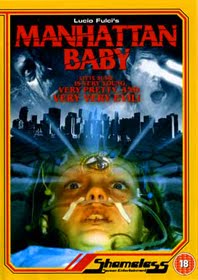
Manhattan Baby Italy 1982
Directed by Lucio Fulci
Shameless Screen Entertainment
Region 0

In lieu of a spoiler warning for this, probably quite short, review... I thought I’d quote you from the back cover of the DVD itself by way of an explanation. And I quote from the uncut Shameless edition that I watched this on... “Most DVD sleeves will give you a succinct plot synopsis but we’re still struggling to understand what the hell goes on in this movie.” And: “... makes up in classic set pieces and pierced eyeballs what it lacks in coherence.” So I don’t think spoilers are really an issue with this movie, to be honest.

I rarely find myself bringing up the name of Lucio Fulci in conversation about film because, as I’ve probably said before, Lucio Fulci is a director with whom, in regard to his work, I have an unsatisfying relationship with. He’s done some fair to goodish movies, like Zombie Flesh Eaters (aka Zombi 2) and City of the Living Dead (which I only just saw and shall “blog up good” as soon as I can). He’s done his fair share of real clunkers like, in my humble opinion, the Spaghetti Western Four of the Apocalypse and the movie I’m looking at here on this article, Manhattan Baby. But he’s also done some really great movies which contribute to whatever genre they happen belong to, like my favourite one of his, the giallo Lizard In A Woman’s Skin.

This one, however, is not a great movie.

To be fair to it though, the spiel on the box is not something I’d be entirely in agreement with. It’s certainly not the incoherent mess that it’s perceived as... at least it didn’t seem that way to me. But, also to be fair, I don’t recall seeing any blatantly pierced eyeballs either... but I understand from the sticker on the packaging that this Shameless version is completely uncut.

No matter. Let me tell you what I thought of it.

This is Fulci’s go at taking popular Egyptology as a starting inspiration and, like so many films before and after it, blending it with formulaic horror methodology and using it to create the trappings of a horror movie. This film felt, to me anyway, to be doing for Fulci’s body of work what the original 1932 version of The Mummy did for the Universal Classic Monster series of yesteryear. That is to say, there is no actual blatant mummy figure in it (Karloff’s Imhotep was only seen in bandages for a few seconds in the original before “transforming” into Ardeth Bey) and instead it relies on Egyptian mysticism and abstract forces of power directed at our protagonists to bring home the scares (although scares would be a bit of an overstatement in the case of both the Universal movie and Fulci’s Manhattan Baby).

It’s not a particularly hard plot and turn of events to crack... perhaps it’s just a bit simplistic for most audiences cultured in a more sophisticated focus on plot development and perhaps that’s why it’s perceived as it is. The script, after all, is not particularly good and is not a million miles away from the early Egyptology-obsessed films which perhaps inspired it. Perhaps less so, in fact.

Still, that doesn’t matter too much either because, frankly, it’s got some great photography and lighting effects and these would normally be more than enough to at least distract this viewer from the weaknesses of the writing and performances (at least in the looping) and give me something I can still really sink my teeth into.

Alas, with this movie that’s just not the case. All in all I’d say that Manhattan Baby’s one, truly unforgivable trait is that it’s really kind of dull and boring and... well it does drag somewhat. Which is a shame because I’ve not seen many of Fulci’s movies and I’d like to get more of a handle on this guy. Admittedly a nice solid atmosphere of bleakness is built up over the first 10 or 20 minutes but this all too soon gets thrown away when the action switches from Egypt to the United States.

Shameless Screen Entertainment do their usual wonderful job with this title (which is a Fulci title that some, to be fair, really love and are happy to watch over and over) with a nice transfer, a load of trailers for their other essential releases and a nice reversible sleeve. And I’m glad that it’s out there on release because that’s what great companies like Shameless are there for... to give us releases we might not otherwise easily get the opportunity to dip our toes in.

And that’s about all I can say about this particular movie I think. I’ll have more to say at some point soon on his movie City of the Living Dead which I found to be a very positive experience (even though it had teleporting zombies in it... I’ll save that for another blog review). For the time being though I’d have to say that Manhattan Baby is not one I’d recommend to any passer by on the street but is a film I believe that some who have acquired a taste for Fulci movies should definitely take a look at if they can.

Wednesday, 13 October 2010

Feline Groovy

The Black Cat
1981 Italy
Directed by
Lucio Fulci
Shameless Screen Entertainment
DVD Region 0

I always have mixed feelings about Lucio Fulci. Sure Zombie Flesh Eaters (aka Zombi aka Zombi 2 depending on which country’s print you happen to be viewing at the time) was an okay movie in that some of the shot compositions are nice (visually it’s like the spiritual cousin of Breakfast At Tiffanys) and in that it never really takes you out of your comfort zone so it’s one of those films you can just relax to. But he also did what I consider to be the truly dullest and most unwatchable spaghetti western ever (and I’ve seen a fair few), Four of the Apocalypse.

On the other hand, he also directed Lizard In A Woman’s Skin which is easily one of the finest giallo movies ever committed to the screen.

So I’m never really sure whether a new Fulci movie is going to bring me something really great, something totally dreadful or something in between the two. But I picked up a DVD copy of his Poe “adaptation” The Black Cat and decided to settle down and watch it because I’ve not seen a great deal of his work.

Now Poe is a hard deal when it comes to adaptation because, frankly, he wrote mostly short stories which, if they were done faithfully on screen, would leave you with movies which are only ten minutes long at most... so most movies which “say” they are adapted from his work use that term very loosely. Most of the plot lines to Poe movies are created from air by scriptwriters in an anemic attempt to give a narrative structure to whatever key moments happen in the original short (if you’re lucky and they bother to even read the original Poe before embarking on the script... for example Roger Corman’s movie Edgar Allan Poe’s The Haunted Palace is actually an uncredited adaptation of H. P. Lovecraft’s The Case of Charles Dexter Ward).

I’ve now seen at least five different adaptations of Poe’s The Black Cat and I have to say that this version is no exception to the above rule. Fulci’s version certainly goes off on it’s own tangents throughout the course of the movie but I also have to say, in all fairness to him, that he manages to hit more of those elements which were part and parcel of the original story than most versions I’ve watched.

This is basically how the Poe version goes...

The story is about a man who hates a cat so much he gouges out its eye. After a while he kills it by hanging it but after a fire in his house the shape of the hanging cat is etched on the wall in the soot. After being haunted by the presence of an identical, one eyed cat which one is to presume is the original cat reincarnated, he goes to kill it with an axe but accidentally kills his wife instead. He walls her body up in the cellar and nearly gets away with his crime when the police investigate but just as they are about to leave a wailing from behind the wall is heard. The police knock down the wall and find the corpse of the wife with the wailing cat on it. To quote Poe, “I had walled the monster up within the tomb!”

Most of these elements from Poe are in place in the Fulci movie (I was impressed by the inclusion of the spectre of the hanged cat on the wall after a fire) although a lot of other stuff is thrown in to the mix to make it a full length feature. Like the fact that the cat in this one seems to be a killer cat of death and is going around causing the murders with it’s slinky feline antics. And the fact that it somehow seems to be able to control the minds of others, including that of a spiritualist who “owns “the cat, played by Patrick Magee (The Final Programme, A Clockwork Orange) a year before his death, in his own unique manner as always.

The cast is rounded out by some familiar names to people who like to watch gialli and horror films. Such luminaries as Mimsy Farmer (Four Flies on Grey Velvet, Autopsy), David Warbeck (Twins of Evil, Razor Blade Smile) and Dagmer Lassander (Femina Ridens, Werewolf Woman, Forbidden Photos of a Woman Above Suspicion) grace the movie with their presence and their collective presence is one of the main factors in helping to lift the movie above the expectations of a jaded audience.

Another factor is the absolutely superb lighting and framing which one would normally expect to find in a giallo more than a horror movie. There’s some really nice things going on here and, from what I’ve seen of the Shameless label so far, they seem to have a bit of a knack when it comes to picking out films which have a very strong and memorable visual flair. People tend not to think of Fulci in this light but in some of his films he certainly does some groovy things with shape and colour and this is one of the better examples.

The way the whole film is leisurely shot and paced gives a certain sense of atmosphere which is not always easy to credibly create in these kinds of movies but it’s certainly the case here that you get a definite feeling of unease and foreboding from the way certain scenes are handled. The DVD case itself makes a comparison to Hammer in terms of the mood conveyed in this picture but I think, in this particular case (or even on this particular case ;-) they are doing the Fulci movie a disservice since it gives off way more dread than the average Hammer movie (with one notable fumble which I will highlight in a minute).

Also thrown into this artistic stew of a movie is a vibrant and jaunty score by Pino Donnagio which is at times reminiscent of some of his earlier work, notably the score he provided for Nicholas Roeg’s Don’t Look Now. I say jaunty because there is, perhaps, a certain sense of some scenes being either notably overscored or, perhaps, inappropriately scored. The point of view shots taken from the cat’s perspective are maybe a little bit “over jolly” and are feintly reminiscent of some of his later works, most notably the theme associated with the little boy in Dario Argento’s Trauma. But mostly it’s pretty good Donnagio and he’s always worth a listen and can always be relied upon to bring a Hermmannesque sensibility to proceedings when it is called for.

The only real major fumble in the whole movie (apart from an unexpected “oh-he-wasn’t-killed-after-all” moment with one of the characters) is when the tension is building as Mimsy Farmer explores Patrick Magee’s house and is transfixed by the gaze of the cat... the cat unexpectedly teleports to another place in the room with a Donnagio musical flourish, reminiscent of the way Mr. Benn used to change clothes in the fancy dress shop on children’s TV. This may well kill the atmosphere for you and leave you to erupt in fits of laughter... you’ve been warned on that one!

The transfer and print quality is everything you’ve come to expect form a Shameless release (with the usual choice of a reversible sleeve). It’s worth checking out this and other releases because there are some real gems in their black cat-alogue (err... sorry, I meant back catalogue... getting carried away again).

This is probably not the most enthralling adaptation of Poe’s work that you’ll see but it is unique in some of the elements of the original story it gets up onto the screen and it’s a more atmospheric side of Fulci that you might not have glimpsed before. Definitely one to add to the pile for late night, alcohol fuelled viewing this Halloween. Give it a shot!