The
Regeneration
Game
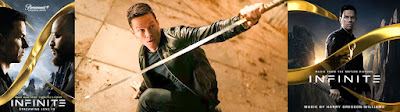
Infinite
Paramount USA 2021
Directed by Antoine Fuqua
Warning: Plot spoilers, I guess.
Infinite is a new science fiction action adventure based on a relatively new novel, The Reincarnationist Papers, by D. Eric Maikranz. Now, this information surprised me because the story is very much a riff in the vein of a Philip K. Dick kind of concept and yes, it’s yet another of these recent sci-fi movies which feels like it's exploring concepts from 1950s science fiction, it seems to me. However, it’s a nice enough concept but... it’s kind of wasted the way it’s been presented here.
The Infinite of the title is the name a certain, smallish underground section of the population give to themselves. They are basically people who, from adolescence, can now recall all their past lives leading up to this point... so they don’t have to learn new skills and are pretty much experienced at everything they’ve tried their hand at for thousands of years. When they die, their soul is just reborn into another body and so on. However, the Infinites are split into two warring factions. There are the Believers... the good guys of the film who want to use their special skills to benefit mankind... and the Nihilists, the bad guys of the story who want to destroy the world so they don’t have to keep coming back in new bodies.
To this end, many years ago, the main villain Bathhurst, played by Chiwetel Ejiofor (who nearly always makes a good villain but he seems to have some truly terrible lines here... much like all his costars in this), invented an egg of destruction which, when activated, will wipe out all life on the planet. In a blistering car chase action sequence at the start of the movie we see a character, one of three Believers who die in the opening sequence, steal the destructive egg and we are told later that he has ‘hidden’ it somewhere. Why Bathhurst can’t make another one is not really made clear but, anyway, it’s up to the Nihilists to find the egg so they can destroy humanity and the Believers to find the egg to keep it hidden or, preferably, destroy it. However, nobody knows where the main action hero at the start of the movie hid it before his death.
Enter Marky Mark Wahlburg. That character has now been reborn into his character, Evan. However, he doesn’t know he’s an Infinite because of him being treated as a schizophrenic throughout his life (and the tin plate in his head doesn’t help either). However, when both factions of Infinites realise it’s him, the Believers nab him from under the noses of the Nihilists and start trying to ‘jog his memory’ about the heroic action man he really is and, more importantly, where he hid the egg.
And that’s the main set up and I won’t say much about the plot. All the actors including those just mentioned and the likes of Sophie Cookson, Dylan O’ Brien, Toby Jones, Liz Carr, Jóhannes Haukur Jóhannesson and Jason Mantzoukas... are all pretty good. However, the dialogue they are asked to deliver in the film is, generally, not. Take the aforementioned Ejiofor, for example. We’ve seen him play a villain in numerous films and he’s always so threatening and not someone to be trifled with. Here, however, nothing much he’s saying is worth listening too and that goes for pretty much all of the other characters in this. The only redeeming moment in his character is the fact that, with the beard and black costume choices he has, he does tend to come off as a kind of knock of Roger Delgado as The Master (from the Jon Pertwee era of Doctor Who), so I was at least able to enjoy his performance on that level.
Another huge problem is the opening of the movie. It starts off with this truly brilliant action sequence (rendered less effective by some rubbish rap song over a lot of it) but... it’s the best set piece in the movie. It’s too strong and makes all the other action sequences in the film which follow look bad in comparison. And I’m sorry but, Marky Mark riding his bike off a really high cliff in Scotland and managing to land it on the wing of a plane which has already been in the air for two minutes really doesn’t help things. This film is definitely going for the action stakes but, as far as I’m concerned at any rate, it really fails to deliver for a lot of the time. Don’t get me wrong, the film is entertaining enough and the kicks, punches, slices and explosions are fine... they just aren’t enough to save it and, coupled with the script... yeah, I was a bit underwhelmed by the whole thing. And I still can’t figure out why a secret society would advertise their whereabouts to the enemy by flying around in aircraft with a big Möbius strip logo on the side.
What I wasn’t underwhelmed with was the action score provided by the great Harry Gregson-Williams. This was, frankly, the only reason I bothered to see the movie, it has to be said, as I'd already bought a copy of the limited edition CD release from La La Land records and I wanted to hear how it played in the movie before listening to it as a stand alone. And how it plays in the movie is... mixed way too low when it could have been way better highlighted against all the bangs and pops of the drab action sequences. But I know the CD will get a fair few spins so, at least there’s that. Thanks to the company for allowing La La Land to put this one out.
And... not much more to say about this one. The film has some nice concepts such as an electronic acupuncture machine to help stimulate memory and a gun that fires bullets which capture the souls of Infinites so they can’t resurrect again, stored in a computer chip instead but... the execution seems lousy on this one, for some reason. Things just don’t seem to be either pumped up enough or gritty enough to be consistently watchable and, yeah, well I won’t be watching Infinite again anyway, I would say. If you like sci-fi action movies then it’s not absolutely terrible and it’s not too dull a diversion of an evening. Just don’t go in expecting an epic.
Showing posts with label Mark Wahlburg. Show all posts
Monday, 13 December 2021
Infinite
Wednesday, 8 July 2015
Planet Of The Apes (2001 version)
The Apening
Planet Of The Apes
USA 2001
Directed by Tim Burton
20th Century Fox Zone B Blu Ray
Warning: There are spoilers in this one folks.
I think I might be right in saying that this was the first mainstream Hollywood film to use and publicise the word “reimagining”... a term we all pretty much hated at the time and that, I think, has finally died down. Burton was apparently insistent that the term be used due to the fact that he didn’t consider what he was doing to be a remake of the original film (reviewed here) and, also, because it still didn’t follow the course of the original novel, Pierre Boulle’s Monkey Planet.
In actual fact, the film is further away from the way the premise is presented in the original novel than the previous version but, although it's less to do with evolution and more to do with either inadvertently or deliberately manipulating time, the end of the movie is closer to the novel, in some ways, than Rod Serling’s much celebrated and deservedly more popular Twilight Zone style ending involving the Statue Of Liberty.*
That being said, I was always somewhat disappointed in this version, especially on this rewatch and considering it’s by an artist of Burton’s pedigree... mainly because it just generally seems to get a bit dull from around the mid-way point. But there are also a lot of really good things about the movie too so... let’s take a look at this thing.
The film abandons the original premise of a long trip with suspended animation and instead gives us a group of scientists in a space station sending out trained monkeys to pilot little capsules and bring back data from an anomaly they are parked near. Indeed, Burton manages a nice little piece of “rug pullery” when we realise that the pilot at the start of the movie is a) in a simulator and b) a chimpanzee.
Mark Wahlburg plays Leo, the equivalent of Heston’s Taylor in the first movie, but he’s a different kind of hero and although he’s a sensible chap, because the apes are made out to be so powerful and physically dextrous in this version, there’s no way he’s ever gonna really beat one in a fair fight. I think this may be one of the reasons this movie didn’t quite hit the right note with audiences when it was first released... because the main protagonist is constantly having to be rescued and always seems so vulnerable... he just doesn’t seem to hit the right “hero” notes that Heston did in the original. This is not necessarily Marky Mark’s fault, though, and he’s always seemed to me to be a fine actor... I just don’t think the character works as well as written, given the intense environment into which he is plunged.
Anyway, the space station is hit with all kinds of disruption coming through the anomaly and Leo’s favourite monkey is sent out in a pod to investigate. When he disappears into the anomaly, Leo disobeys orders and goes out in another capsule after him... also disappearing in the process. I should probably note here that it’s fairly well established in these opening moments that the capsules presumably don’t retain oxygen because both the monkey and Leo have to wear a space suit and helmet to go out in the pod. Plant that away in your memory for a short while... I’ll come back to it later.
When Leo crash lands on the Planet Of The Apes, the realisation of the new environment he finds himself in is not as gradually or intensely done as in the original movie. I’m assuming Burton jettisoned certain things because of the audience already knowing exactly what the plot of the original is and so, this movie’s variation of the hunt sequence is done and dusted within minutes of Leo’s arrival and it’s not long before he is escaping from his captors... including Tim Roth as main bad guy General Thade. He fleas in the company of a group of humans including a half hearted but sexy attempt at love interest for Mark Wahlburg’s totally disinterested character, Daena, as played by Estella Warren, plus three apes including Helena Bonham-Carter’s amazing turn as Ari and the always astonishing Paul Giamatti as Limbo.
One of the main problems with this film is that all the humans can speak and are pretty articulate... which is a very definite deviation from the original movie and which, I think, doesn’t help things in terms of the logic of the movie. I can understand that Burton might not have wanted to take the time to set up a way of communicating with the humans due to the dense amount of material to get through (this movie is actually slightly longer than the original as it is) but the established fact in this version that the humans outnumber the ape population and are all quite articulate begs the question as to why they’ve remained in captivity all these years... even with the apes’ greater strength. And there are other curiosities which this state of affairs brings into question... like the scarecrows seen at one point, used to try and discourage the humans from straying into places the apes don’t want them to. It’s the humans that explain why the scarecrows are there to Leo... so it’s quite obvious this is an absolute nonsense attempt as a long established deterrent on the part of the apes... doesn’t make a hell of a lot of sense, does it?
After this, we have a bunch of humans converging on the source of the signal which Leo is tracking, leading him into the basic conundrum of the movie... the fact that the world here has been created by his colleagues and their trained monkeys going through the anomaly and crash landing at a point many centuries before he even got here... thus leading to the rise of the apes. There’s also a point when an army of humans gather to help Leo and he becomes an almost Christ-like figure to them... which is interesting but remains unexplored mostly... I think one of the problems with this movie is that there’s too much subtext getting in the way of the direct route from A to B.
Then we have a real problem after Leo’s monkey arrives days after him... which makes perfect sense within the logic of the anomaly but, hell, makes a lot less sense when Leo uses the pod to return home without actually needing a space suit or helmet at this point. Pardon? It was shown twice in the first quarter of an hour of the film that a spacesuit and helmet were needed when piloting one of these things through space... so why have the laws of physics changed by this end sequence?
So let’s get to that ending then. Now, readers of the novel will know that, while both adaptations of this novel change a lot of stuff... Burton’s ending is a lot closer to the original. There’s a piece of design of the crashed spaceship Leo finds in the desert that makes it look like the head piece of the Statue of Liberty when viewed from certain angles. Now I think that was both a visual homage to the original movie and also, I would guess, since some photos of this were released well before the movie came out, something to deter the speculation on sites like Ain’t It Cool News that this movie would have a radically different ending to the first. As soon as we all saw those first photos we all thought... hey, there’s the Statue Of Liberty. However, this really is just a design thing and in this version, just like in the book, the Earth really isn’t the Planet Of The Apes at all...
In the novel, when the main protagonist makes the long, suspended animation return trip to Earth, he finds himself returned to another planet with the apes as the dominant culture and the penny drops that, contrary to popular belief, apes actually evolved from man and, in the time it’s taken him to get back, the same thing has happened on the planet Earth in his absence. Burton jettisons the evolutionary aspect and has Mark Wahlburg’s character return to an ape infested Earth, but in this one it’s made pretty clear that this is because the ape villain General Thade has arrived on Earth before Leo did and altered the course of human history.
Now a lot of people didn’t understand this when the movie first came out but, frankly, I’ll say what I said then, again, now... it makes perfect sense. In the movie we saw that the later you go through the temporal anomaly, the earlier you arrive. The monkey went through a few seconds before Leo and took a few days to arrive after him. Leo’s colleagues went through a number of hours, perhaps even days after he did, and arrived hundreds of years before him. So, assuming the exact same rules apply for a trip back through the anomaly, rather than a reversal of the rules, if Thade somehow managed to learn the secrets of the wrecked technology years after Leo left and went through the same anomaly, then he would have arrived many centuries before Leo and that is obviously what must have happened here. Makes perfect sense... one of the few things that does in this movie.
Despite all the drops in logic, the movie is a fairly a solid and diverting entertainment, for the most part... but it’s also a bit flat. The story itself is less than well written, I believe, but the dialogue is top notch with some beautiful rivalry between the two female leads as they play off against each other for Leo’s attention. Searing lines like “He’s the canary, that’s the coalmine.” when talking about launching the monkey into the heart of the distortion is very sharp and there are a lot of lines which are witty and economical, cutting to the heart of the matter, throughout.
There are also a lot of jokes such as an ape organ grinder with a little performing human, which is exactly the kind of humour I would expect from Tim Burton, who mostly does a good job with this movie. Not too mention quite a few sly references for fans of both the Apes series of films and of science fiction in general. For example, the first time you hear an ape talk it says, “Take you hands off me you damn dirty human” in direct parody of Charlton Heston’s famous line in the first movie. Heston himself, playing an ape for the first time in the form of General Thade’s dad, gets to parody his own last line in the original movie as he dies in this one... “Damn them. Damn them all to hell.” There’s also a bit of a humorous irony which I’m sure, given Heston’s personal politics, Burton took great relish in exploiting, by having Heston’s character the only ape in the movie to possess a firearm. And there’s even a quick excerpt from the original (and best) version of The Day The Earth Stood Still in an incoming transmission of anomaly distortion seen in the opening sequences of the movie.
One of the best things about this movie is the score. Jerry Goldsmith’s music to the original was an extremely important and groundbreaking score in it’s orchestration and when I heard about this version being made I thought it was a pretty thankless task because, whoever landed the gig was going to find themselves compared to the classic Goldsmith and they would find that a particularly hard shadow to escape. Being that it’s a Tim Burton film I assumed he would try and get his regular collaborator Danny Elfman but I just couldn’t see Elfman wanting to do it. The original score is such a colossal work. As it happens, Elman’s score here is completely different and, although he does go in for highlighting the percussion in some sections, as you would expect from an Apes score, he does it in a totally different way to any of the previous Apes composers and it holds up as a really appropriate and way more than competent piece in its own right. Which surprised the hell out of me, I can tell you. It’s truly not nearly as important or experimental as Goldsmith’s offering but it’s a real asset to the movie and an equally important score in Elfman’s own body of work, I believe.
All in all, and for the reasons I’ve described above, Tim Burton’s Planet Of The Apes is not the most successful “reimagining” in film history, but it is as inventive as you would expect from an artist of Burton’s capabilities and has some great performances in it which really lift it a bit more than some of the previous efforts. It’s certainly better than Battle For The Planet of The Apes and at least as good, perhaps a little better, than Beneath The Planet of The Apes. A fascinating science fiction/fantasy film which might have built a second franchise on it if it had been a little more critically well received and, presumably, did a little better at the box office. Not exactly the best out of the films but certainly not the worst either and it at least helped pave the way for general audience acceptance that there could, once again, be more Apes movies. So far it’s been up hill for the franchise again, since this stand alone movie.
* It has come to light since I wrote this review that Serling did not come up with the idea for the famous Statue Of Liberty reveal. Click on my review link below of the book Simians and Serialism for more details.
Planet Of The Apes at NUTS4R2
Planet Of The Apes TV Show (live action) - to be reviewed
Time Of The Apes - to be reviewed
Monday, 21 July 2014
Transformers - Age Of Extinction
Basic Extinct
Transformers - Age Of Extinction
2014 USA/China
Directed by Michael Bay
Playing at UK cinemas now.
Transformers weren’t even invented yet when I was a kid... so I missed out on the whole toys and comics thing with them. However, after being grudgingly dragged along to the first movie in this series, I was more than delighted that the original was such a great film. Pretty much a modern classic.
It’s been painful and frustrating, therefore, to have to watch movie after movie of, frankly, badly written and badly paced sequels to that original bright light of an opening shot. Considering it’s the same director all the way through the series, I find it difficult to believe that these sequels can be so atrocious. And, I am very sad to report, that I believe that extends to this latest venture, Transformers: Age Of Extinction when, in direct opposition to my hopes and well wishes for the movie (which it doesn’t need anyway, it’s made a ton of money ensuring further dire exploits in our collective near future), I found myself constantly looking at the time and wishing the damn thing would be over soon.
The problem is not necessarily the story, I think... it is what it is.
Neither is all of the dialogue that ropey either and, even if it wasn’t quite up to scratch, you have a bunch of actors like Mark Wahlburg and Sophia Myles (the original Girl In The Fireplace... wasted in this but shining briefly) giving it their all and so it never sounds too bad. I think what we have here that screws things up a little is break neck direction and action choreography that is practically wall to wall, once it starts... and, in the odd moment when it does give you time to breath, which is barely, doesn’t give enough of a space in the onslaught to actually allow you to invest in the characters and the stakes enough to care about what happens next... and that’s really a shame because the director is more than capable of giving us a well put together, heartfelt film when he wants to.
When a movie written by the likes of Akira Kurosawa or Sergio Leone is made, it becomes clear that the pauses and, really quite long stretches of character establishment, character build up and dramatic tension, are all a very important part of a movie. You need it there so when you contrast it with a well placed action sequence, that sequence becomes more vibrant and dynamic in contrast to anything else that directly surrounds it. Tension and release. It’s all part of the game.
Or... put it another way.
My daytime job is as a graphic designer. Occasionally you’ll get a really clueless client who insists on one or both of the following classic design mistakes.
Number one is they’ll try to fill every gap or piece of negative (or white) space with some kind of textual or design element. Absolutely the wrong thing to do with a design, people. You need the space there to help lead the eye in to where you want it to focus. If you fill the page the eye will just take it’s natural (and standard to all human beings as far as I know) journey across the page/screen without being particularly caught by anything in particular.
Secondly, another thing they’ll do is try to make three or more bits of information stand out and be more important from everything else by asking for this, that and the other to be in bold type, usually quite close to each other. Of course, all that achieves is all the emboldened words dilute each other’s strength and basically cancel each other out. Instead of one clear message you're scatter-shotting a plethora of them and they all fight against each other causing chaos to the eye. Most people, unless they already have a specific agenda that they have to wade through the content of the design for, will not bother to read something like this. The client has just lost the potential customer by ignoring the key message and bombarding the eye with fighting headers.
And I think that’s why Transformers: Age Of Extinction kind of loses it’s way in much the same way as the previous two sequels did. Instead of highlighting things with the occasional action scene, it’s just non-stop action. The kinetic equivalent of overcrowding the page with too many headers and not allowing any white space to lead you to where you need to be. Relentless and pounding set pieces are the order of the day in this movie and, while there are admittedly rest room breaks to ease the monotony, they needed to have a lot more of an emotional hook to them (and they do try, the scripting isn’t completely terrible... clichéd but not terrible) and be a lot longer so the action scenes felt like something when they kick back in gear here. There’s no real sense of that tension and release I was talking about in this one... just noisy motion and explosions. Which personally I find pretty dull, to be honest.
One of the tings that gets me coming back for these disappointments time and time again is that Steve Jablonsky’s score for the first movie is one of the great movie scores of all time. At least, it is to me. Unfortunately, although all the films have been scored by this composer, the sequels never really come close to recapturing the genius of that first score and, sad to say, that I include the score to this movie in that statement. Don’t get me wrong, there’s some nice music in it, what I could hear of it above the explosions, and it all seems appropriate but, again, it’s not got nearly the “hairs raising on the arms” beauty of the original score and that’s a bit of a pity. It does it’s job but, for the most part, you aren’t tapping your toes in time to the music as you are watching this one.
A big change with this one is that none of the human characters from the previous films are back in this one. That’s understandable given some of the politics and comments that have been made around the previous films in the series, but there were one or two I missed. The real loss in all that, though, is that of John Turturro, who always seems to traditionally turn up in the movies when you least expect him to. Alas... he’s not here.
The actors who are in this one, as I said, do a fine job but another reason they’re hampered is that of the regular characters that do make an appearance in this one, and I’m talking about the autobots themselves. They’re really not that sympathetic this time around. Bumblebee is underused, Optimus Prime is a lot more judgemental of humans than we’re used to and as for the other transformers... I just didn’t like them, period. These are not the robots I was looking for... and I really wanted to move on out of the cinema very quickly.
So that’s all I’ve got for you on that one. Special effects are all spectacular but somebody on the payroll really needs to realise that the biggest special effect is when you slow the pacing down and let the spell of the characters overtake you. That’s when you have a film. Transformers: Age Of Extinction is more of a big budget, travelling carny show. Alright as a curiosity but not somewhere you’d want to explore very often. It seems to have made a lot of cash already in the USA though, so “Yay!” and “good for them” to the people reaping those rewards. However, the downside for me to that is that this probably means there’ll be another sequel at some point. I really don’t want one.
Subscribe to:
Posts (Atom)