Showing posts with label Charlton Heston. Show all posts

Wednesday, 8 July 2015

Planet Of The Apes (2001 version)


The Apening

Planet Of The Apes
USA 2001
Directed by Tim Burton
20th Century Fox Zone B Blu Ray

Warning: There are spoilers in this one folks.

I think I might be right in saying that this was the first mainstream Hollywood film to use and publicise the word “reimagining”... a term we all pretty much hated at the time and that, I think, has finally died down. Burton was apparently insistent that the term be used due to the fact that he didn’t consider what he was doing to be a remake of the original film (reviewed here) and, also, because it still didn’t follow the course of the original novel, Pierre Boulle’s Monkey Planet.

In actual fact, the film is further away from the way the premise is presented in the original novel than the previous version but, although it's less to do with evolution and more to do with either inadvertently or deliberately manipulating time, the end of the movie is closer to the novel, in some ways, than Rod Serling’s much celebrated and deservedly more popular Twilight Zone style ending involving the Statue Of Liberty.*

That being said, I was always somewhat disappointed in this version, especially on this rewatch and considering it’s by an artist of Burton’s pedigree... mainly because it just generally seems to get a bit dull from around the mid-way point. But there are also a lot of really good things about the movie too so... let’s take a look at this thing.

The film abandons the original premise of a long trip with suspended animation and instead gives us a group of scientists in a space station sending out trained monkeys to pilot little capsules and bring back data from an anomaly they are parked near. Indeed, Burton manages a nice little piece of “rug pullery” when we realise that the pilot at the start of the movie is a) in a simulator and b) a chimpanzee.

Mark Wahlburg plays Leo, the equivalent of Heston’s Taylor in the first movie, but he’s a different kind of hero and although he’s a sensible chap, because the apes are made out to be so powerful and physically dextrous in this version, there’s no way he’s ever gonna really beat one in a fair fight. I think this may be one of the reasons this movie didn’t quite hit the right note with audiences when it was first released... because the main protagonist is constantly having to be rescued and always seems so vulnerable... he just doesn’t seem to hit the right “hero” notes that Heston did in the original. This is not necessarily Marky Mark’s fault, though, and he’s always seemed to me to be a fine actor... I just don’t think the character works as well as written, given the intense environment into which he is plunged.

Anyway, the space station is hit with all kinds of disruption coming through the anomaly and Leo’s favourite monkey is sent out in a pod to investigate. When he disappears into the anomaly, Leo disobeys orders and goes out in another capsule after him... also disappearing in the process. I should probably note here that it’s fairly well established in these opening moments that the capsules presumably don’t retain oxygen because both the monkey and Leo have to wear a space suit and helmet to go out in the pod. Plant that away in your memory for a short while... I’ll come back to it later.

When Leo crash lands on the Planet Of The Apes, the realisation of the new environment he finds himself in is not as gradually or intensely done as in the original movie. I’m assuming Burton jettisoned certain things because of the audience already knowing exactly what the plot of the original is and so, this movie’s variation of the hunt sequence is done and dusted within minutes of Leo’s arrival and it’s not long before he is escaping from his captors... including Tim Roth as main bad guy General Thade. He fleas in the company of a group of humans including a half hearted but sexy attempt at love interest for Mark Wahlburg’s totally disinterested character, Daena, as played by Estella Warren, plus three apes including Helena Bonham-Carter’s amazing turn as Ari and the always astonishing Paul Giamatti as Limbo.

One of the main problems with this film is that all the humans can speak and are pretty articulate... which is a very definite deviation from the original movie and which, I think, doesn’t help things in terms of the logic of the movie. I can understand that Burton might not have wanted to take the time to set up a way of communicating with the humans due to the dense amount of material to get through (this movie is actually slightly longer than the original as it is) but the established fact in this version that the humans outnumber the ape population and are all quite articulate begs the question as to why they’ve remained in captivity all these years... even with the apes’ greater strength. And there are other curiosities which this state of affairs brings into question... like the scarecrows seen at one point, used to try and discourage the humans from straying into places the apes don’t want them to. It’s the humans that explain why the scarecrows are there to Leo... so it’s quite obvious this is an absolute nonsense attempt as a long established deterrent on the part of the apes... doesn’t make a hell of a lot of sense, does it?

After this, we have a bunch of humans converging on the source of the signal which Leo is tracking, leading him into the basic conundrum of the movie... the fact that the world here has been created by his colleagues and their trained monkeys going through the anomaly and crash landing at a point many centuries before he even got here... thus leading to the rise of the apes. There’s also a point when an army of humans gather to help Leo and he becomes an almost Christ-like figure to them... which is interesting but remains unexplored mostly... I think one of the problems with this movie is that there’s too much subtext getting in the way of the direct route from A to B.

Then we have a real problem after Leo’s monkey arrives days after him... which makes perfect sense within the logic of the anomaly but, hell, makes a lot less sense when Leo uses the pod to return home without actually needing a space suit or helmet at this point. Pardon? It was shown twice in the first quarter of an hour of the film that a spacesuit and helmet were needed when piloting one of these things through space... so why have the laws of physics changed by this end sequence?

So let’s get to that ending then. Now, readers of the novel will know that, while both adaptations of this novel change a lot of stuff... Burton’s ending is a lot closer to the original. There’s a piece of design of the crashed spaceship Leo finds in the desert that makes it look like the head piece of the Statue of Liberty when viewed from certain angles. Now I think that was both a visual homage to the original movie and also, I would guess, since some photos of this were released well before the movie came out, something to deter the speculation on sites like Ain’t It Cool News that this movie would have a radically different ending to the first. As soon as we all saw those first photos we all thought... hey, there’s the Statue Of Liberty. However, this really is just a design thing and in this version, just like in the book, the Earth really isn’t the Planet Of The Apes at all...

In the novel, when the main protagonist makes the long, suspended animation return trip to Earth, he finds himself returned to another planet with the apes as the dominant culture and the penny drops that, contrary to popular belief, apes actually evolved from man and, in the time it’s taken him to get back, the same thing has happened on the planet Earth in his absence. Burton jettisons the evolutionary aspect and has Mark Wahlburg’s character return to an ape infested Earth, but in this one it’s made pretty clear that this is because the ape villain General Thade has arrived on Earth before Leo did and altered the course of human history.

Now a lot of people didn’t understand this when the movie first came out but, frankly, I’ll say what I said then, again, now... it makes perfect sense. In the movie we saw that the later you go through the temporal anomaly, the earlier you arrive. The monkey went through a few seconds before Leo and took a few days to arrive after him. Leo’s colleagues went through a number of hours, perhaps even days after he did, and arrived hundreds of years before him. So, assuming the exact same rules apply for a trip back through the anomaly, rather than a reversal of the rules, if Thade somehow managed to learn the secrets of the wrecked technology years after Leo left and went through the same anomaly, then he would have arrived many centuries before Leo and that is obviously what must have happened here. Makes perfect sense... one of the few things that does in this movie.

Despite all the drops in logic, the movie is a fairly a solid and diverting entertainment, for the most part... but it’s also a bit flat. The story itself is less than well written, I believe, but the dialogue is top notch with some beautiful rivalry between the two female leads as they play off against each other for Leo’s attention. Searing lines like “He’s the canary, that’s the coalmine.” when talking about launching the monkey into the heart of the distortion is very sharp and there are a lot of lines which are witty and economical, cutting to the heart of the matter, throughout.

There are also a lot of jokes such as an ape organ grinder with a little performing human, which is exactly the kind of humour I would expect from Tim Burton, who mostly does a good job with this movie. Not too mention quite a few sly references for fans of both the Apes series of films and of science fiction in general. For example, the first time you hear an ape talk it says, “Take you hands off me you damn dirty human” in direct parody of Charlton Heston’s famous line in the first movie. Heston himself, playing an ape for the first time in the form of General Thade’s dad, gets to parody his own last line in the original movie as he dies in this one... “Damn them. Damn them all to hell.” There’s also a bit of a humorous irony which I’m sure, given Heston’s personal politics, Burton took great relish in exploiting, by having Heston’s character the only ape in the movie to possess a firearm. And there’s even a quick excerpt from the original (and best) version of The Day The Earth Stood Still in an incoming transmission of anomaly distortion seen in the opening sequences of the movie.

One of the best things about this movie is the score. Jerry Goldsmith’s music to the original was an extremely important and groundbreaking score in it’s orchestration and when I heard about this version being made I thought it was a pretty thankless task because, whoever landed the gig was going to find themselves compared to the classic Goldsmith and they would find that a particularly hard shadow to escape. Being that it’s a Tim Burton film I assumed he would try and get his regular collaborator Danny Elfman but I just couldn’t see Elfman wanting to do it. The original score is such a colossal work. As it happens, Elman’s score here is completely different and, although he does go in for highlighting the percussion in some sections, as you would expect from an Apes score, he does it in a totally different way to any of the previous Apes composers and it holds up as a really appropriate and way more than competent piece in its own right. Which surprised the hell out of me, I can tell you. It’s truly not nearly as important or experimental as Goldsmith’s offering but it’s a real asset to the movie and an equally important score in Elfman’s own body of work, I believe.

All in all, and for the reasons I’ve described above, Tim Burton’s Planet Of The Apes is not the most successful “reimagining” in film history, but it is as inventive as you would expect from an artist of Burton’s capabilities and has some great performances in it which really lift it a bit more than some of the previous efforts. It’s certainly better than Battle For The Planet of The Apes and at least as good, perhaps a little better, than Beneath The Planet of The Apes. A fascinating science fiction/fantasy film which might have built a second franchise on it if it had been a little more critically well received and, presumably, did a little better at the box office. Not exactly the best out of the films but certainly not the worst either and it at least helped pave the way for general audience acceptance that there could, once again, be more Apes movies. So far it’s been up hill for the franchise again, since this stand alone movie.


It has come to light since I wrote this review that Serling did not come up with the idea for the famous Statue Of Liberty reveal. Click on my review link below of the book Simians and Serialism for more details.


Monday, 20 April 2015

Planet Of The Apes


Heston, Blooming Tall

Planet Of The Apes
USA 1968 
Directed by Franklin J. Schaffner
20th Century Fox Blu Ray Zone A,B,C

Warning: There’s the obvious spoiler in here so, if you really don’t already know the famous trick ending of this film, then steer clear of this review until you’ve had a chance to watch it for yourself.

I’ve been a fan of Planet Of The Apes for almost as long as I can remember. One of my early cinema memories (although by no means the earliest) was of seeing Battle For The Planet Of The Apes as a five year old in 1973, as part of a double bill with an obscure underwater adventure movie called The Neptune Factor* (I think I slept through a lot of the other movie). The one thing which I remember from that film was... oh, no, wait... I’ll save that memory for when I come to rewatch and review that fifth installment.

I remember it wasn't just the movies I loved as a kid. I also used to watch the live action TV series, the cartoon series, had the novelisations, had some of the comics (not many, some of the British black and white Marvels carrying reprints), had a few of the TV show bubble gum cards (again, not many but at least I still have them), got the Mego action figures and also had a Planet Of The Apes board game. A game in which, if you were caught, your cardboard human had to stand on a cardboard cage while you had to twiddle and then press a button and, if you were unlucky, you would be plunged to the depths of the cage. That was a pretty cool game, actually.

Years later, in the 1980s sometime, I read the original source novel, Monkey Planet, by Pierre Boulle (who also wrote the original novel The Bridge on the River Kwai) and loved it, although I was amazed by how different the novel was to the way the movie turned out. The ape society in the novel, for instance, is much more technologically advanced than the one depicted in the movie version, if memory serves, and it’s far less aggressive to the central astronaut protagonist. Also, in the novel, the central character really does land on a different planet and the ending to the story, while the same outcome in principal, is actually reaching the same kind of point by a different means.

In fact, I remember when reading the novel, thinking how much it was like reading one of Edgar Rice Burroughs original John Carter novels in the way it explored the aspects of the central culture at the story’s heart. I also loved the explanation, not apparent in the film, of the reason for the length of the journey taking hundreds of years and necessitating putting the crew into suspended animation for the majority of the time... the trick to it was that the actual main part of the journey, gazillions of light years, actually only took a few seconds. However, the engines running themselves and the ship through space to reach the speed to enable that main part of the journey took many years... which I thought was kinda clever.

The movie starts with a prologue monologue of Taylor, played by Charlton Heston, as he is about to go into suspended animation. As he puts himself under we go into the opening titles and Jerry Goldsmith’s incredible score, which won him an oscar nomination and should certainly have snagged him the prize, but didn’t. He lost out to John Barry’s, admittedly, fantastic score to The Lion In Winter but, I think in this case the Apes should have probably taken it. It’s such a unique and influential score.

After this we have my favourite part of the movie... the first half hour. No apes and just three astronauts trying to survive in the harsh terrain of what they think is an alien planet. We have philosophical discussions and frightening scarecrows and a bunch of mute, human savages who our heroes encounter after a much needed swim when they find water (I don’t know why they are so pleased to find water at this point because, after all, they already crash-landed in a body of water at the start of the movie). And we have Jerry Goldsmith’s score, wonderfully spotted as certain scenes are wisely left without music to heighten the dramatic effect in specific sections.... although he did actually write some music for the spaceship crash landing which was left out of the finished film.

It’s a beautiful score and many people assume, when hearing it for the first time, that it employs a lot of electronics. It doesn’t. It’s got some great orchestration as Goldsmith gets his musicians to play their instruments in unusual ways that they weren’t designed for, some of the time. He even, at one point, grabbed the big steel mixing bowls from the studio canteen and used these for percussion effects in some of the earlier scenes. And then we have The Hunt. A piece of music which is an action cue when we finally, after a half an hour, see the apes... it’s all fantastic scoring and I was privileged to, at least twice in different years, see Goldsmith reconstruct the 15 minutes or so of music leading into and including the hunt music live in a couple of the concerts I went to see him conduct when he was alive (must have seen him about six or seven times throughout my life, I reckon). It was absolutely incredible. He also uses horns and rhythms to emulate the grunting of the apes as a musical effect in the score too. Outstanding stuff.

As an aside to the music, I see that on the IMDB it says that Planet Of The Apes is the first fully atonal score to grace a movie. Well, in my opinion that’s pretty wrong on a couple of counts. One, because it’s not, in any way, totally atonal... it’s full of rhythm and melody and it’s very hummable, believe me. Secondly because, as far as I know, the first atonal, indeed the first twelve tone serial score, was Leonard Rosenman’s music for the 1955 Vincent Minelli movie The Cobweb... so I don’t know why there are so many incorrect “facts” to be found on the IMDB. It simply isn’t true. Planet Of The Apes is the second, I think, of a long collaboration Goldsmith had with director Franklin J. Schaffner and, like most of the others, it garnered a brilliant musical response from the composer.

Back to the movie, though. Schaffner employs a lot of Dutch angles to keep everything off kilter in these early sequences, to echo the disorientation of the astronauts and incite that kind of empathy in the audience. When the apes finally make their appearance, things are less angled but there are still some striking compositions and designs found throughout the movie and I think, although it’s now back to being a strong and healthy franchise, this first movie is still a little underrated by some. It’s a brilliant film with some unique visuals to match the groundbreaking musical identity, with deft little visual flourishes like the, improvised on the day, “hear no evil, see no evil, speak no evil” pose that the orangutans in the courtroom scene mimic. There are a lot of these kinds of things occurring, both scripted and improvised, throughout the movie and it adds to an already rich, visual and aural feast. It’s no wonder that the movie spawned four sequels, TV shows and two reboots.

And when you think about the story mechanics involved in the first 35 or so minutes... it’s pretty impressive. The writers have to find a way of leaving the astronauts without their clothes and Taylor without a voice to speak (for a while) and Schaffner and the actors have to sell it without alerting the audience as to why it’s necessary to have to do that... otherwise the next half hour or so just won’t work. The way the cast and crew pull this off is... quite astonishing when one considers it. Not to mention the amazing make up which is another major feat and without which the movie might not have been green lit. Without the screen tests involving Edward G. Robinson (who was sadly not up to filming his role as the original choice for Dr. Zaius) then we may not have the franchise we have today.

It’s the ending though, that really gets everybody when they first see the film and, although it’s different from the book, it’s obvious from the strength and twistiness of it, I think, that one of the major writers on this was Rod Serling. It should come as no surprise to anybody that the notorious, half buried Statue Of Liberty reveal at the end of the movie is from the creator and chief writer of the television series The Twilight Zone (first season reviewed by me here) when it’s an ending worthy of the best of those episodes. It certainly puts his stamp on this movie and the ending to Tim Burton’s later, 2001 reboot of the movie, while being a little closer to the novel in essence (if not in tone), is a bit of a let down in a way, in terms of the strength of this original ending.**

Any way you look at it though, this film is superbly directed and edited (some of those shots really shouldn’t work together as well as they do but... Schaffner manages to pull it off pretty well), has brilliant performances from the actors (not least from the likes of Roddy McDowell, Kim Hunter and Maurice Evans, who had to act behind all that make-up) and a classic Jerry Goldsmith score which pulls you in and doesn’t let go. One of the great movie treasures that any cineaste (or even one of us more common and garden variety of movie lovers) should definitely take a look at. Outstanding.

*With thanks to Twitter friend Andrew Elias for correctly identifying the movie I saw on a double bill with Battle For The Planet Of The Apes back in 1973 as The Neptune Factor.

** It has come to light since I wrote this review that Serling did not come up with the idea for the famous Statue Of Liberty reveal. Click on my review link below of the book Simians and Serialism for more details.


Friday, 3 April 2015

Ben Hur


Are Judah One?

Ben Hur 
USA 1959 MGM
Directed by William Wyler
50th Anniversary Blu Ray Box 
Region A/B

You know, I actually bought this super duper, “everything and the kitchen sink” new Blu Ray remaster of Ben Hur to watch and review for last Easter. However, rather than taking their customary small amount of time to get it to me, Amazon actually took many weeks to deliver this one so, by the time it had arrived, the Easter period was long gone. So I saved it for watching this year instead.

I’m not really a religious person and Ben Hur is a film I discovered fairly late in life (I’ve only been properly watching it the last 20 years* or so) and, like lots of other movies I seek out, it was all due to the musical score that I got interested in it. Miklos Rosza’s monumental score for this epic picture is an absolute masterpiece and, because it was always included in the top 5 polls of greatest soundtracks ever written, I figured I should definitely have a listen. And, of course, once I’d heard the score to this I really wanted to see how it supported the film itself... like many of my later filmic discoveries (see my upcoming review of The Car for a similar musical entry point).

The film is the second of only two movies shot on a special camera used by MGM called Camera 65 (the first being the 1957 movie Raintree Country) and, depending on how the print is being projected, it gives you one of three, extremely wide aspect ratios: 2.66:1 when processed on Super 8 film, 2.76:1 on 70mm and 2.55:1 on 35mm. I’m never quite sure which version is being put onto the various home video versions of the film I’m seeing (I have this movie on VHS, DVD and now Blu Ray) but it’s certainly a lot of a longer frame than the standard 2.35:1 Cinemascope ratio most people are familiar with these days (not to mention the standard 1.85:1 ratio most movies post mid-1950s are made to be projected at). This, of course, contributes to the epic feel of the film and matches the emotional splendour of something which is often touted as being, to quote its sometimes used subtitle and borrowing from the 1925 version of the film, A Tale Of The Christ.

Well, I have to say that, although it certainly hypes itself as being a tale of Christ, and it certainly owes the deus ex machina style ending to the crucifixion, it’s actually more a revenge story and it uses the little dips into the periphery of Christ as impetus for fulfilling it’s own story needs, more than anything else. It’s also a very slow and rambly film in some ways and I imagine a lot of younger audiences wouldn’t really want to put up with a stealthily paced, sprawling Biblical epic like this, these days, but... you know... there’s definitely gold in “them thar hills”.

The film deals with the fall from grace of Judah Ben Hur, played by a fairly young and slightly spindly version of Charlton Heston, at the hands of his once boyhood chum but adult antagonist Messala, played by Stephen Boyd. Messala ruins Judah over an unfortunate accident by sending him to be a slave on a Roman Galley while his mother and sister are left to rot in a dungeon. The two ladies are eventually released back into the world when it is discovered they have both caught leprosy. The film certainly sounds like a standard revenge flick in this way... and it truly is, actually... but once you factor in Rosza’s six minutes plus of Overture before the movie opens and a short sequence detailing the birth of Christ, it’s actually around about an hour into the film before Heston is even sent to the galleys, encountering Christ as a man, who kindly defies the Romans to give Judah water when he is being trekked across the desert to his shipboard destination.

After this, we follow Judah, and pretty much only Judah, on his course for revenge as he escapes the galley and, through a strange twist of fate, becomes a citizen of Rome to finally return to his home town to ride against Messala in the film’s fateful and infamous chariot race (although the stories about fatalities in the filming of this sequence in various versions of the film seem to be an exaggerated myth, it turns out). And then, once all these boxes have been ticked, there’s a lengthy end game to the film where everything ties back in to Jesus, leading up to the film’s final solution in the crucifixion scene... but I’m not going to tell you what happens here. I’m not even going to tell you who wins the chariot race either... if you want to know you can find out by watching the movie for yourself.

Although it’s based on the book by Lew Wallace, it’s actually quite a bit different from the novel, as far as I can remember (been a while), which I seem to recall was as much about Judah Ben Hur raising an army to fight the Romans in the name of Christ than the tale as it is presented here but, whether it’s a good adaptation of the original novel or not, it’s certainly a spectacular looking movie. The action scenes are few and far between but the dialogue is quite interesting in places and it’s definitely a movie about the broad strokes in terms of story... jumping a year or three at certain points until it brings itself back to the bits it needs to get to, in order to fulfil its own end game.

It’s nicely and clearly shot, which is just as well because it consists of very long takes for a lot of it and, while there are certainly a lot of shots which incorporate a fluid camera movement, there’s a lot of the film which is purely static shots so, the fact that they are composed and lit well certainly helps. There are some nice transitional shots too... such as going from a shot of the open mouth of a cave to the open shape of an archway. Stuff like this is all good but, like I said, if you’re not that into the music, then you might find certain pasages of this film to be fairly slow.

There are some nice roles, some of them very small, for great character actors like Andre Morrel, Jack Hawkins, Finlay Currie, Sam Jaffe, Hugh Griffith... even a role for Dad’s Army’s Sergeant Wilson, John Le Mesurier, in a scene showing the direct aftermath of the chariot race. Fans of spaghetti westerns, Italian giallo and other films of that ilk should also note that a pre-famous Giuliano Gemma also makes an appearance as a Roman officer in the scene where Judah escapes from Messala’s dungeons and confronts him in his office... once you know he’s there, he’s really not hard to spot. Italian movie fans might also like to know that one of the Assistant Directors on this movie was the legendary, director to be, Sergio Leone... although there is some doubt as to whether he actually had as much to do with the chariot race, as he claimed.

And what about that chariot race? It’s quite spectacular, even now. Fast and dangerous and you can tell that Heston and Boyd were really driving those things at speed around the circuit. There was no way to fake the medium close ups and long shots in those days like you can now and Heston used to get up every morning of the shoot to practice with the horses for a few hours. It really shows in the final product and the stunt men in certain scenes, headed up by stunting legend Yakima Canut, who was second unit director on this, all do stellar work. Canut’s son doubles for Heston in the race, including that really dangerous tumble that Judah takes when he gets thrown over the front of the chariot and into the horses and clambers back in while it’s still speeding along... that was pretty much unplanned and could have been the end of Canut’s son right there but, since he manages to quite impressively come out of it and back into a controlling position... it’s left in the film and Heston is only seen in close up to finish off the final climb back into the chariot. It’s truly jaw dropping stuff.

The chariot scene itself took five weeks to film (it shows... it’s amazing) and, since it was filmed at Cinecitta, which is notoriously next to an airport, it was filmed silently and the sound was all dubbed in later. Itself quite an achievement, when you think about the noise and fury of the arena in this sequence. Interestingly, the decision was made to leave the film without music during the entire chariot race and it really gives the sound effects a raw power of their own. This is an idea composer John Williams later used for George Lucas’ own version of the chariot race in Star Wars Episode I: The Phantom Menace (reviewed here), only bringing in music towards the end of that particular sequence to heighten the effect of a specific incident (for more about the way Williams’ cue works, read my review of the Liam Neeson thriller Run All Night here).

The score, of course, it truly magnificent and, in addition to the background cues, which are left full on in the mix and loud on the soundtrack like they should be, we have Dr. Rosza’s opening titles (which only start up around a quarter of an hour into the film after a load of other cues), his overture and also his Entre Act music for the lead in after the intermission... all lovingly preserved on the Blu Ray and I’m thankful that MGM had enough sense to leave this stuff on the home video versions. Considering you can now even get a beautiful five disc version of the score, courtesy of Film Score Monthly, which is an improvement on even the old two disc book version from Rhino (in terms of content, not necessarily packaging design), I was surprised by how many passages in the film were actually left unscored. Even so, there’s a lot of score to get through (I think Rosza might have taken a year to write it all... if memory serves) and it’s all pretty amazing stuff... just the kind of film Rosza was born to compose. I say that particularly because I find some of the films Rosza has leant his incredible talents to, especially in later years when the stylistic trends in film making were a lot different to what they were in the 40s and 50s, seem almost overscored and old fashioned in ways that don’t always serve the best purposes of the films... but movies like Ben Hur are made all the more magnificent for his astonishing, in your face compositions.

There’s a couple of things I noticed this time around that I’d not noticed before... so I think I’ll finish up this little review by sharing those with you.

The first thing is specifically down to the new Blu Ray transfer, I think. When Judah’s boat is rammed by the enemy of his captors and he throttles the overseer to get the keys and release the slaves drowning in the deck below, one of those coming up through the hatch is missing his left hand. It’s all gory on the stump, like it’s been lost as a consequence of the other ship crashing through the hull. I’d never noticed this before and I then realised that the only way to achieve this effect was to actually have a man without a hand playing that role. Sure enough, when I was looking up a few facts of the film, it turns out that Wyler spotted that one of his extras was without a hand and another without a foot... so he made good use of these two by doctoring their stumps to make them look like ghastly injuries for their scenes. Still haven’t spotted the guy with the missing foot yet but... I’ll maybe catch up with him next time around.

The other thing I noticed on this viewing was, although the story is quite rambling and sprawls four years (three decades if you include the post-overture, pre-credits sequence), it's quite economical with the use of characters. That is to say, once a character has served his purpose - Andre Morrel briefing Messala on the situation in his new posting, Jack Hawkins making Judah a citizen of Rome and a son to his family, Hugh Griffith providing the means to take on Messala and progress Judah’s vengeance on Messala - the characters simply drop out of the narrative asides from, if they’re lucky, a mention or two later on by other characters. There’s no lingering around with them once their story purpose has been achieved... which I find kinda interesting, actually, considering the size and scope of this movie. It may be a little long winded in some sequences but it does make use of everything on screen to push forward a little more in the narrative stakes, it seems to me. Not necessarily my favourite attitude towards crafting a film but certainly a time honoured Hollywood one used more and more these days and an attitude which, obviously, has a long legacy.

And that’s about all I can say about this film except... maybe this one last little nugget, since it doesn’t seem to be mentioned on the IMDB section on the film and it’s one of my favourite little facts about the movie...

My understanding is that Wyler had been filming the classic western The Big Country the year before, with Gregory Peck playing the dashing lead and with Charlton Heston in a more villainous role. In the movie the two have a fist fight in some rocky terrain and, well, by the time Ben Hur was filming, Wyler realised he didn’t have all the footage required to make the fight scene work in The Big Country. So he had Gregory Peck fly out and he and Heston donned their costumes for that film and took some extra swings and tumbles for the fight scene in a rocky terrain (presumably some closer/tighter shots so they matched somewhat) in between takes on Ben Hur, so Heston was technically filming two films while he was out doing this one... which I always find an amusing item and makes me look at the fight scene in The Big Country in a different light every time I see it.

So there you have it. Ben Hur. Religious epic and instant Easter classic. Brilliant acting (although Heston gets a little ropey in a couple of scenes in this, I fear), magnificent sets, wonderful costumes and a drop dead gorgeous musical score. Not much not to like here, to be honest. Definitely a big solid recommendation from me and one that no lover of cinema should not have seen. Ben Hur... Judah man!

*Don’t worry, the movie is not actually 20 years long, 
although I’m sure it might seem that way to the less 
appreciative part of the audience. 


Ben Hur At NUTS4R2

Ben Hur - A Tale Of The Christ

Ben Hur (1959)

Ben Hur (2016)

Monday, 28 July 2014

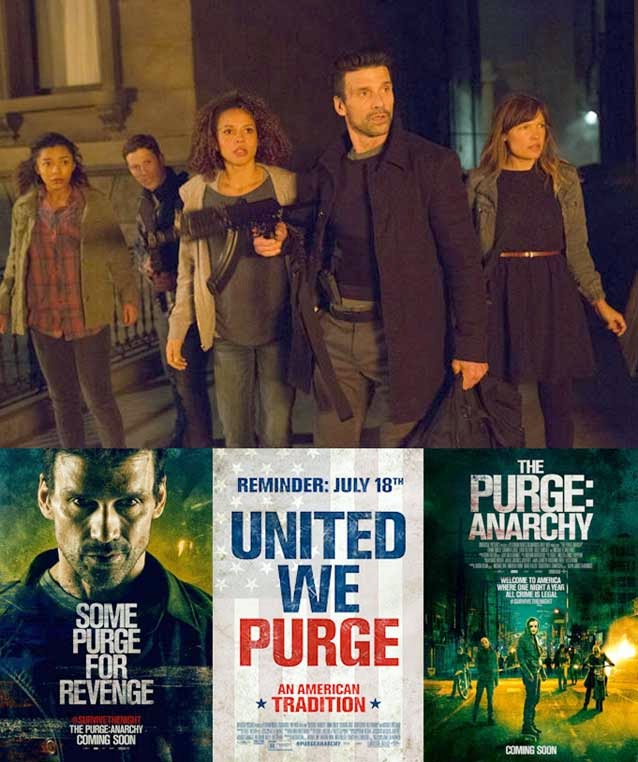
The Purge: Anarchy


Unexpurgated

The Purge: Anarchy
2014 USA/France
Directed by James DeMonaco
Cinema release print.

It’s funny. Although it was only last year, I thought I'd remembered not really being overly fond of The Purge, the first movie in this series. However, I just looked back at the review I wrote of that one (which you can find here) and I actually didn’t give it a bad write up. I was quite defensive about it on some points and, interestingly, one of the points I was going to push in my review of this film, also is pre-empted by me in that initial review. I also picked up on a fair few problems with that first movie and, I have to say, at least one of those problems is repeated in this one too.

The Purge: Anarchy retains none of the characters of the first film and is set one year after the events of that first installment, in the year 2023. It takes the central premise from the original, a twelve hour Government sanctioned period where any crime, including murder, is legal... to keep the crime rate down for the rest of the year... and runs with it. Now it doesn’t expand a great deal on the initial idea but, what it does do, is it explores the obvious symptoms of The Purge and also enhances the, perhaps somewhat obvious, hidden agenda as to why the government wants these annual purges happening.

While the first movie was pretty much a siege turns into a home invasion movie... this installment plays out as the absolute opposite of that tactic. It concerns multiple sets of characters who are, for whatever reason, out on the streets and trying to get to shelter while trying to survive the animalistic death orgy that is the annual “purge”. This surprised me somewhat because I thought it was going to just be a slightly altered re-tread of the first one and, while I had obvious reservations about that, this one really appealed to me and I enjoyed this a whole lot better than the original... despite the fact that Ethan Hawke and Lena Headey weren’t in this one.

It’s an ensemble piece, of course, and the various protagonists are all pretty strong in this. My particular favourite was the main antihero character “Sergeant”... played with great presence by Frank Grillo, who played one of the main "H.Y.D.R.A inside S.H.I.E.L.D" bad guys in the last Captain America movie (reviewed here). He does an absolutely bang up job as a tight lipped, no nonsense, knight in tainted armour killing machine and I read just today that the majority of his dialogue, including his back story, was cut from the movie. Now this is interesting because I bet he wouldn’t have been as half an interesting or compelling character if he’d been talking all the way through so I find it interesting that an already good performance can be strengthened via the “less is more” route in the editing.

I was thinking all the way through the film that, if this had been shot in the late 1960s or early 1970s, this central character would have been played by either Charlton Heston or Yul Brynner... because this is exactly the sort of violent, dystopian science fiction thriller that they would have both had lent their talents to... although I’m not sure Heston would have liked the underlying message of the movie. I touched on this in my review of the first movie but The Purge: Anarchy is very much in synch with the story and attitude to specific films like Planet Of The Apes, The Omega Man, Rollerball, Soylent Green, Westworld and The Ultimate Warrior... almost all of which starred either Heston or Brynner, of course (the exception being Rollerball). I guess a late 1970s/early 1980s comparison could also be made via films like The Warriors and Escape From New York. Just a small bunch of individuals trying to survive a night in the city. Always good for a “hang any action stealth/chase sequence you like on it” kind of plot and these kinds of films can be kind of entertaining (although I seem to remember not thinking much of The Warriors when I saw it back in the heady days of “the video rental age”).

While the film is violent, the concept is pushed out just a little bit to include an anti-Purge faction and what I can only describe as a Government “enhancement” group... in that the government are found to be slaughtering citizens wholesale as an augmentation to the purge because they are required to keep the population down. There’s always a reason that Governments pass these stupidly Draconian laws and, while the reasons are left pretty much to your own speculation in the first movie, this one blatantly comes out with the idea near the end of the movie.

The class structure is once again explored, in this one. There’s even a big tip of the hat to The Most Dangerous Game (aka The Hounds Of Zaroff) in that a whole load of people are captured and taken to a wealthy mansion and courtyard area where rich people bid vast sums to hunt and purge on the poor, huddled and, obviously, unarmed masses in a controlled area with the added advantage of the latest state of the art weaponry. Of course, if this sounds too much like shooting fish in a barrel well... don’t worry, it is... but it’s Hollywoodland time here so, you know, I don’t want to say too much about what happens in this scene but it certainly relates to my next paragraph.

The one problematic thing about this movie, which is also very much a hang over from the first film, as far as I remember, is the number of “deux ex machina” style moments where someone is saved from certain death by the intervention of another character or group of characters the audience had temporarily forgotten about. Like the first film, there’s just way too many of these moments in this one but I have to cut it a little slack because I guess there’s more chance of that kind of thing happening when you’re working on a bigger canvas and not confined to fighting your battles inside a small home. I do, though, think these moments do become quite tiresome, repetitive and increasingly unbelievable as the movie progresses to its final conclusion.

However, this is small price to pay for a film which holds, as its central idea, the concept that guns and violence are a bad thing and I am once again amazed that a film which is so blatantly anti-gun law and opposed to “the right to bear arms” is not heavily snipped by the American censors. Sure, the film revels in violence (well, violence in art is quite often very watchable, to be fair) and it does the obvious thing of trying to have it’s cake and eat it in terms of the play off between the violent nature of the film and the underlying message of anti-violence but, as far as I’m concerned, the subtext of the movie, which is reenforced by the action, or should that be inaction, of one of the lead characters near the films denouement, kind of wins my heart over on this one. As far as I’m concerned, this can only be a good thing and I just hope that all this doesn’t go over the heads of a the teenage audience that these kinds of entertainments are primarily aimed at.

The Purge: Anarchy is a nice bit of violent science-fiction that preserves the lineage I outlined earlier in this review without missing the point of some of those films. It’s a much more entertaining and thoughtful, if not overly subtle, tale than its predecessor and if you are into these kinds of action fests then you will probably be into this one. Definitely something I will catch again in the next couple of years.

Wednesday, 4 December 2013

The Omega Man


He Am Legend

The Omega Man
1971 USA
Directed by Boris Sagal
Warner Brothers Blu Ray Region B

As far as I can make out there have been, to date, four movie versions of Richard Matheson’s classic sci-fi/horror novel I Am Legend. The Last Man on Earth from 1964 (starring Vincent Price and reviewed here), The Omega Man (the subject of this review), I Am Legend (starring Will Smith) from 2007 and a straight to home video release, also from 2007, called I Am Omega. Of the four, I still haven’t got around to watching that last yet but I was gifted with a copy almost two years ago and it’s gaining traction and moving to the top of my “to watch” pile finally, you’ll be glad to know. Hoping to check that one out before the end of the year.

Matheson was reported to be unhappy with the Vincent Price version of his book but I’d have to say that, of the film adaptations I’ve seen of it, that first version is the one that’s closest to the novel. In the book the main protagonist is the sole survivor, kind of, of a virus that wipes out the world and either kills the rest of the population or turns them into vampires. And I mean vampires... proper blood sucking, daylight fearing vampires. The main protagonist spends most of his time hunting them out by day, banging stakes through their hearts and holing up at night.

The Price movie follows this pretty well, as far as I can remember, but if The Last Man On Earth is a version of I Am Legend that Matheson wasn’t happy with, I can’t even imagine what he made of The Omega Man. It’s here that I should go on record saying that, although I love all three movie versions of the book I’ve seen, The Omega Man is by far my favourite of them because it’s just plain, outright fun.

Starting off with Neville, the main protagonist played by Charlton Heston, riding around the city in the far future of... um... 1977, we hear Max Steiner’s theme from A Summer’s Place on the 8 track he puts in the car stereo... before he stops and spots something moving in one of the windows. He immediately stands up in his car, pulls a machine gun from the passenger seat, and opens fire at the window before driving off into the opening credits, with Ron Grainer’s haunting main titles playing over shots of him driving around the deserted city.

Charlton Heston was fast becoming the “go to” man for this kind of film which belongs as part of a collective pre-Star Wars science fiction strike, launched at cinema directly from Hollywood in the late sixties up to the mid-seventies. These films commonly projected cynical and depressing dystopian futures which were popular in their gritty depiction of a world that spiralled off into decay, or in this case, is the inherited fall out from an apocalyptic virus. Heston had recently proven himself suited to this kind of movie with his appearances in Planet Of The Apes and Beneath The Planet Of The Apes and would do so again, after this, with his turn as the main protagonist in Edward G. Robinson’s final film, Soylent Green. Actors such as Yul Brinner, James Caan and a various others were also getting good roles in similarly grim science fiction movies such as Westworld, The Ultimate Warrior, Rollerball, Silent Running and Logan’s Run (which was about the last of the cycle before Star Wars hit and changed the course of on-screen science-fiction forever).

The Omega Man firmly belongs in this camp and, as you may expect, Heston proves himself a pretty good actor as he slowly starts going mad and talking to himself before coming across a bunch of survivors who also have the plague... teaming up with them to find the cure made from in his own blood.

The film finishes both cynically and hopefully with a bittersweet conclusion that more or less mirrors the book without actually fully grasping the concept that the creatures Neville has been hunting for his own survival are actually more afraid of him than he is of them. To them he has become a legend, hence the title of the original novel.

The movie tries to do the novel in very basic structure, and does attempt to address that issue... but really only pays it lip service. The vampires have been replaced by light sensitive, virus infected mutants and any references to vampiric myth has been unequivocally vanquished from the movie. But still, it’s got guns, a babe (in Rosalind Cash) and some “right on” hippy values thrown in as a metaphor created by the fate that has befallen the human race. Like I said, it may not be accurate to the book but it is fun...

It’s also kinda groovy with Ron Grainers score really knocking it out of the park and clear across the world. Even from the opening titles you know this score is going to be special. Grainer was mostly known for TV work, writing familiar themes such as the opening titles music of The Prisoner and, as realised by Delia Derbyshire, the main signature theme for Doctor Who. But he did do a few movies and was known for bringing in some unusual instruments from his personal collection to go in certain scores, like the water bell on this score. The music in this is absolutely perfect and I don’t know why Grainer didn’t get a hell of a lot of other big Hollywood movie gigs off the back of this. I can’t believe it took something like 30 years just to get a limited edition CD of this released (now in it’s remastered and corrected second incarnation from the Film Score Monthly label). Some of the action cues sound a little like his music for The Prisoner but I think this should maybe just be attributed to his style and, frankly, I think this is one of the best scores written for a movie. Why they didn’t make a big thing of this one I’ll never know.

The action is fast and furious in places and the performances are all fine, especially Heston’s man living with himself and Anthony Zerbe as the head of “the family” of mutants, although his preachy, pseudo-religioso performance does start to grate a bit towards the end. There’s a strong Christ analogy at the finish which is not exactly subtle and that fits right in with the general zeitgeist of the time, methinks. Whether you like it or not, I think I’d have to peg The Omega Man as a sci-fi classic... a film that I’m likely to travel back to every few years (not like the other versions I’ve seen). Matheson probably wasn’t best pleased with this version, which does tend to subvert his original narrative into other concerns of the screenwriters, but if you can pull yourself away from the template of the original (and excellent) novel then I think, if you’re a fan of science fiction, you may find The Omega Man worth taking a good, long look at.