Lost Arky Medium Spiral
Indiana Jones And
The Dial Of Destiny
Directed by James Mangold
USA 2023 Paramount/Lucasfilm
UK cinema release print
Warning: One big spoiler from which you can infer the ultimate fate of one of the characters.
Okay then... lets do this. I love the Indiana Jones films but I was kinda worried that both Spielberg and Lucas were stepping away from this one (although I think Spielberg was on this one as executive producer or some such). I’ll get to my main worry later because, in a way, it’s a bit of a spoiler so, you know, I’ll leave it to near the end.
I won’t say too much about the plot of Indiana Jones And The Dial Of Destiny other than it involves a typical 1980s style quest narrative of putting together bits of an artefact before the bad guys... who in this case are the Nazis, despite the majority of the film being set in 1969. And that the artefact in question is the titular dial, aka an invention Archimedes designed called the Antikythera, although it serves a different function in the film to what it was used for in real life. And that’s me done on the story.
Let’s get to the actors.
Harrison Ford is pretty great in this and he’s ably supported by someone called Phoebe Waller-Bridge playing his god daughter Helena. Also, we have Toby Jones in the sequences of the film set in 1939 and Mads Mikkelsen playing a Nazi rocket scientist spanning both 1939 and 1969, who is the main villain of the piece. Anybody who’s seen Mikkelsen play villains will know he’s really good at this kind of thing and this role is no exception.
Then there’s Antonio Banderas who, honestly, is a really great actor... a pity then that he’s totally wasted in this movie. I wish his character would have been written as someone with greater importance to the story. And there are also a couple of actors returning too. John Rhys-Davies returns playing Indy’s friend Sallah for a third time and... yeah, I’ll leave the other returning actor a mystery but, you will be expecting it.
The film is full of action although, the formula seems a little different. It felt a bit like it wasn’t quite as ‘action and plot in overdrive’ as the other four movies and I think it suffers somewhat from this, truth be told. But it’s fine... it doesn’t get boring and Indy fans should be enthralled with the journey this movie takes them on. There are a few problems with the movie too, though...
Okay, my cousin in Australia, who saw it a number of hours before me and who loved it, warned me up front so I didn’t simmer in my own anger for twenty minutes like he did. A big problem is that the Paramount Pictures mountain logo doesn’t transform into the first shot of the movie like the other four films do. This is pretty much like watching a Bond movie without the famous signature tune and gun barrel walk at the start (and we know how that turned out when they tried it on two of the weakest movies in the Bond franchise). So, yeah, that is a pretty anger inducing phenomenon, for sure.
Secondly, the famous shadow silhouettes which Spielberg always used to foreshadow Indy’s entrances at various parts of the movies are completely gone too. Which is annoying and I’d go further and say that, for all the action and dialogue scenes, nothing quite seems as simple as the way Spielberg and his cinematographer would have shot it. It feels elaborately constructed rather than just being elaborately constructed with that fine air of simplicity that made them feel as breezy as the 1930s adventure serials on which they were based. Which is a shame but...like I said... it’s an okay film.
Let me now address two generally cited problems with the film which seem to have come up on social media but which I really don’t think are really a problem at all. One is the ‘younged up Harrison Ford’ CGI. I mean yeah, it’s never great when they do this in movies but, honestly, it’s really not all that bad for the majority of those scenes in the film. I mean, yes, there were a couple of moments where he looked like a fake modern computer game but, for the most part, you should be able to suspend your disbelief enough to get caught up in the action. It’s basically fine... I’m not a fan of this kind of stuff but it suffices here just as big wire cables to hold up the spaceships sufficed in films of the 1930s-1960s. Just ignore it.
Secondly, the last twenty or so minutes of the movie seems to have divided people. All I will say is that it’s traditional for an Indiana Jones movie to build towards a fanciful conclusion. I had the same disappointment when I first saw Indiana Jones And The Last Crusade... which I thought had an absolute rubbish ending. Angels and Sankara Stones I could buy into but ancient knights preserved through the centuries was just silly. I much preferred the next one because the alien at the end seemed a far more sensible option. So all I will say is, the first three movies had religious endings of a sort and the last two movies have similarly fantastical endings which are based on pseudo-scientific wish fulfilment (which you probably will see coming a long way before it happens). Yes, the last twenty minutes or so will cross a line for some people but I think, if you’re going to have this sequence in a movie, then this is rendered as credibly as you could hope for. I didn’t mind it at all.
What I did have a problem with was John Williams wonderful score to the film. I love Williams’ Indy scores but this one felt a little overly familiar. I mean, yes, if you’re going to reference things from previous films then it absolutely is the right decision to score it with a bit of leitmotif which is relevant from the source score. However, I didn’t like the fact that I kept also hearing things which weren’t linked to a specific reference also turning up. For instance, I don't want to be seeing a car chase and then have musical cues like Escape From Venice and Belly Of The Steel Beast (both from Last Crusade) interpolated into the score. It just reminds you of the other movie when it doesn’t have a link so... yeah... found that a bit disconcerting, to be honest.
Okay, there are a few more minor problems also like anachronisms in terms of the time setting throughout the movie (police car livery, makes of gun... that kind of thing) but I don't know how many of these were actually genuine mistakes as opposed to dumbing things down for the audience for greater clarity... so I think I’ll stay off that subject. And now we get to the big spoiler so, yeah, don’t read further if you don’t want to know.
My biggest worry about this one was that they were going to kill off Indiana Jones... not because it didn’t feel right but because it would completely break continuity with the Young Indiana Jones TV show where we know that Indy lives to tell his stories from the perspective of the 1990s (as played by both George Hall and, in one episode, Harrison Ford himself). Especially since the last movie validated the series as continuity in that events from at least one episode are mentioned and, similarly, this movie has its own visual reference to the show. All I will say to others worried about how this movie keeps continuity with that TV show is... it absolutely does. Which is a big spoiler in itself I guess but, the movie doesn’t contradict the timeline in any way that I could see, so have no worries there.
And that’s about all I’ve got to say about this one other than, Indiana Jones And The Dial Of Destiny is an enjoyable enough romp but, for me, it’s easily the weakest of the Indiana Jones films and I won’t be rushing back to the cinema for a repeat viewing. I’ll catch up with it again when I show it to my parents on Blu Ray. It’s a nice enough film for sure and it certainly has its moments but, for me, the writing and direction didn’t come close to the earlier films. It’s not the years it’s the mileage.
Monday, 3 July 2023
Indiana Jones And The Dial Of Destiny
Monday, 13 December 2021
Infinite
The
Regeneration
Game
Infinite
Paramount USA 2021
Directed by Antoine Fuqua
Warning: Plot spoilers, I guess.
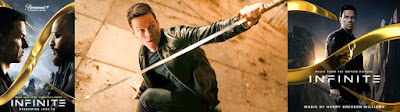
Infinite is a new science fiction action adventure based on a relatively new novel, The Reincarnationist Papers, by D. Eric Maikranz. Now, this information surprised me because the story is very much a riff in the vein of a Philip K. Dick kind of concept and yes, it’s yet another of these recent sci-fi movies which feels like it's exploring concepts from 1950s science fiction, it seems to me. However, it’s a nice enough concept but... it’s kind of wasted the way it’s been presented here.
The Infinite of the title is the name a certain, smallish underground section of the population give to themselves. They are basically people who, from adolescence, can now recall all their past lives leading up to this point... so they don’t have to learn new skills and are pretty much experienced at everything they’ve tried their hand at for thousands of years. When they die, their soul is just reborn into another body and so on. However, the Infinites are split into two warring factions. There are the Believers... the good guys of the film who want to use their special skills to benefit mankind... and the Nihilists, the bad guys of the story who want to destroy the world so they don’t have to keep coming back in new bodies.
To this end, many years ago, the main villain Bathhurst, played by Chiwetel Ejiofor (who nearly always makes a good villain but he seems to have some truly terrible lines here... much like all his costars in this), invented an egg of destruction which, when activated, will wipe out all life on the planet. In a blistering car chase action sequence at the start of the movie we see a character, one of three Believers who die in the opening sequence, steal the destructive egg and we are told later that he has ‘hidden’ it somewhere. Why Bathhurst can’t make another one is not really made clear but, anyway, it’s up to the Nihilists to find the egg so they can destroy humanity and the Believers to find the egg to keep it hidden or, preferably, destroy it. However, nobody knows where the main action hero at the start of the movie hid it before his death.
Enter Marky Mark Wahlburg. That character has now been reborn into his character, Evan. However, he doesn’t know he’s an Infinite because of him being treated as a schizophrenic throughout his life (and the tin plate in his head doesn’t help either). However, when both factions of Infinites realise it’s him, the Believers nab him from under the noses of the Nihilists and start trying to ‘jog his memory’ about the heroic action man he really is and, more importantly, where he hid the egg.
And that’s the main set up and I won’t say much about the plot. All the actors including those just mentioned and the likes of Sophie Cookson, Dylan O’ Brien, Toby Jones, Liz Carr, Jóhannes Haukur Jóhannesson and Jason Mantzoukas... are all pretty good. However, the dialogue they are asked to deliver in the film is, generally, not. Take the aforementioned Ejiofor, for example. We’ve seen him play a villain in numerous films and he’s always so threatening and not someone to be trifled with. Here, however, nothing much he’s saying is worth listening too and that goes for pretty much all of the other characters in this. The only redeeming moment in his character is the fact that, with the beard and black costume choices he has, he does tend to come off as a kind of knock of Roger Delgado as The Master (from the Jon Pertwee era of Doctor Who), so I was at least able to enjoy his performance on that level.
Another huge problem is the opening of the movie. It starts off with this truly brilliant action sequence (rendered less effective by some rubbish rap song over a lot of it) but... it’s the best set piece in the movie. It’s too strong and makes all the other action sequences in the film which follow look bad in comparison. And I’m sorry but, Marky Mark riding his bike off a really high cliff in Scotland and managing to land it on the wing of a plane which has already been in the air for two minutes really doesn’t help things. This film is definitely going for the action stakes but, as far as I’m concerned at any rate, it really fails to deliver for a lot of the time. Don’t get me wrong, the film is entertaining enough and the kicks, punches, slices and explosions are fine... they just aren’t enough to save it and, coupled with the script... yeah, I was a bit underwhelmed by the whole thing. And I still can’t figure out why a secret society would advertise their whereabouts to the enemy by flying around in aircraft with a big Möbius strip logo on the side.
What I wasn’t underwhelmed with was the action score provided by the great Harry Gregson-Williams. This was, frankly, the only reason I bothered to see the movie, it has to be said, as I'd already bought a copy of the limited edition CD release from La La Land records and I wanted to hear how it played in the movie before listening to it as a stand alone. And how it plays in the movie is... mixed way too low when it could have been way better highlighted against all the bangs and pops of the drab action sequences. But I know the CD will get a fair few spins so, at least there’s that. Thanks to the company for allowing La La Land to put this one out.
And... not much more to say about this one. The film has some nice concepts such as an electronic acupuncture machine to help stimulate memory and a gun that fires bullets which capture the souls of Infinites so they can’t resurrect again, stored in a computer chip instead but... the execution seems lousy on this one, for some reason. Things just don’t seem to be either pumped up enough or gritty enough to be consistently watchable and, yeah, well I won’t be watching Infinite again anyway, I would say. If you like sci-fi action movies then it’s not absolutely terrible and it’s not too dull a diversion of an evening. Just don’t go in expecting an epic.
Tuesday, 9 April 2019
Out Of Blue
Out Of Blue
2018 UK/USA
Directed by Carol Morley
UK cinema release print.
Warning: Spoilers by implication here.
There’s a moment relatively early on in Out Of Blue when the lead protagonist, detective Mike, played by Patricia Clarkson (exactly why she has a boy’s name and wears men’s clothing is never really addressed), answers another character by saying that she hates the word ‘closure’. Well, I have to say that this film might have been a little more interesting if it had been lacking exactly that. Instead, we seem to have an abundance of closure comprising the DNA of the movie when, honestly, I think we’d have all been better off with a little restraint shown towards the constant spelling out of something which the writer/director Carol Morley still seems to want to play like it’s something of a twist by the end. I’d blame Martin Amis who wrote the source novel, Night Train for the sloppy plot structure here but, a brief summary of the plot of the novel which I looked at (I’ve not read the actual novel myself) suggests that the movie version is a far cry from the original and has not much business being compared to it.
Now, the main reason I wanted to see this movie is because I really like the actress Patricia Clarkson (since first seeing her at the cinema in High Art back in 1998) and I don’t see too much of her in enough films. So a movie where she’s actually playing the lead rather than a supporting part was something I really wanted to have a look at. And I was not let down.... by that element of the film at least. Clarkson is absolutely electric in this... as she always is... and she really does carry this film, it has to be said. Even when she shares screen time with such phenomenal actors here such as James Caan and Toby Jones, she’s still the person you are looking at throughout the entire movie and... that’s exactly what I was expecting from her.
And there are a lot of other cool things about the movie too. The cinematography, shot design and even set dressing is all pretty amazing. The real problem lays in the plot of the film, I believe. Clarkson’s character works homicide for the New Orleans Police Department and she is called in to find out who has killed an astrophysicist (played by Mamie Gummer) and, even from the start of the film, Clarkson’s character is both empathising obsessively with the victim and, also, having these little funny turns where she is either hallucinating or fainting. Indeed, it’s not uncommon for characters or objects to disappear from a scene, literally winking out of existence like David Hemming’s character at the end of Antonioni’s Blow Up, if she’s not keeping an eye on them.And sometimes even when she is.
Meanwhile, the visual syntax of the movie is shot through with a metaphor of the old ‘multiverse’ theory and, frankly, my disappointment doubled when, at the end, this 'image grammar’ didn’t really have much of a pay off and instead was merely being used as a distraction for the audience to try and fox us from cutting to the truth too quickly. There was a movie out earlier in the year called Destroyer (I reviewed it here) which absolutely relied on the audience misinterpreting the narrative structure of that film and, because of the way the director of Destroyer deceived the audience, we really did get an ending we couldn’t see coming. Alas, the visual elusiveness of a totally coherent shot ebb and flow in Out Of Blue isn’t nearly clever enough to distract the audience for long and the damage is already done when, very early on in the movie, the amnesiac element of Clarkson’s back story is mentioned and alarm bells begin to ring. Then, when an old case of linked, unsolved serial killings from a number of decades before is thrown into the mix with regards to the latest crime, it’s really not a very large step for the audience to figure out that this old case will in some way turn out to be of significance, on a personal level, to the main protagonist.
That’s the main problem here, I think. Not only is it easy to figure out both the identity of the killer on the original case and also Clarkson’s character’s link to it that, well... you just assume there’s going to be something more. The way the clues are fed to the audience is so heavy handed, in fact, that there was a point twenty minutes before the end when I thought the film was over as they’d deliberately revealed everything already... or so I assumed. Then we have an almost entirely redundant final 20 minutes or so... nicely shot and interesting to look at but completely superfluous, where we lead up to a big reveal which... yeah, I honestly thought it had been revealed already, much earlier in the film. Quite early in the film, in terms of one of the elements of that twist.
Now that I’ve said all that, however, I would like to reiterate that the film is extremely interesting in terms of both visual design and editing, not to mention Clarkson in a truly captivating performance. So, despite the weak plot and terribly disappointing closure in the movie, it’s actually worth taking a look at if there’s nothing better playing at the cinema. There are even some nice attempts at visual metaphor where a recurring image of some rolling marbles representing planets makes you realise, at one point, that this is because the lead character is probably losing hers. It’s a nice enough movie and certainly not as terrible as some of the more recent cinematic offerings currently doing the rounds but I couldn’t recommend this one if you are after a more mysterious and ultimately thought provoking cinematic experience. There are good movies out there which use astrophysics as a metaphor at the heart of their inherent mystery but, sadly, Out Of Blue isn’t one of them.
Thursday, 10 August 2017
Atomic Blonde
Fact Is Satchel
Atomic Blonde
2017 USA Directed by David Leitch
UK cinema release print.
Atomic Blonde is a new film directed by former stuntman David Leitch, whose only previous feature length movie directing was some uncredited scenes on John Wick (reviewed here). He is also currently helming the second Deadpool movie and he directed the mini Deadpool teaser earlier in the year. Atomic Blonde is based on the graphic novel The Coldest City by Antony Johnston and, for once, the Hollywood “based on a” machine got it right... it really is based on a graphic novel and not a comic book being mistakenly confused for one.
After a brief prologue putting the story into political context in the 1980s with the imminent fall of the Berlin Wall, the film starts off with a punchy sequence in which a man is running from some unspecified ‘bad guys’ but winds up dead with, amongst other things, a bullet in his skull, all set to the strains of the New Order song Blue Monday (although I’m not entirely sure whether the version used in the film is actually the New Order version). We then sweep into another sequence as we see the main protagonist, British Intelligence Operative Lorraine Broughton (for the purposes of this review) played by Charlize Theron, in the aftermath of the mission which we will see in the ensuing film. We start off with her in a bathtub, filled with ice, to help her badly swollen and bruised body.
We then see her putting up some make-up in the mirror as David Bowie’s song for Paul Schrader’s remake of Cat People, Putting Out The Fire, plays on the soundtrack in a somewhat stolen moment, it seems to me, from Quentin Tarantino’s Inglourious Basterds... in which it's used for a very similar sequence (this film also has another connection with Inglourious Basterds in the fact that popular German actor Til Schweiger turns up in a few scenes). Following this, Lorraine goes to her debriefing in London, sat in a room in the company of Toby Jones and John Goodman as she tells the tale of her recent, disastrous mission in Berlin. The majority of the rest of the film is all flashing back from there (with occasional jumps back to that reference frame) as she goes on a mission to find a microfilm list of all the intelligence agents operating in the world... the very list which the gentleman at the start of the movie was killed for. She is also told to look out for a traitorous ‘double agent’ who goes by the name of Satchel, in order to unmask Satchel and probably terminate with extreme prejudice.
And so she goes to Berlin and, before she can meet her main and thoroughly ambiguous contact David Percival (played by James McAvoy) she is already ‘made’ by the ‘opposition’ and gets herself into trouble which she handles in a most spectacularly violent fashion and then... the film goes on like this for pretty much the rest of the running time. And it’s really not a bad movie, to be honest. A quite tough action piece, nicely framed and well edited so that it’s not going to lose the audience and with the kind of brutal edged comic book violence in it that we’ve seen in, for example, the John Wick films.
Now, there’s a lot going on here in terms of ‘story smoke’ in this one and, ultimately, because it’s the kind of film that delves into the murky underworld of spy fiction, where you never know who is telling the truth and who is working for who, the plot is somehow best left ignored, in my opinion. If this was a Bond or Jason Bourne film, people would be complaining about the simplicity of the plot but, because it’s a different beast, the story doesn’t mean too much, to be honest. The identity of Satchel is treated almost like the identity of the killer in a giallo movie, in that there’s so many people it could be that it’s almost impossible to tell which one it is... and it also doesn’t matter, as it happens. The plot is really, more so than many movies, just a framework to hang the stupendously cool action sequences from and to focus on the ice cold personae projected by Charlize Theron, who does wonderfully well in this role. Indeed, she had eight trainers for this movie and was training alongside Keanu Reeves while he was preparing for John Wick - Chapter 2 (reviewed here) but she still managed to crack two teeth while filming, by all accounts. You can tell by her performance here that she really threw herself into the physicality of the role.
So, yeah, the fight scenes are quite brutal in some places and, rather than being the ‘hit someone, kill someone else before killing the other person you just hit - stop - repeat’ style of combat used in the John Wick movies (which is effective enough and I love those films), the intensity of the fight scenes in this are perhaps even more interesting in that they are more intimate with people taking a long, long time to become incapacitated or die. So, less body count (although it is pretty high) and more the strife and struggle of a well choreographed series of set pieces, in this movie. One of the things I liked about it, regarding this, is the way that both heroine and bad guys are shown to be so damaged and exhausted from their fights that they both have trouble getting up to carry on the combat. There’s one sequence in particular, where Theron’s Atomic Blonde is trying to get a character called Spyglass, who has memorised the troublesome list and who is played by Eddie Marsan, out of the country but she goes on the offensive and enters a multi-story building with him to attack some snipers. In the long, drawn out and chaotic fight scenes which take place here, it was great to see Theron’s character getting punch drunk and falling about all over the place rather than just be the 100% killing machine a lot of these kinds of heroes normally are in these sorts of action spectacles.
My one slight problem with the film was the casting of Sofia Boutella as another agent who becomes Lorraine’s lesbian lover during the course of the story (no spoilers here... it’s in the trailers, people). Toward the end of the movie, Boutella’s character comes under some extreme duress from a third party and it was in these moments that I realised that this actress is going to be typecast if she’s not careful because, the baggage she brings to the role via other movies doesn’t help the credibility of her character here. After all, the agent she is playing is quite vulnerable, almost to the point of naiveté but, the roles I associate her with are the killer blade-legged lady from Kingsman - The Secret Service (reviewed here) and The Mummy in the recent version of... um... The Mummy (reviewed here) . So she really should be able to take care of herself in any situation, is what my brain was telling me. I know that’s wrong and it’s maybe just me but I had a similar ‘unwanted baggage’ problem with Uma Thurman in Paycheck. I’d fairly recently seen her kicking all kinds of backside in Tarantino’s Kill Bill movies so I wasn’t prepared, in that particular case, for her to play a character who wasn’t able to take on anything less than a gazillion bad guys and come out on top. So, yeah, just a slight problem with Boutella’s character here too but... like I said, that could be just unique to me.
The end reveal of the Satchel character comes a lot after you are expecting it to be revealed, assuming you’re not taking anything you see and hear at face value and after a few fake endings. I’m delighted to say I completely guessed the identity of Satchel wrong, so that made me smile a little. That being said, since that identity really could have been anyone, the cleverness of the reveal comes not from the who but from the ‘what’ and ‘ why’ of the character than anything else. Sorry if that seems a little cryptic but I’m trying to keep this review as spoiler free as possible. Either way, the film doesn’t end when you think it’s going to end and there are a couple of little twists which, while seeming fairly unimportant after the violent carnage of the rest of the story, still give the film a nice little end play to add a little more depth to the tale.
Other than that though, a nice piece of modern, kinetic cinema with a strong soundtrack of 1980s songs (plus covers), some cool performances all around and a few striking visual touches here and there. Watch out near the end, for example, in a ‘blink and you’ll miss it’ moment where the blood spray of someone’s brains being blown from their head adds a beautiful splash of red punctuation to the artwork on the wall behind, putting a bloody orifice/red set of lips in the mouth of the subject of the painting (I don’t know if that was serendipitous or planned but it looked really great). There’s also a great pseudo-eighties graphic design style to the way the expository typography is used on screen (with the accompanying swooshing sound of a spray paint can) and even a moment where the moviemakers nearly break the fourth wall when the director uses the flashback format to legitimately have the film you are watching burn up in an imaginary projector, so to speak. So, some nice moments here. I was a bit disappointed, given the setting of the film and the title, that the Blondie song Atomic was not used once in the movie, given that its minimalistic vocals and pounding instrumental could have been put to good use here (not to mention the content of those few lyrics) but, that niggle aside, it’s a really cool flick and if you are a fan of action cinema, pretty much unmissable as far as I’m concerned. I don’t know if this movie was anything like the graphic novel it was based on but, as a film, Atomic Blonde is a great night out at the pictures so... give this one a go, if hard edged action is your kind of thing.
Monday, 9 January 2017
Sherlock - The Lying Detective
Mary-tricious
Sherlock 4.2 - The Lying Detective
UK Airdate: 8th January 2017 BBC 1
Warning: Spoilers from the outset.
And here we go again. This is an almost text book episode of what Sherlock is all about and what it’s always been about since the very first episode aired... It’s all about being very clever in its use of the media to both play with the way the content and information is delivered to good dramatic and comic effect while still using the flexibility of this rug-pull of a malleable breaking of the fourth wall, on a purely narrative level, to be able to wriggle out of anything. For that reason, I really loved it. However, another thing that has remained consistent throughout the majority of the series is the fact that on the level of the actual content delivered... and I mean the writing and its inability to use those same techniques to sustain trust or be anything less than obvious, for the most part... it lives up to its normal standard and is also, unfortunately, fully represented in the chemical make up of this weeks episode.
In other words, it was an entertaining romp but, unfortunately, not clever enough by half.
Now then... this didn’t stop me enjoying this one, I have to say, and I found it to be a much stronger episode than the previous one but... it felt like a stop gap so Holmes can get Watson on board again after the ‘possible’ death of his wife in the previous episode. And, yes, I’m still not buying into that whole ‘Mary is dead’ idea just yet... if I’m going to make myself look stupid on that front then I can at least drown properly without flapping my arms this way and that in terms of my suspicions of where the last episode might end up.
So, despite the excellent performances of all the usual suspects in this one... Benedict Cumberbatch, Martin Freeman, Una Stubbs, Rupert Graves and Mark Gatiss... not to mention the always brilliant Toby Jones playing a really unlikeable serial killer who, alas, because the writing telegraphed his character too much, wasn’t surprising anyone (but, as usual for Jones, he did it so well)... my attentions were fixated on just two things throughout this episode. One of them was the whole Mary Watson thing and I’ll get on with my one last chance at second guessing that in a minute. The other thing was... alas... thrown in my face, so to speak... and that also had its roots in the previous episode.
In last weeks episode, Dr. Watson had a dalliance, albeit in text form, with another woman. This week... after I was sure that Holmes wasn’t actually talking to a dead woman... another character in the story had some chips by the River Thames with Holmes and, at that point, my thoughts marinated to... wasn’t that the lady on the bus from last week but with different coloured hair? And then I told myself I was probably wrong and moved on until another scene with Watson and his therapist and, looking at her I thought... no, wait! Isn’t that the woman from the bus from last week? And then I moved on again because... well I kinda stopped playing that game and I assumed my gut instinct was wrong. Well, it turns out I was completely right in that all three women were, in fact, the same person... the only thing I didn’t quite see coming was her relationship with one of the main characters but.... yeah... you know... my gut was right.
And so I’ll come to Mary. I’m still not convinced her death wasn’t staged... possibly by Mary (and Molly... and I’m still not giving up on my Molly-arty theory either, for now) and the reason I’m still clinging onto this sad conviction that she might still be alive (at least until the conclusion of next week’s episode, at any rate) is because Moffat seems keen to make it seem almost impossible to the viewers at home that she could be anything but dead. So we have the ghost of Mary Watson talking to John Watson and giving him advice... or do we? Well, it was stated and is quite obvious that the ghost of Mary Watson is just a projection created by John Watson to deal with her death and... well... that psychological manifestation doesn’t have to mean that she’s actually really dead, does it? As long as John believes that she’s dead then he can have whatever ghost he likes playing around inside his brain. And that’s where I am at the moment and part of me sincerely hopes I’m wrong in my suspicions because, frankly, it would be nice if Moffat and Gatiss were able to run my mind around in little circles because I hate being right about a lot of the stuff I see on TV and at the movies... kinda numbs the emotions, so to speak. Time will tell... seven more days of that man made temporal construction known as a week should reveal the end game on this one... we shall see.
Other than all that though... great little episode despite the obviousness but with the quality... and this is a gift that Moffat seems to have... to still inject great dollops of humour into the programme even when the two main protagonists of the series are in their darkest places. Some of the dialogue, as always, was pretty wonderful... it’s just the broader strokes on these things which sometimes screw these up a little, methinks. So... wonderful performances, cool and innovative use of the medium to show things in the usual, marvellous, Sherlock manner and, as always, a really nice score by David Arnold and Michael Price which comes out on CD on 27th January (if you were wondering... pre-order it specifically from Silva Screen before the release date here now and you should get the special limited bonus disc of the score to The Abominable Bride thrown in too, if you get your skates on).
Despite some obvious moments, not a bad bit of viewing for a Sunday evening. British television has still got it, I reckon, and Sherlock is very much one of our finest exports. Looking forward to the next one now... just to see if any of my wild theories are right.
Monday, 5 September 2016
Morgan
Guten Morgan
Morgan
2016 USA Directed by Luke Scott
UK cinema release print.
Typical. You wait ages for a movie to play at your cinema with Michelle Yeoh in it and then two come along within seven days of each other (see my review of Mechanic Resurrection here for the other).
Morgan is the feature length debut of Luke Scott, son of Ridley (and I promise I won’t mention that fact again... there’s a lot better things to be than someone living in the shadow of somebody else). After the totally chilling teaser trailer and the somewhat less scary full trailer for the movie, I was pretty much hooked on seeing this and went on its opening evening. I have to say that, although I do have some big criticisms of the movie, for the most part it’s a quite compelling, well oiled machine which would probably bear repeat viewing well.
The trailer makes the film look a science fiction tinged horror movie but... it’s not quite. There’s a lot of punch, chase, stunt work in the last third of the movie and so it’s more along the lines of a sci-fi fuelled action movie in some ways. The strength of it is... even though it’s “not quite a horror movie”, it’s kind of shot in the cinematic style of one. The director is pretty great in keeping to that methodology too and, although some of the editing seemed a little choppy in places, the shorter shots dovetail nicely into the longer ones, delivering an overall satisfying experience, at least in terms of story content and the visual and audio style in which it’s executed.
He also does some nice things with the design of the compositions in places, making full use of the widescreen aspect ratio to present characters on opposite sides of the screen, often leaving the middle of the shot bereft of movement and nicely forcing the collective eye of the audience to work at it and, thusly, propel themselves into the immersive experience a little better. That kind of tactic doesn’t always work for directors, to be honest, but it does in this movie and, at the very least, makes for some real eye candy in terms of the look of some of the scenes.
More compositional retinal soda pop comes from Scott’s decision to use surrogate visual planes to frame important parts of the action... such as putting the focus of a scene as something playing out on a screen somewhere or using reflections in panes of glass to enhance the look of the shot. Indeed, some of the work he does with reflective surfaces in the movie reminded me of some kind of enhanced “Ingmar Berman on acid” style of composition, in the way faces are superimposed either next to each other or directly over the top of one another... which in the case of certain shots I’m thinking of actually are a clue to something which you’ve probably already guessed but which isn’t finally spelled out until near the end of the movie. More on that ending in a few paragraph’s time.
Morgan also has a terrific cast and they are all working very well together. It’s very much, until the last third, an ensemble piece and hardly anyone gets more screen time than anyone else. Here you have the likes of Kate Mara, as company Risk Assessment trouble-shooter Lee Weathers, Anya Taylor-Joy as the titular created superhuman... and other wonderful performers such as Toby Jones, Rose Leslie, Vinette Robinson, Jennifer Jason Leigh, Paul Giamatti, the aforementioned Michelle Yeoh, Boyd Holbrook, Chris Sullivan and even Brian Cox, among others, all playing corporate employees in one guise or another. And everyone is turning in amazing performances... especially Toby Jones, whose role may get a bit overlooked but who I believe gives one of his finest and understated performances as Dr. Simon Ziegler.
The film tells of Kate Mara’s Lee coming into a locked down facility where a home grown product, the now five year old Morgan of the title (although at five years old she already has the physical appearance of a late teen and a keen intelligence much greater than a lot of grown adults), has been confined to her quarters after an incident involving Jennifer Jason Leigh. In this incident, which is executed in a single, top down view and which comprises the pre-title sequence, Morgan is sullen and then, as seen in one of the trailers, suddenly compelled to leap into action and stab out one of Leigh’s eyes. Kate Mara’s character is there, seemingly, to see if the company product needs to be ‘terminated’ or if, in fact, Morgan is, indeed, a suitable case for treatment. Something which the company psychiatrist, played by Paul Giamatti, will be able to evaluate when he comes the day after Lee’s arrival at the facility.
As I said before, Scott pitches the movie to the audience couched in the trappings of horror/suspense films and he does it pretty well, ratcheting up the tension to the sequence where Giamatti arrives and interviews Morgan... something the well prepared audience will already guess goes horribly wrong from the indications in the trailer. From here on out, the film is a hunter/prey kind of movie and the action sequences come to the fore... there’s even a car chase at one point. The director keeps these action sequences playing out in the same visceral but low key visual style, though, which means that the change of pace in the last act doesn’t jar with anything you’ve seen before... which, again, is deftly handled.
However, one of the problems with the movie, and one that I alluded to earlier, is that one of the characters you are introduced to in the first few minutes is obviously holding some kind of secret and... it’s pretty obvious what that secret is liable to be. One of the other characters, more or less, partially calls it out early on in the film too and we really didn’t need that hint so early on. Also, the story seems to treat this minor revelation as some kind of ‘twist’ at the end of the movie when, in fact, you already know this half an hour into the procedings, if you’re paying attention. And with absolute certainty by the time the aftermath of a slightly grizzly impalement scene kind of proves a point. This, in itself, is kinda forgivable because, really, that’s one of the few places the script could logically go to anyway. However, the really big problem with this movie is the “post ending”, which seems tagged on as a “let’s bring Brian Cox in to re-explain it for the exceptionally slow people in the audience too” kind of conclusion. This ending is completely false and it doesn’t just insult the intelligence of the audience, it bludgeons their intelligence repeatedly over the head and then pokes it again with a sharp stick just to make sure it’s done. I was really offended at the way everything was recapped at the end and I think the film would have been a much stronger experience if the last five minutes was just scrapped and the film ended as one of the characters gets in a car and drives away. This really did put a dampener on a film that was, really, pretty great up until this point.
The other aspect of the movie which I found a little disappointing stems from my expectations raised by the trailer campaign. In the first teaser, the Morgan creature starts repeatedly humming a little fragment of melody and its really quite chilly and creepy. Somewhere in between that first trailer and the second, I’m guessing, where this was not heard again, the people behind the film must have decided to eliminate that creepy character quirk from the final product. Now, I can almost understand this as it maybe it’s too pointed about certain aspects of Morgan’s psychological profile but... I honestly think the trade off would have been worth it because that humming sent a real shiver down the spine.
Another thing that those trailers promised was a Morgan who “is still evolving” and, possibly by sheer editing alone, hints at an almost psychokinetic ability from the title character. Now, this idea seems to have been eliminated mostly from the final product too. Certainly there are still big trace elements of this character’s meta-human powers, such as the fact that the character can tell when she is being watched through a video camera or the revelation that she knows all about various people who are coming to visit her for the first time. However, I suspect there might have been a much different cut of the movie originally delivered and the character was somewhat toned down or reshaped in the final cut, at some point. Possibly when that terrible post-ending explanation scene was added into the mix. I’m not sure if this possibility of a more invincible version of Morgan would have been a good thing or not but... well I guess we’ll find out over the next few decades if there was, in actual fact, a different slant on the character... as stories get told about the production over the years, maybe.
As it happens, despite that awful ‘explanation ending’, which nearly ruined the whole movie for me (note to studio heads... if you don’t spell it out for the audience, some of them might pay admission a second time so they can work it out for themselves and you get more profits), the film is actually a great piece of work and a startling full length feature debut from Luke Scott. Amazing performances aside, there’s a lot to recommend about Morgan and, even if it does have a kind of Ex Machina (reviewed here) meets Splice (reviewed here) vibe going for it, it’s also a better film than either of those and well worth a visit to the cinema with a possible Blu Ray pick up at a later date. I only hope Max Richter’s score for this thing gets a proper CD release at some point. He’s a great composer and seriously under-represented in soundtrack releases. Either way, though, give Morgan a go... it’s a nice little movie.
Sunday, 30 March 2014
Captain America - The Winter Soldier
Signed, Shield & Delivered
Captain America - The Winter Soldier
2014 USA
Directed by Anthony Russo, Joe Russo, Joss Whedon
Playing at UK cinemas now.
Warning: Yeah, this one’s going to have some pretty big spoilers because of the things I want to discuss, I’m afraid. If you want to be in the dark when you see this movie... don’t read this.
So here we are back in the Marvel Universe produced version of, um, the Marvel Universe (as opposed to non-Marvel Marvel Universe franchises like Spider-Man and the X-Men). I have to say, this second outing for Captain America is a pretty good movie in the sequence. Probably my fourth favourite of the collected series which dovetails into the Iron Man, Hulk, Thor and The Avengers arc.
The film does the usual thing of not keeping closely to some of the things in the Marvel series of comics on which these stories are, well, let’s call it “inspired by” shall we? However, this one doesn’t really stretch things too far (apart form maybe with a certain aspect of The Falcon... but I’ll get to that soon) and while it’s not nearly as bleak and pessimistic as some people have seemed to have made out, this is not the gung-ho burst of US patriotic bomb blast you might have been expecting from a super soldier named after his country. Overall, I liked the consistent tone of cold war betrayal going on with the plot line (something which began in The Avengers aka Marvel Avengers Assemble) and felt it a more interesting movie than, say, Captain America: The First Avenger (reviewed here)... although I still wish they hadn’t rushed Cap out of the 1940s and kept him in that time period for a few more movies (yes, I do want a 1940s set film version of The Invaders please!).
Now I’m not all that familiar with the storyline of the original comic book version of The Winter Soldier but I remember a friend filling me in on the basic plot line about 8 years or so ago. Marvel haven’t exactly been keeping the identity of The Winter Soldier a secret, with even the IMDB revealing who the character actually is, and it’s fair enough actually... after all, the comics were published a long time ago now. So, this movie sees the return of Sebastian Stan as the brainwashed and “returned to life” Bucky Barnes, reprising his role from the first Captain America movie ( although I still wish they’d have put Bucky in his original costume for that first outing). He plays the role of The Winter Soldier much better than he did the 1940s version of Bucky, in my opinion, but that’s because he didn’t play Bucky as the Marvel Universe equivalent of Robin, The Boy Wonder, as he was obviously modelled after. If you’re unfamiliar with the history of the character, however, the combat scene where his identity is revealed to the audience in Captain America: The Winter Soldier probably made a nice surprise.
The film ditches and rewrites parts of his history of course, as it does with all the characters in the movies to fit them into a strong, unifying Marvel brand (which is about to be shot to pieces with the new X-Men movie, actually, but I’ll get to that later). So, when a scene where Steve Rogers is revisiting his past at an exhibit at the Smithsonian, this film compounds the lack of Nick Fury during World War 2 and so... much more officially in this version... Sgt. Fury And His Howling Commandos becomes Captain America And His Howling Commandos. Similarly, the character of The Falcon, who started out life in a 1969 issue of Captain America, is not wearing his traditional spandex red and white costume with accompanying mask, which infuriates me a little... but, at least, it’s replaced with a practical piece of technology which doesn’t look as out of place within the overall tone of this movie. Plus, well done to actor Anthony Mackie (who I really liked in The Adjustment Bureau, as I pointed out here), for turning in a really solid and likeable performance as one of the beloved heros of 1970s comics.
Chris Evans just gets better and better every time I see him in something and his portrayal of Captain America, is actually pretty competently delivered, considering the character is so righteous and star spangly that he could easily dip into boredom at any second. Evans manages to make him both believable as an actual person and to also deliver a no nonsense confidence within the prison of the character... so that’s pretty good. The film even includes the scenes deleted from The Avengers movie, with Steve Rogers visiting the aged Peggy Carter, his love interest from the first movie, and we see the pain of responsibility in Captain America’s life as his former flame slips into dementia. It was a shame they didn’t feel they could bring this character back, frozen in time like her star spangled boyfriend, but the whole thing works dramatically much better as an anchor in the title character’s life, I guess... so that was pretty good.
And then we have Scarlet Johansson’s take on Black Widow, who is finally beginning to look more and more like the comic book character she is based on. Granted, she doesn’t seem as troubled and tortured by her past as much as she needs to be just yet, and her former love affair with The Winter Soldier seems to have been completely bypassed for the sake of brevity in this movie, but she’s always good to watch and I feel that, if the writers and directors of these movies don’t cop out on us, they’re definitely moving the character in the right direction now.
The film is a heady blend of action and “spy hard” theatrics and the brilliant action sequences, when Captain America throws his mighty shield, are not edited too badly (only gets a little confusing in a few places) and, without a doubt, it has to be said, all those who choose to oppose his shield, must yield. Samuel L. Jackson’s usual turn as Nick Fury is pretty cool too, although it’s really strange that the writers of this movie really expected us to think that they had killed the character off. Frankly, we know a faked death when we see it and there’s a lot of reasons why it just makes no sense to eliminate this character, just yet, from the franchise. So, yeah, I did feel like my intelligence was being way too insulted by that point.
The return of Toby Jones as Dr. Arnim Zola was expected, to be sure, but not in the way they’ve brought him back (which kind of pre-empts a Johnny Depp movie coming out soon, it seems) and I’m glad he returned for this one, if just for Natasha Romanoff’s throwaway reference to the computer hacker movie War Games. Would’ve been nicer to see him in the flesh, maybe, but at least he got a look in.
Emily VanCamp, as Agent 13, is also absolutely brilliant in this, and held my attention for all the scenes she’s in. I’m assuming/hoping that she’ll be a regular in the film series as it develops but, well, let’s see where they go with that. Which leads me to the next big question...
How can we have an Agents Of S.H.I.E.L.D TV show when S.H.I.E.L.D has been historically infiltrated by Hydra and all but destroyed, now, by the main protagonists of this movie? Why am I even watching that show, to be honest? It needs to get better really soon now... I’m the only one in my house still bothering to watch it. Maybe this is the way they kill off the show before, hopefully, moving some of the TV characters back into the main movie franchise?
Like all the Marvel Universe Phase One and Phase Two movies, the film has a post end credits scene and also, like Thor: The Dark World, a mid end credits scene and, this sequence, throws up the little rant I was going to get around to having when the new X-Men movie came out... but now I can do it here too. The original comic book characters of the brother and sister twins who were Scarlet Witch and Quicksilver started off, if my hazy memory serves me correctly, as villains... part of Magneto’s mutant army in the early 1960s X-Men comics, before they switched sides and became part of the superhero team known as The Avengers. So it makes sense for them to appear in continuity here... with an origin which seems to be involving some new villainous society. However, and here’s the problem, 20th Century Fox also have rights to the characters and they are using them in their upcoming movie X-Men: Days Of Future Past... played by different actors and, presumably, with a different movie origin story which doesn’t dovetail into this franchise. This is a bad idea all around, people. It’s surely going to confuse the heck out of audiences who a) don’t know the origin of the characters and b) who don’t realise the Marvel Universe has been strangely split between multiple studios. It’s basically like having two different Spider-Man movies out there starring different actors at the same time. It makes no sense but, lets reserve judgement until we’ve seen both X-Men: Days Of Future Past and The Avengers: Age Of Ultron first, I guess. Maybe the X-Men timeline will wipe them out of existence by the end of that movie.
And that’s about it, for this review, I guess. I used to have a Captain America action figure as a kid with a special toggle on the back which used to make his arms punch if you pulled the joint out of his socket (yeah, that was a deliberate thing you were supposed to do, people... I didn’t usually used to pull my action figures’ limbs out for fun) and it’s nice to see the character now knocking around on film in a credible manner (as opposed to the theatrical serial Captain America from 1944 and the various TV movie incarnations of the character over the years). And the film does have one last special trick up it’s sleeve if you really want to get pulled into your local cinema to see this movie... and it’s this...
Jenny Agutter reprises her brief role from The Avengers (aka Marvel Avengers Assemble and reviewed here) and takes out a roomful of bad guys with her kung fu kickassery (plus some extra help from those quick action edits). There’s a little extra twist to this sequence, shown moments later, but... seriously... go see Captain America: The Winter Soldier and you will get to see Jenny Agutter stand up to Robert Redford’s goons and kick some Hydra butt. Which is as good a proposition as I’ll ever need to get me into cinemas, to be honest.
Captain America: The Winter Soldier is a fun movie in a franchise which knows how to keep a serious level of gravitas and credibility to characters who are, by definition, the very antithesis of credible, while still remembering to keep the writing dialled up to “full on fun”... not the best entry in the Marvel franchise... but certainly a very good one.
Sunday, 2 September 2012
Berberian Sound Studio
The New Berberians
Berberian Sound Studio 2012 UK
Directed by Peter Strickland
Playing at UK cinemas now
Warning: There are going to be some big spoilers here, including the ending... in as much as you could consider it possible to spoil a movie of this nature.
I told myself, and anyone else who was prepared to listen, that I wouldn’t brave London while the Olympics and Para-Olympics were on. This would give me a) time to write more and b) help me save some cash for far more tawdry and unspoken pleasures (that’ll be a book buying spree then). Well the first benefit seems to have been shot down in flames (I’m still only getting three or four blog reviews up a week) and the second option... yeah, maybe, if they’re not expensive books.
However, in the end, a new movie I’d heard only good things about, Berberian Sound Studio, forced me into the busy heart of London while the Para-Olympics were on because, frankly, I could only find one chain of cinemas in London showing the thing and none of those screens were local to me (so much for my Cineworld card, then). On the positive side, I would be seeing it in one of the better cinemas in London... which just goes to show how much I am missing the era of the Lumiere and Metro cinemas these days. So I saw it in possibly the best sound and vision equipment I was likely to have an opportunity to see it on and, also, with a crowd of like minded people instead of the usual coke gargling, popcorn munching heathens who adorn my local multiplex (I promise you... you’d have to see some of them to believe them... and that’s just the staff).
So... was my trip to London worth all the effort in regards to this film?
I’m sorry to say it, and I know I’ll probably get shot down for this but... no, not really.
Berberian Sound Studio is quite confounding in it’s own way because it is at once one of the more interesting films screening at the cinema this year but also, I feel, terribly dissapointing. Dissapointing both in it’s failure to live up to it’s hyped up expectations, which is only partially it’s fault and I’ll get on to that in a minute, and in its failure to really deliver any bite to its metatextual explorations. On the upside, it’s got Toby Jones in it as the main protagonist and, frankly, any film which has that has to have some measure of coolness to it. Hey, just found out he’s Freddie Jones' son, that’s even cooler.
Okay, so the first thing which got me interested in this was everyone referring to it as an homage to either the genres of Italian Giallo or Italian Horror.
For starters, these two genres, despite sharing some major directors working in both (and a fair few other genres), are not interchangeable and rarely cross over because, when a film starts slipping into the realm of the supernatural... it ceases being a giallo and slips into being a horror movie. A giallo is a giallo and a horror is a horror... let’s leave it at that. It really is that simple.
Now, just because I’d heard this stuff word of mouth is not the film's producer's fault, for sure... except that it does use Italian horror as its subject matter (but not it’s own composition) and the trailer (which was the next thing I watched after reading a good many tweets) is, to be fair, cut like it’s a horror movie. The fact that it was premiered at this year’s FrightFest probably does help set up expectations that it’s somehow going to be some kind of horror film too and... it so isn’t.
It also doesn’t help itself in setting up fake expectations by advertising itself with a poster that is, at least in the UK poster design’s case, a whole lot more than just a little reminiscent of one of the more famous poster campaigns for lionised giallo director Dario Argento’s Four Flies On Grey Velvet (see images above). Great poster for sure (both the Argento and the Strickland movie) but it does itself a bit of an injustice when it comes to representing the movie I feel. I thought it had a vague surrealist feel about the movie and I think comparisons to the worlds of David Lynch might be a more pertinent comparision to make, if comparisons are your thing.
The film is about, if indeed it could be said to be about anything, a British sound designer who has been called over to Italy to work on an Italian horror film called The Equestrian Vortex. After he arrives at the studio, within the first few minutes, we are then treated to the full opening titles for this movie within a movie (the actual movie titles for the film you are actually watching are saved for the end credits) and this was my favourite part of the film, it has to be said. The Equestrian Vortex credits are scored in funky 70s horror style and they have a more “British Horror” vibe to them rather than Italian, I would have said. It wouldn’t look out of place on a 70s UK TV anthology show like Hammer House Of Horror, for instance.
There are, it has to be said, sequences in the film which are a direct homage to Italian horror/giallo, but only in that the lighting style is similar to two directors who were/are key exponents of both genres, Mario Bava and Dario Argento. So there are some scenes which are lit in the kinds of bright greens and reds that you would expect from these two directors and their succesful band of imitators. But this stuff is only used for scenes which have a dreamlike quality and as the narrative (or what I shall stubbornly refer to as a narrative, at least) continues, the director starts to play with the format of the film in the good old “medium is the message” kind of way. There is (dare I say it again in another review, bearing in mind I know a review going up next week for The Girlfriend Experience will also be pushing this angle) a very deliberate and repeated use of a Godardian distancing device intended to pop you out of the movie at various scene transitions by way of a flashing “Silenzio” subtitle and scenes from earlier in the film are also replayed, but this time in an Italian dub which, perhaps less than subtly, shifts the viewer into an enquiry of the nature of the footage viewed thus far.
Toby Jones’ protagonist is disturbed by a ringing doorbell one night and after getting scared, he runs through his door, carving knife in hand, only to be confronted with the interior of the screening room of the studio, and we watch as he watches the footage of him being disturbed in the night... the same footage we just watched, of course. The main protagonist starts to disintegrate as a real character for us and, as his character is slowly eroded by repeated scenes and dialogue coming out in the script for the movie he’s working on, which we are familiar with as letters from his mother in England, it’s a temptation to say that some of the more surreal sequences scattered throughout the picture are purely dream sequences. However, the clue in the text comes when the reimbursment via the receipts he turns over for his flight to Italy doesn’t ever get paid to him. His avenue of enquiry leads him to the brick wall of his employers not being able to find any evidence that he has actually been on a flight to Italy.
The end of the film provides no real answers unless you take it for what it is. Toby Jones is merely playing a character you are watching and at the finish, this character just fades out of existence in much the same way that David Hemming’s main protagionist in Michelangelo Antonioni’s Blow Up just winks out of existence. This is not a film about narrative closure and it’s very much a spiritual cousin of the aforementioned Blow Up and some of the more subtle works of David Lynch (such as the hit and miss crowd pleaser Blue Velvet). Experimentation is much the order of the day but, alas, this old reviewer has, I think, seen it all before. There are some very well trod clichés (such as the film stock burning up before your very eyes in the projector... which I’m also pleased to be able to say I’ve actually seen happen in real life too, as it happens) and call me jaded but I was hoping to see something new or maybe even shocking/thought provoking contained in this movie. Overall I found it entertaining but less than mind-blowing.
Don’t get me wrong, there are some great moments here in this movie... but I just don’t feel the movie adds up to being more than the sum of those great moments and it leaves a very unsatisfying taste in the mouth of this blogger. However, the acting, cinematography and music are all great, or at least interesting, and my dissapointment shouldn’t stop you from scurrying off to see this movie. You may get a lot more out of it than me, I suspect. I found it to be a little over-rated but certainly of a high quality of movie making and I’m looking forward to seeing what this director does in the future... as well as catching up with what he did prior to this film. Let me know what you think of it... I’d be interested to hear.