Showing posts with label Philip K. Dick. Show all posts

Monday, 21 July 2025

A Glitch In The Matrix


Life’s A Glitch

A Glitch In The Matrix
USA 2021
Directed by Rodney Ascher
Valparaiso Pictures


A Glitch In The Matrix
is a documentary film by Rodney Ascher, the guy who made the popular documentary Room 237 (which I reviewed here). It seeks to explore the question, from a number of talking heads of people who tend towards believing this idea, that we are living in a simulated reality and don’t know anything of the real world at all. The title of the film comes from the popular movie The Matrix, where some people seem to imply that this is the first time they have come across this concept (although I suspect most people try and answer these existential questions in their early, pre-teen years, as did most of you reading this I would think). 

The talking head ‘eye witnesses’, so to speak, are mostly hidden behind nicely animated avatars and in at least one case this is to hide the identity of the person speaking because I’m sure the director realises that once a certain, revealing scene plays out sometime in the last third of the documentary, which has quite a dramatic impact, the audiences ability to consider the various theories about the nature of our personal realities would be a lot harder to stomach.

The documentary also uses, to punctuate the various chapters which attempt to position corroborating evidence of manifestations of the idea that we are not living in anything other than some kind of computer simulation, black and white footage of the great science fiction writer Philip K. Dick addressing a room full of people in France back in 1977. I think it’s pretty much the first time he had come out about his experiences with the ‘pink light’ which was communicating various theories about his own existence (take that as you will) but, of course, Dick’s fiction had always dealt with the idea that we are all living in a fake reality and you’ll find that idea running through most of his books and stories, to a certain extent. So, yeah, Ascher has correctly identified him as a legitimate poster boy for the idea that we are living in an artificial world controlled by someone else. 

And of course, most religions, including Christianity, set up the idea that we are living in a universe controlled by an overseer who has the ability to bring great change to that world... so the concept may be an easier one for many people to take on and swallow because of the number of religious institutions on the planet utilising similar, in all but name, ideas. 

The documentary starts off with one of the key (and ultimately problematic) people relating an idea he’d heard in school but which I think is very interesting and relevant to a lot of things. His teacher said to him that man’s perception of how the human body and brain works is always perceived as the same as the greatest technological achievements of mankind at the time. So when the big thing was the aqueducts, man thought of various fluids controlling the body. When electricity came out, we locked onto the idea of nerve impulses to the brain being sent electronically. Now we have computers, the human brain is perceived as a computer. So, we’re basically adjusting our vision of ourselves to the technological advancements we make... which is kind of interesting. 

And then, the director carries on interviewing various people, with the help of animated scenarios and montages, in order to run with the idea that we’re all just part of someone else’s simulation. So we have Elon Musk, for example, who’s obviously very much into this line of thinking and who says that the likelihood that we aren’t in a simulation is billions to one. And of course, since it’s impossible to prove we aren’t in a simulation... you have to start to take notice a little. There’s also the way we suddenly snap from one reality to another... when we wake up from a dream... which is also slung here as evidence and The Mandela Effect, illustrated by thousands of people misremembering the death of Nelson Mandela (and various other popular collective pieces of misinformation... google it), is also brought into play here as one of a few ways, like the feeling of deja vu, that you can start maybe detecting the titular glitch in the matrix, so to speak. 

And then something transpires in the recollected narrative of what happens when one of the guests took what he thought was the only path to finding out if he was living in a simulation or not. And then it becomes very clear just why the director decided to go the ‘avatar route’ and also that the location from which this person is talking may not be what it seems... and then it becomes a bit of a struggle to buy into the concept a little, after a huge tragedy takes place and, lets be honest, doesn’t prove one way or the other to that particular person as to whether he is living in the matrix, so to speak. 

And that’s probably my biggest disappointment with A Glitch In The Matrix, a documentary which never fails to hold the interest but which ultimately doesn’t go anywhere. The fact that nobody can prove or disprove any of the factors of ‘simulation hypothesis’ to any extent. Which is possibly because the safeties are all on regarding the human brain so we are never aware enough to be able to adequately explore these possibilities. This was a fascinating ride and it was certainly nice seeing Philip K. Dick talking about his own experiences (as detailed in what was publishable of his Exegesis) and I found it interesting that the idea of real life NPCs came up given that Free Guy (reviewed here) was released the same year as this. Ultimately, though, the film doesn’t really spell anything out and it’s obviously a silly expectation to assume it might hit on something. I enjoyed it for what it is but I’m not sure I could sit through it again, to be honest. I got something out of it but it’s not for everybody... although the idea would obviously provoke discussion. A well executed but ultimately trivial film, I would say. 

Tuesday, 3 October 2023

Jesus Shows You The Way To The Highway


Holy Three Stigmata!

Jesus Shows You
The Way To The Highway

Spain/Estonia/Ethiopia/
Latvia/Romania 2019
Directed by Miguel Llansó
Arrow Blu Ray Zone B


Warning: Yeah... I suppose this has spoilers all through it. In a way.

Jesus Shows You The Way To The Highway is the second feature film by Miguel Llansó, the director of the equally surreal Crumbs (reviewed by me here). Like that earlier feature, the bombardment of various seemingly conflicting or contradicting elements on the audience seems to be the order of the day but, also like that earlier film, once you start to glean and uncover parts of the underlying roadmap, a fairly linear or, at least, penetrable through line on the narrative starts to slowly emerge.

The film had me from the start when the opening title appears over time as an old 1982 ZX Spectrum loading screen, as it would have loaded up from a cassette. We are then flung into the world of the far future where Daniel Tadesse, the male lead of Crumbs, returns in this one as CIA agent D. T. Gagano, partnered with Agent Palmer (played here by Agustín Mateo). After an agent who has been connected to Psychobook, which is something which somehow controls the majority of the future world, has her eyes demolished by a Russian virus, it’s up to Agents Gagano and Palmer to enter Psychoville with their low tech VR headsets, in a series of missions where they can find and trace the source of the virus... which is being distributed as a slimy substance at one point.

Now Gagano just wants to resign from the CIA and stay with his oversexed girlfriend Malin (played by the sensational Gerda-Annette Allikas... this is, bafflingly, her only movie credit). However, when the two agents go in, entering an environment where their masked avatars (of Robert Redford and Richard Pryor) are filmed in a way that is reminiscent of stop motion animation, they come face to face and get into a fight with an Irish accented version of Stalin. On their second encounter, Gagano goes into a coma and is trapped in this alternate reality. A reality where Batman is a fascist president named Bat-Fro, who sends in his subordinate Mr. Sophisticated’s king fu warriors to bring him the Ark of the Covenant... which is actually the very first laptop to enter psychoville. Bat-fro is costumed exactly as Adam West in the old TV shows and, indeed, an old Batman Equal Pay PSA advert starring West, Burt Ward and Yvonne Craig from 1973 is shown playing on a TV set at one point.

And if this all seems fairly mad to you... there’s lots more pop culture references and all of the actors have been deliberately, badly dubbed in English language to mirror the kind of bootleg and international prints of various exploitation films from the 60s and 70s. With some insect men who shoot laser beams from their eyes thrown in for good measure, of course.

Let me just take an aside here to say that the Arrow video contains a relatively short visual essay on the influences of the film and I actually watched that extra (I rarely have time for the extras these days) because it sounded interesting. Alas, the person putting it together correctly identifies that the basic plot structure (or at least as it’s presented to the audience in the most obvious layer) hails from spy movies but he seems stuck on Eurospy films being the influence when, frankly, lots of spy movies have the kind of stylistic qualities inherent in the movie, expecially from the 1960s. And, frankly, citing Our Man Flint as a Eurospy film (it’s an American movie, people!) and, even more alarmingly, incorrectly identifying Bernard Lee as playing ‘Q’ in the Bond movies (he plays ‘M’ guys!), kind of kills the credibility of the piece. Yeah, we can all see he’s referencing Kung Fu movies but, probably not the ones you specifically cite and while I can see it would be worthwhile mentioning the luchador movies such as those made popular by Santo and Blue Demon, it seems to me they’ve kind of missed the point with the obvious homage to knock off superhero movies when you’re not talking about the Filipino and Turkish (among others) superhero movies of the 60s and 70s. So, yeah, was looking forward to the visual essay but I wasn’t impressed, especially when the narrator completely fails to mention the obvious, all pervading influence on the movie... Philip K. Dick.

Okay, so the terrific and chaotic visuals and story strands knitted together before your eyes should all start to come together when, at one point fairly early on in the movie, you find out the full name of Agent Palmer is Palmer Eldritch. As in the Philip K. Dick novel The Three Stigmata Of Palmer Eldritch. Indeed, at one point in the film the viral substance which seems to be opening paths to new realities has been synthesised by the Jesus character into candy, directly referencing one of the two drugs used to gateway into different realities in the novel, Can-D and Chew-Z (with the Z being pronounced in the American way to make sense of the second term). Furthermore, when Jesus first properly appears in the narrative, the story almost nods to the idea of Mercerism, central to Dick’s famous novel Do Androids Dream Of Electric Sheep? And when you realise that the director is referencing Dick and his way of putting characters into alternate realities they had no knowledge of, such as in A Maze Of Death, Ubik and others of that ilk, then the on screen shenanigans of Agents Gagano and Palmer seem relatively easy to decode. Like you’ve just been handed a primer. At some point from then on you realise that all three layers of reality represented in the movie (as barriers between the two layers break down and create a third netherworld between the two) are all just one single alternative reality to an experiment going on at MIT. Except, there’s a little Easter egg towards the end of the picture, referencing the main viral villain, which suggests that even this final reality may well be a false reading.

Whatever the underlying reality, though, Jesus Shows You The Way To The Highway is a chaotic, maelstrom of surrealistic, alternative worlds with lots of fun and bizarre imagery, quite unlike any other film I’ve seen to date, including the director’s previous movie Crumbs, which is an entirely different brand of ‘What the heck?’ than is on show here. It’s one of those films I could easily revisit over and over again and certainly one I’ll be introducing to various film buddies at some point. Why this didn’t get a huge cinema campaign and a shot at the box office over here other than a single, one off screening at Glasgow Film Festival, is a complete mystery to me. People need to be exposed to more films like this, especially in a country where we have quite a diverse range of people living here who would be in more of a position to recognise and understand the visual influences and tropes on display here than some other international audiences, I suspect (and probably more so, for sure, than the expert commentator on the visual essay was able). Anyway, if you love film and want to see something you may well not have seen before then, Jesus Shows You The Way To The Highway is the one to watch. But watch out for those 8-bit music saturated end credits... if you have any leanings toward epilepsy then you might want to give those end titles a miss.

Thursday, 21 November 2019

Do Androids Dream Of Electric Sheep? The Comic


Look Before You Sheep

Do Androids Dream Of Electric Sheep?
The Comic - Boom Studios
24 issues 2009-2010
Art by Tony Parker, Adapted from Philip K. Dick


Wow. It’s not that often I get on board with comic book adaptations but this one is absolutely amazing in the ways it’s both faithful and unfaithful to the original source material. Hopefully when I elaborate on the various qualities of the comic, that comment will become clearer.

Do Androids Dream Of Electric Sheep? is probably my favourite novel. I read it maybe ten times over the decade after I first discovered it which was, I’m sure to nobody’s surprise, the week after the movie adaptation, Blade Runner (which is my favourite movie and which I reviewed here) was released in cinemas here in the UK, back in 1982. The first time I read it I had a hard time with it, in some ways (although I loved Dick’s way of expressing himself in words right off the bat). My biggest criticism of the film after first reading it was that it was nothing like the original novel. It wasn’t too long, however... and after a couple more read throughs... that I realised that, actually, the novel was only different in specific sequences of what is actually going on in a scene from moment to moment. There are literally, if you take adaptation as purely that, only two scenes from the novel translated in the movie.

However, by the time I’d finished my degree course in Graphic Design and wrote (and completed a year before deadline... I was that into it) my final major thesis on the specific ways in which the movie actually was, in spirit, a very faithful adaptation to many of the concepts inherent in the original novel, I was completely sold on both the film and the source and how well they complemented each other.

Of course, that still left me with the concept I found the hardest thing to fathom the very first time I read the book... Mercerism.

The empathic religious union which is one of the main concerns of the novel, where people grip the twin handles of their ‘empathy box’ and ‘merge with Mercer’... an old man who rises from the ‘tomb- world’ and tries to reach the top of a mountain while stones are lobbed at him... was nowhere to be found in the movie. Or was it? I think it could be argued that the Voight-Kampff test based on both empathy and the other driving force of the novel - the responsibility to look after the last surviving animals on the planet or, if you can’t afford one, then to pretend you have one by buying a cheap, electronic simulacrum of one so you don’t seem like an uncaring individual - is as much about the point of Mercerism as anything else.

I’m not going to get in to that argument here though because I’m not talking about the movie version... I’m talking about this comic book version which is, I have to say, pretty much on the nose in terms of capturing the spirit and style of the novel. Of course, half the battle is using a lot of the writer’s original words in both the speech bubbles and in the long stretches of narrative used in the comic but... this rendition really is the closest you can get to reading the original novel if, for some reason, you’ve never read it.

Now the look of some of the characters is interesting here. Many of the those in the movie are not quite the same as in the novel but what the artist, Tony Parker, has done here is to give some (by no means all) equivalent characters a very similar look to what they had in the film. So, for example, even though Deckard is married and a slightly different kind of person in the story, he’s made him look very much like the Harrison Ford version in terms of his dress and hair style etc. Similarly, although genetic designer J. F. Sebastian was originally J. R. Isidore, the low IQ ‘chickenhead’ character and humble employee of the maintenance team who service the electric animals under the disguise of a veterinarian hospital... he looks quite similar here to his movie counterpart. Other characters like Roy Batty look considerably less like those in the film but the artist has definitely gone out of his way to cross pollinate the two worlds - the world of the novel and the world of the film - as much as he possibly can, at least in terms of the visual look of the piece.

And the text is really faithful (just basically taking Dick’s words) with layouts that are simply brilliant. The way vast numbers of narrative panels will butt up against each other and also overlap with speech bubbles is ingenious and he uses the shapes created by these overlapping elements as a way of giving the reader a visual pathway to the order in which to read and decode the page, so to speak. Despite some quite cluttered and beautifully artwork which is quite complex in itself, you never really find yourself getting confused in the narrative space of the thing, even in the specific sections dealing with Mercerism.

In fact, the Mercerism stuff as the artist has chosen to render it here is, if anything, even clearer in terms of how the fusion works because you can see it happening as characters are superimposed or half drawn as Wilbur Mercer in those sequences. And this is what I mean when I say that even where the artist has been unfaithful to the concept, it still ends up retaining the spiritual levity of the original. For example, when I first read the novel back in 1982, the empathy box I visualised was some kind of large cabinet and, to be fair, there were only so many ways to imagine it in those days. In this comic book, Parker has used a TV screen to project the image of Mercer and... a stroke of genius this... where the characters go to ‘grip the twin handles’ of the empathy box, here he’s reimagined it as a kind of modern gaming controller like something you’d find connected to a Playstation console... with the twin handles being the two obvious bits you grip on those controllers. This isn’t something Dick in his time (nor I when I first read it) would have been able to predict or confidentally guess (they didn’t even have the first computer or arcade games when this was written) but it really updates the concept visually so it’s easier for audiences to buy into it. This is complementary, visual storytelling done right.

Similarly, there’s a lot of imagination in the way the worlds, characters and situations are rendered. For example, when the androids in the book are talking about the thriving, black market trade, off-world for pre-colonial fiction, you could only really guess at the kind of thing this could be. Here though, it’s lovingly rendered in allusions to science fiction tales across a range of media from our own past in close parodies showing, for instance, the stratosled rockets from the Flash Gordon serials, a scene from the movie version of The Day The Earth Stood Still and a typical pin-up illustration inspired by Edgar Rice Burrough’s John Carter of Mars novels. Which is a really nice touch and the whole comic is full of these lovely little shout outs.

The artist also comes to a certain kind of compromise as to the make up of the androids. They are kind of a cross between the flesh and blood of the movie versions of the replicants but, again, cross-pollinated with the hard, synthetically wired mechanical Andys of the novel. At first I was a little annoyed about this but then I realised that, while Dick was talking about some quite specific machines here... he was also talking about having to give them bone marrow tests as an alternative way to tell if they were androids so, if anything, the artist has tried to clarify Dick’s thoughts into one, stylistic vision. So, in reflection, I don’t really have a problem with it here.

All in all, then, an absolutely brilliant comic book adaptation and a reading experience which was, almost, as moving as the original novel. Okay, so the other bounty hunter from the completely unknown police department, Phil Resch, was envisaged much harder nosed than I recall him from the book but that’s fine... the points he makes and the ideas that he or Deckard or both may actually be androids (something which is definitively disproven in the novel and this comic because, after all it’s about empathising with them, not becoming them) are all here and the androids, unlike the film, never ultimately come off as superior in their ability to empathise with other beings (or rather, their inability). Arguably, this is one of the elements that makes the film great, the fact that the replicants seem to be morally superior to the majority of the humans that populate the movie but Dick’s original intent... the 'absence of appropriate affect' which he was inspired to write about as this novel after reading an excerpt of a journal of a Nazi prison officer complaining that the noisy screams of the people in his concentration camp were keeping him up nights... is equally as powerful and it’s been faithfully adhered to here.

If you like the original novel, you won’t be disappointed with the comic book version of Do Androids Dream Of Electric Sheep? If you’ve never read it and are only familiar with the movie version, I think you’ll find this is a fascinating read which will probably make you want to explore the concept further in the book. Either way, this is an excellent attempt at depicting the world of a novel with some pretty hard to adapt sections. Give it a go if you have some time.

Tuesday, 6 October 2015

The Incident (El Incidente)


The Incidental Tourist

The Incident (El Incidente)
2014 Mexico
Directed by Isaac Ezban
Seen at the 2015 Raindance Film Festival - 
first UK performance

You know, I rarely see the Raindance Film Festival advertised with the same amount of corporate enthusiasm that the London Film Festival operates under but, every year, it takes place a week or two before the LFF and, every year, I try and see one or two movies premiering there... time permitting.

This year I saw only one movie for my ‘Raindance Experience’, which was director Isaac Ezban’s first feature film The Incident (El Incidente) but, I think I can say with some certainty, it’ll definitely be placing very highly in my end of year best movies round up. It might even come in as my number one film of the year to be honest with you.... but I really don’t want to rule out the possibility that I may see an even better film at some point over the next three months so... we’ll see how that goes.

As usual with festivals such as Raindance and the London Film Festival, I made my choices of which films to go see based on a film fulfilling at least one of the following three criteria... 1. An intriguing premise, 2. Loads of female nudity and 3. Less chance of a future UK cinema release or, if there is going to be one, certainly not for some months. Well, there are no large passages of female nudity in this movie but in terms of the first and third of the criteria... well it certainly fulfils those in abundance.

The initial set up is quite stealthily amazing and, after a brief prologue set around a 'just married' couple arriving at their honeymoon hotel, we start off following the story of two brothers and a policeman who turns up at their door and takes them prisoner for an unspecified crime. The three of them are in a multi-story building and, when the two brothers make a run for it down the long, series of staircases typical of these kinds of high rise flats, the cop wounds one of the fleeing brothers in the leg. As the three are arguing and trying to violently negotiate the situation on the staircase, they hear a weird kind of explosion and... The Incident properly begins. The brothers and the cop suddenly find themselves caught in a recursive occlusion. That is to say, the nine floors of the building keep cycling around to the same floors. When one of the party runs either up or down, they soon catch up the others again from the opposite direction. When a bunch of keys is dropped down the middle of the stairwell... it soon drops down again from above. They are completely trapped on an infinite staircase with a snack machine that constantly and magically replenishes itself each day and, when one of the brothers dies from the lack of medical attention for the bullet wound, we leave the action for a bit with a brilliant piece of camera work which I’ll come back to in a little while.

We are then shown another lengthy set up with a family - mother, boyfriend, boy and girl - driving on a country road. When the girl suffers from an asthma attack and her medical inhaler is accidentally broken, she needs urgent attention fast but... then there’s that weird exploding sound again and... boom: the family are also ensnared in the same way as the first set of characters... on the same road no matter which direction they travel in and with a magically replenishing gas station that has no medical supplies to save the girls life. The girl soon dies and we cut back to the other characters...

It’s 35 years later and we see the aged versions of the characters still on the stairwell, living a slightly crazy life full of near madness, strange religious worship and... well it all gets very surreal. When we next see the family on the country road, a similar 35 years has passed in which they are the only souls around... eking out a strange form of survival, the grown up boy living separately from his parental guardians. And the film goes on from there, running each ‘story’ in parallel until it... well it does reach a conclusion and that conclusion is... equally surreal but certainly a very satisfying end game to this set up. However, I really don’t want to spoil that for you here.

The cast are all excellent, as you would expect from a small scale project shot in just four weeks (although I believe it was quite a gruelling shoot). That is to say, they’re all really great at delivering their charcter's conviction convincingly with the way they interact with each other and their repetitive environment. It really grounds the film and helps the audience suspend any disbelief of the simple beauty of the premise. The writing is a gift to them too and, luckily for the audience on this screening, the writer/director Ezban was on hand to discuss the film and answer questions about it.

Something  he said was a huge influence on him was the TV shows of the late 1950s and early 1960s such as The Twilight Zone and The Outer Limits and, you can certainly see that in the final product although one big difference, to my mind, is that this film doesn’t have a twist ending to it like a lot of those old 1950s science fiction short stories had (obviously an influence on both of these shows). Instead, it has its own organic ending which is a progression of the central narrative hook, rather than a glib answer to it. Certainly, Isaac Ezban does tend to wear his influences on his sleeve with this movie, in that Philip K. Dick’s novel Time Out Of Joint features prominently in the visual narrative of the movie. However, the way the fantasy content is delivered is much more rooted in surrealism, it seemed to me, and one can almost imagine the influence of a director like Luis Buñuel on Ezban’s work and, certainly to my mind, the works of Alejandro Jodorowsky seem particularly pertinent to the style and attitudes displayed in The Incident. 

In pursuit of the surrealist connection, I thought I’d noticed another book in the hands of one of the characters on screen for, literally two seconds and, when the film was over and the' Q and A' started up, I asked the director to confirm what I thought I’d seen and the book in question was, indeed, André Breton’s surrealist book Nadja. However, the placing of the book turns out to be more serendipitous than outright intent in its inclusion here. The director explained that the leading actress Nailea Norvind brought it along to the shoot to show him and, since it seemed to fit in with the atmosphere of the film, he included it in the shoot. Which is interesting but I’m certainly not ruling out the long, shadowy hand of surrealism informing the style of the narrative structure and, even though the director names quite a lot of science fiction influences (Lost, Inception etc) I’m sure he would also be the first to admit he has a surrealist bent.

He certainly knows how to create tension, that’s for sure. There’s a fair amount of camera movement in this film, not least because with something that is a linear continuation looping back on itself, you have to constantly explore the limits of these paradoxical parameters and the film is truly inventive with the way things are cut together. One very intense scene at the end of the first staircase section, for example, is just amazing. The surviving brother takes possession of the policeman’s gun and is threatening to end his brother’s killer’s life with a harsh gunshot that the viewer really doesn’t want to see this up close and “in your face”. However, just as you feel the life ending shot is about to ring out in a jarring, visual blood-splosion, the camera viewpoint takes off and starts quickly climbing the stairs. However, rather than bring relief, this stair climb actually increases the tension because the director has already conditioned you to know that you will catch up with the two again as you loop back round and are rushing up to meet them again... probably just as the gun goes off. Then the director does something even more clever and transitions out of the stairwell climb completely before we catch up with the conclusion of that scene, using it as a point to start off the next parallel story. When we rejoin the two on the staircase, 35 years will have passed in terms of chronology within the fiction.

And there’s also a lot of really great stuff in this film besides the directing and camerawork. The production design, some of it CGI (although there’s no way I would’ve known that without the director revealing it in the Q and A) is absolutely fantastic and the prominent mix of Edy Lan’s Schumann inspired score is just gobsmacking. That score really helps drive the movie along. The story is such that you never really care in the end, just what or why the incident is happening, although there are some ground rules laid out by one (or is it two) of the dying characters and it all starts tying into the opening honeymoon at some point... but the journey to get there and the way in which things are alluded to does make some kind of sense, or at least helps balance a kind of internal logic to the surrealistic mechanics of the movie. I didn’t feel in any way cheated by the end of the film... just inspired.

I’m also watching out for the director’s next movie, The Similars, which just previewed at a festival in the US. In it there’s supposed to be a little scene, possibly after the end credits, which is a reference to this movie and shows just what ‘caused’ the starnge explosion in The Incident in the first place... and I’m really looking forward to trying to catch up with this at some point, maybe in next year’s Raindance festival if the director returns there.

I’d also like to own a copy of this movie to watch again but I was briefly talking to the producer after the screening and he revealed that, as yet, they have no British distribution company to release this movie over here... although he did say it should be getting a high definition release in the US at some point. That’s okay, I’m all multi-regioned up so any subtitled release would be fine for me but I really think this movie needs to be seen in this country because, frankly, I think this writer/director’s vision is really interesting and, certainly, somewhat addictive. It deserves a wider release and I wish some company like Eureka Masters Of Cinema or Arrow Films would pick up the distributions rights over here... it’s a truly superb piece of cinematic art, quite frankly.

If you get an opportunity to see The Incident at some point, especially on a big screen, make sure you grasp it and manage to see it. A director with a definitively distinct voice whose work needs to be celebrated and made accessible to a larger audience. In the meantime, there’s seems to be a subtitled trailer for the movie on you tube right here if you want to check it out.


Wednesday, 19 March 2014

The Zero Theorem


Zero Wolf

The Zero Theorem
2013 USA/Romania/UK
Directed by Terry Gilliam
Playing at UK cinemas now.

Warning: Kind of a big spoiler in here about the end of the movie, depending on your point of view.

Terry Gilliam has always been a bit of a directing hero for me... so I wish I didn’t feel like I have to write this review and make the kind of judgement I do on it. I alluded to my experiences with The Zero Theorem in my previous review of Under The Skin (reviewed here) and I’m afraid I had less than a good time with this one.

I find his films, themselves, a bit hit or miss but, ultimately, Gilliam is an individual artist (yeah, he’s an auteur, for sure), mostly uncompromising (as far as I know) and always interesting. My favourites of his films: Brazil, The Adventures Of Baron Munchhausen, The Fisher King and 12 Monkeys are all pretty incredible in their own way, each of them either a major or minor masterpiece, as far as I’m concerned. And The Zero Theorem is no different in its inventiveness than any of these four movies... which is why it annoys me to deliver a harsher call on this one.

The Zero Theorem has a hell of a lot going for it, though. So let’s get all the good stuff out of the way first.

For starters, it’s got absolutely kick ass actors including a bald Christoph Waltz, who is always watchable (even in The Green Hornet, reviewed here) and, another of my personal favourites, David Thewlis, playing the line manager at the company Waltz works for. All the supporting actors were pretty cool too and, added to this, you have an intricate and art directed to death, dystopian world created for them to all work in. An alternative version of our world perhaps, in the future, where advertising and hard edged consumerism has taken over and trivialised the human existence even more... like we all knew it would. We should have heeded Philip K. Dick when we had the chance. It is a highly detailed clutter of a world with a slightly unreal feeling to it (which I’m sure is deliberate) and a sense of chaos which is directly reflective of the times we are now, unfortunately, living in... and it all works really well.

Conceptually this film is, still, a bit of a masterwork. The “crunching” which is the sole purpose of our hero Qohen Leth (played by Waltz) and his co-workers, is a job which is laboured with game-pads, bicycles, computer screens and software, which comes in a liquid form, to the extent that the actual understanding of the mechanism of the work the people in the film do is just a notch beyond our comprehension... we just see it as a video game analogy of something approximating hard work but conceived in a way which is alien to our way of thinking at present. Which of course further enhances the far flung future aspect of the environment that the film’s main protagonist inhabits.

After an encounter at a party in which Qohen finally gets to talk to the elusive “management”, he is reassigned to work from home on a concept called The Zero Theorem. His goal, as we perceive it, is to guide blocks of formula into walls in a virtual landscape to prove the idea that “Zero must equal 100%” without destroying the integrity of the formula and causing all the formula built structures in the framework to come tumbling down, which they inevitably do... frequently. This is a special project which has already, over the years, seen many people burn-out while trying to solve it and, by the end of the film, when Qohen has abandoned the girl who he loves for his all important work and the promise of his delusion of a “life affirming” phone call, we find that Qohen really is no different from all the others who have tried to solve this apparently unsolvable puzzle. Or is he? With his final descent we are, perhaps, left with the assumption that, ulitimately, life really does have no meaning and that Zero, does indeed, equal 100%. In fact, by the end of the film, I’m not even sure the main character even ever existed as anything more than a virtual reality within the memory banks of a computer where he thinks he works... nor even that the computer, indeed, like anything in the movie, even exists.

Who is doing the asking, for example? Qohen’s boss or God? And is there a difference? And does it matter? The simple answer, perhaps, is no... who cares?

And therein lies my main problem with the movie... I don’t care and, honestly, if Gilliam is trying to prove that either life has no purpose, or at least that life has no purpose that man is able to comprehend, then thanks but... like most people I imagine... I already knew that. Life is pretty meaningless and seems to be about chasing bits of money which are completely unimportant.

Now I’ve often said on here that the end of a movie doesn’t really matter if the build up is good. Like sex, a good tease as a set up doesn’t mean you have to finish in the most traditional way if you don’t want to... and I still say that. The Zero Theorem is nothing, if not one long tease of a movie. But something left me feeling underwhelmed with it... it’s like I was wrestling and hanging on with complex issues dressed up as fun but it felt like there was too much melting ice cream and nothing, really, of the main meal... to mix my metaphors somewhat. It just felt like empty window dressing to get us to a point where the writer of the movie says... “Hey, you know what? It’s been fun but I’m going now. Please lock up on your way out.”

It felt anti-climactic and, although I’m a big fan of movies crammed with exploratory ideas, and this film has them in spades, I was just left unimpressed and, worse, uninterested in the events on screen. Tellingly, this is not the kind of movie I could watch as a repeat viewing... which seems a strange thing for me to be saying about a Terry Gilliam film but, there you have it, I’ve said it and I’m disappointed by that but I have to be honest about this stuff.

I wouldn’t recommend this movie to anyone who isn’t either a) a big fan of Gilliam’s work (which I am) or b) a big fan of movies with a lot of cluttered concepts in them (which I also am)... and even then, it would be to see it as a bit of a talking point rather than something I would really urge that kind of person to look at as a good time at the movies. This one gets a big zero from me, I’m sorry to say, but it doesn’t really matter in the grand scheme of things... I’m still looking forward to seeing the next Terry Gilliam movie already because, after all, when he’s good he’s great but when he’s bad... he’s interesting.

Sunday, 16 December 2012

Blade Runner


Errors In Replication

Blade Runner
1982 USA/China
Directed by Ridley Scott
Warner Brothers Blu Ray A/B/C

Warning: I doubt if anyone reading this has not seen this masterpiece... but I’m putting this here spoiler warning on, just in case. Also... fair warning, if you’re unfamiliar with the film you may be a bit left out in this article. I’m not going to provide a synopsis... this article is going to be long enough as it is. See one of the cuts of the movie first, then please revisit and read this article again if you have the time.

“They don’t advertise for killers in a newspaper...”

I remember hearing those words for the first time in a cinema in Enfield back in 1982.

Watching the original cut of Blade Runner now, 30 years on, those words still bring a special thrill to me and maybe it’s why the movie in the majority of its subsequent recuts and remixes doesn’t really fill me with the same enthusiasm as this initial version did.. although I’m not at all sure, to be honest, the US theatrical release was the one I actually saw in the cinema that day... my memory tells a slightly different story. But I’ll get to that soon.

I guess it’s hard for people to understand the effect that Blade Runner had on the general population of the movie going planet when it first came out that year, if they weren’t around to see it for themselves... especially now that the movie has become enshrined and recognised as the major artistic work it always was. Some people seemed stunned when you tell them just how badly it was received... or to be more precise... just how indifferently.

Here’s what happened back in 1982...

I was at school (school is something you should never subject children to, for the record) and I used to buy, whenever I could find them, two magazines which kept me fairly up to date with what was my version of the news... the British magazine called Starburst, which I’d been buying on and off (mostly off, as I never had any money) since its first issue, and the classier and slightly bulkier American equivalent of this magazine which had been going for a lot longer, known as Starlog. Now Starlog always used to get the inside dope on movies long before they ever arrived in Great Britain, and sometimes you were left in the cold waiting forever for a film to come out that you read about in Starlog but which, it turned out years later, never got any kind of general release in this country at all (and such was the fate, and why I’ve never seen, a movie I was looking forward to at the time called Heartbeeps... but that’s another story). So for months I was waiting for Blade Runner... but another kid got enthused when his Cinefex magazine arrived and covered the movie, so at least I had someone to talk to about it... although I don’t believe he actually got to see it on its initial release in the end. It didn’t actually stay at the cinema for very long, as far as I can remember.

So anyway, the movie gets quickly released and I go and see it with my parents after school one evening and I really enjoy it. It doesn’t stay for long, as I said, and that’s pretty much the last I hear of it until it comes out on the early VHS sell-through market, a few years later. That’s when I rediscover it again and it really hits me, the second time, just how special it was and why I’d loved it so much the first time around... although one of the things I notice about the VHS version is that it isn’t as violent as when I saw it at the cinema. The scene where Roy Batty squashes Dr. Eldon Tyrell’s eyes back into their sockets seems to cut away (quite poetically, I might add) to an owl looking away from the scene... and another sequence where Deckard “retires” Pris seems to be much less “in your face” too... I remembered a lot more thrashing around and shooting than on that early VHS release and, a few years later, when I get an NTSC US cassette edition of the Criterion edition of the movie, with reinstated violence (this movie had a lot of trouble with the US censors at the time, along with Star Trek II: The Wrath Of Khan), I realised that this version, known as the international cut, is the one I saw back at the cinema when it first came out. Now I don’t know how that happened because, I’m guessing, the UK would have supposed to have been showing the US theatrical cut... but I’m pretty sure my cinema was somehow showing this slightly longer version... I don’t know how that could have been, it’s just what I remember (it wouldn’t have been the first time my local cinema at the time had been sent the wrong print of a film though, to be sure).

So anyway, from about 1986 onwards, there was a time when me and one of my best mates went a bit Blade Runner crazy. I’d watched and rewatched the old PAL VHS version to death and knew the film and dialogue by heart by that point... but what you have to remember is that in those days, a commercial release of a movie in it’s correct theatrical aspect ratio was the exception rather than the rule... and the initial releases of Blade Runner on tape were, well, no exception. I finally figured out I needed to be seeing the thing in its full 2.35:1 aspect ratio again and I noticed one day in my local paper, that a cinema in Barnet was showing a midnight screening of the film. So me and my friend went and we got hooked all over again. I started scouring the local papers for one-off showings, when they really were one-off showings, and lots more screenings followed. Many of them didn’t finish until 2am in the morning but that was okay, we were pretty dedicated to this movie.

After a while, we realised that a small following of people, many of the same ones, were turning up to these screenings and that it was becoming quite popular as a film in a way in which it never was on it’s actual theatrical release all those years ago (this, of course, contradicts the use of the term cult when used in conjunction with film... popularity rules that clichéd notion right out). I even went to a screening at Hampstead where it screened as the second half of a double bill with Michelangelo Antonioni’s Zabriskie Point, with Rutger Haur in attendance (he was nice enough to sign my storyboard illustrated screenplay for me, which was good of him).

And then something happened in the USA which put Blade Runner back on the map for the bigwigs in the studio marketing departments who can make a difference... and things changed. The midnight movie and repertory screenings of Blade Runner, which had been quite popular for a few years in the UK, had started to happen in the USA and, quite by accident, an LA theatre accidentally showed Ridley Scott’s original workprint, which he’d used to test screen the movies on audiences prior to recutting and releasing the movie in 1982. It was a big hit... it’s a very “different” Blade Runner experience with vast differences to the original release prints and, in some ways, almost like watching a different movie. My understanding is that, when it caught on that this was a different version of the movie playing, all the fans came out of the woodwork for it and it played to packed theatres for weeks, if not months. The film that was a huge flop on its initial release suddenly seemed to have grown some potent, biomechanically engineered legs for the audience of that particular theatre.

Warner Brothers saw dollar signs and got Ridley Scott to put a directors cut out but, sensing the timing was a “now” thing, the deadline was very tight. All Ridley really had time to do, in my understanding of events, is take off the voice over, add a dopey memory flashback of a unicorn (culled from outtakes of his later film Legend, most likely) and remove the entire original ending coda (half assembled from outtakes of the opening of Stanley Kubrik’s opening sequence for The Shining, as it turns out) and that was that. None of the extra footage and shot alterations etc from the workprint edition made it into this new 1991 “director’s cut”, which Warners managed to turn into a win anyway because, as it happens, the film was really well loved by people after all. A lot of fans of the original cut, myself included, were left a little disappointed, though. Here are the five main reasons why:

1. We liked the voice over... which we do understand was added post-preview, much against Harrison  Ford’s wishes but, whatever you think of it, it does give the original cut a certain hard-boiled film noir quality which really helps it along.

2. It’s been widely reported that the revelation that the Rachel replicant has no built-in four year life span in the end sequence was contradictory to everything we’ve known about the replicants up to that point... not true, actually. This flimsy connection only works if you interpret Harrison Ford’s reluctance to tell Rachel about her files as the knowledge that she will only live for four years... but that’s really not acknowledged. What we do know, from the rest of the dialogue in the film regarding Rachel’s origins, is that she’s a special version, possibly pre-Nexus Six or at least an early version, and quite possibly the first to have false memory implants. The main replicants in the film cannot be fixed because the four year life span engineered into them by the Tyrell Corporation is already in place... to quote Tyrell himself, it “cannot be altered in any way”... nobody says anything about not being able to make them last longer from scratch if they wanted to. In fact, the very necessity of them actually having to be rebuilt with a four year life span implies that they already have done so and then seen the need to add that feature in to iron out certain problems. And so on... I could go on all day (and will if you let me).

3. The awful, awful, badly dubbed and completely out of synch sequence where Deckard interrogates the artifical snake manufacturer wasn’t cleaned up in the slightest.

4. We all love the scene where Deckard shoots Zhora in the back a few times and she smashes through all those windows to her death. Especially when the voice-overs are present. It makes you realise just how human (yeah, human, I said it) Deckard is and helps give you a moral viewpoint of the character in much the same way that the “man with a sack” sequence in Fellini’s Nights Of Cabiria gives the character of Cabiria a massive insight into herself. But the thing is, even in this version, that darned stuntwoman who looks nothing like actress Joanne Cassidy, appears to be totally ridiculous and mismatched... especially in that dodgy wig! A hard thing to fix (back then) and we certainly wouldn’t have expected him to be able to fix that one post-release... but then again, who does?

5. Reason number five is the dumb unicorn...

A lot of people who compare the movie to Philip K. Dick’s original source novel, Do Androids Dream Of Electric Sheep? say that the movie is nothing like the book. Well... yes and no. Although the “mission brief” is virtually identical, as is at least one scene, the movie goes its own way and lots of stuff is changed. Deckard is no longer living with his wife, and his motivation for hunting down the andies (short for androids) in the book is because he needs the money to be able to afford to replace his electric sheep with a real, live sheep. Animals are scarce in the future and expensive. It’s a social embarrassment not to be owning a real one though... that would be bad. But most people can’t afford to own a real animal so there’s a thriving trade in fake electric animals which look like the real thing. This is what Deckard desires and it is this kinda stuff which drives humanity. That and their bizarre “religious coupling” with a shared vision of a figure called Mercer, who is about to be debunked on the Buster Friendly vid show any day now. This is the background milieu of the novel... and it’s very potent (if a little hard to grasp, first read around, when it comes to the concept of Mercer) and you can’t fail to be moved by the novel... like a lot of Dick’s writing. The bit where Deckard has finally earned enough money to buy/save a sheep only to have it thrown off the rooftop of his building by one of the androids is absolutely soul crushing and brilliant.

For the movie, Scott loses all the references to Mercerism (which are pretty important in the book) and most of the stuff about the animals. What he retains, however, is the empathy and moral values of the novel... and the importance of the animals The animals are all over the film in the form of references to artificial animals... and I’ve had so many people ask me why all these animal references are in the film. There’s no context to this stuff if you’re an audience unfamiliar with the original novel, you see. You have no way of knowing just how important these things are to the main characters... and so it kinda gets lost in translation... but it’s still there, etched into the celluloid in a way that would be very difficult to eradicate, even if one chose to do so.

The book also has a sequence where Deckard is forced to confront the issue of whether he is an android or not. This is a plot by the androids themselves and, it turns out, Deckard definitely isn’t... as he wasn’t in the original cut of the movie. I believe that the idea that Deckard is a replicant in the movie was never supposed to have been in the final version of the film (contrary to what Scott says about it now) and here’s why:

a. If Deckard was a much earlier model of replicant, he wouldn’t have fake memories and, although he wouldn’t be a match for a Nexus 6, he certainly would be a stronger character against the other humans (none of whom are in any way as human as the artificial replicants in the movie... who are pretty much morally superior when compared against all the “real” people in this movie). And you wouldn’t send out an inferior model of replicant to hunt down Nexus 6 models anyway, would you? Logically.

b. Getting back to the “Rachel is an experimental version” notion, the origami unicorn that gaff leaves at the end of the movie makes perfect sense. He’s basically telling Deckard that he should enjoy his time together with Rachel, because she’s a mythical creature, a soulless machine with the overt appearance of a warm-blooded human. If Deckard believes he can have a life with her, then he’s living a fairy tale... and so he’s welcome to it. That’s Gaff’s take on it anyway and hence, the origami symbolism of the unicorn. A mythical, fairytale creature.

When Ridley Scott adds the “memory” of an actual unicorn to Deckard’s dreams in the later cuts, then this kinda makes those elements I’ve mentioned above look ridiculous, flawed and, basically, as poorly thought out as anything in Scott’s Prometheus. Don’t get me wrong, I love Ridley Scott’s artistic sensibilities and Blade Runner is my favourite movie, but I think the notion that this frail, human being who even, in my favourite moment, drops his apartment key card because Rachel accidentally frightened him in the elevator, is actually a replicant is... more flawed in concept than a poor, genetically hobbled Nexus 6 model’s lifespan. If this is Scott’s choice now, well, all I can say is... Morphology? Longevity? Incept Dates? He don’t know such stuff!*

And then, for the movies 25th year anniversary, five years ago, we have the big box set in variant versions with five cuts in it, including a new, 2007 Final Cut, which is (or was, apparently) his last word on it.

There’s some extra footage in it but, to be honest, not a heck of a lot. The good things about the new cut are that he’s finally fixed the interrogation dialogue with the snake manufacturer and he’s also got Joanne Cassidy back for reshoots which he somehow manages to blend in seamlessly to replace the dodgy wigged stunt girl of all the previous versions. However, as far as the bad stuff goes, all the other complaints I had about the 1991 directors cut asides from these two fixes, still stands. This may be Ridley’s latest Blade Runner... but it’s not mine.

So onto the film itself then... if you really have never seen it and you’ve made it this far into this review, well you need to see it quick. It’s astonishing. The world Scott and his crew of artists and effects teams create is absolutely beautiful. It’s a real, lived in city of the future which, although harkening back to the Fritz Lang classic Metropolis, along with the comic-book art of Meobius, is itself a dazzling achievement and there’s no way that films like The Fifth Element and a whole plethora of science fiction movies right up to the present day would have happened in quite the same way without the influence of this amazing film.

The lighting and design of the shots and the placement of both people and elements within those shots are amazing. The vulnerability of Deckard, the very man sent to take out these super-human beings called replicants, is absolutely an untypical, of the time, character and did a lot, I believe, to relax Hollywood ideas about how emotionally and physically imperfect the main protagonist of your movie is allowed to be.

Vangelis’ score, shamefully unreleased in a proper version (and there have been numerous attempts, believe me), is absolutely sublime and weaves in and out of your mind like an earworm 20 plus years before the term was even invented. The grime and sleaze of the streets and the dregs of humanity who are still living on earth and not in one of the “off world colonies” are all given a poetic and somewhat epic feel by the mise-en-scene in general and it’s lifted to a point where it often feels like you are watching a moving version of a precious painting which should be hung in an art gallery. The poetry of the images matched note by note by the beauty of the scoring and sound design. It’s the film where the term “designer grime” originated.

There are things you’ll notice, too, if you are a fan of movie history. The “Environ Purge” screen that Ridley included in the destruction of “Mother” in Alien is recycled here, as is the Sydney Greenstreet character of The Fat Man from The Maltese Falcon, in the toys in the character, J. F. Sebastian’s apartment (Ridley loves recycling stuff... he even recycles future moments of dialogue from later on in the movie and puts it in as a sound sample in Deckard and Rachel’s Voight-Kampff scene). Loads of little details, some intentional, some not expecting to be caught years later by obsessive watchers of the movie... all of it forms a potent cocktail that will have you reaching to the back of your mouth to rid yourself of the little maggot that was lurking at the bottom of the grimy, cinematic bottle. There aren't many movies since this one which have had all their elements, perfect and imperfect, come together to create such a brilliant and awe inspiring artistic blend as this one.

The new Blu Ray edition has a replica spinner which is a lot different from the version which was released with the American briefcase edition from 5 years ago, but the digital content of the Blu Ray seems to me to be exactly the same. You have the five most important cuts: the Final Cut, the Original Theatrical Cut (which is the one which was regularly shown on its UK midnight movie revival), The International Cut (which is the old Criterion version and the one I believe I actually saw at the cinema in 1982), the Director’s Cut from 1991 (now rendered redundant for so many reasons, as far as I’m concerned) and the original preview Work Print, which is the one that caused all the fuss when it was shown by accident and which is, to say the least, a very valuable edition, featuring longer and alternate versions of some of the scenes and some of the original musical temp tracks, most of which seem to come from Jerry Goldsmith scores such as Planet Of The Apes and Alien. You also have some quite exhaustive documentaries, still galleries, trailers and deleted scenes (which one day make the cut in a “beyond final cut” I would guess). All this stuff is valuable to fans of the film and, even though it’s just a duplicate set, by and large, to what we had five years ago, it’s still something which should be applauded and rewarded with high sales. At least when Ridley Scott revises his films, some may say for the worse, he makes available all his previous stabs so you can experience the version of the film that you want to be seeing at any given time... something that a certain Mr. George Lucas might learn from, is my opinion on that one.

There’s so much stuff I could say about this movie that I could literally go on forever. How about I break the film down into 5 minute sections and write a chapter or two on each? This review is already way too long though so if there’s anything you want to know further to what I’ve written here, please leave a comment/question and I’ll try to get back to you.

One thing I will say, though, is that if you’ve never experienced this movie at a cinema, or even a massive screen, and especially if you’ve never experienced it at all... then I urge you to do so. It’s one of the greatest artistic achievements of 20th Century film art. That comes with the caveat, of course, that you try and see one of the original 1982 cuts first... my understanding of people who have just seen the "director’s cut" blind without having seen the original version are that their experience is far less rewarding without those “dreaded” (to some) voice-over narratives. Whatever you do though... go see it. Every sequence is a learning experience on the art of film.

*With thanks to Chew, as played by James Hong in the movie.

Friday, 31 August 2012

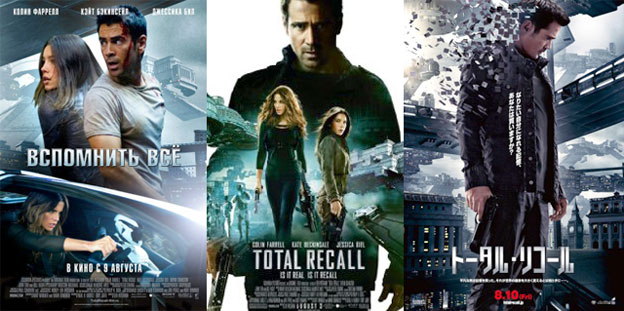
Total Recall 2012


First Among Recalls

Total Recall 2012 USA 
Directed by Len Wiseman
Playing at UK cinemas now

The year was 1990.

8 years since Blade Runner came out in cinemas.

8 years since I read between 30 to 40 of Philip K. Dick’s second hand novels and short story compilations over the space of a year.

Total Recall, directed by Paul Veerhoven was released into cinemas and I was really looking forward to it because it was alleged to have been based on one of my favourite of Dick’s short stories, We Can Remember It For You Wholesale. The title of the new movie bothered me though... after all, with such a great title on the short story, why couldn’t the movie just follow suit (and why call a movie Blade Runner, for that matter, when the original novel’s titles is just so darned cool? Do Androids Dream Of Electric Sheep?).

So there I was, sitting in the cinema in 1990 with my friends and the credits on Total Recall roll and, within about 15 seconds I am absolutely furious! This is ****ing plagiarism right here. This movie is scored by Jerry Goldsmith, one of my all-time favourite composers and I just want to strangle him and never before, or since, have I actually fought this hard to not jump up in front of an audience and knock some sense in to their lack of reaction and lead them in an orderly mob to the projection room with pitchforks and lighted torches.

I look around at my friends and none of them seems particularly worried or as angry as I am and... I just can’t believe it. But I am so enraged I want to spit and stamp my feet. Jerry Goldsmith’s opening title music to Total Recall is, as anybody with half an ear could tell you, a rip off of Basil Poledouris’ opening title music, Anvil Of Crom, from the 1982 Arnold Schwarzenegger adaptation of Conan The Barbarian. I am restless and fidgety in my seat. How am I supposed to enjoy a film when it’s being all copy-cat on Schwarzenneger’s arse.

Of course, what had happened was that the films producers, or possibly director, or anyway... some idiotic suit who wouldn’t know the difference maybe... had wanted to recapture the glory of the earlier Schwarzenneger movie with this one and asked the great Jerry Goldsmith to ape the style of the Conan The Barbarian main titles... probably by way of creating a sound temp track for the movie, a practice Jerry Goldsmith always hated and never really mellowed to (especially after working with Sir Ridley Scott a couple of times, is my understanding), which included Anvil Of Crom over the rough cut.

So I can’t blame Jerry for doing his job and I’ll forgive him... but I won’t forgive the people in charge of this production for doing that to both Jerry and Basil. How awful for them both!

This major felony of artistic taste-crime was further compounded when the film decided it was only going to take the basic kernel of the idea of Dick’s story and, rather than treating it in an intelligent, witty and, frankly downright funny presentation like the writer did, instead turn it into some kind of horrible action movie with a bunch of, frankly, lame special effects (even for the time), and generally destroy all that was good and enjoyable about the original short by cloaking it in a miasma of boring, couldn’t-care-less, chase fests. It was not good and, so far, I’ve never been that tempted to take another look at it and, the few times I’ve tried to get into the score, I’ve always started seeing red and flying off the handle every time I fire up the opening title music. I just can’t get through it when that red mist of angry musical deja vu pours into my ears.

I found out just recently that one of my favourite living directors, David Cronenberg, was developing that original film for a year, attached as the director, before being dropped from the project by the producers. Apparently, he was fired for attempting to make a movie version which was fairly close and respectful to the original PKD source material... when all that the producers wanted was, and I quote, “Indiana Jones on Mars”. I think David Cronenberg’s extremely “Phildickian” inspired movie eXistenZ, which even contains some specific references to Dick’s The Three Stigmata Of Palmer Eldritch in it, if I’m remembering it right, is far superior to what the makers of Total Recall ended up with in every way possible and is a testament to Cronenberg’s ingenuity, skill and ultimately, suitability to this kind of project.

Then I heard they were “remaking” Total Recall.

That’s how they put it. Remaking Total Recall.

Not doing an adaptation of PKD’s We Can Remember It For You Wholesale. Which rankled me somewhat, as you can imagine.

Furthermore, I then heard that Colin Farrell had been picked up for the movie. Now I’ve never quite been able to stand Colin Farrell for very long. He was in a fairly cool movie by Spielberg, inspired by Dick’s story Minority Report, but he wasn’t in it much and that’s about as long as I can handle him for. Which is why I wasn’t all that keen in ever going to see this new incarnation, which hit the cinemas a couple of days ago over here (why are a handful of films now suddenly coming out on a Wednesday or a Monday over here at the moment?). That was until I saw the trailer for it in front of a couple of movies over the last few weeks and liked what I saw in those trailers enough to go and see this on its opening night (in the UK).

I have to be honest... it’s not so much a straight remake of the original movie, thank goodness, but it still significantly “deviates from the brief” so to speak, if that brief was indeed to make a version of We Can Remember It For You Wholesale. You still don’t get the humour of the wild, weird and varied scenarios as the company in the story tries to give the central protagonist a new memory... opening like a set of Russian dolls to reveal that the character has had many lives, all of which match the wildest inventions of the scenarios they are trying to create for him (secret agent, superhero etc., it’s been a while since I read this, obviously). However, having said that, I did rather enjoy this movie on a purely “this is a piece of modern action cinema which works quite well” kinda level and I think a lot of people would like this if they gave it half a chance...I understand lots of people in the US stayed away in droves for this. I think it will make some cash when it gets a DVD release, however.

So... there’s a couple of references to the 1990 version, at least a couple I could pick up on given my relative inexperience of the original and this will probably bring a smile to the faces of fans of the first. But, unlike both Dick’s original work and also the Schwarzenneger vehicle, this particular film is taking itself very seriously most of the way through and it lacks any real humour.

Colin Farrell’s performance is quite good and I was able to suspend my disbelief and allergic reaction to him for, just about, the full duration of the film. Can’t really fault him as an actor... just one of those personalities on screen who I personally have trouble with. He’s excellent in this, as are most people in it, and that should be good enough for me.

Jessica Biel, who is another old hand from a Philip K. Dick movie (Next, inspired by PKD’s The Golden Man) is also on hand and she does a great job here but unfortunately she’s kind of overshadowed a bit by the absolute powerhouse villainess performance put in by Kate Beckinsale in this one as Colin Farrel’s wife/baby sitter. I usually find her a bit hit and miss, although I loved her in Van Helsing and Whiteout, but in this one she really outdoes herself. It’s a real “action woman with confidence” tour-de-force and she seems to have inherited that great ability to really look like she actually could do it all in real life (Nobody could but, hey, she looks like she could, okay?).

The editing in this one is fast and furious and the emphasis really is on action. There’s not a heck of a lot of screen time with people standing around talking... it’s pretty much one big long action chase lasting roughly two hours. There’s also not a lot of let-up to the pacing but that’s just the kind of movie it is. Fortunately, although the editing is pushing through the images at a frantic rate, it’s quite competent on this one (they’re pulling back and getting better again in Hollywoodland with this kind of stuff, I think) and it’s pretty clear throughout the stacked-in-a-row action set pieces just what is going on and when. It’s very easy to comprehend the choreography of the crash, the bang and the wallop.

Harry Gregson-Williams, another composer who I find a bit hit and miss, pulls off a techno augmented score which perfectly complements the thrills on screen and hits all the right notes... all the right notes, that is, if the movie was going to be called The Total Bourne Recollection. It has to be said, the score is excellent, but one of the problems with the movie is that it does seem, in a fair few places, to be trying to capture the zeitgeist of the Jason Bourne franchise and there will be a fair few scenes in this one which might take viewers back to The Bourne Identity... which seems to be the mind echoes that this movie is trying to hit quite often. Consequently, although the score doesn’t have that strongly defined set of bass lines and melodies that the Bourne series has, the orchestration and general style of it is definitely, I suspect, trying to remind you of those films on a sub-conscious level. That being said, though, I loved this score and wish the company had chosen to release a CD of it instead of letting it wallow in some “unreleased” list.

The visual aspect of it, though, is very glossy and, for the most part, sterile in it’s big budget portrayal of a bona fide ”sci-fi thriller”. That is to say, it’s grey and white and has the feel of something like the Will Smith vehicle I, Robot or, indeed, the aforementioned Minority Report. I’m not saying this is a bad thing though... I liked it well enough and I think other people might get a kick out of it if only they’d go to the cinema and give it a try.

In summing up I’d say, don’t go expecting a faithful adaptation of either the original movie bearing this name, or indeed, Phil Dick’s original work... it’s dumbed down significantly, for sure. However, if you like futuristic action movies with lots of punching things in it and lots of bad guys who seem to be incapable of accurately aiming their weapons at the main protagonists, then you could do a lot worse than give this one a watch. Give it a gander if you’ve got nothing better to do.

Friday, 1 April 2011

A-dJust-Ment to say I love you...

The Adjustment Bureau
2011 USA
Directed by George Nolfi
Now playing
at UK cinemas.

Philip K. Dick is not the easiest person to adapt for the moving image... actually, scratch that, I’ll rephrase that last little, perhaps obvious, statement and see if I can’t hint at the real problem with this idea here.

Ready? Here goes...

Philip K. Dick is not the easiest person to adapt for the moving image when the main concerns of that moving image are to provide spectacular special effects and kinetic action to the youngest possible audience imaginable.

There... that did it.

Philip K. Dick is very much a concept man and I think the reason his work has gotten to be a hot property in an age where his stories could be told more credibly with modern technology is because what he really does is talk about small ideas about people and their relationships with each other in a sci-fi milieu which allows him to explore those ideas to a degree unavailable to him in a more vanilla genre of fiction (although I loved his unpublished until after his death, early serious non-sci-fi novels as much, if not more, than his more recognised body of work... it has to be said). Of course... once those little conceptual nuggets are mined by the screenwriters, the evil, money-grabbing circus that is “Modern Hollywoodland” then wants to add action and scope and epicness into the mix... something that really is kinda missing the point with Dick’s work. His stories were always about being human... Hollywood is all about “Kablaam and Dollars” (Hmm... Kablaam and Dollars. Think I’ll run with that at some point).

Subsequently his works are, more than often, quite heavily changed for their big screen counterparts. Screamers is probably the closest to its source material (the short story Second Variety) but even the classic (and in my book, greatest) Phil K. Dick inspired movie Blade Runner (Do Androids Dream of Electric Sheep?) proves that you can take the kernel of Dick’s ideas and run with them in a slightly different direction but still have something which is very much in the style of Philip K. Dick. But if you’re not careful, the director and writers will completely miss the point and the humour of the original story, as they did with the mind-numbingly awful Total Recall ("loosely" based on We Can Remember It For You Wholesale) and turn in a movie which is just so much brainless drivel (and I’d expect better from Veerhoven!).

I’m very glad to report, however, that George Nolfi’s big screen version of Dick’s short story Adjustment Team is one of those movies that, while changing pretty much all the window dressing on the story (married salesman becomes single, successful political candidate) the main premise and, basically, the soul of Philip K. Dick's idea is very much adhered to throughout the course of the story.

Not only is it adhered to, but Nolfi’s lightness of touch with the characters and their brilliant portrayal on screen as played by a whole group of brilliant actors top lined by Matt Damon, Emily Blunt and Terence Stamp (greatly supported by some really sparkling character actors who I hope will get bigger roles as time goes by... serious kudos to John Slattery and Anthony Mackie who really carry the humour and gravitas of the movie off in wonderful ways) actually pushes the humanity even more into the foreground than Dick went in this particular story and ensures that this film is, essentially, all about love. And like all good stories of that nature... it all hinges on... a kiss.

Interestingly, while the Adjustment Team of the story were definitely “sci-fi” in the strictest sense, Nolfi (who also wrote and produced this movie) has left the hardcore workings of The Adjustment Bureau a little more up in the air so it can also, depending on the personal interpretation of various audience members, stand up to theological ideas and concepts of God and angels but without ramming that possibility down the throats of any atheist or agnostic sections of the audience. This is a nice touch in that it can mean all things to all people.

There’s even an ending which suggests the powers that be are as much a part of their plan and can hence be rewritten, just as much as the population of our planet who are all part of “The Plan” without really knowing it.

Sure, there are a couple of plot holes and mis-steps along the way and despite a “magical” foot chase towards the end of the movie, this film probably won’t get many repeat viewings for action buffs (I doubt this is the movie Hollywood were expecting or wanting, to be honest) and so I’m not expecting it to do particularly well at the box office... but for all that this movie is an honest to goodness love story which feels like the real deal (despite the little on-screen time the two lovers have together).

If you like simple love stories wrapped up in a little bit of sci-fi and a little bit of magic... then you won’t be putting a step wrong if you go take a look at this movie. Well done ot the director and I hope he gets another directing gig soonest. If not... something, somewhere needs a little adjustment, perhaps?