Showing posts with label Jerry Goldsmith. Show all posts

Sunday, 19 July 2026

In Like Flint


Acting On Inflint

In Like Flint
20th Century Fox 1967
Directed by Gordon Douglas
French Blu Ray Zone B


Warning: Light spoilers.

You have eyes that keep attracting me,
Dazzling and distracting me,
It’s your Zowie face.
You have a smile, this is disarming,
And style that is alarming,
And such a wowie face.
From Nelson RIddle’s lyrics to the greatest song in movie history, Jerry Goldsmith’s In Like Flint theme.


After the incredible success of Bond spoof/parody Our Man Flint the previous year (reviewed here), in fact, even before that film’s release it would seem, a sequel called In Like Flint was enthusiastically commissioned. It would appear however, according to lead actor James Coburn who played Derek Flint, that the filmmakers, including the director, were not that interested in the film they were making. Coburn has gone on record that it was himself and the stunt choreographer who directed a lot of the finished film between them. Not sure I totally believe that (and I may be prejudiced because I think Douglas has made some good movies) but there may be some truth in that, from a certain point of view, I would guess.

Either way, the lack of backing from the production team doesn’t really come across in the final product, which is another breezy and fun spy movie parody in the vein of the first film. Coburn is back and so is Lee J. Cobb as former boss Lloyd Cramden. After the president is switched under his nose using a special paralysing gas, Cramden is left with the mystery of why the president’s golf swing, which he was timing with his stop watch, took three minutes but only passed in a half a second from his point of view. And then, after a run in with one of the film’s main, soft antagonists played by Jean Hale, Cramden is discredited and suspended from his organisation. Flint believes the problem is coming from within ZOWIE (Zonal Organization for World Intelligence and Espionage) itself and, he’s half right. The real problem is a network of women operating out of a chain of beauty parlours called Fabulous Face... they want to take control of the world and deliver it into the safer hands of women (and who can blame them), something Flint mocks openly when discovering the truth. Despite acknowledging that the real power in the world is really in the hands of secretaries and mistresses. 

And, yes, the women have been guilty of infiltrating various organisations and causing untold damage but, also, slowly brainwashing women to their ways of thinking and diminishing faith in men via thousands of subliminally loaded hairdryers in various salons around the world. However, when the men they’ve been working with in ZOWIE take the operation from their hands, the last quarter of the movie becomes about the ladies and Flint working together to stop the turncoats’ mad plan to dominate or destroy the world (or something). 

And it’s a great film, which always lands differently every time I revisit it. When I was a kid I always preferred this one slightly more than the excellent original but I’ve flip flopped on that as I’ve got older. In Like Flint is fantastic but, I think it’s just a little less ingenious than the first one. However there’s still a lot to recommend in this and much that’s worthy of note. 

Like actress Yvonne Craig, who plays a scene or two as Natasha the ballerina. Of course, this actress was ballet trained herself so is perfect in this role and that training must have helped her out considerably when she was playing her regular spot as Batgirl opposite Adam West and Burt Ward on the third series of the Batman TV show that same year. Genre fans will also know her for little roles in a couple of The Man From UNCLE episodes (and one of the film ‘assemblies’) and from a role in the third and final season of Star Trek, a couple of years later. 

Then there’s all the silly Flintisms and gadgets which pop up. It’s curious because recurring gags like the pulse arm watch to restart Flint’s heart are used without explaining them to the audience this time around and absolutely require knowledge of the first film. However, unlike the first one, where Flint’s arsenal of sleuthing props make their debut on use, mostly, this one goes for a more formulaic introduction of setting up things to bring them back in a deus ex machina capacity later in the film. 

For instance, the wonderfully comic scene where Flint is talking to a dolphin in his pool so he can compile a human/dolphin dictionary, has an absurd pay off later in he film when Flint calls out to any passing dolphins in their own language, to hitch a ride under the security barbed wire on the Fabulous Face beauty resort in the Virgin Islands. The people at the resort have Flint’s three women held hostage in cryogenic suspension. The point is made that they’re all new women, Flint having found his former four aides husbands to marry, earlier in the film. When Cramden asks why there are only three now, Flint replies that he’s ‘cutting down’. 

Another item is the sonic gizmo which Flint shows Cramden at the start of the film, when Cramden calls on Flint for help. This device which doubles as Flint’s belt buckle emits a variety of sonic notes which can either push objects around, like a billiard ball or, if turned up, cause an object to burst apart. Flint uses this device at least twice in the second half of the movie, both to break the glass in the suspended animation chamber in which he is being frozen and also to push himself through space towards the ship containing lady cosmonauts at the film’s conclusion. 

Other moments of fun are less advertised ahead of schedule... such as when Flint poses as the man on the ZOWIE recruitment poster to hide himself in plain sight via a ‘trompe l'oeil’ effect... or the moment when he starts a plane full of Russians he is hastily leaving, to singing a Russian song. Remember those films where the lyrics would pop up on screen and a bouncing ball would stress the word you were supposed to be singing to join in? Well, the Russian letters to the song pop up here with a bouncing red star. So, yeah, you get the idea, the film is still as silly and as entertaining as the previous Flint adventure. 

Once again, Jerry Goldsmith provides scoring duties and, if you think the score to Our Man Flint was one of the greatest film scores of all time (and if you didn’t then you’re not listening right), In Like Flint has a somehow vastly superior score to the original. Not only that but it also has the greatest song in cinematic movie history, some of the lyrics of which are reproduced at the opening of this review. If you want great music, In Like Flint is the movie to go for in soundtrack excellence.

And that just about wraps me up for In Like Flint and the Flint movies in general. In 1976 there was a TV pilot film for a series that never got made called Our Man Flint - Dead On Target, with a different actor and... it completely misses the point of what Flint is all about, even playing the character relatively poe faced and no longer the superman of the movies, relegated to kind of running a private detective agency. It’s truly dreadful and if you really want to see it, at least one DVD incarnation of the movies included it as an extra. I’d not bother though, if I were you. Meanwhile, the first two Flint cinema movies are still an absolute joy to watch and I shall certainly try to keep revisiting them regularly over the years. Trivia hounds might like to note that this is the last film that 20th Century Fox shot in actual Cinemascope. Highly recommended.

Friday, 10 July 2026

Our Man Flint


After Dinner Flint

Our Man Flint
20th Century Fox 1966
Directed by Daniel Mann
Blu Ray Zone B


Warning: Spoilers a-go-go.

Our Man Flint was one of my favourite movies when I was a kid in the 1970s and remains so to this day. Essentially it’s a ‘band wagon’ film, in that it’s trying to capture some of the box office magic which the EON James Bond movies had been doing since four years before. Once a popular version of Bond had finally been unleashed on a largely unsuspecting public (the films were pretty ground breaking in their day), everyone was trying to rush their own knock off versions out into the cinematic wild, with perhaps the Italians and French churning out many of these things. 

The Americans, also, did a fair few and perhaps their most successful were their spoofs such as the four Matt Helm movies, which were absolutely nothing like the books they were based on and starred Dean Martin in the title role, where perhaps someone like John Wayne might have been closer to the character as written in Donald Hamilton’s popular novels (I’ll be reviewing those movies for the blog at some point too, of course). Their other big contribution was the Flint series of two films (and, much later, a truly terrible, missed the point TV pilot which I’m not sure I can be subjecting myself to again for a review). 

The Flint movies were where the Americans really got the formula right and the writers must have had their tongues lodged firmly in their cheeks as the title character, Derek Flint played by James Coburn, out does and sends up, not just Ian Fleming’s beloved character but also the whole idea of the secret agent movie. It’s absolutely ridiculous but, because the leads, including Lee J Cobb as Flint’s former war commander and Gila Golan as the turncoat femme fatale, all play it absolutely straight... the silliness works beautifully until you’re left with an absolutely perfect storm of spy tropes, action and ‘I can’t believe they just got away with that’ gags. 

How silly is it? Well, it’s beautifully over the top. How about the idea of Flint, observed by his four female ‘assistants’, with just his head and feet resting between two chairs, his body suspended off the ground in this manner while he rests (which apparently is something Coburn was able to do and was filmed as was), stopping his own heart for three hours and woken only when a little metronomic attachment comes out of his watch and starts his pulse ticking over again. Or the scene where he kills a fly in a room with a blow dart. Or the scene where he attacks two of the guards at the headquarters of ZOWIE (Zonal Organization for World Intelligence and Espionage) because he realises they are imposters... as he recognises they are wearing Battle Of The Bulge medals. But wait, “there’s no such as Battle Of The Bulge ribbons”... “exactly!” Yeah, brilliantly silly. 

Or how about the scene where Golan, dressed as a harpist, uses the strings of a harp to launch a poisoned dart at Flint, only to hit his boss Cramden (Cobb)... Flint grabs one of his keys, presses a button and a blade pops out the end so he can cut the poison out of the fallen man. A little later, he saves another man’s life by removing a light bulb from an overhead fitting, jamming Cramden’s fingers into it and then using his and Cramden’s body to pass the electrical current into a fallen victim to restart his heart. 

But while all this silliness is going on... and it’s great fun... there’s also a level of ‘over the top’ procedural, as Flint follows a trail of bizarre clues that nobody else on the planet would ever find, to lead him to the enemy threatening the world (known as GALAXY). There’s also a level of ingenuity in terms of how far the gadgetry and inventiveness of the film goes which, for my money, elevates this movie far above the Bond films. I love the Bond series but, for me, the Flint films are the absolute epitome of the spy genre... along with The IPCRESS File (reviewed here) and The Quiller Memorandum (reviewed here). 

For instance, in addition to the key blade, his watch has a rim which can be pulled up at an angle and combined with his pen to form a miniature microscope on his wrist with which he can analyse physical clues. And, of course, his cigarette lighter which contains 82 different weapons... this last item is first revealed in response to Cramden who is trying to equip Flint for the field, with a variety of things which are all refused by Flint. And this is one scene of many where the film doesn’t just spoof the Bond films, it blatantly calls them out...

So, after offering Flint a Walter PPK (Bond’s gun, acquired at the start of both the film and novel of Dr. No (reviewed here), after his Beretta failed him on a previous assignment, he tries to give Flint a briefcase which, with its retractable knives, is clearly modelled on the one in From Russia With Love (reviewed here). But the Bond riffs don’t stop there...

There’s a whole fight scene as Flint and another agent, 0008 (triple oh eight clearly being a riff but one better on 007), exchange intelligence information under cover of exchanging blows in a fist fight. The actor Robert Gunner is made up to look just like Sean Connery (the resemblance is uncanny) and he puts on a Scottish accent to complete the caricature. And during that fight, 0008 clearly states that it’s not SPECTRE behind the threat to the world. Later on in the movie, when Gila Golan’s character is reading a book of The Adventures Of 0008, Jerry Goldsmith’s soundtrack quotes the four base line notes of part of John Barry’s contribution to Monty Norman’s original Bond theme, which I guess is just about as much as they could have gotten away with here without facing a lawsuit. 

And talking about that score. I don’t remember quite when my fascination with soundtrack music began, probably when I first saw the Flash Gordon serials but, Jerry Goldsmith’s absolutely stonking scores for Our Man Flint and its sequel In Like Flint really captivated me as a young ‘un and I still put the insubstantial (can we have an expanded version please Varese?) but absolutely amazing scores on for a spin at least a few times every year. It’s fantastic stuff and the original studio album recording (which is also way different but equally brilliant) featured a track, Galaxy A-Go-Go, which was co-written by a young Randy Newman.

Okay, I think that’s me done with Our Man Flint for the time being. There’s a scene were Flint quickly browns his face up, grabs a revolving towel out of its housing in a bathroom and uses it as a turban to appear Indian at one point which, I suspect, wouldn’t go down great with today’s overly politically correct crowd. But, who cares, it’s just a fun moment and it’s certainly not meant as a mockery in the context of the scene. And I have to say that, rather than pay out way too much money for a very pricey limited US edition, I found more or less the same Blu Ray edition in a French disc (and the second movie) and, although there are no extras (that’s okay, I have two different DVDs of the movie with different extras anyway), I have to say that I’ve never seen the films looking this good. And it’s the full cinemascope frame as always but in a stunning transfer so you can pick up little details you might have missed before. For instance, it’s not even made much of but, when Flint sends a GALAXY guard falling to his death, a quick look down at the body shows his hard hat spinning round and around on the floor at the left of the shot, which I’d never noticed before. 

All in all then, the Flint films are absolutely exceptional and, especially Our Man Flint. I’m not sure why these films aren’t being made more of these days. There’s no Blu Ray release in the UK, the US one was a blink and you’ll miss it affair and even the French editions I have were hard to get for the right price. These films deserve to find a new audience with a younger generation of film goers and, as far as I’m concerned, are absolutely essential viewing for any cinephile worth their salt.  

Sunday, 1 December 2024

Outland


Io Pic

Outland
USA 1981 Directed by Peter Hyams
HMV/Warner Brothers Blu Ray Zone B


Warning: Full plot spoilers.

It’s been a while since I last saw Outland but I do try and watch it at least once on every home video format I eventually own it on... now it’s the turn of Blu Ray and, it has to be said, the film really hasn’t lost much of its power.

I first saw it at the cinema on the year of its release. I was 13 years old but the film was an AA rating, which was nobody under the age of 14... so I either lied about my age by a year or just wasn’t challenged on the door (I forget which).

The film is set on Io, the third largest moon of the five surrounding Jupiter, on a titanium mining colony run by Con-Am. Sean Connery plays the new marshal of the colony, Marshal O’Niel. He’s only been there a couple of weeks but his wife has had enough of being sent from one grubby outpost to the next and so she takes their son and goes to the nearest space station, waiting for a flight back to Earth (their son has never seen the planet he reads about in books). However, O’Neil can’t join them for now because there’s something bad happening at the mining colony and he’s onto something which is killing people. People are doing things like uncoupling their space suits while out on the surface (we watch in graphic detail as their blood boils and their heads explode as the air and organs inside fight to get out... at least, I’m guessing that’s the scientific idea behind those kinds of deaths... maybe they just look cool), travelling down to the outside in the lifts without any suit at all and just generally going mad.

Teaming up with Dr. Lazarus, played by the incomparable Frances Sternhagen, he discovers that these psychotic episodes went up hugely after the arrival of the branch director. So he starts digging and soon uncovers a bunch of people supplying drugs to increase manpower within the mining community, which also eventually makes their customers psychotic... and it all points back to the company, or at least the branch manager, played by Peter Boyle. However, after O’Neil finds and destroys a shipment of drugs, hit men are sent to kill him, arriving on the next shuttle. And, of course, nobody really wants to help him defend himself from these killers.

Okay, so when I was a kid there were two pieces of conventional wisdom about this film which I took with a grain of salt but do still acknowledge that there is something to them. Firstly that this is a remake of High Noon (reviewed here). Well, of course the last 25 minutes, where O’Neil’s potential allies abandon him to his fate and he has to take on the killers alone (more or less), is absolutely an homage to High Noon but, the film is not a complete remake because High Noon was all about that right from the start of the movie. The first two thirds of Outland, however, are a strong police procedural thriller, which happens to take place on a moon of Jupiter. It’s definitely got its own vibe going and it does what it does very successfully.

The other bit of conventional wisdom at the time of its release... and I remember reading this phrase at the time in Film Review, the ABC cinema chain’s monthly magazine that they sold in the kiosk... was that it’s a ‘poor man’s Alien’. Nope. Neither film has much in common other than the one huge influence of Alien (on pretty much everything at the time) of the lived-in, aged up sets with a kind of built in obsolescence. So yeah, it’s certainly gone down that route but, no, it’s a ‘poor man’s’ nothing.

What it is, is a top notch thriller with brilliant performances by both Connery and Sternhagen (who have remarkable chemistry together... how come these two weren’t teamed up in another film?) backed up by a, perhaps slightly simple but certainly solid story and what were, for the time, state-of-the-art special effects... which generally have, for the most part, aged well and don’t look too clunky on the Blu Ray format. What ages the film most is the nature of the computer graphics on the screens but, like a lot of speculative movie fiction, if the film makers had guessed how advanced things have gotten by today, then the films would have lacked credibility for the audiences of the time, for sure. I especially like the interactive, screen golf game that Peter Boyle’s character plays in his apartment.

And, added to this, it’s all supported by a really great score by the fabulous Jerry Goldsmith. He was in his phase where he was experimenting with very subtle electronic augmentation to the orchestra and it’s a truly wonderful score, mixing the dense atmospheric cues of the depressing environment the miners work in with some wonderful action cues which never let the toes stop tapping (I still listen to it on my bus journey home some evenings).

So that’s me on Outland. One of the great science fiction movies of the early 1980s and some of the best of cinema of that era, for sure. Definitely worth checking out if you’ve never seen it and especially if you like police procedural thrillers. 

Monday, 13 May 2024

Kingdom Of The Planet Of The Apes


My Kingdom
For An Ape


Kingdom Of The
Planet Of The Apes

Directed by Wes Ball
USA 2024
20th Century Fox
UK Theatrical Print


Well I certainly wasn’t expecting Kingdom Of The Planet Of The Apes to be any good. Don’t get me wrong, I loved the previous trilogy and pretty much most of the original movies (I even liked the Tim Burton version to some extent) but after War Of The Planet Of The Apes (reviewed here) I couldn’t see where else they had left to go with it. Turns out I was wrong though... they did have a bunch of ideas worth exploring and I thought the new film was absolutely fabulous. Not sure why the critics are grumbling that it’s too slow, to be honest.

This one is set ‘many generations’ after the previous film, except for a brief prologue where you see Caeser’s funeral... about 300 years later, in fact. The hero of this one is a young, teenage ape named Noa who, although he’s played by Owen Teague rather than Andy Sirkis this time around, does bear a striking resemblance to the lead ape of the last three movies. I think it’s the director’s visual shorthand to say that this new legacy hero is part of the same bloodline, without having to tackle that issue in this film (although, I suspect possibly in a future film it may come to light?).

In this one, Noa’s clan are all falconers and the film starts off with Noa and his two friends on an expedition to climb and steal three eagle eggs so they can attend the village bonding ritual the next day. After an accidental intervention by a seemingly bright human, played by Freya Allan and initially named Nova (after the human female in the original 1968 movie, reviewed here), Noa has to leave the village at night to try and get another one, or miss out for a year. But then he discovers a group of masked apes who are from another, much more aggressive clan, headed up by an ape called Proxima Caeser.

These apes slaughter some of the villagers, kill his father, enslave the rest of the villagers (taking them back to Caeser’s own encampment) and then leave Noa for dead. When he awakes the next morning, he clearly has a mission to set his fellow clan members free so, for a while, the movie becomes a road movie with him, a knowledgable orangutan he finds on the way and, eventually, Nova... who turns out to really be called Mae.

Then things really start to happen and when they finally arrive at the ‘kingdom’ of Proxima Caeser, it’s clear he has a more sinister motive for his actions and is much more aware of what the humans were on the planet some 300 years or so before. He even has his own talking human, played by William H. Macy. But that’s as much as I want to give away here because, it’s definitely worth a look and has an ending that sets up the next two films. Although, while some critics don’t see it as a stand alone film at all, I’d disagree... the ultimate set up for the next one is really just established properly right at the end of the picture, in a series of epilogue sequences. I think it works just fine as a stand alone movie, for sure. But, yeah, I hope it does well because, I would like to see where they take the next chapter in the saga, after what happens at the end here. I can’t help but think that Mae will end up being the natural antagonist of the apes by the time of the third movie down the line.

And it’s wonderfully put together, looks nice, is well acted and has remarkable special effects again. I never find myself questioning the reality of the apes in these later films, for sure. And there are also a heck of a lot of nods to the original 1968 movie in this. And that also goes for the music too. While composer John Paesano starts the film off in a very similar musical landscape as Michael Giacchino’s score for the previous movie, as the visual echoes of the 1968 movie start to stack up, the composer goes into the same territory as Jerry Goldsmith, bringing his orchestrations and snatches of his compositions when the crucified ‘scarecrows’ are seen for instance. Or in a very similar scene to the hunt in the 1968 classic, actually having a do over of Goldsmith’s famous accompanying action cue. I don’t know if this was the original intention though because, well, I did also detect a bit of ‘temp trackitus’ in the film... because when Noa first enter’s Proxima Caeser’s kingdom, the music seems to exactly replicate a very specific part of Goldsmith’s score for The Mummy too so... not sure why that happened unless it was part of the musical temp track, I suspect.

However, it certainly doesn’t hurt the movie and I would love to listen to this score away from the movie.  A shame then that Disney don’t seem to have issued it on a proper CD, once again giving us a first film in a franchise now owned by Disney to be the first in that franchise not to have an actual CD score release. It’s such a shame that this isn’t available on a proper format, for sure.

That being said, I think Kingdom Of The Planet Of The Apes is a solidly put together film which, asides from the echoes and retreads, does have some nice ideas and which I think lovers of the franchise will want to jump in and explore alongside with the director and writers. I’ll definitely be revisiting this one again when it comes out on Blu Ray.


Planet Of The Apes at NUTS4R2

Planet Of The Apes TV Show (live action) - to be reviewed
Time Of The Apes - to be reviewed


Tuesday, 1 March 2022

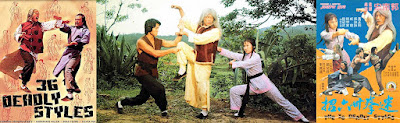
The 36 Deadly Styles


Six by six

The 36 Deadly Styles
aka Mi quan san shi liu zhao
Taiwan/Hong Kong 1982 Directed by Joseph Kuo
Eureka Masters Of Cinema Blu Ray Zone B


The 36 Deadly Styles is the second of the eight movies to be featured in Eureka Masters Of Cinema’s splendid Cinematic Vengeance - Joseph Kuo Blu Ray boxed set release. And, as entertaining as it certainly is, I’m hoping that this one is also the most confusing because, honestly, I’m still not quite sure what’s going on in the movie. After a nice credits sequence which popped me right out of the film for reasons I’ll get to a little later, we are dropped into a fight with two characters being chased through a forest and somehow in the middle of a vendetta. The survivor, I think, is revived and hangs out with a bunch of monks, one of whom has good Kung Fu skills. The reason for the vendetta seems to be... someone killed someone at some point and now the whole family has to die because of it.

However, there’s another story going on here too... with a different guy (who looks a bit like some of the other guys from the other part of the story), also trying to kill off the survivors of a family... I at first thought but, quite near the end, it’s revealed he is trying to kill the man who stole the only information available on The 36 Deadly Styles of Kung Fu... burning them himself without learning them, for the good of all. And, while the other story strand mentions 8 fighting styles, all with stupidly elabourate titles (as is the norm in films like this) such as the “Play the bamboo flute underneath the blue sky” series of deadly blows... the actual 36 styles mentioned in the title of this movie don’t, in actual fact, come into play at all and are never revealed to either the audience or any of the characters.

It all gets very confusing and it doesn’t help when fight scenes between the two parallel (but apparently not connecting) story arcs, such as they are, are cross cut with each other for no apparent reason whatsoever. I’m not sure what conclusion we were supposed to come to from this but, trust me, I was working hard just to decipher that much from the plot which, it has to be said, remains mostly absent.

What that leaves, of course, is a lot of fighting and silly poses, punchy sound effects and even a lot of comic relief, such as one of the villains dressing up in drag in a scene for, honestly, no apparent motive that I could work out. There are also a lot of scenes where people suddenly clutch their chest as their body remembers the terrible kicks and punches they took in various flashbacks to fights from decades before (which, trust me, does nothing to make the film any more comprehensible... quite the opposite, especially if you can’t figure who is flashing back to whom). So, yeah... of course the film is completely watchable and I had a good time with it.

Actually, the real surprise here was the fact that, for a film where the writers (again, such as they are) and director seem to have such a blasé attitude to the way everything hangs together, the prints and transfers on these things are absolutely beautiful, showing no sign of neglect or suffering from any kind of ‘throwaway’ attitude. Another surprise... and it really shouldn’t have been at this point, since I’ve seen a few films like this... was the music.

There is a credited composer on this although, I don’t know why because there’s a heck of a lot of needle drop in this. Starting off with those opening titles I mentioned earlier, which had me nearly jumping out of my seat as they use Jerry Goldsmith’s main theme from Hour Of The Gun. Indeed, there are a few instances of both this score and a couple of other Goldsmith pieces throughout the film, including a touch of his Bandolero score and a smidgeon of an extended sting from The Cassandra Crossing. But it’s not just Goldsmith, of course, who has been filched for the score here. There are also instances of things like Henry Mancini’s score to The Pink Panther and John Williams’ score to The Time Tunnel used during the course of the movie. Which brings me to my next question...

Now don’t get me wrong, I love the fact that I can play ‘spot the cue’ on various Asian ‘classics’ of the 60s, 70s and 80s and, indeed, would refuse to watch them if they weren’t released with their original soundtracks intact. However, there have been quite a few of these releases over here in the past few years by the likes of Eureka, Arrow and 88 Films and, while the scores to these things are pretty much untouchable in their original countries, where copyright laws are almost non-existent, you have to wonder how these companies in the UK can get away with releasing these as they do without paying royalties to various composers. I’m happy that they can though so, you know, no complaints from me here.

And that’s me done with The 36 Deadly Styles, I think. A true mess of a movie in terms of just what the hell is going on at any given minute... and quite often why it’s going on too. But, if you like films with some nice looking kung fu choreography in prints and transfers which look nothing short of spectacular, then the Eureka Masters Of Cinema’s release of this one is definitely for you.

Sunday, 3 May 2020

The Satan Bug


Bug’s Bonhomie

The Satan Bug
USA 1965 Directed by John Sturges
Kino Lorber/20th Century Fox Blu Ray Zone A


I mentioned recently in my review of The Andromeda Strain (which you can read here) that The Satan Bug was another of those great virus themed movies I’d never seen which, given that I am writing this in a semi-lockdown status in the UK during the coronavirus pandemic, is perfect viewing for this time. I also didn’t realise that Alistair MacLean, under a pen name, had written the book on which it was based and nor was I aware that one of the co-writers of the script was none other than famous novelist James Clavell (who also wrote the screenplay to the original version of The Fly, if memory serves).

So I managed to get a US Blu Ray sent over and, I have to say that, while the film isn’t exactly perfect, I was much more impressed with it than I thought I would be.

One of the reasons for that is Jerry Goldsmith’s score for the film, of course, which starts the movie off just right as we go into one of those animated title sequences which could almost have been designed by Saul Bass (but wasn’t, it was by DePatie-Freleng). It’s edgy and sinister with the perfect music to push the kind of expressionistic simplifications of an animated virus depicted and certainly gives you a sense of foreboding before going into the main film...

And then, once we start the movie proper, we get some fairly typical clean looking but interesting 20th Century Fox style art direction and cinematography. I don’t know why all films in this widescreen aspect ratio by this company at the time felt like this but it certainly has a recognisable style and it actually helps with the sterile, laboratory settings of the opening movie.

The plot is simple. We start off with an extremely restrained, almost abstract in what it doesn’t show, heist on a lab (relocated to America for the movie version). After a diversion as special agent Lee Barrett (as played by George Maharis) is recruited to help out as a consultant on the robbery and its fall out, we are made aware by co-star Richard Basehart (who you might remember as the Admiral in the TV version of Voyage To The Bottom Of The Sea) of just how dangerous The Satan Bug of the title, which the robbers have escaped with, is.

After this, the shenanigans begin, as a psychopathic terrorist holds the world to ransom unless all war research finishes (or some such) and Lee, aided by such great actors as Dana Andrews, Anne Francis and Simon Oakland, has to try and track down where the various lethal viruses have been taken before, after witnessing the death of everybody in Florida by a milder stolen virus, Los Angeles is taken down the next day. At this point the movie kind of devolves into a standard track and chase adventure as the 'good guys' rush to keep this from happening but it keeps up the atmosphere of slow burning anxiety for most of the film although, I’ll be honest, the film does start to drag somewhat before its conclusion.

However, there is a lot which is brilliant about the film. Jerry Goldsmith’s pulsating and driven score is one of those things. Like a lot of his films where the director actually listened to him, the film is quite sparsely ‘spotted’, Goldsmith was a master of knowing when to hold the silence and only bring the music in when it was really needed... it’s mostly great stuff and you can totally hear how he would develop into his brilliant Planet Of The Apes score just a few years later. He uses those wonderful musical phrases throughout too which, I can’t really pinpoint in terms of an accurate musical reference, since I really don’t know much about music but I always think of it as his ‘bouncing ball drops’. Little musical phrases of repeat notes which last a few seconds but which get faster as they go and which remind me of a ball dropping and the thuds getting faster as they hit nearer the ground on each bounce. Sorry, that’s the only way I can think to describe it but he uses this kind of musical phrase on a number of his scores from around the period and I can always tell it’s him when I hear them.

Also, those shot set ups early on in the first twenty or so minutes of the film where everything is confined to the labs look absolutely gorgeous. It’s all so well lit with lots of pinky oranges in the lighting schemes to add contrast to the dull, clinical whites and, on occasion, the shots will cut to offices with wooden panels which pretty much mirror the same colour scheme. Since the majority of the labs are made of glass walls, we also have shots mostly made up of vertical struts which Sturges uses to split up his canvass and highlight various characters in their own slats of the screen. Again, he does this with other environments too and where a glass door may slide open to push the emphasis of one of these rectangular slabs that comprise the frame design, he will sometimes cross-cut to a shot of a solid door (such as a vault door) in another room being opened in exactly the same part of the screen. Nice stuff and it was this ‘crowded verticals’ pitched against the later shots of lone or small groups of standing figures against a sterile, US highway desert landscape that kept me interested throughout.

So... lots of visual hooks and musical candy to engage the brain for most of the film.

There are a few clunky bits too though and I especially got annoyed with something George Maharis says into a phone at one point. Interestingly, the two deaths at the start of the movie in terms of the heist sequence show no bodies or aftermath... it’s all alluded to by other characters and the focus of their attention is kept out of shot. However, when Maharis and Anne Francis find a dead body sunk and weighted down (presumably) in a swimming pool a little later, Maharis reports that they found someone... “floating at the bottom of the pool.’ Seriously? If they’re at the bottom of a pool then they’re really not floating are they? And this was written by James Clavell?

One thing which did cause me delight though was spotting some of the smaller actors who would later become much more well known. For example, a young James Hong plays one of the doctors seen at the start of the movie. It doesn’t amount to much more than a cameo but it’s nice to see how he looked back then. Similarly, one of the agents who is following George Maharis and Anne Francis when they have been captured by ‘the bad guys’ is none other than James Doohan, literally the year  before he would become a household name playing Scotty on the very first incarnation of the Star Trek TV show. It’s interesting that he has a bit of a role to play but, since actors are payed more if they have any lines to say, he manages to remain silent throughout... even though he both gets into a gunfight and then has a dramatic moment where he drops dead when exposed to a virus. It was nice to see him in a pre-Scotty role though. And, yes, a waitress in a jazz bar near the start of the film is a young Lee Remick.

And that's pretty much all I’m going to say here about The Satan Bug (or risk getting into spoiler territory)... nice shot design and lighting, a highly competent ensemble cast, some truly catchy music and, as it nears the end, maybe just a little bit dull in places. I loved it though and am planning to be watching this again some day. A good slice of mid-sixties cinematic treasure which is well worth the time of any fan of the cinematic arts... so check it out when you’ve got a moment. Watch it during a pandemic for an extra sense of authenticity.

Sunday, 22 September 2019

Rambo - Last Blood


Blood Wiser Bear

Rambo - Last Blood
Directed by Adrian Grunberg
2019 USA
UK cinema release print.


Aaah... not sure where to start with Rambo - Last Blood.

Regular readers of my blog will know I have a lot of respect, time and admiration for Sylvester Stallone. I think he’s one of the few, true, larger than life ‘Hollywoood stars’ we have left but also a great actor and strong writer who could have maybe had a more varied career. The Rambo films are, for me, among his least interesting films but I loved his fourth one, Rambo, and I’ve always loved the scores to these things. If you want to know my feelings on the other Rambo movies, my review of the whole tetralogy before this one is here.

I was actually fairly looking forward to this fifth entry into the cycle but, it has to be said, I was a little disappointed with it. Not because it’s that badly written (in terms of dialogue at least) and the clichéd plot is not necessarily a thorn in its side either... I think this kind of storyline could have made a good Rambo movie, to be honest. And the revenge/action device as a call to arms present here is also pretty good... the movie is honestly a lot of fun in places.

The acting is not bad either. Stallone is cool (although... I think he his characterisation is part of the problem here) and his supporting cast, especially Yvette Monreal as the niece who Rambo has to go and rescue from the prostitution ring who have enslaved her, are all very good here.

And the action is, mostly, well put together. Or at least, the dramatic weight of it is. Stallone is one of those few actors (and directors, when he puts his hand to it... I’m assuming he has a lot to say when being directed himself and so has an influence on the way things turn out in the movies he’s in)... who understands that if you want to have an action cinema then you have to have the long pauses between the action sequences to give the audience a break and to make the scenes of violence or kinetic energy more potent when they come. Using those elements more as a punctuation to the story rather than being what the story is about. Kurosawa knew this. Steven Spielberg knows this. Sly Stallone knows this. And there is that element here to the film too.

And it is a lot of fun and certainly an entertaining picture a lot of the time.

I do, however, have three problems with the film and, for me, they do put quite a dampener on all the positive stuff but, you never know, some films grow better with age when you watch them again in later years and I suspect this might well be the case with this fifth one.

So my first problem is John Rambo himself. The way he is written and, because of that, Stallone’s portrayal of him, is really not like the character as we've known him. For a start, he talks too much. Rambo was always the strong silent type and though there is one scene where he lets his glares do all the talking for him, when he first approaches the Mexican traffickers, he really is not like the Rambo we’ve known in previous movies and I had a really hard time trying to equate this version of the character with the one we last saw eleven years ago, to be honest. Yeah, I know the character has moved on and he’s become a different person now but, even so, it still felt a bit of a wrong departure for this movie. This big bear of a man is wiser but not necessarily as close to his origins as I would have liked. This felt like it could be any generic action movie with any one of many modern action stars playing the central role... it didn’t feel like a Rambo movie. The plot... yes. The character... no.

Secondly, the big action sequence at the end seems terribly edited to me. It was way too fast. It was very gory and I’m not complaining about that... this element was perhaps the only part of the whole affair that brought it back in line with the previous four but... it has to be said, I was struggling to follow it. Not the sequencing or anything, I was cool with that. It was the details of the deaths which I was struggling with... they were just too fast for me to see what was going on. I could see lots of people's heads and limbs were being folded, spindled and mutilated but, before I had time to register what had happened when somebody's face suddenly got pulverised, for instance, the film had already moved on. So I could have done with a little more understanding of what I’d just seen in a few instances.

Thirdly... the score. I love Brian Tyler’s music and it was when he provided the score to the last film in the series, following in the giant, mythical footsteps of the late, great Jerry Goldsmith, that I first started to notice Tyler’s work and, I’ve been an admirer of his scores since then. This one, however, felt less like a Rambo score but... it’s hard to tell, to be honest. He does quote Jerry’s themes a little but it felt to me like there were some real missed opportunities, especially near the end, where he could have elevated the spirit of Rambo through the music a little more than he did. Not necessarily his fault, of course, he might have gone that way and the studio rejected those cues for all I know. However, this is a very noisy film when the action starts and, for the most part, Tyler’s score is not dialled up far enough in the sound mix to really hear it properly or feel the benefit, I thought. I’d love to hear it away from the movie but, alas, it looks like this may be the first Rambo film not to get a CD release (just a stupid, electronic download thing which isn’t the best way to actually hear the music as recorded) and so it looks like I may never get a chance to hear it now. Which is a great shame. I’m hoping Intrada records might leap to the rescue here at some point but I’m not holding my breath.

And that’s all I’ve got on Rambo - Last Blood. The film ends with a montage of clips from all five films with the last section even having a further hint at John Rambo’s final fate with a bit of footage you don’t get to see in the main film... but again, the scoring on this section felt wrong and it could have really done with some more of Goldsmith’s original themes in here. All in all, if you’re a fan of modern action movies and have no great loyalty to the earlier films in the franchise, then I’d say you’d probably have a good time with the new one. Some older fans may struggle with this version of the character but, ultimately, it’s a solid action movie so it should win the majority of them over, I suspect. Not my favourite of the series by any sense of the imagination but I’m glad I saw it and I wish they’d have done a ‘final stand’ movie which was more appropriate to the original character. I was a little disappointed with this one.

Tuesday, 8 May 2018

Score - A Film Music Documentary + Score - A Film Music Documentary... The Interviews


The Winds Of Score

Score - A Film Music Documentary
USA 2016 Directed by Matt Schrader
Epicleff Media Blu Ray Zone A


plus

Score - A Film Music Documentary
The Interviews - Educational Edition

by Matt Schrader
Createspace
ISBN: 978-1974367412

A NUTS4R2 TWO-IN-ONE REVIEW

“… the really simple brass ‘brahms’ of Inception. Now, when Chris (Nolan) and I did those, they were a story point, an absolute story point. They were in the script. And then they sort of became ubiquitous, in a funny way, in trailer music. People were just sort of using them as transitional pieces. So the idea that they actually tell a story got lost. They’re just a sound effect. So their meaning got distorted and so there’s a sort of misuse of that.”
Hans Zimmer.


Score - A Film Music Documentary is something I didn’t think I’d get to see over here. I’d just assumed it would be one of those films that didn’t get a UK release and would sink without a trace with no other venue to watch it on other than the slight possibility of a dodgy download somewhere. However, I was very pleased to find that there is this Blu Ray release in the US (it’s also been released in the UK but only as a DVD release for some strange reason). I was also surprised to learn that there is an accompanying educational edition, book companion to the film with full length transcripts of the many interviews conducted for this... about 90% of which doesn’t seem to have actually made it into the film so, actually, it’s a very valuable resource independent of the actual documentary itself. I was delighted to be presented with this on my 50th birthday by a friend earlier in the year, before I even knew this tome existed.

There is also, as it happens, a release of Ryan Taubert’s score for this film but, alas, it’s only available as an electronic download and not as a proper CD edition so I probably won’t get to hear it away from the movie. I really do fail to see how a movie about film scores would ignore a segment of the fan base for such things and not release it in a high quality presentation on the best available media. I guess it says something about the studios who control these properties that they’re a little out of touch, I guess.

So, anyway, this really is not a bad documentary and, although it deals primarily with the state of scoring or the film industry now, it’s actually quite unique in its own way because it interviews a lot of the ‘now’ composers who are the ‘new guard’ including some of my absolute favourites like Bear McCreary, Brian Tyler Hans Zimmer and Marco Beltrami. I mean, there’s a whole host of names in here and chances are that, even if movie music isn’t your thing, you’ve heard at least a few scores by each of the many interviewees here. And it was certainly nice to finally be able to put faces to the names I have adorning the, literally thousands, of film score discs I have lining every wall and alcove of my immediate environment.

Although it’s been said by some people that the film only deals with modern scoring from the 1960s and onwards, I think that’s a little unfair as the documentary is only an hour and a half long (personally, I would have liked it to be at least four hours) and there are some deliberate nods to many of the composers who have made landmark scores in the past. Admittedly, there are less golden age composers than I thought would have made the grade (where are Korngold and Tiomkin?) but the film does acknowledge certain aspects of the past with dedicated segments to composers such as Alfred Newman, Max Steiner, Bernard Herrmann, John Barry, Jerry Goldsmith and John Williams although, of those, the only one still living, Johnny Williams, is not actually interviewed for this movie. That being said, I’m kind of glad that the overall focus of this one is a little slanted to modern composers and their methods/practices because, frankly, we’ve already seen a lot of the other stuff countless times... I think interviews with people like Christopher Young, Junkie XL and the great Hans Zimmer are far more valuable at the moment.

The movie opens with... I think it was Marco Beltrami... demonstrating a dying piano way up on a deserted hill which is connected to a studio by loads of wires which react to the wind. So the wind and environment are helping create the musical texture and, as he says, the notes travel through the wire faster than the wind carries them so you kind of hear the echo of the notes first. This is a great opening hook to start the film off with. It then shows the importance of score by using snippets of the Rocky films under Bill Conti’s famous ‘getting stronger’ theme and really gets the message home for an audience who are perhaps unused to contemplating such things (although whether any of them would sit still for a movie about film scores is anybody’s guess).

The documentary has a number of interview snippets with various composers, mostly new guys although there are some people like Quincy Jones also added into the mix and it’s an extremely valuable bunch of excerpts for the modern film score afficionado, it has to be said. There are also numerous, valuable clips of the various composers either conducting or overseeing the recordings of the films from various scoring sessions, which makes for some interesting watching. Especially when they show the cues being performed in one half of the screen and the accompanying visuals for such movies as Mission Impossible: Rogue Nation (scored by Joe Kraemer) and Casino Royale (scored by David Arnold) in the other half.

It’s also nice that you have legends like Hans Zimmer and his contemporaries paying their respects and expressing their admiration of some of the past ‘greats’ of film score composers such as John Williams and Jerry Goldsmith. It’s just nice to see that the importance of these people is so well appreciated still. Plus, a good visual representation of how leitmotif works, as seen when notes of recurring motifs are highlighted during sections of Howard Shore’s score to The Fellowship Of The Ring.

There are also some very interesting choices of interviewee such as a music psychologist, Siu-Lan Tan, who talks about the way music effects us. How music can be delivered directly into the specific reward centre of the brain, the same place where sensations such as chocolate and sex are processed (ha, I knew it). Actually, I found her the most fascinating of the subjects in a way and I am now on a mission to seek out and read her books about this specific subject.

It’s also nice that there’s a lot of fun stuff in here too and if you want to see Bear McCreary rocking the Hurdy Gurdy and talking about the history of the instrument and why he used it on the TV show Black Sails, this is the place to do that. Indeed, a longer take of him playing the instrument and talking about it is one of the very nice extras accompanying the film on the Blu Ray and DVD release of Score - A Film Music Documentary.

The book, Score - A Film Music Documentary: The Interviews, is available separately and, rather than just reiterating all the great stuff found in the movie, it actually gives you way more information when it comes to each composer and their attitude and approach to the art and craft of scoring. There are a couple of slight niggles with this volume though.

One is found in the very first words of the first chapter. Each chapter comprises an interview with a specific composer and starts off by listing a few of the scores they are known for plus a list of awards, nominations and other musical affiliations but I was quite annoyed to see that the first score listed for David Arnold was for Independence Day - Resurgence, the sequel to a film Arnold actually did write the score for. Alas, as I’m sure most fans of film music will be able to tell you, the score for this sequel was actually by Thomas Wander and Howard Kloser. Now, I don’t know if maybe Arnold did actually do some work on this and his score was rejected but I’m guessing that this would surely have been known before this book went to print. So, yeah, that’s a problem. When the same kind of error occurs later in the book for Tom Holkenborg, it’s at least understandable as I think the book may have already been published before he was taken off of Justice League and Danny Elfman took over scoring duties on that one.

The other slight problem I have with this book is the amount of typos. There are absolutely loads of sentences which start off with a lower case letter dotted around the book. At least, I hope these are typos and not some bizarre attempt to change the way English grammar works, at any rate.

In spite of all that though, the volume is something which I think most film score junkies will appreciate. It’s true there are some things you expect certain composers to talk about... so included in David Arnold’s section is his enthusiasm for using Monty Norman’s James Bond theme at various points in a Bond movie and director James Cameron talks about the importance of the temp score and working with James Horner. However, there’s also a lot of stuff which people may find less familiar and it’s in these words by the people in the front line that you gain the real knowledge from.

For instance, Quincy Jones starts off talking about how hard it was to be a black composer in 1960s Hollywood. But it’s interesting to learn how he'd make a conscious effort to get away from representational music (what we would call ‘Mickey Mousing’) and to score something more in touch with mood and feeling/setting (something which Bernard Herrmann used to do, I believe). Similarly, the composing team of Trent Reznor (Nine Inch Nails) and Atticus Ross talk about completely coming at the score from a soundscape kind of sensibility to ensure that each section is appropriate for the mood and tone of a picture and scene. Being an admirer of their score for the US version of The Girl With The Dragon Tattoo, I found their interview section very refreshing and informative.

It’s also interesting to read about the contradictions between composers talking about their work too. Some think the sole job of the score is to just illustrate what’s already on the screen but others, such as Hans Zimmer, more correctly talk about the music enhancing rather than supporting the film. Filling in bits to give the audience emotional direction, for example.

Another interesting point is when the great Bear McCreary makes a really good case for why composers have to use orchestrators and why it’s actually, in the long run, more preferable to the lifestyle than doing it on your own. It’s something I’ve never been quite comfortable with in terms of the artistry of the profession but Bear more than justifies this practice here. He also talks about how you should put the directors in a very comfortable state of mind and connect with them to have the most productive dialogue in the first place.

On the other hand another of my favourite modern film score composers, Brian Tyler, is not a fan of letting what he writes go to orchestrators and mixers and, although he kinda admits it’s a necessity, he will sometimes go and remix it all again afterwords anyway. He also cherishes the imperfections of timing and performance because that's how the music feels "alive and original" which is nice. When you see a concert I’ve always been conscious that this is the only way you will ever see it performed exactly a certain way... no repeats, it’s always going to sound different every time. It’s interesting to see Tyler celebrating this natural phenomenon as being extremely beneficial to the final performance recording of the art form.

And then there’s Garry Marshall. Now, it could be that I was reading his section with the wrong tone but he seemed to come across, at least to me, as either a complete nutter or a total idiot. For example, if he wants a sequence in a film to seem like something is important... he’ll just put in a song by U2. I don’t know, maybe he’s just got a really great sense of humour and I was reading it incorrectly but... yeah... if I were a composer I might have second thoughts about collaborating with him on the strength of his words here, that’s for sure.

However, the book is, as I said, a really useful and insightful tome, in spite of the occasional piece of misinformation and rampant typos . An excellent companion piece to Score - A Film Music Documentary. If you’re a fan of the art of motion picture music then chances are you would have already seen/read this one or added it to your list. If not, then you really should and both the book and the film are certainly good for people who have no idea about the art and want to get up to speed. I’m really happy to have both the Blu Ray and the paperback and these get a big, raised conductor’s baton thumbs up from me. They’re certainly noteworthy.

You can read my review of a Hans Zimmer concert here and a review of a Brian Tyler concert here.

Tuesday, 13 December 2016

Greatest Christmas Music


Christmas Needle Drop

So it’s that time of the year again when seasonal shoppers trample peace and good will into their fellow consumers, as they hastily clamber over their fallen bodies to snatch up the best bargains they can in the name of completing that long list of Christmas shopping requirements. Thankfully, it’s also the time of year when a fair few people get an extended holiday away from work and so the anticipation of this annual absence from the drudgery of the real world (for the most part) suffuses most of our hearts with a feeling of peace, well being and joy... blocking out thoughts of the gazillions of people who die in Christmas shopping traffic or those expiring from hypothermia as the winter bites down hard.

One of the things I always look forward to each year is the start of December because that’s when I feel I can legitimately start playing all my Christmas themed music without getting too many funny looks. So this year, I thought I’d do something new, for my blog, which is pull out and highlight my all time favourite Christmas sonorities for you all to consider listening to at this most festive time of the year. To make things more easier and less agonizing in deciding what’s what, I’ve put my eleven favourite Christmas albums, in reverse order of course, first and then made a second list for absolutely unmissable, stand alone Christmas themed tracks which aren’t on any of those albums listed. Before I start though, a few caveats...

You won’t find Johnny Williams’ two, almost certainly excellent, Home Alone scores on here. Why not? Well simply because I’ve never heard the scores or even seen the movies (and I still have no desire to see Macauly Caulkin do an impression of a work by Edvard Munch, thanks very much). I’m sure these are very good, Christmassy albums but, honestly, I can’t personally recommend them without having heard them.

Also, you won’t find Danny Elfman’s score to Edward Scissorhands on here. Yes, I know it’s been used in a gazillion seasonal adverts and has become almost synonymous with the yuletide season (and dodgy perfume) over the years and... it is a great score... there just wasn’t enough of a Christmas link for me to be able to justify extending my list to twelve, as far as I’m concerned. Elfman’s score for The Nightmare Before Christmas is similarly missing in action but for a simpler reason... I think it’s a bit rubbish and you can hear another, much more interesting musical's influences coming through from the temp track... at least I think I can. Either way, it’s just not for me. However, Elfman fans can relax because one of his Christmas scores did make it in here, so make like a snowflake and chill when it comes to that particular composer.

Okay so first up we have...


The Top Ten Coolest Christmas Albums

11. Everly by Bear McCreary
If you love the music of composer Bear McCreary as much as me, especially his amazing stuff for the last incarnation of the Battlestar Galactica TV show, then you’ll no doubt love the score to this Christmas set shoot ‘em up featuring a machine gun toting Salma Hayek. The icing on the cake is a bunch of Christmas songs with vocals performed by Brendan McCreary and Bear’s wife Raya Yarborough (seriously, her version of Silent Night is well worth the price of the CD). This album is quite new to me but it’s going to be spinning every year in December for me from now on.

10. Die Hard by Michael Kamen
This much loved Christmas action movie has a sequel which also takes place at Christmas. However, Kamen’s music for this first film is much more seasonal as, asides from quoting musical source material like Beethoven’s Ninth and Singin’ In The Rain, he also weaves in some festive tunes which mesh perfectly with the underscore and are manipulated in a similar way to how Kamen manipulates the audience’s emotions. There’s a wonderfully sinister interpolation of phrases from Winter Wonderland in here which will change the way you receive the spirit of the music.

9. Scrooged by Danny Elfman
Danny Elfman’s take on the classic Bill Murray update on Charles Dicken’s A Christmas Carol uses a lot of Christmas melodies and is a perfect summation of Elfman’s ‘Yuletide stylings’. My one complaint would be that the four note melody from Ronald Stein’s score to Roger Corman's ‘Lovecraft masquerading as Poe’ movie The Haunted Palace, so famously (and allegedly) stolen by Toto for the score to Dune, also seems to play a prominent role in this score. Still, a great listen and a fun album.

8. A Christmas Carol and A Child is Born by Bernard Herrmann
Double header from Kritzerland of two phenomenal Christmas scores, including songs, written by my all time favourite composer Bernard Herrmann. It’s a limited edition and probably out of print now but well worth grabbing if you can get hold of one.

7. Gremlins by Jerry Goldsmith
The late great Jerry Goldsmith’s famous score to Joe Dante’s ‘almost horror’ movie is a bit of a masterpiece. Again, the sequel to this was also set during Christmas but that score can’t hold a candle to this one. Asides from the Gremlins and Gizmo themes, of course, there’s some great seasonal tunes encoded into the DNA of this thing and it’s always going to be on my stereo throughout the season. The FSM expanded version of this score is a must-have.

6. Krampus by Douglas Pipes
What an incredible score to a newish Christmas movie. There’s some great, traditional tunes from the Xmas genre which are used to counterpoint and metamorphosise a horror film, and score, which is like a much grimmer version of Gremlins in tone. It’s kind of lazy to say that Pipes score is reminiscent of Elfman at his most Christmassy but he is and I honestly think he out Elfman’s Elfman in some passages. A grim and unsettling but ultimately fun and addictive listen.

5. It’s A Wonderful Life by Dimitri Tiomkin
Kritzerland finally gave us a limited edition of the music from this much loved, and rightly so, Christmas movie... blowing away all the pseudo compilation imitations on the market. It’s a great job they do on this score, considering the age of the master tapes... just put it on and find yourself transported back in time to a black and white Bedford Falls. How cool is it that we finally have this music released?

4. Doctor Who: The Doctor, The Widow and The Wardrobe by Murray Gold
This Christmas special set in the 1940s is easily the most moving and emotional episode of Doctor Who ever and Gold’s music, presented by Silva Screen as a double header with music from the Christmas special The Snowmen, is absolutely heart rending. It doesn’t take many minutes of listening to this music before I’m a blubbery mess, crying into a handkerchief.

3. Star Wars Christmas Album - Christmas In The Stars
How can you not love an album of very strange songs sung by See Threepio, R2D2 and their alien friends to celebrate Christmas in a galaxy far, far away. It even has a young Bon Jovi on at least one track. Despite its absolutely infuriating lack of continuity with the rest of the Star Wars canon, something which my mind can’t even conceive, especially since the Christian faith surely wouldn’t exist in a universe with Jedi in it, it’s hard not to repeatedly play an album which has such cool songs as “What do you get a Wookie for Christmas when he already has a comb?” on it. I’m so glad this album is back in print and on CD.

2. A Charlie Brown Christmas by Vince Guaraldi
Jazz legend Vince Guaraldi’s amazing Christmassy score to the very first Charlie Brown animated special is absolutely spellbinding and something I will always come back to every Christmas. His slightly downbeat version of O Tannenbaum is the most powerful performance of that particular seasonal standard and this is also the first Charlie Brown score to feature the less Christmassy but much loved and popular Linus And Lucy theme. This is an album everybody should have on in the background on the approach to Christmas.

1. Christmas With The Chipmunks by David Seville
There is simply never going to be a better Christmas album than this outstanding volume of Christmas with The Chipmunks (now known, on Amazon, as Christmas With The Chipmunks Volume 2, for some reason). I’ve been listening to this every Christmas since I was born in 1968, originally on the first pressing vinyl and then, from about the mid 1990s, on a CD my friend in America sent me one year. It’s absolutely unbeatable and make sure it’s this version of the album you get because it has the most moving, “there’s something in my eye” rendition by Seville of Silver Bells that you’re ever likely to hear.


Bonus Beats - more unmissable single tracks

9. The Christmas Wine by John Barrry from The Lion In Winter
A very traditional arrangement which is almost hymn like in its rendition but it’s a beautiful side of John Barry from his prime which a lot of listeners may not be familar with. I’ve never seen the film but this is a cool album and this is a great track.

8. A Christmas Song by John Barry from The Last Valley
Another lovely score from a Barry scored movie I’ve never seen... this one sung in a language I don’t even understand (perhaps Latin?). This is another, peaceful hymn and is a good companion piece for my previous pick.

7. December Will Be Magic Again by Kate Bush
The ultimate queen of modern popular music brought this song out very early in her career... which is cool because it’s become a Christmas standard and transports me straight back to the 1970s... even if I did only discover her music from the mid 1980s. This is classic, early Bush and should be played at least once at every Christmas party to make said party more bearable.

6. Birth Of A Penguin by Danny Elfman
Absolutely astonishing, jingly, snowy, Christmassy track which serves as a prologue (and pre-credits sequence) to Tim Burton’s Christmas set, second Batman movie. This fun track tells of two parents throwing away their newborn where he floats into the sewers in a basket before being raised by penguins. This leads into a dynamic version of the Batman theme and it’s a great album to get because it also features the gem of a musical piece that is used to accompany the ‘transformation’ of Selina Kyle into The Catwoman. The expanded La La Land edition is definitely the way to go here because the original release of the score was always sounding muddy and muted... the two La La Land editions don’t.

5. Dragnet Parts 1 and 2 by Stan Freberg
This double header of a Christmas sketch parody of the original Dragnet TV show by Stan Freberg trumps some of his other Christmas themed stuff and also features Miklos Rozsa’s four note theme from The Killers (Rozsa successfully sued the makers of the original Dragnet for nicking this part of his score). It’s a bit of a masterpiece and what more can one say about the inimitable Freberg other than... most people call them Green Onions but really they’re called scallions.

4. 7 O'clock News/ Silent Night by Simon and Garfunkel
The most chilling and depressing version of Silent Night you’re ever likely to find, from Simon and Garfunkel's Parsley, Sage, Rosemary and Thyme album. This cross-fades some horrendously chilling news stories such as a serial killer strangling and stabing student nurses and President Nixon’s response to the anti-Vietnam war protests against the classic hymn, with the grimness of the news broadcast getting louder and louder until the carol is almost fighting to be heard underneath. Jaw dropping stuff and a timely reminder that not everyone is having a great Christmas.

3. Troika from Lieutenant Kijé by Prokofiev
I first became aware of Prokofiev’s Troika as a pre-teen when it was used as the opening title music from Woody Allen’s masterpiece Love And Death. Since then, of course, I've noticed it’s also one of those “Christmas tunes to go to” when it comes to sampling a bit of the main melody and sticking it into your Christmas song. The original composition and orchestration is, however, a beautiful piece which will always conjure up the sound of sleigh bells in my mind.

2. Do You Know How Christmas Trees Are Grown? by John Barry from On Her Majesty’s Secret Service
I’ve never understood why more people don’t realise this but the John Barry song Do You Know How Christmas Trees Are Grown? from On Her Majesty’s Secret Service isn’t just one of the greatest Christmas songs ever recorded, it’s also, without doubt, the greatest James Bond song ever released. Sure, Goldfinger, From Russia With Love and You Only Live Twice are great songs... but they pale in comparison with this masterpiece, sung here by Nina of Nina and Frederick fame (they did a cool version of Little Boxes too). On Her Majesty’s Secret Service is easily the greatest Bond movie by a country mile and, though it also has a more famous song sung by Louis Armstrong (of which I’m not a big fan), it also has the coolest Bond song ever... this one.

1. I Wanna Spend My Christmas With A Dalek by The Go Gos.
Oh wow. you can’t go wrong with this wonderful piece by the GoGo’s. You will hear all the love for a Dalek that you can get in this song, and even hear one join in on occasion, asking for Mince Pies and stuff. It’s a silly song but most Christmas songs are and this is one of the silliest... therefore the greatest and most entertaining Christmas song ever recorded. Why there aren’t a gazillion cover versions of this I’ll never know but, this one is just perfect so you can just play it on repeat for about 15 times before moving onto Christmas With The Chipmunks... a powerful combination, for sure.

Wednesday, 6 July 2016

Star Trek - Nemesis


Data Day Living

Star Trek - Nemesis
USA 2002 Directed by Stuart Baird
Paramount Blu Ray Zone B


Warning: This one has spoilers.

And here we have the franchise killer.

Star Trek Nemesis is the last hurrah for the Star Trek - The Next Generation crew in the film series... so it’s kind of a pity it’s such a terrible movie. I remember when this came out and having high hopes for it... then walking out of the cinema kind of numb and indifferent to it. More like Star Trek Numbesis. Certainly with no desire to go back and watch it again.

I can’t totally pin down why this movie is so ultimately dreary because the story certainly feels like a Star Trek story, although the addition of a supervillain who is a partial clone of Captain Picard thrown into the mix is really something I could have done without, to be honest. It’s a shame because I really paid no attention to that particular character, Shinzon, when the movie was first released. I just didn’t like him and it’s only now that I’ve rewatched the movie that I realise it’s an early appearance, in a very prominent role, for Tom Hardy, who now, pretty much, has superstar status in Hollywoodland. I have to say that, looking at what he did here, he certainly gave it his all and gives the kind of performance I would expect him to be able to give but... it’s just a badly conceived and written role. That’s the real problem, I think, with this character.

Another problem with the movie, and I think I might have touched upon this in my review of Star Trek Insurrection (reviewed here) but it’s even more noticeable here, is that for a television show that invested a lot in being more of an ensemble collaboration with the various actors portraying the Next Generation crew members in equal amounts, this movie really does become the ‘Picard and Data Show’ for the majority of the running time. Most of the other characters don’t have a heck of a lot to do in this one, with the exception of a brief sense of closure in that Deanna Troi and Commander Riker (Marina Sirtis and Jonathan Frakes) finally get to tie the knot and are heading for another marriage ceremony on Betazoid... Troi’s home planet. Of course, regular viewers will know that marriage rites on Betazoid involve the entire congregation being naked and, to be honest, I think I would have much rather seen a movie about that than what we’ve got here.

The story is pretty much centred around Picard and a plot by the Remans (the brother race to the Romulans... oh, right, a Romulus and Remus joke, finally) to destroy various... um, blimey. This is how good this film is... I only watched it a few days ago and I’ve already forgotten the actual details of the villain’s fiendish plan, other than he needs Pickard’s blood to prolong his own life. However, the plot starts off early with Picard, Worf and Data looking for the scattered pieces of an android with a similar positronic brain to Data. They find an identical version of him, a prototype double played by the same actor, Brent Spiner, and they start rebuilding him on the Enterprise. For some reason, the producers chose not to use the already established identical android Lore from the TV show in the plot, which would have made more sense but which might have been too complicated and involved to sum up quickly for a stand alone audience.

However, anyone who had already heard the rumours would have realised at this early stage in the film that the producers of the film series are hedging their bets, trying to have their cake and eat it at the same time because, just like Star Trek II - The Wrath Of Kahn saw the death of a popular character (only to have him brought back in the very next film - my review of that one is here), so too, does Star Trek Nemesis. Namely the death of the very popular Lt. Commander Data. Spiner had already wanted to die in the previous Star Trek film, Insurrection, but this time he gets to go. However, presumably because the wiley producers wanted to ensure a way to get the character back after waving a big enough pay cheque, they have introduced here a duplicate in every way, apart from in memory. Since Data’s memory is downloaded into said android in this one (as a mask to the audience of finding a way of turning around a plot predicament posed in this film), it would be easy to have the former personality take over in the next movie, I’m sure, if this film proved popular. My understanding is that, this indeed was more or less the plan for the proposed sequel but, since this one badly flopped at the box office (in comparison to any of the previous films), that sequel never materialised on our screens.

Having said all this, though, there are a couple of nice things about the movie. Such as the Troi/Riker scenario, for example. And the fact that when the ‘away team’ go to the alien world to put together the android left to them as bait, the director plumps for using a different kind of film stock (presumably) and filters to give that whole section of the movie a much different feel to the rest. Also, the two handers between Tom Hardy as Shinzon and Patrick Stewart as Picard are kind of interesting... just not really something that does the pacing any favours when you put the thing together. Good, interesting acting doesn’t necessarily mean you get a good final product.

But other than those things... yeah, not much going for it. And that extends to the scoring too, I’m afraid...

This was Jerry Goldsmith’s final score written for a movie (although I believe the film didn’t materialise as his last at the cinema... just the last one he actually wrote). I remember the press release at the time from Varese Sarabande records, the label that has put out the majority of the Star Trek movie scores in recent years. They promised a Jerry Goldsmith score that harkened back to the days when he was at the height of his powers (some of us believe he never really left those days... styles change and that’s not a bad thing), comparing this score to his original compositions for Star Trek The Motion Picture (reviewed here). So everybody was pretty ramped up to hear this thing and, when we finally got it, well... it’s a drab score, to be honest. At least the presentation of it on the album at the time of the film’s release certainly was. There was an expanded edition released a few years ago and this is somewhat better but it doesn’t mask the fact that this is definitely the least interesting or engaging Star Trek score that Goldsmith wrote for the franchise. Not a good one to go out on and I’m always saddened that this was the last thing he wrote. But, as always with a Goldsmith score, very appropriate to the movie on screen and supporting it the best way that a composer of Goldsmith’s status could support it. So maybe the drab film spawned an appropriate score... is my guess. We don’t even get to hear Goldsmith’s Klingon theme quoted in this because, frankly, Worf doesn’t have much to do here... which kind of says it all, I think.

What with this and the fact that the writers nearly destroy the Enterprise, once again, (that old crutch) this feels like a Star Trek movie that’s constructed from dramatic moments of its past. Very formulaic and lacking any real substance to the story, such as it is. They even give Captain Janeway from the TV series Star Trek Voyager a cameo (guess that means they all got back to their own universe then... never did see the later seasons of that show), after Jerri Ryan, who played the partial Borg character Seven Of Nine, twice refused a cameo in this movie.

It’s kind of remarkable, then, that after seven years had passed, J J Abrams was able to reboot the franchise, following on from the same timeline but going back to the past and changing the future via the inclusion of Leonard Nimoy as Spock. Those movies are both the past and future of the Star Trek franchise as we know it now... and they seem to be doing a pretty good job so far, although the trailer to the new one, Star Trek Beyond, doesn’t look great, to be honest. You can find my reviews of Star Trek 11 (one of my early ones so please be lenient) and Star Trek Into Darkness here  and here. As for Star Trek Nemesis... not a great film for the Next Generation crew to end on and not a good jumping on point, either, if you’ve never seen a Star Trek movie before. This movie really isn’t a whole lot of fun... you have been warned.

Star Trek @ NUTS4R2
Star Trek Series 1
Star Trek - The Motion Picture 
Star Trek II - The Wrath Of Khan
Star Trek III - The Search For Spock
Star Trek IV - The Voyage Home 
Star Trek V - The Final Frontier 
Star Trek VI - The Undiscovered Country
Star Trek - Generations (aka Star Trek VII) 
Star Trek - First Contact 
Star Trek - Insurrection 
Star Trek Nemesis 
Star Trek Beyond