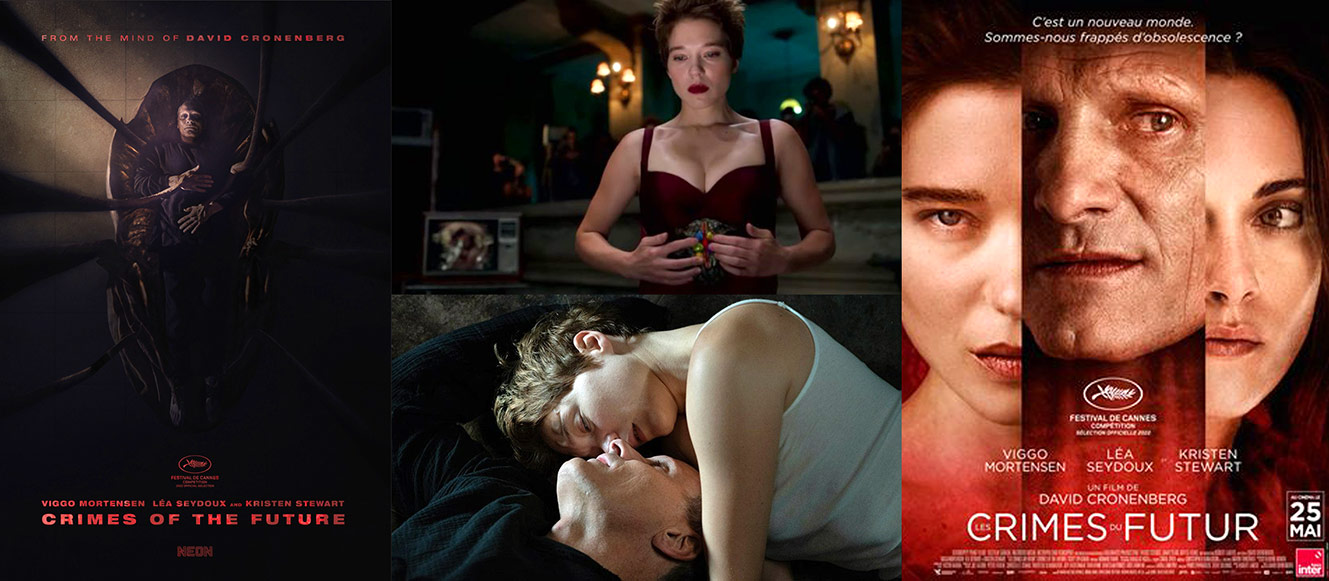
Showing posts with label David Cronenberg. Show all posts

Monday, 1 May 2023

Dead Ringers


Mantle Piece

Dead Ringers
April 2023
6 episodes


I’ve quite liked the majority of David Cronenberg’s movies over the years so I’m always hesitant to watch when I hear a remake or reboot is being attempted, especially his thriller Dead Ringers which I remember making a big impression on me when I saw it on its release in cinemas in the 1980s. That being said, I really enjoyed the remake of Rabid by the Soska Sisters (reviewed here) and I’ve really like Rachel Weisz in the few things I’ve seen her in so, I thought I’d dip my toes into this one.

I was not disappointed at all although, now that I’ve finally finished watching the show, I kind of have my reservations about the last two episodes, it would be true to say. The idea of having Rachel Weisz play the Mantle twins as Jeremy Irons had done in the original movie seemed like a good idea although, I was a bit puzzled that they have both kept the same first names from that one... Beverly and Elliot. The show is said to be based on the 1988 Cronenberg movie and the novel which was ransacked for that... Twins by Bari Wood and Jack Geasland (itself the fictionalised account of two twin gynaecologist brothers who died in real life under mysterious circumstances). I can’t speak for the novel because I haven’t read it but this new ‘adaptation’, I would say, is more ‘inspired’ by the twin sources more than anything else. If you’re expecting an updated body trauma in the spirit of David Cronenberg then, yeah, you won’t find that here...

Instead, what we have is a TV show which is equally enthusiastic about the idea of obsession while following the fortune of the brilliant Mantle twins as they set up a new birthing facility, to try to humanise the process. And it’s impressive right from the opening minutes, I have to say. I was hooked by one of many intense dialogue sequences which opened the first episode (and which has kind of a sequel sequence in the final episode). The show proceeds in a relatively linear fashion with various tricks and sub-plots thrown in which, it has to be said, obscure the narrative somewhat but are obviously included to build a sense of mystery... which works until the final, somewhat obvious, I would say, denouement.

Okay... the good stuff. Rachel Weisz is absolutely brilliant. I’ve always liked her but her performances here are beyond next level. I was frankly astonished that she manages to pull off something which is even more accomplished, perhaps, than Jeremy Irons’ performance in the Cronenberg version (to which there are some references but, like I said, they’re not really ‘doing Cronenberg’ here). And in fact, all the cast in this thing are pretty good, including  Beverly’s love interest played by Britne Oldford as Genevieve Cotard, who really knocks it out the park. She’s presumably named after Geneviève Bujold, the actress who played the equivalent role in the Cronenberg original. Her character also provides one of the show’s best referential jokes in that she’s the star of a fictional TV show based on Cronenberg’s Rabid, as seen on a poster in one shot.

And, it’s all very good and trundles along nicely for the first four episodes although, there do seem to be some narrative gaps which obscure a definitive decoding of the plot but, as I said, I do think that’s deliberate to make things more interesting. For instance, jumps in time between episodes with new characters constantly cropping up in the lives of the Mantles and the ‘group analysis’ sessions for one of the twins being deliberately obstructive to chronological interpretation until the mid-credits sequence... so the last episode does seem somehow clumsy, in some ways. These things do, though, help create a desire to unravel the plot and stay tuned for the audience, I would guess. Add to this a mysterious and over-the-top zany housekeeper with an equally disappointing pay off and I did, I have to say, find myself somewhat disappointed during the fifth and sixth episodes.

That being said, the quality of the writing and the ‘knocking it out the park’ brilliant performances from everyone is absolutely addictive and I found it essential watching once I’d seen the opening hook. I’m not sure where the heck the part of the story, with no real pay off in terms of what Elliot is doing in her lab, really helped the show much either but, I guess it gave that character more to do.

At the end of the day, I think the writers could have just changed the names of the main characters and nobody would know it’s a reboot of the Cronenberg at all. It’s a completely original thing and that thing doesn’t really have to associate itself with its source material at all, to be honest. But, despite my reservations that the show really doesn’t land a good or surprising ending, I am certainly going to be recommending Dead Ringers to all my friends who watch modern TV shows (or whatever we are supposed to call these streaming things now). A good piece of fiction which, I think, could have easily sustained a second season if it didn’t have the ending which it’s been given. Definitely worth checking out though... the dialogue writing is absolutely brilliant and, when you have someone like Weisz delivering it, you’re probably always going to have a winner. Oh... and modern era Doctor Who fans might like to give it a go too as the score is by none other than Murray Gold. Hope this one gets a CD release at some point.

Wednesday, 14 September 2022

Crimes Of The Future 2022


You Are
What You Eat


Crimes Of The Future
Canada/UK/Greece 2022
Directed by David Cronenberg
Canadian Broadcasting Corporation


Warning: Spoilers all over this one as I want
to talk about it properly. Please don’t read my
take on it until after you’ve seen the movie...
which you need to see if you are into the
art of cinema in any way, shape or form.


So Cronenberg returns triumphant with a great new film called, wait for it, Crimes Of The Future... which was also the original working title for his excellent eXistenZ and the title of his earlier short film (reviewed by me here). Now, first of all, let me address the elephant in the room which seems to be the little ‘out of place’ and unduly sensationalistic reportage of this film. I don’t know why people have been walking out of this one and putting it about that it’s somehow controversial but, no, it really isn’t. By modern horror film standards it’s actually quite tame (I just watched The Sadness, reviewed here, the other night so, please!) and, actually, this one isn’t even a horror film... it’s one of Cronenberg’s science fiction films, lacking the horror element completely. It maybe comes on as minor body horror but, I’ve always found that label a little problematic because, nine times out of ten, body horror movies don’t really shift into the horror genre, to be honest.

That aside, though, I always find Cronenberg a bit hit and miss... although more hit than miss I’d have to say and, if you like his work, then I’m happy to report that Crimes Of The Future is actually quite a charming and playful, fun movie. It’s properly old school Cronenberg delivered with the kind of visual sophistication which he started delivering as an aesthetically polished concept in the 1980s-1990s period of his work, I believe. I wasn’t expecting this to be as good as some of the movies I regard as his classics... such as Shivers, Rabid, Scanners, Videodrome, Dead Ringers, Crash and eXistenZ... in fact, I wasn’t expecting it to be much at all considering the, presumably manufactured ‘controversy’ hype used as a tool for marketers. But I have to say that it’s not only harkening back to a classic period of this director’s work, it’s also one of Mr. C’s best films, definitely in the top five of my favourite Cronenberg movies.

The film is set in a future which, it’s implied visually but not revealed, has survived some kind of apocalyptic event or possible evolutionary cull. The colour palette used throughout seems to be very dulled down, neutral and pastel versions of colours and everything seems consistent with that kind of aesthetic throughout... everything dialled back a notch and then infused with beiges, yellows, creams, blues and greens, I believe. Following an opening where a young boy starts eating his plastic wastepaper bin and then is smothered to death by his mother, our two main protagonists are introduced... Saul Tenser, played by Viggo Mortensen and Caprice, played by Léa Seydoux. The two are performance artists of some esteem. Humans don’t feel a lot of pain these days, the ability has left them but, Saul is one of those who still can and who is continually growing new, mysterious internal organs in his body, which Caprice then cuts out of him as the performance, using a Sark unit with robot arms wielding scalpels.... pulling apart new incisions, retrieving and slicing the organ in question and presenting it to the public (I’m assuming the Sark unit is derived from the term sarcophagous here).

However, after registering his next organ with a new, secret company called the National Organ Registry, things start to get complicated. Tenser meets Wippet, played by Don McKellar and Timlin, played by Kristen Stewart. We also meet the two maintenance technicians who come to service his organic bed (used to help him monitor and cultivate new internal organs) and feeding furniture (to help him eat), called Berst, played by Tanaya Beatty and Router, played by Nadia Litz. For reasons that become apparent later in the movie, the playful nature and agenda of these two struck me as being a female version of Wint and Kidd from Diamonds Are Forever (reviewed here). We also meet Scott Speedman in the best performance I’ve seen him give, as Lang Dotrice, father of the murdered child at the start, who wants Saul and Caprice to do a show based on the autopsy of his kid, for reasons which become apparent after Saul discovers he’s part of a cult of people surgically altered to consume plastic instead of food, in easy to consume chocolate looking bars referred to by one as ‘candy’. Of course, given Cronenberg’s passion for Philip K. Dick as evidenced quite explicitly in eXistenZ along with other movies, I couldn’t help but think this was also a reference to Can-D and Chew-Z from Dick’s novel The Three Stigmata Of Palmer Eldritch, which wouldn’t be the first time the director has referenced this specific novel.

However, a part of what qualifies as the government, as manifested by Welket Bungué playing a detective of the Body Crime Unit, are very much interested in this group of people, especially since the dead child has, it is rumoured, inherited the evolved genetic trait of consuming plastic from his father, rather than be surgically altered. All this is going on while Saul has registered for an Inner Beauty Pageant - Category: Best Original Organ With No Known Function... but he’s also an informant for the Body Crime Unit, unknown to Caprice but, as the film progresses, you realise a few of the people who he comes into contact with might know this already.

And its great. One of the buzz phrases associated with the marketing of the film is that ‘Surgery is the new sex’ which, I thought nothing of but it turns out that this is also a mantra of a few of the people in the movie and, certainly Saul and Caprice indulge their mutual sexuality in this way. With Saul controlling the Sark with a remote unit quite reminiscent of the pods in eXistenZ, she lays naked, enjoying each stroke as he slices up her flesh for her sexual pleasure, before putting the unit on remote and joining her. In another scene, she unzips the scar of a new hardware access point from something put in him to monitor the Inner Beauty Pageant and starts licking his open wound which is given and received in much the same manner as a blow job. The punchline to all this comes later when Kirsten Stewart, who coins the phrase ‘Surgery is the new sex’ in the movie, tries to instigate sex with him through a passionate kiss and he rejects her after a minute stating, “I’m not very good at the old sex.” So, yeah, as much as people are calling this one an edgy film, it’s more full of humour, almost to the level where at some points it’s almost functioning purely as a comedy.

And being as it’s Cronenberg, it all looks fantastic. There’s a brilliant moment where a shot is split vertically by the frame of a door. The door opening on the left with Stewart standing in it, with yellowy beige walls behind her and with Léa standing on the right against the wall of the room in which the camera is placed, the wall cream coloured behind her. It’s such a striking shot composition that one could be forgiven for thinking Cronenberg had used a split screen for the shot... it’s that much of a contrast, in spite of using colours which wouldn’t have a lot of perceived contrast against each other in a busier shot. The film is full of this kind of good stuff and you are constantly reminded you are in the hands of a master director all the time.

Once slight criticism might be that the blood effects in the film look like they’re handled by CGI. They may not be but, they do look like they don’t have much substance to them. At least to me. I have no idea how the effects were achieved but it might be a trade off to easily include the concept of the Sark unit (an earlier conceptual version of which was seen in Ridley Scott’s Prometheus, if memory serves).

And one observation, rather than criticism, is that time seems to drift without warning in the film. Everything seems to be taking place in close proximity to earlier events but, as you go through, you realise days, weeks or possibly even months may have taken place between one sequence and the next with no real warning. I was fine with that and the progression of people and organisations over this time can be easily tracked either visually or in details of the text but, I suspect some people may find this a barrier... not an insurmountable one though and I kind of grew to like that freestyle attitude to the story after a while. And it is a proper story, people... this one more than most of Cronenberg’s is actually leading up to a moment in the last shot which, once you think about the consequences of what you are seeing, actually has a meaning and resonance that hints at an actual evolutionary process in a certain direction without direct provocation. So that was pretty cool.

And all of this is supported by a typically Cronenbergian score, provided by the director's frequent collaborator Howard Shore and, frankly, the biggest crime of the future, in regard to this movie, is that this brilliant score at time of writing, has not been issued on a proper CD. Come on people, get your act together. People need a proper release of this stuff on the only format worth listening to it on.

And, apart from me singling out Kirsten Stewart’s performance as being brilliantly against type... I’m used to seeing her play very confident characters, not nervous and excitable people... I will leave you with a solid recommendation for Crimes Of The Future. It oozes old school Cronenberg charm and I found it hugely entertaining. He really knocked it out of the park here. 

Monday, 30 May 2022

Crimes Of The Future & Shorts


The Way
Of All Flesh


Transfer
Canada 1966
Directed by David Cronenberg

From The Drain
Canada 1967
Directed by David Cronenberg

Stereo
Canada 1969
Directed by David Cronenberg

Crimes Of The Future
Canada 1970
Directed by David Cronenberg
Arrow Blu Ray Zone B


Warning: Spoilers that come, hatching from within your body to assault your subconscious mind.

With the imminent release of David Cronenberg’s new feature film Crimes Of The Future, a film which has already had walk outs at Cannes due to its allegedly extreme nature (always a sign of a good movie and a great, unpaid advertisement for it), I though I would take a look at the director’s early short films, made before he was more famous for introducing his trademark body horror into the world (pretty much inventing the sub-genre, I suspect or, rather, putting it on the map as something belonging to a definable collective). Now I remember recording these off the old UK cable network Bravo when it showed them maybe 30 years ago but I started watching for a few minutes and then kinda turned off to them, not revisiting them for a proper look, despite my admiration for this legendary director. But I thought I’d look at them now as a good subject for a tie in review and, as luck would have it, I have a nice Blu Ray edition of these in a special, limited edition Blu Ray disc set of Videodrome, released by Arrow sometime over the last decade (it’s a very nice, out of print package... I believe the disc with these shorts on is still available* as a stand alone release direct from Arrow although, judging from the three figure sums it’s going for on Amazon, you might want to hurry onto Arrow’s web store sometime soon if you want these).

Looking at them now, while there are early twinges of DNA strands which connect them to the groundbreaking films which would immediately follow, I’d have to say that I was fairly disappointed with these films in that, I did catch myself nodding off and having to rewind a number of times over the course of watching these due to their failure to adequately stimulate my mind on a lazy, Sunday afternoon. Now, as much as I love the majority of Cronenberg’s output, there are always a few movies which I find are definitely miss rather than hit for me, such as Spider and Cosmopolis... and so I want to remind people that, as dull as I found these particular films, I am very much a supporter of Cronenberg’s work... it’s just that these ones mostly didn’t click with me.

Transfer and From The Drain are both very short, running at just under and over ten minutes respectively. There’s a strong shot of humour running through these two... as I guess there kind of is in the other two (to a lesser degree and, to be fair, I wasn’t laughing at any of them)... but ultimately these were less comedies to me (as they are classified) and more experimental works (which again, could also be said for the latter two, at least in terms of the techniques employed to present them). So Transfer is a dialogue in a snow covered part of Canada where a reclusive psychiatrist, self exiled to a place far from the rest of humanity, is tracked down by a naive patient. Said Doctor shuns the patient and the job, verbalising that “communication was the original sin” and letting the camera wander away from these two, who have been carrying out one of those continuing conversations at different locations pasted together by an aggressive edit, to fade to black just after the director’s voice can be heard yelling “Cut!”

From The Drain shows two fully clothed men sitting in an empty bathtub in, we are told, the Disabled Veteran’s Recreation Centre. One of them, when he finally decides to engage the other’s attempts at conversation, is frightened about the ‘tendrils’ that come out of the drain and urges the other to plug it up... obviously foreshadowing Cronenberg’s brilliant Shivers (aka The Parasite Murders aka They Came From Within and reviewed by me here). At the end, the nervous one is deliberately exposed to what the other claims is a non existent parasite and he is strangled. The shot where one of the two collects the other's shoes and throws them into a cupboard onto a pile of similar footwear, signals that this is not the first time this has happened. The innapropriate Bagpuss-like guitar soundtrack on this short overwhelmed me and drove me nuts, it has to be said.

Okay, so Stereo is shot in black and white on location in a truly interesting building... and completely set both within and, occasionally, just outside said building. On the print itself, the film is called Stereo - Tile 3B of CAEE Educational Mosaic. An interesting set of establishing shots of a helicopter landing and then depositing a passenger is done in total silence and, it turns out, the whole film is shot with no audio and added voice over narration... and this is true of Crimes Of The Future too, which seems closely related to this and maybe shot in the same location (except in colour). After a while, the first of a series of different but mostly clinical, science gobbledy gook couched voices tells us about the experiment in the building of eight patients who have brain surgery to promote a telepathic response in the subjects, which is then further propagated by emotional and sexual of bonding between two or three or all eight of them to increase the rate of thought flow and dependability in their mutual mind sharing. By the end of the film, three have killed themselves and one has drilled a hole in his head to let the voices out (all done off screen and narrated after the fact). This, of course, strongly foreshadow’s Cronenberg’s Scanners (reviewed here) both in terms of telekinetic people being nurtured in a clinical environment away from the rest of the world population and in terms of the back story of the Michael Ironside villain of Scanners having once resorted to trepanning due to similar conditions.

Crimes Of The Future is similarly set in a series of clinical institutions, starting off with lead voice over by Adrian Tripod, director of the House Of Skin and detailing various homosexual overtones as the male survivors of a world where women have mostly died out due to a curious virus called Rouge’s Malady (foreshadowing AIDS and which effects both sexes, although women are much more susceptible to it). There’s lots of foot fetish imagery in this and also, the film culminates in the broached impregnation of a five or six year old girl who probably hasn’t succumbed to the disease yet, as Tripod becomes involved in an organised gang of paedophiles attempting to save the future population of the planet in this manner. The last shot of the film where Tripod almost but, doesn’t quite make good on this, instead succumbing to something which causes a blue liquid to weep from one eye, is mostly confusing and doesn’t really help things. I don’t know if Cronenberg’s new film, which has a very strong female cast and so is obviously not a straight remake of this (and probably isn’t connected at all), shares any of the ideas explored in this one but the child molestation angle would certainly, in my book at least, explain the walk outs in Cannes (yeah, I could do without the implication of that kind of mental erosion in films I watch too, thanks)... but I’m still happy to give the new movie a go because, well, I kind of trust Cronenberg now (I maybe wouldn’t have, had I seen these movies when they were fresh and of their time, before I'd seen his fantastic early features, I suspect... so it’s a good job I didn’t).

Stereo (which I assume gets its title in a reference to two people synching their minds to each others’ frequency), to me, is definitely the stand out movie on this set and both that and Crimes Of The Future are just over an hour long. They both utilise slow, languid camera movements for the most part but Stereo will be the one that sticks in my mind. There’s a moment where Croneneberg, when one of his characters walks into a room, montages lots of quick fire cuts of each and every object in the room as a kind of mini exploration/assault on the minds eye in terms of what is there. It’s not made relevant why he does this and I suspect he was just experimenting with techniques but it’s an interesting thing I don’t’ remember seeing him do on any of his other films. There’s also a nice visual moment in Stereo where one of the baby’s dummies, which each subject is seemingly issued with, is visually compared in terms of the shape in profile to the Omega symbol found on the back of a pack of Tarot cards. It’s spelled out quite specifically by way of the visual comparison while not once referring to it in the narrative. Again, I don’t know the significance of the metaphor (if there is one) but, well, at least it was interesting.

And that’s me done with the early works of David Croneneberg, collectively as Transfer, From The Drain, Stereo and Crimes Of The Future... and I have to say that I am still very much in the Cronenberg camp but, yeah, I did find these early works a bit of a dull, hard watch, to tell the truth. Still, I’m very glad I saw them and also very glad that I got the limited Videodrome edition with these on extra discs... because now I can go and read the little hard bound booklet which comes as part of the set and which talks about these and the main feature. If you are a fan of the director and tend to grab everything he does, then you should probably try and track these down. If not, I would suggest your life may not be all that much richer for having seen them anyway.

*At time of writing this review.


Thursday, 10 September 2020

Scanners


Head Pops
And Boom Tricks


Scanners
Canada 1981 Directed by David Cronenberg
Second Sight Blu Ray Zone B


The last and only time I saw Scanners prior to now I would have been about 16, a couple of years past its cinema release date, as a rented VHS cassette from my local off licence (the off licence is still there but... alas... they no longer rent movies). I remember liking it at the time (well, who doesn’t like Cronenberg?) but I remember being a little disappointed in the gore quotient, which I was more into as a kid as opposed to nowadays, I guess. I’ve been meaning to re-watch this for years though because, well, Cronenberg has been a consistently great director throughout his career and I always felt that when I first watched this, I wasn’t looking at the thing properly and appreciating it as much as I should.

Cronenberg himself cites this as one of his most chaotic and problematic films to make because it was rushed into production without a finished script, which he would have to write some of it each morning before trying to deal with whatever set or location they were using etc. I have to say that, looking at this movie now, I would never have known there were any production troubles. It’s an astonishingly good psychokinetic thriller with, despite the year of its release, a real 1970s vibe to it which groups it, in my mind, with the most popular of his earlier works Shivers (reviewed here), Rabid (reviewed here) and The Brood. I’d remembered hardly any of this film when I sat down to watch it but, right from the opening scene, I was drawn right in.

The film starts with the main protagonist, Cameron Vale (played by Stephen Lack) who is depicted as a down and out drifter, entering a mall and eating an absent customer’s food. We see him listening in on an old lady’s thoughts and, before he can control himself, his mind has entered hers and she’s taking a lot of internal damage and having a fit while he is trying to ‘turn off’ his powers, accidentally triggered by her negative thoughts. However, two men who have been watching him, shoot him with a tranquilizing dart and then give chase when he runs. The chase through the mall is quite well done and, though it’s vigorously edited, it’s got some nice, fluid camera motion in it and it feels quite coherent.

When Cameron awakens he is befriended by Dr. Paul Ruth (played by Number Six himself, Patrick McGoohan) who works for a company called CONSEC and who is a specialist in people with powerful psychokinetic abilities such as those possessed by Cameron. These people, in this movie, are called Scanners.

Then comes the films first big and, possibly, most spectacular set piece. When CONSEC try to unveil the existence of Scanners to the public in a live demonstration of mind reading, the subject they pick on from the audience of executives, Darryl Revok (played by everybody’s favourite 1980s US American movie villain Michael Ironside) volunteers and lets the Scanner in the room read him. However, he pushes back with his own, very powerful scanning ability and causes the other man’s head to explode in front of the audience in what, to me, is still an iconic piece of 1980s gory imagery (I think it probably started a bit of a trend). Turns out Revok is a psychic assassin who is trying to recruit Scanners and build a powerful army to, more or less, take over the world (wouldn’t you know it?).

From here on, Cameron is given the job of trying to infiltrate this section of recruited Scanners to find out what’s really going on and kill Revok. He becomes involved, to the extent that anyone in an early Cronenberg film becomes involved with anyone, with another ‘outsider’ Scanner who is at the peripheral of this group called Kim Obrist (played by Jennifer O'Neill, who genre fans might remember from Lucio Fulci’s The Psychic aka Seven Notes In Noir). From here on it’s all thriller shenanigans as various people are ‘scanned up good’ and a bunch of dead bodies is left in Revok’s wake as Cameron tries to both get close to him and also find out who the mysterious traitor is at the heart of CONSEC.

More revelations happen towards the end but it’s a thrilling ride and the usual, lovely Cronenberg’s eye for nicely designed compositions in interestingly lit shots certainly helps things along. For instance, when Dr. Ruth is showing Cameron a video of the young Revok, who has drilled a hole in his own head to let the pressure out... he carries the scar of this like a third eye throughout the film (which, I’m pretty sure is a deliberate reference to the third or inner eye)... there’s some wonderful blue lighting hitting both actors on the left hand side of their faces (or right hand, as we see it). Later on, when Cameron is infiltrating what he thinks is a rival chemical firm headed up by Revok, there’s a nice dirty, pale, yellow wash on some of the shots. There’s another great scene where Cameron gets out of a car near a forest but it’s taken from the other side of a spindly network of tree branches between the camera and the actor... which kind of gives another wash or webbed effect to the shot. It’s all good stuff and, like all Cronenberg films, is always visually interesting.

Another great thing about the film is the sound design, which is awesome and, it’s just as well because it needs to be. After all, for a lot of the time we’re looking at various people thinking at each other... connecting through each other’s nervous system rather than just the head, is how Dr. Ruth puts it. So you are looking at people pulling all sorts of strange and, frankly, orgasmic facial expressions at each other which really wouldn’t have looked out of place on the poster campaign for Lars Von Trier’s Nymphomaniac movies. However, the sounds used on the soundtrack really make the shots work and you can really feel the implied power behind the intent of these moments.

Ditto for a young Howard Shore, who has stuck with writing music for Cronenberg’s movies right through to the present, starting with The Brood. He’s more famous for scores like The Lord Of The Rings and The Hobbit movies now, perhaps, but he’s worked on most (possibly all) of Cronenberg’s projects since The Brood and Scanners was only his third score. However, it’s like nothing else he’s done, really. A phenomenal, grinding, sometimes brooding, electronic bludgeon of a score which absolutely pushes the sound design and atonalism, too, in certain sections and helps alert the audience anytime something ‘Scannerish’ is about to happen. Decades ago, Silva Screen released a nice CD compilation of three of Cronenberg’s films which included just over 20 mins from this film but I suspect that’s not the full thing and it would be great to get a complete release of this score one day.

There’s some nice conceptual stuff going on with the film too. Computers (with their green screens and lines of code) were all the rage then and there’s a nice scene where Cameron goes into a phone box and scans his way into a computer system with his mind through the phone, as though he’s some kind of organic modem. The director uses some shots here which, to me, felt like they were inspired a little by the cinema of Dario Argento, as he moves the camera through a close up of a prop (probably built oversize and filmed normally, is my guess) for a few POV shots of the electronic insides of some of the equipment that Cameron is ‘mind hacking’ his way through. When things get a little explosive towards the end of this scene, there’s a nice shot of Cameron holding the telephone receiver which has begun to melt and liquify all over his hand like it’s an escaped convict from a Dali painting. There’s some really interesting stuff here.

My understanding is that the final, mental showdown filmed between Cameron and Revok was originally intended to be a lot more... ‘grand guignol’, shall we say... than just the vein popping, bleeding head with arterial spray and eyeball bursting that made it into the final cut and, this is possibly why it felt a little disappointing to me as a youngster... especially when you compare it to the famous poster painting of Michael Ironside having a full on body meltdown (which I used to pass every day on the way to school when it was released in UK cinemas). That being said, what he did leave in works well enough and I certainly didn’t feel cheated this time around.

The most important thing about Scanners, though, is that is absolutely entertaining and the chemistry between all the actors is very good. If you’re a fan of this kind of science fiction thriller (I’m not sure I’d fully go with it crossing over into the horror genre) then you will probably get a kick out of this one. I’d heartily recommend it to anyone who is into this kind of scientific pulp fiction. That being said, I’ve never seen either the two sequels to this movie, nor indeed the two spin off movies. My understanding is that Cronenberg had nothing to do with those other films but, still, now this movie has whet my appetite I think I’d like to see them so, hopefully I’ll have some reviews up for some or all of those within the next 12 months for you. We’ll see how it goes.

Wednesday, 28 August 2019

Rabid (2019)


Run, Rabid, Run

Rabid
2019 USA Directed by Jen and Sylvia Soska
World Premiere screening at FrightFest on Monday 26th August


Warning: Some very slight spoilerage here if you’ve not seen Cronenberg’s original.

Wow... just wow. Turns out that the last film I saw at FrightFest this year was also the one that took the cake and really rocked it. And I really wasn’t expecting that. I’d kind of only half appreciated the Soska Sisters’ movie I’d seen prior to this, American Mary (reviewed by me here). I wasn’t all that keen on it and a quick reread of my old review makes me come across as somewhat jaded. So I was quite worried about this film for a couple of reasons.

One thing was the trailer... which really does nothing for me and, I think, almost undersells just how remarkably good this new incarnation inspired by David Cronenberg’s classic (which I recently reviewed here) actually is. I honestly wasn’t sure about shelling out for a ticket for this one on the strength of that but then I remembered the exclusive footage I’d seen from this presented at last year’s Halloween Edition of FrightFest and thinking it was pretty great. And then, of course, I found out The Banana Splits Movie was playing before this and I had to see that (my review of that one is here) and so I figured, what the heck, I’m going to see this new version of Rabid, too.

And I’m so glad I did because, right from the opening shot, the Soska Sisters suckered me into accepting their new take on this even while I was aware of the manipulation tactics they were lovingly employing to make sure the Cronenberg fans were kept on board and happy with what they were doing here. And I mean quite literally the opening shot, which starts off with a leather jacket clad girl standing by her motorcycle... just as Marilyn Chambers did in the original, before panning down and away to reveal that it’s actually a billboard advertisement (shame it wasn’t an ad for Ivory Snow, I guess). We see the main protagonist/antagonist of this movie, Rose (played by Laura Vandervoort) standing by her own modest scooter and looking up at the advertisement before riding off to her job as a staff, fashion designer for a conceited fashion superstar called Gunter (played by Mackenzie Gray).

As she approaches her work area we hear Gunter giving a speech and, again, I suspect this is all about the Soska Sisters wanting to make the Croneneberg fans feel comfortable because he’s talking about ways of remaking oneself... while it also taps nicely into both the body horror theme of the story and the idea of his upcoming ‘Schadenfreude Collection’. So, yeah, it was overt but by this point the idea of being open to a remake was slowly settling in with me. I’m pretty hit and miss on remakes myself... everybody loves the third version of The Maltese Falcon with Bogart, for example but, if you are going to be remaking stuff like Ringu then you’d better watch out, as far as I’m concerned.

Anyway, over the next few scenes the characters such as Rose’s best friend and model Chelsea (played here by Hanneke Talbot) and the potential boyfriend Dominic (played by Stephen Huszar) are introduced and Rose’s back story is also fleshed out a little before we get into the main first incident which sparks all that follows, which people who know the original will remember is a motorcycle accident and there is a variant of that here. The nice thing about this was that the directors appear in a few cameo scenes at a party and, due to something they are saying in a toilet cubicle, overheard by Rose, they kinda become the catalyst of all that is to follow because Rose is not left in a stable mindset after this scene.

So after this, things run pretty similarly to the original movie in terms of the main plot focus... the accident happens and a new form of living skin graft is applied to what is left of Rose’s grizzly, hollowed out face and torso. And after things take their course we have the craving for blood, spells of amnesia and, of course, the attacks which begin and, as in the original, escalate on their own independently of Rose who is the carrier of a viral, “don’t mess with me big time” version of rabies. And all I will say as to what Rose becomes in this is... well, you remember those little armpit stingers in the original? I was wondering if the directors would run with that concept here or do their own thing as a replacement and, without getting into spoilers, all I am saying is that this film doesn’t do anything small. And I’ll  leave that for you to discover.

In terms of how the film plays.... well it’s just beautiful. Vibrant, sometimes almost primary colours and shot set ups with a Bavaesque quality to them which eschew some of the more coldly clinical moments of Cronenbergism while simultaneously enhancing the content of key scenes where a sequence might be washed in a dominant green or red playing in contrast to the preceding scene.

Added to this you’ve got a lot of strong performances in here and in terms of the story and dialogue... well it mostly does the same kinda thing but it reaches its end goals in a way which, I think, is more in tune to the way stories are explored and presented now as opposed to, obviously, the late 1970s. Which is absolutely right for this because... who wants to see a so called remake when it just does exactly the same thing as the original, which is its own entity entirely? This one tries to take the essence of Cronenberg’s ideas but makes it more direct and takes its time more in certain areas and rushes through other bits which don’t seem so important in this vision of the tale. Again, it feels like this was the right way to do this and I think this new version is different enough that it would make for a good cinematic double bill with the first version playing right before it.

And, as I said earlier, this one shouldn’t alienate those who are big Croneneberg fans. There are a lot of visual and textual references to his world scattered throughout. For instance, the surgical gowns in the operating room presided over by... ahem... Dr. William Burroughs (played by Ted Atherton) are a deliberate echo of the surgical gowns worn by Jeremy Irons in Dead Ringers... as are the names of the characters played by the Soska Sisters in this, Bev and Ellie. And there are quite a few little nods in this to keep enthusiasts for the work of Mr. C on their toes, such as a shop Santa Claus being gunned down, just like in the original (but for slightly different reasons). One which I’m not 100% sure was deliberate or just me imagining things, is when Dr. Burrough’s wife turns up near the end of the film. I’m skirting around specifics here because of spoilers but the visual look of some of the scenes she is in reminded me somewhat of a reveal right at the end of The Brood. Like I said, though, I’m not sure if that was on purpose or just me getting too near to my bedtime.

Oh... and Claude Foisy’s score works a charm here and is certainly a lot better than the needle dropped tracks on the original Rabid. It’s a shame that this thing isn’t on a CD because I would rush out and buy it (or, you know, my fingers would rush to the internet to grab it) and I’d similarly do the same thing with his score to Pontypool (reviewed here) if it was around on physical media. It’s one of those scores which has moments of great beauty interspersed with an almost industrial grating, ragged style of musical colour and it’s really much more appropriate to this film than what was used in Cronenberg’s original.

If I had one criticism of this version I’d say the ending, which is quite a bit different from the 1977 one, due to the fact that by this point the character of Rose is now quite self aware of what she has become, maybe missed the best part to just stop at. There was a moment near the end where she does something and I thought... “Yes. Good ending! This is precisely what she should do here.” Alas, the scene has a follow up where things are somewhat compromised in terms of how Rose is left and I felt it diluted things a little but, honestly, it’s a very minor criticism of what I shall be proclaiming to people is the Soska’s great masterpiece (with many more to follow, I’m sure) and I can kinda see why this particular ending would also have been a desirable one. It'll grow on me.

Okay... I think I’m drying up on things to say about this because I really need to see it again and study it properly for a few more hits and, alas, it doesn’t come out on Blu Ray here until October... although I think this would have done well as a full cinema release over here, for sure. This is one of the most beautiful looking horror movies made in the last few years and it doesn’t skimp on the gore here either... which is kind of a bonus when it’s done as well as this. Whether you are familiar with the wonderful original version of Rabid or not, this new film deserves your attention. I was, as you can probably tell by now, really bowled over by the Soska Sisters' movie here (who did their Q&A wearing the same dresses as they wear in the film) and I really can’t wait to see where they are going next. Guess it’s about time I ordered their first movie to have a look at on the strength of this one. I’ll try and get that one watched and reviewed sometime next year. Check out Rabid though because... you know... it’s kind of sensational and everything I didn’t think it could be.

Tuesday, 13 August 2019

Rabid


Value Rabid Attacks

Rabid
Canada 1977
Directed by David Cronenberg
Arrow Blu Ray Zone 2


As I said in my review of Cronenberg’s Shivers the other day (you can read that review here), I’ve been wanting to rewatch Rabid because I have a ticket to the world premiere of the new remake by the Soskia Sisters in just under two weeks and wanted this to be fresh in my mind. Having rewatched it now on a nice Arrow Blu Ray (although, I understand there’s a brand new, even more super duper restoration out later this month from 101 Films) it’s easy to see why I always get Shivers and Rabid confused. They’re both concerned with the spreading of a virus... by parasites in Shivers and, arguably, a kind of parasite in Rabid... and they both have the juxtaposition of hard violence and sex appeal to them. I’ll expand on that statement a little down the page.

The very first shot of the film introduces us to the person who is both the main protagonist and antagonist in the film, Rose, played by the late, great Marilyn Chambers. I’ll get back to her in a little while too but the opening credits start as she is waiting for the film’s other main protagonist... her boyfriend Hart, played by Frank Moore... her impressive figure leaning against his motorcycle. Hart soon picks her up and a lot of the titles pay out to various dynamic shots of the two of them on his motorcycle, whizzing around on a road trip...

Then, right bang smack in the middle of these credits, the cycle zooms past a building and instead of following the vehicle as we have in all the shots prior to this, we stay with the shot of the exterior of the building, The Keloid Clinic... because the director is now using this held moment as an establishing shot... followed by the interior of one of the offices where Dr. Keloid, his wife and his business partner Murray Cypher, played by Joe Silver (who also has a similar kind of role in Shivers) are discussing the future of his business, which is a cosmetic hospital specialising in modern techniques of plastic surgery. This is a great way of quickly filling in the audience about the hospital prior to the next series of shots which, when the titles resume, show a vehicle in the road blocking it after a man has an argument about directions with his wife and the motorcycle swerving to miss it but going up and over the edge of the highway. Hart is thrown clear but Rose lands underneath the motorcycle which then explodes on top of her.

However, this action has been witnessed by one of the cosmetic patients at the clinic through their binoculars and it’s not long before Dr. Keloid is racing to the scene of the accident with an ambulance and rushing the two patients back to his hospital where he has to perform an emergency operation on Rose which is an experimental form of surgery he is trying out, to do with using internal skin grafts. As he explains to his team while he cuts some skin from Rose’s thigh, he is going to be using “unusual skin grafts treated so they become morphogenetically neutral.’ Neutral field grafts which grow with the patient like an embryo. Now, I don’t pretend to completely understand the scientific lingo here but it’s the only explanation we get to a possible reason as to what happens next in the film... which truly continues Cronenberg’s obsession with ‘body horror’ that he was responsible for popularising around this time.

What does happen next is that, Rose wakes up and, mostly using her natural sexual attraction, starts drinking people’s blood by biting them with a kind of proboscis which retracts from a new orifice in her armpit. When she tries the same trick on a cow or tries to eat normal food, it just makes her throw up so very quickly the ‘half Rose-half beast’ she has become learns that she needs to drink the blood of humans to survive. Unfortunately, this also gives her victims a kind of untreatable super-rabies which causes them to attack others and spread the virus before dying themselves. Soon after Rose ‘escapes’ from the hospital, the new rabies spreads like wildfire and it’s not long before Canada is under martial law. And so the plot of the movie becomes Rose trying to find safe haven in between sexually enticing various human snacks while both Hart and Murray are out on the streets looking for her.

It’s business as usual for Cronenberg then... or at least what would become business as usual during this cycle of the writer/director’s career and I have to say, he has the added bonus of having more money (it seems to me) to make his wonderful shot compositions sparkle... he tends to gravitate to the centre or just slightly off-centre of the screen with some of his designs in this one, as he sets up vertical blocks of colour and texture to compartmentalise the screen.

There’s also the fact that many of the performances seem somehow more professional than some of those in his previous feature, not least of all Marilyn Chambers’ turn which really does stand out here in comparison to the expectations of her more famous career. And if you don’t know who Chambers is... or rather was, she died ten years ago.... she was the wholesome face of the Ivory Snow commercials in America. Yep, the famous Ivory Soap girl with her “99 & 44/100% pure” catch line. Well, she was the Ivory Soap girl until she started appearing, simultaneous to her advertising career with Ivory Soap, as the leading porn star in such, perhaps fondly remembered, pornographic films as the notorious Behind The Green Door, Resurrection Of Eve and Insatiable. This caused a scandal within the advertising industry at the time but, in the very rare crossovers she did, she really showed that she was more than up to the task of doing some good (and in this case somewhat ‘out there’... in the best Cronenbergian sense) performances and could hold her own with much more experienced commercial actors. I think this also shows how good porn actresses can be in general and that they shouldn’t necessarily be typecast in the genre of films with which they are most famously associated. An argument for a different article perhaps but, one wonders if Brian DePalma’s pursuit of porn actress Annette Haven for the lead in his film Body Double (which she ended up not starring in after all) was inspired by the casting of Marilyn Chambers in this.

It’s interesting that, although the method of viral contamination in Rabid is not a sex based one like it is in Shivers, the film seems somewhat more sexualised because there are a fair few nude shots of Chambers, who would have been totally comfortable doing those kinds of scenes anyway. It gives the film possibly a little more of an erotic edge to proceedings than in the previous movie where the theme of sexuality was more pushed to the foreground while remaining discretely in the background at the same time.

As well as the usual horror effects... which are done quite well with the proboscis that lurks within a sphincter under the armpit being particular well done, as sophisticated as anything in Cronenberg’s later ‘body horror’ movies... he also injects a more overt, almost slapstick sense of humour, into things at times. The moment in the shopping mall, for instance, where a policeman armed with a machine gun sprays a rabid attacker with lead and inadvertently also kills the Santa Claus in the Christmas Grotto is a particularly humorous swipe at establishment values, it seems to me.

Also... and perhaps I’m being a little unkind here but... whoever picked out the needle-dropped cues from a music library on this one (it may have been Cronenberg himself) did not do nearly as good a job as was done in Shivers. The over the top 1950s B-music style stings are lovely but totally out of place with the scenes they are scored with here and certainly give an unintentional humour vibe in places when it’s more than likely that the opposite effect is probably what was required.

Asides from that minor gripe though, Rabid is another early winner from the mind of David Cronenberg and I can’t really decide which, between Rabid and Shivers, I like more. I’d certainly recommend the movie as another good jumping on point to this writer/director’s cinema for those who haven’t seen his work before and now, all that’s left for me to do, is to go and see the new Soskia Sisters reboot at the London Frighfest this coming Bank Holiday Monday, so I can watch it with the original template in mind. And, hopefully, unless anything happens to me, a review will follow soon.

Sunday, 11 August 2019

Shivers


Parasite Lost

Shivers
aka The Parasite Murders
aka They Came From Within

Canada 1975
Directed by David Cronenberg
Arrow Blu Ray Zone 2


I’ve been meaning to re-watch some of the old Cronenberg classics for some time now and have, over the last few years, bought some shiny new Blu Ray restorations to do just that. The reason I’m watching Shivers now is because I’ve got tickets to the premiere of the Soskia Sisters remake of Rabid and I wanted to watch the original again before seeing the new one. However, since I always get Shivers and Rabid confused in my mind, I wanted to refamiliarise myself with Shivers first... especially since it comes directly before Rabid in terms of when it was made.

Looking at this now, it’s strange to try and process the reaction to this movie when it was first released in Canada. There was a bit of a scandal about this being made with funding from the taxpayers and most people seemed to condemn this film as being a terrible movie. I’ve never thought it was a terrible movie, to be honest. I always kind of quite liked it although, it has to be said, some of the acting may be a bit questionable... I’ll get back to that in a minute.

The film’s opening credits sequence takes the form of a slideshow advertisement, where a voice tells us of all the promise of buying an apartment in the new, modern Starliner Apartment Block which houses a community of people on Starliner Island. It introduces us to the fact that the people who live in the block have their own shops and facilities like an indoor swimming pool (which plays prominently in the last act of the film) and it’s a nice idea for Cronenberg to give the audience a kind of a map to the environment in which the film they are about to watch will take place.

We then have a sequence with a new couple visiting the apartment block for the first time to get a sales tour but this is intercut with the film’s first scene of ‘ body horror’ running simultaneously with their dialogue with the guy in charge of the buildings. A man... a doctor/research scientist as it turns out... is trying to stop a schoolgirl from leaving his apartment, violently and eventually manages to strangle her. He then tapes up her mouth... to stop something we’ll see later from leaving her body and then puts her down on a table, slices open her stomach with a scalpel and then pours acid into the open cavity. After he’s done this he slices his own throat open with a scalpel and dies.

A lot of the early part of the film also concentrates on Nicholas, played by Allan Kolman, who is very sick with constant, surprise stomach cramps and who is trying to just survive his day. His wife Janine, played by Susan Petrie, is worried about him so she goes to see the doctor who has a practice in the Starliner apartment block. Here we meet the two people who act, for the most part of the movie, as the real protagonists of the film... Doctor Roger St. Luc, played by Paul Hampton and Nurse Forsythe, played by the lovely Lynn Lowry, with whom he is romantically involved. He promises to stop by and have a look at Janine’s husband later that evening but, as he gets more patients exhibiting similar symptoms... things moving around inside them and pushing on the skin... it’s an appointment he never gets to make. 

As he gets deeper into his day, Roger finds that the doctor who killed himself has been experimenting on people under the guise of an organisation who are breeding parasitic slug thingies to replace failing human organs like kidneys. However, as his fellow researcher soon finds out and then reveals to Roger, he was actually on a mad scientist trip to create a parasite that's “a combination of aphrodisiac and venereal disease that will hopefully turn the world into one beautiful, mindless orgy.” And that’s exactly what the parasites do... get inside people and then ‘sexy them up’ so that they attack other people and pass more sluggy looking parasites on to them...  transforming them into a growing number of infected, sexed up, somewhat aggressive and ultimately doomed human beings. So there’s your plot set up and the rest of the film is about Roger and his nurse trying to get out of the apartment complex and warn the rest of the world before becoming infected themselves. People who are familiar with the work of David Cronenberg will know him as one of the main geniuses of the modern horror scene, not to mention the man who... well he didn’t exactly invent but certainly he popularised the sub-genre of ‘body horror’ with films like this, Rabid, Scanners, The Brood, Videodrome, the remake of The Fly, eXistenZ and probably a few others I’m forgetting. So if you’re familiar with the inevitability of the situations he creates in these films, which might seem to some as pessimistic and bleak in their outlook, then you can probably guess how this all ends.

Meanwhile, Nicholas has been vomiting up parasites which escape into the complex and attack other people, including the most famous member of the cast, to genre fans at least, Barbara Steele as Janine’s friend Betts. Now let me say something about the almost amateurish acting vibe coming from some of the cast. I think the real problem here... at least in how the film may have been perceived by some at the time... is in the somewhat lacklustre and minimalistic performance by Allan Kolman as Nicholas. However, you have to remember that right from the outset, this character has several parasites swimming around in his body affecting the way he acts and talks so, I suspect, this somewhat less than engaging performance is a result of him really nailing the part and giving Cronenberg exactly what he wanted, rather than anything lacking in his performance skills. That’s my guess anyway since the actor seems to have gone on to a successful career in small roles in film and television over the years.

Let’s talk about Barbara Steele for a moment here too. This iconic actress from such fan favourites as Mario Bava’s Black Sunday, Roger Corman’s Pit And The Pendulum, Riccardo Freda’s The Horrible Dr. Hichcock, Federico Fellini’s Eight And A Half, Michael Reeves’ The She Beast plus The Curse Of The Crimson Alter, Nightmare Castle and The Long Hair Of Death, amongst many others, has a nude scene here which is both supposed to be an obvious ‘exploitation’ moment but which also manages to not show any of Steele’s sexualised body parts such as breasts or backside. It’s a scene where Steele is attacked by a parasite in the bath and it swims into her vagina (is the implication) but there’s no real nudity on display in any overt way here. Which is odd considering there’s a scene with Steele and Susan Petrie naked and doing the back stroke in the pool towards the end of the movie.

However, the reason I’m highlighting this scene is not to complain about it but to show how Cronenberg, who clearly wants us to get a ‘sex vibe’ from the sequence, manages to give us a ‘sexual surrogate’ to create the illusion in the audience's head that they are watching a proper nude scene. It’s simply done by just crosscutting this scene constantly with a sequence in which Doctor St. Luc is on his phone talking to someone but, as he talks, he watches (as do we) his nurse lover strip down out of her uniform to finish up for the day... under which she is not wearing any underwear of course. So, simply but brilliantly, the director manages to add the sexualised thrill missing from the simultaneous scene of Steele’s bathtime encounter... which ends really strongly with a close up shot of her walking bare foot on broken glass long before Bruce Willis did exactly the same thing in Die Hard... while not showing anything of Steele herself.

As a quick shout out to the lack of underwear on the nurse, I will say that, for a film about a sexual parasite, there is very little nudity in the movie as a whole but there is a definitive lack of underwear in it. None of the female characters seem to have ever heard of a bra (maybe people in Canada don’t wear them) and so everyone’s nipples seem to be covered but fairly prominent throughout... which I’m not going to complain about either. That Susan Petrie is a dish, though. Sorry, I just had to make that pun here or I wouldn’t be able to live with myself.

There are some nice shot compositions in this movie too... which you kinda expect from Cronenberg these days, it has to be said. Especially in some of the few, rare scenes shot externally to the apartment block at night. There’s a lovely shot of actor Joe Silver, for example, leaving a big office block via the front entrance and the whole atrium area is lit up in subdued greens right in the centre of the frame as he leaves and walks towards camera, with the rest of the shot around that atrium all very dark (practically pitch black) to highlight the action... very nice. It’s somewhat echoed in a similar shot in Rabid but it’s much more striking here.

Looking at the film now, it doesn’t seem that much dated but seems to give off that 1970s vibe of laid back, voyeuristic naturalism (for want of a better term) which puts it as a spiritual cousin to other contemporary movies such as Brian De Palma’s Sisters (reviewed by me here) or Martin Scorcese’s Mean Streets. Which is good company to be in, as far as I’m concerned. There are a few silly mistakes in the movie too, it has to be said but my biggest criticism would be the scene where Doctor St. Luc rescues his girlfriend by repeatedly shooting the guy who is trying to rape and ‘parasite her up’ in the car on top of her. Honestly people, a doctor should know that the human body is usually not resistant enough to bullets that said projectiles at that close range would as likely travel through the body and into the person below. However, James Bond makes a similar mistake in Thunderball (reviewed here), if memory serves, so I’ll just let that one pass for now.

And that’s pretty much all I have to say about Shivers at the moment. Some of the music is nicely effective in some sequences but I’m pretty sure it’s all been needle-dropped in from a music library from varying, contributing composers so it’s not likely at present that I can find any of them on CD. They are, for the most part, well utilised and all in all help contribute to some of the stronger performances in the film and give the whole bunch of viral shenanigans a certain sense of menace and inevitability. Not my favourite of Cronenberg’s oeuvre but certainly one of his best and most fondly remembered (as much as I mix it up with his next film). Definitely a recommendation from me, especially if you’re not familiar with this director’s work and aren’t worried about the lack of visual sophistication in some of the effects shots. This is a film I’ll continue to come back to when I can.

Friday, 31 August 2012

Total Recall 2012


First Among Recalls

Total Recall 2012 USA 
Directed by Len Wiseman
Playing at UK cinemas now

The year was 1990.

8 years since Blade Runner came out in cinemas.

8 years since I read between 30 to 40 of Philip K. Dick’s second hand novels and short story compilations over the space of a year.

Total Recall, directed by Paul Veerhoven was released into cinemas and I was really looking forward to it because it was alleged to have been based on one of my favourite of Dick’s short stories, We Can Remember It For You Wholesale. The title of the new movie bothered me though... after all, with such a great title on the short story, why couldn’t the movie just follow suit (and why call a movie Blade Runner, for that matter, when the original novel’s titles is just so darned cool? Do Androids Dream Of Electric Sheep?).

So there I was, sitting in the cinema in 1990 with my friends and the credits on Total Recall roll and, within about 15 seconds I am absolutely furious! This is ****ing plagiarism right here. This movie is scored by Jerry Goldsmith, one of my all-time favourite composers and I just want to strangle him and never before, or since, have I actually fought this hard to not jump up in front of an audience and knock some sense in to their lack of reaction and lead them in an orderly mob to the projection room with pitchforks and lighted torches.

I look around at my friends and none of them seems particularly worried or as angry as I am and... I just can’t believe it. But I am so enraged I want to spit and stamp my feet. Jerry Goldsmith’s opening title music to Total Recall is, as anybody with half an ear could tell you, a rip off of Basil Poledouris’ opening title music, Anvil Of Crom, from the 1982 Arnold Schwarzenegger adaptation of Conan The Barbarian. I am restless and fidgety in my seat. How am I supposed to enjoy a film when it’s being all copy-cat on Schwarzenneger’s arse.

Of course, what had happened was that the films producers, or possibly director, or anyway... some idiotic suit who wouldn’t know the difference maybe... had wanted to recapture the glory of the earlier Schwarzenneger movie with this one and asked the great Jerry Goldsmith to ape the style of the Conan The Barbarian main titles... probably by way of creating a sound temp track for the movie, a practice Jerry Goldsmith always hated and never really mellowed to (especially after working with Sir Ridley Scott a couple of times, is my understanding), which included Anvil Of Crom over the rough cut.

So I can’t blame Jerry for doing his job and I’ll forgive him... but I won’t forgive the people in charge of this production for doing that to both Jerry and Basil. How awful for them both!

This major felony of artistic taste-crime was further compounded when the film decided it was only going to take the basic kernel of the idea of Dick’s story and, rather than treating it in an intelligent, witty and, frankly downright funny presentation like the writer did, instead turn it into some kind of horrible action movie with a bunch of, frankly, lame special effects (even for the time), and generally destroy all that was good and enjoyable about the original short by cloaking it in a miasma of boring, couldn’t-care-less, chase fests. It was not good and, so far, I’ve never been that tempted to take another look at it and, the few times I’ve tried to get into the score, I’ve always started seeing red and flying off the handle every time I fire up the opening title music. I just can’t get through it when that red mist of angry musical deja vu pours into my ears.

I found out just recently that one of my favourite living directors, David Cronenberg, was developing that original film for a year, attached as the director, before being dropped from the project by the producers. Apparently, he was fired for attempting to make a movie version which was fairly close and respectful to the original PKD source material... when all that the producers wanted was, and I quote, “Indiana Jones on Mars”. I think David Cronenberg’s extremely “Phildickian” inspired movie eXistenZ, which even contains some specific references to Dick’s The Three Stigmata Of Palmer Eldritch in it, if I’m remembering it right, is far superior to what the makers of Total Recall ended up with in every way possible and is a testament to Cronenberg’s ingenuity, skill and ultimately, suitability to this kind of project.

Then I heard they were “remaking” Total Recall.

That’s how they put it. Remaking Total Recall.

Not doing an adaptation of PKD’s We Can Remember It For You Wholesale. Which rankled me somewhat, as you can imagine.

Furthermore, I then heard that Colin Farrell had been picked up for the movie. Now I’ve never quite been able to stand Colin Farrell for very long. He was in a fairly cool movie by Spielberg, inspired by Dick’s story Minority Report, but he wasn’t in it much and that’s about as long as I can handle him for. Which is why I wasn’t all that keen in ever going to see this new incarnation, which hit the cinemas a couple of days ago over here (why are a handful of films now suddenly coming out on a Wednesday or a Monday over here at the moment?). That was until I saw the trailer for it in front of a couple of movies over the last few weeks and liked what I saw in those trailers enough to go and see this on its opening night (in the UK).

I have to be honest... it’s not so much a straight remake of the original movie, thank goodness, but it still significantly “deviates from the brief” so to speak, if that brief was indeed to make a version of We Can Remember It For You Wholesale. You still don’t get the humour of the wild, weird and varied scenarios as the company in the story tries to give the central protagonist a new memory... opening like a set of Russian dolls to reveal that the character has had many lives, all of which match the wildest inventions of the scenarios they are trying to create for him (secret agent, superhero etc., it’s been a while since I read this, obviously). However, having said that, I did rather enjoy this movie on a purely “this is a piece of modern action cinema which works quite well” kinda level and I think a lot of people would like this if they gave it half a chance...I understand lots of people in the US stayed away in droves for this. I think it will make some cash when it gets a DVD release, however.

So... there’s a couple of references to the 1990 version, at least a couple I could pick up on given my relative inexperience of the original and this will probably bring a smile to the faces of fans of the first. But, unlike both Dick’s original work and also the Schwarzenneger vehicle, this particular film is taking itself very seriously most of the way through and it lacks any real humour.

Colin Farrell’s performance is quite good and I was able to suspend my disbelief and allergic reaction to him for, just about, the full duration of the film. Can’t really fault him as an actor... just one of those personalities on screen who I personally have trouble with. He’s excellent in this, as are most people in it, and that should be good enough for me.

Jessica Biel, who is another old hand from a Philip K. Dick movie (Next, inspired by PKD’s The Golden Man) is also on hand and she does a great job here but unfortunately she’s kind of overshadowed a bit by the absolute powerhouse villainess performance put in by Kate Beckinsale in this one as Colin Farrel’s wife/baby sitter. I usually find her a bit hit and miss, although I loved her in Van Helsing and Whiteout, but in this one she really outdoes herself. It’s a real “action woman with confidence” tour-de-force and she seems to have inherited that great ability to really look like she actually could do it all in real life (Nobody could but, hey, she looks like she could, okay?).

The editing in this one is fast and furious and the emphasis really is on action. There’s not a heck of a lot of screen time with people standing around talking... it’s pretty much one big long action chase lasting roughly two hours. There’s also not a lot of let-up to the pacing but that’s just the kind of movie it is. Fortunately, although the editing is pushing through the images at a frantic rate, it’s quite competent on this one (they’re pulling back and getting better again in Hollywoodland with this kind of stuff, I think) and it’s pretty clear throughout the stacked-in-a-row action set pieces just what is going on and when. It’s very easy to comprehend the choreography of the crash, the bang and the wallop.

Harry Gregson-Williams, another composer who I find a bit hit and miss, pulls off a techno augmented score which perfectly complements the thrills on screen and hits all the right notes... all the right notes, that is, if the movie was going to be called The Total Bourne Recollection. It has to be said, the score is excellent, but one of the problems with the movie is that it does seem, in a fair few places, to be trying to capture the zeitgeist of the Jason Bourne franchise and there will be a fair few scenes in this one which might take viewers back to The Bourne Identity... which seems to be the mind echoes that this movie is trying to hit quite often. Consequently, although the score doesn’t have that strongly defined set of bass lines and melodies that the Bourne series has, the orchestration and general style of it is definitely, I suspect, trying to remind you of those films on a sub-conscious level. That being said, though, I loved this score and wish the company had chosen to release a CD of it instead of letting it wallow in some “unreleased” list.

The visual aspect of it, though, is very glossy and, for the most part, sterile in it’s big budget portrayal of a bona fide ”sci-fi thriller”. That is to say, it’s grey and white and has the feel of something like the Will Smith vehicle I, Robot or, indeed, the aforementioned Minority Report. I’m not saying this is a bad thing though... I liked it well enough and I think other people might get a kick out of it if only they’d go to the cinema and give it a try.

In summing up I’d say, don’t go expecting a faithful adaptation of either the original movie bearing this name, or indeed, Phil Dick’s original work... it’s dumbed down significantly, for sure. However, if you like futuristic action movies with lots of punching things in it and lots of bad guys who seem to be incapable of accurately aiming their weapons at the main protagonists, then you could do a lot worse than give this one a watch. Give it a gander if you’ve got nothing better to do.

Monday, 18 June 2012

Cosmopolis


Cos n’ Effect


Cosmopolis 2012
France/Canada/Portugal/Italy  
Directed by David Cronenberg
Playing at UK cinemas now

Warning: In reading this review you will be sitting 
in a metaphorical traffic jam with a load of spoilers
glancing at you from other lanes. Beware.

I should probably start off this little review with a warning that I haven’t actually read Don DeLillo’s novel, the one that Cronenberg took as his starting point for this work. So I don’t know if this movie version is actually a literal adaptation of the work or if Cronenberg has taken the spirit of it and done his own thing with it (like Naked Lunch, for example). What I can say, though, is that Cronenberg probably wouldn’t have touched this if the source material wasn’t already something which he responds to on an artistic level and it would be true to say that it fits nicely into his oeuvre and is especially in tune with his earlier works, although actual bodily decay/mutation is not an issue for the characters in this one.

Set in a world where the rich can rise or fall in a day due to the instability of the economy, a rich power player called Erik Packer, who looks a bit of a thug actually (Who the heck is Robert Pattinson? He looks like Tarantino and you just want to punch him.), embarks on a quest to be driven in his deluxe limo downtown to get his haircut... a journey which will take him all day and into the night and see his fortunes fall due to, and I paraphrase the words of one character, his inability to predict the random elements of nature within the patterns of the stock market figures, as represented metaphorically by the discovery of his asymmetrical prostate. During his day he plays host to numerous visitors both in his limousine and in various interior spaces, while worrying about a “credible death threat” and getting the pretty-boy veneer stripped from him as he shows his true thuggish nature by the end of the piece.

For a road movie, it’s a pretty claustrophobic one with the majority or the film (if not all of it, actually) shot in sets rather than locations (as far as I could tell). The visitors with whom he talks money or philosophy or poetry or has sex with include some fairly famous names giving fine performances (Juliette Binoche and Samantha Morton, to name two) and for the most part the script is quite dense and I’d normally find this pretty interesting but, I have to say, I spent a lot of my time in front of this movie feeling kinda bored. The attitude of the main character didn’t help this lethal malaise that infected me as I started watching his movie but, at the same time, I got the impression I was watching a future classic in that it so neatly dovetails into that “easy-to-decode” early Cronenberg phase. Well, I say early but I saw traces of eXistenZ in it too... in addition to some of his earlier works like Videodrome and the remarkable Crash.

Talking of which, I think the choice of lead actor, or at least his style of acting, is a definite shift for Cronenberg in that he used to use some pretty inspired and charismatic actors to portray the kind of cooled down, emotionally vacant characters he often populates his films with... James Woods, James Spader, Debbie Harry and Jeff Goldblum spring instantly to mind. Pattinson seems to throw less fire into his role but I don’t think that makes him any worse an actor than those other guys because of it. Contrarily, and possibly even serendipitously, Pattinson’s lack of presence may be the exact kind of stripped down perspective that both he and Cronenberg are going for in this one... and if that’s the case then it might be because the last scene in this movie which the narrative leads to is such an intense, suspenseful one.

Following the eye stabbing of a VIP live on television, as seen in Erik Packer’s limousine, the director further re-enforces the unexpected and damaging properties of violence with a brutal, point blank slaying of an important regular character towards the end of the film. You will see it coming... but still you feel the injustice of the decision made, just as the person responsible will have to embrace the consequences of this act later on, towards the end of the film. This wariness around tools of violence is the way that Cronenberg sets the scene for the final act of the movie, which is a double header between Robert Pattinson and the remarkable actor Paul Giametti as the target and the assassin come face to face with each other in a run down apartment. Steven Spielberg used a similar emotional device in the opening of Jurassic Park, when the power of the dinosaurs is demonstrated with deadly results to ramp up and heighten audience expectation and anxiety when we see these beasties again, for instance. As did David Lynch when he introduced his audience to Sailor Ripley in Wild At Heart with that notorious, literally head-banging, opening. What this does for Cronenberg’s movie is it gives it a very intense edge that one minute either actor could  shoot the other at any time during their long and twisty-turny conversation. This gets almost unbearable at times and makes me wonder if Pattinson isn’t such a bad actor after all, if he can credibly hold screen time against Giametti.

As I said earlier, Cronenberg’s obsession with physical decay and mutation is not mirrored in this movie but the story does concern itself with the gradual decline of the human mind after a day doesn’t quite go just as you’d expect it too. This is reflected in both protagonist and antagonist in the final scene and, frankly, if by that point you can still work out which one actually is protagonist and which is antagonist, then you’re doing well. This is also mirrored in the journey of the physical media the film is made up of, at least that’s what I thought, since the early shots of the terrain outside of the limousine look much like the fake, projected backdrop the director used deliberately in certain scenes of eXistenZ whereas, as Packer presumably gets poorer, everything starts to look a little more grimy and real... to the point where an incident leaves Packer messy and angry on the streets. The ramshackle set design of the place where Giametti’s character lives seems very much, to me at least, as an external projection of that “slow, body-horror mutation” that marked this director’s early works (or his early funny ones, if you will).

Another great thing which also harkens back to the early Cronenberg is the ending. I’ve been suckered in before with Cronenberg’s endings stopping a few seconds short of where you’d like them to end and he’s done exactly the same to me with this one. He puts you in a place where you are trying to figure out which of the two or three possible endings that Cronenberg has deftly lead you too will be the final, end game of the movie and... as the seconds drag on... your choices are suddenly taken away from you and I’ve definitely seen a few of his movies end in exactly the same way as this one did. It’s nice that there’s a certain symetry at work here... maybe Cronenberg’s prostate is less skewed than his main protagonist’s. Either way, it’s a nice way to finish and I certainly didn’t share the groan that the majority of the other six members of the audience, in the cinema that I saw it in, let out as a collective response to the commencement of the final credits.

If Cronenberg is your thing and you like his early work, especially Videodrome and eXistenZ, then you might like to give Cosmopolis a chance, although it has to be understood that my comparisons to these two works are not to be found in the surface details of the movie and if you look for them there then you will see no similarity, other than the very fluid, slow and steady camerawork that Cronenberg likes to view his ideas from. On the other hand, if you struggle with the emotional aspects of Cronenberg’s work usually, then you might be quite lost in this one since very few of the characters express themselves as being anything other than voyeurs to the events that are actually happening to them... and often don’t seem that present in the moment, getting drawn along in the wake of the cause and effect and ultimate downward spiral of... well... of following the flow of the money.

Personally I’m glad I saw this one but I have no idea if I could sit through it again... although I can see how his kind of movie could be best seen as a personal, individual experience with just the lone viewer and a DVD, as opposed to the normally preferred venue of the cinema. That is to say, Cosmopolis is a dish best served cold, perhaps?

Saturday, 18 February 2012

A Dangerous Method


Jung At Heart

A Dangerous Method 2011
UK/Germany/Canada/Switzerland
Directed by David Cronenberg
Screening at UK cinemas.

Warning: This review will certainly contain some dangerously
heavy spoilers... and probably a few Freudian Gym Slips too!

I’ve mostly enjoyed the movies of David Cronenberg and have followed his work with great interest. Although marginalised, perhaps rightly for a while, as a horror movie director and, on top of that, a “body-horror” director (a marginalisation of a marginalisation), he has come to be a little more well respected over the last few years with releases of movies which are not obsessed with the disintegration, metamorphosis or derangement of the human body but which fall into more “popular” concerns. As this happened, the mainstream audiences and critics seemed to have been happy to have embraced him almost instantly... it’s as if they needed an excuse to let him into their club.

I’ve never thought any less of Cronenberg for being a horror director. Frankly I’ve never thought of him as anything other than an auteur... a man holding a genuine artistic vision which he uses as his goal posts to plug in various talents such as Carol Spier (who’s not with him on this production), Denise Cronenberg and Howard Shore to help him to realise his vision on celluloid (or whatever today’s nasty digital equivalent of celluloid is called). As someone trying to talk about him (or write about him and his work) here, I find it problematic that he’s moved away from horror films because his stylistic traits are much easier to tag on something like eXistenZ or Videodrome where I can lazily just point out the obvious similarities in the amorphous, fleshy environments his characters populate. Take away little “critic crutches” like this and I really need to go back and watch his movies again and dig deeper than what seem to have become merely surface details... or maybe just another phase of his career as an artist. I don’t have time to do that here though so, don’t expect much insight into his leanings from me here on this one.

One thing, however, that I did realise about Cronenberg's output while watching this one in particular, which perhaps should have been obvious to me before now (and perhaps it was and I just forget... I’m in my forties now, I do that) is that, although he certainly has a very sharp eye for the details and look of his movies, he is very focussed on performance. He wants to take the actors away from their own comfort zone and to strip away their body props and trade tricks and force them to explore the depths that his characters are reaching... and his characters do usually go right into the depths of their own dark psyches, more often than not, with the obvious luxury (seeing as he’s done so many horror movies where such conclusions are not necessarily considered box office poison by the producers) of being able to leave his characters wallowing in their own darkness, or often dead from it, at the end of the movie.

A Dangerous Method is a case in point. Keira Knightley’s performance, especially at the start of the film, is phenomenal. Yeah, yeah, okay... it could be considered oscar bait posturing (play a character with a physical or mental impairment and they’ll love you for it and awards will be falling on you out of trees) but, frankly, I found her absolute paroxyms of “out of control” emotional outrages to be really quite naturalistic and, in some instances, almost disturbing to watch... which is all good. I honestly haven’t seen Knightley attempt anything half as hard as this kind of role in the past and I think it’s a credit to both Cronenberg and his actors that they will push themselves and dive into these depths for him.

The film tells the real life story of Jung (Michael Fassbender) and one of his patients, Sabina Spielrein (Keira Knightley), and also his relationship with Sigmund Freud (played by Viggo Mortensen). Once Jung has ascertained the true nature of Sabina’s debilitating mental abberation, and pretty much cured her of this, the two embark on a sado-masochistic affair before Jung calls it off due to feelings of guilt about his wife. However, by the end of the movie and after his split with both Sabina and Freud, Jung is left alone and regretting ever leaving the woman he loved to this infinitely passionate degree for the rest of his life. Confronted by a married and pregnant Sabina towards the end of the movie, after having left her twice, he refers to her bump and says that “that should have been mine”. This movie proves without a shadow of a doubt that when it comes to the person you come alive for, whether you are already married or in a relationship or not, you choose to ignore the obvious passion of the person you are destined to be with at your peril.

It’s a very talky movie (which is fair enough since it’s based on both the play called The Talking Cure, as well as the book A Very Dangerous Method) but this is really not a problem... the screenplay is well written and interestingly, indeed, devastatingly (in Keira Knightley’s case) performed and will hold your attention if you are aware of the nature of the subject matter beforehand (I even found Vincent Kassel watchable in this... which is something that never really happens to me... maybe he’s an entertaining actor after all, I’m thinking). Basically, if you like pipes, sex, lots of smouldering (and that’s just in the male leads!) and a bit of “original” BDSM, then you are in for a treat with this one... and Keira Knightley goes topless too which is another good thing (and I’m guessing Mr. Freud might have applauded me for pointing that important fact out). Catch it while you can!