
Justice Ink
The Red Dragon
USA 1945 Directed by Phil Rosen
Monogram/Warner Bros DVD Region 1
So it’s been a little while, again, since I reviewed a Charlie Chan film... mostly because of lack of availability of the few movies left in the series that had never been commercially released on a home video platform. Now, a pricey division of Warner Brothers called Warner Archives have finally released the remaining few Chan titles on DVD in a two disc, three movie set... comprising the remaining two Roland Winters titles (don’t worry... I’ll get to those in separate reviews) and this one, The Red Dragon, a missing gap from the Sydney Toler portrayals of the famous detective from Hawaii. Of course, regular readers will probably know my absolute favourite actor to portray Chan was Warner Oland, and there are actually a few of his earliest appearances in the character which are still not available. However, this is because those first few to star him are pretty much missing in action and, unless a bunch of film reels show up in some odd location someday... it looks like they’ll be lost forever. Still, I remember the unbelievable resurrection from the ashes of the, more or less, full original cut of Fritz Lang’s Metropolis a few years back so... you know... never say never.
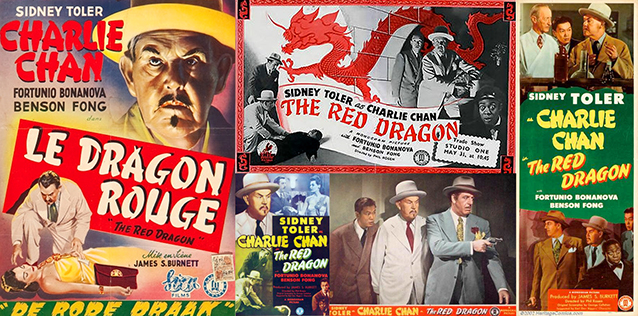
The film starts off promisingly with an opening credits painting which is the most expressive and interesting I’ve seen used in the series. Depicting Toler’s head and shoulders in the bottom left and a big dragon taking up the rest of the frame where the credits overlay. It’s pretty great but, alas, even with late series regular Phil Rosen returning to directing duties, the quality of the rest of the movie does little to live up to the magnificence of this title card. However, from a film historian’s perspective, as opposed to just kicking back and enjoying the movie, this has its little bonuses too. I must ask a film historian to verify this, next time I see one.
So, yeah, there’s good and there’s bad and I’ll get to the worst thing first because it’s the very thing that reveals the silver lining in this one...
The acting is really terrible. Seriously, it’s so wooden at times it creeks and although these films don’t always have the best players, they’re usually better than this. Now, it may, to an extent, be something to do with the staging of the action because... well, there’s an awful lot of chance encounters which lead to conversations to drive along the plot. For instance, man comes out of lift, bumps into other man who happens to be waiting for the lift, and the two talk, standing statically, for the next minute or two. This is a really flat and less than dynamic way to fill the audience in on the plot details, it has to be said. But so is the line delivery of the majority of the actors, so I’m not letting them off the hook here, either.
The good thing though, from a historical viewpoint, is that the main regular cast are all very natural and comfortable and run rings around the rest of the players. Take Toler himself, for instance. You really do get a sense of just what a consummate and professional actor he was here. When you see how stilted almost everyone else is in this, you get the chance to compare him and realise just how good he was at bringing the Charlie Chan character to life. I got a real appreciation of Toler above and beyond the usual assumption that he will play the role as best he can, with this one.
Benson Fong returns here as number three son and, although he acquits himself quite well, he’s not given too much more to do than look puzzled and interested at his ‘Pop’s’ conclusions and deductions here. He also has the usual two hander comic relief moments but this time, instead of Mantan Moreland playing his ‘funny black man’ role as chauffer Birmingham Brown, Fong gets to partner up with Willie Best as Birmingham’s cousin Chatanooga Brown, who played in at least three Chan films and played Chatanooga at least twice. The difference between Best and Moreland is not too great, however. He comes across as a maybe slightly younger, slimmer version of Moreland himself, given exactly the same kinds of lines and scaredy cat actions to follow but without the occasional added wit of Mantan Moreland’s two man stand up comedy routine that the writers occasionally drew from and threw into the mix. Best is fine, however and, though his lines are pretty forgettable in this, he doesn’t let the side down when it comes to playing the part of the Chan family chauffer here. Of course, Moreland would return to the series again later.
We also have a lady who was joggling at my memory as I was watching her all the way through the film. She’s not exactly outstanding in this but I knew the face and I somehow managed to miss her name in the credits. Turns out she’s Carol Hughes, who Flash Gordon fans will recognise as being the second of the on-screen Dale Ardens, appearing in the third of the three initial Buster Crabbe serials, Flash Gordon Conquers The Universe, for Universal. This means that both of the serial actresses who played Dale Arden have appeared in a Charlie Chan film and both opposite Sydney Toler’s version of the character. Jean Rogers, who played Dale in both Flash Gordon and Flash Gordon’s Trip To Mars starred in an earlier picture in the series, Charlie Chan in Panama. I know what you’re thinking... A Chan, A Plan, A Canal, Panama but... no, it doesn’t quite work like that.
The film is kinda hum drum in a lot of ways but it does, at least, have a genuine mystery at it’s heart and Charlie Chan flies to assist a character who has a history of solving cases with him but whom, in terms of actor and character, I could find no trace of within the history of the Chan movies. In this case, the first murder is committed in a room full of witnesses, as the victim gets a bullet for his troubles. It’s quite comical to watch him as he, in his final moments he takes the time to type a dying clue on his nearby typewriter. The trick is, though, that although one shot is heard, two bullets have been fired, on slugs which have never been rifled down to be fired from a firearm. And what is the significance of The Red Dragon Chinese ink at the scene of the first crime, which gives the movie its name? Is it something to do with the papers which tell of the mysterious, newly discovered, ‘missing element’ that can cause even more widespread atomic damage than the recently exploded atom bomb?
Only Charlie Chan can work out the answers to this Chinese puzzle, which, of course, he does in the short running time of the film. The mystery behind the double shot bullets with no visible firearms is a bit of a dreary one but the idea of that particular challenge is a good one. The only other outstanding thing I noted in this viewing was that, once the killer has been unmasked, so to speak, by Chan on a staircase, he breaks free from the police and has a go at Chan himself. It’s unusual for Chan to get in on the action in these kinds of movies... that’s why he always has either number one, two or three son with him... because they’re young enough to get into fist fights. Here, Toler deftly grabs the leg of the killer and throws him downstairs. So a little unusual but welcome bit of mild action shenanigans for Chan in this one.
And that’s me done here. The Red Dragon is nowhere near one of the greats in terms of the Chan movies but people who like these films will no doubt want to check this one out. I’ve always liked the Charlie Chan movies and so this new Warners set is an unmissable release as far as I’m concerned. If you’re into the Chan then make haste and purchase honourable DVD collection before bird is no longer early enough for worm!


