Showing posts with label Sidney Toler. Show all posts

Saturday, 27 September 2025

Daughter of Shanghai/King Of Chinatown


Anna-B

Daughter of Shanghai
aka Daughter Of The Orient
Directed by Robert Florey
USA 1937
Paramount Pictures
 
plus

King Of Chinatown
Directed by Nick Grinde
USA 1939
Paramount Pictures
Both screened in 35mm at NFT2 
on Saturday 20th September 2025


Warning: Some spoilers.

I’d booked three separate screenings of the Anna May Wong - The Art Of Reinvention* season at the NFT this year because I wanted to see her in more films and, honestly, three was all I could really afford, both in coin and time. And I was expecting this second visit, featuring a double bill of B movies from the late 1930s, to be a good chance to see Anna in a couple of talkies I’d not seen before, expecting her to really knock my socks off with her acting (which, to be fair, she did) and expecting not much else from them. 

What I got was so much more...

I mean, wow, these were both roughly an hour in length but they’ve got to be two of the most entertaining B movies I’ve seen in quite a while. These were rip roaringly paced aplenty and gave me an Anna May Wong I’d never seen, quite, like this before. 

For starters, she’s not talking in any stupid pidgin or broken English here... she’s fully playing a Chinese-American, born and bred in the US, just as she was in real life (the Daughter Of Shanghai title references her stage name when she goes undercover as an ‘exotic dancer’). So she just talks naturally and has a pretty amazing presence here... but in a slightly different way. Less mysterious but certainly still goddess-like. 

Also, she’s very much playing a woman of her own agency in both pictures and not some minor character or somebody doomed to die in the final act. Indeed, in Daughter Of Shanghai her part was greatly changed, tailored for her and made more important once she’d signed on the dotted line for Paramount. 

The casts in these are terrific too, for B movies. In both films, Wong’s romantic interest is played by Korean-American actor Philip Ahn, who does a really good job in both his roles... one as a police investigator and the other as a lawyer. In King Of Chinatown we have Akim Tamaroff playing a soon to be reformed, bad but getting good guy, heading up a protection racket. The real villains of both films, doubling up in tandem, are played by J. Carrol Naish and a very young Anthony Quinn. And that’s not all... in King Of Chinatown, Anna May’s father is played by Sidney Toler, just a year after he took over from the great Warner Oland as Charlie Chan. 

And, the real discovery for me... the chief henchman, a nasty piece of work... in Daughter Of Shanghai, with a moustache no less, was the great Larry ‘Buster’ Crabbe. Yep, Flash Gordon himself in the same year he played Buck Rogers (which featured Ahn’s brother as the diplomat for the Saturnians, reviewed here) and was about to shoot his third and final Flash Gordon serial, Flash Gordon Conquers The Universe (reviewed here). I’d not seen him play a villain before so this was a bit of a revelation. He was obviously trying to not let himself get typecast in certain roles, I suspect... but he does it really well. 

Daughter of Shanghai, tells a story which could easily be ripped from today’s headlines in the UK because it deals with human traffickers bringing cheap labour from overseas and forcing people to take them on in employment for bed and board (while getting rich off the fee to get them safely into the US). We see how ruthless they are at the start because, on the plane crossing over to America, when a government aircraft starts following them, they pull a lever and, in the back of the plane, the floor opens and drops the hopeful people to their death. 

Anna May plays the daughter of a prosperous store in Chinatown but, her father is killed when he starts to investigate the people who are threatening him to take in illegal immigrants and... well, the villains think Anna May’s character Lan Ying Lin is dead also, but she outsmarts them and gets away without them even realising it (she manages to pull this trick off twice, when left for dead in this movie). Then, rather then wait for Ahn to find out who is behind the smuggling ring, she goes undercover and abroad, finding out for herself before being rescued by Ahn and then returning to America to find the real ring leader. At which point the film turns into shooting and fist fights which would not look out of place in the best of the Republic serials. It’s... as I said... rip roaring stuff.

In King Of Chinatown, Wong plays successful surgeon Dr. Mary Ling, who saves the life and, looks after, Akim Tamaroff’s character... partially because she thinks her dad might have been responsible for the shooting in the first place and partially because she wants the money he’s paying her privately to look after him to fund her hospital when she goes to China. And it’s another brilliant story with double crosses, a fixed boxing match and, surprisingly, a whole lot of heart coming from Tamaroff’s mob boss, who is inspired by the good doctor to change his ways and turn over a new leaf. So... of course he gets killed before the end... the reach of the Hays Code strikes again. No crime unpunished... and all that.

Both films were presented in 35mm prints on loan and, honestly, I was absolutely in love with these two movies as I watched them. These both deserve decent, UK Blu Ray releases, for sure. 

My one big disappointment of the day was what the BFI did at the start of the screening... which made my blood boil. On a notice outside the door they’d put up a so called ‘trigger warning’. It read, "DAUGHTER OF SHANGHAI + KING OF CHINATOWN. King Of Chinatown contains racist attitudes, language and images including yellowface." This last, I suspect, referring to Sydney Toler’s make-up**. Honestly, these warnings really get under my skin. Are the woke brigade so unbelievably stupid that they can’t watch a movie in the context of its time. How crazy is this? I mean, if I was an ace surgeon and I went to that screening, would I be shocked that Anna May Wong was pretending to be a surgeon and maybe getting some stuff wrong? No. So why are people getting so sensitive when an actor is able to effectively pretend to be from another race. This stuff is crazy and these censors of public attitudes should be stopped. 

So, yeah, that put a slight krimp in my evening. But, honestly, Daughter Of Shanghai and King Of Chinatown were such good movies that my spirits soon lifted and I enjoyed the heck out of them (and I already want to see them again). So if you get the opportunity to check these ones out, do so is the advice I would give. 

*Alas, it was not to be. Real life stuff has caught up to me in the most unpleasant manner and I am now unable to attend that last screening, which was to be the day this blog post is published. To say I'm gutted would be an understatement.

**Also, I should probably point out here that Toler’s make-up, aphorisms and broken English further push the idea in the movie that the father is originally from China and is used to contrast Wong’s ‘born in America’ attitude towards the world... so yeah, not only effective but it serves a purpose.

Friday, 19 August 2016

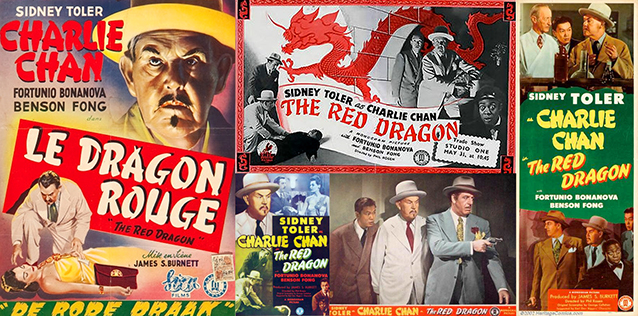
The Red Dragon


Justice Ink

The Red Dragon
USA 1945 Directed by Phil Rosen
Monogram/Warner Bros DVD Region 1


So it’s been a little while, again, since I reviewed a Charlie Chan film... mostly because of lack of availability of the few movies left in the series that had never been commercially released on a home video platform. Now, a pricey division of Warner Brothers called Warner Archives have finally released the remaining few Chan titles on DVD in a two disc, three movie set... comprising the remaining two Roland Winters titles (don’t worry... I’ll get to those in separate reviews) and this one, The Red Dragon, a missing gap from the Sydney Toler portrayals of the famous detective from Hawaii. Of course, regular readers will probably know my absolute favourite actor to portray Chan was Warner Oland, and there are actually a few of his earliest appearances in the character which are still not available. However, this is because those first few to star him are pretty much missing in action and, unless a bunch of film reels show up in some odd location someday... it looks like they’ll be lost forever. Still, I remember the unbelievable resurrection from the ashes of the, more or less, full original cut of Fritz Lang’s Metropolis a few years back so... you know... never say never.

The film starts off promisingly with an opening credits painting which is the most expressive and interesting I’ve seen used in the series. Depicting Toler’s head and shoulders in the bottom left and a big dragon taking up the rest of the frame where the credits overlay. It’s pretty great but, alas, even with late series regular Phil Rosen returning to directing duties, the quality of the rest of the movie does little to live up to the magnificence of this title card. However, from a film historian’s perspective, as opposed to just kicking back and enjoying the movie, this has its little bonuses too. I must ask a film historian to verify this, next time I see one.

So, yeah, there’s good and there’s bad and I’ll get to the worst thing first because it’s the very thing that reveals the silver lining in this one...

The acting is really terrible. Seriously, it’s so wooden at times it creeks and although these films don’t always have the best players, they’re usually better than this. Now, it may, to an extent, be something to do with the staging of the action because... well, there’s an awful lot of chance encounters which lead to conversations to drive along the plot. For instance, man comes out of lift, bumps into other man who happens to be waiting for the lift, and the two talk, standing statically, for the next minute or two. This is a really flat and less than dynamic way to fill the audience in on the plot details, it has to be said. But so is the line delivery of the majority of the actors, so I’m not letting them off the hook here, either.

The good thing though, from a historical viewpoint, is that the main regular cast are all very natural and comfortable and run rings around the rest of the players. Take Toler himself, for instance. You really do get a sense of just what a consummate and professional actor he was here. When you see how stilted almost everyone else is in this, you get the chance to compare him and realise just how good he was at bringing the Charlie Chan character to life. I got a real appreciation of Toler above and beyond the usual assumption that he will play the role as best he can, with this one.

Benson Fong returns here as number three son and, although he acquits himself quite well, he’s not given too much more to do than look puzzled and interested at his ‘Pop’s’ conclusions and deductions here. He also has the usual two hander comic relief moments but this time, instead of Mantan Moreland playing his ‘funny black man’ role as chauffer Birmingham Brown, Fong gets to partner up with Willie Best as Birmingham’s cousin Chatanooga Brown, who played in at least three Chan films and played Chatanooga at least twice. The difference between Best and Moreland is not too great, however. He comes across as a maybe slightly younger, slimmer version of Moreland himself, given exactly the same kinds of lines and scaredy cat actions to follow but without the occasional added wit of Mantan Moreland’s two man stand up comedy routine that the writers occasionally drew from and threw into the mix. Best is fine, however and, though his lines are pretty forgettable in this, he doesn’t let the side down when it comes to playing the part of the Chan family chauffer here. Of course, Moreland would return to the series again later.

We also have a lady who was joggling at my memory as I was watching her all the way through the film. She’s not exactly outstanding in this but I knew the face and I somehow managed to miss her name in the credits. Turns out she’s Carol Hughes, who Flash Gordon fans will recognise as being the second of the on-screen Dale Ardens, appearing in the third of the three initial Buster Crabbe serials, Flash Gordon Conquers The Universe, for Universal. This means that both of the serial actresses who played Dale Arden have appeared in a Charlie Chan film and both opposite Sydney Toler’s version of the character. Jean Rogers, who played Dale in both Flash Gordon and Flash Gordon’s Trip To Mars starred in an earlier picture in the series, Charlie Chan in Panama. I know what you’re thinking... A Chan, A Plan, A Canal, Panama but... no, it doesn’t quite work like that.

The film is kinda hum drum in a lot of ways but it does, at least, have a genuine mystery at it’s heart and Charlie Chan flies to assist a character who has a history of solving cases with him but whom, in terms of actor and character, I could find no trace of within the history of the Chan movies. In this case, the first murder is committed in a room full of witnesses, as the victim gets a bullet for his troubles. It’s quite comical to watch him as he, in his final moments he takes the time to type a dying clue on his nearby typewriter. The trick is, though, that although one shot is heard, two bullets have been fired, on slugs which have never been rifled down to be fired from a firearm. And what is the significance of The Red Dragon Chinese ink at the scene of the first crime, which gives the movie its name? Is it something to do with the papers which tell of the mysterious, newly discovered,  ‘missing element’ that can cause even more widespread atomic damage than the recently exploded atom bomb?

Only Charlie Chan can work out the answers to this Chinese puzzle, which, of course, he does in the short running time of the film. The mystery behind the double shot bullets with no visible firearms is a bit of a dreary one but the idea of that particular challenge is a good one. The only other outstanding thing I noted in this viewing was that, once the killer has been unmasked, so to speak, by Chan on a staircase, he breaks free from the police and has a go at Chan himself. It’s unusual for Chan to get in on the action in these kinds of movies... that’s why he always has either number one, two or three son with him... because they’re young enough to get into fist fights. Here, Toler deftly grabs the leg of the killer and throws him downstairs. So a little unusual but welcome bit of mild action shenanigans for Chan in this one.

And that’s me done here. The Red Dragon is nowhere near one of the greats in terms of the Chan movies but people who like these films will no doubt want to check this one out. I’ve always liked the Charlie Chan movies and so this new Warners set is an unmissable release as far as I’m concerned. If you’re into the Chan then make haste and purchase honourable DVD collection before bird is no longer early enough for worm!

Sunday, 12 January 2014

Shadows Over Chinatown


Toler Powered

Shadows Over Chinatown
1946 USA
Directed by Terry O. Morse 
Monogram - Warner DVD Region 1

Shadows Over Chinatown is the penultimate of the Charlie Chan films to feature Warner Oland’s replacement, Sidney Toler. I reviewed his final film in the role, before Roland Winters continued in the series, in my review of The Trap (here).

The film starts off very promisingly... 13 passengers on a bus in a rainstorm, including Charlie Chan, Number Two son Jimmy and regular chauffeur Birmingham Brown (as played by Victor Sen Yung and comedian Mantan Moreland), are forced in to a stop to sort the bus out. This is almost a perfect recipe for a murder mystery, I thought to myself, as I was expecting the whole film to be set in the large passenger waiting room... however, it was not to be and is only a brief stop to get the plot up and running and also have someone make an attempt on Charlie Chan’s life.

Two things happened in this opening sequence. One was that I spotted, right off the bat, that one of the background passengers, who even has a couple of words, is an uncredited appearance by John Hamilton... who would, in later years, go on to play Perry White opposite George Reeves in the 1950s TV series, The Adventures of Superman. So it was nice seeing him for the brief amount of screen time he gets here.

The other thing that happened, which popped me right out of the movie, is the little bit where the passengers come into the interior of the bus station. In long shot, the aforementioned Hamilton is seen making a show of taking off his light grey raincoat, to reveal a much darker suit, and then removing his hat before sitting down at the right of the screen. However in the next shot, which is a close up grouping of the same set of characters, he is sitting with his raincoat on and all done up. If I could spot that on what may be my first viewing (I may have seen this one back in the 1980s, I’m not sure) then I’m sure audiences back in 1946 seeing it on a much larger screen would have spotted that error as well. It’s a big one and I had to wind it back to make sure I hadn’t got confused with the characters and believe what I’d just seen. Such a shame.

And then, after an attempted murder in which Chan is saved from certain death by the birthday watch his son gave him stopping a bullet, the bus journey continues and the plot switches to the big city... which is a shame really.

Now then, this film is really not terrible and had me entertained throughout... but it did seem a little tired and lazy for a Charlie Chan mystery, to be sure. For instance, the identity of the killer, who I’m not about to reveal here, is someone who I was suspicious of throughout the whole movie and so it came as absolutely no surprise when the killer is finally revealed. Which is a shame because I was really hoping I was wrong and there are enough suspects in this one... at least at the start of the film... by the end they’ve kinda thinned out a bit due to either transforming themselves into allies of Charlie Chan or turning up on the receiving end of a bullet or knife blade.

The usual comedy shenanigans of Victor Sen Yung and Mantan Moreland are all present and correct, although in some sequences they are starting to get a little surreal and, in all the sequences, I’m afraid that they feel like exactly what they are... comedy padding to puff up the running time.

All the performances are fine, though, and if the script does seem very lacking at some points, it’s at least convoluted enough to keep the characters up to various pursuits... even if the identity of the killer seems to be more and more obvious as each fresh corpse turns up. The dialogue seems equally jaded, for this humble viewer, too... with the usual Chan aphorisms and retorts seeming a little less cute or charming and a far cry from the sparkling pearls of wisdom that had turned up in other films starring either Oland or Toler in the role.

All in all though, this is not a spectacularly dull film and the overall feel, while maybe not a solid, mystery thriller, is still one of “they don’t make movies like these anymore”... while at the same time begging the dubious question of... “But, should they?”

I am, however, very pleased that Warner Brothers have seen fit to release this Region 1 boxed set of four, previously unreleased on commercial DVD, Charlie Chan films, which includes this Toler film and three of the Roland Winters entries. I’ve only ever seen one of Winter’s films, in a previously released box set, so am looking forward to watching the three in here to see how well he does in comparison to his predecessors. Reviews of those three will be coming soon... watch this space.

Saturday, 11 June 2011

Charlie Chan: The Untold Story


A Proper Charlie

Charlie Chan: The Untold Story of the Honourable Detective and His Rendezvous with American History by Yunte Huang
Publisher: W. W. Norton & Co.
Language English
ISBN: 0393069621

A friend of mine sent me this book for my birthday and I’m well pleased to have it and have read it. I’ve always liked Charlie Chan... ever since my first experiences at a very young age with the old Hanna Barbara cartoon, The Amazing Chan and the Chan Clan (with Charlie voiced by Keye Luke... no stranger to the world of Charlie Chan as he played Number One Son Lee Chan opposite Warner Oland, Roland Winters and Peter Lorre in one of the Mr. Moto films). This lay the seeds so that later, in the early eighties, I was able to appreciate the old 1930s and 1940s Warner Oland and Sidney Toler movies that BBC2 used to screen at 5.40pm on a Thursday evening.

Since then I’ve obviously read the six (only six were written!) original Earl Der Biggers novels and acquired as many of those old movies as I’ve been able to get. I’ve also managed to grab the movies featuring two of Charlie Chan’s spiritual cousins, Mr. Moto and Mr. Wong, who doubtless made it into movie versions riding the back of the success of the Charlie Chan series.

In this book, the writer traces the lineage of the character and concentrates not so much on Charlie Chan himself, but with the history of the Chinese in Hawaii and Honolulu (Charlies stomping ground) and more specifically with legendary police officer Chang Apana who was said to be the real life inspiration for Charlie Chan and was known as such by his contemporaries... and still is to this day.

Now I’m not a great one for history books but this one is pretty entertaining and readable and I’m very glad to have read this little peak into Chinese culture and its racial tensions. Details of a post-Chang Apana murder case scandal which was very much racially manipulated to get the “incorrect” but “right” verdict fair made my blood boil (as I hope it would any modern reader) and the delightful story of a distinguished Naval Captain meeting his untimely death by being killed by the celebratory cannon fire meant to salute and welcome him in his honour as his ship pulled into harbour, although ultimately tragic, was the source of much mirth for this reader.

I think the links between Earl Der Biggers character and Chang Apana are kind of tentative though, to be honest. He’d already written the first three of the six novels before meeting and getting to know Chang Apana and, though a case is made that the newspaper article of a heroic arrest made by a Chinese Police Officer in Hawaii that inspired the inclusion of Bigger’s Charlie Chan character in the novel The House Without A Key may well have been, in fact probably was, an arrest carried out by Chang Apana... I personally don’t see this as validation that the claim that Chang Apana was the real life basis for Charlie is a correct one. However, when Biggers and Apana were finally introduced, it’s quite clear that Biggers was more than happy to let that idea stand and even perpetuate it himself. Good publicity, after all, is money in the bank.

This book is a great little, almost random, summary of Chinese people in American culture and this also includes lightly touching on other fictional characters such as Sax Rohmer’s Fu Manchu (who had also been played by Warner Oland a few times on screen). I’ve read the Fu Manchu novels myself and think they’re brilliant pulps (along the lines of Conan Doyle’s Sherlock Holmes stories) and I’m glad I now know that the English (very much English and staying put in his own country thank you very much, more tea guv’nor?) author Arthur Henry Sarsfield Ward, better known as Sax Rohmer, died ironically of one of the first strains of Asian flu on these shores. That has a nice circularity to it.

The downside of this book for me is the persistent racial element. The writer Yunte Hunag is a Chinese lecturer living in America and he seems to have written this book coming from a place which admires the exploits of the fictional detective and his perceived ancestry while being torn by the undeniable racial stereotype which the character falls in. This is okay and since I’ve never been racially oppressed (as far as I can remember) it’s really not my right to judge anyone who has been oppressed in this way but, as I was reading, I got the feeling that the writer was kinda ramming this down my throat a little and getting very assertive about the acceptance in popular culture of this kind of racial stereotype. This book seems like it’s been written as a defence of the Chinese race when, to someone like me, no defence is or would ever be needed for any race or species living on the planet. So I was possibly feeling a little perplexed at the constant reminders throughout the book and the constant necessity to compare racist slurs against Chinese folk with racial slurs against other races which the reader may find more popular or accessible (?) and come to an understanding of them as they compare to various intimations about the Chinese race.

Now I, and I would hope this is the case with most people, just tend to see Charlie Chan as an entertaining, Chinese hero... a keeper of the peace who polices his beat with a well aimed aphorism and less often the unsophisticated thuggery which gun play might bring. And that’s enough for me. It’s no more complicated than that. Yes, I can see that my “simplistic entertainment” view of Charlie (which to be fair to myself, is the purpose he was created for) doesn’t allow me to see or respond at the racial stereotypical characteristics embedded in our subconsciousness by such broad and possibly offensive portrayals such as these... and I take on board that this is probably Hunag’s precise point, that we’ve all been programmed by such characterisations from birth without realising it. By the same token, though, I would have never have even thought that there was any implied racial slur ingrained in these character portrayals unless I’d read this book and had them pointed out to me... and then again, that’s probably also something which Hunag wants me to realise. But it does rather delve too deep into a character and a stupid gaijin like myself would rather be entertained by a character and writer I admire rather than ponder the historical subtext of racial antagonism that such a character, almost certainly inadvertently on the part of Earl Der Biggers, conjures up in the minds of some. Maybe I’m just too simplistic a person to bother with such things. And maybe I should be more bothered in the future but, seriously, a persons race or skin colour is an unacceptable thing to base an opinion of a person on and so I just tend not to look at people in a racist manner. Thank goodness. At least not so far as I am aware.

Don’t get me wrong, Yunte Hunag is not completely gung ho about this slant on the character and he is trying to make the reader aware of this subtext while clearly loving the subject of his novel as much as any Charlie Chan fan in the world. I did, however, find it the one tiresome element to an otherwise absolutely excellent historical portrayal of the effects of America on Chinese culture.

Whichever way you cut it though, this is a great book and should definitely be on the “to read” pile if you’re a fan of the great, literary detective... even if it doesn’t cover the movies so much as the real life careers of Chang Apana and, to a certain extent, Earl Der Biggers. Definitely a resounding recommendation on this one!