Showing posts with label Mantan Moreland. Show all posts
Tuesday, 20 June 2017
The Sky Dragon
Cabin Clue
The Sky Dragon
USA 1949 Directed by Lesley Selander
Monogram (via Warner Archive) DVD Region 1
I don’t think it was deliberate but, for one reason or another, The Sky Dragon was the last of the 47 Charlie Chan talkies made between 1929 and 1947. This brought to an end what had been a ‘mostly’ profitable series of films, albeit via a law of diminishing returns as the series went through cheaper studios and shrinking budgets as it wore on. Original number one son Lee Chan, as played by Keye Luke, is back as the only one of the Chan offspring present, playing opposite Roland Winters in his last go at the honourable Hawaiian detective. Luke had returned a few films previously and, while he was once the juvenile comic relief, putting him back in here in that spirit maybe made a bit less sense because he and his on screen father Winters, were both the same age.
Also back, of course, is the later series regular Mantan Moreland, continuing his wisecracking, perpetually fearful chauffer routine as Birmingham Brown although, it has to be said, the only decent scenes he gets in this are opposite Lousie Franklin, who plays the maid of one of the murder suspects in this film.
There’s also, much to my delight, the inclusion of actress Noel Neil in the proceedings. Noel Neill was, as you no doubt know... the original Lois Lane, first starring in that role opposite the very first cinematic Superman Kirk Alyn in the theatrical serials Superman (1948) and Superman Vs Atom Man (1950). This was one of a few movies she made in between those two serials. Of course, she also went on to reprise her role as Lois Lane opposite George Reeves in the 1950s TV show The Adventures of Superman from the second series onwards (Phyllis Coates left the role after her first season). She later turned up in a “blink and you’ll miss it” cameo as Lois Lane’s mother in one of the extended cuts of the 1978 motion picture Superman The Movie (again opposite Kirk Alyn, playing Lois' dad) and later performed as an old, dying woman ripped off by Kevin Spacey’s Lex Luthor in the opening of the 2006 movie Superman Returns. I think she also got some ‘Super’ TV cameos under her belt as well (before her death last year at the age of 95).
Alas, Noel is wasted in this movie as she doesn’t have much to do except provide a friendly female face and provide Charlie Chan with helpful information to clear her fiance of the murder charge when the occasion arises but... it was nice to see her here again, for sure.
This film starts off in an airplane as a man is murdered for the half a million dollars he is carrying while the rest of the crew and passengers are drugged, unconscious. These passengers include Charlie Chan and his number one son who then set about the rest of the movie trying to find the identity of the killer and, as usual, try to find the truth of the matter while the police jump at every opportunity to convict an innocent person of the crime. The police never really came off that well in these films, to be fair.
This is not the best of the Chan films I’ve seen, in all honesty, but it is pretty fast moving for it’s ‘just over an hour’ B-movie running time. The trail of the mystery is kept lively by a bunch of murders, incidents, tussles with possible suspects and Lee Chan pulling a wedding director from a fire after his garage has been set ablaze... with him in it... in an effort to destroy some camera negatives which will reveal the all too obvious, to this viewer at any rate, identity of someone in the film.
However, while the pacing is quite tight, I can’t say I was really all that impressed with the film and nothing much really stood out other than the occasional, expected, Charlie Chan aphorism which are peppered throughout the short running time with, it seemed to me, just a little less joy than they have been in some of the previous films. I liked the idea of the murder and theft taking place on the plane but would have really loved it if the entire movie had taken place in that plane with Charlie solving the crime before the plane lands and it would have given the perpetually cash strapped Monogram Pictures a cheaper budget, too, I would suspect... having to shoot on only one set. However, after the first quarter of an hour the action moves out of the plane and I suppose it’s easier to keep the pacing up when your characters can go from incident to incident as the story progresses. Monogram had been going since 1924 but released their last movies in 1952, so things must have been really tight by this point.
It would have been nice to see the series continue on after The Sky Dragon, although there was still a little life in the character after these films had come to an end. For me, those early days of Warner Oland playing Charlie opposite Keye Luke as a much more youthful “number one son” are still my favourites... but I honestly don’t mind Sydney Toler and Roland Winter’s takes on the character and I will probably be rewatching these movies over and over until I die (which hopefully won’t be very soon). Take this movie for what it is, a mildly entertaining entry into a great series of classic Hollywood detective yarns. And... just by way of a heads up... although it’s the last in that series of Charlie Chan films, I’m not planning on making this my last review of a Charlie Chan movie. Watch this space.
Wednesday, 12 October 2016
The Feathered Serpent
Chan Clan Phooey
The Feathered Serpent
USA 1948 Directed by William Beaudine
Monogram/Warner Bros DVD Region 1
So here we have The Feathered Serpent, the penultimate of the six films where Roland Winters played Charlie Chan and, although it’s not an especially entertaining edition of the exploits of the world’s most famous Chinese American detective, it is one which is quite unique in the history of the series. It’s the only one of the original run of films which spanned nearly two decades and various companies to feature two of Charlie Chan’s sons in the same film, together. Namely Number Two son, played by Victor Sen Yung and, after a very long absence, Keye Luke as Number One Son.
Now Keye Luke was an artist who used to paint posters for various movies until he shot to fame in the original US run of Charlie Chan films opposite Warner Oland, my favourite Chan man, in the title role. I always remember him from watching the Charlie Chan films as a kid where he used to run in on a scene, usually thinking he’d solved the mystery and yelling something along the lines of “Gee, pop!” When Oland died unexpectedly, Luke had already shot some scenes for the next movie and these were transplanted, with new scenes added, when the Charlie Chan film was hastily rewritten and turned into one of the Mr. Moto films with Peter Lorre. The 1938 film Mr. Moto’s Gamble, to be precise, which I reviewed here. After the films were recast with Sydney Toler, Luke declined to continue in the series and so number two and three sons replaced him, on and off, for the majority of the Toler films. But, one decade later, Keye Luke was back in the series, opposite Roland Winters... regardless of the fact that he was slightly older than the man playing his father at this time (many years later, Luke would go on to voice Chan himself in the Charlie Chan cartoon show).
Now, with Mantan Moreland continuing in his role as the Chan family chauffer Birmingham Brown, you might think, with the three of them, that there are now way too many sidekicks for a Chan film to comfortably handle and, to tell the truth, you’d be right. How many 'on screen dummies' do you need to explain things to under the banner of audience exposition? I might be a little harsh on the idea, actually, because the writing on this one isn’t that great, even though it’s a remake of a former 1937 Western, The Riders of the Whistling Skull.
Roland Winters seems a little too laid back in this one, it seems to me and... I have to wonder what he thought of Keye Luke returning to the role. It’s a bit of a puzzler because I’m presuming they really went to town ageing Winters on this one in some subtle way because, as I indicated above, Keye Luke who is seen playing his offspring is, actually, five months his senior. Something only Hollywood could be bold and stupid enough to get away with.
This one isn’t so much a mystery story, since the villain behind the plot of this tale of a doomed archeological expedition reveals himself fairly early on in the proceedings. The set up is such that, with Chan and his team on vacation in Mexico, they find themselves suddenly embroiled in a plot when the man they rescue from the roadside turns out to be one of two missing scientists that another expedition are trying so hard to find. That means it’s up to Chan to help them find the scientist in question and also find the hidden Aztec lair full of buried treasure. So, yeah, the usual stuff but the execution of it here leaves a lot to be desired, I think.
There’s lots to groan about in this one, too. When the lights go out in a house at night and the first murder is committed under cover of darkness, it only takes the lighting of one single candle to suddenly plunge the set back into a fully lit shot set up. Oh dear.... still, Monogram were not known for being particularly brilliant film studios, that’s for sure. These Monogram films had a much smaller budget than the 20th Century Fox produced movies and, although some of the Monogram Chan films are excellent, the lack of production value really shows on this one.
Another groaner is when Chan and his sons, with Birmingham Brown tagging along, decide to join the expedition, Number One and Two sons immediately dress up in safari suits, along with obligatory pith helmets... this looks really silly. Actually, one of the great problems with this is the apparent lack of chemistry between Keye Luke and Victor Sen Yung. This would be Yung’s final Charlie Chan film... although he’d started back when Sydney Toler first took over from Warner Oland, with Benson Fong also playing number three son in the films where Yung wasn’t available. Now, I’m not sure if this lack of dynamic interaction between the two is a personality thing or whether it’s because they have just been given some terrible lines to work with here. What I do know for sure is that, once again, Mantan Moreland’s portrayal as comic relief Birmingham Brown is fantastic and he somehow manages to get the best lines, again, in this one. For example, when he wants to get out of a scary situation he says to one of them... “There’s somebody I’d like to see outside.” When he’s asked who, he answers “Me!”. Similarly, in another moment when he’s at a disagreement about staying where the trouble is, he reminds his boss... “Oh Mr. Chan, we’re on vacation. Why don’t we vacate?”
So yeah, Moreland and his quick fire dialogue really helps hold the movie together, for me, but ultimately, this one does fall kinda flat. There’s a nice mixture of moving camera and also static edits in and out of compositions but, at the end of the day, there’s just not enough going on here and it’s just not well written. Even the comedy moment which you can see coming a mile off, with Moreland sitting on a rock and accidentally activating the entrance to the hidden temple, is not milked the way it might once have been and it’s just a genuinely dull affair, for most of the short running time. The Feathered Serpent is not a Chan film I’d recommend anybody start on but, if you are a die hard fan of the series, the fact that he has two sons sharing the screen with him is certainly interesting. If you want to get excited about Charlie Chan, however, go back to the Warner Oland movies first, would be my advice.
Friday, 19 August 2016
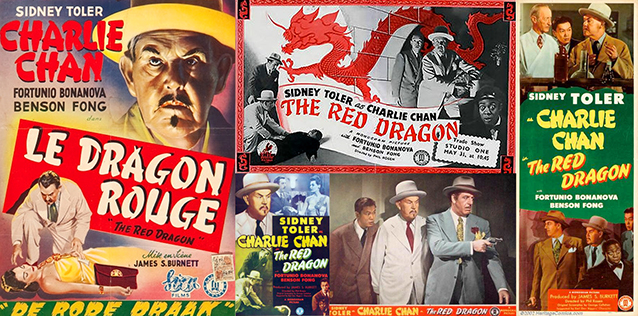
The Red Dragon
Justice Ink
The Red Dragon
USA 1945 Directed by Phil Rosen
Monogram/Warner Bros DVD Region 1
So it’s been a little while, again, since I reviewed a Charlie Chan film... mostly because of lack of availability of the few movies left in the series that had never been commercially released on a home video platform. Now, a pricey division of Warner Brothers called Warner Archives have finally released the remaining few Chan titles on DVD in a two disc, three movie set... comprising the remaining two Roland Winters titles (don’t worry... I’ll get to those in separate reviews) and this one, The Red Dragon, a missing gap from the Sydney Toler portrayals of the famous detective from Hawaii. Of course, regular readers will probably know my absolute favourite actor to portray Chan was Warner Oland, and there are actually a few of his earliest appearances in the character which are still not available. However, this is because those first few to star him are pretty much missing in action and, unless a bunch of film reels show up in some odd location someday... it looks like they’ll be lost forever. Still, I remember the unbelievable resurrection from the ashes of the, more or less, full original cut of Fritz Lang’s Metropolis a few years back so... you know... never say never.
The film starts off promisingly with an opening credits painting which is the most expressive and interesting I’ve seen used in the series. Depicting Toler’s head and shoulders in the bottom left and a big dragon taking up the rest of the frame where the credits overlay. It’s pretty great but, alas, even with late series regular Phil Rosen returning to directing duties, the quality of the rest of the movie does little to live up to the magnificence of this title card. However, from a film historian’s perspective, as opposed to just kicking back and enjoying the movie, this has its little bonuses too. I must ask a film historian to verify this, next time I see one.
So, yeah, there’s good and there’s bad and I’ll get to the worst thing first because it’s the very thing that reveals the silver lining in this one...
The acting is really terrible. Seriously, it’s so wooden at times it creeks and although these films don’t always have the best players, they’re usually better than this. Now, it may, to an extent, be something to do with the staging of the action because... well, there’s an awful lot of chance encounters which lead to conversations to drive along the plot. For instance, man comes out of lift, bumps into other man who happens to be waiting for the lift, and the two talk, standing statically, for the next minute or two. This is a really flat and less than dynamic way to fill the audience in on the plot details, it has to be said. But so is the line delivery of the majority of the actors, so I’m not letting them off the hook here, either.
The good thing though, from a historical viewpoint, is that the main regular cast are all very natural and comfortable and run rings around the rest of the players. Take Toler himself, for instance. You really do get a sense of just what a consummate and professional actor he was here. When you see how stilted almost everyone else is in this, you get the chance to compare him and realise just how good he was at bringing the Charlie Chan character to life. I got a real appreciation of Toler above and beyond the usual assumption that he will play the role as best he can, with this one.
Benson Fong returns here as number three son and, although he acquits himself quite well, he’s not given too much more to do than look puzzled and interested at his ‘Pop’s’ conclusions and deductions here. He also has the usual two hander comic relief moments but this time, instead of Mantan Moreland playing his ‘funny black man’ role as chauffer Birmingham Brown, Fong gets to partner up with Willie Best as Birmingham’s cousin Chatanooga Brown, who played in at least three Chan films and played Chatanooga at least twice. The difference between Best and Moreland is not too great, however. He comes across as a maybe slightly younger, slimmer version of Moreland himself, given exactly the same kinds of lines and scaredy cat actions to follow but without the occasional added wit of Mantan Moreland’s two man stand up comedy routine that the writers occasionally drew from and threw into the mix. Best is fine, however and, though his lines are pretty forgettable in this, he doesn’t let the side down when it comes to playing the part of the Chan family chauffer here. Of course, Moreland would return to the series again later.
We also have a lady who was joggling at my memory as I was watching her all the way through the film. She’s not exactly outstanding in this but I knew the face and I somehow managed to miss her name in the credits. Turns out she’s Carol Hughes, who Flash Gordon fans will recognise as being the second of the on-screen Dale Ardens, appearing in the third of the three initial Buster Crabbe serials, Flash Gordon Conquers The Universe, for Universal. This means that both of the serial actresses who played Dale Arden have appeared in a Charlie Chan film and both opposite Sydney Toler’s version of the character. Jean Rogers, who played Dale in both Flash Gordon and Flash Gordon’s Trip To Mars starred in an earlier picture in the series, Charlie Chan in Panama. I know what you’re thinking... A Chan, A Plan, A Canal, Panama but... no, it doesn’t quite work like that.
The film is kinda hum drum in a lot of ways but it does, at least, have a genuine mystery at it’s heart and Charlie Chan flies to assist a character who has a history of solving cases with him but whom, in terms of actor and character, I could find no trace of within the history of the Chan movies. In this case, the first murder is committed in a room full of witnesses, as the victim gets a bullet for his troubles. It’s quite comical to watch him as he, in his final moments he takes the time to type a dying clue on his nearby typewriter. The trick is, though, that although one shot is heard, two bullets have been fired, on slugs which have never been rifled down to be fired from a firearm. And what is the significance of The Red Dragon Chinese ink at the scene of the first crime, which gives the movie its name? Is it something to do with the papers which tell of the mysterious, newly discovered, ‘missing element’ that can cause even more widespread atomic damage than the recently exploded atom bomb?
Only Charlie Chan can work out the answers to this Chinese puzzle, which, of course, he does in the short running time of the film. The mystery behind the double shot bullets with no visible firearms is a bit of a dreary one but the idea of that particular challenge is a good one. The only other outstanding thing I noted in this viewing was that, once the killer has been unmasked, so to speak, by Chan on a staircase, he breaks free from the police and has a go at Chan himself. It’s unusual for Chan to get in on the action in these kinds of movies... that’s why he always has either number one, two or three son with him... because they’re young enough to get into fist fights. Here, Toler deftly grabs the leg of the killer and throws him downstairs. So a little unusual but welcome bit of mild action shenanigans for Chan in this one.
And that’s me done here. The Red Dragon is nowhere near one of the greats in terms of the Chan movies but people who like these films will no doubt want to check this one out. I’ve always liked the Charlie Chan movies and so this new Warners set is an unmissable release as far as I’m concerned. If you’re into the Chan then make haste and purchase honourable DVD collection before bird is no longer early enough for worm!
Wednesday, 26 March 2014
The Golden Eye
Miner Incursion
The Golden Eye
1948 USA
Directed by William Beaudine
Monogram - Warner Brothers
DVD Region 1
Well it looks like this may be my last Charlie Chan movie review for a little while... until either Warners or some other interested party decide to commercially release the few missing movies I don’t have yet... or until I maybe go back to the start and watch them all over again.
This is the fourth of the six movies headlining Roland Winters in the role of Chan and, blimey, I’m finally starting to get used to the guy. Either he’s grown on me big time or the writing on this one is more able to play to the strengths of the actor and the way he performs the role. Either way, this movie is a pretty fun romp in the series and certainly the best of the Winters’ films I’ve seen to date.
One of the reasons for this may be because Chan is totally on the case in this one and has a lot more to do with the story than usual... not just leaving it to other characters to play out the running time. Don’t get me wrong, this film still has a lot of supporting players including the second of three regular appearances by Tim Ryan as police “Lt. Mike” as Chan calls him... who does a great job acting as a whacky, undercover drunk (then immediately sobering when he visits Chan to exchange information). Some great and thoroughly entertaining acting going on here in this one. And, of course, the later Chan’s would be incomplete without the double act routines of Victor Sen Yung as Number Two Son and Mantan Moreland as chauffeur Birmingham Brown. Their scenes are a little less frequent than usual, which allows Winters and Ryan to shine, but their presence is still very much felt and a wonderful bit of business takes place at the start where they are dressed in dodgy cowboy outfits, packing to go under cover in a resort Western town (the Lazy Y Ranch) which is situated near The Golden Eye gold mine... which gives this film its title.
The plot is pretty obvious in both its execution and denouement, with a mystery involving a non profitable gold mine which has suddenly become very profitable for absolutely no reason... you pretty much figure out what is going on there right from the bat. However, as with a lot of these kinds of formulaic films with running characters, the plots are merely a skeleton to hang some nice scenes on which show the characters you know and love in their best light and, like I said earlier, this one’s a fun old romp.
There’s kind of a “surprise” villain in this one too but, honestly, if you didn’t see that one coming then you’ve not been watching enough mystery movies during your life. There are no "real" surprises here but plenty of smiles and chuckles and I’m really glad to see Winters really getting into the part here... even if Chan’s days as a running, cinematic icon were, sadly, numbered.
There’s a very strange bit right at the end where, after Chan has revealed the solution to the mystery and the various bad guys have been captured or met with death, Mantan Moreland gets a last say in the movie. Birmingham Brown steps right out of the scene, walks over to the camera and breaks the “fourth wall” by talking to the audience in a little “wrap up” monologue all his own. I don’t recall ever seeing this happen in a Charlie Chan movie before and I’m wondering if this was something the director was trying out as a feature to use in forthcoming films in the series. Not having access to the final two stories, as yet, this isn’t something I am going to easily find out, I suspect.
As Chan films go, The Golden Eye goes a long way to capturing the magic in a bottle of some of the Warner Oland and Sydney Toler movies in the series and I have to say I thoroughly enjoyed this one. Just hoping somebody will release the missing Chans to us sometime soon though. I need my opium fix.
Sunday, 2 March 2014
Shanghai Chest
Chesty Coffin
Shanghai Chest
1948 USA
Directed by William Beaudine
Monogram - Warner Brothers DVD Region 1
Okay, it’s Charlie Chan time again. This is the third of the Roland Winters “end phase” of the Charlie Chan films, which were so popular that they’d racked up over forty films by this point. This is also the third one I’ve seen him in and I think, either he’s giving a slightly better performance than usual and has relaxed into the role by this point or... it may be that I’ve just finally gotten used to him.
The plot in this one isn’t bad though and the general writing and pacing of it really brings out the best of the performers, one of whom I was pleased to see, is Tristram Coffin, one of my favourite B-movie, serial and TV guys... perhaps best known for his portrayal of the title character in the Republic serial King Of The Rocket Men. Even Victor Sen Yung and Mantan Moreland, as Number Two son and chauffeur Birmingham Brown respectively, are back on form. Their comedy shenanigans are at their usual pace but they seem to be slightly better suited to slotting into the general story of this one and, though they are certainly used as padding at one point to increase the running time of the movie, they certainly don’t feel like they are being used in this way.
The plot is intricate in that it involves a murderer who is a) covering the tracks of his real motive by serially murdering from a list of potential victims in alphabetical order and b) is leaving the fingerprints of a dead and executed victim of the justice system behind at the scenes of the crimes to make it look like “revenge from the grave”. It all works pretty well and because of the confusion with the dead man’s fingerprints, we even get a nice scene with Charlie Chan experimenting with various chemicals, latex gloves and fingerprints (with Birmingham’s assistance) to demonstrate the possibility that a dead persons fingerprints can, indeed, be transferred onto various places with the aid of science.
I’m pretty sure I’ve seen the plot used here before, more than once, possibly even on a Chan movie, but I can’t remember just where. It doesn’t really matter though. This isn’t going to appeal to a lot of people but those who are fans of the Roland Winters Charlie Chan films should appreciate this one as being one of his better ones. The aphorisms still aren’t up to scratch but Winters performance seems a lot more confident and a little faster in the role.
There’s a slightly stronger racist element at play too, but it falls into the “quaint and that’s the way it was back then” category for me... although I can see why people would get upset about it. I’m talking about a scene where Sen Yung sends Mantan Moreland into the windows of a house on a dark night instead of going himself because Mantan will be “harder to see in the dark”. Not a great moment of political correctness, to be sure, but Moreland seems to have had no problem accepting his regular wage from the exploitation of his Brimingham Brown role (a role which he plays extremely well in most, if not all, of his Charlie Chan outings) and I doubt anyone was much worried about it at the time. I’m aware I’m watching this from a different historical context so I’m not going to lose any sleep over it, to be honest.
The one thing which lets down the mystery side of things here is the fact that we always see the killer as a shadowy figure and never see his face until he is revealed at the end. However, since the murderer is fairly tall and stocky, and since the cast is fairly limited, it doesn’t take too long for the viewer to figure out who the real culprit is, on this one. There’s really only one person of that stature on the set... so that’s a bit of a shame. What is interesting, though, is that the film features a scene where the killer uses a stubby, six shooter revolver with a silencer screwed on the end. I don’t know when the silencer was first used on film but I bet this is one of the earlier appearances of it on screen (and if anyone does know... please drop me a line).
One strange thing is that there seems to be a few throwaway scenes with characters that feel like they are meant to lead to something bigger as links to clues but which are then dropped after they’ve been set up. A shady character in an insurance agency who gives Chan the runaround, for instance, makes a sinister phone call right after he leaves the building and then this is not mentioned again throughout the film. I think the script was possibly rewritten as it was being filmed and certain scenes became casualties of a hasty rewrite along the way. Not the best way to make a movie but that’s my guess and, after all, it was churned out by Monogram.
Another curio is that Charlie Chan is not from Shanghai and there is no “chest” in the film... which makes the title of the movie, being Shanghai Chest and all, possibly a greater mystery than the one which Chan and his colleagues are so intent on solving during the film’s short running time. But enough said on that one, I suspect. Cleverer minds than mine can work out the reasons why this is so.
These last attempts to capture Chan’s waning popularity by Monogram are nowhere near a match for the Warner Oland and Sydney Toler films, but Chan enthusiasts should enjoy this one and it’s certainly a lot better than Docks Of New Orleans (reviewed here). Give it a try sometime if you’re feeling particularly Chanthusiastic.
Friday, 31 January 2014
Docks Of New Orleans
What’s Up Docks?
Docks Of New Orleans
1948 USA
Directed by Derwin Abrahams
Monogram - Warner Brothers DVD Region 1
Warning: Ever so slight spoilers.
Okay, so Docks Of New Orleans is the second of Roland Winters' Charlie Chan films, made for Monogram after Fox had dropped the series a fair way into Sidnet Toler’s run. This is also only the second of the Winter’s films I’ve seen and so I’m still not all that familiar with this guy's way of playing the iconic role.
So I started watching this one and about 5 minutes in I’m getting strong feelings about it. For example, when one of the main characters goes into his office I said to myself... he’s not leaving that office alive. And I was right. And then I remembered how the murder was committed and I thought... wait a minute. I definitely haven’t seen this film before, have I?
Well I had and I hadn’t? Not only had I “kinda” seen it, it turns out that I “kinda” reviewed it on this blog too. This is a remake, it turns out, of one of the Boris Karloff Mr. Wong films... Mr. Wong, Detective, which I reviewed here. This is a less polished and even more sluggishly paced version of the same storyline and, if I didn’t know better (and I really don’t) then I’d say it was even shot on more or less the same redressed sets. Be interesting to find out if that was so.
Anyway, the murder weapons are not quite glass spheres in this one... they are actually glass radio tubes, which makes a little more sense. And the method of murder is still a brilliantly outrageous one. What happens is, when a certain pitch of note is played on a radio or instrument in the vicinity of a pre-planted radio tube, the glass shatters and releases a poison gas, instantly killing the occupant of the room near the radio. This is a particularly well staged murder in a scene (also, like many of them, found in the former Mr. Wong film) where a man is killed by the murderer pre-warning him of an attack by a letter. He is advised to lock himself in his study and not let anyone near him until police protection arrives. Of course, the victim does this and rings the police for help, thus summoning his own death when the pitch of the sound of the approaching police car shatters the glass tube and releases the poison gas. Maybe it’s a good definition of a poison pen letter?
The film is padded out with the usual routines of Victor Sen Yung as Number Two son (the name of the character played by this actor seems to change halfway through the series, for some reason) and Mantan Moreland continuing his Birmingham Brown role. Moreland even gets to do some of his two man stand up routine with another actor at one point in the film, but even this can’t liven up the proceedings that much and Tommy Chan and Brimingham Brown’s antics seem a little sedate and curtailed in this entry, compared to the comic heights they have sometimes reached in other entries in the series.
Roland Winters is kinda interesting as Chan... but perhaps not as suited to the role as his predecessors, it seems to me. He’s actually a quite good actor and he uses facial expressions well in the part. You can see his character thinking things through and reacting to things in a similar fashion, perhaps, to the way my favourite Charlie Chan, Warner Oland, performed the role. However, it has to be said that the performance is very slow paced and lethargically delivered. Many times I almost wanted to finish Winter’s lines for him because he seemed to be going so slowly.
The writing on this, also, is really not up to speed and I found the usual Chan aphorisms to be less amusing (read, less plain bonkers) than in previous films in the series. It’s hard to even pick them out as aphorisms in the dialogue to be honest... and that’s really a shame because it’s an essential signature of the Chan films and I’m sure Winters could have really got into the role if he was given more than these scripts to work with.
All in all, this is not too hot a Chan movie and I think I preferred the Mr. Wong version to this lukewarm remake. Still, it’s early days with the Winters' Chans for me and I look forward to seeing the next two films in this DVD set very soon.
Sunday, 12 January 2014
Shadows Over Chinatown
Toler Powered
Shadows Over Chinatown
1946 USA
Directed by Terry O. Morse
Monogram - Warner DVD Region 1
Shadows Over Chinatown is the penultimate of the Charlie Chan films to feature Warner Oland’s replacement, Sidney Toler. I reviewed his final film in the role, before Roland Winters continued in the series, in my review of The Trap (here).
The film starts off very promisingly... 13 passengers on a bus in a rainstorm, including Charlie Chan, Number Two son Jimmy and regular chauffeur Birmingham Brown (as played by Victor Sen Yung and comedian Mantan Moreland), are forced in to a stop to sort the bus out. This is almost a perfect recipe for a murder mystery, I thought to myself, as I was expecting the whole film to be set in the large passenger waiting room... however, it was not to be and is only a brief stop to get the plot up and running and also have someone make an attempt on Charlie Chan’s life.
Two things happened in this opening sequence. One was that I spotted, right off the bat, that one of the background passengers, who even has a couple of words, is an uncredited appearance by John Hamilton... who would, in later years, go on to play Perry White opposite George Reeves in the 1950s TV series, The Adventures of Superman. So it was nice seeing him for the brief amount of screen time he gets here.
The other thing that happened, which popped me right out of the movie, is the little bit where the passengers come into the interior of the bus station. In long shot, the aforementioned Hamilton is seen making a show of taking off his light grey raincoat, to reveal a much darker suit, and then removing his hat before sitting down at the right of the screen. However in the next shot, which is a close up grouping of the same set of characters, he is sitting with his raincoat on and all done up. If I could spot that on what may be my first viewing (I may have seen this one back in the 1980s, I’m not sure) then I’m sure audiences back in 1946 seeing it on a much larger screen would have spotted that error as well. It’s a big one and I had to wind it back to make sure I hadn’t got confused with the characters and believe what I’d just seen. Such a shame.
And then, after an attempted murder in which Chan is saved from certain death by the birthday watch his son gave him stopping a bullet, the bus journey continues and the plot switches to the big city... which is a shame really.
Now then, this film is really not terrible and had me entertained throughout... but it did seem a little tired and lazy for a Charlie Chan mystery, to be sure. For instance, the identity of the killer, who I’m not about to reveal here, is someone who I was suspicious of throughout the whole movie and so it came as absolutely no surprise when the killer is finally revealed. Which is a shame because I was really hoping I was wrong and there are enough suspects in this one... at least at the start of the film... by the end they’ve kinda thinned out a bit due to either transforming themselves into allies of Charlie Chan or turning up on the receiving end of a bullet or knife blade.
The usual comedy shenanigans of Victor Sen Yung and Mantan Moreland are all present and correct, although in some sequences they are starting to get a little surreal and, in all the sequences, I’m afraid that they feel like exactly what they are... comedy padding to puff up the running time.
All the performances are fine, though, and if the script does seem very lacking at some points, it’s at least convoluted enough to keep the characters up to various pursuits... even if the identity of the killer seems to be more and more obvious as each fresh corpse turns up. The dialogue seems equally jaded, for this humble viewer, too... with the usual Chan aphorisms and retorts seeming a little less cute or charming and a far cry from the sparkling pearls of wisdom that had turned up in other films starring either Oland or Toler in the role.
All in all though, this is not a spectacularly dull film and the overall feel, while maybe not a solid, mystery thriller, is still one of “they don’t make movies like these anymore”... while at the same time begging the dubious question of... “But, should they?”
I am, however, very pleased that Warner Brothers have seen fit to release this Region 1 boxed set of four, previously unreleased on commercial DVD, Charlie Chan films, which includes this Toler film and three of the Roland Winters entries. I’ve only ever seen one of Winter’s films, in a previously released box set, so am looking forward to watching the three in here to see how well he does in comparison to his predecessors. Reviews of those three will be coming soon... watch this space.
Monday, 18 October 2010
The Last Tolercoaster Ride
The Trap 1946 US
Directed by Howard Bretherton
Monogram DVD Region 1
And so we come to the last of the Charlie Chan films starring Sydney Toler in the role (although the Chan films would continue with Roland Winters). By this time Toler had been dying from intestinal cancer for a while and could barely walk some days and the last few films do kinda show a lack of energy from the title character. But the Chan films have always had a good supporting cast to share the action with... they’ve never really been completely Chancentric... even in the films when he was without the aid of number 1, 2 or 3 son. And by this time the Toler movies had not only one of his famous sons, Victor Sen Young back as Jimmy Chan, but also the regular presence of Mantan Moreland doing his regular Birmingham Brown routine. So the running around doing legwork scenes could be easily handled by two competent foils.
Even so, though, this is not exactly a great Chan film. It’s a bit slow and plodding and really just not as pacey as some of the others in the series. The cinematography isn’t bad though... but not as brilliant as it had been slightly earlier in the series. Most of the action takes place in sets of a house with a few small scenes on a highway and on a beach. There’s a really terrible beach set which looks really claustrophobic with a load of people grouped in it and which really draws attention to itself when it’s cut against some location shots of an actual beach. But this may have been written as having less locations due to the deteriorating state of the lead actor for all I know.
There are some great little character actors in this piece and... wait for it... Kirk Alyn turns up playing the usual policeman-who-needs-Charlies-help-with-the-case role. It was great to see him in this but, honestly, what a come down for the Man of Steel. When you think that this guy, just a few years earlier, had been the star of the two Superman serials! This guy is easily my favourite Superman (and a solid, no nonsense Clerk Kent for that matter)... why was he relegated to these kinds of roles? Oh well... at least they didn’t make him the “bumbling, comic relief” version of the policeman in this one... they save those kinds of scenes for Mantan Moreland... still he doesn’t exactly get a chance to shine either. Poor Kirk.
The acting in this one is a bit hit and miss. There are some irritating “screamers” in this house! But the saddest thing is when Charlie Chan goes off in hot pursuit of a suspect. How he caught him in his car is anybody’s guess because instead of walking to the vehicle in question, he slowly shuffles towards the vehicle aided by Jimmy and Birmingham and it really hits home that this guy can’t be playing Chan for much longer... he was dead within a year.
The revelation of the murderer actually was a revelation to me (I was hedging for Kirk Alyn’s policeman being behind the murders) but I barely recognised the character and her identity didn’t mean much to me. Just a quick pay-off to signal that the end of the movie is approaching, and with it the end of a second great era fr the Charlie Chan films. Warner Oland was always my favourite Chan but Toler also had a certain charm about him. Never seen a Roland Winters Chan movie but I have, "just one", on ice so I’ll uncork that dubious but hopeful pleasure in a week or two.
I really love the Charlie Chan movies but I’d have to say, if you’ve never seen a Charlie Chan movie before... don’t put this one anywhere near the top of your “to see” list.
Labels:
Charlie Chan,
Kirk Alyn,
Mantan Moreland,
Sydney Toler,
The Trap
Tuesday, 17 August 2010
A Channer Darkly
Dark Alibi 1946 US
Directed by Phil Karlson
Warner Brothers DVD Region 1
Finally, someone has released some more Chans on DVD! So I’m now catching up with the eighth Chan box set (eight if you include that lousy old UK Region 2 poorly transfered from TV screenings boxed set which was then superceded when the US started releasing the Chan’s right).
Dark Alibi is one of the later Monogram Chans starring Sydney Toler as Charlie. Now Sydney Toler was an excellent incarnation of Chan, no doubt about it... unfortunately he’s always compared unfavourably to Warner Oland, and yes there’s certainly no doubt in my mind that Warner Oland was the greatest Chan of all... but cut Sydney Toler some slack because he’s really pretty good in the role too!
This one co-stars Benson Fong as semi-regular character Tommy Chan aka Number Three Son (who you may also remember from his role 20 years later as one of the three evil scientist egghead villains from Our Man Flint) and Mantan Moreland as chauffer Birmingham Brown doing his usual scaredy cat role (NUTS4R@ readers who are regular horror genre enthusiasts may remember him playing almost the same role in King of the Zombies).
This movie starts off really well with some excellent chiaroscuro camera work. Silhouettes, shadows on walls, shots through bars... typical of the US film noir style which grew out of German Expressionism from two decades before (when is someone else going to figure that out... do I have to think of everything ;-). There is some really great, moody stuff in this opening robbery/murder scene but unfortunately the rest of the movie never again scales the visual heights so brilliantly introduced in this opening (which makes me wonder if the opening footage was lifted from another movie).
Still, it’s not a bad Chan movie. Not a patch on the Oland films of course, nor on the earlier Toler vehicles when the series was still at Fox! But it moves along at a pace... Benson Fong is pretty annoying however and Mantan Moreland, while always lovable, frays the nerves a bit on this one. Constantly talking to his legs to not run out on him there are numerous, repeated insert shots of his legs trembling which, it has to be said, really isn’t funny.
That being said, however, there are three nice scenes where Ben Carter, Mantan Moreland’s partner from his stand up comedy act runs some of their routines with him. While not as good as the routines they did together in the Chan movie The Scarlet Clue a year earlier, the scenes are still a welcome relief and one of them is chosen to conclude the picture by letting Charlie in on the routine himself. Sydney Toler would have been getting on a bit for now but he seems to do a pretty good job with his timing in this routine.
Other things of note in this entry in the series is a really intense scene where Charlie Chan appears to be shot at point blank range... I actually got nervous because there was no possible way out and I didn’t want to spend the rest of the movie with a recovering Chan in a hospital ward... however, the real villain of the piece has sabotaged the gun and the pseudo-henchman type villain only succeeds in killing himself with the booby trapped gun... which splits nicely into comical strips along the barrel.
Probably the worst thing about this movie, which is mostly set in a US prison, is its inability to leave you guessing on this one in the “whodunnit” stakes. The “surprise twist” villain at the end of this movie is almost a redundant scene because you pretty much guess the main culprit from that character’s first walk-on appearance early in the movie.
Still, all in all the majority of the Chan films are remarkably watchable and this one is no exception... even if Mantan Moreland was a little less on form than usual. Am looking forward to firing up the DVD player and putting the next one on soon.
Subscribe to:
Posts (Atom)