Showing posts with label Ania Pieroni. Show all posts

Wednesday, 2 March 2022

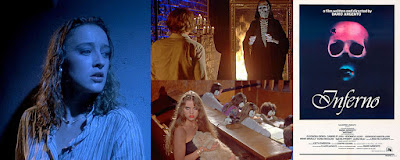
Inferno


Mother Nature

Inferno
Italy 1980 Directed by Dario Argento
20th Century Fox - Arrow Blu Ray Zone B


Warning: Some spoilers here.

Following on from the success of his phenomenal film Suspiria (reviewed by me here), the great Dario Argento made a movie with mostly American finance which, honestly, shouldn’t be overlooked as, like many of his films, it’s a truly beautiful looking picture. Also, it’s one of the few horror films in his CV (he mostly directed gialli) and it’s a direct sequel to Suspiria, being a second helping of the story of another of the Three Mothers (or Three Witches) who Daria Nicolodi and Dario Argento cribbed/were inspired to create from a few pages in Thomas De Quincey’s sequel essay to Confessions Of An English Opium Eater (and which is often bundled in with that book by publishers).

Now, the directing genius Mario Bava helped out Argento on this one on special effects although, I’m now hearing that while Argento was ill, Bava directed whole sequences and Irene Miracle says, according to a source, that Argento wasn’t on the set during her shoot for the film. Either way, I can’t start pulling this film apart and assigning scenes to who I thought might have directed different portions of it so, for me, this is an Argento film and it surely has some of the key features of Suspiria mixed in with it, such as the strong, vibrant colours pitched against each other in the lighting (which is admittedly a Mario Bava signature but it also very much came to be an Argento fingerprint on a lot of his movies too).

The plot is very thin, as you would expect form an Argento film and it’s just the principle protagonist, Mark played by Leigh McCloskey, wandering around Italy and then, for most of the picture, an apartment building in New York (home to Mater Tenebrarum, the Mother Of Darkness), trying to find his sister Rose, played by Miracle. That beings said, Argento films are never about the story or even the acting and this one is no exception. It’s all about atmosphere and the unbelievable visual feast of eye and ear candy that the director lavished on the senses of the audience.

The film lulls you in with Rose reading from a fictional book by the architect Varelli, talking about DeQuincey’s Three Mothers. Then, all of a sudden, the brilliant Keith Emerson score comes crashing in with the title of the film and then, as the credits continue on an angled shot of Rose from above, in a very slow zoom, the music stays strong and really pulls you in.

This one is very focused on Argento’s obsession with architecture and three quarters of the film are about moving the characters in small adventures around the New York building. The shot design is mesmerising stuff and, as he often does, Argento uses a lot of moving camera where he completely moves around the space without tearing apart the compositions as he goes, framing actors in portions of the screen in areas made by various horizontals and verticals of objects or architectural features of the sets. Indeed, there’s an elaborate sequence where Daria Nicolodi is watching Mark’s unconscious body being dragged across the floor from a window opposite and... it’s a gridded window so, of course, when the killer relaxes his grip on the body, Mark's head is perfectly framed in one of those small squares. This film shows Argento at the top of his game and I think it’s this period of his career, or his slightly earlier phase, that people think of when they recall the ‘golden age’ of this particular director’s output as an artist.

The use of various connections of acoustical egress and access via grills and ventilation shafts in the structure of the New York building does, of course, play to the director’s favourite modus operandi, as he moves the camera around cramped, interior crawlspaces to show the journey of a conversation. But, the real triumph of artifice over nature, which often highlights his work, is seen in a brilliant shot where a man simply gets out of an elevator and walks into a corridor. I remember the very first time I saw this movie, maybe 20 or more years ago, I had to backtrack on the DVD I was watching it on because I couldn’t work out why the man was holding his right leg at a funny angle in a quite unnatural pose as the doors open. However, when you look to the left of screen and see one of various windows which you see more of as the camera backs away from the angled shot to follow the progresss of the man down the corridor, you realise that those windows all have a very thin, black slanted separating line and the man’s leg, held at the same angle for a second or two, was a deliberate visual echo to the environment he finds himself in. Totally artificial, of course but, an interesting detail, none the less.

There are also references to earlier Argento ‘moments’, if that’s the right word, such as one of the killers (the film seems to have a few ‘agents’ of the Three Mothers) being reflected in the broken piece of a glass door handle, something which plays on Argento’s use of reflective surfaces up to that point. There are also things in this which I’m sure are references to other artists, such as the ants crawling on Mark’s hand in a scene which, although they actually do become a slight story point later on, I’m sure are there as a little visual homage to Dali and Bunuel’s Un Chien Andaleau.

Despite the vibrant colours in some of the film recalling Suspiria, this movie seems to have its own atmosphere to it, although the director does go out of his way, it seemed to me, to recall certain moments of the previous ‘installment’ in this as, almost a way of engaging the audience and giving them more of the same. There’s a scene with Sacha Pitoëff as a particularly unpleasant character, for example, where he is being picked off by rats in New York’s Central Park (which I believe was rebuilt in a studio in Italy, if memory serves) and a hot dog vendor who you assume is running to his aid but actually hacks away at his neck with a knife once he gets to him... which almost recalls the unexpected moment when the blind man gets killed by his own dog in Suspiria. Also, a lot of the dialogue in the movie sounds particularly childish, such as the deliberately child-like dialogue in the former film... which does no favours for the actors here, I’d have to say.

The very first time I watched this movie I was particularly unimpressed with Leigh McCloskey’s performance and thought he was a bad actor. Now that I watch it and, taking into consideration the dialogue and atmosphere of the thing, I realise that this must have been a quite deliberately minimal performance and it’s actually perfect for the film. McCloskey does a brilliant job here and, in a scene where he’s overwhelmed by the presence of the Third Mother (Mother Of Tears) in a music lesson in Rome, I realise now that his performance combined with the misé en scene and Ania Pieroni’s performance as Mater Lachrymarum... is a masterpiece of visual film making, no two ways about it. A sequence which absolutely transfers a sense of slow burn, oozing intensity onto the viewer. Really wonderful stuff. And, of course, Mark taking ill and also the exploding, burning building around him as he makes good his escape at the end, also recall similar moments from Suspiria.

Missed opportunities abound, of course, in terms of Ania Pieroni since she did not reprise her absolutely brilliant performance as Mater Lachrymarum in the third part of the trilogy made 27 years later... nor, indeed, in Luigi Cozzi’s closely related movie The Black Cat, nine years later. But she does a good job here in her two small scenes and she really adds to the film, I think.

Emerson’s music is one of those Argento scores which, at first, seems out of place and sometimes inappropriately placed... until you get used to it and realise just how outstanding it is. When his song Mater Tenebrarum kicks in (which is also nicely covered by Claudio Simonetti’s group Daemonia on a couple of their albums), it’s totally unexpected but absolutely fantastic and it feels like, rather than try and fit itself to the on screen action, the visuals are trying to keep up and fit themselves to the music... it’s quite an ear opener of a sequence, for sure.

And that’s me done, for the time being, with Argento’s Inferno, although this really is one of those films which a lover of cinema can never be completely done with... it’s something which I’m sure I’ll revisit many more times over the course of my life. Another Argento masterpiece and as great a contribution to horror cinema as you can get... it just looks so beautiful.

Sunday, 12 June 2016

Tenebre (aka Tenebrae)


Giallo Dolly

Tenebre (aka Tenebrae)
Italy 1982 Directed by Dario Argento
Synapse Dual Blu Ray DVD Zone A/Region 1 Steelbook


1982 was a really great year for movies. We got Star Trek II - The Wrath Of Khan (reviewed here), John Milius’ original Conan The Barbarian, John Carpenter’s The Thing adaptation and, my personal all-time favourite, Blade Runner (reviewed here). We also got what I think is one of director Dario Argento’s absolutely best movies... Tenebre (aka Tenebrae).

It’s been a while since I’ve watched the movie but it’s one of the two Argento films I saw back to back on TV a couple of decades ago and, notably, Tenebrae was still stupidly censored in our country. I’ll get to the ridiculousness of that particular cut a little later on but what it did, of course, was made me pursue all of Argento’s films on DVD, with the release of various uncut, good quality releases in their correct aspect ratios available in different countries and easily playable once I was armed with a low priced multi-region player from my local Tesco (the fact that you could also buy the original Buster Crabbe Flash Gordon serials on US DVD at the time was another big incentive to get myself multi-regioned up).

Now, with the appearance of Blu Ray, I can’t really re-buy all the 3000 plus movies I have on DVD again... especially when there are so many other previously unreleased movies still being unearthed around the globe. Argento, however, is one of the directors whose films I would at least be happy to upgrade ten or more of. So I leapt at the chance when I heard of this new US Synapse three disc dual format version of one of my favourites... primarily because the third disc is a remastered edition of Goblin’s classic score for the movie. That being said, they’re not allowed to be credited as Goblin on this film because the line up had slightly changed and there were some legal issues, I believe... so, to this day, the music is still credited to Simonetti-Morante-Pignatelli. It’s one of their greatest, however, and if you want to know what a “disco slasher” sounds like... this score is it. I’ll always remember those old vinyl soundtrack adverts on the back of Starlog magazine as a kid in the 1980s, with the lurid Tenebre cover of the girl’s head hanging down and the broken glass panel going through the back of her neck. It pretty much became an iconic image... once seen, never forgotten.

The film starts off with the fictional thriller novel of the title being read from (by Argento himself, if you choose to watch it with the Italian language track on) and the book is then thrown on a fire to be devoured by flames as Goblin’s (sorry... pseudo Goblin’s) score kicks in. We then follow a shoplifter played by Ania Pieroni, who had made an unforgettable appearance in a cameo as the third mother (The Mother Of Tears) in Argento’s previous film, the Suspiria sequel Inferno. Here she is pursued by her killer, represented voyeuristically with a following camera eye which is, possibly, overused as a visual prop in this movie but, frankly, is so stylishly done that I really don’t mind it here. There’s some absolutely beautiful moments in this early sequence with the camera stalking her with Argento’s keen eye watching her from behind a rack of goods in a shop, stopping and starting the movement in time as she is framed perfectly at every stop by a gap in the display shelf packaging. It’s just these kinds of sequences which keep me interested in Argento and the giallo format in general.

After getting herself into various bits of trouble with antagonistic forces of one kind or another, Pieroni is attacked by the black gloved killer, force fed pages of the fictional book Tenebrae (written by the lead character, Peter Neal) and then slashed to death with a straight razor. When we finally meet Peter Neal, played by Anthony Franciosa, who is visiting Italy to do a tour for his book, he is already being included in the investigation of this and other similar murders. Heading up the investigation is Detective Germani, played by the extraordinary Spaghetti Western star Giuliano Gemma and, in typical giallo fashion, he checks back in with the main protagonist, in this case Neal, who starts to get involved with his own investigation. As you would expect from this genre, the bodies start piling up and it’s not long before everyone you expected to be the killer is gradually murdered, leaving us with few people left in the cast who the antagonist could be.

Tenebre is somewhat overshadowed, I think, by the Bava drenched colours of the two Argento films that came before this one (Suspiria and Inferno) but I think it’s a much maligned movie in that respect, in that it’s easily one of the greatest of the gialli ever committed to celluloid. Contrary to the title of the piece, the film is all bright light with shiny, reflective surfaces and architectural details. Although the big city landscapes are quite blatantly modernistic, I think it’s often forgotten, or mostly completely overlooked, that the film was intended to be set in the near future. But whether people take that away from this or not... one thing for sure is that it’s one of the most hyper-real and typically outstanding giallo movies that Argento ever made.

For example, on a visual level, similar to the sequence I described with the tracking camera in the shop, Argento uses a lot of vertical lines to split up and separate different people into specific, multi-layered spaces... challenging or creating perspective as he captures his performers doing their thing. There’s a brilliant shot, for example, towards the end of the movie with Anthony Franciosa and Argento’s early muse Daria Nicolodi (the mother of their daughter, the actress and director Asia Argento) standing back to back, with Nicolodi in the foreground and Franciosa a little further away, where the two planes are artificially split by the vertical of the middle of the frame of a set of windows they are standing in front of. Absolutely incredible stuff.

Another celebrated shot is the one which starts off outside the window of a lady's apartment looking in, travels in close up around the building a bit, enters her lover’s room upstairs through another window, comes back out again and goes “around the houses”, so to speak, before ending up back down in the original woman’s room. This is a prelude to a brilliant double murder, committed against the two lesbian lovers, with some breathtaking shots including a razor blade slicing a big hole in a t-shirt to reveal the face of the girl who is in the process of putting it on... and the celebrated ‘head through the glass panel’ shot I mentioned from the old vinyl album cover earlier on. And there’s an exceptional shot of a straight razor striking the side of a lightbulb to shatter and extinguish it which really does stick in your mind long after the film is over.

There's a truly great visual flourish at the end of the movie which certainly shows Argento's influence on his contemporaries and the rich visual legacy the next generation of film-makers have in their arsenal. A character in the centre of the shot bends down to inspect a possible clue and the killer is revealed behind him taking up the exact same visual space. When the character stands up again, his head replaces the head of the kiler in the shot exactly, once more. I think you'll find that this exact same shot set up is recreated by Brian De Palma in, I think, Raising Cain, if my memory is working properly.  So clearly an influential director... of that there can be no doubt.

In typical genre fashion, any number of characters are built up as possibly being the murderer but, like all good gialli, your suspicions are shifted constantly the more you watch (and, as I said before, the more your suspects end up as just another gory death for the killer’s roving, camera eye). However, Argento also does something quite clever in terms of the final solution of the puzzle of just who the killer is in this one but... I really don’t want to spoil the chance that you might figure it out for yourself, if you’ve never seen this movie before. But, yeah, it’s a typical example of the genre in that Argento manages to subtly, and often not so subtly, set up pretty much almost everyone in the film to possibly be the killer.

It’s also a film where Argento gets to poke fun at his critics too, which is kinda nice. He took a lot of flack in the 70s and 80s for being a misogynistic director but the arguments for that have always seemed quite false to me. For instance, there are almost as many men being killed off in imaginatively gory ways in his films as their are women. Also, giallo movies are abundant with both female killers and strong women who survive to the end of the movie as the ‘final girl’ trope of many horror movies. I don’t think you can call that particularly disempowering or hateful, to be honest.

This also has, as far as I’m concerned, the best script of any of Argento’s movies in terms of credible dialogue and Argento uses it quite well in one particular line, where he argues exactly in opposition to the myth that somebody who makes violent art is a violent person. The line comes from the Peter Neal character in the movie, whose books are being used by the killer as a justification for his own actions... at least in the first half of the film. Frankly, we are all living in a real life world where a notorious serial killer was inspired in his killing by the George Lucas movie Star Wars Episode VI - Return Of The Jedi... so any argument that giallo or horror films are a catalyst due to their content dies with that reality, as far as I’m concerned. The line itself, spoken to the police inspector is “If you find someone killed with a Smith and Wesson revolver, do you go and interview the president of Smith and Wesson?” This is a fair point, I think, and definitely raises the question of whether the manufacturer, or the artist in this analogy, should be held responsible for the way people choose to respond or react to their product or art.

There’s also a particularly comical moment in this one where John Saxon, who has hilariously demonstrated in an earlier scene that his new hat doesn’t fall off, finally gets caught up in a particular incident where his headwear heads to the floor and this involves the death of one of the male characters (I’m being cagey here about the identity of that character because I really don’t want to give anything away to people who haven’t seen this movie yet). But these kinds of little details and clues in the script are what help make Tenebre one of the absolutely greatest and credible of the films made in the giallo genre and for me. It stands the test of time with other classic Argento gialli such as Deep Red (aka Profondo Rosso, reviewed here), The Bird With The Crystal Plumage and Four Flies On Grey Velvet.

The film is presented uncut and the UK version is also uncut, nowadays. This main censored scene in previous UK versions featured the actress Veronica Lario, who went on to notoriously marry Silvio Berlusconi at one point in her life. Here, she is waiting with a gun in her hand when an axe comes through the window and severs her arm halfway up, above the wrist. She then gets up and paints the clinically white walls red with the arterial spray of her blood. The comical thing about some of the previous, censored versions, is that the BBFC in our country (for example) decided that the actual axe going down into the arm, which is relatively tame compared to the aftermath, was excised from prints but... the truly ostentatious goriness of the moments following, were always left completely in tact. How insane is that? Just another odd thing to show that censors were really bizarre when it came to doing what they saw as their job.

The disc itself sports a lovely transfer of the film and includes several extras including a feature length documentary on the history of the screen giallo, with maybe just a little over emphasis on Argento’s huge contribution towards popularising the format himself. The documentary includes comments from a number of genre experts (one of whom I wish wasn’t included in this film as an expert of this particular subject, for reasons I won’t go into here) and it’s great to see such brilliant testimony from such cool people as Alan Jones, Maitland McDonagh, Kim Newman and a variety of writers and directors of these kinds of films too. I do wish, though, that people would stop holding up Michelangelo Antonioni’s Blow Up as an example of a giallo film in order to somehow legitimise the genre to people unfamiliar with it, to be honest. I really can’t see how Blow Up, wonderful as it is, could ever be considered a giallo, bearing in mind how many of the genres tropes and intents it fails to demonstrate. Also, the music that plays throughout the majority of the documentary is also from the main feature presented here. Not particularly surprising, given the expense of music rights, but still something which might have been better served with a decent mixture of Morricone and Cipriani mixed in with the Goblin, methinks. But this is a minor criticism of a great little US Blu Ray set of this film.

If you’ve never seen Tenebre and you are a fan of the genre then this is a near perfect giallo and, also, an absolutely brilliant jumping on point if you’ve never seen one of these movies before. An incredibly beautiful film to look at with traditionally clunky but ‘still much more credible dialogue than most gialli and with some just jaw droppingly stunning set pieces in places. Definitely something everyone into Italian film should see at some point. No wonder Dario Argento is still thought, rightly so, as the master of his craft.